



Abstract
Democratic participation is widely viewed as a crucial underpinning of legitimate governance; however, little is known about how this participation is practically accomplished. This study contributes to a better understanding of what democratic citizenship encompasses in actual practices of public engagement. Using conversation analysis and discursive psychology, we analyze interactions between government officials and citizens in Dutch public meetings on the effects of livestock farming. We examine situations where citizens treat officials’ closing-implicative moves as “wanting to shelve” issues. We demonstrate how this uptake is preceded by officials treating citizens as not understanding what is within the scope of discussion, thereby challenging their democratic competence. Citizens subsequently turn the tables on the officials, treating them as not wanting to fulfill their democratic duties. We argue that these practices point to broader relational issues between government and citizens, transforming what seem mere agenda issues into negotiations about what constitutes good democracy.
Keywords
Public meetings are rooted within democratic traditions, addressing the call for more understanding and collaboration between governments and citizens (see Buttny and Cohen, 2015). Social and political psychologists have thus far mainly dealt with more overarching questions related to democratic subjectivity, such as the values or motivations underlying political attitudes (e.g., Barnea and Schwartz, 1998; Jost, 2017; Wheeler, 2021). The current study follows language and social interaction scholars who add a new dimension to social psychological work on democratic citizenship by approaching democracy and its management as a live issue. Drawing on a dataset of audio and video recordings of Dutch public meetings where government officials, experts, local residents and farmers discuss the effects of livestock farming in the area, we use conversation analysis (Sidnell & Stivers, 2013) and discursive psychology (Wiggins & Potter, 2017) to unravel the intricacies of everyday democracy. In particular, we analyze the negotiations between officials and citizens about what falls within the legitimate domains of discussion at that particular place or moment.
Democratic Citizenship: Different Approaches
The Social Psychology of Democratic Citizenship
Starting with Allport's (1945) acknowledgement of the importance of democratic participation and psychologists’ role in advancing citizen participation, social psychologists have investigated a range of cognitive and behavioral aspects of democratic citizenship, such as the psychological underpinnings of political conviction or orientations toward political life (e.g., Caprara et al., 2006; Crawford, 2014; Jost, 2017; Sinnott and Rabin, 2021), or individuals’ beliefs, values, or attitudes regarding civic engagement (e.g., Lin, 2019; Neufeind et al., 2014). According to Rose (1996), many of social psychology's main preoccupations such as attitudes (see e.g., Eagly and Chaiken, 1993), social identity (see e.g., Tajfel and Turner, 1979) and group-level behavior and group dynamics (see e.g., Hogg and Turner, 1987) have a close relationship with concerns regarding democratic citizenship in contemporary societies.
Whereas these reflections suggest a close connection between “psychology” and “citizenship,” social psychological work directly addressing (democratic) citizenship has, however, remained absent (Andreouli, 2019). As Condor (2011) argued, this is remarkable since longstanding social psychological interests and concepts, such as quality of life, intergroup conflict, self-regulation and social cohesion, are intimately linked with citizenship as a construct. The concept of citizenship can be valuable to social psychologists aiming to explore the difficulties citizens face when occupied with issues of democracy and politics, since a better understanding of what moves citizens requires a close examination of the experiences that engage them (Andreouli, 2019). Another tradition within social psychology therefore takes citizens’ everyday reasoning and claim-making regarding democratic or political matters as a point of departure (e.g., Anderson and Gibson, 2020; Barnes et al., 2004; Condor, 2011; Haste, 2004), identifying, for instance, under what circumstances citizens treat political inactivity as legitimate (Condor & Gibson, 2007) or the ways individuals define social recognition and the practices of naturalization that may threaten the feeling of being recognized (Andreouli & Howarth, 2013). Nevertheless, to date, social psychological work on citizenship has commonly examined bottom-up everyday citizenship and formal state practices of the construction of citizenship separately. What remains unaddressed are the actual occasions where citizens and governments meet, giving insights into the ways officials and citizens collaboratively construct democracy and democratic citizenship in real life. Research in the language and social interaction tradition presents a new aspect to social psychological work on political and democratic subjectivity by focusing on “ordinary democracy” (Tracy, 2010): the real-life practices occurring within local-level public meetings.
“Ordinary Democracy”: The Interactional Negotiation of Participation and Control
Language and social interaction (LSI) scholars have shifted attention from the psychological processes of civic participation to empirical examinations of how democracy and democratic practice get established in situ, when citizens and governments communicate (Buttny & Cohen, 2015; Leighter et al., 2009). Overall, a focus on the real-life interactions within public meetings shows that the multiparty character of these meetings, where several individuals may wish to speak at the same time (Mondada et al., 2017), results in a specific deontic configuration in which turn allocation and organization and the controlling of topics typically depend on institutional actors such as officials (Buttny & Cohen, 2015; Heath & Mondada, 2019). Consequently, officials and citizens in public meetings “begin with different capacities to manipulate the tacit procedures and architecture of talk,” where access to such procedures “is a significant resource for accomplishing power in face-to-face interaction” (Molotch & Boden, 1985, p. 285). In this regard, officials’ power to set the agenda in public meetings has been well documented as they may, for instance, “cut off” discussions or grant permission to or disallow audience members to speak (e.g., Boholm, 2008; Buttny, 2010).
On their part, citizens are not necessarily “passive accepters” of the meeting's organization. Citizens may, for instance, hold routine conversational procedures “hostage” (cf. Molotch and Boden, 1985) through persistent questioning of experts, denying them “permission” to proceed (Van Burgsteden & Te Molder, 2021). Moreover, citizens may resist the officials’ agenda by taking more than one turn or heckling the authorities’ speech (Boholm, 2008; Davies, 2011; Llewellyn, 2005). Furthermore, citizens’ claims of expertise may challenge the binary distinctions between “laymen” and “experts” (Sprain & Reinig, 2017) and their use of metadiscourse (Buttny, 2010; Leighter & Black, 2010) may enable them to raise issues for further discussion.
Consequently, public meetings’ frames and their institutional arrangements have been said to be “constantly under negotiation” (Davies, 2011, p. 74); specifically, “a locally managed, rhetorically situated negotiation, located in the practical politics of everyday life” (Potter & Hepburn, 2007, p. 187). The current study adds to these insights by exploring how officials’ moves to closing a subject and citizens’ subsequent resistance to those moves, reveal participants’ orientations to, and management of, “democratic competence.”
The Intertwinement of Gatekeeping and Democratic Competence
Meeting organizers have the rights and responsibilities to safeguard the occasion's progressive and topical continuity. Organizers thereby act as “gatekeepers” (Corra & Willer, 2002), being in the position to control those elements of the meetings that are typically valued by citizens such as speaking time or what subjects are put up for discussion (cf. Potter and Hepburn, 2007). The current study focuses on “gatekeeping in action” (Clayman & Reisner, 1998), with officials restricting or preventing certain discussions, and citizens’ subsequent challenges of these moves.
Political scientists and social scientists more widely have since long acknowledged that opinions, values and customs have varying levels of legitimacy in society, depending on factors such as culture, legal authorization, or mainstream support or consensus. The “Overton window,” named after its founder Joseph Overton, refers to the spectrum of views tolerated in public discourse (Lehman, 2010). Views or subjects falling inside the “window” are considered debatable within a given society. Things that fall outside the “window” are issues that are regarded as broadly supported and thus beyond debate, such as “motherhood and apple pie” (Hallin, 1984) or issues that are treated as illegitimate and beyond debate, such as “America shouldn’t be a democracy.” Over time, the window can be shifted, however (cf. Clayman, 2017), and the legitimacy of a position or subject (e.g., gun control or gay marriage) can move from one side of the Overton window (e.g., being cast as beyond the pale) to the other (e.g., being cast as legitimate).
In our materials, officials claim that certain issues have already been discussed or that it is not the right time to discuss them, rather than stating that some topics should not be discussed because they are beyond debate. Thus, in the situations we address, officials invoke procedural bases for shaping the political debate. In their study of how professionals invoke procedure to set the frame for the interaction, Nielsen et al. (2012) show that chairs in meetings may close certain topics by explaining how the interaction should proceed. They thereby confirm an asymmetry in knowledge and entitlement with the other attendees, and orient to other participants’ “procedural membership competence” as not (yet) being sufficient. Likewise, the current study shows how, by relying on procedure, officials treat citizens as if they do not understand what the democratic procedures in a given assembly consist of, highlighting their lack of competence in this regard. Citizens subsequently turn the tables on the officials by treating them as not wanting to talk about matters that are clearly important to them.
While known within political theory, the term “democratic competence” (Bennett, 1988; Shapiro & Bloch-Elkon, 2008) refers to cognitive notions of having political knowledge that reflect the actual state of affairs, of genuinely being attentive to political issues and being rational, all to enable (what is defined as) informed participation in the political process. The current study diverts from this cognitive approach by exploring participants’ own orientations to being democratically competent, during real-time interactions.
Context and Method
This study focuses on public meetings regarding livestock farming in the Netherlands. Despite its apparent (economic) success, the Dutch livestock sector is highly contested. Public discussions on livestock farming have addressed issues such as landscape impairment, the environment and health risks, resulting in protests against expansions or new establishments of farms (Breeman et al., 2013).
Attending public meetings has been regarded as a typical American way of “doing democracy” (Tracy & Hughes, 2014). Since the USA is a populist democracy, citizens have a bigger role in public meetings than in most European countries where deliberation is predominantly restricted to elected and appointed officials (Tracy, 2014). Nonetheless, with the 2007 Lisbon-Treaty, participatory democracy has become an integral part of the EU, targeting the improvement of its democratic legitimacy (Marxsen, 2015). In the Netherlands, citizens’ self-responsibility has increasingly been stressed and the Dutch state is often referred to as a “participation society” (Dekker, 2019) in which public meetings and workshops constitute conventional participation practices (Uittenbroek et al., 2019).
Our data consist of six recorded public meetings on livestock farming (total duration: approximately 11.5 h), held between 2011–2019 in the Netherlands (Table 1).
Overview of Recorded Public Meetings.
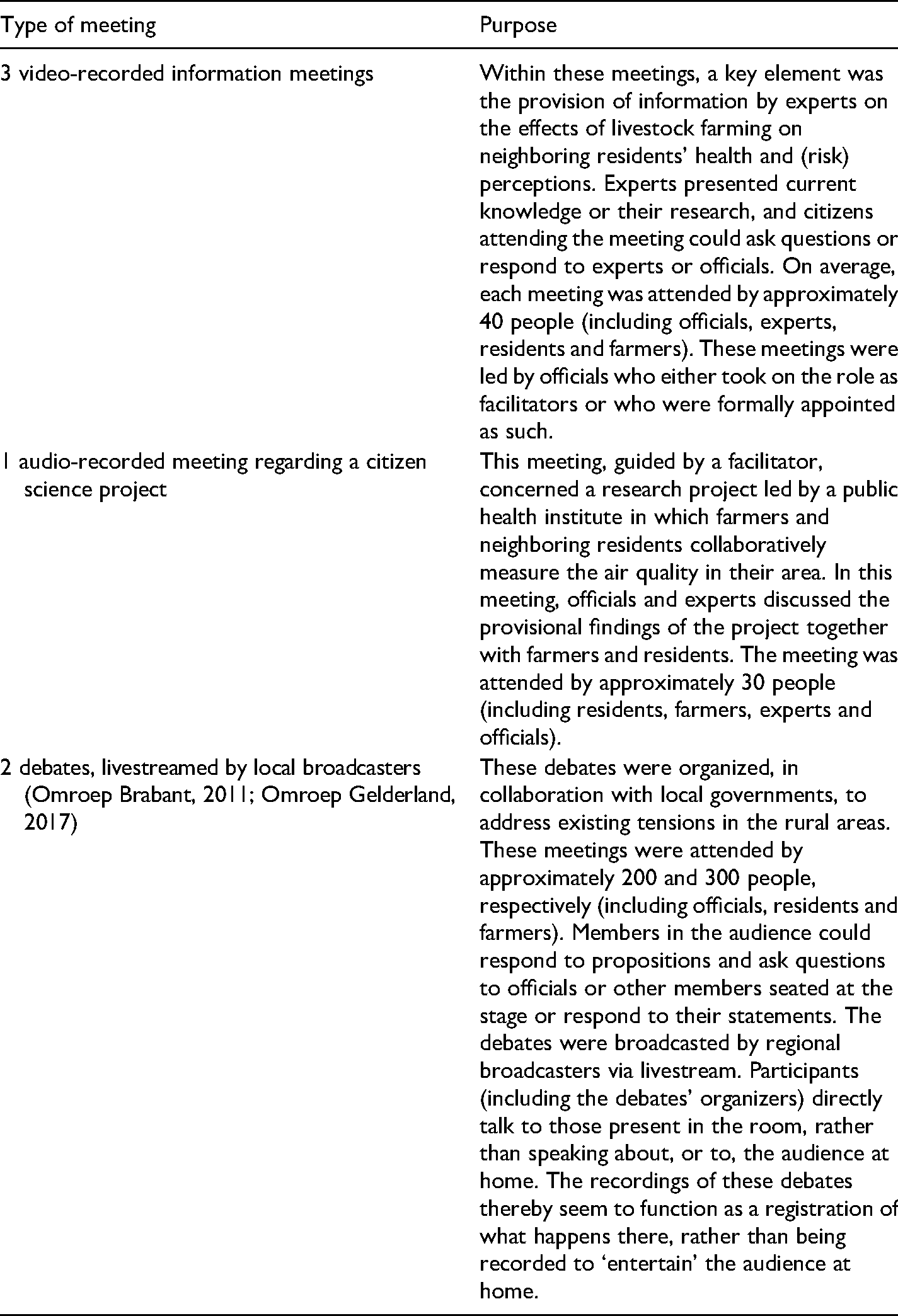
The research was approved by two stated Research Ethics Committees: The Social Sciences Ethics Committee of Wageningen University and Research and the Ethical Review Committee of Vrije Universiteit Amsterdam. Participants consented to participation in our research prior to the meetings. Concerning the livestreamed debates, we obtained approval from the broadcasters to use these meetings for our research. All recordings were transcribed using Jefferson's (2004) transcription system, which captures details of interaction such as phonetic, prosodic and embodied elements. We anonymized the transcripts by replacing identity-related information with pseudonyms. We translated the transcripts to English as literally as possible and sometimes made practical concessions to ensure the translation's readability.
We combine the methods of conversation analysis and discursive psychology. These methods are highly compatible, as they both are inductive methods for analyzing what interlocutors make available and observable through their talk and how they show their understanding of each other. Discursive psychology's distinguishing feature is its focus on how speakers invoke and make relevant psychological constructs in interaction (Wiggins & Potter, 2017). Following these frameworks, our analyses are grounded in the turn-by-turn development of the interactions, focusing on the actions achieved by participants, the design of their turns and the sequences of turns through which actions and activities get realized (Sidnell & Stivers, 2013).
While attending one of the meetings, the lead author witnessed a situation where a resident claimed to have been put “on hold” after an official attempted to close the topic he just raised. Both authors observed a similar situation when analyzing another recorded meeting. Because an apparently procedural aspect of the gathering invoked citizen displays of moral indignation (cf. Drew, 1998) and the apparent need for officials to instantly remedy the case, these situations were marked as interesting for further analysis. The recordings and accompanying transcripts were examined to look for situations where citizens explicitly challenged officials’ closing moves, resulting in a collection of 14 cases. Since we investigated the situations for exhibiting a normative order in their own right, instead of considering them as a subset of the larger set of responses to closing moves, we excluded (tacit) alignment with officials’ closings and indirect opposition by continuing talking (Schegloff, 2007). We adopted an iterative analytical procedure, which entailed multiple rounds of analysis where individual instances were examined, also in view of their common features. As presented in this article, the ways citizens explicitly challenge closing-implicative actions vary and so they cannot be considered one practice. However, the overall action is similar: citizens treat officials’ closing-implicative actions as deliberate avoidance of discussion.
Analysis
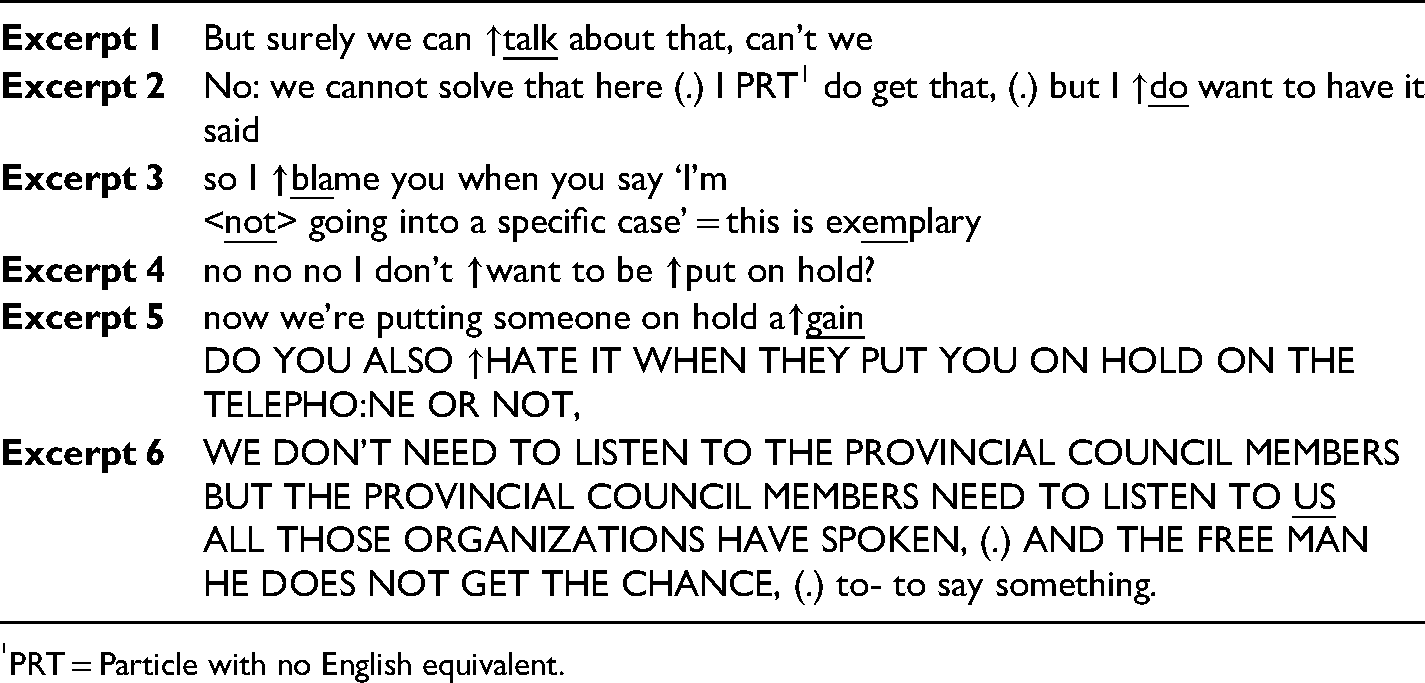
In the following, we scrutinize how and to what interactional purposes citizens challenge officials’ gatekeeping efforts. We will show that officials in all situations treat the introduced issues as “out-of-bounds,” but they do so in different ways. That is, the grounds officials offer for closing the issue differ across these cases (e.g., they pose that the meeting is not the appropriate place to discuss this versus they claim that the issue has already been discussed sufficiently). In focusing on the ways officials “close the gate” by invoking procedure, and citizens seek to “open the gate back up,” we reveal how democratic competence, as one's understanding of what lies within the legitimate boundaries of discussion in this venue, is oriented to and treated as an accountable matter by participants. Table 2 shows an overview of the forms of resistance by citizens, which will be discussed in the following paragraphs.
Citizens’ Treatment of Closing Moves as “Shelving.”
PRT = Particle with no English equivalent.
While taking different syntactic forms (interrogative, declarative and imperative), as we show and argue, citizens’ challenges all initiate negotiations on participants’ rights and understanding regarding what matters can and should be discussed. As we demonstrate, whatever the format of the challenge, officials’ responses are indicative of the accusations these challenges embody: Officials remediate the challenge by clarifying their actions and/or acknowledging citizens’ claims.
Patrolling and Defending the Boundaries of Democratic Discussion in Public Meetings
Excerpt 1 comes from an information meeting regarding the potential expansion of a goat farm. Here, experts provide information on livestock farming and its effects on human health, and answer questions of residents in attendance. The excerpt shows how the meeting's facilitator suggests suspending a discussion that has failed to yield agreement. It reveals how the facilitator treats the issue as already having been established within the meeting, moving to closing the subject. However, his explanation casts the resident introducing the issue as having insufficient knowledge of what has already been spelt out regarding government activities, which the resident resists by treating the facilitator as avoiding discussion of the issue.
First, the facilitator intervenes in a long dispute between Nick, a resident, and Marc, an expert. The resident argued that the local government does not take care of psychosocial issues caused by farming, whereas the expert argued that they do take care of these matters (omitted from transcript). After providing a summary of the prior discussion (omitted), the facilitator returns to some prior statements from public health officials in the meeting (“the ladies,” line 1) and reiterates what has already been established within the meeting (lines 1–13). He thereby casts the resident's objection as in some way formed on the basis of insufficient understanding of government operations, thereby laying the ground for closing the subject. The facilitator concludes by formally assigning the matter to the municipality (lines 11–13), after which the issue can be taken off the table. The resident treats this move as evasive (line 16).
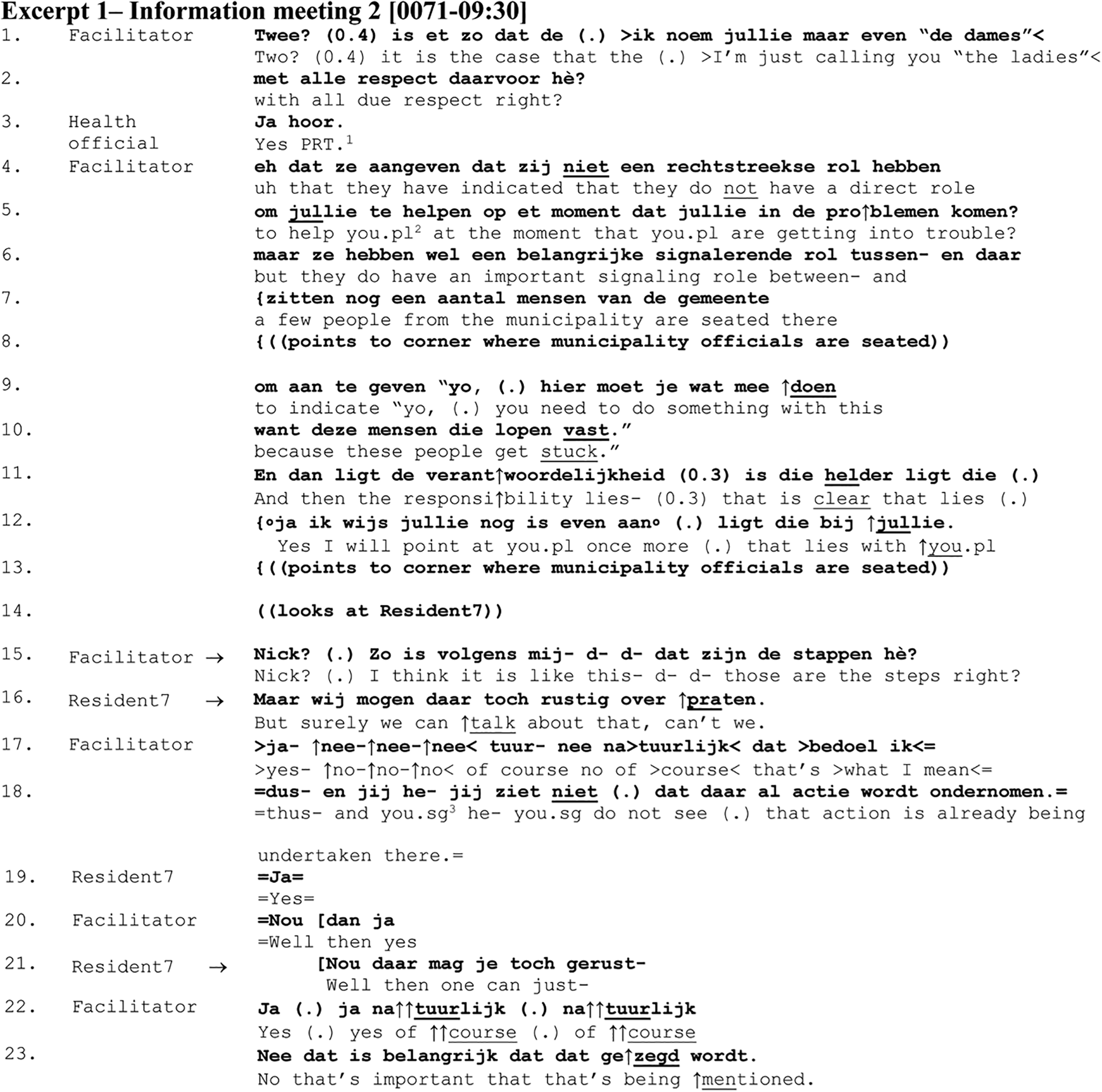
The facilitator requests the resident (Nick) to confirm the conclusion (line 15). Yet, the resident's response disattends the essence of the facilitator's turn (cf. Clift and Pino, 2020) and instead raises another issue. By asking “but surely we can ↑talk about that, can’t we” (line 16), he suggests that the facilitator aims for the opposite, namely, making things “unsayable.” As the question is tilted towards a confirming response (Heritage & Raymond, 2012) and includes a reference to what is self-evidently allowed (“surely”), the resident simultaneously claims the right to discuss the matter (nevertheless). We can now begin to see how the tables are turned on the facilitator. The resident conveys that this is not a matter of him not understanding what can be discussed here, but rather of the facilitator wanting to stifle debate.
Throughout his response, the facilitator is oriented to the accusatory nature of the resident's turn. First, he poses the issue as a misunderstanding (line 17), and, at a faster pace, responds with the multiple saying “>yes-↑no-↑no-↑no<” (Stivers, 2004), suggesting that the resident should halt his course of action. Through his use of “of course” (Stivers, 2011), the facilitator displays that the resident's question is “unaskable,” implying that the alternative (i.e., they cannot talk about this) is unimaginable, which is also reflected in line 18 where the facilitator treats the resident's question as “inapplicable.” Moreover, the beginning of the facilitator's response (line 17) is spoken at a higher pitch. Using high pitch, the facilitator displays being upset and claims innocence (Hayashi et al., 2012). Although the facilitator acknowledges the resident's points, the resident again hints at the facilitator having closed a legitimately discussable issue (line 21). The facilitator once more confirms that the possibility to discuss the issue is self-evident and emphasizes the issue's importance (lines 22-23). Thus, throughout the excerpt, the ways the facilitator deals with the challenge serve to contradict any alternative, motivational grounds that might be presumed (cf. Edwards and Fasulo, 2006) and suggest resetting the terms of engagement.
The next excerpt (Excerpt 2), from the same meeting as the previous excerpt, reveals a similar pattern of challenging a closing move, where one of the residents claims that the closing is not about him not understanding the meeting's requirements, but rather about the other's unwillingness to discuss his issue. In this situation, the issue raised by the resident is treated as a political issue and for that reason, non-discussable. We show how the facilitator's explanation of the meeting's modus operandi is used as a means to close the subject. The resident resists this move by treating the facilitator as avoiding discussion, thereby making explicit that he does understand these procedures.
First, the resident indicates his disapproval of the government's treatment of Q-fever victims, a disease transmitted from goats to human beings. He clearly judges the compensation of farmers rather than patients, thereby explicitly addressing a goat farmer attending the meeting (lines 8–12). His display of moral indignation (Drew, 1998) and use of extreme case formulations (“extremely,” Pomerantz, 1986), index the experienced gravity of the government's actions (lines 6–7).
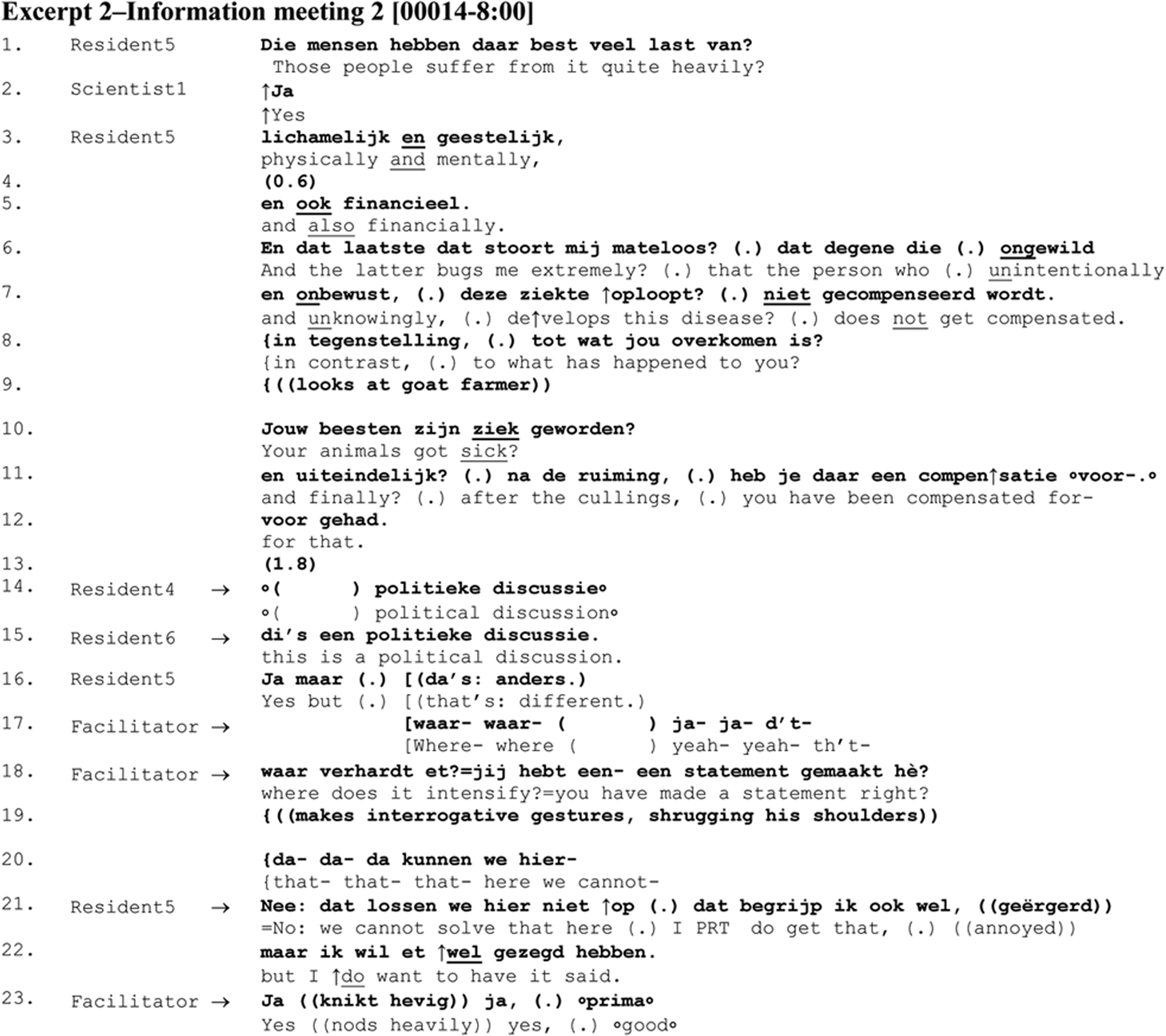
By framing the resident's contributions as a “political discussion” (lines 14–15), two other residents suggest that contributions should be “neutral,” treating the resident's input as (political and thus) off-topic. The facilitator's “where does it intensify” (line 18) builds on these turns and moves towards closing the issue, by indicating the line must be drawn with more drastic “political” decisions, irrelevant for the current setting. He states that the resident “has made a statement,” and “here we cannot…” (“solve that,” line 20), explicating what the meeting is (not) about and treating the resident as not understanding this (cf. Nielsen et al., 2012).
The resident pushes back by suggesting it is the facilitator who does not understand the resident's line of action: He was not concerned with solving the matter; rather, he (merely) wanted to “have it said” (line 22). This is also manifested by the double insertion of “wel” (“do”) in his turn (Hogeweg, 2009). His first use of “wel” (line 21) serves to counter the assumption invoked in the facilitator's turn that he does not understand that the issue cannot be solved here. The “wel” in line 22 indicates a difference between two activity types touched upon in the interaction. Concretely, the resident rebuts the suggestion that he introduced this issue to have it solved, by explicating he was engaged in another activity: he (only) wanted to mention the problem. He thereby departs from the substance of the facilitator's turn and instead addresses its sanctionable character (cf. Clift and Pino, 2020): “You may not want me to say these things, but I have a right to say them.” This presents the facilitator with the choice to either align with the resident's turn by, for instance, treating it as sensible and/or genuine, or to disalign with it by, for instance, treating it as inappropriate and/or absurd. As in Excerpt 1, the resident's challenge gets a remedial action in response: The facilitator nods heavily, thereby showing affiliation and acknowledging the resident's wish to hear what he said (line 23).
The next excerpts, 3A-C, are derived from a debate (Omroep Brabant, 2011), and show how a provincial official closes an issue by invoking a rule associated with debate, namely that the discussion of specific cases is “out-of-place.” By moving the discussion towards more general (“substantive”) issues and rejecting the idea that (political) decisions about concrete cases can or should be taken on this occasion, the provincial authority conveys that he participates in the debate as an expert, rather than as a decision-making official. By contrast, the residents approach the provincial authority in his role as (political) decision-maker, suggesting that specific cases may at the same time be more generic in nature and should therefore still be discussed.
The first of these excerpts, 3A, starts with a resident addressing the provincial executive member. He voices his objections to decisions made by the official and to current regulations around farm expansions.
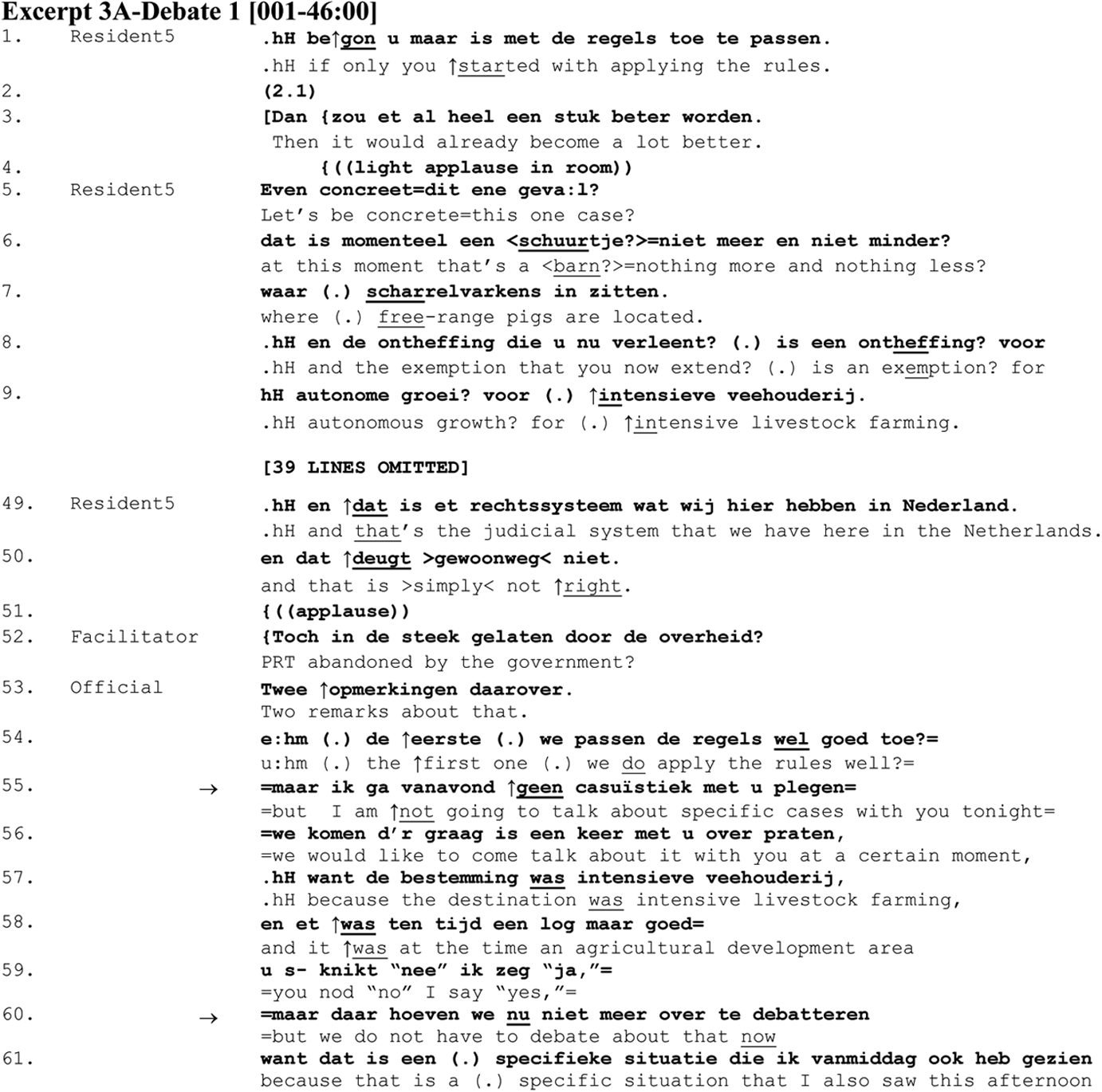
The official responds by asserting information. He rebuts the claim in the resident's turn by stating that they do administer the regulations correctly (line 54) and by providing particulars on laws regarding spatial zones (lines 57–59), he indexes his superior epistemic authority in the domain of government operations. By explaining how the interaction should proceed (lines 55, 60-61), the official treats the resident as not (yet) being a “competent member of the specific context” (Nielsen et al., 2012, p. 1471). In so doing, the official closes the issue. Nevertheless, the official makes a distinction between the occasion's demands and his willingness: By stating that they “would like to come to talk about it at a certain moment” (line 56), he displays a willingness to discuss the matter later. His subsequent turns, however, reveal he would use such an occasion to be proven right (lines 57–59).
Later (Excerpt 3B), another resident challenges the official's closing efforts by holding him accountable for not wanting to address “individual cases” (lines 311–316). Her challenge comes approximately 15 minutes later in the conversation. This pertains to the turn-taking system in debates, which may not allow for a next turn to directly follow an endeavor to close a topic and may entail that the challenge occurs somewhat later.
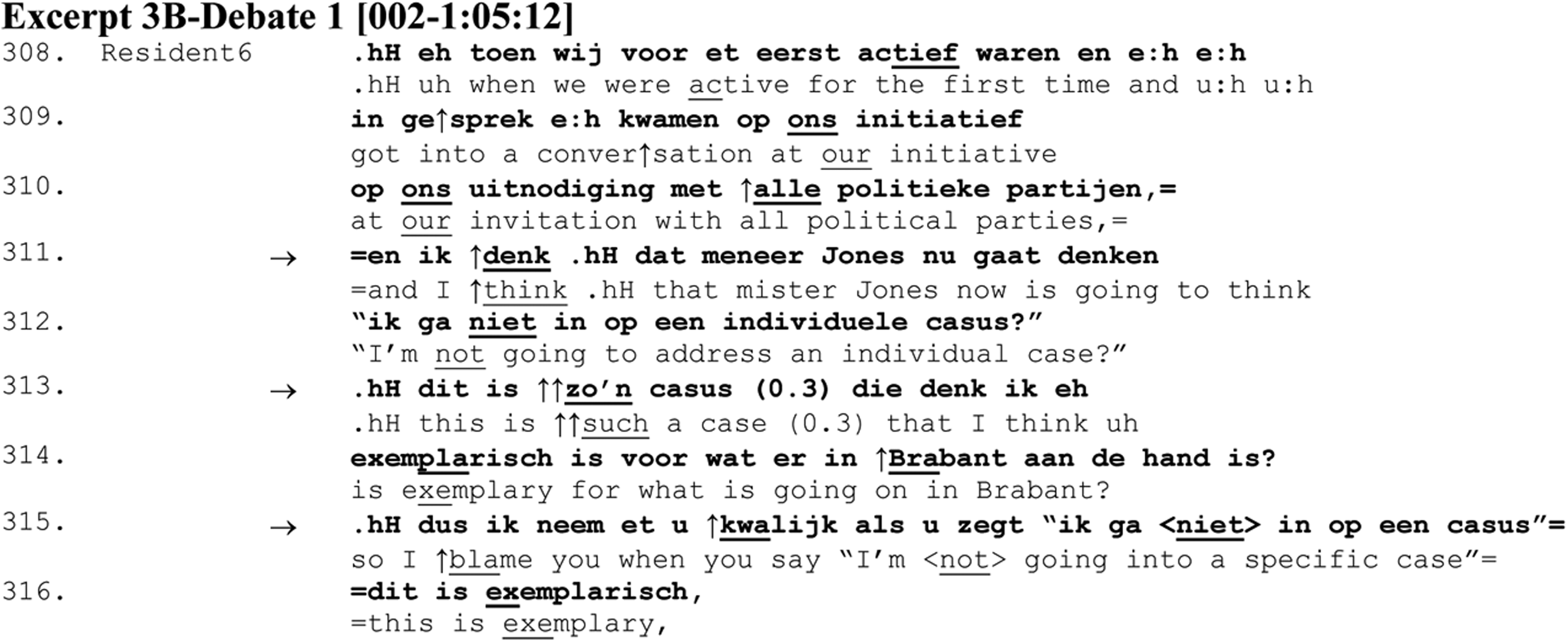
The resident returns to the official's closing attempt (see 3A) by repeating his statement that he is “ <
In response, the official immediately starts defending himself and directly engages with the accusation that the resident's turn embodies (lines 339–344):
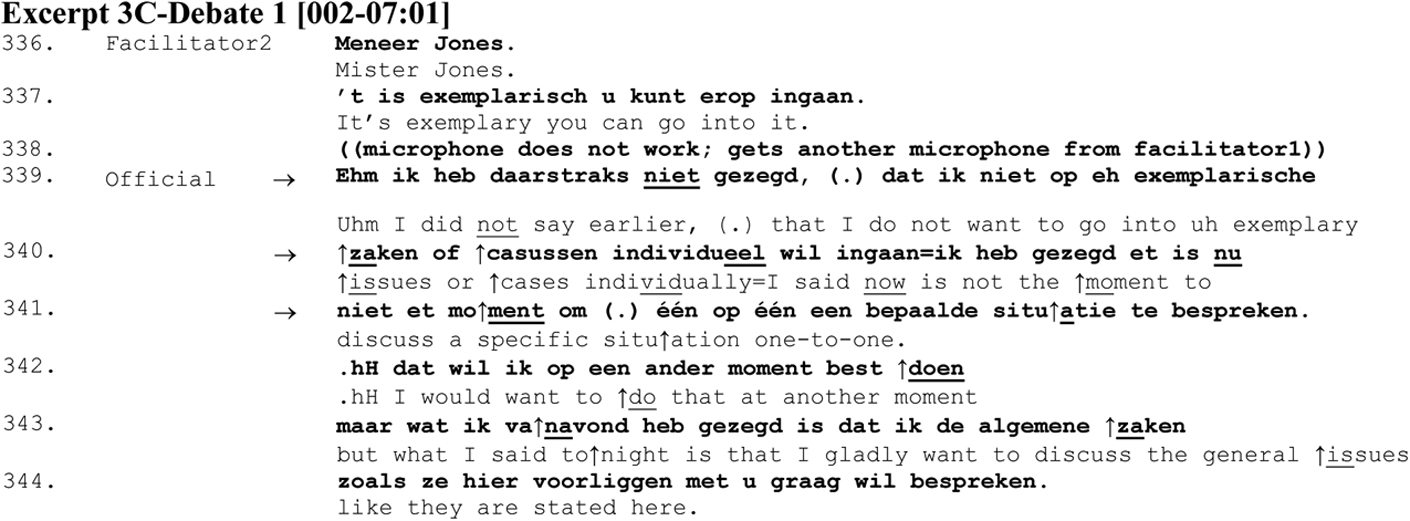
By stating that he “did
Summary. This section revealed situations where citizens treated officials’ moves towards closing a topic as “shelving issues.” We showed how officials’ explanations of the meeting's procedures or what has already been established may be used to close a discussion. Such explanatory moves, however, may cast citizens as lacking the competence for participating in this democratic occasion (cf. Nielsen et al., 2012), as becomes clear in citizens’ subsequent challenges of these moves. Citizens oppose officials’ actions by treating them as evasive. It is not they who hinder democratic activity through a lack of understanding of the rules, but the officials, who fail to address the issues raised by the citizens. Citizens thereby turn the tables on officials and invoke their rights to determine the agenda. Officials respond to citizens’ turns with remedial actions, showing an orientation to the accusatory nature of citizens’ turns.
The Last Resort: Publicly Denouncing “Shelving” as a Hallmark of Government Action
In this section, we show situations where citizens’ challenges of officials’ closing moves reach a high point, in that their challenges are used as a last resort when they are not successful in getting their issue on the agenda. In these examples, the challenges are part of a series of moves by which citizens repeatedly placed their issue within the boundaries of the permissible and officials just as persistently treated the issue as not relevant for the here-and-now. Thus, in these situations officials are seeking to preempt the introduction of a subject altogether. Compared to the cases in the prior section, these examples reveal sharpened positions where officials get publicly sanctioned for not addressing citizens’ issues. That is, citizens portray officials’ “shelving of issues” as a recognizable and characteristic act of (bad) governance, thereby inviting recognition and approval with their audience. These cases show how citizens more explicitly seize the opportunity to pillory officials, evidenced by details of talk such as the speakers’ louder tone of voice and/or speakers’ indications that officials’ actions are harming them personally. Moreover, members in the audience become involved in the “gatekeeping conflict” when they start laughing or applauding along with the speaker.
For instance, officials may characterize the matter that was introduced as beyond the meeting's scope, whereas citizens may repeatedly resist these moves by indicating that the issue does “belong.” See Excerpt 4, from a meeting where a scientist from a public health institute presents the results of a survey on how municipality residents experience their living environment. The excerpt starts with a resident displaying disgruntlement about the large-scale livestock operations, pointing to nuisances caused by farmers who do not deliver many benefits for Dutch citizens, considering most of the meat is exported. The official displays anticipation of an (“in-depth”) discussion of the issue raised, which characterizes it as both familiar and potentially comprehensive, thereby providing an explanation for her interruption (line 4). This interruption is met with resistance by the resident (line 6), which results in a discussion between the official and resident.
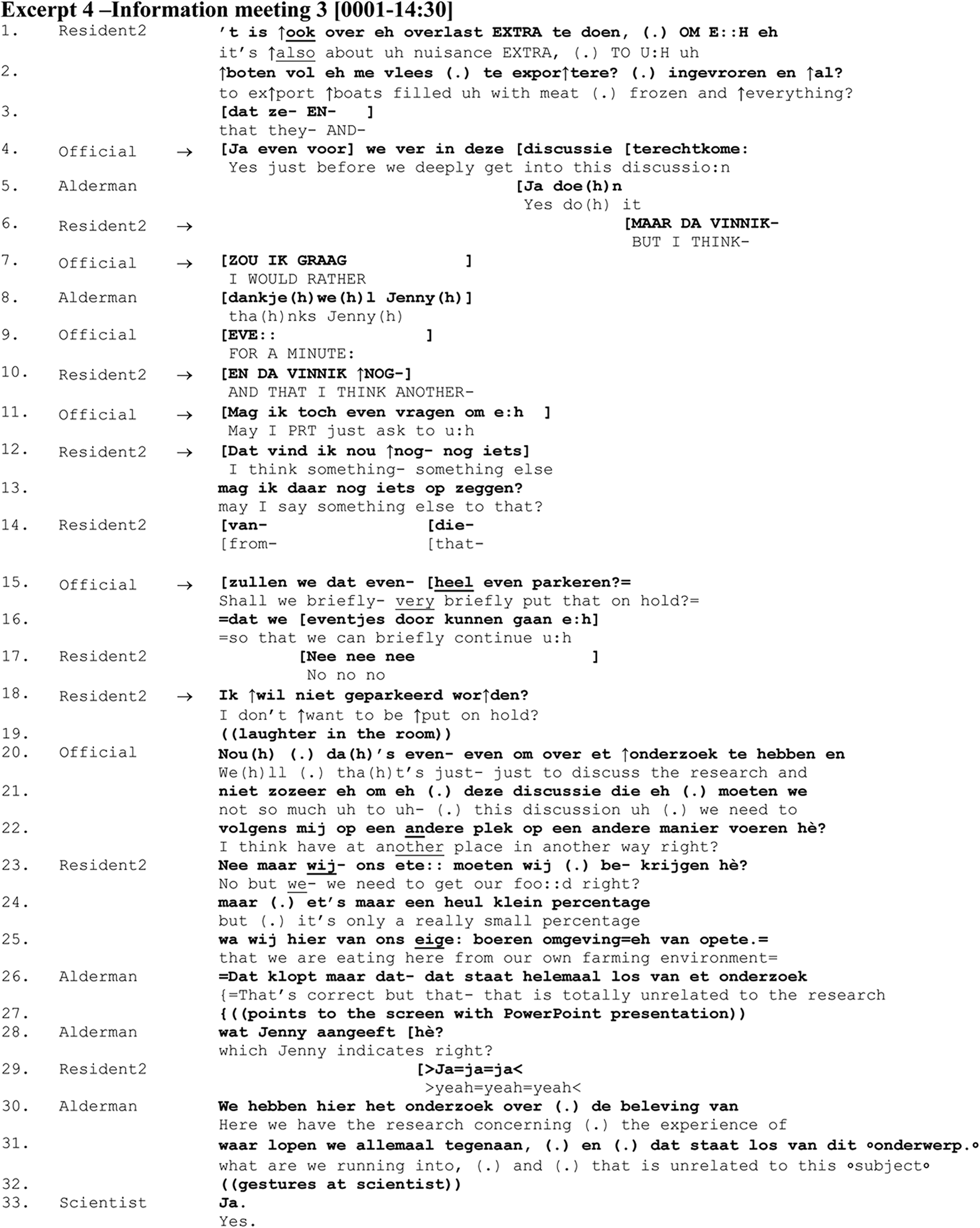
The official's deictic reference to “this discussion” (line 4) treats the issue as a “hot topic.” She positions “this discussion” in opposition to what is within the meeting's boundaries, and receives the alderman's public support for this purpose (lines 5, 8). The resident, however, does not abandon his course of action and continues talking, interrupting the official's trajectory of talk and orienting to his issue as “belonging” (lines 6, 10, 12). But the official does not give him space to bring the issue forward (lines 7, 9, 11).
The resident then requests for permission to introduce his issue (line 13). Rather than complying with this request, which is the preferred second pair-part (Schegloff, 2007), the official reverses the sequence by making the resident the recipient of a proposal to “briefly put that on hold” (line 15). The formulation of her proposal treats “putting on hold” as delicate and dispreferred: She repairs “briefly” into “very briefly” and adds that then they can “briefly continue.” By outlining the meeting's procedures (lines 15-16), she underscores her epistemic authority regarding the limits of discussion, while simultaneously placing the resident in a lower epistemic position (Nielsen et al., 2012). In so doing, she preempts discussion of the issue. The resident's “no no no” (Stivers, 2004) suggests that the official should halt her course of action, while the account for this suggestion – “I don’t
The official is visibly put in a sensitive position. The official's laugh particles interpolated in her turn (Potter & Hepburn, 2010) reveal the problematic and uncomfortable nature of the resident's accusation (line 20). Moreover, if she had not joined in the laughter, she would have risked disaligning with her audience (Schenkein, 1972). The well-preface functions as a “my side” alert, indexing her turn as founded in her own experience, which displays a corroborative, rather than a radically opposing stance (Heritage, 2015). She displays reluctance to (directly) go against the resident's project (Bilmes, 2014) through repeated in-turn hesitations (lines 20-21). Moreover, the turn-final tag “right” and stance-marking “I think” (Kärkkäinen, 2003) function as softening practices, which downgrade the otherwise explicit departure from the resident's turn (line 22). The production of her response thus softens “the tensions between control and democratic participation” (Potter & Hepburn, 2007, p. 182), working against the impression of being ill-intentioned.
However, the official's explanation of how the interaction should proceed (lines 20-22), once more indexes the asymmetry in knowledge and entitlement between the official and the resident. The resident reverses these roles by informing the official instead (lines 23–25), suggesting the issue is appropriate. The alderman's subsequent explanation (lines 26–28, 30-31), however, puts the issue outside the boundaries of discussion again. The resident's “>ja = ja = ja<” (Stivers, 2004) indicates that the alderman has needlessly persisted the matter and should terminate this line of action (line 29). Hereafter, the scientist continues her presentation, while the resident abandons his course of action.
More than the prior excerpt, the next case (Excerpt 5A-5C) shows the possible scope of negotiations on participants’ rights to determine what are discussable matters. Whereas the officials attempt to close the issue by treating it as outside of the realms of discussion, one of the residents eventually (Excerpt 5B) argues he is bureaucratized, ostensibly eliciting involvement from other audience members by bringing the issue into broader and recognizable political waters.
In this situation, the same resident as in Excerpt 4 asked the scientist in the meeting about the negative effects of livestock operations on drinking water, to which the scientist responded that she cannot answer that (omitted). The resident indicates that it is difficult to imagine that an answer cannot be given (lines 1–4), after which one of the officials enters the conversation and moves to closing the issue (lines 6, 8).
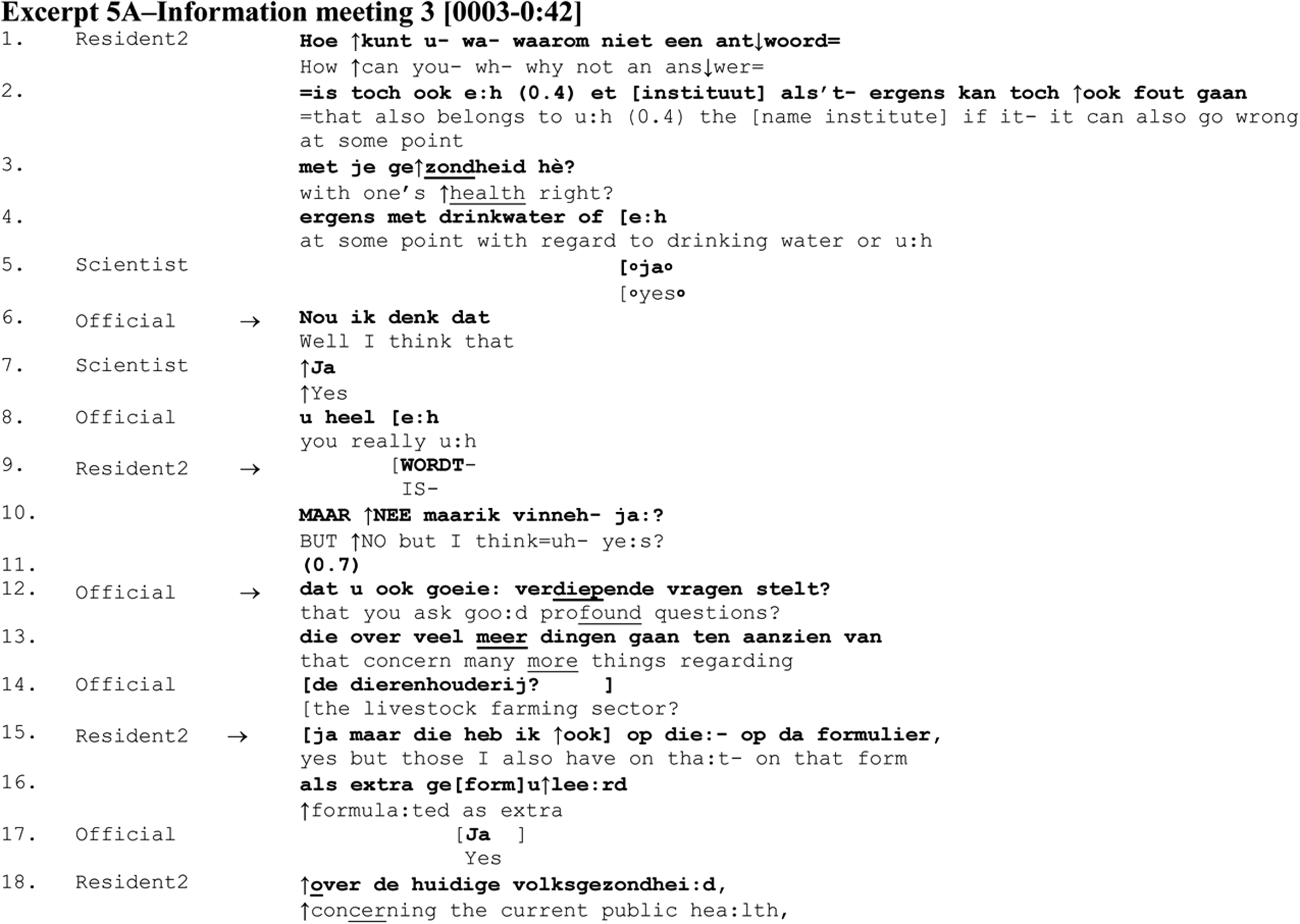
The official's assessment (lines 12–14) hearably moves to closing since “you ask goo:d profound questions” hints at “but they do not belong here.” The resident evidently hears it that way as he starts explicating that he also wrote down this issue on the questionnaire, thereby proposing it as a topic for discussion (lines 15–18).
Having put the issue within the meeting's scope, the resident has found a basis for pursuing his query about groundwater, which again receives a “no knowledge” response (lines 19–25, Excerpt 5B). Now, the alderman intervenes. By invoking procedure in explaining the discussion boundaries (lines 27-28, 30), the alderman confirms an asymmetry in knowledge and entitlement between him and the resident, moving to closing the matter. Thus, there have been multiple attempts by the resident to raise issues; yet, on two occasions an official places the resident's issue outside the meeting's scope. The discussion now seems to have hardened and the resident firmly challenges these closures by indicating he is treated in an utterly bureaucratic fashion, ostensibly prompting audience members to participate in the conflict (line 32).
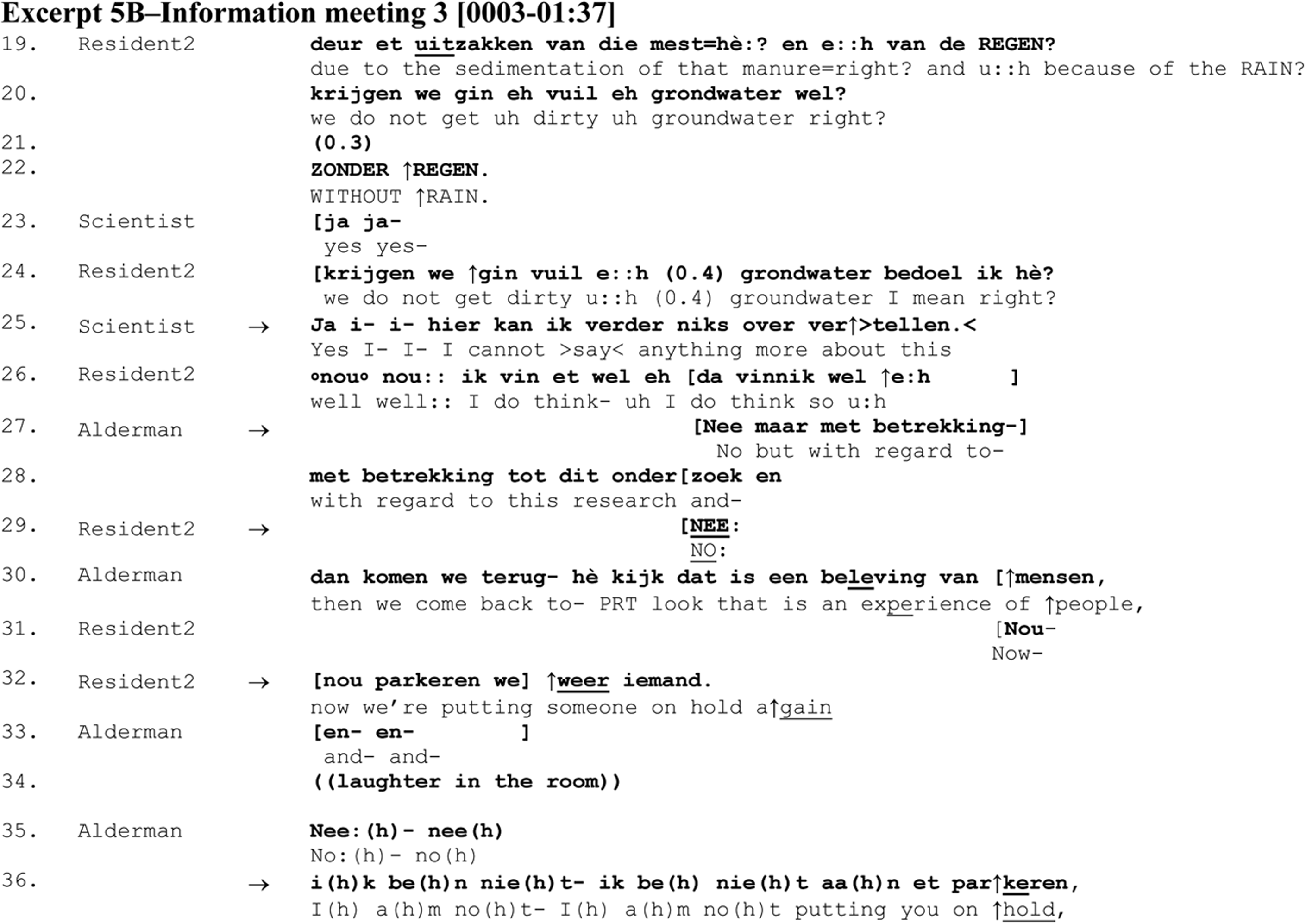
The resident claims to be treated in a reprehensible fashion. Formulating the alderman's action as “we’re putting someone on hold again,” makes it recognizable as a routine (Edwards, 1994, 1995). By classifying “putting someone on hold” as a common practice, he disqualifies the action. Specifically, “now we’re putting someone on hold again” orients to a norm, which is that “we shouldn’t be doing that here,” presented as part of the stock of common experience we all share (Kitzinger, 2000, pp. 127–128). He raises a judgment regarding an objectionable practice while also appealing to his rights to influence the subjects discussed. In so doing, the resident's resistance converses the issue of being accountable in the alderman's direction. The room treats this resistance as “laughable” (line 34), creating a division and incipient tension between the audience and the meeting's organizers. In defending himself and revealing attempts to mitigate the issue, the alderman treats the resident's turn as an accusation (lines 35-36), and the laugh particles interpolated in his turn reveal the troublesome character of the resident's turn (Potter & Hepburn, 2010).
Next, the alderman and resident continue negotiating on what can be discussed. The alderman ostensibly continues with the explanation of the meeting's procedures he started in lines 27-28 (line 37), while preparing to close the topic. But the resident's “DO YOU ALSO
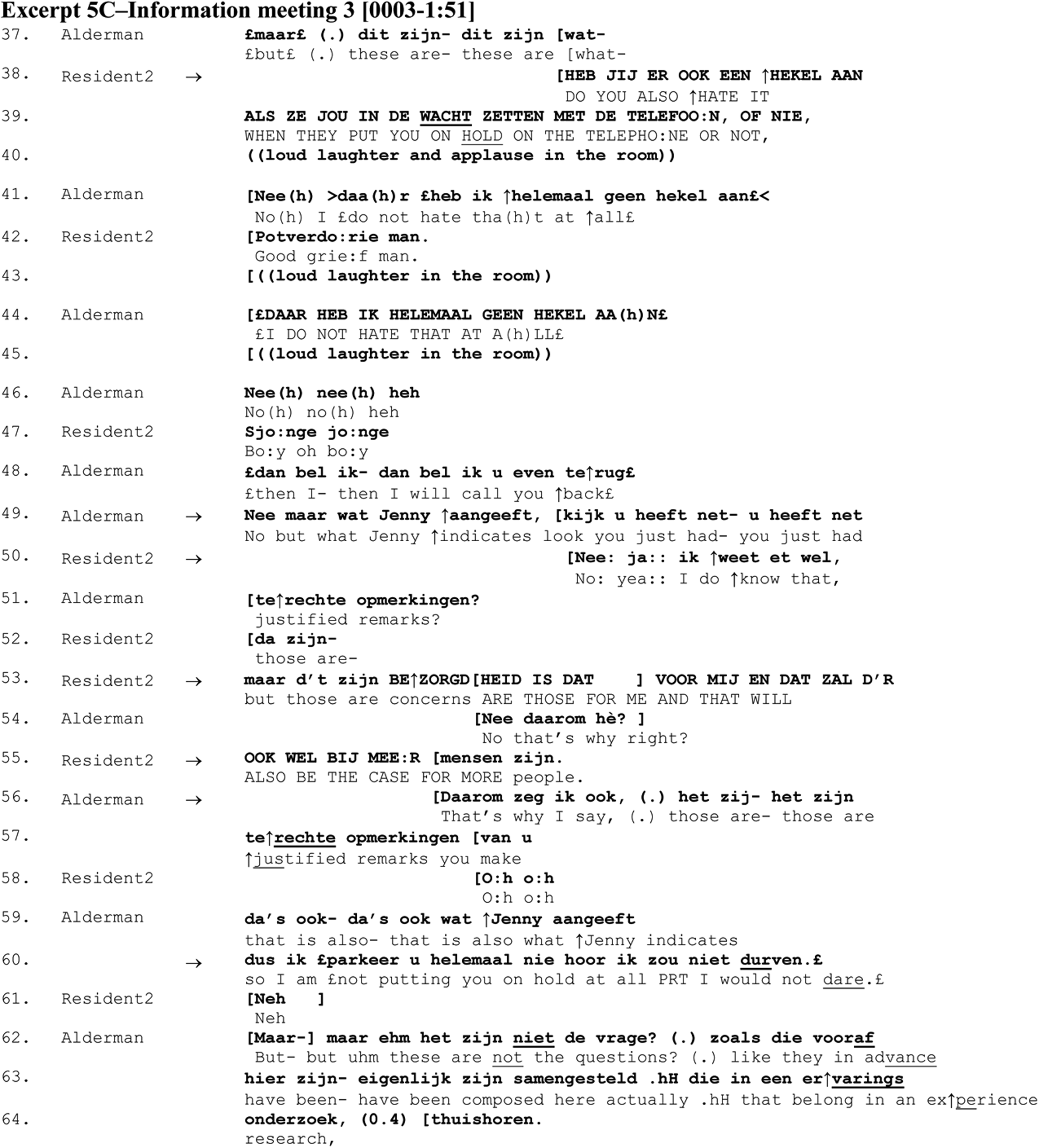
In response to the resident's turn, the audience starts laughing (line 40), but now at a louder volume than before, and starts applauding, which self-organizes the audience as co-members of one category in opposition to another category. Again, the laugh particles inserted in the alderman's turns (lines 41, 44, 46) display the delicate position he is placed in and his joking responses work to convey his stance toward his actions as not completely serious or ill-intentioned (lines 44, 48). His turn-initial “no but” (line 49) reveals a shift from “joke” to “serious” (Schegloff, 2001) in following up on the municipality official's prior assessment of the resident's statements (lines 49, 51). The resident now explicitly treats it as a matter of competence by making clear it is not the case that he does not understand the meeting's procedure (line 50). By emphasizing his worries and by defining it as an issue of collective concern, he again works to establish that the matter does belong within the realm of discussion. The alderman, softening his turn by stressing that the resident has put forward “justified remarks” (lines 54, 56-57), still does not accept the issue as “belonging.” As before, his action of explaining the research procedures treats the subject as “unrelated,” and is thereby used as a resource to close the issue (lines 62–64).
Due to space limitations, we will not elaborate on the resident's next resisting moves. This example shows that negotiations on what constitute legitimate subjects for debate can be expansive when neither party displays a willingness to abandon their projects (cf. Raymond and Zimmerman, 2016). The resident's challenges of closing moves appeal to his rights to determine what are legitimately discussable matters. By suggesting the officials do not adhere to what is “naturally” allowed in this setting, he reflexively characterizes (Locke & Edwards, 2003) his own actions as conforming to the meeting's standards.
We now turn to our final example from a livestreamed debate (Omroep Gelderland, 2017) organized by a provincial council to discuss issues high on policy agendas. We, again, show the situation in parts (Excerpts 6A-6B). Here, the closing of an issue is grounded in elements of the meeting's organization: The facilitators (one being a Council member, the other working at the broadcaster) seek to preempt the discussion of an issue altogether by posing that a farmer who attempts to raise an issue has “missed his chance.” As we show, by treating the farmer as not understanding the “rule” that participants in these gatherings need to respond timely, they prevent the farmer from introducing his issue. Through the ways the farmer treats the facilitators’ closing moves as “shelving” (Excerpt 6B), he appears to involve other audience members in the dispute.
Here, the farmer has been given the opportunity to respond to a Provincial Council member's proposition. The farmer, however, mentions he wants to respond to an earlier proposition (line 1). This results in a quarrel between him and both facilitators, who claim that he can only reply to the current proposition.
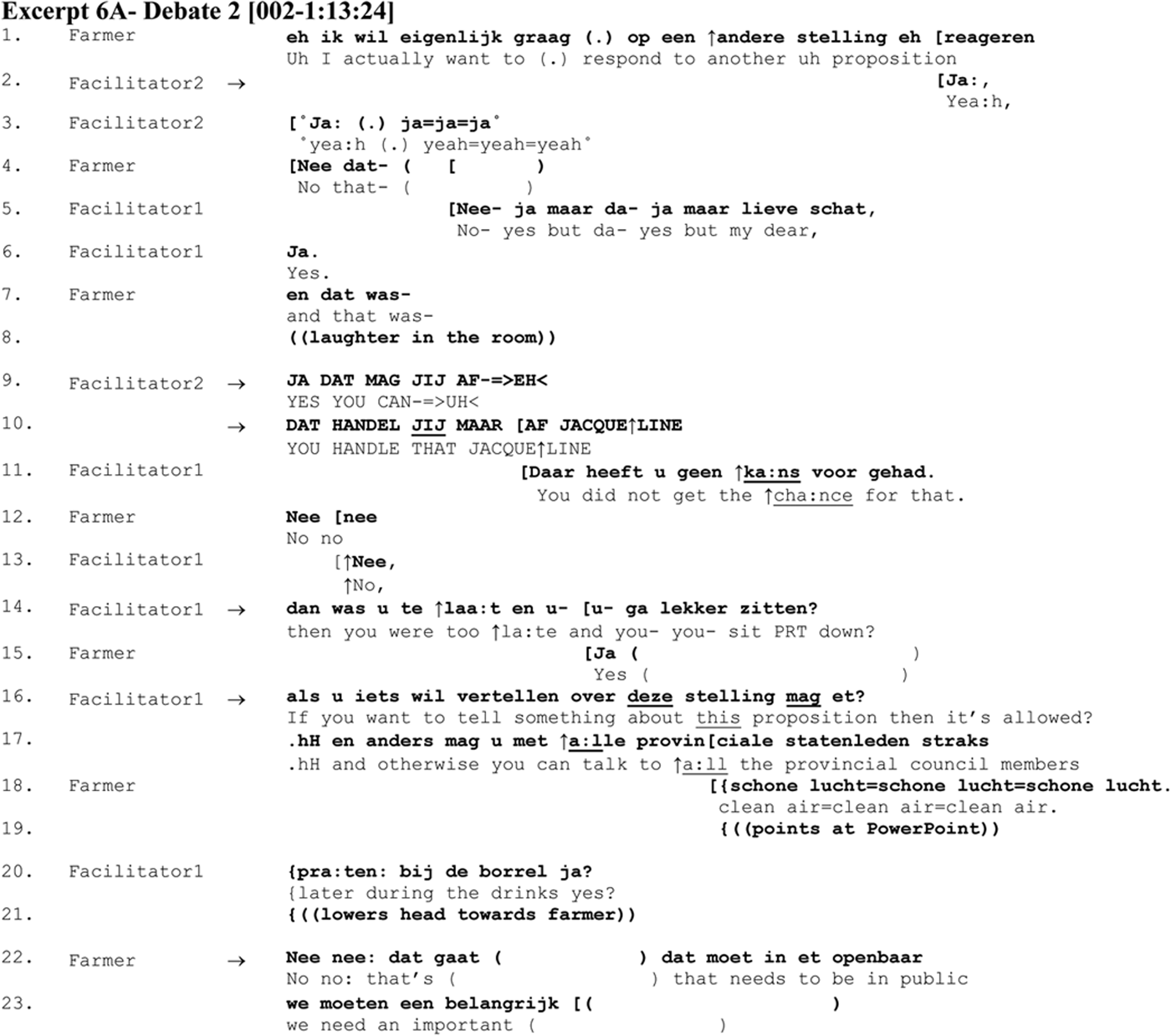
One of the facilitators responds with “˚yea:h (.) yeah = yeah = yeah˚” (line 3), which treats the action of “responding to other propositions” as a familiar, but inadmissible one. Next (lines 9-10), he makes explicit that the resident's initiated action is not allowed by designating the other facilitator as the person having to conclude the matter. By indicating how the interaction can or should proceed, the facilitators move to close the issue (lines 14, 16-17, 20). The farmer's response serves to position his contributions as legitimate by referring to the current discussion topic (lines 18-19), pointing at the PowerPoint visible to all attendees. He builds on the facilitator's suggestion to talk to the provincial council members during the drinks by asserting that this is an issue that needs to be put forward in public. He thereby indicates that now is and must be the time to discuss this, again working to establish that his contribution is appropriate (lines 22-23).
The “competition” on permissibility of the issue does not end here, as one of the facilitators again explains the procedures, see Excerpt 6B (lines 24-25). Now a critical point seems to have been reached and the farmer deflects attention away from the content of the facilitators’ turns by highlighting their objectionable character (lines 27-28).
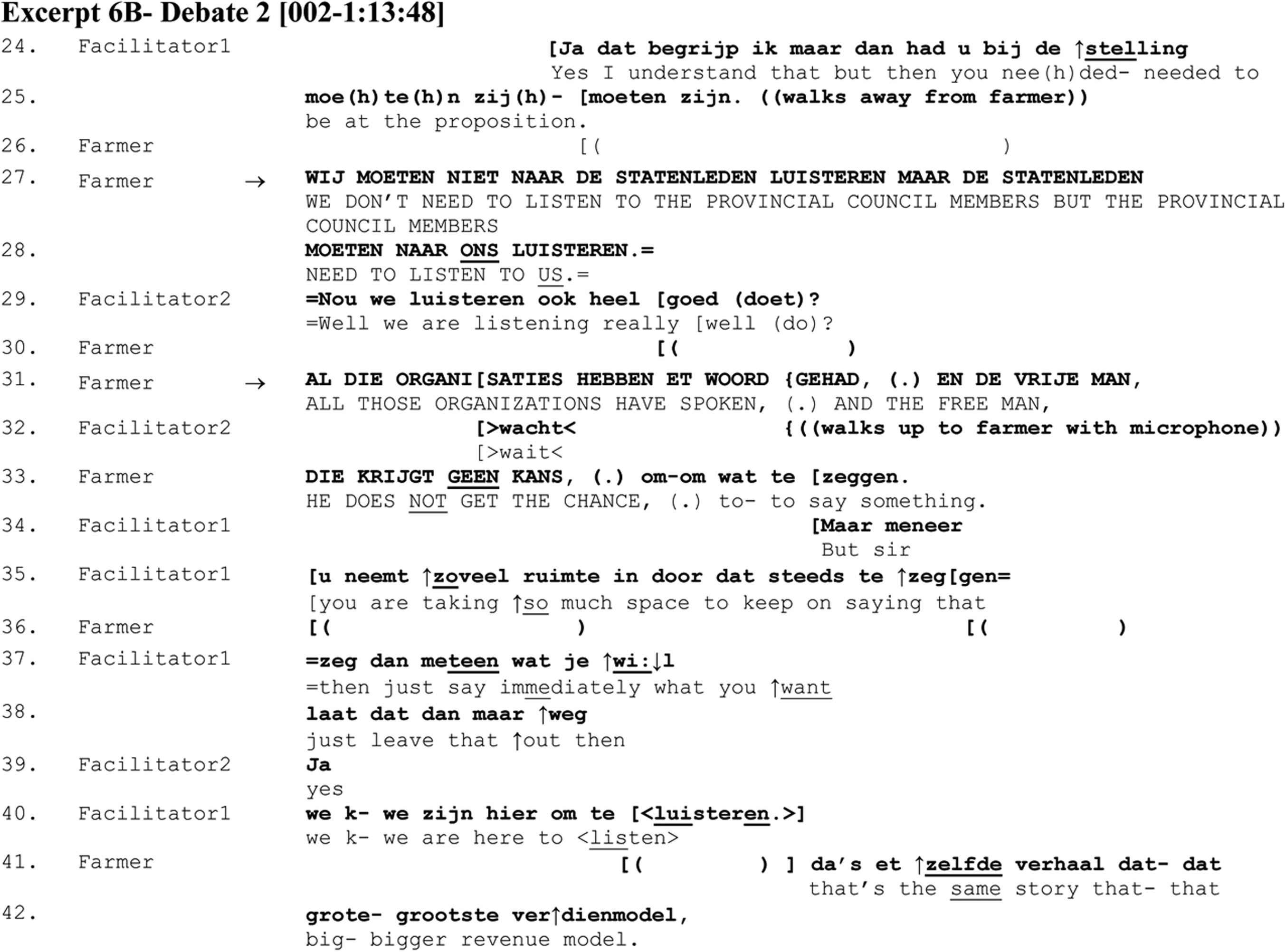
The farmer creates a contrast between “we” and “they,” “the Provincial council members” (lines 27-28). The extreme case formulation (Pomerantz, 1986) “ALL THOSE ORGANIZATIONS” (line 31) serves to characterize his complaint as legitimate, also by building a contrast with the “FREE MAN.” By pointing to the inequalities in speaking opportunities, he alludes to his perceived injustice, but with the idiomatic formulation “free man” he also makes the experience available as an experience of many (cf. Kitzinger, 2000). In so doing, he seems to prompt the audience to participate in the discussion.
The farmer treats the facilitators as complying with the Provincial Council members’ interests, deliberately not offering him speaking opportunities. His response shifts the focus of the discussion from his own actions as not in line with the occasion's demands to the other party's conduct as inapposite. One of the facilitators immediately refutes the accusation by claiming to be a good listener (line 29). By walking back to the farmer with the microphone and emphasizing that their role is to “listen” (line 32, 40), the facilitators’ response is indicative of the sensitivity associated with being accused of acting undemocratically. Moreover, by stressing that the farmer's critiques come at the expense of what he “really” wants to mention, the facilitator marks whatever the farmer wishes to contribute as important (lines 34–38). The facilitators’ responses thus become a way to remediate the farmer's criticisms.
Discussion
This study focused on public meetings to uncover the heretofore unexamined ways in which matters of gatekeeping may become intertwined with issues of democratic competence, via patrolling and defending what are debatable subjects in public gatherings. We showed how participants treated democratic competence, as one's understanding of what can legitimately be discussed in this venue, as an accountable issue. Using discursive psychology and conversation analysis to foreground “democracy's empirical face” (Tracy, 2007, p. 6), we analyzed situations where citizens treated officials’ closing-implicative moves as a way to “shelve issues.” Our analysis showed how officials’ closing moves, by explaining to citizens “how the interaction can, will, should or usually does proceed” (Nielsen et al., 2012, p. 1457), cast citizens as not understanding the gathering's procedures, as became clear in citizens’ challenges of these moves.
As demonstrated, across these cases the grounds offered by officials to close these issues differ. Issues were, for instance, treated as practically beyond debate because they had already been established in the meeting (Excerpt 1), or were treated as a political issue and for that reason, non-discussable (Excerpt 2). Officials also invoked specific rules associated with debate, in casting the discussion of specific cases as “out-of-place” (Excerpt 3), or by indicating that the issue should have been raised earlier, not now (Excerpt 6). Officials further treated issues as not having to do with the current topic; thus as beyond the meeting's scope (Excerpts 4 and 5). As a result, while all matters were treated as “not permitted,” the reasons provided for their “non permissible” status vary.
In the situations analyzed, citizens resisted the closing turn and turned the tables on officials by suggesting that the officials avoid discussing certain matters. They thereby invoked “subjectivity” (Edwards, 2007), here: some ulterior motive, to undermine the “objectivity” of the official's claim that the problem is in the citizen('s competence). By characterizing the issue as evidently belonging and displaying an orientation to the obviousness of being allowed to speak up, citizens challenged the legitimacy of officials’ actions and reflexively alluded to their own “proper” understanding of what is debatable (cf. Locke and Edwards, 2003). Relevant to this observation is Nancy Fraser's (1990) seminal work. Fraser criticized Habermas' (1974) historical description of the public sphere. She argued that this traditional notion of the public sphere and its focus on the “common concern” treats aspects of one's private life as not “public,” which has the potential to marginalize or silence minority voices. Fraser (1990, p. 71) criticized this notion by posing that “there are no naturally given, a priori boundaries” between what is generally considered to be private and what is considered to be public, or of "common concern.” In this respect, this study revealed how citizens, by challenging the officials’ closure of the issues they raise, may work to transform their talk from what is treated as a “private” citizen's concern into a legitimate, validated and ratified societal concern.
These occasions demonstrated the ways officials dealt with the challenges by acknowledging citizens’ points and/or disambiguating what they were doing by, for instance, emphasizing that closing moves were not caused by individual dispositions or inclinations (Edwards, 2007; Edwards & Fasulo, 2006) but by “objective” factors such as the occasion's requirements. Officials’ remedial actions indicated that they themselves also deem the behaviour to be accountable. In this sense, from a participants’ perspective, the officials’ democratic competence is at issue too. We therefore argue that these situations are about more than just the meeting's agenda. Given that citizens treated officials as deliberately avoiding discussion and officials responded in ways that reflected their efforts in refuting any other motivational interpretation of their conduct, the examined situations point to broader relational issues between government and citizens by turning what seem mere agenda issues into negotiations about what constitutes good democracy.
Language and social interaction research has demonstrated the “democratic dilemma” for organizers of public gatherings. The ideals of having an open, unrestricted discussion may conflict with the management of turn-taking or timekeeping; an orientation which becomes apparent in organizers’ interactional practices with which they manage topics and speaker contributions (Bora & Hausendorf, 2006; Buttny & Cohen, 2015; Llewellyn, 2005). For example, Potter and Hepburn (2007) revealed how officials may present themselves as unbureaucratic and non-authoritative so as to not hinder democratic participation. Our study contributes to this work by showing how officials’ formulations used to postpone or prevent discussion of a topic orient to the difficulty of restricting or excluding discussion in a political system that protects freedom of speech. For example, officials at no point suggested that something is “beyond the pale” or outside the “Overton window” (cf. Lehman, 2010); rather, they indicated that these issues had already been discussed or that the present meeting, or a specific moment within it, is not the appropriate time for them to be discussed.
A common criticism of psychological work is the tendency to psychologize and individualize essentially social practices, neglecting an analysis of these phenomena as practical matters (e.g., Humă et al., 2021; Potter and Hepburn, 2020). Social psychological studies on democratic citizenship have addressed this criticism by examining the ways citizens practically engage with political and democratic matters (e.g., Anderson and Gibson, 2020; Condor, 2011). Our study adds a new component to social psychological work on democratic subjectivity by discussing the ways citizens’ competencies to effectively participate in democratic engagements get managed “in the wild.” It examines the interface of personal competence and bureaucratic organization and the resources participants use to manage this interface, showing that democratic competence is a practical accomplishment constructed in the politics of everyday life.
Potter and Hepburn (2007) observed that if participants in public meetings resist or disrespect the organizers’ request to not speak longer than a few minutes, they go against basic democratic principles such as “practicality” and “fairness.” Such democratic principles may be made explicit through requests such as “be brief, don’t repeat.” Yet, such an injunction “hearably diminishes the importance of citizens’ speech” (Buttny, 2010, p. 653). As with patients coming to the doctor's (Heritage et al., 2007), citizens typically have more than one issue they bring to public meetings (see Buttny, 2010; Buttny and Cohen, 2015). This study therefore raises questions about whether “interactional smoothness” and “democracy” are a “good fit.” Our findings question if not addressing certain issues introduced by citizens, with a view to efficient democracy, is fruitful in the short term. We showed that once a trajectory of closings and challenges has been initiated, there is a risk for officials to be pilloried, which means there is little to gain for the organizers, neither in terms of time, nor in terms of their reputation. More importantly, the sheer possibility of being exposed publicly to these kinds of accusations and the fact that they are attended to as utterly recognizable by those present, points to a serious problem in the relationship between government and citizens. Further research into what kinds of (inter)action citizens categorize as “being heard” may help to better respond to situations that seem purely procedural, but which can in fact impact the relationship between government and citizen more fundamentally. For instance, studies on real-life public meetings have addressed what citizens’ displays of “openness” and “listening” look like in the interactions (e.g., Sprain and Black, 2018; Sprain and Ivancic, 2017; Van Burgsteden et al., 2022). Future research could examine the interactional effects of such displays and whether they enable participants to transform the conversation in a more collaborative type of engagement.
This study is limited in several respects. First of all, we only studied Dutch public meetings. Although civic dissent has been considered in, amongst others, Swedish (Boholm, 2008), British (Davies, 2011) and Northern-American (Tracy & Durfy, 2007) contexts, it may be worthwhile to examine whether the phenomenon we discussed also occurs in public meetings across Dutch borders. Furthermore, our exploratory study focused on a rather limited data set, revealing the existence of a practice and analyzing some of its workings. We did not, in the first place, examine the phenomenon's prevalence. And, in accordance with our conversation analytic perspective, nor did we try to connect the practice with cultural background or participants’ individual characteristics. While we have revealed how participants worked out their entitlements regarding the occasion's agenda via patrolling and defending the boundaries of discussion, we have not been particularly focused on the ways participants approached each other in terms of their roles or identities. Future studies could address more specifically how participants’ roles and identities become part of negotiations on the meeting's organization, revealing, for instance, how civic resistance gets its form. Such analyses can shed light on people's orientations to norms which they may not (be able to) articulate as they are not necessarily consciously aware of them.
Conclusion
Whereas democratic participation is largely regarded as a fundamental element of legitimate governance, few studies have approached democracy and its management as a live issue. We showed how matters of gatekeeping in public meetings were treated as accusations of lacking democratic competence, both from the side of citizens and the side of officials. Examining these situations through an interactional lens thereby made visible how “grand” democratic competencies were contested via the “micro,” procedural aspects of social interaction. Our study revealed that when officials tried to preempt discussion of some issues, they risked being exposed publicly to accusations of wanting to stifle important discussions and shelving citizens’ concerns, which questions whether closing off discussion is efficient in terms of time. By identifying this phenomenon, we hope to have paved the way for novel research on how the morality of democratic engagement is practically managed in real-life situations.
Footnotes
Notes
Acknowledgements
The authors would like to acknowledge Marije van Braak, Bogdana Humă, Clara Iversen and Joyce Lamerichs and the two anonymous reviewers for their invaluable comments on earlier drafts, and Liesbeth Claassen, Valérie Eijrond, Joke van der Giessen, Renske Nijdam, Danielle van Oudheusden, Joyce Zwartkruis and Danielle Timmermans for their advice.
Funding Information
This work was supported by the Netherlands Organization for Health Research and Development (ZonMw) under grant number 50-52200-98-325.
Declaration of Conflicting Interests
The author(s) declared no potential conflicts of interest with respect to the research, authorship, and/or publication of this article.
