



Abstract
This study examined the role of pronouns in supportive messages and hope appeals in facilitating people's coping with coronavirus 2019 (COVID-19). Participants included 256 residents of New York State, and they evaluated hypothetical messages about COVID-19. Results showed that when people have a communal orientation to coping, you-language (vs. we-language) supportive messages led to more emotional improvement. The presence (vs. absence) of hope appeals in supportive messages increased communal coping. We discuss the implications of results in promoting emotion- and action-focused coping.
Coronavirus 2019 (COVID-19) is a public health emergency that people experienced as both an individual stressor and a shared problem. COVID-19 is an individual stressor to the extent that people feel personally at risk, are forced to manage their own and loved ones’ health, and confront the challenges of living in pandemic conditions. COVID-19 is a shared stressor to the extent that people feel their community is at risk, collaborate to manage the spread of disease, and experience the shared burden of the pandemic. Because COVID-19 involves both individual and shared stressors, the pandemic offers a context for juxtaposing and integrating perspectives on messages that contribute to social support and communal coping. In this study, we assess the distinctions between those two coping strategies as differentiated by the type of pronouns used in interpersonal messages about COVID-19.
Theory and research on social support and communal coping both emphasize emotion-focused coping (Afifi et al., 2020). Mitigating the spread of COVID-19, however, also requires adopting health-protective behaviors. Prior research suggests that messages that inspire hope can motivate behavior change (e.g., Nabi & Myrick, 2019). Thus, another focus of this study is to put work linking hope to action-focused coping in conversation with perspectives on social support and communal coping. To begin, we discuss how communal coping and social support align, respectively, with first-person plural pronouns and second-person singular pronouns. Then, we discuss the role of hope appeals in facilitating action-focused coping.
Communal Coping, Social Support, and the Use of Pronouns
Communal coping involves the pooling of resources and efforts among people (Lyons et al., 1998). Communal coping occurs when people perceive their stressor as collectively owned and work together to manage it (Lyons et al., 1998). When groups experience a shared stressor, such as COVID-19, communal coping can increase people's sense of efficacy and alleviate emotional distress (Afifi et al., 2020). Prior research has inferred an individual's communal coping orientation from linguistic markers of first-person plural pronoun use (i.e., we-language). Simmons et al. (2005), for example, observed that first-person plural pronoun (vs. second-person pronoun) use during marital interactions about a partner's psychological disorder predicted more shared responsibility and better cooperative problem-solving. Other studies have shown that exposing people to messages containing different pronouns can shift their perceptions of social connectedness. For example, Brewer and Gardner (1996) found that exposure to first-person plural pronouns (we, our, us, ours) enhanced a collective self-concept, whereas exposure to first-person singular pronouns (I, my, me, mine) promoted an individualist self-view. Fitzsimons and Kay (2004) also demonstrated that messages using we-language (vs. you and I) produced greater interpersonal intimacy. These studies suggest that the use of first-person plural pronouns within messages may both reflect and bolster one's sense of community and communal orientation to coping.
Compared to communal coping, social support does not require that the support provider and recipient view the stressor both as “our problem” and “our responsibility” (Lyons et al., 1998). Instead, by offering instrumental, informational, or emotional assistance to another person, social support has the potential to buffer the effect of stress on health (Burleson, 2009). Communication scholars have explored how social support influences people's emotional responses to difficult events by examining verbal person-centered messages (VPC; Burleson, 1994). VPC indexes the extent to which supportive messages acknowledge, validate, and legitimize a distressed person's feelings and perspectives (Burleson, 1994). VPC messages are characterized by the use of second-person pronouns (i.e., you-language) because those messages have the goal of alleviating the emotional distress experienced by others. Empirical studies and a meta-analysis (High & Dillard, 2012) concluded that a higher level of VPC generally does a better job improving emotional outcomes. In this study, we focus on moderately person-centered messages (e.g., messages that distract, offer sympathy, and provide non-feeling-centered explanation of the situation) because they represent the most common form of messages in supportive interaction (Jones et al., 2018).
Cutrona and Russell (1990) argued that social support is only effective to the extent that the type of support matches the specific needs of a distressed individual. Research on support gaps indicates that discrepancies between actual and desired (a) types of social support (e.g., informational support, emotional support; see Xu & Burleson, 2001) and (b) amount of social support (e.g., McLaren & High, 2019) can be dissatisfying. We consider another type of support matching: whether the linguistic features of a supportive message align with people's coping orientations. We predict that when people have a communal orientation to coping, supportive messages that focus on shared appraisal and responsibility by using first-person plural pronouns are likely to have the best support outcomes. In contrast, when people have an individual coping orientation, supportive messages that target another person's emotions, perspectives, and experiences by using second-person singular pronouns are likely to elicit the best outcomes.
Because VPC messages convey emotional support, we test whether a match between communal coping orientation and we-language supportive messages predicts more emotional improvement than a mismatch between them. When people receive we-language supportive messages that are consistent with their communal coping orientation, they may have a greater sense of communal coping. Accordingly, we propose:
Hope Appeals
In addition to emotion-focused coping, the rapid spread of the virus necessitated action-focused coping to contain the pandemic. Hope is a future-oriented emotion that motivates people to engage in a recommended behavior to achieve a desired outcome (Lazarus, 1999). A hope appeal is a persuasive message that evokes hope to motivate behavior change (Chadwick, 2015; Nabi & Myrick, 2019). Hope appeals in this study include two main components: (a) the presentation of an opportunity to achieve a better future and (b) information about recommended actions that are viable and effective to achieve a desired outcome (Chadwick, 2015).
Beyond the emphasis on action-focused coping, hope appeals may also facilitate emotional recovery from a stressor by encouraging people to consider their stressful circumstances as an opportunity rather than a threat (Chadwick et al., 2016). When people become confident in their ability to conquer a shared issue, they may be motivated to participate in communal problem-solving processes (van Zomeren et al., 2012). Thus, we predict that the presence of hope appeals corresponds with more emotional improvement and communal coping than the absence of hope appeals:
Method
Between June 10th and June 26th, 2020, we collected self-report data from people who were living in the state of New York. We chose residents of New York State because they were severely affected by the pandemic at the time and were subject to state-wide COVID-19 guidelines (abc7NY, 2020). 2
Participants
The final sample consisted of 256 residents of New York State (132 females, 124 males) recruited from a Qualtrics prepaid panel. 3 The top three counties in which the participants resided were New York City (26%), Queens (9%), and Bronx (8%). The average age of the participants was 46.32 years (SD = 17.34, range: 18–89). Approximately one-third (33%) of the participants identified as non-White (15% Latina(o), 11% African American, 5% Asian, less than 1% Native American, 2% multiethnicity).
Procedures
Participants completed an online questionnaire via Qualtrics. After providing informed consent, participants responded to measures assessing communal coping orientation. Then, we asked them to imagine having a conversation with a neighbor about COVID-19, and they received one of four manipulated messages from that neighbor. Participants reported their evaluations of the message and their perceptions of COVID-19 in light of that message.
Materials
Variations between messages manipulated the type of pronouns in you-language versus we-language supportive messages and the presence versus absence of hope appeals (Table 1). While supportive messages focus on alleviating emotional distress, hope appeals aim to motivate behavior change. Incorporating both messages is necessary because they help manage different aspects of the pandemic (i.e., the emotional toll and slowing the spread of the virus).
Experimental Messages.
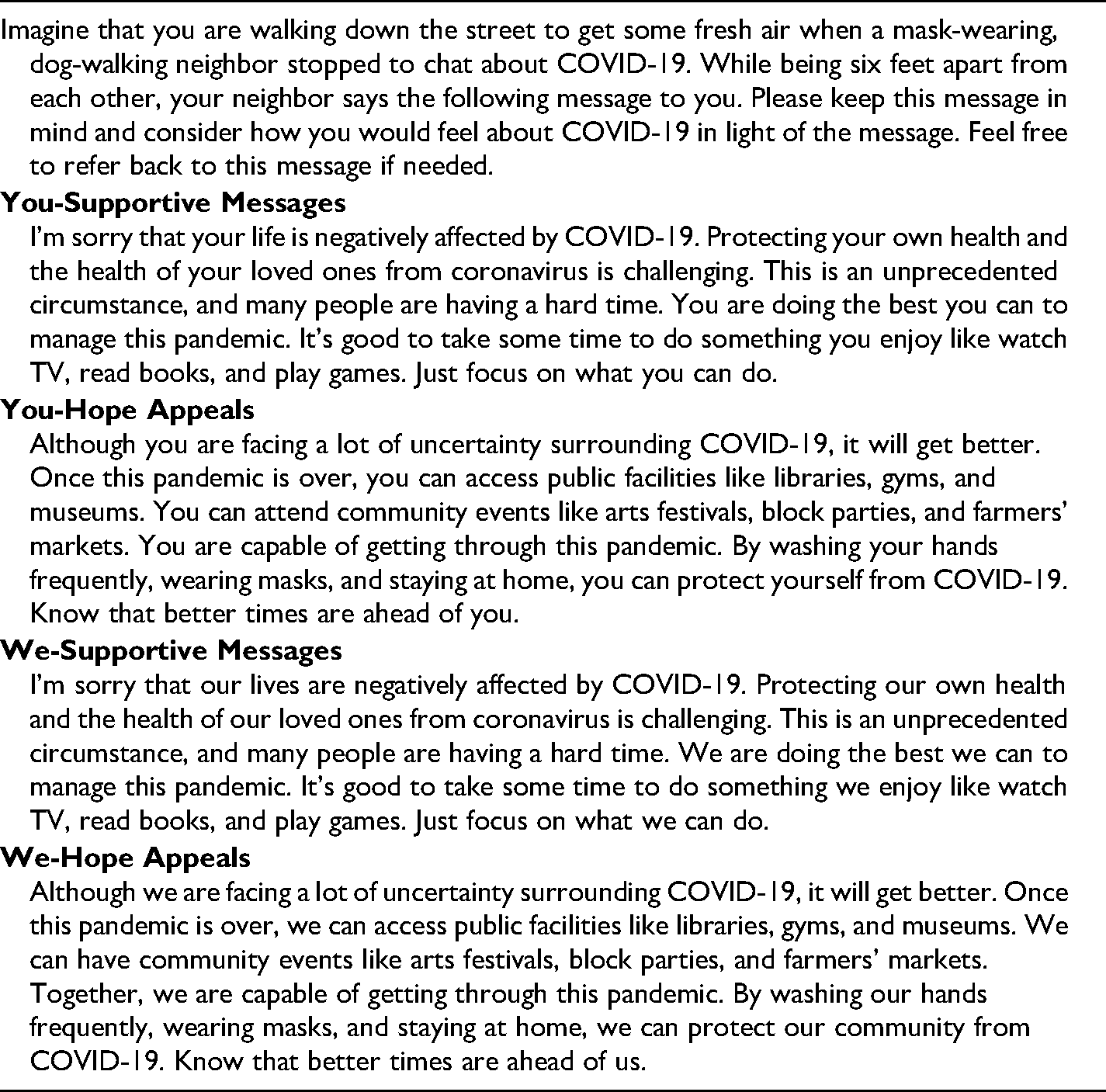
To manipulate supportive messages, we adapted the wording of messages that exhibited a moderate level of person-centeredness (High & Dillard, 2012). Hope appeals incorporated two elements per Chadwick (2015): (a) an opportunity perception by highlighting that the current situation will get better and (b) efficacy information by presenting examples of preventative health behaviors against COVID-19. We incorporated either second-person singular pronouns or first-person plural pronouns in those messages conveying emotional support and hope.
Measures
All measures were indexed by multi-item scales, and all responses were recorded on a 6-point scale (1 = strongly disagree, 6 = strongly agree) unless otherwise noted. 4 A confirmatory factor analysis using AMOS version 27 was employed to test the measurement properties of all the scales. Based on prior research (Lyons et al., 1998), we modeled communal coping as a second-order latent construct with appraisal and action as first-order constructs. The measurement model included all items for each latent construct, and latent constructs were allowed to covary. After removing one item from the communal coping orientation scale due to poor factor loading, 5 the resulting measurement model showed acceptable fit, χ2(158) = 217.12, p < .01, CFI = .98, RMSEA = .04 (90% CI [0.026, 0.053]), PCLOSE = .88.
Communal Coping
Participants were asked to think about how they and their community have been handling COVID-19 using a 5-point scale (1 = strongly disagree, 5 = strongly agree). We consulted Basinger (2020) and created items that captured the two dimensions of communal coping. For the appraisal dimension, participants were presented with the stem, “When I think about COVID-19, I mostly think about … ,” which was followed by three statements (e.g., “how it is my community's health issue that we face together”). Three items were used to capture the action dimension (e.g., “It is my community's responsibility to prevent the spread of COVID-19). As per Helgeson et al. (2018), we created a composite score of communal coping by combining the appraisal and action items (α = .76, M = 3.96, SD = 0.62).
We included two items to assess communal coping as an outcome in the posttest (one item for each dimension). Participants were asked to consider what they thought about COVID-19 after reading the message, and they responded to items using a 6-point semantic differential scale (“My own health problem that I face alone/My community's health problem that we face together” and “It is my/my community's responsibility to find ways to cope with COVID-19”). The correlation between those two items was .40, p < .001 (M = 4.02, SD = 1.35).
Emotional Improvement
We included five items to capture emotional improvement (e.g., “That message helped to cheer me up”) based on previous research (Jones & Wirtz, 2006). These items showed good reliability in this study (α = .94, M = 3.91, SD = 1.35).
Message Realism
Three items assessing the perceived realism of the message were included in the survey (e.g., “This message was realistic”). The reliability of the scale was .84 (M = 4.45, SD = 1.33, Mdn = 4.67).
Trait Hope
Participants’ trait hope was measured using the Life Orientation Test employed by Scheier et al. (1994). The scale consists of five items (e.g., “I’m always optimistic about my future”). The reliability of this scale was .91 (M = 4.19, SD = 1.15).
Analytical Procedures
We evaluated demographic and contextual variables that were associated with substantive variables to determine covariates. 6 To test the hypotheses, we ran separate hierarchical regression analyses in SPSS version 27 with emotional improvement and posttest communal coping as the dependent variable. For each regression model, we entered covariates in the first step. In step two, we entered the dummy-coded variables distinguishing you-language versus we-language supportive messages and the absence versus presence of hope appeals, respectively, and communal coping. In step three, we entered the two-way interactions between you-language versus we-language supportive messages and presence versus absence of hope appeals and communal coping. We mean centered communal coping for the product terms. 7 To correct for multiple testing, we employed the Holm–Bonferroni method.
Results
Drawn from significant associations between the variables of interest and message realism and trait hope (Table 2), we controlled for them in the main analyses.
Intercorrelations for Substantive Variables and Covariates.
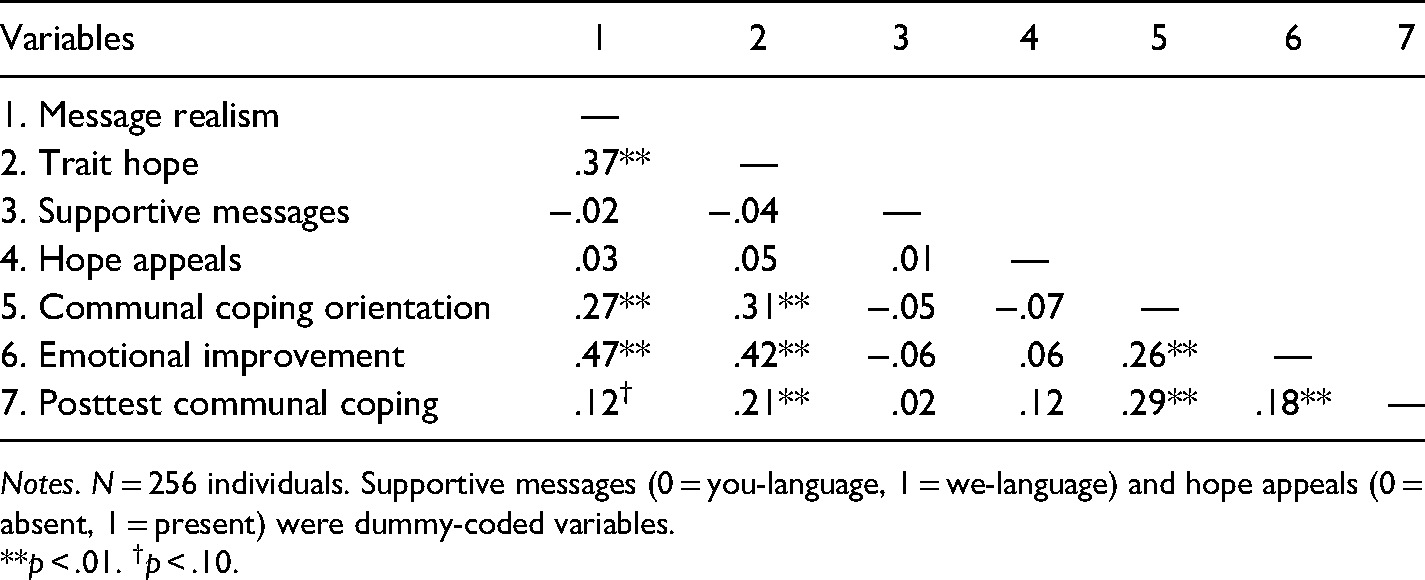
Notes. N = 256 individuals. Supportive messages (0 = you-language, 1 = we-language) and hope appeals (0 = absent, 1 = present) were dummy-coded variables.
**p < .01. †p < .10.
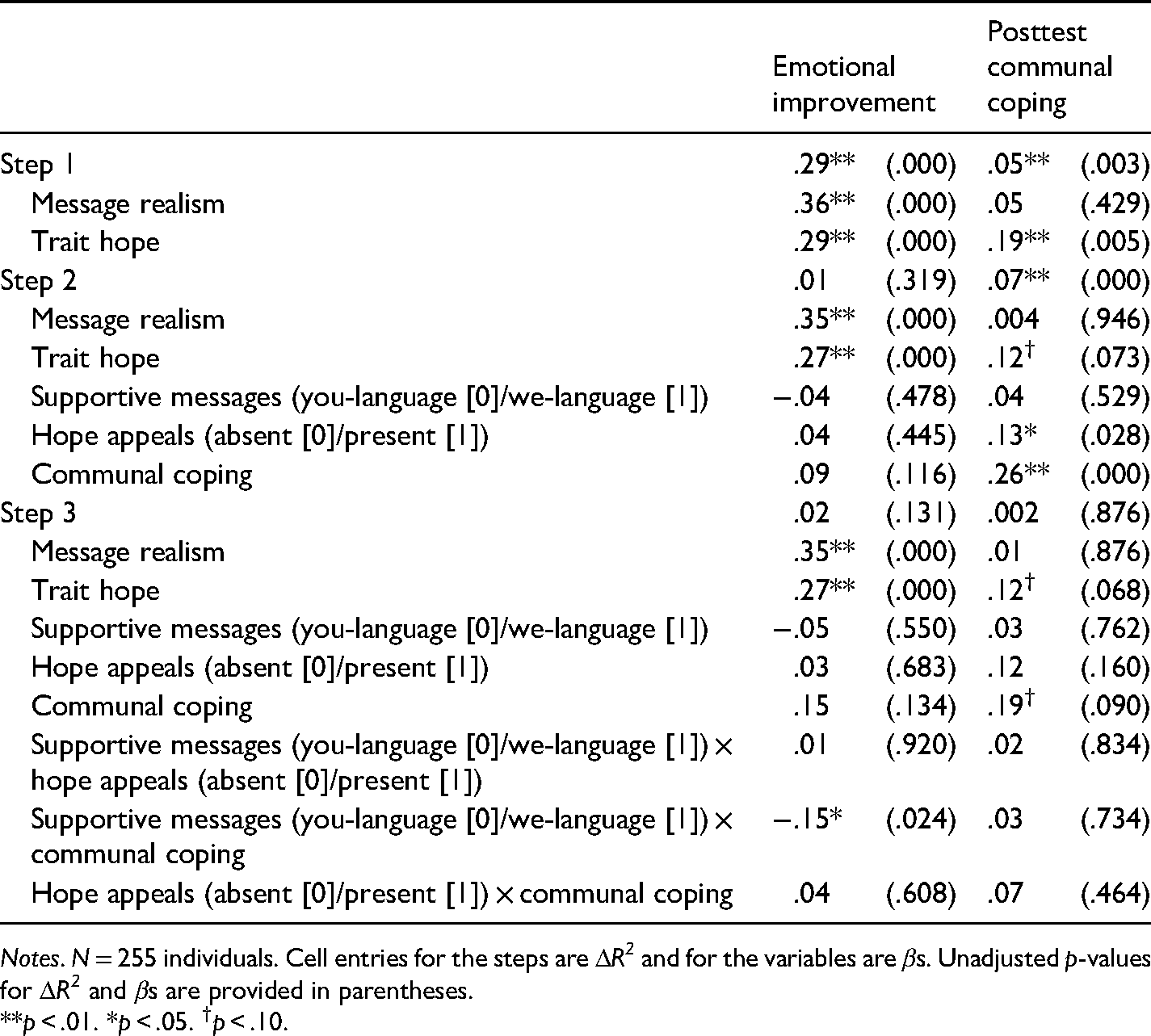
To test H1 and H2, we conducted two hierarchical regression analyses (Table 3). Results from the first step of the analyses showed that message realism and trait hope accounted for 29% and 5% of the variance in emotional improvement and posttest communal coping, respectively.
Hierarchical Regression Predicting Outcome Variables.
Notes. N = 255 individuals. Cell entries for the steps are ΔR2 and for the variables are βs. Unadjusted p-values for ΔR2 and βs are provided in parentheses.
**p < .01. *p < .05. †p < .10.
H2 was tested by the second step of the regression models, which revealed the relationship between the presence versus absence of hope appeals and outcome variables. Results showed that the presence versus absence of hope appeals was not significantly associated with emotional improvement, β = .04, p = .45, 95% CI (−0.17, 0.39), and hence, H2a was not supported. We observed a significant association between the presence versus absence of hope appeals and posttest communal coping, β = .13, p = .03, 95% CI (0.04, 0.67), such that the presence of hope messages was associated with more posttest communal coping than the absence of hope appeals. Thus, H2b was supported.
H1 was tested by results from the third step of the regression models, in which we assessed whether communal coping orientation moderates the association between you-language versus we-language supportive messages and outcome variables. We found a significant two-way interaction when emotional improvement was the dependent variable, β = −.15, p = .02, 95% CI (−1.01, −0.07). The interaction graph in Figure 1 illustrates that when communal coping orientation was high, you-language supportive messages corresponded with more emotional improvement than we-language supportive messages. H1a predicted that when people have a communal orientation toward coping with COVID-19, we-language supportive messages would be associated with more emotional improvement than you-language supportive messages. Given that these findings are contrary to our expectations, H1a was not supported. We did not observe a significant two-way interaction when posttest communal coping was the dependent variable, β = .03, p = .73, 95% CI (−0.44, 0.62), and thus, H1b was not supported.
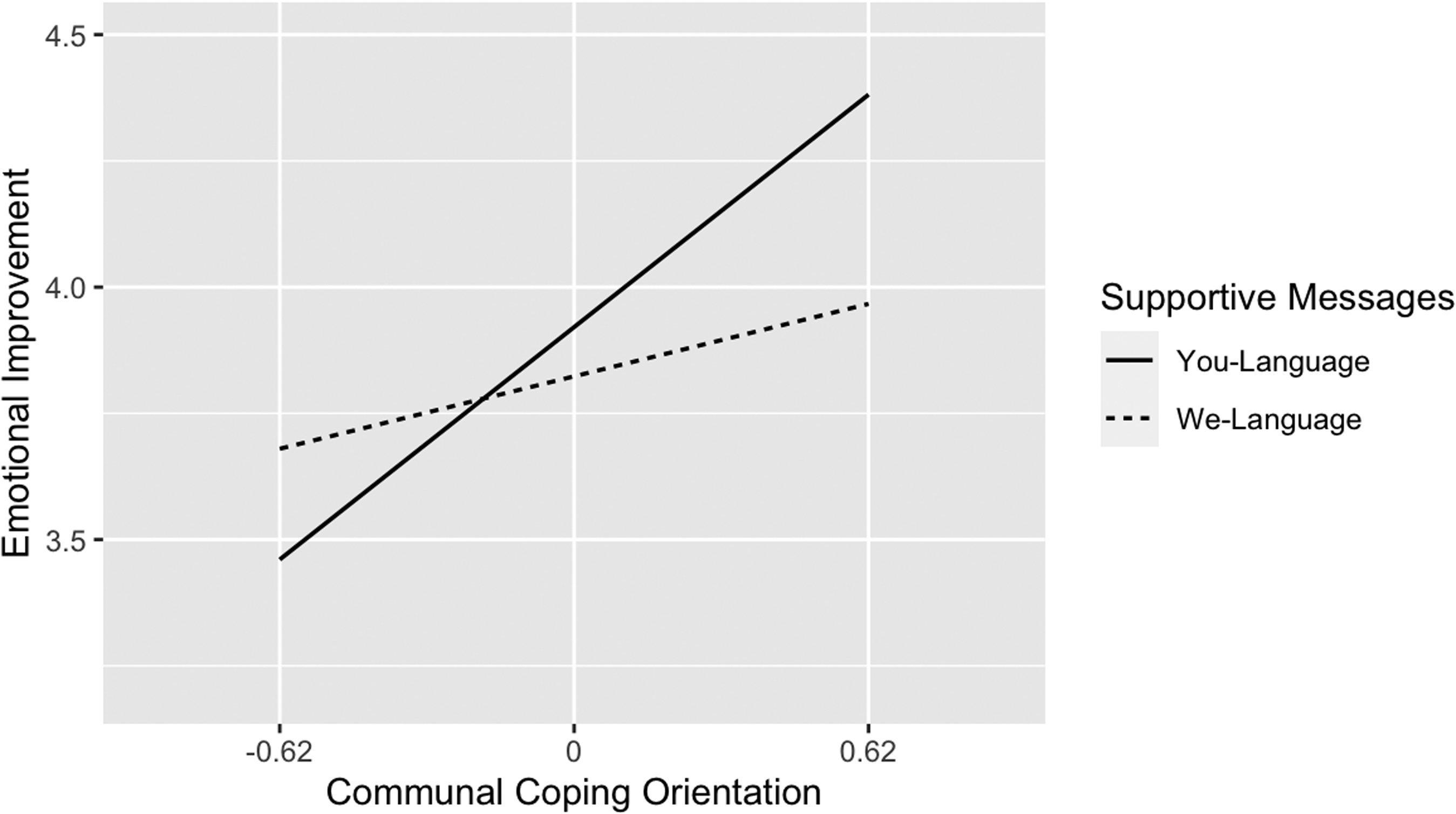
Interaction effect for emotional improvement.
We corrected for multiple testing and adjusted the alpha levels for the two significant results, namely H1a and H2b. Given that we ran two regression models to test H1 and H2, respectively, with the overall alpha level set to .05, the p-value for H1a ( = 0.024) was less than αadjusted ( = 0.025), and the p-value for H2b ( = 0.028) was less than αadjusted ( = 0.050). Thus, we rejected the null hypotheses for H1a and H2b.
Discussion
We aimed to clarify whether a match between communal coping orientation and we-language supportive messages was associated with better support outcomes than a mismatch between them. Another goal was to assess how the inclusion of hope appeals in supportive messages influenced people's coping with COVID-19. The results suggest that the form of pronouns within supportive messages affects emotional improvement depending on a person's communal coping orientation, and the presence of hope appeals within a supportive message can increase communal coping.
Contrary to H1a, you-language supportive messages, compared to we-language supportive messages, were associated with more emotional improvement when communal coping orientation was high. As Helgeson et al. (2019) argued, when people have shared illness appraisals, they are less likely to interpret their partner's emotional support effort as a threat to self-efficacy. Instead of perceiving you-language supportive messages as conveying separateness and independence (Brewer & Gardner, 1996), people with a communal orientation to coping may view such support as collaboration toward a common goal and are particularly receptive to a partner's emotional support messages. Notably, we found that there were no significant differences in people's reports of communal coping after receiving you-language or we-language supportive messages (H1b). It is likely that when people have a communal orientation to coping, they may perceive you-language supportive messages as a collaboration rather than one-sided support provision (see Helgeson et al., 2018).
The presence (vs. absence) of hope appeals did not predict emotional improvement (H2a). In keeping with H2b, we found that the presence (vs. absence) of hope appeals was associated with more posttest communal coping. These results indicate that hope appeals may target action-focused coping more so than emotion-focused coping. We wonder if the presentation of opportunity perception by highlighting that people will once again access public facilities and attend community events prompted people to think that they collectively share the burden of COVID-19. Because hope motivates behavior change, efficacy information about adopting preventive health behaviors may also target the behavioral dimension of communal coping.
The results have practical implications for health message designs. Given that the COVID-19 crisis is experienced as both an individual and shared stressor, it is important to assess people's coping orientation (whether they perceive the stressors as individually or collectively owned) so that messages can be tailored to their needs. When people have a communal orientation to coping, you-language supportive messages are likely to increase the personal relevance of COVID-19, validate the other person's experience, and alleviate emotional distress. Furthermore, we recommend incorporating hope appeals in supportive messages to facilitate action-focused coping. Not only do people face the emotional toll that comes with the pandemic, but they also need to take actions to slow the spread of the virus.
Our claims, however, are tempered by the limitations of this study. Although we replicated procedures that have been commonly used to evaluate supportive messages (e.g., Bodie et al., 2011), the use of hypothetical scenarios may attenuate message effects, and it does not capture actual behaviors people perform in their daily lives (Baumeister et al., 2007). Future research should examine face-to-face conversations and directly observe behavioral outcomes of social support. In addition, only one message was used to operationalize emotional support and hope appeals, respectively. Although we based the messages closely after well-established exemplars (Chadwick, 2015; High & Dillard, 2012), future research should replicate supportive messages and hope appeals with multiple messages to better operationalize those constructs. On a related note, because only single messages were used, the effect of you versus we language may not be reliably conveyed in those messages. We also did not establish message realism in advance, which can threaten ecological validity to the extent that people may react differently to those experimental messages in real-life conversations. Finally, we did not include measures to assess whether the presence of hope appeals motivated people to adopt health-protective behaviors. Although there was one item from posttest communal coping that captured action (“It is my/my community's responsibility to find ways to cope with COVID-19”), including other scales to assess people's behavioral intentions is needed in future research.
Supplemental Material
sj-docx-1-jlsp-10.1177_0261927X211044721 - Supplemental material for The Effects of Type of Pronouns and Hope Appeals in Supportive Messages About COVID-19
Supplemental material, sj-docx-1-jlsp-10.1177_0261927X211044721 for The Effects of Type of Pronouns and Hope Appeals in Supportive Messages About COVID-19 by Xi Tian, Youllee Kim and Denise Haunani Solomon in Journal of Language and Social Psychology
Footnotes
Declaration of Conflicting Interests
The authors declared no potential conflicts of interest with respect to the research, authorship, and/or publication of this article.
Funding
The authors received no financial support for the research, authorship, and/or publication of this article.

Supplemental Material
Supplemental material for this article is available online.
Notes
Author Biographies
References
Supplementary Material
Please find the following supplemental material available below.
For Open Access articles published under a Creative Commons License, all supplemental material carries the same license as the article it is associated with.
For non-Open Access articles published, all supplemental material carries a non-exclusive license, and permission requests for re-use of supplemental material or any part of supplemental material shall be sent directly to the copyright owner as specified in the copyright notice associated with the article.
