



Abstract
While there is substantial research on COVID-19’s general framing in the news, little is known about the antecedents and moderators of using moral language in communicating the disease to audiences. In this study, we rely on the Model of Intuitive Morality and Exemplars to explore how news media’s attention on COVID-19 and moralizing language in COVID-19 news vary with respect to ultimate (historical pathogen prevalence) and proximate (spread of COVID-19) socio-psychological factors. Specifically, we analyzed 1,024,800 news headlines from 28 countries published throughout 2020 and applied automated content analysis for moral language extraction. Our results provide support for increased media attention and higher levels of moralizing language in COVID-19 news for regions with high historical pathogen prevalence and COVID-19 spread. We discuss the theoretical impact of these findings in view of the socio-psychological relevance of moralizing language for disease-related news and point towards future research directions.
In March 2020, the spread of COVID-19 led the World Health Organization to announce the outbreak as a worldwide pandemic (WHO, 2020). Global news media have since acted as a central means for communicating and disseminating COVID-19 related information, including trends in infection rates and behavioral guidelines for slowing disease spread (Quandt et al., 2020). Notably, the specific language that journalists adopt to cover recent infectious outbreaks such as Ebola (Sell et al., 2017) and Zika (Yotam & Jamieson, 2020) impact how audiences process, understand, and behaviorally respond to infection-related content. At the same time, the social construction of pandemic news is not only shaped by a region’s mediated (e.g., news or social media) environment but is also prone to variation in a region’s non-mediated (e.g., social or biological) environment (Tamborini, 2011, 2013). In view of these considerations, there now exists a substantial need for interdisciplinary scholarship that (1) identifies language cues that are of sociopsychological and theoretical relevance for processing COVID-19 related news, and (2) examines regional covariates that modulate the degree and language patterns with which COVID-19 news is communicated to audiences.
In the current study, we address these interlocking challenges by integrating media and socio-psychological theory with recent methodological advancements in computational communication research. Building on the Model of Intuitive Morality and Exemplars (MIME; Tamborini, 2011, 2013; Tamborini & Weber, 2020), we assume that moral arguments—societal prescriptions for morally right or wrong behaviors—are instrumental language cues for imposing behaviors that yield optimal outcomes for society as a whole (Buckholtz & Marois, 2012), including prescriptions for COVID-19 related health behaviors (Amin et al., 2017; Van Bavel et al., 2020). Analogously, recent research applying parasite-stress theory (Thornhill & Fincher, 2014) has demonstrated that regional variation in historical pathogen prevalence (HPP; Murray & Schaller, 2010) shapes individuals’ group-focused moral concerns to increase group-cohesion and avoid pathogen exposure (Van Leeuwen et al., 2012). Hence, we generally predict that the representation of group-focused moral concerns in COVID-19 news coverage (by using language emphasizing group-oriented moral norms) is positively reinforced by a region’s HPP and COVID-19 prevalence.
Theoretical Background
Infectious diseases have exerted a fundamental selection pressure on humans throughout their evolutionary history (Ackerman et al., 2012). To combat the existential threat posed by invading parasites, humans have developed a physiological immune system. This system comprises biological mechanisms, down to the cellular level, which aids human beings in their survival against pathogenic threats. However, evidence suggests that immunological stress and the continued maintenance of a physiological immune system are associated with significant nutritional and energetic costs to humans (Lochmiller & Deerenberg, 2000). To this end, social psychologists have argued for the existence of a complementary behavioral immune system (BIS) that acts as the first line of defense (Schaller, 2011). The BIS provides individuals with specific psychological responses designed to reduce the probability of initial infection. Therefore, proponents of the BIS argue that humans have evolved cognitive faculties that monitor a variety of salient, non-pathogenic physical and environmental cues to proxy the likelihood of pathogenic agents in other people. Such cues have the potential of prompting aversive behavioral responses in humans, even if the probability of actual infection is low. For instance, evidence suggests that when assuming increased pathogen threat (even falsely), humans are capable of displaying aversive, prejudiced attitudes against ethnic outgroups (Faulkner et al., 2004), physically handicapped people (Ryan et al., 2012; Weber et al., 2012), individuals with obese bodies (Park et al., 2007), homosexuals (Terrizzi et al., 2010), and the elderly (Miller & Maner, 2012).
Furthermore, to illustrate the interdependence between pathogen threat and behavioral defenses at a regional level, parasite-stress theory (Thornhill & Fincher, 2014) posits that spatiotemporal variation in parasite adversity influences human culture and gives rise to communal value systems that can guide an individual’s behavior in their respective society. From this ultimate perspective, the uniqueness of proximate sociocultural practices in regions where people have been subject to increased threats of pathogenic exposure is argued to be a response to the need for more effectively avoiding disease. In fact, evidence shows that humans who reside in high pathogen prevalent regions do exhibit anti-pathogen sociocultural practices more strongly. In particular, avoidance of “outsiders”—manifested in the form of increased ethnocentric (Navarrete & Fessler, 2006) and xenophobic (Faulkner et al., 2004) attitudes—seems to be a salient feature of heightened anti-pathogen practices. Studies also report that individuals in these regions are less extroverted, associate themselves more with collectivist values (with behavioral advantages during pandemics, including ingroup-cohesion), and emphasize a greater role of family loyalty and religiosity (with an emphasis on specific purity rituals) in their lives (Fincher et al., 2008; Schaller & Murray, 2008; Thornhill et al., 2010).
Notably, recent research has demonstrated that pathogen stress also increases the salience and motivational relevance of humans’ group-focused moral concerns. Moral Foundations Theory (MFT; Graham et al., 2013) suggests that there are five innate, universal moral foundations that exist among individuals across cultures and societies. Each foundation is associated with its virtue and vice dimensions that respectively indicate whether a particular moral foundation has been upheld or violated. We provide below a short description that characterizes what each of these foundations entail in a practical context.
Care/Harm is related to the evolutionary capacity in humans to feel and empathize with the pain of others and underlies the common notions of kindness, gentleness, and nurturance. Fairness/Cheating is concerned with the evolutionary mechanisms in humans that are sensitive to reciprocity and equality and evokes intuitions of justice, rights, and autonomy. Loyalty/Betrayal is related to the evolutionarily held tribal tendencies of human beings and elicits notions of patriotism and self-sacrifice for the group. Authority/Subversion is shaped by society’s long-standing acceptance and establishment of hierarchical social interactions and signals the importance of obeying legitimate authority and respecting traditions. Sanctity/Degradation is associated with the psychology of disgust and contamination in human beings and underlies the value of guarding oneself against contamination. While bodily purity is particularly salient in times of pandemic, this foundation extends to the spiritual realm as well.
The functionality of these moral foundations can be further reframed within two separate categories: individualizing and binding. The first two foundations (care/harm and fairness/cheating) are primarily concerned with protecting the rights and freedoms of individuals and are referred to as the individualizing foundations. The last three foundations (loyalty/betrayal, authority/subversion, and sanctity/degradation) remain focused on preserving the group as a whole and are referred to as the binding foundations.
In particular, moral norms emphasizing group loyalty, respect for authority and tradition, and bodily/spiritual purity have been suggested to serve the function of reducing pathogen transmission by increasing group-cohesion within community networks (Van Leeuwen et al., 2012). When pathogen risk is high, social interactions with outgroup members can expose ingroup members to foreign pathogens. Thus, to mitigate pathogen spread, individuals, medical professionals, news agencies, and political leaders may emphasize the importance of the binding moral foundations in their everyday language when discussing ingroup-outgroup social exchange. In this study, we conceptualize moral language as communication—here in written form expressed in news articles—referencing the five moral foundations as introduced by MFT. Indeed, the psychologically pluralistic nature of moral foundations manifests itself through the emotional and linguistic cues in everyday human interactions (Graham et al., 2013). Using language, people have the capacity to signal their personal values to others and thereby inform contentious ideological debates in the larger community, helping motivate social action and empowering community members to regulate one another’s behaviors (Boyd et al., 2015; Clifford & Jerit, 2013; Kennedy et al., 2021; Li & Tomasello, 2021). Therefore, it can be argued that language which attempts to influence and regulate community behavior through means of value-driven reasoning may be especially instrumental for individuals who reside in high pathogen prevalence regions. Here, compliance within community networks can be regarded as highly relevant as the consequences of individual members remaining ignorant of or defecting from established social norms are particularly severe. In other words, if people do not know which social norms are important to abide by or if people violate those norms when their personal interests conflict with overall group interests, it is inevitable that such behavior will subsequently result in a marked increase in disease-driven mortality rates, especially so in high pathogen prevalence regions (Pettit, 2018). Accordingly, the moralization—the usage of language cues referencing moral values—of disease-related language can serve as a powerful communicative means to prompt ingroup members to abide by customs pertaining to the binding foundations. By doing so, ingroup cohesion is framed as morally righteous and ingroup members, who violate binding moral norms, may even be retaliated against via punishment or social exclusion (Ellemers et al., 2019).
Despite this evidence and the implications of group-oriented (henceforth referred to as “binding”) morality in high pathogen prevalent regions, little research has been conducted to examine the association between the moralization of disease-related language (e.g., in news) and pathogen stress across different cultures and at a global level (i.e., during the COVID-19 pandemic). Previous research in this area has primarily relied on the Moral Foundations Questionnaire (MFQ; Graham et al., 2013) to estimate cross-national, binding moral concerns of individuals during “normal” times (i.e., not during pandemics with increased pathogen threat) whilst paying little attention to the aggregated representation of moral language in global news media coverage during times of the COVID-19 pandemic. This gap in research can largely be attributed to the inaccessibility of real-time updates on global pandemic news and the challenging task of extracting latent moral cues from textual data (Weber et al., 2018). However, recent advances in computational communication research and moral text mining circumvent these challenges (Hopp et al., 2020a).
We build on these advancements and systematically investigate daily (i.e., repeated) fluctuations of news media attention on COVID-19 and the associated use of moralizing language in international news outlets throughout the year 2020. Moreover, we predict that there exist dynamic (i.e., overtime), cross-level dependencies within and across regions of varying HPP, and with regard to continually evolving, spatiotemporal covariates, such as the effective reproduction rate of COVID-19. Specifically, we hypothesize:
At the time of this paper’s submission, some regions have been able to exercise successful control over local virus spread; however, the COVID-19 pandemic is still not contained in many regions. We seek to understand how different stages of the crisis, as inferred from the degree of local spread, impact news content. Thus, we additionally ask:
Moreover, our theoretical rationale suggests that the use of binding moral foundations in news coverage on COVID-19 should be accentuated in regions with higher HPP. Hence, we predict:
Likewise, we seek to understand how different stages of the crisis, as inferred from the degree of local spread, impact the use of binding moral foundations in news content. Thus, we ask:
Furthermore, we have thus far only discussed the binding moral foundations and their associations with HPP and the regional, daily reproduction rate of COVID-19. As mentioned previously, the binding foundations (loyalty/betrayal, authority/subversion, and purity/sanctity) view the group as paramount in terms of moral value while the individualizing foundations (care/harm and fairness/cheating) regard the individual as primary. Thus, we are also interested in investigating whether or not the individualizing foundations interact with HPP and the regional, daily reproduction rate of COVID-19. To this end, we propose an additional research question:
Method
All data, code, and Supplemental Material (SM) have been made publicly available via the Open Science Framework and can be accessed at https://osf.io/8qax3/?view_only=76cfe2239fcf446faf50cdfcede9c082.
Data Collection
News records
News records were collected utilizing the Global Database of Events, Language, and Tone (GDELT) interface for Communication Research (iCoRe; Hopp et al., 2019; Leetaru & Schrodt, 2013). iCoRe allows for fast, transparent, and user-friendly access to large-scale news and associated metadata contained in GDELT, including the Global Knowledge Graph. Notably, we retrieved news articles’ headlines, as copyright prevents GDELT from providing access to full article texts. Yet, headlines are frequently more explicit compared to the full-text article body, thus mitigating errors in translating multilingual corpora to English (described below); moreover, focusing only on headlines avoids the issue of articles referring to multiple (international) outlets that can each express different moral language (Van Atteveldt et al., 2021). Furthermore, the moral language of headlines is interesting in its own right as the headline is the first (and sometimes the only) part of an article that audiences process. In addition, previous research has shown that headlines are an important framing device (e.g., Liu et al., 2019) and a signal of news values (e.g., Ng & Zhao, 2020).
Instead of querying all the news sources monitored by GDELT, iCoRe whitelists a curated, international source list available at All You Can Read (https://www.allyoucanread.com). This website maintains a repository of established sources with substantial audiences domestically and/or internationally. Using iCoRe, we queried all news records from 28 regions (see Supplemental Table 1 for sources and regions) published between January 1, 2020 and December 31, 2020. To standardize our news collection across time and regions, we randomly sampled 100 news records for each day and region, resulting in a total of 366*100*28 = 1,024,800 retrieved news records.
Moral Language Extraction
Recent research has established the increasing capacity of moral language online to influence both digital and societal outcomes (Brady et al., 2020; Hopp et al., 2020b; Mooijman et al., 2018; Priniski et al., 2021; but see Burton et al., 2021). The precise operationalization of moral language, however, remains a challenging research task. Previous dictionary-based work in this area has relied primarily on expert-generated or data-driven word lists (Araque et al., 2020; Frimer et al., 2017; Graham & Haidt, 2012; Rezapour et al., 2019). The extended Moral Foundations Dictionary (eMFD; Hopp et al., 2020a) is a more recent solution that leverages an extensively validated, crowd-sourced annotation procedure (Weber et al., 2018) for the extraction of moral content in textual narratives. Beyond the reliable capturing of individual-specific and intuitive moral sensibilities across a large number of annotators, this approach also allows for incorporating the moral prototypicality of any given word via its assignment to multiple foundations in a probabilistic manner. These advantages afforded to researchers via the eMFD are important as the linguistic emphasis on a relevant moral foundation is likely dependent upon the social context it is expressed within and, thus, by taking into account this natural and context-driven variation in moral information, the eMFD, and its dedicated, open-source text analysis tool eMFDscore, is well-suited for the challenging task of automated extraction of moral language patterns (Hopp et al., 2020a). The eMFD wordlists aim to reflect the five moral foundations, as identified by MFT (Graham et al., 2009) and as described previously in this paper. Each moral foundation is further split into its virtue and vice dimensions which reflect either the upholding or violation of a foundation.
We would like to point out here that the eMFD, as well as other popular dictionaries including the Moral Foundations Dictionary (MFD; Graham & Haidt, 2012; MFD 2.0; Frimer et al., 2017), are optimized for the English language. At the same time, this research seeks to examine multilingual news content as it gives us the opportunity to study moral content in different cultural contexts. Although attempts have been made to reliably construct dictionaries for computational extraction of moral content in other languages (Matsuo et al., 2019), these resources are still in their infancy, resulting in limitations for multilingual moral content analysis. Recent research provides evidence that for comparative text analysis using a traditional “bag-of-words” approach, machine translation, and in particular Google Translate, generates considerable overlap with human translated texts (De Vries et al., 2018). Furthermore, imperfections in translations of single news headlines are less problematic compared to the faulty translation of a dictionary (i.e., the measurement instrument) that propagates errors across the whole corpus (Lind et al., 2019). To circumvent the challenge of multilingual news content, we machine-translated all non-English news headlines into English using the Google Translate web service. Thereafter, we extracted the moral language cues in each headline using the “bow emfd single vice-virtue” scoring option of eMFDscore, returning a total of 10 scores (ranging from 0 to 1) for each headline that denotes the representation of each foundation and its vice/virtue dimension. To capture the overall representation of individualizing and binding moral foundations, we summed the virtues and vices values of the care and fairness foundations into an individualizing index and likewise summed the virtues and vices values of loyalty, authority, and sanctity foundations into a binding index.
Media Attention on COVID-19 (MAC19)
For each region and day, we define media attention on COVID-19 as the proportion of our randomly sampled articles that mention or discuss COVID-19. For example, if on March 10, 25 of the 100 randomly sampled articles from Denmark mention COVID-19, then the MAC19 score for Denmark on March 10 would have a value of .25. To identify articles that mention COVID-19, GDELT uses several, full-article keyword searches (e.g., “COVID-19,” “pandemic,” “virus”) and flags articles accordingly if they match a keyword (The GDELT Project, n.d.).
COVID-19 Infection Rates (R)
To establish regional COVID-19 prevalence, we integrated our dataset with infection rates sourced from the popular online platform (Our World in Data, n.d.). The authors directly source data on COVID-19 infection, hospitalization, and death rates from John Hopkins Coronavirus Resource Center (Dong et al., 2020). As part of this repository, we also obtain real-time estimates of the effective reproduction rate (R) of COVID-19. The calculation of this measure is based on Arroyo-Marioli et al. (2021), who estimate reproduction rate based on, (1) the construction of a time series of how many individuals are infected at a given point in time, (2) the application of the Kalman filter (Welch & Bishop, 2001) to estimate a smoothed growth rate of this time series, and (3) the exploitation of the theoretical relationship, offered by the benchmark SIR model (Smith & Moore, 2001), between Susceptible (St), Infected (It), and Recovered (Rt) individuals. The authors reliably demonstrate that their real-time estimates are robust against biases even when new cases are imperfectly reported by government agencies. In this study, we proxy local daily infection rates via the real-time estimates of the effective reproduction rate (R) of COVID-19 as identified above.
Historical Pathogen Prevalence
We used a numerical 7-item index developed by Schaller and Murray (2008) to estimate the relative historical prevalence of infectious diseases. We were able to successfully extract data for all 28 regions we study in this research. Individual numerical estimates captured prevalence for the following seven diseases: leishmania, schistosoma, trypanosoma, malaria, filaria, dengue, and typhus. These estimates were then aggregated into a composite index reflecting a single region’s overall HPP. Schaller and Murray (2008) computed these disease prevalence indices on a common scale of measurement by converting all seven disease prevalence ratings to z scores. Each overall disease prevalence index was then computed as the mean of z scores of the items included in the index, thereby rendering the mean of the seven-item HPP index as approximately 0. Positive scores signal that disease prevalence in a particular region is higher than the mean, while negative scores signal that disease prevalence in a particular region is lower than the mean.
Results
Descriptive Analyses
Figure 1 provides a first visual inspection of the time-series trajectory of MAC19 across all 28 regions during 2020. While MAC19 is still relatively low at the beginning of 2020 (except for Hong Kong, China, and Taiwan, which peak earlier in the late January), most regions started focusing on COVID-19 by mid-March, with Hong Kong noting the highest levels. Overall, across regions, media attention flattens in the middle of 2020 but starts increasing again towards the end of 2020, with substantial region-specific variations.
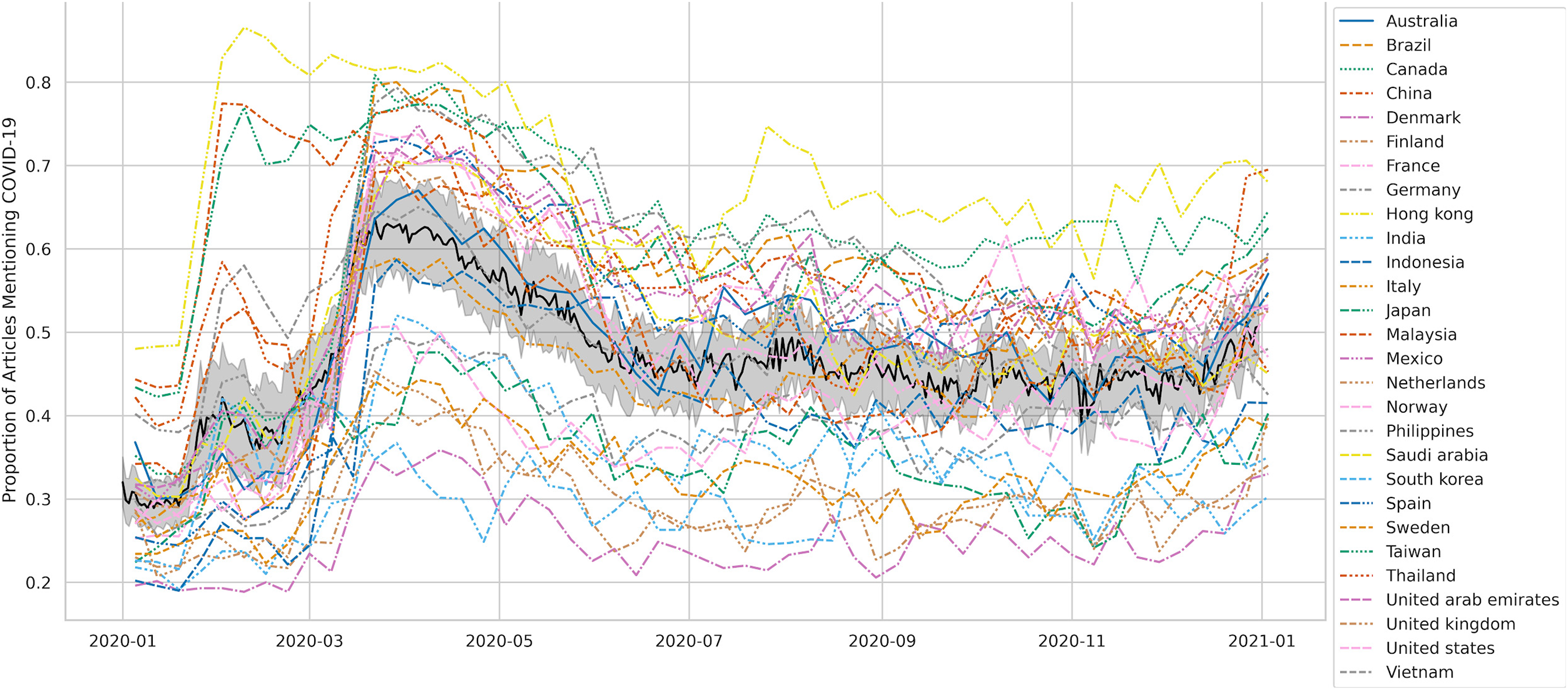
Media attention on COVID-19 from January 1, 2020 to December 31, 2020.
Furthermore, Figure 2 provides information on the distribution of MAC19 and the HPP in each of the 28 regions. Overall, news sources in regions with high HPP tend to report more on COVID-19, although there are notable exceptions, such as Canada (low HPP, high MAC19) and India (low MAC19, high HPP).
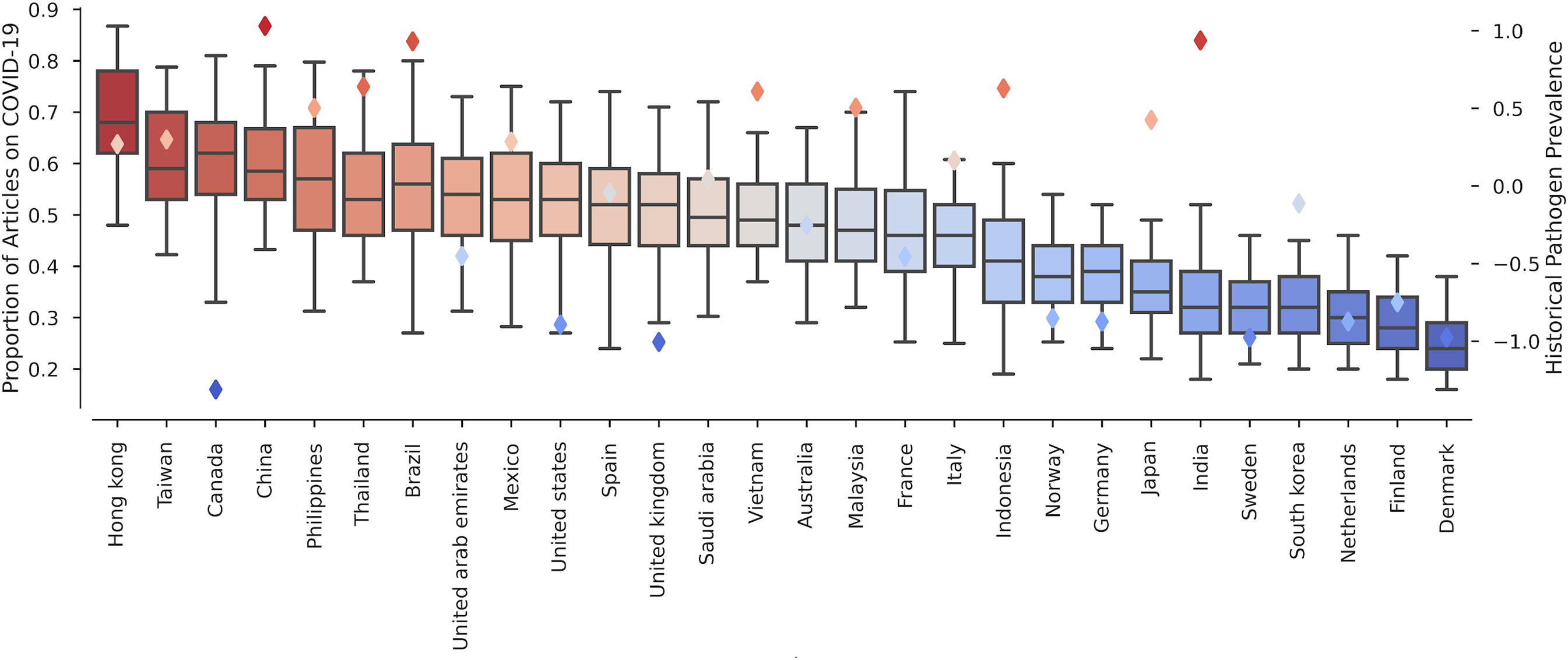
Media attention on COVID-19 and historical pathogen prevalence across regions.
Statistical Analyses
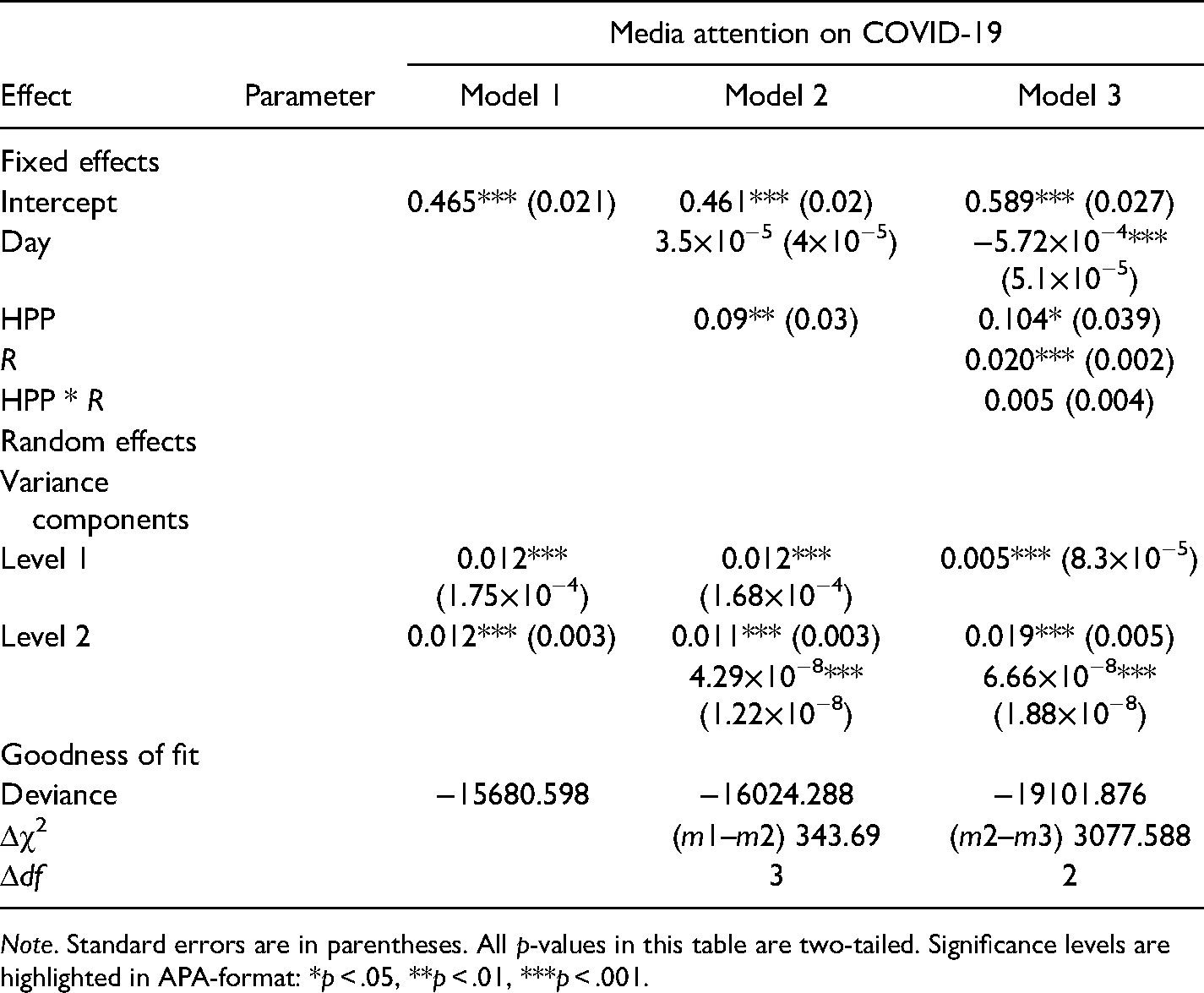
Our statistical analyses relied on multilevel linear growth models (fitted with IBM SPSS Version 27), which afford us to robustly analyze repeated, daily observations of COVID-19 media attention (first level) across regions (second level) (Hesser, 2015). Before testing our hypotheses, we first constructed an unconditional mean model (see Model 1 in Table 1) to examine region-level variation in MAC19 without any additional predictors. This model shows that 46.5% of the variance in MAC19 can be explained by region.
Model Parameters and Goodness of Fit for Media Attention.
Note. Standard errors are in parentheses. All p-values in this table are two-tailed. Significance levels are highlighted in APA-format: *p < .05, **p < .01, ***p < .001.
To test whether a region’s HPP predicts daily media attention on COVID-19 news (H1), after accounting for unspecified region-specific variance, we added each day of 2020 (range: 1 – 366) as a repeated measure, nested within each region, specified the seven-item, z-transformed HPP index as a fixed effect, and added the day and region as random effects (Model 2, Table 1). This model revealed that HPP significantly predicts MAC19 (γ11 = .09, SE = .03, t [28] = 3.009, p = .006). Thus, H1 is supported. To assess whether the regional, daily reproduction rate of COVID-19 (R) moderates the relationship between HPP and MAC19 (RQ1), we further built on Model 2 and added both R and the cross-level interaction between HPP and R as fixed effects (Model 3, Table 1). This model revealed that the main effects of HPP (γ11 = .104, SE = .039, t [28] = 2.628, p = .014), and R (γ12 = .020, SE = .002, t [8,025] = 8.797, p < .001) were significant. The interaction between HPP and R on MAC19 was not significant. This observation indicates that R does not moderate the relationship between HPP and MAC19 and, thereby, we deny RQ1. Notably, this full model is successful in explaining almost 74% of the total variance in MAC19.
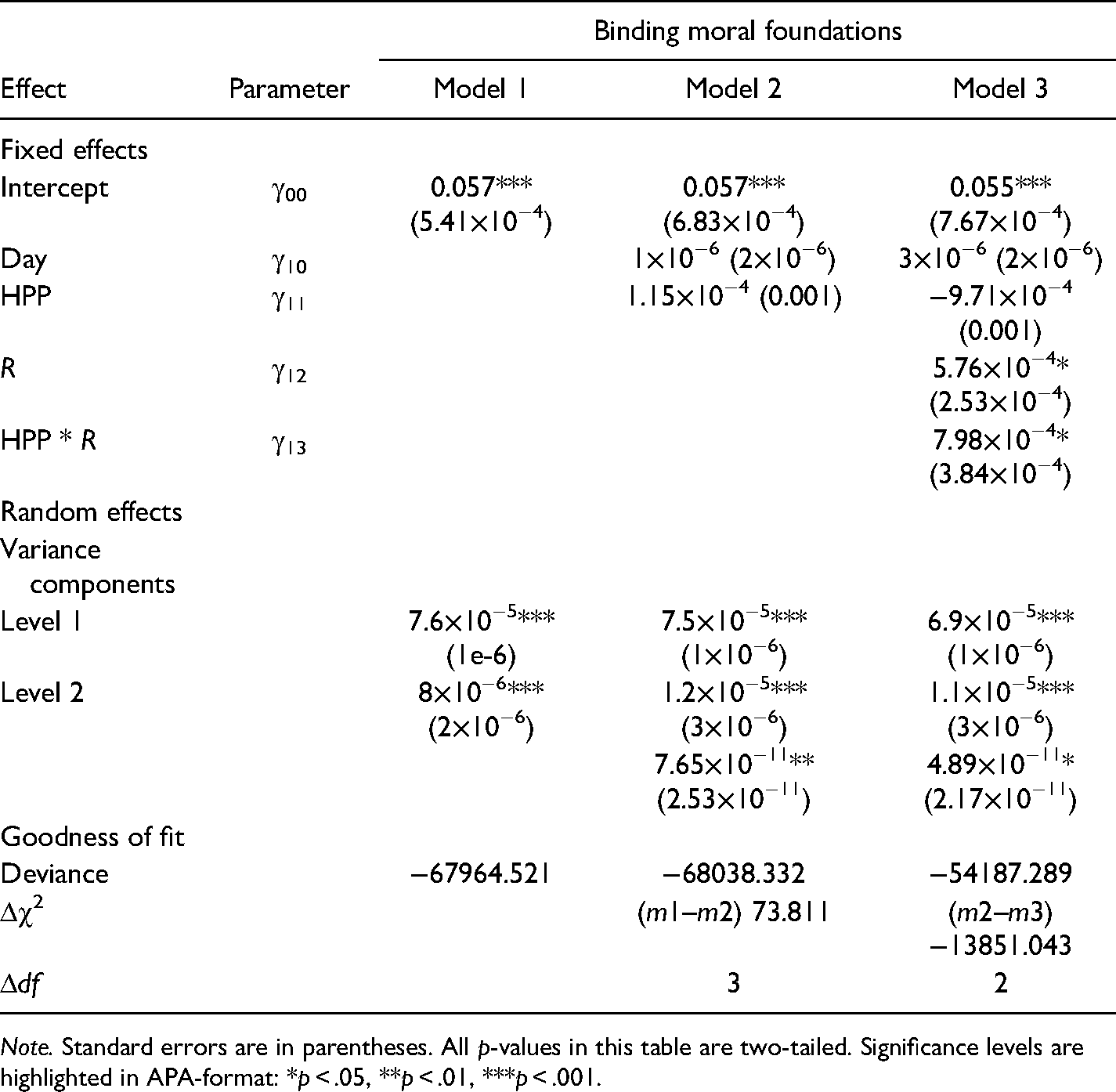
Further, we tested whether a region’s HPP positively predicts the daily use of binding moral foundations in regional COVID-19 news over time (H2). Our unconditional mean model (see Model 1 in Table 2) shows that 5.7% of the variance in the use of binding moral foundations can be explained by region. Then, we added the HPP index as a fixed effect along with the day and region as random effects (Model 2, Table 2). The result showed that HPP has no significant impact on the use of binding moral foundations in COVID-19 news language. Thus, we find that H2 is not supported. Next, to assess whether the regional, daily reproduction rate of COVID-19 (R) has an effect on the relationship between HPP and the use of binding moral foundations (RQ2) in language, we added both R and the interaction between HPP and R as fixed effects (Model 3, Table 2). We observe that the main effect of R (γ12 = 5.76 × 10⁻⁴, SE = 2.53 × 10⁻⁴, t [4,596] = 2.282, p = .023) and the interaction between HPP and R (γ13 = 7.98 × 10⁻⁴, SE = 3.84 × 10⁻⁴, t [3,483] = 2.077, p = .038) has significant effects on the use of binding moral foundations in language, thereby answering RQ2 in the affirmative. This full model is successful in explaining 11.4% of the total variance in the use of binding moral foundations in COVID-19 news language.
Model Parameters and Goodness of Fit for the Use of Binding Moral Foundation.
Note. Standard errors are in parentheses. All p-values in this table are two-tailed. Significance levels are highlighted in APA-format: *p < .05, **p < .01, ***p < .001.
To answer whether the regional, daily reproduction rate (R) of COVID-19 affects the relationship between HPP and the use of individualizing moral foundations in COVID-19 news (RQ3), we constructed two models following the logic established in the previously stated protocols for hypothesis testing. Our unconditional mean model (see Model 1 in Table 3) shows that 9.2% of the variance in the use of individualizing moral foundations can be explained by region. Our multilevel linear growth model (see Model 2 in Table 3) demonstrates that only the main effect of reproduction rate (γ12 = −7.62 × 10⁻⁴, SE = 3.16 × 10⁻⁴, t [5,284] = −2.410, p = .016) is significantly correlated with the use of individualizing moral language, thereby denying RQ3. This full model is successful in explaining almost 15.8% of the total variance in the use of individualizing moral foundations in COVID-19 news language.
Model Parameters and Goodness of Fit for the Use of Individualizing Moral Foundations.
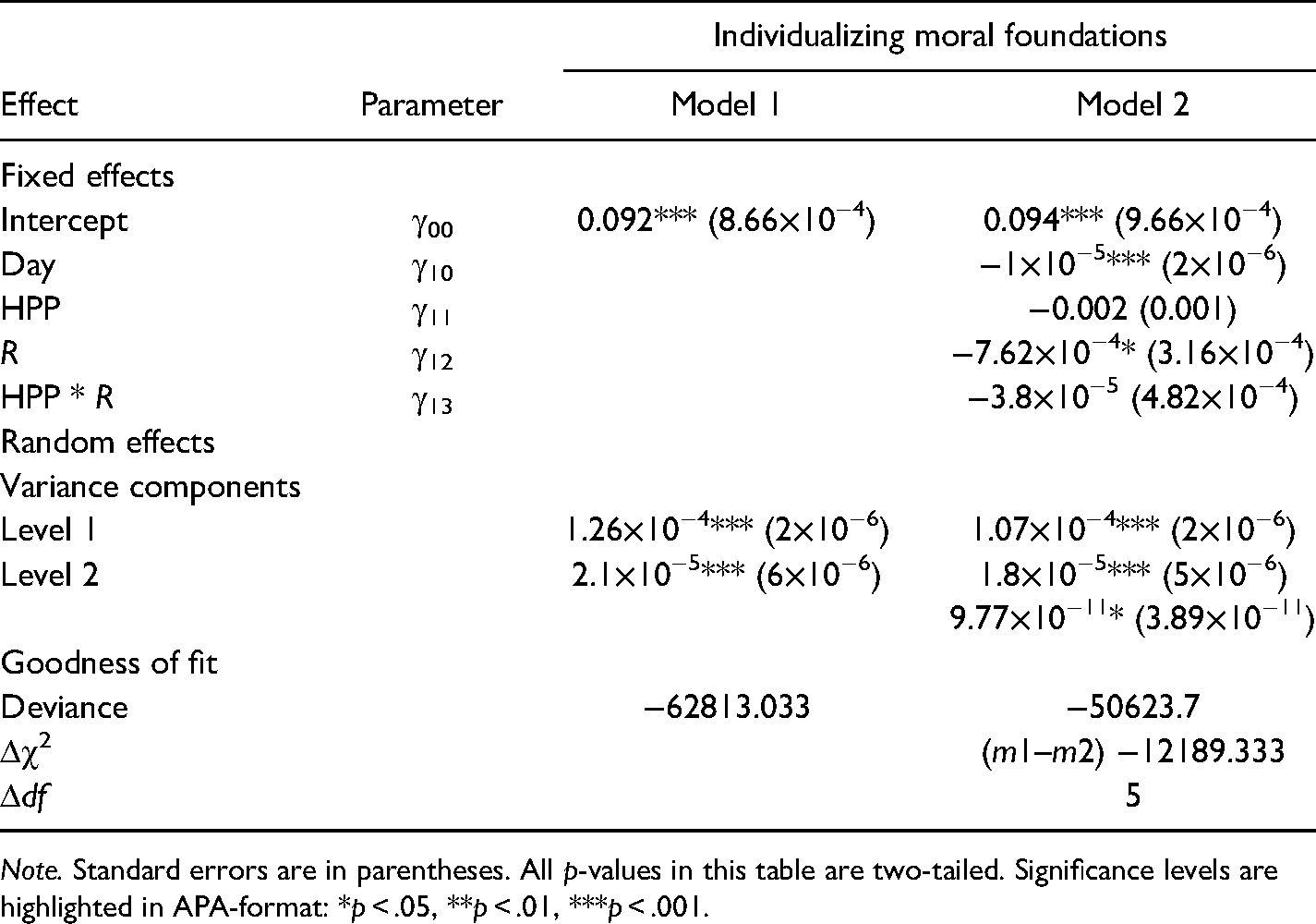
Note. Standard errors are in parentheses. All p-values in this table are two-tailed. Significance levels are highlighted in APA-format: *p < .05, **p < .01, ***p < .001.
Post-Hoc Analyses
In view of the previous results, we further explored the relationship between HPP, R, and the use of moral language in COVID-19 news in detail. Specifically, we were interested in assessing differential effects across moral virtues (i.e., emphasizing actions that uphold moral norms) or moral vices (i.e., emphasizing actions that violate moral norms) when using the binding or individualizing moral foundations. For this purpose, we first summed the binding virtue foundations (loyalty, authority, sanctity) into a virtue binding index, and likewise summed the binding vices (betrayal, subversion, degradation) into a vice binding index. Analogously, we summed the individualizing virtue foundations (care, fairness) into a virtue individualizing index, and likewise summed the individualizing vices (harm; cheating) into a vice individualizing index. Relying on the same multilevel linear growth modeling logic 1 as in the previous section, we found that only R had a main effect on the use of binding virtue foundations (γ12 = 3.85 × 10⁻⁴, SE = 1.79 × 10⁻⁴, t [5,593] = 2.153, p = .031; see Supplemental Table 2), whereas the interaction between HPP and R was a marginally significant predictor for the use of binding vice foundations (γ13 = 6.17 × 10⁻⁴, SE = 3.22 × 10⁻⁴, t [3,657] = 1.913, p = .056; see Supplemental Table 2). For the individualizing virtue foundations, HPP (γ11 = −2.33 × 10⁻³, SE = 8.48 × 10⁻⁴, t [37] = 2.749, p = .009), R (γ12 = −9.67 × 10⁻⁴, SE = 1.88 × 10⁻⁴, t [8,177] = −5.157, p < .001), and the interaction of HPP with R (γ13 = −9.96 × 10⁻⁴, SE = 2.85 × 10⁻⁴, t [8,496] = −3.492, p < .001) had statistically significant effects (see Supplemental Table 3). For the individualizing vice foundations, HPP (γ11 = −3.87 × 10⁻³, SE = 1.70 × 10⁻³, t [36] = −2.268, p = .029) was a significant predictor, whereas the interaction between HPP and R (γ13 = 9.41 × 10⁻⁴, SE = 4.92 × 10⁻⁴, t [3,805] = 1.912, p = .056) was a marginally significant predictor (see Supplemental Table 3).
Discussion
The aim of this study was to examine how news media’s attention on COVID-19 and moralizing language in COVID-19 news vary with respect to disease-relevant ultimate and proximate socio-psychological factors. Our results demonstrate that HPP is positively related to media attention on COVID-19 over time, suggesting that regions with higher historical pathogen threat have dedicated a greater proportion of news coverage to the discussion of the disease since its onset. This finding supports the notion that news media in high HPP societies may mirror and extend individuals’ BIS by increasing disease-related coverage in response to pathogenic stressors. In this role, news media can be argued to participate in the process of facilitating the reinforcement of anti-pathogenic attitudes. Analogously, from a classic news-value perspective (Lippmann, 1922; Weaver et al., 2007; Ziegele et al., 2014), it could be argued that disease-related information is of greater news value in regions with high HPP. As pathogens are of higher cognitive and motivational salience to individuals residing in high HPP regions (Thornhill & Fincher, 2014), and because news values guide not only journalists’ news selection, but also the selection of news by the audience (Eilders, 2006), news sources in these regions may capitalize on humans’ alarm system for sensational (disease-related) information (Ng & Zhao, 2020) to increase viewership and maximize profit. Yet, these remain speculative explanations, and there likely are additional factors that influence news media coverage, particularly in high HPP regions (e.g., a more restricted freedom of the press; Murray et al., 2013), which modulates the salience of pandemic news. Future work should identify such additional factors and test their effects on disease-related news content.
Moreover, we were unable to demonstrate a direct relationship between HPP and binding language in COVID-19 news. This lack of association is surprising considering previously shown relationships between individuals’ endorsement of binding moral norms and HPP. A possible explanation for this finding may be that discourse in global news media has generally become more individualistic in recent years (Santos et al., 2017). Evidence is now pointing towards an increasing prevalence of cultural markers that indicate a rise in individualistic practices. Supporting this argument, research finds that societies are practicing greater levels of self-expression (Inglehart & Baker, 2000), parents are increasingly choosing unique and distinctive names for their children (Ogihara et al., 2015; Twenge et al., 2016), and literary works, over time and cross-culturally, are becoming more reflective of individualistic rather than collectivist themes (Yu et al., 2015; Zeng & Greenfield, 2015). In fact, when considering the relationship between HPP and individualism, a recent study in the United States found that increases in pathogen prevalence were associated with increased individualist practices and individualist word use (Grossmann & Varnum, 2015). While the authors’ work was limited to only one country, we reason that they further bring into question the plausibility of establishing direct associations between HPP and binding language in disease-related news. Combined with the findings observed in response to H2 in the present study, there is some ground to argue for the proposition of a new research perspective that takes into account the rate of cultural change within societies in addition to evolutionarily determined factors.
Our findings in response to RQ2 illustrate that these shifts in language patterns are actually dependent on the interactions between historical sociocultural factors and contemporary environmental stressors. We demonstrated that immediate pathogen stress (i.e., COVID-19 reproduction rate; R) does play a moderating role in the elicitation of language in news media that includes representations of the binding moral foundations, especially in high HPP regions (compared to low HPP regions). Notably, as the pandemic worsened, it is likely that news media in high HPP regions more frequently relied on appeals for collective obedience, group allegiance, and public cleanliness to reduce the risk of pathogen transmission within their communities. Similarly, it is also plausible that influential individuals within high HPP regions—such as medical professionals or political leaders who strive to protect the in-group—have been emphasizing the binding foundations in regards to guidelines made to the public via news media. Concluding, it appears that cross-regional shifts in language surrounding COVID-19 (Ro, 2020), particularly with regard to moralizing language, is not solely a function of a region’s historical make-up, but rather that historical stressors and immediate pathogen stress (infection risk) interact in shaping the trajectory of disease-related language. These interactions provide a fruitful ground for further investigating the interplay between ultimate and proximate environmental factors when understanding language change in the context of the parasite-stress model.
Interestingly, in our post-hoc analyses, we observed that the interaction between HPP and R is significantly associated, albeit marginally (p = .056), with an increased word usage in news headlines highlighting that binding foundations are violated. Violations of authority, loyalty, and/or sanctity typically reflect instances when something is construed to be intrinsically damaging to the in-group and thus considered as “morally wrong,” keeping in mind the in-group’s well-being (Greene, 2013). With the onset of the pandemic, there was an emergence of stringent societal norms to protect in-group members via travel restrictions, an imposition of lockdowns, and the adoption of health safety precautions. Importantly, violating these group-oriented safety measures is a threat to the survival of members within communities, which may explain why we observed heightened news attention to binding moral violations in regions high in HPP and R.
At the same time, we did not observe an interaction of HPP and R in predicting the overall reliance on individualizing foundations in COVID-19 news coverage. Rather, we observed that the interaction between HPP and R mitigated the use of words that connote the upholding of individual-oriented moral concerns. Upholding notions of care and/or fairness typically reflect instances when something is construed to be intrinsically beneficial to the individual and thus considered to be “morally right,” thereby emphasizing the individual’s well-being. In contrast, we found that language with references to violations of individualizing foundations, analogous to the binding foundations, are indeed significantly, albeit marginally, represented in news media from high HPP regions. This finding may reflect the negative consequences that follow widespread pathogen transmission, particularly inflicting “harm” not only on individual lives within a community but also on the socioeconomic infrastructures that these communities operate through. When contrasted with our findings on the prevalence of binding violations in high HPP regions, which can be construed to represent direct threats to overall group well-being, the sensitivity towards individual harm and suffering in high HPP regions may reflect the overall greater unified response to harm in collectivist societies that have been shown to be higher in HPP (Triandis, 1995). Indeed, as mentioned previously, binding morality is not only about aversion to out-group members but is also associated with increased ethnocentric attitudes (Navarrete & Fessler, 2006), a propensity to be particularly sensitive towards the well-being of in-group members. Interestingly, our findings from RQ3 also suggest that as R increases, the representation of individualizing virtues actually decreases, pointing towards additional evidence that it may very well be in-group member suffering, in particular, that elicits such types of moral language patterns.
Limitations and Future Research
This study has limitations that warrant further discussion. Firstly, the applied automated content analysis procedure inherits various shortcomings that future research may wish to improve. We used a “bag-of-words” scoring procedure to identify individual moral words contained in news headlines from regional sources. While this approach is theoretically feasible for studying psycholinguistic phenomena in machine-translated multilingual textual content (Courtney et al., 2020; De Vries et al., 2018; Windsor et al., 2019), a major shortcoming of this approach is that semantic structures are ignored during the analysis. This has real implications on the interpretations made above which only emphasize the desirable effects moral language has on strengthening social cohesion during the pandemic. For instance, while the emphasis on the loyalty/betrayal foundation may certainly strengthen in-group cohesion, it is equally likely that such an emphasis in the media may be construed in political terms. Thus, it is plausible that many constituents may perceive the adoption of specific pandemic behaviors such as mask-wearing and social distancing to be reflective of political group affiliation (Allcott et al., 2020) and, therefore, react in direct opposition to health appeals made by officials from a different political background. Similarly, this research does not consider how individual moral saliences in the population may interact with moral content emphasized by news media. For instance, compliance with official health regulations may prove to be problematic for those people who value individual freedoms and are psychologically aversive to dominance by authority figures (Iyer et al., 2012). Thus, it is certainly plausible and worth considering that with an increased emphasis on language in news media that emphasizes the authority/subversion foundation, certain segments of the population may become even less likely to comply with pandemic guidelines (Byrd & Bialek, 2021). Finally, while news media discourse around infectious outbreaks and medical innovations (e.g., COVID-19 testing, vaccinations) typically emphasizes the sanctity/degradation foundation, such language may in fact prompt reactions of disgust, especially from those who are sensitive to the notions of bodily contamination (Amin et al., 2017; Hornsey et al., 2018). Disgust reactions have been routinely associated with avoidance behaviors in general (Clifford & Jerit, 2018; Kam, 2019) and its plausible that such reactions may also serve to be a contributing factor to lowering topical relevance for pandemic news (Fletcher et al., 2020), thereby reducing the overall efficacy of health messages surrounding desirable pandemic behavior.
Secondly, because news headlines are typically quite short, the likelihood of dictionary-based, moral signal detection was rather low in our study. Hence, to increase moral signal extraction, future research may (a) probe the use of automated content analysis procedures that rely on semantic similarity of moral words (e.g., Garten et al., 2018; but see Hopp et al., 2020a), and (b) supplement the analysis of news headlines with the analysis of full-text articles. Furthermore, given that prior validations of the eMFD (Hopp et al., 2020a) both relied on the same content domain (namely, news content) and used articles retrieved from the same online data repository (GDELT) as we do in the present study, we believe these validations should allow for extrapolation to more recent news content as well. Nonetheless, given time and resource constraints, we encourage that future studies should aim to further validate the automatically extracted moral content scores via crowd-sourced, manual content annotations on a set of randomly selected articles (Van Atteveldt et al., 2021).
Moreover, we cannot rule out the possibility that some of our news headlines were written or published by authors that reside outside of our examined regions. For example, it is very well possible that a journalist writing for India Times may have actually grown up and spent their entire life in Southern California, thereby causing a spurious effect on the relationship between a region’s historic environment and its associated language pattern in disease-related news. Analogously, our current analysis has focused on news headlines that simply mention COVID-19, without further specifying location (e.g., information about domestic versus international COVID-19 developments) or topical context (e.g., mask wearing). Hence, future research may complement our large-scale, quantitative analysis with a more qualitative, in-depth examination of journalistic practises during the COVID-19 pandemic across select regions and sub-topics.
Lastly, while our current study has focused on HPP and the COVID-19 reproduction rate as primary regional covariates for influencing the coverage of COVID-19 news, there likely exist several additional, socio-psychological environmental factors that guide the use of specific language patterns around COVID-19. For instance, stable environmental factors that warrant further exploration include a country’s general freedom of the press, population density, or socioeconomic standing, whereas a country’s stringency index (i.e., policy measures deployed to curb local infection spread) may be an important fluctuating environmental covariate for studying the public discourse surrounding COVID-19.
Conclusion
This study provides converging evidence that news media’s attention on COVID-19 and moralizing language in COVID-19 news vary with respect to disease-relevant, ultimate and proximate socio-psychological factors. Specifically, we showed that news media’s attention on COVID-19 is driven by a region’s HPP, while the use of moralizing language surrounding COVID-19 news coverage is largely driven by an interaction of historical pathogen stressors and immediate COVID-19 infection risk. Taken together, this work serves a first step for studying the cross-cultural, socio-psychological antecedents and determinants of language patterns adopted in COVID-19 related news, and highlights the importance of integrating historic, stable environmental factors with contemporary, dynamic fluctuations for deriving a more nuanced understanding of the complex relationships connecting disease-related language use and social psychology.
Supplemental Material
sj-docx-1-jlsp-10.1177_0261927X211044194 - Supplemental material for Does Regional Variation in Pathogen Prevalence Predict the Moralization of Language in COVID-19 News?
Supplemental material, sj-docx-1-jlsp-10.1177_0261927X211044194 for Does Regional Variation in Pathogen Prevalence Predict the Moralization of Language in COVID-19 News? by Musa Malik, Frederic R. Hopp, Yibei Chen and René Weber in Journal of Language and Social Psychology
Supplemental Material
sj-docx-2-jlsp-10.1177_0261927X211044194 - Supplemental material for Does Regional Variation in Pathogen Prevalence Predict the Moralization of Language in COVID-19 News?
Supplemental material, sj-docx-2-jlsp-10.1177_0261927X211044194 for Does Regional Variation in Pathogen Prevalence Predict the Moralization of Language in COVID-19 News? by Musa Malik, Frederic R. Hopp, Yibei Chen and René Weber in Journal of Language and Social Psychology
Footnotes
Declaration of Conflicting Interests
The authors declared no potential conflicts of interest with respect to the research, authorship, and/or publication of this article.
Funding
The authors disclosed receipt of the following financial support for the research, authorship, and/or publication of this article: The authors received financial support from the U.S. Army Research Laboratory (to R.W.), contract grant number: W911NF-15-2-0115; and from the John Templeton Foundation (to R.W.), contract grant number: 61292.

Supplemental Material
Supplemental material for this article is available online.
Notes
Author Biographies
References
Supplementary Material
Please find the following supplemental material available below.
For Open Access articles published under a Creative Commons License, all supplemental material carries the same license as the article it is associated with.
For non-Open Access articles published, all supplemental material carries a non-exclusive license, and permission requests for re-use of supplemental material or any part of supplemental material shall be sent directly to the copyright owner as specified in the copyright notice associated with the article.
