



Abstract
To what extent is minority language use in society imposed by social determinism, a force acting on individuals based on the language group's relative vitality in terms of demography, institutional support, and status? Can social determinism be countered by the force of self-determination sustained by group members’ personal autonomy, critical consciousness, and strong engaged integrated identity? These questions are addressed by testing a revised Self-determination and ethnolinguistic development (SED) model, using structural equation modeling. This model specifies how three categories of language socialization (enculturation, personal autonomization, critical consciousness-raising) mediate between objective ethnolinguistic vitality (EV) and four psycholinguistic constructs (engaged integrated identity, community engagement, linguistic competencies, subjective EV) in the prediction of minority language use. Results on a large sample of French Canadian students in different EV settings strongly support the SED model and show that social determinism can be at least moderately countered by psycholinguistic constructs that increase individual self-determination.
Keywords
For decades, research on minority language use and the survival of linguistic minorities has examined the ethnolinguistic vitality (EV) of minority groups. Giles et al. (1977) pioneered this area of research by defining EV as “that which makes a group likely to behave as a distinctive and active collective entity in intergroup situations” (p. 308). They advanced that three structural factors underlie a group's EV: demography, institutional support, and status. The more a language group has strong demographics (numbers and proportions), controls important societal institutions, and has a high status in society, the more it is likely to “survive and thrive as a collective entity in an intergroup context” (p. 308).
Giles et al. suggested that “a group's subjective assessment of its vitality may be as important as the objective reality” (p. 318). They also discussed sociopsychological factors related to EV, such as that of social identity (Tajfel, 1978), and the idea that minority language groups could envision “cognitive alternatives” to their current situation and exercise different strategies of social change, ranging from linguistic assimilation to competition with the dominant group (Tajfel & Turner, 1979). These strategies could depend on the perceived stability/instability and legitimacy/illegitimacy of their situation (Turner & Brown, 1978).
For over 40 years, researchers manifested interest in the ideas that one could analyze the objective vitality of language groups on a continuum, and that measures of group members’ subjective ethnolinguistic vitality (SEV) (Bourhis et al., 1981) could be correlated to a variety of sociopsychological variables (for recent overviews, see Bourhis et al., 2019; Smith et al., 2017). The EV framework inspired a large variety of theoretical models and numerous empirical studies.
The differences between objective and subjective aspects of EV are now widely recognized (Smith et al., 2017). The subjective aspects of EV have been developed considerably (Ehala et al., 2016), and new measures of objective EV have been proposed (Smith et al., 2017). With few exceptions (e.g., Landry et al., 2007a), the factors that mediate between objective EV and sociopsychological components of EV (e.g., SEV, ethnolinguistic identity) have not been subjected to theoretical modeling, and rarely studied empirically. The present study focuses on this important issue first addressed by Harwood et al. (1994) in their extended model of EV. They saw the Landry & Allard (1992) multi-level macroscopic model of additive and subtractive bilingualism as providing the “situation elements” and the basis for predicting vitality outcomes. They stated that Landry and Allard's notion of an individual network of linguistic contacts reflected objective EV and predicted SEV (see the third of Harwood et al.'s nine research propositions and their section on bilingualism, pp. 188–189). Building on this notion of an individual network of linguistic contacts, the self-determination and ethnolinguistic development (SED) model (Landry et al., 2007a) was the first to specify which types of linguistic contacts would predict key sociopsychological components of EV.
Purposes of the Study
The purposes of the present study are twofold. First, it provides a detailed presentation of the revised SED model, its rationale, and its hypotheses. The model shows objective EV to be related to three different types of minority group member bilingual socialization experiences and how each of these (enculturation, personal autonomization, and critical consciousness-raising) is related to crucial bilingual development variables: language competencies, group identity, community engagement, and subjective ethnolinguistic vitality. The model also shows that different language socialization experiences and bilingual development have specific effects on minority language use in different social domains: family, friends, media consumption, and public spaces. This relatively comprehensive model is of particular interest to minority language groups because of the special emphasis given to measuring the degree to which, on the one hand, external vitality factors socially determine language use, and on the other, the extent to which internal factors such as the engaged linguistic identity and community engagement of minority group members contribute to their self-determined language use. These are fundamental questions on the maintenance and loss of minority languages and their revitalization. Designing a model on these questions has involved unifying several theoretical frameworks, namely those of EV, social identity, self-determination, and critical consciousness-raising. Second, the study provides an initial empirical test of the model's hypotheses with a large sample of Francophone minority high school students experiencing different degrees of French vitality in Canada. However, before presenting the revised SED model, we briefly position it within the ethnolinguistic vitality framework.
A Macroscopic View of EV: From Society to the Individual
Landry et al. (2007a) proposed the macroscopic intergroup ethnolinguistic development model, using the idea of a macroscope to present a schemata of the EV framework. A macroscope is a conceptual tool that describes a phenomenon as a whole while also describing its parts and their interrelations (De Rosnay, 1979). This model portrays the minority group perspective in an intergroup rapport de force with a dominant group, spanning from the collective level (society) to the individual level.
As a macroscope, the model identifies four levels of analysis; the top two illustrate societal intergroup dynamics at the collectivity level and the lowest two focus on bilingual socialization and language development outcomes, including language use, at the individual level. The revised SED model we describe later is positioned at the two lowest levels of the macroscope. The macroscopic model posits that the more the minority group emphasizes the development of the minority language, the more the bilingual development of its members is additive, i.e. a second language is added without loss of the first (e.g., Cummins, 1981; Lambert, 1975; Landry et al., 2009a). Conversely, focusing on acquiring the dominant language is a subtractive process that can lead to minority language loss.
The macroscopic model proposes that group vitality in an intergroup context can be conceived of as a power struggle between a top-down force of social determinism and a bottom-up force of minority group self-determination. Social determinism is experienced when EV structural factors favoring the dominant language at the societal level lead to the subtractive bilingualism of minority group members and minority language loss. The opposing force of self-determination is based on a critical social consciousness of these external forces and on strategy development and action that focus on social change fostering additive bilingualism and minority language maintenance.
Research in Canada using the EV framework on French communities outside Quebec found that bilingual development was strongly socially determined. Using only the structural factors defining objective EV (mainly demographic vitality), different Francophone groups could vary markedly on the EV continuum, and a high percentage of variance could be explained on key psycholinguistic variables and language behaviors of group members without even considering their language socialization (see Landry et al., 2010, chapter 2). Landry and Allard (1992) compared the bilingualism of French minority groups and English majority groups and concluded that being bilingual is more a question of where you live than of who you are. Commenting on this research, leaders of the French communities asked if it was possible to counter such a strong social determinism and if additive bilingualism was possible in low vitality contexts. Research addressing these concerns focused on French schooling, since the Canadian constitution of 1982 and its Charter of Rights and Freedoms affirmed the right to schooling in the minority's official language, English in Quebec and French outside Quebec (Power, 2014; Supreme Court of Canada, 2020). Schooling in the French minority language was found to strongly foster additive bilingualism and Francophone identity (Landry & Allard, 1991, 1993, 2000) and the minority school was proposed as an essential milieu to foster self-determination of language use and community engagement (Landry et al., 2010).
Two models were derived from the macroscope to analyze the effects of self-determination: the cultural autonomy model at the collectivity level (Landry, 2009, 2018; Landry et al., 2007b), and the SED model at the individual level. The SED model, our focus in this article, studies self-determination by analyzing, on the one hand, the social determinism factors impacting the language socialization of minority group members and their bilingual development and, on the other hand, language experiences fostering personal autonomy and consciousness-raising that lead to self-determined language use.
Ultimately, minority situations require collective action for social change at the societal level. However, the self-determination of minority group members is important when it fosters their empowerment as agents of social change engaged in collective action aimed at language maintenance or revitalization. This idea has common ground with several social identity theory developments which identify factors contributing to the participation of group members in collective action (e.g., Chan, 2017; Hogg & Williams, 2000; van Zomeren, 2013). It also has commonalities with Ehala's notion of hot and cold ethnicities (Ehala, 2011). The remainder of this article focuses on the development of self-determination at the individual level and on the empirical verification and validity of the revised SED model.
The SED Model, its Variables and Hypotheses
How can minority group members counter social determinism and maintain minority language learning and use in low vitality contexts? The SED model focuses on the objective vitality of the group and how it impinges on the language socialization of minority group members in both a minority and a majority language. It analyzes how the bilingual development outcomes of language socialization affect the use of the minority language relative to that of the dominant language. Bilingual socialization is seen as the key variable that mediates between objective EV and bilingual development as well as the most proximal cause of this development.
Figure 1 is a revised version of the SED model portrayed in earlier publications (see Appendix). The revised version encompasses objective EV, three categories of bilingual socialization, and their relationship to four sociopsychological constructs of bilingual development and four language use domains. We now define the model's constructs and present its hypotheses. Structural equation modeling (e.g., Kline, 2011) is used to test this model (see Method).
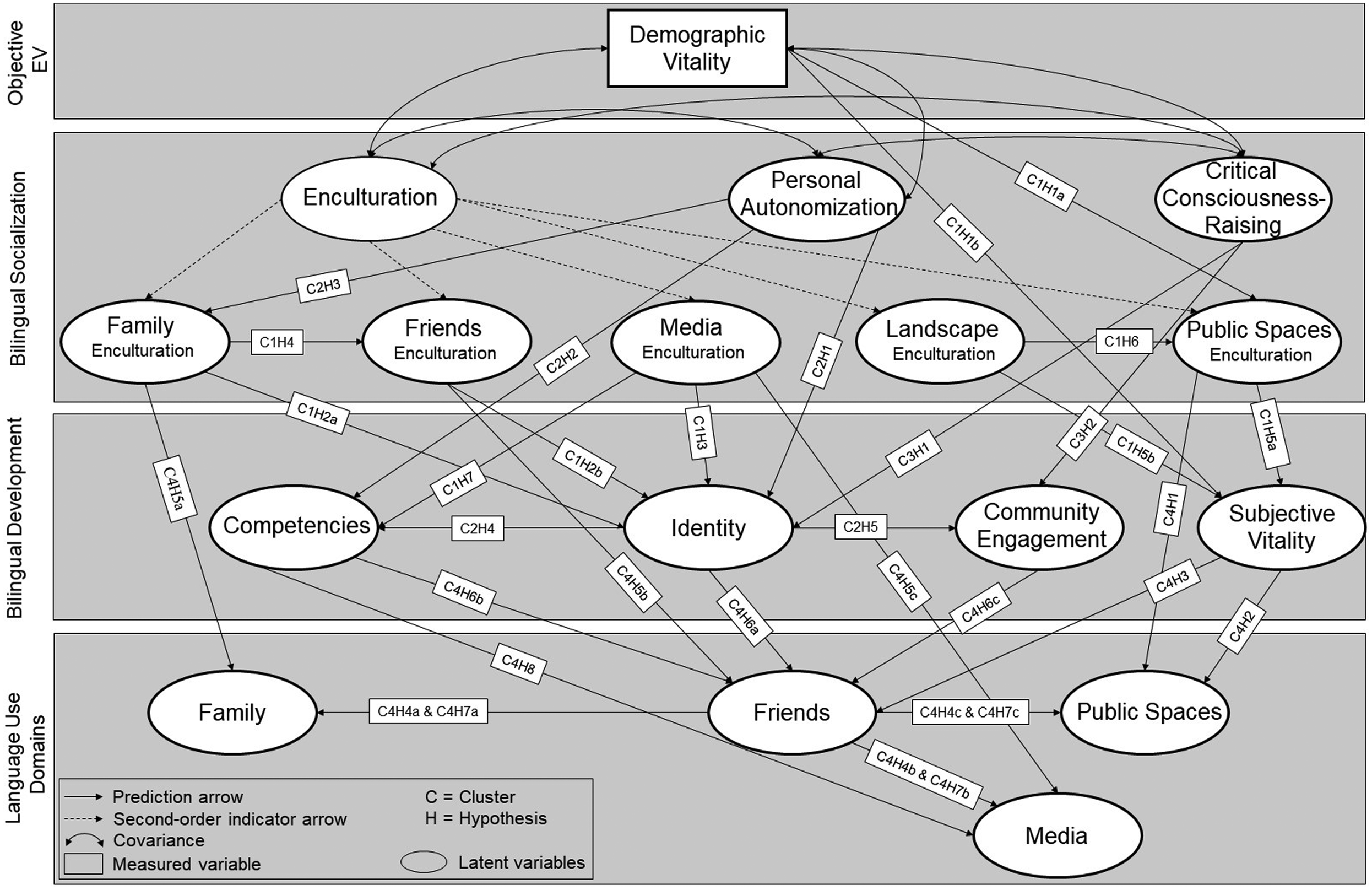
Revised self-determination and ethnolinguistic development (SED) model (adapted from Landry et al., 2007a, 2010)
This model takes into consideration the objective linguistic vitality of the group, not only as a group characteristic but also as a phenomenon experienced by individuals in their environment. Demographic vitality is in itself a strong determinant of language contacts and language development (Landry et al., 2010) and one of the best predictors of language use in society (Lachapelle & Lepage, 2010). In the rectangle at the top of Figure 1, demographic vitality (a measured variable from the Canadian census), is the proportion of Francophones in the municipality inhabited by each participant in the study. This proportion reflects the presence of the minority group in each participant's linguistic experiences. Demographic vitality is expected to covary with the three categories of language socialization (curved bidirectional arrows). As a general proposition of the model, demographic vitality is expected to be more strongly related to enculturation (quantity of language contacts) than to personal autonomization and critical consciousness-raising (qualities of contacts). Indeed, enculturation is seen as the most socially-determined category of language socialization, i.e., the most strongly and directly related to objective EV.
Latent constructs (shown as ovals in the model) are not measured directly; they are inferred from their indicators which are measured variables defining a construct (see Method). Enculturation encompasses five domains on a private-public continuum in which enculturation and language learning occur. Each enculturation domain is a second order indicator of the more general construct of enculturation (depicted by dotted lines) since each domain has its own specific indicators (i.e., measured variables). The remaining unidirectional arrows on solid lines in Figure 1 represent specific hypotheses to be tested. To simplify their presentation, we grouped them into four clusters, one for each of the three bilingual socialization categories, and one for the four language use domains. Clusters and their corresponding hypotheses are numbered to help locate them in Figure 1. We now turn to the hypotheses for each category of bilingual socialization, and finally for language use.
Bilingual Socialization Categories and Hypotheses Clusters
Enculturation hypotheses cluster
Enculturation is the basis of language learning, an experience that can be very different in low and high vitality contexts, and is expected to be strongly socially determined. Hamers and Blanc (2000) define enculturation as “part of the socialisation process by which a child acquires the rules of behaviours and the values of his culture” (p. 371). In the SED model, the enculturation construct designates the degree of contact with one's ingroup minority language relative to that with the outgroup majority language. Group members learn not only the languages with which they are in contact, but also the social norms dictating their use (e.g., when in contact with members of the majority, use their language). Enculturation becomes the basis of language habits that begin in early childhood and influence which language is used in different domains on a private–public continuum (e.g., when at home, use French; when shopping, use English). In this study, we define enculturation in terms of the quantity (i.e., proportion) of French and English language contacts during childhood; it combines participant retrospective estimations of their language contacts from ages 2 to 6, and from ages 7 to 12. Questions on language contacts in these two childhood periods were introduced well after those on their current language use in adolescence, to help participants distinguish between their childhood enculturation and their present language use in adolescence, a major period of identity formation (Phinney, 1990). As a person gets older, language use is influenced not only by past habits of childhood enculturation, but also by one's identity and community engagement.
There are reasons to believe that demographic vitality is a strong determinant of enculturation in public spaces. Past research (Landry et al., 2009b) found that demographic vitality was most strongly related to variables measuring language status: enculturation in the public space domain and subjective ethnolinguistic vitality. We can therefore expect that, aside from its covariation with enculturation—and thus indirectly with all its subdomains—demographic EV will be especially associated to enculturation in public spaces and subjective ethnolinguistic vitality. A first enculturation cluster (C1) hypothesis is:
Family life and friendship networks are domains of childhood enculturation in the private sphere. They foster important aspects of bilingual development, especially in relation to how strongly an individual identifies with the minority language group (Landry et al., 2006). Ethnolinguistic identity is a solidarity or intimacy variable reflecting belongingness to a group (e.g., Ashmore et al., 2004; Noels, 2014). Identity is also a “situated” experience, its saliency varying with context (e.g., Clément and Noels, 1992). Landry et al. (2006) found that enculturation in private domains was a predictor of identity, but not of subjective ethnolinguistic vitality (SEV). They suggested that contrary to identity (a solidarity construct), SEV is essentially a status variable. A second hypothesis in the enculturation cluster is:
Enculturation in the media may also be related to identity development. Landry et al. (2006) defined enculturation in the media as a relatively private domain. Although controlled by public institutions (e.g., Moring et al., 2011), this language domain provides relatively private experiences; experienced in the home and with friends and family, media consumption is influenced by one's personal tastes and interests. Media consumption has also been found to be associated to social identity gratification (e.g., Harwood, 1997; St-Onge, 2021; Vincze & Freynet, 2014). A third enculturation hypothesis is:
In low vitality contexts, families may not always find it feasible to foster enculturation of their children in the minority language. The presence of friends and relatives speaking only the dominant language sometimes inhibits the use of the minority language in the home. However, research suggests that families can have some influence on enculturation with friends in early childhood (Landry et al., 2009b). We hypothesize that:
Later in life, language use with friends is much less under the control of the family. This is why a reverse effect is tested for language use with friends in adolescence (see the language use hypotheses cluster below).
Beyond those shaping one's identity, there may also be domains of bilingual enculturation that influence whether individuals believe that their language is strong and valued in their community, i.e., the perceived legitimacy or status of their language. As already hypothesized, subjective ethnolinguistic vitality (SEV) is a status variable; it is the perception of the vitality and status (Bourhis et al., 1981) or strength (Ehala, 2010) of a language group (see also Allard and Landry, 1994). Landry et al. (2006) found that SEV was best predicted by enculturation in public spaces and the linguistic landscape. Landry and Bourhis (1997) found that the linguistic landscape was the strongest predictor of SEV, but they did not control for language enculturation in the public domain. SEV is important because it can influence an individual's propensity to use the minority or the dominant language in certain domains (see C4H2 & C4H3 in the language use cluster of hypotheses). We hypothesize that:
In fact, the linguistic landscape (i.e., language of commercial and public signs) may itself have a carryover effect on the language spoken in public spaces. This was proposed by Landry and Bourhis (1997). The more a language is dominant in the landscape, the more it is likely to be used in public spaces. We therefore hypothesize that:
The relationship between enculturation domains and bilingual competencies, however, can only be partially explored by this model. Minority language schooling is the most important variable fostering competencies in the minority language, a strong predictor of identity (Landry & Allard, 1996; see also Saindon et al., 2011, for French as a second language) as well as a crucial factor of self-determination (Landry et al., 2010). But the present study could not test for the effects of degree of French language schooling because all participants received their schooling in French, with the exception of English as a second language. Other predictors of French competencies are enculturation through French media, intellectual aptitude, and socioeconomic status (Landry & Allard, 1996). The only enculturation domain in the SED model remaining as a potential predictor of French competencies in this study is that of the media. We hypothesize that:
If enculturation were the only factor in determining bilingual development, its strong relationship to demographic vitality could signal that bilingual development and language use are almost entirely socially determined. The two remaining categories of language socialization, i.e., personal autonomization and critical consciousness-raising, represent qualitative aspects of language socialization that are less directly influenced by social structures of EV than enculturation and more responsive to conscious control by the minority. They are hypothesized to foster the self-determination force needed to counter social determinism by helping individuals to internalize the reasons for their language use and manifest more active engagement in their language choices (Landry & Rousselle, 2003).
Personal autonomization hypotheses cluster
In order to counter social determinism in low vitality contexts, people need to be autonomous and self-motivated. Language experiences contributing to personal autonomization in the SED model are defined from the perspective of self-determination theory (Deci & Ryan, 2002; Ryan & Deci, 2017). This theory posits that healthy psychological growth and autonomy depend on life experiences contributing to the satisfaction of three basic and universal psychological needs: autonomy, competence, and relatedness. When these needs are satisfied, behaviors are more autonomous and internally motivated. Use of the self-determination theory framework in language research has mostly been complementary to that of Gardner (Gardner, 1985, 2007) in second and foreign language motivation studies (e.g., Noels, 2001; Noels et al., 2019).
Self-determination theory attaches particular importance to “integrated identity” when discussing personal and social identity. Ryan and Deci (2017) affirm that: A growing body of research on identity formation within SDT clearly shows that: (1) persons have multiple identities; (2) these identities vary in their relative autonomy and in their integrity and coherence with one another; (3) more autonomous and integrated identities are facilitated by need-supportive social contexts; and (4) the more integrated an identity is, the greater its benefit is for individuals’ flourishing. (p. 392)
A study based on the SED model has shown that identity formation in a context favoring personal autonomization correlates with more positive evaluations of life satisfaction and health (Landry, Deveau, et al., 2009; see also Dragojevic et al., 2018).
Analyses of the role of personal autonomization (language socialization supporting the satisfaction of basic needs) in the original SED model has led us to define a more elaborate linguistic identity construct and to create a more parsimonious SED model. Initially, our identity construct had two components based on Tajfel's classic definition of social identity: “that part of an individual's self-concept which derives from their knowledge of their membership in a social group (or groups) together with the value and emotional significance attached to that membership” (Tajfel, 1981, p. 255). Deveau et al. (2005) and Deveau (2007) found that items measuring the first part of Tajfel's definition, such as those elaborated by Landry and Allard (1990), measured identity self-definition. They found that this factor was distinct yet related to a second factor, named identity engagement, related to the second part of Tajfel's definition. Identity engagement came with items that measured other constructs like self-categorization (Turner et al., 1987), group self-esteem (Luhtanen & Crocker, 1992) and commitment to the group (Ellemers et al., 1999). This two-component identity construct was a strong predictor of other constructs in the original SED model: satisfaction of basic needs (ACB feelings), desire to integrate the minority community, and intrinsic motivation to learn and use the language (see Appendix). Further analyses indicated that a single multi-component identity construct could synthesize these constructs. 1 We call this six-component construct engaged integrated linguistic identity, the grouping of these components creating a richer identity construct while contributing to a more parsimonious model (see Results).
Aimed at identifying factors related to self-determination, the revised SED model, combining elements of EV theory, social identity theory, and self-determination theory, proposes the following hypotheses in the personal autonomization cluster (C2). First, it posits that the language experiences that contribute most to an individual's autonomy also foster identity development:
Moreover, because personal autonomization experiences in school predict school achievement (e.g., Reeve, 2002; Ryan & Deci, 2017, chapter 14; Vecchione et al., 2014), it is hypothesized that:
It is also hypothesized that parents who are supportive of their children's basic needs while providing French enculturation in the home will lead to the children's more frequent use of French in early childhood within the family:
Finally, the new construct of engaged integrated identity, comprising identity self-definition, engaged identity, satisfaction of basic needs, desire to integrate the minority community and intrinsic motivation to learn and use the language, is hypothesized to be related to the other two psycholinguistic constructs that are expected to foster self-determination of language behavior (competencies and community engagement).
Critical consciousness-raising hypotheses cluster
In order to counter social determinants that hinder minority language use in low vitality contexts, group members need to acquire, along with autonomy and self-motivation, awareness of their situation and of the potential for change. Critical consciousness-raising constitutes the third category of language socialization in the SED model. This construct, named conscientization in our original SED model (see Appendix), is based on the work of Freire (1973, 1981) and the ensuing development of critical pedagogy (e.g., Cummins, 2000; Ferrer and Allard, 2002; Jemal, 2017; Kumashiro, 2000). Critical consciousness-raising consists of ethnolinguistic experiences contributing to a person's critical consciousness of power relations between a dominant outgroup and the person's minority ingroup. It also comprises their awareness of the consequences of these power relations on minority ethnolinguistic development or potential for development, and on the minority group's actual sociolinguistic situation and potential for emancipation and vitality (Allard et al., 2005). Critical consciousness-raising can be formal (e.g., through schooling) or informal (e.g., one's personal experiences) and is on a continuum ranging from mere awareness to critical consciousness. One can experience critical consciousness-raising directly as an actor or indirectly as an observer (by vicarious learning, as proposed by Bandura, 1977). Whereas personal autonomization influences one's internal motivation to learn and use the minority language, critical consciousness-raising fosters engaged language behaviors that make up the community engagement construct in the bilingual development level of the model. We consider critical consciousness-raising the most essential element for self-determination and participation in collective action aimed at social change and language maitenance or revitalization (Landry et al., 2010; see also Godin et al., in press).
Allard et al. (2009) defined three levels of engaged language behaviors (i.e., community engagement) that become increasingly difficult to attain in a minority context. The lower level of engagement is the valorization of the group's language and culture (e.g., encouraging someone to attend the minority school). A second level is that of affirming oneself in situations where the group's situation is underprivileged (e.g., asking for services in the minority language). The higher level of engagement is manifest when one takes part in asserting the group's rights and militates in favor of its recognition, both of which involve a confrontation with the dominant group or partaking in “social competition” (Tajfel & Turner, 1979). Allard et al. (2009) found that the three levels of engagement can be reduced to two interrelated factors: (1) valorization and (2) self-affirmation and assertiveness. Only the latter factor is used to define the community engagement construct. Two hypotheses compose the critical consciousness-raising cluster (C3):
Language Use Hypotheses Cluster
The purpose of the SED model is to compare the strength of factors sustaining social determinism with that of factors fostering self-determination in their effects on language use in minority situations. The last cluster of hypotheses (C4) comprises all constructs hypothesized to predict language use in four domains. Some of these constructs represent the forces of social determinism, others, those of self-determination. We posit that the effects of enculturation components, stemming from objective EV social structures and predicting language use, are primarily socially determined. Social determinism can be a positive or a negative force for the minority group. It is negative in low vitality contexts, when social structures impose enculturation and the ensuing socialized behaviors in the dominant language. It is positive when objective EV minority group resources or relative cultural autonomy (e.g., demographic density, institutions such as schools and media, and status or legitimacy factors such as minority rights) offer opportunities to use the minority language. Self-determination is mainly enhanced by resources that favor “language socialization from within” (Landry & Rousselle, 2003), as when the family and institutions controlled by the minority (e.g., schools and media) enhance qualitative aspects of language socialization (personal autonomization and critical consciousness-raising) that lead to internalized personal resources such as engaged integrated linguistic identity and community engagement. Personal autonomization and critical consciousness-raising are both expected to strengthen minority language use in society. Subjective ethnolinguistic vitality, a status variable, is the only bilingual development component expected to reinforce language use from a social determinism perspective.
Research has shown the importance of peer influence on many aspects of adolescent behavior (e.g., Albert et al., 2013; Steinberg & Morris, 2001), including language development (e.g., Allard and Landry, 1994: see language vitality beliefs concerning social models; Ribeiro et al., 2017). We therefore posit language use with friends as the core language use construct, the latter mediating the three other language use domains.
Two patterns of hypotheses are proposed. The first pattern (C4H1 to C4H5) pertains more to social determinism. One aspect of this first pattern relates to public spaces:
The other aspects of this first pattern of hypotheses relate to the effects of determinants on more private domains of language use and consumption. Since enculturation in public spaces and subjective ethnolinguistic vitality are expected to reflect the objective EV construct of demographic vitality (see hypothesis C1H1 in the enculturation cluster), and since language use with friends is our core language use construct mediating language use in other domains (see above), we hypothesize that:
It is of note that minority language use by children in the family domain is relatively stable until they leave home (Lachapelle & Lepage, 2010). Minority language use is therefore expected to be more strongly related to early enculturation in the stable family domain than in the constantly evolving domains of friends and media.
The second pattern of hypotheses (C4H6 to C4H9) pertains to self-determination. Three psycholinguistic self-determination constructs (engaged integrated identity, linguistic competencies, and community engagement) are hypothesized to be related to language use, while the friendship domain remains the core language use construct. We therefore hypothesize that:
Moreover, in relation to the expected effect of media enculturation on linguistic competencies (see hypothesis C1.7 in the enculturation cluster), it is hypothesized that:
Finally, because all three bilingual development constructs that relate to self-determination in the model are expected to foster minority language use, it is hypothesized that:
This last hypothesis cannot be reflected in Figure 1 but the effects are measured separately by removing the friends domain as a mediating variable and calculating the direct effects on each language use domain. These are presented in the Results section.
Method
Population
Although French is a co-official language in Canada, the only official language in Quebec and an important language internationally, Francophones outside Quebec are a rather small minority. In the rest of Canada, the 1.07 million French mother tongue population represents 4% of the population. This percentage drops to 2.6% when language most spoken at home is the criterion. Their share of provincial populations ranges from less than 1% in some provinces and territories to 32% in New Brunswick, the only officially bilingual province. Outside Quebec, more than 85% of Francophones are bilingual compared to only 7% of Anglophones. Language transfers (languages other than French spoken most often at home, overwhelmingly English) are approximately 40%, ranging from 11% in New Brunswick to over 70% in some provinces. Only about half of Francophone parents transmit French as the mother tongue to their children (all data from the 2016 census and Statistics Canada, 2017a, 2017b). Although Francophone parents have a constitutional right to French education, only about 50% of their children attend French schools, 15% are in English schools in various French as second language immersion programs, and 35% are in a regular program in English schools (Corbeil et al., 2007; Landry, 2014). A strong negative factor related to language transfer and school choice is exogamy (Corbeil et al., 2007), which is the case for two thirds of these parents (Vézina & Houle, 2014). Exogamous Francophone parents transfer French mother tongue to only 29% of their children and enroll only 34% of their children in French schools, compared to 91% and 88%, respectively, for endogamous Francophone parents.
A sample of 8,124 students from 143 French-language high schools in all Canadian provinces outside Quebec and two territories (Yukon and the Northwest Territories) took part in the study, which covered the 2004–2005 and 2005–2006 school years (86% of all existing French high schools). Most students were in Grade 11 (81%), but some from grades 10 and 12 in small schools also took part. Average age was 16.5. The data of students who had been present for only one of the two days of testing and of those with over 9% missing data were removed from the database. Multiple imputation for missing data using LISREL (Du et al., 2001) resulted in a file of 5,677 cases with complete data.
Measuring Instruments
Students completed two questionnaire booklets and linguistic competence tests in English and French. The latter used the cloze deletion test technique (Oller Jr., 1979). Because of space limitations, the many questionnaire scales are not described here. Their descriptions and descriptive results are reported in Landry et al. (2010) (See reference for download information). All scales are of nine points. Except for the critical consciousness-raising and community engagement constructs, all indicators of latent constructs are relative measures (French relative to English). All enculturation and language use indicator scores measured the use of French relative to that of English (9 = totally in French and 1 = totally in English). For all other indicators, English scores were subtracted from the French scores (scores could range from −8 (very English dominant) to + 8 (very French dominant).
Procedure
The questionnaires were administered over two consecutive days, in one 75-min period per day. On day 1, a timed 20-min English cloze test was administered, followed by the first questionnaire booklet which contained demographic data questions and most of the questions measuring the psycholinguistic variables. On day 2, a timed 20-min French cloze test was administered first, after which students answered the second questionnaire booklet on language socialization experiences.
Analyses
Structural equation modeling is a powerful statistical procedure. It can verify if conceptual constructs in a model are well represented by measured indicators (the measurement model) and if relations between constructs are consistent with the theoretical model (the structural model). Moreover, the multiple relations between constructs tested consider (control for) all other relations in the model. We used EQS 6.3 for Windows (Bentler, 2003) to test the revised SED model by means of structural equation modeling. Before this test, we used confirmatory factor analyses using EQS to test for the relative independence of the model's constructs, to check for loadings of latent constructs on their respective theorized indicators, and for cross-loadings. After several indicators were removed because their latent construct did not predict them adequately, model adequacy measures confirmed the relative independence of its constructs.
As proposed by Kline (2011), we used four measures of model adequacy or “goodness of fit to the data”: Chi-square test (χ 2 ), Comparative Fit Index (CFI), Standardized Root Mean Square Residual (SRMR), and Root Mean Square Error of Approximation (RMSEA). We also report the percentage of standardized residuals having absolute values >.10. EQS gives the results of two post hoc tests that can help bring more precision to the theoretical model. The Wald test shows which paths should be removed from the model because they are not statistically significant. The Lagrange Multiplier test calculates paths and covariates that can be added to the model to improve it.
Results
The measurement model depicts the links between latent variables and measured indicators. The structural model specifies a regression structure among latent variables that postulates links between latent variables that “hypothesize the impact of one latent construct on another in the modeling of causal direction” (Byrne, 2006, p. 7).
Measurement Model
The model's constructs loaded adequately on their respective indicators. Due to space limitations, detailed results of the measurement model are available as supplemental material in the online version of this article.
Structural Model
Figure 2 shows the results of the final structural model. The model's fit to the data was very good: χ2 = 12735.026, df = 855, p = 0.000; CFI = 0.951; SRMR = .035, RMSEA = 0.049 (90% confidence interval = 0.049–0.050). Overall, 98.89% of the standardized residuals were between 0.1 and −0.1. None were above 0.140. Statistical significance of χ2 estimation was probably due in part to large sample size.
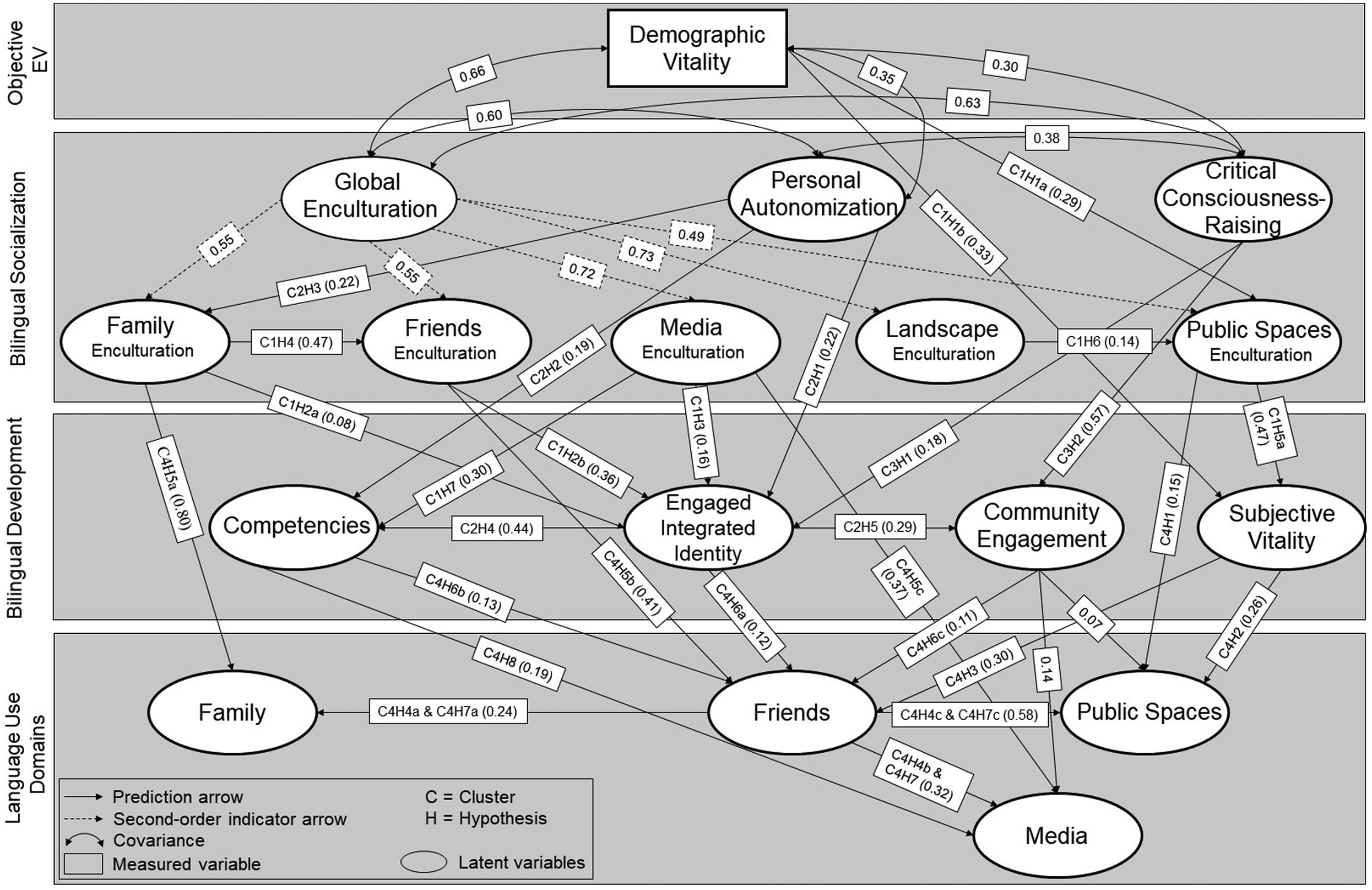
Structural equation modeling results for final revised self-determination and ethnolinguistic development (SED) model.
The covariances among all pairs of exogenous constructs that represent the three categories of language socialization and demographic vitality (curved bidirectional arrows at the top of the model) were 0.60 (R2 = 0.36) between enculturation and personal autonomization, 0.63 (R2 = 0.40) between enculturation and critical consciousness-raising, and 0.38 (R2 = 0.14) between personal autonomization and critical consciousness-raising. The two qualitative aspects of language socialization shared more variance (R2) with enculturation (36% and 40%, respectively) than between themselves (14%). Covariance between demographic vitality and enculturation (0.66, R2 = 0.44; this covariance is 0.76, R2 = 0.58 before demographic vitality predicts other measures) was much higher than that of demographic vitality with personal autonomization (0.35, R2 = 0.12) and critical consciousness-raising (0.30, R2 = 0.09). This supports the general proposition that objective EV is more strongly related to enculturation (the quantity of language contacts) than to the qualitative aspects of these language contacts.
The first hypothesis in the enculturation cluster (C1H1) was that, aside from its covariation with enculturation, and thus indirectly with its components on the private–public continuum, demographic vitality would have a direct relationship with enculturation in the public space domain (C1H1a) and subjective ethnolinguistic vitality (C1H1b), two status variables reflecting EV. These hypotheses were supported with direct path coefficients of 0.29 and 0.33, respectively.
The hypotheses that enculturation in the family (C1H2a), the friendship network (C1H2b), and via the media (C1H3) predict identity were supported with direct paths of 0.08, 0.36, and 0.16, respectively; as hypothesized, none of these constructs were related to SEV. The direct effect of enculturation in the family on engaged integrated Francophone identity is small. However, part of this effect is mediated by the friendship network which is strongly predicted by the family domain (0.47), supporting hypothesis C1H4. As hypothesized, enculturation via the French media (C1H7) was related to stronger French competencies (0.30). Aside from a direct effect of demographic vitality (C1H1b), only enculturation in the two status domains were related to subjective ethnolinguistic vitality. Enculturation in public spaces had a strong effect (0.47), but the linguistic landscape had only an indirect effect on subjective vitality, through its carryover effect on enculturation in public spaces. These effects supported hypotheses C1H5a and C1H6 but hypothesis C1H5b (removed from Figure 2) was only partially supported. The French linguistic landscape was related to more French enculturation in public spaces, a carryover effect of 0.14 (C1H6), but its effect on subjective ethnolinguistic vitality (C1H5b in Figure 1) was completely mediated by enculturation in public spaces. However, when the direct effects of demographic vitality on enculturation in public spaces was removed, the carryover effect of the linguistic landscape was stronger (0.28) and the French landscape did have a direct effect on subjective vitality (0.20).
All five hypotheses in the personal autonomization cluster (C2) were supported. Engaged integrated identity loaded well on all its components (see Supplemental Material in online version), suggesting that they all contributed to the definition of the new more elaborate identity construct. Personal autonomization was directly related to engaged integrated identity (0.22), linguistic competencies (0.19), and family enculturation (0.22). These effects supported hypotheses C2H1, C2H2 and C2H3, respectively. In turn, engaged integrated identity predicted competencies (0.44) and community engagement (0.29), thereby providing support for hypotheses C2H4 and C2H5.
The two hypotheses stemming from the critical consciousness raising cluster (C3H1 and C3H2) were supported. Critical consciousness-raising predicted engaged integrated identity (0.18) and had the strongest direct effect on community engagement (0.57).
The last cluster of hypotheses proposed two patterns of relations, one related to social determinism and the other to self-determination. Hypotheses in the former were all supported. Early enculturation in public spaces had a direct effect on later language use in that domain (0.15), part of which was mediated by subjective ethnolinguistic vitality (0.26). These results supported hypotheses C4H1 and C4H2, respectively. Subjective ethnolinguistic vitality predicted language use with friends (0.30) and, as hypothesized, language use with friends mediated this social determinism by having direct effects on the use of French in the other three domains. These effects supported hypotheses C4H3 and C4H4. But the relative size of the effects for hypothesis C4H4 (C4H4a, C4H4b and C4H4c) cannot be specified before the effects of the self-determination variables (C4H7a, C4H7b and C4H7c) are also taken into consideration (see below). As expected, each enculturation domain predicted its respective language use construct: media (0.37), friends (0.41), and family (0.80), supporting hypothesis C4H5 for each domain (C4H5a, C4H5b and C4H5c).
Most of the hypotheses concerning self-determination effects were supported. As postulated in hypothesis C4H6, (a) engaged integrated identity (0.12), (b) linguistic competencies (0.13), and (c) community engagement (0.11) each predicted language use with friends, but with relatively weak effects. Language use with friends in turn mediated these effects on the other three language use domains (C4H7a, C4H7b, C4H7c). Below, we calculate the relative parts of these mediated effects that are socially- and self-determined. Linguistic competencies predicted French media use (0.19), giving support to hypothesis C4H8. When not mediated by the core language use construct (friends), all self-determination constructs had direct effects on all language use domains, albeit weakly for some, giving support to hypothesis C4H9 (not shown in Figure 2). However, two effects which were not hypothesized in Figure 1 improved the model's fit to the data slightly and were added to Figure 2, as suggested by the Lagrange Multiplier test. Even when mediated by the friends’ language use domain, community engagement was still directly related to more use of French in the media (0.14), and had a weak statistically significant relationship with the use of French in public spaces (0.07). No other relations suggested by the Lagrange Multiplier test improved the model.
In structural equation modeling, a mediated effect (Baron & Kenny, 1986; Little et al., 2007) is confirmed when a statistically significant effect is either no longer statistically significant (complete mediation) or is weakened (partial mediation) when a mediating variable is added. As found in relation to hypothesis C4H9, all three self-determination variables, when not mediated by language use with friends, had higher direct effects on the other language use domains. For example, when not mediated by language use with friends, community engagement was more strongly related to use of French in public spaces (0.22 instead of 0.07), and its prediction of French media use was 0.24 instead of 0.14. Similarly, the prediction of French media use by linguistic competencies increased from 0.19 to 0.32. The only language use domain with a prediction under 0.12 by all non-mediated self-determination variables was that of language use in the family domain, which, as already mentioned, is a stable behavior strongly predicted by early enculturation (0.80), and with a very large proportion of explained variance (96%, see Table 1). Hence all effects of self-determination variables were either fully or partially mediated by the friends language use domain (supporting all components of hypothesis C4H7).
Variance explained by the model for the bilingual development and language use variables.
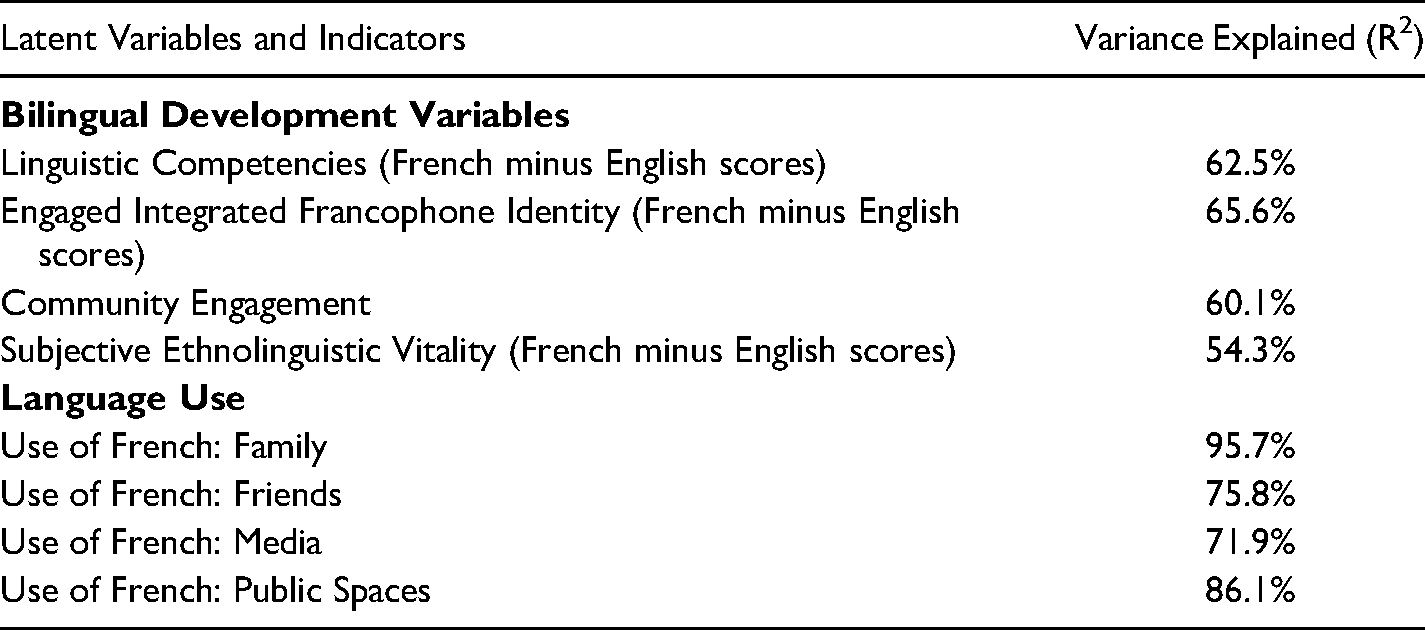
The model explained a relatively high percentage of variance on all psycholinguistic and language use constructs (see Table 1). To estimate the relative portion of variance explained on each language use domain by socially-determined and self-determination variables, we partitioned the R2 values shown in Table 1 for each language use domain (see note 2 for method of calculation). 2 For language use with friends, the 76% of explained variance was split 52% for social determinism and 24% for self-determination, thus a ratio of 2.17 in favor of social determinism. For language use in public spaces, the 86% of explained variance was split 66/20, a ratio of 3.3 in favor of social determinism. For media use, the 72% of variance explained has a lower ratio of 1.52 (43.5/28.5) in favor of social determinism. For the use of French in the family domain, the 96% of explained variance was heavily tilted in favor of past enculturation. The ratio was 15.5 (89.9% for social determinism and 5.8% for self-determination). All language use domains were therefore more strongly socially determined than self-determined.
Discussion and Conclusion
In sum, the revised SED model is strongly supported by the results. The general proposition that demographic objective vitality is more strongly related to enculturation (quantity of language contacts) than to personal autonomization and critical consciousness-raising experiences (qualitative aspects) is confirmed. Moreover, it is shown, as proposed by our hypotheses, that private domains of language enculturation, along with the qualitative aspects of language socialization, are the language contact attributes that relate to the development of self-determination. SEV, the variable most analyzed in the EV literature (Smith et al., 2017), is related to status variables (demographic vitality, enculturation in public spaces and the linguistic landscape) underlying social determinism and predicted language use in public spaces and with friends. On the whole, minority language use is shown to be strongly socially determined.
A first important caveat is that the model in Figure 2 is not the only pattern of relations that fits the data (Kline, 2011). In earlier analyses, an extended model, with all 6 indicators of engaged integrated identity inserted as separate latent constructs with their own theoretically based hypotheses, fit the data well. Other variants of the extended model also provide a good fit. The very good fit of the model obtained with a more global multi-component identity construct gives credence to the contention that this model is conceptually equivalent to other extended versions of the SED model. Also, the choice of language use with friends as the core language use domain—since it mediates effects on other language use domains—is not the sole pattern possible, but it remains a reasonable and parsimonious assumption. The revised SED model in Figure 2 is more parsimonious than the original model (Appendix). In the words of Simon (2004), in searching for pattern in phenomena “science seeks parsimony, not simplicity” (p. 32).
Creating a new, richer multi-component linguistic identity construct contributes greatly to model parsimony. Engaged integrated identity unites research contributions of EV theory, social identity theory, and self-determination theory in the field of ethnolinguistic identity, integrating their respective attributes into a single second-order factor. High engaged integrated linguistic identity scores characterize persons whose self-defined identity and group engagement are strong, who feel their basic needs are satisfied in their language contacts, whose motivation to learn and use the language is internalized (i.e., integrated to their self and values), and who desire to integrate the linguistic minority community.
The results of this study show that the effects of social determinism on language use are strong, but not entirely overwhelming. Except for the family domain (0.80), the path coefficients between each enculturation domain and its respective language use variable don’t exceed 0.41 (friends domain). Moreover, except for language use in the family, self-determination variables explain from 20% to 29% of language use scores variance, effects that can be considered moderately strong to strong (Cohen, 1988). Likewise, the 90% explained variance on family language use by the family enculturation effect is not entirely socially determined. This result supports the finding that children's language use in the home is quite stable until they leave home (Lachapelle & Lepage, 2010). But parents are autonomous persons who can choose different language dynamics in their homes for their children's early enculturation (Landry, 2010; Landry et al., 1991; Landry & Allard, 1997). Recent research in Canada's Atlantic provinces has shown that awareness-raising activities in French school districts seem moderately effective in helping exogamous parents increase the transmission of French as a mother tongue to their children, and their enrollment in French schools (Landry & Pépin-Filion, 2021; Pépin-Filion & Landry, 2021). Exogamy is strongly related to demographics (Lachapelle & Lepage, 2010; Landry, 2010), but enculturation dynamics within the home involve choices that ultimately belong to parents. The SED model would predict that, in low vitality contexts, parents who experienced the strongest critical consciousness-raising would be the most likely to transmit the minority language as mother tongue to their children and to enroll them in a minority language school.
Given the rather moderate effects of self-determination in minority language use in this study, it is important to recall that this factor was constrained by the fact that all participants were attending French schools. This did not allow to test for the potentially strong effects of the degree of French language schooling on the self-determination variables. The same study, done with a representative sample of the children of all French-as-mother-tongue parents outside Quebec, would have about 50% of the children in French schools and 50% in English schools (about a third of the latter in French immersion). Given the strong effects of degree of French schooling on French competencies and identity in past research, a more heterogeneous group of students—in terms of the language of their schooling—would certainly enhance the effects of self-determination. Identity, linguistic competency, and community engagement scores would have much more variability and produce stronger effects. Another mitigating factor for the moderate effect of the self-determination variables is the relatively low participant scores on the community engagement variables (see Landry et al., 2010). The importance of critical consciousness-raising as a pedagogical intervention in French schools is relatively new. Very few teachers have received training in critical consciousness-raising pedagogy (Cormier, 2005; Godin et al., in press). Moreover, given their young age, the participants in this study are not yet in active adulthood and are not expected to be highly engaged in their community.
The present study has practical implications. The results clearly show that the internal factors that foster self-determination are dependent on enculturation in relatively private domains and on the qualitative aspects of language socialization. These factors are more amenable to minority group control than the external factors (e.g. demography) determining EV. Results show that critical consciousness-raising is most crucial in favoring community engagement. We believe that minority language schooling and the implementation of a critical consciousness-raising pedagogy are the most essential elements for self-determination development at an early age and for fostering participation in minority group collective action (Godin et al., in press; Landry et al., 2010).
In conclusion, we strongly recommend further research on social determinism/self-determination dynamics. St-Onge (2021) tested the revised SED model with Francophone students in New Brunswick and inserted Harwood's media identity gratification construct (Harwood, 1997) in the model. His study confirmed the model's hypotheses and showed that with this added construct, media consumption was more self-determined than socially determined. It remains to be seen if the model can apply to other linguistic minorities. Part of the original SED model (Appendix) has been tested with English-speaking students in Anglophone minority schools in Quebec (Landry et al., 2013; Landry & Allard, 2016), and the entire original model was used in a study of non-Francophones learning French as a second language in Canada (Boutouchent, 2015). The results are very consistent with those of the present study. The original SED model was also used in Africa to study the dominance of French over various African languages (Pitroipa, 2012), but the model has yet to be tested statistically with that study's data. It is crucial, however, that this model be tested with minority groups that vary in their linguistic vitality and that the language of schooling effect be measured, when possible. One cannot test the EV framework in a study of minority group members residing in the same municipality, or who experience uniform vitality across settings. It also remains to be seen if the SED model can be used in language revitalization (Fishman, 2001; Grenoble & Whaley, 2006) endeavors. The cultural autonomy model (Landry, 2009, 2018, based on EV, see Smith et al., 2017) proposes that linguistic vitality can be increased through the convergent efforts of important social actors, namely families, the group's civic society, and the State (Landry, 2018). This collective action may transform a socially-determined linguistic minority into one engaged in “reciprocal determinism” (Bandura, 1978). While objective EV maintains its influence on language enculturation and use, group collective action may increase group cultural autonomy and serve to improve minority education programs (a most necessary element of group cultural autonomy and self-determination), fostering thereby the engaged integrated identity and community engagement of its members, and gradually improving the group's EV.
Footnotes
Acknowledgments
The authors thank the anonymous referees, as well as Julien Landry and Dominique Pépin-Filion for their very useful comments and suggestions on previous versions of this article.
Declaration of Conflicting Interests
The author(s) declared no potential conflicts of interest with respect to the research, authorship, and/or publication of this article.
Funding
The author(s) disclosed receipt of the following financial support for the research, authorship, and/or publication of this article: This study was made possible by grants from the Government of Canada (Department of Canadian Heritage), the Government of Ontario, and the Social Sciences and Humanities Research Council of Canada (grant 410-00-0760).

Supplemental Material
Supplemental material for this article is available online.
Notes
Author Biographies
Appendix
The Self-Determination and Ethnolinguistic Development (SED) Model (Landry et al., 2007a, 2010; adapted from Landry et al., 2005)
References
Supplementary Material
Please find the following supplemental material available below.
For Open Access articles published under a Creative Commons License, all supplemental material carries the same license as the article it is associated with.
For non-Open Access articles published, all supplemental material carries a non-exclusive license, and permission requests for re-use of supplemental material or any part of supplemental material shall be sent directly to the copyright owner as specified in the copyright notice associated with the article.
