




Abstract
According to common belief, friends communicate more accurately and efficiently than strangers, because they can use uniquely shared knowledge and common knowledge to explain things to each other, while strangers are restricted to common knowledge. To test this belief, we asked friends and strangers to play, via e-mail and face-to-face, the word-description game Taboo, in which objects need to be described without using certain “taboo” words. When descriptions were sent via e-mail, there was no difference in accuracy (number of correct answers) nor in efficiency (number of words per correct answer) between friends and strangers. When descriptions were given face-to-face, friends were more accurate than strangers, but not more efficient (number of seconds and words per correct answer). Shared knowledge did not predict accuracy or efficiency. Hence, our findings do not support the idea that friends only need a few words to understand each other.
In the movie Four Christmases, the main characters play the game Taboo, in which they need to get their partner to say a target word (like “mini-skirt”) by describing it without using any “taboo” words (“short,” “1960s,” “fashion,” “sexy,” and “women”). One couple, which has a very close relationship, clearly outperforms the others, because they understand each other instantly. For example, the wife describes the term “mini-skirt” as “The thing I am not allowed to wear to Supercross,” which immediately triggers the correct answer from her husband.
This nicely illustrates the folk wisdom that communication between two people who know each other very well is both accurate (they understand each other correctly) and efficient (they only need a few words to do so). The existence of this belief is supported by research showing that people think their friends under stand them better than strangers do (e.g., Savitsky, Keysar, Epley, Carter, & Swanson, 2011). It is not clear, however, whether friends do indeed communicate more accurately and more efficiently, because research on this topic is scarce and provides mixed evidence. In this article, we test this belief using the game Taboo.
Comparing Friends’ and Strangers’ Conversations
Many studies have shown that people who have a close bond (e.g., couples, good friends) have the feeling they understand each other especially well (Kruger, Epley, Parker, & Ng, 2005; Pollmann & Finkenauer, 2009; Riordan & Trichtinger, 2017; Savitsky et al., 2011; Swann & Gill, 1997). For example, Savitsky et al. (2011) gave their participants ambiguous phrases to communicate to either their spouse or to a stranger (e.g., “What have you been up to?” can convey not only interest in someone’s well-being but also irritation that someone is late) and found that spouses were no better in conveying the intended meaning of a sentence than strangers. All participants overestimated their accuracy, but this overestimation was larger for spouses, indicating that people expect communication with a close other to be more successful than with a stranger.
Similar results were found in studies asking people to communicate an emotional message via e-mail to either a friend or a stranger (Kruger et al., 2005—Experiment 3; Riordan & Trichtinger, 2017—Experiment 3). Although friends and strangers were equally accurate in detecting the emotional tone of a message, friends expected to be more accurate than strangers.
In these three studies, no difference was found between friends and strangers in terms of accuracy of communication, but efficiency was not taken into account. In our study, we include efficiency as a second indicator of how well friends and strangers communicate because the common belief that friends communicate better than strangers encompasses the idea that “we only need a few words to understand each other.” Moreover, there are theoretical reasons to expect differences in efficiency between friends and strangers, although these do not point in one clear direction. Based on politeness theory and conversational constraint theory (Brown & Levinson, 1987; Kellermann & Park, 2001), one could argue that friends are less concerned about being polite and can therefore be more direct (i.e., more efficient). Yet, friends also tend to use more humor in their conversations, which often violates the maxim of quantity (Holmes & Marra, 2002) and would therefore be less efficient.
Empirically, the findings are mixed as well. We were able to identify two studies that directly investigated whether close others communicate better than strangers, measuring both accuracy and efficiency. The first study investigated how familiar and unfamiliar partners describe map routes to each other (Boyle, Anderson, & Newlands, 1994). Task performance was measured by calculating the distance between the routes that needed to be described and the routes drawn by the addressee. Friends not only performed more accurately on the task than strangers but also used more words (were less efficient).
The second study compared the communicative accuracy and efficiency of married couples and strangers when describing unfamiliar things (tangram shapes or photographs of unknown children; Schober & Carstensen, 2009). Efficiency was measured both as the time it took people to complete the task and the number of words needed. Results showed that spouses and strangers were equally accurate and efficient, irrespective of measurement.
Lines of research related to message design and empathic accuracy are also relevant here. Fussell and Krauss (1989) studied message design, asking their participants to describe 30 abstract line drawings to a friend. Four weeks later, participants received their own descriptions, their friend’s descriptions, and descriptions a stranger had written for their friend. They were then asked to match these with the drawings. Participants matched more drawings correctly based on their friend’s descriptions than on the stranger’s descriptions. This suggests that people design messages specifically for receivers, a phenomenon known as recipient or audience design (e.g., Clark & Murphy, 1982; Sacks, Schegloff, & Jefferson, 1974).
Fussell and Krauss’ (1989) study has often been cited ambiguously, or even as evidence for a communicative advantage of friends over strangers. For example, Thompson and Fine (1999): “Thus, people who share a relationship (and, hence, previous conversations) are better able to construct and utilize shared communicative understandings;” and Hope, Ost, Gabbert, Healey, and Lenton (2008): “Indeed, research shows that individuals in close relationships outperform stranger pairs in recall tasks by means of mutual cueing and increased cue effectiveness.” These quotes give the impression that Fussell and Krauss showed that friends communicate better than strangers. However, their participants did not design the message for a stranger, so this conclusion cannot be drawn. This is not to say that the design of the Fussell and Krauss study was flawed, as it was not their purpose to investigate communication between strangers.
Work on empathic accuracy showed that male friends are more able to “read each other’s mind” than male strangers (Stinson & Ickes, 1992). Here, dyads were videotaped during interactions and afterward were asked to view the videotape and indicate what they believed their partner thought and felt during the interaction. Male friends achieved roughly 50% higher accuracy scores than male strangers in this task, indicating that they were better at guessing what their interaction partner was experiencing at certain stages in the interaction. Stinson and Ickes also investigated why male friends showed higher empathic accuracy and were able to rule out similarity in personalities as an explanation. Rather, they suggested it was friends’ ability to guess the other’s thoughts and feelings when the conversation concerned events that happened outside the lab setting. This suggests that shared knowledge may give friends an advantage over strangers, although this was not directly tested. Additionally, this task was not a direct test of the claim that friends communicate better than strangers, because they did not know that they would later be asked to guess each other’s thoughts and feelings. Had they known, strangers might have designed their utterances differently.
Taking stock, neither theory nor previous research make clear whether friends indeed communicate more accurately and more efficiently than strangers. The tasks used so far either involved conveying emotions via speech or describing routes or objects to each other. These tasks allow for a measure of accuracy, because speakers share the goal of achieving shared meaning in this context (Burleson, 2010). However, the description studies are arguably low in external validity, as they do not give sufficient room for the possible advantages of knowing each other to emerge. Neither the description of abstract figures task nor the map route description task are likely to elicit the use of shared knowledge (unique knowledge that only a pair of friends know they share), but they will rather be based on common knowledge (knowledge that most people in a certain language community have; Lee, 2001). Given that shared knowledge is a key difference between friends and strangers, we chose to use the Taboo task, which encourages the use of shared knowledge between friends because it concerns the description of common objects. In other respects, the Taboo task is similar to previous tasks in that it allows to objectively measure both accuracy and efficiency.
Shared Knowledge and Communication Accuracy
If friends can indeed communicate better than strangers, the use of shared knowledge may explain why differences emerge. For example, if friends are asked to describe “Johnny Depp” to each other, they can either use common knowledge (e.g., “He plays the Hatter in Alice in Wonderland”) or shared knowledge (e.g., “He is my favorite person in the world”; examples are from our data). This distinction corresponds to what Clark (1996) calls “communal common ground” (common ground inferred from shared community membership) and “personal common ground” (common ground based on shared personal experiences). Being able to use common knowledge and shared knowledge should enable friends to choose the most efficient strategy. Strangers, on the other hand, can only use common knowledge, and this restriction may result in less accurate and less efficient communication.
Shared knowledge has been shown to enhance efficiency when people describe landmarks to each other. Two people from New York City needed fewer words to match pictures of New York City landmarks than two people who had never been to New York City (Isaacs & Clark, 1987). Shared knowledge also enables people to include a hidden message in a letter for a friend that a stranger cannot identify (Fleming, Darley, Hilton, & Kojetin, 1990) or to refer to landmarks in a way that an eavesdropper is not able to identify it (Clark & Schaefer, 1987). It is not clear how friends use shared knowledge in description of everyday objects, and whether or not they use it to make their messages as efficient as possible, following the maxim of quantity (Grice, 1975).
The Current Studies
The goal of the current studies is to test whether friends indeed communicate more accurately and efficiently than strangers. To this end, we asked participants to play the game Taboo, in which certain target words (common objects and celebrities) need to be described without using five taboo words. Typically, these taboo words represent “obvious” common knowledge (for “Johnny Depp,” e.g., the words “actor,” “cinema,” “movie,” “America,” and “pirate” are taboo). This particular setup has four advantages:
First, the game has external validity in that it relates to the everyday situation of word-finding difficulties (Burke, MacKay, Worthley, & Wade, 1991). Sometimes speakers struggle to remember a particular word or name and it becomes necessary to describe it. If the listener is then able to guess the correct word, the conversation will go more smoothly. The Taboo game enables us to model this situation. By using common objects and well-known celebrities, this task has a higher external validity than tasks used in previous studies.
Second, the use of common knowledge is restricted by the taboo words, which should increase the use of shared knowledge. This arguably puts friends at an advantage over strangers, since only the former can rely on shared knowledge. For example, when describing a trampoline, a friend could say “It stands in our backyard and it is big; we slept on it.” If a communicative benefit for friends exists, this setup should reveal it.
Third, the taboo words make the task sufficiently complex to reduce the likelihood of a ceiling effect for accuracy, because people need to monitor their speech for taboo-errors. People are generally good at monitoring their speech and are even able to correct their speech before articulation, although this is effortful (Levelt, 1989).
Fourth, in the concrete context provided by the Taboo game, accuracy and efficiency can be clearly defined and measured as, respectively, the number of target words guessed correctly and the number of words/amount of time needed for the explanation.
In our first experiment, we zoom in on initial descriptions in an asynchronous setting. It is well known that when two persons communicate, they give (explicit or implicit) feedback to each other about their understanding, which in turn may influence the messages that are being produced and contribute to how common ground is built up (e.g., Clark & Wilkes-Gibbs, 1986; Schober & Clark, 1989). In the first study, we intend to minimize the influence of feedback to be able to compare systematically the design of initial utterances as produced by friends and strangers. This is why we opt for controlled communication via e-mail.
In our second experiment, we use a less controlled, but more externally valid setting, and let friends and strangers interact face-to-face. In these settings, the listener is able to ask for clarification and the speaker can use nonverbal cues to check whether the listener has understood the message (Clark & Brennan, 1991). Given that friends (at least male ones) appear to be better in reading the other person’s mind (Stinson & Ickes, 1992), we predict that the advantage of friends over strangers will be more pronounced in Study 2. Both studies were conducted in Dutch, but we have no reason to believe that the effects we are interested in are influenced by language or culture.
Study 1
Method
Below, we first describe the procedure and the materials, as this clarifies from where the participants came.
Procedure
The study was conducted as part of a first year methodology course. During the first week of the course, all students were asked to participate in a study about e-mail communication and to find a friend who would be willing to participate with them but did not take the course. The friend (“recipient”) had to be a person to which participants talked once or twice a week and to whom they spoke within the last week. Students (“sender”) were instructed to fill in an online survey, providing their own name, e-mail address, age, and gender as well as their friend’s name and e-mail address. They also indicated their closeness to the friend (see below). Senders were randomly distributed over the “friend” and “stranger” conditions. All senders received an e-mail with instructions (see materials) and either the name and e-mail address of their own friend or the name and e-mail address of another student’s friend (a stranger to them). They were instructed not to talk to their classmates about this e-mail to make sure that senders did not know that there were two conditions (friend or stranger). They were instructed to send a standardized e-mail to their designated recipient and, if no reply came within 4 days, to send a standardized reminder. We asked senders to estimate the number of correct answers the recipient would give, and e-mail this to the experiment leader right after they sent the e-mail to the receiver. All e-mails between sender and receiver had to include a cc to the experiment leader. A week after they sent out their e-mail, senders filled in another survey using their own data and the data from the recipient, if available.
Material
Senders first filled out an online survey with demographical information about themselves and their friend, as well as a questionnaire to measure their closeness (Dibble, Levine, & Park, 2012). This scale is designed to fit a wide range of relationships and includes 12 questions, measured on a 7-point scale (e.g., “When we are apart, I miss my friend a great deal”). It also showed good reliability in this study (α = .95).
A standardized e-mail was sent to the senders with instructions about the task and a template for the e-mail to the recipient in which the name of the recipient was already included. Senders only had to include the 10 descriptions for the target words and their name at the end of the e-mail. The target words and taboo words were taken from the game Taboo, to ensure that relevant taboo words were chosen. For example, one target word was “city,” and the taboo words were “house,” “center,” “big,” “shopping,” “work.” 1 In the explanation of the task, it was stressed that taboo words should not be used in descriptions of the target words, nor should parts of taboo words (“shop” instead of “shopping”) or parts of the target (e.g., “Johnny” for “Johnny Depp”). It was prohibited to use any other language than Dutch. There were no restrictions on the length of the description.
On average, people used 27.50 words (SD = 15.15) per target word, and there was no significant difference in the length of the descriptions sent to friends or strangers, U(209) = 5,614, p = .725. A typical description for the target word “city” would be “It is bigger than a village,” although there was substantial variation among descriptions.
All descriptions were coded for use of shared knowledge (yes/no) by nine coders, blind to condition. Coders were instructed to code a description as containing shared knowledge if it contained personal information that could be understood by the sender and the recipient, but not by others. Two examples were provided, one of which was (target word: Johnny Depp) “I think this is a handsome man. . . . We watched him together several times.” Every description was coded independently by three coders, and in case of discrepancies the code that was given twice was chosen (6.4% of the cases). As expected, people did not use shared knowledge in their descriptions to strangers, as there were virtually no scores for shared knowledge (<1%) in that condition. In the friends condition, 13.8% of the descriptions contained shared knowledge. An example would be “If I go shopping for clothes or shoes I go to the (target word). My job is also in the (target word).” To measure interrater agreement, all pairwise Cohen’s Kappas were calculated and averaged across the three coders and 10 items. The average kappa was 0.69, indicating substantial agreement, even though using shared knowledge was less prevalent than not using shared knowledge, which makes the kappa overly conservative (Di Eugenio & Glass, 2004).
A check for the use of taboo words revealed that only 71 participants managed to avoid using any taboo word, indicating that the task was challenging. 2 Descriptions in which a taboo word was used (on average one description per participant) were not included in the analyses; therefore, the number of words and the number of correct answers are scores relative to the number of remaining descriptions. A Mann-Whitney U test showed that there was no significant difference in the number of taboo words used in descriptions for friends (M = 1.17, SD = 1.16) and strangers (M = 1.14, SD = 1.13), U(209) = 5,786, p = .436.
Participants
A total of 216 participants filled in the first part of the questionnaire, and 210 sent out the requested e-mail on time. One participant was excluded because they apparently misunderstood the instructions and included all taboo words in the descriptions. Of the senders, 192 provided the requested estimation of the recipient’s score on time (before the recipient replied). Of the recipients, 180 replied to the e-mail (one recipient requested that his data should only be used for the educational part of the study and not the publication about it; he is not counted here). Significantly more friends (N = 102, 99%) than strangers (N = 78, 74%) replied, χ2(1) = 27.33, p < .001; a fact that we address in the analyses and the discussion. Also, friends replied marginally significantly faster than strangers, with friends responding on average within 39.19 hours (SD = 47.16) and strangers within 55.76 hours (SD = 57.96), U(174) = 3,056, p = .058.
Senders’ mean age was 21.3 years (SD = 4.08) and 37.3% were males. They had been friends with their friend for on average 75.5 months (SD = 63.87), and the average relationship closeness score was 5.73 (SD = 1.01). The recipients’ mean age was 21.6 years (SD = 4.26) and 34.0% were males.
Results
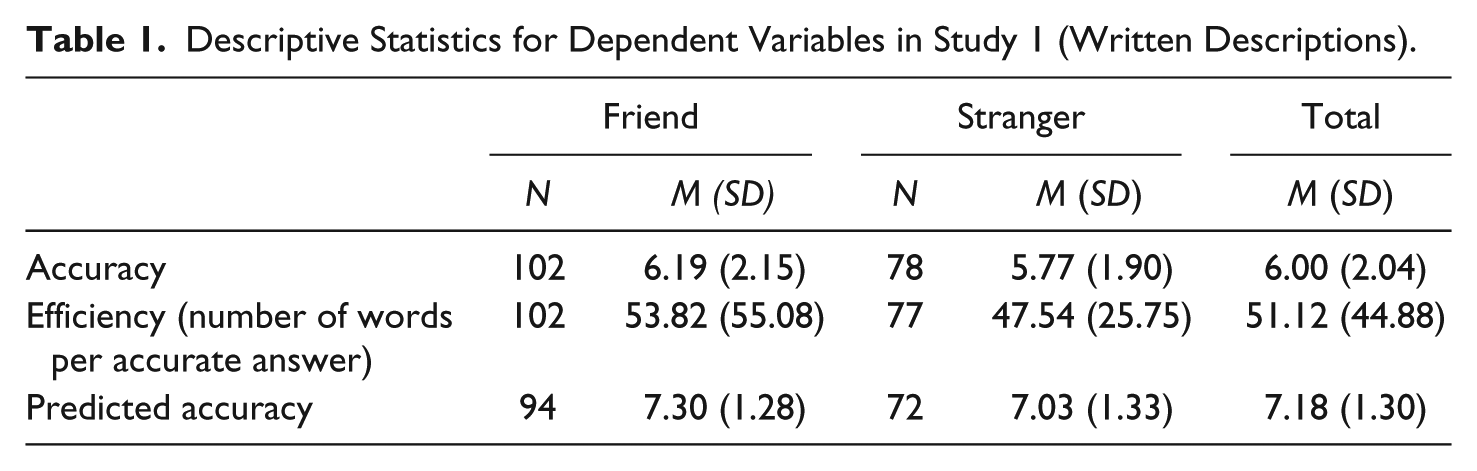
The results are summarized in Table 1.
Descriptive Statistics for Dependent Variables in Study 1 (Written Descriptions).
Accuracy and Efficiency
An independent samples t test revealed that there was no significant difference between the number of correct answers given by friends and by strangers, Mdif = 0.42, 95% confidence interval (CI; −0.19, 1.02), t(178) = 1.32, p = .19, r = .10, 3 so it cannot be concluded that friends are more accurate than strangers.
To test whether friends used fewer words than strangers per correct answer, an efficiency score was calculated by dividing the number of words used by the number of correct answers. One person had no correct answers, so for this person, no efficiency score could be calculated. The efficiency scores were not normally distributed, so more weight should be placed on the bootstrapped confidence interval than on the p value. There was no significant difference between friends and strangers in number of words needed per accurate answer, Mdif = 6.27, 95% CI (−4.99, 20.56), t(177) = 0.93, p = .36, r = .07. The confidence interval even leaned toward the positive end, which would suggest that friends needed more words than strangers. Thus, in this task, there was no support for the hypothesis that friends only need a few words to understand each other.
Our sample size and the variation in friendship length and closeness also allowed us to zoom in on the friends’ condition and analyze differences within this group. We investigated whether the length and the closeness of the friendship were associated with accuracy and efficiency. There were no significant correlations between friendship length and accuracy, r(102) = .05, p = .609, nor efficiency, r(102) = −.16, p = .100, nor between friendship closeness and efficiency, r(102) = .003, p = .974. However, we did find a significant correlation between friendship closeness and accuracy, r(102) = .21, p = .036, indicating that friends who were closer guessed more words correctly.
Shared Knowledge
To investigate whether the use of shared knowledge improves accuracy or efficiency, we compared those senders in the friend condition who used shared knowledge at least once (N = 53) to those who did not use shared knowledge (N = 49). The idea is that those who use shared knowledge at least once strategically chose the most efficient way to describe something, either with common or with shared knowledge. This should give these friends an advantage (in terms of both accuracy and efficiency) over friends who rely only on common knowledge. There was no significant difference in the number of correct answers for those who use shared knowledge (M = 6.10, SD = 2.21) and those who do not (M = 6.29, SD = 2.11), t(100) = 0.43, p = .67, r = .04, 95% CI (−0.62, 1.00). There was also no significant difference in efficiency between those who use shared knowledge (M = 59.05, SD = 42.32) and those who do not (M = 48.16, SD = 66.18), t(100) = 1.00, p = .32, r = .10, 95% CI (−31.29, 12.48). There was thus no indication that the use of shared knowledge increased accuracy or efficiency.
Additionally, we zoomed in on the 54 individuals who used shared knowledge and tested within subjects whether the descriptions that contain shared knowledge led to more accuracy or are more efficient than the descriptions that contain no shared knowledge. A Wilcoxon Signed Rank test on the percentage of correct answers revealed that there was no difference in accuracy for descriptions that contain shared knowledge (M = 59.44%, SD = 37.97) and descriptions that do not (M = 59.37%, SD = 25.38); standardized test statistic: −0.07, p = .956. A paired samples t test showed no difference between the number of words per correct answer for descriptions with or without shared knowledge (M = 48.79, SD = 29.69 vs. M = 55.11, SD = 41.40), t(42) = 1.06, p = .29. Taken together, we found no evidence for more accuracy or more efficient communication due to the use of shared knowledge.
Estimated Accuracy Versus Actual Accuracy
Although not the main focus of our study, we also tested whether we replicated the finding that senders overestimate their own accuracy, especially when they are friends (Riordan & Trichtinger, 2017; Savitsky et al., 2011). A two-way analysis of variance with estimated versus actual accuracy as within-subjects factor and type of receiver as between-subjects factor revealed that senders indeed overestimate their accuracy. The estimated accuracy was significantly larger (M = 7.18, SD = 1.30) than the actual accuracy (M = 6.09, SD = 2.00), F(1, 164) = 47.23, p < .001, η2 = .09. This effect was equally strong for friends and strangers, as there was no significant interaction effect, F(1, 164) = 0.05, p = .824. This indicates that people were overly optimistic about their accuracy, but friends were not more optimistic than strangers.
Discussion
This first study provides no evidence for enhanced accuracy or efficiency for friends compared to strangers when describing target words to each other via e-mail. We therefore show that in an asynchronous setting, in which they have sufficient time to design their descriptions, people are able to design descriptions for strangers that are as accurate and efficient as when they design descriptions for friends. We do find that, within the group of friends, friends who are closer guess more words correctly. However, this result should be interpreted with caution, because it is based on correlations and not on an experimental manipulation. It may be that there is a third variable that explains the association between closeness and accuracy. For example, people with better perspective taking skills might have closer friendships and also be better at writing or understanding descriptions.
This first study took place in a controlled setting, focusing on initial descriptions. In our second study, we go a step further to see how people design their messages on the fly while facing the recipient; we also include a number of additional variables. The fact that in the first experiment more friends responded to the request and did so faster than strangers suggests that there are differences in other variables. One of these may be that friends feel simply more obliged to reply to a request from a friend (Roloff, Janiszewski, McGrath, Burns, & Manrai, 1988). Another one may be that friends are more motivated than strangers, though this motivation did not directly translate to better outcomes. This idea is supported by other research showing that people persist longer in lifting a weight if they believe that their coworker on the task is a friend rather than a stranger (Kerr & Seok, 2011). In our second study, we invite participants to the lab and only then assign them to a condition in order to avoid nonrandom missing data. We also directly measure whether friends are more motivated to perform well than strangers, and how this relates to performance.
In addition, we measure how much people enjoy the task. There are indications that friends have more fun than strangers when interacting. For example, people who play a video game together with a friend are more engaged in the game and report (marginally) more positive affect than people who play together with a stranger (Ravaja et al., 2006). Friends also laugh more than strangers while working on amusing tasks, if the dyads include at least one male member (Smoski & Bachorowski, 2003). Other studies find no differences between friends and strangers on positive affect when playing a video game together (Gajadhar, de Kort & IJsselsteijn, 2008) or on amusement when watching a film (Hess, Banse, & Kappas, 1995). The effects of friendship on fun are thus not clear.
In our study, which involves shared knowledge, an additional aspect comes into play: descriptions that refer to shared knowledge may be more entertaining than descriptions that refer to common knowledge because they trigger shared memories, which are known to enhance positive affect (Alea & Bluck, 2007). Thus, earlier research suggests that friends might enjoy the task more than strangers. To test this idea, we include a measure of enjoyment. Finally, we also test whether people perceive the task as easier when interacting with friends, and how confident people are in their performance. With these diverse dependent variables, we can verify that our task is suited to detect differences in interacting with a friend or a stranger.
Study 2
Method
Participants
A total of 106 participants (30 males, 75 females, 1 gender undisclosed) took part in this study. None of them participated in Study 1. Their age ranged from 17 to 53 years (M = 22.25, SD = 5.09), and they were partly recruited via a participant pool (and participated in exchange for partial fulfillment of course requirements) and partly via the personal network of a research assistant (and participated without direct compensation). All participants had a chance to win a 10 Euro gift certificate if they would earn the best score in the game. For one dyad, the audio failed, so efficiency could not be measured, and for another dyad, both video and audio failed, so neither their accuracy nor their efficiency could be measured.
Procedure
Participants were invited to sign up with a friend and for every time slot, two pairs of friends were scheduled, so that either the two pairs of friends could participate or the friends could be split up to form stranger dyads. In case there was no second pair of friends due to a missing sign up or no-shows, friends automatically participated in the friends’ condition (19 dyads). To ensure roughly equal cell sizes, the number of forced “friend condition dyads” was determined each day, and the number of people for the “stranger condition” was increased by that amount. It was then randomly determined which couples would participate in which condition. In total 27 dyads participated in the “friend condition,” and 26 dyads participated in the “stranger condition.”
After signing an informed consent form, participants were informed that their task was to play the game Taboo. The rules of the game were explained, after which they heard whether they would play with their friend or a stranger from the other dyad. The two dyads were led to different rooms where they started the study with the first questionnaire, which is described below. After completion of the questionnaire, the video camera was set up, and the game cards were handed out. Participants decided who would describe and who would guess. They were left alone to play the game without time limit, but they knew that the team with the best score and the best time would win a 10 euro gift certificate. On average, it took about 8 minutes to complete the game after which a final questionnaire was completed.
Material
We used almost the same material as in Study 1, with some small adjustments. We decided to replace 2 of the 10 target words from Study 1 (“P. Diddy” and “stage fright”) because they did not elicit much shared knowledge. They were replaced by “jealousy” and “thong.” We also changed some taboo words that were frequently used, to reduce data loss. We replaced these with words from the descriptions of Study 1 to guarantee the inclusion of relevant taboo words. The target and taboo words can be found in Table 2.
List of Target Words and Taboo Words Used in Study 1 and 2.
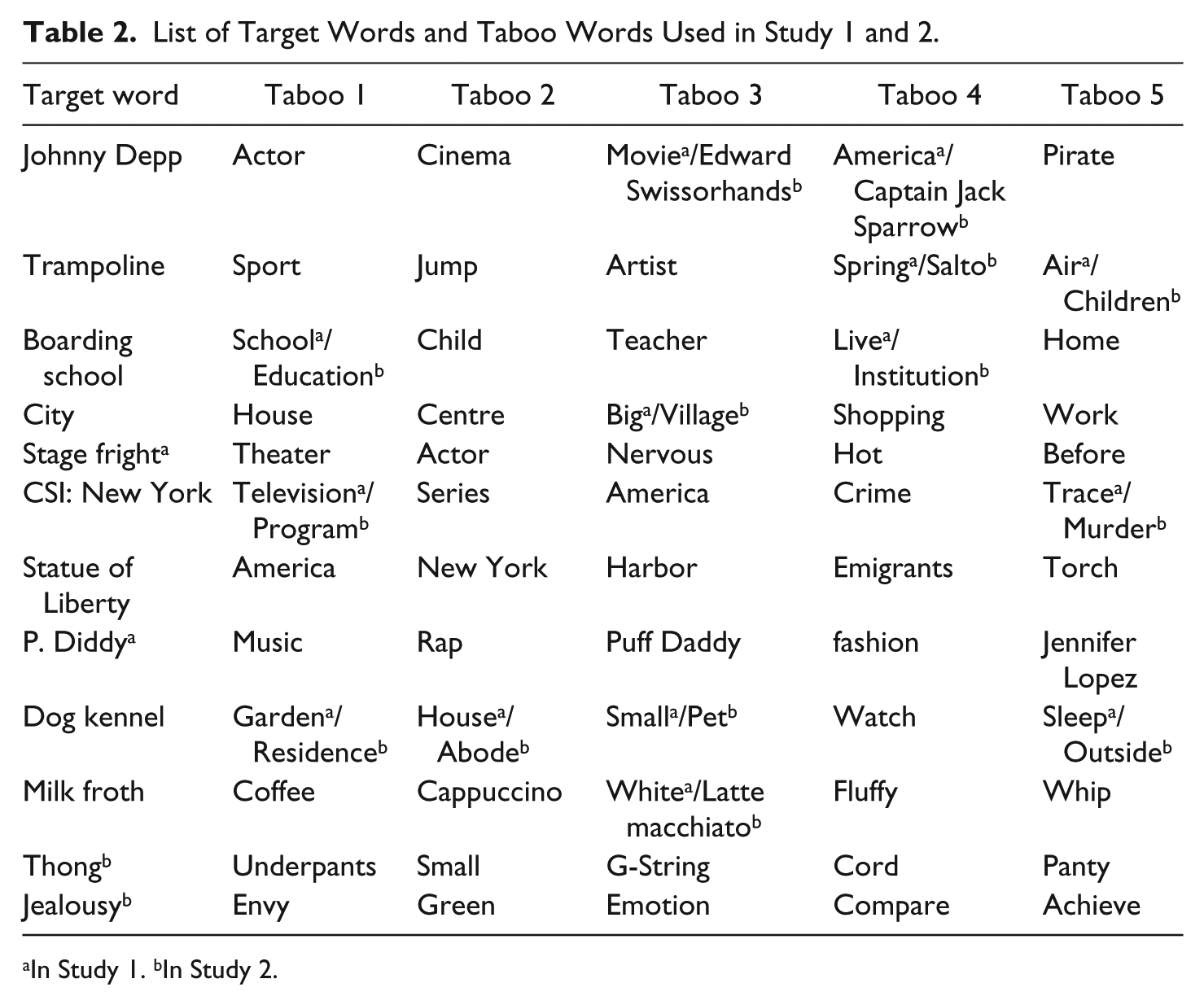
In Study 1. bIn Study 2.
The pregame questionnaire asked about participants’ gender, age, and education level. To measure type and strength of the friendship, we used the friendship scale from Study 1 (Dibble et al., 2012), which again had a good reliability (α = .99). Finally, participants were asked to indicate how many target words they thought they would guess correctly (0-10) and how motivated they were to earn a good score (on a 5-point scale).
The postgame questionnaire included an estimation of how many target words they thought they guessed correctly, and measures of enjoyment and perceived difficulty. Enjoyment was measured with eight items, four of which were reverse coded (fun, dull, entertaining, pleasant, annoying, boring, enjoyable, and nasty) and perceived difficulty was measured with four items, two of which were reverse coded (easy, hard, difficult, and simple).
The descriptions were transcribed to count the number of words used. Only words were counted, no fillers or sounds. The transcriptions were also used to check for the use of taboo words and shared knowledge. Only five couples managed not to use any taboo words. Additionally, some participants considered an answer as correct which was in fact incorrect (e.g., “jealous” instead of “jealousy”), or gave up on a target word. The efficiency scores (time and number of words needed) were calculated using only correct answers. Shared knowledge was coded by two independent coders. The average kappa was .68, indicating substantial agreement. Conflicts were solved by including ratings from a third coder.
Results
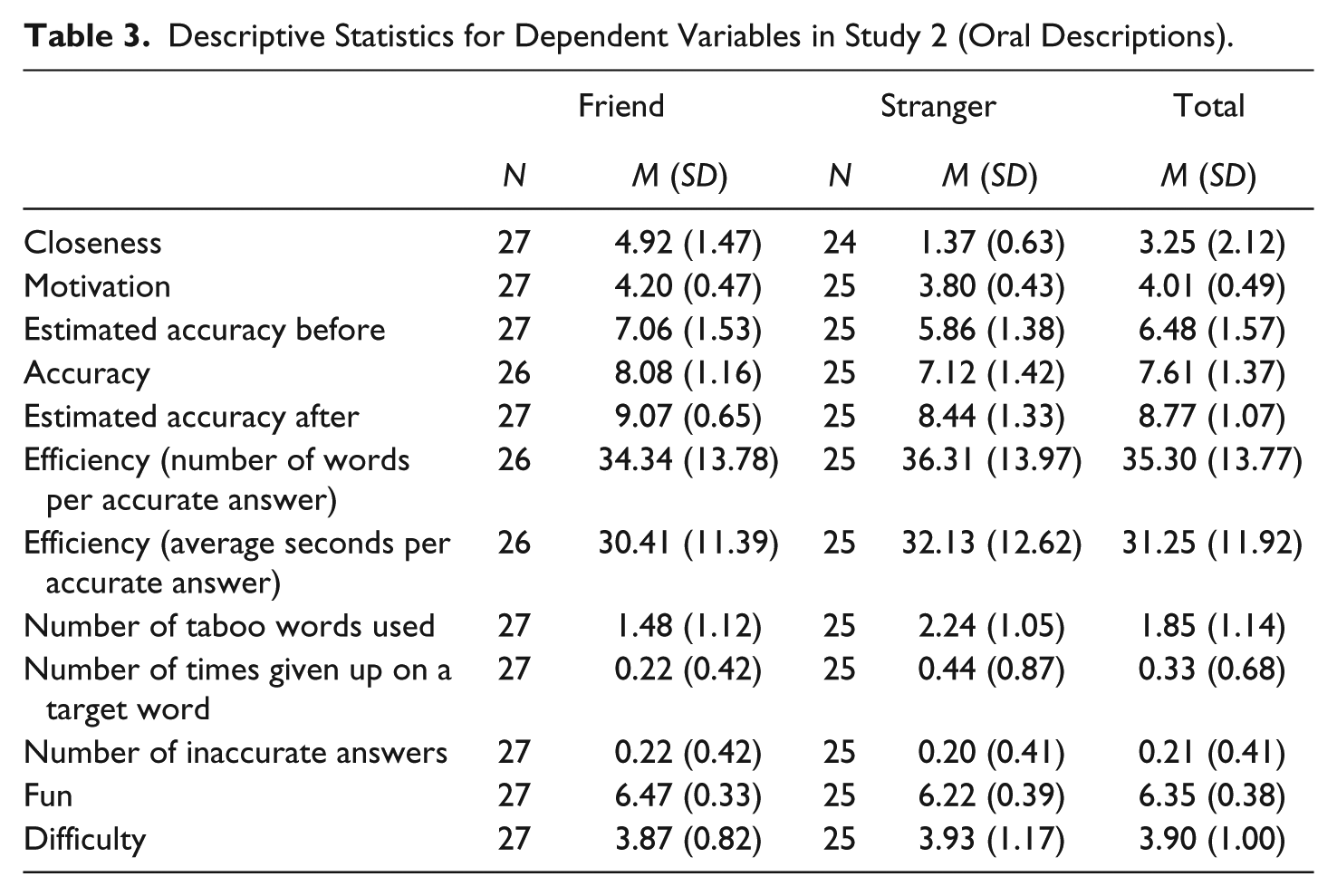
The results are summarized in Table 3. For most dependent variables (e.g., accuracy, efficiency, and shared knowledge), there was only one score per dyad, so the analyses were on the level of the dyad. Three variables were measured individually (motivation, perceived fun, and difficulty) and analyzed with a multilevel model. Two variables (number of times given up on a question and perceived fun) showed heavy kurtosis in their distribution. Inspection of the data revealed that one subject had a score of 1.38 on the perceived fun scale. This was a clear outlier, given that the second lowest score in the whole sample was a 5, so we decided to discard that person’s score and to use the partner’s score (5.88) as the score for the dyad (removing this outlier-score had no impact on our findings and did not change the outcome of the significance test).
Descriptive Statistics for Dependent Variables in Study 2 (Oral Descriptions).
Accuracy and Efficiency
We first tested whether friends and strangers differ in their accuracy and efficiency. The multivariate test of the multivariate analysis of variance with number of correct answers, number of words per correct answer, and seconds per correct answer was marginally significant, F(3, 47) = 2.68, p = .058, η2 = .15. The univariate tests showed that friends gave more correct answers than strangers (Mfriends = 8.08 vs. Mstrangers = 7.12), F(1, 49) = 6.93, p = .011, η2 = .12. There was no significant difference in the number of words per correct answer, Mdif = 1.97, F(1, 49) = 0.26, p = .613, η2 = .005, and the number of seconds per correct answer, Mdif = 1.72, F(1, 49) = 0.26, p = .610, η2 = .005. Thus, friends were more accurate when playing Taboo, but we found no evidence that they were more efficient than strangers.
We further investigated where the difference in accuracy came from. Because participants were given unlimited time for the game, there were only three reasons not to earn all 10 points: use of taboo words, accepting a wrong answer, and giving up on a target word. We conducted three chi-square tests to see whether friends and strangers differ on these three variables. None of the three chi-square tests was significant (Fisher’s exact test taboo: χ2(4) = 6.96, p = .130, Fisher’s exact test Giving up: χ2(2) = 1.39, p = .632, Accepting wrong: χ2(2) = 0.38, p = .845). However, unlike the last two variables which varied only between 0 and 1 (with the exception of one couple giving up on four target words), the use of taboo words varied between 0 and 4 with a normal distribution (z score skewness: 1.08, z score kurtosis: 0.74), so the chi-square test may not be the best test to detect the pattern. We therefore also conducted a t test with number of taboo words as dependent variable and type of partner as independent variable. The t test showed that strangers use on average 0.72 more taboo words than friends, t(50) = 2.39, p = .021, r = .32, which represents a medium-sized effect. It thus seems that the difference in accuracy could be mainly attributed to a difference in using taboo words.
Shared Knowledge
As above, we tested whether using shared knowledge to describe targets is a successful strategy. Given that almost all couples in the friends’ condition used shared knowledge for at least one of the target words, we could not compare those who use it to those who do not use it, and instead compared descriptions with and without shared knowledge, within couples.
We first tested whether descriptions with shared knowledge were more accurate than those without. Because overall accuracy rates were very high, we performed a Wilcoxon signed rank test with the percentage of correct answers for descriptions in which shared knowledge was used (M = 88.04, SD = 30.03) and descriptions in which no shared knowledge was used (M = 81.33, SD = 10.94) as within subject factor. The difference was significant, N = 23, standardized test statistic = 2.07, p = .038. This could be explained by the fact that descriptions with shared knowledge (M = 3.26, SD = 11.44) were less likely to contain taboo words than descriptions without shared knowledge (M = 17.49, SD = 12.67), N = 23, standardized test statistic = 3.19, p = .001. Note, however, that these analyses were based on few cases (the combination shared knowledge—taboo was rare), so they should be interpreted with caution.
Second, we tested whether descriptions with shared knowledge were more efficient. The means already point in the opposite direction for both the number of words per correct answer (Mshared knowledge = 42.02, SD = 24.18 vs. Mno shared knowledge = 34.22, SD = 16.70) and the seconds per correct answer (Mshared knowledge = 34.60, SD = 19.09 vs. Mno shared knowledge = 29.86, SD = 13.93). Two dependent samples t tests showed that the differences were not significant; twords(22) = 1.34, p = .196, r = .08, 95% CI (−3.15, 18.99); tseconds(21) = 1.10, p = .286, r = .05, 95% CI (−3.86, 13.12).
Motivation, Fun, and Difficulty
We measured motivation, fun, and perceived difficulty of the task to investigate on which additional variables friends and strangers differed. For the variable fun, including the random intercept was redundant, so we removed it. We found that friends’ motivation was significantly higher than strangers’, F(1, 51.38) = 10.31, p = .002, 95% CI (0.15, 0.63), and that they also reported significantly more fun, F(1, 106) = 7.74, p = .006, 95% CI (0.08, 0.49). There was no difference in the perceived difficulty of the task, F(1, 53) = 0.23, p = .637, 95% CI (−0.69, 0.43).
Additionally, we reasoned that the use of shared knowledge might be related to the enjoyment of the task, so we correlated the number of descriptions that contained shared knowledge with the self-reported enjoyment of the task (on the dyad-level, there is only one shared knowledge score per couple). The correlation was r(27) = .313, p = .111, 95% CI (−0.97, 0.613). We thus find no significant relation in this study, but it should be noted that the sample size is only large enough to detect strong effects, so this idea should be tested again in a larger sample.
Estimated Accuracy Versus Actual Accuracy
As above, we tested whether people overestimated how many target words they would guess correctly and whether friends did so more than strangers. We asked participants to estimate how many target words they thought they would guess correctly before and after they played the game. This is different from Study 1, where participants gave their estimations after they completed their descriptions but before they got feedback from the recipient. Here, the pregame estimation was before they even knew the target words, and the postgame estimation was after they finished the game. By that time, participants knew how many target words were guessed correctly because they knew the right answer, but they did not know how many answers would be invalid because they included taboo words (most people were unaware that they used these), so it was still an estimation.
An analysis of variance with condition (friend, stranger) as between subject factor and score (actual, estimated before, and estimated after) as within subject factor (with Greenhouse-Geisser correction) showed no interaction effect, F(1.566, 78.29) = 0.69, p = .47, η2 = .01. There was a main effect of score, F(1.566, 78.29) = 46.17, p < .001, η2 = 0.48; contrast analyses showed that the actual score was significantly higher than the estimation before, F(1, 50) = 17.86, p < .001, η2 = .26, and significantly lower than the estimation afterward, F(1, 50) = 41.99, p < .001, η2 = .46. This can be explained by the fact that participants beforehand did not yet know how difficult the target words would be and afterward were more confident, but ignored the possibility that they might have used taboo words inadvertently. There was also a main effect for condition, F(1, 50) = 15.87, p < .001, η2 =.24, in that friends scored higher than strangers for both the actual score and the pre- and postgame estimations. In sum, we did not replicate the finding that friends overestimated more than strangers, mainly because friends’ actual scores were indeed higher in this study.
Discussion
In this second study, we found that friends were more accurate than strangers. Friends tended to use fewer taboo words, which could indicate that friends’ enhanced motivation increased their ability to follow the game rules, which led to a better result. Importantly, we again found no evidence for enhanced efficiency for friends. It took friends and strangers equal time to describe things to each other.
General Discussion
Our two studies provide some support for the idea that friends are better in describing target words to each other than strangers, but no evidence that they are more efficient. In an asynchronous setting, where people have ample time to optimally design their descriptions, strangers are as accurate and efficient as friends. Within the sample of friends, we found that more closeness is related to more accuracy. In a synchronous setting, where people’s descriptions are more spontaneous, we find that friends are more accurate, but again, not more efficient. The increased accuracy in Study 2 could be attributed to the fact that friends use fewer taboo words than strangers. This could be explained by the fact that fewer taboo words occurred in descriptions with shared knowledge. In both studies, shared knowledge was unrelated to efficiency when describing targets. We find large differences between friends and strangers on self-report scales of motivation and enjoyment, so perhaps the main differences between friends and strangers do not lie in objective variables such as accuracy and efficiency but rather in more subjective perceptions.
These results enrich our understanding of communication processes between friends and strangers. As previously noted, Boyle and et al. (1994) found that friends were better in describing routes to each other than strangers. However, Schober and Carstensen (2009) found that spouses were not better in describing abstract figures and photographs of unknown children to each other than strangers. A possible explanation could be differences in the difficulty of the tasks. The task used by Schober and Carstensen had accuracy rates of 100% in many of their conditions. Our task, as well as the task used by Boyle and et al., had lower accuracy rates. It may be that differences between friends and strangers only emerge in more challenging tasks, for which friends seem to be more willing to invest effort, which might be advantageous, especially for challenging tasks. Whether the task-difficulty is indeed a moderator of the effect of closeness on accuracy in communication needs to be explored.
Importantly, none of the aforementioned studies found evidence for friends being more efficient than strangers. This is remarkable because it contradicts the belief that friends only need a few words to understand each other.
Of course, the degree to which efficiency and accuracy are important may vary from one conversational task to another (e.g., Kellermann, 2004). In the Taboo-task, they are clearly central, but in other situations (e.g., when one person offers emotional support or tries to comfort another person (Burleson & Goldsmith, 1998), they may be less important. Needless to say, the fact that we do not find a clear benefit for friends over strangers in our setting does not mean that we predict no benefit for friends in other settings.
Our results fit the idea that people can successfully design messages for a particular recipient (Fussell & Krauss, 1989), irrespective of whether that person is a friend or a stranger. When people have sufficient time, as in our Study 1, descriptions sent to a stranger are equally well understood by a stranger as descriptions sent to a friend are understood by that friend. In Study 2, where descriptions are more spontaneous, strangers understand each other less well than friends, which suggests that message design takes some deliberation.
The Role of Shared Knowledge
Our task enabled us to investigate the role of shared knowledge in friends’ descriptions, one of the key differences between friends and strangers that has not yet been investigated. We find that friends indeed use shared knowledge, and in Study 2, descriptions containing shared knowledge lead to more accurate answers. Descriptions with shared knowledge contained fewer taboo words, which is in line with our reasoning that friends would switch to a different strategy (using shared knowledge) when the use of common knowledge is restricted. This indicates that friends can use their shared knowledge not only to create hidden messages (Fleming et al., 1990) and prevent eavesdroppers from understanding a message (Clark & Schaefer, 1987) but also to overcome the restrictions concerning the use of common knowledge in the taboo game.
Shared knowledge does not make messages more efficient. In both studies, the messages containing shared knowledge were even slightly longer. Although shared knowledge makes descriptions between experts more efficient than descriptions between novices (Isaacs & Clark, 1987), friends do not seem to use shared knowledge in that way in the Taboo game. Due to sample size restrictions, we could not properly test the idea that shared knowledge increases task enjoyment, so more research is needed on this topic.
An open question is which difference between friends and strangers explains communicative differences. Friends and strangers differ on many dimensions other than the availability of shared knowledge. For example, friends know each other better than strangers (Funder & Colvin, 1988), friends have more similar personalities than strangers (Stinson & Ickes, 1992), and friends care more for each other and for the relationship (Clark & Mils, 1993). The results of our first study suggest that within the category of friends, the level of closeness predicts accuracy. In the future, research using the rough distinction between friends and strangers needs to be complemented by research with more fine-grained measures.
Motivation and Fun
In our first study, we found that friends were more likely to respond to the e-mail than strangers and did so sooner. This suggests that friends were more motivated than strangers to participate. Another explanation may be that recipients in the stranger condition were somewhat surprised to receive an e-mail from a stranger. Although we instructed our participants to inform their friend about the arrival of an e-mail with a request to participate, a number of recipients noted to be surprised in their replies. Maybe some recipients in the stranger condition who were not well-informed considered the e-mail as spam, because it came from an unknown mail address. To directly test the idea that friends are more motivated than strangers, we included this variable in the second study and indeed found that friends were more motivated than strangers to earn a good score. As soon as people hear that they will be working on the task with a stranger, their motivation to do well drops from 4.2 to 3.8 on a 5-point-scale. This finding is in line with findings from group processes showing that, when performance on an individual task is evaluated on the group level, people perform better if their input is pooled with friends than if their output is pooled with unnamed individuals (Karau & Williams, 1997). Our findings also show that if friends collaborate directly, their motivation is higher than that of strangers. This highlights the need to carefully consider how to compose working groups.
We also find that friends enjoy the task more than strangers, even though the overall enjoyment of the task was very high, with an average of 6.35 on a 7-point scale. It is therefore remarkable that we still find a significant difference between friends and strangers. This contributes to the issue of whether it is more fun to experience something with a friend or with a stranger, which was unresolved in the literature (Gajadhar et al., 2008; Hess et al., 1995; Ravaja et al., 2006; Smoski & Bachorowski, 2003).
Friends’ and Strangers’ Confidence
We replicate the finding that people overestimate their ability to explain target words to others (or the other’s ability to guess the correct word). However, contrary to what Savitsky and et al. (2011) found, here overestimation was not more pronounced for friends. Their findings were based on one shot spoken descriptions, whereas our studies used written descriptions and dialogues. When writing, people have more time to adjust their message to the profile of the recipient than when speaking. It is likely that this message design leads to equal accuracy scores for friends and strangers and also equal estimations of accuracy, because people can judge more easily whether their messages are successfully designed. In our second study, using dialogues, we found that friends were indeed better than strangers, so the higher estimated accuracy among friends seemed warranted.
Conclusion
Our two studies provide new insights into the interaction processes of friends and strangers. Contrary to common belief, friends were not found to be more efficient than strangers in their communication, but they were more motivated to do well than strangers. Whether this motivation translates to more accuracy seems to depend on the nature of the task and the setting, with an advantage for friends in more challenging tasks in a synchronous setting. More research is needed to directly compare the influence of these and other moderators on friends’ and strangers’ interactions.
Footnotes
Acknowledgements
We would like to thank Ghyslaine Krebbex for her help with collecting data for Study 2. We deeply appreciate the constructive feedback we received from the editor and two anonymous reviewers.
Declaration of Conflicting Interests
The author(s) declared no potential conflicts of interest with respect to the research, authorship, and/or publication of this article.
Funding
The author(s) received no financial support for the research, authorship, and/or publication of this article.