




Abstract
Many definitions exist to define giftedness. A common denominator in these definitions is that they are ‘classical theories of concepts’ based on a set of necessary and sufficient conditions. As a result, a clear borderline is drawn between those belonging to the category and those outside, supposedly making identification of gifted students easy. In this article, a new way of defining giftedness is suggested by a cluster concept. In addition, the article argues that giftedness is situated - a property of the individual in the environment. These two factors are judged to have significance for understanding giftedness in relation to students who are at risk of being left without provision, such as creative students who perform well in a practical setting. Above all, the paper challenges the idea of provision being based on identification which is based on definition. Instead, it is argued that identification should take place within provision.
Keywords
Introduction
A review of previous research in giftedness indicates that the field is dominated by three topics; (1) how giftedness can be defined, (2) how giftedness can be identified, and (3) what methods to apply when providing teaching for gifted students (Sims, 2023). Not only are the topics discussed individually, but they are also linked in a chain of dependency, meaning that provision of educational adjustments is dependent on being identified, while identification is dependent on how giftedness is defined, seemingly making the definition the core concept of the field.
In the earliest studies of genius by Galton and giftedness by Terman, the concept was defined as amounting to an innate ability confirmed in IQ-tests (Dai, 2010). Since then, a great deal of research has argued for the need to replace this definition with something more multifaceted (Borland, 2005; Gardner, 2011). However, a more open definition used in scientific studies of giftedness may well generate other problems. For example, a definition that is too open may seem arbitrary, which may affect reliability and validity of giftedness research making it difficult to generalise.
In response to this dilemma, the aim of the article is to present a way of defining giftedness in the form of a cluster concept - a definition that is flexible but still able to arbitrate between gifted and non-gifted. It will discuss what should feature in such a cluster concept for giftedness and how this could be useful in practice. Additionally, the article will argue for using the cluster to capture creative aspects of giftedness, commonly excluded by studies and provisions based on more traditional definitions and test-based identification methods. In the article, these are exemplified by creative and so-called practical and situated abilities.
The problems of limited identification
Two of the models most commonly referred to in defining giftedness are Renzulli’s Three-ring conception of giftedness from 1972 (Renzulli, 2005), and Gagne’s Developmental model of Giftedness and Talent (DMGT) from 1985 (Gagne, 2005). Renzulli describes giftedness as consisting of a combination of three factors. The first of these is above average ability, meaning that the person is able to perform actions with exceptional skill and that the results are successful. The second factor is task commitment - exceptional abilities depend on practice, motivation and perseverance. The third factor is creativity. By this he means a capacity to generate novelty and to adapt previous experiences to new circumstances. According to Renzulli, it is only when all three factors coincide that giftedness occurs (Renzulli, 2005). Gagné’s model brings what he calls interpersonal catalysts to the table. These are variables such as the person’s level of motivation, maturity, and mental strengths. Interestingly from the perspective of this paper, he highlights the importance of environmental catalysts such as family circumstances, opportunities for stimulation, and support surrounding the individual. By doing so, Gagné not only defines what giftedness means but also what conditions the growth of an innate potential (gifts) to be turned into a developed ability (talent) (Gagne, 2005). Comparing these models: both define giftedness as something other than innate abilities. Still, neither depart from the assumption that high performance on IQ tests is the appropriate marker for identifying giftedness. Renzulli sets the limit to 20% of the population while Gagné sets the limit at 10%, and then even divides the definition further into different levels of giftedness depending on level of IQ ranging from mildly to extremely gifted (Gagne, 2005).
By taking the definition of giftedness to be high performance on these or other standardised tests, there is a high risk of false negatives – that is, not identifying the full extent of the group that should be the object of study in giftedness research. For example, it ignores the possibility of the gifted student as underperformer, often referred to in gifted research, but rarely taken into consideration in sample construction (Freund & Holling, 2008; Jackson & Jung, 2022; Kim, 2006; Neihart, 2007). Gifted students might not be those who receive the highest results in test situations. Instead, they may be those who “fool around” (Kokot, 2016) or who are “unruly”, going where their interests take them rather than strictly following instructions or working diligently; indeed, they could be students who do not exhibit “particular care about “doing well”’ Dai et al. (2015, p. 82). Gifted students may also deliberately underachieve to be accepted by their peers or to avoid sticking out, for example by the use of ‘camouflage language’ (Gross, 2006). In relation to Sternberg’s work on creativity, standardised tests might be particularly misleading. Sternberg sees creativity as including an individual’s ability to adapt to new circumstances and as something commonly undervalued and unrecognised since it looks different from established knowledge (Lubart et al., 2019; Sternberg, 2005). But standardised tests are not constructed specifically to elicit creativity in the form of presenting novel and unexpected solutions, and they do not provide the opportunity for independent creative reasoning and synthesis. Instead, they are based on pure deductive reasoning abilities, basic memory tasks, and pattern recognition.
Giftedness as a cluster concept
In scientific investigation, a common way of categorising something is by the use of what Andersen et al. (2006) describe as ‘classical concepts’ defined by necessary and sufficient conditions. All items named by the concept satisfy all the conditions and if a condition is absent, then the concept should not be applied. Undoubtedly, such a definitive cut off-point makes for ease of use since, in theory, it looks easy to decide, in a given case, whether the concept applies or not. However, Andersen et al. claim that in practice complex concepts, such as ability, may not possess such a clear cut-off criterion. These concepts may be inherently fuzzy and subject to the Sorites paradox – where should we draw the line for a collection of grains of sand to be considered a ‘heap’ for example (see Sak, 2021, p. 373). One solution is to add conditions to the definition, but as Andersen et al. state “[a] sceptic might respond that there is no visible end to this process” (2006, p. 6).
This line of reasoning is particularly relevant to research into giftedness. For example, in a research review based on a total of 114 articles collected from Web of Science and SCOPUS (Sims, 2023), no article claimed giftedness to be solely innate. Instead, the articles discussed giftedness as a combination of nature and nurture, or as a social or even a political construction. In addition, the articles suggested many and varied criteria to include in defining giftedness. In fact more than 70 different criteria were identified in the review, some contradicting each other. For example, on the one hand, gifted students were described as successful, confident, self-reliant high-performers, on the other, they were loners who struggle, feel alienated, and are ridden by self-doubt.
Using a variety of criteria, each of which functions as a sufficient condition for giftedness (but not a necessary one), presents a definition that is more open, but at the expense of becoming too inclusive or weakening its explanatory power. In such a situation, Andersen et al. argue for “a theory of concepts that functions equally well inside and outside the sciences” (2006, p. 8). As an alternative, they suggest turning to Wittgenstein’s ‘Family resemblance’ concept from 1953, which, instead of requiring a common denominator to belong to a category, focuses on finding similarities which are “overlapping and criss-crossing” (Wittgenstein, 2009, para. 66). In a (blood-related) family, Wittgenstein argues, there is unlikely to be one single feature that is common to all members. Instead, some family members may share one feature, such as physical build, while others have colour of eyes or hair in common. Family members are then related by one or more of these features but not necessarily all of them, and there need not be a single necessary condition for membership (Wittgenstein, 2009). Andersen et al. point out that, in contrast to ‘classical concepts’, membership of a category is not based on a set of sufficient and necessary conditions since there is “no single, common feature linking all members of a category” (Andersen et al., 2006, p. 12). Instead, there is only the weaker requirement that at least one condition in the cluster is satisfied. Despite this, most friends of this kind of ‘cluster concept’ point out that, just like family resemblance, if one condition is satisfied then it is likely that more will be – but this is not part of the definition (see Boyd, 1999, p. 143).
Gaut uses such an ‘open texture’ cluster concept for the definition of art (Gaut, 2005). As with Wittgenstein’s discussion of games, Gaut points out that artforms such as architecture, music, sculpture, dance and painting are all different from one another and arguably possess no common features (although of course some theorists dispute this). Nonetheless, all are considered to be art because pairs (or bigger subsets) of artforms share relevant properties. In contrast to a classical concept, Gaut describes a cluster concept as satisfying three conditions: (1) If all the properties in the criteria appear, the object belongs to the concept, however, if fewer properties are present, the object still belongs to the concept. (2) No properties are individually necessary conditions for the object to belong to the concept. (3) Some of the properties must be present for the object to belong to the concept.
Applying this model to the 70+ criteria find in the research review it means synthesising into ten cluster cells which group together similar criteria. This is illustrated in Figure 1. Despite appearing as a static arrangement, the model is essentially dynamic. There are myriad combinations of cells (more than 1000), that is, many ways in which the cluster concept can be applied. For example, giftedness may manifest in a way in which satisfies many cells or in a way that satisfies only a few. The only requirement is that at least one cell is satisfied but not any particular one. At the same time, it is likely that the cells will be satisfied together. For example, extraordinary creativity may well include also the redefinition, the questioning, and the connection of disparate areas. Giftedness as a cluster concept.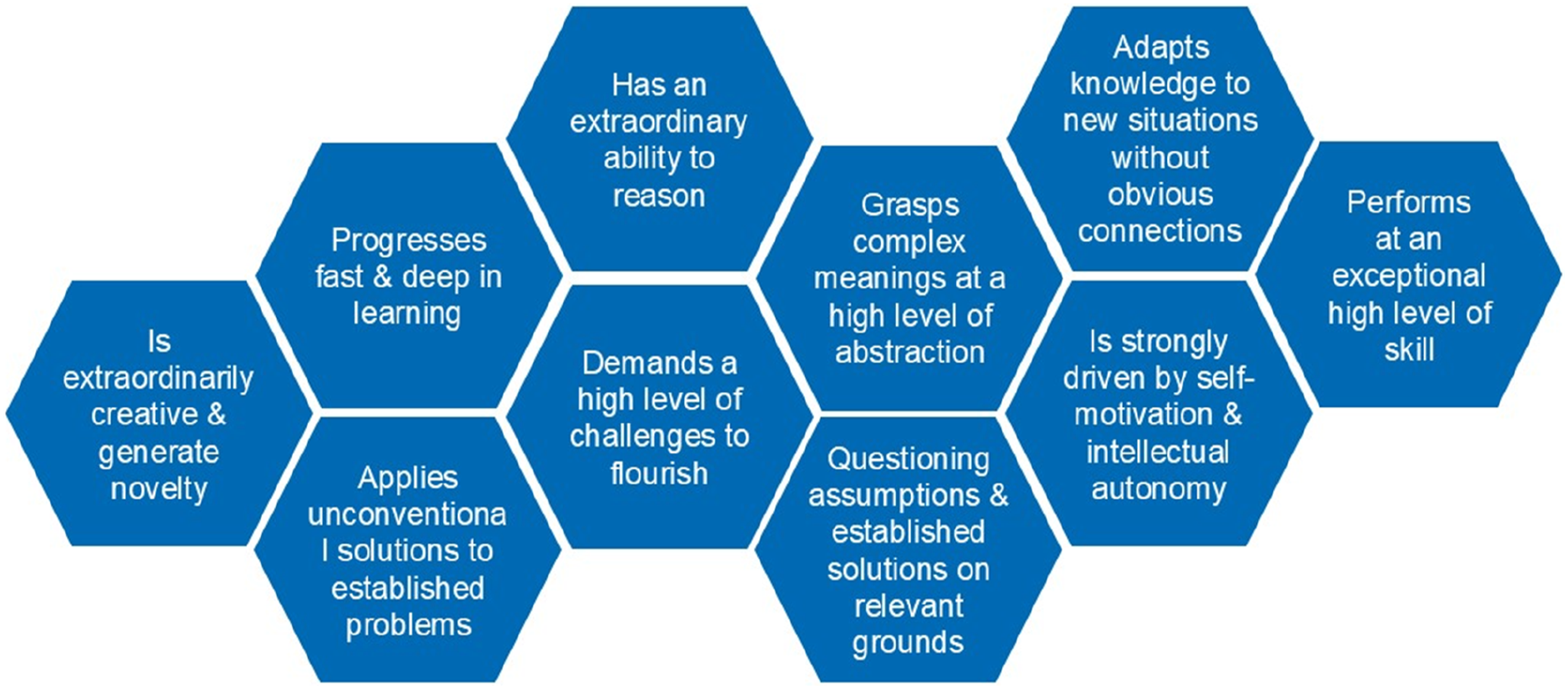
In contrast to the classical models of Renzulli and Gagné mentioned above, the cluster model relaxes the requirement that high performance and task commitment are necessary conditions for giftedness. Instead, it allows the inclusion of students who may underperform, or those who might not respond well to test conditions and who might be more creative than can be identified through standardised tests. This critique of the limits of the classical models is in line with other work such as that of Ugur Sak (2021). In addition, the cluster is not domain-specific in the sense that the conditions set out in the cells can be applied to various areas of knowledge, such as aesthetics, sports or in practical areas involving, say, creative and critical thinking abilities (Lubart et al., 2019; Sternberg, 2005) not measured in traditional IQ test, nor necessarily visible in a school setting. This will be discussed further below.
Giftedness and the environment
We have argued so far that giftedness is a multidimensional concept manifesting in different ways which, amongst other things, makes it difficult to measure. It is not only a dynamic concept at its base but the conditions in which it manifests and flourishes are also dynamic. In other words, giftedness is not an isolated feature of an individual, but is, at least partially, constituted by the environment in which it operates (Sternberg, 2024; Ziegler, 2005; Ziegler & Phillipson, 2012). The psychologists Sasha Barab and Jonathan Plucker refer to ‘smart context’ in their article discussing situated learning (2002) and in a recent talk Plucker (2024) talks about the ‘gifted environment’ (2024). In this section we make sense of these notions through recent work in so-called 4E cognition.
That the environment plays a key role in cognition is a central tenet of the diverse group of perspectives collectively known as 4E cognition. The four E’s are extended – cognition extends out into the world, embodied – cognition involves the body in an essential way, enactive – cognition is a performance involving the world rather than an abstract manipulation of symbols in the head, and embedded – cognition is essentially situated in its environment (for an overview see Newen et al., 2018). What these approaches have in common is that any discussion of cognition must place the environment at the centre of the debate in some form or other. For example, one of us has argued that the essence of a cognitive system is a coordinated coalition of processes operating in the environment rather than a “machine with fixed components” (Sims, 2022, p. 17). This situated view of cognitive processes does make a difference to the way we operate both in cognitive psychology and in related fields. “If [the hypothesis of extended cognition] is true, then pursuing empirical work in psychology solely in a white-room environment may not be the best course of action” (Sims, 2022, p. 19) since cognition is performative and occurs in the environment often through the use of material tools.
The link to giftedness can be illustrated using a musical example. A skilful instrumentalist would still be able to play relatively well, we assume, on another instrument, but the performance is likely to be better on her own instrument. Indeed, for a gifted performer, we might even describe the instrument as an extension of her body. And while a good instrument can improve the performance of a less skilful player, it cannot entirely compensate for lack of technique. In this case, ability is the result of the coordinated actions between the instrumentalist and the instrument: “cognition is constituted by a dynamic interaction between an organism and its environment” in systems that “extends beyond the boundaries of the neural architecture of the brain and even beyond the organism” (Sims, 2022, p. 13).
The big lesson here is that, on a 4E view, cognition is not just a matter of retrieving representational knowledge from one’s head. It is not even a response to environmental stimuli as traditional models suppose. It is a performance in which the environment plays a crucial constitutive role. But if this is correct then there are far-reaching implications: if cognition is environmentally situated then so is giftedness. It would then be a mistake to regard giftedness as an ‘internal’ property of the individual independent of the environment. This is one way we could make sense of Barab and Plucker’s ‘smart context’. Giftedness becomes externalised and is best expressed as the system of individual and environment coordinated in the right way (see Sims, 2025).
The crucial role of the environment has been noted in the giftedness literature by amongst others Gagné (2005), but with the difference that individual and environment are seen as two distinct entities. A 4E-cognition approach regards the individual and the environment as a coupled system - the individual performance really is one with the environment. This idea can be related back to Clark and Chalmers in their field defining paper: The human organism is linked with external entity in a two-way interaction, creating a coupled system that can be seen as a cognitive system in its own right. All the components in the system play an active causal role, and they jointly govern behaviour in the same sort of way that cognition usually does. If we remove the external component the system’s behavioural competence will drop, just as it would if we removed part of it’s brain. Our thesis is that this sort of coupled process counts equally well as a cognitive process, whether or not it is wholly in the head (Clark & Chalmers, 1998, pp. 8–9).
If this is correct, then identification of giftedness may include features in the cluster concept that would require, for example, the demonstration of artistic creativity. For example, instead of requiring a test subject to categorise words, a section in an IQ-test testing verbal flexibility may use the words in a poem, or a dialogue, or require the subject to illustrate their meaning through a drawing. This does not mean that mathematical-logical puzzles that comprise the bulk of IQ testing are completely free of creative possibilities, but rather that the test should be broadened to performance items that require manipulation of environmental features that are not related to symbolic reasoning or pattern recognition. After all, doing maths using symbols is environmentally situated but so is playing the cello. The first concerns traditional representations while the second does not. Identification will need to be broadened to take the whole cluster into account.
The practically able
As might be evident by now, the field of research into giftedness and gifted education contains many dichotomies: innateness/enculturation, high-performance/under-performance, individual/environment. Another of these is the tendency to distinguish theoretical knowledge and practical skills, and to value the former and give it higher status than the latter. Nearly 30 years ago, Persson (1997) criticised both this division and the related tendency to connect giftedness to facility in ‘intellectual’, school-based knowledge. Instead, Persson proposed that ‘craftsmanship’ was a term that deserved attention since the ability to solve practical problems in a skilful manner was just as worthy of the accolade ‘gifted’ as theoretical abstraction. In defining ‘bodily-kinesthetic’ ability, Gardner (2011, Chapter 9) says something similar in describing the essentially embodied process by which individuals skilfully manipulate objects in their environment. He points to the role of body (i.e. the hands of the craftsperson) in exhibiting such an ability. It would be a mistake, then, to neglect such kinesthetic abilities in a survey of the attributes of giftedness.
Gardner refers to this ability as an intelligence, and one of many, but he does not separate it from more theoretically oriented abilities. Although his theory of multiple intelligences predates the 4E revolution in cognitive science, our reading is that it is entirely compatible with situated cognition, and that bodily-kinesthetic abilities are equivalent to an embodied and enactive perspective on intelligence and therefore giftedness.
This situated foundation for giftedness has some interesting and significant consequences, not least, in how giftedness may be manifested. Freed from giftedness being something inside the head we can search for it in hitherto unexplored places. Take, for example, the craftspeople at work in the BBC-production The Repair Shop (2017-). In the show, highly-talented individuals use their specialised knowledge and remarkable skills to restore broken heirlooms, often homemade and unique. Their skills go beyond a mere reconstruction. Commonly, the repairs are made either using materials or parts originally intended for other purposes, or by making new parts from scratch since the part that is needed has long since stopped being produced. Their gifted performances are critically situated in their workshop where their tools become literally an extension of their bodies and with which they literally think.
In an in-service project on differentiated teaching and giftedness run by C. Sims between 2019 and 2020, one of the participants, Urban Söderberg, focused on what he decided to call ‘the practically able’ (Söderberg, 2021). As a teacher of construction and carpentry at upper secondary school (age 16–19), he described the following experience: Sometimes – but not very often - we get students who have an exceptional ability to use tools and machines. They have a high conception of methods, constructions and how these are organised. They read the construction plans without difficulty, and they reason at a high level of complexity about problems and challenges. They pass the theoretical courses without much effort, but they only do what they have to. When talking about what they are doing, their contributions are far more developed – it is like talking to a highly experienced builder (Söderberg, 2021 translation CS).
Söderberg also interviewed parents of children with practical abilities about their experiences based on a call where he asked for participants who “flourish when they are allowed to use their hands practically”. He noted how the parents gave similar stories of children who, from an early age, were skilful with their hands and their bodies, but who were underperforming, or not performing at all, in school. Amongst this group, there was a tendency for more theoretical school subjects to be described as “tedious”. Instead on focusing on doing classwork, students tended to become distracted and unfocussed. In the words of a parent about a son: “when boredom sets in, he may ‘fool around’ a bit by writing in a funny way, or in a completely different way, like backwards or something, but it doesn’t contribute to his grades and is not appreciated by the teacher” (Söderberg, 2021, p. 184).
We referred earlier to Barab and Plucker (2002) and their focus on situated abilities and the idea of smart contexts. They give examples of this in terms of arithmetic operations performed using material objects as props. There is a striking study cited concerning children working in a Brazilian market (Saxe, 1992). As part of their work, they needed to calculate prices of combinations of goods that they were selling. Psychologists posed as difficult customers to ask the children (what could be construed) as problems in arithmetic.
1
Students had little difficulty answering in a material context where the item itself could be part of the apparatus of the calculation. However, when asked to make similar calculations in a maths test, the same children encountered difficulties, and their performance was significantly worse. Barab and Plucker explain the discrepancy as follows: Although talent may be reserved by some to describe individuals possessing exceptional ability and ability may be described as an internal trait, in our description neither ability nor talent are possessed. Instead, they are treated as equivalent terms that can be used to describe functional transactions that are situated across person- in-situation (Barab & Plucker, 2002).
Granting that cognitive abilities range over the environment and embrace practical as well as symbolic performances supports the cluster concept of giftedness. We would not expect exceptionality to be limited to one or other area of expertise – or that it would be entirely about traditional ‘intellectual’ tasks. The cluster concept is able to capture this variety of ability as well as the nature of the dynamic relationship between the individual and the environment. Moreover, these arguments suggest that the nature of giftedness could evade capture by one-dimensional measurements or single criteria. The cluster model could feature in identification of the gifted student but as we shall see below maybe the traditional ordering definition-identification-provision is something that can be questioned.
Identification before provision?
This paper argues for a broader conception of giftedness that corresponds to broader set of criteria for identification proposed in the cluster concept. The reader might expect that we proceed much as before: using the cluster concept to set up criteria for the identification stage, which then allows the targeting of specific gifted individuals in the provision stage to be offered specific kinds of educational support. But this is to ignore the arguments we gave for the situated nature of cognition, and therefore the situated nature of giftedness. In this final section we make an argument for rolling the identification and the provision stages into one.
Recall that we took cognitive abilities to be distributed over the individual and environment. This would mean that identification would need to be situated in the environment, and in education this would normally mean a classroom or other space in which teaching and learning activities are happening. The view taken in this paper is that it would not make any sense to absent students from the classroom and put them through identification, tests or even diagnosis (Sims, 2023). This is because taking them out of their usual environment disrupts the whole cognitive system. Instead, identification of gifted students needs to proceed parallel to the provision procedure. Teachers will need to engage with all students, in the normal classroom space, in a way that allows a variety of responses. 2 From this, suitably trained teachers will be able to make identifying judgments based on the cluster concept for giftedness. Taking a situated approach thus collapses the identification and provision phase of the traditional sequence into a single dynamic engagement. Instead of identifying before providing we argue that identification should only occur when providing.
Concluding remarks
This paper has argued that giftedness is a complex phenomenon that can be manifest in many and diverse ways. The gifted education researcher should, therefore, reject so-called classical conceptualisations of it that rely on a set of necessary and jointly sufficient conditions. Instead, both researchers and teachers in the classroom should adopt a cluster concept model of giftedness reflecting its multifaceted nature. The particular version of the cluster concept proposed here is based on a meta-study that synthesises more than 70 different criteria. This cluster concept of giftedness summarises much previous work by the gifted education research community.
A second strand in the paper has been the idea that cognition in general, and giftedness in particular, are situated in the environment. This means that, far from being a property of brains or even individual human beings, giftedness is a property of a person in an environment (including a social one) – it is a relational concept. It is possible that a person can be gifted in one environment but not another. These ideas fit well into a 4E framework for cognition. Giftedness possesses features that are embedded in the environment, embodied in the individual, extended, encompassing both the individual and the material tools in the environment, and enacted through interactions with the environment. The last feature in the list highlights that gifted performances do not just concern abstract symbolic reasoning but also can be found in practical actions in the world, including creative acts in the arts and the crafts.
These arguments, if correct, have quite far-reaching practical consequences. For a start, the gifted researcher and the teacher in the classroom should not ignore creative acts in sport, in the arts, in practical subjects like craft, building or engineering. These practitioners too can be gifted. Secondly, there are implications for the procedures surrounding providing an appropriate education for the gifted student. The traditional picture of a rigid sequence in which giftedness is defined, gifted students are identified, and appropriate provision is devised should be rejected. In its place should be the realisation that identification should be situated in the classroom environment. This means that provision and identification are actually parallel or, perhaps more accurately, different aspects of the same practice.
Footnotes
Declaration of conflicting interests
The authors declared no potential conflicts of interest with respect to the research, authorship, and/or publication of this article.
Funding
The authors received no financial support for the research, authorship, and/or publication of this article.
