



Abstract
Critical thinking is internationally recognized as an important aspect of school education. Particularly in the United States, Scandinavian, and Asian countries, critical thinking is firmly anchored in school curricula. In this context, critical thinking is often aligned with critical thinking skills, which can be taught in structured programs and are comparable to strategies for self-regulated learning. Unlike in the United States, in German-speaking countries, critical thinking is a buzzword in pedagogical debates and is not firmly embedded in instructional contexts. There are desiderata for the entire educational system (theoretical, empirical, and school-practical). In the context of gifted education, development projects place a particular focus on the possibilities of design and investigation. Two projects will be presented, as well as exemplary implementation possibilities relevant to schools’ diagnostic and didactic processes. The projects will be related to each other, and research perspectives are given.
Introduction
Critical thinking is widely regarded as an important component of school education. Particularly in the United States, Scandinavian, and Asian countries, critical thinking is heavily incorporated into school curricula (Terblanche & De Clercq, 2021). In this context, critical thinking is frequently associated with critical thinking skills (Facione, 1990), which can be taught through structured programs and are comparable to strategies for self-regulated learning (Fischer, Fischer-Ontrup, & Schuster, 2021; Stoeger & Ziegler, 2010). As it is in the United States, in German-speaking countries, critical thinking is a buzzword in pedagogical debates rather than firmly embedded in instructional contexts. There are goals for the entire educational system (theoretical, empirical, and school practice). In the context of gifted education, development projects place a strong emphasis on the possibilities of design and investigation.
This perspective serves as the foundation for this research. First, this study approaches critical thinking as a theoretical construct and incorporates it into the discourse on giftedness. On this basis, this study presents two practical examples developed and scientifically supported by the University of Münster in Germany. Diverse groups of students are included in this study.
For the Development Project Sustainable Future Shaping, which is part of a larger project titled Leistung macht Schule (Promoting Excellence in School Education [LemaS]), elementary and secondary school students were trained to critically address the various problem areas outlined in the UN Sustainable Development Goals. As part of this process, schools hosted various activities, including campaigns encouraging students to become activists and take on various responsibilities.
For the Challenge and Support Project Plus, high school students collaborated with university student teachers to develop their own research questions. This project often begins with students’ learning or other school experiences. In some cases, the Sustainable Development Goals are used to formulate complex problems and pertinent questions. For this project, students wrote their own research papers and gave lectures.
Both projects will present learning architectures and demonstrate exemplary implementation possibilities relevant to schools’ diagnostic and didactic processes. Finally, the projects will be related to each other, and research perspectives in the field of giftedness research will be developed. The two projects will be used to discuss how to promote critical thinking in the classroom and the role of the SDGs in this regard. To this end, a systematic comparison is revealed, and links to critical thinking skills are demonstrated.
Perspectives on critical thinking in gifted education
Gifted education in Germany
Gifted Education has gained popularity in Germany in recent years (Fischer & Müller, 2014). Because of the experiences of National Socialism, gifted education has long been associated with elitist behavior and the possibility of military careers (Bergold, 2013). It was in the 1980s, thanks to Joe Renzulli and colleagues’ efforts, that serious academic and school-based work on gifted education began. Differentiated models of giftedness were developed in various major research programs, including the Munich longitudinal study on giftedness (1986–1988) and the Marburg project for gifted children (1987–1989), as well as research on stereotypes. For example, ideas for gifted education in school practice, particularly in the area of enrichment, were developed (Rogalla, 2009). There are also additional training courses (ECHA-Training) for teachers that are recognized throughout Europe (Fischer, 2010). With the federal and state government initiative to support potentially high-achieving students: “Leistung macht Schule” (2018–2027), has made the topic of promoting giftedness even more relevant since 2018 (Weigand, 2020).
LemaS is a joint initiative of the federal government and the federal states of Germany. This project aims to promote high-achieving and potentially high-achieving students over ten years (Weigand, 2020). Various support measures have been developed and investigated for this school research project. The school research project was divided into four modules based on (I) performance-enhancing school development, (II) challenge and support in the regular classroom, (III) diagnosis and guidance, and (IV) challenge and support outside of the regular classroom (Preckel et al., 2020). Further subdivisions include 22 subprojects organized in various disciplines such as psychology, general education research, and subject didactics. The state of North Rhine-Westphalia has added school development programs that are designed and implemented in collaboration with schools and supported by research (Vohrmann et al., 2018).
Conceptions of critical thinking
Critical thinking is a multifaceted concept with different definitions across disciplines. Critical thinking can be viewed as a metacognitive process (Dwyer et al., 2014) that includes cognitive strategies like logic, analysis, and reasoning (Ennis, 1964; Paul, 1989). This perspective has been developed for over 30 years (Bensley, 1998; Ennis, 1987a, 1987b; Halpern, 1996; Walser, 2008) and served as the foundation for a Delphi definition of critical thinking skills (Facione, 1990). This definition is central to the international discussion of critical thinking (Abrami et al., 2015; Hitchcock, 2020).
Furthermore, the intersection of critical thinking skills with other metacognitive processes, such as self-regulated learning (Fischer, Rott, et al., 2021), has become apparent, particularly since self-regulation is linked to critical thinking (Dwyer, 2017). This is also because critical thinking helps students understand complex situations (Bourn, 2018; Staudinger, 2019). However, the findings of several studies, such as those on observable critical thinking in young people and the success of programs to improve critical thinking in students (Abrami et al., 2015), challenge this assertion. The following paragraphs discuss a multiperspective pedagogical approach.
There are numerous current and future challenges to social, economic, and environmental issues. This essay does not focus solely on critical thinking skills (Greene & Yu, 2016). Rather, it views critical thinking as the primary motivation for (pedagogical) actions (Pfister, 2020). According to Dewey (1916), critical thinking is a type of thinking that “is the intentional endeavor to discover specific connections between something we do and the consequences which result, so that the two become continuous” (p. 186). Dewey’s pragmatist understanding demonstrates that thought and action are not mutually exclusive, but rather are one. His approach to reflective thinking must also be viewed through this lens (Dewey, 1910, 1933), which can be defined as a meaning-making process in which experience and interaction with others are particularly important (Rodgers, 2002).
A pedagogical-philosophical perspective on critical thinking expands on this understanding by emphasizing norms, values, and attitudes, as well as emotions, tolerance of ambiguity, and motivation, as the primary objects of critical thinking. The pedagogical-philosophical perspective is influenced by more than just norms, values, and personality traits. That is, it also influences the shaping and interpretation of norms, values, and personality traits through behavior. Critical thinking can also result in a renegotiation or shift in norms and values, while also contributing to personality development (Pfister, 2020).
Critical thinking and giftedness
The active-concerned citizenship and ethical leadership (ACCEL) model (Sternberg, 2017) also emphasizes critical (analytical) thinking as a key characteristic of giftedness in discourses on giftedness. Sternberg (2017) emphasized that critical thinking in the classroom context necessitates activities that apply to students’ daily lives. Questions about orientation frameworks for values and norms are linked. Critical (analytical) thinking and other characteristics, such as common sense, passion, creativity, wisdom, and ethics, are thus concise as an alternative definition of giftedness because people require different giftedness characteristics for participation and co-creation in the 21st-century world from those that have dominated the discourse so far. The main point here is not to link giftedness to a definition of IQ, but rather to understand giftedness from various perspectives in an open manner.
Sternberg (2017) defines IQ orientation as a narrowing that prevents current problems and global challenges from being adequately addressed (Ambrose, 2016). This broadens the scope for shaping pedagogical processes that are severely constrained by narrow understandings and excludes those from the concept of giftedness support who can be described as marginalized or discriminatory. Integrative giftedness and learning process model 2.0 (Figure 1) was developed in German-speaking countries (Fischer, Rott, et al., 2021), which connects to Sternbergs’ ideas and addresses the design options for gifted education in the social environment. Integrative Giftedness and Learning Process Model 2.0. Note. From Integrative Giftedness and Learning Process Model 2.0 [figure] by Fischer, Rott, et al., 2021, source.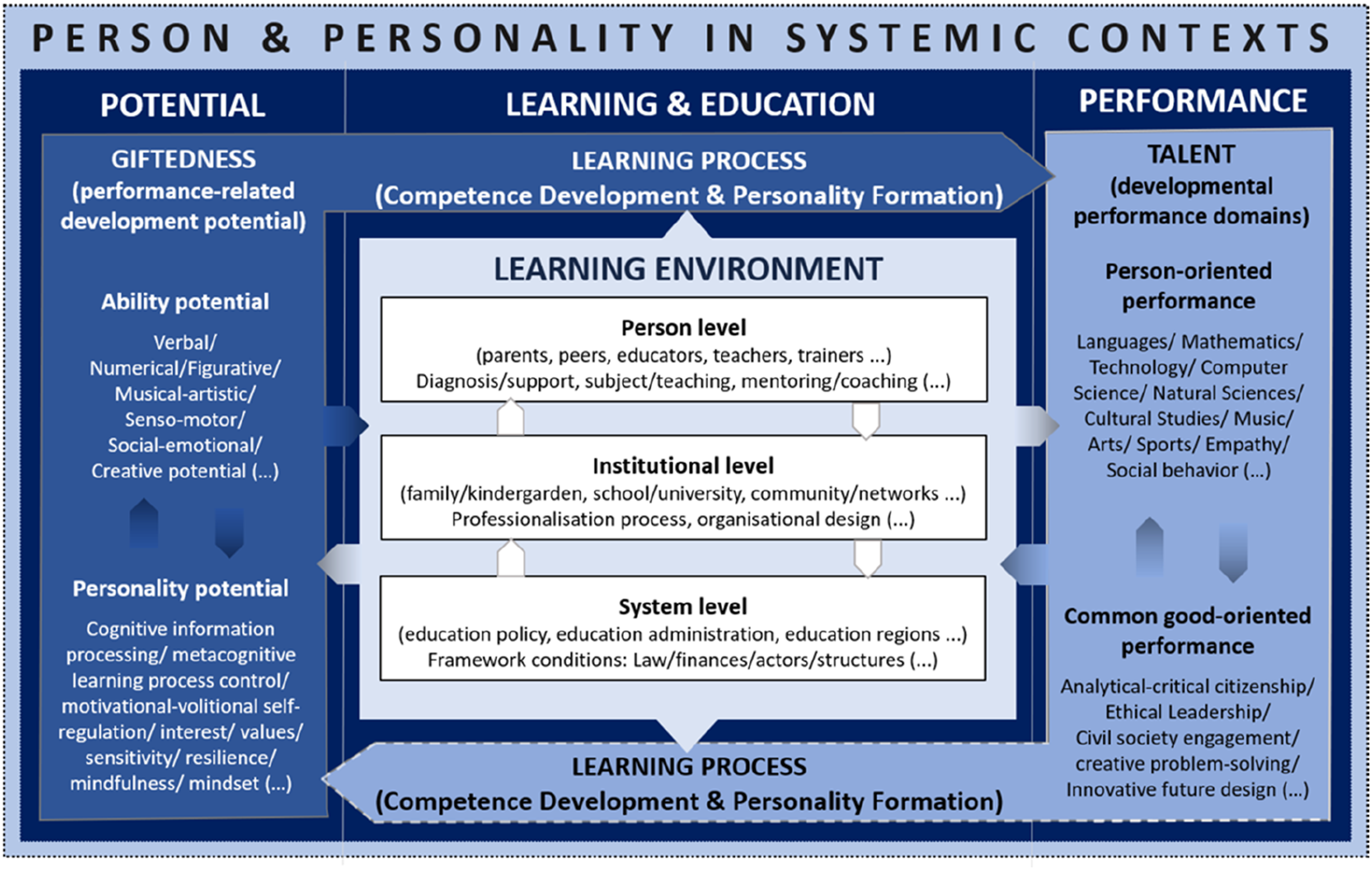
This model was further developed as an orientation framework within the context of the LemaS research network, focusing on people in social contexts. The LemaS approach (Weigand, 2020) for giftedness as a performance-related development of potential caused by unique individual combinations of ability and personality potentiality was considered. Furthermore, the multidimensional concept of performance of the LemaS joint project with different content domains was considered, with an emphasis on both person-oriented performance and common good-oriented performance in the sense of the ACCEL model of Sternberg (2017). Furthermore, when it comes to influencing the learning process, the learning environment is viewed as a multilevel system. That is, in addition to the personal level, the institutional and system levels are equally important. Furthermore, domain-related perspectives based on prospective giftedness research and retrospective expertise research are combined under the assumption of a circular spiral learning and development process, particularly because the respective achievement level, in interaction with the learning environment, can influence future giftedness development.
Critical thinking in gifted education
We believe that the pedagogical-philosophical perspective of critical thinking can promote the development of personality and giftedness by examining norms and values. Critical thinking has the potential to increase action creativity in the context of the tension between social norms and individuality (Joas, 2012), as well as open new paths to problem-solving. This is related to the promotion of giftedness to address and motivate people to use their talents to make the world a better place (Renzulli, 2012). For this purpose, promoting individual personality traits is not the only important step. Rather, giftedness promotion and talent development should encourage people to collaborate and seek common ground with others (Ambrose, 2019; Patrick et al., 2005).
One goal of gifted education should be to encourage critical thinking. This can then lead to (young) people learning how to use and evaluate various sources of information, allowing them to make fact-based decisions. This necessitates a value horizon centered on the greater good. This allows people to articulate their arguments more forcefully in social settings, making them more persuasive. The goal is to empower individuals to participate in social decision-making processes and shape issues.
The project architecture for gifted education described in the following paragraphs is based on the school-based enrichment model (SEM) (Renzulli & Reis, 1997), which means that organizationally, learning opportunities are provided for students outside of regular classrooms and across curricula. Students are challenged and given opportunities to pursue their interests and talents. The enrichment triad model (Reis et al., 2021) is specifically mentioned, as it defines three types of enrichment. Type I includes entry-level, offerings of short durations on diverse topics, such as guest lectures, demonstrations, and short projects. Type I has a minor role in the following projects; however, types II and III are used and combined in various ways. Type II focuses on opportunities to learn important basic skills, including methodological skills like research and presentation. In Type III, students must apply competencies related to their own topics or projects.
Critical thinking in school learning environments
The question of how critical thinking can be implemented in the school aspect is addressed using two learning architectures. For this purpose, the development project Sustainable Future Design, which is part of the project LemaS, as well as the Challenge and Support Project Plus, will be presented. Both projects were developed and researched by the University of Muenster, Germany. To provide insight into both projects, the descriptions follow this structure: (1) integration of the specific project into more general contexts, (2) project specialization, (3) teaching strategies to promote critical thinking (4) products on the part of students, (5) incomplete research design, and (6) expected outcomes.
The development project sustainable future design
Integration into more general contexts
Sustainable Future Design is embedded in the LemaS subprogram “Challenging and Supporting Outside the Regular Classroom” and allows participating schools to implement a potentially potential enrichment measure. Elementary and lower-secondary students with projects on sustainable future designs were addressed. The substantive goal is for students to become advocates for the UN Sustainable Development Goals (Kohnen et al., 2021). In the context of LemaS, this study focuses on a specific group of students whose potential should be challenged and developed in terms of the giftedness dimensions of the ACCEL model. Renzulli (2012) and Sternberg (2017, 2020) believe that students should be able to discover, develop, and apply their talents to help create a better, more sustainable world.
Project spezification
This is implemented in schools by forming groups of five to eight students. Students are selected primarily based on their interests, which are supplemented by teacher assessments of motivation and performance (e.g., school grades). However, sometimes selection is used to achieve a balanced group constellation. There is no systematic diagnosis, which means there is no use of standardized testing, as is typical in Germany. These groups can also include students of various grades and years. Because it is an enrichment program in which students frequently leave their regular classes using a revolving door model (Greiten, 2016; Renzulli et al., 1981), students must be able to independently compensate for absences from their regular classes.
Teaching strategies to promote critical thinking
The basic design of the enrichment program is based on the SEM and focuses on Enrichment Type III (as described above). In this project, students were expected to identify with their self-selected topics while also acting professionally. The actual implementation of the projects occurs in phases inspired by design thinking (Kohnen et al., 2021; Shiveley et al., 2018). During the first phase, students explore the topics of the UN Sustainable Development Goals and select focus areas that are particularly important to them. Figure 2 Conversations among student team members determine which focal points will be realized through an action or campaign. Students then concentrated on the focal points (empathy phase). In the following phase, the target group for the planned action or campaign is considered, and in the fourth phase, ideas are generated for implementation rights to the target group. This raises methodological concerns, such as the question of which media will appeal to which audiences. The fifth phase entails creating a strategy for executing an action or campaign, which is then implemented in the sixth phase. The diagram below depicts the individual phases: Phases of the Project for Sustainable Future design. Note. From Phases of the Project for Sustainable Future Design [figure] by Translated according to Fischer & Fischer-Ontrup (2023), p. 339.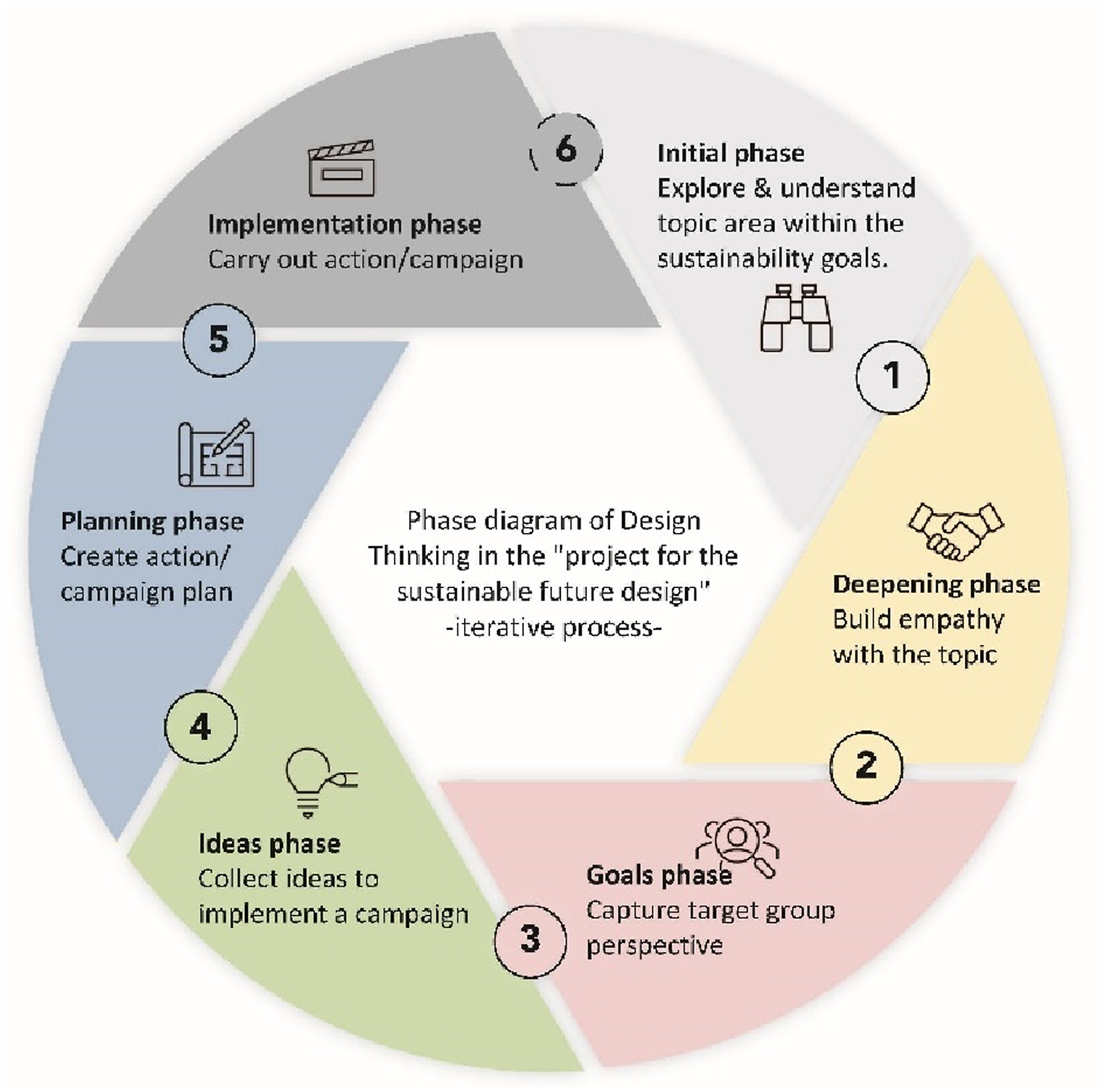
In each phase, students are challenged and supported based on the various dimensions of 21st-century skills (Ananiadou & Claro, 2009) and the ACCEL model. Initially, emphasis was placed on content-related cognitive elaboration of the major topics. As the process progresses, communication, collaboration, and creativity are required in the discussion surrounding the group’s focus to make joint decisions. Critical thinking is also challenged here because the group discussion questions both the content and the perspectives of oneself and others. However, arguments for one’s position must also be presented.
The goal of enrichment is to foster collaboration and shared learning in the pursuit of a transformative gifted education approach (Sternberg & Fischer, 2023) that forces individual potential development into the context of peer interaction of gifted students with others (Cross, 2016; Maksic, 1998).
Creativity is especially important when considering how to design a campaign that is appropriate for the target audience. However, this process is required not only when students work in groups, but also when they collaborate with teachers and adults. Finally, it is also required for the execution of actions and campaigns. Achieving the highest level of student participation is an important goal in school-based enrichment. Decisions should be made collaboratively with students, teachers, and other adults. This corresponds to participation levels seven and eight of the OECD Learning Compass 2030 (OECD, 2020). The OECD criticizes the fact that most decisions are made by adults. In the first level of the participation ladder model, adults manipulate children in decision-making scenarios. At level 8, decisions are made jointly and collaboratively, which means that children or students should initiate and lead their own projects. In this context, supporting teachers play a unique role: they assist project teams when faced with challenges by allowing students to act largely autonomously while also providing organizational, technical, and methodological advice.
Following the UN Sustainable Development Goals, projects aimed at achieving a sustainable future address various social and scientific issues, including climate change and biodiversity loss. Therefore, the context of socio-scientific issues (Nerdel, 2017; Ratcliffe & Grace, 2003) necessitates ethical evaluation competence, for which the critical thinking process is an important starting point (also see the capability approach mentioned above). In this context, attitudes, motivation, and emotions, as well as capabilities, are important (Halper, 1996; Rafolt et al., 2018, 2019). This also establishes a link to norms and values (Hasslöf & Malmberg, 2015), for which the UN Agenda 2030 serves as a social framework and orientation (Martens & Ellmers, 2020; UN, nd).
Products on the part of students
The first project results from the project teams (N = 10) demonstrate various campaigns and actions. The students clearly also want to reach people outside of their own school community. Therefore, many projects involve contact with people and organizations outside of school, such as running campaigns on the town hall square or assisting poor children through local welfare organizations. A primary school group, for example, launched a project to address the issue of forest pollution in their own town. To allow other citizens to actively participate in litter clean-up, the students established a litter picker rental station. Here, anyone can borrow a litter picker before going for a walk in the forest and actively collect litter there. To organize and finance the litter tongs, the students approached the mayor and persuaded him to buy them for the project. This example demonstrates that the students want to persuade and engage others with their projects.
Research design
The development project’s accompanying longitudinal research focuses on the potential for students to develop 21st-century skills, considering student interactions in making decisions for joint action, project design, action or campaign, and student participation opportunities in the project. The accompanying research was design-oriented. To employ a mixed-methods approach (Mejeh & Hagenauer, 2023), quantitative research instruments (questionnaires or standardized tests of self-efficacy expectations and critical thinking) will be used and evaluated. Transcripts of student and teacher interviews, as well as classroom discussions, will be analyzed qualitatively and constructively.
Expected results
The accompanying longitudinal research of the projects focuses on the individual development of students’ potential while also taking into account students’ interactions in the decision-making process for joint actions and campaigns. Methodologically, quantitative research instruments such as scales measuring general self-efficacy expectations (Schwarzer & Jerusalem, 1999), cognitive abilities (subscale; Weiß, 2006), and critical thinking are used and evaluated. Simultaneously, transcripts of student and teacher interviews, as well as classroom discussions, are analyzed in a qualitative-reconstructive manner.
Initial findings indicate that students gain self-efficacy in these projects and develop skills on an individual basis. These competency gains do not appear to be due solely to interest in and engagement with project content. The project’s central goal of promoting social interaction within and outside the groups contributes significantly to skill development. This is especially true for decision-making processes that require students to engage in dialog and explore common paths.
Student Self-Assessments on the Project.
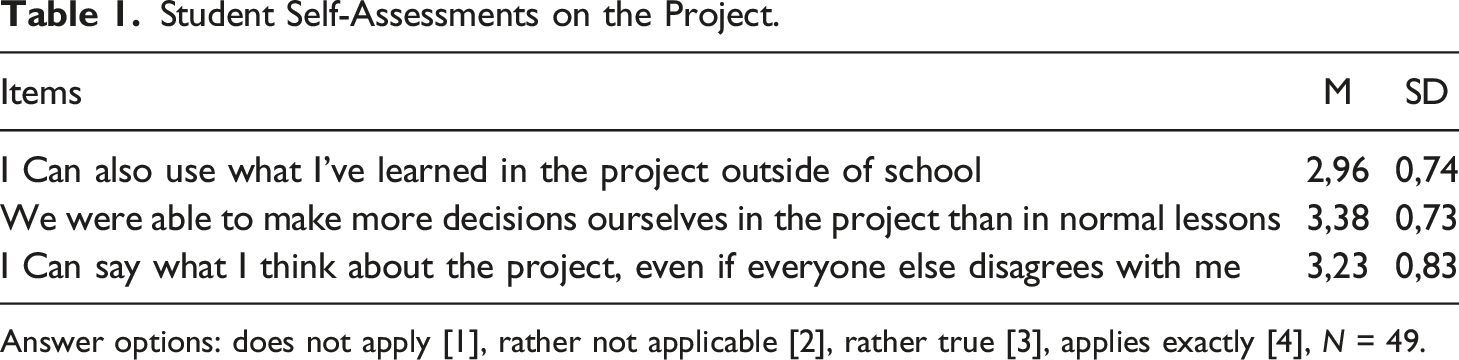
Answer options: does not apply [1], rather not applicable [2], rather true [3], applies exactly [4], N = 49.
Challenge and Support Project Plus
Integration into more general contexts
The Challenge and Support Project Plus, launched at the University of Muenster in 2016, is aimed at students aged 15 to 18 in high schools and comprehensive schools (upper school). The participating high school students came from various schools in the region to attend university. They participated in the project along with student teachers. Student teachers accompanied high school students on their projects to serve as mentors (Schulte ter Hardt et al., 2020).
Project spezification
The Challenge and Support Project, which began in primary schools, serves as the foundation for this project. The questions about self-regulated learning are crucial. Students choose a unique topic based on their interests and write an accompanying paper. They presented their main findings at a conference. In secondary schools, project complexity increased as students grew older. Lower school students’ work is guided by topics. However, beginning in middle school, they developed their own research projects and conducted them using appropriate scientific methods such as interviews and experiments. Here, the projects culminated in writing essays and delivering presentations.
The Challenge and Support Project Plus focuses on the project’s fundamental perspectives. It is intended as an enrichment measure and is aimed at students who are perceived in partner schools to be particularly interested, motivated, or committed, as well as those who have been assessed as capable of performing additional tasks outside of schoolwork. The schools chose which students were invited to participate in the project. The university does not use standardized measures like intelligence tests to identify eligible students. Finally, students must actively decide to participate in the project. Teachers at their schools encouraged them in their decisions. Because courses at schools and universities are typically held outside of the classroom, it is an additional offering integrated into the daily school routine of participating schools. Each academic year, an average of 20 students from six partner schools engaged in Challenge and Support Project Plus. In the future, the number of students is expected to rise to 35 per academic year.
The project’s goal was to familiarize students with the methods of scientific work, motivate them to participate in research activities and provide them with a framework for their interests that extends beyond the regular school curriculum. Critical thinking is incorporated into the measure as long as it can be viewed as a kind of cross-layer. Critical thinking skills are not taught explicitly, but rather through controversial topics and questions. Furthermore, students are encouraged to reflect.
Teaching strategies to promote critical thinking
Students in Challenge and Support Project Plus were exposed to all three types of the enrichment triad model. At various points in time, they were allowed to gain experience on specific topics by attending lectures given by scientists and watching videos created for this purpose (Type I). For this project, students generated their own scientific questions and approached problems in diverse ways (Type II). The project was initially intended to teach students how to approach learning from an interdisciplinary perspective. In the meantime, the project grew. Students can now work on topics related to the UN Sustainable Development Goals and formulate scientific questions. They can also initiate their own projects or campaigns, which they present as the culmination of the one-year project. Thus, impulses from extracurricular developments are also taken up, as evidenced, for example, in the climate protests of the Fridays for Future movement. Students' projects frequently revolve around topics and questions that arise in their daily lives.
In Challenge and Support Project Plus, students learn research-based learning strategies (Type II). They then used them in a targeted manner. They created independent research designs and carried them out in the real world. The projects were primarily designed by individual students. During the seminar, however, participants could exchange ideas in various ways and levels. For example, students may brainstorm ideas for developing appropriate topics and questions, as well as discuss existing research, theoretical foundations, and methodological implementation possibilities. Extensions addressed questions about the scientific work for the project, as well as transfer and communication issues. During the project, when students have differing opinions, they must be able to deal with complex arguments and contradictions. Their own project ideas should not be based on opinions but on scientifically sound knowledge, and students must systematically use this knowledge to complete their projects. Furthermore, when working on projects, students should conduct research and apply methods and strategies appropriate to the research topic.
Students were each responsible for developing their own projects. Therefore, students can work at their own pace. They can choose and deepen their thematic focus, as well as establish personal priorities (Type III). Simultaneously, students are involved in cooperative situations that require them to exchange ideas with other people. Figure 3 Students present their ideas and plans to one another, provide and receive feedback, and participate as interlocutors. Teachers in schools, lecturers at universities, and students involved in the project all help students on various levels: they advise the students on projects and plans, connect them with experts, and provide a learning environment in which students can work on their projects. They not only provide content impetus but also methodological support, as in scientific work. From Phases of the Challenge and Support Project Plus. Note. From Phases of the Challenge and Support Project Plus [figure] (Translated according to Fischer & Fischer-Ontrup, 2023, p. 338).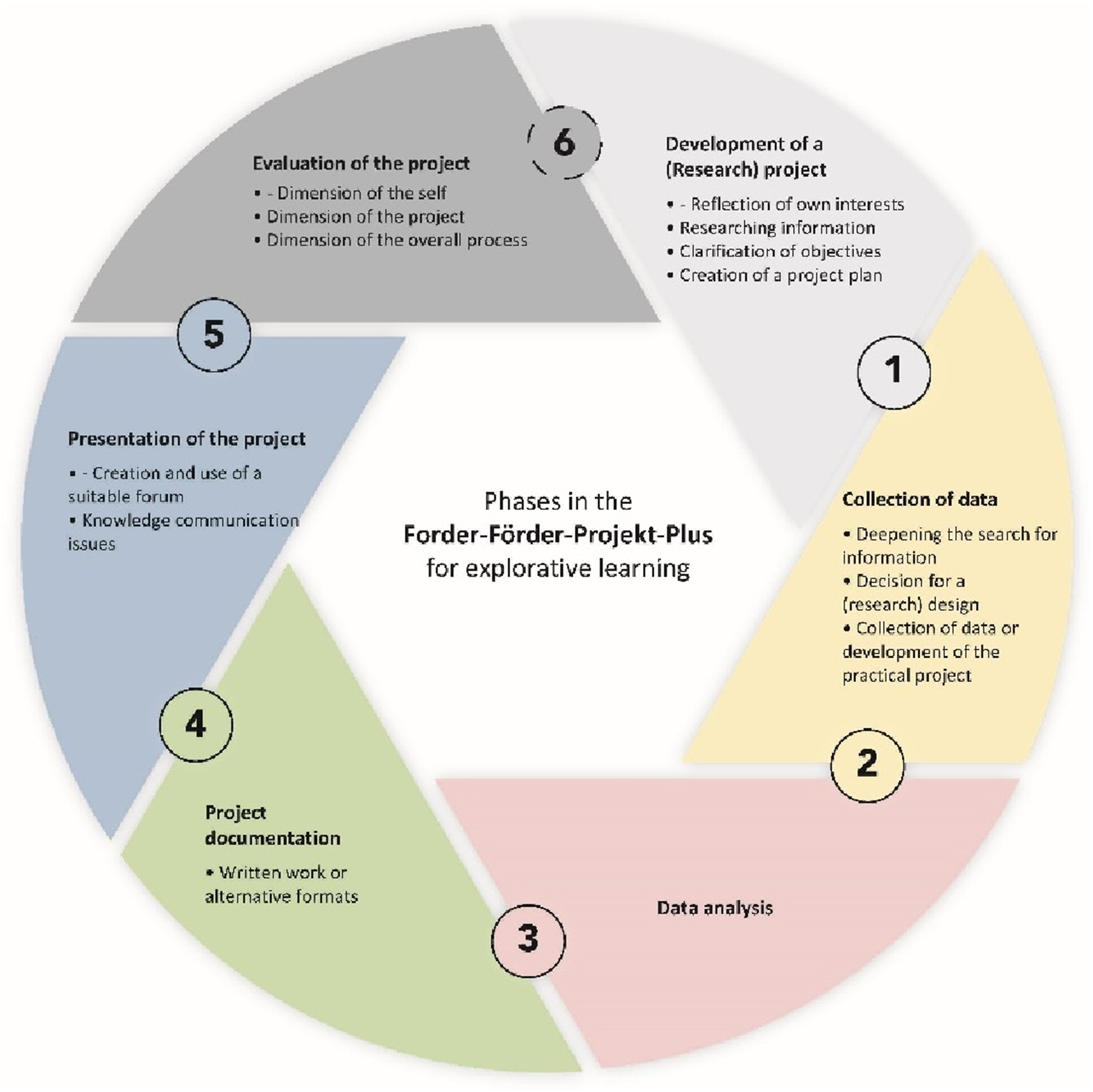
The project was set to run for one school year. Students decide whether or not to participate in the project before summer vacation. Following the summer vacation, the school makes its first offers, which are intended to spark thematic discussion. Tasks are designed to provoke an examination of one’s own learning (biographical learning) and familiarize students with relevant themes (learning, UN Sustainable Development Goals). During this process, students’ interests should be discussed and thematized. The university will make measures available through an online platform, allowing for both individual and in-depth familiarization.
Throughout the school year, various events were held at the university as part of the seminar. These events allowed participants to get to know each other and learn about conducting research at the university library. The students then developed preliminary topic ideas for their individual projects while receiving both theoretical feedback and assistance from the university in terms of methodology (e.g., interview techniques and questionnaire design). University students accompany students on their projects, providing feedback and ensuring the structure of the projects. After six months, the students presented their projects with scientific posters at a university working conference, where they received feedback from teachers, other students, lecturers, and experts. Students use these tips to implement their projects. They have another six months to complete this task, and during that time, they must also create a product (such as a written paper or presentation) to document their project. After the project phase, the students presented their findings at a conference held at the castle of the University of Münster, where they addressed a large audience.
Products on the part of students
During the project, students write research papers and present their findings in front of an audience. The orientation toward the students' world is clear. They address questions or issues that arise in their daily lives. In some cases, questions that cannot be explored in depth at school are addressed explicitly.
Research design
The success of the project is measured in several ways, including assessing students’ final products and overall development, interviewing accompanying teachers and students, and conducting research on students’ self-efficacy. In terms of future developments, school didactic and high school didactic instruments are being evaluated. For example, regarding the reflection competence of students or accompanying mentors (Rott, Gilhaus-Schütz, et al., 2021; Rott, Schulte ter Hardt, et al., 2021).
Expected results
The students' final products provide multiple points of reference for the evaluation. On the one hand, it is critical to determine which topics or questions students work on once they can make independent decisions in a project setting. This information can also be used to plan regular lessons. This is also true if adaptive lesson design is central to development processes. It is expected that a diverse range will emerge here. Teachers are expected to benefit from the project structure because it will allow them to experience their students in a new way, opening up new possibilities for pedagogical diagnosis. Students' self-efficacy expectations are likely to rise significantly.
As an example, the student mentors demonstrated how they use this setting to reflect on their own learning biography. The learning maps used for this purpose show that the testing and application of learning strategies are perceived as particularly relevant for them during their studies, as well as for the students participating in the project. Learning maps have also been demonstrated to be an effective tool for recording students’ developmental perspectives and emphasizing their own learning (Rott, Schulte ter Hardt, et al., 2021).
Discussion
The two approaches to promoting giftedness have partially congruent learning architectures. However, these two architectures differ in terms of target groups (age), project objectives, and opportunities for participation. Both approaches are based on the interests of the students; that is, students have significant autonomy in project content and can set their own priorities for products. The Challenge and Support Project Plus aims to help students improve their scientific skills, gain academic expertise, and learn how to present their findings to others, such as by writing papers or giving presentations. Students involved in this project, which focuses on creating a sustainable future, should become persuasive advocates for sustainability goals.
Even if both projects can initially stand on their own and adapt to schools that want to promote gifted students, it may be beneficial to allow them to build on one another in chronological order. Thus, cross-school collaboration and development are also possible. Some schools have already successfully included this type of synergy in their curricula. This seems to make sense because the level of support provided through learning and organizational strategies is less in the Sustainable Future Design Project than in the Challenge and Support Project Plus.
The Challenge and Support Project Plus emphasizes more on types II and III of the triadic model, according to Renzulli, and provides a comprehensive program for learning as well as research strategies or support for self-regulated learning. This enables students to apply and develop specific (learning) strategies. Students without prior experience may require additional assistance in learning the strategies for self-regulated learning required for a project Sustainable Future Design.
In turn, the Sustainable Future Design Project gives students a great deal of design and decision-making flexibility. Thus, these two projects differ in the tension between structuring, which promotes learning, and the degree of freedom of self-determination (Deci & Ryan, 2008). Furthermore, in these projects, both students and teachers are challenged, as teachers must be able to play the roles of learning facilitators and advocates. Furthermore, teachers must learn to make decisions in partnership with students on an equal basis.
Both projects challenge students to develop critical thinking skills. These projects have various focuses and approaches that are tailored to the ages of the participants. The project Sustainable Future Design aims to emotionally connect students to the project. Students do not start from academic or cognitive backgrounds but are approached based on their experiences or interests. Student products are more freeform than those in Challenge and Support Project Plus, allowing for greater student access. Meanwhile, the Challenge and Support Project Plus strengthens scientific thinking and work by bringing students together with experts and asking them to pose and work on their own scientific questions using appropriate methods.
It is also reasonable to assume that their critical thinking abilities are challenged. Both projects require an understanding of the students’ ideas, goals, and motivations. Furthermore, as supporters, they must prepare and develop learning architectures so that students feel anchored and can move forward with their own projects. This requires a high degree of flexibility and creativity among teachers. Reflection on project processes and a shift in perspective, as well as the teachers’ understanding of their role, all contribute significantly to the project’s participatory design.
Critical Thinking in the Project Phases.
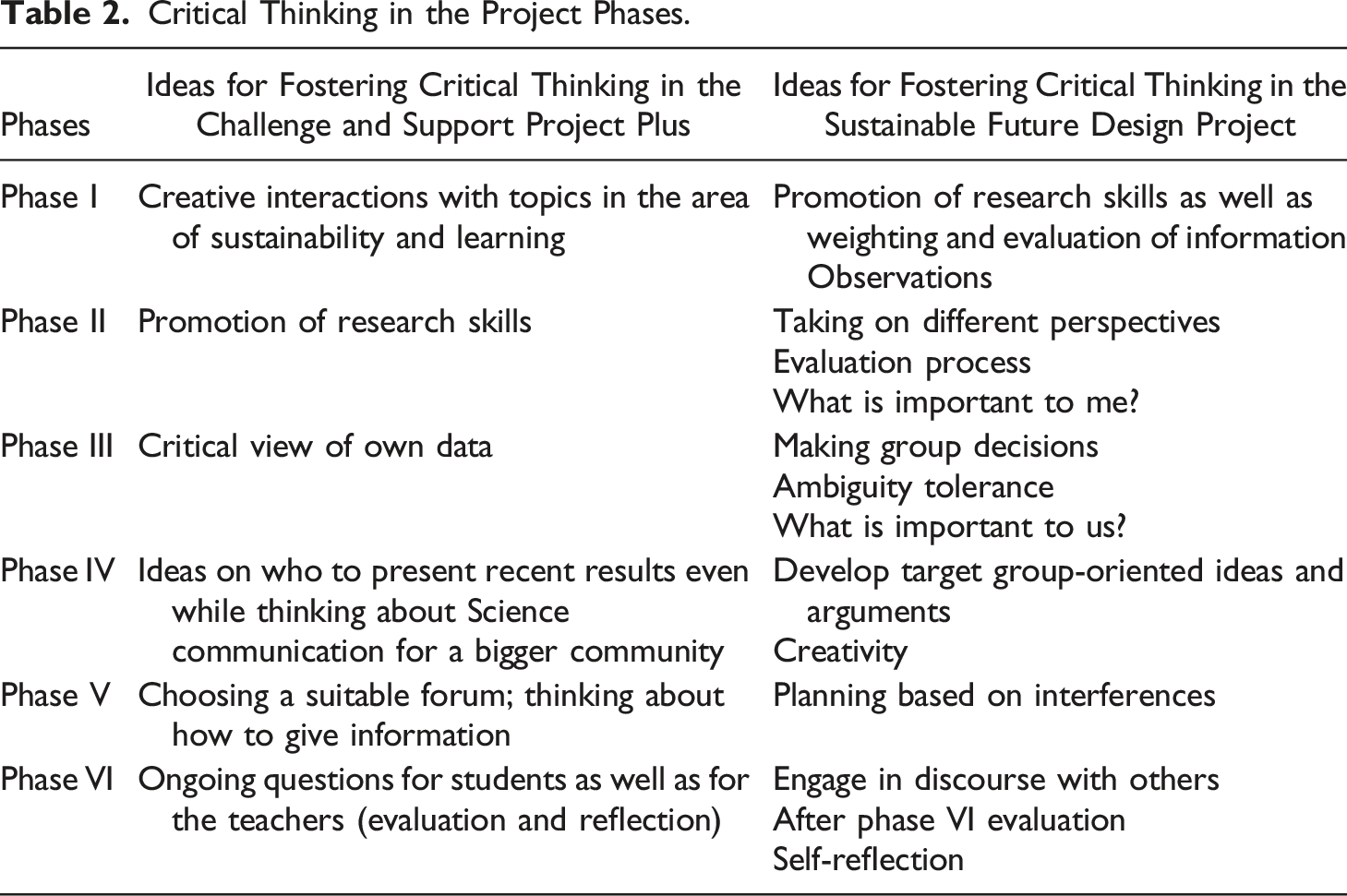
Finally, there are some initial implications for the education system. Project formats provide an opportunity for discussions that are difficult to implement in regular subject lessons. The topic of sustainability lends itself particularly well across disciplines. Opening up the institution of the school to collaborate with other stakeholders, such as the university, can result in a more diverse perspective, which should be sought more frequently. Complex projects should be designed to benefit all students, not just a select group of them. It is therefore necessary to clarify how such projects can be applied to regular lessons. Particularly in terms of the student’s creative possibilities in such formats, it is necessary to clarify how the openings can be integrated into the given timetables. Questions of pedagogical diagnostics can be especially useful, for example, when determining how students can reach their full potential. Both projects can contribute valuable information here. The importance of critical thinking should be particularly emphasized. This appears to be a critical skill that should receive more attention in school. Findings in this area that can be applied to non-project settings would be ideal. Hopefully, the accompanying empirical research will provide valuable insights in this direction.
Footnotes
Declaration of conflicting interests
The author(s) declared no potential conflicts of interest with respect to the research, authorship, and/or publication of this article.
Funding
The author(s) disclosed receipt of the following financial support for the research, authorship, and/or publication of this article: This work was supported by the Open Access Publication Fund of the University of Münster.

Author biographies
David Rott, Dr, member of the academic staff, member of the Institute of Educational Science in various positions since 2010.
Marcus Kohnen, Dr, seconded teacher at the Institute of Educational Science.
Christian Fischer, Prof. Dr., Professorship in educational science with a focus on school pedagogy: gifted education/individual fostering Head of the Working group on gifted education/individual fostering since 2010.