




Abstract
Giftedness is typically thought of as an individual characteristic. But the development and labeling of an individual as “gifted” is always a collective process and takes place embedded within local, sociocultural, and temporal contexts. The view of giftedness as individual is deceptive and results in faulty practice, such as the bestowal of huge advantages in development and labeling upon children whose parents have more substantial financial and other resources. This article applies a pentagonal implicit theory of giftedness to the analysis of individual, collective, and contextual factors in development and labeling and concludes that giftedness should never be viewed merely as an individual characteristic. Doing so not only distorts reality but creates procedures that tend to pass identification and development of “giftedness” inequitably through successive generations of families by virtue of the families’ resources.
Keywords
Schools around the world identify children as gifted, using a variety of tools in their identification, such as intelligence tests, achievement tests, school grades, teachers’ and parents’ reports, and evidence of special talents (Pfeiffer, 2018; Plucker & Callahan, 2020; Silverman, 2012; Sternberg & Ambrose, 2021). Although the exact criteria for identification diverge, they converge in one key respect: Identification is of individuals. That is, the label “giftedness” is or is not applied to individuals, rather than, say, to groups or other collectives, or to individuals operating in particular environmental contexts.
This article calls into question the assumption that giftedness inheres in the individual. Rather, it will be argued, giftedness inheres in personal interactions with particular tasks and contexts (see also Sternberg, 2023; Ziegler, 2005); on this view, giftedness is, at some level, in part collective rather than merely individual (Sternberg & Karami, 2021). Others are somehow involved in the interaction among person, task, and environment and how those interactions are labeled.
This article will be based on a pentagonal implicit theory of giftedness (Sternberg, 1993; Sternberg & Zhang, 1995). It is an “implicit” theory in that it refers to the way people use a term, in this case, “giftedness,” for labeling. This theory views people as gifted if they meet all of five criteria. They must (a) excel in some identifiable way, (b) be relatively rare statistically in the way they excel, (c) be able in some way to demonstrate their excellence, (d) be productive in demonstrating this giftedness—that is, they show some consistency in the way they produce to demonstrate their gifts, and (e) be valued for the excellence they demonstrate by persons in positions of authority in some group or groups. Although the remarks in this article will be based primarily on this implicit theory, it will be shown later in the article that the same points—the importance of the interaction between individual, tasks, and contexts, and the collective nature of giftedness--apply as well to virtually all other theories of giftedness. The pentagonal implicit theory shows the importance of collectives and context.
Criterion (a) requires the identified individuals to excel in an identifiable way. Criterion (b) requires that the way be statistically rare, which is different from mere identifiability. Criterion (c) requires that the criteria be demonstrable. In other words, the criteria cannot be simply things that someone states they have or can do or that someone attests to, based on their observations. The identified individuals must show a product of some kind, which is different from statistical rarity. There are things that are rare that cannot be demonstrated (thoughts never stated orally or put down in writing) and things that are demonstrated that are not rare (most ideas in student papers). Criterion (d) requires productivity—that the behavior is demonstrated consistently—it is not just a one-off. Even when a single IQ test score is used to identify the gifted, it is assumed that the IQ score would be attained consistently, and that it is not a one-time lucky accomplishment that never could be demonstrated again. The need for consistent productivity is why test adapters care about test-retest or alternate-forms reliability—to ensure that results are consistent over time for the individuals taking a given test. And criterion e requires that the products be valued by some authority.
Figure 1, drawing in part from Bronfenbrenner (1977, 1995), shows how difficult it is to separate the individual from collective and contextual elements. Individuals are embedded in collectives of people with something in common—the family, the school, after-school groups, friend groups, and the like. These collectives are embedded in local contexts, such as the community in which they are situated. The local contexts are embedded in larger socio-cultural contexts of many kinds, which are in turn embedded in the times in which they all are situated. When one thinks one is evaluating an individual—even when one goes to great pains to make sure that the individual does not “cheat” and consult with others—one is always evaluating the individual, or identifying the individual as gifted, as embedded in multiple collectives and contexts. The view of the individual as separate from these collectives and contexts is somewhat illusory. The individual, collectives, and contexts. The individual is embedded within a variety of collectives, which are in turn embedded in local contexts, which are embedded in a socio-cultural context, which is embedded in a temporal context. Loosely after Bronfenbrenner (1977, 1995).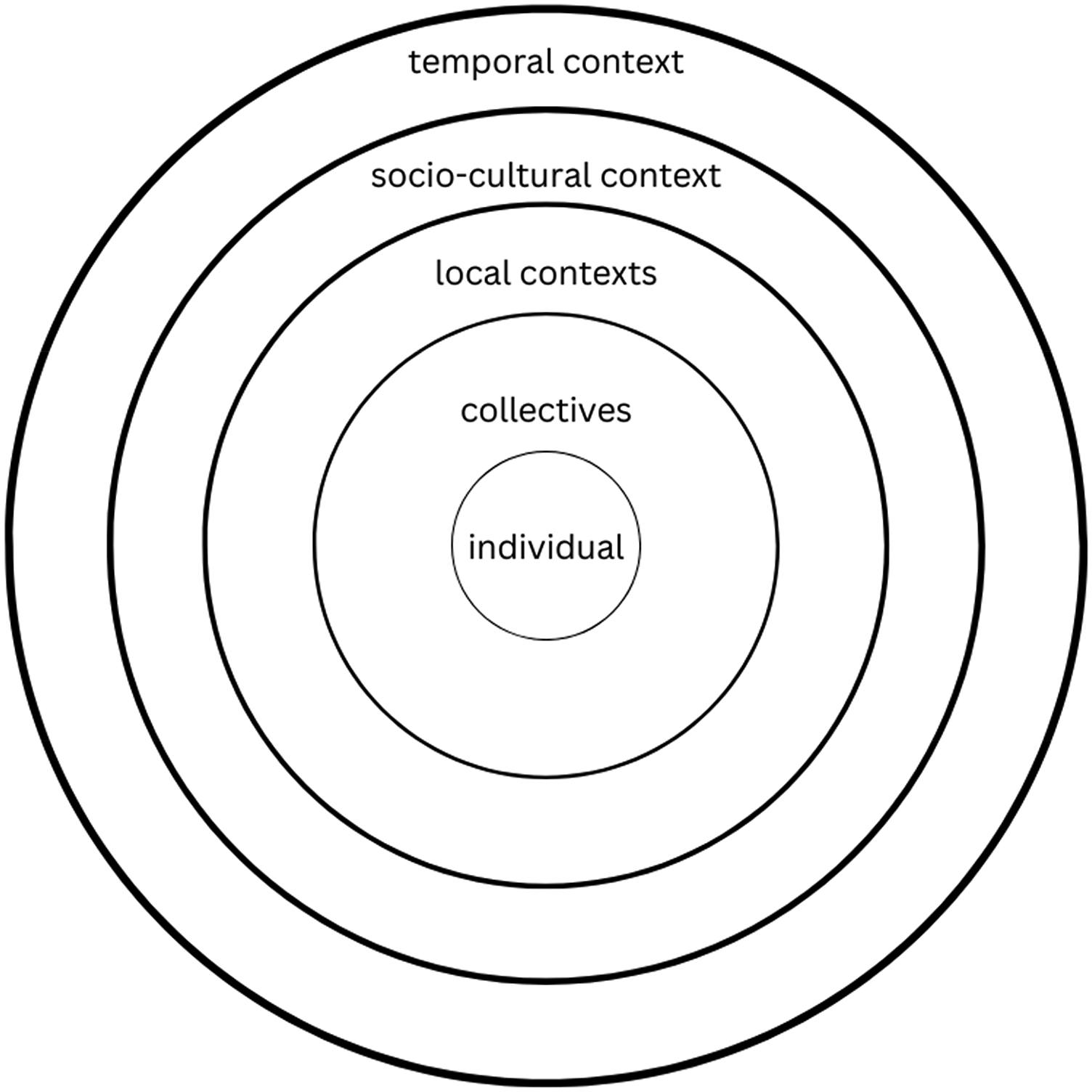
The levels shown in the figure start with the individual. The individual may accomplish whatever it takes to be identified as “gifted.” Without the performance that is valued, the child will not be labeled as “gifted.”
But the individual is embedded in a series of collectives—the family, possibly an extended family, a school, possibly after-school activities or work activities, friendship groups, and the like. These are groupings in which the child actively and immediately participates. They may socialize the child in a direction that makes “gifted” labeling more likely, or, on the contrary, less likely, as when the child is steered away from education or toward work (to support the family) or gang activities. No matter how high the child rises at McDonald's or perhaps in a gang, the rise will not lead to a societal label of “gifted.”
The labeling depends on the opportunities and contextual constraints available in the local environment. Children growing up in a rural small-town community, such as Hammondsport, NY (with a population of under 600 and an average household income of about $60,000), will have very different opportunities from the child growing up in Scarsdale, NY, with a population just under 20,000 and an average household income of over $250,000. By comparison, the average income in Bangladesh is roughly $2800 in US dollars. The average income in the capital, Dhaka, is much higher, at $7700, but makes Hammondsport look incredibly wealthy. How, exactly, does one equate opportunity, and the opportunity to develop gifts and be labeled as being “gifted,” across the variety of local contexts in which children grow up?
Labeling further depends on the sociocultural context within which the individual and the local context are embedded. In Afghanistan in 2023, where girls have been excluded from schools, what are the opportunities to be labeled as and develop as “gifted”? How about in other fundamentalist countries, such as Qatar, where girls and even women have their rights seriously curtailed (Human Rights Watch, 2021)?
In other countries, curtailment is perhaps better hidden. For example, in the United States, as discussed elsewhere, elite colleges seek diversity, but most of that diversity comes from those families with very high incomes (Mandery, 2022). Staggeringly large percentages of wealthy parents use expensive college-admissions counselors to give their children edges in admission that simply are not available even to children from middle-income families. Many of the elite colleges perpetuate the labeling of young people as worthy of admission by giving strong preference to alumni children, children of wealthy donors, and children who play sports or avail themselves of opportunities not available to children of less wealthy families. Universities in the United States, and especially elite ones, often have teams for diverse sports such as polo, water polo, squash, sailing, golf, and lacrosse. Being “gifted” or “talented” in such sports can give one a big edge in admission (Sternberg, 2016). But one cannot demonstrate or even develop a talent if one lacks access. And to get to a school in the U.S. that has those sports, one way or another, usually requires unusual parental resources. The result of these practices is that advantage passes through generations of families as a result of family resources, icing out children from less privileged families. In this way, “diversity” can become a perverse label for the passing of enhanced resources over generations.
Finally, the sociocultural context is embedded in a temporal context. Growing up in Ukraine 5 years ago was very different from growing up there now because the Russian government, or Vladimir Putin, perhaps, decided to invade the country. Growing up in China during the Cultural Revolution was different from growing up there a decade later. Growing up in the United States during the times of slavery was very different, at least for those who were slaves, than it was a century after the end of slavery. It is not that all problems defy solutions: But some problems are, at a given time, almost insuperable, whereas others at least have a chance of being solved. To speak of labeling of “giftedness” outside the sociocultural and temporal contexts in which it appears is simply to create a construct, that, if viewed only individually, is illusory. Giftedness is never merely individual.
Children whose opportunities are curtailed in one way (e.g., music not allowed in the home) may find other ways to develop their skills, or other skills to develop. And challenges in childhood often lead to the development of strategic compensatory mechanisms that enhance an individual’s skill set (Ellis et al., 2020, in press). But it is nevertheless sad that, whatever other skills these children may develop, they may miss their calling and their passion because the opportunity to pursue their calling was taken away from them.
Countries and the cultures embedded within them differ in their degree of individualism vs. collectivism, with, for example, the United States, Great Britain, and Australia coming out as very high in individualism and India, Pakistan, and Vietnam as very high in collectivism (Gorodnichenko & Roland, 2011); but giftedness is almost always identified individually. On most tests used for identifying the gifted, collaborating with others would be considered cheating. Yet, the enculturation and socialization of the child has been a highly collective process. The collective aspect of performance is hidden because it has been years in the making, rather than occurring exactly at the time of assessment. Thus, perhaps oddly, the collective aspect of performance is disallowed only in the last minutes of a collective process that has played out over a child’s entire lifetime. One could argue that the last moments are to determine how much the child has benefited from that long-term process. The problem is that different children have had very different collective processes, some of which have prepared them ideally for the moment of assessment, others of whom have had processes of enculturation and socialization that have prepared them little or not at all for the assessments that are to be conducted on them.
Countries also differ tremendously in the contexts they provide to both individuals and collectives. Giftedness among Yup’ik Native American youth in southwest Alaska, U.S.A., who hunt and gather to survive, might be conceived of differently from giftedness among youth in an upper-class U.S. suburb, such as Scarsdale, New York, or Palo Alto, California. Residents of these suburbs, in turn, might need different skills from children whose survival depends on how well they beg for money in Calcutta, India, in São Paulo, Brazil, or really, anywhere in the world.
Applying the criteria
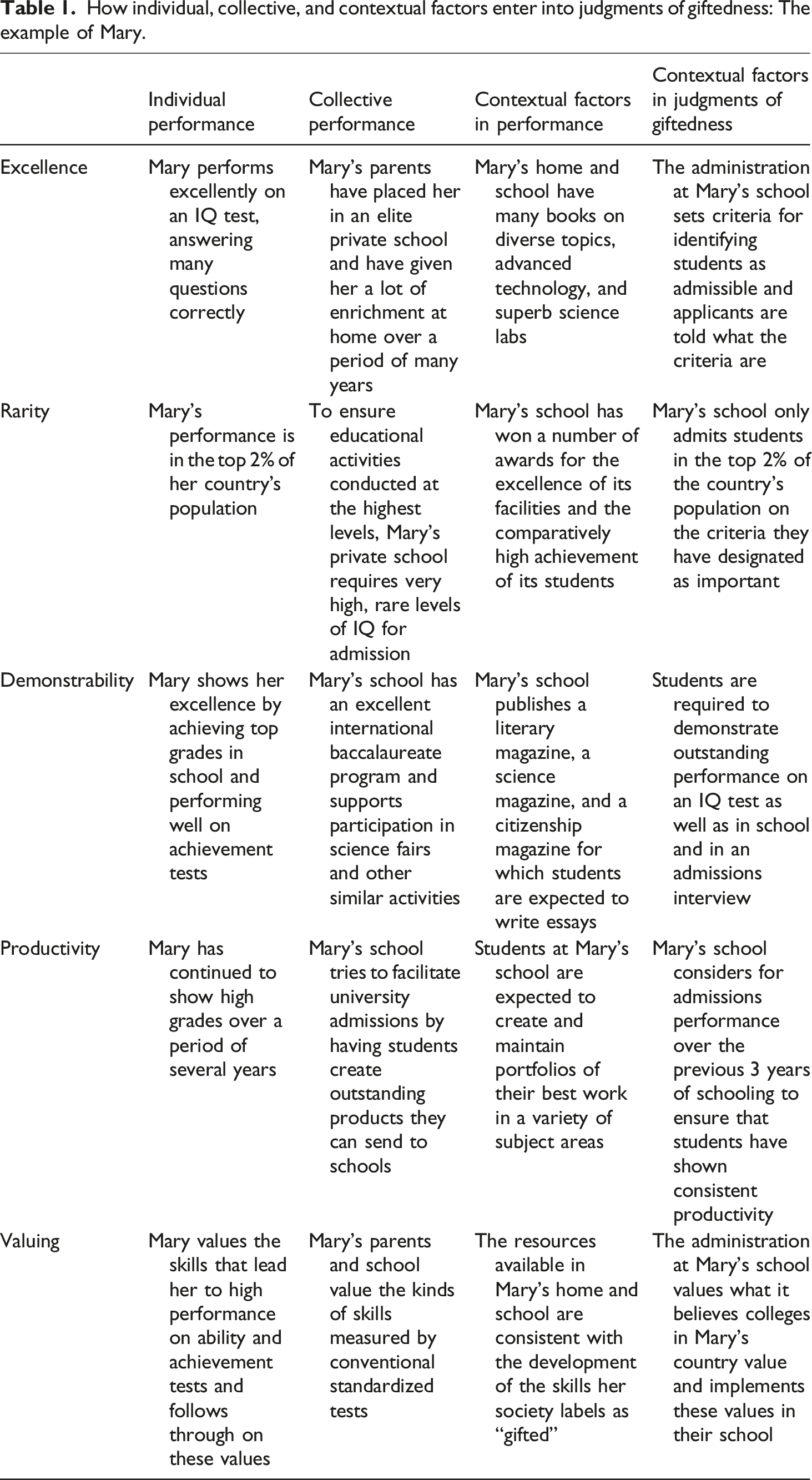
How individual, collective, and contextual factors enter into judgments of giftedness: The example of Mary.
Excellence
Excellence refers, obviously, to one’s “excelling,” which in turn means, according to the online Merriam-Webster (N.D.) dictionary, “to be superior to: surpass in accomplishment or achievement.” This definition, in turn, raises the question of, superior to whom? Excellence is judged collectively and is embedded in various levels of context.
Young people are usually assessed in relation to their age- or grade-peers. The large majority of the assessments administered to young people are norm-referenced (with respect to the performance of peers), although some are criterion-referenced (with respect to specified achievements on some prespecified criteria--Berk, 1984).
From the times of the first Binet-Simon intelligence tests (Binet & Simon, 1905), norm-referencing has been primarily with relation to a sample of age- or grade-peers within what is perceived to be a particular population (Salkind & Frey, 2022). The question then becomes: What is the appropriate population against which to norm a test? Oddly, this question has never been answered in a totally compelling way.
One possibility for evaluating test results is through the use of local norms. If one is deciding which of the children in a given school should be granted entrance to a gifted program, one might decide to use local norms, such as for a school or school district that is allocating scarce slots in its program. But what if the school is an extremely highly selective school within which most or all of the students are conventionally “gifted”? Or what if the school attracts students who are not visibly high achievers of any identifiable kind? Does one then identify the most gifted of the gifted, or the most gifted of the not-so-gifted? Truly local norms also may differ greatly even within schools just a few blocks of each other, such as in New York City, Paris, France, London, UK, or really, any large diverse city anywhere.
Another possibility is state or provincial norms, as are used on statewide mastery tests. Using such norms, one can evaluate giftedness of selected young people relative to other young people in the state or the province. The problem is that this procedure creates wide discrepancies between states or provinces. For example, in the United States, scores on a 500-point scale in fourth-grade mathematics ranged from 250 (Wyoming) down to 221 (New Mexico) or 178 if one included Puerto Rico (The Nation’s Report Card, 2022). The idea that what it means to be gifted in one part of a country differs radically from what it means in another part of the country may seem, to some, inequitable. It also might, oddly, encourage parents to move from one place to another if they were eager to have their children labeled as “gifted.” And it may reflect not any particular characteristics of individuals, but rather characteristics of environments in which the individuals are brought up.
A third possibility is national norms. Intelligence tests, often used for gifted identification, typically use national norms. The discussion above, however, points out some of the limitations of national norms. First, enculturation, socialization, and educational opportunities are different in various parts of many countries. So, national norms may not reflect well the opportunities for young people available in any particular part of the country. For example, in the United States, educational opportunities in inner cities and extremely rural areas are often different from those available in suburbs, and especially wealthier ones. Second, in countries that are linguistically diverse, including the occurrence of schools with children speaking different first languages, the effects of linguistic background will be potentially quite pronounced. Third, the adaptive tasks that young people are raised to face may be quite different from one locale to another. For example, the Yup’ik children hunting and fishing in Alaska are raised with different adaptive tasks from the children in Los Angeles, California (Sternberg, 2020a). One set of parents may never consider their children going to college and so may never prepare their children for college; another set of parents may structure children’s lives so that college is the major organizing principle of the children’s lives. Will a single test with national norms be equitable for the children of the two sets of parents?
Excellence, then, can be viewed only in particular contexts, whether local, state or province-wide, national, or international. What is excellent in one context may not be particularly noteworthy in another context, and similarly, of course, what is excellent at one age may not be at another. This statement refers not only to levels of performance, but also to kinds of performance and to ways in which those kinds of performance are judged. But beyond context, a child’s being identified as “gifted” is not merely an individual accomplishment, but also the result of a collective enculturation, socialization, and educational effort by parents, teachers, often, extended family, and the adults who supervise a variety of activities in the locale in which a child grows up. And labeling is often done as a collective enterprise, either explicitly (by a committee) or implicitly (by a shared understanding of a group of judges in positions of authority in a given context). It is no coincidence that children in different localities, or states, or countries score so differently on tests used to assess excellence: They grow up with utterly different opportunities and often, senses of what it means to be gifted. A Romanian philosopher, Costica Bradatan (2022), who is now at Texas Tech University, has written:
“I came into the world in a family of barely literate peasants, and there was not one book in the home where I grew up….You could in principle borrow books from the village’s library, but it was risky. You could get punished if you were caught reading. That was precious time stolen from productive work; child labor was routine in that quasi-paradise.
“In the home in which I grew up, few words were spoken. The use of words was a too-demanding affair for people whose main job was sheer biological survival. An angry look, a jolt or the occasional beating were much more effective means of communication. Intellectual atrophy in that environment was a social epidemic. My own early socialization was largely with the cows I attended.”
Bradatan was writing of his own childhood, but also of what it was like growing up in Romania in the 1970s and in the subsequent years. Through his love of books, and through emigrating to the United States, he was able to escape the stultifying environment in which he grew up. But how many children who might otherwise be labeled “gifted” never get the chance? How many grow up in totalitarian environments in which the only way safely to be labeled as “gifted” is to submit oneself entirely to the whims of the party governing the state?
Sternberg and Grigorenko (1999) wrote of their experience in the slums of a large city in India (which also could have been in any of a number of other countries). What impressed them was how utterly hopeless, at least at that time, the situation of the children was. The children they studied were, for the most part, of the lowest caste, lived in conditions that most of us could not imagine in our worst nightmares, and endured educational opportunities that could be described as minimal or nonexistent. Their chances of ever escaping from their environment were extremely limited, to put it in the best possible light. Their social mobility was nonexistent. In many parts of economically more advantaged countries, such as Appalachia in the United States, social mobility is little, if at all better.
Those who use generic instruments for identification of the gifted often have very little idea of the circumstances in which many children grow up. They may not even appreciate how limited the opportunities are of the children they teach. For example, in work in rural Alaska, many of the teachers—who were White individuals brought from the cities—had very little sense of the environment in which children were being raised. They simply saw the children as intellectually limited. Yet, if the teachers were confronted with some of the adaptive tasks these youngsters faced, such as traveling on a dogsled in the winter over many miles to the next village, without obvious landmarks, they quite likely would have died trying (Grigorenko et al., 2004). Others have reported similar experiences: What one cultures considers gifted, another ignores or devalues (Cole et al., 1971; Greenfield, 1997, 2017; Luria, 1976; Rogoff, 2003).
Rarity
For a label of “giftedness” to be assigned to an individual, the individual must show performance that is not only excellent, but also rare (Sternberg, 1993; Sternberg & Zhang, 1995), relative to other individuals who are part of one’s life context. For example, virtually all children in grade 5 may do excellent work on academic tasks for children in grade 2, but their performance will not be rare, and hence would not be viewed as “gifted.” Almost all of them may be excellent relative to younger students at stating their names, but the fact that their age peers are all able to do it renders their excellent performance in self-naming as not worthy of being labeled as “gifted.”
Rarity shows the importance of context in assigning the label of “giftedness.” What is rare in one context may not be rare in another context. For example, violin performance that may be rare at a typical college may be viewed as ordinary in the context of the esteemed Juilliard School of Music, despite the performances being identical in excellence. A science project that is viewed as exceptional at a typical high school may be seen as ordinary at the Bronx High School of Science, one of the high schools for gifted students in New York City, despite the two projects being comparable in quality.
Because of the importance of rarity—if everyone or almost everyone is labeled as “gifted,” the term loses its meaning—the potentially “gifted” person is gifted in large part as a function not only of any particular knowledge or skills, but also as a function of the comparison group. In current times, rarity is often only partially, and necessarily, a function of a gift or talent. If one is compared to people only from a particular community, state, ethnicity, socioculturally defined race, religion, or whatever, the rarity of one’s gifts can be seen as very different as a function of the group. Thus, luck plays a large part here in labeling of the “gifted”—the luck of being considered in a certain locale, or being labeled as from a particular locale, or being born to parents with certain characteristics or other characteristics. Gladwell (2011) made a similar point, as did Bradatan (2022). Much of who is determined to be “gifted” is due simply to sheer luck of parentage, community, resources, socioculturally favored groups, and the like. Indeed, a group that is socioculturally favored at one point may be disfavored at another, so timing is key as well. We might like to think of giftedness as coming from within the individual, but much of it comes from the situations we happen, by sheer luck, to find ourselves in.
Demonstrability
Demonstrability, according to the pentagonal implicit theory of giftedness (Sternberg, 1993; Sternberg & Zhang, 1995), is one’s ability to show what one can do. Demonstrations are typically made by the potentially labeled individual, so they clearly involve the individual. But they involve much more—they involve collectivities in different levels of context. Suppose, for example, that one has the fortune to have truly exceptional musical talent, but one lives in a cultural or religious context in which music is frowned upon or even forbidden. One has the musical talent but is not allowed to demonstrate and possibly even to develop it. (This restriction is indeed the case among some current-day religious groups--see, e.g., Salazar, 2021). One might, in theory, have become the next Beethoven, but won’t.
Of course, such restrictions may seem exotic. They aren’t. In many parts of the world, such as in parts of Brazil, children are forced onto the streets to survive any way they can, either through begging, street businesses, or crime (Campos Lima, 2021; Ceci & Roazzi, 1994; Nuñes, 1994). In Peru, many children have been forced into lives of crime growing coca leaves because adults know that, if they are caught, they will face minor sentences or be released (The Economist, 2022). The research shows that the children may be “gifted” at running a street business: It is just that such an excellence is not generally designated by society as representing “gifted” behavior.
This practice of forcing children into lives of crime is not unique to Peru: Drug dealers routinely recruit young children as dealers to minimize sentences, in the UK and elsewhere (Lusher, 2019). For much of the history of the United States, women were either severely restricted in their education, or if they were educated, restricted in what they could do with that education. U.S. Title IX, guaranteeing equal access to education, was not passed until 1972 (U.S. Department of Education, 2021). The author’s own U.S. university did not accept women as undergraduates until 1969.
Even if explicit discrimination does not exist, the effects may be the same through implicit discrimination, which is often economic. One might have exceptional talent for the piano, but if a child’s parents cannot afford to provide access to a piano, that talent will never be demonstrated.
In 2015, at the Trinity School and the Collegiate School in New York City, roughly 40% of students were admitted to Ivy League Colleges; at the Brearly School, also in New York City, the percentage was 37% (The Street, 2015). But at Trinity, the current annual tuition is U.S. $57,230 and at the Collegiate School, U.S. $55,900. At Brearly, it is U.S. $58,700. The average family income in the United States is U.S. $70,784 (for 2021). Although these elite private schools offer some scholarships, they need tuition dollars to offer their services, and scholarships are limited. Clearly, the overwhelming majority of gifted students in the U.S. will not gain the kind of access to elite universities and the job offerings that follow elite degrees that would be offered to children who had the good fortune to grow up in wealthy families. Very strong public schools also can provide excellent access to elite schools, but those public schools, such as New Trier High School, tend, in the United States, to be placed in wealthy communities. In other countries, such as Germany, tuition is free or very inexpensive, and the opportunities are much more widely spread out across the population. But often, to be admitted to, or to be able to stay in excellent universities, one needs a level of education that may not have been available.
Giftedness is individual, in part, but context exerts a tremendous effect on one’s chances for giftedness to be recognized and to provide access to opportunities in societies. Rarity is in large part a function of opportunities the environment offers and parents, in particular, provide. If one grows up during a war, often, all bets are off. Giftedness can be understood only in its context and as a function of collective efforts not only of the individual who might be identified, but also of teachers, parents, extended family, and others.
Productivity
Psychologists sometimes study one-hit wonders (e.g., Kozbelt, 2008), because they defy the usual notion of giftedness in doing something great, but only one time. Engelbert Humperdinck is one such one-hit wonder, for his opera Hansel and Gretel, as was Gregor Mendel, for his discovery of laws of genetics. Harper Lee was famous for To Kill a Mockingbird and J. D. Salinger for The Catcher in the Rye. But in general, the goal of identifying the gifted is not to identify someone who can create one distinguished product one time, but rather to identify someone who will be productively gifted over a stretch of time. Often, those who produce one exceptional product but no more are viewed as having “flamed out.”
Sometimes, people view productivity as a negative—believing that the truly gifted or creative go for quality rather than quantity—but Dean Simonton (e.g., Simonton, 1997) has shown compellingly that quantity and quality are highly positively correlated, not negatively correlated. The reason is that creators and others have a relatively constant probability of success—that is, of any work becoming a “hit.” So, the more works they have, the more hits they are likely to produce and the more distinguished their records of accomplishment are likely to be. Sometimes, envious evaluators deride high productivity because they never could achieve it themselves.
When schools use academic performance as a criterion for identifying young people as gifted, they are implicitly using productivity as a criterion for identification. They are looking for individuals who have shown some consistency in outstanding performance, rather than those who are a one-time wonder, say, in one course or with one teacher. Standardized tests also, in their own way, assess for consistency, in that their creators construct them so as to sample a broad range of behavior over a content domain—whether in assessing achievement or ability—to ensure some consistency.
A child’s or adult’s ability to be productive depends very largely on the luck of one’s circumstances. Young people in Ukraine as this article is being written in early 2023, who were on their way to distinguished accomplishments, in many cases, will have gotten sidetracked by the war instigated by Russia. Young people in any occupied territory throughout the world will be limited in their potential accomplishments by the occupation. Sometimes, weather-related events can wipe out much of one’s future, such as the kinds of extreme flooding that have become more common in the 21st century. Many young males, including especially ones who realized that they would be employable in other countries, fled Russia because they feared becoming cannon fodder in the war in Ukraine (Hopkins, 2022). Whatever career they started, no matter how distinguished, was interrupted and their ability to be productive in that work was curtailed. In repressive countries, including mostly autocratic ones but also democracies where various kinds of political correctness have taken a toll, gifted individuals may be hindered in their productivity by political or ideological constraints. Or, in a country such as the United States, where the cost of a college education can reach high five figures and beyond (e.g., $80,000 or more), a student’s productivity may be cut short by the inability to pay, or later, by the effort that must be made to repay student loans.
Productivity is not necessarily measured in the generation of tangible products. What is “productive” depends on one’s context. Some individuals serve others—for example, through advice, service, therapy, ministry, or whatever. What is important is that they have something show for their giftedness that serves others beside themselves and that, at some level, helps to make the world even just a little bit better (Sternberg, 2020c, 2020d).
Valuing
The Guinness Book of World Records is filled with the accomplishments of people who have established known world records but who, for the most part, are not labeled as “gifted,” despite their excellence, statistical rarity, and productivity—eating the most hot dogs in a given period of time, holding one’s breath for the longest period of time, filing the most lawsuits, and so forth. The reason that these accomplishments generally are not labeled as “gifted” is that they are not widely valued in the contexts in which one lives, by those who control the levers of power and influence in the world.
What constitutes a “gift” is typically determined by those who hold positions of power in a societal hierarchy. And they may have a limited view of what constitutes a “gift” for members of groups other than their own. An extreme case in U.S. history is that of slaves, who were not allowed to learn many of the skills, such as reading and writing, needed to be identified as “gifted” by the standards of White society, then or now (Tolley, 2016). Today, as this article is being written, college and even high school education is being denied to women by the Taliban in Afghanistan (Hadid, 2022). In some ways, little has changed: The groups that are denied opportunities change; the denial of opportunity seems not to.
The role of valuing can hardly be overestimated. Schools tend to value academic accomplishments, for example, but some families—including the one the author grew up in—may devalue those kinds of accomplishments. For example, parents in rural Zanzibar often hold the children they perceive to be the brightest home from school rather than encouraging their success in school. These are the children who, for parents, are the most useful ones for domestic tasks at home and for farm work in the fields (The Economist, 2002). In the United States, at least one entrepreneur, Peter Thiel, has paid promising young people not to go to college (e.g., Luke, 2021; Wieder, 2011).
Sometimes, what is valued can change quickly within a society. When the Soviet Union fell, the value of academic excellence dropped quickly while the value of practical skills increased proportionately. Those who were able to adjust quickly to the new political and economic situation benefited; those who maintained the Communist value system were left with skills that the changed society no longer much valued (Grigorenko & Sternberg, 2001). In the United States, the fall of the system of slavery left those who relied on the plantation system having to find new knowledge and skills with which to succeed. More recently, throughout the world, people found themselves needing a new set of basic skills to avoid contracting, or later to cope with, an infectious disease that was new to the world. Some people got vaccinated and wore masks; others preferred to believe in misinformation. The death rates were different. For example, death tolls from COVID-19 were much higher in counties that voted for Donald Trump than for Joe Biden for president, reflecting the difference, on average, in Republican vs. Democratic political party views toward the pandemic (Wood & Brumfiel, 2022). The government of China went from one extreme to another, first locking people down to reduce death rates from COVID-19, and then utterly abandoning controls, and experiencing a skyrocketing of illnesses and deaths (Normile, 2023). During the lockdowns, many businesses were forced to shut, so that even many gifted entrepreneurs were not able to carry on their businesses. In the first quarter of 2020, almost half-a-million Chinese businesses were shuttered as a result of losses due to the pandemic (Leng, 2020). Talent could not easily spare one from the disappearance of customers for one’s products or services.
In life, often, it is not giftedness that brings the reward, as Socrates learned the hard way. Even today, whistleblowers who excel ethically often end up isolated and unemployed (Kenny & Fotaki, 2023). They may be subjected to harassment and internet mobbing. In many sociocultural niches, the ones who succeed most are “gifted”—in their Machiavellian efforts to sell themselves out to whoever controls the levers of power. Thus, in the United States, for example, many never-Trump politicians joined Trump’s most devoted acolytes when they saw it as to their political or economic advantage (Niskanen Center, 2020). But such capitulation to leaders occurs all over the world. Those who defy dictators such as Xi or Putin often end up in prison, or in the latter case, poisoned or falling out of windows (Wilson & Ardrey, 2022). Others simply disappear and are never heard from again.
The role of contextual and collective influence in other theories
The Sternberg-Zhang (1995) theory has been used to organize the discussion in this article. But other theories would have ended up in the same place. Consider four examples (and others can be found in Heller et al., 2000; Pfeiffer et al., 2018; Sternberg & Ambrose, 2021; Sternberg et al., 2022).
Terman
First, Terman (1925) used IQ as a basis for identifying the gifted. That would seem to be an individual trait. Yet, Terman’s sample was far from diverse:
“By 1928, Terman had 1,528 subjects between the ages of 3 and 28. As a group, they were overwhelmingly white, urban and middle class. Nearly all lived in California. The gender imbalance—856 boys, 672 girls—puzzled Terman for the rest of his life (were boys smarter, or were teachers more likely to recommend them?). The group was lopsided in other ways as well: there were only two African-Americans, six Japanese-Americans and one American Indian” (Leslie, 2000).
Terman found, as others have after him (Gould, 1981; Sternberg et al., 2021), that IQ tests tended to identify members of certain groups but not of others. As a result, members of underrepresented minority groups are especially underrepresented in programs for the gifted (Gentry et al., 2021). So, what would seem to be an individually administered test of an individual characteristic actually is a reflection of the valuing of certain characteristics emphasized in certain kinds of schooling given to certain kinds of children. The test is very much a product of a sociocultural milieu (Sternberg, 2020a), and even the act of taking an individual intelligence test is a cultural act, historically much more compatible, say, with individualistic than with collectivistic cultures.
Renzulli
Second, Joseph Renzulli’s (1978) model of giftedness identified above-average ability, creativity, and task commitment as the three key ingredients of giftedness. These would all seem to be individual characteristics, but are they? If we start with “above-average ability,” we end up with more questions than answers. Above-average with respect to whom, what, and where? And what exactly is “ability”? There are many models and factors of ability (e.g., Carroll, 1993; Conway & Kovacs, 2020; Gardner, 2011; Gottfredson, 1997; McGrew, 2005; see various models described in Sternberg, 2020b). And task commitment when, with respect to what, and relative to whom? Presumably, not hot-dog eating. And against whom are candidates for the label of giftedness being compared? What seem to be individual characteristics all depend on the sociocultural milieu in which the candidate is operating, and the conception of giftedness that is operative in that milieu.
Gagné
Gagné (1999, 2020) has suggested that there is a distinction between gifts and talents. Gifts, according to Gagné, are mostly determined by genetics, and they include intellectual, creative, socioaffective, and sensorimotor abilities. Talents, in contrast, are developed from gifts in interaction with the environment, and they include academic, arts-based, business-based, leisure-based, social-affective, athletic, and technological domains, as well as possibly other domains.
This view is inconsistent with the view presented here. This is not the place to get into an argument about relative effects of heredity versus environment, other than to say that the heredity vs. environment is a twentieth-century view (e.g., Eysenck & Kamin, 1981) that, in the field genetics, is viewed as largely antiquated. It is a debate today held only by those outside the field. The study of epigenetics has shown that genes and environment are not in opposition to each other but rather work together, with environmental factors “turning on” the expression of certain genes while “suppressing” the expression of others (e.g., Allis et al., 2015; Armstrong, 2013; Carey, 2013). Genes affect the experiences one has and, indeed, that one often creates (Scarr & McCartney, 1983), but experiences also affect the expression of genes. At some level, anyone who has had identical twins (including the author of this article) knows that genes are not determinative: Identical twins are extremely similar in some respects, but typically also have notable differences in personality, intellectual, and other characteristics.
Second, it turns out to be extremely hard to specify anything like a complete set of domains in which giftedness will be judged. For example, in a cult, an autocratic society, or in certain contemporary political parties, giftedness may be viewed as a function of blind obedience. Those who are most valued (and sometimes rare) are those who obey blindly without questioning. They are the ideal hypothetical citizens of Oceania in Orwell’s (1949) 1984. Creativity, in such a society, is not valued at all as a gift, but rather is seen as a threat. In a related vein, as Sternberg (2021) points out, IQ may be a useful characteristic in many circumstances, but there are a lot of high-IQ people who believe in unfounded conspiracy theories, some of whom died because they did not believe in the reality of the threat of COVID-19.
Third, the idea of “natural abilities” is itself possibly flawed. What is even considered an “ability” varies culturally (Sternberg, 2020a), and usually favors the developed knowledge and skills characteristic of those who retain power and influence in a society. For example, the abilities that are necessary for survival in the frozen tundra are not measured by IQ tests, but in that environment, can be a matter of life or death (Grigorenko et al., 2004).
Ziegler
Ziegler (2005) most clearly defines the role of context. According to Ziegler, giftedness is a characteristic that can and does change over the passage of time. It occurs within an environmental context, and it is the result of varied and diverse interactions between the individual and the environment in which the individual lives. Giftedness is not an inherent characteristic, but rather an attribution that the identified person potentially will carry out expected kinds of actions in the future. It thus is, in Sternberg’s (2020d, 2020c) terms, transactional. Ziegler’s view, then, is very similar to the view here: It recognizes that giftedness is an attribution that can differ over time and space. What the Sternberg-Zhang (2005) view adds is a specification of the processes involved in identification, or labeling of individuals as gifted or not.
Conclusion
Giftedness is often treated as an individual trait—as something that resides within an individual (Terman, 1925). And yet, it always is developed and labeled in a sociocultural milieu. What is labeled as “gifted” in one sociocultural milieu, and at one time, may not be labeled as “gifted” in another. The gifted shaman, for example, might be valued in one culture but not another, unless in that other culture, they use their same skills to become something else that is valued by the other culture. Someone who was gifted or talented, however one describes it, on a typewriter, was once a valuable asset in many offices. Today, their skill would be worth much less. And the Guinness Book of World Records, as mentioned earlier, is a testament to all the gifts (and talents) that societies have chosen not to designate as worthy of the label of “gifted.” Giftedness always has collective elements, because it is nurtured and developed by many, and then is labeled by many, including some who set criteria for labeling but have long since passed away.
What are the implications of the current view for practice? The main implication is that gifted educators, as well as theorists and researchers, should stop viewing giftedness as something to be “discovered.” Giftedness is invented. There is no one “correct” theory of the abilities, achievements, or other characteristics that comprise the gifted individual, because giftedness is a label representing a sociocultural consensus, sometimes one imposed on the society by those in power, who often label as gifted either those like themselves or those who will conform to what they, as the powerful, seek. For example, intelligence tests, often used in identification, measure people’s skill in giving desired answers to problems that are structured in ways that lead to a supposedly “correct” answer. Creativity tests allow for more flexibility, but they, too, often represent a fairly limited and indeed trivial conception of creativity as one of giving divergent responses to questions such as: What are unusual uses of a brick (see essays in Kaufman & Sternberg, 2019; Sternberg, 2018)?
Given that giftedness is largely a labeling phenomenon, the best gifted educators can do is to be reflective on what deserves the label. Using readily available criteria—IQ tests, achievement tests, school GPA—is not being reflective. It puts the burden of defining giftedness on someone else, as though that someone else somehow had the “right” answer. What is most needed today are proposals for what are appropriate criteria. For example, Sternberg (2017) proposed an ACCEL model—Active Concerned Citizenship and Ethical Leadership. Others may propose different criteria. The critical issue is to be reflective as to what the world needs today and not to pass the buck to scholars of the past, especially Lewis Terman, who had many skills and talents but was also what today likely would be considered to be racist and classist (Leslie, 2000; Sternberg et al., 2021). There will be scholars comfortable with Terman’s views, but their view perhaps represents more of a dark past rather than a bright future. The world in these times is facing serious turmoil—a pandemic, poverty, radical income disparities, global climate change, pollution, creeping autocracy, and more. The world needs giftedness to solve its problems (Sternberg et al., 2022), not just giftedness that represents high performance in indices that are poor predictors of future active citizenship and ethical leadership seeking to make the world a better place. Some scholars of the gifted need to stop, metaphorically, playing the same old vinyl records, changing only the labels on the records to create a more modern feeling. The world also needs to create a more nearly level playing field for the development and identification of children as gifted, not a playing field that heavily advantages children with parents having substantial resources, as in the admissions procedures of many highly selective public schools, private schools, and colleges in the United States and elsewhere.
Footnotes
Declaration of conflicting interests
The author(s) declared no potential conflicts of interest with respect to the research, authorship, and/or publication of this article.
Funding
The author(s) received no financial support for the research, authorship, and/or publication of this article.
