




Abstract
The Swedish educational system has, so far, accorded little attention to the development of gifted pupils. Moreover, up to date, no Swedish studies have investigated teacher education from the perspective of mathematically gifted pupils. Our study is based on an instructional intervention, aimed to introduce the notion of giftedness in mathematics and to prepare prospective teachers (PTs) for the needs of the gifted. The data consists of 10 dynamic geometry software activities, constructed by 24 PTs. We investigated the constructed activities for their qualitative aspects, according to two frameworks: Krutetskii’s framework for mathematical giftedness and van Hiele’s model of geometrical thinking. The results indicate that nine of the 10 activities have the potential to address pivotal abilities of mathematically gifted pupils. In another aspect, the analysis suggests that Krutetskii’s holistic description of mathematical giftedness does not strictly correspond with the discrete levels of geometrical thinking proposed by van Hiele.
Introduction
Gifted education in general, and mathematically gifted pupils, in particular, has traditionally received little attention in Sweden. One reason for this is that until the last decade, the main objective of the Swedish educational system—characterized as primarily egalitarian—was to provide support to all pupils in order to achieve a basic level of knowledge and competence (e.g., Dodillet, 2019; Persson, 2010). Persson describes the lack of interest toward gifted pupils as: It is likely that nowhere is resistance to assist gifted students in school stronger than in the Scandinavian countries for historical, cultural, and political reasons, particularly in Sweden (Persson, 2010, pp. 536–537).
However, in 2015, the Swedish National Agency for Education (NAE)— the organization responsible for educational programs in Sweden—provided general support material for gifted pupils (Skolverket, 2015). Yet, by continuing to accentuate the egalitarian view—namely, that all pupils are considered gifted and talented—pupils in the focus for the mentioned support are labeled “particularly gifted.” Thus, it is not unreasonable to assume that the NAE, through this statement, continues to presume that excellent performances of the gifted are basically particular phenomena and thereby unlikely achievable for all pupils. Nevertheless, based on a governmental initiative from 2012, 24 primary schools in Sweden organize programs, in so called “peak performance classes,” for excelling pupils in grades 7–9 (ages 14–16). To these classes, pupils are recruited based on their general school performances and their strong interest for particular subjects—predominantly mathematics and natural sciences. The programs are mainly experimental, planned to run until 2024. However, even though the governmental intentions were in concordance with other countries’ excellence initiatives, an analysis of the outcome of these programs displays some problematic issues (Dodillet, 2019). One pivotal issue is that the NAE deviated from the official regulations by implementing the planned elite education for interested pupils, rather than gifted pupils (Dodillet, 2019). Further, the NAE’s own evaluations of the programs ignore subjects as talent or giftedness, instead, the evaluations “focus on the students’ gender, socio-economic status, and ethnic background” (Dodillet, 2019, p. 265) and problematize the fact that top performing pupils are recruited from a homogenous group (Dodillet, 2019).
Also, the Swedish Education Act (SEA) addresses the needs of the gifted in relatively vague terms, by stating that all pupils must receive guidance and stimulation in their learning and personal development (SFS, 2018, p. 1098). However, it is mentioned that Pupils who easily reach the knowledge requirements that are to be achieved the least, or the requirement levels that apply, must be given guidance and stimulus to be able to reach further in their knowledge development (SFS, 2018, p. 1098; our translation).
As indicated, the Swedish cultural and educational context seems to be inattentive to the needs of the gifted. Consequently, when the present study was designed, teachers in primary and secondary schools were expected to meet the needs of mathematically gifted pupils mainly in regular classes. In concordance with directives from the SEA, also The Higher Education Ordinance (SFS, 2011, p. 688) for teacher programs displays an egalitarian view on pupils. Thus, when describing skills and competencies that prospective teachers (PTs) must develop, the needs of the gifted are not mentioned. Instead, it is stated that PTs should. “demonstrate the ability to plan, independently and together with others, implement, evaluate and develop teaching and educational activities in order to stimulate each pupil's learning and development” (SFS, 2011, p. 688, our translation).
That is, PTs are expected to plan and implement activities for every pupil, that is, also for the gifted. However, due to the lack of nationwide programs and dedicated classes for gifted pupils, PTs are expected to teach, stimulate, and develop all pupils in heterogeneous settings, that is, in regular classrooms.
In similar veins, the research on gifted pupils, particularly on the mathematically gifted, is limited in Sweden. For example, until the spring of 2021, only four doctoral theses have discussed mathematically gifted pupils (Mattsson, 2013; Mellroth, 2018; Pettersson, 2011; Szabo, 2017), and currently there are no PhD students in the field of mathematical giftedness. Among other themes, the mentioned four theses highlight the difficulties that gifted pupils are facing in the egalitarian educational system, the lack of programs for identifying giftedness, and the problems teachers are facing when trying to provide support for mathematically gifted pupils. Importantly, so far, no Swedish studies have investigated teacher education from the perspective of mathematically gifted pupils.
From an international perspective, mathematical giftedness has been examined mainly in the contexts of teaching the subject, of problem-solving and problem-posing activities, and of case studies observing gifted individuals and their teachers (e.g., Leikin & Sriraman, 2017). Consequently, so far, only a few empirical studies (e.g., Sriraman, 2004a) have problematized possible connections between generally agreed frameworks of mathematical giftedness (e.g., Krutetskii, 1976) and models of geometrical thinking (e.g., van Hiele, 1986).
The goals of the present study are twofold. Based on the peripheral status of gifted pupils in the Swedish educational context, one goal of the study is to examine how an instructional intervention, that aimed to introduce the notion of giftedness in mathematics, can prepare prospective mathematic teachers (PMTs) in taking gifted pupils into account when designing dynamic geometry tasks. Based on the lack of empirical studies that have investigated associations between mathematical giftedness and geometrical thinking, another goal of the present study is to investigate possible connections between these two phenomena.
Accordingly, we examined two distinct effects of the mentioned intervention. Firstly, the impact of a seminar about mathematically gifted pupils on the qualitative aspects of geometrical activities constructed by PTs. Secondly, the possible connections between the framework of Krutetskii (1976) for mathematical giftedness and the model of geometrical thinking developed by van Hiele (1986) displayed in the mentioned activities.
Next, these two theoretical frameworks are described briefly.
Mathematical Abilities of the Gifted in the Context of Krutetskii’s Framework
Empirical attempts to delimit abilities that can be considered mathematical have engaged researchers since the end of the 19th century (e.g., Calkins, 1894) and are typically situated in the context of problem-solving (e.g., Krutetskii, 1976). However, studies conducted within the psychometric paradigm of giftedness—omnipresent in the first half of the 20th century—were unable to describe appropriately the characteristics of the mathematically gifted. Diverging from the psychometric standards, Hadamard (1945) made a pioneering attempt to identify the nature of mathematical thinking of eminent mathematicians and scientists, by indicating that intellectual attributes associated to mathematics are intricately related and articulated in flexible ways.
A seminal work on mathematical abilities, based on a longitudinal study that analyzed the mathematical activities of around 200 pupils, was published in 1968 by a Soviet research team led by Krutetskii (1976). The study indicates that the mathematical abilities of gifted pupils should be regarded as components of a complex system, with the following structure: Obtaining mathematical information (e.g., the ability for the formalized perception of mathematical material); processing mathematical information (e.g., the ability for logical thought, the ability for rapid and broad generalization of mathematical objects, relations, and operations, the flexibility of mental processes, and the strive for clear and simple solutions); retaining mathematical information (mathematical memory, i.e., a generalized memory for mathematical relationships); and general synthetic component (a mathematical cast of mind) (Krutetskii, 1976, pp. 350–351).
Krutetskii’s team emphasizes that respective components of the framework can be developed to different extents through appropriate mathematical activities, and, that gifted pupils’ mathematical abilities emerge from a wide interaction between these components. Moreover, Krutetskii underlines that the structural components were observed mainly during the process of mathematical problem-solving and are connected to that process.
However, despite describing particular characteristics of mathematical abilities, Krutetskii conclude that these abilities are closely interrelated, forming a “single integral system, a distinctive syndrome of mathematical giftedness, the mathematical cast of mind” (Krutetskii, 1976, p. 351). Nevertheless, it is also mentioned that the general synthetic component may not be directly observable during problem-solving, mainly because “It is expressed in a striving to make the phenomena of the environment mathematical … in short, to see the world through ‘mathematical eyes’.” (Krutetskii, 1976, p. 302).
Of importance for this article, Krutetskii’s study emphasizes the comprehensive character of the ability to generalize mathematical objects, relations and operations in the context of mathematics teaching, by stating that “is by its nature a general ability and usually characterizes the general property of teachability” (Krutetskii, 1976, p. 353) and indicating that “is an essential component in all abilities, since ability as a property of the personality should find expression in operations permitting a transfer from some conditions to others” (Krutetskii, 1976, p. 353). Also, mathematical memory is described in terms of generalized understanding. By differentiating it from the mechanical recall of numbers and algorithms, importantly, by drawing on the ability to generalize mathematical objects and relations, mathematical memory is characterized as a “memory for generalized, curtailed and flexible systems” (Krutetskii, 1976, p. 352). Ultimately, Krutetskii’s team underlines that the formation of pupils’ individual mathematical abilities is dependent on the teaching methods of the subject.
Considering that Krutetskii’s study was concluded in the 1960s, it might be natural to ask whether his work retains its acceptance in the research field. In that respect, it should be noted that studies (e.g., Garofalo, 1993; Heinze, 2005; Leikin, 2010; Sheffield, 2003; Sriraman, 2003; Van Harpen & Sriraman, 2013) continue to draw on Krutetskii’s ideas and offer relatively small deviations from his main concepts. Thus, it is reasonable to assume that the presented framework still offers a reliable and versatile description of the mathematical abilities of the gifted.
The Van Hiele Model of Geometrical Thinking
The van Hiele model of geometrical thinking has its origin in work done by Pierre and Dina van Hiele in the 1950s (van Hiele, 1986). The model consists of five hierarchical levels of thought in geometry, describing pupils’ progress in geometrical thinking. The five levels of thinking are labeled by Clements and Battista (1992) as “visual,” “descriptive/analytic,” “abstract/relational,” “formal deduction,” and “rigor/metamathematical” to indicate their characteristics. At the first level, pupils can recognize figures by their geometric shapes. Although pupils at this level can perceive a geometric figure as a whole, they are not able to perceive its properties. At the second level, pupils can perceive properties; however, they are seen separately, and pupils do not see a relationship between them but are able to recognize and characterize figures by their properties. Pupils at the third level perceive a relationship between properties and between figures, and they are able to create meaningful definitions and provide informal arguments. However, it is at the next level (fourth) level pupils are able to perceive the significance of axioms, propositions, and theorems. Pupils at this level can construct proofs based on formal deductive reasoning. Finally, at the fifth level, pupils are able to work in a variety of axiomatic systems. The model has been applied to explain why many students have difficulty with the higher order cognitive processes, particularly proof, required for success in high school geometry. It has been theorized that students who have trouble are being taught at a higher Van Hiele level than they are at or ready for. The theory also offers a remedy: go through the sequence of levels in a specific way. (Usiskin, 1982, p. 1)
Although the van Hiele model primarily was used to analyze students’ geometrical understanding, researchers have used the model to analyze curriculum standard documents and textbook tasks (Fuys et al., 1988) as well as developing test items as a mean to assign pupils to a particular van Hiele level (Burger & Shaughnessy, 1986; Crowley, 1987; Mayberry, 1983).
As described, the levels of the van Hiele model of geometrical thinking are essentially sequential and discrete, depending on pupils’ age and knowledge of geometrics. However, studies (Sriraman, 2004a) show that gifted pupils, who have not been taught formal methods of proving geometrical theorems, prove geometrical relationships by flexible, holistic approaches (Krutetskii, 1976), that is, not by carrying out sequential phases. Thereby, it seems that gifted pupils’ geometrical thinking—while confirming Krutetskii’s description of mathematical giftedness—do not necessarily converges toward the discrete levels of the van Hiele model.
Method
The study was conducted in the context of a geometry course (7.5 ECTS credit 1 ) for PMTs in secondary and upper secondary school (ages 14–18) in Sweden. During the course, different axiomatic-deductive systems are discussed, with a focus on both Classical Euclidean and Non-Euclidean geometries, where the use of dynamic geometry software (DGS) is emphasized. Although the course focused on geometry, an instructional intervention, that included mathematical problem-solving, was performed with the objective to increase the PMTs’ ability to challenge gifted pupils in the regular classroom. As a part of the course assignment, the PMTs were asked to construct (in pairs or in small groups) DGS activities for all pupils, that is, including gifted pupils. These activities are the object of analysis in this article.
Participants
In total, 24 PMTs participated in the study. The PMTs were at the end of their first package of courses in mathematics, as a part of a five-year teacher education program with double specialty, that is, one major subject (e.g., language, mathematics, and physics) and a second subject, that depends on their respective options of major subject. Most of PMTs were at the end of their first year of study at the teacher program. The choice of PMTs at the end of their first year was motivated by the fact that the study focuses on geometry, which is the last course in the first package of mathematics courses. That also implies that a part of PMTs, depending on their major subject, had no pure mathematics courses left after this course. That is, even though PMTs were relatively fresh in the teacher program, and had limited experience of the program, participants have acquired an important part of their mathematics courses prior the present study. They also had some experience in elaborating lecture-plans and having micro-lectures. The PMTs were average performing students, and they were informed about the study prior to their participation. Moreover, they were informed that their participation will not affect their grades in the course and that they could withdraw from the study at any time, without further notification. Also, an ethics application was approved, and all required rules were followed.
The intervention
The PMTs were offered one seminar on giftedness in mathematics, described below in detail. This was the first occasion in their education program when they discussed the characteristics of mathematically gifted pupils. After the mentioned seminar, the participants performed one homework about task design in a DGS environment and participated in a follow-up seminar. Regarding the DGS environment, the PMTs have, as learners of mathematics, been introduced to dynamic mathematics software (i.e., not particularly DGS) in previous courses.
One seminar on mathematically gifted pupils
Early in the course, the PMTs participated in an online seminar about mathematics education for gifted pupils, which was mainly based on a survey of research (Szabo, 2017). During the seminar, aspects of mathematical giftedness and creativity in the context of mathematical problems were emphasized. Accordingly, Krutetskii’s framework (Krutetskii, 1976) on mathematical giftedness was introduced, and its structural components were problematized from an educational perspective. Particularly, by drawing on previous studies (e.g., Sriraman, 2003, 2004b), the significance of the ability to generalize mathematical relations and operations in the teaching of the subject and in the construction of problem-solving activities for the gifted were highlighted. In the next step, some recent ideas about connections between mathematical creativity and giftedness, and, about problem posing in the context of mathematical creativity, were presented (e.g., Singer & Voica, 2017; Van Harpen & Sriraman, 2013). The presentation of mentioned ideas was also motivated by pivotal perspectives on mathematical creativity concluded by Haylock (1987). Haylock indicated that mathematical giftedness, by drawing on a well-developed flexibility of mental processes, observed by Krutetskii, 1976, is closely related to creativity, and that “Fixation in problem-solving is the counterpart to flexibility, a key aspect of creative thinking” (Haylock, 1987, p. 64).
Finally, in a somehow limited attempt due to the online nature of the seminar, some approaches to construct problems for the gifted, in order to address their creativity and to develop their mathematical abilities, were introduced.
Next, we are going to present three examples that were introduced for the PMTs. These examples were presented from a perspective of mathematical problem-solving, although, without a DGS-context. The first example is about a ladder leaning against a vertical wall and subsequently sliding down along the wall. Given some numerical parameters, one needs to compute the distance between the initial and final position of the support point of the ladder (Figure 1). The figure shows a ladder leaning against a vertical wall. The support point of the ladder is 1.4 m from the wall and the ladder reaches up to 4.8 m on the wall. After a while, the ladder slides down 1.2 m along the wall and is now marked with the dashed red line. How far has the support point of the ladder moved from its original position?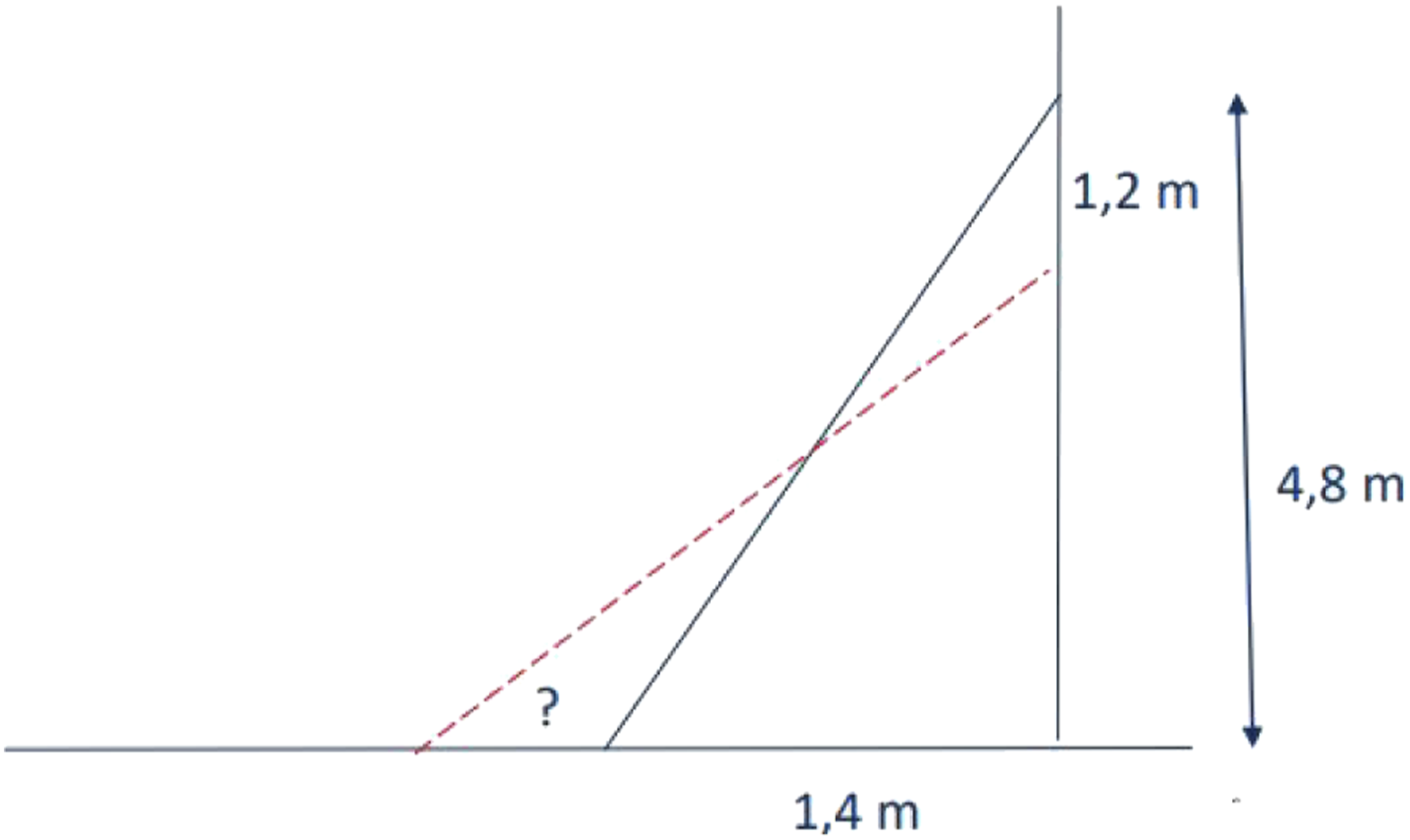
Afterward, we discussed possibilities to adjust the given example—by progressing from numerical to general solutions—in order to challenge gifted pupils. This is illustrated in the second example, drawn on the first one. We emphasized that instead of working with numerical values, pupils should assume in more general terms if the support point of the ladder moves a longer, an equal, or a shorter distance than the distance dropped on the wall (Figure 2). The figure shows a ladder leaning against a vertical wall. The ladder slides down a quarter of the original height along the wall (the blue arrow in the figure). The dashed red line indicates the new position of the ladder. The support point of the ladder on the ground has moved. 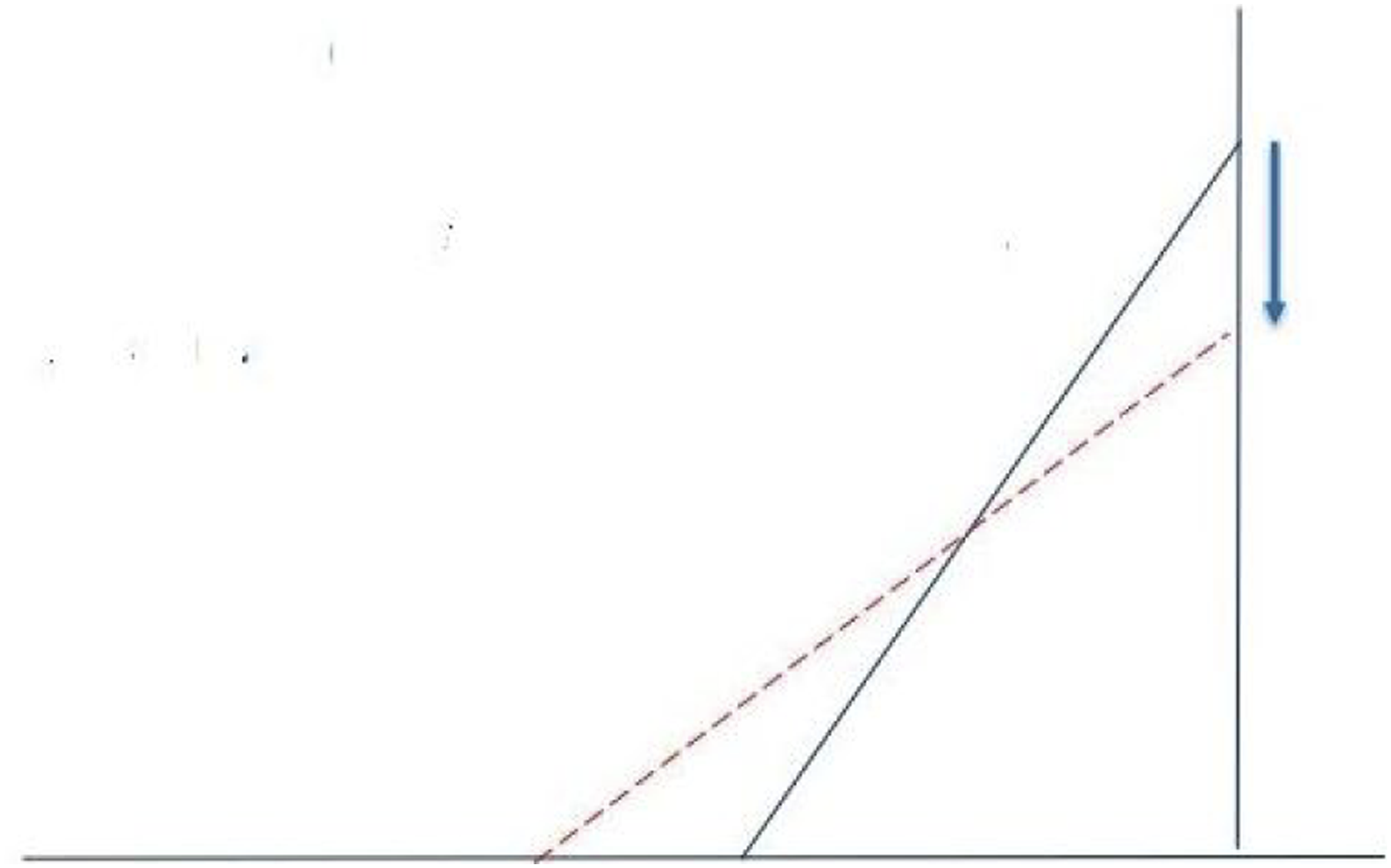
After discussing the differences between the numerical and general solutions offered by the examples above, by highlighting those opportunities where gifted pupils are able to encounter general mathematical relationships (Krutetskii, 1976), another example was introduced. The third example (see Figure 3) was about comparing the perimeter of a large semicircle with the sum of perimeters of two inscribed semicircles. This time, we once again addressed mathematical abilities of the gifted by demonstrating how these pupils may possibly progress from numerical solutions to a general one. In a semicircle, we draw two smaller semicircles, which tangent each other and the large semicircle, as in the figure. Is the perimeter of the large semicircle larger, shorter, or equal to the sum of the perimeters of the inscribed semicircles? Motivate your answer.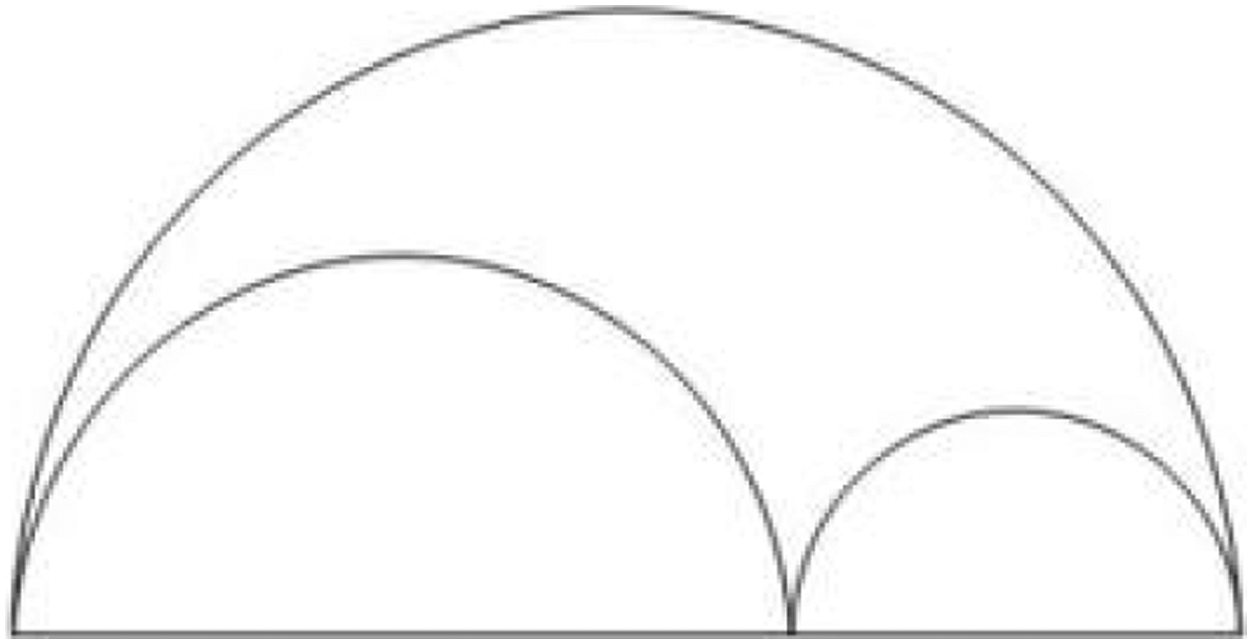
During the seminar, we also mentioned gifted pupils’ ability to produce divergent solutions to given tasks, as an important perspective on mathematical creativity (Haylock, 1987).
After the seminar on mathematically gifted pupils
After the mentioned seminar, participants were encouraged to use DGS in order to explore and to generalize mathematical relationships, but also to make and verify mathematical conjectures. Afterward, they completed a homework and participated in a follow-up seminar on task design with DGS.
The homework was introduced by using three versions of a sample task—provided by Trocki and Hollebrands (2018)—in order to address “…the same two learning goals: 1) justify that opposite angles of parallelograms are congruent; 2) justify that the diagonals of parallelograms bisect each other” (Trocki & Hollebrands, 2018, p. 127). The three versions of the task consisted of a combination of a sketch of a parallelogram and some instructions and questions that were intended to guide pupils to achieve the mentioned learning goals. At the follow-up seminar, the PMTs discussed their respective homework in small groups and in whole-class setting.
During the remaining part of the course, by referring to the seminar about mathematical giftedness, the PMTs were reminded about ways to adapt geometrical activities to suit all pupils, that is, also the gifted. However, their goal was still to construct activities for pupils in the regular classroom.
The course assignment
The PMTs were divided into 10 small groups to plan a geometry lesson by designing DGS activities for upper secondary school pupils, including gifted pupils. Besides the written assignment, the PMTs were asked to review and provide both written and oral feedback on another group’s work. At a minor seminar, the PMTs presented their own work and they received feedback from both peers and the teachers (two of the authors of this article).
Data collection
The main data consists of documents in terms of (both preliminary and final versions of) lesson plans, including the designed DGS activities, from the 10 groups. Since there were small differences between the two versions provided by all groups, we decided only to code the final version.
Analysis
The analytical frameworks
To classify the activities constructed by PMTs, based on the concepts presented in the theoretical background section, we decided to use two different analytical frameworks.
First, we focused on significant abilities of gifted pupils that can be addressed in the context of problem posing. Thus, we accorded particular attention toward the ability to generalize mathematical objects, relationships, and operations (Krutetskii, 1976). Consequently, based on Krutetskii (1976) complex system of mathematical abilities, we outlined the following analytical framework: (O) The ability to obtain and formalize mathematical information with respect to the problem: - For example, the pupil is given the opportunity to display an understanding of the structure of the problem, by representing the problem in appropriate symbolic forms that highlight the relationship between the given entities and underlying variables. (P) The ability to process mathematical information: - For example, the pupil is given the opportunity to use an appropriate problem-solving strategy and to perform well-known methods for problem-solving by using logical, systematic, and sequential thinking. (G) The ability to generalize mathematical objects, relations, and operations: - For example, the pupil is given the opportunity to use obtained particular results in order to construct a general solution of the problem.
Second, to determine the mathematical depth that the tasks promote pupils to reach, we use the van Hiele model, and in particular, the levels of geometrical thinking (van Hiele, 1986), as described in Mayberry (1983). Level I: “At this level, figures are recognized by appearance alone. A figure is perceived as a whole, recognizable by its visible form, but properties of a figure are not perceived. At this level, a student should recognize and name figures and distinguish a given figure from others that look somewhat the same” (Mayberry, 1983, p. 59). Level II: “Here, properties are perceived, but they are isolated and unrelated. Since each property is seen separately, no relationship between properties is noticed and relationships between different figures are not perceived. A student at this level should recognize and name properties of geometrical figures” (Mayberry, 1983, p. 59). Level III: “At this level, definitions are meaningful, with relationships being perceived between properties and between figures. Logical implications and class inclusions are understood. The role and significance of deduction, however, is not understood” (Mayberry, 1983, p. 59). Level IV: “At this level, deduction is meaningful. The student can construct proofs, understand the role of axioms and definitions, and know the meaning of necessary and sufficient conditions. A student at this level should be able to supply reasons for steps in a proof” (Mayberry, 1983, p. 59). Level V: “The student at this level understands the formal aspects of deduction. Symbols without referents can be manipulated according to the laws of formal logic. A student at this level should understand the role and necessity of indirect proof and proof by contrapositive” (Mayberry, 1983, p. 59).
Using the analytical frameworks
The activities constructed by PMTs were subjected to qualitative content analysis (e.g., Elo & Kyngäs, 2008). Such analyses are typically either theory-driven or data-driven, depending on the researchers’ ambitions in the context of the actual study (Kvale & Brinkmann, 2009). In this study, the analysis was theory-driven, based on the frameworks of Krutetskii (1976) and van Hiele (1986), respectively.
To illustrate the coding process, we use one of the activities, developed by Group B.
Analysis according to both analytical frameworks.
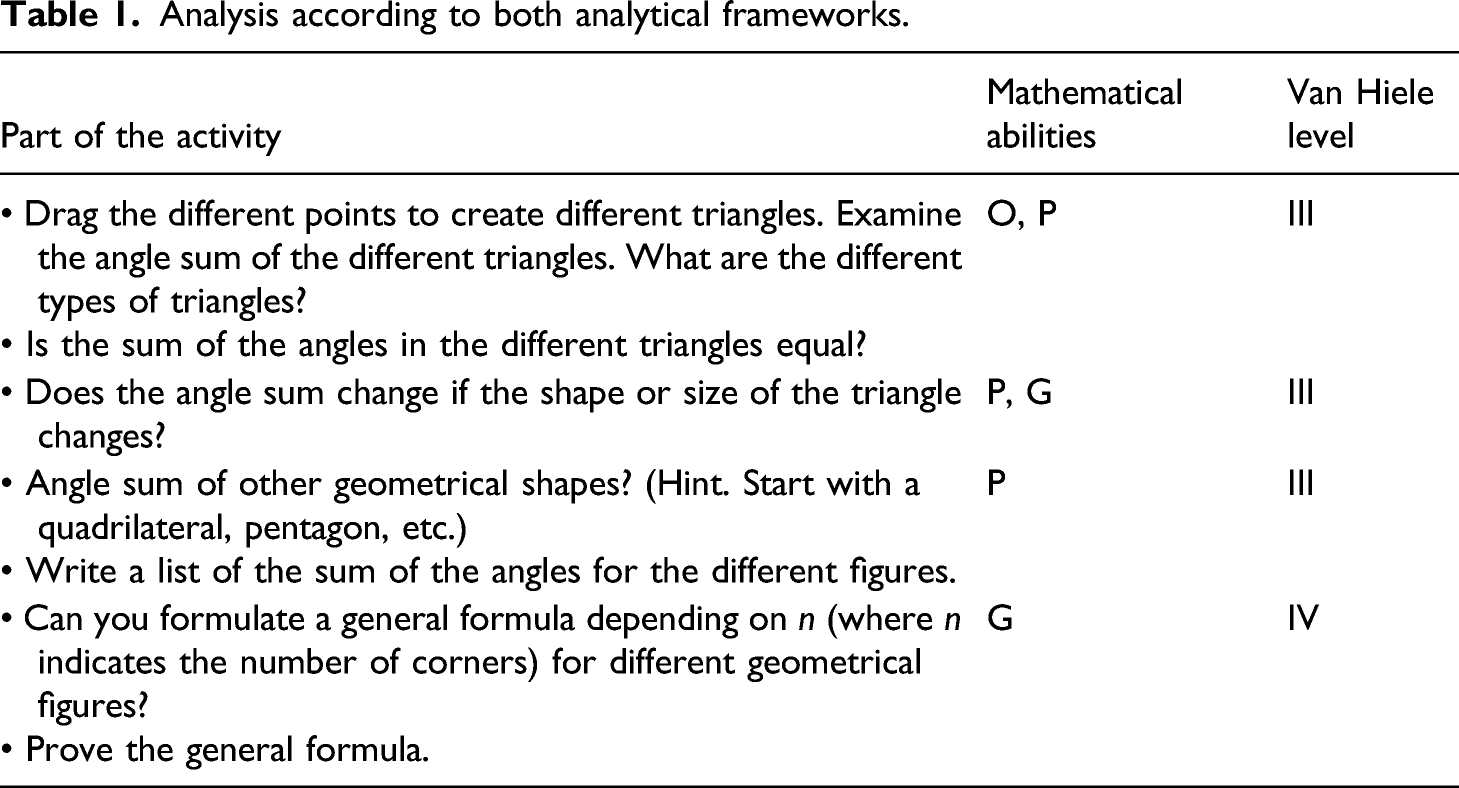
The purpose of the activity constructed by group B was to give the opportunity for pupils, especially for the gifted, to find the sum of interior angles of a polygon, that is, the general relationship between polygons and their respective sum of interior angles. An analysis of the different parts of the activity constructed by group B, displays that pupils are initially expected to answer questions by straightforward use of DGS in order to calculate specific angles, that is, they need to obtain, formalize and process mathematical information (O, P) according to Krutetskii’s model: What are the different types of triangles? Is the sum of the angles in the different triangles equal?
However, already the next question “Does the angle sum change if the shape or size of the triangle changes?” initiates a more general reasoning from the pupils. Thus, in order to answer this question, they need to extend and analyze the results of their calculations, that is, to process mathematical information (P). When using the van Hiele model, we regard the tasks above as level III because they require pupils to use definitions of triangles and make logical assumptions about properties and relationships between different triangles.
Next, after calculating the sum of interior angles of polygons of different shapes (P), the task “Write a list of the sum of the angles for the different figures” prepares pupils for the generalization of the obtained mathematical relations (G). According to van Hiele, this task reaches level III. Although pupils are asked to start to generalize, formal proofs are not yet requested.
Consequently, the final two tasks promote the idea of finding a general relationship between shapes of polygons and the sum of their interior angles. Can you formulate a general formula depending on Prove the general formula.
Thereby, the activity constructed by group B appeal clearly to pupils’ ability to generalize mathematical objects and relations (G), a mathematical ability that is a characteristic for the gifted and closely connected to the teachability of the subject (Krutetskii, 1976).
These final tasks reach level IV in the van Hiele model since formal proofs are requested.
The reliability and validity of the study
Both the validity and the reliability of the analysis were tested. Even though reliability and validity are concepts closely associated to quantitative research, these are also frequently used in the qualitative paradigm (e.g., Golafshani, 2003). When discussing validity and reliability in the context of qualitative studies, some researchers indicate that “the most important test of any qualitative study is its quality” (Golafshani, 2003, p. 601). In similar veins, it is indicated that reliability and validity in qualitative research should be assessed in terms of trustworthiness, rigor and quality (e.g., Golafshani, 2003).
The validity or trustworthiness of the present study was interpreted in terms of the generalizability and rigor of obtained results (Golafshani, 2003; Stenbacka, 2001). Accordingly, our aim was to perform high-quality qualitative research in every aspect and to document it accurately. Consequently, the design of the study, the selection of analytical frameworks, the intervention, the analysis and documentation of empirical data were carried out in trustworthy and rigorous ways.
The reliability of the study was tested in collaboration between all four authors of this article. In the first phase, the first, the second, and the third author performed an analysis of the anonymized PMTs activities independently. Afterward, mentioned authors compared their respective analytical findings. This phase indicated that the authors drew similar conclusions and used identical codes in more than 90% of the tasks included in the activities. That is, associated mathematical abilities (Krutetskii, 1976) and levels of geometrical thinking (van Hiele, 1986) were identical at more than 90% of the total tasks. In the deviant cases, respective tasks were discussed and associated to plausible categories of abilities (Krutetskii, 1976) or levels of geometrical thinking (van Hiele, 1986). Finally, the fourth author checked independently the analysis performed by the first three authors. Thus, based on the relatively high proportion of coinciding conclusions that emerged during the distinct sequential phases of the analysis, and the associated scrutinization and examination of deviant conclusions, it seems that the reliability of the data analysis holds an acceptable level.
Results
Addressing gifted pupils according to Krutetskii’s framework of mathematical abilities
The analysis indicates that structural components, that is, included tasks, of all activities are ordered sequentially, in an axiomatic way. That is, every activity starts with tasks that require numerical solutions, thereby appealing to pupils’ abilities to obtain and formalize (O) and to process (P) mathematical information according to Krutetskii (1976) framework. Moreover, it seems that a vast majority of activities conclude with the opportunity to assemble obtained numerical solutions in order to find general geometrical relationships. Thereby, the analysis displays that 9 of the 10 groups (see Table 3) constructed mathematical activities that, at least theoretically, address a pivotal characteristic of gifted pupils, that is, the ability to generalize “mathematical objects, relationships, and operations” (G).
. Activity of group A according to addressed mathematical abilities.
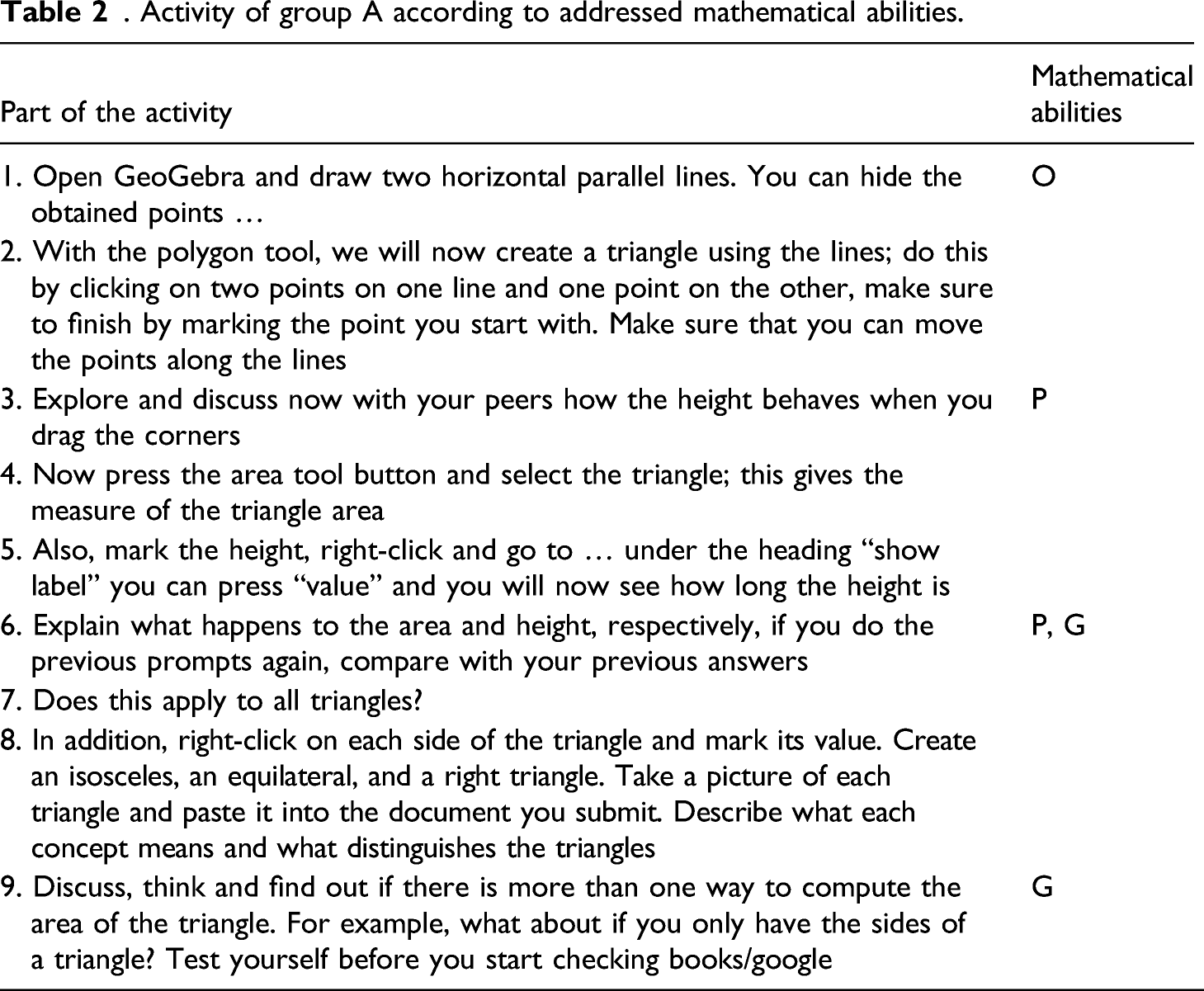
As seen above, the activity constructed by group A encourages pupils to explore areas of triangles drawn between two parallel lines, while the height of triangles is equal to the distance between the two lines. In that way, pupils are expected to find a general relationship, that shows that the area of triangle depends only on its base and its height. This activity starts with relatively simple instructions (O), for example, “Open GeoGebra and draw two horizontal parallel lines.” and “With the polygon tool, we will now create a triangle using the lines; do this by clicking on two points on one line and one point on the other ….” Then, it continues with some numerical tasks (P) “Now press the area tool button and select the triangle; this gives the measure of the triangle area. Also mark the height […] you will now see how long the height is.” Later – by accentuating the possibility to compare obtained numerical solutions – the activity prepares pupils to compare and generalize obtained results (P, G) “Explain what happens with the area and the height […] compare with your previous answers.” Additionally, the next question “Does this apply to all triangles?” initiates the expected generalization (G). Finally, the task “Discuss, think and find out if there is more than one way to compute the area of the triangle. For example, what about if you only have the sides of a triangle?” accentuates the necessity of a general solution (G).
Addressing different levels of geometrical thinking according to the van Hiele model
The analysis indicates that only three of the van Hiele levels were applicable to the activities examined in our study: (II) description, (III) abstraction, and (IV) deduction. All the tasks in this study are beyond the basic level of visualization (I). Concerning the level of rigor (V), none of the tasks requires indirect proof.
Activities according to addressed mathematical abilities and to levels of geometrical thinking.
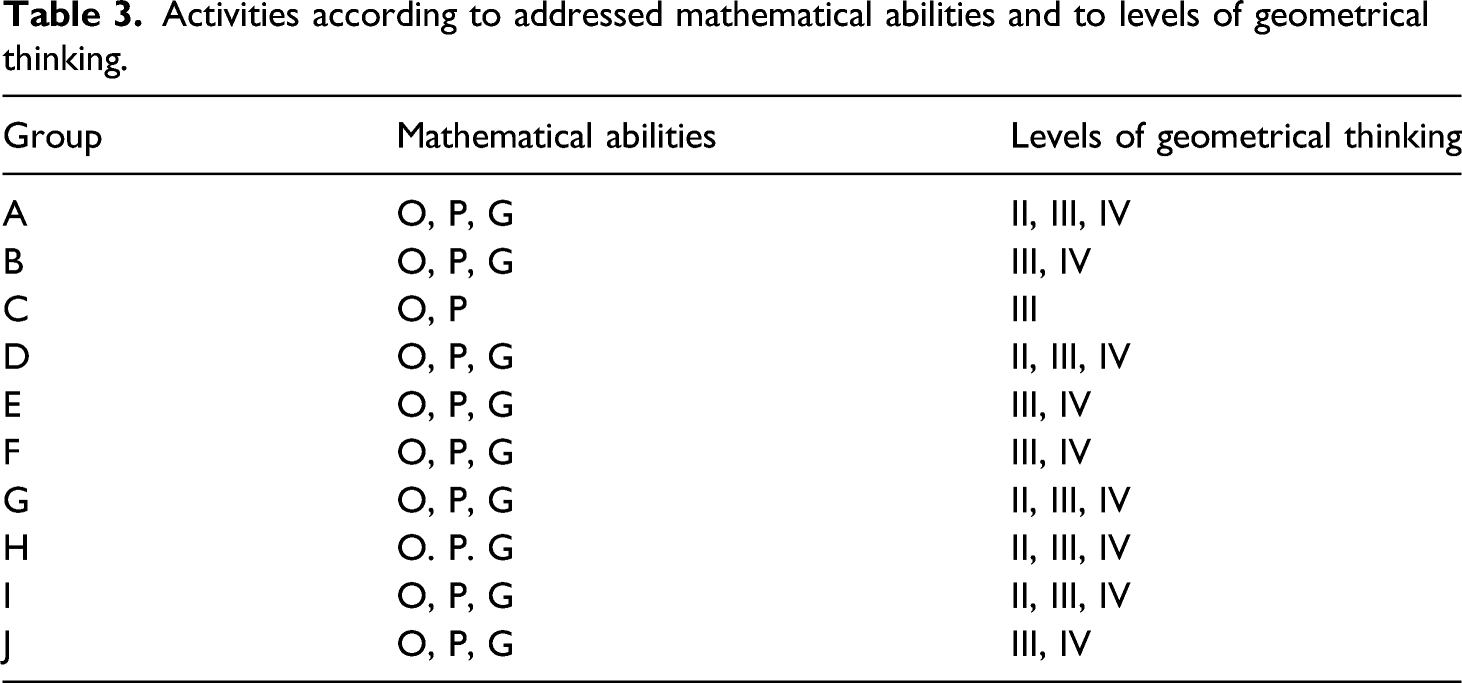
We will use the same tasks as above (see Table 2) to exemplify the results related to the analysis based on the van Hiele model.
The first part of the activity (see Table 2, tasks 1–2) constructed by group A, relates to the second level of geometrical thinking according to van Hiele’s model (II), where properties are perceived, but they are isolated and unrelated. The pupils are supposed to construct using DGS different geometrical elements, for example, “Open GeoGebra and draw two horizontal parallel lines […] With the polygon tool, we will now create a triangle using the lines”; but no relationships between properties are asked to be noticed. The second part of the activity (see Table 2, tasks 3–8) reaches the third level (III), where definitions of different types of triangles are needed, for example, “Create an isosceles, an equilateral and a right triangle.” In this part, relationships between triangles of different shapes are in focus, for example, “Describe what each concept means and what distinguishes the triangles.” and logical implications are supposed to be carried out, for example, “Explain what happens with the area and the height […] compare with your previous answers.”
The third part of the activity (see Table 2, task 9) reaches level IV. Here, pupils are supposed to determine different ways of working, for example, “Discuss, think and find out if there is more than one way to compute the area of the triangle.” Finally, pupils are asked to examine and prove their findings.
Addressing mathematical abilities and different levels of geometrical thinking
As mentioned, all activities were constructed axiomatically and started with tasks that require numerical solutions. Subsequently, we would like to present some additional examples of initial tasks that, according to the analysis related to Krutetskii’s framework, could be solved with a straightforward use of DGS (O) or by processing the mathematical information (P). Likewise, these tasks are displaying the van Hiele levels II or III: Group D: Create an arbitrary quadrilateral (convex) with the "Polygon" tool … mark the midpoints on each side of the arbitrary quadrilateral … construct the inscribed quadrilateral. Group E: Start by studying how the shape of the regular polygon changes when the amount of corners changes, by dragging the slider n. Compare the outer and inner polygons. … Set the radius to 1 … Fill in the spreadsheet with values of the perimeter for different numbers of corners and create lists … Group F: Measure the angles of the triangles; is there any connection between the triangles? … Measure side Group G: Create a circle sector … select the BAC angle. Create a new point D on the circle outside the circle sector. Construct the segments BD and CD.
Nevertheless, 9 of the 10 activities contained tasks that offered opportunities to generalize obtained results and geometrical relationships (G) and thereby were categorized as activities that address gifted pupils. The analysis shows that these tasks correspond to the van Hiele level IV, the deduction is included, and pupils can construct proofs. Next, we present some of these tasks: Group D: Formulate a hypothesis about the relationship between the area of the inscribed quadrilateral and the area of the original quadrilateral ... Does the results agree with your hypothesis … Prove the relationship between the area of the inscribed quadrilateral and the original one … Group E: … can you draw any conclusion about what will happen to the perimeter if the number of corners tends to be very large?... Find out the circumference of both the inner and outer polygons with n corners expressed in r … Group F: Formulate a relationship between the sides of the triangles … Check if there is any further relationship between the triangles … If there is any relationship, try to formulate it and prove it. Group G: You will now see all four inner angles. Can you find a relationship between the angles? Formulate a hypothesis and justify it. Prove your hypothesis!
Table 3 provides an overview of the results according to Krutetskii’s and van Hiele’s frameworks, respectively.
Discussion
The goals of the present study were to examine the impact of an intervention—based on a seminar about mathematically gifted pupils—on geometrical activities constructed by PMTs, and to examine possible associations between the framework of Krutetskii (1976) and the van Hiele (1986) model of geometrical thinking through the analysis of the mentioned activities.
Concerning the first goal, the results display that the intervention had a considerably impact on geometrical activities constructed by the participants. That is, even though the mentioned seminar introduced a brief perspective on giftedness and problem-solving for the gifted, the participants were able to construct activities that include tasks which are appealing to gifted pupils. That is, the analysis indicates that 9 of 10 groups constructed activities that address a pivotal characteristic of the gifted, that is, the ability to generalize “mathematical objects, relationships, and operations” (Krutetskii, 1976, p. 350). Thus, a relatively high proportion of activities have the potential to stimulate gifted pupils. In the context, we would like to state that this conclusion may not be considered unexpected since mathematically gifted pupils’ ability to generalize mathematical objects and relationships was emphasized during the intervention and the following lectures. In addition, it should be mentioned that the activities constructed by the PMTs seem to be more well-structured—every activity consists of a distinct sequential order of instructions—compared to the examples that were presented during the seminar about giftedness. Thus, it is not unreasonable to assume that this occurred because PMTs were encouraged to use DGS during the whole course and, importantly, the constructed activities were designed in a DGS environment. However, an analysis of the impact of the DGS on mathematical problem posing is beyond the aims of this article.
According to the second goal of the present study, the analysis indicates an inter-relationship between particular levels in Krutetskii’s and van Hiele’s frameworks, respectively. That is, every activity identified as addressing mathematical giftedness (G), also reached the van Hiele level IV, that is, it included requests of deductive arguments. This inter-relationship was found by qualitatively examining responses from each group. However, when it comes to the level of tasks in the mentioned activities, there is no one-to-one correspondence between category G (Krutetskii, 1976) and level IV (van Hiele, 1986). That is, not every task that represents Krutetskii’s category G, reached simultaneously level IV, according to van Hiele. For example, as displayed in Table 2, tasks 6–8 were categorized with G (Krutetskii, 1976) but only reached level III (van Hiele, 1986). However, mentioned 9 of 10 activities displayed both category G and level IV through their final tasks. In that aspect, the present study confirms previous suggestions (Sriraman, 2004a) that the holistic description of mathematical giftedness according to Krutetskii’s framework does not correspond strictly with the hierarchical discrete levels of geometrical thinking of the van Hiele model. This theoretical inter-relationship between the two frameworks has considerable potential for mathematics gifted education, particularly for analyzing tasks that have a geometric component to it.
Although the current study is based on a small sample of participants, most of them at the end of the first year of the teacher program, and constructed activities were situated in a DGS environment—attributes that should be considered as limitations of the study—the study may offer some implications for teacher education. Foremost, it suggests that even a relatively limited intervention seems to make PMTs aware of some characteristics of mathematically gifted pupils. That is, even though gifted pupils are not particularly addressed in the Swedish educational context (SFS, 2011, p. 688; 2018, p. 1098) and PMTs are expected—without being taught about the characteristics of the gifted—to plan and implement activities for all pupils in regular classrooms, it seems that a limited intervention had the potential to initiate PMTs in addressing some pivotal abilities of mathematically gifted pupils. From a different perspective, the analysis indicates that constructed activities display every intermediate level of geometrical thinking (van Hiele, 1986) before reaching their respective top-level. Thus, it seems that activities constructed by the participants had the potential to address the geometrical understanding (van Hiele, 1986) of pupils at different performance levels, that is, also of average performing pupils. Consequently, it is not unreasonable to assume that the PMTs, in their upcoming teacher profession, will be able to construct mathematical activities to stimulate every pupil in the heterogeneous classroom. Thus, it seems plausible that seminars about mathematically gifted pupils can offer PMTs the opportunity to be better prepared to stimulate pupils at different performance levels in the regular classroom, that is, also the gifted. Consequently, we would like to suggest that well-planned seminars on giftedness in mathematics, particularly on mathematically gifted pupils, should be offered in a regular basis for PMTs in Swedish teacher education programs.
Finally, we would like to stress that a different selection of participants or a focus on a different mathematical area would have most probably displayed aspects of the mathematical activities constructed by PMTs, or about the interaction between the two examined frameworks, that were not observed in this study. Accordingly, the findings of this study should not be interpreted in a more general perspective or transposed to a context that is different from the Swedish educational system.
Footnotes
Declaration of Conflicting Interests
The author(s) declared no potential conflicts of interest with respect to the research, authorship, and/or publication of this article.
Funding
The author(s) received no financial support for the research, authorship, and/or publication of this article.
