



Abstract
In the context of veterinary education, simulators are devices or sets of conditions aiming to imitate real patients and enable students to practice skills without the need for live animal use. Simulator use in veterinary education has increased significantly in recent years, allowing consistent practical teaching without reliance on clinical cases. This review examines the available literature regarding the use of simulation and simulators for teaching practical day one competences to veterinary students. Scientific databases were searched and 73 relevant articles were reviewed. The reviewed articles revealed that there are a number of simulators currently available to veterinary educators, that simulators can enhance student skills and provide an alternative learning environment without the need for live animal and/or cadaver use, and that they usually receive positive feedback from the students who use them. There appears to be a bias towards small animal simulators — however, some skills that are developed through the use of small animal or table-top models will be transferrable to other species. The majority of large animal simulators focus on bovine rectal palpation and/or pregnancy diagnosis. Further research is required to increase the repertoire of available simulators for use in veterinary education, in order to improve the practical skills of veterinary students and reduce the use of live animals and cadaver material for teaching purposes.
Introduction
Simulation is, in its simplest definition, the imitation of a situation or process. In the context of veterinary or medical education, a simulator is “a device or set of conditions that aims to imitate real patients, anatomic regions, or clinical tasks”. 1 The use of simulators for teaching in healthcare professions has increased significantly in recent years, 2 and it is likely to continue increasing with the advent of new technologies and increasing drive of academic institutions and regulatory bodies to ensure a consistent level of competence in new graduates. Scalese and Issenberg 2 discuss a worldwide shift towards outcomes-based education and standard-setting by universities and professional regulators for quality assurance in order to produce consistency amongst graduates. According to Edwards, “there is a societal expectation that veterinarians everywhere will all have graduated at the same standard and have the same basic competencies”. 3 In the UK, veterinary curricula aim to ensure that students graduate with all of the skills designated by the Royal College of Veterinary Surgeons (RCVS) in their List of Day One Competences, and there is a drive to ensure that all students achieve a consistent learning experience during their time at university. 4
Teaching of practical clinical skills is crucial for veterinary education, in order to ensure that graduates comply with the RCVS Day One Competences, but also because confidence and proficiency in performing clinical procedures is important to veterinary students. 5 The strongest predictor of skill level is the number of hours of deliberate practice, 6 and this time can be limited in veterinary education due to the variable availability of practical teaching opportunities on live patients, as such opportunities are reliant on case exposure and consent from the animal’s owner (the client).
Historically, veterinary students would have been trained in surgical and other clinical skills via the use of dissection of cadaver materials, observation of clinical cases and some institutions may have utilised live animals obtained and anaesthetised for the purposes of surgical training. These practices were commonplace at all education levels in a range of subjects and at a number of institutions until the ethical issues surrounding the use of animals for teaching purposes were highlighted and widely discussed, both within education and society in general.7,8 The concern observed within educational institutions and society paralleled the increasing concern for use of animals in science more generally, and the growing desire for the development of non-animal alternatives across multiple sectors.
This movement led to the development of non-animal alternatives for educational purposes which, according to a 2005 review by Hart et al. 9 appeared to gain popularity in the early 1970s — although the earliest non-animal alternatives identified in this current literature review were surgical ligation simulators dating from the early 1990s. Around this time, the UK-based resource centre for general non-animal alternatives, InterNICHE (the International Network for Humane Education), was founded (originally as EuroNICHE in 1988), 10 and the Animals (Scientific Procedures) Act 1986 was passed into UK law. 11
There is no doubt that observing and then practising clinical techniques on live animals provides the most accurate and applicable ‘real-life’ scenario for veterinary students and will provide the most benefit to their future patients. However, the obtainment and use of live animals purely for teaching is strictly controlled within ethical guidelines in a number of countries and veterinary institutions across the globe, and there is a drive within veterinary pedagogy to develop and utilise alternatives to live animals when teaching certain practical clinical skills in order to protect animal welfare without compromising student teaching and learning. The use of simulators in veterinary education is a relatively new and progressive field of study and although the use of simulators cannot fully supersede the use of live animals for teaching, simulators may provide a suitable facility for students to practice skills prior to performing procedures on live patients.
Teaching simulators allow the development of practical skills in the absence of a live patient, and can produce more confident graduates and greater proficiency in practical skills, in addition to protecting animal welfare and reducing the need for live patients in teaching.2,5,12–15 It can also be postulated that the use of simulators provides a safe, low-risk environment for students in which to practice their skills and not experience concerns regarding animal welfare or pressure from observing parties, such as the client. A safe, low-stress environment might also increase learning potential, as student anxiety has been demonstrated to inhibit learning, and stress in medical situations inhibits judgement.16,17 The availability of clinical skills laboratories at veterinary institutions is considered to be beneficial for enhancing student learning, complementing traditional training and benefitting animal welfare by reducing the requirement for live animals or cadaver materials in teaching sessions. 18 As aforementioned, the facility to practice skills on live animals is a crucial component of veterinary education, and the use of simulators cannot supersede this. However, simulators can aid the development of skills prior to practising on a live animal, and can improve the levels of student competence and confidence when they then need to perform a procedure on a live clinical case requiring veterinary treatment or intervention. This, in turn, can improve animal welfare, as tasks will be performed more skillfully with less stress and lower risk of harm to the patient.2,5,12
A number of teaching simulators are already employed within veterinary schools, ranging from simulators to teach clinical skills (such as clinical examinations, intramuscular and intravenous injections, rectal examinations, ophthalmic examinations and anaesthetic monitoring), to more complex surgical simulators (such as for neutering and arthroscopy).1,2,12,19,20 It is highly likely that there are additional smaller, less publicised simulators used within veterinary schools that are unique to individual establishments. Martinsen and Jukes
20
divided simulators into four categories: 1. Models, mannequins and simulators; 2. Multimedia computer simulation; 3. Virtual reality; 4. Ethically sourced animal cadavers and tissues.
The categories described above do not allow for the distinction between the different types of learning outcomes that simulators can be used to achieve (e.g. to gain practical clinical skills versus anatomical knowledge or communication skills). The aim of this article is to summarise the available literature regarding the use of practical simulators for teaching practical clinical skills to veterinary students. Therefore, simulators within this article are separated into the following broad categories: — Model-based practical simulators: for teaching practical clinical skills via the use of non-cadaver model simulators. — Practical virtual simulation: using virtual reality or augmented reality to deliver practical skills. — Non-practical virtual simulation: using computer software or virtual reality programs to deliver teaching material or example case scenarios, which are mainly theoretical. — Communication-based or scenario-based simulation: using actors, multimedia software or example communication scenarios, to teach professional or communication skills.
It is acknowledged that non-practical virtual simulation, multimedia computer simulation and communication or scenario-based simulation are of extremely high value to the veterinary curriculum. The former may indeed be an area of advancing research and technology in the near future, with the advent of modern virtual reality technology. However, the focus of this review is on the use of practical simulators for teaching practical clinical skills. As such, any discussions on non-practical, virtual and communication-based simulation will be limited.
Materials and methods
The research question set for this review was: What simulators are available for teaching practical Day One Competences to veterinary students and are they efficacious? Sub-questions as part of the main research question included: — Do simulators realistically mimic the task being performed when compared to a live animal? — Do simulators improve student learning and skills? — Do students provide positive feedback regarding simulators? — Do students prefer training on live animals? — Do simulators improve the welfare of animals? — What challenges do educators face in simulator use and development?
Search strategy
Four databases (CAB Abstracts, Scopus, ScienceDirect and Wiley Online Library) were searched using the terms below and Boolean operators. Google Scholar was not included due to unmanageably high number of articles yielded on initial searching (71,400), and a lack of clear refining tools, as documented by Halevi et al.
21
The search yielded a total of 73 relevant articles. The search terms were: — Search 1: Simulation OR Simulator AND Veterinary AND Education — Search 2: Simulator OR Simulation AND Veterinary — Search 3: Model AND Veterinary AND Education — Search 4: Simulation OR Simulator AND Veterinary AND Training — Search 5: Model AND Veterinary AND Training
Further searches were performed with: Simulation OR Model AND Veterinary AND (Education OR Training) AND <species> bovine, ovine, porcine, feline, canine, equine, cattle, sheep, pigs, cats, dogs, horses. Searches were also performed using the plural forms (simulations/simulators), and it was found that the search results were the same, regardless of singular or plural form.
Certain journals with a number of relevant articles were searched separately, in addition to the main database searches (e.g. Journal of Veterinary Medical Education, Alternatives to Laboratory Animals). Reference lists and bibliographies of discovered articles were examined to identify other relevant publications. The Wiley Online Library and ScienceDirect searches yielded high numbers of articles on initial searching, necessitating subject refinement to Veterinary Medicine/Science and original research articles. The following dates were covered in the database searches (the latter date being the date the search was performed): — CAB Abstracts: 1973 to 16 January 2022 — PubMed: ‘unknown’ to 16 January 2022 — ScienceDirect–Elsevier: ‘unknown’ to 16 January 2022 — Scopus: ‘unknown’ to 16 January 2022 — Wiley Online Library: ‘unknown’ to 16 January 2022
The following exclusion criteria were applied: non-English language; non–peer-reviewed articles; full text unavailable or articles not relevant to the research question. The inclusion criteria consisted of peer-reviewed articles written in the English language and relevant to the research question(s).
Results
Small animal simulators
Of the 73 articles reviewed, 45 (61.6%) focused on small animal simulators; the majority of these were canine models (73.3%, n = 33/45), with four being feline models and two being lagomorph (rabbit) models. Six articles described a model that could be utilised for both canine and feline applications. It must be noted, however, that the anatomy of mammalian species for the purposes of clinical skill simulator modelling is often very similar, and therefore certain skills learnt through the use of some canine models (e.g. skin suturing or ligation of blood vessels) will be transferrable to other species.
The most common procedures featured in the reviewed articles were: laparoscopy; venepuncture and/or intravenous catheterisation; and anaesthetic procedures and monitoring (with four articles each). This was closely followed by neutering (orchiectomy and ovariohysterectomy), endotracheal intubation, and endoscopy.
Most of the articles were experimental studies (93.3%, n = 42/45), plus two cross-sectional surveys and one observational study via analysis of case records. Of the experimental studies, 30 involved the creation of a simulator and then the assessment of its validity by comparing the ability of simulator-trained participants when subsequently performing the task (either on the simulator, a cadaver or a live animal) with a control group (non–simulator-trained). The majority of the experimental studies obtained participant feedback on the perceived usefulness of the simulator, or their perceptions on their change in confidence and/or competence following use of the simulator (n = 36/45).
Farm animal simulators
Of the 73 articles reviewed, 10 (13.7%) focused on farm animal simulators. All of these were experimental studies, and all were based on the use of bovine simulators. Nine out of the ten studies assessed bovine rectal palpation simulators, such as the Haptic Cow (Virtalis Ltd, Cheshire, UK; https://www.virtalis.com/haptic-cow/) and/or Breed’n Betsy (Brad Pickford, Australia; http://www.breednbetsy.com.au/) or a Bovine Trans-rectal Palpation Phantom created by the researchers.19,22–27 One article focused on a calving simulator. 28
Equine simulators
Nine of the 73 articles reviewed (12.3%) focused on equine simulators. All of the studies were experimental, and the techniques included: intravenous and intramuscular injections; 29 intra-articular (joint) injections; 30 diagnostic regional anaesthesia (nerve blocks); 31 endoscopy of the upper respiratory tract; 32 gynaecological examination;33,34 laparoscopic ovariectomy; 35 and cardiac dissection. 36 Cardiac dissection was included as a clinical skill for the purposes of this article, due to the RCVS listing the ability to perform a post-mortem examination in their Day One Competences, and the assumption that the cardiac dissection procedure would be required as part of a thorough post-mortem examination. 4
Simulators applicable to all species
The simulators detailed within the reviewed literature.
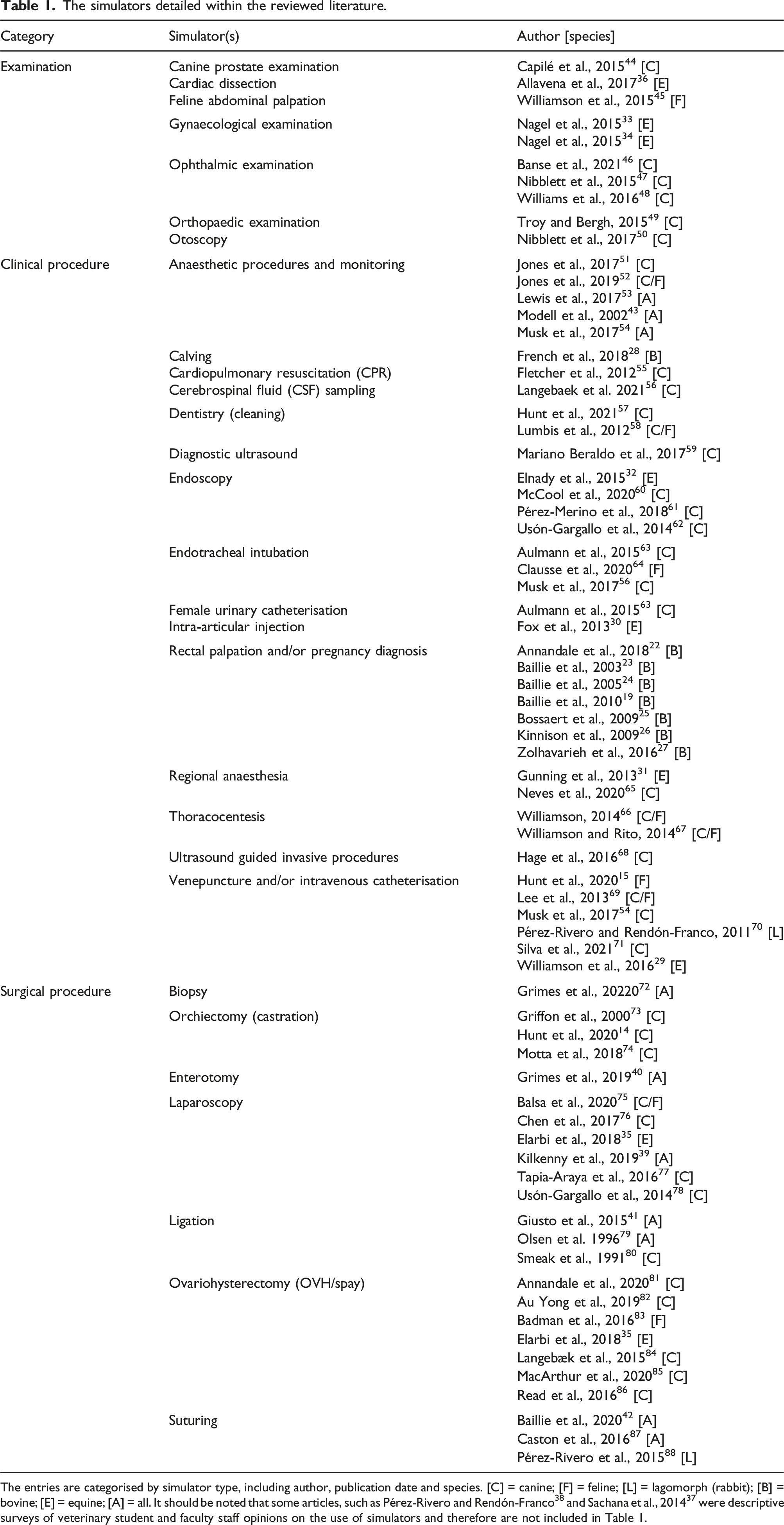
The entries are categorised by simulator type, including author, publication date and species. [C] = canine; [F] = feline; [L] = lagomorph (rabbit); [B] = bovine; [E] = equine; [A] = all. It should be noted that some articles, such as Pérez-Rivero and Rendón-Franco 38 and Sachana et al., 2014 37 were descriptive surveys of veterinary student and faculty staff opinions on the use of simulators and therefore are not included in Table 1.
Discussion
The use of simulators for teaching purposes in veterinary and medical education has been extensively studied, and the reviewed literature illustrates that simulators are being developed and implemented into veterinary curricula across the globe, with the overall aim of improving practical skills in students (and therefore new graduates) and reducing the use of live animals and cadavers in veterinary education.
A notable species discrepancy
From the reviewed literature, there appears to be a notable species discrepancy within the field of simulator development, with small animal simulators seemingly over-represented compared with simulators based on other species. Simulator development for large animal species might be hindered by the costs involved or by the availability of materials, as large simulator models are likely to be more expensive and more difficult to construct from readily available everyday materials than table-top simulators. These factors may therefore contribute to the apparent bias towards the use of small animal simulators that are documented in the reviewed literature.
It must be noted that, for the purposes of clinical skill simulator modelling, the anatomy of mammalian species is very similar and therefore skills learnt through the use of certain models (for example skin suturing or ligation of blood vessels) will be transferrable to other species. However, there is a paucity of literature regarding the use of simulators based on large animals, as compared to those based on small animals — for example, although venepuncture simulators appear to be available for small animals and horses, none were found in the reviewed literature that were specifically designed to relate to farm animals. The procedure for jugular venepuncture in horses is very similar to that used in cattle, though phlebotomy (bleeding) of cattle is often performed via venepuncture of the tail vein (median ventral coccygeal vein), as this is considered to be quicker and easier to perform in cattle when restrained in a race or cattle crush, or when free-standing in cattle stalls, and provides little disturbance to the animal. 89 However, it should be noted that the lack of peer-reviewed literature detailing such simulators does not necessarily preclude their existence. Indeed, it is a distinct possibility that clinical skills laboratories within numerous veterinary schools hold a vast range of simulators which have never been described in the published literature.
Simulator efficacy
Many of the studies described in the reviewed articles appear to document that simulators can be used effectively to improve student skills in performing certain practical tasks.29–31,34,38–40,42,50,52,58,67,71,74,76,80–84,86,88 The time taken to carry out a surgical procedure, as well as the respective performance scores of students using simulators, have been correlated with live surgical performance and procedure times.15,89 Training on models has been shown to achieve learning outcomes that are equivalent 86 or superior71,72,78,82 to those achieved through the use of cadaver or live animal practical classes. Training based on simulators can increase student confidence in performing a task,56,71,73,80–83 and in identifying anatomical structures or landmarks, even if the students did not increase their competency in performing the practical task itself.65,84 Simulators have also been shown to decrease student anxiety prior to performing a task on a live animal.56,71,82
Positive feedback was received from students for the majority of the simulators documented in the reviewed literature, but in some studies, a few students provided feedback stating that they would prefer more live animals to be used for teaching purposes.44,54
The humane evaluation and validation of simulators
A small number of the reviewed articles described how the procedural success of simulator training was monitored, by subsequently observing students performing the task on live animals; some studies used live animals obtained specifically for research purposes, and others used animals obtained for undergraduate or postgraduate teaching purposes. It must be noted that the use of live animals for invasive procedures (i.e. surgery), in this type of follow-up monitoring study, would be considered unethical in some veterinary schools, and thus would not pass the stringent ethical review process in those institutions. Indeed, the use of live animals obtained specifically for the purposes of teaching surgery is prohibited by some institutions. At the author’s institution, all surgical teaching is performed under direct and continuous supervision from a qualified veterinary surgeon registered with the Royal College of Veterinary Surgeons (MRCVS) on clinical cases undergoing surgery for medical reasons, with full informed consent from the animal’s owner. At no point in the veterinary course at the author’s institution are live animals obtained, anaesthetised, used for the purposes of teaching and then euthanised; such practices are forbidden in accordance with the institution’s ethical framework and guidelines.
However, it is understood that the purpose of certain types of study, involving the use of live animals, is to ensure that a simulator under development can mimic the real-life situation. If the simulator is thus validated, then it could replace the use of live animals for teaching certain skills, and therefore reduce the number of live animals used for teaching purposes in the longer term. However, alternative methods of simulator validation — ones that do not necessitate the use of live animals obtained solely for this purpose — would be preferred from an ethical standpoint. For example, it would be preferable to observe students performing a certain task on clinical cases requiring veterinary intervention, rather than obtaining animals and performing the task solely for validation purposes and without a clinical need.
According to the National Centre for the Replacement, Refinement and Reduction of Animals in Research (NC3Rs7) guidelines on the responsible use of animals in bioscience research, “All experimental work should seek where possible to avoid the use of animals if the work has the potential to cause animals pain, suffering, distress or lasting harm. Where use of animals is considered necessary, the researcher should advance sound scientific reasons for their use, explaining in proposals for support why no realistic alternative exists.” 7 It could therefore be argued that if researchers were to follow these guidelines, then the procurement and use of animals purely for the purposes of validating teaching simulators would be prohibited, as there is no justifiable reason why veterinary students could not be observed performing such tasks on actual clinical cases during their training. The logistics of obtaining the data for such a follow-up study would be more complex and potentially lengthier than if it were solely generated within the veterinary school clinical laboratories, but this would not necessarily preclude such data from being obtained.
Academic and student opinion
Knight 90 documented that certain veterinary academics were opposed to the introduction of more-humane methods of teaching, and listed a number of institutions in which veterinary students had requested more-humane methods and had been met with opposition from their faculties. The majority of these institutions were in the USA. He also documented the introduction of a conscientious objection policy, for practicals involving the use of live animals or cadaver materials. 90 A number of reasons for academics objecting to the introduction of more-humane methods were also postulated — however, this article by Knight was published more than 15 years prior to the current review. It is hoped that the overall progress in the field of veterinary education, the quality improvements and enhancements in simulator use, and the advances made in virtual and augmented reality technologies that have occurred in the intervening years will have led to veterinary students no longer facing such opposition today.
According to Sachana et al. 37 students would like traditional training methods to be paired with alternative approaches, such as simulations, with 68.8% of students expressing a desire for alternative classes. Students did express a desire to be exposed to as many humane models for teaching as possible; however, 52.1% of students would not refuse a live animal class even if an alternative was offered. The study 37 appeared to show that simulations can be an effective supplement to traditional teaching methods, but it seems that, alongside some academics (as documented by Knight 90 ), some students still prefer live-animal or cadaver practical classes. 56 The preference for live-animal classes amongst some students could be due to increased realism and the perception that simulators cannot provide a true representation of performing tasks on live patients, even if the learning outcomes achieved through the use of simulators have been documented to be equivalent or superior to those achieved by using live animals. 91 More research is required on this topic, particularly in light of recent advancements and growth in the area of simulators and simulations for use within veterinary education.
It should be noted that students raised concerns regarding the use of live animals in teaching in some studies,44,48,79 but similarly some students provided feedback stating that they would prefer more live animals to be used for teaching purposes,44,54 or that they did not consider the welfare of the animals used to be a concern due to the significant educational value provided by the practical class. 48 According to Verrinder and Phillips “veterinary students are sensitive to animal ethics issues and are motivated to prioritize the interests of animals but have little experience in taking action to address these issues”, 92 which could be interpreted that veterinary students are aware of ethical guidelines surrounding the use of animals in a general sense, but perhaps do not know how to act in response to them. It therefore remains the responsibility of the educational establishment to ensure that any animal use adheres to their own ethical framework or guidelines, and that it is in line with national ethical guidelines. They should also aim to teach veterinary students the importance of animal welfare and the ethical use of animals in teaching and/or research. This includes providing access to a conscientious objection policy, if appropriate for the particular procedure being performed, and ensuring that this policy does not interfere with the compulsory aspects of the curriculum at the individual institution. 90
A future perspective
It is the author’s sincere hope that more simulators are developed and validated in the future, in order to help educators adhere to modern ethical guidelines that aim to protect animal welfare and reduce the need to obtain live animals solely for teaching or pedagogic research purposes. In addition, these simulators will provide veterinary students with opportunities to learn practical skills in a safe, low-risk environment. As aforementioned, it is not envisioned that simulators will completely supersede the use of live animals for teaching purposes, as this is a crucial aspect in many areas of veterinary training. It is hoped that the use of live animals, particularly for the teaching of invasive skills such as surgical techniques, will be restricted to clinical cases requiring veterinary intervention, rather than using animals that have been obtained solely for the purpose of teaching such skills. In these cases, however, the use of simulators will serve to increase student competence and confidence prior to their exposure to the actual clinical cases.
Conclusions
It was clear from the reviewed articles that there are a number of simulators and simulations currently available to veterinary educators, and that they can effectively enhance student skill acquisition, provide suitable alternatives to the use of live animals or cadaver material, and that they are usually well-received by students. There is a bias towards small animal simulators — however, some skills learnt through the use of small animal or table-top models will be transferrable to other species. The farm animal simulators reviewed were biased towards bovine rectal palpation and/or pregnancy diagnosis, and it was clear that there is scope for further research into large animal simulators, both for farm animals and for horses. The use of live animals to validate simulators in some of the reviewed studies would not be in adherence of current ethical guidelines in the UK. Further research is required, in order to develop an increased repertoire of available simulators for use in veterinary education. This will, in turn, serve to improve practical skills in veterinary students and also reduce the use of live animals and cadaver material in veterinary education, with the long-term aim of both improving animal welfare and the competence and confidence of veterinary graduates.
Footnotes
Declaration of conflicting interests
The author(s) declared no potential conflicts of interest with respect to the research, authorship, and/or publication of this article.
Funding
The author(s) received no financial support for the research, authorship, and/or publication of this article.
