



Abstract
This article provides novel insights into a less explored topic: the relationship between the lobbying activities of social partners and business advocacy groups and the development of gender equality policies. The study analyses the process of amending Finnish gender equality legislation to include provisions on pay transparency, focusing on the roles played by social partners and business advocacy groups in shaping the policy. Particular attention is given to the discursive strategies and institutional work employed by these actors to support or, more prominently, oppose the legislation. The findings reveal that while trade unions generally advocate for equal pay initiatives, employer organisations and business advocacy groups consistently resist pay transparency measures through discursive strategies, including defensive institutional work and claims of illegitimacy. These dynamics have significant implications for policy development and the broader advancement of gender equality and equal pay. With the European Union Directive on Pay Transparency adopted in 2023 and requiring implementation within three years, this topic holds considerable relevance across the European Union and beyond.
Introduction
This article addresses a relatively underexplored area within current scholarship: the role of social partners and associated business advocacy groups in the development of gender equality policies. The study focuses on a specific case involving an ultimately unsuccessful attempt to amend Finnish gender equality legislation to include pay transparency measures, a process abandoned due to disagreements among government parties. The analysis examines the formal statements of key stakeholders during the final stages of the policy process, highlighting the interests and power dynamics of employer organisations and business advocacy groups, while also considering the perspectives of other participants.
The gender pay gap continues to be a challenge in most countries, including Finland, where it currently stands at 16% (e.g., European Commission, 2022; Official Statistics of Finland, 2023). Pay transparency is increasingly recognised as a potentially effective measure to address this gap, complementing existing policies and legislation. Following the adoption of the European Union (EU) Directive on Pay Transparency in March 2023, the implementation of such policies at the national level has gained renewed urgency. EU member states are required to adopt the directive within three years, creating significant pressure to develop corresponding national policies and legislation.
Although the EU Pay Transparency Directive was ultimately accepted, it faced opposition from various stakeholders, including EU-level business advocacy groups and employer organisations (e.g., Elomäki and Kantola, 2020). Similar resistance is likely to emerge during national policy processes. Finland's current government, led by Prime Minister Orpo, has indicated in its program that “pay transparency will be promoted according to minimum standards set in the Directive” (Finnish Government, 2023). This approach aligns with the government's conservative-populist and pro-business orientation, which maintains close ties to business advocacy groups. In contrast, the previous government, led by Prime Minister Marin (2019–2023), pursued a more ambitious attempt to renew gender equality legislation by introducing pay transparency measures that exceeded the EU's requirements. This bolder approach contributed to significant resistance and ultimately led to the failure of the proposed legislation. The 2021–2022 policy process under the Marin administration serves as the empirical case for this article.
This article aims to analyse the arguments presented both in favour of and against the proposed pay transparency legislation and to examine how these positions influenced the policy process and its eventual failure. A discursive approach (e.g., Lombardo et al., 2009), combined with the concept of institutional work (Lawrence and Suddaby, 2006; Lawrence et al., 2011) and scholarship on power, especially agenda-setting power and decision-making power (e.g., Bachrach and Baratz, 1962, 1963; Bonafont, 2024; Marchbank, 1994), provides the theoretical framework. Institutional work refers to actions aimed at creating, maintaining, or disrupting institutions, which in this context includes legislation as an institutional framework subject to contestation. This article investigates how institutional work was employed both to challenge the status quo and to defend it by opposing stronger policy measures perceived as threatening the core interests of employer organisations. The analysis focuses on power dynamics, particularly the ability to shape the policy agenda (e.g., Bachrach and Baratz, 1962, 1963; Bergqvist et al., 2015; Marchbank, 1994) and discursively construct (il)legitimate representations of pay transparency and the proposed legislation.
The data used in this research consist of official statements submitted by various stakeholders (N = 37, totalling 185 pages) on the draft pay transparency legislation during the late stages of the policy process in 2022. While these statements may not represent the most decisive element influencing the policy's outcome, they serve as a final platform for stakeholders to articulate their positions. These written submissions explicitly reveal the central interests of key actors and the discursive strategies employed to argue either in favour of or against the proposed legislation. As such, this dataset is particularly well-suited for analysing the core interests of different stakeholders and offers valuable insights into the tactics and discourses of resistance. The analysis focuses primarily on opposing arguments and the use of defensive institutional work (Maguire and Hardy, 2009), as these reveal what aspects of the proposed legislation were perceived as threatening and how actors constructed arguments to advocate for abandoning the government's bill. In addition to the primary data, supplementary materials, including media articles, position statements, press releases by social partners, and prior reports and meeting minutes from the tripartite working group, were also analysed. This study addresses the following research questions:
What types of arguments and discursive tactics were employed in favour of or against the pay transparency legislation? How do these positions vary among different actors? What forms of institutional work did the stakeholders engage in to achieve their desired policy outcomes? What underlying interests are reflected in this institutional work?
This article contributes to the literature on the influence of social partners and business advocacy groups in policy processes (e.g., Elomäki and Kantola, 2020; Koskinen Sandberg, 2016; Elomäki et al., 2021) by examining a case where actors formally committed to advancing gender equality policies collectively opposed legislative renewal as a unified group. This resistance, while apparent, is strategically obscured through various tactics aimed at legitimising their opposition, delegitimising opposing views and shaping public opinion to align with their perspective. The findings consistently demonstrate that employer organisations and business advocacy groups resist pay transparency measures via discursive institutional work and claims of illegitimacy. These tactics have significant implications for policy development and, ultimately, the advancement of gender equality. Given the central role of social partners in policy formulation at both the national level in Finland and the EU level, such resistance poses a substantial barrier to progress. Research on the role of social partners and business advocacy groups in shaping governmental gender equality policies remains limited. By addressing this gap, this article offers an important contribution to understanding how these actors influence the policy process in ways that hinder equality initiatives.
Power and institutional work in a policy process
Over the past few decades, lobbying activities have increased significantly, and the impact of interest groups, including business advocates and social partners, on public policies is undeniable (e.g., Coen and Katsaitis, 2024). While business lobbying has been extensively studied in various contexts – within nation-states, at the EU level and internationally (e.g., Bernhagen and Bräuninger, 2005; Coen, 2009; Miller and Mooney, 2010; Rasmussen, 2015; Vesa et al., 2018) – the interest and influence business lobbyists, together with employer organisations, have on gender equality policy has received limited attention in scholarship so far (but see Elomäki and Kantola, 2020; Elomäki et al., 2021; Koskinen Sandberg, 2016; Seibicke, 2024).
This study uses scholarship on power, especially agenda-setting and decision-making power (e.g., Alasuutari and Qadir, 2014; Bachrach and Baratz, 1962, 1963; Bonafont, 2024), together with the concept of institutional work, borrowed from organisation studies (e.g., Lawrence and Suddaby, 2006; Lawrence et al., 2011) to analyse resistance to the legislative renewal which business advocacy groups and employer organisations view as unfavourable to their interests. Institutional work represents actions directed at creating, maintaining and disrupting institutions. Institutions are broadly defined and can take various forms, including legislation. Institutional work can be categorised as disruptive (Lawrence and Suddaby, 2006), aimed at challenging or dismantling existing institutions, or defensive (Maguire and Hardy, 2009), aimed at defending and upholding them. Defensive institutional work can be carried out through various means, including discursive strategies. This study focuses on these discursive tactics and strategies of institutional work, where actors use powerful discursive tactics to achieve their objectives in the policy process (e.g., Maguire and Hardy, 2009; Moisander et al., 2016).
The central factor influencing decision-making is the ability to control the public discourse and knowledge about the topic in question, thereby influencing the shared understanding of social reality, as well as the understanding of policy problems (Alasuutari and Qadir, 2014; Van Dijk, 2001). Power relations between central actors shape all stages of policy processes, from bringing the issue to the political agenda to negotiation, controlling the agenda, acceptance and eventually implementation (e.g., Bachrach and Baratz, 1962, 1963; Bonafont 2024; Engeli and Mazur, 2018). Business power has been found to be particularly strong in policy processes, although other actors, such as trade unions, have power too (Rasmussen, 2015; Vesa et al., 2018). The exercise of power is present in policy processes, and ‘hurdles’, including forms of resistance and non-acceptance, can cause stumbles at different phases (e.g., Bergqvist et al., 2015; Koskinen Sandberg, 2016; Marchbank, 1994).
Pay transparency as a political goal
The right to equal pay is both a human and a fundamental right and is enshrined in several international treaties (e.g., European Commission, 2006; European Union, 1957; International Labour Organisation, 1951). It also remains a highly contested issue, with policy measures aimed at equal pay being met with strong and continuous resistance from several actors, including business advocacy groups and employer organisations (Erikson, 2021; Koskinen Sandberg, 2016). At the national level, non-discriminatory and equal pay for women and men is regulated by the Constitution of Finland (731/1999) and the Equality Act (609/1986) and has been a priority of gender equality policy in Finland for decades. In recent years, pay transparency has emerged, both internationally and nationally, as a key factor in improving gender pay equality (Ministry of Social Affairs and Health, 2021). In 2014, the European Commission (EC) adopted a recommendation on pay transparency (EC, 2014), and the EU adopted the Pay Transparency Directive in March 2023, to be implemented by member countries within three years. The objective of increasing pay transparency was also set out in the government programme (2019–2023) of Prime Minister Sanna Marin (Finnish Government, 2019), which is why the policy process took place even before the EU Directive came into force.
Finland has a progressive image when it comes to gender equality. Finland, together with other Nordic countries, features among the most gender-equal countries in the world (World Economic Forum, 2023). Despite this reputation, the Nordic countries share structural features that undermine gender equality goals, such as significant gender segregation in the labour market and a substantial gender pay gap (European Commission, 2022; Grönlund et al., 2017; Official Statistics of Finland, 2023). The gender pay gap is attributed to the segregation of the labour market, but also lesser valuation of feminised work, which is institutionalised in the structures of the labour market and collective agreement system (Ref 5). These institutional features are among the main reasons why all initiatives to further investigate the gender pay gap and organisational pay practices meet resistance. The central actors know that further scrutiny of these practices is likely to reveal inequality, and changing the wage levels and wage relativities is costly. This is particularly problematic for businesses and employers, although trade unions also have had a role in negotiating wages as part of collective bargaining; thus, the issue is not entirely unproblematic for them either.
In Finnish society, social partners have a powerful role in policy formulation, and employer organisations have typically opposed most major gender equality initiatives on equal pay but also family policies such as the parental leave system (Elomäki et al., 2021; Salmi and Lammi-Taskula, 2014). Resisting pay transparency measures, and more binding and detailed gender equality legislation in general, has long been a central goal for employer organisations (Elomäki and Kantola, 2020; Koskinen Sandberg, 2016). Trade unions have mostly supported such initiatives, at least in the recent past. As collective bargaining has been decentralised, policy processes are the area in which trade unions, business confederation and employer organisations still have significant power. Of these, business interest groups have the upper hand (Vesa et al., 2018).
The case: key stakeholders conducting institutional work around pay transparency legislation renewal
To understand the political debate on pay transparency and its implications, there must be an understanding of the key stakeholders, their interests and their influence on political decision-making. It is also important to understand how they operate to, for example, influence public opinion and the overall policy process.
Prior to the final stages of the policy process and the submission of statements on the draft law, a tripartite working group was established to draft the government bill on pay transparency. Formally convened by the Ministry of Social Affairs and Health, the working group included representatives from trade union confederations, employer organisations, the business advocacy group Federation of Finnish Enterprises (which, while not technically an employer organisation, is a relatively new participant in policy processes), various ministries and individual experts.
The social partners had already been engaging in institutional work (e.g., Lawrence and Suddaby, 2006) to impact public opinion before the working group's work formally began. An example of the skilful use of the media space to influence a policy process was the EK's (Confederation of Finnish Industries) widely publicised ‘study’ that, through the use of leading and manipulative questions, reported that Finns do not want pay transparency (YLE, 2019). These study results were featured all over the Finnish media before the tripartite working group had even begun its work. Pay transparency was deliberately misrepresented by the EK and the SY (Federation of Finnish Enterprises) as providing unlimited access to colleagues’ pay information and dubbed as ‘pay snooping legislation’ and ‘mandatory wage publicity’ by organisations representing employers and businesses (e.g., position statement SY, 2022). Several of these organisations engaged in external communications both in support of and against pay transparency throughout the policy process. This advocacy began more than a year before the working group initiated its work and continued throughout the entire process (e.g., position statement EK, 2019; position statement STTK, 2019).
As the tripartite working group commenced its work, the minutes of the meetings (our supplementary data) show that there had been major disagreements on pay transparency law and opposition from employer organisations, similar to what can be seen from the statements on the bill submitted at a later stage of the policy process (our main data). The employer organisations, together with the Federation of Finnish Enterprises SY, argued that the law is problematic, not needed, a breach of confidentiality and GDPR and will be burdensome for employers if implemented (minutes of the working group's meetings). The process also took an unexpected turn when the EK abandoned the working group, criticising it for not obeying the practices of typical tripartite policy processes and the Ministry of Social Affairs and Health, which was in charge of the process, for conducting inadequate preparation (YLE, 2020).
In the final report of the working group that presented its work, including the draft law, most participants submitted either complementary or conflicting statements (Ministry of Social Affairs and Health, 2021). The SY, the KiT (the Commission for Church Employers), the KT (Local Government and County Employers), the SAK (the Central Organisation of Finnish Trade Unions) and the STTK (the Finnish Confederation of Professionals) provided statements of disagreement, whereas Akava (the Confederation of Unions for Professional and Managerial Staff in Finland) and the VTML (the Office for the Government as an Employer) left complementary opinions, the latter being mostly similar to the views of the other employer organisations.
Although the process was difficult, the tripartite working group was able to deliver a draft law, mainly based on the state administrations’ determination. The draft law entailed the obligation to promote knowledge of pay, report on organisational wage determination practices regularly, and employee representatives’ access to wage data, including individual comparators’ wage information. Yet, much to everyone's surprise, the draft law was eventually abandoned, since the parties comprising Prime Minister Marin's notably female-dominated, even feminist, government did not reach an agreement on it (Finnish Government, 2022). The main topic of debate within the government concerned employees’ right to gain access to wage information, which was one of the most difficult aspects of the draft law from the employer organisations’ and business advocates’ perspectives. However, information on what exactly happened behind closed doors, and why exactly the legislative process failed, is not available.
Data and methods
For our data, we used different stakeholders’ statements on the bill. The legislative process in Finland contains a phase in which stakeholders are invited to comment on the draft law before it continues further into the process. Although not the most important part of the policy process in terms of influencing the law, these data are valuable because they expose, in a written and clearly argued format, the central interests and arguments of the stakeholders; for this reason, they are excellent for discursive analysis. The data consisted of statements (185 pages) from 37 different stakeholders on the draft bill concerning possible legislation changes to the Equality Act to promote pay transparency (VN/11746/2020). The data were taken from 22 April to 3 June 2022 (Lausuntopalvelu.fi, 2022). Since the statements were publicly available, there was no need to anonymise the stakeholders. Statements were issued by government entities, individual specialists, employer organisations, labour market organisations and other men's and women's associations (Table 1).
Stakeholders that issued statements on the draft government bill on pay transparency legislation.
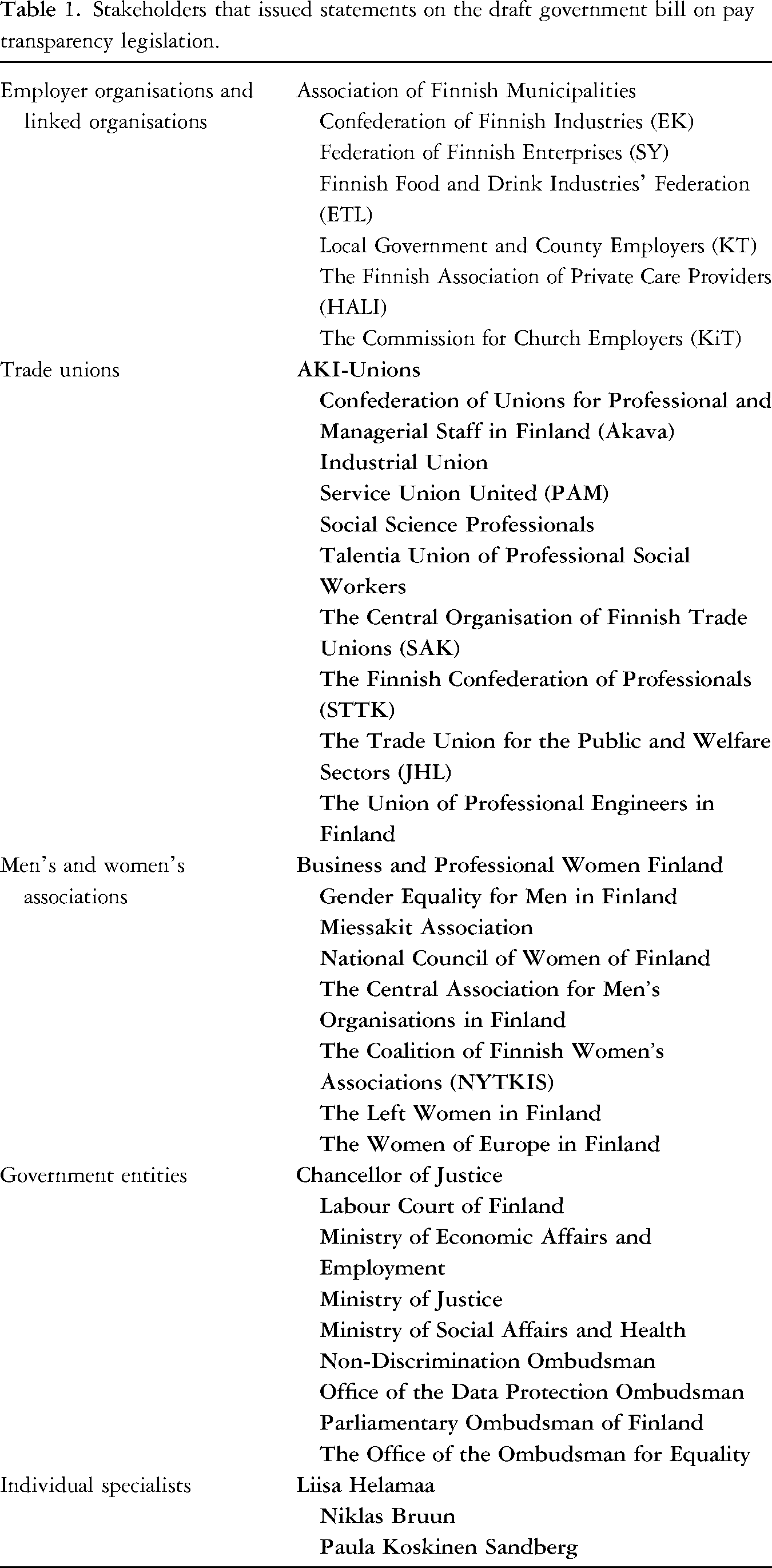
In addition to the main research data, media articles, position statements and press releases, working group reports and minutes of the tripartite working group's meetings (documentation of 13 meetings, public data, accessed from Ministry of Social Affairs and Health by request) provided the supporting data for this article. These were used especially in building the case description that preceded this section but were not analysed extensively as research data.
The draft bill is available (in Finnish) in Lausuntopalvelu.fi (Lausuntopalvelu.fi, 2022). We here collect suggested changes to the law to Table 2, translated from Finnish to English by the second author. The translation was aimed at preserving the meaning of the original text.
Suggested amendments to Finnish gender equality law.
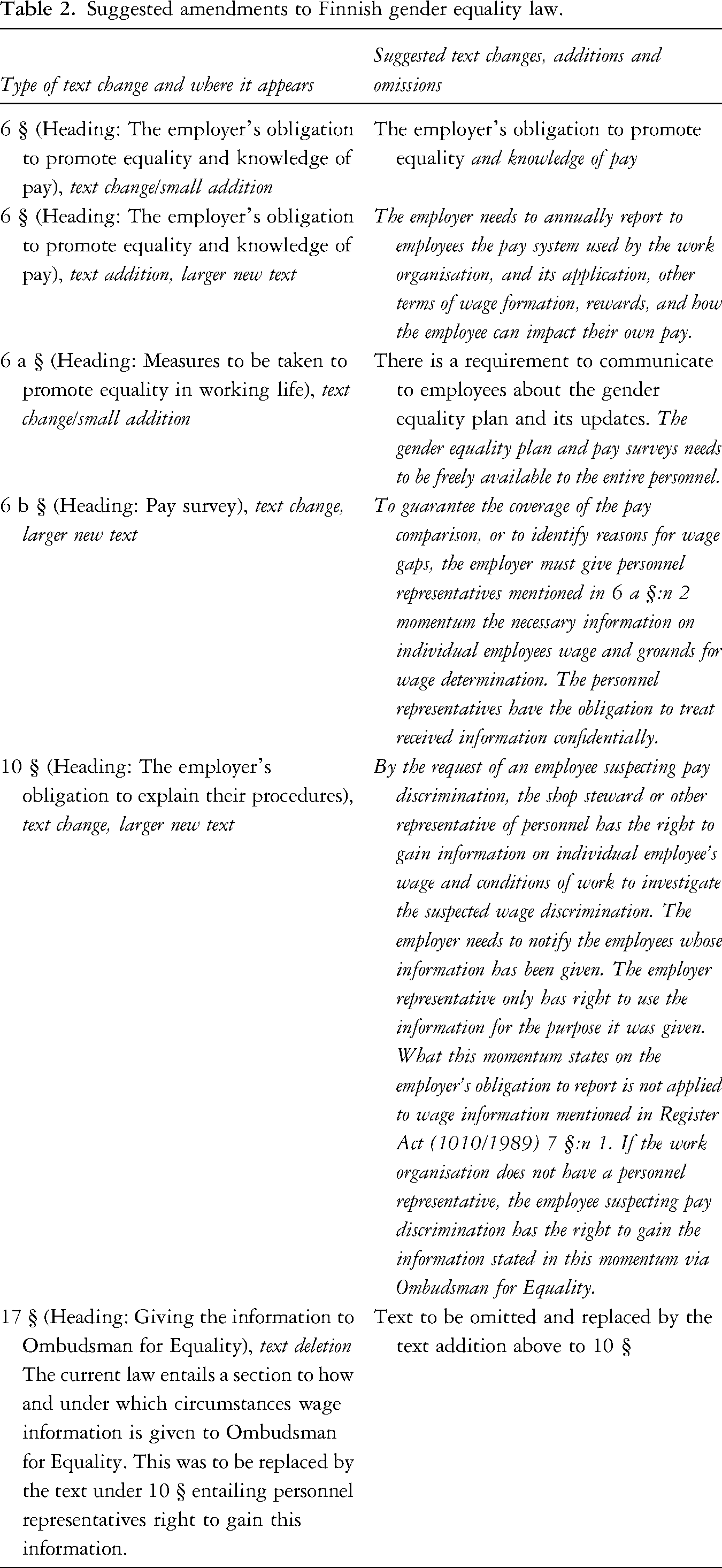
Discursive approach and institutional work
This study employed a combination of qualitative methods, namely qualitative content analysis and discursive methods (e.g., Fairclough, 2015; Lombardo et al., 2009; Van Dijk, 2001). The analysis aimed to map the discursive tactics used to support, and especially resist, pay transparency measures. In doing so, we sought to analyse the institutional work (Lawrence and Suddaby, 2006; Lawrence et al., 2011, Moisander et al., 2016) involved in deliberate actions to defend existing legislation and resist change.
The data analysis was conducted through a reiterative review process in which the data were re-read various times. During the first readings, our main prerogative was to identify and perceive the similarities and differences between the statements. We also focused on what was being said and what was not. Subsequently, we focused more on the views and arguments that had been presented in favour of or in opposition to the pay transparency legislation and narrowed down the text under analysis. To facilitate understanding of these messages, we defined the similarities as sets of meanings that enabled the classification of the data into three main types of discourse: objecting, supporting and promoting. Finally, we moved on to a more critical level and reflected on the findings according to a broader theoretical framework of agenda setting and decision-making power and institutional work.
Results: power and institutional work in the policy process
Of the 37 statements on the draft government bill, nine (all employer organisations and business advocates, no trade unions) opposed it, 18 agreed with it (including some of the trade unions), and 10 (including some of the trade unions) called for even stricter pay transparency regulations. The results of the content analysis and discursive analysis of the views and arguments issued in favour of and in opposition to pay transparency legislation are summarised in Table 3. After the summary, a more detailed analysis is presented. The analysis focuses on the opposing arguments (i.e., defensive institutional work, Maguire and Hardy, 2009), since they reveal what was considered threatening in the proposed legislation.
The three main discourse types in statements on the government bill according to the respective actors.
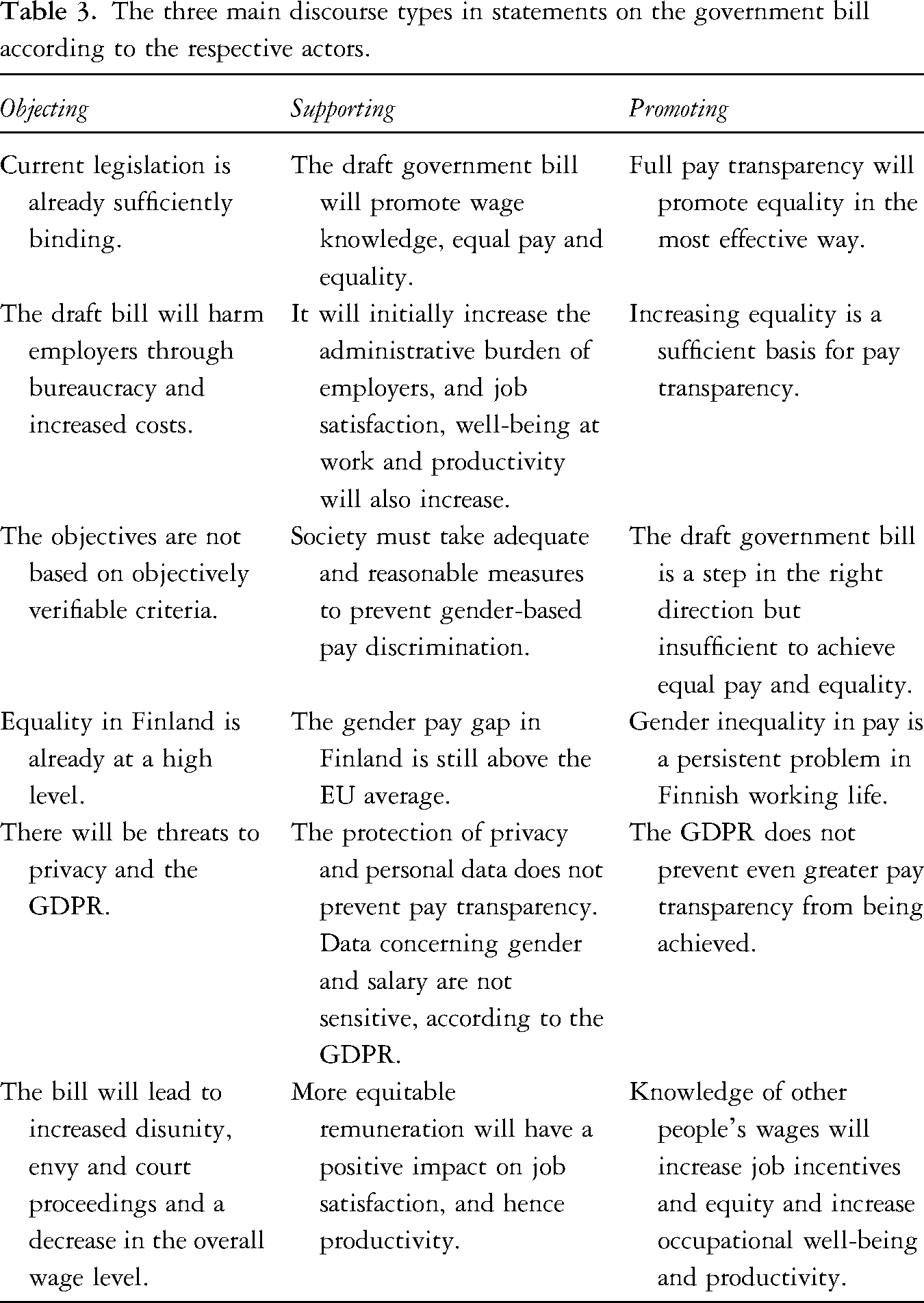
Summary of supporting and promoting arguments
The discourses of supporting and promoting pay transparency were distinct. Supporters expressed relative satisfaction with the draft law, while promoters advocated for even stronger measures (see Table 3). Supporting arguments had similarities: they agreed that the government bill promotes wage transparency, equal pay and overall equality, and while it may initially burden employers administratively, it is expected to enhance job satisfaction, well-being and productivity. Supporting views also assert that privacy and personal data protection will not impede pay transparency, as neither gender nor salary is considered sensitive data under GDPR. Promoting discourses advocate for full pay transparency, as gender equality as an important political goal justifies pay transparency. While promoting views see the government bill as a step in the right direction, they find it insufficient for achieving equal pay and gender equality. Additionally, they have arguments similar to promoting views that knowledge of others’ wages would boost job incentives, equity, occupational well-being and productivity. A summary of supporting and promoting arguments is presented in Table 3.
Opposing arguments: discursive resistance by employers and business advocates
The most fascinating data among the dataset are the opposing and resisting arguments by employer organisations and business advocacy groups. These actors conduct defensive institutional work through a variety of discursive strategies (Maguire and Hardy, 2009; Moisander et al., 2016) to defy legislative changes on pay transparency, i.e., limiting decision-making (e.g., Bachrach and Baratz, 1962, 1963). Altogether, nine statements were against the draft government bill, seven of which were by employer organisations or business advocacy groups (namely Federation of Finnish Enterprises SY) and two by associations promoting anti-feminist views. The findings highlight the fact that employer organisations and business advocacy groups opposed pay transparency measures throughout the process, clearly and consistently. The same views, arguments and wordings were often repeated in the dissenting statements concerning why the drafting of the legislative proposal should not be continued, indicating that these texts had been drafted together among the group of likeminded actors to build a common strategic argumentation against the government bill, enhancing their impact. For business power, unity between different actors is central to achieving lobbying objectives (e.g., Rasmussen, 2015). The opposition is very clear in the Federation of Finnish Enterprises’ statement: The Federation of Finnish Enterprises opposes the propositions presented in the draft government bill, and in our view the bill is not feasible in the form that it is presented in the draft – the government bill is illogical, legally low quality and substantially interferes with employees’ right to privacy. (Federation of Finnish Enterprises SY, 2022, June 3)
The dissenting statements shared several common views and arguments: increased negative effects on jobs, non-compliance with General Data Protection Regulation (GDPR) and privacy, increased administrative burden and costs for employers, risk of increased use of legal processes, and questioning the existence of pay discrimination in Finnish society. Furthermore, these statements argued that Finnish legislation was already sufficiently binding. They highlighted that the Equality Act had been recently amended in 2014 and contended that employers already avoided pay discrimination due to the reputational harm it could cause.
Several of the dissenting statements mentioned that the draft bill did not comply with the principles of traditional tripartite preparation and that the impact assessment, which served as the background to the draft government bill, had been unsatisfactorily, inadequately and unilaterally carried out. The statements described the proposed amendments as illogical, legally weak, employer-blaming or causing significant interference in the protection of the privacy of workers. Overall, the draft government bill was considered ‘unenforceable’, an expression used by several actors. The amendments are inappropriate, foreign to the practical working life, increasing administrative bureaucracy and employer costs, contradictory and unclear in nature, infringing the protection of privacy and giving a distorted picture of the situation of equality in working life. (The Commission for Church Employers KiT, 2022, June 2) The amendments seem to reflect ideological dreams, and they do not in essence respond to the needs of working life in practice. Non-workable amendments are not in anyone's best interest. There is no need for sections that are foreign to practice in the workplace, and obsessing on these sections does not contribute to their objectives. (Confederation of Finnish Industries EK, 2022, June 3)
In its statement, the Confederation of Finnish Industries EK stated that gender equality was a fundamental right that had great importance and was to be welcomed, but it was not enough to justify undermining this fundamental right and protecting a person's privacy by increasing pay transparency. According to the dissenting statements, the draft government bill also gave a distorted picture of the situation of equality in working life since it assumed that there was significant gender-based pay discrimination in the Finnish labour market. However, the statements claimed that there were no grounds or statistics to support such a presumption.
Several dissenting statements considered the current state of equality to be very good in Finland in international comparisons. The Federation of Finnish Enterprises SY pointed out in its statement that Finland was the third most equal country in the world, according to the World Economic Forum; that it was the second most equal country in the EU in terms of gender participation in work; that equality for Finnish women at work was the fourth highest in the world; and that Finland was third in terms of having the most equal balance of power, compared with other EU member states. The Local Government and County Employers KT added: The starting point for the draft government bill, namely that pay equality is not being achieved in the workplace due to discrimination, and therefore that pay transparency regulations should be tightened, is incorrect. There is no scientific or statistical evidence of such a problem at all, not to mention that it would be a major problem in Finnish workplaces. (The Local Government and County Employers KT, 2022, June 3)
The dissenting statements highlighted what were argued to be the underlying causes of the pay gap between women and men. For example, the Local Government and County Employers KT and the Federation of Finnish Enterprises SY stated that the pay gap was due to segregation in working life, with women and men working in different fields and in different positions. This common argument used by the employers in their public speeches and documents effectively shifted attention from the undervaluation of feminised work and workplace-level pay disparities to the structural features of the labour market and, ultimately, individual choices. A similar discursive tactic has often been used by employers in previous policy processes and their external communication. The average difference in pay between women and men is not due to the fact that the same employer pays different wages for similar jobs; the difference is due to the fact that women and men work in different sectors, and the pay capacity of different employers varies from one sector to another. (Local Government and County Employers KT, 2022, June 3)
Almost all the dissenting statements agreed that increasing knowledge of pay in Finland would be a good thing, but to ensure equality in the workplace, there was already sufficient information about basic wages and the basis for determining possible increases; therefore, no legislative changes were needed. Possible increases in pay transparency were seen to have increased employees’ envy and curiosity towards their co-workers’ wages, which would lead to the abuse of legitimate suspicions of pay discrimination in accordance with the draft bill.
The dissenting statements also highlighted that increasing pay transparency could lead to issues such as rising wages and workers’ willingness to change jobs. Fearing charges of wage discrimination, employers no longer dared to raise employees’ wages or compete for skilled workers on the basis of what they would pay. Some of the statements also referred to increased pay transparency in the draft government bill affecting companies’ international competitiveness and weakening their opportunities to reward employees with better salaries.
All of the dissenting statements objected to an amendment forcing employers to report annually on the remuneration system and one of the obligations for employers to devise equality plans under section 6a of the Equality Act that would apply to workplaces with at least 20 employees, instead of the current 30. This was seen as a significant and unnecessary administrative burden that would cause increased bureaucracy and financial costs for smaller companies. There is no objectively verifiable information or evidence that there are such problems or shortcomings in the companies that employ 20–29 people that would be remedied by the obligation to draw up an equality plan. (Confederation of Finnish Industries EK, 2022, June 3)
The inadequacy of the draft bill was also highlighted by the fact that a breach of privacy or of the GDPR would violate EU law. According to the statements, information on an individual employee's wages should under no circumstances be made public, and all recipients of the information should have an obligation of secrecy under the law. The right of staff representatives to be provided with details of employees’ wages in the event of pay discrimination was also considered inappropriate. Current legislation has already provided sufficient scope to influence suspected pay discrimination through the Ombudsman for Equality.
When interpreting the texts, it is crucial to consider the vested interests of the authors, as these directly influenced the content of their statements. Employer organisations, for instance, represented the interests of the employers they serve, including businesses, public sector entities and third-sector organisations, thereby highlighting the importance of their perspectives. Similarly, the Federation of Finnish Enterprises advocated on behalf of smaller companies and businesses in Finland. For example, the potential benefits of pay transparency for employees and organisations and the promotion of gender equality in general were not discussed. The draft bill was viewed by the employers’ associations as taking an unnecessary and unilateral ideology, and their statements pointed out the disadvantages it posed for employers. Gender equality was considered important, but it was argued that it was already at a high level in Finland, with the current legislation already providing sufficient means to promote equal pay.
Illegitimacy claims as institutional work
To summarise the main results and further demonstrate the kind of discursive strategies and discursive institutional work (Moisander et al., 2016) that those opposed used in trying to delegitimise the draft law, seven main claims of illegitimacy or actions to create illegitimacy, based on the analysis in the earlier sections (both main data and supporting data, such as news stories and minutes of the meetings of the working group), are presented in Table 4. To understand the outcomes of the process, the ultimate failure of the draft law and the power dynamics impacting the process, it is especially important to analyse further the opposition to the law and the discourse used in the opposition.
Illegitimacy claims and action presented by opposers of the pay transparency law.
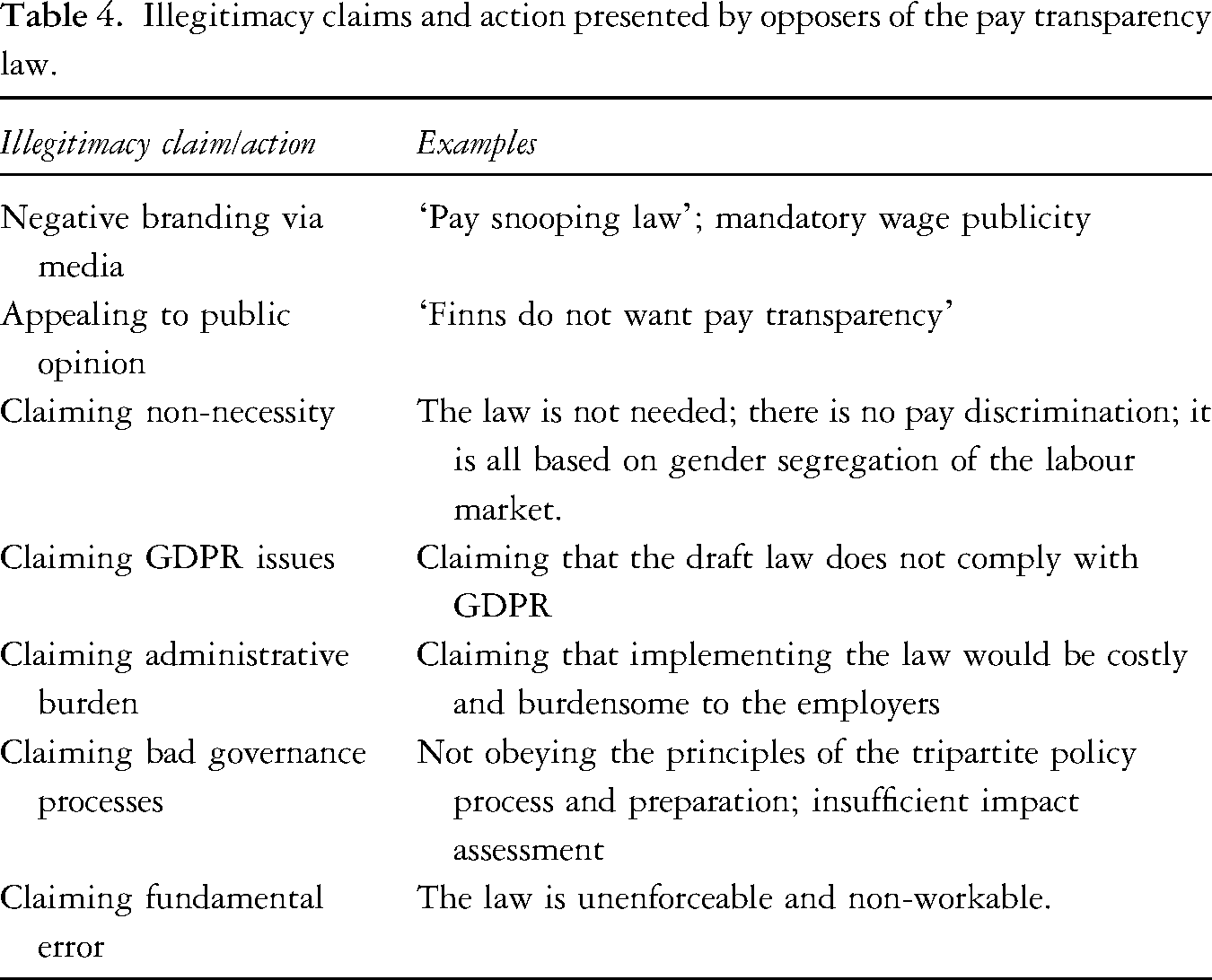
The discursive tactics used by opponents of the draft law primarily involved portraying the legislation and its preparatory process in a negative light. These tactics included attempts to sway public opinion against the law or asserting that public opinion was already opposed to it, often referencing media articles to support these claims. Such efforts began even before the formal policy process commenced. Opponents also argued that the law was unnecessary, contending that it was based on unwarranted assumptions, such as the existence of wage discrimination. This approach sought to undermine not only the draft law itself but also the underlying policy problem it aimed to address. Additionally, they asserted that the law was non-compliant with GDPR and claimed that it would impose an excessive administrative burden on employers. The legitimacy was also eroded by claims of bad governance by the Ministry of Social Affairs and Health, with the employer organisations claiming that the ministry had not followed the usual policy processes and rules or conducted proper impact assessments. The ultimate illegitimacy claim was to state that the law was unenforceable and that it could not be implemented because it had fundamental errors. All of these tactics constituted discursively conducted defensive institutional work and resistance towards the legislation via illegitimacy claims (e.g., Maguire and Hardy, 2009; Moisander et al., 2016). These efforts aimed to dismantle the policy process, erode its credibility and ultimately prevent the law's renewal and implementation.
Discussion and conclusion
This article analysed the discursive strategies used in support of, and especially in opposition to, Finland's proposed pay transparency law in 2022. The analysis focused on discursive tactics within a policy process characterised by divergent stakeholder interests, where formal participants of a policy process (employer organisations and business advocacy groups) actively opposed the policy objective. The study utilised the concept of institutional work, which encompasses actions aimed at creating, maintaining, or disrupting institutions (Lawrence and Suddaby, 2006; Maguire and Hardy, 2009; Moisander et al., 2016), alongside scholarship on agenda-setting and decision-making power and discourse analysis (e.g., Bachrach and Baratz, 1962, 1963; Fairclough, 2015). The institution targeted in this case was Finland's gender equality legislation, which was slated for amendment.
Legislative reforms must navigate numerous obstacles and are vulnerable to challenges at various stages of the policy process (e.g., Bergqvist et al., 2015; Koskinen Sandberg, 2016; Marchbank, 1994). Policy initiatives aimed at promoting equal pay are often contentious and perceived as threatening by certain stakeholders, making them particularly susceptible to resistance. Although disagreements among government parties ultimately derailed the proposed pay transparency reform, employer organisations and business advocacy groups may have played an important role in its collapse. Their lobbying efforts and strategic use of discursive institutional work effectively delegitimised the initiative in the eyes of both the public and policymakers.
Our findings show that all employer organisations and the business advocacy group, the Federation of Finnish Enterprises, opposed pay transparency in a clear, open and consistent manner. From the perspective of agenda-setting power and decision-making power (e.g., Bachrach and Baratz, 1962, 1963; Bonafont, 2024; Marchbank, 1994), these groups were unable to prevent pay transparency from being included on the political agenda during the left-green-centre government of Prime Minister Marin. However, they successfully influenced the decision-making process. In their discursive institutional work (Moisander et al., 2016) opposing the policy, the draft law was portrayed in highly negative terms through various claims of illegitimacy. Opponents frequently characterised the drafting process as exceptionally inadequate and unilateral.
Power is expressed not only through decision-making but also through the ability to limit and prevent decisions from being implemented (Bachrach and Baratz, 1963; Koskinen Sandberg, 2016; Marchbank, 1994), such as obstructing the enforcement of new legislation. Established connections between political parties and ideologically aligned lobbying organisations often provide such groups with informal access to policy processes. This dynamic is evident in the relationships between business lobbying groups and pro-business political parties, as well as between left-wing parties and trade unions. In this case, the institutional work of employer organisations and business advocates effectively resisted legislative change. The presence of central actors within policy processes who work against proposed reforms has significant implications: their influence can weaken legislation or even cause legislative initiatives to fail entirely. Weaker gender equality legislation undermines efforts to promote gender equality and combat wage discrimination, ultimately hindering societal progress toward equality. As the EU Directive on Pay Transparency is implemented in the coming years, similar patterns of resistance are likely to emerge. This highlights the importance of studying how key stakeholders interfere with or obstruct policy processes and understanding the broader consequences of these actions.
Footnotes
Acknowledgements
We would like to thank the editorial collective of Critical Social Policy for their constructive feedback and support.
Funding
The authors disclosed receipt of the following financial support for the research, authorship, and/or publication of this article: This work was supported by the Research Council of Finland, (grant number 361428).
