



Abstract
This article explores four Swedish municipalities which have reacted differently to legislation aiming to regulate a ‘fair and equal’ distribution of refugees: from barefaced rejection to the advocacy of refugee settlement as an investment in future citizens. Interviews with people who work with settlement show that housing is made central in different municipal strategies and creates an unequal landscape of evictability for refugees depending on where they are placed. Temporary and conditional residence permits for refugees, which have been made standard in this time of temporary legality, are simultaneously dependent on settlement strategies in municipalities: housing and access to jobs determine whether you can stay or stay with your family. This deportability of refugees is what is at stake. Yet access to housing is continuously treated as a mundane ‘service’: both in the categorical denial of housing and in the evaluation of what can qualify refugees to deserve settlement.
Introduction
Across Europe, temporary and conditional asylum protection has been increasingly used since 2015 (Schultz, 2022; Schultz and Kaytaz, 2021). Simultaneously, restrictive ‘integration’ requirements related to income, housing, language proficiency and ‘knowledge-of-society’ are imposed on refugees with temporary protection as thresholds to permanent residence, family reunification and citizenship. The exclusionary effects of these requirements (Pfirter et al., 2021), which also carry racialised logics of class, gender and culture (Bonjour and Duyvendak, 2018) make long-term possibilities for asylum protection difficult to attain. Critical debates in migration studies have generated knowledge of how these conditions structure segments of a society as deportable (De Genova, 2002) and the effects this has on how migrant populations are able to live their lives. In Sweden, the shift to temporary residence permits in July 2016 has made access to permanent status and family reunification dependent on proof of ‘self-sufficiency’, which is interpreted as having an income through employment and proper housing for your family. Since opportunities for housing and income are regulated at the municipal level, local regulations of welfare have become closely intertwined with immigration control. Migration studies have contributed important insights into the effects of multi-level governance, showing how integration policies have become increasingly local in their design and implementation. Studies have explained not only how cities implement practices of racial exclusion that counter national integration policy (Ambrosini, 2012) but also how they strive to offer sanctuaries for migrants (Darling and Bauder, 2019). Against this backdrop, sometimes referred to as ‘the local turn’ in migration studies (Zapata-Barrero et al., 2017), we explore local (municipal) differentiations of providing the welfare services needed for refugees’ settlement, where housing is often the most urgent as well as the most controversial issue. Our aim is to analyse how the difference in refugee settlement policies and practices produce, reproduce or mitigate ‘deportability’.
The Swedish welfare state system, known for its strong ambitions, is based on the principle of local self-government. Sweden's 290 municipalities are relatively independent in terms of planning and delivering welfare services, which produces local variations. This makes Sweden an interesting case for studying the increasing interplay of the local-level governance of welfare and integration services and immigration control. The Swedish government introduced the Settlement Act (SFS 2016: 38) in March 2016. All municipalities were thus obliged to accommodate refugees and offer them housing, language training and other welfare services. Municipalities have, however, developed very different local housing and settlement policies, ranging from temporary to permanent housing alternatives (Holmqvist et al., 2022). Consequently, local refugee settlement policy remains a discretionary space that enables municipalities to control possibilities for people to settle and stay on their municipal territories. In this article, we analyse refugee settlement policies and practices in four municipalities by interviewing ‘integration coordinators’, local politicians and non-governmental actors and by studying local policy documents and media coverage.
In the following section we discuss the introduction of temporary and conditional asylum in Sweden and how this has become linked to local-level settlement policies. We then discuss how the expansion of granting refugees temporary status, in tandem with certain conditions, produces deportability. By widening our understanding of deportability in relation to people with a temporary status we suggest that the notion of deportability should be examined in relation to policies and practices that have the power to reproduce or mitigate the condition of temporariness produced through temporary residence permit regimes. We then analyse how municipal refugee settlement policy and people who work with local refugee settlement in the four municipalities relate to the temporary status of refugees in how they interpret and implement settlement policies. Our contribution reveals how local settlement policies and practices affect conditions tied to deportability in different ways and thus create local forms of borders that regulate the actual possibilities for people with temporary status to remain – not only in specific municipalities but also in Sweden.
Temporary legality and refugee settlement policy in Sweden
Critical border studies have expanded the concept of border from a physical demarcation of a geographical entity – such as a nation-state – to how states attempt to govern the mobility of people within and beyond their territory (e.g., Mezzadra and Neilson, 2013). One form of bordering is the shift towards temporary legality, meaning the increasing use of temporary statuses (Chauvin et al., 2013; Kretsedemas, 2012; Rajkumar et al., 2012). Temporary and conditional residence permit systems have been used by European states since the early 2000s to control migration (Mansouri et al., 2009). A significant development in Northern and Western Europe, post-2015, is the use of temporary asylum protection not only for so-called ‘exceptional cases’ of group-based protection (such as for refugees fleeing the Balkan wars in the 1990s and the war on Ukraine since 2022) but also, increasingly, for individually assessed refugees (Schultz, 2022; Schultz and Kaytaz, 2021; Vedsted-Hansen, 2022). Alongside this shift to temporary asylum protection as the norm, family reunification has also been restricted or suspended for refugees in various countries, to further signal the idea that the presence of refugees is only temporary (Ataç, 2014; Bech et al., 2017; Kraler and Bonizzoni, 2010). Simultaneously, increasingly restrictive requirements related to income, housing, language proficiency, and ‘knowledge-of-society’ are imposed on refugees as thresholds to permanent residence permits, family reunification and citizenship (Bonjour and Duyvendak, 2018; Borevi et al., 2017).
Since July 2016, temporary residence permits of either 13 months or three years apply to refugees in Sweden, except to quota refugees resettled through the UNHCR, who are accorded permanent status. Before 2016, permanent residence permits had been the rule for decades. The new legislation detached permanent residence status from refugee protection grounds and tied it to work-related income requirements and employment. In many cases, family reunification requires certain levels of work-related income, as well as a home of a sufficient size and standard. A one-room flat is sufficient for a couple, but extra rooms are required for children. Only two children are allowed to share a room, which means that three rooms are required for a family with three to four children (Swedish Migration Agency, 2024). Additional requirements – such as language proficiency and a knowledge of ‘Swedish society’ – for the attainment of permanent status and citizenship are currently being processed (SOU 2021:2; 2023:25). Such requirements tied to residence permits thus function as a form of bordering inside the territorial border, which means that integration and settlement policies become enmeshed in immigration control.
Since 1994, Sweden's refugee settlement policy has been premised on the right of people seeking asylum to choose to find their own housing or to receive help to settle in a municipality. Both during the asylum process and after being granted protection (Borevi and Bengtsson, 2015). For those who cannot find housing on their own, the housing responsibility is divided between the state and the 290 municipalities. During the asylum process, adults and families are accommodated in state-run asylum centres under the responsibility of the Swedish Migrationsverket (hereafter ‘Migration Agency’). Those who are granted protection – the so-called ‘newly arrived refugees’ – and who are accommodated by the Migration Agency during the asylum process, are offered housing in a municipality through the Settlement Act introduced in 2016. The Settlement Act also includes ‘quota refugees’ resettled in Sweden through the UNHCR. ‘Unaccompanied children’ and refugees from Ukraine are also settled in a municipality during the asylum process or while holding temporary protection, under separate settlement policies. Although we focus on the Settlement Act and the ‘newly arrived refugees’ subject to this act, all forms of settlement are incorporated in the strategies and overall implications of refugee settlement in the municipalities.
Before the introduction of the Settlement Act, not all municipalities agreed to accommodate refugees, which resulted in long waiting periods for people looking to settle in a municipality. The idea behind the Settlement Act, which forces all municipalities to accommodate refugees, was to disperse refugee reception and to give better possibilities for ‘integration’ by allocating refugees to municipalities with good labour-market prospects (Government Bill 2015/16:54). The number of resettled persons allocated to each municipality is decided according to its population, labour-market prospects and total reception of refugees. Municipal housing supply is, however, not considered (Rogat, 2022), to prevent municipalities from using a lack of housing to avoid having to receive refugees. Nonetheless, in 2020, two out of three municipalities reported a shortage of housing for refugee settlement. The standard timeframe for housing is not stated in the Settlement Act and several municipalities limit their responsibility to two years. Municipalities therefore approach local refugee settlement differently, which becomes visible through local housing policies, ranging from permanent leases to temporary time-limited leases. About half of the municipalities, mainly those in metropolitan regions, offer only temporary contracts (Boverket, 2022). The practice of terminating leases after two years was appealed in October 2017 but was later deemed legal (Case No. 25142-17, 26 March 2018; Case No. 4155-18, 22 February 2019). The two-year limit is connected to the ‘introduction period’, which lasts for two years, during which ‘newly arrived refugees’ participate in a state-run introduction programme with the aim for them to learn Swedish and find a job as quickly as possible. Each municipality is financially compensated by the state during these first two years and refugees receive an introduction benefit from the state.
The effects of local differentiation in relation to the Settlement Act have been heavily discussed in Sweden, mostly in terms of how it affects relations between municipalities. It has become commonplace in the new landscape of refugee settlement to talk about ‘social dumping’ as a way of illustrating how the figurative dumping of people – who are deemed to be a social cost – across a municipal border sometimes appears as a political and economic strategy (Jansson, 2019). To illustrate this, we use an excerpt from an in-depth Swedish media coverage of this phenomenon, by the magazine Hem & Hyra (Eriksson, 2020): They escaped from Afghanistan and came to Sweden in 2015. During the first three years they moved from town to town, from north to south – Malmö, Lycksele, Vännäs. And south again. To Sigtuna municipality, just outside Stockholm. The family felt that they could finally make a home for themselves and started building a new life. ‘We went to school, Mum studied Swedish and Dad got a job as a janitor’, the son […] says. However, the contract for the apartment was a short-term contract and limited to two years. They had to find a new flat. […] ‘The municipality said that they arranged housing for us in Kramfors [a rural northern municipality] instead and that we were moving there. We didn’t want to but what could we do? It didn’t feel like we had a choice’.
Bordering across municipalities and the state: deportability and evictability
Over the last decade, migration scholars have observed how integration policy and asylum are increasingly decentralised (Glick Schiller and Çağlar, 2009; Glorius and Doomernik, 2020). This opens new policy areas up to local interpretation, which both creates specific differences between municipalities (Bak Jorgensen, 2012) and presents challenges for multi-level governance and congruent policy (Scholten, 2013). Some municipalities interpret integration policies pragmatically, depending on the social and economic challenges and opportunities they face (Garcés-Mascareñas and Gebhardt, 2020), which may also speak back to economic policy and fiscal discipline guiding state budgets and migrant scepticism (Hansen, 2021). Yet, the geographies of refugee reception are heavily polarised (Ambrosini et al., 2019) and the local level plays an important role in contemporary bordering.
Bordering practices may have the effect of creating a threat of deportation, which functions as a state power to build up a pool of deportable migrants who are politically docile and economically exploitable (De Genova, 2002). The concept of deportability (De Genova, 2013) has been developed in relation to the transformation of modern-day deportation from a measure of exception into a normalised practice of immigration control (Walters, 2002). While the legal bases and technologies for large-scale deportation have developed since the 1980s and the number of deportations has escalated since the early 2000s, most of those rendered deportable never actually get removed. The notion of deportability is thus understood as ‘the possibility of being removed from the space of the nation-state’ (De Genova, 2002: 439). Studies on deportability often illustrate the experiences of irregularised populations who face a constant fear of being apprehended during internal border checks (e.g., De Genova and Peutz, 2010). Different empirical studies, however, suggest that migration policy tends to place migrants on a deportability continuum (Hallett, 2014; Kubal, 2013).
Van Baar (2016) argues that the notion of deportability fails to grasp other processes of displacement inherent to the intra-state logic of eviction that target certain groups. By introducing the concept of ‘evictability’, he intends to delineate the continuities between processes of displacements that take place inside the nation-state and expulsions from the nation-state (see also Lind, 2020; Persdotter, 2019). Practices that produce threats of eviction (rather than deportation) – including processes of gentrification and segregation – might have similar effects on those who are legally ‘citizens’ but are seen as internal ‘dangers’ to the state and its welfare system: Roma, muslims, homeless people and other minoritised populations within the EU who are continuously forced to move, are expelled or are displaced, within both a single nation-state territory and the EU. The notion of evictability thus refers to ‘the possibility of being removed from a sheltering place’ (Van Baar, 2016: 214) and, according to van Baar, de-nationalises the notion of deportability by refraining from taking the nation-state for granted as a methodological entity of enquiry when analysing mobilities and expulsions. Returning to the reportage above of the family who was forced to move in Sweden, we see indications that evictability structures their experiences of ‘settlement’. However, while van Baar suggests ‘forgetting’ about the nation-state in the concept of deportability by using the concept of evictability, we suggest that these processes – controlled at different scale levels – are studied in tandem when exploring how welfare states relate to people in temporary legality.
There is no immediate threat of deportation for people with a temporary status – yet there are specific circumstances of settlement and housing that may reinforce or prolong the threat of deportation. For our empirical case, evictability helps in refining and delineating the multiple policies and practices, at different scales of government, that are involved in controlling migrant populations with different status insecurities in the welfare state of Sweden. We suggest that the notion of deportability should be examined in relation to practices and policies that negotiate the meaning of being under temporary protection: from being potentially long-term members of a community to being excluded from all forms of future plans. A lack of the ‘right’ type of housing and income is made central to people's lives when they are subjected to migration policy that keeps parents, children and lovers separated for indefinite periods of time. Between July 2016 and December 2023, 43,460 applications for family reunification were rejected due to the income and housing requirements. This number includes rejections for reunification with a family member residing in Sweden with different types of residence status, including work and study permits, asylum protection status and Swedish citizens. Specific statistics on rejections of reunification with a person holding a temporary permit based on asylum protection grounds are, however, not accessible (Swedish Migration Agency, 5 February 2024, personal correspondence). Furthermore, families with many children must choose which of their children to take to Sweden, if they are unable to afford or find a large enough apartment (Dahl, 2021). In the case of children being close to the age of 18, the passing of time might also result in them ‘ageing out’, becoming ‘adults’, thus lacking the legal right to be reunited with their parents. The requirements tied to family reunification are not only detrimental for the general well-being of refugees (Gustafsson, 2022) but also function as a migration control instrument – to prevent family members from entering and to push those with temporary status to leave – in what has been described as self-deportation (Park, 2019). Such requirements thus prevent, obstruct or delay long-term membership and should therefore be understood as an important aspect of the indefinite and continuous state of deportability that people in temporary legality are facing. When we observe evictability processes as part of deportability, we enable an analysis of how local settlement policies and practices affect conditions tied to deportability, including prospects for family reunification. As shown in Figure 1, while evictability and deportability derive from different scales of governance and policies with different motivations, nonetheless they intersect in the lives of those with temporary legality. Focusing on only one of them does not suffice for understanding the current condition of temporary legality. Analysing the ways evictability and deportability intersect and create borders across various scales thus reveals actual possibilities for people in temporary legality to remain.
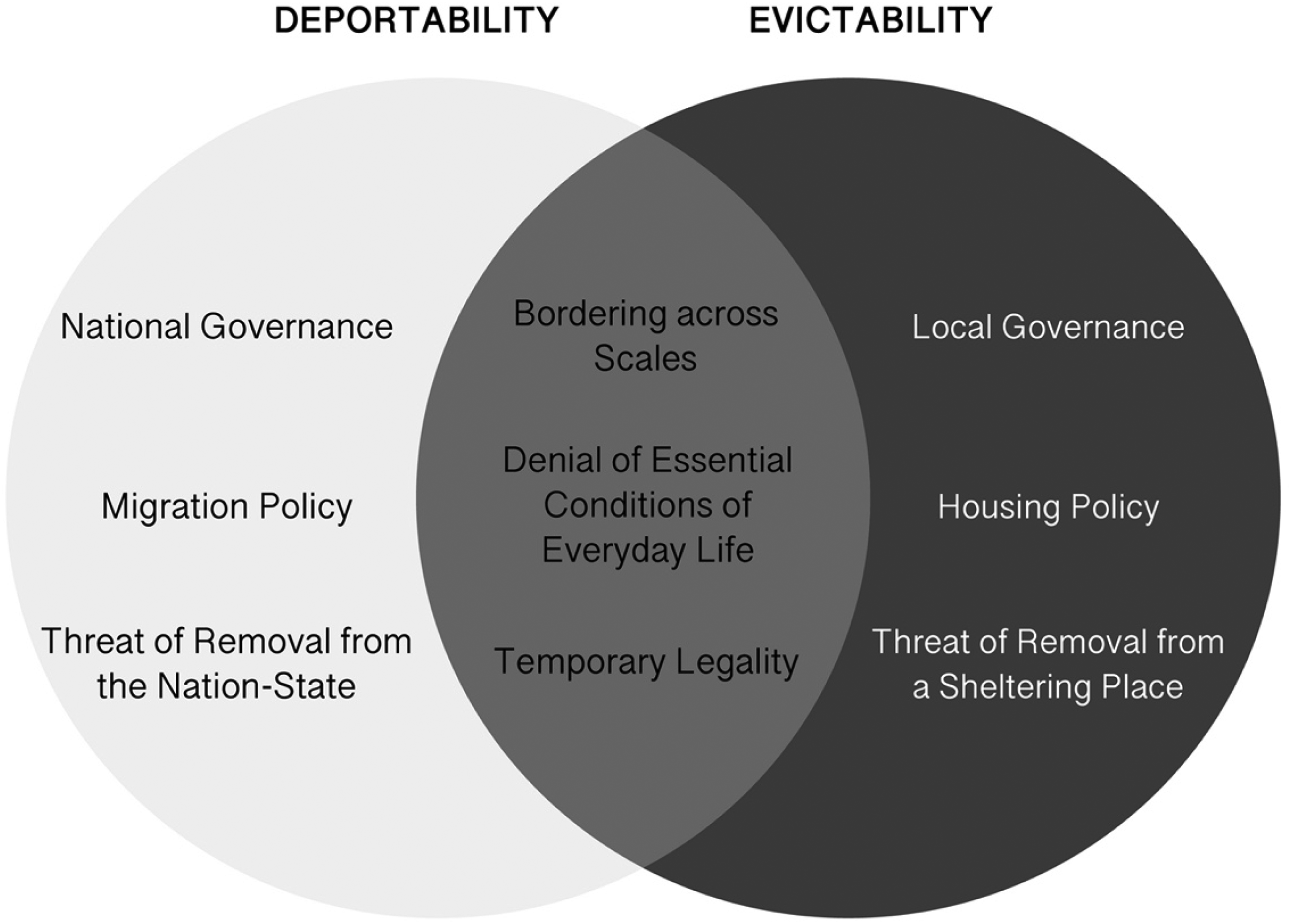
Deportability, evictability and how they intersect under temporary legality.
Studying the four municipalities
The Settlement Act has produced new understandings of spatial differentiation in Sweden, revealing uneven conditions across municipalities (Emilsson and Öberg, 2022; Grange and Björling, 2020; Holmqvist et al., 2022). Swedish municipalities can consist of an urban area, part of a big city or of a rural region and differ in terms of population, labour and housing market conditions, etc. Municipalities with the most favourable housing policies are scattered across the country, while the most restrictive are concentrated around the three metropolitan areas of Stockholm, Gothenburg and Malmö (Holmqvist et al., 2022). Paradoxically, housing for refugees is limited in metropolitan areas, where the prospects for finding work are significantly better. Small cities or rural regions can also provide employment – however, mainly in jobs that do not require higher education (Vogiazides and Mondani, 2020).
The four municipalities in our study are selected to illustrate these differences: North Town and South Town provide only temporary housing and are situated in the more-restrictive metropolitan areas. East Town and West Town offer permanent housing and are situated in the hinterland of mid-south Sweden where housing policies vary. While there is a certain tendency towards a geographical pattern of housing policy type, there are no direct correlations between political leadership and housing policy (Holmqvist et al., 2022). The municipalities in our study illustrate this, since South Town – with the most restrictive housing policy – has a conservative–right majority, whereas North Town – which also has a restrictive housing policy – is led by a centre–social democratic coalition. West Town – with the most generous housing and reception policy – is a centre–right coalition, while East Town – the other municipality with long-term contracts – is a centre–social democratic coalition (see Figure 2 for a contextual overview). As the municipalities are chosen to illustrate different local policies and practices, they are to be understood as ‘typologies’ rather than as providing an in-depth analysis of local context. We have therefore chosen to anonymise the municipalities in order to direct the reader to the municipal practices rather than to specific municipalities.
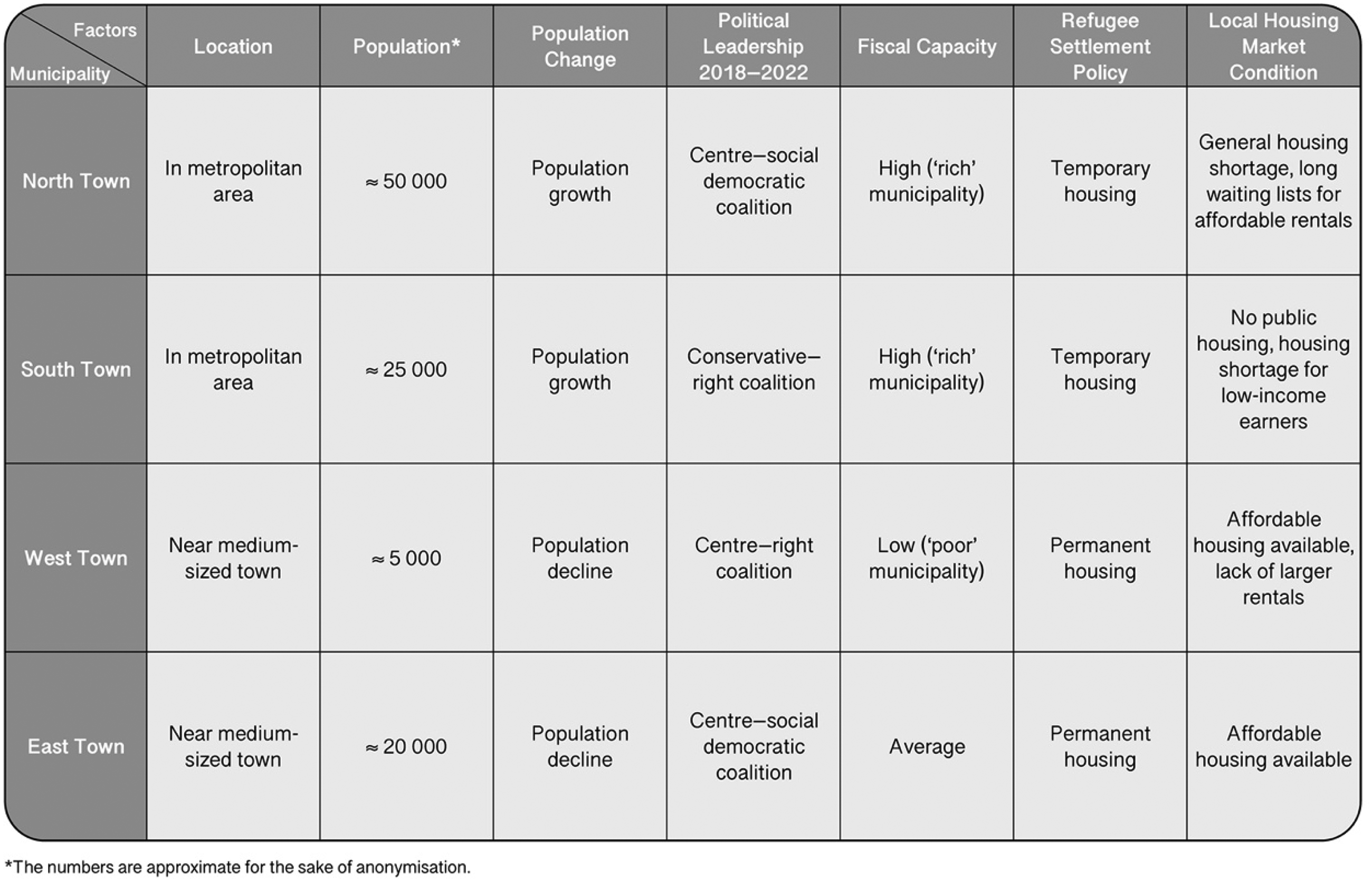
A contextual overview of the four municipalities.
In total, we interviewed 10 people during the spring of 2021 and the fall of 2022. In all four municipalities we interviewed actors holding the position of ‘integration coordinator’ or a similar position. Their role is to facilitate settlement and ‘integration’ from the municipality's perspective. Their tasks differ between municipalities and, even if some of them partly shape the municipal engagement with settlement, their roles also reflect local politics of refugee settlement. At each location we also interviewed one local politician involved in the process of implementation of the Settlement Act. Additionally, we interviewed one person who was active within the local civil-society network engaged in giving support to those settled in South Town and one person involved in a local activist group fighting evictions in North Town. As the study focuses on municipal practices, interviews with people affected were not included. Thus, the experiences of refugees are only present in the material through the perspectives of the interviewees, which is a limitation. The analyses also rely on policy documents, reports and media coverage related to the Settlement Act. All interviewees have given their recorded oral or written consent and the research was approved by the Swedish Ethical Review Authority as of 4 September 2019 (Reg. no. 2019-04038). In the following section we analyse the four municipalities in relation to how their refugee settlement policies and practices produce, reproduce or mitigate deportability for people with temporary status. A summary is provided in Figure 3 at the end.
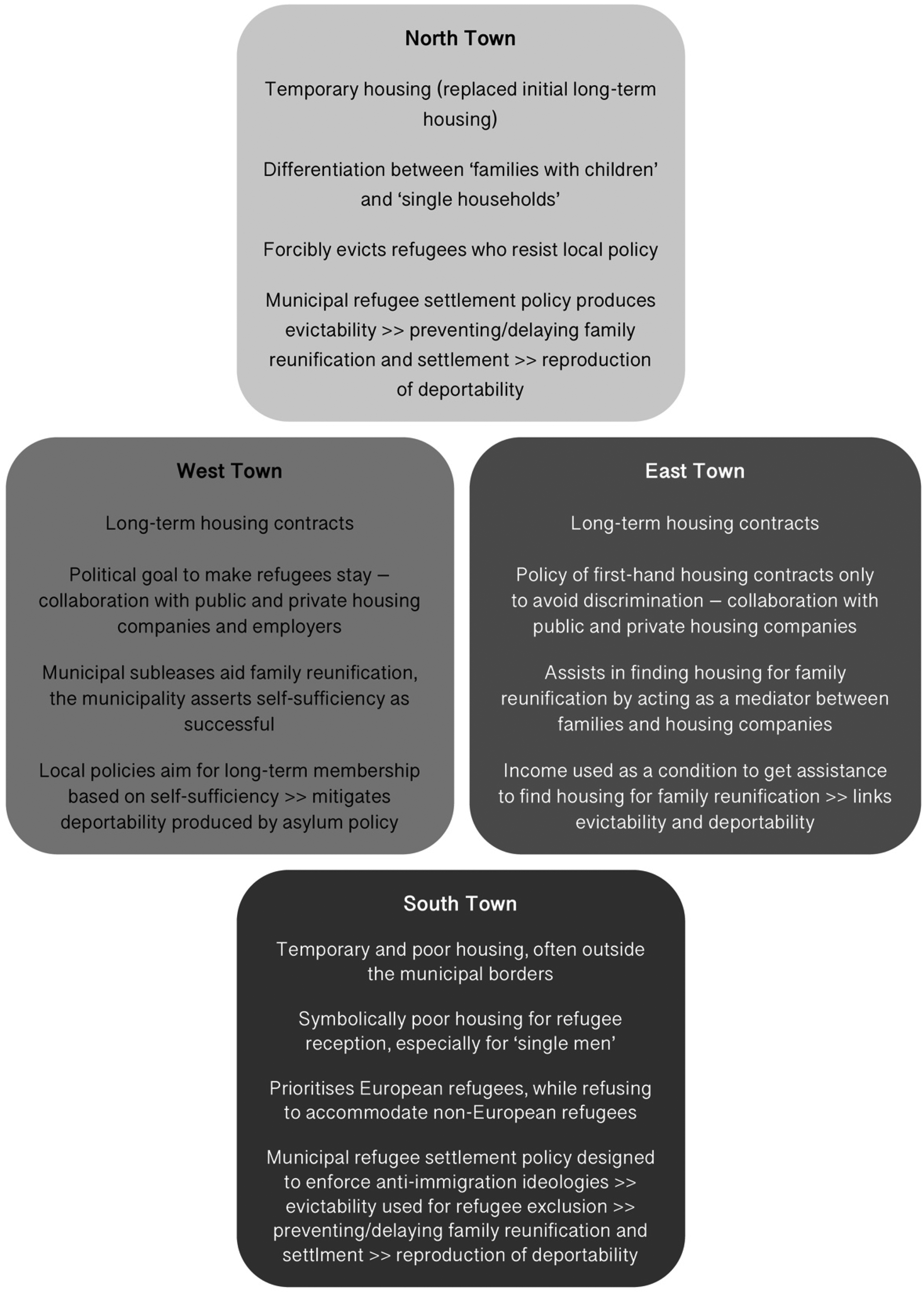
An overview of the settlement policies and practices in the four municipalities.
Evictability as a living condition in South Town and North Town
Before the introduction of the Settlement Act in March 2016, South Town did not have any organised refugee reception and few people chose self-settlement there. Rental housing had been downsized and the municipality's public housing company was sold in 2012, making it difficult for a range of socially and economically disadvantaged groups to find affordable housing (Local politician, 19 February 2021). The lack of rental and public housing aided South Town to find ways to circumvent the Settlement Act, initially by not providing housing at all. In 2016, a majority of the 99 refugees who were ‘assigned’ to South Town had to wait at the Migration Agency's accommodation centres for up to a year before the municipality, reluctantly, provided housing solutions. The housing alternatives offered were symbolically poor. Caravans, without toilets and running water, were provided next to a dumpster area on the outskirts of the main city. The caravans were shared by two ‘single’ men, while families with children were either accommodated in repurposed horseboxes, in temporary emergency shelters in neighbouring municipalities provided by social services or in somewhat more stable housing solutions, however temporary. South Town's general housing policies, which structurally prevent certain people from settling there, in combination with reception practices directly aimed at people who are subject to the Settlement Act, demonstrate an unwillingness to accommodate refugees, making it nearly impossible for them to remain in the municipality. By limiting access to housing and refusing to provide more long-term possibilities in terms of length of contracts and bearable living conditions, the municipality deliberately made these people evictable. As critically expressed by one of the integration coordinators in an interview on 20 January 2021: First, I think, the tactic was to not accommodate people at all. To keep people at the Migration Agency's reception centres for as long as possible. And then, when they arrived here, to create solutions as poor as possible, so that they move along quickly. That is what happened in these caravans – not many stayed there for a long time. It became a sort of transit.
In October 2020, the mayor of South Town was asked what he thought about the municipality having the lowest number of refugees who had arrived in 2015 residing there, whereby he replied: ‘I think it's good since they are overrepresented in social costs’ (News article, October 2020). Depicting (non-European) refugees as a ‘cost’ unveils the idea behind the inter-municipal practice of ‘social dumping’, which becomes a rationale for the production of evictability. In the spring of 2022, South Town once again refused to accommodate refugees, this time specifically targeting ‘quota refugees’. While South Town refused to accommodate 36 quota refugees, the mayor wanted to prioritise Ukrainian refugees, arguing that ‘[quota refugees] are extremely difficult to integrate in Swedish society’ (News article, February 2022). The separation between different groups of refugees indicates a dimension of racialisation in South Town's attitude towards settlement. Despite the Settlement Act's mandatory liability of refugee reception, the Migration Agency decided to settle the families elsewhere in order to guarantee a better reception for them. South Town's reaction in response to the Settlement Act illustrates how refugee settlement has become a battleground for the principle of local self-government. While the Settlement Act has enabled the state to decide that South Town has to accommodate refugees and how many, the state has little possibility to interfere in how they are accommodated. The politically structured evictability of refugees in South Town can be understood as a tool with which to protest against the national refugee policy.
North Town initially chose a different approach and provided housing on a long-term basis, mainly as subleases through the municipality's public housing company. North Town thus used its public housing company to solve the ‘housing issue’. However, in October 2016, about six months after the Settlement Act took effect, North Town, along with other municipalities that wanted to minimise their housing responsibilities, decided to limit these housing contracts to two years. This eviction practice was, as mentioned, deemed legal more than a year later. Since the waiting period for first-hand housing contracts is 8–12 years in the metropolitan area of North Town, people argued that they had no chance of finding affordable housing. With a low-income job, it is difficult to afford the precarious housing options available and studying becomes nearly impossible. They would thus be forced to leave the municipality and to start all over again somewhere else (statements from people threatened with eviction published on a local activist group's website). If staying in North Town, they would be pushed into homelessness or, at best, into a precarious racialised housing market where subleases through private individuals – which are expensive, short-term and often illegal – are usually the only option (Activist, 18 September 2020; Integration coordinator, 3 March 2021).
The integration coordinator in North Town explained that the ‘reception team’ raised concerns about these difficulties of time-limited contracts with local politicians: Yes, we had a discussion, we weren’t satisfied with two years. There is such a difference depending on how resourceful you are. The requirements are very high. To complete language studies, find a job – it is impossible to do it within two years. It creates stress: as soon as you move in you have to start thinking about moving out; it becomes impossible to focus.
In 2018, North Town's newly elected local government introduced possibilities for the extension of rental contracts for up to four years, in response to the tenants’ continuous resistance to the two-year rental policy. However, while families with children were automatically given extensions, ‘single households’ had to apply, in most cases leading to the denial of extensions (Integration coordinator, 3 March 2021). Some of these ‘single households’ were, however, struggling to reunite with their partners and children. According to the integration coordinator, family reunification did not qualify as a reason for extension, unless the reunification was scheduled to happen in the next couple of months. This practice creates an administrative border (Könönen, 2018), since the Migration Agency requires a housing contract before deciding on the matter – a process which takes months or even years due to a combination of bureaucratically induced waiting processes (Gustafsson, 2022). Temporary access to housing and disqualification from extensions may thus disrupt or prolong family reunification. A change of employment or employer, for example due to moving, can be interpreted as a person lacking a stable income and might result in a rejection of the application for reunification (Häckner Posse, 2019). Furthermore, apart from the risk of children ‘ageing out’ and thus becoming ineligible for family reunification, Leinonen and Pellander (2020) have shown that a delay can lead to a negative decision, as the length of separation from the family can be interpreted as an interruption of family ties. As the parenthood of those waiting to reunite with their families was misrecognised by North Town, they were rendered ‘single’ and thus less deserving of continued shelter. Similarly, in South Town, ‘single men’ were assigned poor and temporary housing. Paradoxically, by lacking a home that qualifies for family reunification, their parenthood is further hindered for an indefinite period of time.
As of February 2021, 66 households settled through the Settlement Act were currently residing in North Town; of these, 17 households had been formally notified of eviction and 15 cases were due in court, including families with children (Memo North Town, 22 February 2021). Those who eventually lost in the court proceedings were not only forced to leave but had to bear the municipality's legal costs (Local activist, 18 September 2020). The initial approach of facilitating housing for refugees hence changed into a bureaucratically violent eviction process, whereby all were forcibly evicted by the municipality. As opposed to South Town, the actions of North Town are not premised on a municipal opposition to the national regulation of refugee settlement as such. Instead, evictability is explained in relation to a strained housing market and thus made into an administratively viable way of handling the ‘housing issue’, disregarding the specific effects this has for people with a temporary status.
Deservingness and self-sufficiency in East Town and West Town
East Town was described by our interviewees as a town where there are both jobs and housing for refugees. The municipality prides itself in always taking responsibility for refugee settlement, in contrast to other municipalities in the region, which use time-limited contracts or other measures that force refugees to seek housing elsewhere (Mayor, 14 October 2022; Integration coordinator, 16 September 2022). The integration coordinator emphasised their policy of first-hand housing contracts. It is common that municipalities act as guarantors, she explained, by subletting apartments to ‘newly arrived refugees’, because otherwise the housing companies would not release apartments for refugee settlement. Such ‘social contracts’, she explained, are usually used for individuals who have lost their rental possibilities due to repeated payment failures or misconduct. The aim of convincing housing companies to provide first-hand contracts was hence to bypass any reproduction of the negative stereotyping of refugees in East Town. Such an active involvement could, furthermore, help in solving the problems that arise for families under these conditions – for instance, the trajectory of accessing a larger apartment necessary for family reunification: If we call the housing companies and explain the family's situation, they will help. We have a pretty good collaboration and it's like … usually if there are situations like this, we can book an appointment with the housing company and the individual and we can sort of … then we can explain, because the housing company does not always understand this, this connection. Then we can function as an intermediary and explain the situation (Integration coordinator, 16 September 2022).
Subleases in East Town may be thought of as problematic because they risked labelling refugees as less worthy but there were also other standards to which the municipality adhered. Having an income was presented as a central precondition, as revealed in this interview of 16 September 2022: Interviewer: Have you encountered the connection between residence permits, work and housing? Integration coordinator: Yes, we have met people who have not been allowed to be reunited with their family because they have no income and, because of that, they do not have the right apartment either. However, we cannot do anything about that. It must be up to the individual. On the other hand, we have seen that many who want to be reunited with their families have found a job… What we have seen in [East Town] is a positive development – that they have worked harder to get an income to bring their family here. […] If they have an income, then we will help with housing, so that they can bring their family here.
In contrast to the other three municipalities, West Town's Integration and Labour Market Department had an explicit political goal to make (at least) half of all refugees stay, by creating housing and job opportunities in collaboration with private and public housing companies and employers (Steering document, Integration and Labour Market Department, 2023–2026). The mayor of West Town told us that ‘the municipality has survived thanks to refugee reception’ (interview, 15 September 2022), emphasising the positive effects of tax revenues and state funding related to refugee reception. While encouraging refugees to stay in the municipality, their economic self-sufficiency was emphasised: The core issues for the politicians are the population level, that we facilitate people settling here […] and that they become self-sufficient and not become a burden for the municipality (Head of Integration and Labour Market Department, 2 September 2022).
The political goal to make people remain translates into quite different policies and practices compared to municipalities that want to get rid of people. This can be illustrated by the practice of aiding family reunification, where West Town acted as a guarantor and sublet apartments to families and, later, where the lease was transferred to the families as a first-hand contract. The Head of Department described this as important, especially if there were children in the family. The housing market was less strained in West Town compared to metropolitan municipalities. The challenge was, instead, to find larger rental apartments that met the needs of low-income families (with or without a refugee background). She explained that the municipality was working on a housing policy programme to push private contractors to invest in larger rental apartments to meet the real demands of their inhabitants. Refugee reception in West Town is an illustrative example of alternative ways of thinking about the settlement of refugees as long-term members of a community, rather than being evictable and unwanted. When asked whether residents have problems qualifying for permanent residence, the Head of Department (2 September 2022) replied that ‘We have had a few isolated cases but, since we have such a high employment rate, it has sort of become a non-issue for us. After all, no one is unemployed after five years in [West Town]’.
Settlement practices in West Town resisted the temporariness that permeates asylum law by aiming for people to become long-term community members. The political goal of making people stay mirrors efforts to actively support families being able to live together and to develop local labour-market strategies to promote ‘self-sufficiency’, which also increases the possibility for refugees to qualify for a less-precarious legal status. Nonetheless, the municipal policies and practices in both East and West Town aligned to but also produced local interpretations of the ideas behind temporary legality, where self-sufficiency is a condition for membership.
Concluding discussion
In this article we have placed the condition of temporary legality at the centre of an analysis of how different Swedish municipalities work with or against the settlement of refugees. This has allowed us to put the regulations of welfare services, such as provision of housing, in conversation with what it means to be deportable in the eyes of both the state and the local authorities. When temporary legality is cemented in migration policy – for instance when residence permits are short-term – it is not necessarily an act of protest or defiance when municipalities interpret their housing responsibilities as being only temporary. However, municipalities’ rejection of responsibility makes visible the fact that temporary legality has actual effects on people's lives and that refugees continue to be de facto deportable if they are unable to meet the ‘self-sufficiency’ requirements. Similarly, although some municipalities actively want to keep refugees in their communities, their work is structured by the ‘paradigm of temporary legality’ (Kretsedemas, 2012). To keep welcoming refugees, these municipalities need to mitigate the temporariness induced by migration policy, by considering the lived experiences and effects of temporary residency. It is only when we include other life conditions, such as family life, that we can fully see how the municipal practices of housing and settlement structures deportability, even in these accommodating municipalities.
The specific conditionality of family reunification in Sweden prompts us to revisit deportability as a concept that captures the threat under which people with temporary protection live. We argue that the function of family reunification as a ‘reward’ for economic contribution is a violent neglect of what is at stake. In several municipalities, separation from family members is treated as a mundane matter, not as a racially structured harm facing people in temporary legality (see also Gash and Yamin, 2019). Municipalities that imagine refugees as future citizens express concern and interest in their possibilities to remain, together with loved ones, although they do so in different ways. Municipalities that have no interest in facilitating the settlement of refugees do not reflect on how locally produced processes of evictability may cause separation and a protracted form of deportability.
The right-wing coalition government elected in 2022 in Sweden wants to remove permanent residence status completely, which includes the possibility to revoke or downgrade permanent status for those currently holding it and to make the threshold from temporary status to citizenship even more difficult (Tidö Agreement, 2022). This article only provides a small contribution to what it could mean in the future if models of ‘civic integration’ (Bonjour and Duyvendak, 2018) and ‘welfare for work’ (workfare), which characterise both East Town and West Town, are abandoned in favour of a system whereby moving beyond temporality and conditionality is actively prevented, as in North Town and South Town. The question thus arises as to how municipalities will, in the future, be able to imagine refugees as long-term citizens.
Footnotes
Acknowledgements
The authors would like to thank the individuals interviewed and the activist group in North Town for their time, experiences and knowledge. Leti Volpp and Amin Parsa provided valuable feedback on early versions of the manuscript and Rebecka Söderberg provided supportive comments on a late version of the manuscript. We would finally like to thank the editorial team at Critical Social Policy for their pertinent and thorough feedback. Sofi Jansson-Keshavarz is the lead author of the manuscript.
Funding
The authors disclosed receipt of the following financial support for the research, authorship, and/or publication of this article: This work was supported by the Swedish Research Council (grant number 2019-00689); the Centre for Local Government Studies, Linköping University; Gunvor och Josef Anérs stiftelse; and Helge Ax:son Johnsons stiftelse.