




Abstract
In 2012, Home Secretary Theresa May told a newspaper that she wanted to create a ‘really hostile environment’ for irregular migrants in the UK. Although the phrase has since mutated to refer to generalised state-led marginalisation of immigrants, this article argues that the hostile environment is a specific policy approach, and one with profound significance for the UK’s border practices. We trace the ‘hostile environment’ phrase, exposing its origins in other policy realms, charting its evolution into immigration, identifying the key components and critically reviewing the corresponding legislation. The article analyses the impact and consequences of the hostile environment, appraising the costs to public health and safety, the public purse, individual vulnerability and marginalisation, and wider social relations. We conclude by identifying the fundamental flaws of the policy approach, arguing that they led to the 2018 Windrush scandal and risk creating similar problems for European Economic Area nationals after Brexit.
Introduction
From indefinite immigration detention to the controversially-high income threshold for sponsoring a foreign spouse, the UK has notoriously harsh immigration policies. These policies became particularly exclusionary and punitive during the early years of the 21st century; feeding-into and fed-by high levels of public and media concern over immigration. Theresa May became Home Secretary in 2010 and was responsible for implementing the infamous commitment to reduce net migration to the ‘tens of thousands’. This pledge – unwise and evidently unachievable – has coloured subsequent immigration policy development, with May introducing a stream of policy changes seeking to reduce arrivals of migrants and increase removals. It was within this maelstrom of new policies that May gave a newspaper interview in 2012 announcing the introduction of a ‘really hostile environment for illegal migration’ (Kirkup and Winnett, 2012).
The ‘hostile environment’ is difficult to pin down. Unlike most major policy reforms, no White Paper presaged its introduction. There is no central policy document, no official definition nor clear aims and objectives. The policies are spread across various Immigration Acts, rules and regulations and affect numerous sectors and policy arenas. The term’s meaning is also shifting, expanding in academic and media discourses to refer to a general stance of nastiness towards migrants. We argue that this linguistic slippage obscures a policy approach that is much more specific and significant. The hostile environment heralded a step-change expansion of everyday borders that is unprecedented in the UK in its scale, scope and speed. This article offers a definition of the hostile environment that identifies its most pertinent components by tracing the policy origins and evolutions, and critically reviewing the services and sectors that we identify as (currently) constituting the strategy. The article then critically appraises the policy strategy’s success and outcomes, including impacts to individuals and society. We conclude by identifying the core and underlying problems of the hostile environment, demonstrating their role in the Windrush scandal 2018 and potential for a repeat after Brexit.
Origins
In her 2012 newspaper interview announcing the hostile environment, May claimed that foreign nationals believe ‘that they can come here and overstay because they’re able to access everything they need’ (Kirkup and Winnett, 2012). As part of a wider commitment to slash immigration figures, May described a new approach intended to dissuade illegal residence in the UK by preventing people from accessing basic services. It meant the diffusion of national borders and their enforcement away from the external edges of the polity and sole hands of trained state officials, into everyday spaces within the interior of state territories, requiring migrants to prove frequently their right to reside during everyday life (Balibar, 2004; Johnson and Jones, 2016), including through the ‘biometric borders’ of databases and algorithms (Amoore, 2006; Lyon, 2009). With negligible numbers of immigration offences actually prosecuted (just 500–600 each year, with convictions even lower (Aliverti, 2016)), and numbers of forced removals declining each year, it was tacit recognition of the limits of direct governmental immigration enforcement and the decision to significantly broaden responsibility for UK border controls.
Over the last few decades, several countries have pursued polices that bring local government officials, public servants, police officers, private companies and even ‘ordinary people’ into controlling migration. Such processes of ‘devolution’ (Coleman, 2009; Lahav, 1998) or ‘vernacularisation’ (Cooper et al., 2016) of immigration enforcement have a relatively long history in the USA but a more recent and slow-paced development in the UK (Flynn, 2005; Yuval-Davis et al., 2019). This article uses the term ‘deputisation’ to describe the co-opting of organisations and people as de facto immigration officers (Walsh, 2013, 2014), a concept that has also been used in the context of the expanding USA criminal justice system (Wilson Gilmore, 2007). Through deputisation, a medley of actors are made ‘street level bureaucrats’ (Lipsky, 1980), responsible for enacting – and interpreting – immigration policy on the ground.
In creating the hostile environment, Ministers introduced policy changes that dramatically diffused the immigration system across the breadth of society. The striking ambition for the scope of the hostile environment is illustrated by the range of government departments brought together after May’s interview to assess the rules on migrants’ access to work and services. Members of this ‘Hostile Environment Working Group’ included the Ministers of State for Immigration, Government Policy, Foreign and Commonwealth Affairs, Justice, Employment, Housing and Local Government, Schools, Care Services, Universities and Science, as well as the Parliamentary Under-Secretary of States for Health and for Transport, and the Exchequer Secretary to the Treasury (ICIBI, 2016a: 4.2).
As part of a superficial rebrand, the working group was later renamed the more anodyne ‘Inter-Ministerial Group on Migrants’ Access to Benefits and Public Services’, and the whole approach is now usually officially referred to as ‘the compliant environment.’ The ‘hostile environment’ terminology, however, is extremely important, and not only for openly acknowledging the UK’s punitive approach to migration management. The phrase is a recent addition to migration policy parlance and strongly attributed to Theresa May, although a passing reference was made by the previous, Labour, government a couple of years earlier in an immigration white paper (UKBA, 2010). The ‘hostile environment’ phrase has a longer history elsewhere in the Home Office, where it originally referred to dangerous overseas locations, used for example in government guidance for journalists working in warzones. After 9/11, the term was primarily used to refer to the disruption of ‘soft’ support and funding for terrorism and serious and organised crime, for example by requiring banks to carry out regulatory checks on customers (e.g. Home Office, 2004).
Appropriating a phrase that was previously only used to refer to warfare, terrorists and serious criminals (and still continues to be used in these contexts, see Hansard, 2015, 2017a), May extended a policy approach from one Home Office team (Organised Crime and Counter Terrorism), to another (Borders and Immigration). By so doing, she fed the delegitimisation, criminalisation and securitisation of mobility, as well as fundamentally altering the UK’s border practices.
Defining the UK’s hostile environment for migrants
The UK’s immigration system developed directly out of the collapse of the British Empire and reflected a political drive to control the entry of racialised and dispossessed former colonial peoples (El-Enany, 2020). It has long been characterised by restrictive policies, absurdly complex and ever-changing Immigration Rules, harsh and arbitrary decision-making, criminalisation of mobility and indefinite immigration detention (Goodfellow, 2019). Political rhetoric and policy-making on immigration has become especially harsh in recent years (Goodfellow, 2019; Yeo, 2020). Some of May’s other initiatives, for example, included Operation Nexus (under which people are deported as ‘foreign criminals’ on the basis of police contact rather than conviction (Griffiths, 2017)), and Operation Vaken, under which vans with ‘Go home or face arrest’ billboard messages were driven around ethnically-diverse London boroughs, adverts placed in minority ethnic newspapers, and immigration enforcement vehicles re-branded to resemble police cars (Jones et al., 2017)).
Although journalists, politicians and academics often use the hostile environment label to refer to broadly marginalising, criminalising and punitive policies and practices, we argue that the hostile environment for migrants is more than just hostile policies. May’s conceptualisation does not exist in a White Paper nor central policy document, but we can infer a definition from its origins and evolution. It is made up of multiple components which are spread across sectors and operate independently, but that share core characteristics and function cumulatively to produce a specific and holistic policy strategy. We argue that the defining feature of May’s hostile environment for migrants is the ‘deputisation’ of border enforcement to third parties. Giving non-state actors responsibility for state functions is also seen in the hostile environment for terrorists and serious criminals, but in an immigration context those co-opted are not just in financial services. A sweeping range of public servants, agencies, companies, private organisations and members of the public are now obliged to check people’s immigration status and enforce immigration-related restrictions. The significance of these policy developments for redrawing UK border practices and social relations risk being lost by loose use of the ‘hostile environment’ phrase to refer to generalised state hostility.
Precursors to the hostile environment for migrants
Specific aspects of the immigration system, notably enforcement activities such as immigration detention, have been ‘outsourced’ to large multinational security companies for several decades. Securicor, for example, was contracted to operate the first detention centre, Harmondsworth, in 1970. Until very recently, however, most of the immigration system has been directly controlled by the Home Office, with just a small number of other state actors involved. Local Authorities, for example, have checked immigration status in relation to welfare benefits and social housing since the 1990s. Private, non-state actors were brought in by the Immigration (Carriers’ Liability) Act 1987, which required ferry companies and airlines to check immigration status before bringing passengers to the UK, fining them for anyone without permission to enter. Nearly a decade later, employers were brought into checking immigration status through the Asylum and Immigration Act 1996, which introduced the criminal offence of employing a someone without permission to live and work in the UK (although in practice the provision was little known and rarely enforced). However, beyond welfare assessors, ferry companies, airlines and employers, the use of third parties to enact border functions remained highly limited in the UK until well into the 21st century.
The Labour government of 1997–2010 took a crucial step towards hostile environment-style deputisation of third parties, albeit in a limited and tempered way. Labour’s 2007 immigration policy included plans to create an ‘increasingly uncomfortable environment’ for ‘illegal migrants’ by denying them ‘the benefits and privileges of life in the UK’ and creating ‘crime partnerships’ across government agencies and public services (Home Office, 2007: 17). The pressure on employers to check immigration status was strengthened by the Immigration, Nationality and Asylum Act 2006, which increased civil fines and amended the criminal sanction. Prosecutions remained extremely low however, with fewer than 100 brought under the 2006 Act between 2009-14 (Hansard, 2014). In 2008, Labour created the Points Based System through secondary legislation, requiring ‘sponsors’ (employers and education providers like private schools and higher and further education institutions), to monitor foreign employees and students, report their behaviour to the Home Office and dismiss anyone breaching the rules (e.g. missing lectures, taking unauthorised absences). Failure to comply leads to loss of sponsor licence, being unable to recruit new foreign workers/students and having to dismiss existing ones, with potentially catastrophic business consequences.
These policies were the direct precursor of the hostile environment, but a far cry from the contemporary approach. Under Labour, the strategy was limited in scope and its punitive elements counterbalanced with a sliding scale of punishment and an intention to simplify the immigration rules to make them ‘easier to obey’ (Home Office, 2007: 17). In 2012, under the Conservative-Liberal Democrat coalition, the strategy shifted from ‘uncomfortable’ to ‘hostile’ and the protective aspects abandoned. The range of third parties co-opted into immigration policing increased dramatically, rapidly diffusing the reach of the immigration system across sectors and society, to create what has been described as ‘state racial terror’ (El-Enany, 2020).
Legislation and policy
A year after May’s newspaper interview, the Interventions and Sanctions Directorate (ISD) was established within the Home Office’s Enforcement Directorate. From a Freedom of Information request we know that the ISD is responsible for overseeing the operationalisation of the hostile environment and that it works with ‘partners’ across government and public and private sectors, to ensure that access to benefits and services is restricted for irregular migrants and that sanctions are enforced (WhatDoTheyKnow, 2013). Four months later, a new Immigration Bill formalised the approach. The Bill became the Immigration Act 2014 and was subsequently fortified and extended by the Immigration Act 2016. These two Acts make a wide range of third parties – including employers, bank employees, marriage registrars, the Driver and Vehicle Licensing Agency (DVLA) and landlords - responsible for conducting immigration status checks, refusing people services/jobs/accommodation, and sharing migrants’ data with the Home Office.
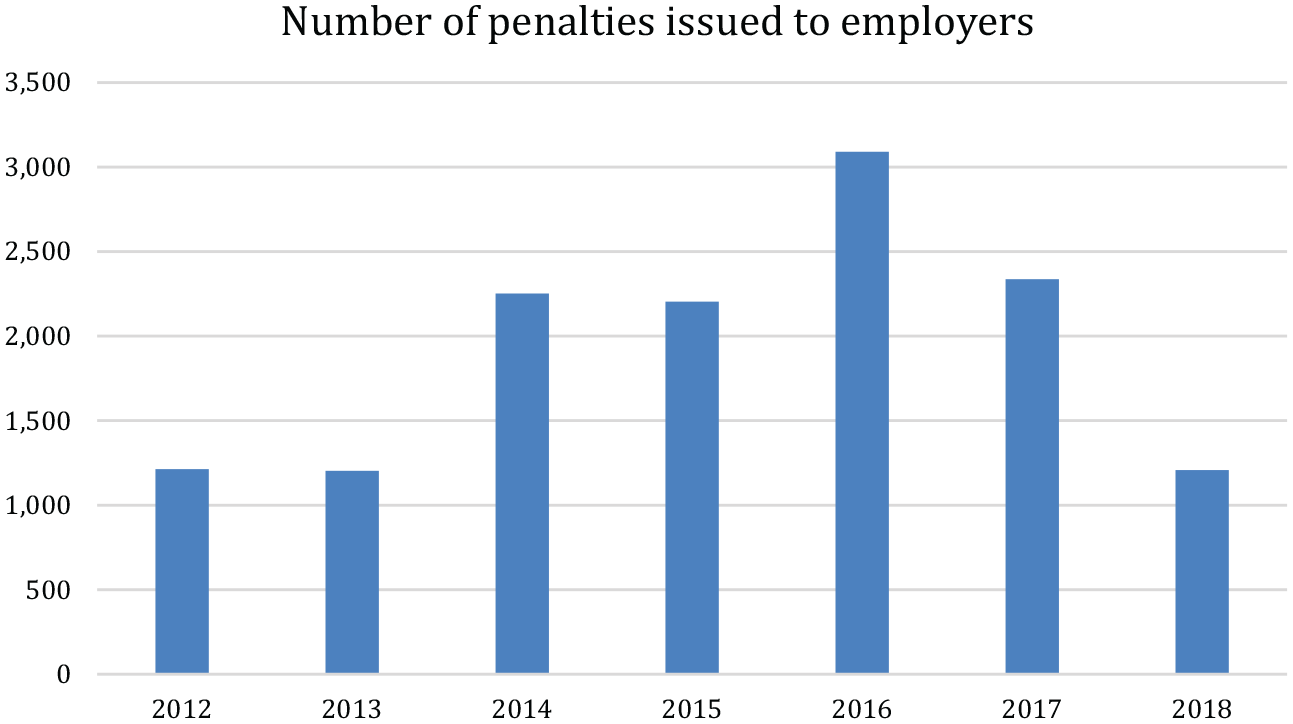
Source: Compiled from Home Office statistics on illegal working civil penalties issued to employers.
Alongside these two Immigration Acts, regulations and secondary legislation have brought additional essential frontline personnel - in health, education, policing and homelessness services - into the immigration sphere. They also strengthened the immigration functions of Local Authorities, with various teams adopting new immigration roles and developing partnerships with the Home Office, including those managing alcohol and taxi licensing, environmental health, building and planning, street-market regulation and neighbourhood wardens (Corporate Watch, 2017a). Some Local Authorities have even voluntarily contracted the Home Office to embed immigration officials in their organisations so as to conduct immigration status checks (Savage and Cadwalladr, 2019).
Evaluating the hostile environment
Given the extensive scope of the hostile environment across services and sectors, we might expect the policy approach to be carefully designed, evidenced and assessed. And yet, until 2018, there was remarkably little governmental monitoring, political scrutiny, media concern or public or parliamentary debate. With no White Paper underlying the policies, no clear aims or objectives and data-sharing Memorandums of Understanding only released as a result of Freedom of Information requests, months after operationalisation (Liberty, 2018: 11), it might appear that low public awareness was intentionally maintained. External reviewers have repeatedly criticised the Home Office for failing to specify policy objectives or measure the impacts of the hostile environment. The Independent Chief Inspector of Borders and Immigration criticised Ministers for not asking the key questions, creating pressure to deliver specific outcomes, setting targets for evaluation, assessing impacts or acting on information generated by the policies (ICIBI, 2016a: 7.9). Four years later, the Windrush Lessons Learned Review found that the department is still failing to monitor or properly evaluate the effectiveness and impact of the measures (Williams, 2020: 140), and the National Audit Office concluded that the Home Office cannot assess whether the policies have any meaningful impact on voluntary departures (NAO, 2020).
In this section we examine the impact and repercussions of the hostile environment. The task is complicated by a lack of data and uncertainty over the official objectives, although by piecing together clues from May’s 2012 interview, other Ministerial statements and the Immigration Bill factsheet, we can infer that the policy aims are: to discourage people from coming to the UK, to stop them overstaying visas, to prevent irregular migrants from accessing services and drawing from the public purse, and to make it easier to remove people.
The lack of clear objectives or official monitoring might suggest that the policy approach is propelled less by practical considerations around cost, resources and numbers, than ‘feeling rules’ appealing to notions of belonging, fairness and national sovereignty (Hochschild, 2003; Sirriyeh, 2015). It is notable that the original impact assessments stated that the Home Office ‘expected’ to increase the number of voluntary departures but that this could ‘not be quantified’, and simply that it was ‘thought that the benefits would exceed the costs’ (IfG, 2019: 38). Senior Home Office officials have said that even if evidence showed that the policies were ineffective, the approach would not be abandoned because it is ‘the right thing to do’ and that ‘the public would not find it acceptable’ for irregular migrants to access the same benefits and services as citizens and lawful migrants (ICIBI, 2016a: 7.8). Theresa May often justified the hostile environment using the concept of fairness, including asserting that ‘most people’ in the UK think that it is not fair for irregular migrants ‘to continue to exist as everybody else does’ (Travis, 2013). The hostile environment, then, may be better understood as an ideological stance, than an evidence-based, ends-driven policy approach, but must nonetheless have its costs and repercussions properly assessed.
Impact on individuals
One aim of the hostile environment is clearly being met: access to services is obstructed for those without immigration status. The number of people affected is unknown, not least because many are too precarious to seek publicity or redress, but it is estimated that there are around 800,000–1.2 million unauthorised migrants in the UK (Pew, 2019). However, the hostile environment also harms migrants who do have lawful immigration status as well as some British citizens (discussed below). The human impact can be extreme, as was illustrated by the plight of long-term, lawful residents in what became known as the ‘Windrush scandal’ after the ship that brought Caribbean workers to the UK in 1948 (see below). Many people were left destitute, some died prematurely and others were forced to leave the UK for countries they had left decades previously. The impact on newly arrived migrants may be even more severe, as they are less likely to have the socialisation, culturalisation and emergency support networks of long-term residents.
The human impacts of the hostile environment are wide ranging and potentially extreme. Reduced income through loss or denial of employment triggers a cascade of serious problems. Accommodation may be lost, a problem exacerbated by the ‘right to rent’ scheme and denied access to the social welfare safety net. Those affected are forced into becoming street homeless (where they are vulnerable to being referred to the Home Office) or dependent upon friends and charity. Some engage in irregular work, where the lack of employment rights and protections create a hyper-vulnerable ‘super-exploitable workforce’ at risk of modern slavery (Bloch et al., 2014; Lewis et al., 2017). Barriers to marriage interferes with people’s right to respect for their private and family life, and families may be afraid of vaccinating children or enrolling them in schools. There is evidence that some vulnerable people, including pregnant women and victims of abuse, are too afraid of immigration repercussions or excessive costs to seek care (Feldman, 2020; Gentleman, 2019). Others are turned away when they try, as was the case with a man that helped bring to light the Windrush scandal after he was incorrectly denied cancer treatment after 44 years of lawful residence (Gentleman, 2019).
It is important to remember that these dire impacts are not accidental side effects of the hostile environment but are central to its operation. Indeed, the effectiveness of ‘everyday borders’ is the production of generalised feelings of instability and anxiety (Flynn, 2015), which creates chronically insecure and dehumanised, ‘deportable’, people (de Genova, 2002).
Migration numbers
Researchers have shown that the deterrent effect of punitive policies and sanctions on immigration rates is negligible (Bloch et al., 2014; Duvell et al., 2018). Certainly, the (scant) evidence available does not suggest that the hostile environment is succeeding in deterring arrivals or overstaying, nor encouraging departures. Whilst it is difficult to assess the impact of individual policies from national statistics, it is evident that net migration has been increasing since the hostile environment began. Unauthorised migration has probably remained static in this period (Pew, 2019). According to Home Office statistics, both enforced and voluntary departures are actually decreasing each year (Figure 2).
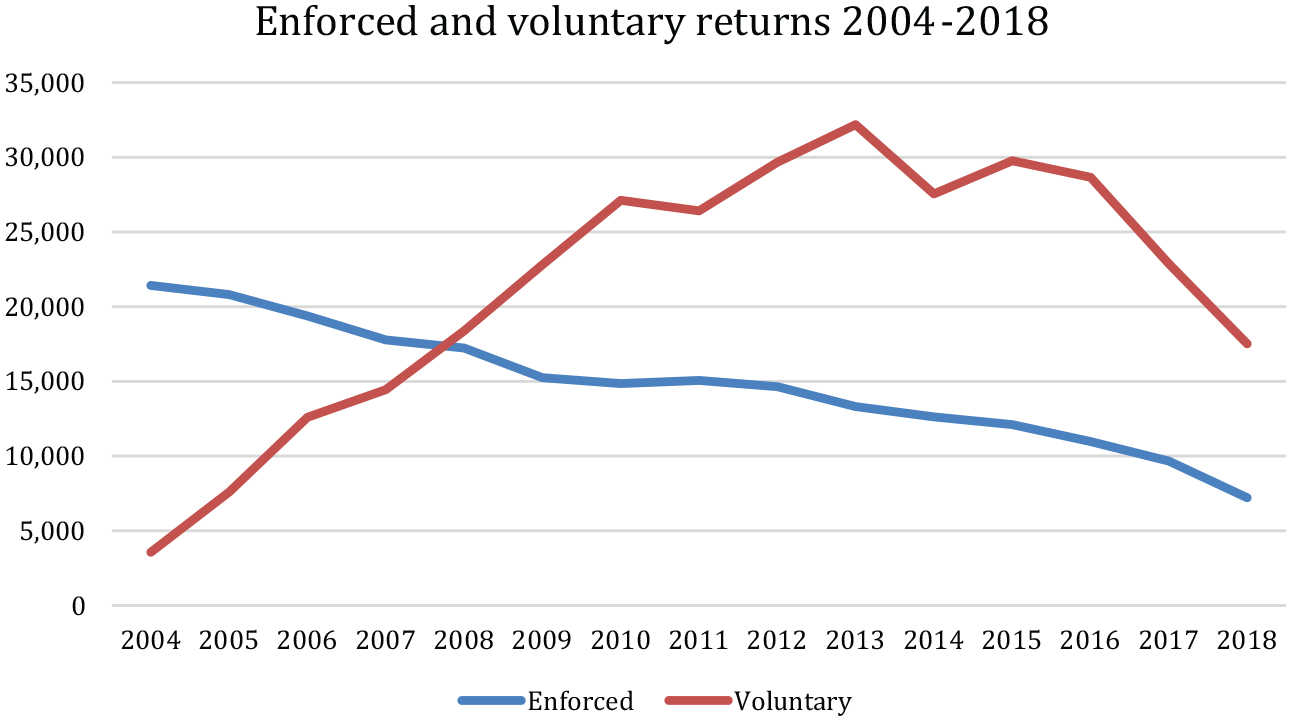
Source: Compiled from Home Office Quarterly Immigration Statistics (June 2019, table ‘returns1’).
In any case, the ‘illegal immigrants’ that the policies are designed to tackle are not an easily-definable or static group, but are produced through hostile environment policies, document checks and immigration-imbued service interactions (York, 2018). It is becoming increasingly easy to lose one’s lawful immigration status, including through increased cost and complexity of immigration applications, inflexible rules, Home Office data errors and reductions of legal aid and grounds of appeal, and increasingly difficult to regularise one’s status (Yeo, 2020).
Financial costs
The hostile environment might prevent unlawful migrants from drawing from the public purse but is unlikely to be saving the tax-payer money overall. The Home Office spreads some of its costs through deputisation but also faces new costs, such as the ISD’s budget (£5.5 million in 2016 (ICIBI, 2016a: 4.14)). Much of the hostile environment’s costs however fall on other branches of the state, such as schools, hospitals and Local Authorities, as well as third parties like employers, banks and landlords, and ultimately therefore the general public. Although the hostile environment could generate revenues, it seems that these are outweighed by its implementation costs. Civil penalties, for example, have proven extremely difficult to enforce (Casciani, 2013), and the NHS spends more money chasing overseas patients than it recovers (and often eventually discovers that the person was actually entitled to free healthcare after all) (Hansard, 2017b).
Costs for society
In addition to catastrophic individual impacts, the creation of an underclass of illegalised people unable to engage with basic or emergency services has risks for the wider society. As also found in the USA (Walsh, 2014), deputised immigration checking presents risks for public safety and security, puts strains on community relations and undermines citizenship by encouraging a climate of fear and hostility. Public health is threatened when people are afraid or prohibited from accessing medical treatment, vaccinations, antenatal care (Potter, 2017, Schweitzer, 2016) or ‘track and trace’ programs, as has been recently illustrated by the Covid-19 pandemic. Road safety is reduced and hit-and-run accidents made more likely by depriving people of driving licences (Lueders et al., 2017). Giving the police immigration roles risks police/community relations and creates barriers for witnesses and victims to report crimes (Laville, 2013). Deputising immigration management also weakens government accountability and responsibility (Walsh, 2013) by shifting the – heavy – burden of enforcing refusals and restrictions.
The hostile environment also impacts society by legitimising and even encouraging racism and xenophobia. Concerns over potential discrimination have been raised from the beginning, including by NGOs, lawyers and British and Commonwealth politicians. For example, Communities and Local Government Minister Eric Pickles voiced concerns in 2013 that the landlord provisions would impinge on ‘anyone foreign-looking’ and several Caribbean foreign ministers warned of disproportional impacts on Afro-Caribbean UK residents (Grierson, 2018b). NGOs made similar warnings: the JCWI called the 2013 Immigration Bill a ‘travesty’ that would ‘divide society’, and the Immigration Law Practitioners Association warned it would be ‘intrusive, bullying, ineffective and expensive and likely racist and unlawful to boot’ (Travis, 2013).
It seems that these fears were valid. Ethnic minorities are disproportionately subject to immigration checks and having their residence questioned. Banks are reluctant to open accounts for foreign nationals, including those with lawful but limited leave to remain (Travis, 2017a), universities are accused of exceeding their statutory duties and acting in discriminatory ways, including by rejecting students from ‘high risk’ countries (Times Higher Education, 2015) and performing discriminatory attendance monitoring (Liberty, 2018: 18). A Home Office-commissioned assessment of the ‘right to rent’ pilot found landlords making discriminatory comments and disproportionately requiring ethnic minorities to prove their immigration status (Home Office, 2015). One NGO’s poll of landlords found 44% would not rent to people who ‘appear to be immigrants’ (Shelter, 2016), and another found that half of landlords report being less likely to rent to foreign nationals and 58% refusing ethnic minorities without British passports (JCWI, 2015). In April 2020, the Court of Appeal found that the ‘right to rent’ scheme causes landlords to discriminate, although held that it was nonetheless lawful.
The risk of institutional discrimination translating into uneven immigration enforcement through the hostile environment is perhaps particularly high with the police. Evidence shows the overrepresentation of ethnic minorities at every level of the criminal justice system, including stop-and-searches and traffic stops (Bowling and Philips, 2002). With a case for deportation now potentially built upon a person’s police file rather than criminal conviction, under Operation Nexus and the hostile environment, deportation can be justified through a medley of police encounters and arrests, even if they were for cautionable offences, made in error or did not lead to charges (Luqmani Thompson and Partners, 2014: 7). The brunt is borne by ethnic minorities, as well as some marginalised white groups, such as east Europeans and Roma. Polish and Romanian police officers, for example, were seconded to London under Operation Nexus to target their nationals for removal (Bloomer, 2016). The destitution polices have also largely focused on rough-sleeping Europeans (Taylor, 2018).
The hostile environment not only legitimises and encourages discrimination by those to whom it deputises, but is an ongoing expression of the colonial system of racial ordering (El-Enany, 2020).
Flawed foundations
The hostile environment for migrants is flawed. It has little impact on migration numbers, and yet has considerable human, financial, social and public safety costs. This section argues that the core problems relate to faulty underlying assumptions, the selectivity of immigration checks and poor-quality data. These fundamental flaws encourage overzealous and discriminatory application and result in high ‘collateral damage’ to countless lawful migrants and British citizens.
Accuracy of data
Unlike many countries, the UK does not have a central population database or identity card system. Third parties conducting checks are dependent, therefore, upon the quality of Home Office data to verify people’s nationality or immigration status. It is concerning, then, that the department is regularly criticised for its databases being outdated and not up to standard (IfG, 2019: 34), holding information that is incomplete or inaccurate, and demonstrating high error rates and recordkeeping failings (ICIBI, 2016a: 2.7; ICIBI, 2016b). The Home Office’s poor-quality data is passed onto the third parties enacting hostile environment restrictions, with potentially catastrophic implications for individuals. An error rate of almost 10% was found of customers identified as disqualified for banking by the Home Office (ICIBI, 2016a), and yet the Home Office instructed banks and building societies to only update records ‘in exceptional circumstances’ and that ‘the default position should be to refuse’ to doublecheck decisions (Home Office, 2017: 3) (and even then it takes up to a year to reopen bank accounts recognised as wrongly closed (Liberty, 2018: 25)). Poor Home Office data has been shown to result in the DVLA issuing driving licences to people whose immigration status should preclude them (ICIBI, 2016a: 2.8), whilst simultaneously incorrectly revoking hundreds of driving licences each year from those entitled to them (e.g. 259 licences were reinstated in 2015 (ICIBI, 2016a: 5.62)). The risks relating to poor-quality or biased data capture, retention and utilisation are exacerbated by assumptions that data is neutral and accurate, and the barriers to reconsideration and redress.
Selective checks
Unlike the blanket identity checks required to access services in many countries, the UK’s hostile environment does not impose universal or mandatory checks. Third parties are not obliged to check everyone’s documents, rather they are penalised if they provide jobs/accommodation/services to foreign nationals without the correct immigration status. This is an important distinction. It encourages racial profiling by those deputised, by incentivising discriminatory application of checks on those deemed ‘foreign’ by their appearance, name or accent. Like other ‘street level bureaucrats’ (Lipsky, 1980), these de facto immigration officers wield considerable discretionary power and the authority for ad hoc interpretation of public policy.
The types of sectors brought into the hostile environment result in a disproportionate impact on those whose socio-economic background, age, health or ethnicity brings them into contact with public services or the criminal justice system, or who suffer precarious accommodation or employment. The ‘Good Citizen’ (white, male, middle class, home-owning and in possession of a passport) is likely to be relatively unaffected (Anderson, 2013). Understanding the uneven impacts of the hostile environment requires an intersectional approach that acknowledges the interrelation of variables such as gender, ethnicity and socio-economic status (Yuval-Davis et al., 2019). The hostile environment clearly encompasses both classed and racialised biases, as is evident across the British immigration system (e.g. Bhui, 2016; Griffiths, 2017; Mayblin, 2017; Parmar, 2019; Sirriyeh, 2015); and reflects its origins in controlling the movement of racialised poor people from former colonies (El-Enany, 2020).
Undocumented vs. unlawful
The fatal flaw at the heart of the hostile environment is the conflation of being undocumented and unlawfully-resident. It is assumed that those who have legal immigration status will have documentary evidence, so that a lack of ‘papers’ equates to a lack of immigration status. However, although these populations overlap, they are not synonymous. Many lawful migrants do not possess documentary proof of their identity or immigration status, or only have expired documents. Indeed, millions of British citizens do not have passports, with 17% of UK residents (about 10 million people) in the 2011 census reporting that they did not have one. With Britons who have refused or failed to prove their nationality to employers being fired under hostile environment policies, some are applying for passports simply in order to live and work in their own country. And as noted, the requirement to prove one’s lawful status is not experienced equally.
Overzealous application
Serious problems arise from this mix of selective application of immigration checks coupled with erroneous assumptions over the quality of Home Office data and likelihood that people have documents. These include overenthusiastic third parties executing excessive and discriminatory checks and restrictions, as has also been shown for other national contexts of deputised immigration controls (Walsh, 2013). The hostile environment encourage third parties to treat an excessively broad and racialised group of people as unlawful migrants and to go beyond their legal obligations to overly-comply or even collaborate with the Home Office, as some universities and companies are accused of doing (e.g. by facilitating Home Office workplace raids by arranging fake meetings for their employers). There is evidence that people are being denied access to primary healthcare (to which everyone is entitled), or wrongly turned away from hospitals and maternity care (Bulman, 2017; Feldman, 2020). Marriage registrars refer thousands more couples to the Home Office for investigation each year than originally anticipated (Home Office, 2013), even though three quarters are subsequently permitted to marry (ICIBI 2016c). Lawful migrants, European Economic Area (EEA) nationals and British citizens are caught up in the process. Such harm is felt unevenly across society, particularly affecting those most likely to be subject to checks or most unlikely to have documentary evidence of their identity or immigration status, such as asylum seekers (Cassidy, 2019), pensioners, precarious workers and those with chaotic lives, low income or health problems. By encouraging existing and new forms of exclusion and risk-profiling, the hostile environment reinforces hierarchies of belonging and differentiated membership.
In a few cases, third party cooperation is encouraged through financial reward. Homelessness charities, for example, are contracted through a ‘payment by numbers’ scheme under which funding is tied to the number of rough sleepers helped to leave the UK (Corporate Watch, 2017b). Local Authorities must engage in Home Office immigration enforcement projects if they wish to bid for the Controlling Migration Fund (Corporate Watch, 2017a). But primarily, over-compliance from deputies is encouraged through threats of high sanctions coupled with the extreme uncertainty and complexity of the immigration system. It is notoriously difficult to assess immigration status and identity documents, and to stay abreast of the frequently-changing policies. Hostile environment guidance for employers and landlords, for example, are long and complicated 40-page booklets (e.g. Home Office, 2020).
And yet mistakes result in severe sanctions like forfeited sponsorship licences, civil fines, criminal charges and imprisonment. Employers, for example, face a £20,000 penalty or five-year prison sentence for hiring unlawful workers, but no incentive for employing eligible foreign nationals and no effective sanction for discriminatory hiring or checking practices. They – like other third parties – are often unsure exactly what is required (e.g. incorrectly believing that they are legally obliged to conduct immigration checks rather than just being forbidden from hiring someone without permission to work). The uncertainty pervading the hostile environment is sustained by government, including through the creation of overly-broad criminal offences that are intended to be operationalised selectively. Providers of safe housing to victims of abuse, for example, have only been reassured that they probably will not be prosecuted for housing irregular migrants.
These factors encourage third parties to adopt over-cautious approaches to immigration checks and restrictions, affecting many more people than ‘just’ those unlawfully-present, and doing so in discriminatory ways.
The Windrush scandal
From 2017, the media began to cover the plight of long-standing, lawful residents being brought into the immigration gaze through the hostile environment (Gentleman, 2019). Eventually termed ‘the Windrush scandal’, these cases illuminated the human repercussions of the system’s flaws, particularly the false assumption that lawful residents have documentary evidence, and the racialised and classed biases encouraged by selective checks and high sanctions facing those ‘deputised’. Those affected arrived in the UK decades ago, with a right of entry and residence as ‘Citizens of the United Kingdom and Colonies’ or Commonwealth citizens. They retained their rights after the Immigration Act 1971 removed them from new entrants, but these rights were protected in law, not physical documents. This caused little problem until the hostile environment. These residents (many elderly, working class and minority ethnic), were particularly likely to face immigration checks, but found themselves unable to prove their lawful status (for which they carried the burden of proof (Bawdon, 2014; York, 2018)). Scores lost jobs and homes, were denied pensions or healthcare, even detained or deported.
The diffusion of everyday borders can offer opportunity for collaboration and resistance (Cooper et al., 2016). The Windrush scandal and campaigning by those affected have led to (some) pushback from those deputised, the resignation of a Home Secretary, (limited) policy row-back from politicians and help for a small group of people affected to be retrospectively documented. Some Local Authorities and police forces are beginning to distance themselves from the hostile environment (although some others are doing quite the opposite), with the National Police Chiefs Council on modern slavery and organised immigration crime stating that the police had an ‘inappropriate relationship’ with immigration enforcement and would no longer automatically check the immigration status of victims of crimes. Several Royal Colleges of medicine and medical NGOs have spoken-out about immigration checks and data-sharing spreading into healthcare (e.g. RCP, 2018) and new NGOs have been established to campaign against hostile environment in schools (Against Borders for Children) and universities (Unis Resist Border Controls). Even the Home Office is softening its rhetoric and speaking of ‘compliance’ rather than hostility, although the policies remain mostly intact.
Conclusion
This article argues that the hostile environment for migrants is a specific policy approach and represents a significant development in the UK’s immigration strategy by effectively admitting that governments cannot meaningfully enforce immigration laws or ensure impermeable borders. Although the Home Office remains responsible for operationalising the immigration system, the hostile environment ‘deputises’ responsibilities, devolving the spaces and agents of immigration policing across everyday society, and making an unprecedented range of agencies, services, institutions, companies, charities and private individuals responsible for checking immigration status, passing on information to the Home Office and delivering immigration-related exclusions. The policies were based on little evidence, planning or monitoring, they do not appear to have meaningful impact on immigration numbers, and serious questions arise over their ethics, efficiency, effectiveness and logic. There are high costs for the public purse, health, safety, security and society, including by erecting barriers to healthcare and undermining equality and social cohesion through encouraging xenophobia and racism. Moreover, by being based on erroneous assumptions regarding immigration status, documentation and the reliability of Home Office data, as well as legitimising discrimination and encouraging overzealous application, the hostile environment expands the subordinated ‘illegal’ category of persons, drawing-in citizens and lawful migrants in the process.
Despite a political aspiration for affecting migration arrival and removal rates, the hostile environment is not merely an immigration policy. It is a deliberate attempt to ‘devolve’ responsibility for border policing, diffusing it throughout British society, and to curtail the lives of certain people – particularly those racialised and impoverished (Anderson, 2013; El-Enany, 2020) - leaving them physically present, but criminalised, marginalised and precarious. The hostile environment is a moral and punitive political stance; creating and disciplining ‘deportable’ people (de Genova, 2002; Flynn, 2015), sustaining racialised colonial hierarchies (El-Enany, 2020) and requiring UK residents to inflict considerable harm on each other, with profoundly significant consequences for individuals and broader society.
It is especially concerning, then, that lessons have not been learned as a result of the Windrush scandal. Although some Local Authorities, police forces and doctors have spoken out about the hostile environment in recent years, the hostile environment remains firmly embedded in primary and secondary legislation and professional services and culture. Indirect immigration enforcement is also expected to be the primary means of policing immigration after Brexit, given that EEA nationals will probably have visa-free access to the UK but face restrictions on their right to work and access public services. As it stands, existing EEA residents of the UK are personally responsible for applying for settled status even if they are automatically entitled and are given electronic rather than hardcopy evidence of their status. Assuming – as seems certain – that after Brexit the consequences for failing immigration checks will continue to be dire, as it stands the problems demonstrated by Windrush will inevitably be repeated.
Footnotes
Acknowledgements
The authors would like to thank the University of Birmingham and the Economic and Social Research Council for their support of this article and its open accessibility, and to the Critical Social Policy editors and anonymous reviewers for their pertinent and constructive feedback.
Funding
The author(s) disclosed receipt of the following financial support for the research, authorship, and/or publication of this article: The writing of this article was partly funded by the Economic and Social Research Council, grant number ES/K009370/1.