




Abstract
This article focusses on Gypsy and Traveller communities who live on local authority managed sites around Great Britain. The subject of sites has come to the fore in the last couple of years, as the Police, Crime, Sentencing and Courts Act 2022 criminalised roadside living and therefore nomadic ways of life. Using the concept of environmental racism, the article explores the proximity of sites to environmental hazards including main roads, sewage works, industry and refuse and recycling centres. The mapping of all Gypsy and Traveller sites in England, Scotland and Wales - permanent sites (291) and transit sites (60) - shows that a sizeable proportion of sites present a risk to residents’ health due to their geographical proximity to pollutants and that many are infested with vermin and flies and separated from settled communities which can result in isolation and exclusion. Case studies of Gypsy and Traveller sites shows that the location of sites is not just a historical legacy of racism as new sites are being placed in polluted and isolated areas. Sites are locally contested and racialised language and stereotypes are used to try and stop sites being placed in certain areas. Local authority planning departments are aware of the unsuitability of some site locations and their potential risk to health. However, local opposition and a homelessness crisis within the communities can leave Gypsy and Traveller people with little or no choice about site locations which can be in places that are polluted, on the margins and away from settled communities.
Introduction
The 2021 Census recorded a total of 168,748 Gypsy, Roma and Traveller (GRT) people in England and Wales, 0.3% of the total population. However, the actual numbers are estimated to be about 300,000, and the highest estimates place the numbers at 500,000 (Gov.UK, 2022). Around a quarter of GRT communities live on sites while the rest live in bricks and mortar housing (Cabinet Office, 2019). GRT is used as an umbrella term to describe ethnic groups or others with nomadic ways of life (Cabinet Office, 2019). The terms are contested (Richardson and Ryder, 2012). In this article we use Gypsy and Traveller people as a reflection of ethnic groups with a nomadic way of life. The main Gypsy and Traveller communities in the UK are Romany English Gypsies, Irish Travellers, Welsh Gypsies, Scottish Gypsies as well as Roma people who tend to be more recent arrivals, coming to the UK from the 1990s onwards from eastern and central Europe and who live in fixed housing (Cabinet Office, 2019).1
This article focusses on Gypsy and Traveller communities who live on local authority managed sites around Great Britain. Sites are either publicly or privately owned and are authorised through local authority planning processes. The article considers how and why publicly owned and managed sites are isolated and often located in places that are hazardous to health. The subject of sites has come to the fore in the last couple of years, as the Police, Crime, Sentencing and Courts Act came into force at the end of June 2022, criminalising roadside living and therefore nomadic ways of life (Office for National Statistics, 2022). The legislation has placed the spotlight firmly back onto the conditions on and availability of official local authority permanent sites and on the transit sites used for short stays. In this article we show that a sizeable proportion of sites are in close proximity to pollutants, that they are separated and isolated from settled communities and are infested with vermin and flies. Site locations, in marginal areas and disproportionately near harmful pollutants, is a consequence of racism in the planning process. This article shows how some people from settled communities, their political representatives and local media raise objections to the development of new sites near residential housing settlements, pushing them to the margins in places that others would not be expected to live.
There are five main sections in this article. First we provide an overview of the policy context. Second, we explain the mixed-methods approach to the research. Third, we consider the concepts of environmental racism and weathering, which are disproportionately experienced by marginalised and often racialised groups. We also present new data from the most comprehensive mapping exercise ever carried out, which included 291 local authority sites. Fourth, we explore the contemporary placement of sites by mapping the proximity of transit sites (60) to environmental hazards and we provide an in-depth analysis of a new site which has recently obtained planning permission. Finally, through two case studies of Gypsy and Traveller sites, we examine the planning processes which have led to sites being located in dangerous places. Site visits and interviews with residents were carried out to better understand the realities of living on sites which can quite literally be next to the sewage works.
Background and policy context
There is a long history of limiting the nomadic ways of life for Britain's Gypsy and Traveller communities (Smith and Greenfields, 2013). The Caravan Sites Act 1968 placed a legal duty on local authorities to create sites in an attempt to redress a series of laws, including The Caravan Sites and Control of Development Act 1960, which had eroded the right to camp and had reduced the number of traditional stopping places for nomadic communities by barring caravans from stopping on common land and in towns and on village greens (Quarmby, 2013). The Caravan Sites Act 1968 was designed to create new sites while at the same time sought to control Gypsy and Traveller communities occupying land that was not authorised.2 It became quickly apparent that councils were not creating suitable sites, partly as a result of local campaigns against sites, pushing many to the margins of towns and cities (Cripps, 1977). Local resistance alongside local politics meant that sites were quickly eliminated as possibilities. As Cripps noted, ‘if a local councillor …fails to oppose a site in his ward … his seat is in jeopardy’ (1977: 11).
Local authorities, often left to their own devices, established their own criteria for site development. For instance, some said that sites should be screened from view and away from other housing, which created effectively segregationist practices. Others stipulated that sites should not be too large and even, in one area, should not have smell impact. Few policies suggested that sites themselves should not be too far from services, or how far they should be from sources of contamination (Clark, 2001). Bill Forrester was a local government officer in the 1970s and later chair of the National Association of Gypsy Traveller Officers, and was partly tasked with identifying sites at the time of the 1968 Act. According to Forrester some of the land selected for sites were, …just whatever bit of land somebody could get, and some are still operating. So the whole business of how sites came about and where they were, is really nothing to do with proper planning…. And even now, there are still sites where you are saying, ‘Why here?’ (Interview with Quarmby). …excessively close to sewage plants, refuse destructors, traffic laden motorways, intersections of those and other busy highways, main railway tracks and other features contaminating the environment by odour, noise and so on (1977:11).
The statutory duty to provide sites was repealed in 1994, although local authorities still had the power to make a compulsory purchase of land for sites and should assess the need for new sites. Making assessments for new sites became a statutory duty under Section 225 of the Housing Act, 2004 and the need for sites had to be included in the wider housing strategy (Commission for Racial Equality, 2005). Nevertheless, one of the major issues still facing Gypsy and Traveller communities is the lack of available pitches on authorised sites. To explore the shortage of permanent pitches and transit pitches Sweeny and Dolling (2021) wrote to all Local Authorities and Private Registered Providers in England and Wales to enquire about availability and waiting list length on their sites and received responses on 251 of a possible 266 sites. Sweeny and Dolling (2021) found that there were at least 1696 Gypsy and Traveller households on waiting lists for pitches. Failure of successive governments to address the shortage of sites continues (Willers and Baldwin, 2019). However, it is not only the lack of sites and pitches that are a problem, it is also the location of the existing sites which we explore after the methods section below.
Methods
The data was collected using mixed methods. First, sites were mapped using the Caravan Count 2020, a list of all authorised public sites in England and Wales. A Freedom of Information request to the Scottish government obtained the names and addresses of authorised public sites in Scotland. A total of 242 sites were mapped in England, 28 in Scotland and 21 in Wales.3 In England and Wales, the government tool MagicMap was used while in Scotland Google Maps was used to measure the distance of the sites to a list of potential hazards focusing on motorways and A Roads, railway lines, sewage plants, recycling and refuse centres, industrial estates, rivers, canals and the sea. Transit sites were also mapped, 60 in total. The transit sites were identified through the Caravan Count (2022), desk research and expert information from those tracking the placement of sites as the landscape is rapidly changing.4
In order to determine which hazards to map, we used Mitchell's (2019) work on environmental inequality in the UK and environmental injustice. Mitchell (2019) shows the unequal relationship between social deprivation and proximity to air pollution, flood risk, lack of green spaces, river water quality and waste hazards, like recycling. Proximity to environmental hazards is strongly associated with poor health outcomes such as birth defects, fetal death, cancer in children, cardio and respiratory illnesses, renal disease and diabetes (Brender et al., 2011). Environmental Information Requests and some linked Freedom of Information requests were sent to all councils in Great Britain and the Northern Ireland Housing Executive - responsible for five open authorised sites - to find out what environmental complaints had been received from site residents between 2017 and 2021. Responses were received from 167 councils.
In-depth case studies were carried out in three areas: one was a site that had recently been approved but not yet populated and two were long established sites that were known, through the mapping, to be places close to environmental hazards. Digital copies of local newspapers who reported on the issue of site developments for Gypsy and Traveller communities were analysed along with planning meeting documents acquired through Freedom of Information requests. Site visits were carried out and interviews with NGOs and site residents took place at the two long established sites.5 A total of 11 interviews with NGO representatives – both local to the sites visited and national - and a total of 13 site residents were interviewed. Repeat interviews were carried out with five site residents. The interviews took place during the day and were all with women who were at home due to caring responsibilities – in some cases children were present during the interviews – or because they worked from home. Though the article did not explore differential experiences between men and women, men are more likely to work away from the site and so women who spend more time on site are more impacted by site conditions.
Interviews were recorded, transcribed and analysed thematically. Gatekeepers from local NGOS accompanied Quarmby to the sites. Access was only possible due to Quarmby's long history of work with Gypsy and Traveller communities, including an ethnography of the eviction of Dale Farm (Quarmby, 2013). Even though from outside of the communities, this long standing engagement has led to relationships of trust without which the research would not have been possible. Gypsy and Traveller communities are subjected to racism from others in the population and the media and so letting outsiders onto a site requires vouching from trusted people. Gatekeepers from local NGOs were therefore necessary for negotiating access to sites and interviews with residents and accompanied Quarmby during the site visits. Site locations and site names have been removed as well as any identifying features. In addition, pseudonyms have been used for site residents to ensure anonymity.
Environmental racism and Traveller site locations
In the United States (US), the concept of environmental racism - the process that leads to minority and low-income communities facing a disproportionate level of environmental harm (Benz, 2019; Taylor, 2014) - is well developed. In the UK the concept of environmental racism is less used, but the placement of Gypsy and Traveller sites in areas that are likely to expose residents to hazardous environments and therefore unequal health outcomes means that the concept has relevance in the UK context. Similarly, the concept of ‘weathering’ explored by Geronimus (2023) in the US context to examine the ways in which environmental, political and social factors impact on health, even inter-generationally, has wider application to the UK when certain groups are ‘othered’ with ‘inescapable consequences’ (2023: 11).
Powell (2013) considers the application of the ghetto, which spatially confine groups that are dispossessed and stigmatised, to Gypsy and Traveller communities in the UK. Ghettos and Gypsy and Traveller sites share some important characteristics such as ‘ethnic homogeneity, spatial confinement, shared cultural identity, mutual distancing and a retreat into the private sphere of the family’ (Powell, 2013: 116). Although site dwelling Gypsy and Traveller people are from different ethnic groups, Powell (2013) argues that the shared cultural heritage of a nomadic lifestyle makes sites relatively homogenous and are places that do not contain outsiders. Sites are often segregated from settled communities, are marginalised and stigmatised and residents are exposed to greater environmental hazards and poorer health outcomes than settled communities.
Research on health inequalities in the UK demonstrates unequal health outcomes where people from Gypsy and Irish Traveller backgrounds report the poorest health (Raleigh, 2023). Both men and women from Gypsy and Traveller communities had twice the rates of long-term limiting illness than those in the White British group (Bécares, 2015). Survey research carried out in response to the Covid 19 pandemic found that Gypsy and Traveller men were 12 times more likely than their white British counterparts to report multimorbidity, defined as two or more physical conditions of high blood pressure, diabetes, heart disease, lung disease and cancer or another clinically diagnosed chronic health condition. Gypsy and Traveller women were just under twice as likely as white British women to report multimorbidity (Taylor et al., 2023). Poorer health among Gypsy and Traveller communities means that people from these communities have a life expectancy of between ten and 25 years less than the general population and much higher rates of long-term illness as well as conditions that which limit daily activities or work (Friends, Families and Travellers, 2022).
Housing is a major determinant of health outcomes (World Health Organisation (WHO), 2018). There are four inter-related elements to housing: the house, the home, the neighbourhood and the community. The physical conditions of a house that might include mould, asbestos, cold and damp are important, as are infestation, noise and hazardous internal structures. Broader factors in the environment are also important such as overcrowding, isolation from services, the quality of the neighbourhood, safety and a lack of green spaces. Many of the factors the WHO (2018) identified as comprising unsatisfactory housing were evident in the location of Gypsy and Traveller sites and were highlighted by the site residents and organisational representatives interviewed for this research. Others too have pointed to the detrimental health impacts of living on Gypsy and Traveller sites that could be over-crowded, unsafe and have poor sanitation (Cabinet Office, 2019).
The mapping found that sites were often isolated and segregated from settled communities, quite literally on the wrong side of the tracks. This type of residential segregation is known to negatively impact on wider community relations (Greenfields and Smith, 2010). Shubin observes how encampments on the peripheries of towns and cities lead to ‘liminality’, ‘in-betweeness’ and ‘social exclusion’ (2011: 1932). In this research many of the sites mapped were developed after the 1968 Caravan Sites Act and so three and sometimes four generations of families have been subjected to environmental racism and the impacts of weathering. Figure 1 shows the proximity of sites in England, Scotland and Wales to major hazards.
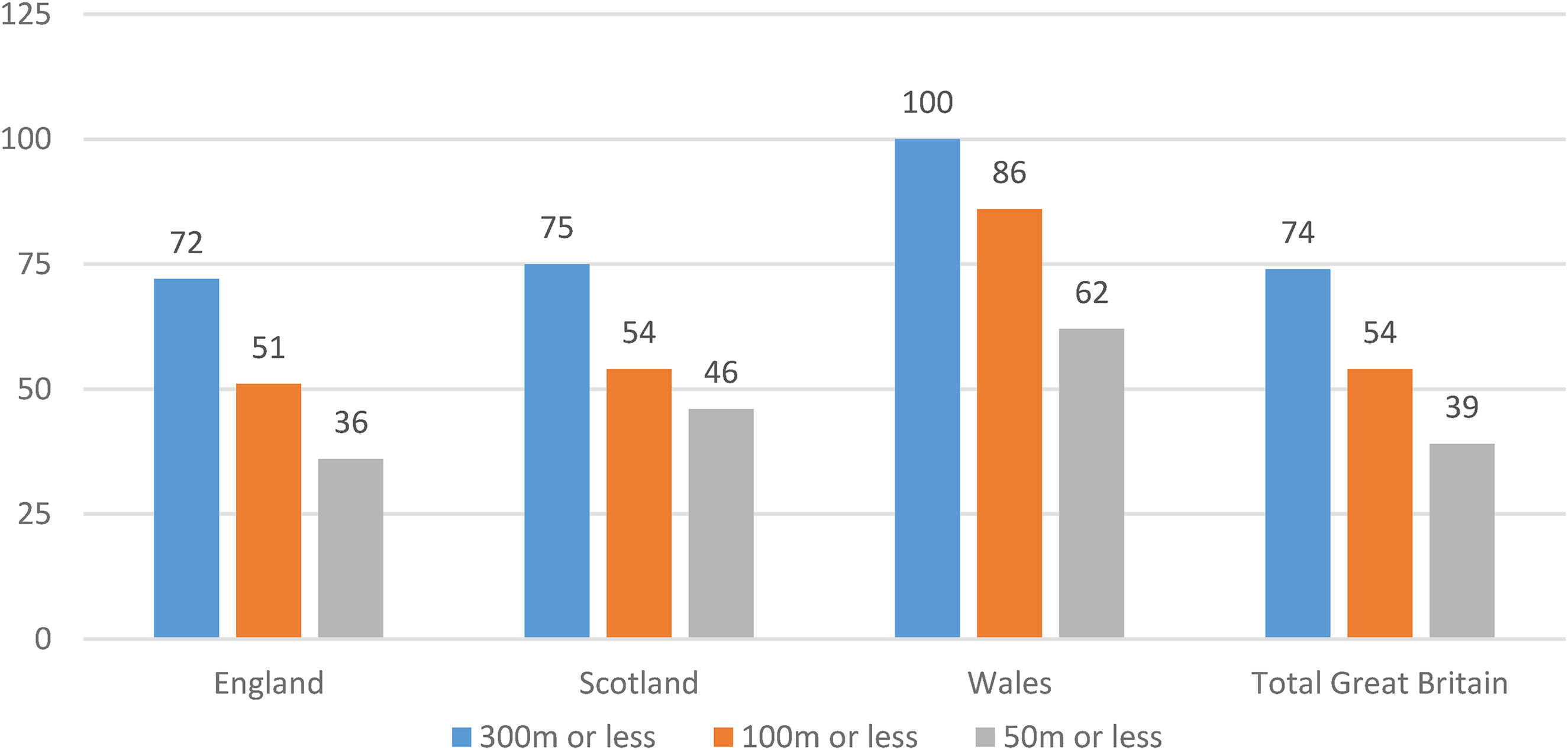
Total % of sites within 300m, 100m and 50m of at least one of: motorways, A roads, rail lines, refuse/recyling plants, sewage works, rivers, canals, sea, industrial estates.
Figure 1 shows that almost four in 10 sites in Great Britain are within 50 metres of at least one environmental hazard and more than half are within 100 metres. For perspective, most premier league football pitches are just over 100 metres in length and between 64 and 68.6 metres in width. While the numbers of sites are small in Wales and Scotland, the data clearly demonstrates that the sites in Wales are in the most hazardous places. Breaking down the data further, 43% of sites in Great Britain were within 100 metres of one or more motorway, A road or railway lines while around one third (34% were within 100 metres of one or more motorway or A road. Major roads, as well as some types of rail and where diesel is used can impact on respiratory health. It is not only the air pollution that affects those living on sites, it is also the noise; caravans have little sound insulation. The aggregation of data in Figure 1 hides some of the worst sites which were right beside motorways or tucked under flyovers or between two major roads. For example, one site in the south of England was less than 50 metres from both a motorway and an A road, while one in East Anglia was less than 50 metres from two A roads. It is not surprising that those living in such areas would experience poor respiratory health.
As well as air pollution from traffic, 12% of sites were within 100 metres of one or more industrial, sewage and/or recycling/refuse centre. Living near sewage, industry or the dump results in traffic from heavy vehicles, in dust, odour and noise and are distanced from green spaces making them harmful (Mitchell, 2019). Some of the worst sites were quite literally in the middle of an industrial estate or next to the sewage or the dump or combinations of these. One site in the Midlands, for example, was less than 50 metres from the sewage works, next to two different rubbish and recycling plants and near an industrial estate. Sites are often located in the areas that service the needs of settled communities and out of town industry and are not places where others are expected to live.
Figure 2 shows the environmental complaints on sites, received by councils and these illustrate the everyday impact of location. Among the 167 councils who responded, around three quarters (73%) had received environmental complaints from Gypsy and Traveller sites within their areas. The most frequent complaint related to vermin – of those councils that had received complaints around half (51%) had complained about vermin, followed by waste (38%). Sewage, drainage problems, odour, noise, fire, dust, air pollution and flooding were also issues that residents complained to the council about. Given the proximity of sites to refuse and recycling centres, sewage works, industry and major roads, the complaints were not surprising and almost impossible to solve.
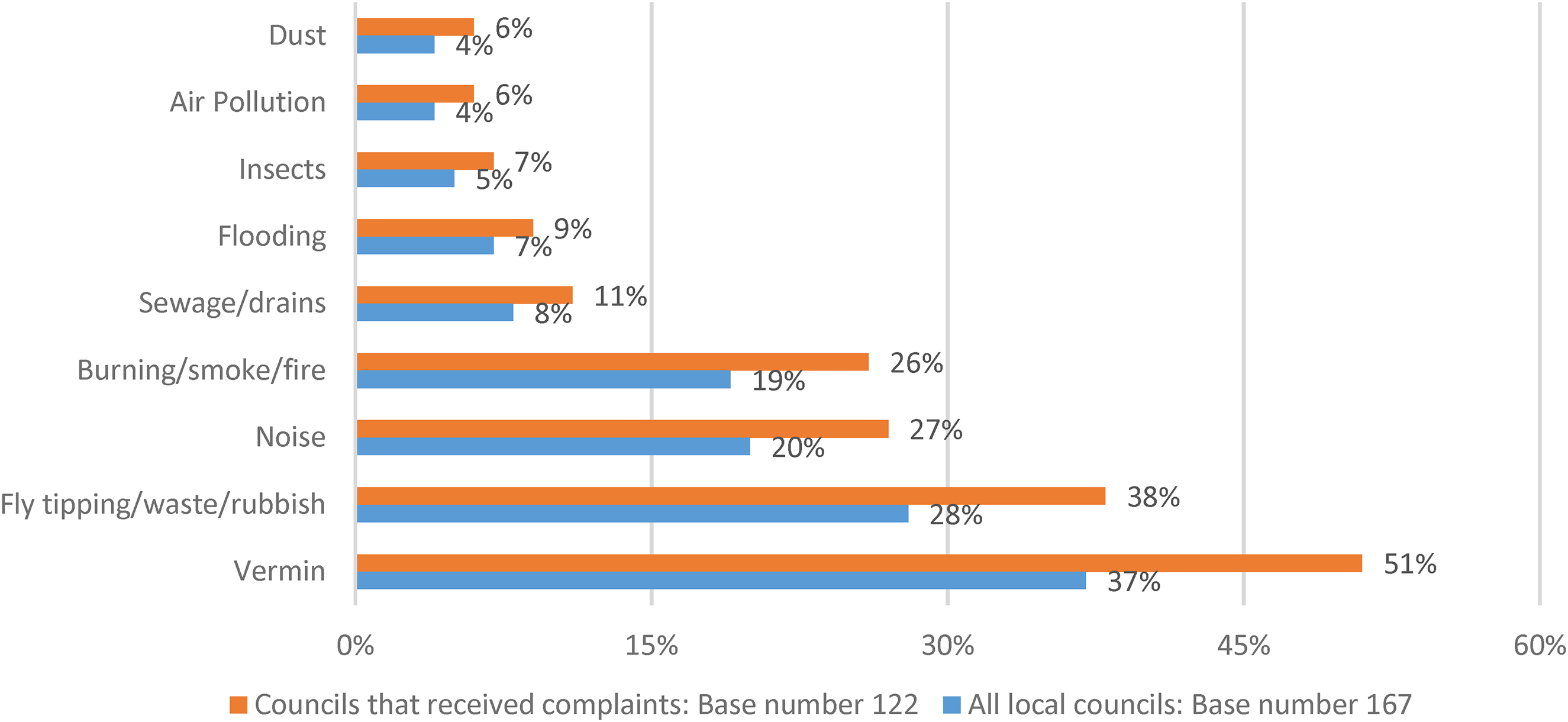
Type of environmental complaints made to local councils, 2017–2021.
Whilst the majority of sites have a legacy element to them due to historic planning decisions, this research also found that new sites are also being placed in undesirable and hazardous locations as the next section explores.
Site locations: A contemporary issue
Transit sites, for short stays, are being developed in greater numbers because of the Police, Crime, Sentencing and Courts Act, 2022. The growth in these sites is to offer Gypsy and Traveller communities somewhere legal to stay rather than risk being fined or imprisoned when stopping roadside. Transit sites were mapped and in-depth analysis was carried out around the development of a new permanent site. The consequences of a planning system that dictates where nomadic Gypsies and Travellers can live, alongside spatial confinement, and the criminalisation of nomadic life means that is that Gypsy and Traveller communities are unable to leave places that are hazardous without risking prosecution. Transit sites have traditionally been used by community members when they are travelling for work. They are also used for leisure purposes, for example when travelling to traditional horse fairs, such as Appleby or Stow, or on the way to large religious meetings that have become increasingly popular (Quarmby, 2013).
A number of short-stay transit sites are currently working their way through local authority planning departments. However, there is a real concern about the suitability of these proposed sites. Adrian Jones, policy lead for the Moving for Change network, noted that the strategy is to ‘create sites where they think nobody would want to go’ and if people do not use the designated sites they can be arrested. Transit sites are placed in even worse locations that permanent ones as Figure 3 shows. Half of the available transit sites were within 50 metres of an environmental hazard and a transit site in the South of England is less than 50 metres from the sewage works, the recycling/refuse centre and an industrial estate and pollution from major roads is also an issue. Facilities on transit sites can also be at the bare minimum. Toilet, showers and washing up areas are often inadequate and in some cases there is no electricity supply. Families use these sites, and the bits of tarmac or gravel that are allocated for sites means children have no green space or safe place to play (Quarmby, 2022).
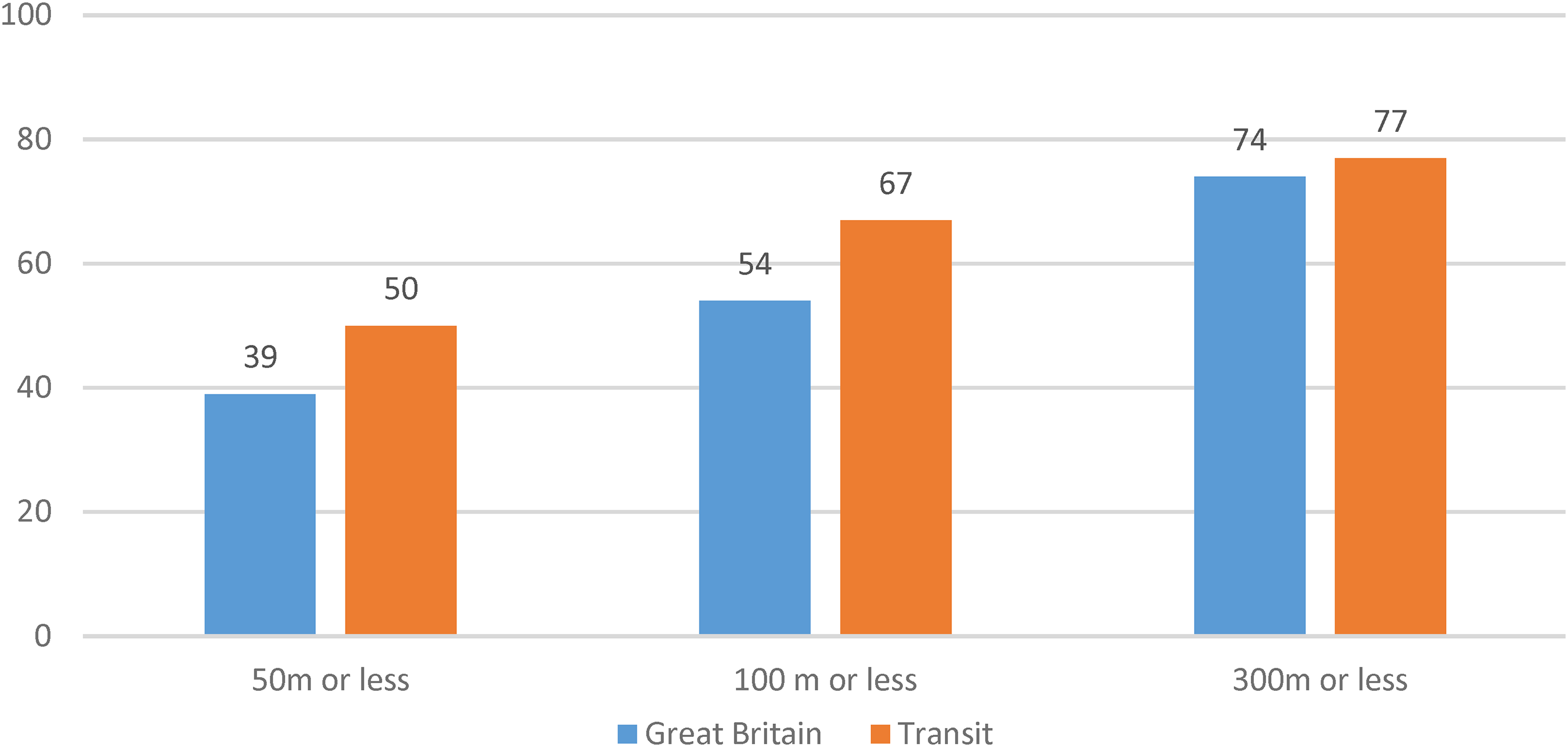
Total % of sites in Great Britain and Transit sites within 300m, 100m and 50m of at least one of: motorways, A roads, rail lines, refuse/recyling plants, sewage works, rivers, canals, sea, industrial estates.
The level of hostility from many living in bricks and mortar housing means that where new permanent sites are proposed, local resistance is used to try and block planning permission with pressure brought to bear on local planning officers through local politicians, in much the same way as described by Cripps (1977). One recent example is a site in southern England, which includes 1100 new homes and a small Gypsy and Traveller site. The Gypsy and Traveller site is to be located around a quarter of a mile from the rest of the community with a separate entrance, no vehicle access, along a track with no footpath and next to the sewage pumping station that services the whole development and by the West Coast Mainline railway line. Yvonne MacNamara, CEO of the Traveller Movement, explained how this was typical of local authorities who treated Traveller communities as ‘like second-class citizens’ which means more generally that the communities are not seen to be deserving of public resources (Taylor, 2008).
The new development is planned to include a school, health care centre and shops but the distance between the developments means that children from the Gypsy and Traveller site will most likely attend a different school than those in the housing. Tyler notes how Gypsy and Traveller people are ‘the quintessential outliers and often lead a shadow parallel existence alongside the settled communities in the areas in which they live’ (2013: 133). Before the new site was authorised, other sites were considered in the local authority area. One site was proposed then dropped after a bitter local campaign and numerous objections. A local newspaper referred to ‘relief as Gypsy and Traveller site plans for [place name] are scrapped’. One councillor, said at a planning meeting in July 2016 that ‘The proposed site…is right on the entry to [place name] which does not give a good first impression of the town’ and suggested that Gypsy and Traveller people should be offered houses instead, with total disregard for nomadic ways of life. Another councillor said in a planning meeting, that more sites would encourage ‘behaviours that residents do not want.’ Even though the National Planning Policy for Traveller Sites 2015 makes clear that sites should not be deliberately isolated from settled communities, it is clear that this new site has been designed with isolation and segregation in mind. This segregation was also to include a landscaped buffer to keep the already separated site out of sight. Planning decisions have consequences that impact for generations, as the next section shows.
Site locations: History of site development and resident's perspectives
The pattern of making Gypsy and Traveller people ‘outliers in our society’ (Marcus, 2019: 1) is long established. This section considers the consequence of planning for segregation and of placing sites in dangerous places by exploring the findings from site visits and interviews with site residents and local NGO representatives. One site was in the north of England adjacent to the town's recycling centre and the other was in Wales next to a busy road and very heavy industry. Both sites were local authority authorised and managed.
The site in the north of England was authorised in the 1970s after pressure to address the local homelessness problem among Gypsy and Traveller communities. The search and identification of possible sites was always met with resistance from local communities complaining that sites were ‘noisy’ and ‘a nuisance’ and these complaints were reported on in local newspapers who fueled the flames of anti-Gypsy and Traveller discourse. One paper reported a statement made by the then chair of the housing panel that, ‘it is just not on to have Gypsies coming so close to houses’, making clear the view that Gypsy and Traveller people should be kept away from settled communities. Negotiations to acquire land was protracted, some council tenants went on rent strike because caravans were camping nearby while Gypsy and Traveller people were unwilling to move until sites were created. The council finally sought planning permission for the current site at the end of 1974. The chief planning officer wrote the Development Control Report stating in a handwritten document obtained through a Freedom of Information request that, ‘The site itself is hard surfaced and it is proposed to erect, where necessary, a plastic chain link fence on pylons, for security purposes.’ Nevertheless, the chief planning officer recommended that the site go ahead, without planning objections stating that, In my opinion the proposal envisages the introduction of a residential use into what is primarily an industrial locality and as such is unacceptable. However, I have been given to understand that the use of this site as a Gypsy encampment has been agreed in principle by this authority and as such I would therefore recommend that no objection be raised subject to the usual conditions.
A tour of the site during one of three site visits showed mould in utility blocks, where families use bathrooms and cooking facilities, cracked paving on their slabs (concrete pitches) which residents felt was linked to the vibration from the recycling plants and the heavy trucks that rumble around the site to the scrapyard every day. There is also a chicken slaughterhouse nearby, which burns carcasses regularly and so windows need to stay closed even in the summer as the smell is overwhelming. The summer also brings flies who are attracted by the waste recycling and other industrial processes that surround the site. As you enter the site you can hear the noise from the trucks, just a few metres away, as they go to the recycling plant and the heavy industry and the air is heavy with dust. There is no green space for the children to play in. One resident who had lived on the site for nearly 30 years, and is the third generation of her family while her children are the fourth generation to live on the site, described some of the problems as follows: We are living in an industrial area, it's the air quality, the sand, the dust, the recycling tip is just behind us, so the noise is a big problem…There is an incinerator near the slaughterhouse and that's really bad, they run it once every week or two, the incinerator starts and the smell, you can’t open your door… In the amenity blocks some of them have got really bad mould. You can wipe the black off but it's comes [back]…we’ve got no green space (Jane). The skips drop at five o clock in the morning it's like a bomb going off …you never get used to because it's just random… and it drops so hard it shakes the chalet….like an earthquake (Mary). Skin complaints…Like eczema and like, psoriasis, you break out all the time, because that can be connected to pollution…if you go away from the site for a couple of weeks, you can notice it goes away, then you come back to it. You know, as it comes back again. Years of institutional and societal racism that has led to an untenable situation borne out in Gypsy and Traveller people's life expectancy and suicide rates. Simply put, no other community would be expected to live on industrial estates flanked with tips and slaughter houses (NGO Interviewee 1). Gypsies and Travellers are forced to live in areas that no other ethnic group would be expected to live. At [organisation] we see the human cost of this inequality to people's physical and mental wellbeing. It is heartbreaking to hear our young people talk about themselves in relation to the vermin and pollution they live alongside and the impact this has on their feelings of self-worth (NGO Interviewee 2).
Similar to the site in the North of England, the site in Wales was also contested before planning permission was granted. The planning department attempted exemption from providing a site, under the Caravan Sites Act 1968, which was refused by central government. Alongside resistance from planning there were also local protests, media opposition and local councillors attempted to pass responsibility to other geographical locations. Gypsy and Traveller people moved from one unofficial site to another, trying to find somewhere they could settle. The site location was first discussed in the autumn of 1972. The Freedom of Information request showed that the council initially considered that the site was, …too remote, too exposed, dangerous because of traffic and that some children would have to change school unless special transport were provided.
During the public inquiry the council admitted that there was a problem with displacement and homelessness because traditional Gypsy and Traveller sites had been lost to developments and the consequence was that communities were instead living on unauthorised sites where they could be moved on. Reflecting on the proposed site location the public inquiry distinguished between what would be suitable for what it termed ‘the ordinary citizen’ compared to the suitability for what it described as ‘itinerant families’. Whether the site would be acceptable to the ordinary citizen, accustomed to a comfortable way of life seems to me irrelevant. The issue is whether the site would be suitable for a Gypsy encampment, in mind the squalid conditions in which many itinerant families presently exist. national abjects…a population symbolically and materially excluded… forced to either give up their nomadic way of life or compelled to subsist in often abject border zones within the state (2013: 135).
The site location was known to be problematic and in 1982 the City Environmental Health Officer wrote to the council's chief executive, solicitor and other key personnel members, saying that the condition of the site was ‘very bad’, and that the site was ‘heavily rodent infested’ stating ‘in my opinion the condition of the site is such to be prejudicial to the health of the inhabitants’. The problems on the site have continued. There is a nearby water treatment plant giving off a ‘foul odour’. The council officer explained, in a Freedom of Information request in 2022, how residents described the smell, …preventing them from being able to open their windows in…the extreme heatwave we recently encountered. You can’t even leave the windows open in the summer, the smell of the sewer is awful, in the summer it can be putrid (Tracy). I’ve got COPD, you can’t breathe here. A lot of people have asthma…Lots of babies in the community have poor health…A lot of them have skin rashes…and we can’t bathe them, and the price of the water is high and we need to wash and cream them twice a day… nobody ever lived past about 50 here…whatever is coming out is killing people…lots of people are dying of chest, COPD, cancer (Sarah). The kids are forever off school… it was impetigo…there are a lot of bad chests. It's from the [industry], you get up in the morning and you would have to wash everything again from the dust its red dust, you see it overnight you can’t leave the dust, it won’t come out if you don’t clean it every morning. If it damaging to cars, what is it doing to us…
Conclusion
The article has shown where Gypsy and Traveller sites are placed and the impacts of this on the everyday lives of people living on sites. Councils - planning and health officials in particular - were well aware that the sites were located in unpleasant and sometimes hazardous places. Objections made to planning are often couched in overtly racist tones from local residents and reported in the local press, who did not want Gypsy and Traveller people near their houses and neighbourhoods. Resistance to sites reduced the options available for site placement leaving Gypsy and Traveller communities living in poor locations, often cordoned off and confined by physical barriers like fence chains rather than trees and shrubs. The research also found that over time site conditions had worsened as many sites were located in or near industrial areas that had expanded, as the two case studies have shown.
The experience of environmental racism is clear. The mapping shows the proximity of Gypsy and Traveller sites to busy roads, railway lines, council tips and recycling centres, sewage stations, industrial estates and water. This isn’t just a historic planning legacy; new sites which have recently been developed show that planning officers are still facing largely the same objections and transit sites are often in worse places than permanent sites. The case studies of two sites showed the terrible living conditions on sites that include vermin, flies, dust, odour and noise and the constant battle to keep things clean by having to wash things down every day but also not being able to open windows even in the heat of the summer when the flies and odour was even worse. What is clear is that both the conditions as well as the broader problematic environmental factors such as isolation and a lack of green spaces (WHO, 2018) were evident on Gypsy and Traveller sites.
Environmental racism leads to poor health outcomes. Although health data was not collected as part of this research, survey data shows that Gypsy and Traveller communities experience poor health outcomes and these were alluded to by people living on sites where respiratory, gastro and skins complaints were the norm among site residents. The longer-term and inter-generational consequences of the physical environment, in what Geronimus (2023) terms as ‘weathering’, were also clear from the interviews with site residents. Site residents were not only living on the margins, away from settled communities and the services that others have access to, but were contending with the health effects of industry and pollution.
The choices for Gypsy and Traveller communities continues to get bleaker. There is a massive shortage of available pitches and therefore a large homelessness problem. Settled communities resist Gypsy and Traveller sites in their local areas and so sites continue to be located on the margins and peripheries of towns and cities. These locations leave communities isolated and excluded, and conditions can be dismal. The 2022 legislation makes things worse, as Gypsy and Traveller people are forced to either stop their nomadic way of life or use transit sites, which are often worse than permanent sites. One site resident, commenting on how poor the conditions were summed up the problem by stating that ‘they wouldn't expect anyone but a Traveller to live here’.
Footnotes
Acknowledgements
Thank you to all the site residents, who took the time to talk about their experiences and were so hospitable and generous with their time. Thanks to the organisations who explained issues and supported the research including Gate Herts, Leeds Gate, London Gypsies and Travellers, York Travellers Trust, Travelling Ahead and Gypsies and Travellers Wales, the Traveller Movement, Friends, Families and Travellers and Moving for Change. Also to academics, campaigners and experts, including Ryan Powell, Margaret Greenfields, Bill Forrester, Candy Sheridan, Abiline McShea, Colin Clark, John Mawer, Matty Mitchell, Lynne Tammi and Adrian Jones. Thanks to the anonymous reviewers for their helpful comments and suggestions.
Funding
Part of this research was funded by a Paul Hamlyn Foundation Ideas and Pioneers grant (2021–22), awarded to Katharine Quarmby.
Notes
Author biographies
Address: Arthur Lewis Building, University of Manchester, Oxford Road, Manchester, M13 9PE
Email: alice.bloch@manchester.ac.uk