




Abstract
There is an assumption in UK policy-making that there is a problem with the integration of migrant communities. This has led to political and media attention that suggests a major societal issue. This article rejects that claim but not by showing that migrants are integrated, but by changing the analytical gaze. It begins with the premise that the least integrated group in British society is not those at whom political attention is aimed. Rather than migrant communities, it is elites that live largely separate lives, and their separation is not one resulting from discrimination and/or lack of material resources, but is one actively pursued across multiple domains and transmitted inter-generationally. Using UK Government refugee integration strategies as the framework, the article examines what we know about elite integration across a multitude of domains and shows that elites live largely self-segregated lives.
Introduction
In 2008 Savage and Williams called for a revitalisation of study into elites (Savage and Williams, 2008), which contributed to a re-invigoration of research across multiple dimensions and using multiple methods. In later work Savage and Hjellbrekke (2021) pointed out that research has tended to be focused on specific aspects of elite position, their political power, corporate power and social and cultural capital. The aim of this article is less about elite power, but elite segregation. What elites do, how they live and subsequently what this might suggest about integration or segregation is the focus of this work.
The assumed behaviour of racialised populations has led to accusations of non-integration and in some cases policies and strategies applied to them to move them from the periphery, where the supposedly are, into a mythical and coherent centre. The aim here is not to examine elite integration in comparison to, for example, refugee integration where considerable work has been done. Instead, we seek look at what the evidence says about elite integration in its own right, but using the framework applied to refugees. The objective is to raise broad questions about integration strategies aimed at racialised populations by inverting our gaze towards a population that generally have an ‘integration dispensation’ (Schinkel, 2018). To do so we use the framework developed for the Home Office to look at refugee integration in 2004 (Ager and Strang, 2004) and used ever since, the ‘Indicators of Integration’ framework. This framework discusses outcomes comparable with the overall population, taken as a single unit, and looks at social connections between groups. The groups mentioned are 'national, ethnic, cultural, religious or other'. While ‘other’ could include class, it is not named.
The suggestion here is not that elites are the only population that to varying degrees separates from other demographics in society. Indeed, there are many groups of the population that do so in various ways. What we do suggest is that while a great degree of political attention is paid to other groups, mostly but not exclusively racialised groups, elites have had no such attention. This raises significant questions as to the aim of integration policies. They not only assume a singular whole into which people must integrate but, as we seek to show below, they provide a dispensation for one very segregated group.
Refugee integration – a solution in search of a problem?
The British government has had a political focus on the integration of migrants for some decades. The assumption underpinning policy has been that migrants need to adapt to a singular and ill-defined British culture and identity to ‘fit in’. From the 1960s UK Governments operated a dual approach, to limit migrant numbers and outlaw overt discrimination for those here (Solomos, 2003). This approach continued until the late 1990s when the New Labour Governments maintained aspects of it, but also opened up access to ‘migrant workers’ on behalf of business. However, alongside this they appealed to an apparent public desire for restriction by appearing tough on unwanted migrants, mostly asylum seekers and refugees. Thus, asylum applicants were subject to restrictions (Consterdine and Hampshire, 2014), and those recognised as refugees were supposed to ‘integrate’, making them more culturally ‘like us’ (Kalra and Kapoor, 2009). Outcomes of integration were compared to the overall population, taken as a single entity, but in many cases the direct comparison was with people in communities where refugees lived, most often, though not exclusively, deprived communities.
A number of policy documents and integration strategies problematise migrant integration and supposedly also suggest solutions. The most up-to-date UK Government Integration document from 2019 is used in this article but is a continuation of the 2004 ‘Indicators of Integration’ framework. The assumption in integration policy is that there is a problem with integration, that minority communities are living apart, or living ‘parallel lives’, meaning that ‘we’ are ‘sleepwalking into segregation’.
Thus, the picture presented is one of ethnic ghettos and urban landscapes being marked by segregation. Such arguments, of course, are also bound into debates about national culture and national values, positing that such a thing exists that ‘we’ have and that newcomers should be required to both have and to perform. It was under Tony Blair, Prime Minister between 1997 and 2007, that these developments took off. He asked, 'how do we react when that ‘difference’ leads to separation and alienation from the values that we hold in common' (Ware, 2008). However, there is an inability of those who claim that others do not conform to these values, to define what these values are.
Cantle provided much of the academic gloss to arguments around immigrant integration. He argued that ‘migrant communities’ and ‘host communities’, taken as two homogenous groups, 'often do not seem to touch at any point, let alone overlap and promote meaningful exchanges' (Cantle, 2001: 9). Simpson and Finney's work argues that most claims about such segregation 'turn out to be myths' (2009: 2). Thus, while mythology builds up around immigrant integration, silence is evident in the stories of self-segregation among those who have an ‘integration dispensation’ (Schinkel, 2018), British elites.
It is the argument of this article, that elites in Britain, and indeed likely elsewhere, are the least ‘integrated’ social group across the multiple domains of integration. The main difference in their lack of integration is that they choose to self-exclude from wider society (Sassen, 2014).
For Nylund, there is a strong inter-relationship between place, and experiences and normalisation of segregation. Using Lefebvre 'representations of space tend to manipulate the lived space' (2000: 59), so discourse, or lack of discourse about separate lives creates an understanding of the situation, as much as people living separate or connected lives. Discourse about ‘the problem of integration’ creates the image of problematic lack of ethnic mixing, while the silence on class segregation is suggestive of a lack of problem.
This article seeks to begin the process of redirecting our gaze from those at whom integration is presently aimed towards those who, we wish to suggest, are a largely self-segregated part of the British population. We do not provide any new empirical analysis but seek to bring together existing elite research under the ‘Indicators of Integration’ framework.
Social capital and refugee integration
Much integration theory either explicitly or implicitly engages with social capital, and integration policy approaches have done likewise. For the purposes of this article, we look at social capital in a necessarily circumscribed way that encompasses only brief mention of the perspectives of Putnam and Bourdieu. There is a disjuncture between the two in terms of their use, with Putnam's approach being evident in policy around racialised populations and Bourdieu's having more traction in work on elites. Given we look here at elites, but using frameworks applied to racialised groups, these are appropriate for this article, though we recognise that the work here is a simplification.
Putnam's work concerns what he saw as the decline of community in the US, evident in falling voter turnout and involvement in civic organisations. Putnam argued that this was due, at least in part, to an absence of social capital, which he conceives of as social trust and norms of reciprocity which impact on collective values and societal integration (Putnam, 2001). He saw its decline at least in part as a result of increasing ethnic diversity. He introduced two distinct forms of social capital: bonding and bridging social capital (Martikke, 2017: 4). The former refers to internally coherent networks that are characterised by specific forms of reciprocity. Bridging social capital, on the other hand, looks outside of these groups and connects them to wider forms of trust and reciprocity. Bridging social capital is viewed as having a positive impact on community cohesion and the creation of common causes (Ibid) and is viewed by Putnam as a societal good.
His work has had considerable appeal to policymakers. It uses a series of indicators to prove the existence or absence of social capital, done through supposedly quantifiable measures that can be tracked over time. It also appeals because it provides apparently cheap and non-economic solutions to social problems (Portes, 1998: 3).
Bourdieu's perspective is much more class based, with social capital one of three forms of capital (alongside cultural and economic) inherited by social class position and utilised by individuals. It is thus an individual rather than a public good. According to Bourdieu (1984), social capital reflects the material advantages gained by individuals from inheritance and social networks, and so it reinforces class inequalities. What makes individuals connect are the very patterns of behaviour and norms that have been produced by habitus and therefore reflect an individuals’ position in society (Martikke, 2017: 8). As a result, behaviour is ultimately about reproducing the existing social order (Ibid).
There are clear links between Putnam's view of social capital and integration policy, with its focus on quantifiable indicators, norms, values, networks and trust. Policy has placed demands on the ‘outsiders’, that they should become more like ‘us’. This is closely linked to the New Labour discourse of migrants having a ‘duty to integrate’ (BBC, 2006).
The starting point to understanding UK Government views of social capital and migrant integration is to highlight what it is that is being asked of migrant communities, before we later apply them to elites. The ‘Indicators of Integration’ framework was the prime means by which refugee integration was both conceptualised and operationalised, and this framework has subsequently been updated to include other dimensions. See Figure 1:
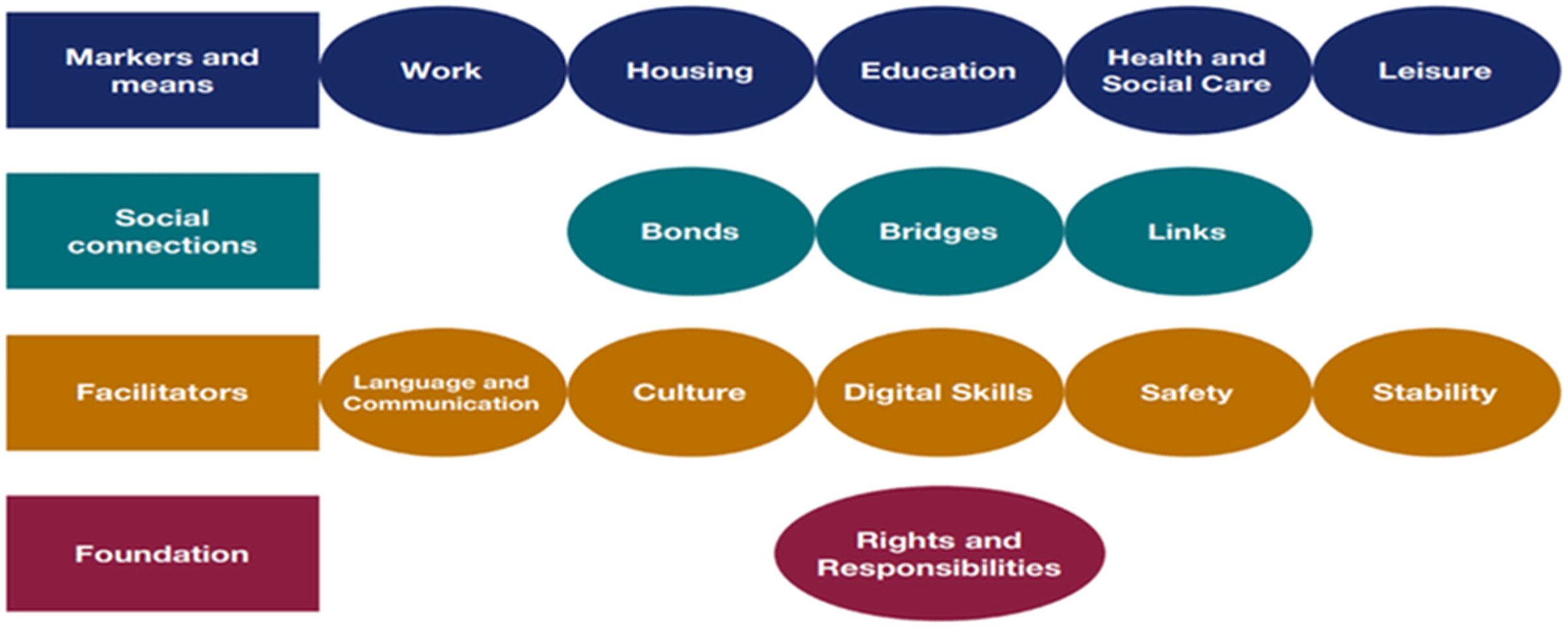
Indicators of integration framework 2019.
Most of what follows emerges from Section 7 of the Home Office report (from here referred to as ‘The Strategy’), that accompanies the 2019 Framework, with a focus on ‘outcome indicators’, quantitative indicators that borrow from Putnam's approach to diversity and social capital (Putnam, 2001). Below we highlight some of the ways that the Government suggest these indicators be measured. We focus on the Markers and Means and Social Connections, along with culture.
There are five headings under Markers and Means, the so-called domains of integration: Work, Housing, Education, Health and Social Care, and Leisure. Home Office Research Report 109 (2018: 16) suggests that 'these domains represent the context in which integration can take place as well as major areas of attainment that are widely recognised as critical to the integration process'. As examples the Strategy suggests that progress in education is a key marker of integration as it provides employment opportunities and social connections, though almost entirely within deprived or disadvantaged groups, perhaps providing ‘bonding capital’ but no ‘bridging capital’.
In terms of social connections, the emphasis is on relationships between people.
In the foreword to the Framework, then Immigration Minister Caroline Noakes states that 'Integration encompasses access to resources, like education and healthcare, opportunities for work and leisure, as well as broader concepts like social mixing.'
The key question raised by such comment, and one seldom if ever addressed by policymakers, is integration into what and with who? (Favell, 2019). So, when Noakes discusses access to education and healthcare, or jobs, there is no recognition that people are being asked to integrate into a divided and stratified society that, following Bourdieu (1984), reproduces itself according to individual self-interest.
From the outset then, there is a supposed absence of integration. There is a conception that the absence of integration is a social ill, and that absence is routinely highlighted as problematic. Across all the factors highlighted by Noakes, class cleavages would be all too apparent if they were to get similar attention. It is to one of these cleavages that we now turn.
Who are the elites?
As this article uses literature from other scholars, and they define elites differently from one another, no single definition is provided. Elites in most of this literature are distinguished only by the amount of wealth they have accumulated and what they do with that wealth, not by their ethnicity, gender or any other demographic factors. Nevertheless, it is worth making a few comments to explain some of the broad parameters of who constitutes the elites. Advani et al. (2021) provide a useful point that we should look beyond income. They suggest that if we look at property wealth, physical wealth, private pension wealth, financial wealth and business assets (2021: 408), we find even greater concentrations, and with it twice the level of inequality than if we looked solely at income.
Advani et al. suggest 5 elite thresholds: families where adult net worth exceeds £250,000, £500,000, £1 m, £2 m and £5 m (2021: 413/14), while Atkinson and Kei Ho (2020) use ultra-high net worth for those with disposable assets of over £30 m. Their £30 m or Advani et al.'s £5 m net worth (the top 1% of the population), are equally relevant and encompass most of the behaviours discussed here. The increasing nature of wealth concentration is discussed by Advani et al. (2021). Between 2016 and 2018 the top 3 deciles of net wealth increased their share of national wealth, while the middle 5 deciles share decreased. National mythology suggests that class strata are permeable. This is refuted by the evidence. Advani et al. show a remarkable stability in higher social strata, and that any mobility that does take place is almost entirely from the stratum immediately below (2021: 399). 'They are clearly a relatively exclusive grouping, with restricted upward mobility into its ranks' (Savage et al., 2013: 233).
Most work on elite minorities has been about political representation and minority communities (see for example Saggar and Geddes, 2000), while other aspects of elite position and experiences have yet to receive much attention. That said, there remains an ‘ethnic penalty’ in terms of income for many racialised elites (Higgins et al., 2024), and so elites are not homogenous. Nevertheless, in the literature that follows elites are not defined according to their citizenship status and are taken as a single entity, and so for the sake of argument we do likewise.
Housing and neighbourhoods
When we look at individual domains of integration in the Strategy it is useful to highlight in brief how each is described before pointing to existing research on elite segregation across them. Starting with housing, the Strategy states that 'Housing structures much of an individual's experience of integration. Housing conditions impact on a community's sense of security and stability, opportunities for social connection, and access to healthcare, education and employment' (2018: 32). So housing is presented as having multifaceted effects, though the individual indicators focus entirely on housing security and social connections. Elites clearly do not lack security, so it is the other aspects of housing we look to here.
Most work on elite segregation has been spatial, examining housing and neighbourhoods. Musterd et al. point out that there is a long history of wealthier communities being spatially segregated, but they suggest that 'metropolitan Europe is becoming more divided, with increasing income disparities accompanying growing spatial separation of the better-off from the poor' (2017: 1070). Like wealth accumulation these things seldom occur as a momentary experience but are part of a longer process that links neighbourhoods to wider social structures. 'At the heart of socioeconomic segregation research, we find the strong assumption that spatial distance follows social distance' (Musterd et al., 2017: 1064). Elites seek housing and neighbourhoods alongside other elites, the type of people who they already engage with in schools, Universities, the workplace or in pursuing cultural activities.
Morrison points to the issue of inequality in choice and decision-making whereby poorer people are segregated in neighbourhoods that are determined by the availability of affordable housing, while elites do so voluntarily. 'High-income households believe sorting into successfully higher-priced sections of the housing market will be to their financial benefit, that it will help support their relative social position, will enhance personal safety and bolster the chances that their children will continue to enjoy upward social mobility' (Morrison, 2015: 73).
Benard and Willer (2007), like Bourdieu, see wealth and status as linked but different, but they point to their intersections being housing and neighbourhoods where privileged individuals wish to live together. 'While residential choice processes are based in complex cultural understandings of what factors make a neighborhood attractive, we believe that much of the dynamics can be captured in terms of wealth and status. These two variables shape the relative desirability of neighborhoods and the relative ability of individuals to access them' (Ibid: 152).
Education
In terms of education the focus of the Strategy is on examining access to and progress within education, but with base level indicators, such as the % gaining five GCSEs. It states that 'Education creates significant opportunities for employment, for wider social connection, and mixing for language learning and cultural exchange'. However, like housing, education can be tied to integration, but also to segregation, in some cases quite severe segregation. We now look at existing research, first of private schooling and then of access to elite universities.
Gutiérrez et al. (2020) look at school segregation using global Pisa data, an international survey of schooling, and like much of the other work reviewed here, they point to forms of elite self-removal. School admissions outside of selective schools are infected with neighbourhood segregation issues. This link means that 'education policymakers may need to be much more radical if they are to foster greater levels of integration between the rich and the poor' (Gutiérrez et al. 2020: 157), though there is little evidence of interest never mind radicalism in the UK context. This even though, for Gutierrez and Torres, educational inequality impacts on social mobility, and potentially social cohesion, but a class cohesion that has no apparent locus in public debates.
The UK Government itself touches on some of these issues in their State of the Nation report (2019), which aims to examine social mobility. However, its concern is entirely about mobility from low to medium, not about how those born into elite classes stay there, and what they do with the reproduced privileges that they accrue. That said, there is acknowledgement of the circularity of this process, and a hint at why those with power do not seek to do anything about it. 'Independent schools are both better resourced and often socially exclusive in nature. Given society's decision makers remain disproportionately drawn from independent schools, there is a risk that future leaders will be detached from the broader lived experience of the people their decisions may impact' (State of the Nation, 2019: 35).
In the UK, the percentages of school children attending private schools has remained relatively stable at about 7% since the 1980s but the higher up the class ladder the more private schooling becomes the norm. 'At the one-hundredth percentile, close to 60 per cent of children go to an independent school. At the ninety-fifth, this falls to 17 per cent' (State of the Nation, 2019: 53). For those at the top, the norm is private, and this also reproduces labour market privilege (Ibid 54). However, in a somewhat bizarre articulation the Governments’ State of the Nation report warns that independent schools risk entrenching privilege, rather than that being the whole raison-d’être of that education sector. As a key site of capital conversion for individuals (Gamsu, 2022: 1241) privilege is ingrained given that private schools have income per pupil of 3.7 times that of state schools, and the ratio increases for the more expensive and exclusive private schools (Ibid: 1247).
And just as not all Universities have the same elite advantages, neither do all private schools. There is gradation. 'There's evidence that the more you pay, the more your position in the queue improves. The UKs two most expensive private schools, Eton and Winchester……..are also the two most successful of all UK schools in terms of Oxbridge offers' (Kidd and Jago, 2020: 1202).
Kidd and Jago (2020) examine links between elite schooling and elite higher education, and then on to elite employment, and see schooling as both a tool and an outcome of segregation. They point to Sutton Trust research that shows that just 8 elite schools in the southeast of England, 6 of them private, provided more students to Oxbridge between 2015 and 2017 than 2900 other schools, while they also add that such students then go on to better paid and more interesting jobs (Kidd and Jago, 2020: 1201). Dorling adds that the most prestigious 100 schools account for 30% of Oxbridge students, and 84 of them are private. 'We have an educational system that is designed to polarise people – one that creates an elite who can easily come to have little respect for the majority of the population' (Guardian, 2014).
Donnelly engages with habitus in Higher Education to make the point that 'class position can play a significant role not only in the way young people conceive of the HE landscape, but also in their understanding of the importance of making the ‘right’ kinds of choices' (2014: 57/8). There is a socialisation process that teaches the rules of the game, but there are also institutional links between private schools and prestigious universities. Thus 'the knowledge and social capital evident within the private schools made Oxbridge a real and realisable option for many of their students' (Ibid: 58). So, the social connections that supposedly support integration in universities, as in other sites, only take place within rather than between social classes, providing little in the way of common values or trust.
Boliver (2013) has examined access to elite Russel Group universities in the UK between 1996 and 2006 and finds that not only is there an ‘at application’ filtering, but also that those from ‘lower classes’ are less likely to apply to more elite universities. Thus, the notion that a place is ‘not for the likes of me’ is a key factor in ensuring that elites dominate the lecture theatres of elite institutions. They are viewed, according to Boliver, as the preserve of those who have attended private schools. However, she also finds that a second filtering takes place, that equally qualified students from state schools are much less likely to receive offers of admission even if they do apply (Ibid: 344).
Over and above access to the most prestigious universities, habitus may also play a part in the continuation of studies, with dropout rates from these institutions much higher for those not from elite backgrounds (State of the Nation, 2019: 85). This means that the very limited social interaction between classes that does take place at these institutions tails off as university life proceeds. Once more this perhaps suggests no unity of values or even experiences across social classes, but instead the classed nature of society creating segregation.
Employment
The Strategy discusses employment in relation to economic independence and progress and sees this as something that supports integration. Again, it talks of bonding, and building cultural competence, but not cultural capital. As Favell argues, 'A lot of celebrations of 'successful' integration are celebrations of class inequalities—how wonderful it is that black people have attained the modest success of white 'national' working classes' (Favell, 2019: 4). Those in elite jobs have a dispensation. A combination of habitus and cultural, social and economic capital combine to ensure that employment at all levels is a site of segregation rather than integration.
However, an important question here concerns the relationship between higher paid, elite jobs and integration, and we would suggest that the evidence shows that for those in elite employment, the jobs become less rather than more indicative of integration as they ascend the employment ladder.
Wakeling and Savage suggest that the move from university to employment is imbued with elite privilege. 'The golden triangle’ of Oxford, Cambridge and certain London institutions emerges as a distinct elite' (2015: 290). Hanseke et al. also point to the links between elite education and employment. 'In Britain, private schools propel a narrow sector of the population towards successful careers in elite positions' (Henseke et al., 2021: 252). Employment into positions of power in business, politics, administration and the media are dominated by those who attended private schools (Ibid: 252), though it is also possible to add the judiciary, medicine and finance to that (Friedman et al., 2015).
The link between social networks developed at elite educational institutions and elite occupations is also one made by Lambert and Griffiths (2018). They point to continuities in patterns of social interactions 'which are consistent with them actively seeking occupational social reproduction' (Lambert and Griffiths, 2018: 345). Privilege is reproduced and social, cultural and economic capital deliberately stratifies.
Boliver (2013) also hints at the ties between educational segregation and access to more prestigious employment. 'Graduates of more prestigious universities have been shown to be more likely to secure professional and managerial jobs and to earn higher salaries' (Boliver, 2013: 345). Thus, the dominance of elites in prestigious Higher Education institutions then carries into the labour market, in part due to the networks and recruiting practices of employers. 'Privately educated graduates are a third more likely to enter into high-status occupations than state educated graduates from similarly affluent families and neighbourhoods' (MacMillan et al., 2015: 487). The process then is relatively simple, private schools lead to access to higher status universities, which leads to better paid and more high-status jobs, allowing the levels of disposable income to reproduce the process inter-generationally (Freidman et al., 2015). Others can access these educational establishments, and indeed sometimes jobs, but they do so at a comparative disadvantage (Freidman et al., 2015: 268). Higher incomes (on average £12,000 more for those from elite backgrounds), and higher cultural and social capital are more evident among those from elite backgrounds working in key professions. Those paid more are more likely to have been schooled privately and/or attended Oxford or Cambridge and they carry cultural and social capital that we return to shortly.
Health
In relation to health, the key issues in the Strategy are equity in access to health services and the responsiveness of such services to the individual. It states that 'Good health enables greater social participation and engagement in employment and education activities (2018: 34)'. Key measurement criteria concern comparative health and mortality rates. In the present era the life expectancy of poorer sections of the community are falling, while for elites they continue to rise (Raleigh, 2018). Thus, the issue again emerges of who is to be compared, and subsequently what equity means. For elites, does their standing as a group with diverging health outcomes reflect a lack of integration, certainly a lack of connection to a publicly funded health system?
The Marmot Review, commissioned in 2010 to examine health inequalities is explicit that they emerge from wider inequalities. Indeed, of use for this article, that review highlights some of the domains in which persistent inequality is clear. They are ‘in early child development and education, employment and working conditions, housing and neighbourhood conditions, standards of living, and, more generally, the freedom to participate equally’. While these inequalities impact unequal health, they are also tied to the disaggregation of the public sphere whereby elites have removed themselves from these domains and established their own, though in healthcare only ever partially. Nevertheless, ability to pay ensures that healthcare for elites is very much responsive to the individual, for example, in making doctors’ appointments at a time that most suits.
Taking access to health and to private health as a key issue, there is some opaqueness in relation to numbers and usage. While elites will often use private healthcare on an ongoing basis, there are non-elites who will save to use it episodically. With increasing waiting lists and an aging population, alongside the impacts of Covid 19, it is likely the occasional users of private health have increased. The interest here it not on sporadic users of private health, but on those for whom the ‘choice’ of public or private is not one that is made. It is that more institutionally separated private system that is the contention, removing as it does the users from the institutions, outcomes and individuals involved in the NHS, and questioning any notion of the equity and responsiveness that the Government claim is an aim and/or outcome of integration.
Recent controversy, or more pointedly the lack of controversy around former Prime Minister Rishi Sunak's use of private healthcare is a case in point. The GP clinic he uses charges £250 for a half hour appointment, making it clearly unaffordable for most people. Sunak argued that it was 'not appropriate' to talk 'about one's family's healthcare'. Dr John Puntis, co-chair of campaign group Keep Our NHS Public responded that 'It should be no surprise that Rishi Sunak has private medical care arrangements; this will be the norm for many of the rich and powerful … those making decisions about vital public services are often least likely to use them' (Guardian, 21 November 2022). Elites do not mix with others in healthcare settings but enter and leave private clinics quickly and at a time of their choosing, a situation that is the selling point for private providers.
So, going back to the Strategy, access to healthcare is not equitable even at the point of need, and only elites have access to healthcare that is truly tailored to their individual needs. Diverging life expectancies are also suggestive of less rather than more integration in relation to health. In terms of social class, there seems little evidence of common values regarding healthcare.
Culture and leisure
Much of the political attention to integration and social capital has been focussed on questions of culture. Indeed, one of Putnam's key ideas, enthusiastically adopted by politicians, is that the existence of multiple cultures reduce societal cohesion. The Strategy looks at culture in relation attendance at cultural events but also at multiculturism and the assumption of a thing called ‘national culture’. It argues that 'An understanding of others’ cultural values, practices and beliefs promotes integration between people of different backgrounds'. The markers include percentages engaging with UK cultural institutions and then moves on to local culture, with the focus on neighbourhood cohesion in the face of diversity. Local culture reflects residential segregation and sometimes has ethnic diversity, but as detailed above, people from different class backgrounds do not tend to live in the same area. Thus, local culture can have some ethnic mixing, but class mixing is absent.
Moving on to the linked issue of leisure, the Strategy says that 'leisure activities can help individuals learn more about the culture of a country or local area, and can provide opportunities to establish social connections, practice language skills and improve overall individual health and wellbeing' (2018: 38). It goes on to suggest that membership of local libraries and sports centres are key indicators, but these are, of course, highly segregated by class. Indeed, the Strategy seems to view leisure as providing bonding but not bridging capital. It can help to keep social groups internally cohesive but does little for broader social mixing.
Culture and cultural consumption are taken up by Warde and Bennett (2008). 'Cultural participation provides a platform on which to acquire and use social capital; meeting the right people lubricates the social life of members of the upper echelons of society' (Warde and Bennett 2008: 240). The issue of the social construction of taste is of crucial importance. Tastes are constructed in a way to be similar enough to constitute membership of a shared culture. Indeed, Warde and Bennet suggest that taste and liking a specific form of cultural consumption is not the key thing, the key thing is to see others and be seen by others in your own cultural social sphere.
In their empirical work with managerial elites Warde and Bennet find shared cultural commitments but also that those who would admit to not particularly liking classical music and opera would attend them as important cultural events. The rhythms of cultural life provide a commonality, such that people from similar jobs, and perhaps also neighbourhoods, would meet each other at such cultural events. Friedman et al. (2015: 276) find that even within key groups of professions there is a cultural split, with those from more elite backgrounds tending to engage more in ‘highbrow’ culture. So even when people who appear ostensibly to belong to the same employment related social grouping are outside of the workplace, they are involved in different cultural endeavours. Elites 'go out to cultural events comparatively often, and even if not very interested, are fluent and have more than a smattering of knowledge about many forms of culture. They collect things. Almost all say they eat out often – and those who say it is a rare occurrence still mostly do so more frequently than the national average. They support cultural organizations. For example, they are likely to be supporters of arts organizations' (Warde and Bennett 2008: 253).
Following Bourdieu (1984), cultural taste exhibits strong elements of the reproduction of privilege and segregation. Friedman and Reeves (2020) examine entries to Who's Who, providing a huge corpus of data that can be compared over time. They suggest that this is the top 0.5% of the population and their work allows analysis of the move from the landed gentry to the new urban elite over time. What they find is that the recreational activities enjoyed by these elites have strong economic barriers to entry, but also that the cultural norm among elites remains what is referred to as ‘highbrow’ arts and culture. There is 'an enduring nostalgia and reverence for the leisured aristocracy, and the attendant 'gentry aesthetic,' remains strong' (Ibid: 341).
Bourdieu argued that people 'tend to draw disproportionately from either cultural or economic resources in their struggle to maintain and enhance their positions in the social order' (Bourdieu, 1984: 725). He identified clear links between elites, the cultural pursuits and interests that they hold, and the cultural activities they engage in. In terms of segregation, for Bourdieu, lifestyle represents the strongest barrier between social classes, a barrier not addressed by political attention to social capital, or indeed in Putnam's work. Bennett et al. (2008) conclude that cultural activities are less about taste and more about space, or to put it simply, which cultural practices different classes wish to be seen to be involved with. They suggest that there are few working class spaces that have not been encroached on by the middle classes, but that there remain cultural spaces that are inhabited solely by elites. 'Cultural preferences track lines of social cleavage' (Ibid: 251). The consumption of ‘high culture’ is also, importantly, tied to locality, and so to the other key indicators of integration. This consumption is seen as primarily having local value and allows integration into a local elite. Overall, Bennett et al. (2008) find that cultural consumption patterns reflect a reality of segregation. Elite respondents in their work almost all attended cultural events such as the orchestra and opera, and those that did not were limited due to their geography rather than their place on a cultural consumption hierarchy. Social capital here is about social networks and social bonds that help to maintain separation between classes.
Conclusion
Much of the political imperative underpinning migrant integration has been based on unfounded assumptions (Simpson and Finney, 2009). Two assumptions have been that a. there is a single coherent whole which people are supposed to integrate into and tied to that b. that ‘British people’ are fully integrated into this whole in a uniform way. This article challenges both by inverting the gaze of integration. We look towards another part of the population, that by all objective measures really do live parallel lives but who have an integration dispensation (Schinkel, 2018), the nation's elites. In doing so we suggest that there is no coherent whole and that Britain is a stratified nation. 'The really decisive difference, after all, is not the difference between the ‘well integrated’ and the ‘less integrated’; it is the difference between those for whom integration is not an issue at all, and those for whom it is' (Schinkel, 2018: 5). As we have shown above, across an array of integration ‘domains’, elites have removed themselves from aspects of society through processes of enclosure.
This is a group who cut themselves off from many aspects of British society, who work closely with people from similar backgrounds, who live in areas with people from similar backgrounds, who have attended private schools and elite universities where they interact mainly with small elite groups in society and where they are prepared socially and culturally for their societal positions, and who then reproduce that process by starting all over again with their own offspring in a system of closed access. Thus, across domains there are strong elements of social bonds, but they are intra-class bonds, with very limited bridging capital. Indeed, elite reproduction is in part maintained by that lack of social integration. As Cornwell and Dokshin suggest, 'the formal and informal social connections elites share with one another facilitate a form of social cohesion that helps elites consolidate power and maintain social closure' (2014: 803). Thus, contrary to Putnam, their social and cultural capital are not of benefit to society as a whole but are only of benefit to them.
However, this segregation has been naturalised by politicians and their media allies by never questioning it. They have a dispensation, one that suggests that integration as is presently understood and represented in policy is both raced and classed. It is the poor that must be included, and the racialised that must be integrated. To compare quantitative outcomes of elites and those populations would be neither possible or desirable. Even where data exists, it would likely show that elites are clearly integrated into their social class, which is constructed as quintessentially British, though there is a need to understand the position of minority elites. We have not compared the empirical outcomes measured by integration strategies, but we do raise questions around the politics of integration. The attention paid to the integration of racialised groups, measured in ways Putnam would likely approve, is in stark contrast to the absence of political attention to elites. The conclusion must therefore be that policy is only concerned with integration to the extent that it can shrink cultural differences between racialised groups and the imagined national whole, or else it is weaponised against the ‘other’. It does not concern itself with class stratification or indeed wider conceptions of national cohesion, nor with rising levels of inequality. Integration then might have a locus in categories of practice, but given the differential political interest, we must question its utility as a category of analysis.
Footnotes
Acknowledgements
I would like to thank Matt Dawson and Teresa Piacentini for their helpful comments on an earlier version of this article.
Funding
The author received no financial support for the research, authorship, and/or publication of this article.