




Abstract
Since 2014, gender equality has gained momentum in Irish higher education. Feminist organising and media attention resulted in an ‘almost-perfect storm of pressure’ to which the state responded by developing an ‘ambitious and radical’ policy. Employing Bacchi's methodology (WPR), this article demonstrates the problem of gender inequality has been gradually narrowed to address the lack of ‘women’ in senior positions. Competing problematisations were marginalised. The unequal distribution of care work in and out of higher education was ignored, silencing the gendered experiences of academics and non-academics, particularly precarious and outsourced staff. The policy machinery is found to reduce gender transformation to state-led stages and sideline feminist demands, highlighting the need to investigate the role of gender expertise and national statistics. The focus on the glass ceiling (a trend across Europe) is a form of ‘gender branding’ drawing on and reproducing neo-colonial progress-scales while stalling intersectional agendas.
Introduction
Within European debates dedicated to gender in higher education, there is a much-used formula. It begins by lamenting the persistence of gender inequality, a claim evidenced by statistics displaying the small number of women at the senior level. It moves to explain why this is so and, accordingly, suggest and/or evaluate measures to address ‘the problem’. A productive discourse, it promptly conveys the need for gender policy and proactively delivers solutions to break the glass ceiling. This formula has become a trap. Our article sustains this proposition by joining efforts to critically analyse gender and diversity management in higher education (Aavik, 2017; Ahmed, 2012, 2021; Lund 2020; Ní Laoire et al., 2020; O’Keefe and Courtois, 2019; van den Brandt et al., 2018). From most feminist perspectives, the ‘problem’ of gender inequality is not simply to assure access, inclusion, or promotion but to disrupt overarching tendencies to reproduce the status quo. A case study in the Republic of Ireland exposes the effects of focusing on the glass ceiling.
Gender equality (GE) became a priority in Irish higher education (HE) thanks to an ‘almost-perfect storm of pressure’ that gained momentum by the mid-2010s (Quinlivan, 2017: 7). It emerged from high profile discrimination cases against female academics in one university, leading to widespread feminist mobilization, an increasing public relations crisis, and the change of the national policy (O’Keefe and Courtois, 2019; Ruggi and Oliveira Filha, 2020). Self-described as ‘ambitious and radical’, the resulting policy claims that ‘without radical action, we cannot guarantee that Irish HEIs [higher education institutions] will ever be free of gender inequality’ (HEA, 2016: 9).
The GE policy is entangled with the broader transformation of Irish HE along neoliberal lines, a process that began in the 1990s and intensified during the economic crises of 2008 (Khoo, 2012; Mercille and Murphy, 2015). The encouragement of non-state funding and the re-introduction of payment with higher prices for non-EU students was partially borrowed from European and global institutions. Still, Ireland is an active participant in shaping policy templates (Linková et al., 2020; Mercille and Murphy, 2015). Neoliberal trends resulted in the deterioration of working conditions with increased precarity (Flynn, 2020; Ivancheva et al., 2019; O’Keefe and Courtois, 2019; O’Sullivan et al., 2020) and the concentration of power on highly paid management positions. Because the ‘rhetoric of gender equality permeates new managerial reforms’ (Devine et al., 2011: 631), it is urgent to investigate how.
Methodology
To consider governmentalities operating through the gender policy, we employ Carol Lee Bacchi's approach ‘What is the problem represented to be?’ (WPR). Conventional politics assumes problems exist before and apart from a policy created to ‘solve’ them. Differently, WPR investigates how ‘problems’ are discursively enacted. This methodology foregrounds subordinate problematisations disputing legitimacy, something this article is especially concerned with.
The policy process is often understood as a cycle in which the main stages are agenda-setting, formulation, implementation, and evaluation. WPR questions the assumption (implicit in the policy cycle heuristic) that the first stage of setting the agenda consists in merely identifying or recognising a problem. The ‘problem’ is not anterior to the policy but part of it (Bacchi and Goodwin, 2016: 59). Instead of taking the policy cycle for granted, it is important to introduce the expectation of the stages into the analysis.
WPR methodology refuses a researcher position responsible for delivering knowledge about policy efficacy or efficiency because any evaluation effort is necessarily entangled with the policy problematisations. In this sense, it raises the bets of policy analysis, encompassing the relationships of ruling around what can be said and how. The guideline consists of six questions followed by a round of reflexive examination (Table 1):
WPR Guiding Questions.
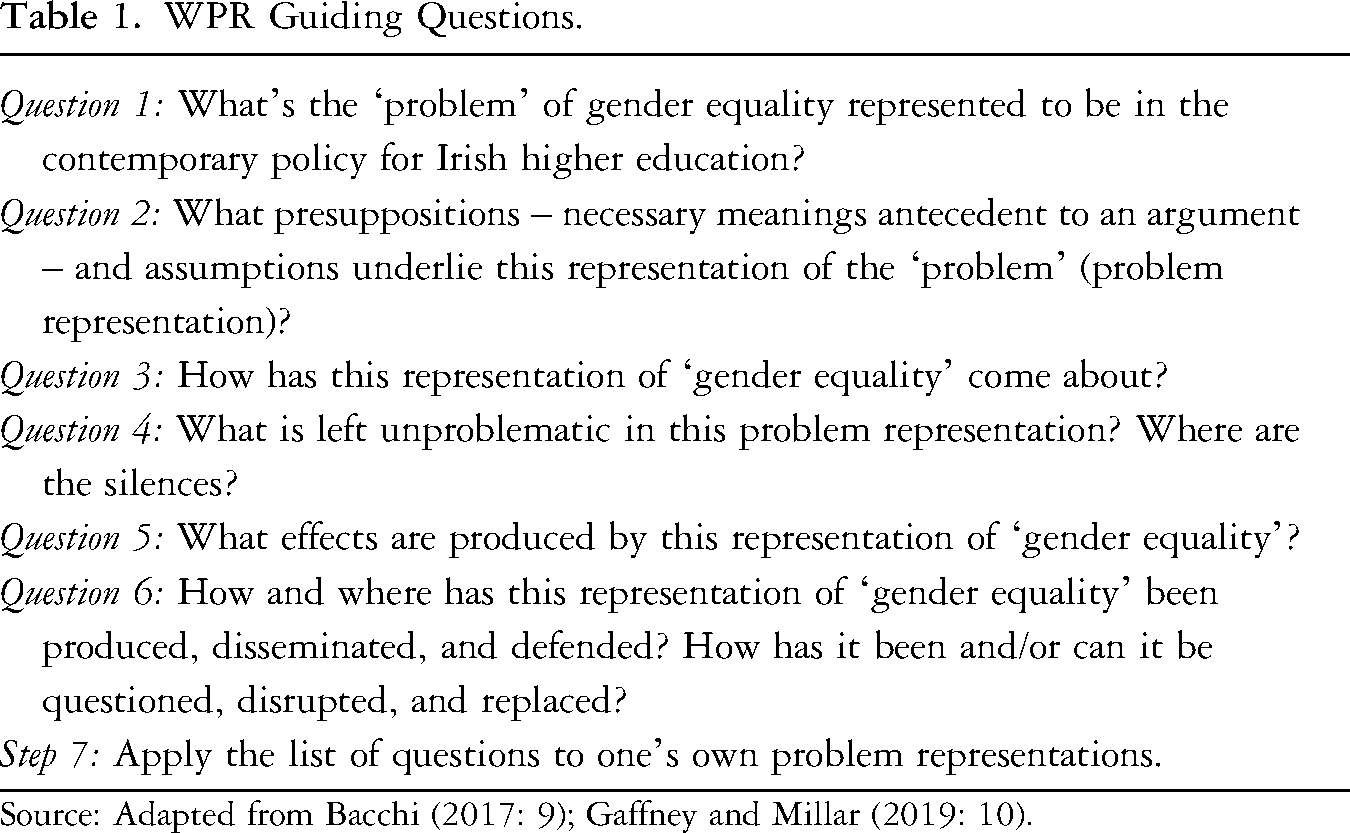
Source: Adapted from Bacchi (2017: 9); Gaffney and Millar (2019: 10).
Articles relying on Bacchi's methodology usually concentrate on two or three questions (Gaffney and Millar, 2019; Harrington, 2021; Pantazis, 2016; Spanger, 2011l). Although such an approach is conducive to limited word count, following the entirety of WPR leads to a significant expansion in the inquiry. Hence, we consider each of Bacchi's questions, using them to structure the text. Our objective is to employ WPR to widen the problematisation enacted by the Irish policy, inspired by Iverson and Allan (2017: 88) suggestion that 'We must maintain important momentum for advancing gender equity through policy, yet also critically examine how policy problems are framed rather than pursue policy solutions based on acceptance of how a problem is defined'.
We focus on two documents from the Irish Higher Education Authority (HEA): the Report of the Expert Group: National Review of Gender Equality in Irish Higher Education Institutions (Jun/2016) and the Gender Action Plan 2018–2020: Accelerating Gender Equality in Higher Education (Nov/2018). The first was produced as a direct result of the gender crisis, aiming to introduce a sectorial policy. The second reviewed it and developed a focused action plan. Together, they shape the management of GE in Irish HEIs.
The study is grounded on a detailed reading of the policy documents. WPR encompasses Foucaultian-inspired archaeological, and genealogical inquires, broadening the scope to include an account of the context and its conflicts. Therefore, we relied on grey papers, other HE policies, media accounts and a thorough review of the Irish literature on GE in HE. These sources show the stabilisation of the GE ‘problem’ as breaking the glass ceiling was accomplished by side-lining marginalised representations despite ongoing contestation.
Policy summary and ‘problem’ representation (Question 1)
WPR examines the policy solutions to find out how problems are represented. Since 2016, Irish HEIs are expected to establish fully resourced Vice Presidencies for Equality (or an equivalent unit), GE sub-committees within the governing body, and academically-led GE fora to develop and implement annual GE action plans. The rationale for such actions is that ‘a specific academic agent of cultural and organisational change is needed in each HEI to help embed GE within all aspects of the work of the institution’ (HEA, 2016: 49, 54). A specialised national unit was created in 2019, the Centre of Excellence for Gender Equality (now Centre of Excellence for Equality, Diversity and Inclusion). The policy approach aims to strengthen accountability and avoid superficial initiatives (O’Connor and Irvine, 2020). It recommends gender balance in key decision-making bodies and unconscious bias training for managers (HEA, 2016: 53, 60, 93).
These complementary recommendations imply that the ‘problem’ of gender inequality in Irish HE is the lack of governance structures and the lack of ‘women’ in leadership roles. Such a ‘problem’ is based on an understanding of change as a top-down endeavour: ‘[t]he achievement of GE needs to be led from the top, with the ultimate responsibility for its achievement, sitting with the HEI President, or equivalent’ (HEA, 2016: 9).
Acknowledging workload allocation is gendered, a recommendation directs the need for transparent and annually monitored work distribution by managers. Coherent with its accountability strategy, it proposes that ‘[e]vidence of this will be taken into account in the performance development reviews of managers/supervisors responsible for setting staff workloads’ (HEA, 2016: 64). In this ‘solution’, gendered working patterns are associated with deficient overseeing by line managers.
The core characteristic of the Irish policy is its systemic approach with recommendations tailored to different stakeholders (O’Connor and Irvine, 2020). One of the main tools connecting the strategy is the Athena SWAN Chart (ASC), an award developed in the UK to promote GE in HE (AdvanceHE, 2015). Three of the main Irish research funding bodies started requiring ASC accreditation as eligibility criteria, repurposing audit mechanisms to pressure transformation (Drew, 2021). If the solution is to withhold funds from HEIs that do not properly manage GE, the problem is represented as the lack of commitment from institutions.
The policy distances itself from previous approaches aiming at ‘fixing the women’ and proposes identifying and dismantling the barriers against women's progression (HEA, 2016: 9, 15). The notion of ‘barriers’ draws from extensive scholarly production (the 2016 report has eight bibliography pages) and is synthetised in career scissor-charts (Figure 1). Since the gradual ‘fall out’ of women along the career ladder is understood as a ‘waste of talent’ (considered below), the solutions address the diverging lines: gender-sensitive recruitment, selection, and promotion procedures and gender quotas for promotion following the flexible cascade model (HEA, 2016: 67, 123).
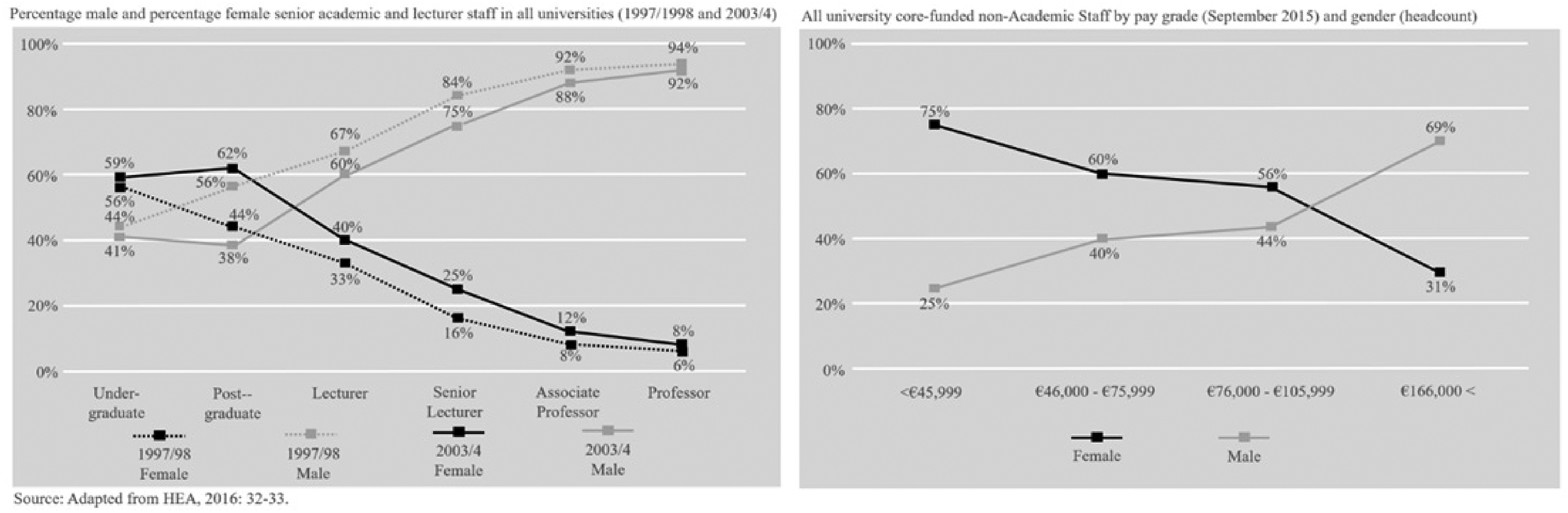
Gender inequality as portraited in the career scissor-chart.
The career scissor-chart is a meaningful device circulating in European GE policies. It offers an easily readable depiction of how academic structures are permeated by gender inequality and an adequate setting to compare longitudinal shifts. Exhibited as the synthetic representation of gender inequality in HE, it can become a trap. It implies a manageable representation of the ‘problem’, prioritising the gender binary and side-lining the intersectional dimensions of inequality in academia.
In the WPR approach, verifying the destination of funds and the implementation of compulsory mechanisms are ways to identify the dominant problem representation. The policy sets targets to achieve a ‘minimum of 40% women and 40% men to be full professors, at the appropriate pay scale’ by 2024 (HEA, 2016: 72). Introduced in 2018, a Senior Academic Leadership Initiative (SALI) offers 10-years supplementary funding for HEIs to hire professors ‘in areas where there is a significant under-representation of women’ (HEA, 2018: 13). The creation of these 45 ‘new and additional gender-specific posts’ aims to ‘strengthen gender diversity at the senior academic leadership level within HEIs and encourage the benefits that such diversity can deliver’ (HEA, 2019: 1–4). Incoherently, gender-specific posts for professional, support or technical personnel are not suggested; instead, a vague recommendation is made to ‘[c]ombat stereotyping of “female” and “male” roles and horizontal segregation among non-academic staff’ (HEA, 2016: 74).
The proposed solutions demonstrate the reading of the scissor-chart is mainly geared towards the higher echelons, even though the gender ‘bottleneck’ is located at doctoral or postdoctoral levels in Ireland and other European countries (Dubois-Shaik et al., 2019:184). Through the policy, gender inequality is made a synonym for the gender imbalance in senior positions, and the ‘solution’ is to ensure vertical mobility for academic ‘women’.
Throughout the advance of the national policy in Ireland, GE became more singular in focus and issues considered in 2016 were bypassed in 2018. Work-life balance and caring responsibilities, for example, were not prioritised (Ferrara, 2021). Even if not all Irish HEIs provide full cover for maternity leave, the HEA recommends establishing an institutional family-leave ‘working group’ (a classical Yes, Minister delay strategy) with no time-bound commitments (HEA, 2018: 35). Although the policy-texts do not employ the term ‘glass ceiling’, its overriding objective is to assure ‘women’ have access to managerial positions, a proposal criticised for being a ‘luxury problem’ (Benschop and Brouns, 2009; Calás and Smircich, 1996: 226). We now turn to the WPR second question.
Presuppositions and assumptions (Question 2)
Inspired by the Foucauldian archaeological inquiry, Bacchi urges us to identify intelligibility requirements in problem representation, questioning the unexamined ways of thinking that shape ‘who we are and how we live’ (2009: 218). The presumption of the gender binary as stable, constant, and the primordial axis of inequality grounds the GE policy silences intersectional claims. Like the heteronormative Swedish initiatives analysed by Powell et al. (2018), the Irish texts use ‘gender’ as presumedly non-controversial. According to Bacchi, however: ‘the very existence of gender analysis procedures or the lack of those procedures shapes the possibilities for becoming “women” and “men”’ (2017: 34, 20). The availability of gender data is one of the dimensions of these processes.
The 2016 Report is described as ‘the first milestone’ for GE because ‘it highlights clearly for the first time the extent of the significant under-representation of women at the highest levels, of both academic and professional, management and support staff’ (HEA, 2018: 14, italics added). This is a distortion of the facts. The HEA had assembled gender data previously (Linehan et al., 2009), but this practice was interrupted in 2004 (O’Connor, 2008: 15) and only recommenced after the gender crisis.
So, the novelty claim made by the policy in 2016 is based on a deceptive assumption of past ignorance. It circumvents the fact that ‘[f]or several decades, there have been concerted efforts by women in Irish HE for something to be done about representation at senior levels’ (Coate and Howson, 2014: 4). Indeed, ‘the low status of women working in academia’ has been raised from the 1980s (Smyth, 1995: 12; Hodgins, 2021)
In the current policy, the state is positioned as the ‘referee’ to ‘level the playing field’ for women in academia, skilfully ignoring its historical role in reproducing and intensifying gender inequality (Harford, 2018). Whilst problematising gender management as ‘lack’, the policy avoids addressing institutional instability, expressed in the dismantling of the Higher Education Equality Unity (HEEU) in 2003. It ignores the impact of aggressive austerity measures implemented after the crash of the Celtic Tiger on the increase of gender inequalities (Hodgins and Mannix McNamara, 2019; Loxley, 2014; Mercille and Murphy, 2015). Likewise, it bypasses the gendered impact resulting from the rise of managerialism in Irish HE (Lynch, 2010) or from the uneven allocation of funding privileging STEMM (science, technology, engineering, mathematics and medicine) over other disciplinary areas (O’Connor, 2014).
The policy presupposes change is a process with definite stages, the ‘virtuous cycle’ of a policy. It starts with the public acknowledgement of ‘the problem’, followed by the collection of statistics (evidence), the instalment of a task force or working group (preferably composed of experts), the benchmarking of ‘best’ practices internationally and consultation with stakeholders resulting in the creation of an action plan, with the subsequent monitoring and evaluation of the implementation and potential acceleration of priorities. Several assumptions in this virtuous cycle reduce the path for transformation into state-led stages, capturing the possibility of change into the functioning of the state apparatus.
Firstly, the critical role is played by the state itself. The knowledge recognised by the policy (centralised national gender statistics), for instance, can only be collected, systematised and publicised by the HEA (Coate and Howson, 2014: 3). This specific type of knowledge is taken as a precondition for action. Data is simultaneously made a barrier (when not available), and half of the solution, as if the visualisation of the statistics offered an evident equality aspiration: ‘Ideally the achievement of GE would be obvious through quantitative data analysis’ (HEA, 2016: 17).
Secondly, GE is portrayed as consensual ‘progress’ in which the future is made tacitly unproblematic. Expressions like journey, path, roadmap, trajectory, and stages (HEA, 2018: 7, 28) produce a supposedly pre-established destination. The underlying assumption is that once the gender lines in the scissor chart are made stable and parallel, HE will be ‘free’ of gender inequality.
Thirdly, the goal is taken as a national aspiration to transform ‘Ireland in a world-leading country for gender equality in higher education’ (HEA, 2018: 2). Figure 2 demonstrates how such ambition guides the data interpretation.
The gender equality ‘race’ in European Academia. Trends in the number of women at professor level in France, Germany, Switzerland, and Ireland.
Source: Adapted from HEA, 2018: 19.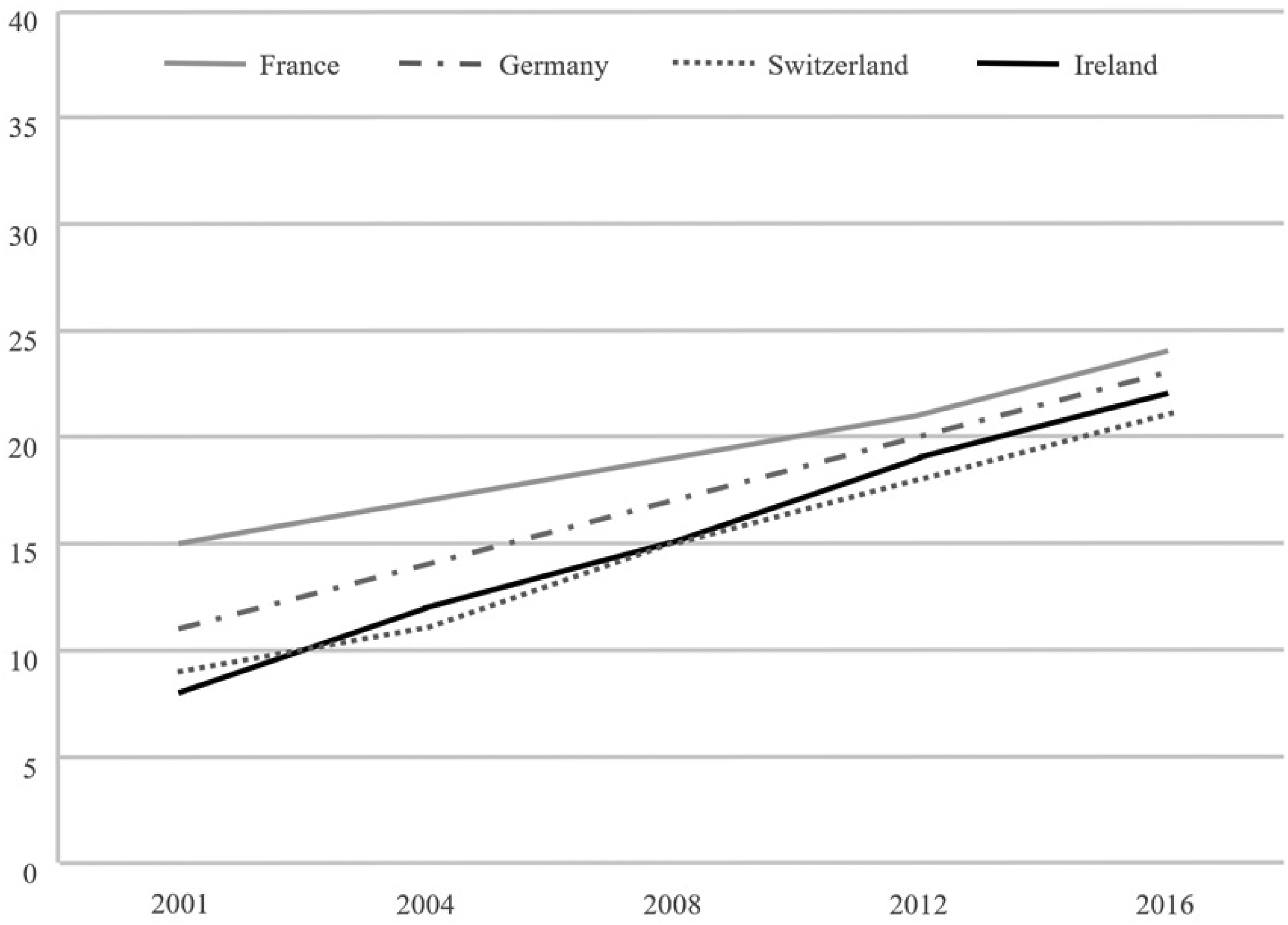
Indeed, one of the unexamined ways of thinking that organise GE policy is to see the transformation of gender relations as part of the ‘evolution’ of societies. Like other versions of the progress-ideology, a unified path leading to a consensual future is presumed as evident. In progress frames, discrepancies between countries are read not as coetaneous (and conflictual) diversity but as positions ranked on a time-scale.
Thus, subtle and implicit imaginary effectively organises time and space according to ‘gender progress’. In this imaginary, Scandinavian countries are commonly coded as the ‘future’. This can be identified in the Irish policy: ‘Gender inequality in HE continues to exist in countries that generally finish top of the overall GE index, such as Norway and Sweden’ (HEA, 2018:18, italics added). Other places, like South and North Korea denote backwardness (HEA, 2018: 18, footnote).
GE regimes at once presuppose and reinforce global gender hierarchisations. From this perspective, transferring the ASC from the UK using HEA funds is especially troubling because it promotes neo-colonial policy flows (Also Ní Laoire et al., 2020: 587; for a divergent approach to ASC introduction in Ireland: Drew, 2021).
A Eurocentric understanding of history represents gender equality as a target and a measure of progress, and it entangles aspirations for equality in imperialist projects (Abu-Lughod, 2013). It also encourages a competitive ethos that assesses national progress ‘against’ other places. This explains why the HEA repeatedly states the aim is to use gender to create a ‘distinctive’ national brand: By investing in GE, Irish institutions will maximise their pursuit of excellence and successfully attract and keep the most talented students and staff, from all over the world. It will also provide Ireland with the opportunity to be recognised as unique in its inclusivity and excellence (HEA, 2018: 7, italics added; also HEA 2016: 18).
The idea of HE as a competitive market is a pervasive assumption relying on the National Strategy for Higher Education, which aims to support ‘[g]lobally oriented and internationally competitive institutions [through] the creation of a strong national educational brand to raise awareness of the quality of Ireland and its HE institutions’ (HEA, 2011: 83, italics added). Khoo (2012: 208) maintains that although ‘Irish universities have turned to the global scramble for reputation comparatively recently’, this has been driven by the willingness to profit from international academic inequalities and a predominantly English-speaking setting. Indeed, the Irish Universities Association (IUA: n.d.a) celebrates the increase in number of ‘international’ students. In this context, internationalisation is primarily an ambition of selling degrees to higher fee non-EU students.
We believe it is urgent to investigate the effects such ‘internationalisation’ have on GE agendas in the Global North, and we invite others to engage in this effort. Drawing from antiracist, intersectional, and decolonial scholarship, such criticism offers an opportunity to disentangle feminist demands from imaginaries of progress that reproduce imperial hierarchies. The next question helps us to empirically relate GE and feminist organising.
‘Problem’ genealogy (Question 3)
WPR locates the state as one player shaping governmentalities, acting alongside journalists, researchers, activists, and the knowledges they produce. Newspapers portraited the Irish policy favourably. One headline, for instance, read: ‘Experts decided that institutions had to change, rather than women’ (The Irish Independent, 12/Nov/2018). This is an exemplary illustration of the division of labour in policy processes, presupposing an ‘evidence-based’ approach: the state executes experts’ recommendations, and the media legitimates the ‘solution’. The consensual language partially silences the controversy in defining goals, actions, and priorities.
Yet, the development of the current policy is the direct effect of an institutional gender crisis that started in 2014 when two legal decisions ruled against the National University of Ireland, Galway (NUI Galway). The first involved the School of Engineering, that precariously employed a female academic for more than a decade, discriminating against her on the grounds of gender and disability. She was summoned to work during maternity leave and was unilaterally downgraded, resulting in her exclusion from decision-making spaces. The academic was awarded compensation and the right to have the title of ‘lecturer’ restored to her contract, but the university appealed (Equality Tribunal, 2014a).
The second and more famous ruling retroactively promoted Micheline Sheehy-Skeffington to Senior Lecturer, proving she had been discriminated against in a round when sixteen men and only one woman were successful (Equality Tribunal, 2014b). After the decision, five other women lecturers filed cases against the university. They had been shortlisted and deemed suitable in the same round in 2008/9, but ultimately not promoted. Unions supported the litigants, and Sheehy-Skeffington donated her award to help cover their legal expenses. Various initiatives were held in their favour creating what Quinlivan (2017: 7) described as ‘an almost perfect storm of pressure’ for transformation in Irish HE. After years of legal battle and reputational damage, the cases were amicably settled. The gender crisis at NUI Galway created momentum for the prioritisation of GE by transforming individual episodes into a collective issue (Ruggi and Oliveira Filha, 2020).
During the same period, NUI Galway was negotiating the full integration of St Angela's College, that offered courses on nursing, education, and home economics, mostly taught by women. The merge proposal demoted their contracts from lectures to university teachers. St Angela's staff held a one-day strike in February 2015 and threatened a second in April, successfully changing the terms of the integration (The Irish Times, 2015). NUI Galway gender crisis was compounded by widespread grassroots engagement, triggering the scrutiny of decision-making processes and the monitoring of EU statistics (Michelines3Conditions, 2016).
Although the subsequent problematisation affirms that transformation should be ‘led from the top’, the leverage for change was a conflict prompted by feminist organising (see Nielsen, 2017:18 and Paol etti et al., 2021 for similar conclusions in other contexts). WPR is helpful to our task because it opens space to recognise the competing versions of/for GE circulating simultaneously on the margin of a given set of solutions. This simultaneity matters. The Irish policy was designed in a controversial context, and it should not be addressed as ignorant of critiques but actively shaped against them. The problem representations that were subordinated by the policy are investigated in the following question.
Silences and contestations (Question 4)
WPR acknowledges marginalised issues, interrogating what is silenced or not accounted for in a particular problem representation. To address this question, we will rely on gender demands voiced in Ireland before, during and after the policy was implemented. They show how the response to the gender crisis was selective and restricted. We assume because ‘boundaries between forms of work are situated in relations of power and are forms of exclusion, they need to be contested’ (Ivancheva et al., 2019: 452).
Ferrara (2021) challenges the Irish policy for not prioritising ‘maternity support, childcare, accommodation, teaching load reduction options, and administrative relief for mothers.’ Since the 1990s, scholarship has shown maternity leave structure is troublesome for permanent staff (Keher, 1995), and it is even worse for other groups of workers in HE (Flynn, 2020; PGWA, 2021). The right of temporary research staff to family leave is ‘ambiguous’, depending on their line managers and the duration of their contracts (Maxwell et al., 2019). Other people on precarious contracts like hourly-paid lecturers and PhDs are not entitled to maternity (or sick) leave. This makes non-EU passport-holders particularly vulnerable as they cannot access to the Irish social protection system due to their migration status. The policy is silent on such issues.
Professional, administrative, technician, and support staff traditionally exist to ‘assist’ academic work, an institutionalised distribution of care work akin to the split between doctors and nurses. The structure is gendered, and the disparity in income and prestige is undeniable (Connell, 2019; Litterick, 2019). In Ireland, women are the majority in the subordinate positions while men occupy the senior high-income posts (as show in Figure 1). The need for job-revaluation has been voiced for more than three decades (O’Sullivan, 1995). However, the GE policy is silent about the lack of promotion schemes for non-academic staff, interrupted during the economic crisis. If a professional, administrative, technician, or support employee aspires to be promoted to a grade higher grade, they need to wait for a vacancy. Any ‘promotion’ prospect is, in fact, a job application and posts may not be advertised in their unit or area of expertise. The long-term effect of this system is that many non-academic staff perform work above their pay-grade, normalising daily exploitation.
Another dimension silenced by the policy has to do with precarity. Forty-five per cent of those lecturing and 80 per cent of those hired as researchers in Ireland are employed on a non–permanent basis (Cush, 2016). O’Keefe and Courtois (2019) argue that it is misleading to understand precarity as a stepping-stone in a beginner's career. Instead, there's a ‘precarity penalty’ diminishing someone's ability to be made permanent, let alone progress after years of provisory contracts. Moreover, exploitation of precarious work is not enacted exclusively by senior managers but filtered down through the system (O'Keefe and Courtois 2019).
Even though the GE policy addresses the need for transparent workload allocation, it refrains from addressing the conflictive nature of working patterns’, based on the devaluation of care. Howson et al. argue that less prestigious work ‘needs to get done, so tensions emerge as these activities are often left to women and junior colleagues, who then get “stuck”’ (2018: 343). It is because some do the ‘housework’ (teaching, pastoring, etc.) that others are ‘freed’ to pursue more prestigious activities and progress in their careers (Harford, 2018; also Lund, 2020). As universities continue to casualize their workforce, more women accessing the higher ranks does not mean progress for those stuck in contract work. (…) Assuming that women who reach positions of power can help others progress through the ranks ignores the power relationships that deeply divide the academic workforce. We have reason to worry that the situation will actually worsen given the rate at which casualization progresses in universities, erecting more and more impassable barriers between the ‘stars’, on the one hand, and the growing numbers of marginalized, invisible workers directly and indirectly exploited by them. (2019: 466, italics added)
The relation between care work and precarity helps us realise that the focus on the glass ceiling is partially created by concealing other nodes of inequality and ignoring intersectional dimensions. The devaluation of care in scales of prestige, power, and financial compensation is a structural feature of HE and one of the legitimising social roles of the educational system as a whole. The unequal pyramid in HEIs is sustained by low-income and often fixed-term positions, primarily occupied by ‘women’ with lower educational attainment. Here is where quotation marks around ‘women’ are most needed and where a strictly binary and unproblematised approach to gender becomes especially dangerous (see Bhopal and Henderson, 2021: 154 for an assessment of the racial and class profile of ASC beneficiaries in the UK).
The GE policy does not incorporate outsourced personnel. All statistics grounding the GE policy are based on figures for ‘core-funded staff’. They exclude the majority of workers responsible for activities such as cleaning, catering, reception, gardening, security, front-line disability support, health promotion, or crèches. These different categories, whose work makes possible the daily functioning of HEIs, are gendered in ways that relate to the lack of women in senior positions but would require specific policy inputs and intersectional analysis.
The GE policy does not include any race, ethnicity, nationality, disability, or sexual identity analysis. Yet again, the lack of statistics is crucial (O’Connor and Irvine, 2020). Coate and Howson state, ‘[t]here are no published data concerning the ethnic origins of Irish academic staff, but it is safe to say that the numbers of Black and minority ethnic background staff are very small indeed’ (2014: 3–4; also Joseph, 2019). Structural racism against Irish Travellers/Mincéirs means few students survive the settled education system, never mind being hired as HEIs staff. O’Keefe and Courtois presume ‘that the precarious academic rank is also racialized, not unlike foreign domestic work’ (2019: 467). As mentioned, outsourced personnel have not been considered part of GE policy, but there is no doubt Irish HEIs, like other public and private organisations in the country, benefit from exploitative global care chains (Marshall, 2011).
Gender imbalance in senior positions is a significant issue, and policy should tackle it. Quotas for promotion and women-targeted posts are valuable, necessary tools. However, the narrowing of the problem has meaningful consequences. If GE is synonymous with breaking the glass ceiling, it becomes caught in the machinery of reproducing the status quo – the GE policy ‘trap’ we mentioned at the beginning of the article. Though GE may help some women to reach ‘the top’, the unfairness of the structure is disregarded and, therefore, reinforced. This is especially dangerous in a policy that overlooks intersectionality because there is shattered glass pilling at the bottom. WPR following question offers space to consider this in more detail.
Policy effects (Question 5)
This article suggests two effects produced by the Irish GE policy. The first is connected to the use of talent as the link between GE and excellence: ‘Ireland will have achieved GE in HE when: The most talented women and men are employed at all levels in Irish HEIs’ (2016: 11). There are abundant references in the policy to ‘talented people’, ‘talented women/female’, or ‘best talent’ (H EA, 2016: 9, 11, 13, 16, 18, 70; HEA, 2018: 3, 9, 24, 26), defending that ‘[t]he introduction of gender quotas encourages highly qualified women to apply for top positions, while discouraging mediocre men’ (HEA, 2016: 70, italics added).
The sorting of people as talented and mediocre across gender lines is akin to the separation of ‘deserving’ and ‘undeserving’ poor, focusing on moral deficits at the individual level instead of ‘tackling societal inequities and institutional failings’ (Gaffney and Millar, 2019: 16). This dividing practice assumes that competition for senior positions is the normal, expected, and effective way of managing staff in HEIs, implying everyone desires to be promoted to ‘the top’. It takes for granted and thus reinforces the existence of a pyramid structure whose pinnacle is reached by (presumably innate) ‘talent’. The effect is to bestow higher income, prestige, and decision-making power as legitimate rewards to the ‘talented’ people (also named ‘high-quality’ or ‘world-class’).
The perception of promotions as a meritocratic competition does not identify but produces ‘talented people’. Talent is at once proved and established by institutional success. Moreover, this heightens the subjective attachment of people in senior positions to the hierarchy that sustains their ‘superiority’, generating compliancy with the system (Linehan et al., 2009: 406, 411–2). Although the policy anticipates that ‘[c]hanges that bring about inclusion for one group will have far-reaching benefits for everyone’ (HEA, 2016: 23), there is no guarantee that promoting women to the leadership level will result in ‘the benefits of diversity’ (also O’Connor, 2017: 274). The policy overall sustains meritocratic assumptions that reproduce the status quo. Substantial diversity would require decision-making processes to ensure the participation of groups that are not in senior positions, foregrounding intersectional issues.
The second policy effect relates to the enclosure of specialised fields of knowledge. This node in the governmentality apparatus is partially sustained through financial links. At least two research projects on gender and senior management in Ireland informing the 2016 policy received research funding from national agencies or EU bodies (see Devine et al., 2011; O’Connor, 2014: xi). This monetary connection reveals how GE regimes facilitate the production of ‘evidence’ for policies. Research bodies seem not as generous in supporting investigations on precarious work. O’Keefe and Courtois long-term project is, for example, not funded (the GARCIA project is, however, an exception, Murgia and Poggio, 2019).
Another dimension requiring further analysis involves hiring external ‘suppliers’ to develop GE work. In Ireland, different entities participate in GE, providing training or awarding accreditation (AdvanceHE), analysing surveys (Yellow Window, MAPS), and calculating gender pay gaps (QPMG, PwC). In this sense, GE policy actively participates in the HE corporate turn, promoting HEIs entanglement with external (mostly for-profit) consultancies.
If ‘gender knowledge’ is crucial in the policy process, it is important to be aware of how knowledge ownership is claimed and how epistemic values are defended (Pereira, 2017). The creation of the Irish Centre of Excellence for Gender Equality serves as an example. Its remit included managing national statistics that are considered ‘key to enabling data-driven decisions to be made so that actual, rather than perceived barriers to gender diversity can be addressed’ (HEA, 2018: 23, italics added). The contrast between expertise and ‘perceived’ knowledge widens the gap between GE experts and people on the ground, whose knowledge is dismissed. This is no minor trend, considering how the policy cycle selectively addresses grassroots claims. Subsequent developments on ‘diversity’ demonstrate how the policy apparatus works to enact a ‘problem’.
On December first, 2020, a headline on the Irish Times read ‘Does Ireland have a diversity problem at third level?’. It publicised a new report by the Royal Irish Academy and the British Council in Ireland, explaining: How many ethnic minority students go to college in Ireland? Nobody seems to know – and it’s putting a generation at risk of being left behind (…) [T]his lack of data may be harming the educational and career opportunities of Black, Asian, Traveller and other ethnic minority students in Ireland (The Irish Times, 2020: n/p).
The headline's question mark indicates ‘a diversity problem’ is not fully recognised in Irish HE. The problematisation suggests that the trouble lies in the ‘lack of data’ dislodging structural racism as the source of harm. The presumption is that once the ethnic and racial inequalities are made ‘visible’ by gathering appropriate statistics, the solution will be in hand. Such a progress-led narrative places a specific kind of ‘knowledge’ before the change, containing ‘diversity’ within the policy apparatus. The policy's ‘virtuous’ stages are operationalised and incorporated into the ‘problem’, indeed creating it.
According to the report that originated the newspaper's article: ‘In the absence of systematic data collection [in Ireland] (…) the discussion necessarily relied heavily upon UK data for insights’ (RIA, 2020: 1, italics added). This implies that the UK is the obvious policy source and more ‘advanced’ in addressing race/ethnicity due to the availability of statistics; moreover, it presumes an unproblematic analogy between race relations in Ireland and the UK, which is misleading (McVeigh, 1995; 2002).
Since the production of statistics is a prerogative of the HEA, the imperative for data is a policy trick. Lack of data is not the same as lack of knowledge. There is no need to ask if Ireland has a ‘diversity problem in third level’. Racial and ethnic inequality is a structural feature of HE everywhere. To profess the need to collect data as the first step for policy development is to pretend ignorance. The main effect of following the policy prescribed cycles is to postpone change. Indeed, there are voices in Ireland defending that ‘taking action against racism and for equality does not require us to wait for the establishment of a data collection system’ (NASIIWG, 2020: 2).
WPR approach takes ‘differences’ as attributions and not acquired characteristics (Bacchi, 2017). We ought to foreground practices that assign and claim difference or conversely efface and occlude them. In shaping a ‘problem’, policies set the stage for criticism. The underlying question is who composes the group that may benefit from the policy. By silencing gender intersections with ethnicity, race, class, nationality, sexual orientation, generation, religion, and disability status, gender is placed as the most pronounced axis of inequality. What this, in turn, creates is a state-centred appeal for recognition.
Through its focus on the gender binary, GE prompts the repetition of the intersectional claim. It binds the analysis to reiterate that other meaningful dimensions intersect with gender as if this was a newly proposed argument. The presumption that gender should be dealt with before ‘other issues’ in a lining up of inequalities is a stalling tactic, as shown by promises of inclusion from almost 30 years ago in Ireland (Egan, 1995: 4). The persistence of this debate and the crystallisation of the policy aversion to intersectionality seems to be encouraged by GE as a ‘European’ project pursuing ‘world leadership’. However, this project is not consensual, as show in the following question.
Defence vs criticism (Question 6)
WPR approach considers instances of production and disruption of the problem representation. To address this question, it makes sense to go back to the policy solution recommending the creation of ‘specific academic agent(s) of cultural and organisational change’ (HEA, 2016: 49). The remit of gender policymakers and practitioners is precisely to produce, disseminate and defend GE policy. Ferrara’s (2021: n/p) assessment of the Irish policy using Margaret Atwood's characters offers a criticism that focuses on the personal intentions of GE practitioners: ‘In academia, the problem is systemic and difficult to overcome because (…) many women involved in policymaking seem like the Aunts of The Testaments. They pretend to look after the weakest, to protect underrepresented minorities, but are often agents perpetuating inequality’.
As important as it is to highlight how interpersonal relations are entangled in systems of power, we argue that this line of argument is misleading. It risks reducing the tension produced by GE to a debate of individual ‘goodness’ vs ‘badness’, occluding broader relations of ruling (O’Keefe and Courtois, 2019). More fruitful criticisms address not the people but the processes. Indeed, unions have opposed the Irish GE policy on such grounds: The focus on GE in higher and further education has largely been on the promotion of more academic women to senior roles. However, precarious employment be it hourly paid, fixed term contract or outsourced working, is also an enormous but largely overlooked problem in the sector. Tackling precarious work is crucial to achieving GE and pay equity (Ronayne quoted in SIPTU, 2019: n/p).
Previously, we presented questionings communicated as silences, most of them in a scholarly format. We want to emphasise that disruptions exist in other forms, especially agit-prop, conscious raising campaigns, and activist material developed by solidarity networks. Collective work of this sort is the core of feminist disruption in academia (Ahmed, 2021; Pereira, 2017). The Irish case demonstrates that change is produced by a continuous dispute within and beyond institutions. Instead of an agenda that proposes change is ‘led from the top’, many projects value collective work done ‘against the top’ to disrupt the status quo (3LWW, 2014; Cotera, 2018; Hanson and Noterman, 2017; Ivancheva and Keating, 2020; Lajoie, 2020; Steinþórsdóttir et al., 2019). As a concluding discussion, we will present a brief assessment of our analysis.
Concluding discussion (Step 7)
The Irish policy allowed us to investigate how expert knowledge is deeply entangled in European GE regimes. We showed how the current problem representation manufactured (and constrained) expectations for change, shaping GE debates. Our work is not ‘floating’ above this messy conversation. WPR's last step offers an opportunity to address this, a challenging task that requires further interlocution.
Although there might be advocacy gains in sustaining an allegedly consensual goal by stabilising a ‘problem’, we assume GE is a collective ongoing and open-ended effort where conflict is fruitful. We analyse the Irish policy out of respect, believing that cooperation can take the shape of dissent, disagreement is a tool in knowledge production, and consistent change requires the steady probing of what's the problem represented to be.
In this sense, we questioned how GE in Ireland has been gradually dwindled to breaking the glass ceiling. We did so to disrupt the policy-trap that reduces gender inequality to the lack of ‘women’ in senior positions. Focusing on this might help some women climb the career ladder, and eventually, the scissor charts’ lines might run contiguous and parallel. Still, Irish HE will not be free of gender inequality. While not addressing the devaluation of care work or the managerial structure of power, the policy fails to challenge the unfairness denounced by feminisms.
The GE policy invisibilises most care work done in HE. It deprioritises non-academic staff, ignores precarity, and excludes outsourced workers. The policy apparatus presupposes it is impossible to know most cleaners in Irish HEIs are ‘economic migrant women’ because the HEA does not collect data on them. Differently, we maintain that GE policies that disregard cleaners and other outsourced workers or do not engage in intersectional analysis are skewed by privilege.
In presenting a summarised genealogy of the problem representation, we foregrounded feminist organising at NUI Galway as the central leverage for change against the policy presupposition that ‘GE needs to be led from the top’. We tackled the role of gender data in shaping the problem representation and how this relates to the enclosure of expertise. ‘Talent’ was identified as a dangerous gender tool for it can be used to legitimate the existing power structures. We tried to dislodge debates focused on the moral standing of gender practitioners to concentrate instead on processes of inequality.
We proposed the glass ceiling problematisation is linked to ‘femvertising’ and sustained by academic imperialism. It converges with aspirations to develop a ‘strong national educational brand’ framed by the ambition to sell degrees to non-EU students. Neo-colonial maps are also reflected in policy flows, including the Athena Swan Charter. We suggested the need to disrupt the consensual imaginary of progress that shapes GE debates reproducing ‘progress’ scales and constricting possibilities for the future.
Our article began by proposing that in most feminist perspectives, the ‘problem’ of gender inequality requires avoiding collision with structures of inequalities. This claim places feminisms as the ‘correct’ standpoint to assess the limits of GE. Presupposed here is the division of labour endorsing the ‘expert’ helm of research and theory. There are epistemic dividends of assuming feminisms have a high moral stand to evaluate GE, and we relied on them. Nevertheless, feminisms are just as deeply entangled with imaginaries of progress. Challenging the ‘problem’ of GE in HE is an opportunity to re-organise presuppositions around change, time, and space much needed in feminist theories and practices.
Footnotes
Acknowledgements
Thanks to Júlia de Oliveira Ruggi, Stephen Gaffney, Kate Kenny, and the reviewers from CSP and ephemera who read and contributed to the text. Thanks to Maira Oliveira Ruggi for adapting the HEA charts.
This research is supported by the Centre for Global Women's Studies with funds from the Office of the Vice-President for Equality and Diversity at NUI Galway and the Irish Higher Education Authority (HEA) Covid-costed extensions for PhD projects.