



Abstract
Ireland has become an international exemplar in the use of citizens’ assemblies to determine policy. Globally, deliberative fora seek to mitigate concerns of a democratic crisis, but they also may address the ‘care crisis’, where politics-as-normal seems unable, or unwilling, to address citizens’ care needs. Drawing on Tronto's (2013) call for a caring democracy in which citizens take their responsibilities to care with one another, this paper examines the potential for deliberative processes to deliberate ‘with’ as well as ‘about’ care and to expand current care work debates. Using Barnes’ (2012) ‘care full’ deliberation as an analytic framework, we document and interrogate the process and outcomes of Ireland's Citizens’ Assembly on Gender Equality (CAGE) (2020–21), particularly how it understood care work and responded to care workers’ needs. We then reflect on the potential for citizen deliberation to realise better caring outcomes for all citizens.
Introduction
A political ethic of care seeks to reinstate care as ‘the basis of citizenship, of solidarity and of justice’ (Williams, 2012: 115), in which interdependence is the basis of human interaction, and caring supports social solidarity. In Caring Democracy, Tronto (2013: 139) proposes that citizens take their responsibility to care with one another, thereby repositioning care from the marginalised private realm to consider ‘larger structural questions of thinking about which institutions, people and practices should be used to accomplish concrete and real caring tasks’. Tronto (1993: 112) argues centring care politically will influence democracy itself, as ‘questions about “who cares for whom?” and the legitimacy of current arrangements will become central political and moral questions’.
Increasingly, policy analysis through an ethics of care lens has sought to re-imagine how care-centred deliberative policymaking processes could work (Barnes, 2012; Barnes et al., 2015). Examining the potential of participative policymaking, Barnes (2012) developed the precepts of ‘care full deliberation’ through the application of Tronto's (1993) principles of care – attentiveness, responsibility, competence, and responsiveness. For Barnes (2008: 475), deliberating with care relates to how care deliberations take place and whether outcomes reflect the ‘contribution of care to justice and well-being’. ‘Care full decisions’ require ‘dialogue between those making policies and those subject to them’ (Barnes, 2012: 161). Prioritising the life experiences and expertise of citizens and their advocates requires the participation of those most affected by the issues being deliberated (Barnes et al., 2015). Drawing on Young's (2000) work on inclusion and democracy, Barnes et al. (2006) advocate forms of deliberation that extend beyond the argumentation approach favoured by officials and experts, to include narrative, storytelling, situated knowledge and emotion.
This paper examines the potential for deliberative processes to enact care full deliberation by exploring a particular case study, Ireland's Citizens’ Assembly on Gender Equality (CAGE) (2020–21). CAGE is one of a series of citizens’ assemblies established in Ireland to examine key debates of public importance, including marriage equality, reproductive rights, and biodiversity loss. Care issues permeated CAGE's modules, including those on the Constitution and care services. Paid and unpaid care work emerged as a particular focus of CAGE's work and social protection module. In this paper, we analyse the care deliberations within the work and social protection module by asking three questions: firstly, how was care and care work debated and understood, secondly how did the process of CAGE itself enact care full deliberation and thirdly, what were the consequences for understandings of care work.
We begin the article by situating the ‘state’ of care in Ireland and continue by examining citizens’ assemblies as a mechanism for deliberating better care futures. Drawing on Barnes’ (2012) care full deliberation as an analytical framework, our analysis problematises CAGE's framing and conduct of political deliberations of care and interrogates the wider potential for citizen deliberation to generate caring outcomes.
Situating Ireland's gendered uncaring state
Societally, Ireland reflects the global disparagement of paid and unpaid care work. From its inception, the Catholic-dominated Republic circumscribed the state's care responsibilities through article 41.2 of the Constitution, colloquially termed the ‘woman in the home’ clause, which positioned women as caregivers within the patriarchal family (Hanlon, 2018). Nation-wide care services were slow to develop and were largely provided as a charitable service by state/voluntary providers (Fischer, 2011; Lewis, 2000). Current provision remains a patchwork of largely inadequate state provision, supplemented by informal family and costly private care (Cullen and Murphy, 2021a; Dukelow and Considine, 2017). Services are marked by high levels of marketisation (Murphy and Dukelow, 2016), reflecting Ireland's constrained investment in public services and austerity-focused policy (see Cullen, 2019; Cullen and Murphy 2021b). Low wages and precarity have resulted in an increasingly migrant care-force (Cullen, 2019). Women's increased labour force participation has created a ‘double burden’ for women, who have not experienced a proportionate reduction in unpaid care responsibilities (Hanly and Sheerin, 2017). Census and national survey data demonstrate continuing gender inequality linked to care work: women have a lower employment rate; represent 94% of those looking after home/family as principal economic status; make up three-quarters of those receiving carer's allowance; and constitute 86% of lone parents (Central Statistics Office, 2020). Against this background of poor access to care and gender inequality in care work, there has been increasing debate in Ireland about how to address care deficits. It is in this context that we explore CAGE.
Ireland's citizens’ assembly: Deliberating care work
In the last decade, Ireland has become an international exemplar in the use of ‘mini-publics’, or citizens’ assemblies, to debate complex social and legal issues (Courant, 2021; Farrell et al., 2019). Such deliberative processes have led to substantive, positive upheavals, including ‘radical recommendations’ (Devaney et al., 2020: 141) to address the climate crisis.
Deliberative mini-publics typically share four features: a representative membership; a learning phase to understand issues; deliberation and discussion; and production of recommendations (Willis et al., 2022). Globally, the use of deliberative fora has been linked to concerns of a democratic crisis (Farrell et al., 2013), which has parallels with the ‘care crisis’ in which politics-as-normal is unable, or unwilling, to address care needs. Despite being seen as a progressive form of decision-making (Courant, 2021; Farrell et al., 2019; Harris et al., 2021; Suiter et al., 2016; Suiter et al., 2021), concerns have also been raised about their operation. This has included disquiet about the role of governments in setting their parameters (Willis et al., 2022); the rigid, expert-driven format of deliberation (Barnes et al., 2006); the lack of implementation of many recommendations (Devaney et al., 2020; Farrell et al., 2019); and concerns as to whether citizens’ assemblies can challenge the long-standing gender and social disparities in political participation (Harris et al., 2021).
Deliberative democracy, of which citizens assemblies are part, moves political decision-making beyond the policy capture of lobby groups and the yes/no dichotomy of the ballot box (Barnes, 2008; Willis et al., 2022; Young, 2000). Instead, deliberative processes enable people to determine, through consideration of moral, social and economic factors, ‘which proposals the collective agrees are supported by the best reasons’ (Young, 2000: 23). As such, deliberative democracy offers tools for more nuanced debates and conclusions about difficult policy areas, such as care work. In this article, CAGE is examined not as an ideal of deliberative democracy (none yet exists, see Willis et al., 2022), but as a contemporary deliberation about care initiated by government and undertaken by citizens. We therefore aim to build on the potential for deliberation to address care and other societal crises in more informed and grounded ways, by offering suggestions for how the practices of future citizens’ assemblies could be strengthened through the adoption of care full deliberation.
The citizens’ assembly which forms the basis of this article is the Citizens’ Assembly on Gender Equality (CAGE) 2020-21, which was established by the Irish government to make recommendations to ‘advance gender equality’ across a range of modules (including, the Constitution, gender norms and stereotypes, work and social protection and care). On work and social protection specifically, it was tasked to ‘identify and dismantle economic and salary norms that result in gender inequalities, and reassess the economic value placed on work traditionally held by women’ and to ‘scrutinise the structural pay inequalities that result in women being disproportionately represented in low pay sectors’ (Seanad Éireann/Irish Senate, 2019).
CAGE followed the formats of previous assemblies, albeit almost entirely online due to the pandemic. The government-appointed chair, civil service secretariat and expert advisory group designed the process and agendas (Citizens’ Assembly, 2021). The 99 CAGE members, purposively selected via a polling company to be nationally representative by gender, age, region and social class, had to be Irish citizens entitled to vote in referenda. Limitations of CAGE's membership were highlighted by the Chair (Citizens’ Assembly, 2021) and in the official evaluation (Suiter et al., 2021), including the exclusion of the 12% of people living in Ireland who are not Irish citizens and the polling company's selection of members by calling door-to-door, which prioritises those living in houses and is likely to reduce inclusion of socially excluded groups (see also Courant, 2021 on sampling concerns at previous Irish citizens’ assemblies).
Once selected, members received presentations from experts (predominantly academics), advocates (representing civil society, trade unions and business), and individuals with lived experience. They heard summaries of public submissions to CAGE, engaged in Q&As, held private member-only discussions (not available for analysis) and refined their recommendations over time, concluding in ballot voting. The work and social protection module included inputs from the Irish Business and Employers Confederation, the Irish National Organisation of the Unemployed, the National Women's Council, academics from different disciplines, an official from the Department of Public Expenditure and Reform and six individuals with lived experience (two lone mothers; father; female migrant care worker; disabled woman; and retired mother). Participating individuals and organisations were determined by the chair and secretariat in consultation with the expert advisory group and steering group (Suiter et al., 2021). Further detail on how CAGE's agenda was ultimately decided is not publicly available and there have been calls for such processes to be ‘more systematic, transparent, and open to public input’ (Courant, 2021: 11). The evaluation of CAGE (Suiter et al., 2021) recommended that the agenda-setting process for future assemblies be reconsidered.
In the two-day work and social protection module (November 14, 2020; December 5, 2020), which is the focus of this analysis, ‘Care work and the pay and conditions of care workers emerged as a key example of lower paid, less valued sectors’ (Citizens’ Assembly, 2021: 63). Day one addressed work, low pay, the gender pay gap and occupational segregation. Day two focused on social protection, work arrangements and caring responsibilities. As such, this module examined care work both as paid work in the care sector and as unpaid work organised within families. The provision of care services was the subject of a subsequent module.
The authenticity and effectiveness of deliberative processes are framed by their structure and design (Martin, 2012). The democratic legitimacy of deliberative fora can be interrogated by scrutinising three forms of legitimacy – input, throughput and output/outcome (Bekkers and Edwards, 2007). Input legitimacy relates to norms, such as opportunities for citizen participation, the quality/inclusiveness of representation and how/whose interests make the agenda. Throughput legitimacy considers how collective decision-making is realised, the quality of participation in decisions, and the quality of the checks and balances embedded in that process. Output legitimacy includes the effectiveness, efficiency and responsiveness of outputs, transparency and how accountability is organised. Building on Bekkers and Edwards (2007) and Barnes’ (2012) care full deliberation framework, Figure 1 synthesises CAGE's deliberation of care work at the work and social protection module and the material analysed here (discussed in the next section).
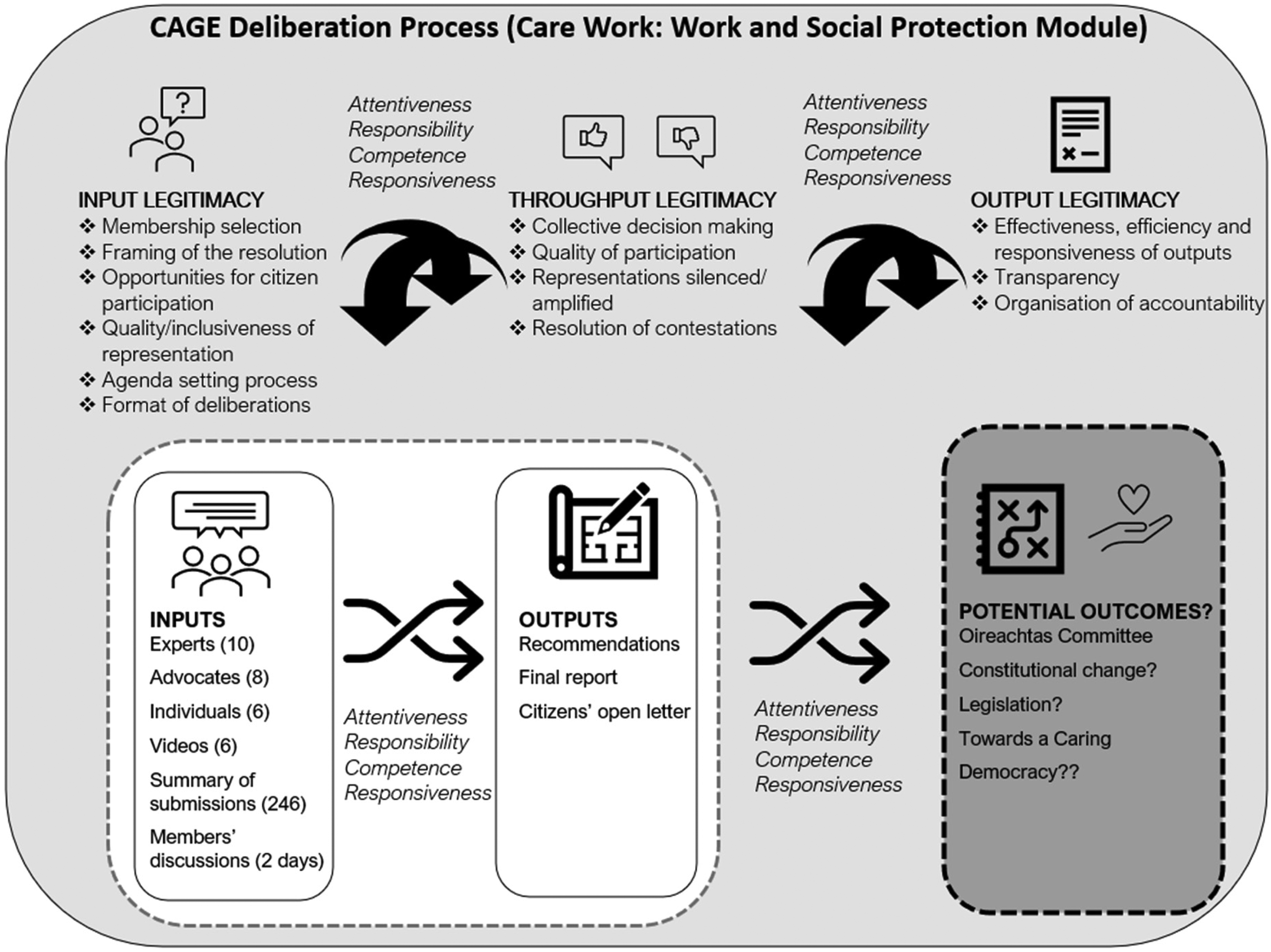
CAGE care full deliberation (care work: work and social protection module).
Method and material
The aim of our analysis was to examine whether and how CAGE engaged in care full deliberation of care work. We engaged in a two-part analysis combining the ‘What's the Problem Represented to Be?’ (WPR) critical discourse methodology (Bacchi, 2009) with the model of care full deliberation (Barnes, 2012). The material drawn on in this article – CAGE's final report and the work and social protection module's core public material (presentations, videos, and transcripts) – are outlined in Figure 1 and were publicly accessible via the CA's website.1 Excerpts are provided in italics in the text below and are denoted as provided by citizens (members) (M), CAGE chair (C), experts (E), advocates (A), individuals (I), videos produced by organisations (V), the CA's Final Report (FR) or accompanying Citizens’ Open Letter (COL).
Initially, to problematise the representation of care work in the module, we employed WPR analysis. Through the holistic application of six questions problematising what the ‘problem’ is represented to be, we used WPR to uncover how care work was problematised at the module, uncovering the conceptual logics, underlying assumptions, and silences, as well as the effects and the harms created. Secondly, to draw out the deliberative elements of CAGE, we applied Barnes’ (2012) approach to care full deliberation (provided in Table 1). Care full deliberation rests on integrating Tronto's (1993) principles of care: attentiveness, responsibility, competence and responsiveness.
Care full deliberation
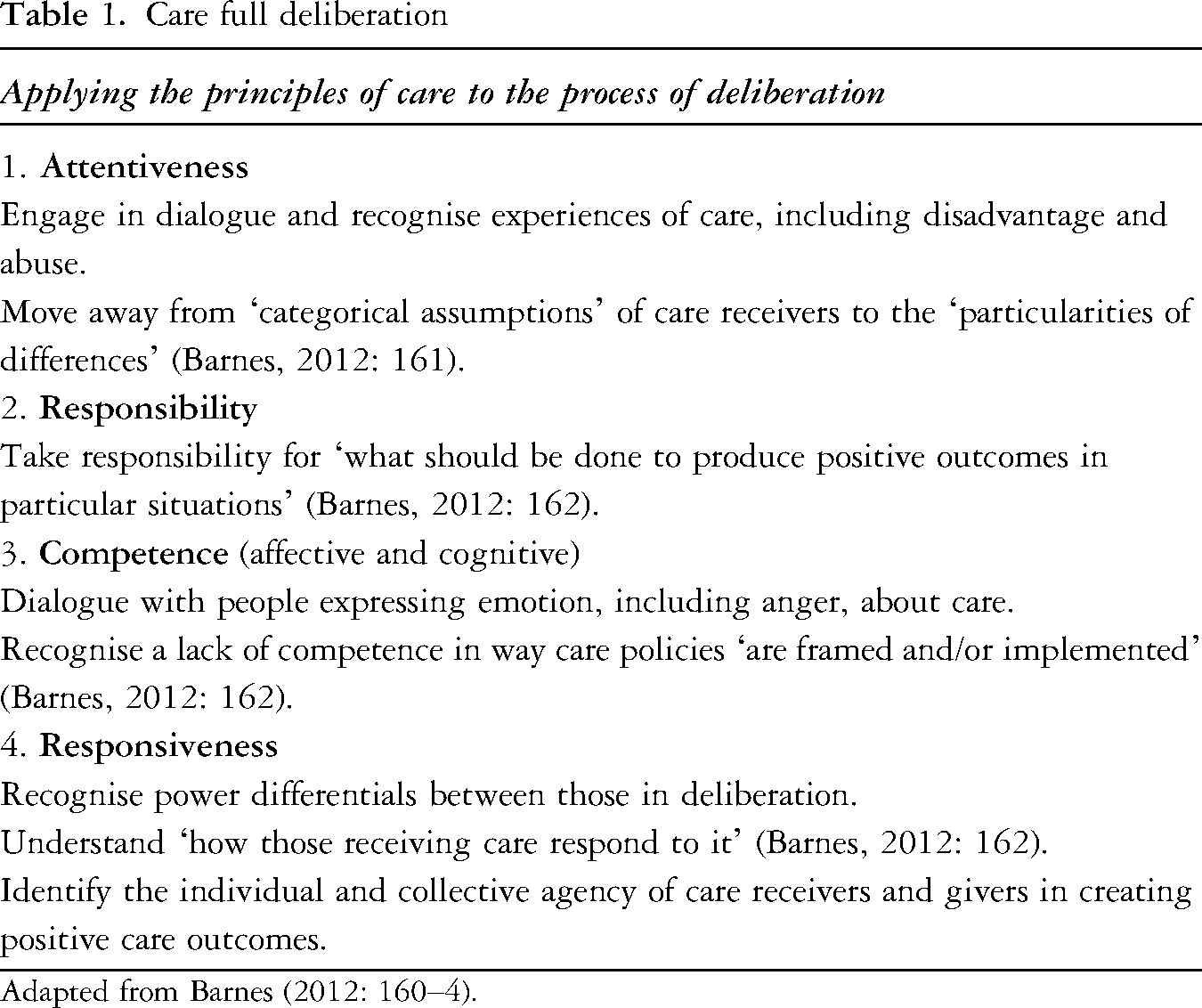
Adapted from Barnes (2012: 160–4).
The first author read and watched all material from the work and social protection module a number of times. Following this process of becoming immersed in the material, she extracted data in line with each of the six WPR questions. Following this process uncovering the problematisation of care work, the material was further examined using the care full deliberation framework (see Table 1). This phase of the analysis sought to identify how Barnes’ elements of care full deliberation – attentiveness, responsibility, competence, responsiveness – were reflected in how CAGE deliberated and understood care work, who they recognised as care workers, and what they recommended to improve care conditions for paid and unpaid care. Following review and discussion of the emerging themes by all authors, the findings were structured into Barnes’ (2012) four elements of care full deliberation outlined in the next section.
Findings: towards a care full deliberation of care work
Our analysis examined how elements of Barnes’ (2012) care full deliberation were visible in CAGE's deliberation. Attentiveness in such processes requires a ‘preparedness to listen and to hear’ (Barnes, 2012: 161) discussions about care in modes outside the communicative norms of policymaking. This requires diversion from ‘categorical assumptions’ of care receivers to witness ‘particularities of differences’ (Barnes, 2012: 161). Responsibility relates to ‘what should be done to produce positive outcomes in particular situations’ (Barnes, 2012: 162) and an ability to discern between obligations (pre-agreed arrangements) and responsibilities for care needs, which requires sensitivity to actual circumstances. Competence reflects an affective ability to dialogue in different registers, including emotion and anger, as well as the cognitive ability to identify any lack of competence in care policy and implementation. Finally, responsiveness requires awareness of the power differentials in care deliberations, and recognition of the agency of care receivers and givers in creating good care outcomes.
Attentiveness
The first analytical in-road – attentiveness – focuses on the particularity of care experiences. Our analysis indicates that CAGE showed attentiveness in how it approached the complexities of care work experiences. CAGE presented an understanding of unpaid care work as ‘care for all and family members with additional care needs. Be it parents, brothers, sisters across the board’ (M). It reflected an awareness of care identities as fluid, such that ‘Disabled women can be parents and carers themselves as well as people receiving care and support’ (I) and that paid migrant carers too need to be ‘able to start families and access afford[able] child care…’ (I). CAGE also demonstrated a broad understanding of the multiplicity of paid and unpaid care workers, with different positions and identities. An emphasis on unpaid women's caring was combined with a nascent understanding of all people as care workers and men as future care resources. Low paid workers were particularly connected with paid care work, as were migrant carers. Lone parents were presented as resilient unpaid carers experiencing significant inequities, with ‘twice the stress, twice the worry and little support in navigating parenthood’ (I). An individual lone parent identified how the lack of care services, and activation rules demanding availability for full-time employment, meant not having ‘much choice in the roles I took, it was a matter of survival and being there to be a parent to my daughter’. Paid migrant carers were underscored in experts’ descriptions of Ireland's care workforce but were made most visible in the stirring contribution of a migrant carer. Undocumented, she worked in a ‘world of … isolation, working very long hours (11 h/12 h a day, 6 days a week) and being paid only 400 euros a month… I was being exploited’.
CAGE was attuned to the ‘unreliable and unjust’ (Chatzidakis et al., 2020: 17) makeup of current care arrangements reliant on ‘free’ family and paid-for care. Women were presented as impacted by the intersections of their unpaid and paid care work – ‘unpaid care work [is] dominated by women’ (E) and ‘The responsibility of care negatively impacts women in terms of work opportunities and pay levels’ (E). CAGE recognised that paid care work is undermined, as ‘“female” skills [are] undervalued: caring, nurturing, admin’, so that the ‘low status of women ‘rubs off’ on evaluation of the job’ (E). As one advocate outlined, women live with ‘the presumption of others that they are then available to take on caring roles, which they may prefer or not to undertake if they had an alternative choice’.
Paid care work was represented as ‘precarious employment’ (FR: 80), ‘traditionally regarded as women's work and are undervalued’ (E). CAGE's attentiveness to paid care work as arduous was perhaps aided by moments which broke through the formal policymaking hierarchies, such as when a health care assistant said: ‘I’d invite Leo [Ireland's then Taoiseach/Prime Minister Leo Varadkar] to come and spend a week with me working in my department here. And I’d like Leo just at the end of the week to tell me how tired he is, tell me how fruitless the job feels because nobody recognizes us’ (V). The low pay and degradation of low paid care workers was so strongly felt that one expert made the plea that ‘these are real jobs
Responsibility
Responsibility in care full deliberation requires the achievement of positive outcomes, in this case for care workers and recipients. CAGE concluded that women's predominance ‘in unpaid care and low paid jobs, including in the care sector, has implications for the social protection system’ (FR: 67). These, it was suggested, should be resolved by ensuring all citizens are entitled to welfare payments, including a universal pension and potentially a universal income. One expert drew directly on the ethics of care to propose a ‘‘careful’ not careless model of activation’ to accommodate unpaid care and employment. CAGE members said that ‘any and all forms of caring work of any duration should be treated as paid employment [e.g., for pension entitlements]’ and that ‘everybody basically [should be] paid for caring work’ through a ‘participation income’ (M) which would act as a ‘form of financial recognition and allows for collection of stamps for pensions, especially in cases of unpaid care work or voluntary work’ (M).
Throughout deliberations, and codified in its care work-related recommendations,2 CAGE identified the state's responsibility to actively support and contribute to both paid and unpaid care work. At the Constitutional level, CAGE recommended that the ‘woman in the home’ article be replaced with non-gendered language, which ‘obliges the State to take reasonable measures to support care within the home and wider community’ (FR: 12). In recognition of the impact of unpaid care work on social welfare entitlements, CAGE recommended individualising the social protection system; piloting a Universal Basic Income scheme; additional activation supports for lone parents; state pensions for women previously unrecognised for unpaid care work; and the introduction of a universal state pension. For employment, CAGE recommended measures to increase security of contracts and a right to flexible working; for parents, increased paid leave; for politicians, parental leave, and flexible working options. To support paid care workers, they recommended improvements in pay, conditions, and advancement. For family carers, they endorsed improvements to welfare payments, pension entitlements and access to respite. To challenge the gendered nature of caring, they sought state investment in programmes to support men into caring careers and increased visibility of men's caring in the media.
In these recommendations, CAGE acted to restore value to paid and unpaid care work denied in the market system. A participation income, one advocate suggested, ‘would recognise other meaningful contributions such as care or voluntary work, and other forms of work that contribute to the common good’. Such measures would ensure ‘caring in the home should not be treated with any less value than other work’ (M). Thus, a key concern for CAGE was a universal reorientation of the welfare system, combined with ‘individualization of the welfare system so that nobody is unseen in the system and everyone is accounted for and treated equally’ (M). It was noted that the welfare payments introduced during the pandemic were ‘completely individualised’, providing ‘a model that can be built on’ (A). There was a desire for different care needs and life trajectories to be supported, with ‘Carer's Allowance, at a level that brings people above the poverty line’, ‘access to child care’ for jobseekers and ‘everyone should get the same pension of equal value once they turn 65’ (M).
CAGE's establishing resolution advised members to be mindful of ‘the costs versus the potential impact’ (Seanad Éireann, 2019). Yet, as deliberations developed, many members ‘felt that cost alone should not be a determining factor in deciding whether significant changes should be made, for example in the area of care’ (FR: 87). The Chair sought to ‘test the willingness of members to take account of the possible need for increased public funding in deciding their recommendations’ (FR: 87), which resulted in a statement attached to their recommendations: ‘These should be funded firstly through greater efficiency and accountability for public funding and reprioritisation between current spending and revenue raising. If necessary, we are also prepared to support and pay higher taxes based on the principle of ability to pay, to make a reality of our recommendations’ (COL: 3).
Competence
Care full deliberation is attentive to any lack of competence in how care policies are framed and/or implemented. CAGE was particularly attuned to the gender inequities at the core of care work and sought to challenge gendered incompetence in the framing of care policy. CAGE made significant efforts to confront the gendering of care and work arrangements, examining women's lower employment rates and status, women whose caring contribution was overlooked by the welfare system, and the ‘motherhood penalty’: Many young women will find themselves young mothers, either as lone parents or in couples. And they'll find their pathways limited by care barriers and they're often restricted to quite local labour markets because of care. For women who are re-entering work after maternity they may find discrimination based on that maternity …. And for women who may spend some years at home in early childcare years, they… might end up on lower pay and lower status work than they had previously. (E)
Relatedly, CAGE's understanding of competence in care policy and practice was strongly influenced by the larger pandemic context, which brought care needs to the fore of people's lives. Lockdowns during CAGE destabilised entrenched care responsibilities and shifted workplace norms, creating new momentum for care leave and flexible working. As one individual asserted: ‘Women have risen to the challenge and have shown their strength during the Covid crisis, turning into teachers, leaders and workers all at the same time’. The importance of low paid workers, including those engaged in care, was affirmed – ‘the pandemic … makes us aware of how much we need the work that low paid workers perform’ (E). The crisis demonstrated ‘just how much we depend on these essential workers in the care sector’ (C) and the poor conditions of ‘young women, women of colour or migrant women’ care workers in child and social care, who have ‘the highest concentration of low pay workers and precarious terms of employment’ (A). In response, CAGE identified the necessity not only to commit to care across the life course, but also to develop ‘well designed, publicly funded pay and career structures for carers, whose invaluable work in the home and wider community contribute so much to the common good of our society’ (COL: 2).
Responsiveness
Barnes’ fourth analytical axis, responsiveness, focuses on the experience of care receivers, as well as the agency of care givers and receivers to create good care. CAGE was perhaps least developed in this element of care full deliberation. While CAGE appreciated unpaid and paid care work in their own rights, there was a significant emphasis on care as a service, to be accessed and activated to enable more involvement in non-care employment. As such, care arrangements were sometimes portrayed as in service to the (labour) market, rather than from the perspective of the care giver/receiver. A sentiment emerged that ‘the unequal division of care is a key barrier to women's equality in the area of work’ (A). Of key concern was that ‘we have not achieved the level of female labour market participation that is necessary for Ireland to remain competitive’ (A). Unpaid care work was represented as creating better employees: ‘I found this balance between career and carer as being really beneficial both personally and professionally… [I am] more productive in my work hours and more creative and bring a new lens to the projects that I’m working on’ (I). Conversely, employment practices were represented as often being unreceptive to caring: ‘Long work hours whether in demanding well paid work, or exhausting low paid work, create significant burdens for many people seeking time for care work, self-care and or to contribute to their communities’ (E). The everyday reality of resolving care and employment demands, particularly when care is devalued as women's work, was bluntly outlined: ‘Why am I worth less than a man doing my job?… 75% of the work we do is unpaid, unrecognised work, yet it is the most vital to keep society functioning’ (I).
Members regularly demonstrated concern for economic calculus, taking potential costs of new care supports into account in a manner which suggests continued support for some forms of marketisation. There was considerable attention to economic perspectives, seeking to examine what supports for care work might ‘cost’ the state (‘How do we pay for changes to tax and welfare system that as you propose? How much would it cost… how could it be paid for?’ (M)), and, in parallel, how the economic value of care work could be calculated (‘Do we collect data on the economic value of unpaid care and household services to Irish national economic activity; and is there a way of economically calculating, from this, how women subsidise the national economy each year…?’ (M)). Yet, reflecting the complexity of care debates, CAGE mixed these market concerns with a questioning of the dominance of commodified care provision, illustrated by concerns about the cost of the privately-dominated childcare sector – ‘Think about how much parents have to pay for childcare for creches. Our childcare fees are one of the highest in Europe’ (E) – and strong recognition of the poor pay and conditions of care workers.
A market focus reached a zenith in a business sector video in which women's labour market participation was heralded as ‘key to have societies that are more: competitive; sustainable; inclusive’. Care services and ‘creative accommodations, like part time hours, reduced hours, job sharing etc.’ (I) were identified as a means ‘to raise female employment levels and ensure continued continuity of employment’ (E). At other times, when CAGE sought solutions to women's overall labour force segregation in low paid sectors, the value of care work was undermined, with discussion veering into how women could be moved out of paid care work into ‘more valuable’ professions. Greater investment in care work was presented as the solution to care barriers to employment: ‘child care is recognized as a barrier to equality and lack of child care services delay a return to employment’ (M); ‘more accessible affordable childcare is really necessary and that's absolutely important to improve women's cycle earnings and employment opportunities over the life cycle’ (E). The scarcity of affordable childcare is compounded by Ireland's low replacement of earnings for maternity, paternity and parental leave, such that Ireland (with the UK) has the lowest payment rates for maternity leave in the OECD (OECD, 2022). Thus, care investments were often presented as means to advance women's employment and gender pay parity, rather than to achieve a better care environment.
Discussion: Problematising the citizens’ assembly process
CAGE indicates how a collective consideration of care responsibilities can provide an alternative to neoliberalism's disregard for care in political deliberations (Barnes, 2012; Lynch, 2022). Our analysis suggests that CAGE's processes exhibited some potential in terms of care full deliberation, but also significant constraints. The Chair praised members for the time that they gave to ‘build compromises in deciding their considered views’ (FR: 86), whilst citizens recounted gathering in ‘mutual respect and openness as we listened, learned, and reflected’, as well as the complexity of deliberation in which their ‘views on gender equality were deepened and at times challenged’ (COL: 1). However, CAGE as a form of care full deliberation was likely stunted by its genesis and procedures. What began with a government resolution was built out through expert knowledge partially supplemented by lived experiences. CAGE's ability to deliberate with care, particularly in terms of attentiveness and responsiveness, was diminished by limitations in membership criteria, the emphasis on expertise and official modes of engagement, time pressures and the one-off nature of deliberation. The breadth of CAGE's gender equality remit limited the depth of engagement with care work. The structure of meetings, which divided sessions into those with expertise and with lived experience, and which gave significantly more time to professionals, appears to have created a hierarchy of ‘relevant’ knowledge and of modes of communication. This prioritisation of expert voices conflicts with the care ethics impetus to elevate the status of close-to-the-ground knowledge of those directly engaged in caring (Barnes, 2012; Lynch, 2022). Individuals were presented, somewhat patronisingly given the broad societal scope of their contributions, as ‘personal experiences and stories’ who ‘each have faced many challenges in their lives and … will speak today about what they would recommend … to improve their situation’ (Panel Chair). Conducted mainly within formal communication norms, CAGE included only flashes of emotion, as when one individual, who was not entitled to a full state pension, broke the politesse: ‘… I love my country but boy did our state let me and others of my vintage down. I tell my children never to forget what successive governments have done to their mother and others’.
Analysing care as a form of labour, as in the module analysed here, can draw out the social, political, and economic contexts and inequalities in which care activities are situated (Barnes, 2012), reveal the power relations in care arrangements (Keller and Kittay, 2017), and call attention to the poor economic circumstances of both paid and unpaid carers (Rummery and Fine, 2012). In its characterisation of paid and unpaid care work, CAGE was attentive to the harsh conditions and the lack of state support for caring. However, CAGE approached care work primarily as a high-level concept, focusing on wider sectoral issues for care work, rather than on specific embodied and emotional practices. In part, this block to responsiveness reflects the limited space given to lived experience, and the relative absence of care receivers from the module. The dark side of care and the potential for neglect and abuse, was also left opaque. Greater reflection on human interdependence and the need for care may have opened the CA's discussions up to the ambivalence care engenders, the ‘feelings of belonging, appreciation, intimacy and joy, but also feelings of ambivalence and anxiety, tension and fear’ (Lynch, 2022: 17).
Further, CAGE's deliberations contained within them an unresolved tension between asserting the value of caring as an essential function of society (and the state) outside of economic concerns, with support for the continued marketisation of care services. While seeking to apportion responsibility for care work, it seems apparent that CAGE sought to operate within perceived ‘responsible’ economic parameters, reflective of current capitalist policy preferences of competitiveness, marketisation and austerity (Lynch, 2022; Williams, 2018). Greater investment in care services was presented as the solution to care barriers to employment, reflecting the objective of individualistic, market-led approaches to get ‘unproductive’ women into paid work (Williams, 2018). Left unanswered was who will do the essential care work, if all are funnelled to high-status, high-pay work. A more nuanced approach to the combination of care and work, via a care-worker model, would recognise that ‘achieving the appropriate balance of reciprocal care and commodified care is not simply a matter of childcare policy, but is a deeper question of the combined fiscal, social security, education, and labour market systems’ (Murphy, 2011: 49).
CAGE did not give explicit attention to power differentials between those inputting into the deliberations. Although the political trade-offs governments make in deciding policy were described in one expert's presentation (‘The state can't provide everything for everyone and so there's no magic money tree’ (E)), deliberations did not significantly draw out the different interests/antagonisms between caregivers and receivers (see Williams, 2012). However, CAGE's attentiveness and responsiveness to different caring identities in Ireland challenges, at least to some extent, the devaluation of care in capitalist societies (Lynch, 2022). CAGE's expansive understanding of who provides care in society – which suggests who the state should recognise as essential to care relations (Barnes, 2012) – was epitomised in their consideration of paid migrant carers and the unpaid care of lone parents. This was a significant enlargement of caring identities in Ireland, where lone parents have historically been vilified (see Government of Ireland, 2021) and neglected in social welfare provision. CAGE's understanding of the multiplicity of care workers suggests an emerging form of Williams’ (2018: 557) ‘‘intersectionality in action’: the need for alliances and dialogues between the different groups making claims around care policies’.
In its recommendations, CAGE demonstrated an ability to look beyond current arrangements, to enlarge the care responsibilities of the state and develop new understandings of caring citizenship. In calling for more state intervention in care work and standing ready to pay more taxes to achieve this, CAGE points to the potential for citizen deliberation to expand the limits of care debates. Recommendations to support those engaged in unpaid caring represent a significant departure from Ireland's minimalist welfare and male breadwinner-focused activation system (Cullen and Murphy, 2021b). Moving beyond the limits of Irish welfare, CAGE recognised that all people have care needs, and that the state, with its potential to reach all (Olofsdotter Stensöta, 2020), is often best placed to provide for care work. CAGE placed relational demands on the state's social protection system to better account for unpaid care work and it asserted the importance of care relations in the priorities and functions of a state, which, tethered to an outdated breadwinner model, had left caring to the family, to charity and the market. Such a reorientation of welfare would mark a rupture with women's historical claiming of citizenship through their dependent role as wives to a male breadwinner (Lewis, 2000), and conversely would provide a caring identity for men previously captured as providers (Hanlon, 2018). In these conclusions, CAGE therefore echoes feminist economists’ arguments for pandemic recovery based on investment in care work and services (Heintz et al., 2021).
Conclusion
Generally, Irish citizens’ assemblies’ influence has related to the creation of legal rights (marriage equality and abortion access), rather than the development of social infrastructure, as would be required to achieve the care work recommendations. Perhaps reflecting critiques of previous assemblies for a lack of fulsome implementation (Devaney et al., 2020; Farrell et al., 2019), CAGE was cautious about state delivery of its recommendations: ‘if our society is to continue to use Citizens’ Assemblies to get representative views on important issues, the response should show that the citizens’ recommendations have had a tangible impact’ (FR: 7) and the citizens made a plea that government ‘match our commitment by accepting our recommendations and implementing them without delay’ (COL: 3).
CAGE has now ceased, and its recommendations have been subsumed into the political process, initially for review by a new parliamentary committee on gender equality. This somewhat convoluted process signals the ultimate control of the executive and political representatives over Ireland's care future. It also emphasises the need to ensure continued care full deliberation in all processes where care responsibilities are allocated and the use of other avenues, including activism and the development of counter discourses, to reassert care work and caring as society's central concern (Lynch, 2022).
Joan Tronto (2020), the progenitor of ‘caring democracy’, has urged caution about any universalising application of the concept across contexts, and care-as-politics theorists have shied away from arguing for particular processes, policies, or institutions (Bourgault, 2017). Yet, Barnes’ framing of care full deliberation and the case study of CAGE provide some guidance about how it may be possible to initiate a broad societal reckoning with care work. Care ethics suggests that centring the voices of care givers and receivers may create space for resistance and counter discourses (Casalini, 2020), which challenge unequal power relations of state-controlled deliberation and lead to the emergence of new issues and alternative solutions. Questions remain as to how CAGE would have operated and what it would have concluded if it was centred around carers, care receivers and their direct concerns. Future citizens’ assemblies could aim to elevate practice knowledges of those citizens shouldering the heaviest care burdens (Lynch et al., 2021) as well as those in receipt of care, and approach caring as both hands-on activity and political imperative.
Footnotes
Acknowledgements
An early version of this article was presented at the 2022 Carework Virtual Symposium and the authors in particular thank Professor Gabrielle Meagher for her dialogue and engagement, which assisted us to further develop our analysis.
Funding
This work was supported by the Carolan Research Trust.
Notes
Author biographies
Address: Institute for Social Science in the 21st Century (ISS21), University College Cork, Cork, T12 YE30, Ireland. Email: