




Abstract
The Vulnerable Persons Resettlement Scheme (VPRS) comprised the UK government's primary response to persons forcibly displaced by the Syrian civil war. Recipients were granted immediate recourse to public funds and a locally-based 12-month integration support plan, designed at the discretion of practitioners. Drawing on forty in-depth interviews with refugees and practitioners in two areas with contrasting local approaches, this article explores the tensions that emerged when broader central government policies (distinct from the VPRS), intersected with resettlement support in recipients’ lives. Two current welfare reforms are identified and evaluated as having impacted resettled families’ housing experiences: firstly; the Two-Child Limit and secondly; the Benefit Cap. The article demonstrates how the financial precarity produced by both policies undermined local practitioners’ resettlement support. In doing so, the article challenges dominant policy narratives of exceptionality, locating those resettled within the routinised systems of precarity and conditionality embedded in the welfare system.
Introduction
On 7 September 2015, former Prime Minister David Cameron committed to resettling 20,000 Syrian refugees to the UK over a five-year period. The newly-introduced quota was facilitated by expanding an existing programme, the Vulnerable Persons Resettlement Scheme (VPRS), an initiative that had already resettled a total of 239 individuals from the region of conflict (Bolt, 2018). In contrast to those subject to the UK asylum system, recipients of the VPRS were granted immediate recourse to public funds, temporary residency, permission to work and a personalised 12-month integration support plan. Existing research on the VPRS shows how resettlement schemes have created a two-tier asylum system, as those who arrive spontaneously to UK borders and then seek asylum have limited access to public funds (Turner, 2015; Karyotis et al., 2020). This article therefore provides a unique insight into how recent resettlement policy has operated in practice, exploring how local housing strategies intersected with (and were undermined by) broader measures embedded in UK welfare policy.
There is a long history of restricting access to services for those identified as asylum seekers, in contrast to resettled persons (Sales, 2002; Bloch, 2002; Bloch and Schuster, 2005). This article focuses on those who have been resettled and situates recipients’ access to public funds within a matrix of broader, nationally-imposed UK policies. In doing so, it demonstrates how the support, entitlements and funding allocated to refugee families were undermined by other central government reforms, to which those resettled were also exposed. Despite the positioning of recipients of the VPRS as exceptional (Turner, 2015), this article highlights the precarity that such individuals were routinely subjected to as a direct result of broader welfare policy. To demonstrate the systemic impact of national policies on resettlement support, the article draws on research that compared and contrasted two different local authority approaches to the VPRS. The effect of national measures on local resettlement policy is examined with reference to two central government welfare policies: firstly; the reform of the Two-Child limit and, secondly; the Benefit Cap. The two policies are crucial in understanding how resettled persons experienced housing support, as both exacerbated families’ precarity and poverty.
Policy paradoxes: Entitlements to public funds in austere times
Whilst resettled refugee families were granted access to public funds, prior research has demonstrated the institutionalised precarity that can occur, even for those with access to welfare support. During the past decade, the UK has pursued a rigorous programme of austerity, resulting in a series of public expenditure cuts. Introduced explicitly in 2010, austerity measures have been articulated as a form of ‘institutional violence’ (Cooper and Whyte, 2017: 23). One of the primary mechanisms by which austerity has been enacted involved entrenching conditionality in the UK welfare system to restrict recipients’ access (Dwyer and Wright, 2014). Fletcher and Wright (2018: 329–330) neatly summarise austerity as a ‘punitive turn…allowing for a wholesale roll-out of conditionality, never seen before in the British system’. Such measures have been proven to be disproportionate in their impact, further exacerbating existing racial, gender and ‘class’ inequalities (Guentner et al., 2016; Bassel and Emejulu, 2017) and perpetuating precarity amongst those affected (Jones et al., 2020; Reeves and Loopstra, 2017). Austerity policies have consequently led to increases in child, food and fuel poverty (Main and Bradshaw, 2016; Lambie-Mumford, 2019), detrimental effects on health and employment opportunities (Welfare Conditionality, 2018), and the continual stigmatisation of welfare recipients (Macdonald et al., 2014; Tyler, 2020; Redman and Fletcher, 2021), all of which have been argued to lead to fatal consequences (Mills, 2018).
Housing is a key focus of this article, due to its prominence as a domain where welfare conditionality is frequently enacted (Hodkinson and Robbins, 2013). As Jupp (2017) demonstrates, austerity measures are often experienced in household spaces, areas that are (deliberately) rendered invisible. Whilst connections between housing and welfare policy are historically rooted (Deas, 2013), the embedding of conditionality in access to public funds has been shown to restrict residents’ access to safe and affordable accommodation (Manzi, 2015; Wilkinson and Ortega-AlcÁzar, 2017), further entrenching poverty amongst recipients (Child Poverty Action Group [CPAG], 2016; Machin, 2017).
Resettled families’ entitlements to public funds can therefore be contextualised in a broader system where welfare reforms often impact access to affordable housing. However, refugees are also presented with additional structural and subjective constraints when navigating access to welfare and housing support in the UK. Inappropriate and unaffordable housing has been shown to shape access to a range of provisions in refugees’ lives, detrimentally impacting employment opportunities and educational training (Bloch, 2002; Cheung and Phillimore, 2014), access to healthcare (Ager and Strang, 2008), and experiences of stability and belonging (Phillips, 2006). Dissatisfaction with housing has also been demonstrated to adversely affect experiences of belonging and well-being amongst recipients of resettlement schemes (Collyer et al., 2018), a familiar pattern embedded in prior programmes (Hale, 1993; Robinson and Coleman, 2000). Access to low-quality accommodation or insufficient welfare provisions therefore have been assessed to impact refugees’ experiences of other forms of support, including the development of social links and various key services. The following section will further outline the two welfare policies that are shown to undermine resettlement support (the Two-Child limit and the Benefit Cap), with a final consideration of the VPRS itself.
Policy contexts
Welfare reforms: The Two-Child limit and the Benefit Cap
Two welfare reforms that intersected with refugee families’ housing experiences are identified in this article: the Two-Child limit and the Benefit Cap. Due to their conditioning of financial support on the basis of family size, both policies are assessed to produce similar impacts on larger families (Work and Pensions Committee, 2019). The two reforms have also been critiqued as highly racialised due to their disproportionate effect on structurally minoritised persons (CPAG et al., 2021). Implemented in 2017, the Two-Child policy restricted certain UK families’ access to child tax credits, based on family size and their children's date of birth. For families in receipt of welfare support with two children, any additional children born after April 2017 were consequently deemed to be no longer eligible for child tax credits. To date, the policy remains in place, with 1.1 million children identified as living in households affected by the policy (Department for Work and Pensions, 2021).The reform has therefore been assessed to increase both the number of children in poverty, and to further entrench deprivation amongst those previously in a precarious position (CPAG, 2021).
The second policy explored in this article is the Benefit Cap. Although introduced in April 2013, the reform has extensively impacted refugee families who have arrived in the UK as part of the VPRS. The Benefit Cap restricts the total annual welfare payments per household to £20,000 for families based outside of London and £23,000 for those living in the capital, limiting access to housing support (Kennedy et al., 2016). As the policy was implemented across the UK, previously affordable rent payments became too expensive for families accessing welfare support (Savage, 2018). As a direct consequence, impacted families struggled to pay for rent, food and warmth, resulting in an increased reliance on Discretionary Housing Payments (DHP) (Sefton et al., 2019; Work and Pensions Committee, 2019). Recipients of the VPRS were impacted by the Benefit Cap after approximately eight months of resettlement in the UK, mid-way through their first year of resettlement support.
Resettlement policy: The VPRS
Practices of UK resettlement are historically embedded, with the structure and design of specific programmes evolving over time (see Bloch, 1999; Collyer et al., 2018; Robinson and Coleman, 2000; Robinson et al., 2003). The VPRS is one of the most recent iterations introduced in the UK, alongside the Gateway Protection Programme (GPP) and the Vulnerable Children's Resettlement Scheme (VCRS). The implementation of the VPRS included a co-ordinated collaboration between various organisations, including the United Nations High Commissioner for Refugees (UNHCR), the International Organisation for Migration (IOM), the Home Office, UK Regional Strategic Migration Partnerships (SMPs), and numerous sub-regional and local authority departments. Recipients of the scheme were initially identified by UNHCR (2011: 243) in line with its resettlement submission categories, including: ‘women and girls at risk, survivors of violence or torture, refugees with legal or physical protection needs, refugees with medical needs or disabilities, children and adolescents at risk and/or refugees with family links in resettlement countries’. Eligible families were subsequently referred to a series of UK national, regional and local institutions for resettlement consideration. Refugees were widely dispersed across the UK, with resettlement locations determined on the basis of local authority volunteerism. Figure 1 illustrates the UK context of the policy, demonstrating the continual communications that occurred between the Home Office, regional organisations, sub-regional authorities, and local governments.
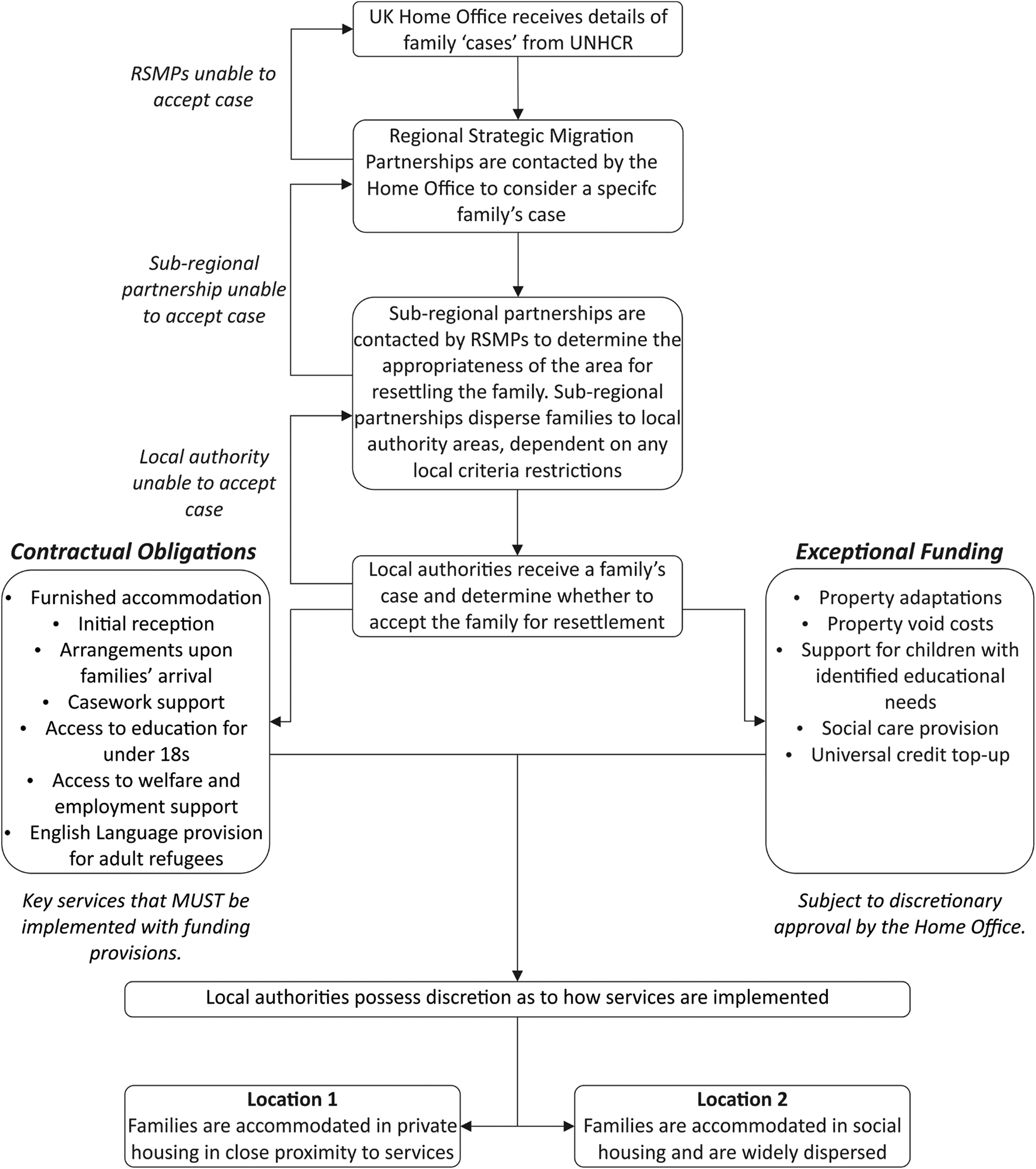
The implementation of the VPRS. Source information: MCGUINNESS (2017).
Under the VPRS, intensive, ‘front-loaded’ support was provided to Syrian refugees, in which assistance was prioritised for the families’ first twelve months in the UK. Local authorities who voluntarily participated in the scheme were eligible to reclaim funding over a period of five years, although the financial support given to local authorities steadily decreased during Years 2–5 of provision. As a condition of receiving government funding, local authorities were required to facilitate ‘integration services in accordance with a personalised support plan for the refugee/family's first 12 months in the UK’ (Gower and Cromarty, 2016: 11). As Figure 1 demonstrates, contractual obligations included facilitating access to: appropriate accommodation; educational facilities; English for Speakers of Other Languages (ESOL) classes; suitable healthcare, employment and welfare support; integration casework; and, finally; interpreting services (McGuinness, 2017). Whilst the core obligations of local authorities participating in the VPRS remained the same, practitioners in the different local areas had discretion in terms of how services were designed and implemented. The local policy designs relevant to this article are outlined in the subsequent section.
This article draws on research that compared and contrasted two different local approaches to resettlement in two socio-demographically similar areas. In Location 1, refugees were accommodated in private housing, located in close proximity to essential services and to other resettled families. In comparison, in Location 2, social housing was prioritised by practitioners for resettled persons, with refugees widely dispersed across the local area due to a lack of supply (see Figure 1). The empirical data analysed in this article was based on qualitative interviews with two groups: practitioners and resettled refugee families. Forty interviews were undertaken as part of the project with 45 individuals (9 interviews with 11 policy practitioners; 31 interviews with 34 Syrian individuals). Practitioner participants included caseworkers, resettlement leads, and regional representatives who could be classified as ‘frontline service providers’ (Berg, 2019: 185). Such individuals operate within the confines of mandated central government policy, but possess discretionary powers in relation to the allocation of local services.
Thirty-one interviews also took place with 34 Syrian individuals (17 interviews in Location 1 with 19 individuals; 14 interviews with 15 individuals in Location 2). The families had been resettled at different times, with the earliest arriving in 2016 and the latest in 2018. Interviewees were defined in VPRS policy as part of 18 different family ‘units’ across the two locations. Family sizes varied between participants and primarily consisted of those with two parents and three children (10 out of the 18 ‘family units’ interviewed), two parents with four children (5 of the family units interviewed) and two parents with two children (1 family unit interviewed). No lone parent families participated, but empirical data was further supplemented by interviews with two families consisting of adult siblings. Of the 18 families interviewed, all adult members were interviewed (either jointly or individually), with the exception of 3 individuals. A roughly equal number of men and women participated (18 men, 16 women) and the ages of interviewees ranged from 18 to 62. Refugee interviewees primarily self-identified as Syrian, with one family identifying as Kurdish. All participants self-identified as Muslim, and possessed various pre-migration histories. An interpreter was provided upon request and empirical interview data was transcribed and analysed. Research locations and persons interviewed were immediately anonymised to ensure confidentiality. Thematic analysis was employed, with NVivo used as a coding tool.
The ethical ramifications posed by conducting the research that this article draws on were carefully considered. The main eligibility criteria issued by UNHCR and the UK government for the VPRS included: survivors of torture and violence, women and children at risk and people in severe need of medical care (Home Office, 2017). Interviewing such persons about their past experiences can risk retraumatising them without a reflexive awareness of the complex ethical implications involved, as such individuals have frequently been exposed to serious physical, psychological and emotional trauma (Mackenzie et al., 2007; Bloch and McKay, 2016). In line with Block et al., (2012), centring families’ experiences and ethical reflexivity were therefore pivotal to the project. Strategies included restricting the scope of interviews to both the UK context (rather than pre-migration experiences) and resettled families’ experiences of local policy. Participants were all adults over eighteen and the research received full ethical approval from the University of Manchester ethics committee. The project therefore incorporated a careful consideration of participants’ vulnerability (Krause, 2017), whilst avoiding the risk of reifying representations of victimhood and obscuring individual agency (Dona, 2007). The following section will now turn to how the intersection of the three identified policies (VPRS support, the Two-Child limit and the Benefit Cap) impacted Syrian families’ experiences and practitioners’ local approaches to resettlement.
Findings
Delivering the VPRS: navigating the labyrinth
In September 2015, local policy practitioners were contacted by central government with a request to voluntarily participate in the newly-expanded VPRS. The appeal for such a commitment occurred in a context of large-scale reductions in public expenditure (Gray and Barford, 2018). Whilst financial assistance from central government was incorporated in the VPRS, the programme was delivered in a policy environment where local authority funding had been reduced by 40% from 2010 to 2015 (Sparrow, 2015). Extensive cuts to public spending therefore constituted the backdrop of the VPRS, a scheme that mandated refugee families’ access to public funds, local services and a personalised integration support plan.
The sourcing of suitable and affordable housing for resettled families has been retrospectively identified as the scheme's primary impediment (Bolt, 2020). Practitioners’ experiences in acquiring appropriate accommodation for resettled families has been shown to be constrained across the UK due to the lack of supply of three-to-four bedroom properties (Bolt, 2018; 2020), the impact of the Benefit Cap on rent affordability (Jamroz and Tyler, 2016) and the limited availability of social housing (UNHCR, 2017). Each of these barriers intersected to further hinder local practitioners’ capacities to allocate suitable housing for resettled families in Location 1 and Location 2: ‘The bigger houses that we need (because the family size is bigger), is difficult as well, because not many four-beds, three-beds come on the market…It's given by housing need, what we could source, where we could source it, cost. We had to take all that into factor' (David, Practitioner, 2018, L1). Furthermore, the positioning of immediately available accommodation in areas with statistically high crime rates, extensive waiting lists for accommodation access, and the limited availability of school placements, GPs and ESOL classes were identified by practitioners as exacerbating such obstacles: We wouldn’t want to place [resettled families] in an area where we thought there might have been high-levels of like, you know, anti-social behaviour, that kind of stuff. So, it was important to identify the right properties…It's almost like a collective decision based on all our knowledge of the borough. Because otherwise…you could get a family living totally isolated or totally in the wrong place and have to travel miles to the school or something like that. So it's important that the starting point, which is the home, is the right place for them (Lucy, Practitioner, 2019, L2)
The acquiring of appropriate accommodation suitable for family size, affordability and locale was consequently consistently identified by service providers across both areas as a significant barrier to participating in, and implementing, the VPRS.
The impact of the Two-Child limit and the Benefit Cap further exacerbated obstacles to finding affordable accommodation for resettled families. As Figure 2 demonstrates, recipients of the VPRS with three or more children were invariably impacted by either one (or both) of the policies, resulting in a curtailment of welfare support contingent on family size (see Work and Pensions Committee, 2019).
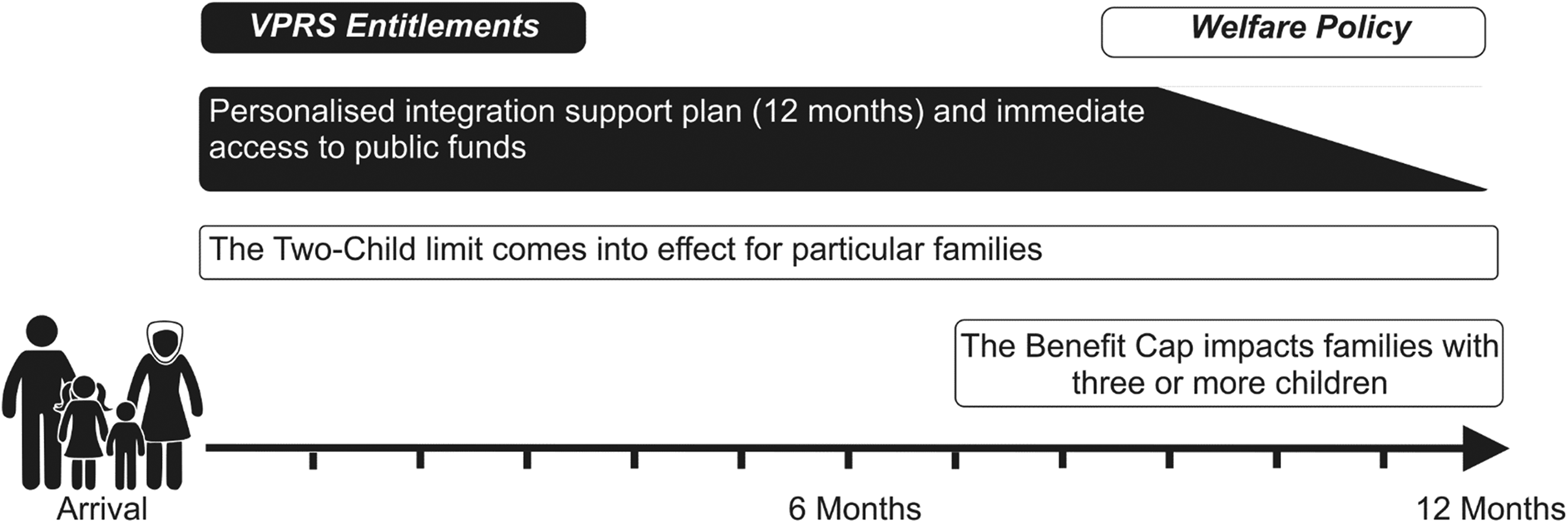
The intersection of welfare reforms in Syrian families’ lives.
Nine of the eleven practitioners interviewed in the research that this article draws on emphasised the detrimental impact of the two welfare reforms on the affordability of housing for those resettled. Jessica co-ordinated the regional allocation of Syrian families to appropriate local authorities upon arrival in the UK. Despite refugees’ immediate access to public funds, the Benefit Cap and Two-Child limit were identified as directly impacting the affordability of rent for resettled families consisting of more than two children: ‘Accommodation costs is a big one, massive, huge, enormous…And austerity's a big part of it…things like the Benefit Cap, Universal credit, housing costs
Given the discursive framing of resettled refugees as exceptionally vulnerable and deserving of access to public funds (Armbruster, 2019), families’ subjectivity to welfare reforms revealed the conflicting policy rationale that practitioners were required to navigate. Contradictions in implementing the VPRS were most explicitly demonstrated through a Home Office request for resettled families to be exempt from the Benefit Cap due to difficulties in acquiring accommodation from local authorities. Such an application was denied by the Department of Work and Pensions (DWP), with the refusal justified due to concerns of being seen to ‘favour’ resettled families above other welfare recipients (Bolt, 2020: 8). Assertions of ‘favouring’ Syrian refugees can be traced to earlier, historically-embedded tropes whereby policies targeted towards racially minoritised residents are perceived as disproportionately structuring resources (Beider, 2015; Hewitt, 2005; Rhodes, 2010). However, professional expectations of adjudicating access to public funds in a ‘fair’ manner continued to constitute the institutional context of practitioners’ work:
The [Benefit Caps] come in if they have more than two children. And some of these are large families. They've got five children. They didn't know about Benefit Cap when they signed up for this…. If you've got five kids and living on Benefit Cap where they pay for two, it's tough… [But], there's been kind of a bit of a campaign to say they should be exempted from Benefit Cap…I can see why you would want that, but on the other hand, you can't single this group out for specific treatment because, actually, that's a form of discrimination. Whether or not that's what you want to call it, that is what it is (Jessica, Practitioner, 2018).
Whilst recipients of the programme were narrativized in central government policy as vulnerable (Turner, 2015), practitioners operated in a system whereby welfare reforms were asserted as policies that instilled fairness (Hamnett, 2014). However, such policy rhetoric of ‘fairness’ obscures the disproportionate effect of policies of welfare disentitlement on resettled Syrian families, due to larger family sizes and limited personal savings as a result of displacement (see UNHCR, 2017; Bolt, 2018, 2020). With the exception of one family, all of the parents who participated in the research that this article draws on had three or more children. Whilst poverty was a recurring theme in relation to the welfare system for all participants across both locations, financial precarity was significantly exacerbated for larger families. Mustafa, his wife Yara and their three children were resettled to the UK in January 2017, with the family welcoming their fourth child in 2018. Due to Mustafa's ill health and Yara's caring responsibilities, both parents remained reliant on welfare support, and were consequently subjected to the Benefit Cap and the Two-Child limit. The long-term effects of both policies manifested in the family's life via difficulties in affording rent, food, and warmth after approximately two years of resettlement support: ‘I've got no one to help me. Every time I contact [L1 practitioners], they say there's nothing we can do…I’ve got small children and need help. I beg anyone to help me' (Mustafa, 2018, L1, translated).
Despite the contrasting design of resettlement policy in Location 2, larger families impacted by the Benefit Cap and/or Two-Child limit echoed such lived realities of financial precarity. Hadiyah and Abdul were resettled in Location 2 in early 2017 with their three young children. Two years subsequent to their initial resettlement, the family continued to identify the unaffordability of basic subsistence whilst living in the UK, including rent payments. As Hadiya identified: ‘We’re having to pay towards the rent…it makes things really difficult and we have felt it really' (Hadiyah, 2019, L2, translated). The cumulative impact of the Benefit Cap and Two-Child limit therefore exacerbated financial precarity for all larger resettled families, as demonstrated in the experiences of other refugees (Kartallozi, 2014).
Furthermore, the ramifications of the two welfare reforms proliferated beyond monetary restrictions on daily living costs. As both measures entrenched poverty within resettled families’ households, parents were also restricted in purchasing provisions for infants and educational supplies for older children. Selda was resettled with her husband Adib and their three children in 2018, with the family welcoming a fourth child, Roaa, shortly after their arrival in the UK. Despite only having lived in the UK for seven months at the time of the interview, Selda's experience consisted of material scarcity following the birth of her new-born. Whilst Selda was in her third trimester of pregnancy when resettled in the UK, the family remained ineligible for child tax credits to support Roaa as a direct result of the Two-Child limit. As with many families in the UK affected by the Two-Child limit (see Sefton et al., 2019), Selda prioritised the available welfare support for the most vulnerable member of her family: her new-born baby (Roaa). Consequently, the Two-Child limit constrained purchases for all her children, including in accessing basic necessities for her infant and in purchasing educational supplies and clothing for her elder school-aged children: We actually need an iPad for homework, one of the teachers told us. I can’t really buy an iPad for the children because [the baby] doesn’t get any money from the government really, and yet she's the most needy one of the whole family. She needs nappies, she needs milk. So, we haven’t got the money really to get all that for the [elder] kids. My children want to wear the same clothes that other children are wearing… there's a lot of pressure (Selda, 2018, L1, translated).
The insecurity produced by the welfare reform situated Selda's elder children in a position of relative poverty, with limited access to educational supplies. In a context of UNICEF (2013: 4) concerns of a ‘lost generation’ of Syrian children, the financial constraints placed on resettled families by the Two-Child limit therefore contributes to the disruption of particular children's education, due to the unaffordability of school supplies.
In the absence of a standing policy of UK resettlement, local authorities participating in the programme adapted VPRS guidance in various ways (Jamroz and Tyler, 2016). Whilst recipients of the scheme were entitled to specific provisions (McGuinness, 2017), local authorities possessed discretion in relation to how support was delivered. Two contrasting approaches to housing resettled families consequently developed in Location 1 and Location 2 (see Figure 1). The first approach (Location 1) accommodated resettled families in private housing situated in close proximity to services, whilst the second (Location 2) dispersed families across the borough to facilitate access to social housing. This section will demonstrate how, despite the different local responses to the VPRS, the Benefit Cap and the Two-Child limit continued to constrain refugee families’ positions within the housing market in both areas, with families in Location 1 forced to relocate, and those resettled in Location 2 trapped in the lower sector of the housing market. Intersections between welfare reforms and VPRS support therefore continued despite contrasting local approaches to support, resulting in a series of unintended (and unavoidable) consequences.
The primary method through which practitioners exercised discretion manifested in how local authorities designed and implemented policy responses. Understanding the processes by which local VPRS strategies were constructed matters; such aspects determined how practitioners’ discretion was used, and which interventions were deemed appropriate (see Boswell et al., 2011; Bottero, 2020). In Location 1, local practitioners prioritised families’ access to services when allocating housing. Properties that facilitated the clustering of families in close proximity to essential services were therefore acquired. However, due to the broader constraints identified earlier in sourcing accommodation provisions, practitioners were reliant on private housing stock to facilitate such clustering: We’ve got doctors who are bi-lingual, dentists who are bi-lingual, we’ve got the ESOL provision in [the area]…[But] there isn’t the housing stock here to house everyone in social accommodation so we have to source some from the private sector, which has added costs for the individuals (Sophie, Practitioner, 2018, L1).
Policy strategies of clustering those resettled in the UK in close proximity have been previously identified as providing an ease of access to services and social support for refugees (Musgrave and Liebl, 2017; Sales, 2007). However, the detrimental impact of policies of welfare disentitlement on rent affordability resulted in families being forced to relocate to cheaper accommodation: We have a lot of issue with them wanting to move to the cheapest property and sometimes them not understanding that the cheapest property might not be the best (Sophie, Practitioner, 2018, L1).
Recipients of the VPRS were therefore dispersed away from the carefully-selected accommodation and locale that practitioners had identified within the local housing market.
The impact of welfare reforms resulted in the forced relocation of three out of the nine families interviewed. Those affected were subsequently dispersed away from essential services, drop-in centres and other family members, all of which had been carefully selected by practitioners. Khaliq, Maha and their three children had arrived in the UK in 2018 (sixth months prior to the interview date) and expressed their satisfaction with their housing situation. Khaliq's accommodation was positioned in close proximity to his children's schools, ESOL classes and their registered GP, with neighbours identified as a key source of support for the family: My neighbours…came and introduced themselves and they are very lovely and friendly and I am very happy in the new house…[My children] go and play with the neighbour, maybe in the garden…the area is very nice. We feel safe (Khaliq, 2018, L1).
Whilst the development of personal relationships is a complex, situated process structured by broader power dynamics (Edwards et al., 2006), social support has been shown to substantiate access to resources, employment opportunities, and self-efficacy for refugees (Cheung and Phillimore, 2014; Tip et al., 2020). However, as with other UK-based families impacted by welfare reforms (see Savage, 2018), formerly affordable rent payments became too expensive for the family once the Benefit Cap policy was implemented. Consequently, Khaliq and his family were forced to relocate from their private accommodation to a more affordable provision, dispersed away from essential services and newly-developed friendships: In the beginning, I don’t want to move my house because my neighbours [are] very nice, but I[‘m] forced to do that because the price is very expensive…My house is private house and I am looking for a Council house because more cheaper…And I am going to pay after, I think, 8 months, I should pay part of the price, the whole price of the house… I don’t want to move (Khaliq, 2018, L1).
By withdrawing welfare support for larger families, the Two-Child limit and the Benefit Cap compelled Khaliq and his family to relocate to new accommodation. The cumulative effect of both welfare reforms manifested in a series of consequences over time, including the dispersal of Khaliq's children away from their schools and the loss of the social links developed by the family during their first year in the UK. Similar patterns of displacement emerged in the experiences of another family resettled in 2017. Abbas, Marwa and their three children had lived in the UK for two years at the time of the interview. The family was forced to relocate as a result of their subjectivity to the Benefit Cap after their first year of resettlement. Marwa explained how their ‘new house is beautiful, but far. Far from my children's school… my brother [is] far from here' (Marwa, 2018, Location 1). Despite evidence as to the frequently transient nature of access to welfare support for UK citizens (Hills, 2017), the centrally-imposed reforms had a lasting impact in the lives of Abbas and Marwa, resulting in the family's dispersal away from essential services and Abbas’ newly-resettled brother.
Practitioners in Location 2 utilised their discretion by implementing a different approach to resettlement support. Families were instead facilitated access to social housing to ensure affordability, resulting in recipients’ dispersal across the area. As one practitioner, Caroline, explained, such a decision was deliberately selected to reduce the costs associated with the Benefit Cap: We’ve often found there's been issues around the benefits and rent and other things, but with the social landlord it's much easier to resolve them… Some of our families have become subject to the Benefit Cap because of the number of children they’ve got (Caroline, Practitioner, 2019, L2).
However, whilst provisions of social housing were selected to assuage the impact of the Benefit Cap, welfare reforms continued to position refugees as financially precarious. Layla and Omar were resettled in the UK with their three children in 2018. Despite the family's access to social housing, rent payments were still deemed unaffordable, and were further compounded by a perceived isolation from services and other resettled families: ‘So we[‘re] still receiving benefits…the money wasn’t enough at all…We didn’t like the area in the beginning, because it's really isolated and it's really far from the other Syrian families' (Omar, L2, 2019). Paralleling Layla and Omar's experience, Salma was resettled with her husband Muhammed and their three children in 2018. Whilst Salma was able to maintain rent payments subsequent to the impact of the Benefit Cap, the family remained in a precarious position. Salma depicted how her family were confined to the lower sectors of the housing market, explaining that ‘the money is not enough anyway to get by for the whole family' (Salma, 2019, L2, translated). The family's limited access to social support and key services as a result of their dispersal in the local area was further identified as exacerbating such precarity: ‘Everyone is thinking that I’m too far so they don’t want to see me' (Salma, L2). Practices of dispersing refugees have been extensively critiqued as a method that exacerbates exclusion, isolation and precarity amongst those subjected to the process (Bloch and Schuster, 2005; Sales, 2007). By unravelling Salma's experience of her local area, the Benefit Cap and Two-Child limit are revealed to ‘fix’ families in a specific location. Unable to find affordable accommodation elsewhere in the borough, the two welfare reforms infused a sedentary impact in Salma's life, containing her family in an area where she felt unsafe and abandoned. Salma and her husband Muhammed further revealed how their family had been a target of hate crimes and racially-motivated attacks, leading to their desire to move to another location: ‘I want to move… Muhammed was thinking of leaving the house and the area because I was scared for my children' (Salma, 2019, L2, translated). Many of the interviewed families that shared their experiences similarly emphasised their subjectivity to institutional and everyday racisms, as demonstrated in Reyes and Phillimore (2020). However, refugees remained constrained from moving to new accommodation whilst accessing welfare support. Despite practitioners’ deliberate strategy to acquire social housing to alleviate the impact of the Benefit Cap, refugees were confined to the lower sector of the housing market and prevented from relocating in instances where they felt unsafe.
Concluding remarks
In a context where resettlement remains one of the few remaining legal routes to seek asylum in the UK, this research has provided extensive insights into how normalised structures and policies operate for those resettled. Despite refugees’ access to public funds and more extensive entitlements being granted, many of the systemic exclusions embedded in the welfare system intersected with local approaches to resettlement support. Whilst such policy paradoxes have been extensively evidenced previously and in different ways in the lives of those seeking asylum (Sales, 2007; Bloch, 2008), this article has specifically focused on the impact of reforms to the welfare system.
The intersection of welfare reforms and resettlement policy has therefore been depicted in this article as perpetuating a series of contradictions, whereby seemingly unconnected policies intersected with resettlement support, leading to a series of consequences in recipients’ lives. Thus, the article has extended existing knowledge of the VPRS in two main aspects. The first has demonstrated how each of the three identified policies (local resettlement support, the Benefit Cap and the Two-Child limit) intersected, with the two welfare reforms exacerbating precarity within the household and placing constraints on purchases for refugee children. The second key contribution in this article evidences the conflicts that emerged between centrally set austerity measures and the local delivery of VPRS policy. Consequences of the intersections between different local approaches to resettlement and welfare reforms varied, but primarily included: secondary migration in Location 1 (whereby families relocated to a more affordable area, dispersed away from key services), or recipients’ entrenchment in the lower sectors of the housing market in Location 2. Regardless of the different approaches used in both areas, the two welfare policies reproduced structural inequalities in all families’ lives, intersecting with local VPRS approaches to resettlement support in complex ways. In both locations, the Benefit Cap and Two-Child limit entrenched constraints over families’ control as to the location where they lived and resettled families were hence positioned as precarious and isolated. This article has therefore provided vital evidence of the intersection between resettlement policy and welfare reforms, in a context where the UK government has committed to resettling 20,000 refugees displaced from Afghanistan. As local Councils continue to be constrained by housing supplies in implementing the latest scheme (see Taylor, 2021), the subjectivity of resettled refugees to the Benefit Cap and Two-Child limit may require careful consideration, given the findings presented in this article.
Footnotes
Acknowledgements
The author would like to thank Alice Bloch for her thoughtful comments on an earlier draft and Claire Alexander for her constructive feedback which helped to shape and refine the arguments. I am very grateful to the three anonymous reviewers for their helpful comments.
The author declared no potential conflicts of interest with respect to the research, authorship, and/or publication of this article.
The author disclosed receipt of the following financial support for the research, authorship, and/or publication of this article: This work was supported by the Economic and Social Research Council, (grant number ES/J500094/1).
