



Abstract
Family policies promoting gender equality and parents’ shared responsibility for their children tend to assume good parental collaboration post separation. However, this assumption obscures the reality of conflict and intimate partner violence (IPV) in some separated families. Focusing on Sweden, this article examines the 2016 reform which implies that the state ceases acting as an intermediary to organise child maintenance unless ‘special reasons’, including the experience of IPV, are invoked. Thus, the Swedish guaranteed child maintenance scheme became conditional. Drawing on interviews with resident parents and case officers at the Swedish Social Insurance Agency (SSIA), this article suggests that the reform increases the vulnerability of resident parents in several ways. Moreover, the ‘special reasons’ exemption creates a new distinction between ‘violent’ and ‘normal’ families, which case workers struggle to administer, and which leads to a withdrawal of state support for many families.
Introduction
Family policies promoting gender equality and parents’ shared responsibility for their children tend to assume that parents will collaborate with each other, even after separation or divorce. In many countries, financial responsibilities post separation are regulated by law and organised as child maintenance, which can be defined as the ‘money transferred between parents post separation for the purpose of supporting children’ (Cook and Skinner, 2019: 166). This article aims to contribute to the body of research examining the consequences and risks of ‘amicable’ family policies (Kurki-Suonio, 2000) underpinned by ideals of gender equality and equal parenting. In the case of separation, equal parenting translates into a preference for shared custody, based on the assumption that parents are willing and able to collaborate with each other, and that it is in the child’s best interest to have contact with both parents (Blomqvist and Heimer, 2016; Harris-Short, 2010; Kurki-Suonio, 2000). However, as shown by several scholars, the policymakers’ assumptions regarding parental collaboration after separation overshadow the reality of conflict, intimate partner violence (IPV) and gender inequality (Bunting, 2007; Eriksson, 2011; Fehlberg et al., 2011; Harris-Short, 2010). Broader aspects regarding shifts in families’ access to welfare rights (cf. Titmuss, 1968; Johansson, 2001; Fink, 2001) also become relevant in this context.
Problems regarding child maintenance procedures may take the form of non-compliance (e.g., Cook et al., 2015; Natalier, 2018), a risk of violence from the ex-partner (e.g., Douglas and Nagesh 2019; Patrick et al., 2008), and a risk of micro-aggressions during interactions with public officials (e.g., Natalier, 2017). Researching the risk of financial abuse post separation is important because, while studies have shown that financial abuse is a feature of IPV, this research has mostly focused on cohabiting couples (Natalier, 2018). IPV may however intensify after a separation and take various forms, including financial abuse and stalking (Bunting, 2007; Douglas and Nagesh, 2019; Miller and Smolter, 2011). Previous research highlighted that, although child maintenance schemes are designed to facilitate money transfers between separated parents and reduce the risk of poverty of the resident parent (i.e. the parent with whom the children live the majority of the time), they can have the opposite effect and, instead, increase the risk of financial insecurity and abuse (Douglas and Nagesh, 2019; Natalier, 2018; Skinner and Davidson, 2009).
Studies on child maintenance have mainly focused on the contexts of Australia, New Zealand, the UK, and the US. Some scholars singled out Sweden as a good example with respect to child maintenance policy because of its ‘guaranteed maintenance scheme’ (Bergman and Hobson, 2002; Cook et al., 2015; Hakovirta, 2011; Patrick et al., 2008; Skinner and Davidson, 2009). Guaranteed maintenance means that if the parent liable for payment neglects to pay, the resident parent can claim child maintenance from a state agency, which then collects the money from the liable parent. However, the way child maintenance works in practice in Sweden has not received much attention. In this article, we show that access to guaranteed child maintenance has been seriously weakened by the 2016 reform of the Swedish Social Insurance Code.
Previous research on child maintenance policy
Child maintenance refers to money expected to be paid regularly, either directly to the resident parent or via an agency acting as an intermediary. This monetary transfer is usually not applicable in 50/50 shared custody, i.e., when children spend an equal amount of time with each parent, even though such arrangements do not necessarily imply an equal share in the financial responsibility towards the children (Bruno, 2018).
In contrast to welfare schemes organised between the state and the claimant, child maintenance involves three parties – the state, the resident parent and the non-resident, and therefore liable, parent. This makes it a particularly complex scheme because of representation and power differentials between these parties (Cook et al., 2015; Natalier, 2017). Based on a comparative analysis between Finland, Germany, Spain, the UK, and the US, Hakovirta and Jokela (2019) found that child maintenance contributes significantly to the income of lone mothers, and that there is a great variation in the level of child maintenance between and within countries. Previous studies also showed that mothers are often more financially vulnerable post separation than fathers (e.g., Estrada and Nilsson, 2004), suggesting that child maintenance is particularly important for single mothers. While family policies aim to reduce the poverty of lone parents, this conflicts with another purpose of current family policies, namely the promotion of children’s ‘best interests’ by encouraging (financial) collaboration between separated parents. The emphasis on collaboration implies that separated parents are expected – and sometimes forced by court decisions – to maintain contact with each other, which may heighten the risk of abuse after separation (Kurki-Suonio, 2000; Smart, 2004).
Financial abuse, which is often associated with other forms of IPV, may lead to financial instability, and previous experiences of violence may reappear in relation to financial matters. This form of abuse can be exerted through one partner’s control of jointly owned financial resources or through more blatantly violent acts, such as destroying the partner’s belongings or depriving the partner of basic resources (Sanders, 2015). An ex-partner may also withhold payments and thereby control the resident parent’s economic resources. As noted in previous research, financial abuse may also be manifested in welfare state interventions intended to support parents and children. Scholars have claimed that some welfare schemes even facilitate economic abuse because their design enables perpetrators to sustain their financial advantage and undermine their ex-partners’ (often women’s) financial autonomy (Natalier, 2018; Cook, 2021). This type of abuse may go unnoticed because, in the context of equal-parenting family policies, victims may hesitate to disclose abuse out of fear of litigation and imposition of shared custody (Fehlberg et al., 2011). In a similar vein, Miller and Smolter (2011) coined the term ‘paper abuse’ to describe how perpetrators can obstruct or prolong legal and administrative processes, e.g., by filing frivolous lawsuits, making false reports of child abuse, and taking other legal actions ‘as a means of exerting power, forcing contact, and financially burdening their ex-partners.’ (2011: 638). Commenting on the situation in the US where early cooperation was made a condition for receiving certain welfare benefits, Pearson et al. (2001) noted that, although the system allowed claimants to request an exemption from the requirement to cooperate if they could show a ‘good cause’, few claimants made such requests. Reasons for this included reluctance to report IPV and lack of knowledge about this possibility (see also Meyer et al., 2007). Studying the effects of a similar exemption in Australia, Patrick et al. (2008) observed that some claimants refrained from seeking an exemption because they found the process embarrassing and intrusive and did not want to revisit the pain of past violence. Based on interviews with separated mothers and the analysis of government forms, Cook (2021) showed how information about the possibility of requesting an exemption was downplayed or hidden to the advantage of the state. Further, studies examining the role of professionals in administering child maintenance schemes highlighted the difficulties for social workers in assessing IPV (Hagen and Owens-Manley, 2002). Pearson et al. (2001) argued therefore that ‘training and staffing are critical aspects of an agency’s response to domestic violence’ (Pearson et al., 2001: 187). Overall, previous research reveals that current family policies tend to overlook the risk of post-separation abuse and may even exacerbate the financial vulnerability and exposure to violence of resident parents, who are predominantly women.
Child maintenance in Sweden and the 2016 reform
Sweden passed its first law regarding the support of children of divorced or never-married mothers in 1938 – the Income Maintenance Act. Like other welfare state initiatives emerging from Swedish family policy at that time, this law required the state to guarantee provision for the child and recover the allowance from the father (Bergman and Hobson, 2002). Another influential development in the formation of Swedish family policy was a rather radical shift in the construction of fatherhood in the 1970s, establishing joint custody as the preferred option for separated parents (see Schiratzki, 1997). This shift was underpinned by the assumption that ‘it was to the child’s advantage to have good contact with both parents’ (Bergman and Hobson, 2002: 101). The father’s responsibility after a separation ceased to be merely financial and became linked to aspects of care and closeness.
Today, Swedish family policies and laws generally promote shared parenting after separation, with the expectation that parents share the legal responsibility for their children and have contact with each other (Eriksson, 2011). This preference became the norm in 1998, when the Parental Code – the main Swedish family policy statute – was amended to authorise the courts to order 50/50 alternating residence, even against the will of one parent. Blomqvist and Heimer (2016) observed that, although Swedish policy makers discussed the pitfalls of imposing shared custody, they still decided that it is in the best interest of the child to have contact with both parents after separation.
Swedish family policies are grounded in an overarching discourse of gender equality which tends to obscure power imbalances between the parents (Lindvert, 2002; Eriksson, 2011; see also Fink, 2001) a circumstance that has been referred to as the ‘Nordic paradox’ (see Korkmaz, 2021). Apart from its commitment to gender equality, Sweden has a strong commitment to the rights of the child. This can be noticed, for example, in the Swedish Government’s decision to incorporate the United Nations Convention on the Right of the Child (CRC) into Swedish law from 1 January 2020 (McCall-Smith, 2019). However, scholars have claimed that Swedish family policies do not pay sufficient attention to the impacts of parental conflict, IPV, and financial abuse in separated families (Blomqvist and Heimer, 2016; Bruno, 2018; Eriksson, 2011). Given these presumptions, it is not surprising that the child maintenance reform of 2016 emphasises equality and agreement as central features of good parenting post separation.
As mentioned earlier, the term ‘child maintenance’ refers to regular cash transfers paid by one parent to the other. This cash transfer is typically paid by the separated fathers. In Sweden, this transfer can take two forms, either as maintenance allowance, stipulated by the Children and Parents Code, whereby the liable parent pays the allowance directly to the resident parent, or through maintenance support, stipulated by the Social Insurance Code, 1 whereby the liable parent pays through the intermediary of the Swedish Social Insurance Agency (SSIA). In short, the maintenance allowance is a private arrangement for the transfer of money between parents, while maintenance support is the arrangement mediated by the state. The latter guarantees child maintenance because the resident parent receives the payment from the SSIA which in turn seeks the money from the liable parent. If the latter does not pay, he or she owes the SSIA rather than to the resident parent. Prior to the 2016 reform, any parent could opt for maintenance support instead of organising the money transfer privately. In 2014, Statistics Sweden established that ‘it is common that parents apply for maintenance via the SSIA . . . a third of the mothers and a quarter of the fathers’ (SCB, 2014: 12, authors’ translation).
Although parents did not have to explain their reason for applying for maintenance support, it is reasonable to assume that this support scheme was mostly used by parents who experienced some level of disagreement and therefore preferred to organise the maintenance transactions through a state agency. The 2014 report of Statistics Sweden indicates that difficulty in finding a financial arrangement with an ex-partner is gendered, with 34.9 per cent of mothers and 4.3 per cent of fathers saying that they had no financial arrangement for their child because the other parent did not want to pay for maintenance support (see Table 1).
Responses (in %) to the question: ‘Why did you not have an economical arrangement for your child?’
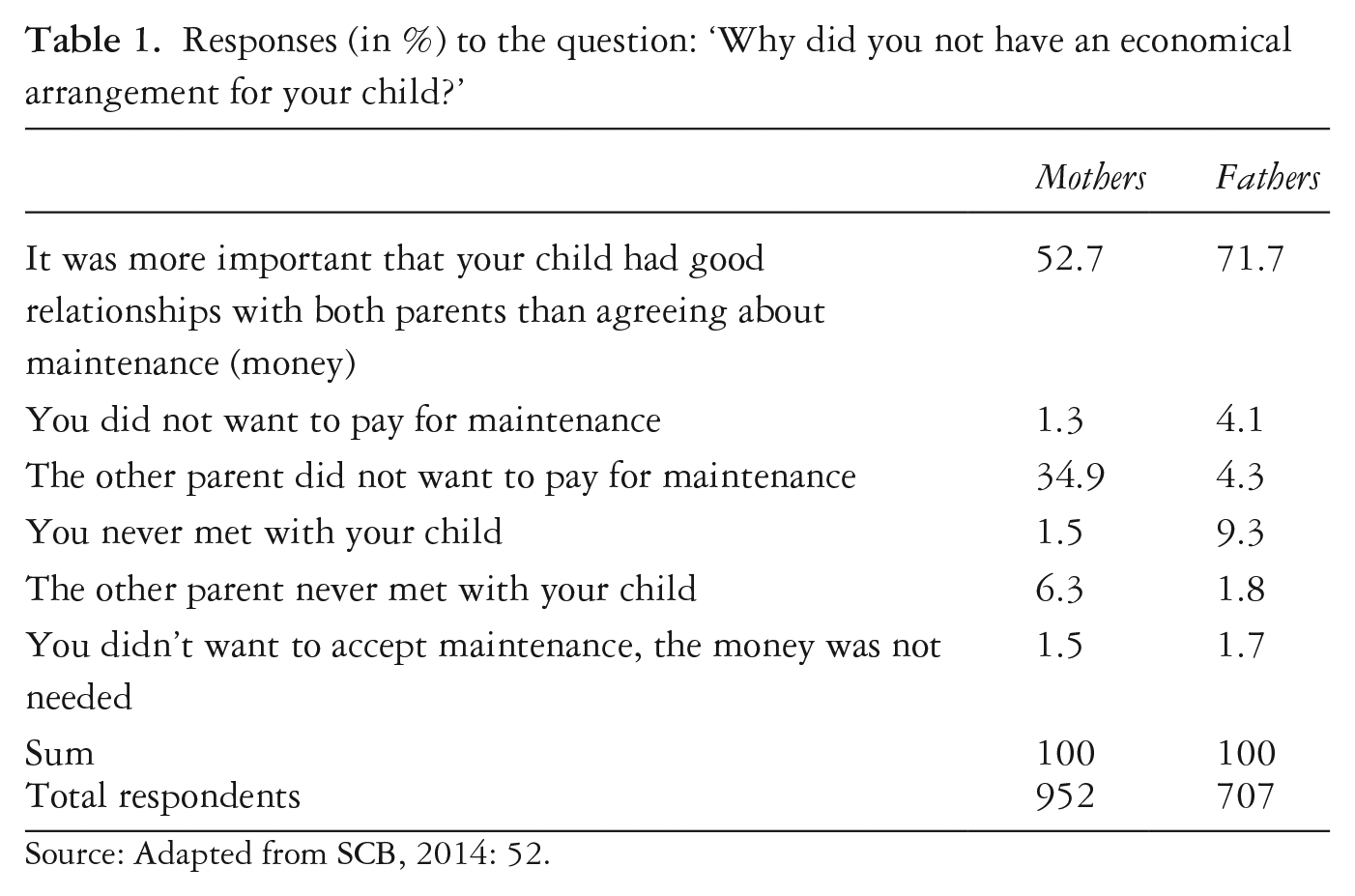
Source: Adapted from SCB, 2014: 52.
However, the possibility of getting maintenance via the state was curtailed by the 2016 reform. The explicit aim of the reform was to promote parental cooperation and reduce the number of maintenance support cases handled by the SSIA (Government Bill, 2014/15: 145). The reform stipulates that, if the liable parent has paid the SSIA for six consecutive months, the SSIA will automatically cease to intervene, and the parents must organise the cash transfer privately. Claimants may seek an exemption if they can show ‘special reasons’ – such as previous occurrences of IPV – in which case the SSIA’s continued mediation may be justified. Since the reform, the issue of IPV has been more prominent in the SSIA’s work routines because of the agency’s new role of assessing if special reasons may be invoked in maintenance processes (Fernqvist, 2020; ISF, 2019). These assessments are usually done by the case officers, sometimes in collaboration with senior colleagues with more administrative experience (but not necessarily knowledge) regarding IPV, who are internally referred to as ‘specialists’.
Granted exemptions are not permanent and cases are generally re-evaluated every six months (ISF, 2019). If the exemption is denied, resident parents can renew their application. However, each application is processed as a new application and takes approximately 6–8 weeks to be administered. Apart from increasing the resident parent’s burden of responsibility for accessing benefits, these conditions imply that a population already vulnerable to financial hardship (i.e., lone mothers) may experience increased vulnerability. In Sweden, lone mothers are twice as likely as lone fathers to experience financial hardship (Försäkringskassan/SSIA, 2018:49) and men earn more money than women (Statistiska Centralbyrån (SCB)//Statistics Sweden, 2020) which underpins the gendered aspect of this vulnerability.
One of the policy makers’ main arguments was that it is in the best interest of the child that parents collaborate with each other, partly because private arrangements should result in more money being transferred to the children (ISF, 2019). This was criticised by Swedish interest organisations, politicians and legal experts who warned of the risk of abuse when parents with a history of conflict are required to arrange child maintenance privately. For example, the political party Feminist Initiative stated that ‘SSIA’s duty is to protect women exposed to violence, not to make them vulnerable’ (Dagens Arena, 2016, authors’ translation). The Swedish society of lawyers noted that the perspective informing the reform had an ‘unrealistic view of parents’ will and capacity to collaborate’ (Advokatsamfundet, 2014: 2, authors’ translation). The Swedish Social Insurance Inspectorate (ISF) observed that ‘one needs to consider that conflicts of interests between the parents can be exacerbated, especially when (the often economically more vulnerable) resident parent risks being more exposed to the other parent’s will to collaborate’ (ISF, 2014: 1, authors’ translation). Notwithstanding these reservations, the reform came into force on 1 April 2016.
Methods
This article is part of a larger project on the impact of the 2016 maintenance reform in Sweden. For this study interviews have been carried out with (a) ten case officers working exclusively with child maintenance at the SSIA and (b) eight resident parents who at the time of the interview had been informed by the SSIA that they would have to arrange the maintenance transactions themselves because of the reform. The overall purpose of these interviews was to capture the informants’ perspectives on the reform, with a particular focus on experiences of abuse. The interviews were conducted during the latter part of 2017, a year after the reform came into effect. The interviewed case officers were recruited through contacts with their superiors, who provided them with information about the study. All but one of the interviewed case officers were female. While it is possible that professional self-image, attitudes towards IPV and other topics discussed have gendered dimensions, these aspects would need to be explored in future research as they could not be examined within the scope of this article.
The case officers’ work experience varied. Some had been working at the SSIA for several decades while others had recently started their job. None of the interviewed case officers reported having any previous training on or professional experience of issues regarding children, families or IPV. The interviewed parents, seven women and one man, were recruited through advertisements and contacts with organisations aimed at lone parents. All of them had experienced some form of physical, psychological, or financial abuse from their ex-partner. Their financial situations varied at the time of the interview. Some, including the only father in the sample, described themselves as relatively well-off, while others had been receiving income support 2 from the Social Services for several years.
The interviews did not include questions about the participants’ ethnic background or identification. However, one of the case officers referred to her non-European descent and mentioned that her cultural understanding regarding the social stigma associated with separation and divorce contributed to her knowledge about the predicaments that parents with similar backgrounds could face. Due to the limitations of her professional discretion, she said that she was often unable to use this knowledge in her practice. Overall, it is likely that lone mothers with non-European descent, who are overrepresented among parents living in economic hardship in Sweden, (e.g., Salonen, 2018) are particularly vulnerable to the changes that the maintenance reform has entailed. Due to the small sample in this study, however, definitive conclusions cannot be drawn.
To ensure consent, an information letter was sent to the participants prior to the interview, describing the aims of the study and clarifying that participation was voluntary and that the interviewee could withdraw consent at any time. The central themes of the interviews with the parents touched upon their interactions with the SSIA after the reform, their views on the reform’s implicit demands for cooperation and their experiences of violence. The interviews with the case officers mainly inquired about their contacts with separated parents after the reform, and their routines for assessment of special reasons and IPV. Interviews lasted 45–90 minutes and were transcribed verbatim. The transcripts were then closely read and broken down into codes, such as ‘assessing special reasons’, ‘financial conditions post separation’ and ‘experiences of contact with the SSIA’. Codes can be defined as labels used to describe the core content in the segments of the interview data to which they refer (see also Saldaña, 2013: 3). Using a thematic analysis approach, these codes were reworked into broader themes and interpreted in the light of previous research on child maintenance and abuse (cf. Graneheim and Lundman, 2004). The interview excerpts presented in this article were translated and slightly modified for readability. In some cases, details were changed to preserve the anonymity of the informants. The study was approved by the Regional Ethical Review Board in accordance with the Ethical Review Act (reference number 2017/094).
Findings
This section discusses three important findings of our study. First, our interviews suggest that the reform increased the risk of financial insecurity and financial abuse for resident parents. Second, the assessment process linked to the ‘special reasons’ exemption seem to increase uncertainty for both parents and case officers. Third, the reform created a new distinction between ‘violent’ and ‘normal’ families.
Increased vulnerability to financial abuse
This first theme suggests that the reform puts resident parents, lone mothers for the most part, at risk of financial insecurity and abuse. One of the central assumptions behind the reform was that separated parents have, or should have, the ability to cooperate regarding financial matters, thereby relocating the responsibility for child maintenance from the welfare state to individual parents. Several of the interviewed mothers expressed worry about how the reform would affect their access to maintenance since they had previous experience of unreliability and conflict with the other parent, not least in financial matters: There’s more for me to worry about now [after the reform]. Luckily I have the finances to cope even if he causes trouble. I have also been fortunate when it comes to housing. I got a good deal selling my old apartment and got the new one cheap. . . I’ve just been fortunate. (Parent G)
One mother brought up how the maintenance payments from the other parent, who had not had any contact with the child since he was an infant and had not paid her directly prior to the reform, restricted her budget, because she consistently received too small amounts: He pays just below the minimum level for maintenance support. I don’t know why but I guess he needs to make a statement, that he has to punish us somehow. He wants me to fight for it when he brings up the custody issue [with the social services]. He has a hold over me with that and he knows it. (Parent O)
This quote suggests that, although this mother’s finances might not have improved with continued maintenance support, if the maintenance transactions were still processed by the SSIA at least the other parent would not have the possibility to ‘punish’ her by not paying the full amount of the allowance. Parent O frames the other parent’s actions as a kind of deliberate control, which can be interpreted as a form of abuse facilitated by the reform. It is noteworthy that this mother (and her children) had experienced various forms of abuse from the other parent, which made her eligible for an exemption. At the time of the interview, however, no such exemption had been approved.
The resident parents also mentioned that being willing to pay an amount to a government agency does not imply a willingness to pay the same amount directly to an ex-partner when the relationship is dysfunctional: It is not the SSIA he’s mad at, it’s me. He wants to fight me. He had said before that he would pay less, but no, now he has managed it well so the (SSIA) told me to contact them if he misbehaved. But is it really OK that I should have to worry about that? The SSIA says ‘Well, he has done what he’s supposed to’, and yesterday I got a letter saying that we are supposed to take care of it ourselves. (Parent Z)
This mother raises an interesting aspect that also emerged in the interviews with case officers, namely that strategic use of the maintenance system is perceived as a way for the liable parent to maintain some power and control over the resident parent. This is similar to processes described by Miller and Smolter (2011), who address how one party may obstruct or delay legal and administrative procedures in order to keep contact with and control over the other. The present study suggests that financial power and abuse can be expressed by the liable parent through diligence and ‘good behaviour’ regarding maintenance transactions. As such, paying the maintenance support to the SSIA in the proper way can be interpreted as a strategy to get renewed contact with the parent, as shown in the quotation above. This is because, as stipulated by the reform, the SSIA will cease to intervene after six months if the liable parent pays the allowance regularly to the agency.
The interviews with the case officers suggest that the reform has led to a heightened level of financial insecurity and abuse for resident parents, which is also acknowledged in a report from the Swedish Social Insurance Inspectorate (ISF, 2019). The case officers describe how the maintenance support regulations restrict their scope of action in cases where they notice a risk of financial insecurity and/or abuse.
If the liable parent has been able to pay to us for six months, we cannot assume that he or she is going to skip it just because we are out of the picture. That is the law right now, and that causes a lot of frustration among parents. They will call, or write on their new application, ‘I knew this would happen, that I won’t be getting any money now’. We at the SSIA are pretty powerless in that respect. (Case officer B)
The fact that the liable parent has paid in full and on time to the SSIA is not, of course, any guarantee that s/he will continue to do so once the maintenance is arranged privately, especially not when there is a history of conflict between the separated parents. This aggravating circumstance is a recurring feature in the interviews with both parents and SSIA case officers. However, this risk is not mentioned in the Government Bill that laid the foundation for the reform. Instead, the Bill repeatedly states that providing for the children after separation is a not a governmental or public responsibility, but a parental responsibility (2014/15: 145, p. 75). Hence the issue of maintenance transactions between separated parents is simply reduced to a monetary and practical matter, with no regard being given to how power imbalances, control strategies and abuse might have a profound effect on these transactions (see also Natalier, 2018).
Defining and assessing special reasons eligibility
Another presumed benefit of the reform was to reduce the administrative workload of the SSIA. In the early stages of the reform, however, the interviewed case officers stated that the intensity of their work had increased, among other things because of the difficulties regarding the assessment of the exemption requests based on ‘special reasons’. Almost all the interviewed case officers mentioned that the claimants’ phone calls became longer, more emotional and challenging to assess.
Early in the implementation of the reform, the parents and SSIA case officers described facing uncertainty and difficulties when handling the ‘special reasons’ clause, especially regarding the documentation of IPV. Although they were aware that reporting previous experiences of IPV could be a way to obtain an exemption and remain in the maintenance support scheme, the interviewed mothers expressed uncertainty about how severe the violence had to be for the special reasons clause to apply: I: Have [the case officers] mentioned the possibility to claim special reasons to continue receiving the maintenance through SSIA? Parent F: No, not in so many words. They did say that if there’s been violence and if he abused our daughter or something like that, and the police and prosecutor were involved and stuff. . . but there hasn’t been. So we don’t have a chance. We can’t get away.
This quote suggests that parents did not receive clear information regarding exemption. A similar situation was noted by Cook (2021) in the Australian context. Interestingly, the interviews with the Swedish case officers reveal that the latter did not get much information either, making them unsure of how to assess violence and threats. The informants explained that the SSIA’s practice changed a few months after the reform: Before the reform we didn’t talk much about financial violence. . . didn’t see it. Last month actually, we got some information that violence doesn’t have to be just physical violence. That there are other types of violence. And now, we are going to work a bit differently with it, but in the beginning it was more strict. They were supposed to arrange it [the maintenance] themselves, regardless of financial abuse. (Case officer L)
One of the insecurities associated with the maintenance process after the reform concerns how claims of previous violent incidents should be documented. Early in the implementation process, the case officers explained, claimants were required to provide a written documentation of IPV (such as a doctor’s certificate, court records, or records from the social services) to verify their claims. One mother recalled: The SSIA asked me if I had a court decision regarding the violence but I had chosen not to. . .He has been violent, I could have had a court decision but it is so hard to go through with it. I know of abusive fathers who’ve been in court but didn’t get sentenced. . .You care so much about your child, and you have to pick your battles (Parent G).
Many cases of IPV go unrecognised by public authorities, partly due to under-reporting and partly because psychological and financial abuse are associated with difficulties regarding evidentiary value and prosecution (see e.g., Socialstyrelsen/National Board of Health and Welfare, 2016). It is therefore likely that many parents, like G, refrained from going to court because they were afraid that it might affect the child’s well-being and custody arrangements.
The case officers’ lack of knowledge regarding IPV in general, and financial abuse in particular, was noticed by parents calling the SSIA following the reform. The interviewed father reflected about the consequences this lack of knowledge can have for lone mothers with financial difficulties: I spoke to this really nice woman but I noticed early on that she didn’t have a clue about anything, a profound lack of understanding. By all means, she was competent and professional but she did not understand this. (. . .) I come to think of all lone mothers, who are not as financially stable as I am, that have to deal with this. (Parent S)
He described his relationship with his ex-partner as highly dysfunctional, mainly because she harassed him and displayed inappropriate behaviour towards their children. At the time of the interview, he had sole custody of the children. As illustrated by the quote, this father underlined repeatedly that he was much better off than many lone mothers due to his financial and social situation. This suggests a gendered aspect of maintenance, which would need to be unpacked in future research.
Distinguishing between ‘violent’ and ‘normal’ families
Since the reform allows for continued handling of maintenance support with the SSIA as mediator if there are special reasons, IPV has become a key factor in maintenance support applications. Parents who experience violence and abuse from the other parent need to inform the SSIA, and case officers are, according to SSIA’s instructions, recommended to tell the parent that possible exposure to violence may constitute grounds to recieve continued maintenance support. Hence a sharp distinction lies at the foundation of the reform, where experiences defined as violence enable some parents to receive maintenance support, while others, presumably conforming better with egalitarian ideals who do not meet the criteria for receiving maintenance support, are expected to handle the maintenance transactions themselves. Thus, the reform has created a new distinction between ‘normal’ and ‘violent’ families. As Elizabeth et al. (2012) point out, a distinction where ‘relationships characterised by violent asymmetries are juxtaposed to relationships that are normal and supposedly egalitarian’ (2012: 460) may be an over-simplified dichotomisation, which conceals violence experienced by ‘normal’ families. Moreover, the interviews with case officers underlined the practical difficulties inherent to making such a distinction: At first, we didn’t have any clear guidelines. We didn’t know what was to be labelled as special reasons. . .we were really strict then, really strict. Everything had to be in writing. They needed evidence and things like that. We were unrelenting. Not many cases passed as special reasons if they didn’t have a police report or something like that. (Case officer A)
Prior to the reform, child maintenance was a universal benefit in the sense that any separated parent could apply for it. After the reform, this scheme became conditional on an exemption for ‘special reasons’. What constitute special reasons was rather vague at the outset of the reform, making the case officers, who now have to draw a line between mundane and violent conflicts, uncertain and confused.
It is unclear to the claimants what constitutes special reasons. They wouldn’t know if they didn’t call us. We have had some discussions about this, and we took a brief course on threats and violence that focused specifically on these cases, and we weren’t that satisfied with it. (. . .) We work very differently. The information we received at the training is not the same as what our local specialists at the office told us (Case officer A)
Some case officers claimed that since the reform they became more aware of IPV, especially financial abuse. One talked about a mother who received a derogatory and crude sexist comment on her bank statement along with the maintenance transaction. Others mentioned that they received calls from distressed parents who were convinced that the other parent would never pay directly to them as an expression of anger or revenge.
Although the policymakers envisioned that privately arranged maintenance (i.e., maintenance allowance) would grant the resident parent a higher level of compensation, none of the parents interviewed for this study wished to change from maintenance support to maintenance allowance, for fear of an increased level of conflict with the other parent (see also ISF, 2019). Both parents and case officers expressed worry that many families have fallen off the SSIA’s radar and are being left without the support they are entitled to by law. Indeed, it is probable that few resident parents apply for maintenance support since the reform because this benefit is likely to be transformed into a maintenance allowance after a couple of months, and because the assessment process for ‘special reasons’ is intrusive and risks stigmatising the claimants. This situation needs to be further investigated in future research.
From guaranteed to conditional child maintenance: Does anyone benefit?
The maintenance reform of 2016 represents a shift in the organisation of both welfare benefits and family policies in Sweden whereby maintenance support, a long-standing benefit for resident parents with little or no contact with the other parent, is gradually being replaced by a maintenance allowance, which is arranged by the parents themselves. This change needs to be understood in the context of broader changes in the Swedish welfare regime, where the responsibility for several benefits and support measures is being transferred from the state to individual citizens. Regarding family policies, the 2016 reform was presented as a means of improving the relationship between separated parents, although several scholars in Sweden pointed to the risks associated with such policies for families and children (e.g., Eriksson, 2011).
Having examined the early stages of the reform through interviews conducted during the first year of its implementation, it is clear that the emphasis on parental cooperation post-separation has caused difficulties both for parents and case workers at the SSIA. Much of the problem is linked to the possibility to claim ‘special reasons’ to continue receiving maintenance payments through the SSIA. This article has suggested that this process entails both parties making fine distinctions. Parents who were previously exposed to IPV have to decide whether or not to report the IPV to benefit from the ‘special reason’ exemption, and the case officers have to assess the instances of IPV and decide which parents should be singled out as ‘deserving’ continued support of the SSIA. Reflecting a general tendency towards increased selectivity and individualisation previously observed in relation to other welfare benefits in Sweden and other Western countries in the late-modern era (Johansson, 2001; see also Titmuss, 1968), the maintenance support scheme in Sweden has been transformed from a universal benefit into a more targeted one limited to ‘special’ cases, i.e., where there is a history of IPV. Based on interviews during the early stages of the reform, this article found that case officers struggle to assess whether claimants are eligible to receive support by the state to obtain child maintenance, not least because of their lack of knowledge regarding IPV. Following Elizabeth et al. (2012), we find it relevant to discuss the implication of a distinction between ‘violent’ and ‘normal’ families. First, families labelled as violent risk being stigmatised and viewed as ‘problematic’. Second, families regarded as ‘normal’ fall off the welfare state’s radar, with an unknown level of violence and without guaranteed access to maintenance support. Third, the requirement to ask claimants about IPV has put case officers in a new role for which they were not adequately prepared, leading to stress and an increased workload.
Increasing demands for parental contact post separation and creating arenas for such contact may stir up new conflicts and put resident parents and children at risk of controlling behaviour, threats, harassment, and violence from the other parent. The use of child maintenance schemes to gain or maintain control was documented in previous research and characterised as an expression of IPV and unequal power relations where vulnerability and risk are clearly gendered (Natalier and Hewitt, 2014; Natalier, 2018). In Sweden, these risks have been exacerbated through the reform, because of the need to invoke ‘special reasons’ for obtaining assistance from the state to get maintenance.
Concluding remarks
This article explored the consequences of the 2016 maintenance reform, reflecting the ‘individualist turn’ in welfare arrangements, involving ‘policies that stress individual responsibility, incentives and opportunities rather than direct state spending’ (Taylor-Gooby and Martin, 2010: 101). When it comes to the practical outcomes of the reform, our study suggests that families are negatively impacted by the reform. Since there is a long-established overrepresentation of financial hardship among lone mothers in Sweden, as in many other countries (Salonen, 2018), it is also likely that outcomes of the reform are particularly affecting mothers and their children. Unlike welfare systems in other countries, lone mothers in Sweden do not run the risk of losing other benefits due to planned but unpaid child maintenance (see Cook, 2021). Nevertheless, our study suggests that there is an important risk that resident parents who are entitled to maintenance from the other parent refrain from contacting the other parent and consequently do not get any maintenance at all. This risk needs to be investigated in future research.
The extent to which the reform has had any long-term effects on lone mothers who have experienced abuse is difficult to determine solely on the basis of this study. It is clear, however, that during the early stages of the reform, many parents expressed worry and fear regarding financial insecurity and a heightened risk for IPV. We can therefore suggest that the reform may contribute to a feminisation of poverty in the Swedish welfare state given the gendered inequalities embedded in the maintenance scheme. One of the aims of the reform was to reduce the proportion of separated parents who probably could arrange the payments between themselves but used maintenance support by default. The policymakers envisioned that the reform would reduce the administrative strain on the SSIA, but our study suggests that their workload increased. From a broader welfare-state perspective the question remains: Considering the insecure position that the reform may put many families in, is it worth it?
Our findings align with research on child maintenance schemes in Australia, New Zealand, and the US. As such, this article showed that the 2016 reform seriously weakened the ‘maintenance guarantee’ that previously characterised child maintenance in Sweden, causing stigmatisation, exposure to violence and financial precarity for lone mothers and their children. Some of the potential consequences of the reform that were pointed out by activists, researchers and other stakeholders seem to have, at least in part, become reality. Yet it is important to remember that the frontline SSIA workers, the case officers, have some discretionary power. Our study suggested that case officers have not been trained sufficiently to make decisions regarding ‘special reasons’ and IPV. Policymakers need to take more account of the fact that any family is at risk of violence, including financial abuse, post separation, and they should strive to support rather than punish parents who seek assistance to obtain maintenance for their children.
Footnotes
Funding
The authors disclosed receipt of the following financial support for the research, authorship, and/or publication of this article: The research on which this article is based was funded by the the Swedish Social Insurance Agency (project number 070577-2016).