




Abstract
The article contributes to understanding the political economy of implementation of social protection programmes at local level. Current debates are dominated by technocratic arguments, emphasizing the lack of financial resources, technology or skills as major barriers for effective implementation. Describing how chiefs, assistant-chiefs and community elders are routinely at the centre stage of core implementation processes, including targeting, enrolment, delivery, monitoring, awareness and information, data collection or grievance and redress, this study on Kenya argues for the need to look more closely into the local political economy as an important mediating arena for implementing social policies. Implementation is heavily contingent upon the local social, political and institutional context that influences and shapes its outcomes. These processes are ambivalent involving multiple forms of interactions between ‘formal’ and ‘informal’ institutional structures, which may support initial policy objectives or induce policy outcomes substantially diverging from intended policy objectives.
Introduction
The idea that context and politics influence development interventions is nothing new. The central role of politics in shaping policy processes and outcomes has also gained increased attention in the debate around social protection in a low-income setting (Hickey, 2007, 2009; Lavers and Hickey, 2016; Künzler, 2016; Kramon, 2019).
While most of the literature is concerned with what policy cycle models commonly define as the ‘policy-formulation and decision-making stage’ (for example Howlett and Ramesh, 2009; Grindle and Thomas, 1991), the implementation of social protection policies remains under-researched. Studies often focus on specific operational features, such as targeting or the delivery of social protection programmes (Pellisery, 2005; Raabe et al., 2010; Shankar et al., 2011; Barrientos and Pellisery, 2012; Wanyama and McCord, 2017). Technical and operational shortcomings, such as lack of data or human and financial resource constraints tend to dominate the debate and are commonly portrayed as major barriers to smooth implementation, which can only be overcome through investments in operational and human capacities (Calder et al., 2011; Cosgrove et al., 2011).
Discussing the role of traditional authorities, including chiefs, assistant-chiefs and village elders in Kenya’s oldest and one of the largest cash transfer programmes, the Cash Transfer for Orphans and Vulnerable Children (CT-OVC), this article questions the assumption that – once an operational structure has been designed and guidelines for its implementation developed – social policies are implemented according to formal rules and guidelines regardless of context specificities.
Instead, we argue that operations and institutions delivering social policy are re-interpreted and adapted to the local context resulting in hybrid delivery systems that mix formal and informal rules and regulations. This applies especially to constrained administrative contexts, like Kenya, where local social, administrative and political structures, including traditional authorities, play an important role in delivering public policies and in shaping their outcomes (Casson et al., 2010).
Describing how formal processes and institutions of the Kenyan CT-OVC become enmeshed in the local political economy in three counties in Kenya, the article argues for the need to focus on the local political and social context as an important mediating arena for implementing social policies and at the same time, for accessing them. Rather than considering informal institutions either functional or dysfunctional for the effective delivery of social assistance, we argue that implementation processes are much more complex and based on a dynamic interplay of ‘formal’ and ‘informal’ institutions which is continuously evolving.
This requires a different perspective on informal institutions, which are commonly portrayed as antagonists to their ‘formal’ counterparts (for a critique see Von Benda-Beckmann and Von Benda-Beckmann, 2000; Midgley, 1984; Voigt, 2009) and having a key role in fostering and reproducing inequalities, in particular for those exposed to intersecting vulnerabilities and inequalities (Stewart, 2013).
Using an empirically grounded approach that understands implementation processes as a dynamic interplay of different sets of institutions, we look at the ‘rules of the game’ that determine behaviour and constrain social forces rather than those formally prescribed (Hyden, 2008). Based on an endogenous understanding of institutions as an outcome of interactions between social forces and evolutionary historical processes instead of exogenously given and enforced from outside (Greif, 1998; for a sociological perspective see Von Benda-Beckmann and Von Benda-Beckmann, 2000), the article aims at illustrating the ambiguous and multifaceted role of informal institutions: With reference to the resurging debates of traditional authorities as development brokers and co-producers of public goods in the local context (Logan, 2009; Baldwin, 2013; Mershon, 2016) we show that while informal institutions may indeed hamper implementation, they may also have an important pro-active role in implementing social policies for the poor.
The first section presents the conceptual framework. The second section gives an overview of Kenya’s local institutional setting and the operational structure of the CT-OVC. The final two sections discuss empirical results and draw conclusions.
The rules of the game: Addressing the interplay between formal and informal institutions
Anthropologists, sociologists, political scientists and economists have long argued for the need to look closer into so-called ‘informal’ institutions to understand better their roles in policy processes and outcomes, in particular in mediating access to resources (Scott, 1976; Zacher, 1988; Von Benda-Beckmann et al., 1988; Hyden, 2008; Easter, 2000; Helmke and Levitsky, 2006; Voigt, 2009; Carey et al., 2018). Informal institutionalised practices (Carey et al., 2018: 1171) also exist in highly institutionalised democracies and administrations (for example Lijphart, 2012). They are, however, particularly relevant in developing countries, where formal institutions tend to be weak and ‘informal’ institutions closely interact with ‘formal’ ones, often playing a key role in enabling or constraining political behaviour and shaping institutional outcomes (Stone, 1996; Hyden, 2008; Helmke and Levitsky, 2006).
According to Voigt (2009) institutions have two common, related features: a) collective rules and b) effective sanctioning mechanisms. Accordingly, institutions are defined as ‘[. . .] commonly known rules that structure recurring patterns of interaction and are equipped with enforcement mechanisms that allow for sanctioning or threat of sanctioning in case of non-compliance.’ (Voigt, 2009: 27, own translation). The same is true for informal institutions which differ from formal ones only in the degree to which rules and enforcement mechanisms are codified (Voigt, 2009; Helmke and Levitsky, 2004).
Understanding informal institutions as equivalent to formal institutions, we argue for a more differentiated assessment of how institutions actually interact and shape human behaviour and policy outcomes and for that matter, the distribution of resources (Von Benda-Beckmann and Von Benda-Beckmann, 2000). This functional perspective enables a shift from an antagonistic, hierarchical perspective on formal and informal institutions towards a relational approach that emphasizes the way in which they mutually re-inforce each other, shaping institutional change and policy outcomes (Von Benda-Beckmann, 1988).
Much has been written about the co-existence or hybridization of political institutions in the African context between formal democratic systems and informal traditional systems of rule (Logan, 2009; North, 1990). This concerns aspects of democratic and electoral attitudes (for example, Logan, 2009), but also the way traditional authorities act as development brokers, for example in the provision of public goods, such as healthcare and education (Lawson, 2009; Baldwin, 2013). However, dynamics between ‘formal’ and ‘informal’ institutions remain largely undefined preventing a more differentiated and structured analysis of how institutions interact. Moreover, there is a strong focus on how ‘[. . .] informal institutional practices constrain behaviour, and too little on the ways in which agents can enact change in the context of policy design and implementation’ (Carey et al., 2018: 4).
Here we draw on Helmke and Levitsky (2004) who propose a more differentiated approach to formal-informal interaction based on two dimensions: a) the degree to which formal and informal institutional outcomes converge, meaning that following informal rules will lead to a substantially similar or substantially different or diverging outcome from a strict adherence to formal rules; b) the extent to which relevant formal institutions are effective, i.e. rules and procedures that exist on paper are enforced and complied with in practice (Helmke and Levitsky, 2004). This results in four (ideal) types of institutional interaction (Table 1).
A typology of informal institutions.

Source: Helmke and Levitsky (2004).
Where formal institutions are effectively working, informal institutions may still have an important complementary role, filling in gaps by addressing contingencies not provided for by formal institutions. In this role, they may assume an important efficiency enhancing role supporting formal institutions in achieving intended policy outcomes. Informal institutions may also produce diverging outcomes, accommodating rules and regulations to their interests without however directly violating them. This strategy is often used by actors who dislike outcomes generated by formal rules, but are unable to openly violate them. While this implies diverging from formal rules, it may overall, still contribute to effective policy outcomes for the poor.
Where formal institutions are weak or lack authority, informal institutions may substitute them in order to achieve outcomes compatible with formal rules. Although from the outside they may be viewed as subverting formal rules and procedures, they successfully take over tasks, which formal institutions were designed for, but failed to accomplish. The opposite is the case in competing systems of interaction, where informal institutions may indeed become dysfunctional and structure incentives in ways that are incompatible with formal rules, creating competing systems of obligations: in order to follow one rule, actors must violate another, leading to clientelism, patronage, clan politics or corruption (Helmke and Levitsky, 2004).
While Helmke and Levitsky focus their discussion on how formal-informal patterns of interaction may evolve over time, this article focuses on their impact on policy outcomes, in particular how beneficial they are in delivering social policies to the poor. We will argue that even where institutional outcomes diverge from each other this may still result in productive policy outcomes. Although the effectiveness of institutions in a context like Kenya may be considered limited, we believe that the differentiation into effective and ineffective institutions is of relevance even in a generally weak context, as the considerable variation in CT-OVC implementation across regions shows.
The patterns presented in Table 1 represent ideal-types and provide a snapshot of otherwise fluid processes. However, it enables us to identify these processes in a more structured way, showing that how actors apply rules differs, even within the same setting. It contradicts the predominant notion of traditional authorities as henchmen of political and economic elites, perpetuating neo-patrimonial relationships while undermining democratic rights associated with citizenship, in particular of the poor and marginalised (Boone, 2012; Hassan, 2015; Logan, 2009). Also, strong informal institutions are not necessarily a consequence of weak formal ones, as is often assumed: even where formal institutions are strong, informal institutions continue to play an important role (North, 1990; Logan, 2009). They do not merely exist alongside the formal institutions, but ‘[. . .] play a key role in making effective the formal rules of the game’ (Helmke and Levitsky, 2004: 728).
Kenya: Local political and institutional structures
Kenya transitioned to a multi-party system in 1991 and has since experienced five democratic elections. After the intense political violence following the 2007–2008 elections, which brought the country to the brink of civil war, Kenya adopted a new constitution in 2010, which was to present a break with the past. Its main features were substantial checks and balances aimed at curtailing the powers of the executive branch and an extensive devolution. Both were meant to end the intense centralisation of power that the Kenyan political system had witnessed over the years (Hassan, 2015).
Power was devolved to 47 newly created and elected county governments, with the executive power exercised by governors and legislative powers vested in the county assemblies. In order to protect the interests of the county governments, a bi-cameral parliament with an upper house (senate) was introduced, which is directly elected by the counties (Cheeseman et al., 2016). County governments are supposed to receive no less than 15 percent of national revenues. In addition, the central government is required to set aside 0.5 percent of its revenues into a fund to equalise access to basic services (roads, water, healthcare facilities and electricity) in marginalised areas (Kempe, 2015).
Devolution meant a substantial re-shuffling of local administrations. Before 2015, the Provincial Authority was the core local institution in Kenya. Designed as a prefectural authority, its main task was to coordinate central government policies and development programmes at the local level. It arbitrated local conflicts (ranging from land to marriage disputes) and was in charge of local security (Hassan, 2015). However, the main function of the Provincial Authority, which also involved the traditional authorities, was political. Since independence, it constituted the ‘prolonged’ arm of the central government and guaranteed all-embracing presidential power even in the remotest areas of Kenya. The provincial authorities were granted almost unlimited power, as long as they administered their sphere to the satisfaction of the president in power (Oloo, 2008).
In the newly devolved system, the provincial authorities were completely abolished and replaced by the newly established county governments. County governors are in charge of most government functions, apart from police and national security, which remain centralised.
However, observers note that devolution has not altered much the dominant political features based on patronage and authoritarianism (Branch and Cheeseman, 2010; Cheeseman et al., 2016). Decentralised government thus remains a stronghold of national political influence at local level.
The Cash Transfer for Orphaned and Vulnerable Children (CT-OVC)
Social policies in Kenya were traditionally focused on classical welfare measures in the formal economy, including health insurance, pensions and invalidity benefits. Over the last decade, non-contributory schemes have increased substantially to combat rising poverty. One of the biggest programmes is the National Safety Net Programme (Inua Jamii), which is implemented by the Ministry of East-African Community, Labour and Social Protection and encompasses four major cash transfer programmes: The Hunger Safety Net Programme, the Older People Cash Transfer, the Persons with Severe Disability Cash Transfer and the CT-OVC which is the oldest and – together with the Older People Cash Transfer – largest of Kenya’s cash transfer programmes (MLEAA, 2016).
Targeting poor families living with orphans and vulnerable children, the CT-OVC was initiated in 2004 as a response to the rising number of orphans due to the HIV/AIDS epidemic. It aims to encourage the fostering and retention of orphaned and vulnerable children within their families and communities and to promote human capital development of children and carer households (National Safety Net Programme, n.d.). The countrywide programme provides KES 2,000 per household per month (around 19 US$), paid on a bi-monthly basis. The initial pilot in 2004 included 500 beneficiary households in three districts. Until 2016, this number has increased to 365,232 beneficiary households in 47 counties (Government of the Republic of Kenya, 2017). As most caretakers are female the gender distribution is strongly skewed towards female recipients: The annual sector review in 2018/19 identified 234,000 female and 59,000 male recipients (Government of the Republic of Kenya, 2020).
Impact evaluations suggest that the transfer, which is equivalent to 12 percent of the national poverty threshold and 25–30 percent of beneficiaries’ household income, has substantially increased household consumption levels, enabling families with OVCs to maintain or even increase their living standards (National Safety Net Programme, n.d.). Beneficiaries have shifted to more nutritious and higher-quality food, which suggests a positive impact on nutrition (The Kenya CT-OVC Evaluation Team, 2012; Pouw et al., 2020). Evidence suggests that the transfer has increased female decision-making power in beneficiary households (From Protection to Production, 2013) and has had significant positive impacts on secondary school enrolment, in particular for girls (The Kenya CT-OVC Evaluation Team, 2012). The programme has shown to facilitate safe transitions to adulthood decreasing the likelihood of first pregnancy by 34 percent (Handa et al., 2015) while increasing mental health and aspirations among youths (Kilburn et al., 2016).
Methodology and data
The article is based on qualitative research on the political economy of cash transfers in three Kenyan counties (Kibera, West-Pokot and Kwale). Against the background of the conceptual framework presented above the empirical analysis aims at (1) assessing modes of involvement, i.e. identifying the roles of traditional authorities in the OVC-CT programme implementation and categorizing the relationship between (informal) traditional authorities and formal programme structures, (2) assessing whether they produce outcomes benefitting poor persons and 3) illustrating reasons for their involvement.
Field sites were selected based on the following criteria: 1) differences in poverty incidences, 2) differences in per capita income (relatively high, medium and relatively low) and 3) differences in geographic setting (urban/rural, degree of income inequality).
Twenty interviews with local stakeholders engaged in the implementation of the CT-OVC were conducted (3 county children’s officers, 3 sub-county children’s officers, 2 volunteer children’s officers, 4 community leaders/elderly, and 7 members of OVC-committees at local level). Interview partners were purposefully selected to represent a balanced representation of each county and each function. With the exception of 3 members of the OVC-committees at local level and 1 volunteer children’s officer, all stakeholders interviewed were male, reflecting the male dominance of the civil service and chieftainship in Kenya. Although the constitution of 2010 calls for improved gender equality in elected and appointed positions, public offices are heavily male dominated, especially with regards to core decision making positions: Of the 47 county governors, in 2018, only 3 women where elected governors, while in the county executive committee and the county assembly women had a share of above 30 percent (KNSB, 2020). A similar picture emerges with regards to village elders where women – though still few – can be found, but no female chiefs (Nyamweru and Chidongo, 2018).
In addition, 13 interviews (2 key informant interviews and 11 focus group discussion) with beneficiaries and non-beneficiaries were analysed. These interviews had been conducted for a broader qualitative community impact assessment that was carried out in parallel (Pouw et al., 2020). In line with the topic of this research, the selection of interviews and analysis focused on those passages where reference to the institutional set-up, traditional authorities and issues of accessibility was made. Information derived from available secondary data on social protection in Kenya includes policy and operational documents related to cash transfer programmes in Kenya such as the CT-OVC programme manual, impact evaluations and ministerial or administrative websites, in particular the website hosted by the social protection secretariat.
Interviews were recorded before being transcribed in Microsoft Word and analysed using Atlas.ti. Content analysis was applied. A code list was developed based on the conceptual framework and applied to a first round of analysis of interviews. The code-list was then re-defined and expanded before being applied to all interviews.
Informed consent was obtained by all interview partners prior to the interviews. Interview partners were informed about the objectives and content of the study, privacy and data security, voluntary participation, the right to refuse to answer without consequences, and information on who to follow up regarding complaints or further information on the study. Enumerators were trained and received instructions on ethical data collection.
Navigating the local political economy: The role of traditional authorities in implementing the CT-OVC
Modes of involvement
The national management of the CT-OVC lies with the CT-OVC Secretariat at the Ministry of East African Community, Labour and Social Policies. However, local administrative structures such as the line ministry at the county and sub-county level (county and sub-county children’s officers) play an important role in programme implementation.
Traditional authorities have no formal role in implementing the CT-OVC. Yet, while the operations manual of the CT-OVC programme does not assign them any role and does not explicitly mention them (Calder et al., 2011; Office of the Vice President and Ministry of Home Affairs, 2007), evidence suggests that the day-to-day implementation at local level looks quite different. Chiefs, assistant-chiefs and community elders are routinely at the centre stage of core implementation processes, including targeting, enrolment, delivery, monitoring, awareness and information, data collection or grievance and redress.
The specific interactions between formal institutions and traditional authorities are multifaceted and may be complementary, substitutive, accommodating, or even competing producing either productive or unproductive policy outcomes (see for a summary Table 2).
Informal institutions in the context of the CT-OVC.
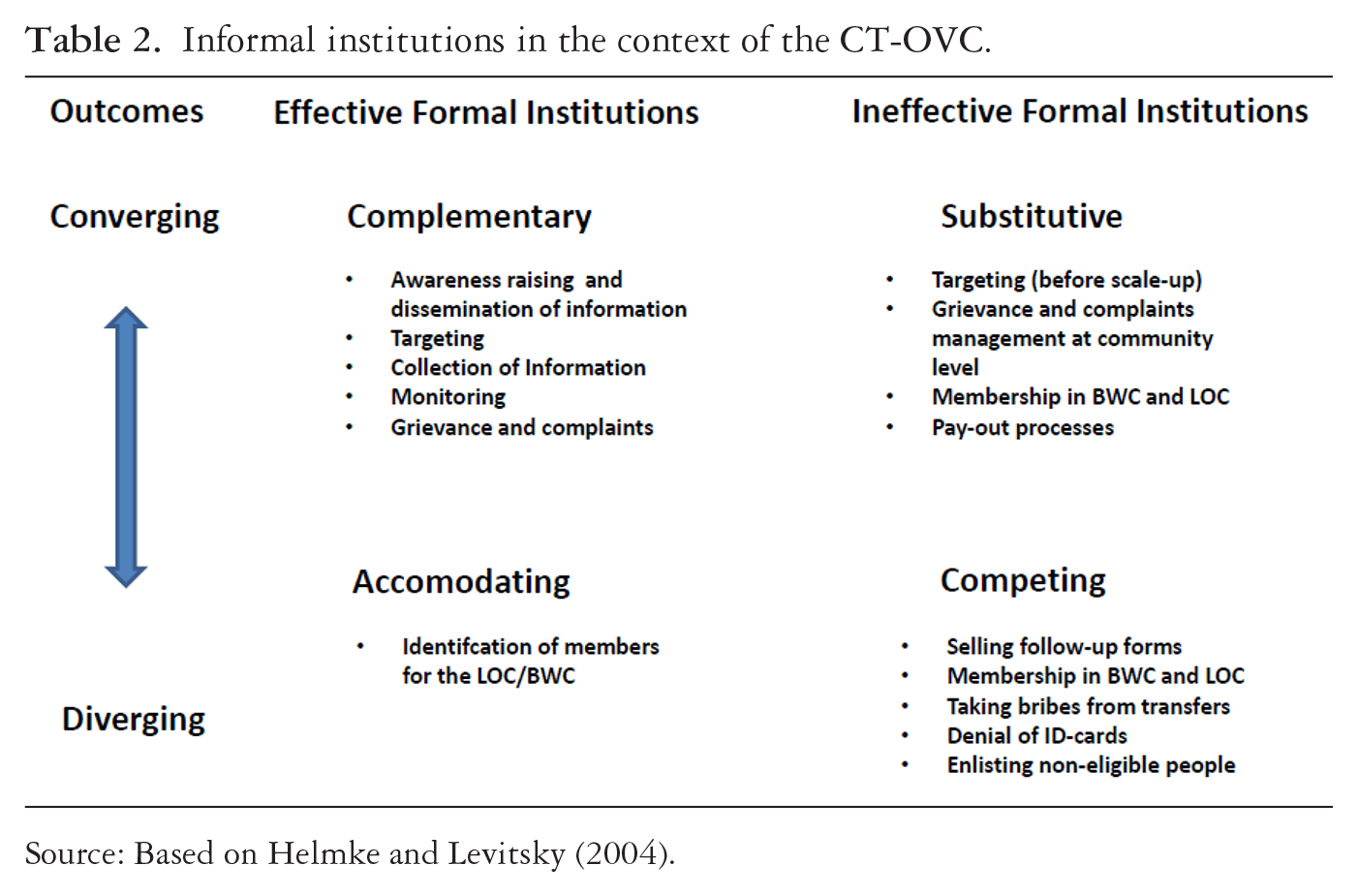
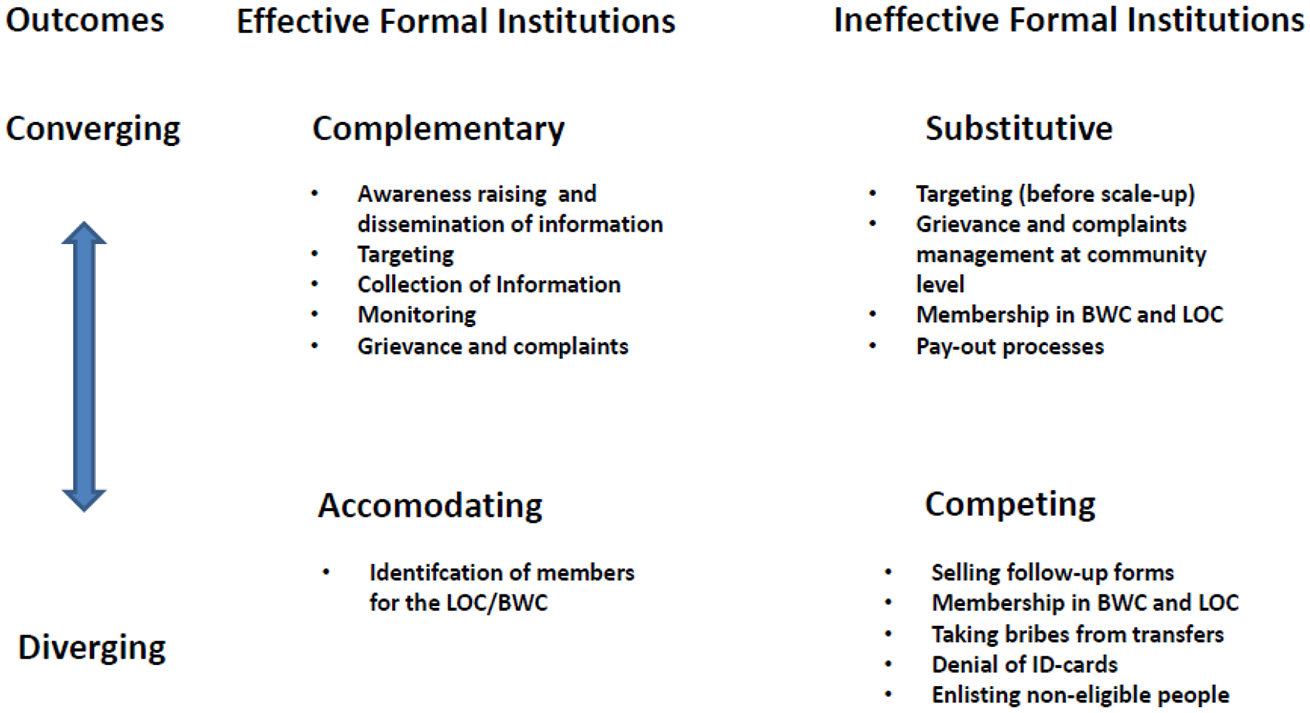
Source: Based on Helmke and Levitsky (2004).
Traditional authorities are instrumental in mobilising communities and disseminating information thereby complementing formal programme structures, even where they are functioning well and are routinely enforced: We mobilize and sensitize through chiefs. They have people who are under them, the wazee wa mitaa (village elders) and the assistant-chiefs. So they will pass the information and call people for us at barazas (community meetings). (Kwale sub-country children’s officer, Int. 9) Because I cannot hold a baraza without informing the chief, he is the one who will call his people, then I go and address them, and they assist in a big way. (West Pokot sub-county children’s officer, Int. 2)
Chiefs also complement targeting processes being involved in all stages, including identification, registration and validation: After creating awareness, we select groups of people called Locational OVC Committees, who go to the ground to enlist the families who they think are eligible for the program in collaboration with local leaders, like the chiefs, the wazee wa mitaa (village elders) and all those. [. . .] To ensure the quality of the people who have been identified, we will come back to the community and call another baraza. And the community helps us to verify the families. (Kwale sub-county children’s officer, Int. 2)
Civil servants reported that they would also rely on chiefs as highly efficient and effective data collectors complementing their own limited operational capacities: The chiefs are very cooperative. The other day, we were collecting telephone numbers, and there was voter sensitization going on at the same time, but when I contacted the chiefs, they would do it at the same time. [. . .] They do not tell me that this is for the County Commissioner and this other one is yours and we are not under your authority. They did it, we deal with almost 6000 households [. . .] and we were able to get about 4,000 and something telephone numbers, you can imagine, in a period of 3 weeks, through the chiefs. (West-Pokot sub-country children’s officer, Int. 2)
Another area of involvement is grievances and complaints. Although the BWCs are meant to be the central mechanism through which CT-OVC beneficiaries channel their complaints, traditional authorities play an important complementary function in monitoring complaints and reporting grievances to the next higher formal level.
[I]f they [BWC members] do not report, we find the report from the chief, and the chief links us up to the complainant, from there, we are now able to sit together and listen to the person. Sometimes we call the BWC, that’s how we are able to verify some of the issues being raised. (West-Pokot sub-county children’ officer, Int.8)
They also support the BWCs in their monitoring function, making sure that beneficiaries use the money as intended, i.e. for the orphans. If misuse is reported, the traditional authorities are usually closely involved in case management.
So the mkasas [village elders] help us in the identification of the OVCs. They play a very big role, you see. I cannot know who is who. When an issue comes up on misuse, maybe somebody enrolled without OVCs the village elders are the ones who confirm. They either endorse or say otherwise. (West Pokot county children’s officer, Int. 8)
This intimate knowledge of the communities and their poor and vulnerable people, especially in sparsely populated counties, such as West-Pokot, puts chiefs in a very powerful position allowing them to reconcile formal rules with their interests while still producing beneficial outcomes for the poor. CT-OVC operational procedures require the establishment of two important implementing committees at local level: The Locational OVC Committee (LOC) is a temporary committee in charge of the targeting process at the community level. It identifies households with OVCs and mobilises potential beneficiaries for community validation and enrolment. The Beneficiary Welfare Committee (BWC) is responsible for sharing information (for example payment dates) and gathering complaints and grievances. Despite being explicitly excluded, traditional authorities have a key function in selecting committee members, and routinely advise the LOC making sure that community-based targeting works. There is certain logic to it: The assistant-chief calls for a meeting and then selects committee members, telling them ‘You will be one of the leaders. You will be the chairman of the committee,’ and so on. [. . .] The LOC is composed of people in the community who are a bit well-up, they know more about the community; they know where the pockets of poverty are. (Kwale county children’s officer Int.1)
In this way, assistant-chiefs in charge of sub-communities and hamlets far from the main village sitting on the LOC can make sure that people living further away from the main community, usually the poorest and most marginalised, are also enrolled.
The chiefs are supposed to be eliminated at the LOC level. But now we have a problem. [. . .] Here in West Pokot, you cannot do away with chiefs. [. . .] This area is so expansive. These are the people who assist us. [. . .] (West Pokot county children’s officer, Int.2)
A similar logic applies to the BWCs, the local representative body of CT-OVC beneficiaries. Most BWCs are often led by non-beneficiary chairmen, including teachers, businessmen or community elders. These are highly respected and have the required capacities (reading and writing skills) to carry out the tasks associated with the BWC.
Where implementing structures are weak or lack authority, traditional authorities may even substitute them and take on tasks which formal institutions are not (yet) in the position to perform: In areas with weak payment mechanisms chiefs were actively involved in the collection and distribution of the CT-OVC transfers. If pay-points were too far and people too poor to pay the fare, chiefs went to collect cash transfers for their village collectively.
While complementing formal grievance and redress mechanisms, evidence suggests that traditional authorities may also substitute them. Especially in rural areas, traditional authorities are historically highly trusted and experienced local dispute settlement institutions that in many ways are considered much more efficient and effective than the BWCs.
They [chiefs] come in handy, because sometimes when there’s an issue, the BWC, together with household members, they gather at the chief’s office for deliberations. (Kwale sub-county children’s officer, Int. 4)
In the process of devolution, the formal targeting mechanism switched from a two-step model of geographic and community-based poverty targeting to community-based selection only. This appears to have increased the role of traditional authorities, in some areas even to the extent of substituting formal targeting processes: The politically motivated quota-system which guaranteed each region and county an equal share of CT-OVC beneficiaries, together with the limited funds available, resulted in a very limited number of beneficiaries per location. For local civil servants – especially in vast and sparsely populated areas – a complex targeting process did not make sense; instead, they simply asked traditional authorities to identify eligible beneficiaries and forward the list to them.
Yet, the strong role of traditional authorities in targeting is not without friction. While they may complement formal institutions, also the opposite is the case. Local public servants, including County Children’s officers, Sub-County Children’s officers, representatives of the Constituency Social Assistance Committee (see below), and community members complained about chiefs, assistant-chiefs and community elders routinely skewing targeting rules in their favour and enlisting family members, kinsmen or non-eligible persons in return for personal or material favours: Sometimes they are arrogant, because sometimes they don’t select the right people. Of course, when it comes to orphans, they run for their own relatives and friends, and some of them are given some token or a bribe so that they enrol the person in the system. (West Pokot CSAC, Int. 3)
Chiefs would hide follow-up application forms given to them to sell them to the highest bidder, resulting in the exclusion of eligible needy beneficiaries and the inclusion of better-off non-eligible ones, thus failing to achieve programme objectives. They would also abuse of their power with regards the issuance of ID-cards. Having a document is a precondition for enrolling in the programme and withdrawing the payment at the bank. In the areas close to the Mozambique border, where migration of certain ethnic groups across national borders is an integral part of their livelihoods, chiefs tended to deny OVCs born in Kenya and thus eligible to the programme their IDs defining them as non-Kenyans because of their ethnic background.
The Constituency Social Assistance Committee (CSAC) is a local monitoring body at constituency level created in the devolution process. It represents the Members of Parliament at the constituency level and is a parallel structure to the Area Advisory Committee, which represents the county government. The committee supervises all social protection activities at the local level. It is comprised of political appointees and government bureaucrats from the various line ministries. CSAC representatives repeatedly emphasized that the CSAC’s introduction had greatly improved transparency and accountability: [P]reviously, they used to call people to the chief and they’d get registered there. So they never used to get the genuinely needy. But nowadays it’s better, because we as CSAC go to the interior and verify that it is true, [. . .] so we look for the really needy cases, [. . .] because our job is actually to supervise if the work [targeting] has been done well. (Kibera CSAC, Int. 3) There are great changes. Before, there was no one who could come and look at how the programme is faring, because it was just between the officers and the chiefs, who are very corrupt. But nowadays, there is that body, the CSAC, who is very serious with following that situation until everyone gets what they deserve. (West-Pokot CSCAC, Int. No. 3)
Strengthening the formal institutions’ effectiveness by improving the monitoring of local targeting processes seems to have thus, reduced competitive behaviour. Yet, this positive impact seems to be thwarted: The fact that the majority of CSAC-members are nominated on political grounds has been criticized as an attempt to increase political interference with the programme (for example Kramon, 2019). Many MPs perceived the OVC-CT as means to gain political mileage.
[. . .] [Y]ou may find a MP who has a list which he wants to enter into the beneficiary list. [. . .] Now it brings conflict. You have criteria you have to follow; you have to do genuine work, but here you have a person who has a list of people he has promised to pay for. [. . .] So you start fighting. (Kwale Sub-county children’s officer, Int. 3)
In some areas, this appears to have increased the pressure on traditional authorities to skew core programme operations, such as targeting, competing with formal CT-OVC rules. Civil servants were acutely aware and worried about this increasing politicisation of their programme and of losing ambiguous, yet indispensable allies to get the programme implemented.
Reasons for involvement
Civil servants and policy makers at the national level tend to portray traditional authorities as a threat to proper and transparent programme implementation (for example, Calder et al., 2011). As discussed above, civil servants at the sub-national level, however, underlined the importance of traditional authorities in order to carry out their work properly. Two aspects are emphasized in this regard. One is capacity; the other is the chiefs’ authority as important community gate keepers.
Where local administrations lack human and operational resources, such as computers, phones or office cars, traditional authorities play a key role – even if outcomes are ambivalent. The geography adds additional constraints: in rural areas, where administrative units cover huge and sparsely populated areas, transaction costs are high. Sub-county children’s officers complained about their heavy workload, with the CT-OVC being only one among many child-related activities and programmes they are supposed to administer: There’s the wide coverage, huge workload. The county is very vast, a very big area with limited staff. [. . .] I have one officer per sub-county, who is supposed to do other things. [. . .] The cash transfer is just one third of what we do. [. . .] We have a capacity gap in terms of the numbers and of course the equipment, the machinery, the vehicles, activities, etc. (Kwale county children’s officer, Int.1)
Mobile devices often do not work, making communication a challenge. Many have no means of transport or fuel to carry out their work. In this situation, traditional authorities play a key role in keeping programmes running.
However, the importance of traditional authorities for the CT-OVC lies not only in a malfunctioning formal administration. In rural contexts, chiefs are important local authorities that civil servants just cannot ignore, especially as the programme is supposed to involve the community: These are the people who are most trusted by the public here. You cannot do anything without the chief. You say you do away with them, you are doomed. When the chief says something, it is like law, you see things moving. (West-Pokot sub-country children’s officer, Int.2)
In town, the situation is different. Due to higher population density, urban areas tend to have more social welfare officers. The shorter distances make their tasks easier. In this context, CT-OVC institutions seem to be better able to gain ground. Beneficiaries, civil servants and other officials hardly mentioned traditional authorities. They mostly referred to the formal institutions, in particular to the BWCs. However, this does not mean fewer complaints about skewing of targeting processes, favouritism and corruption. Only the actors change: Some of the officers concerned with the selection of the beneficiaries here at the grassroots level, ask for bribes for your case to be considered, and therefore if you don’t have the money, you may not be lucky. (Kibera non-beneficiaries FGD, Int.12)
Besides geography, time seems to determine the interplay between formal and informal institutions. In areas where the CT-OVC has been in place for longer, formal institutions appear to be more ingrained and functioning. The longer programmes are in place, the better people tend to be informed about their main features, enabling them to critically question ‘unruly’ behaviour and turn to formal institutions as an alternative to claim their rights.
Discussion and conclusion
This analysis of the local political economy of the CT-OVC in Kenya has shown that the formal programme set-up of social policy interventions represents just one set of the ‘rules of the game’. Although having no formal function in the programme, traditional authorities are strongly involved in the implementation of the OVC-CT including targeting, the selection of beneficiary committees, awareness raising or grievance and redress.
However, their role is ambiguous. Chiefs and assistant-chiefs create competing systems of obligations that diverge from intended formal institutional outcomes, rendering CT-OVC rules of access and redistribution completely obsolete and leading to distorted policy outcomes, as particularly evident in relation to targeting processes. This confirms the findings widely described in the literature of informal institutions having a largely negative impact on access to public social services and resource distribution – usually in favour of the powerful and rich.
In contrast to Carey et al. (2018) and others we argue that such a narrative overlooks the role of traditional authorities in facilitating social policy outcomes at local level, complementing effective but inadequate formal delivery structures and partly substituting them where they are weak by supporting civil servants in the provision of basic operational functions. Their operational and institutional capacity and political authority at local level appear to make them more effective and efficient than formal programme structures, reducing transaction costs for an understaffed and underpaid administrative system. This may also include diverging from formal rules by accommodating them to the local stakeholders’ interest while still creating beneficial outcomes for the poor, as shown in relation to the participatory programme aspects. The findings also contrast the belief that patronage is the prevalent pattern of distributive politics in Kenya (for example Wanyama and McCord, 2017; Kramon and Ponser, 2016, Burgess et al., 2015). As outlined by Kramon (2019), the fact that redistributive policy interventions are vulnerable to patronage does not necessarily mean that actors involved in the programme are also willing to engage in it. Although having a critical stance towards traditional authorities, civil servants rely on them to make programmes work. Particularly in rural areas traditional authorities are key implementing partners at sub-national level. A trade-off seems to take place where civil servants accept ‘unruly’ practices that may undermine intended policy outcomes in one sphere in exchange for support in programme delivery in another.
Time and the urban environment seem to be favourable conditions for operational processes to formalize. However, this shift towards more effective institutions is not necessarily linear or irreversible. In fact, with devolution, incidences of patronage appear to have increased within the context of the CT-OVC. Because MPs have recognized the importance of cash transfer programmes as a means to make political mileage, they try to increase their influence in targeting processes. As part of the local bureaucratic structure and central stakeholders in programme implementation at local level, civil servants and traditional authorities alike are facing pressure to compete with programme rules and regulations in favour of the MPs’ interests (Wanyama and McCord, 2017).
The politicization of the CSAC or the reported cases of corrupt civil servants in urban areas show that the common notion of ‘corrupt’ traditional authorities versus ‘effective and transparent’ civil servants or formal structures as presented in the good governance literature does not hold (for a critical review see, for example Grindle, 2004; Chowdhury and Jomo, 2012). Especially in settings where favouritism or corruption are widespread and the formal administration weak, the question should rather be how to minimize rent-seeking behaviour overall.
To what degree the gender dynamics highlighted above reinforce formal-informal institutional dynamics and how this may shape the impact of CT-OVC remains open. More research is needed. This also concerns the aspect of what factors make institutional actors behave in one way or the other, hampering or facilitating local implementation processes with benefits for the poor.
The findings also contribute to critically questioning the ‘institutional myth’ of formal, rational government structures being more efficient, effective and ‘ruly’ than informal institutions. Categorising formal-informal interactions based on Helmke and Levitsky (2004), we have shown that informal institutions are neither ‘harmful’ nor ‘beneficial’, but – depending on their pattern of interaction with formal ones – can be both. Even where formal-informal patterns of interaction diverge (i.e. accommodating pattern), outcomes may still be beneficial for poor people.
The geographic setting and programme duration seem to be important determining factors of how formal-informal interaction evolves. However, further research is needed as to why and under which circumstances this is the case.
From a policy perspective, this suggests the need for a more differentiated appraisal of informal institutions (for example, Rohregger, 2006; Yeboah-Assiamah et al., 2017; Pfeiffer, 2011). They are an integral part of local power structures even where strong and functioning formal institutions exist. They just cannot be ignored. There is a need to take a closer and more critical look at how formal and informal institutions can be better aligned and held accountable to produce effective, transformative outcomes for the poor. Traditional authorities have an important administrative and political function in delivering social protection. This institutional ‘hybridity’ will continue to be a reality even where programmes are well implemented, and rules routinely enforced. Rather than judging traditional authorities as dysfunctional from the outset, it may be time to ask how we can strengthen their transformative potential in order to produce more inclusive outcomes for the poor.
Footnotes
Declaration of Conflicting Interests
The author(s) declared no potential conflicts of interest with respect to the research, authorship, and/or publication of this article.
Funding
The author(s) disclosed receipt of the following financial support for the research, authorship, and/or publication of this article: This article is based on a comparative research project on social policies and inclusive growth in Kenya and Ghana. It was supported by funding of the NWO-WOTRO Science for Global Development Framework, through the INCLUDE knowledge platform ‘Inclusive Development in Sub-Saharan Africa’ research programme (W08.390.004).