




Abstract
Reform of the family leave system has been on the Finnish political agenda for a long time but has proved to be a challenging task. The challenges relate to ideological differences between the political parties and to non-decision making in tripartite working groups, where the labour market parties participate in policy formulation. The article analyses the recent attempt to reform the Finnish family leave system under a right-conservative government (2015–2019) as an example of how diverging political ideologies and vested interests undermine adoption of government gender equality policy. The case also serves as an example of the growing influence of knowledge, and especially economic knowledge, in policy-making. The article provides new insights into the changing processes of decision-making in relation to gender equality policy.
Introduction
A pivotal aspect of research on gender equality policy is to analyse the conditions and processes informing the adoption or non-adoption of a particular policy. While much of previous research has focused on the strategies and alliances of feminist actors within and outside government in the push for policy reform (Outshoorn and Kantola, 2007; Woodward, 2004), other studies have sought to better understand the circumstances of policy adoption and power struggles by exploring opposition to reform proposals (Bergqvist et al., 2016; Marchbank, 2000). In corporatist regimes, where labour market parties participate in policy-making processes, the vested interests and power of such organizations are known to be a key factor in stalling or diluting gender equality reforms (Koskinen Sandberg, 2016; Salmi and Lammi-Taskula, 2015).
In that context, the present article analyses a recent attempt to reform the Finnish family leave system. Although Finland has a reputation as a gender-equal country with strong supporting policies, the level of family allowances is small by comparison with other Nordic countries, care responsibilities are unequally divided between the parents, and leave take-up is affected by other social inequalities that structure the Finnish society. Notoriously, reform of the family leave system has proved challenging as a result of ideological differences between the political parties, compounded by the interests of central labour market organizations, which play a central role in reform efforts within the Finnish corporatist regime (Lammi-Taskula and Takala, 2009; Salmi and Lammi-Taskula, 2015).
The reform in question was initiated by a right-conservative government in unfavourable conditions shaped by austerity, conservatism and nationalism (Elomäki and Kantola, 2018) following significant societal pressure to improve gender equality by reforming family leave. The negotiations were dominated by economic concerns – in particular, there was concern that the initiative should not incur additional costs and that it should increase the employment rate. After some months of heated negotiation between the government and labour market organizations, the initiative was withdrawn.
In approaching the economization of this reform and its ultimate stalling from the perspective of policy adoption processes (e.g., Bergqvist et al., 2016; Koskinen Sandberg, 2016; Marchbank, 2000), our theoretical aim is to complement the existing literature on the challenges of gender equality policy adoption. In particular, we focus on the growing role of knowledge in policy-making (e.g., Triantafillou, 2015; Ylöstalo, 2020a) and the increasing authority assigned to economic knowledge (e.g., Hirschman and Berman, 2014), which has to date received little attention in the literature on gender equality policy adoption. Gender equality policies can reproduce further inequalities, for instance through racist or ethnocentric biases (Lombardo and Verloo, 2009). Taking an intersectional approach that takes into account how gender intersects with class, race and sexuality (e.g., Crenshaw, 1991; Verloo, 2013), we investigate how gender equality was framed and how particular social groups and the marginalizations and privileges implied in policies were silenced during the policy process.
To that end, we address the following research questions.
1) Why and how were gender equality goals and intersecting inequalities suppressed in pursuing this reform?
2) Why did the reform fail despite the dilution of its content?
The study draws on extensive documentary data (N = 101) and interviews with participants in the policy process (N = 14). Using qualitative methods, we performed an in-depth analysis of the conflicting interests and knowledge-base underlying the sidelining and economic framing of gender equality and the initiative’s ultimate failure. The article clarifies how the dynamics of corporatist policy-making process and increased reliance on quantitative economic knowledge contribute to the challenges of gender equality policy formulation and adoption. We argue that intersectional gender equality concerns were displaced by the ideologies and economic interests of key actors, which narrowed gender equality to labour market equality between highly educated men and women and ignored class-based and racialized inequalities. By prioritizing quantitative economic evidence, the policy process further contributed to the sidelining and narrowing of gender equality. The economization and ‘workfaring’ of family leave policy led to a benefit-cutting model, which would have treated different social groups differently.
Struggles over family leave policy in the Finnish corporatist context
The Finnish family leave policy is generous by international standards. When the reform was initiated in 2017, the existing scheme provided approximately 13 months in total of paid family leave. Four months are reserved for the mother, six months can be divided as the parents wish, and nine weeks are reserved for the father. Once paid family leave ends, children have the right to early education, which is relatively affordable and publicly subvented. Families can also opt to take care of children at home by drawing a home care allowance (low flat rate) until the child turns three.
The Finnish family leave system has been criticised for its highly gendered uptake. Although the scheme itself generally allows either parent to take leave, more than 90% of total leave is taken by women (The Social Insurance Institution of Finland, 2019). Furthermore, Finland lags behind other Nordic countries in terms of leave entitlements for the father as well as uptake of the leaves (Duvander et al., 2019; Eydal et al., 2015; Salmi et al., 2019) and employment rates for young women. In 2016, less than half of mothers whose youngest child was under three were in employment (Statistics Finland, 2017). Especially home care allowance has been linked to adverse labour market outcomes for women, including smaller earnings, stalled career development and lower accumulated pensions (Kuitto et al., 2019; Misra et al., 2011). Long leave for mothers contributes to the unequal division of labour as it strengthens traditional gendered division of domestic responsibilities (Hook, 2010) whereas research has shown that fathers taking longer leave are likelier to reduce their working hours and increase childcare and household work (Bünning, 2015).
The take-up of family leave is not only gendered but is linked to broader class-based and racialized inequalities. Women with tertiary education, higher income and secured jobs return to work earlier, and highly-educated fathers who have a highly-educated spouse use more family leave. In contrast, low educated women in precarious labour market situations use home care allowance the longest. (Salmi et al., 2019.) Also immigrant families often rely on home care allowance, which can be partly traced back to their disadvantaged economic context (Tervola, 2018). Foreign-born women often struggle entering education and training and remain outside the labour force or work in low paid occupations.
The differing historical stances of the major political parties regarding the home care allowance have posed challenges for reform of the leave scheme. In the 1970s and 1980s, social democrats, the left and women’s associations were demanding universal rights to public day care services. The home care allowance was a compromise, responding to the demands of the rural-conservative Centre Party on behalf of families who took care of their children at home. (Hiilamo and Kangas, 2009). Historically, political parties have also been divided on the issue of quotas for fathers as care providers, with left and liberal parties more supportive than those promoting conservative values (Lammi-Taskula and Takala, 2009). The increased emphasis on neoliberal austerity in the 2010s has also altered the Finnish government’s approach to gender equality and family policies at the expense of traditional ideas of redistribution and social investment (Nygård et al., 2019). This change has been visible in policy reforms, as piecemeal improvement of family transfers in 2007–2012 gave way to welfare cuts in 2013–2017. These included cuts in parental leave allowances and restricting universal rights to childcare (Nyby et al., 2018).
Difficulties in renewing family policy also reflect the central role of labour market parties in social and public policy, including family leave reforms. The power of employer organizations and trade unions is rooted in the history of the Finnish corporatist regime, where conditions of employment, including wages, have been negotiated in so-called ‘incomes policy agreements’. These agreements have included social policy and tax reforms and work-life initiatives (e.g., Bergholm, 2015; Kauppinen, 2005) as well as family policy reforms (Lammi-Taskula and Takala, 2009). In these tripartite negotiations, the power of labour market organizations has shaped policy, since the earnings-related family leave insurance is funded mainly by social security contributions paid by employers, wage earners and entrepreneurs. The tripartite approach to negotiation means that resulting policy is always a compromise among the interests of different parties, which can be disappointing from a gender equality perspective. In the 2000s, these corporatist policy processes have made it especially challenging to increase leave for fathers (Salmi and Lammi-Taskula, 2015).
Investigating the (non-)adoption of gender equality policy
To gain a better understanding of the failed attempt to reform the family leave system in 2017–2018, we complement earlier literature on opposition to gender equality policy adoption, which has tended to highlight the interests and strategies of opposing actors, by focusing on the growing role of knowledge and its effects on policy processes and outcomes.
Feminist scholars studying policy adoption have recently drawn attention to the failure or dilution of policy processes and to actors, such as political parties and labour market organizations, who oppose specific reform proposals (Bergqvist et al., 2016; Koskinen Sandberg, 2016; Marchbank, 2000). This research demonstrates that to understand the circumstances of policy adoption and the dynamics and power relations between the actors involved in the policy process, it is useful to explore the ideologies, interests and strategies of opponents of gender equality initiatives, as well as failed reform attempts (Bergqvist et al., 2016.)
In analysing policy adoption, it is important to take account of the different elements of the policy process. To be adopted, a policy has to cross several hurdles, and a stumble is always possible (e.g. Koskinen Sandberg, 2016; Marchbank, 2000). At each stage of the process, a policy initiative is likely to encounter resistance that reflects the values and vested interests of actors involved in the process (Bachrach and Baratz, 1962, 1963). Power struggles between key actors determine which issues will ultimately surface in public debate and subsequently on the political agenda. These struggles also shape policy formulation, as the involved actors bring their values and vested interests to the negotiating table, influencing how the final decision is made (or not).
As a tool for analysing the diverging interests of central actors and the subtle use of power, the concept of non-decision making (Bachrach and Baratz, 1962, 1963) is especially useful in corporatist policy contexts, where the issues being negotiated pose a threat to the interests of the parties involved. A focus on non-decision making directs attention to how political agendas are restricted to relatively uncontroversial issues, and how policy processes are stalled as actors foreground the interests they represent while preventing other less desirable issues from reaching the agenda. Gender equality is a good example of the kind of issue that can often become marginalized (Koskinen Sandberg, 2016; Marchbank, 2000), and the interests of marginalized groups are also often ignored in these power struggles. Value and interest-related battles also influence how the issues addressed in the policy process are understood. Competing constructions of these issues imply specific solutions, sidelining other perspectives and solutions (Bacchi, 1999).
Along with power struggles between central actors, shifts in public governance also shape policy processes and their outcomes. One such shift of particular relevance here is the move towards evidence-based policy-making and the growing role of knowledge (e.g., Triantafillou, 2015; Ylöstalo, 2020a). Increased reliance on scientific knowledge in policy-making has influenced power relations between actors; for instance, the power of knowledge producers has increased, as politicians rarely have the resources to acquire an in-depth understanding of the complex knowledge that underpins policy initiatives (Ylönen et al., 2020). Evidence-based policy-making has also affected the strategies of actors involved in policy processes, as proponents and opponents of a given initiative increasingly formulate their arguments in terms of ‘neutral’ and ‘objective’ knowledge claims rather than deploying political discourse (cf. Kantola and Squires, 2012: 387–388).
Research on the role of knowledge in policy-making indicates that not all knowledge is equally valued. The evidence-based policy movement tends to favour forms of knowledge production associated with economics and the natural sciences (Triantafillou, 2015; Ylönen et al., 2020). In recent decades, economics in particular has gained authoritative status in policy-making contexts (Hirschman and Berman, 2014), including the formulation of gender equality policy (Elomäki, 2020; Ylöstalo, 2020b). These ‘evidence hierarchies’ (Triantafillou, 2015) affect policy outcomes, affecting how societal problems are understood and what kinds of policy solutions are proposed (Hirschman and Berman, 2014). This increasing influence of economics poses particular challenges for gender equality policy. Feminist scholars have demonstrated that mainstream economics is based on gendered, classed and racialized assumptions, sidelining crucial issues such as unpaid work, ignoring the experiences of women and marginalized groups, and offering limited tools for analysing intersecting inequalities (Folbre, 2009; Nelson, 1995).
Data and methods
Our research data include a large document archive spanning the critical timeline 2015–2018 (n = 101) and semi-structured interviews with central actors who participated in the policy process (n = 14). The document archive consisted of written materials published by the central actors, that is, central labour market organisations, government parties and affiliated ministers and members of parliament, and government administration (see Table 1). The documents include press releases, statements and blogs regarding the need to renew family leave policy, as well as official government documents and public preparatory documents produced during negotiations. We also consulted media articles published at that time in the national newspaper Helsingin Sanomat, but these data were not systematically analysed.
Key actors in policy process: interests, position on family leave, research data.
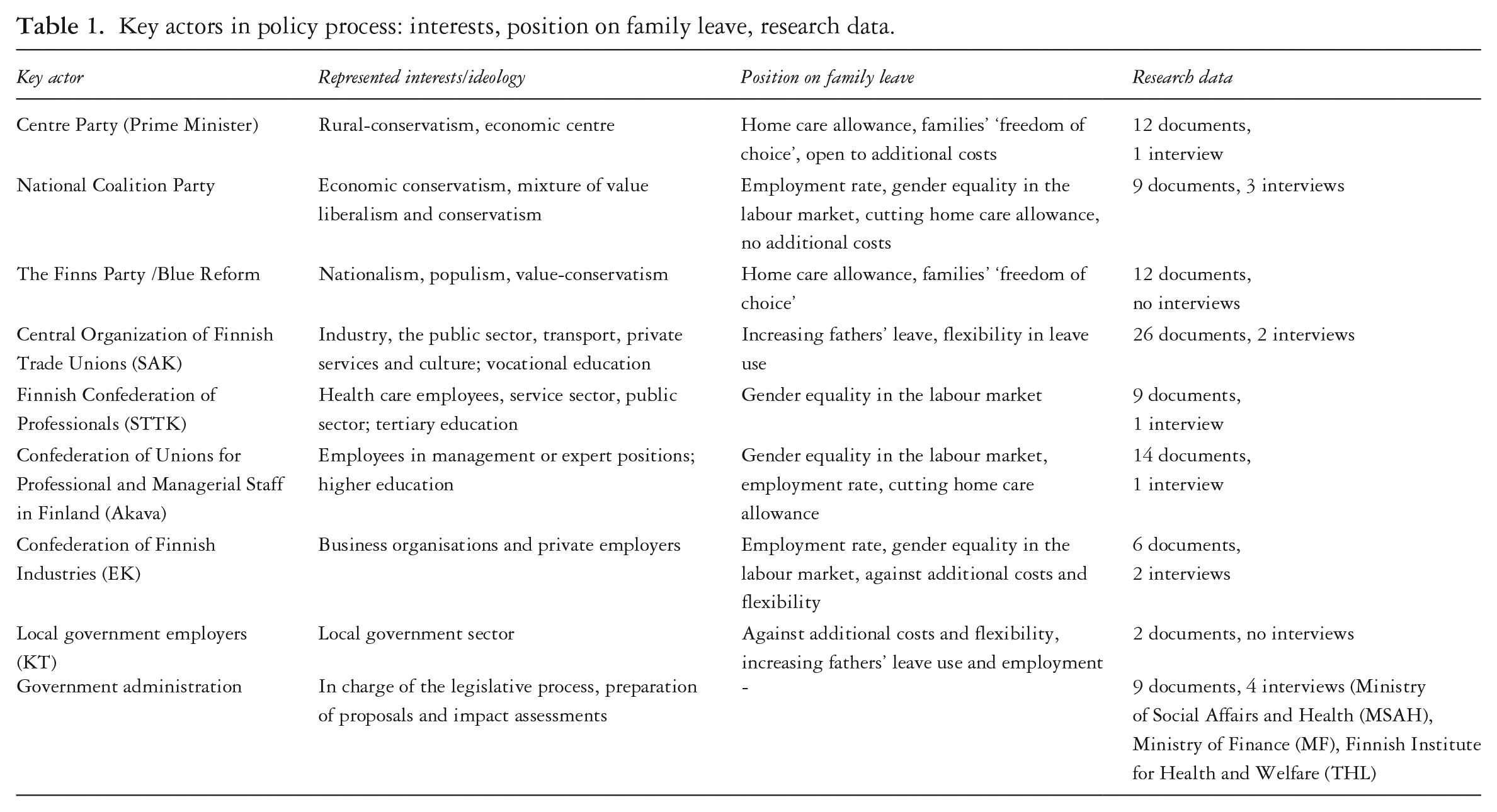
The interviewed persons were involved in the policy-making process and included representatives of government coalition parties and central labour market organizations, as well as civil servants. Questions were modified to reflect the informant’s role and organization and included questions about their organization’s position, the course of negotiations and the positions and roles of other actors and conflicts between them. The interview data do not encompass all the relevant actors, as we were unable to recruit representatives of the Blue Reform party or local government employers.
We analyse the data through a descriptive tracing of the policy process. Following the tools provided by literature on policy-processes (e.g., Marchbank, 2000), our analysis explored three stages of the policy process: a) agenda setting, b) negotiation, and c) stalling of the process. At each stage, we investigated the conflicting interests and power struggles between and within government parties and labour market organizations, as well as the prioritized forms of knowledge, paying attention to how gender equality goals and marginalizations and privileges implied in policies in terms of class, race and sexuality were voiced and silenced. Documents were used to analyse the public positions of the actors, and interviews provided insights to the negotiations that took place behind closed doors.
In addition, in particular in the analysis of the agenda-setting phase, we utilized a discursive approach that draws attention to how the actors’ discourses construct reality (Lombardo et al., 2009). We explored how the different actors framed the reform and interpreted key concepts, such as gender equality. Paying attention to discourses is important, as societal problems, like the gendered take-up of family leave, can be represented in different ways, and these representations affect the proposed solutions (Bacchi, 1999).
Agenda-setting phase: Struggles related to framing
The agenda-setting phase was pivotal in determining the framing and content of the family leave reform. Prime Minister Juha Sipilä’s right-conservative government (2015–2019) was focused on austerity, structural reforms, marketization of public services and raising the employment rate, and this reform was not originally on that neoliberal agenda. During government negotiations, the centre-right National Coalition Party tried to introduce shortening of the home care allowance in the programme, but this was resisted by the conservative Centre Party and the Finns Party (Interview NCP3).
On this occasion, the labour market organizations, which had impaired previous reforms (Lammi-Taskula and Takala, 2009), took a proactive role. Ahead of the parliamentary elections, the three trade union confederations (SAK, STTK and AKAVA) were already advocating extension of the father’s quota. In spring 2016, the blue collar workers’ union confederation SAK initiated public debate about the reform of the leave scheme by publishing a concrete proposal (SAK, 21 April 2016). Other major labour market organizations and political parties soon proposed their own models of family leave. While all proposed extending the fathers’ quota, the models differed as to the length of earnings-related leave, its allocation between parents and the duration and level of the home care allowance. We contend that these diverging proposals reflect two fundamental conflicts, with far-reaching consequences for considerations of gender and other inequalities. The first of these concerned representations of the status quo and framings of the reform (cf. Bacchi, 1999); the second was about money.
Although family leave arrangements have been central to Finnish gender equality and family policy and are often seen in terms of redistribution and social investment (Nygård et al., 2019), public debate on the need for reform focused on employment rates. In particular, this was a key issue for the National Coalition Party, the private employers’ federation EK and for AKAVA, the higher education trade union confederation. These actors sometimes used the rhetoric of ‘work incentives’ that situates family leave as an issue of workfare rather than welfare. For instance, the National Coalition Party argued that the allowance should ‘incentivize people to work and be entrepreneurs’ (NCP, 27 February 2017). Other actors also used employment-related rhetoric, in some cases to force the government to put reform on its agenda. For instance, SAK supported its model with statistical evidence that the total employment rate would be 1.5% higher if young Finnish women’s employment rate reached the level in Sweden (SAK, 30 August 2016). This focus on employment rate and labour supply partly sidelined other goals, including gender equality and the well-being of children and families.
In the public debate preceding the initiative, most of the key actors referred to gender equality, but only the white collar workers’ STTK prioritized this frame while the Centre Party, the Finns Party and the local government employers completely sidelined any gender perspective. Gender equality was largely constructed as a question of women’s position in the labour market, suggesting that the main problem with gender equality in the current system was its negative impact on women’s pay, pensions and career advancement. This perspective served the interests of many actors by excluding ideologically more difficult issues – such as uneven distribution of care – from the debate and reinforcing the emphasis on employment rates. The focus on career and pay development was mainly of relevance to well-educated women and obscured class-based reasons for women’s long family leave and fathers’ low take-up. Labour market organizations and government parties were mainly silent about how the gendering features of the leave system intertwined with class and race. The blue collar SAK did not draw attention to the situations of low-educated parents in precarious low-paid jobs, and none of the key actors mentioned migrant women or families. However, following SAK’s example, most actors apart from conservative parties challenged the heteronormativity of the leave system and called for equal rights for lone parents and same sex families.
A second factor that contributed to the sidelining and narrowing of gender equality goals during the agenda-setting phase was the focus on issues of cost, reflecting the neoliberal austerity paradigm that dominated family and gender equality policy debate in the 2010s (cf. Nygård et al., 2019). Somewhat surprisingly, the idea that the family leave system could be reformed without additional public spending was first raised by the blue collar SAK (SAK, 21 April 2016). Other key actors quickly adopted SAK’s discourse of ‘cost-neutrality’ – for instance, the National Coalition Party’s stated position was that ‘in the current economic situation the reform must be done in a cost neutral manner’ (NCP, 27 February 2017). Only opposition parties and civil society organizations, who had no say in the eventual negotiations, called vocally for immediate public investment in the family leave system. The result was an almost unanimous understanding that the family leave system could and should be reformed without incurring extra cost. In practice, this excluded measures that would most effectively ensure equal division of care responsibilities in a family-friendly way by extending paid parental leave to increase fathers’ quota.
Evidence and knowledge played a key role in the agenda-setting phase. SAK’s model of family leave and its use of employment statistics illustrate how an evidence-based approach shapes the efforts of interest groups to influence policy-making based on ‘neutral’ knowledge rather than values-related arguments (cf. Kantola and Squires, 2012). The special authority assigned to economics knowledge in policy-making in the field of gender equality (Elomäki, 2020; Ylöstalo, 2020b) was also apparent in disagreements about the kind of knowledge on which reform should be based. Based on broad survey and interview data, one finding of the Finnish Institute for Health and Welfare’s (THL) study of family leave use was that cutting the home care allowance would not have the desired effect on employment because of the precarious labour market position of those who used the allowance for the longest time (Salmi and Närvi, 2017). Mainstream economists rejected that research in the media, arguing that qualitative studies and surveys could not be used as a basis for policy, and that policy-makers should confine their attention to mainstream economics findings regarding causal behavioural impacts (e.g. Iltalehti, 13 September 2017).
The agenda-setting phase culminated in August 2017, when the government finally introduced the reform to its agenda. Along with increasing societal pressure, several key events around the government’s mid-term review laid the ground for the reform: the splitting of the populist Finns Party, the formation of a more moderate Blue Reform group that continued in the government, and the appointment of Annika Saarikko of the Centre Party as a more progressive Minister for Social and Family Affairs. However, the government parties’ strict framework conditions for the reform reflected a continued emphasis on austerity and employment. Among those conditions, the reform was to have ‘positive employment effects verified by the Ministry of Finance’, and ‘parental leave allowances were to be reformed within the general government fiscal frame agreed on in the government programme’ (PMO, 31 August 2017). While the conditions also included references to improving gender equality and consideration of children’s and families’ needs, the quantified and measurable conditions regarding employment and costs carried more weight in the negotiations than these more general goals, as detailed in the next section.
The negotiations: Interests, power struggles and economic expertise sideline gender equality
The negotiations began immediately after the reform was announced and had a two-tier structure. Three responsible ministers – one from each party – were appointed by the government and met regularly, tasked with finding a political compromise. In keeping with the Finnish corporatist tradition, the Ministry of Social Affairs and Health set up a tripartite working group comprising representatives from the major labour market organizations and civil servants from different ministries. The group’s mandate was to find a compromise that would satisfy the government’s conditions and the interests of the labour market organizations, with particular regard to earnings-related leave (funded mainly by social security contributions paid by the employees and employers) and flexible leave provisions.
During the negotiations, the divergence in values and interests between government parties, among labour market organizations and between government and those organizations became more pronounced. The strict framework conditions meant that increasing the employment rate and keeping costs at bay became the key goals as negotiations proceeded. It became clear that these framework conditions implied cuts rather than improvements in existing allowances, serving the interests of the National Coalition Party and the private employers EK.
The emphasis on cost neutrality and employment made it difficult to promote gender equality through the increased fathers’ quotas that most actors had argued for in the agenda-setting phase. The National Coalition Party strictly enforced these conditions in ministerial meetings, and while it was prepared to finance the potential increases in childcare costs, no additional funding was to be allocated for benefits. The National Coalition Party also stressed that the overall employment rate had to increase and not just women’s employment rate as the Centre Party had assumed (Interviews NCP1, NCP2, CP). In the tripartite working group, EK opposed any option that would increase employers’ social security contributions (Interview SAK1; see also STTK, Akava, EK1). While the trade unions criticised EK’s strictness, increasing social security contributions was also a difficult issue for at least some of them (Interview Akava).
The emphasis on costs created a zero-sum game, in which the only way of increasing designated leave for fathers was to cut mothers’ earnings-related leave or the home care allowance. Moreover, increasing the father’s quota without reducing the level and/or duration of other entitlements would have reduced the total employment rate. The framework condition regarding employment also foregrounded the politically contentious home care allowance. For the National Coalition Party and the EK, abolishing or cutting the home care allowance to increase employment and gender equality was a key goal, and the trade unions would have supported the cuts. In contrast, the Centre Party and the Blue Reform wanted to protect the home care allowance.
These conflicts of values and interests sidelined even the narrow view of gender equality as gender equality in the labour market that had prevailed in the agenda-setting phase. As one of the civil servants in charge of the reform explained, ‘[gender equality] was for many on the top ten list, but I am not sure whether it was the number one priority that someone would have defended’ (Interview MSAH2). Based on the interviews, concerns for class and race barely surfaced in the negotiations, even if the pressures to cut the home care allowance specifically targeted poorly educated, low-income mothers, including women from immigrant backgrounds, who take the longest family leave and have the lowest employment levels (Närvi et al., 2020). The earlier discourse of enhancing women’s pay, pensions and careers was thus in practice reduced to pushing women in precarious and low-paid jobs to the labour market. In contrast, the focus on macroeconomic and employment outcomes allowed for the extension of leave rights to diverse families, even if the conservative parties in government did not promote them in the agenda-setting phase: As one interviewee stated: ‘[E]qual treatment, of single parents, of same sex parents, we noted that those changes would cost like a few millions, so it does not make a difference in the big picture, we decided we will just take care of them’ (Interview NCP2).
Another factor that contributed to the sidelining and narrowing of gender equality goals was the increasing authority assigned to economic knowledge and expertise in the policy process (cf. Hirschman and Berman, 2014; Ylönen et al., 2020). This was apparent in the composition of experts invited to participate in policy formulation and in the information considered legitimate as a basis for decision-making. Earlier corporatist formulation of family policies involved experts from gender equality associations, family and child welfare organizations and national research institutes (e.g. MSAH, 2011). In this case, those actors were not included in the tripartite group and played a narrower consultative role. Strikingly, not even the government agency for gender equality policy was invited to participate; instead, there were seats for public officials from the Ministry of Finance and the Social Insurance Institution, who were responsible for preparing impact assessments but had no expertise regarding the substance of the policy to be negotiated.
Secondly, the reform was guided by economic knowledge based on quantitative statistical methods such as microsimulation and econometric analysis. The negotiations were based on assessments of cost and employment impacts as the most significant knowledge base (Interviews THL, SAK1, MF), with little supporting knowledge for goals related to gender equality and the needs of children and families, which were less easily quantified. The extensive body of social science research on the unequal division of family leave and explanations for its use was not accepted as a basis for policy formulation. The prioritization of evidence of measurable economic impacts over qualitative research reflects the evidence hierarchies within the evidence-based policy (Triantafillou, 2015) and the increasing authority of economics in policy-making (Hirschman and Berman, 2014).
From a gender perspective, the prioritized knowledge was based on problematic assumptions about economic incentives as the main driver of individuals’ choices, was blind to power relations within families, and ignored the precarious labour market situations and discrimination that also affect leave use. This narrow, quantitative knowledge-base sidelined complex and abstract questions connected to inequalities and power relations from the debate (cf. Elomäki, 2020; Ylöstalo, 2020b). Moreover, the assessments about impacts on public finance, social security costs and employment prepared by the Ministry of Finance took a macro-perspective that obscured impacts of the planned policy-measures on families and individuals. This seemingly neutral and objective evidence thus depoliticized the fact that policy measures that produced the desired impacts, such as cutting the home care allowance, would not have treated all families equally. The authority assigned to economists’ knowledge of measurable impacts also benefited the National Coalition Party and the employers’ associations, which emphasized employment and public finance impacts.
Stalling of the reform
By February 2018, the negotiations were focused on the so-called ‘4+5+4 model’, referring to the allocation of earnings-related allowance months (parent 1, either parent, parent 2). The model would extend the period of leave for the father by shortening the amount of leave to be divided between the parents (in practice taken up by the mother). While slightly increasing the total duration of earnings-related allowances, the new model would have entailed a cut to the home care allowance, limiting full-time leave once the child reached the age of two (MSAH, 5 February 2018a). The Ministry of Finance estimated that this model would increase employment by 1,300 persons (full-time equivalent) while public spending would increase by 91 billion euros annually, of which 85 million related to increased demand for child care services (MSAH, 5 February 2018a). Calculations about distributional impacts that were only produced at this stage of the process showed that the model would have decreased the total amount of family leave benefits for two thirds of families, with biggest negative effects for small-income families (MSAH, 5 February 2018b).
Only a few days after the negotiators received these estimates, Saarikko (the minister responsible for the reform) unilaterally halted the policy-making process (HS, 9 February 2018; Saarikko, 9 February 2018). Although negotiations had been difficult and the interests of the Centre Party had been marginalised, the announcement and the Centre Party’s decision to use its veto surprised and disappointed the other parties. Apparently, the National Coalition Party knew all along what kind of reform would be possible within the framework conditions, and those conditions served its interests (Interviews NCP1, NCP2). In contrast, the Centre Party had not realized until negotiations began that cutting entitlements was the only way of satisfying the conditions (Interviews Akava, NCP1, NCP2), indicating the unevenness in power relations between the government parties.
The announcement was immediately followed by a media battle, in which the various actors tried to represent themselves and failure of the reform in a favourable light. The quantitative economic knowledge produced during the reform process played a key role in the battles that followed. The Centre Party justified its withdrawal by referring to the cost estimates and the assessments of employment and distributional impacts. In her blog posts, Minister Saarikko wrote that ‘impact assessments changed my thinking’ (Saarikko, 11 February 2018). The Centre Party emphasized that the failure was a consequence of state finances, adding that the Centre Party would not accept rising childcare costs to municipalities and the state, since the reform delivered only a small increase in employment; nor would the party accept the ‘cut of several hundred euros’ that the reform would have implied for families (HS, 9 February 2018a; Saarikko, 9 February 2018). Rather than talking about the home care allowance – one of its key issues in the agenda-setting and negotiation phases – the Centre Party represented itself as a responsible actor with concerns about lower-income families. In so doing, the Centre Party distanced itself from its own recent austerity politics. In contrast, the National Coalition Party emphasized that ‘increasing costs in childcare were taken care of in the budget plans’ and argued that the real reason for the failure of reform was resistance from the conservative wing of the Centre Party, which would not accept cuts in the home care allowance (HS, 9 February 2018b; Interview NCP1).
While gender and class-based interests were sidelined during negotiations by the emphasis on employment rates and the public finances, calculations about distributional impacts were thus used to re-politicise the question of redistribution traditionally associated with social insurance and gender equality. Also social science research about leave-use that had been ignored at the earlier stages was mobilized in a manner that made class-based inequalities visible. Minister Saarikko dismissed as unrealistic the EK view that cuts to the home care allowance would increase employment by ‘tens of thousands’ and noted that ‘women using home care allowance longest are often those with a precarious labour market situation and thin educational background.’ She favoured softer measures, such as education and training, ‘carrot rather than the stick’, to support these women’s labour market entry (Saarikko, 11 February 2018).
The National Coalition Party advanced a different interpretation of the evidence. Rather than publicly expressing disappointment about the estimated employment effects, the party emphasized that employment impacts should not be assessed at a moment in time but should take account of long-term effects (Interviews NCP1, NCP 2). The party also criticized how estimated distributional impacts depended on shifts in allowances, arguing that calculations should instead take account of improvements in a family’s economic situation if parents returned to work earlier (Interview NCP1). These differing interpretations of the same information illustrate that decisions about how to measure specific impacts are not technical or neutral but have implications for the perceived desirability of a given policy.
In the public battles, much of the responsibility for the reform’s failure was attributed to the conservatism of the Centre Party, but labour market organizations also contributed. Publicly, labour market organizations were vocal about their disappointment that the process had stalled, and they continued to call for further work on gender equality (Akava, 9 February 2018), and especially for increases in father’s leave (SAK, 9 February 2018, 11 February 2018; STTK, 9 February 2018). However, this is somewhat disingenuous, as the unwillingness of labour market organizations (especially EK) to increase insurance payments prevented a solution. The quota for fathers could have been increased without loss to anyone, with longer earnings-related leave compensating for the cut in home care allowance. According to some sources, however, EK would not even accept a solution that would see the state increasing its contribution to earnings-related leave (Interviews SAK1, CP).
The trade union interviewees questioned whether the tripartite negotiations could have achieved a compromise even if the Centre Party had not stalled the process. Although trade unions were strong proponents of improving women’s labour market position, agreeing to a model that would cut women’s rights would not have been a self-evident compromise (Interview Akava). In turn, the Centre Party contended that labour market organisations should contribute to the reform by financing the extension of father’s leave (Saarikko, 11 February 2018). In short, it is unclear whether labour market organisations lived up to their public claims that they were strong proponents of gender equality and to what extent they saw class-based interests relevant to the reform.
Conclusions
This article analysed a failed attempt to reform Finland’s family leave system in terms of the difficulties of formulating and adopting gender equality policy in an unfavourable context shaped by austerity, conservatism and corporatism. The case illustrates how power struggles and vested interests among policy makers, as well as a growing reliance on economic knowledge, led to non-decision making and the dilution of gender equality policies. Our analysis of the barriers observed at different stages of the policy process shows how a focus on employment and costs sidelined broader gender equality goals, such as the equal sharing of care as a value in itself, and obscured class and race-based inequalities.
The case illustrates how in a political atmosphere of austerity and supply-side labour market policies, improving gender equality in the home and in the labour market would make the agenda only if it did not increase public spending and if it increased the employment rate. Framing the family leave reform as a labour-supply increasing workfare reform reflects the increasing tendency to present gender equality policies in terms of macroeconomic benefits such as increased economic growth and employment (Elomäki, 2020; Kantola and Squires, 2012; Kunz et al., 2019).
The present analysis also suggests that the suppression of certain gender equality goals and the narrow interpretation of gender equality were linked to vested interests and power relations among the key actors in the negotiations. Throughout the process, gender equality goals were squeezed between the neoliberalism and conservatism of the government coalition parties (i.e. workfare vs. families’ ‘freedom to choose’) and the vested interests of labour market organizations, including their unwillingness to increase social security contributions. Key actors differed in their interpretations of gender equality and how it would be best achieved, and both political parties and labour market organizations diverted attention from difficult issues at different stages of the policy process and largely ignored broader inequalities.
In comparison to earlier corporatist policy processes around gender equality and family leave, labour market organizations were less influential here, as the government took charge of steering this politically difficult reform. Although labour market organizations have been seen to hinder gender equality aims in previous family leave policy reforms in Finland (Lammi-Taskula and Takala, 2009; Salmi and Lammi-Taskula, 2015), political conflicts about money and the home care allowance meant that sidelining those organisations did not produce a long-awaited reform or make adoption easier. In the power struggles between key actors, the no-cost and workfare approach of the National Coalition Party and the employers’ associations prevailed.
This case also illustrates the challenges posed by the growing policy-making authority of economic knowledge for gender equality (Elomäki, 2020; Kunz et al., 2019; Ylöstalo 2020b). In prioritising quantitative assessments of costs and impacts on employment and income distribution, gender equality experts and expertise were excluded from the policy formulation process. This in turn obscured the unequal power relations, structures and socio-economic differences implicit in use of family leave and favoured policy solutions involving benefits cuts. The reliance on economic knowledge production also affected power relations between central actors by advancing the interests of employers and the National Coalition Party.
The economized understanding of gender equality as labour market equality sidelined issues of care and child welfare, and the focus on costs and employment excluded the most effective means of altering the unequal division of care and fathers’ low take-up of family leave. Apart from the concern for diverse families that was compatible with the economized agenda, socio-economic differences between women and families were largely obscured. Yet the planned reform would mainly have benefited well-educated, middle-income families while benefits cuts would have focused on less educated and migrant women and forced them to (re)enter the labour market – typically to low-paid, precarious jobs. Class interests and redistributive issues eventually entered the political debate when the Centre Party used them as the main argument for stalling the reform, illustrating how some forms of economized knowledge can be used to repoliticize at least some of the inequalities it tends to invisibilize and depoliticize.
Footnotes
Acknowledgements
We want to thank Julius Hokkanen for collecting the research material and the Tampere University gender studies research seminar participants for constructive comments on earlier draft of the article.
Funding
The author(s) disclosed receipt of the following financial support for the research, authorship, and/or publication of this article: This work was supported by the Academy of Finland (grants 316514, 317448).