




Abstract
In a contemporary evolution of the tutelary state, welfare reform in the United Kingdom has been characterised by moves towards greater conditionality and sanctioning. This is influenced by the attributing responsibility for poverty and unemployment to the behaviour of marginalised individuals. Mead (1992) has argued that the poor are dependants who ought to receive support on condition of certain restrictions imposed by a protective state that will incentivise engagement with support mechanisms. This article examines how the contemporary tutelary and therapeutic state has responded to new forms of social marginality. Drawing on a series of in-depth interviews conducted with welfare claimants with an offending background in England and Scotland, the article examines their encounters with the welfare system and argues that alienation, rather than engagement with support, increasingly characterises their experiences.
Introduction
United Kingdom (UK) welfare reform has been characterised by the increasing use of conditionality, in which eligibility for welfare provision across a range of social policy areas has been tightened and there is a growing use of fiscal sanctions to incentivise welfare recipients to behave in particular ways. This new welfare apparatus is driven by particular governmental understandings of the causes of poverty and unemployment and the orientations and conduct of marginalised groups. The use of sanctions has been justified by communitarian notions of the duties and obligations of welfare recipients and a paternalistic belief that marginalised groups need to be facilitated to behave appropriately and incentivised to take up support. However, the nuanced relationship between the new welfare regime and emerging forms of marginality is under-researched. There is also a need to enhance our understanding of the perceptions and experiences of those subject to welfare-related sanctions and to explore empirically the extent to which governance rationales about the effects of sanctions on the behaviour of marginalised individuals are valid.
The article begins by placing the contemporary emergence of welfare conditionality within a historical development of the tutelary state and its therapeutic apparatus and briefly establishing potential linkages between marginality, state responses and alienation. The article continues by describing the UK policy context and the existing research evidence on the impacts of benefit sanctions on marginalised individuals. The authors then present the findings from a study of how welfare recipients with an offending background encounter and experience the welfare system, including the use of sanctions. The article argues that, rather than operating to incentivise and facilitate engagement with support, sanctions are increasing a sense of alienation among marginalised groups.
The tutelary and therapeutic state
De Tocqueville (2003 [1835]) identified the tutelary state as an emergent form of administrative, regulatory and protective governance. This was based on the centrality of a liberal equality that necessitated an avoidance of the state provision of social guarantees to individuals that risked creating new forms of personal dependency (Murphy, 1992); a precursor to the contemporary notions within the welfare state. As the tutelary state developed through the 20th century it deployed forms of therapeutic intervention aimed at normalising targeted population groups, involving the imposition of defined standards of well-adjusted family life and individual conduct on targeted working class and marginalised groups (Donzelot, 1979; Polsky, 1989). De Tocqueville believed that the tutelary state could cover an entire society through a form of impersonal domination enacted through networks of regulations. Similarly, Donzelot (1979) argued that the normalising and imperial enterprise of therapeutic intervention penetrates the whole of society (see also Foucault, 1977), including the autonomy of the working class family (Poyer, 1978) through programmes of domestic tutelage (Polsky, 1989). These necessitated linking families permanently to outside agencies and served to discredit customs and habits rendered obsolete by modern conditions and requirements of living (Polsky, 1989).
The development of welfare conditionality, also termed coercive welfare (Phoenix, 2008) or authoritarian therapeutism (Wacquant, 2013), may be understood as the latest stage in the development of the tutelary state, in which an original conceptualisation of the state’s obligation to the labouring classes morphed into an extensive apparatus of tutelary and therapeutic technologies. This was accompanied by an understanding that both social rights and opportunities were delivered by the state to marginal groups and, therefore, that reciprocal obligations should be required. That is, in Kant’s (1970 [1793]) understanding, the aim of the tutelary state was increasingly to enact social protection by prescribing to individuals the ends and means of their own happiness (see Moggach, 2009); which for contemporary commentators such as Mead (1992) has been achieved through the provision of ‘opportunities’. This justifies the coercion and punitive sanctioning of those failing to adhere to required processes of normalisation which characterises welfare systems in the UK, US and other advanced liberal democracies (Polsky, 1989; Mead, 1992; Wacquant, 2016).
Marginality and alienation
Increasingly precarious and threatening social and economic conditions can generate specific forms of alienation in individuals, what Merton (1938) famously termed ‘anomie’, especially ascribed to the ‘criminal’. Alienation may be experienced as a form of societal isolation and personal dislocation resulting from powerlessness. But Wacquant (2016) argues that such alienation is linked not only to new forms of social marginality but also to the particular mechanisms through which the state responds to such marginality. Underclass theorists, for example, argued that while urban and societal transformations of the 1970s and 1980s had generated a new class that was not so much alienated, as entirely culturally and socially isolated, from ‘mainstream’ society, it was state practices, including welfare provision, which had exacerbated such disconnection. It is now argued that a contemporary post-industrial precariat (Wacquant, 2008; Standing, 2011) has emerged, characterised by social insecurity, to which the state’s response has been to redefine collective societal risks as matters of individual responsibility (Lea and Hallsworth, 2013) and to attempt to inculcate self-blame and habituation to low-wage and insecure labour. Techniques of stigmatisation result in a ‘spectre of uselessness’ Sennett (2006: 83–130) and ‘permutations of dishonour’ (Wacquant, 2013: 244) for those within the precariat and especially those who access welfare benefits. In addition to the pervasiveness of political, media and societal discourses generating ‘a noxious identity’ (Wacquant, 2016: 1083), it is claimed that individuals’ encounters with the ‘fearsome and frowning face’ that the contemporary state presents to the working class (Wacquant, 2009: 312) leave a ‘heavy imprint’ of discipline on welfare recipients and transform their mentalities through the routine experience of threat and coercion (Marwell, 2016: 1097; Rodger, 2013).
Policy context
Mead has played a pivotal role in promulgating the idea of welfare dependency in the post-cold-war world (Garrett, 2015). His principal concern is the attitudes and behaviour of the poor who, it is alleged, lack ambition and competence because they are ‘passive’ and ‘do little to help themselves’ (Mead, 1992: 213). This passivity is particularly marked in the labour market. ‘The poverty of today’s underclass differs appreciably from poverty in the past: underclass poverty stems less from the absence of opportunity than from the inability or reluctance to take advantage of opportunity’ (Mead, 1991: 3). A refusal to work, reflecting the development of an ‘entitlement mentality’, is viewed as the major cause of ‘welfare dependency’.
From this perspective a curtailment of citizenship may be necessary because the question now becomes ‘how passive you can be and remain a citizen in full standing’ (Mead, 1992: 213). The task for the state is to inculcate the capacities for agency in the poor by imposing adequate disciplinary controls. The tactic of ‘help and hassle’ is also important in this respect (Mead in Peck, 2001: 337). Welfare conditionality can be viewed in this context. Consequently, policy making in the tutelary state is paternalistic in that it consciously assumes a protective or ‘tutelary’ role in order to instil the desirable individual qualities that will produce socially acceptable behaviour.
The powerful influence of such ideas has been reflected in ongoing reforms of the UK welfare system which have enforced behavioural requirements: ‘Conditionality embodies the principle that aspects of state support, usually financial or practical, are dependent on citizens meeting certain conditions which are invariably behavioural’ (Department for Work and Pensions [DWP], 2008: 1). Recipients are required to behave in certain ways to access welfare goods such as cash benefits, social housing or support services. Behavioural conditions are enforced through sanctions that reduce, suspend or end access to these goods. Consequently, Morris (1994: 3) identifies the emergence of a new narrative ‘stressing not the rights but the obligations of citizenship, the principal obligation being to work in return for support’.
Access to unemployment benefits has traditionally been made conditional on unemployment being involuntary, with an expectation of active job search. However, there have been a series of welfare reforms since the mid-1980s that have tightened eligibility criteria for benefits and introduced a system of rules and sanctions for non-compliance. There has also been a dramatic increase in the severity of sanctions imposed for failure to satisfy work-related activity requirements. The original maximum penalty of six weeks’ loss of benefit, which had existed from 1911 to 1986, was increased to 28 weeks in 1988 (Webster, 2014). The 2010 White Paper Universal Credit: Welfare that Works (DWP, 2010a) further increased the level of conditionality applied to some recipients, and extended sanctioning periods up to three years, which equates to: ‘the most punitive welfare sanctions ever proposed by a British government’ (Slater, 2012: 949).
Conditionality and those on the margins: Previous research
Sanctions are experienced disproportionately by disadvantaged claimants as has been found in studies in Australia (Howard, 2006), the United States (Handler, 2006) and the UK where the House of Commons Committee of Public Accounts (2013: 9) warned: ‘We are concerned that these sanctions may unfairly penalise the most vulnerable claimants’.
Specific vulnerable groups disproportionately affected have included the homeless (Homeless Link, 2013; Crisis et al., 2014); problem drug users (Social Security Advisory Committee, 2010); and prison leavers (DWP, 2014a). Although the Social Security Advisory Committee (2010) reported a lack of evidence that sanctions influence the behaviour of vulnerable claimants, an international review concluded that, while sanctions reduce benefit claims the long-term effects on earnings, job quality and criminal activity were generally less positive (Griggs and Evans, 2010).
The impacts of sanctions have been found to include disengagement from the welfare system (Griggs and Bennett, 2009; Wacquant, 2009: 95; Social Security Advisory Committee, 2012; Homeless Link, 2013), increased anxiety, mental health problems and problematic substance misuse, increased crime and survival theft, family breakdown, debt, and increased poverty and use of food banks (O’Connor et al., 1999; Machin and Marie, 2004; Wacquant, 2009; Rotik and Perry, 2011; Homeless Link, 2013; Crisis et al., 2014; DWP, 2014a; Loopstra et al., 2015).
The present research
The findings presented here are based on an Economic and Social Research Council funded study of the ethicality and efficacy of welfare conditionality. The study was independent of any governmental agencies (indeed, the DWP did not participate in the research), although researchers were dependent on local community and voluntary organisations (some receiving state funding) to access some participants. In addition to key informant interviews and focus groups, the study comprised qualitative longitudinal research in ten case study towns and cities in England and Scotland with 481 welfare recipients drawn from nine category groups, including ex-offenders who are the subject of this article. Individuals were interviewed on three separate occasions over a two-year period, focusing on their experiences of support and sanctions within the welfare system and their perceptions of the impacts and ethics of new forms of conditionality. This article is based on the first wave of fifty-seven interviews with ex-offenders conducted in late 2014 and 2015. All interviews were recorded and fully transcribed.
Most of the ex-offender sample had been imprisoned; some had served multiple short sentences whilst others had long jail terms of more than 10 years. Ex-prisoners are an acutely disadvantaged group (see Table 1). Most suffered multiple barriers to employment with poor mental health, problems with drugs and/or alcohol, literacy and numeracy difficulties, and homelessness being particularly pronounced. Some of those serving long sentences had help with maths and English and in a few cases had acquired vocational qualifications whilst in custody. However, this was not a practical proposition for those on short sentences and most have had very little support to prepare for their release: ‘Nothing, just about £60 cash, that’s it, out you go’ (Sheffield woman aged 35 years).
A profile of the prison population in England and Wales.
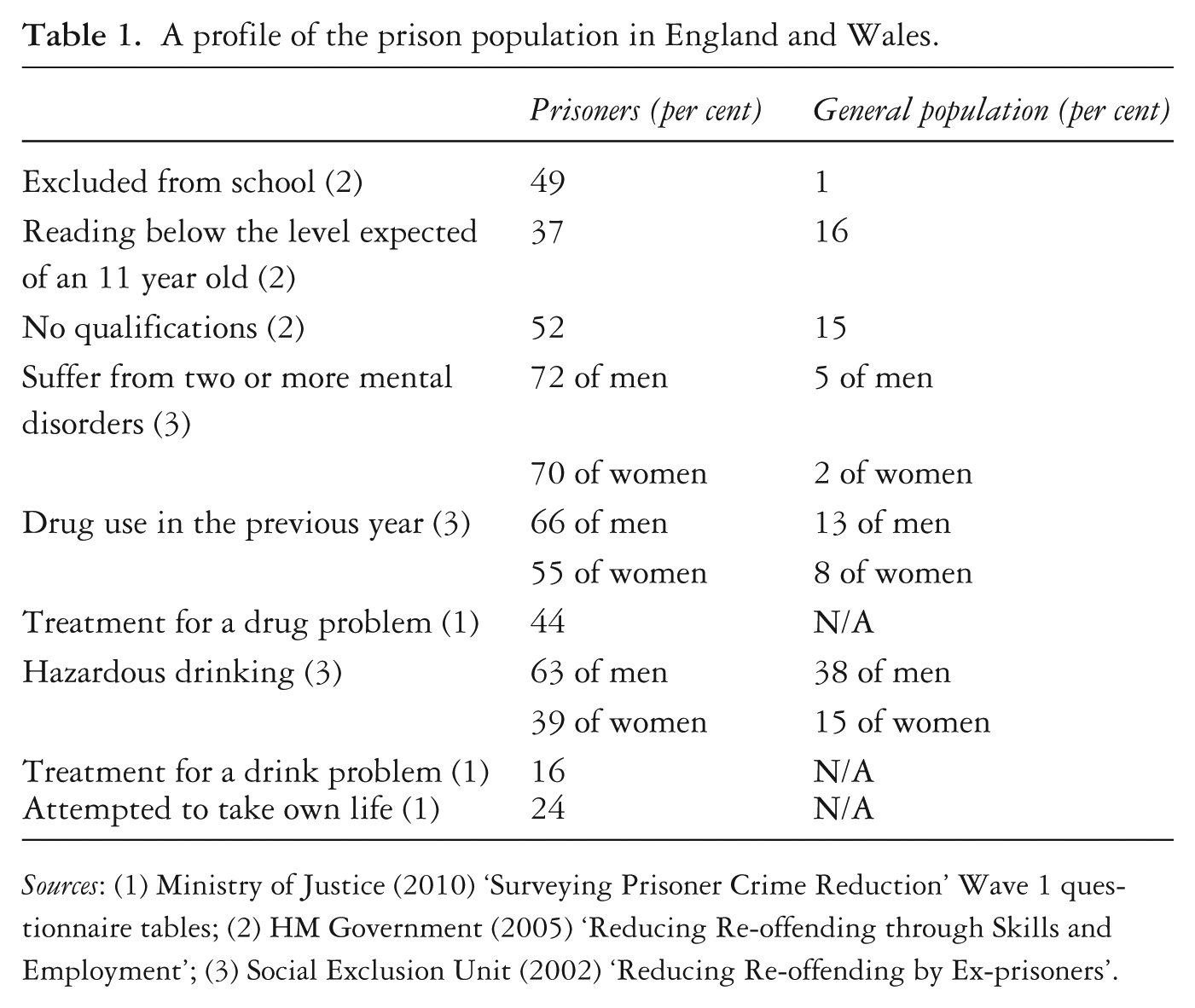
Sources: (1) Ministry of Justice (2010) ‘Surveying Prisoner Crime Reduction’ Wave 1 questionnaire tables; (2) HM Government (2005) ‘Reducing Re-offending through Skills and Employment’; (3) Social Exclusion Unit (2002) ‘Reducing Re-offending by Ex-prisoners’.
Findings
Previous studies have emphasised an inability amongst some marginal groups to alter conduct in order to avoid benefit sanctions. However, the present research suggests that rather than fostering engagement with assistance, welfare conditionality deepens the profound sense of alienation that many ex-offenders feel towards state support and the notion that it is an engine of social progression. This article defines alienation as the experience of isolation resulting from powerlessness and argues that welfare reform has transformed a long-standing antipathy into alienation from front-line staff providing employment support, statutory employment support agencies and work that provides a meaningful stake in society.
This has a number of implications for theory. First, the passivity of many individuals reflects their perceived powerlessness rather than a reluctance to help themselves. Second, a reticence to take up offers of government employment support should be seen in terms of both poor previous experiences which led some to view it as ‘punishment for unemployment’ and its irrelevance to the type of work sought by most ex-offenders. Third, many are acutely aware of their stigmatisation and the potential for employer discrimination but actively seek to minimise the impact rather than indulge in self-blame. Finally, most had a strong work ethic and were active in the labour market. This suggests that the tutelary state is not needed to perform the role of a guardian to combat the supposed passivity of some groups in the labour market nor as a disciplinarian to enforce the acceptance of chronically insecure employment.
Alienation from front-line staff
The legacy of ‘institutionalisation’ and the incorporation of the norms of prison life into individuals’ habits of thinking, feeling and acting (Haney, 2001) can undermine relationships with front-line employment support staff. Some individuals lacked the knowledge, self-confidence and ability to effectively navigate the process of making a new benefit claim. Episodic engagement with the welfare system meant that individuals were not familiar with the latest developments. A Peterborough man aged 34 years confided that: ‘I never used to bother with benefits. Because I used to come out of prison, be out three months, banged up for like two, three years, and then do the same … so I don’t really understand a lot of it.’
Some of those with multiple and complex needs claimed Jobseeker’s Allowance (JSA) but the expectation is that claimants are ready to work and are thus exposed to full conditionality. This had brought them into conflict with front-line staff. A Sheffield man aged 39 years with a heroin addiction and a severe personality disorder had claimed JSA following his release from prison and had been quickly sanctioned. A drug support worker had subsequently helped him to make a successful claim for Employment and Support Allowance (ESA). He concluded that: ‘It has taken me 20 years to get on the right benefit’.
Many claimants thought that staff lacked empathy and understanding of their particular circumstances and needs. ‘They’ve never had to sleep in a doorway thinking hold on a minute, this is bad enough, but now I can’t even feed myself because I’ve got no money [following a sanction]’ (Sheffield man, 37 years).
A Sheffield woman aged 44 years sought to make a new claim following her release and asked how long the process would take. The reported response was: ‘Well you came out of prison with £47 [discharge grant], what have you done with that? And from the social that is totally the wrong attitude because how can anyone live on £47 for four weeks, knowing you’ve got no gas, no electric, no food?’
The inconsistent and arbitrary nature of support and sanctioning was also reported: Some just count them and then sign you and let you go. Other ones, depending on maybe who they’ve had in before or who they are or how keen they are on their jobs will go through it in depth and ask you ‘Why didn’t you do this? Why didn’t you do that?’ But in a very aggressive manner. (Edinburgh man, 29 years)
Inter-personal distrust and confrontation often characterised dealings with front-line staff. An Edinburgh man aged 45 years noted: ‘I’m an ex-offender and I know some of the issues that they face. Plus the fact that most prisoners who spend time inside, you get that them and us thing’.
Some had been sanctioned as a result of personal confrontations: ‘When people have got a hard, tough life … like on the street, you’re going to have a bit of an attitude. You’ve just got to think that, like if I’d won the lottery I’m sure I wouldn’t have an attitude’ (Bristol man, 27 years). Some individuals had been banned from Jobcentres for threatening/assaulting staff: All he was interested in was job search, job search, job search, that’s all he done. I mean shut up man, you know what I mean, you’re like a broken record. In fact I was even covering with my hand saying: ‘I’ll break your jaw when I get you outside, you’re getting it.’ (Edinburgh man, 29 years)
There was a sense of powerlessness, rather than passivity, underpinning a reluctance to appeal the imposition of sanctions. A Black London man aged 42 years explained: ‘You really can’t win and there’s no way of fighting against them … because they’re above you … we don’t have our say in the Jobcentre’.
A lack of knowledge about the appeal process, illiteracy, low self-confidence and low self-worth were contributory factors: ‘A lot of people in prison don’t have that ability. They can’t read, they can’t write, they don’t know how to put a sentence together. So they’re slightly left by the wayside’ (Edinburgh man, 41 years).
Some individuals reflected on the different spaces in which the tutelary state is enacted, viewing prison as a refuge from the problems of poverty and the additional responsibilities and penalties brought about by conditional welfare. It was not uncommon for those that had incurred benefit sanctions to draw our attention to the perceived advantages, often the simplicities, of prison as a Sheffield man aged 39 years reported: ‘I’d been in the system, kids’ homes, the lot, since I was 12 years old. I was treated better in prison [compared to Jobcentre Plus]. You don’t have to worry about benefits in there.’
Alienation from public employment services
Welfare reform has compounded the alienation of individuals from the public employment services in three key dimensions: employment support as surveillance; the hegemony of a model of support that denies social class; and the transformation of job seeking into a paperless process.
Support experienced as surveillance
Offenders have long displayed a strong sense of antipathy to the receipt of government support. A study conducted during the late 1960s found a general reluctance to engage with statutory support. ‘Many prisoners profess to despise the services of the Ministry [of Labour] and maintain they will get their own jobs’ (Martin and Webster, 1971: 142). Research participants were subjected to surveillance following their release from prison and resented its extension into the welfare system: ‘I’ve got to meet probation once a week, I’ve got to meet a hostel man once a week. I don’t want to see all these fucking people. Well maybe I want support, but not them, not their support, not government support’ (Black Bristol man, 47 years).
This antipathy towards authority had been intensified by welfare reform which has changed Jobcentre culture from ‘people sustaining’ activities towards a ‘people transforming’ role (Meyer et al., 1998). In the US Wacquant (2009: 101) has argued that reforms produced welfare offices that: ‘borrowed the stock-and-trade techniques of the correctional institution: a behaviorist philosophy of action … constant close-up monitoring, strict spatial assignment and time constraints, intensive record keeping and case management, periodic interrogation and reporting, and a rigid system of graduated sanctions for failing to perform properly’. Many interviewees highlighted the focus of Jobcentres on surveillance and punishment: ‘I feel when you go into the actual building [Jobcentre] – it feels like you’re actually going into jail with these four great security guards’ (Peterborough man, 27 years).
These perceptions should be seen in the light of the growing focus of Jobcentre Plus on sanctioning benefit claimants. The Agency has competing goals which are related to its two key functions of helping people into work and ‘policing’ benefit entitlement. Nevertheless, ongoing welfare reforms have massively strengthened the latter with the result that sanctions have increasingly become the lived experience of many. Prior to the Coalition government at most 3.8% of JSA claimants per month were sanctioned before challenges but this rose to 6.8% in the year to March 2014 (Webster, 2015). Moreover, 22% of all JSA claimants were sanctioned before challenges over a five-year period from 2009/10 to 2013/14 (Webster, 2015). Furthermore, 30.9% of JSA claimants sanctioned in the year to June 2014 were sanctioned more than once (Webster, 2015). Perhaps not surprisingly our respondents reported: ‘The way I see it is if you don’t get a job you’re getting sanctioned’ (London man, 31 years).
The UK devotes fewer resources to labour market programmes for unemployed people than most Organisation for Economic Co-operation and Development (OECD) countries. From 1990 to 2005 the UK spent less than 0.5% of gross domestic product (GDP) per annum on active labour market programmes compared to around 1.5% in countries such as Sweden and Denmark (Bonoli, 2010). Furthermore, persistent cost-cutting leaves the British system as one of Europe’s most frugally funded public employment services (Bonoli, 2010). Consequently, many individuals reported that Jobcentre Plus provided very little support: ‘The Jobcentre’s just really pointless. The only thing they’re good for is your benefits’ (Edinburgh man, 39 years).
A reluctance to take up offers of government employment support should be seen as a reflection of poor previous experiences which meant that training schemes were frequently experienced as ‘punishment for unemployment’. An Edinburgh man aged 41 years remarked: ‘It was just like a holding pen. If all these guys are in here, sitting in here, reading papers blah, blah from nine o’clock in the morning until half four in the afternoon then they’re not out working on the fly’.
The pointlessness of the support was a recurring theme: ‘It was just a nightmare having to do, like the courses they put you on are so ridiculous. Can you name three types of transport you might be able to get to work, like you’d ask a three year old’ (Black London man, 34 years).
The alienation of individuals from government support is demonstrated by the much lower than expected number of prison leavers taking advantage of ‘day one’ access to the Work Programme (see DWP, 2014a). From March 2012, all prison leavers who claim JSA including those claiming within thirteen weeks of leaving custody, were supposed to enter the Programme from ‘day one’. It was argued that early intervention was the key to overcoming significant barriers to work and preventing re-offending. Yet the indications are that participation in the Programme has been stymied by poor previous experiences of training programmes and its strong association with sanctioning: ‘If you’ve been in prison for 3, 4, 5 years there is a lot of acclimatisation to do. It’s [Work Programme] too much stress too quickly. It is get released, bang, too much’ (Edinburgh man, 37 years).
Job search support that denies social class
Job seekers can now be directed to prepare a curriculum vitae (CV), set up an email address or register for the Universal Jobmatch website prior to their first meeting with Jobcentre Plus (DWP, 2014b). This is premised upon a model of employment support that imposes a white-collar model of job search and denies the social class of recipients. Sassen (1996) argues that economic restructuring has led to a shift of labour market functions such as recruitment for low-skilled work to the household or local community. This was borne out by the present study which found that those undertaking such work frequently rely on friends and acquaintances: ‘It was a good job but the money was crap, £4.50 an hour. It was my brother [an existing employee] that got me that job’ (Glasgow man, 27 years).
Having strong local social networks was a vital pre-requisite for accessing low-skilled work. Some individuals resented the imposition of a job search tool that was an irrelevance to the way in which they accessed employment: People are giving up, and people are giving up because they don’t understand it in the first place. You’ve got to bring a CV in, and people are saying to me ‘What the fuck’s a CV? I’ve never had a CV in my life.’ But if you don’t want a CV you get sanctions. (Glasgow man, 27 years)
Most were acutely aware of their stigmatised social position and the potential for employer discrimination but rather than indulge in self-blame sought to minimise the impact on their chances of work. Some were reluctant to use CVs because of the potential for facilitating employer discrimination. A Peterborough man aged 29 years disclosed: ‘It’s very hard to find work with a criminal record … Everywhere wants CVs now and it’s the gaps in the CV where they’ve learnt to work out people have got criminal records.’ Moreover, the process of getting help to produce a CV is also highly stigmatising: ‘I’ve been unemployed that long I’ve not got an employment history. The only thing I’ve done has just been training programmes’ (Glasgow man, 31 years).
This focus reflects the trend evident from the late 1980s away from training programmes towards low-cost measures for immediate job preparation. Respondents frequently complained that job search support had been imposed on them, as described by an Edinburgh man aged 31 years: ‘One thing I hate about being on the dole is when you get put on some course and one of the first things they want to do is mess about with your CV’. He had been required to continually revise the CV in contradictory ways: ‘Well they called it tweaking it. It was about two and a half pages long. Somebody decided they wanted to make it smaller and then someone wanted to make it longer. Somebody wanted me to add this, that and the next thing. I said “Oh give it a rest”.’
The mainstay of back-to-work support is the self-directed use of the online Universal Jobmatch website which matches job openings to candidates with certain skillsets. JSA claimants can be required to register or risk losing their benefits. Most job seekers are required to use the site and advisers can observe the vacancies that individuals have applied for and subsequent job interviews. Respondents complained that it does not lead to employment and reduces the time available for more effective forms of job search: ‘The Jobcentre say like “Oh yes, we want you to go on to Universal Jobmatch and look for a job”. But you’re more likely to get a job going into town and speaking to people’ (Peterborough man, 39 years).
The transformation of job seeking into a paperless process
During 2014 it was announced that 23,000 electronic signing pads would be installed at more than 700 Jobcentres signalling an end to the paper booklets that claimants traditionally used. At the same time, 6,000 digital job search computers were being installed to allow individuals to search and apply for jobs online. Announcing these measures the Minister for Employment said: ‘But as the economy grows and the jobs market changes, so are Jobcentres. Long gone are the Full Monty days of job cards in the windows and queuing for your dole’ (McVeigh in DWP, 2014c).
This narrative of progress was completely at odds with the experience of many respondents. Some disclosed literacy and numeracy problems: ‘One of my pals gave me a hand. He would kind of write it down and that for me … Because I wasn’t very good with forms and that’ (Edinburgh man, 25 years). Illiteracy extended to information technology. A Glasgow man aged 35 years confided that: ‘It’s all online now. I don’t have online in the house. I’m never going to afford a computer or the internet’. Another interviewee incurred a four-week sanction ostensibly because he was unable to cut and paste job search information required by the Jobcentre. He complained: ‘Well they’ve got all the computers and they want you to use computers and that, but yet if you ask for assistance there’s nobody to help you’ (Edinburgh man, 34 years).
Therefore, the actual sites, mechanisms and interactions through which the contemporary tutelary state is enacted often increased individuals’ alienation rather than reducing it or altering perspectives and behaviour as therapeutic interventions are intended to achieve.
Alienation from secure work that provides a meaningful stake in society
Deindustrialisation and labour market de-regulation have had a profound effect on the nature of work available to marginal groups with a rise in low-paid work, in part-time and flexible employment (voluntary and involuntary), and in the growth of the informal economy. Simultaneously, labour market de-regulation has been promoted despite weak evidence for the magnitude of its benefits and almost total neglect of its costs (Glyn, 2006). Those costs have largely been borne by the low skilled in the form of greater precariousness of work.
Moreover, the labour market history of many interviewees suggests that work has become an engine of social marginality. A dependence on chronically insecure poverty-wage labour, the family, and informal and criminal enterprise was much in evidence. Most individuals had a strong work ethic and were active in the labour market; many men had worked in low-skilled, male-dominated manual jobs in manufacturing and construction and had undertaken cash-in-hand work. Most were seeking similar work and had often secured employment through word-of-mouth. This has two key attractions to marginal groups. Individuals can vouch for the reliability of the prospective employees; and it can restrict the competition for available jobs which is highly prized for those that suffer from employer discrimination.
The chronic insecurity of employment and its inability to function as a ‘stepping stone’ to better quality work and thus provide a route out of poverty was emblematic. Some individuals had been recycling through the lowest reaches of the labour market for decades. Most had a series of menial jobs interspersed with spells of unemployment and imprisonment rather than anything that could be remotely described as a career. This alienation from secure higher quality work was often not restricted to the present generation. Inter-generational experiences of poverty-labour profoundly influenced attitudes to the contemporary labour market: ‘My dad went out working every day and my dad had nothing to show for it. I’ve never been on a holiday in my life and I come from a working class family, that’s wrong’ (Glasgow man, 35 years).
Work was often physically demanding but required few qualifications. A London man aged 34 years had churned between unemployment and a series of labouring jobs. He was currently claiming JSA.
I’ve been on and off with the labouring and that, trying to get work, but it’s just so hard work as well, it’s really hard. You walk in, in the morning and you see like 1,000 bricks and flipping tonnes of ballast and tonnes of soft sand, and you’re like, ‘Why did I get up in the morning? [laughs]’.
He reported: ‘I’d rather be working than learning because at the moment I have no money coming in or anything’.
The proliferation of zero-hour contracts had introduced further uncertainty to many lives. For example, a Peterborough man aged 27 years had had many short-term jobs secured through agencies.
How it works is I could get work from now to January in a warehouse and it would die off. There would be nothing all the way though to about April or May. Then from there onwards maybe I could get the odd couple of days in a food processing place ten hours a day.
He lost his last job several months ago: ‘I was getting 18 days in a row with no day off [in a warehouse]. It was busy as hell one minute and the next minute they kept ringing “Sorry we’ve got no work for you”.’
Addictions and mental health problems made holding down any job very difficult. ‘I can get a job but I cannot handle the money, you know what I mean? I’m happy skint because I’m not drugged out of my mind’ (Edinburgh man, 41 years). His most recent job was repairing the roof of a major rail station. ‘I work in construction usually … I was on the station roof for three years, was making £1,250 a week, all went on drugs’. Violence was a pronounced feature of some lives. ‘I’ve taken that many drugs there is a bit of brain damage, you know what I mean? Yes, I suffer from violence as well, I’ve stabbed people and been stabbed in the main artery.’
Some had limited work experience. A Bristol man aged 47 years had not worked for 25 years since losing his painting and decorating job. Suffering from depression and alcoholism he had frequently been homeless. Most recently he has served a five-year prison sentence for the supply of drugs. He is currently claiming ESA (Support Group) and is resident in a hostel. However, he stays clear of the hostel during the day because of the prevalence of drug using. ‘I had a one-to-one with my key worker up there, because I’m waiting to go into detox to come off alcohol. I said, “Well that place ain’t going to help me”’.
Criminal enterprises were a more lucrative, albeit risky, option for some. A Glasgow man aged 35 years had, for example, left the city in order to recover from his drug addiction but was quickly confronted with a moral dilemma on his return. ‘I was three, four hours in Glasgow. I was offered a bag of heroin and about 5,000 acid tabs. There you go, get an earner. Pay me back when you’ve got the money. Easy’.
A few had eschewed formal work for crime, such as this London man aged 48 years: ‘I’ve never really worked, to be quite truthful. I was like, a commercial burglar’. On leaving school he had initially worked with his father in construction but was soon attracted to crime. ‘You know, all my family are Paddies so they’ve all worked on building sites, but it just wasn’t for me at the time … I was young, I was like – the money was better in the criminality’. He supplements his benefits by working cash-in-hand. ‘My brother-in-law’s a painter and decorator, so I get a lot of work with him. So he gives me like, £70 a day’.
These findings indicate how individuals can become further alienated from rapidly changing labour market and employment opportunities and this frames their alienation from the interventions of the tutelary state that evolves in response to these new forms of socio-economic marginality.
Conclusions
Mead has sought to change the normative landscape of welfare which is now characterised by an emphasis on state authority and the obligations of the poor, to the neglect of their social rights that were a key pillar of previous tutelary welfare regimes. This new imperative is premised on a model of behaviour that highlights the dependency of the poor on the state for support. From this perspective the poor are ‘depressed but dutiful, willing to observe mainstream norms like work only if government will enforce them’ (Mead, 1991: 20). The task for policy makers is, therefore, to ‘confront the motivation problem’ (Mead, 1991: 19). A mainstream political consensus has been forged on the need for welfare reforms to replace social protection with conditional regimes that purport to activate and empower the poor (see also Cruickshank, 1999). However, our findings suggest that far from motivating and re-engaging marginalised individuals, sanctions enhance and entrench their alienation.
Proponents of conditional welfare might argue that those furthest from the labour market are not exposed to full conditionality and attendant sanctions. However, the present research has discovered that many of those with the most profound and complex barriers to work claim JSA; are subject to full conditionality; and regularly fall foul of the requirements of conditional welfare. Institutionalisation leaves many uniquely unable to satisfactorily negotiate a rapidly changing benefits system. Furthermore, many had a history of claiming JSA and multiple experiences of benefit sanctions.
Mead (1992) argues that the state assumes the position of protector in that conditionality is used to break down the isolation of the poor from mainstream society. Since a lack of employment is a major cause of this isolation, efforts to promote work have been prioritised. A ‘hard paternalism’ based on coercion appears to animate recent moves towards further strengthening of the UK conditionality regime since unemployment is argued to be rooted in the demoralisation of the poor. ‘Today the government is announcing the most radical overhaul of our welfare system since its inception, driven by a single, overriding principle: the purpose of welfare is to help people into work. Work is the surest route out of poverty’ (DWP, 2010b).
However, many of those on the margins retain a commitment to wage work but economic change and labour market de-regulation have transformed the nature of employment available to such an extent that it no longer fosters social inclusion. Waged work is frequently experienced as chronically insecure, exploitative and exclusionary. As Wacquant (2016) argues, new forms of statecraft need to be understood as a response to emergent forms of marginality. Consequently, conditional welfare might be better conceptualised as a means of forcing benefit claimants into precarious work and facilitating disentitlement from benefits. This is supported by several previous studies of UK welfare reform. Peck (2001: 342) argues that the imposition of a range of compulsory programmes is an effort to construct a new system of labour regulation ‘enforcing labour market participation in a climate dominated by unemployment, low pay, work insecurity and low grade service employment’. Byrne (2005) suggests that the purpose is to re-regulate the reserve army of labour and increase its size and closeness to the labour market. Similarly, Wiggan (2015) views welfare reform as a product of evolving antagonistic class relations between capital and labour. He contends that Mandatory Work Activity and the Work Programme facilitate differentiated activation, where segmentation and stratification of the non-employed population reproduces an insecure, disciplined, segmented and stratified labour power for insecure labour markets. Whereas Adkins (2017) argues that the law is being used in the assembly of a market for the labour of the unemployed. ‘The contractual arrangements between the DWP and [Work Programme] providers not only frame the activities of the unemployed as labour but also as an object of calculation and measure in regard to payments, bonuses, service levels, targets, benchmarks, market share’ (Adkins, 2017: 300).
The criminal is the classic member of the ‘underclass’ defined by drug taking, illegitimacy, violence and an inability to hold down a job (Murray, 1990). Poor mental health and addictions had marked many of our respondents’ lives. Remarkably the work ethic endured amongst many ex-offenders which suggests that the state is not needed to perform the role of guardian to combat the passivity of such groups in the labour market nor as a disciplinarian to enforce precarious employment. Those unwilling or unable to comply with behavioural requirements are increasingly subjected to punitive benefits sanctions and disentitlement. Such illiberal measures become less problematic for the state as responsibility is attributed to individual irresponsibility (Dwyer, 1998). Consequently, Mead (1992: 212) maintains that the ‘social problem becomes the dysfunction of the poor’. The present research has found that it is the way in which support is provided to marginal groups which results in alienation, sanctioning and disentitlement: ‘When you’re at rock bottom, you get kicked. You feel like giving up … I’m not going to get any money. I’m not going to get any help. I can’t be bothered with it [claiming benefits]’ (Bristol man, 28 years).
Offenders are also alienated by wider discourses since contact with the criminal justice system can result in even more crime through negative labelling and stigmatisation. Nevertheless, ongoing welfare reforms have also transformed a long-standing antipathy into alienation from state support. Furthermore, the operant purpose of conditional welfare is to force marginal groups into work that fails to provide a meaningful stake in mainstream society. Consequently, some interviewees have begun to question the utility of remaining in the welfare system: ‘Why wait down there [Jobcentre] for an hour maybe more? Then I’ve got to wait two weeks for the money. I’d just jump in my mate’s car and have a quicker earner, you know’ (Bristol man, 50 years).
The tutelary and therapeutic state has always sought and required a universalising coverage of society and a penetration into the family lives and conduct of the most marginalised (De Tocqueville, 2003; Foucault, 1977; Donzelot, 1979). An apparent consequence of new forms of sanctioning being to push marginalised individuals outside the encompassing ‘mesh’ (Wacquant, 2016) of the welfare or penal regime, therefore, actually undermines a core pillar of the tutelary project of government.
Footnotes
Funding
The support of the Economic and Social Research Council (ESRC) (grant number: ES/K002163/2) is gratefully acknowledged. We would also like to thank the wider study team and all research participants.