




Abstract
British policy-makers have increasingly sought to intensify and extend welfare conditionality. A distinctly more punitive turn was taken in 2012 to re-orientate the whole social security and employment services system to combine harsh sanctions with minimal mandatory support in order to prioritise moving individuals ‘off benefit and into work’ with the primary aim of reducing costs. This article questions the extent to which these changes can be explained by Wacquant’s (2009) theory of the ‘centaur state’ (a neoliberal head on an authoritarian body), which sees poverty criminalised via the advance of workfare. We present evidence of an authoritarian approach to unemployment, involving dramatic use of strategies of surveillance (via new paternalist tools like the Claimant Commitment and the Universal Jobmatch panopticon), sanction and deterrence. This shift has replaced job match support with mandatory digital self-help, coercion and punishment. In relation to Work Programme providers, there is a contrasting liberal approach permitting high discretion in service design. This article makes a significant original contribution to the field by demonstrating that Wacquant’s analysis of ‘workfare’ is broadly applicable to the British case and its reliance on a centralised model of state action is truer in the British case than the US. However, we establish that the character of British reform is somewhat different: less ‘new’ (challenging the time-tethered interpretation that welfare reform is a uniquely neoliberal product of late modernity) and more broadly applied to ‘core’ workers, including working-class white men with earned entitlement, rather than peripheral workers.
Introduction
Far-reaching British welfare reforms (1996–present) have been pursued by Westminster governments from all three of the major political parties, who share the central aim of ‘getting people off benefits and into work’ (Department for Work and Pensions (DWP), 2010a; 2010b). For two decades, there has been surprisingly little political debate over the intensification and extension of conditionality that is central to this change (Bennett, 2014; Dwyer and Wright, 2014; Lindsay and Dutton, 2013). Since 2012, the dominant approach of combining mandatory self-help with sanctions and minimal support has taken a decidedly more punitive turn. Whilst access to unemployment benefits has always been conditional (for example on the requirement to be involuntarily unemployed and the expectation to seek paid work), we identify and explore the rise of ‘conduct conditionality’ (Clasen and Clegg, 2006) in the form of coercive behaviouralism. The details of British social security policy and employment service practices are examined in order to assess the extent to which Wacquant’s (2009) theory, primarily developed with reference to the US, is applicable to the British context – i.e. does the system operate to ‘punish the poor’?
First, we outline Wacquant’s (2009) ideas about the transformation of welfare claimants into criminals in a ‘centaur state’. Second, we set out the policy context of rising behavioural conditionality and the punitive turn, highlighting key points in the road to the criminalisation of benefit claimants and low-paid workers. Third, we assess the extent to which British social security and employment service reform has involved the criminalisation of unemployed claimants according to the key themes of surveillance, sanction and deterrence. We conclude with a reflection on the applicability of Wacquant’s (2009) ideas to the British case and the extent to which punitive welfare reform might be considered as a ‘global workfare project’.
Theorising welfare reform: Towards surveillance, punishment and disentitlement?
Academic debate about social security reform is polarised. Whilst Dunn (2014) argues for coercion on the grounds that unemployed people are too ‘choosy’ about jobs, critics highlight a lack of job opportunities (Taulbut and Robinson, 2014) and the analytical limitations of assuming that stereotypes of immoral behaviour can be generalised across entire income groups and neighbourhoods (Pykett, 2014), which has come to define entitlement to benefits (Grover, 2010). Whitworth (2016) argues that neoliberalism and paternalism present divergent and at times contradictory views of welfare subjects, which has led to stark mismatches between policy intentions and likely outcomes. Behavioural conditionality is viewed as part of a wider trend towards the criminalisation of social policy (Knepper, 2007; Grover, 2008; Rodger, 2008). This involves a redefinition of the aims and purposes of the welfare state including an abandonment of concerns for meeting human needs in favour of maintaining a disciplined and orderly society (Rodger, 2008). Wacquant (2009) has argued that a transnational political process is underway to exert social control over ‘the poor’. Harsh penal policies (‘prison-fare’) and social policies (‘workfare’) can be understood as a symbolic and material apparatus to control marginal populations created by economic liberalism and welfare state retrenchment. In Wacquant’s (2009: 98) terms, claimants are ‘saddled with abridged rights and expanded obligations’.
Wacquant (2009: 43) has argued that a new type of neoliberal political regime has emerged, the ‘centaur state’, which is ‘guided by a liberal head mounted on an authoritarian body’. The centaur analogy was first used by Machiavelli (and subsequently by Gramsci) to refer to the diversity of strategies of rule deployed by the state towards various social classes combining a mixture of coercion and consent (Squires and Lea, 2013). For Wacquant it refers to a neoliberal state that retains strategies of consent towards corporations and upper classes but is authoritarian and coercive towards those experiencing poverty. The result has been the ‘double regulation of the poor’ that involves, on the one hand, the decline of the Keynesian welfare state and its replacement with a workfare state and, on the other hand, the criminalisation of ‘the poor’ and the expansion of the prison system to contain the disorders created by growing social insecurity. Prison-fare has been characterised by burgeoning prison populations (the US population behind bars has risen from 380,000 in 1975 to 2.4 million today; Wacquant, 2014) and the movement of the penal system away from welfarist notions of rehabilitating inmates to merely warehousing them.
Wacquant (2009: 95) shows that US benefit claimants have been portrayed as deviant rather than deprived, as a problem population whose supposedly work-shy behaviours must be rectified by means of ‘preclusion, duress and shaming’. This has transformed benefit claimants into ‘cultural similies of criminals who have violated the civic law of wage work’ (Wacquant, 2009: 60). Welfare and penal policies have increasingly become informed by the same behaviourist philosophy relying on deterrence, surveillance and graduated sanctions in order to modify behaviour. Furthermore, the punitive nature of welfare programmes operates in the manner of a labour parole programme designed to push claimants into low-paid, chronically insecure jobs. ‘At best, such programs replace “dependency” on means-tested state programs with “dependency” on super-exploitative employers at the margins of the labour market’ (Wacquant, 2009: 59). This theme of permissive liberalisation towards employers is taken up by Standing (2011), who illustrates the wide reach of exploitative forms of insecure employment to a new ‘precariat’ class.
A critique of Wacquant (2009) is that the strength of his theorisation outweighs the evidence, which needs to be updated (Schram, 2010; Wood and Craig, 2011) and is open to alternative interpretation. Marwell (2016: 1096) challenges Wacquant’s ‘trope of a centralised state pushing out policy mandates that cascade uniformly downstream’. Instead she advocates using a ‘governmentality’ perspective, which better reflects the ‘multiplex relations among government, business, nongovernmental organisations and hybrid organisational forms in the production of urban inequality’ (Marwell, 2016: 1095). Soss et al. (2011: 6–8) argue that the US state has used governmentality to discipline and govern people living in poverty by strengthening and extending its reach into business, civil society and ‘self-mastery’. They argue that greater attention should be given to how these processes operate in practice to create ‘compliant and competent worker-citizens’ (Soss et al., 2011: 9). Thus, ‘managerial reform is political because it changes who does what and how’ (Brodkin, 2013: 26). This chimes with the largely parallel European and Australian literature on the combined effects of ‘activation’ policy changes with new governance strategies (cf. van Berkel et al., 2011; Considine et al., 2015). This comparative literature does not adopt Wacquant’s (2009) punitive and disciplinary conception of reform but has offered greater elaboration and explanation of the varieties of governance reforms and their interaction with ‘activation’ reforms.
Here, we develop debate by building on existing analysis of the applicability of the ‘prison-fare’ strand of government action (Mayer, 2010; Piven, 2010; Squires and Lea, 2013), recognising the record rise in the British prison population (growing by 91% between 1993 and 2014 (Prison Reform Trust, 2015) and representing about 20% of the US rate of the mass imprisonment (Adler, 2016: 226)). We offer original analysis of British evidence of ‘workfare’. Existing analysis has indicated an ‘Americanisation of the British welfare debate’ (Deacon, 2000), which has shifted policy concern with inequality to ‘dependency’ and been disproportionately influenced by American ideas (Deacon, 1997; King, 1999; Peck and Theodore, 2001; Daguerre and Taylor-Gooby, 2004). Next, we set out the story of British social security and employment service reform and investigate the extent to which Wacquant’s core ideas of surveillance, sanction and deterrence characterise the experience of claiming benefits for unemployment in Britain today, involving: the new paternalist conception of the role of the state in respect to the poor, according to which the conduct of dispossessed and dependent citizens must be closely supervised, wherever necessary corrected through rigorous protocols of surveillance, deterrence and sanction. (Wacquant, 2009: 59–60)
The policy context: Rising behavioural conditionality and the punitive turn
The genesis of coercive behavourialism in Britain can be traced to the mass unemployment of the 1980s which, in combination with ideological predilections and cost-cutting commitments, prompted the Conservative governments (1979–97) to commission a series of social security reviews and introduce a ‘stricter benefit regime’ (Blackmore, 2001). Eligibility criteria for unemployment benefits were tightened and a system of rules and penalties were introduced. The original maximum penalty of six weeks’ loss of benefit, which had existed from 1911 to 1986, was increased to 13 weeks and then 26 weeks in 1988 (Webster, 2014). The mechanism for annual adjustments to the value of benefits was also altered, which resulted in continuing year-on-year devaluations to already inadequate benefit rates, relative to average earnings (Bryson and Jacobs, 1992). This can be seen as the start of a long-term process of ‘conversion of the right to “welfare” into the obligation of “workfare”’ (Wacquant, 2009: 43). However, it was the policy approach and practices introduced with Jobseeker’s Allowance (JSA) in 1996 that can be seen as a decisive turning point.
This strengthened behavioural conditionality with the introduction of Jobseeker’s Agreements ( mandatory back-to-work plans negotiated with an adviser at the initial benefit registration) and Jobsearch Diaries (mandatory records of actual job search activity between re-registering/‘signing on’ interviews). Paralleling US reforms, this style of administration ‘multiplied forms to be filled out, the number of documents to be supplied [and] the frequency of checks’ (2009: 50). This expanded the surveillance of unemployed people and marked a watershed in mandation practices, for example new Jobseeker Directives meant that front-line Jobcentre advisers could instruct jobseekers, with legal authority, to take specific action that they deemed necessary for finding work (e.g. to alter personal appearance). Although initially rarely used (Blackmore, 2001), these established the principle of discretionary authority to ‘correct’ individual behaviour on threat of sanction.
The groundwork for the punitive turn had been firmly laid when the Labour government came to power in 1997. Their adoption of JSA represented a powerful new consensus (Bryson, 2003) on coercive conditionality. An intensive development of ‘work for all’ and ‘work first’ welfare reform followed (Lindsay at al., 2007; Lindsay and Dutton, 2013), based on ‘the principle that aspects of state support, usually financial or practical are dependent on citizens meeting certain conditions which are invariably behavioural’ (DWP, 2008: 1). A series of welfare-to-work programmes were showcased (e.g. a range of New Deal programmes, Employment Zones and Working Neighbourhood Pilots). However, Labour’s welfare changes (1997–2010) were balanced by the development of measures to ‘make work possible’ (e.g. more childcare and financial assistance with its high costs) and to ‘make work pay’, e.g. the National Minimum Wage and tax credits to top up low wages (Millar, 2002). Labour’s approach introduced work-related conditionality, particularly from 2002 to new groups like lone parents and ill or disabled people via Work Focussed Interviews.
Laying the groundwork for the wholesale criminalisation of benefit claimants?
Wacquant (2009: 59) argues that US reforms are aimed at ‘the dispossessed and dependent’ with the criminalisation of people living in poverty being gendered and heavily racialised. In the US, ‘workfare’ was applied predominantly to working-class black women, via a range of municipal social assistance programmes (under the auspices of Temporary Assistance to Needy Families (TANF)). In Britain, however, the introduction of JSA is significant because it meant that coercive reforms were applied right across a centralised nation-wide social security system, which conflated the two previously distinct strands of social assistance benefits and unemployment insurance. This feature of the British system is unique and reflects a more centralised reform than the US case. Overall, the effect was to remove the long-standing distinction between the respectable receipt of benefits for unemployed workers with contributions records and the more needs-based principle for other groups. This laid the groundwork for a much broader application of punitive measures, techniques of surveillance and disallowance strategies. At the time of its inception, this was mainly a change for working-class white men, making it more of an issue of class than of gender or race.
However, by 2002, the punitive approach to unemployment began to be applied to new groups, via Work Focussed Interviews across working age caseloads, made possible organisationally by the creation of Jobcentre Plus (which brought social security and employment services together in one centralised agency, operating with a high degree of standardisation and limited discretion for front-line workers). From 2008 onwards, cohorts of lone parents (approximately 90% of whom were, and still are, women, Office for National Statistics (ONS), 2016) were re-routed from Income Support onto JSA according to the age of their youngest child. The new stricter Work Capability Assessment brought in for Employment and Support Allowance (ESA) led to a high proportion of ill or disabled claimants being reassessed as ‘fit for work’ (DWP, 2015a) in a process that can be interpreted as ‘redefining medical conditions that qualify as a disability in a restrictive manner’ (Wacquant, 2009: 91). Some of those categorised as ill or disabled were moved to the ESA Work-Related Activity Group (WRAG) and became subject to job search conditionality and sanctions, instead of being exempted (as would previously have been their case). Many others were categorised as unemployed without recognition of health conditions or disability and were redirected onto JSA with full job seeking expectations. This means that the British ‘claimant unemployed’ have become constituted very differently than in previous generations, including higher proportions of people whose capacity for job seeking and working is limited by: (a) being a sole carer (primarily lone mothers); and (b) disability or health impairments. Thus, the British target group for criminalising benefit reforms is very broad, encompassing both social insurance and social assistance schemes, for a wide range of claimants.
The punitive turn
The substance and rhetoric of UK Conservative–Liberal Democrat Coalition government reforms (2010–15) represented a strong degree of continuity with the ‘work first’ strategy of the preceding Labour government. However, the Coalition government introduced a harsher approach in 2012 that involved the rapid extension and intensification of benefit sanctions (Dwyer and Wright, 2014). The sanctions regime is intended to operate in conjunction with Universal Credit (UC) (originally planned for phased roll-out from 2014–17) as the main working-age income benefit for people in a wide range of circumstances, including those in work and the partners of claimants (DWP, 2010a, 2010b). For those in work, UC replaces Working Tax Credit, with a new expectation that part-time workers will usually be required to seek extra pay and additional hours or multiple jobs up to a total of 35 hours per week. Part-time workers are expected to dedicate their non-working time to job search (i.e. each week, a worker on a 25-hour contract is expected to spend 10 hours looking for work, including attending Jobcentre appointments, logging job search and being subject to sanctions). This represents a further conflation of previously distinct income maintenance schemes, with formerly separate rationales, allowing for a wholesale roll-out of conditionality, never seen before in the British system. Since the Conservative government took power in 2015, the approach to welfare reform has moved away from concern with alleviating poverty (experienced in or out of work). The main policy drivers for this reorientation of social security and employment support have been a combination of ideological concern with ‘dependency’ and cost-cutting. Next, we consider how applicable Wacquant’s (2009) analysis is to the British case in relation to the core themes of surveillance, sanction and deterrence.
Surveillance, sanction and deterrence
Wacquant argued that the US reforms produced welfare offices that: borrowed the stock-and-trade techniques of the correctional institution: a behaviouralist philosophy of action … constant close-up monitoring, strict spatial assignments and time constraints, intensive record keeping and case management, periodic interrogation and reporting, and a rigid system of graduated sanctions for failing to perform properly. (2009: 101)
In this section we present evidence that British employment services, provided via Jobcentre Plus and Work Programme providers, can be described in broadly similar terms, with the majority of jobseekers having experienced the system as compliance-based. We argue that the balance between sanction and support has tipped firmly in favour of the former, examining the inter-related strategies of: (a) surveillance; (b) sanction; and (c) deterrence.
Surveillance: Generalising the corrective tools of new paternalism
Since the advent of JSA, administering benefits for unemployed people in Britain has been centrally and increasingly concerned with surveillance and correction. Here, we present three major new paternalist tools that provide evidence to support Wacquant’s (2009) argument that close supervision and correction operate to criminalise claimants: the Claimant Commitment, coercive self-help and the Universal Jobmatch system.
The Claimant Commitment: Correction writ large
A Westminster directive saw Jobseeker’s Agreements replaced (December 2013–May 2014) by Claimant Commitments, as the new standardised, nationwide, tool of back-to-work conditionality for out-of-work UC, JSA and ESA-WRAG claimants. The Claimant Commitment facilitates large-scale surveillance of detailed back-to-work plans, involving variable coercion, since claimants can be sanctioned for non-compliance with any item written in the document. Full work-related conditionality is the expectation for the majority of claimants (DWP, 2010b), who, under UC must evidence 35 hours per week of job-seeking. This formalises and generalises the type of discretionary authority used in Jobseeker’s Directions (whereby claimants could be instructed, on threat of sanction to take any step deemed necessary by their advisor). This extension of conditionality is important because it is combined with very minimal support and operates in tandem with Universal Jobmatch to universalise surveillance and ease large-scale sanctioning (see below).
Coercive self-help and the absence of support
Wacquant (2009: 59) argued that in the US ‘the insufficiency and inefficiency of forced-work programs are as glowing as their punitive character’. British employment services can be described in a similar way, operating to monitor and discipline benefit recipients and, under UC, low-paid workers. Minimal resourcing and persistent cost-cutting leaves the British system as one of Europe’s most frugally funded public employment services (Bonoli, 2010). The core of the British approach to back-to-work support is self-help, using call centres and automated self-administered online services. Most jobseekers find themselves a job (around 75% come off JSA within six months and almost 90% within 12 months (DWP, 2012a; House of Commons Work and Pension Committee (HoC WPC), 2014b)). Jobcentre Plus has also been subject to several rounds of hard-hitting cuts (losing at least 28,850 posts and 22 Benefit Delivery/Contact Centres between 2008 and 2012 (Public and Commercial Services Union (PCSU), 2011b; Wintour, 2011)), which have reinforced its residualisation. In order to reduce corporate running costs by 40%, Jobcentre Plus was recentralised within the DWP. However, planned office closures for 2017 are at odds with new demands on front-line staff time including UC, which extends conditionality requirements to 1.2 million people in work (Pennycook and Whittaker, 2012). Consequently, there is ‘a risk that the resource implications of recent and planned policy changes will put too great a strain on already stretched Jobcentre staff’ (HoC WPC, 2014a: 42).
Jobcentre Plus offers a ‘low road’ variant of work first activation where benefit recipients are required to adjust their aspirations in line with the de-skilled job opportunities available at the ‘low end’ of the labour market (Clasen and Clegg, 2006; Wiggan, 2007). High levels of compulsion are combined with a compliance regime of cheap mandatory support designed to ensure rapid labour market re-entry (Wright, 2011). A recent DWP survey showed that only one in seven of the JSA and ESA claimants who left benefits for paid work found their jobs through Jobcentre Plus (TNS BRMB, 2013). Overall, staff cuts, high caseloads (for JSA around 140 claimants per adviser; rising to over 600 per adviser for ill or disabled claimants, HoC WPC, 2014b) and a strategy of ‘minimising footfall’ (Stafford et al., 2012) mean a chronic lack of time for face-to-face contact with advisers. Claimants report adviser interviews that were too short to be of any value (Fletcher, 2011) and official guidance requires snap judgements, taking ‘seconds’, to determine whether or not a claimant is ‘vulnerable’ (Stafford et al., 2012: 500). Furthermore, cost minimisation has reinforced standardisation, leaving little space for flexibility or discretion: The service can appear monolithic and unresponsive and … staff seem to work to a remit that doesn’t allow or encourage them to be creative or flexible when addressing the needs of customers. (Consumer Focus, 2009: 28)
The Universal Jobmatch panopticon
Wacquant (2009: 106) observed that US benefit recipients are subject to ‘extensive record-keeping, constant testing and close-up surveillance, allowing for the multiplication of points of restraint and sanction’. Since 2012, the mainstay of British back-to-work support for the majority of jobseekers has been the self-directed use of the online Universal Jobmatch vacancy system, which is laced with compulsion and intrusive surveillance. Most jobseekers are required to use the site by Claimant Commitments and/or ‘Day One Conditionality’ (from 2013 claims for JSA and UC usually cannot be made without first satisfying digital requirements (National Audit Office (NAO), 2016)). Work coaches can observe claimants’ online activity (e.g. which vacancies they have applied for). In the absence of any evidence of job outcomes (Monster Government Solutions UK (MGSUK), 2013: 13), it appears that Universal Jobmatch is primarily a surveillance tool garnering evidence for sanctioning – a digital panopticon. In practice, Universal Jobmatch has eased the normalisation of hard-hitting sanctions, which is the topic to which we now turn.
Sanctions at the expense of support
Wacquant charts a: shift ‘from carrots to sticks’, from voluntary programs supplying resources to mandatory programs enforcing compliance with behavioural rules by means of fines, reductions in benefits, and a termination of recipiency irrespective of need. (2009: 60)
The same can be said of the British system, which has massively expanded financial hardship via ‘disciplinary administrative sanctions’ Adler (2016: 196) and new forms of civil penalty (operating alongside the existing stringent system of criminal prosecution for benefit fraud). Punitive benefit sanctions were applied to a quarter of JSA claimants between 2010 and 2015 and the elusive UC sanctions rates (not released until four years into its implementation) are even higher (NAO, 2016; Webster, 2017). Sanctions are applied without trial and impact immediately and disproportionately on vulnerable people (Adler, 2016). There are three issues of note: (1) major changes to the legal scope of centrally controlled benefit sanctions, which lengthen and deepen likely experiences of poverty and risks of eviction and destitution; (2) fluctuating sanctioning rates, which rose rapidly and then fell; and (3) front-line sanctioning practices in Jobcentre Plus and the Work Programme.
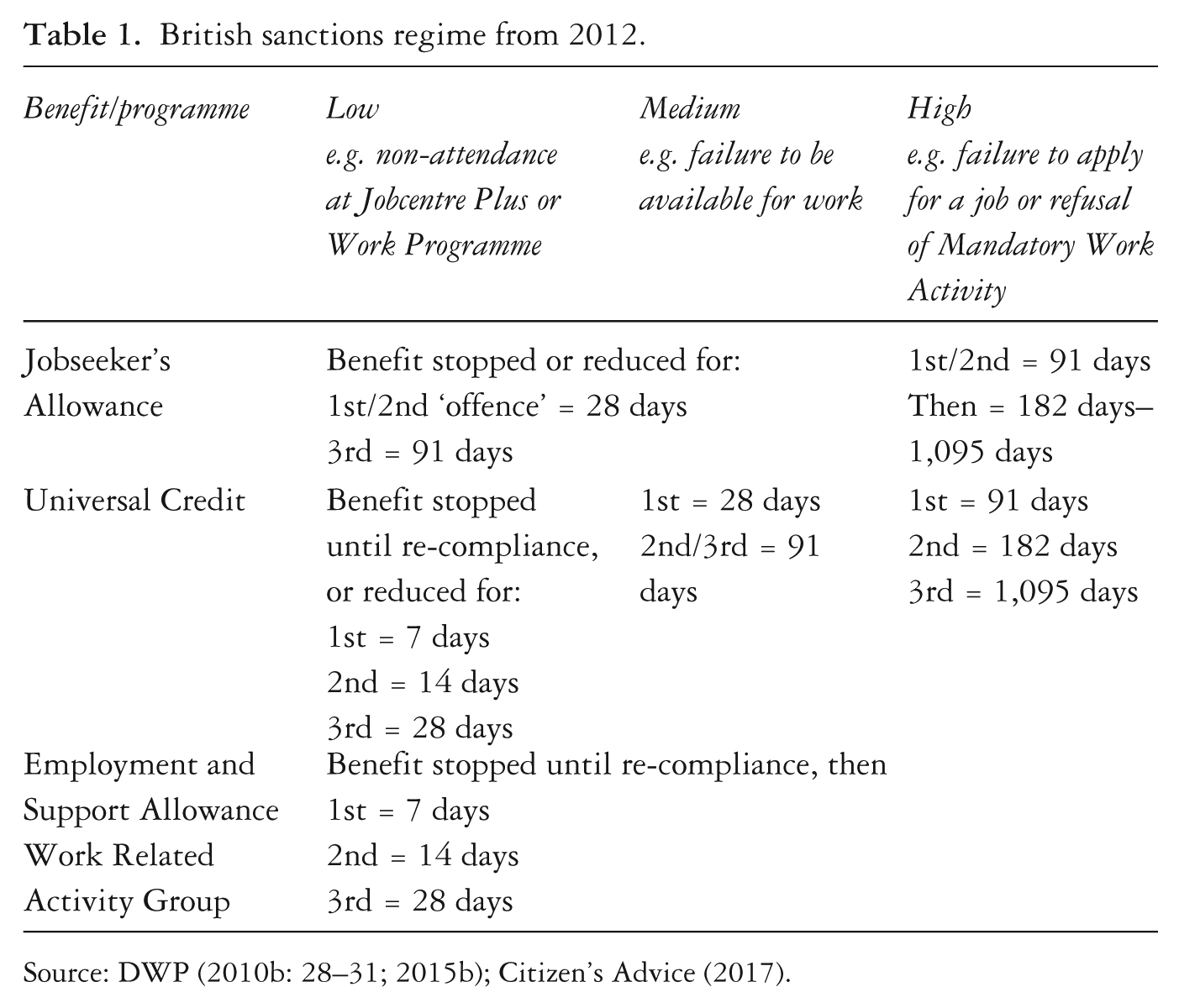
In 2012, the ‘most punitive welfare 1 sanctions ever proposed by a British government’ (Slater, 2012: 2) were introduced. The new system of sanctions (see Table 1) and civil penalties was introduced across the board, in all localities, for working age claimants (JSA, UC, ESA), including £50 fines for ‘negligently making a false claim’ (Gillies et al., 2013: 6). Stringent anti-fraud measures, such as criminal prosecution for withholding change of circumstances information, already existed and continue alongside the new system of fines (Citizen’s Advice, 2017). The language of benefit administration has become more punitive, with official regulations referring to commonplace service sector experiences like missing an appointment as an ‘offence’ escalating to a ‘serial and deliberate breach’ (Webster, 2014). Financial penalties are now frequently much greater than those imposed by courts but without similar processes or protections (Adler, 2016; Webster, 2014).
British sanctions regime from 2012.
Source: DWP (2010b: 28–31; 2015b); Citizen’s Advice (2017).
Table 1 shows that even first ‘offences’ for ‘low level’ requirements (e.g. being late for one appointment) can trigger open-ended, week-long or month-long sanctions. Benefit recipients may be subject to double conditionality if they receive concurrent sanctions under their main income-related benefit (i.e. JSA/ESA/UC) and the Work Programme. The 2012 change extended the use of ‘disentitlement’ with claimants then subject to sanctions after re-compliance. Under UC, the period for which a sanction applies is, in effect, more than doubled because sanctions are consecutive, rather than concurrent, and Hardship Payments must be repaid (Webster, 2017: 4). These severe financial penalties are disproportionate, far outweighing the minor infringements for which they are applied and out of alignment with financial penalties for comparable civil and criminal offences (Adler, 2016). Furthermore, this sanctions regime has been introduced to enforce a rapid extension and intensification of individualised job-search conditions via the ‘Claimant Commitment’ (Dwyer and Wright, 2014). Consequently, the British social security system offers increasingly insecure and inadequate income, with a firm emphasis on punitive sanctions.
Although sanctioned claimants are eligible to apply for Hardship Payments (at a reduced rate, available after a two-week waiting period of no income), DWP’s (2013a) own evaluation survey showed that only 23% of sanctioned JSA claimants and 13% of ESA claimants were informed of this, with tiny proportions of sanctioned claimants actually applying. Deep poverty and the increasing threat of destitution are used to discipline wide groups of unemployed people and low-paid workers.
Front-line ‘benefit off-flow targets’ and sanctioning practices
The fluctuating rate of sanctioning offers clear evidence of a criminalisation strategy, which is sensitive to central government control. From 2010, there was a rapid and ‘spectacular’ rise in JSA sanctions (Adler, 2016). Webster (2016: 2) reports an overall increase May 2010–March 2016, with ‘1.65m more JSA sanctions than there would have been if the rate inherited from the previous government had continued’. Similarly, the ESA sanctions rate tripled from 2012 to 2013 (Webster, 2014). However, since October 2013, the number of JSA and ESA sanctions has subsequently fallen. This fall has been attributed to declining Work Programme caseloads and a behind-the-scenes directive to ease off on sanctioning (implemented via hidden managerial methods rather than transparent changes to policy guidance), prompted by mounting public concern (Webster, 2016). The first release of UC sanctions data (ONS, 2017) indicates that another likely factor explaining the fall in the JSA/ESA sanctions rate (from late 2013 onwards) is the migration of the ‘likely to be sanctioned’ part of the caseload (i.e. young people) to UC, where sanctioning rates are surprisingly high. For example, in 2016 ‘there were approximately 339,000 JSA or UC sanctions on unemployed people before challenges, of which 157,000 were JSA and 182,000 UC’ (Webster, 2017). The NAO (2016: 8) review of benefit sanctions concluded that it ‘is likely that management focus and local work coach discretion have had a substantial influence on changing referral rates’. This alludes to the Jobcentre Plus ‘benefit off-flow target’ (the proportion of claimants who have left benefit by the 13th, 26th, 39th and 52nd weeks of claims), which has been used as a new managerialist tool since 2011 to shape the front-line activity of work coaches, operating implicitly as a sanctions target (Couling, in HoC WPC, 2014a). Jobcentre staff whose sanctioning rates are not meeting expectations are subject to an ‘improvement plan’, which is a formal performance management proceeding (PCSU, 2014). There are concerns that the ‘benefit off-flow’ target encourages the prioritisation of cases and actions that will most quickly and effectively result in the termination of benefit claims, at the expense of helping people (especially those who need most support) to find work (NAO, 2013). This represents a major departure from the organisational goals of Jobcentre Plus, which had previously been conceived in the Employment Service tradition of helping people to find work (dating back to the 1908 Labour Exchanges, DWP, 2010c).
Webster attributes much of the dramatic rise and fall in sanctioning rates to both changes in the size of the Work Programme client group and high-level political decisions about their use: Its effect was amplified by the ruling by the DWP, strongly criticised in the Oakley report of July 2014, that contractors must refer claimants for sanction if there is any breach of requirements, even where they know that the claimant is co-operating fully. (2016: 2)
DWP retains strong central control over sanctioning practices, even in marketised services and in devolved regions. In addition to a new focus on sanctions, there remain concerns about a lack of Work Programme support for those who are ‘harder to help’, who contractors spend less on, leaving some people receiving ‘very little support’ (DWP, 2013a; NAO, 2014). ‘Creaming’ and ‘parking’ pervade contracted-out employment services (Carter and Whitworth, 2015; Finn, 2013; HoC WPC, 2010; Hudson et al., 2010); NAO, 2012; Newton, et al., 2012. The hands-off accountability of ‘black box’ discretion for delivery, with relatively generous financial incentives, has been associated with complaints of poor quality services, malpractice and fraud. The DWP’s processes for provider fraud detection and minimum service standards (e.g. to ensure that providers are ‘fit and proper’) have been deemed inadequate (PAC, 2012). This reflects a liberal approach towards private contractors, in contrast to the authoritarian approach for claimants, consistent with Wacquant’s (2009) depiction of the centaur state.
This demonstrates that the policing of job-seeking requirements was a top priority of the central state approach to dealing with the core client group of Jobcentre Plus services (short-term unemployed benefit recipients) and the core client group of decentralised/marketised back-to-work support delivered by Work Programme providers (long-term unemployed people, those facing significant barriers, i.e. disabled people, people with long-term health conditions and lone parents, and multiply disadvantaged jobseekers). The whole system of employment services remains sensitive to political manipulation, via largely hidden managerial methods, towards the criminalisation of benefit recipients. Although current sanctioning rates have fallen, the legislative capacity remains as a generalised threat for the widespread and routine application of severe and long-lasting financial penalties for those in and out of work.
Sanctions are more heavily emphasised than support, confirming the applicability of Wacquant’s (2009) analysis to the British case. Perhaps the most compelling evidence of this punitive shift is found in the performance statistics, which show that sanctions dwarfed employment outcomes: By March 2016, for JSA, the Work Programme had delivered about 843,000 sanctions … compared to only 483,827 job outcomes. For ESA, it had delivered 36,986 job outcomes and there had been 175,000 sanctions. (Webster, 2016: 2)
Work Programme providers have expressed concerns that sanctioning could trigger negative outcomes for priority groups, such as offenders, with ‘evidence of sanctioning leading to individuals ceasing to participate and signing off and to claimants resorting to robbery when sanctioned’ (NIESR et al., 2014: 95). The Work Programme evaluation has found that most sanctions result from participants’ failure to attend the initial meeting with an adviser and that some of this is the result of poor quality information passed between Jobcentre Plus and providers (Newton et al., 2012).
Deterrence
Wacquant (2009: 43) argues that welfare reform is ‘designed to dramatize and enforce the work ethic’. In Britain, the potential controversy of withdrawing entitlement to social support has been deflected by the use of powerful stigmatising anti-welfare rhetoric which gained greater momentum after the 2007 global recession legitimised ‘austerity measures’ (Wiggan, 2012). This is a clear example of a deterrence strategy using ‘degradation of the recipient self and glorification of the working self’ (Wacquant, 2009: 101). Several aspects of recent reforms indicate the making of a ‘vast web of disentitlement strategies’ (Wacquant, 2009: 91). Here, we focus on increasing risks of poverty, Day One Conditionality and Mandatory Work Activity.
The British government has a long tradition of using poverty as a powerful deterrence strategy. Prior to the punitive turn in 2012, JSA rates already fell far short of the cost of basic necessities, offering one of the lowest income replacement rates of the 27 European Union member states (Esser et al., 2013) and represented only ‘half of the actual, average expenditure of single adults in the poorest households’ (Kenway, 2009: 4). Depriving unemployed people of necessary income has intensified as a strategy in recent years with changes to the method for annual uprating setting a course for ongoing declining values, freezes to benefit rates, the Household Benefit Cap (a limit to the total amount of income a household can receive from benefits) and the removal of income via the Spare Room Subsidy, known as the ‘Bedroom Tax’ (a reduction in Housing Benefit affecting those deemed to have one or more ‘spare’ bedrooms). Whilst this strategy may seem relatively uncontroversial for short-term unemployed workers, the new impact is on lone parents, with likely impacts on children, disabled people, those in-work and partners/dependants of claimants.
Day One Conditionality usually means that claimants must have a Claimant Commitment, as well as an email account and must create an online profile and publicly available CV via the Universal Jobmatch system. Day One Conditionality can be considered as a major deterrence strategy since those who would struggle with the types of digital or job-seeking compliance that could trigger a sanction are now less likely to establish entitlement. Day One Conditionality shifts the timing of major failures of compliance with requirements related to online access, Universal Jobmatch and the Claimant Commitment to the pre-claim period, rather than becoming apparent at a later stage. This is likely to impact disproportionately on disabled people and those with long-term health conditions who have been wrongly assessed as fit for work, people without sufficient language, literacy or IT skills, or those who object to intrusive surveillance.
Discretionary Mandatory Work Activity (MWA, DWP 2013c) – workfare in its true sense – was introduced in 2011 on the justification that: ‘a month’s full time activity can be a real deterrent for some people who are either not trying or who are gaming the system’ (Grayling quoted in DWP, 2012b). JSA and UC claimants could be compelled, at the discretion of their work coach, to undertake a work placement of 30 hours a week lasting for a month in the not-for-profit sector. The DWP national evaluation found that a third of claimants (31%) felt that a key reason for being referred to the MWA was to put them off claiming JSA (ICF GHK and TNS-BRMB, 2012). Moreover, there was widespread resentment amongst participants about being compelled to work without pay (ICF GHK and TNS-BRMB, 2012). Despite the evidence of its ineffectiveness (ICF GHK and TNS-BRMB, 2012), MWA was expanded to cover 70,000 people, before being replaced by the Work and Health Programme in 2017. MWA was an explicit ‘disentitlement strategy’ Wacquant (2009), aimed more at punishing benefit receipt than enabling effective transitions into employment.
Conclusion
In this article, we have demonstrated how the groundwork was laid for a wholesale criminalisation of benefit receipt. A series of reforms by successive governments from different political perspectives culminated in a largely unopposed punitive turn, which from 2012 has operated to deter claims, subject recipients to surveillance and punish by harsh sanctions. This broadly supports the applicability of the ‘workfare’ side of Wacquant’s (2009) theory of the ‘centaur state’ in the British case, which operates in an authoritarian way to punish people living in poverty.
At the same time, the support offered to benefit recipients has been substantially withdrawn. Public employment services have been residualised and the minimal underfunded services that remain are characterised by ‘do it yourself’ job search. Universal Jobmatch operates as a modern day panopticon with a disciplinary gaze that ensures self-administered surveillance and doubles as an online evidence-maker for sanctioning. The liberal head of the ‘centaur state’ can be observed in the engagement of prime-contractors for the Work Programme, with a permissive high discretion ‘black box’ approach to service design, used in conjunction with an authoritarian approach towards claimants, frequently mandated to participate, coerced towards digital self-help and punished via sanctions (required by DWP contracts). Both Jobcentre Plus and Work Programme services are designed to offer the cheapest support for immediate job entry and reward front-line staff for ending benefit claims. Sanctioning has become a new employment service norm penalising recipients doubly by the levy of financial sanctions and also the further reduction in the quality of employment support provided. This bargain basement version of a public employment service has come to serve the role of submitting individuals to a burgeoning welfare-to-work market which is itself characterised by discriminatory practices and sanctioning (Grover, 2013).
This article contributes to the literature on interpreting the reform of social security and welfare systems. It advances the branch of the field that views such reforms as disciplinary and punitive, by identifying the broad thrust of policy design and detailing the specific policy influences and managerial tools that shape front-line delivery of employment services and social security administration in Britain. The evidence is quite compelling that the balance between sanction and support has tipped decisively in favour of the former. This is significant because it proves, broadly, that Wacquant’s (2009) ideas are indeed transnational, adding greater weight to the assertion that there is an ongoing ‘global workfare project’ (Wacquant, 2009; Brodkin, 2015) that seeks to reduce social rights and push working-class people towards low-quality, precarious forms of employment in deregulated labour markets.
However, we have also demonstrated that even in Britain, a close US ally, the morphology of governance, policy and practice is distinct. On the one hand, some aspects of reform, such as workfare in the sense of coerced free labour, are more limited. On the other hand, new paternalist tools of surveillance and correction are more centrally controlled, standardised and widely applicable, impacting on social insurance for the ‘core’ labour force as well as social assistance systems for peripheral workers. The racial and gender profile of those subjected to punitive reforms consequently also differ. Wacquant (2014) argues that the ‘taint of blackness’ was central to US workfare reform (confirmed by Soss et al., 2011), because it was black mothers claiming social assistance who were criminalised. However, the initial punitive turn in the British case mainly affected working-class white men – signalling an attack on class, although in the last decade these strategies have been applied to women as lone parents and to disabled people.
Wacquant’s (2009) analysis of the ‘centaur state’ is predicated on the notion that there has been an historical rupture in the approach taken to social marginality. However, in the British case such a ‘double regulation of the poor’ is a long-established feature of the state’s response to economic crises. For example, in Britain during the inter-war period there were rising prison populations, benefit cuts, the removal of claimants from statutory benefit and the coercion of nearly 190,000 unemployed men into labour camps (Fletcher, 2015). Thus, Britain can be considered as having a previous record of large-scale disciplinary social security reform, rather than simply being a contemporary US emulator. Previous US literature (Marwell, 2016; Soss et al., 2011) has presented new governance reforms as a challenge to Wacquant’s (2009) ‘outdated’ conception of the state. However, in the British case, more so than any other international example, Wacquant’s presentation of a strong central state is warranted, since large-scale organisational reform, processes of marketization, de/re-centralisation, devolution and new managerialism have developed in ways that have retained and even strengthened central control over social security and employment services. The next step for research in the field is to establish whether these trends are observable beyond the transatlantic experience in other types of welfare system, in a variety of socio-economic or historic contexts.
Footnotes
Acknowledgements
We are grateful to our funders and to those who read earlier drafts of this article with careful attention. The constructive comments of the reviewers, editorial collective and colleague Prof Nick Bailey (University of Glasgow) all contributed to strengthening and developing the article.
Funding
This article is based on policy and evidence reviews conducted as part of ESRC grant ES/K002163/1.