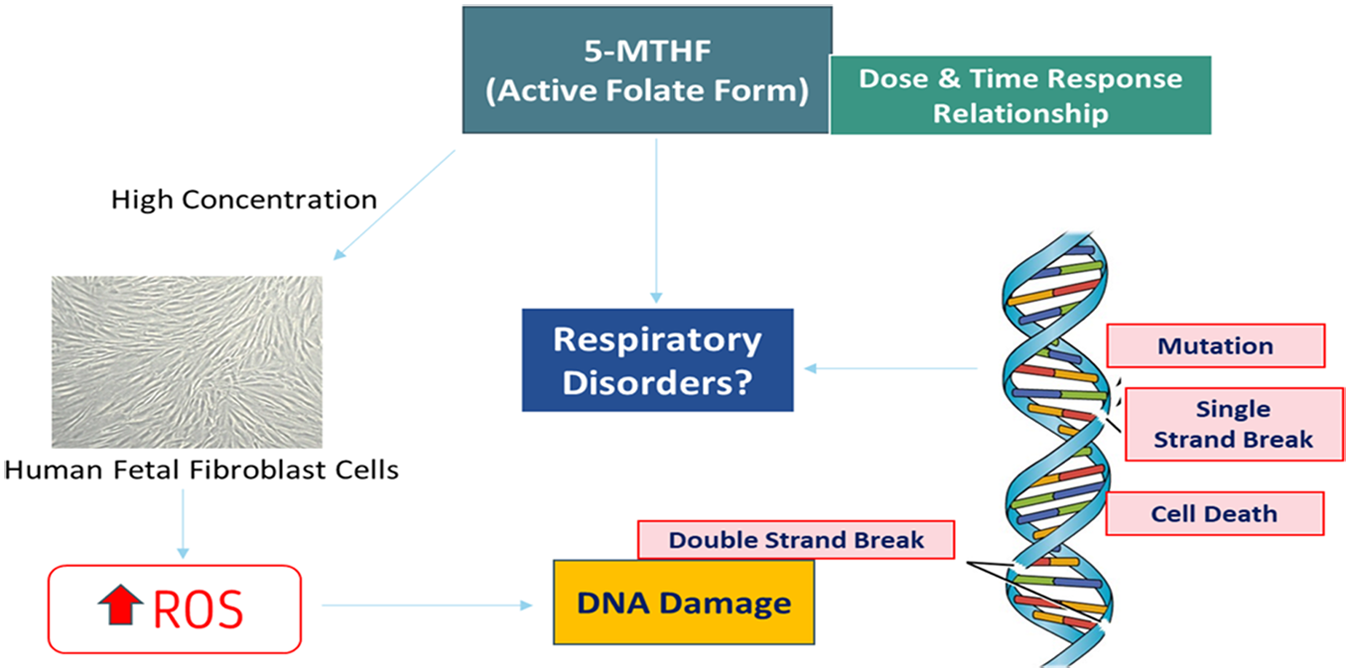
Background: Folic acid (FA) supplementation is widely regarded as a key nutritional intervention during pregnancy due to its protective effect against neural tube defects. Recent research has reported FA supplementation outcomes on offspring's health, with increased incidences of allergy/respiratory problems. Aim: This study evaluates if increased levels of 5-methyltetrahydrofolate (5-MTHF) are associated with DNA modification, leading to disruption of cell proliferation in fetal lung cells and increasing susceptibility to asthma. Methods: Two fetal lung cells, MRC5 and IMR90, were treated with nine concentrations of 5-MTHF for six time points. Cell viability was evaluated using Trypan Blue staining. Flow cytometry analysis to quantify DNA content in cells was done with a propidium iodide stain. Followed by 1.6 mM glutathione treatment to alleviate the oxidative stress caused by 5-MTHF. A quantitative test for DNA damage was executed using neutral and alkaline comet assay. Gene expression study for five genes namely MTR, MTHFD1, XRCC1, Pol β, and epidermal growth factor receptor (EGFR) was evaluated using a 2-step quantitative reverse transcription polymerase chain reaction. Results: Fetal lung cell survival rate remained unaffected with 5-MTHF concentration below 1.25 µM. Beyond this concentration, cell viability is reduced with an increase in concentration. Cell cycle analysis revealed cell arrest in the G1 phase. The antioxidant activity of glutathione led the cells to bypass this arrest. Precisely, 10 and 50 µM 5-MTHF concentrations led to double-strand DNA breaks and single-strand DNA breaks. Gene expression study revealed lower expression of the MTR gene and higher expression of MTHFD1, EGFR, XRCC1, and DNA Pol β gene with an increase in 5-MTHF concentration. Conclusion: 5-MTHF concentration higher than 1.25 µM led to DNA damage in MRC5 and IMR90 human fetal lung cells.
AkogluBMilovicVCasparyWF, et al. (2004) Hyperproliferation of homocysteine-treated colon cancer cells is reversed by folate and 5-methyltetrahydrofolate. European Journal of Nutrition43(2): 93–99.
2.
BaierleMGoethelGNascimentoSN, et al. (2017) DNA Damage in the elderly is associated with 5-MTHF levels: A pro-oxidant activity. Toxicology Research (Cambridge)6(3): 333–341.
3.
BethuneGBethuneDRidgwayN, et al. (2010) Epidermal growth factor receptor (EGFR) in lung cancer: An overview and update. Journal of Thoracic Disease2(1): 48–51.
4.
BohnTTurckDCastenmillerJ, et al. (2023) Scientific opinion on the tolerable upper intake level for folate. EFSA Journal21(11): e08353.
5.
CarboniL (2022) Active folate versus folic acid: The role of 5-MTHF (methylfolate) in human health. Integrative Medicine (Encinitas, Calif.)21(3): 36–41.
6.
CeahlăuMSelevestruR, et al. (2023) Harmfulness of prooxidants in bronchopulmonary dysplasia in preterm children. Moldovan Journal of Health Sciences10(3): 3–10.
DasSRaundhalMChenJ, et al. (2017) Respiratory syncytial virus infection of newborn CX3CR1-deficient mice induces a pathogenic pulmonary innate immune response. JCI Insight2(17): e94605.
9.
Harlan De CrescenzoAPanoutsopoulosATatL, et al. (2021) Deficient or excess folic acid supply during pregnancy alter cortical neurodevelopment in mouse offspring. Cerebral Cortex31(1): 635–649.
10.
HeQLiJ (2023) The evolution of folate supplementation – from one size for all to personalized, precision, poly-paths. Journal of Translational Internal Medicine11(2): 128–137.
11.
IscanBTuzunFEroglu FilibeliB, et al. (2019) Effects of maternal folic acid supplementation on airway remodeling and allergic airway disease development. Journal of Maternal-Fetal & Neonatal Medicine32(18): 2970–2978.
12.
KancherlaV (2018) Countries with an immediate potential for primary prevention of spina bifida and anencephaly: Mandatory fortification of wheat flour with folic acid. Birth Defects Research110(11): 956–965.
13.
KosekiKMaekawaYBitoT, et al. (2020) High-dose folic acid supplementation results in significant accumulation of unmetabolized homocysteine, leading to severe oxidative stress in Caenorhabditis elegans. Redox Biology37: 101724.
14.
KwonDChaHLeeH, et al. (2019) Protective effect of glutathione against oxidative stress-induced cytotoxicity in RAW 264.7 macrophages through activating the nuclear factor erythroid 2-related factor-2/heme oxygenase-1 pathway. Antioxidants (Basel)8(4): 82.
15.
LaubeMDornisDWenzelF, et al. (2021) Epidermal growth factor strongly affects epithelial Na(+) transport and barrier function in fetal alveolar cells, with minor sex-specific effects. Scientific Reports11(1): 15951.
16.
LedowskyCSchlossJSteelA (2023) Variations in folate prescriptions for patients with the MTHFR genetic polymorphisms: A case series study. Exploratory Research in Clinical and Social Pharmacy10: 100277.
17.
LiuHZhangBSunZ (2020) Spectrum of EGFR aberrations and potential clinical implications: Insights from integrative pan-cancer analysis. Cancer Communications40(1): 43–59.
18.
RybarovaSMuriJHodorovaI, et al. (2012) Importance of expression of DNA repair proteins in non-small-cell lung cancer. Klinicka Onkologie Journal25(5): 370–374.
19.
SilvaCKeatingEPintoE (2017) The impact of folic acid supplementation on gestational and long term health: Critical temporal windows, benefits and risks. Porto Biomedical Journal2(6): 315–332.
20.
UribeMMarroccoIYardenY (2021) EGFR in cancer: Signaling mechanisms, drugs, and acquired resistance. Cancers (Basel)13(11): 2748. doi:https://doi.org/10.3390/cancers13112748
21.
YuTXuePCuiS, et al. (2018) Rs3212986 polymorphism, a possible biomarker to predict smoking-related lung cancer, alters DNA repair capacity via regulating ERCC1 expression. Cancer Medicine7(12): 6317–6330.
Supplementary Material
Please find the following supplemental material available below.
For Open Access articles published under a Creative Commons License, all supplemental material carries the same license as the article it is associated with.
For non-Open Access articles published, all supplemental material carries a non-exclusive license, and permission requests for re-use of supplemental material or any part of supplemental material shall be sent directly to the copyright owner as specified in the copyright notice associated with the article.