




Abstract
The study focuses on the empowerment of the digital platform users in India under the influence of the Digital India initiative. The study measures the perceived competence of the population from rural and urban areas of Gujarat. About 400 respondents were surveyed using a stratified sampling technique. The study finds that the perceived competence of the users is increased by the antecedents namely self-determination, perceived control, goal internalization and meaning, whereas impact showed a negative relationship with the perceived competence. The study provides theoretical and policy implications for academic researchers and policymakers.
Executive Summary
Developing economies across the globe are aspiring to become digital economies by increasing digital literacy among their population. In India, one of the key initiatives boosting literacy is the Digital India initiative. This initiative focuses on the dissemination of tools and information that increase digital literacy across the population and aspires to deliver last-mile connectivity. However, in India, digital literacy is unevenly distributed between rural and urban populations, making it difficult to measure the effectiveness of such initiatives across the country. This study measures the initiative’s effectiveness using theories of psychological empowerment (Menon, 2001; Spreitzer, 1995), which conceptualize it as a reflective construct. The study analyses the effect of five antecedents, namely goal internalization, self-determination, perceived control, impact and meaning on the perceived competence of individuals from rural and urban areas. The study used a structured questionnaire and stratified sampling technique to collect data from 400 respondents who use/have used various government schemes (e.g., Aadhar, Ayushman Bharat, UPI, MyGov and other digital portals) from rural and urban areas of Gujarat, India. Furthermore, the data analysis was done in a two-step process. First, an exploratory factor analysis was conducted to extract factors using principal component analysis. The Kaiser–Meyer–Olkin measure was 0.850, and Bartlett’s test of sphericity was found significant. Second, the main hypotheses were tested using linear regression analysis. The model collectively explained 42.4% of the variance in the dependent variable, with an adjusted R2 value of 0.416. The results showed that, except for impact (which had a negative effect), all the other antecedents significantly increased the perceived competence of the sample population. The findings of the study contribute significantly to the literature and have theoretical and policy implications for academics, practitioners and policymakers.
In the 21st century, a majority of economies have been undergoing digital transformation. In India, the Digital India initiative aims to expand digital infrastructure, improve internet access and enhance digital literacy across the country (Khokhar, 2016; Perannagari & Gupta, 2022). This initiative was launched by the Central Government of India under the vision of Prime Minister Narendra Modi in 2015 as a transformative campaign aimed at making the country a digitally empowered society and knowledge-based economy. Digital India initiative’s foundation is built on three key areas: providing accessible digital infrastructure to all citizens, offering governance and services on demand, and empowering citizens with digital literacy. These pillars create a robust framework intended to improve access to information, enhance economic opportunities, and facilitate a transparent and efficient governance system across the country (Rathore & Panwar, 2020). However, data have shown that internet penetration increased by 55% in 2025 from 14% in 2014; yet, it is low, as only half of the population of 1.4 billion can access the internet today. Moreover, this increase is skewed towards the urban areas compared to rural areas (Statista, 2025). This trend results in challenging realities like increasing the extensive digital literacy in rural areas (Sood & Saxena, 2017), addressing infrastructure limitations (Nurullah, 2009) and ensuring secure digitalization to counter cybercrimes (Sharma & Sharma, 2019). Thus, the Digital India initiative also becomes a tool to bridge the digital divide that exists in the form of urban–rural divide, healthcare infrastructure efficiencies, gender disparity and other important issues in the country that are a result of our socio-economic disparities (Patankar et al., 2017; Shah, 2017).
Therefore, the Digital India initiative fosters a digital environment that supports innovation, entrepreneurship and empowerment, though its success depends on both technological and social factors such as literacy, affordability, competence and sustainable innovation driving for socio-economic progress, bridging resource disparities and enhancing quality of life (Bera, 2019; Choudhuri et al., 2021). For example, such initiatives also have pervasive effects such as supporting e-commerce and empowering women entrepreneurs (Shah, 2017). Additionally, from the youth’s perspective in the country, Digital India has also been a key initiative that can empower the rural youth, especially boosting their digital access (Shah, 2017). However, unnavigated digital media use among youth has also heightened the concerns about media literacy and critical thinking ability, like easy communication comes with the burden of information overload (Holkar, 2022; Saxena & Srivastava, 2023). Hence, the Digital India initiative has the potential to digitally empower the population. This study explores the antecedents that affect the empowerment in the context of the Digital India initiative.
In the literature, empowering aspects of such initiatives are scarce, also the factors that play a role in measuring the effectiveness of these kinds of initiatives present a challenge to academics and practitioners. Some studies have tried to study the technical aspects that affect the efficiencies of such initiatives, such as power outages and inconsistent internet speeds, economic factors like the high costs of digital equipment or social factors related to the empowerment of citizens (Sindakis & Showkat, 2024). However, there is a gap in studying the crucial role such initiatives play in empowering the population, bridging the rural and urban divide by fostering literacy, facilitating information exchange and creating sustainable agriculture practices (Nahum-Shani et al., 2022). For example, social media empowers rural communities by enabling participation in public life and advocacy (Czyzewski, 2024), thus making empowerment an important factor to measure the effectiveness of such initiatives and its impact on an individual, making it critical to study such a phenomenon (Narayan, 2005). Furthermore, Malhotra and Schuler (2005) argue that many empowerment studies rely on a narrow range of indicators and analyses that lack a clear operational framework due to consensus-based approaches, which often fail to define empowerment comprehensively. Empowerment is considered as a transformative process, enabling individuals to gain autonomy and influence. Moreover, most studies develop indicators primarily for cross-community comparisons, which may not fully capture empowerment’s contextual nuances. For example, Rashid and Elder (2009) emphasized the need to understand the environments, skill and applications necessary for mobile-based information services to effectively contribute to empowerment. However, these indicators may differ across societies and evolve, requiring flexibility in both fostering and assessing empowerment (Schuler et al., 2010). Thus, the current study deems empowerment an important facet for measuring the impact of initiatives like Digital India.
The remainder of the article is structured as follows. The following section presents literature review and hypotheses formulation, followed by methodology, data analysis, results, discussion and implications. Conclusion and limitations conclude the article.
LITERATURE REVIEW AND HYPOTHESIS FORMULATION
Conger and Kanungo (1988) conceptualized a motivational approach for psychological enabling, defined as ‘a process of developing feelings of self-efficacy among organisational members through the identification of conditions that foster powerlessness and through their removal by both formal organisational practices and informal techniques of providing efficacy information’. For example, in an organizational setting, Thomas and Velthouse (1990) extended this approach by viewing power as energy, that is, to empower is to energize. For them, empowerment is associated with ‘changes in cognitive variables (called task assessments), which determine motivation’ (p. 667). Thus, on the basis of this, Spreitzer (1995) conceptualized a model, defining empowerment as increased intrinsic motivation manifested in four cognitions: meaning (i.e., purpose), competence (i.e., self-efficacy), self-determination (i.e., autonomy in initiation and continuation of work behaviour) and impact (i.e., influence on work outcomes). For the context of the study, perceived competence is measured among respondents and is defined as ‘the capacity of individuals, groups or society using the capacity individuals has for psychological freedom to plan and access better education, skills and information, in order to improve their life-opportunities’ (Ahad et al., 2021). Following the empowerment theories, perceived competence can also be defined as an outcome of a process through which the individuals gain mastery and control over their living and gain a critical understanding of their empowerment (Lin et al., 2017; Miguel et al., 2015; Riddle et al., 2019; Rodrigues et al., 2018; Siegall & Gardner, 2000; Zimmerman, 1990).
Studies in past that have focused on e-government research have found three key trends: the development of e-democracy, accountability and participation (Abu-Shanab & Harb, 2019; Lindgren et al., 2019). This study focuses on the third aspect of these facets, that is, participation, and how it affects the competence of the citizens and enhances their capabilities because of initiatives. For example, an empowered citizen can enhance the grounds of information-rich society and enable government institutions and policymakers to be accountable and responsive to citizen’s e-participation (Pirannejad & Janssen, 2017). Additionally, governments have adopted various strategies as there is no one-size-fits-all solution; contextual factors play an important role in encouraging citizens to engage and deliberate strategies, requiring cooperation between local authorities and citizens. This cooperation needs to leverage information and communication technologies that facilitate deliberations among service providers, policymakers and citizens (Henman et al., 2021; Hujran et al., 2020). Still, these transformational changes face low adoption rates for these government initiatives in the case of developing and developed countries (Li & Shang, 2020). Sometimes these challenges are addressed by creating a platform for the state–citizen interaction (Wetterberg et al., 2016).
This study primarily focuses on the empowerment of citizens due to such initiatives. Empowerment in literature has been extensively studied in various contexts of social and sociopolitical research, but a definitive definition could be empowerment as an active psychological process involving human activity and circumstances of existence, showcasing that the environment we live in and factors and norms govern our reality, and the behaviours and activities individuals can engage with (Zimmerman & Rappaport, 1988). Some of the outcomes of this process achieve self-acceptance, confidence, sociopolitical understanding, and enhance their decision-making and control resources in their lives. Zimmerman (1995, 2000) defined empowerment as a second-order construct with three first-level factors: first intrapersonal/emotional empowerment, including feelings of competence, meaning, impact and autonomy/self-determination; second interactional/cognitive empowerment pertaining to understanding the sociopolitical context and power relations; and finally, behavioural empowerment involving actions taken to directly influence one’s life (Hur, 2006; Speer & Peterson, 2000).
Empowerment was initially considered a reflective construct and has been empirically validated that it may be measured as a formative construct (Rodrigues et al., 2018). It needs to be understood that the nature and definition of empowerment are diverse and that it is impossible to have a single measure applicable to all scenarios due to its dynamic nature (Sharma et al., 2024). The frameworks of Zimmerman (2000), Spreitzer (1995) and Menon (2001) have studied empowerment majorly in the workplace context (Almahamid, 2019; Llorente-Alonso et al., 2024; Riquelme et al., 2010). Apart from this, empowerment has been examined to improve healthcare goals, address sociopolitical issues and understand youth participation through digital means (Mendelson et al., 2010). The current study explores to measure perceived competence as a measure of empowerment for capabilities and control (Mustafa et al., 2023) of the citizens of India. Wood and Bandura (1989) refer to perceived competence as ‘beliefs in one’s capabilities to mobilize the motivation, cognitive resources, and courses of action needed to meet given situational demands’ (p. 408), which may have resulted due to the Digital India initiative, and the constructs used in the study are from the Spreitzer (1995) and Menon (2001) work to determine the empowerment provided by such government initiatives. Furthermore, we discuss the variables and frame the hypotheses for the study. The conceptual model for the study is shown in Figure 1.
Conceptual Model for the Study.

Meaning
Meaning is defined as the value provided by a work goal or purpose, judged in relation to an individual’s own ideals or standards (Thomas & Velthouse, 1990). Furthermore, it also involves a fit between the requirements of a work role and an individual’s beliefs, values and behaviours (Brief & Nord, 1990; Hackman & Oldham, 1980). For example, in an organizational setting, when workers perceive consistency between the organization’s objectives and their own values, they perceive significance (meaning) in their tasks (Brief & Nord, 1990). Thus, it can also be defined as the perceived internal/external value of a task by a person being empowered. Now, this value can emerge from the purpose of the task itself, from the people involved or even from the type of work that is required to complete the task. Meaning can also be highlighted as the means of giving attention to the value of work or missions as judged through the standards and ideas of an individual. For instance, giving meaning to work involves comparing the requirement role of work and beliefs like an individual believes that the tasks one performs have value. This value is translated into the person’s feeling that they have contributed to a noble cause. Therefore, in literature, meaning refers to the worth an individual attributes to their task at hand on the basis of their own beliefs. In conclusion, it can be said that it is the match between their requirements and personal values (Spreitzer, 1995, 2008). Thus, we propose that:
H1: Meaning positively affects perceived competence of the users.
Self-determination
Similar to competence referred to as mastery of behaviour, self-determination is an individual’s sense of having choice in initiating and regulating actions (Deci & Ryan, 2013). It reflects the autonomy in initiation and continuation of work behaviours and processes, that is, making decisions about work methods, pace and effort (Bell, 1989; Spector, 1986). In an organizational context, self-determination assumes intelligence, where intelligence concerns the collective environmental responsiveness of a workforce regarding its ability to read and interpret external change, and to act swiftly in line with the resulting strategic direction. For example, an individual’s perception of self-determination is their connection with intrinsic motivation. For example, Gwinner et al. (2005) found that frontline service personnel must have an inherent motivation to provide adaptive services. Thus, we propose that:
H2: Self-determination positively affects perceived competence of the users.
Goal Internalization
Goal internalization is defined as the dimension of ‘meaning’ in the Spreitzer (1995) model of psychological empowerment related more to the significance of immediate task, whereas in the works of Menon (2001), goal internalization highlights the energizing effect of organizational levels, goals and aspirations. For example, goal internalization has been studied in the context of psychological empowerment. Also, in goal-setting literature, it is established that acceptance at the level of the task has positive motivational effects on their performing task (Locke & Latham, 1990). In an organizational setting, goal internalization of an employee makes them beyond employee-level task goals to the broad organizational objective. Goals that reflect a higher purpose or worthy cause are principally empowering (Burke, 1986). Under the psychological lens, a goal is an energizing element, particularly a valued cause or meaningful project. In similar ways, feeling of significance, community and enjoyment reflect the appeal of ideas and goal internalization (Bennis & Nanus, 1985). Thus, we propose that:
H3: Goal internalization positively affects the perceived competence of the users.
Perceived Control
Perceived control is defined as the perception of control or the lack of it; it has received attention of psychologists in research like locus of control (Rotter, 1966), powerlessness (Seeman, 1959), learned helplessness (Abrahamson et al., 1980), and primary and secondary control (Rothbaum et al., 1982), suggesting sense of perceived control is critical for feelings of power. Thus, making perceived control one of the basic psychological states constituting the experience of empowerment has been emphasized in the empowerment literature (Menon, 2001). Additionally, this sense of feeling powered can be empowerment if it treats an internal urge or drive to influence and/or control others (Ansbacher & Ansbacher, 1956; White, 1959), intrinsic motivation to feel competent and self-determining (Deci, 1975). Therefore, for example, some empowering strategies consist of delegations, increasing participation and providing information and resources (Kanter, 1983), leading to a sense of perceived control. Empowered people feel confident in their environment (House, 1988). Furthermore, two elements of formulation impact (i.e., the degree to which the individual’s behaviour makes a difference) and choice (i.e., the extent of personal causation for the behaviour) reflect the importance of perceived control for psychological empowerment (Thomas & Velthouse, 1990). Thus, we propose that:
H4: Perceived control positively affects perceived competence of the users.
Impact
Impact is defined as the degree to which an individual can influence administrative, strategic or operating outcomes at work (Ashforth, 1989). Impact is the contrary of learned helplessness (Martinko & Gadner, 1982), and it is distinct from locus of control. Whereas impact is influenced by the work context, internal locus of control is a global personality characteristic that endures across situations (Wolfe & Robertshaw, 1982). Impact has been examined in research on learned helplessness (Abramson et al., 1978) and also defined as an individual’s psychological belief that one individual has little control over outcomes (Seligman, 1975). For example, it is the conviction of individual’s conviction to influence organization outcomes (Ashforth, 1989). Hence, it is particularly identified ‘control over the entire work and its outcome’ (Sagie & Koslowsky, 2000) and ‘influential initiatives’—those that involve significant change and real innovation (Spreitzer & Quinn, 2001). This can be interpreted as empowered individuals have a higher level of sense of impact because they do not feel a sense of helplessness in the workplace (Martinko & Gardner, 1982).
H5: Impact positively affects perceived competence of the users.
METHODOLOGY
The research design for the study was a quantitative cross-sectional design; the data were collected using a structured questionnaire (Malhotra, 2020). In the study, exploratory factor analysis (EFA) was used for data analysis and linear regression was used for hypotheses testing. Software used for data analysis was Statistical Package for the Social Science (SPSS), version 25.
Sampling
The data were collected using stratified sampling from the two districts of the Indian state of Gujarat. Gujarat was chosen as it is one of the top-performing states in the country with a healthy balance of rural and urban population (Deepak et al., 2024). The survey involved 400 participants from rural and urban settings of Gujarat (details of the respondents are provided in Table 1). The sample population consisted of people from these areas, who are using/have used the various government schemes (e.g., Aadhar, Ayushman Bharat, UPI, MyGov and other digital portals). The survey instrument used a Likert scale ranging from 1 for strongly agree to 5 strongly disagree. The items for all the variables (i.e., perceived competence, meaning, self-determination, perceived control and impact) were adopted from Spreitzer (1995) and Menon (2001) to fit the context. The scales for each of the constructs consisted of three items each.
Sample Demographic Analysis.

Data Analysis
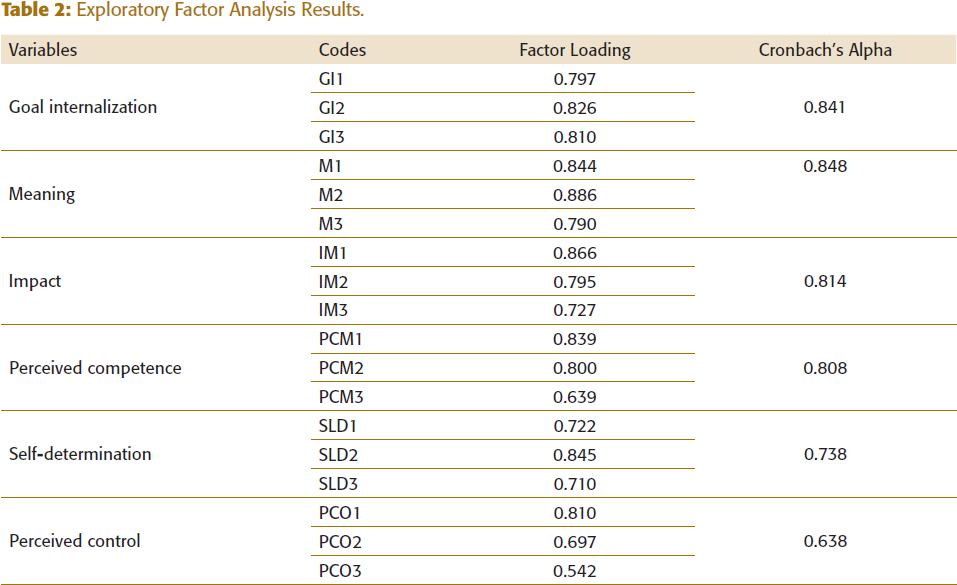
The data analysis was done in two steps. In the first step, EFA was done to assess the construct validity. Prior to commencing EFA, the scales’ reliability and sampling adequacy were evaluated. Reliability was measured using Cronbach’s alpha, a widely accepted metric for internal consistency, where values above 0.60 indicate satisfactory reliability, implying that items are correlated and measure a cohesive construct (Hair et al., 2014; Sekaran, 2003). Next, EFA was conducted using principal component analysis to extract factors; all the items displayed factor loadings above 0.50, signifying strong relationships with their respective factors (Hair et al., 2014). Furthermore, sampling adequacy and correlation were also measured using the Kaiser–Meyer–Olkin (KMO) test, and Bartlett’s test of sphericity found to be 0.850, which was significant (refer to Table 2).
Exploratory Factor Analysis Results.
Hypotheses Testing
In the second step, linear regression analysis was used to test the study’s hypotheses by examining the relationship between the predictor and dependent variables. The model fit for the regression model was assessed through R2 and adjusted R2 values, reflecting the proportion of variance explained by the predictors; higher values indicate greater explanatory power (Cohen, 2003). Additionally, the overall significance of the model was tested using F-statistic and its p value, verifying the model’s ability to predict the outcome. For each predictor, beta coefficients, standard errors, t values and p values were reported to determine the strength, direction and significance of relationships with the dependent variable. The key assumptions of linear regression, including homoscedasticity, normality of residuals and multicollinearity, were also checked to ensure result reliability (Tabachnick & Fidell, 2007).
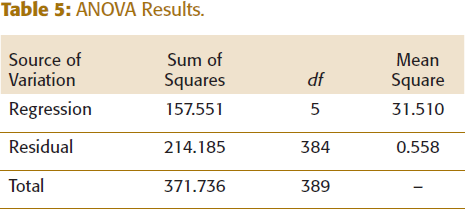
In the current study, regression analysis revealed that the independent variables—perceived control (MPCO), meaning (MM), self-determination (MSLD), goal internalization (MGI) and impact (MIM)—collectively explained 42.4% of the variance in the dependent variable, perceived competence (R2 = 0.424). After adjusting the number of predictors, the adjusted R2 value was 0.416, indicating that the model retains a moderate level of explanatory power even when accounting for potential overfitting. The standard error of the estimate was 0.746, suggesting that the observed values deviated moderately from the predicted values along the regression line. The overall statistical significance of the model was confirmed through analysis of variance results, which showed an F-statistic of 56.49 (p < .001). This indicates that the predictors collectively explain a significant portion of the variance in the dependent variable. The regression sum of squares was 157.551, while the residual sum of squares was 214.185, further demonstrating that the model accounts for a substantial share of the total variance. Degrees of freedom for the regression were 5, with 384 degrees of freedom for the residuals. The hypothesis testing revealed that four independent variables positively influence perceived competence. Goal internalization (B = 0.447, p < .001) emerged as the strongest predictor, with a standardized beta coefficient of 0.444 indicating a robust positive relationship. Perceived control (B = 0.253, p < .001), self-determination (B = 0.155, p = .002) and meaning (B = 0.118, p = .008) also showed significant positive effects on perceived competence. Conversely, the variable impact (B = −0.120, p = .007) negatively influenced perceived competence, suggesting an inverse relationship. The model’s constant was 0.334 (p = .051), representing the baseline level of the dependent variable when all predictors are zero. These findings underscore the importance of goal internalization as the most influential factor, followed by perceived control, self-determination and meaning, in shaping perceived competence. Additionally, the negative effect of impact suggests a need for further exploration into how this variable interacts with other predictors in the model. Overall, the regression model offers valuable insights into the factors affecting perceived competence, with practical implications for theory and application (refer to Tables 3–5).
Linear Regression Analysis Results.

Linear Regression Model Summary.

ANOVA Results.
RESULTS
The findings reveal significant insights into the psychological factors influencing perceived competence among users. The internalization of the goal emerged as the strongest positive predictor of perceived competence (B = 0.447, β = 0.444, p < .001), emphasizing the critical role of aligning personal values with task goals in enhancing competence. Perceived control also had a substantial positive effect (B = 0.253, β = 0.261, p < .001), indicating that autonomy and control over actions significantly boost confidence. Additionally, self-determination (B = 0.155, β = 0.162, p = .002) and meaning (B = 0.118, β = 0.125, p = .008) positively influenced competence, albeit to a lesser extent, highlighting the importance of intrinsic motivation and purpose. Interestingly, impact exhibited a negative relationship with perceived competence (B = −0.120, β = −0.145, p = .007), suggesting that the perceived lack of meaningful contributions can diminish confidence. Overall, these results underscore the multifaceted nature of psychological empowerment and its influence on users’ perceived competence (refer to Table 6).
Results of Primary Hypotheses.

DISCUSSION AND IMPLICATIONS
The current study explored the effectiveness of the Digital India initiative in accordance with the increasing perceived competence, thus making the citizens feel empowered. The study explored the antecedents proposed by Spreitzer (1995) and Menon (2001) for psychological empowerment in an organizational setting to measure the effectiveness of a government policy. Thus, the study provides a few insights into the form of theoretical and policy implications as follows.
Theoretical Implications
The study took a different approach to measure the effectiveness of a government policy and how it has increased perceived competence among the population. First, the results of the study reaffirmed the models of empowerment proposed by Spreitzer (1995) and Menon (2001) suggesting that they were effective in measuring the perceived competence of the users in terms of making them feel empowered. However, the study investigates the psychological aspect rather than the technological adoption of the population, and it extended a theory of empowerment that has been frequently used in organizational settings. These findings have justified that the decoupling of factors affecting empowerment can be utilized based on the types of interventions. Hence, findings have shown different results from Spreitzer (1995) and Menon (2001), who considered different factors affecting empowerment in individuals. Our study provided insights into those effects that vary to certain degrees, where some factors can be instrumental in certain contexts. Thus, empowerment in the current study measured behavioural empowerment, that is, that individuals influence their lives due to Digital India initiatives, showed by reiterating empowerment’s dynamic nature and its complexity to measure all its aspects simultaneously (Sharma et al., 2024).
Empowerment is a psychological state of mind (Zimmerman, 1995) reflected by perceived competence, meaning, goal internalization, self-determination, impact and perceived control. The study concurs that people have learned and utilized skills, and their perceived competence has enhanced (Pal et al., 2021). Meaning and self-determination positively affected the perceived competence of the users in line with the results of Turnipseed and VandeWaa (2020) and Ma et al. (2021) increasing their trust and organizational citizenship behaviour in the context of Digital India initiative, where they feel more engaged in participation and can effectively motivate their peers and social group to do the same and find meaning in using the digital means.
Furthermore, perceived control also affects perceived competence, which indicates that there is an internal drive for the users to adopt the technology for personal causation and that the users who feel empowered to manage their digital interactions perceive themselves as more competent (De Charms, 1968; McClelland, 1961; Winter, 1973). Goal internalization was found to be the strongest predictor affecting perceived competence in line with Yukl (1989), which can be interpreted as indicating that the Digital India initiative has provided a higher purpose or worthy cause that has increased their perceived competence, reflecting the critical importance of aligning user goals with the capabilities of digital platforms.
Finally, impact exhibited a negative relationship in contrast to other studies (Spreitzer, 2007), but it can be noted that impact is defined as the contribution made by an individual in strategizing, administering or operating outcomes (Spreitzer, 2007). This clearly indicates that when users feel that their contributions or actions on digital platforms are ineffective or lack visible outcomes, their sense of competence diminishes (Ro & Chen, 2011). This finding resonates with the notion that people disengage when their efforts appear insignificant or unrewarded (Menon, 2001). Thus, the current study found results that have extended the models proposed by Spreitzer (1995) and Menon (2001) for psychological empowerment to the realm of finding the effectiveness of government initiatives. It also found a set of antecedents that affected the perceived competence of the respondents, with goal internalization being the strongest predictor, followed by self-determination, meaning and perceived control in line with previous studies of empowerment and found that impact affected negatively in the case of the Indian population.
Policy Implications
The study results provide policy implications for stakeholders such as governments and policymakers. The findings suggest that governments at the central and state levels can enhance the perceived competence and empowerment among populations that use digital platforms. Specifically, in the context of the Digital India initiative. Policymakers need to integrate more psychological constructs, such as perceived competence, meaning, self-determination, goal internalization and perceived control, into the design of existing programmes.
For example, while expanding initiatives such as Pradhan Mantri Digital Saksharta Abhiyan (PMGDISHA) and Skill India, modules on various topics, namely financial literacy, cybersecurity and digital self-management can be included to enhance users’ confidence and perceived control. For the rural population, this can further be enhanced using schemes such as PM-Kisan and e-National Agriculture Market (eNAM), providing them with real-time information tailored to their localized needs, fostering goal alignment and self-determination.
Here, autonomy in digital interactions such as the ability to choose from multiple services, manage data securely and customize experiences empowers users to navigate platforms with confidence. The disengagement can be overcome using platforms such as MyGov and UMANG, which give them real-time feedback systems to showcase individual and community contributions, inspiring population to sustain their engagement.
At the state level, policymakers can adapt and localize central schemes to address specific challenges and opportunities. For instance, state governments can integrate their local programmes to complement the digital initiatives, providing grassroots training and services in the regional languages for vulnerable communities. The governments can further integrate digital literacy workshops to teach users how to independently leverage these services. In particular, expanding user education in rural areas and semi-urban areas can help bridge the autonomy gap across demographic groups.
This can further be enhanced by training the Customer Service Centres owners, and users in general can be trained emphasizing the customization, and management services can further strengthen this sense of control, particularly among elderly, and management of services can further strengthen this sense of control, particularly among the elderly and less tech-savvy populations. When users understand that digital tools can directly contribute to their personal or professional objectives—such as learning a skill, accessing government schemes, or connecting with markets—their confidence and sustained engagement increase. To address this, the government should consider amplifying the visibility of user contributions.
CONCLUSION AND LIMITATIONS
In conclusion, the current study is one of the first in the empowerment literature to explore the antecedents that measure the effectiveness of a government initiative from a psychological empowerment perspective, rather than a technology-adoption perspective. The study validated a model that can be further utilized for similar interventions by policymakers. However, the study has certain limitations. First, the study’s design was cross-sectional, meaning that the responses were collected at a single point in time and are susceptible to changes over time. Future research can address this limitation by adopting a longitudinal design. Second, the current study employed a quantitative approach, focusing on a specific set of antecedents. There may be additional variables that have yet to be identified. Hence, future research can consider a mixed-methods approach to identify and validate variables using both quantitative and qualitative methodologies that may influence perceived competence or relate to psychological empowerment. Finally, while this study focused on exploring antecedents, future studies could investigate variables that play moderating or mediating roles in shaping perceived competence or the empowerment of the population.
Footnotes
DATA AVAILABILITY STATEMENT
Data will be made available on genuine request.
DECLARATION OF CONFLICTING INTEREST
The author(s) declared no potential conflicts of interest with respect to the research, authorship and/or publication of this article.
FUNDING STATEMENT
The authors would like to acknowledge the funding received from Indian Council of Social Science Research (ICSSR) for Minor Project 2023-24 on Investigating Impact of Digital India Initiative on Urban and Rural Youth in Gujarat (File No.: ICSSR/RPD/MN/2023- 24/G/27).

e-mail:
e-mail:
e-mail: