




Abstract
Decades of studies on the work-family interface and the preponderance of literature make it rather ambiguous to find a future direction for research. While only in the past decade technology and generational cohorts have been studied concerning the work-family interface. Millennials, the youngest generational cohort in the workforce with the maximum potential for technology use, have seldom been analysed. This article attempted to draw propositions from existing literature and arguments, considering work-family conflict and negative outcomes concerning technology use and generational cohorts.
Executive Summary
Technology usage and its derogatory impact on employees give the impression of a new pandemic globally. In addition, having employees from multiple generations in the same workforce has turned the situation even more complex. The available literature on generational cohorts has predominantly looked at the lives in the Western world. However, Dr Twenge highlighted that the generational psyche has been influenced by the concurrent social–economic and cultural changes that took place during the childhood of that generation. Undoubtedly, India as a society has gone through a significant shift in this context since the 1980s, different from the changes happening in the Western world at the same time. In this article, I have tried to highlight these changes and connect them with the work–family ideologies and technology usage of the current dominant generation, the ‘millennial’ in the workforce. Different genders might have developed differing work–family values even when belonging to the same generational cohort. This article gives a well-developed mediation and moderation model to understand how different generational cohorts would experience the work–family conflict mediated by perceived digital overuse (PDO), which is an outcome of technology usage mostly ‘smartphones and internet’. Gender has been highlighted as a crucial moderator in the model, like female employees might be more ready to take advantage of this phenomenon of technology usage than male employees. The efforts recovery theory (Meijman & Mulder, 1998) and the conservation of resources theory (Hobfoll, 1989) have contributed to this model formulation. This article will be very helpful in comprehending the work and non-work needs of different generational cohorts, mostly the dominant cohort ‘millennial’, along with a gender component in it, in deciding the work–family policy formulation.
Information technology, smart devices and communication apps have occupied a distinctive space in the work–family research and developed some core challenges for researchers in the 21st century (Kossek et al., 2021; Ninaus et al., 2021; Santos et al., 2023). During the COVID-19 pandemic, the work-from-home option has become a solution for continuing business without compromising the crucial need for social distancing (Shirmohammadi et al., 2022). Even after the pandemic, some organizations decided to continue similar work options as it helped reduce costs. Remote working, flexible working, and telecommuting have broken the boundaries between work and home to a great extent (Russo et al., 2018). Employees get calls even after working hours, encroaching on their space and time devoted to families, causing work–family conflict. In addition, technology overuse generates stress symptoms and has become a concern for researchers and policymakers because of some direct health impacts (Eurofound, 2021).
Generational cohorts are a popular notion in the case of work–family research along with technology usage. Millennials have used technology more than previous generations (Bauman & Shcherbina, 2018). This generation also displays family centrality, focusing more on having a work–family balance than the earlier generations (Joshi et al., 2010). Both demands are at odds with one another, which raises the possibility of higher work–family conflict. According to an article in Forbes (2022), millennials will be about 75% of the workforce by 2025, becoming the dominant chunk of the workforce. Hence, the technology used by millennials and work–family needs a closer look.
Researchers have discovered a lack of homogeneity in work and family values among millennials from different nations. The millennials from the United States, Sweden and New Zealand possess additional work and social values (Schewe et al., 2013). Hence, millennials grown in lower-middle income countries like India, with varying economic, political and cultural landscapes, might carry different values than those in lower-middle income countries because of their learning during their formative years (Scott, 2000). However, millennials in India were not solely featured in academic research (Gulyani & Bhatnagar, 2017).
Research on millennials found ambiguous findings on some of their work values. When popular literature highlights reducing work-centrality with successive generations (Joshi et al., 2010), one study on the US population found millennials have higher work-centrality than the previous generation (Bennett et al., 2017). It may or may not be the case in India because of traditional social norms. Here, we wish to draw attention to how the conventional high power distance culture—which values work above family life and the emerging non-traditional gender ideology may influence millennials’ understudied work–family conflicts. Maybe the more significant social expectations of men doing provider work and women doing household chores clash with this generation’s expectations and may be ringing a bell. Women are often considered at the receiving end of family and work conflict in India and are prioritized in human resource policies that have been implemented at the workplace. However, this case might change with changing family values. Depending on past findings, forecasting the future may not always be helpful; instead, a fresh look would be beneficial.
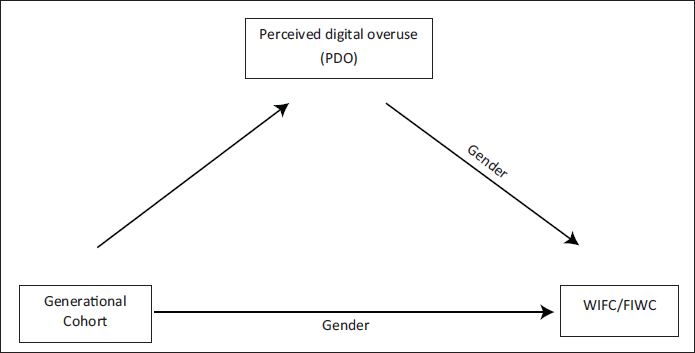
Hence, in the realm of the above situation of confusion among technology use, national culture, and millennial values, in this article, we tried to put together a conceptual model (Figure 1) that underlines the potential connections between millennials and work–family conflict. The efforts recovery theory (ECT) (Meijman & Mulder, 1998) and the conservation of resources theory (Hobfoll, 1989) contributed to the model formulation. Here, we are responding to the call from Ghosh (2016), who called for a new model to meet millennials’ needs. This article also responds to the call for more work on Indian millennials (Gulyani & Bhatnagar, 2017).
Proposed Conceptual Model.
CONCEPTUAL PROPOSITIONS: LITERATURE SNAPSHOT
Concepts used in the subsequent sections are perceived technology overuse, work–family conflict and gender. Perceived digital overuse (PDO) is defined as ‘the perception of a cognitive overload caused by the overwhelming amount of information and communication mediated and conveyed by digital media’ (Gui & Büchi, 2021, p. 7). Work interfering with family-type conflict is defined as the interruption of family demands caused by work demands, and family interfering with work-type conflict is the interruption of work demands caused by family demands (Greenhause & Beutell, 1985).
Millennials and Work–Family Conflict
Previous research has discovered that different generational cohorts mean people born in different periods carrying varying work values can have significant business challenges (Costanza et al., 2012) as they bring different organizational expectations within work–family policies (Beutell & Wittig-Berman, 2008). For instance, a specific organization’s workforce is disproportionately made up of one generation, such as the boomers (born between 1946 and 1964), Gen Xers (1965–1981), millennials (1982 and 1999) or the most recent generation, also known as Gen Z (born after 1990). In that case, this may result in a different work climate more inclined towards that dominant cohort.
Millennials are referred to as the Me Generation (Twenge, 2006) because they focus more on their happiness than their previous generation. Previous generations focused more on hard work, loyalty, dedication and long-term relationships. Because this generation has grown up in small nuclear families compared to their previous generations, they also had fewer siblings because of pressure for population control. They have been given freedom of choice for food and clothing style while growing up and have developed a sense of entitlement and a self-centred nature. Millennials are more likely to be cynical, have higher career orientations and carry an increased need for recognition (Costanza et al., 2012). Millennials have also been found to have higher social consciousness, belief in group activities and team spirit than individual gains (Twenge et al., 2008). Millennials are more likely to expect extrinsic rewards than previous generations (Twenge et al., 2010). As the studies were conducted on student samples, the findings could differ if performed on a group of employees.
Previous research has highlighted that the longer the time spent at any organization, the higher the organizational commitment, which generally is an advantage for the organization in terms of long-term employment. However, millennials are not interested in remaining in an organization for an extended period (Deloitte, 2016). Most importantly, this generation works to live rather than live to work. Like Gen Xers, millennials are also more inclined to family and prefer to work in those organizations and careers that can accommodate their family needs. Work identification might get hampered if it fails to fulfil their family life expectancy. The millennials are supposed to demand a more significant number of family-accommodative policies than others. Millennial men are more dedicated towards their families and caregiving responsibilities (Alwin & McCommon, 2007). Fathers are slowly getting involved in the parenting work in contrast to the dominant breadearner role, indicating higher family identification. According to a recent review article, work–family research is slowly moving towards intergenerational issues, and motherhood or fatherhood has become crucial (Molina, 2021).
According to Twenge et al. (2010), millennials are more likely to favour extrinsic incentives like money and leisure. It will be more challenging to keep them inspired to remain in the same company with the same level of reward (Pinzaru et al., 2017). Millennials have higher narcissism than the previous generation and would demand immediate recognition for their work (Twenge et al., 2008). Burgeoning work pressure in today’s competitive economic climate might call for higher work hours in the future. The concept of a ‘round the clock’ work culture might excite this generation. Still, millennials’ increasing acknowledgement of family needs may create more conflicting situations when they are in organizations traditionally designed for men and based on gender roles.
Indian Context and Work–Family Conflict
It may be difficult to convey an entire narrative by generalizing the work–family setting beyond India to various Asian contexts. According to World Population Review, India has already overtaken China with 141.7 crore people (Mukhopadhyay, 2023). Higher education has increased in the last few decades. Hence, competition for employment has reached its peak. One of the world’s earliest civilizations originated in India. Indian cultural dimensions and social structures are dominated mainly by Hindu philosophy, making it different from any other national context. The family as a unit has a special place in the Indian context. This nation still considers childless parents taboo (Matsuo, 2022). Marriage and family formation are considered spiritual needs in this dominant Hindu culture. Hence, the family is a crucial resource for Indians. As per COR by Hobfoll (1989), in any stressful situation, any individual will try to protect the ‘family’ resource in India. Any threat to family life would also cause tremendous stress.
Hinduism places the most significant value on karma [actions], not the outcome. Indian families are generally tightly tied with family relations where parents remain in the decisions-taking position, beginning from finding brides to other life decisions (Larson et al., 2001; Ramu, 1988). Hence, elders traditionally play a significant role in family decisions in India.
However, recent studies found children are slowly taking centre stage in the family, and parents are ready to do anything and everything to give their children a better future. As per a review article by Sooryamoorthy (2012) on the Indian family system:
Modern Indian families, by and large, have become child-centred and focused more on the life and development of their children, and the parents are prepared to work to any extent to achieve this aim. Any sacrifice on the part of the parents is possible for this. (p. 7)
An Indian study found that working women are likely to choose to have a single child (Pradhan & Sekher, 2014). With this single-child scenario, childbearing would become a lifetime experience, perhaps making this a crucial moment for both female and male counterparts.
The dominant cultural dimension of power distance in India is very traditional. The work–family relationship is significantly influenced by conventional gender-based ideology, which is strengthened by the presence of elderly parents. Family and society have not supported women’s career aspirations in India (Gani & Ara, 2010), and women employed in a joint family set-up make higher family–career trade-offs than nuclear families (Buddhapriya, 2009). Because of this dominant cultural index, women’s caregiving roles remained unchanged after they entered the workforce (Anand & Vohra, 2022; Buddhapriya, 2009). Caregiving does not mean only looking after children and spouses. Instead, it includes elder care. India is one of the few nations where caring for older adults remains with the family.
Other than this, Hofstede’s cultural dimension of indulgence is shallow in the case of India, and restraining is very high, which is rarely a case in any other nation around the world (Hofstede Insights, 2003). Indians will do everything that is expected from them by society. And personal needs are mostly sacrificed for family needs. Family unity and family norms are placed much above individual wishes, and the earning role of women has not been recognized as being above their caregiving role (Gani & Ara, 2010).
However, things are a little different for the millennials in India, as they have seen an era where women’s empowerment is reinforced by political and national ideologues (Kishor & Gupta, 2004). Furthermore, the state amended and implemented various rules and social marketing campaigns during 1980 and the following decade to encourage small families and manage the population boom (Mahadevan & Sumangala, 1992). People have opted for small families even when it was only a girl child. The importance of the girl child was highlighted. Opening the economy for private investments generated employment opportunities, and women entered the workforce on a large scale (Radhakrishnan, 2009). Hence, Indian millennials might have grown with little changing gender values towards women, as identified in a study conducted in Mumbai (Rajadhyaksha & Velgach, 2015).
This generation has witnessed the changing economic scenario of the nation. 1991 was the year of the opening of the Indian economy, and family life took a paradigm shift after that. Exorbitant expenses, higher education fees, healthcare and lifestyle had an excellent potential for making a hole in the pocket (Joshi & Gandotra, 2006) and a desperate need to earn more and more, making work an essential aspect of life. Work has become competitive and requires more employee dedication than ever. Maybe employers would take advantage of this need and make them work more and more by stretching work boundaries. The COR theory posits that an overworked employee would be anxious and unable to care for the family’s requirements (Hobfoll, 1989). As per Grandey and Cropanzano (1999), work–family conflict is a typical stress that causes resource loss. Even though Hobfoll (1989) made COR theory a psychological resource theory, in the later stage, physical and cognitive energies are crucial personal resources (Lee et al., 2020). Physical ability to do work, having time, recovery from work and sleep hygiene have been included in the physical resource base. A tired employee will lack these resources and will experience stress.
Regarding family, Indian millennials may try to follow the old norms set by the elders in the family or society and the new values they have learnt while getting a primary education because India is still a transitioning society. Generations before millennials were clear about their deliverables. A woman was the caregiver even though she had begun earning by working out. Man took the bread earner’s role but never expected to be part of the caregiving. Parents make vital family decisions (Larson et al., 2001; Ramu, 1988). However, this generation wants to have it all. Women want to work and earn but still cannot compromise on their spouses’ earnings. Expecting equal support at home but still confused with traditional gender ideology. Because women want to become ideal mothers (Chae, 2015), which means the best caregivers for their children, they want to display ideal worker norms in the workplace (Ridgeway et al., 2022), because they want to grow in their careers. India has dominant conventional gender roles like men earning bread and women giving care. Men prefer educated and working spouses because of increasing inflation and would lend a hand in parenting. This is perhaps because of the changing values and the desire to adhere to the ideal employees’ role because of the workplace stereotypes (Ridgeway et al., 2022), making this generation’s life more ambiguous and burdensome. There will be family demands and equal eagerness to cater to that among the millennials. Hence, millennials may try to compromise at the work front to cater to family needs.
Proposition 1: Indian millennials will face more work interfering with family conflict (WIFC) than their previous generations.
Millennials are those people who have families with children at home because the previous generation has grown-up kids, and the next generation has yet to start a family. Past research has seen children’s family size and age as crucial factors for more family demands. Men want to be integral to parenting, and women are already in the ideal motherhood trap (Chae, 2015). Childcare giving also carries an economic dimension. With inflation, school fees and extracurricular activities consume a significant part of the salary annually. Hence, parents may expect the best from their children in return. To increase the return, they would also invest time and care. Thus, millennial men and women are equally inclined towards their family and childcare, irrespective of gender. Organizations are not in the mood to compromise on their work demands. Even though the family is valuable to this generation, they may still compromise family time to provide them with a better life. Therefore, millennials will work more even when they have a higher family identity and land higher work, interfering with family conflict more than previous generations.
Proposition 2: Indian millennials will face higher WIFC compared to their previous generations.
Work remains a non-compromising domain, and family has always taken a back seat while fulfilling the work demands, as survival is also equally important.
Proposition 3: WIFC will be higher than family interfering with work (FIWC) in the case of millennials.
For millennials, conflict between work and family will be more prevalent than family-work conflict.
Millennials, Usage of Technology and Work–Family Conflict
Researchers have traced that laptops, smartphones, apps and notepads occupy a considerable space of this generation, and they called them ‘networked workers’ (Fenner & Renn, 2009). The millennials are the only generational cohort born in the technological era. They used the internet in school, their first mobile phone in their teenage years, smartphones, Wi-Fi and various advanced technologies before they reached the age of 30 or entered the workspace. Hence, millennials are called ‘digital natives’ or ‘net generations’ (Fenner & Renn, 2009). Networked workers remain connected to others using all these networking devices.
The Mediating Role of PDO
The cognitive effects of excessive information and technology usage, which can negatively influence workers’ psychological wellness, attention spans and mental health, are PDO (Asad et al., 2023). All the above factors would be crucial resources for any individual. Greenhaus and Powell (2006) highlighted psychological well-being and happiness as resources. PDO has become essential to using information technology in the work and personal living space. Some researchers defined it as cognitive overload because of information caused by digital technology (Gui & Büchi, 2021). According to Büchi et al. (2019), digital overuse is perceived as a positive disparity between desired and actual internet usage and the amount of time overspent online in comparative and synchronistic situations. Hence, it can be cognitive overload because of overwhelming information and excess time spent on the internet. Most of the time, the focal individual is unaware of the extent of internet use. One may trace how much-valued activities are sacrificed because of internet use. Individuality and context are crucial in defining whether the internet is overused. Only the focal individual can realize what a perfect example of digital overuse is. The internet is a massive repository of information, professional, educational, parenting, health-related, marital aspects, fashion, climate and many more. One tries to sacrifice other life aspects to acquire all this information, which results in stress.
Craig Brod initially used technology-led stress or ‘technostress’ in his book The Human Cost of the Computer Revolution. The book explains that distortion in contemporary society is caused by a person’s incapacity to tackle new technologies (Brod, 1984).
The internet has many social media websites like Facebook, Twitter and Instagram. Other than this, numerous game apps blink on these platforms; these social media platforms are always trying to create content so that a person gets addicted to it (Haddon, 2016), which can begin temptation for tech use and stress. Technostress is generated by the availability of technology and the organizational demand for using it, which harms the work–family needs (Harris et al., 2022). It creates higher role ambiguity, lower job satisfaction and a higher workload. Be it work demand or social demand for the use of the internet, this can generate stress. The outcome of simultaneously doing multiple technology-based and physical work-based tasks. Performing physical work like attending to a child’s doubt clearance need in academic work, cooking, consoling a sobbing toddler, convincing a grumpy teenager, talking to a spouse on family expenses and answering work-related queries from the supervisors through email or chat or replying to a subordinate at the same time needs varying levels of cognition. It signifies work–family multitasking (Schieman & Young, 2015). Conference work calls continue for long hours, taking away real time invested in work (Gibbs et al., 2021). Free internet has increased unnecessary chats, and time spent on it has improved this multitasking because it gives the idea that work can be executed anywhere, anytime. Work–family multitasking resulting in technology use may create a situation of role overload and result in higher work–family conflict.
Besides this technology used for work, online shopping, whether virtual or real, may consume a lot of energy, and going to a shop and buying something might consume some time. Still, it pushes someone to do some physical activity and social interaction, which also helps in recovery (Kim et al., 2017), which is missing because of too much technology dependency. Furthermore, smartphone-based e-commerce platforms (e.g., Milk Basket, Big Basket, Jio Mart, Instamart and Amazon grocery) and many more such services have reduced this opportunity. We are not counting fashion platforms, which consume equal energy. As per the COR theory, energy loss would cause stress.
According to Hobfoll’s (1989) COR theory, stress is brought on by resource loss or threats to already-existing resources. PDO can result in higher cognitive resource loss. Mental competence, which has been considered a cognitive resource, may be affected by PDO. In this scenario, when work and family demands are so high, physical and psychological energy becomes crucial for any individual. Hence, PDO carries all the potential for resource loss. COR theory posits one needs to replenish the physical and mental energy lost by multitasking (Hobfoll, 1989). However, lack of recovery time would not let one fill it. As per COR, work–family conflict is the stress generated by a lack of resources, resource loss or threat of future resource loss. As PDO is causing so much resource loss, one would not be equipped enough to deal with the burgeoning demands of work and family.
Millennials are perceived to have higher expertise in technology (Krahn & Galambos, 2014) than their previous generation, spend the maximum time online (Kim, 2018), and are a networked generation. Millennials do not feel wrong about cyberloafing, which means using companies’ internet for non-work purposes during working hours and sending and receiving non–work-related emails (Chavan et al., 2022). In this qualitative study on millennial postgraduation students from varying cultural backgrounds studying in a metropolitan university in Australia, cyberloafing was justified by the millennials, and they never felt wrong about that. The finding depicts that cyberloafing reduces concentration on work tasks and gives a lot of distraction. It may also reduce productivity, requiring extra work hours to fulfil the commitment. As millennials do not feel wrong about cyberloafing, they can have higher internet and smartphone addiction and perceived digital overuse.
Generation X employees learnt the technology required for doing work. However, they are not well versed in the social media platforms like millennials (Lester et al., 2012). Unlike millennials, they are also disconnected from the global community through a network (Strauss & Howe, 2009). Millennials have higher anxiety about mobile phone use because they fear missing out, leading to higher use of mobile phones and social media than Gen X (Kuss et al., 2018). Millennials are more workaholics and find themselves as work martyrs than Gen X—the previous generation (Carmichael, 2016). They feel irreplaceable by someone else and work hard to fulfil their ambitions. As the work is mainly done digitally, their technology use will also be higher than Gen X, which can have a higher cognitive impact. Millennials want to grow in their career faster and try to get connected to the professional network, which might increase technology usage. The number of posts on professional networking LinkedIn gives this clue. Hence, millennials will have higher perceived digital overuse than their previous generations because of their familiarity, expertise with the devices and justification of cyberloafing and using extra hours to fulfil work commitments.
Proposition 4: Millennials will have higher PDO than their previous generations.
Integration of communication technology into individual work has made these work–family boundaries more permeable (Ashforth et al., 2000; Fenner & Renn, 2009). Recently, work has penetrated the realm of family, and the family entered the work area, leading to many unforeseen effects (Becker et al., 2022; Russo et al., 2018; Soga et al., 2022). Becker et al. (2022) have studied loneliness among telecommuting workers. Among all the initiatives recommended to manage work–family challenges, flexible work arrangements have been given tremendous importance in recent years (Soga et al., 2022) because time is considered a scarce resource. However, people working on a flexitime setup do more work, feeling unfit for the ideal worker concept, self-exploitation, unstable daily routine, and reduced mobility options (Soga et al., 2022).
Technology replacing face-to-face communication can negatively impact social capital, a good resource base generated by multiple role-playing, as Greenhaus and Powell (2006) argued, because social capital needs to be continuously nurtured (Lesser, 2000). Informal networks at work and non-verbal communication play a significant role in solving work–family issues. Employees are sometimes unaware of their stress level, which can be gauged by looking at their facial features. However, technology work takes away the very opportunity. When people opt for telecommuting and do not interact face-to-face, an informal network fails to be formed. Lack of social capital would result in stress, according to the COR theory given by Hobfoll (1989).
Telecommuting and technology use have helped reduce conflict because they help with time management. However, policymakers forgot about the recovery aspect. People like long drives while returning from work; it gives them enough time to transition into the other role healthily. This transit is missing because of telecommuting or technology-based work. Work as a domain would remain demanding. As per ECT by Meijman and Mulder (1998), sufficient time is needed to recover from the negative strain resulting from too much work demand. Moreover, telecommuting employees have issues with self-management and end up doing more work than an employee at the office (Chung, 2022). Hence, telecommuting employees need more recovery time; however, they are missing it altogether.
The medical fraternity, primarily psychiatrists, has warned about the outcome of this digital overuse (Bawden & Robinson, 2009). After technology entered the work domain, organizations wanted their employees to remain ‘on’ around the clock to reply to their work-related queries (Kao et al., 2020). Even during leisure hours, they are expected to pick up calls or remain available for work demands (Santo et al., 2023). Constant staring at the screen has health implications, which have already been warned about by the medical fraternity. The electromagnetic field generated by smartphones has a role in interrupting sleep, which can develop a headache and remaining available for work results in burnout symptoms (Kao et al., 2020; Ninaus et al., 2021). Screen use during sleep time impacts sleep quality, crucial to work recovery as ‘Sleep is the recovery activity par excellence’ (De Lange et al., 2009, p. 375). This screen time may result in poor recovery and reduced energy to deal with work–family demands. As per COR theory, sleep quality and recovery from work are essential physical resources (Lee et al., 2020). A tired individual would face difficulty in managing multiple roles demand. Hence, we propose digital overuse would result in higher work–family conflict in both directions.
Proposition 5: Perceived digital overuse will be positively associated with WIFC and family interfering with work conflict (FIWC).
Proposition 6: PDO will mediate the relationship between generational cohorts (millennials) with WIFC and FIWC.
Influence of Gender
Research on work and family is by default ‘gendered’ by nature due to experience in the formative years of observing gendered roles (Korabik, 2015). At the same time, socialization during formative years leads to different generational cohorts (Schuman & Scott, 1989). As per Eagly’s gender role theory, women need to be a caregiver while men need to earn bread for the family (Eagly & Chrvala, 1986). Globally, women have been identified with higher work–family conflict, mostly connected to their social gender role expectations (Korabik, 2015). Indian-employed women have been found to have higher gender role demands, and career trade-offs are present in the literature (Buddhapriya, 2009).
Even though Indian society supports traditional gender roles, millennials, mostly born towards the end of 1980 and early 1990, have received a higher exposure to dual-working parents in their vicinity than their previous generation. Women who have seen working couples in a family or acquaintances might have a different mindset towards work–family management which can be argued from the perspective of social learning. These millennial women have the idea of both sides of the coin as providers and caregivers. The media has also played a crucial role in highlighting relevant issues and might have given important information on possible mechanisms to manage work and family challenges. The examples of Indra Nooyi, Arundhati Bhattacharya and Shika Sharma have already given it enough impetus. There are several books on work–family management for women, and the internet is filled with information on employed women. However, there is a lack of information on how men manage work and family. Hence it can be argued that millennial women will be more ready than their previous generations.
In addition, Indian urban populations have been shifting their gender ideology more towards egalitarianism than traditional (Rajadhyaksha & Velgach, 2015). Non-traditional gender orientation is the belief that men contribute to household chores and caregiving like women. It might loosen the established norms for domestic chores divisions and reduce pressure on working women. The gender awareness of the spouse has a role to play in women’s work–family conflict (Kailasapathy et al., 2014). Millennial men are more dedicated towards their families, and caregiving responsibility indicates non-traditional gender role orientation (Alwin & McCommon, 2007). In addition, there is more need for the father’s nurturer and provider roles. As family responsibilities are not new to women in a traditional society like India, millennial women would be less affected by changing work expectations, or maybe the changing values of men will be favourable for women. Hence, we argue that millennial women would face lower work–family conflict in both dimensions than men.
Even though digital technology usage remains the same for both, women better know how to deal with family stress because of social learning during their upbringing, as Bandura suggested (Bandura, 1969). Hence, women would be more equipped with the required psychological resources than men, which might reduce the conflicting situations in both the domains and the experience of stress. Technology has a crucial resource feature. However, as studies highlighted, the mere availability of resources may not lead to a result. Instead, the utilization of it matters (Greenhaus & Powell, 2006). In this context, women have higher resource utilization abilities than men. As per the latest study, in traditional societies, women experience better work–family enrichment (positive outcome) than men by utilizing both resources (Beham et al., 2020). Thus, women will be in a better position than men to reduce the impact of technology overuse on work–family conflict by aptly utilizing the resources.
Proposition 7: Gender will moderate the relationships mentioned above. (a) Millennial females will have less association with the WIFC/FIWC than males. (b) For women compared to men, there will be a reduced association between PDO and WIFC/FIWC.
THEORETICAL AND PRACTICAL CONTRIBUTION
This article makes some important points. First, this article addresses the lack of studies on Indian millennials (Gulyani & Bhatnagar, 2017). Studies have always referred to millennials in upper-middle income countries. This article highlighted millennials’ specific values in this geography and how these altering values would influence their work–family conflict. Second, it will compare all three generational cohorts working in the organization now, like Gen X, millennials and Gen Z. Third, here we have highlighted strain-based work–family conflict rather than time-based work–family conflict, the dominant parameter in this research domain. Fourth, technology overuse is a concern at this time. Finally, it has been predicted that women would better manage the impact of technology usage and changing values on work–family conflict than men.
Boundary and border theories (Clark, 2000; Nippert-Eng, 1996) have been employed in studies on technology adoption, where they explained segmentation and integration preference. Permeable or impermeable borders. However, when we pass through, the boundaries are not practically under control (Russo et al., 2018). Work and family almost reached a gaseous state where molecules of both domains can bombard each other anytime. In this article, we have not focused on the boundaries or borders but looked at the actual scenario for the employees, highlighting the work boundary permeability because of the global demand for parenting. With the invention of online shopping options, technology has become necessary for personal lifestyles (Amirtha & Sivakumar, 2018). After the pandemic, parent-teacher meetings have happened on Zoom calls (Salters, 2020), which was never imagined in the past. There is no such strict boundary between work and family during telecommuting. Parents attend to the children and, at the same time, follow the work calls. Hence, multitasking at both ends and lack of recovery would cause more stress and a threat to resource loss. The COR theory and ECT, were the perfect fit for understanding the occurrence.
Millennials come with changing gender ideology, whereas most work–family policies are formulated depending on traditional social expectations. As there is no one-size-fits-all solution, organizations must remodel their workplace and create work–family policies that consider evolving requirements and manage their work performance accordingly. In recent years, cross-cultural human resource practices and the impact of national culture on individuals’ work–family experiences have received researchers’ attention (Farndale & Sanders, 2017). This article can provide some guidance to practitioners. Parenting will be a crucial factor for this generation in India (Sooryamoorthy, 2012), and fathers would want to be part of it. Hence, employers must make policies to give equal weight to fathers’ need for parenting like it has been given to mothers in the past. Though Indian corporations are incorporating paternal leaves (Baral & Bhargava, 2011), the government found it a sophisticated policy (The Hindu, 2016), and surprisingly the minister was a woman. Now, policymakers need to relook at this policy in the future. Implementation of the relevant act would have made it a mandatory policy.
Overusing digital technology seems to produce a lot of strain and stress on the employees, which needs timely attention. As ECT and COR suggest, employees need intermittent breaks to recover and replenish the lost resources, and organizations need to pay attention to this. Short power naps, tech-free times and no technology during lunch breaks can be helpful in this. Digital detoxing needs to be encouraged by employers. The millennial generation has higher narcissism and entitlement, indicating a potential reaction if their needs are not recognized (Twenge et al., 2008). They are individualistic and prepared to change jobs at a moment’s notice. A proactive supervisor can handle this to comprehend their problems at work. Hence, it would be appropriate for the workers to be trained to integrate work and family in this era of technology to lower conflicts.
CONCLUSIONS AND FUTURE IMPLICATIONS
We are going through a pandemic of technology usage. This technological generation, mainly the millennials, is at the centre of the phenomenon as Gen Z has yet to start a family. As forecasted by Colbert et al. (2016), we are working in a digital workforce with millennials, which is not easy. Millennials will not carry the same values worldwide, so a whole perspective for all may not be a perfect solution. Indians have seen varying economic, political and social changes in the past. With a unique cultural and religious landscape, they might react differently to the changing business scenario. In this conceptual article, we tried to highlight the special features of Indian millennials. We proposed a model for this generation as called by a previous researcher (Ghosh, 2016). Extensive literature support and an empirical investigation will help the progress of this field of research.
There can be several other relevant variables in the field, and accommodating all the variables in a single model was not viable. Many can raise a question on the boundary of years for generation identification. The person born in 1982 may vary from the values of a person born in 1995. However, as Dr Twenge mentioned in her book, this is the only way.
Footnotes
ACKNOWLEDGEMENT
I would like to thank my professors who helped me pursue this topic and become a researcher.
DECLARATION OF CONFLICTING INTEREST
The author declared no potential conflicts of interest with respect to the research, authorship and/or publication of this article.
FUNDING
The author received no financial support for the research, authorship and/or publication of this article.
Ethical Statement
All prerequisite ethical guidelines have been followed in this research, and this research does not involve any human participation in the conduct of the study.
e-mail: