




Abstract
This paper proposes the concept of culture as a variable in designing social marketing campaigns for Covid-19 vaccination. Fear appeal has been often used for inducing safety behaviours in contexts of smoking, drugs and risky driving. The authors claim that fear appeal can be efficacious for persuading people to take Covid-19 vaccination if it uses ‘culture’ as a filter. It analyses three cultural dimensions that impact the cognitive and affective processing of fear appeal: uncertainty avoidance, individualism, and high/low-context communication. The research develops a new culture-compatible communication model expandable to any vaccination drive or health campaign pivoted to bring about change.
Immunization hesitancy among individuals has been recorded as a problem in case of vaccination for themselves or their children by several research studies (Nowak et al., 2015; Solís et al., 2021). The recent COVID-19 pandemic has provided yet another evidence that the problem of immunization hesitancy is not restricted to child vaccination only, hampered by factors like parental anxiety, misinformation, or theological beliefs (Opel et al., 2009). Even adult vaccination presents stupendous challenges. This problem assumed massive proportions globally with many people across the world evincing vaccine skepticism. Even strong persuasive devices like using expert authority and scientific proof have failed to overcome this vaccine reluctance completely.
In order to address the issue of vaccine hesitancy, public service communications are often used to bring awareness and prompt rescue actions. To make these communications effective in terms of their persuasive impact, marketing techniques have been applied, leading to the emergence of a phenomenon called social marketing. Social marketing is defined as ‘the application of commercial marketing technologies to the analysis, planning, execution and evaluation of programmes designed to influence the voluntary behaviour of target audiences in order to improve their personal welfare and that of society’ (Lee & Kotler, 2011). Emotion is one of the most potent tools of persuasion in social marketing, and fear is one of the most powerful human emotions that can trigger big behaviour changes (Manyiva & Brennan, 2012). Fear is a primary emotion that entails the perception of danger leading to the inducement of protective response (Bagozzi et al., 1999; Malatesta & Wilson, 1988). Fear is a commonly used negative appeal in advertising (Brooker, 1981; Hastings et al., 2004). It generates tension and stress, motivating individuals to explore ways to alleviate the negative emotions (LaTour & Zahra, 1988).
Fear appeals find prolific use in social marketing campaigns in the context of health and safety concerns (Cauberghe et al., 2009; Kirby, 2006; Laros & Steenkamp, 2004; Xu et al., 2015) and anti-smoking campaigns by several countries like the United States, the United Kingdom and Australia (Biener et al., 2000; Chapman, 1999; DeJong & Hoffman, 2000; Grey et al., 2000; Manyiva & Brennan, 2012). Existing studies investigating the effectiveness of fear appeals in social marketing campaigns have produced mixed findings. Some deem fear communications as a very powerful source of persuasion (Xu et al., 2015), whereas others have denounced fear strategy as a counterproductive messaging technique (Ruiter et al., 2014). This polarization motivated the authors to explore the potential of using fear appeal in nudging desired responses in vaccination contexts. The authors chose the context of vaccine hesitancy in adults as COVID-19 and its consequent vaccination has dominated the contemporary discourses in almost all fields of study, including medicine, technology, management and communication, nudging scholars worldwide to revisit, re-analyse and reorient their research problems, perspectives and paradigms to decode this unique situation.
After conducting an extensive review of several studies done on fear appeals over the last 60 years, Ruiter et al. (2014) concluded that there was a need for more research to understand and test the effects of fearappeal. The same issue of research gap was noted by Peters et al. (2012) too. Paucity of work on the efficacy of fear appeal coupled with the contemporary problem of vaccine hesitancy presents a potential research area to be explored.
Existing studies on fear appeal have mostly targeted problems like smoking, substance abuse, HIV, and risky driving in social marketing campaigns (Andrews et al., 2014; Terblanche-Smit & Terblanche, 2010). Particularly, no research has been conducted, to the best of the authors’ knowledge, on the deployment of fear appeals in countering immunization hesitancy in adults, which is currently being faced in several parts of the world during the vaccination drive to combat COVID-19 menace. Only one study, Leventhal et al. (1965) conducted long ago reports limited effect of fear appeal in social marketing to promote inoculation against Tetanus. Since then, no study has examined the role of fear appeal in social marketing designed to promote adult inoculation.
The concept of adult inoculation has assumed significant importance in the current times owing to COVID-19 outbreak globally. Vaccination has been proposed as an effective way along with certain precautionary measures such as masking and physical distancing to counter this disease as there is no evidence-backed specific treatment available until now. This has led to the question of exploring an effective method of persuasion to counter vaccine scepticism acting as a stumbling block in the emergence of a COVID-free world. Hence, the authors decided to study fear appeal as an effective form of persuasion leading to an augmented acceptance of vaccination.
Culture is a crucial factor, which affects the outcomes of any act of communication. Particularly, when persuasive communications are crafted, the appeal efficacy cannot be universal—the way a South Korean will process the communication code will differ from the manner an American recipient of the message is likely to decipher it (Lee & Park, 2012). Accordingly, in the use of fear appeals, the types of fear appeals, and the moderating factors that are likely to affect the application efficacy of these types of fear appeals are likely to vary for diverse cultural markets. A closer look at the literature on the effect of culture on the effectiveness of fear appeals revealed that there is not much work done around fear appeals and culture psychology and the limited number of studies in the area have mostly compared the effectiveness of fear appeals between two (South Korea and the United States, Chung & Ahn 2013; China and Canada, Laroche et al., 2001), and at best, four countries or cultures (Sampson et al., 2001). Hence, the authors felt the need to develop a comprehensive model of the use of fear appeal in countering vaccine hesitancy that would consider the cultural context. While the model development was motivated by the topical issue of how to promote vaccination among population, the model can be applied to health campaigns in general or campaigns targeting behaviour-modification across cultures.
The remainder of the article is structured as follows. The next section deals with the theoretical background and the conceptual genesis of the culture model of persuasive communications for diverse countries, followed by a discussion leading to the presentation of what the authors would like to term the culture-compatible model of communication (CCC model) for social marketing of inoculation to convert sceptic audiences into voluntary jab takers. The article concludes with a discussion of implications for researchers as well as practitioners.
THEORETICAL BACKGROUND
Persuasion Theories and the Culture Variable in Fear Appeal Messages
Several theories have been proposed to explain how fear appeals work. One way of understanding the relevance of the culture variable in fear appeal messaging is to follow the heuristic-systematic model (HSM) of persuasion proposed by Chaiken (1980, 1987). This model propounds that receivers of a persuasive message follow two routes of processing—systematic/central processing based on hard arguments and laborious cognitive analysis of those arguments and heuristic/peripheral processing adopting ‘cognitive short-cuts’ (Averbeck et al., 2011) based on extraneous tangential information not central to the core text like the popularity status of the celebrity endorser used for broadcasting the message, or audio-visual effects augmenting the presentation attractiveness of the message.
We propose that since culture conditions how the readers/audience filter the information, it can affect the way consumers process fear appeal messages. Though the emotion of fear is a basic primary emotion, which is thought to be a universal affective component used in communication, culture may influence its reception and its outcome via the dual processing operation of HSM. Systematic processing may be based on the entire gamut of information provided on a specific subject. Heuristic processing ‘may involve the use of relatively general rules (scripts, schemata) developed by individuals through their past experiences’ to guide the decision-making process’ (Averbeck et al., 2011, pp. 36-37). These ‘past experiences’ can be supplied by one’s culture which can act as a carrier of ‘general rules’ provisioning one’s decision-making process. The authors claim that cultural dimensions like uncertainty avoidance index (UAI), individuality/collectivistic index and low-context (LC)/high-context (HC) value vector can shape these ‘general rules’ aiding nimble decision-making, leading to the heuristic pattern of consumption of persuasive messaging. For example, cultures with trait fear, like high UAI cultures may repudiate heuristically high fear content messages because they have been raised with chronic fear constantly shaping their behaviours and attitudes and hence may adopt defensive avoidance mechanisms to avert ‘extra fear’ coming their way. They may not use logic/rationale systematically to understand the need of this extra fear embedded in threat messages being presented to them. They hence may just tend to turn away from the abundance of threat content.
Similarly, social fear may act as a heuristic cue for collectivistic cultures where a mere thought of facing communal rejection may spur a quick decision to go a certain way in order to conform to the social normativity.
Moreover, LC cultures with their emphasis on factual, data-based logical analysis and cognitive rigour in communication (Beamer, 2011) are more likely to follow systematic processing rather than heuristic processing alone in receiving and responding to persuasive stimuli. HC cultures tend to process in addition to the attribute information and its consequent cognitive treatment, affective elements like endorser affability, contextual cues like reviews of the salient others in their reference groups, bandwagon appeals in terms of majority ratings in constructing their evaluations, thereby acting massively on heuristic cue adoptions in their decisionmaking processes. Thus, heuristic cues may attenuate information cues in HC cultures, whereas in LC cultures systematic processing may subdue heuristic diagnosis of persuasive material. Hence, the authors propose that culture variable should be concomitant to the configuration of a message following the HSM of persuasion.
Culture and Communication
Culture can be defined as a set of beliefs, values, ideologies and assumptions shared by a group of people (Adler, 2002; Maznevski et al., 2002). Culture is ‘those deep, common, unstated experiences which members of a given culture share, communicate without knowing, and which forms the backdrop against which all other events are judged’ (Hall, 1966). Communication and culture are interrelated. Gramsci (2000) imbues the concept of culture with the meaningmaking process. ‘Culture is a process as well as a product of communication’ (Liu et al., 2015, p. 55). As culture infuses communication, one cannot talk about ‘effective’ communication without taking into account the culture of the target audience. Hence when it comes to fear communications as a tool to promote inoculation, culture forms a vital component in the manner the message should get coded.
In most of the research studies undertaken on culture, the work of the Dutch social scientist Geert Hofstede is often used with its presentation of the cultural dimensions as filters to navigate behavioural communications. Hofstede (1980) proposed five cultural value orientations which act as markers of cultural differentiation. Out of these five values, the authors adopt the cultural dimensions of UAI and individualism index since these could have vital roles to play in the context of fear appeals as discussed in the next section. The other three value orientations, namely, power distance index, masculinity index, and long-term orientation do not present the case of an overt relationship with the processing of fear as an emotion and its application as a persuasive device. Hence the authors chose to test only uncertainty avoidance and individualism index as these cultural dimensions are directly amenable to the operationalization of fear appeals in social marketing messages. Edward Hall, an anthropologist, who is credited with the emergence of intercultural communications as a salient management subfield, drew distinction between HC and LC communication cultures (Hall, 1959). LC cultures prefer direct communication, while HC cultures value indirect communication. The authors use this dimension as the third variable in the conceptual evolution of their culture-communication fear model. As was the case with Hofstede (1980), other cultural value vectors propounded by Hall (1959), like the language of time, the language of friendships, the language of things, the language of space and the language of agreements do not directly impact the administration and/or reception of fear appeal messages. Therefore, the authors selected the dimension of LC and HC communication only from the work of Hall for its unmissable effect on the communication apparatus of fear psychology.
HC versus LC communication was propounded by the anthropologist, Edward T. Hall much before Geert Hofstede published his research work. Hofstede did not explore its implications for the cultural dimensions he presented and chose a different research track for his intercultural studies. Hence the authors decided to string these diverse dimensions together in order to explore more meaningful correlations between these value orientations to analyse the working of the emotion of fear as a device of persuasion in social marketing messaging to counter vaccine hesitancy. The uniqueness of this work lies in fusing these three cultural values as theoretical derivations from two prominent scholars of intercultural studies in order to conceptualize how variegated cultural filters may get fused to impact the human psyche comprehensively when presented with fear material.
The next sections elaborate on these three cultural value orientations in the context of fear communications as applicable to vaccine promotions.
UAI and Fear Communications0
Uncertainty avoidance is ‘the extent to which people feel threatened by ambiguous situations and have created beliefs and institutions that try to avoid these’ (Hofstede, 1980). This dimension indicates the attitude of people of a particular country towards uncertain or unknown situations and their propensity to take risks. The cultures with low UAI are open to trying out new things even if it involves some degree of risk. High UAI cultures experience high levels of anxiety in situations marked by low levels of certainty. Generally Eastern cultures are uncertainty-avoidant cultures, and Western cultures are uncertainty-oriented (Beamer & Varner, 2011). Compared with high UAI cultures, low UAI cultures demonstrate high tolerance for diversity and ambiguity, and are more open to embracing risks without getting rattled by the fear factor.
This dimension of UAI is likely to have a significant relationship with fear communications. Fear appeal can be weak or strong depending on the severity of fear arousal stimuli (Ruiter et al., 2014). The level of severity of the stimuli has produced differing effects on the adoption of message recommendations. Some studies show that response performance increases linearly with the intensity of fear appeal (Baron et al., 1994; Miller & Miller, 1998; Witte & Allen, 2000). These studies report a positive correlation between the incremental progression of fear and propensity of suggested behaviour adoption. There are other studies that reveal a curvilinear relationship between response effectiveness and the strength of fear appeal (Janis, 1967; Keller, 1999; Quinn et al., 1992). These studies assert that fear appeal loses its power beyond a certain extent following an inverted U pattern. Thus, unlike the linear model, the curvilinear model proposes the limitation of fear appeals-fear can be effective in persuasive communications only till an extent. Once it crosses a certain threshold, it can become counterproductive and can generate negative outcomes like defensive avoidance (people try to eschew the fear material to mitigate disbalance and to preserve self-esteem) and reactance behaviours by rejecting the message as personally irrelevant. For instance, research studies have reported repudiation of fear messages designed for dissuading drug consumption or smoking habits by reporting that these fear ads endeavour to scare the recipients, but they do not find these messages personally relevant (Hastings & MacFadyen, 2002).
There is dissonance among scholars when it comes to the efficacy of fear appeals. Some endorse its highintensity usage, and some denounce severe fear appeal measures. Those who criticize use of augmented proportions of fear appeals, opine that the use of high fear appeals in public-sector advertising may lead to a higher probability of grabbing audience attention, but these higher levels of attention capture do not translate into more attitudinal and/or behavioural alterations (Jannsens & De Pelsmacker, 2007). Research studies have posited that people get inured to high-threat advertising and screen the negative affective appeals out by adopting defensive avoidance strategies (Devlin et. al., 2002). Hence, a high fear appeal can trigger a fear control process engendering behavioural reactions that hinder the acceptance of recommendations embedded in the fear appeal leading to what is called defensive avoidance (Jannsens & De Pelsmacker, 2007). Ruiter et al. (2014) found that low-threat information works better than high-threat information. They claimed that targets of threat information tend to repudiate high health frightening communications. De Hogg et al. (2007) opine that ‘fear-arousing’ communication marked with severity of the fear content does not produce more effect than the simple citation of the repercussions of a particular behavioural act. The linear model promotes high depicted fear over moderate fear formats for higher predicted effects, whereas the curvilinear model claims low effect predictions for high fear and positions moderate fear appeals as more efficacious change agency (Tannenbaum et al., 2015). There is an ‘optimal’ level of fear threshold beyond which additional fear either becomes ineffectual or counterproductive, thus establishing a non-monotonic relationship between fear arousal and persuasive effect (Cockrill & Parsonage, 2016; Tannenbaum et al., 2015). Moreover, strong fear appeals tend to be considered unethical (Halperin, 2006; Lee & Chang, 2010).
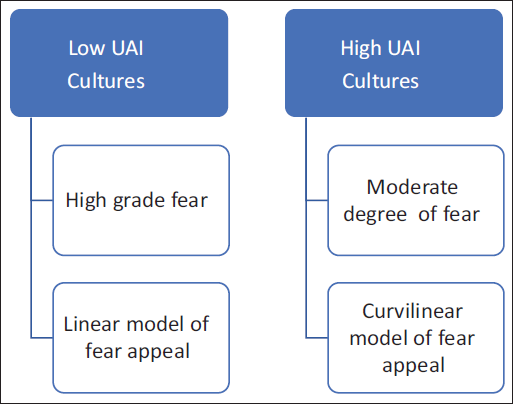
But this entire debate around linear and curvilinear models of fear appeal does not take cognizance of an important determinant of the efficacy of fear appeals—the culture factor. Culture factors can, to a great extent, play the role of predictor when deciding whether linear or curvilinear fear appeals would work for the audience of a particular country. This factor of culture as the moderator of fear appeal is hitherto missing in the fear appeal literature. Based on the discussion above on uncertainty avoidance and the differential effects of varying intensity of fear appeals, and the subsequent discussion on the linear and curvilinear models, the present authors propose that cultures which are high on the UAI, like Japan and Greece, will need moderate fear appeals (curvilinear model) for the recommended behavioural adoption responses but cultures which are low on UAI like India and Sweden will need high fear appeals (linear model) for protection response to be activated. In other words, for countries such as India, low on UAI, we propose that linear model will be more applicable. On the other hand, for countries such as Japan, high on UAI, protection response for inoculation will follow a curvilinear model.
The relationship between the cultural dimension of UAI with the format of fear is owing to the psychological conditioning one gets in the formative phase of one’s life pertaining to the tolerance thresholds for accepting fear by one’s native culture. Countries high on UAI are already raised in fear—fear of unknown, fear of situations low on certainty, fear of the new, etc. They are attuned to obviating or mitigating this fear by bringing more and more structure into their organizations, societies, and life in general by repudiating their security threats. If such cultures are exposed to high-intensity fear appeals in social marketing messages too—nudging them to get vaccinated to safeguard against the novel Coronavirus with its inherent uncertainties owing to its unprecedented origin, these cultures may adopt a defensive avoidance reaction resulting in the outright rejection of the subject of persuasion. Since these cultures have already being raised on fear psychosis and hence, cannot withstand more fear stimuli, moderate fear appeals can work better here than high-intensity fear appeals. These cultures are likely to follow a curvilinear model of fear by tuning out the ‘fear noise’ if this fear intensity transgresses a certain threshold of their tolerance which is already low. Fear saturation may compel these cultures to dismiss high-fear messages as not personally relevant as these cultures may tend to take recourse to escapist propensities in order to safeguard themselves from the onslaught of ‘extra’ fear.
However, low UAI cultures have not been raised on fear. They are used to accepting novel threats, uncertain scenarios, unpredictable futures and hence low amounts of fear material may not be able to perturb them by rupturing their psychological safety valve. These high uncertainty tolerant cultures would need more and more intense degrees of fear to obliterate their fear complacency. Therefore, for these cultures high-grade fear will work more and more following linear model of fear appeal to neutralize their fear immunization. The relationship between UAI and fear type is presented in Figure 1.
Cultural Dimension of UAI and Fear Levels.
Individualism Index and Fear Communications
Individualism defines a social orientation towards selffocus which promotes individual aggrandizement over societal submission. In individualistic societies, people are encouraged to live life on their own terms without strictly subscribing to the sanctions of the society. The relationship framework between the social constituents is loose and hence everyone follows his or her own course of action (Hofstede, 1980). Collectivism, on the contrarian, puts a premium on social affiliation rather than self-centredness as a way of life. In collectivistic societies, people lead lives directed by the ‘rules’ of the collectives to which they belong. People strongly identify themselves in relation to their reference groups into which they are integrated right from their birth and follow the group normative of this social nucleus with lifetime loyalty which is rewarded by strong collective support systems (Hofstede, 1980). For instance, USA is an individualistic culture that believes in selfmaximization, has credence in personal uniqueness and hence displays propensity toward non-conformity with society, mitigating the social pressure phenomenon and therefore can be branded as a ‘loose’ culture. Japan, on the other hand is a prescriptive culture, exerting high pressure on conformity with the societal valuations and hence is a ‘tight’ culture. Individualistic societies celebrate independence, while collectivistic societies sanction interdependence. People in collectivistic cultures develop an interdependent self-schema. Research has demonstrated that people in collectivistic cultures are more influenced by others’ opinions. For example, Lee and Green (1991) found that reference groups such as the extended family, neighbours and friends, exert a greater impact on the purchase decisions made by Korean consumers (collectivistic culture) than for American consumers (individualistic culture). Collectivistic cultures live by strong cohesive units (family, organization, profession). Collectivistic cultures are found mostly in Africa, Asia, South America, and the Middle East. Individualistic cultures are found in North America, Europe and Australia.
The concept of ‘face’ is very important in collectivistic societies. ‘Face’ represents a collective of tacit social rules to be followed to obviate the possibilities of damaging the image of people involved in interactions. There is an enormous thrust on maintaining dignity and respect of the interactants, leading to the usage of facework communications. People try not to bring ‘shame’ to one’s group. Face can be gained by following appropriate social etiquette and by engaging in acts that enhance the reputation of the family, the organization to which one belongs. Face can be lost with perpetration of dishonourable actions like not following the social normative. Thus, maintaining face is an important issue in collective societies.
This value of communitarian orientation versus selfcentralization is likely to index the fear communications in terms of typology—which type of fear will be more effective in a given culture. Most of the research work done in threat appeals have investigated the quantitative measure of fear exhibition, the message recipient demographics, the susceptibility quotient of the audience processing it, the presence or absence of efficacy statements and the recommended remedial actions in singular or iterative formats (Tannenbaum et al., 2015). But nowhere culture and the type of fear appeal that may work in congruence with the cultural profile of the target audience has become the theme of the fear appeal literature.
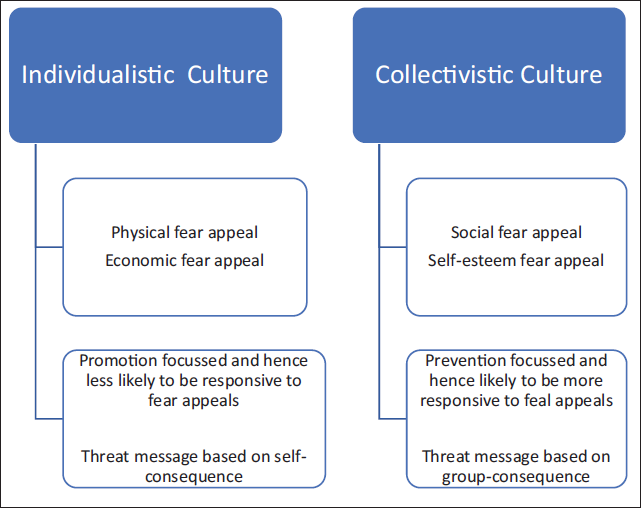
There are four types of fear appeals generally used in marketing messages. Physical fear appeals present threat to health and physical well-being. It works on the narrative, ‘Do this ...or else your health will suffer’. Social fear appeals, on the other hand, present threat to one’s social image. It works on the narrative, ‘Do this ...else your social prestige will be at stake; you may lose your social support which is very important for your survival’. In addition to these two, there are economic and self-esteem fear appeals. Economic fear appeals pertain to the trepidation of financial setback (Calantone & Warshaw, 1985), whereas self-esteem fear appeals present threat to one’s reputation status and the resultant psychological tensions (Menasco & Baron, 1982). Social, physical, economic and self-esteem fears are the most common types of fear appeals used in advertising (Menasco & Baron, 1982). The authors propose that culture impacts the manner in which the type of fear presentation affects the consumers of the advertising. Social fear appeal should work more in countries scoring high on collectivism which entails a greater emphasis on seeking social validation than individualistic cultures with less pressure of garnering social endorsements. Collectivism defines the extent to which people relate with their reference groups and seek external validation for their actions in the format of social approvals (Heine et al., 1999; Triandis, 1989). Hence these societies experience high volume of social pressure and need more social capital for a ‘rich’ living (House et al., 2004). For example, as social network is valued highly in India, social pressure for ensuring conformity with the standards fixated by society is high. Hence, use of social fear in social marketing should work more in India than other fear appeals in motivating Indians to get vaccinated. Bartikownski et al. (2019) found social and self-esteem fear appeals are used more often in China, though the focus of this research was not social marketing but commercial advertising. The authors also point out that the exploration of this aspect of fear research can provide a promising avenue for future research. As a corollary, we therefore propose that for social marketing too in collectivistic cultures, where social acceptance is a vital concern for one’s selfidentity, social and self-esteem fear appeals will be more effective than physical and economic fear appeals. On the other hand, in individualistic cultures, physical and economic fear appeals may work as more powerful agents for hosting attitudinal and/or behavioural mutations.
The regulatory theory posits that there is a duality in ramification of population—some people are promotion-focused—they give more importance to the pursuit of positive outcomes, whereas some people are prevention-focused—they put a premium on the evasion of negative consequences (Kurman & Hui, 2011). Fear appeals are inherently designed to be preventive communications as they usually are loaded with exhortations meant to obviate negative behaviours. Therefore, one can conclude that people with preventive orientations will respond more favourably to fear appeals in comparison to people who exhibit promotion preferences. Research studies using culture variables in the context of regulatory communications conclude that collectivistic cultures demonstrate more preventive propensities as compared to individualistic cultures (Kurman & Hui, 2011; Lockwood et al., 2005). Consequently, fear appeals should be more impactful, and should have higher effect sizes for collectivistic rather than individualistic message recipients. This is yet another way in which culture functions as a vital component in the processing of fear appeals and hence, should act as a useful guide for the social marketing practitioners.
The value of communitarian orientation versus selfcentralization and the choice of target consequence of the threat message is also likely to influence the persuasiveness of the threat message. Since members of the collectivist culture tend to have relatively stronger interdependent self-construal, they perceive themselves as part of a group (Markus & Kitayama, 1991). They are emotionally connected with their group members and place greater importance on the impact of their actions on others than on themselves (Triandis, 2018). Although studies have not directly looked at the interaction effect of collective versus individual orientation and the target consequence of the threat message, there is some empirical evidence suggesting that the effectiveness of fear appeal—whether directed at an individual or a group, can differ based on the cultural dimension. For instance, Chung and Ahn (2013) found that Americans (high on individualism) demonstrated greater message acceptance when the fear communication threatened the self, whereas South Koreans (high on collectivism) reported greater acceptance rates with fear message threatening the family. In another study, Uskul and Oyserman (2010) found that fear appeal depicting individual consequence of a disease was more persuasive for European Americans primed for individualism, whereas Asian Americans primed for collectivism were more receptive towards fear appeal focusing on relational outcome of a disease (burden on the family). Thus, we believe that fear message appeals focused on group consequence will be more effective for collectivistic cultures. On the other hand, fear appeals focused on self-consequence will be more impactful for individualistic cultures (see Figure 2).
Individualism Versus Collectivism and Types of Fear Appeals.
HC and LC Communications
‘Culture is communication...communication is culture’ (Hall, 1959). A HC culture uses more vague communicative formations as it relies heavily on tacitly understood information base. Messages are more to be inferred from the context and transmitted less using explicit verbal codes. These cultures stress nonverbal over verbal communication. LC cultures prefer direct forms of communications and most of the information is encoded in explicit words. Examples of LC cultures are Germany, the US, Canada and many northern European countries. HC communication accentuates the placement of information in the contextual environment in which the conversation is being practiced rather than emphasizing the investment of meaning in the linguistic texture. HC communicators prefer to rely more on tacit transmission of the message than the overt verbal coding as the vehicle of message transference. LC communication, on the other hand, subjugates the role of context to the language coding which acts as the prime carrier of the meaning constitution. (Hall, 1976). Thus, HC and LC communication styles, to a great extent, represent antithetical formats of communication with the former using indirect whereas, the latter using direct modes of expression.
Mostly collectivistic cultures practice HC communication with their minimalistic verbiage. There is less emphasis on the words, and more on the context surrounding those words. For instance, non-verbal cues such as the tone of voice, gestures, and facial expressions hold great significance in conveying the message. LC cultures, on the other hand, value language as the primary carrier of message. There is more need for linguistic expression and discomfort for silence. Silence is considered negative as it may be interpreted as lack of information or ignorance. Higher verbal frequencies and precise articulations are appreciated. German, Swiss, and USA are LC cultures, whereas Arab, Asian, and Mediterranean cultures are HC communicators.
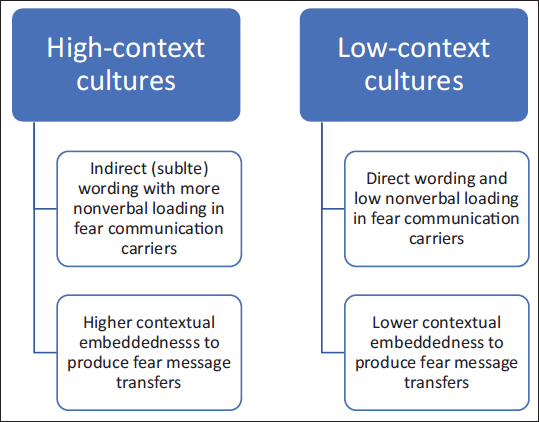
The authors propose that fear communications should be more explicit with distinct and direct verbal coding for LC cultures, while fear communications should be subtler and hence indirect for HC cultures. Fear should reside more in context than in words for enhanced message appeal in these cultures. This could be achieved through choice of music, voice tonality, body gestures or surrounding scenes. Thus, whether fear appeal should be explicit or implicit is yet another area where the culture records its powerful presence as the deciding factor (see Figure 3).
High Versus Low-context Communication and Fear Message Transfers.
CCC Model for Fear Appeal
Integrating the above discussion on the three chosen dimensions of culture and their consequent correlation with different aspects of fear appeal, we present the following model (see Figure 4) of culture filters for fear communication procedure.
Culture-compatible Communication (CCC) Model for Fear Appeal: Cultural Coding and Fear Formatting.
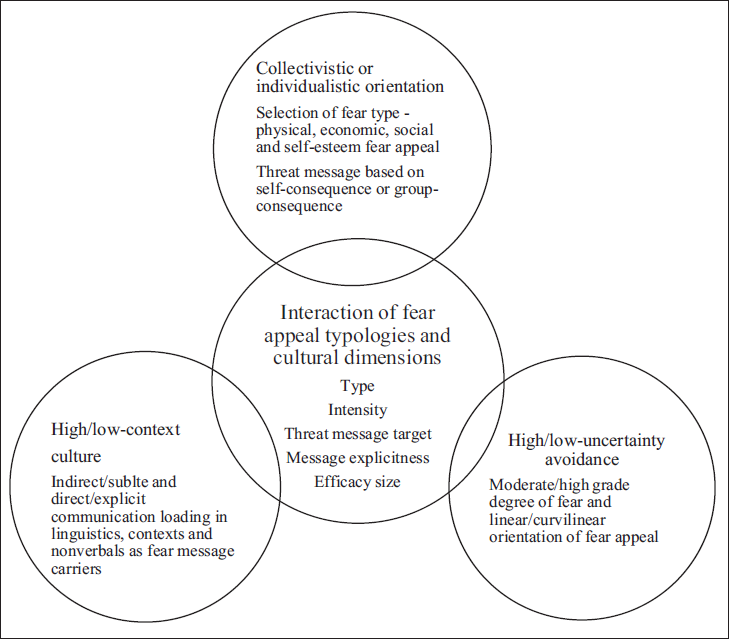
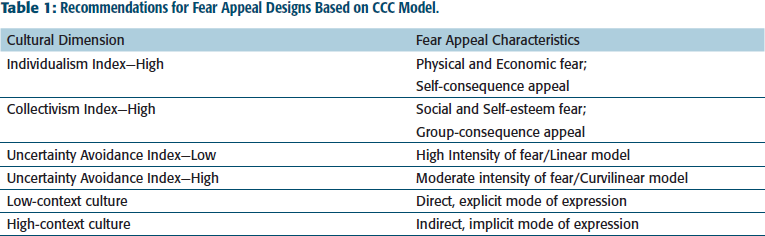
This model succinctly presents the ‘cultural proforma’ which once filled up will give a ready applicator scheme for the construction and dissemination of the fear appeal-based social marketing acts. For example, in case a given culture has high UAI, high collectivistic value and HC communication style, the fear appeal-based social marketing messages should be subtle, should follow a curvilinear model employing moderate intensity fear level and should deploy social and self-esteem fear appeals with threat message focused on group-consequence insinuating repercussions for others (family/society/organization/country) rather than self-consequence, placing the message recipient in the context of his/her group. As this cultural profile is more amenable to prevention-focused messaging, one can expect large efficacy outcomes for fear appeal messages as fear communication is primarily a preventionfocused communication type. These recommendations are summarized in Table 1.
Recommendations for Fear Appeal Designs Based on CCC Model.
CONCLUSIONS, LIMITATIONS AND FUTURE DIRECTIONS FOR WORK
Through this work, the authors propose that culture is an important variable in designing social marketing communications. Fear appeal can prove to be a powerful device of persuasion only if it is culturally customized. Though there are several cultural variables presented by different experts like Hofstede, Hall, and Trompenaars, the authors identify uncertainty avoidance, individualism index and LC/ HC communication as the cultural dimensions which are particularly pertinent in using fear appeal in social marketing campaigns for inducing inoculation behaviours. To enable social marketing campaign architects, decode the cultural complexity, the authors present a simplified version of the culture filter as a readymade framework for application. This work is unique in terms of the presentation of CCC model constructed by the authors for customizing the promotional campaigns for COVID-19 vaccination in order to ‘deuniversalize’ the communication schema adopted across the cultures with the same persuasion methods used for diverse countries. The authors claim that there is no universal persuasion design which fits all when it comes to employing fear appeal for social marketing campaigns for adult inoculation. Since countries differ in their cultural lineaments, the same promotional method cannot convert vaccine hesitancy into vaccine adoption in different countries. Emotions are universal—the emotion of fear is universal. Still, the way people process emotions is not the same. This affective differential is the key to understanding the geo-psychographics of a particular country before deciding the persuasion format which will be effective there.
So far, the research on fear appeal has not taken culture angle for analysing the social marketing phenomena. The contribution that the authors claim to make through this article is giving a new thought process to the entire discussion around social marketing events by presenting culture as a factor of paramount importance in deciding the potency of fear appeal. The production of CCC model represents the abstraction of the cultural value orientations from the thick body of intercultural communication scholarship. The cultural dimensional approach adopted in this article will enable a quick refashioning of social marketing campaigns in order to accomplish a quick cultural attunement of COVID-19 vaccine adoption campaigns across geo-cultural zones varying widely in psychographics of their resident constituents. This pithy model is application-oriented and can give a nimble access to a marketer to the realm of cultural studies without having to take a deep dive into heavy literature corpus with its intricate theoretical ramifications. The model is not circumscribed only to COVID-19 context but is extendable to any vaccination drive or health campaign pivoted to bring about change in closeted mindsets. No research till date, to the best of the authors’ knowledge, has used this intercultural communication lens to comprehend and generate a model based on cultural dimensions for application to social marketing communications.
While our work has not directly explored the role of ethical beliefs in different cultures, we caution practitioners to keep the ethical angle also in mind while making use of fear appeal in their communication message. The use of fear appeals for socially beneficial causes has raised important ethical issues. These mainly include two issues. One, fear appeals may create unwarranted anxiety among the audience; and second, fear appeals are criticized if the proposed solution is perceived as ineffective in eliminating the posed threat (Duke et al., 1993; Spence & Moinpur, 1972). Since ethical beliefs are a function of culture (Reidenbach & Robin, 1990), one must understand the cultural perception of ethicality when deploying fear in communication messages with respect to depicting the amount of fear, the type of fear, and mode of communication. For instance, in an empirical study, the use of social threat was viewed to be more unethical than the use of physical threat by South Australian students (Arthur & Quester, 2003).
Additionally, our work presents a new culture-based conceptual model of communications to address vaccine hesitancy. Empirical work can be carried out in future to test the model. The CCC model can be examined by applying it to different cultures and by comparing and contrasting the outcomes. Samples can be chosen from different countries and ads can be designed using this CCC model varying the degree and the type of the fear appeal. Qualitative and quantitative metrics can be used to measure the attitudinal-cum-behavioural changes that result in the subjects of diverse cultures owing to the exposure to these culture-compatible ads. Such research experiments can help in changing the entire landscape of social marketing campaigns as their results can help decode the complex cognitive and affective processes that people from diverse cultures use in processing and responding to the productions of persuasive stimuli. Thus, our work presents a promising new avenue of research work for social marketing academics and practitioners, especially in these times when the entire world is combating with vaccine hesitancy and is looking forward for articulating effective communication work to persuade more and more people to get the vaccination shots in an endeavour to make the world COVID-19 free.
Footnotes
DECLARATION OF CONFLICTING INTERESTS
The authors declared no potential conflicts of interest with respect to the research, authorship and/or publication of this article.
FUNDING
The authors received no financial support for the research, authorship and/or publication of this article.

e-mail:
e-mail: