




Abstract
Thousands of farmer-producer companies (FPCs) have been registered in India due to national and state policies. Given their resource-constrained environments, most FPCs face myriad challenges and are struggling to become viable. While the policies provide for incubation support for FPCs, the level of support has been inconsistent and inadequate. This paper proposes a framework for classifying FPCs and their differing incubation needs and advocates for a stronger incubation ecosystem for FPCs, moving away from a one-size-fits-all approach. It also suggests prioritising incubation support for an oft-overlooked category of FPCs with the potential for generating remunerative returns.
In recent years, government and civil society organizations have focused on promoting large numbers of farmer organizations (FPOs) to enhance farmer welfare through collectivization. The FPOs can be registered as societies, cooperatives, producer companies and other forms, each with its own organizational, governance and regulatory requirements. The idea of producer companies emerged at the turn of the century as a response to the limitations of previous forms of FPOs, for example, low member commitment, inadequate focus on business aspects, bureaucratization and political influence, in the case of cooperatives (GOI, 2000; Shah, 2016; Trebbin & Hassler, 2012). Producer companies were first proposed by the Y. K. Alagh Committee in 2000 (Alagh, 2019; GOI, 2000) and later incorporated into the Companies Act (GOI, 2011, 2013). In 2020, the Government of India announced a scheme for the promotion of 10,000 FPOs (DACFW, 2020; PIB, 2020; SFAC, 2019), henceforth referred to as the 10K FPO scheme. Since then, there has been rapid growth in the number of producer companies registered in India.
As of March 2024, more than 40,000 producer companies (PCs) were registered in the country (NAFPO, 2024). Typically, more than 90% of PCs registered are farmer-producer companies (Neti et al., 2019), hereafter referred to as FPCs. These FPCs have been promoted by government bodies (e.g. agriculture and horticulture departments), NGOs, corporate CSR groups, philanthropies and groups of farmers themselves and other FPCs.
Most PCs face persistent challenges, both at the sector level and at the level of individual FPCs. Therefore, to understand the current situation, we have conducted multiple studies of FPCs in recent years, comprising more than 100 interviews of farmer shareholders, board of directors, CEOs, managers, promoting institutions, government organizations, funders and other stakeholders as well as detailed analysis of characteristics of FPCs based on registration data from the Ministry of Corporate Affairs. Our studies show a clear concentration of FPCs in easily accessible districts (such as Ahmednagar, Nasik and Pune) at the expense of less accessible aspirational districts. This runs counter to national FPO policy objectives (Govil et al., 2020; Neti & Govil, 2022; Neti et al., 2019).
Furthermore, our studies have highlighted a dissonance among promoting institutions, government bodies and small producers in their normative imagination regarding the purpose of FPCs, leading to differences in the investments being made (financial and non-financial). The studies have also pointed out compliance challenges and the vulnerability of marginalized shareholders to fraud, mismanagement and negligence. The FPCs face significant strategic and operational challenges with limited access to equity and debt and a lack of inadequate management expertise and business acumen (Govil et al., 2020; Govil & Neti, 2021; Neti & Govil, 2022). Several other studies have also pointed out similar challenges related to funding, talent, market linkages, business strategy, internal governance, operations and others, which affect their performance and viability (Dey, 2018; Prasad et al., 2020; Singh, 2008; Singh & Singh, 2014).
Despite these drawbacks, policymakers and practitioners continue to believe in the potential of FPCs to generate significant social and economic benefits for small and marginal producers (as evidenced by a few exemplary FPCs). Successful PCs have received substantial mentoring, handholding and financial and operational support from promoting institutions, funders and other well-wishers (Govil et al., 2020).
In many ways, the challenges faced by FPCs are similar to those faced by business startups. For mainstream startups, support for overcoming strategic and operational challenges is provided by business incubators. For FPCs, there are no designated incubators; however, promoting institutions such as resource institutions (RIs), producer organization promoting institutions and community-based business organizations (CBBOs) are expected to play this role to some extent. The degree of support required by PCs is greater since the owners are usually marginalized producers.
At the same time, the ability of promoting institutions to incubate PCs is hampered as most of them view FPCs mainly through the lens of producer collectivization and production and do not have a good grasp of FPCs as business entities. Therefore, it is not surprising that very few PCs are able to start business operations and grow, as evidenced by many studies, including ours.
In this paper, drawing from our ongoing study of FPCs, we make the case for creating strong incubation support for FPCs and identify the kinds of incubation support required for strengthening the viability of FPCs. We propose a framework for categorizing different types of FPCs and their incubation needs, which is a significant departure from the currently prevalent one-size-fits-all approach. We advocate prioritizing incubation support for one category of FPCs based on certain considerations.
In the next section, we start by summarizing the numbers and characteristics of FPCs in India.
FPCs IN INDIA
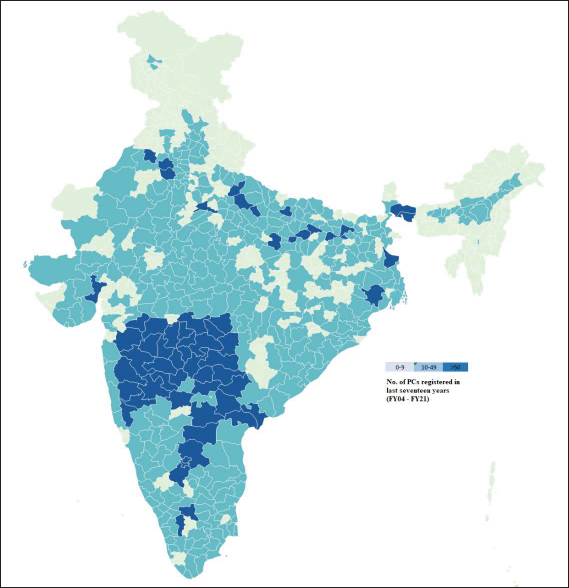
In our study, we identified approximately 16,000 PCs, registered across the country as of March 2021 (Figure 1). Our analysis revealed a significant geographical disparity in the promotion of FPCs, with a high concentration of PCs in certain regions. For instance, 33% of all registered PCs as of March 2021 were in Maharashtra and 12% in Uttar Pradesh. Very few PCs have been registered in aspirational districts (Neti & Govil, 2022).
One of the biggest challenges faced by FPCs is that of capitalization. As of March 2021, there were only 11% of PCs with a paid-up capital (PUC) of ₹10 lakh or more, 32% with PUC between ₹1 and ₹10 lakh, 42% with exactly ₹1 lakh, and 15% had less than ₹1 lakh (Neti & Govil, 2022). This is important because FPCs require a minimum of ₹3–5 lakh in equity to start operations and raise working capital loans (NABKISAN, n.d.).
As of March 2021, only ~18% of PCs registered during the previous 2 years had reached PUC ≥ ₹5 lakh (threshold needed to start operations) compared to 23% two years prior (as of March 2019). In fact, during those two years between April 2019 and March 2021, 70% of companies showed no growth in PUC. If we treat PUC as a rough indicator of business activity for early-stage PCs, low growth in PUC indicates the poor health of most PCs.
Beyond capitalization, PCs face multiple operational challenges related to managing supply chain operations, raising working capital and debt, managing finances, finding markets for their produce, value addition, internal governance and compliance, as well as linking with an ecosystem of suppliers and experts. PCs are also unable to attract talent to rural areas where they operate (Prasad et al., 2020). Many PCs have not been able to start operations or have only sporadic operations. Most PCs have weak business acumen and poor entrepreneurial and strategic capabilities to identify business opportunities, imagine possibilities, experiment and take risks (Govil & Neti, 2021, 2022; Govil et al., 2020).
These challenges are exacerbated by the fact that most of these are companies owned by marginal producers. Many operate as standalone companies with hardly any professional linkages to the business ecosystem in their respective regions.
These persistent challenges and the recent decline in the quality of PCs may be indicative of an industry bubble—high quantity and low quality (Neti & Govil, 2022). This not only jeopardizes farmers' livelihoods but may also discredit the entire sector and future efforts to collectivize farmers for improving livelihoods.
Despite these evident deficiencies in numerous ground reports and research, most NGOs and CBBOs which promote FPCs are not equipped to provide the requisite support to overcome them. Therefore, the incubation needs of the sector and the landscape of existing incubators need to be understood.
INCUBATION FOR FPCs: CURRENT SITUATION
The 10K FPO scheme expects CBBOs to act as incubators for FPCs. The responsibilities of the CBBOs, as described in the Small Farmers' Agri-Business Consortium (SFAC) Strategy Paper, which describes the scheme, are summarized below (SFAC, 2019):
Assist in community mobilization, including cluster finalization, baseline survey, value chain study and formation of groups.
Registration of FPCs with registrar of companies, including mobilization of capital/ equity.
Training of board of directors on roles, responsibilities and management.
Training and capacity building of farmer groups, including identification of training needs, developing training modules, conducting basic training workshops and organizing exposure visits.
Assist in communication and dissemination of information to farmers by way of market and crop advisory.
Preparation and execution of business plans, including business plan preparation (for different incubation services), acquiring land, mobilizing equity capital.
Assist in regular interface with stakeholders like various government departments, financial institutions, training and research and development institutions.
Incubation/handholding services for sustainability, including ensuring input, credit, market linkages, preparing and implementing related business plans, support and monitoring for business sustainability. If required, facilitating the establishment of necessary common facilities.
Facilitating traceability, compliance and global market connectivity.
The SFAC Strategy Paper further states: ‘There is a need for competent Cluster Based Business Organisations (CBBOs) with capability to effectively mobilise farmers and to offer the necessary range of incubation services. These CBBOs need to have demonstrated capabilities’ (Clause 9c of SFAC, 2019). The policy also specifies the types of institutions that can play the role of CBBOs; these include trusts, societies, foundations, corporations, corporate CSR bodies, other FPOs, etc. However, despite the intent of the policy, it is evident that these CBBOs are not able to provide the kind of support required to establish sustainable and competitive FPOs.
There are three reasons for the above. First, the specified list of services to be provided by CBBOs (such as facilitating the establishment of input shops, providing credit linkages, establishing common facility centres, providing direct market ties and training of the board; SFAC, 2019), is not adequate for establishing a sound business. For example, it ignores the importance of business acumen and expertise in identifying remunerative business opportunities, imagining possible business and operating models and evaluating business risk. These are essential capabilities for developing sound business strategies and models, especially in the initial years, and require expertise different from business planning per se.
Secondly, it is extremely challenging for a single organization to span the entire spectrum from community mobilization to incubation (both at individual company and cluster levels), as these are very different capabilities. Mobilization requires the ability to work with community members, inculcating a shared imagination among farmer members and the board of directors, and, over time, building a sense of ownership of the collective enterprise. On the other hand, incubation requires a deep understanding of the sector, business opportunities, markets, customer segments, sector/commodity-specific strategic drivers of profitability, relevant schemes and sector-specific compliance requirements, as well as the ability to nurture fledgling enterprises in resource-constrained environments.
Third, the duration of incubation support as envisioned in the 10K FPO policy is grossly inadequate. To wit: Mainstream start-ups typically require 7–10 years to establish themselves firmly. It is difficult to imagine that enterprises in resource-constrained environments with limited talent availability would be able to accomplish the same in a mere three years. Once the project and, consequently, the CBBO support ends, most FPOs are unable to continue without active ongoing support. Our field interviews revealed several such instances. In one instance, the CEO of an FPC stated that even a year after the end of the project, he continued to reach out to an employee of the CBBO for compliance documentation and to respond to government notices, even though that employee had been reassigned to a different project and location by that time.
In many ways, the policy treats establishing and running of FPOs as a project rather than as incubating a business (despite the use of the word ‘incubation’ in the document). Therefore, it is not surprising that most FPOs established under the policy are unable to receive the kind of support required by new businesses to establish themselves and manage their operations. Since many philanthropic and CSR organizations have designed their FPO projects following the same norms as the 10K policy, the FPOs supported by them are also facing similar challenges.
Besides CBBOs, there are other incubators that support agri-businesses and social start-ups. These incubators are run by agricultural universities, private sector and public sector. In some cases, non-banking financial companies that provide long-term loans to high-performing FPCs, also provide business incubation services somewhat similar to mainstream incubators.
There are about 300 mainstream start-up incubators and accelerators in India (Bhattacharya et al., 2021), which are publicly or privately sponsored (Korreck, 2019). Private ones can be part of corporates or can be independent institutions. Publicly sponsored incubators are run by agricultural universities, academic institutions or industry associations. They are more interested in job creation and social impact, while private independent incubators focus on profitability and private corporate incubators prioritize the strategic goals of the parent company.
Of these, approximately 50 are agri-business incubators, mostly housed in academic institutions such as agriculture universities (Indian Council of Agricultural Research (ICAR) annual report 2022–2023). Many of these are sponsored by the ICAR, Ministry of Agriculture and Farmer Welfare, Ministry of Food Processing Industries, Department of Science and Technology, Ministry of Micro, Small and Medium Enterprises, Atal Innovation Mission, among others (Bhattacharya et al., 2021).
Most of these incubators provide technical assistance such as guidance on appropriate seeds and planting material, suitable machinery and equipment for processing certain millets, fruits or vegetables, possible funding sources for the purchase of such equipment, product development and refinement, access to lab facilities, etc. They are not equipped to provide substantial guidance for business development and operations.
Thus, neither mainstream agri-business incubators nor CBBOs are able to fulfil the incubation needs of most FPCs. In the next section, we provide a framework for categorizing different types of FPCs and, consequently, their incubation requirements.
HETEROGENEITY OF FPCs AND THEIR INCUBATION NEEDS
There is a significant variation among FPCs in their business models, operations, types of markets they sell to and plans for growth. Different FPCs may imagine their purpose and desired nature of business differently. Some FPCs aim to undertake only the primary processing of commodities, while others see themselves as establishing sophisticated processing facilities. Some want to sell at minimum support prices (MSP) to government agencies, while others aspire to develop their own brand in the long run or sell white-label commodities to established mainstream brands. For example, an FPC working with fruits may aspire to sell only fresh fruits or, sell pulp and juices to bulk buyers or even establish its brand. In other words, differences in imagination result in differences in the targeted end state for each FPC.
Not only is their desired set of business activities different, but their starting points are also distinct depending on the local context. Some FPCs start with inputs business, while others start with aggregation and primary processing, and a few resource-rich ones may start directly with high-end value addition. And, of course, at any given point of time, FPCs may be at different stages of their journeys.
Therefore, it is important to keep the above heterogeneity in mind when trying to understand the needs of different FPCs. As stated above, FPCs have different desired end states, different starting points and are at various stages in their long-term journey, and as a result, face distinct challenges.
In order to capture and classify the heterogeneous needs of FPCs, we have developed a classification framework based on insights from our studies. We have grouped FPCs into the following three categories based on their desired end state (not their current stage): (a) production-oriented FPCs, (b) process-oriented FPCs and (c) market-oriented FPCs.
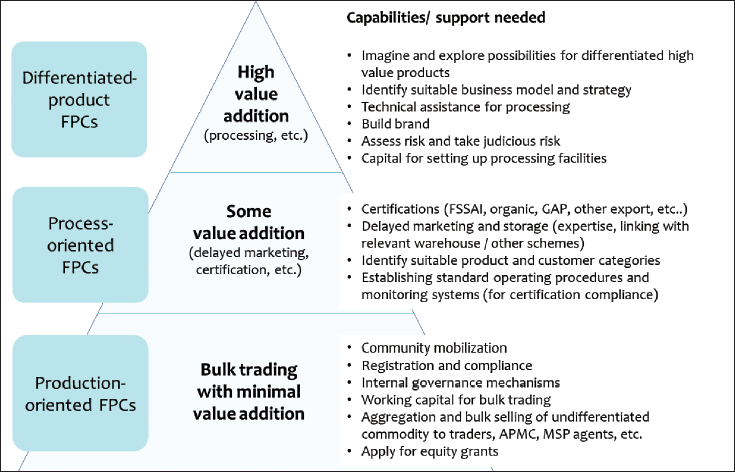
Production-oriented FPCs aim to focus primarily on bulk trading with minimal value addition. Their intended buyers could be government agencies, traders and other bulk buyers. Depending on the life-cycle stage they are in, they may require support with mobilization, registration, compliance, establishing strong governance mechanisms and working capital for large-volume trading and identifying bulk buyers (Figure 2).
In our study, we came across many such FPCs. One FPC in Uttar Pradesh comprised farmers who were producing wheat. The role of the FPC was limited to procuring the produce from farmers, identifying bulk buyers and selling the produce to them. Another FPC, based in Maharashtra, consisted of farmers producing pulses. The FPC procured the produce from farmers and sold it to the public distribution system(PDS) at MSP set by the government. As a result, the FPC was able to generate remunerative returns for the farmers. Another group of FPCs based in Madhya Pradesh procured rice and millets from members and sold them to a social enterprise. In all these cases, the PCs relied on support from promoters for mobilization, compliance, securing working capital, identifying bulk buyers and establishing internal procedures.
Process-oriented FPCs focus on activities and markets with the potential to generate higher margins without the necessity of sophisticated processing. The activities they engage in typically include delayed marketing through storage and certification of produce (organic or export certifications, etc.). Much of their attention would need to be devoted to developing standard operating procedures for implementing and monitoring such activities, including adherence to certification requirements. They will also need access to expertise relevant to their specific commodities, region, etc.
To wit: Most dairy PCs are highly process-oriented—they follow clear procedures for every step of procurement and processing of milk, such as efficiency metrics for milk collection routes, procurement pricing based on the quality of milk, operating procedures for chilling plants, etc. Besides dairies, our studies included FPCs dealing with the organic production of cotton, chia seeds and other crops. Such FPCs focus on ensuring compliance with farm processes with requirements for organic certification. In all these cases, the companies aimed to generate higher returns for their members. They required additional expertise and support to establish standard operating procedures (for production and/or processing), apply for certifications, etc.
Differentiated-product FPCs aim to develop distinctive products, such as fruit and vegetable pulp, consumption-ready jowar flakes, dried jamun snacks, juices, etc. These are often marketed under their consumer brand and in bulk. These companies require quite an intensive support system to help them imagine and discover suitable products, markets and customer segments (often niche), identify appropriate business models and strategies, assess and take judicious risks, etc. These FPCs require technical support, capital investment and long-term loans for extended periods.
Our studies included a case where an NGO recognized that there is business potential in processing and selling custard apple pulp to bulk buyers. Even before forming an FPC, the NGO piloted the idea by buying custard apples from the open market, processing them via a local processing unit and selling them to determine the potential profitability and operational requirements of such an enterprise. Through this pilot, it identified a suitable financial and business model for a future company. Similarly, we came across a few other FPCs that received similar support from their promotors (in several cases, the promoters were umbrella FPCs themselves) in conceptualization, strategy development, deep technical expertise and funding arrangement. We visited another FPC, which, at the time of the visit, was setting up a mango pulping unit to supply to branded food companies through a state government grant for processing units.
Most FPCs today appear to be aiming to be production-oriented FPCs. Very few are aiming to (or have the capability to) develop differentiated products. A small percentage of FPCs aim to derive value from process-oriented models, though a very large number have the potential to do so. Our study shows that the popular imagination of FPCs is limited to production-oriented models or differentiated product models. Popular imagination overlooks the potential of process-oriented models, which can bring high value to producers with limited investment in resources and expertise.
In terms of management talent, managers in production-oriented FPCs need to be able to handle bulk trading with primary grading and sorting and raise equity from shareholders. In differentiated-product FPCs, the managers need to have strong business acumen, the ability to identify remunerative customer segments and sales channels, assess business risks, etc. Operationally too, they need to have strong management skills, including the ability to handle complex operations and larger financial investments and loans. This capability is rare in rural areas where most FPCs are located. Therefore, it is not surprising that most companies which are on a path to viability are doing so as part of a two-tier operating model, with a market-facing company based out of larger cities with greater talent availability and a group of supplier FPCs focused on production and aggregation (Govil et al., 2020). On the other hand, process-oriented FPCs require managers to understand relevant processes, develop strong standard operating procedures and implement and monitor adherence to them. It is relatively easier to train or hire talent with such capabilities in rural areas for process-oriented FPCs compared to differentiated-product companies.
In terms of capital requirements, production-oriented FPCs require working capital for large-volume, low-margin trading. Capital needs of process-oriented FPCs are also primarily for working capital, and, to a limited extent, for storage, periodic certifications, etc. On the other hand, differentiated-product FPCs also require capital for investment in processing infrastructure and other value-addition activities.
As evident from the above, the business models and operational priorities of these three categories of FPCs are significantly different. Therefore, their support requirements are also distinct. The next section delves deeper into the incubation needs of each category of FPCs and suggests approaches for addressing them.
ADDRESSING THE INCUBATION GAP: THE MISSING MIDDLE
As pointed out in our previous studies, improvement in the quality of FPOs requires a shared imagination among different stakeholders with respect to the purpose of the FPCs, business objectives and trajectory. It also requires strengthening the operational capabilities of different categories of FPCs (such as operations management, financial management, value addition, internal governance, compliance and market linkages). Finally, it also requires strong entrepreneurial characteristics and business acumen (Govil et al., 2020).
Currently, production-oriented FPCs are being promoted by NGOs, FPO federations, private companies and other organizations often classified as RIs or CBBOs. Some of these promoters also provide limited incubation support for mobilization, registration, setting up the board, filing compliance documents, etc. Since these companies are focused on aggregation, market linkages are limited to selling at local or regional mandis or to agents.
In our study, FPCs classified as differentiated-product FPCs were promoted and incubated by well-to-do farmers or social enterprises and, in rare cases, by NGOs with a long-term commitment to a particular community of farmers. In all cases, a very significant amount of funding and capacity building had been invested into a single company and its management teams. Often, the cost of the management team, external experts and capacity-building efforts is borne through philanthropic and government grants. In many ways, the nature and quality of investment required for differentiated-product FPCs is very similar to that required for mainstream urban start-ups.
However, in general, the incubation needs of FPCs differ in many aspects from the incubation of mainstream startups. Furthermore, FPCs, which fall under the three different categories, have distinct support requirements due to differences in business models and operational priorities described in the previous section.
Therefore, a one-size-fits-all kind of support, as imagined in the 10K FPO policy, may not translate into a significant improvement in the quality and viability of FPCs. For FPCs to have a fighting chance at viability, the nature of incubation has to cater to the specific needs of each category. While some of the needs may be similar across categories (e.g. financial management and internal governance), other requirements vary depending on the desired degree of value addition and the level of expertise required to connect with markets.
For production-oriented FPCs, the current system of CBBOs as incubators may suffice, but only if they can build market linkages, set up governance, compliance processes and standard operating procedures for routine work and so on. Another key aspect of support required is building the capacity of the PC to apply for and utilize working capital loans to start and grow their operations.
Differentiated-product FPCs are closest to mainstream startups in their imagination, business models and operational priorities. While existing mainstream incubators should be able to cater to these FPCs, in reality, this is hardly ever the case. There are many challenges, such as the absence of a clearly identifiable entrepreneur and working with the board as a whole. In mainstream startups, incubators typically work with 1–2 entrepreneurs per enterprise. However, in FPCs, there is no entrepreneur; instead, the board of directors (producer members of FPCs) and sometimes the CEO act as the de facto ‘entrepreneur’. Moreover, the FPC board members usually have limited education and entrepreneurial capabilities and have limited duration terms.
In a mainstream start-up, the drive to start an enterprise originates from the entrepreneur(s) who bootstrap the enterprise, proactively reach out to mentors/advisers, potential buyers, investors and incubators and develop networks to take the enterprise forward. In contrast, FPCs are usually the result of the policy and the efforts of the promoting institution. The push to form FPCs comes from the promoting institutions. The idea of starting a collective enterprise usually does not exist in the imagination of a typical small producer. Our interactions with the producers have shown that while they contribute share capital and call themselves ‘owners of the FPC’ (yeh toh hamari company hai), what they actually expect is a reliable non-exploitative buyer for their produce (Govil et al., 2020). Many producer members often see the share capital contribution as a service fee to be paid to the PC and not as an investment with an expectation of returns. Thus, another significant difference between FPCs and mainstream startups is that the ‘entrepreneurs’ in the case of FPCs (i.e. the board members) do not have a significant personal financial stake in the company as investors. Thus, the board members do not have any ‘skin-in-the game’ individually as investors and usually relate to the PC primarily as suppliers.
Given their limited education, business experience and professional networks, FPCs require much more handholding than mainstream start-ups.
Mainstream incubators usually take a stake in the incubatee enterprise expecting high returns when they exit. However, this is not possible in the case of the PC, given the limitations imposed by the legal structure. It can, however, be possible only in a two-tier model where the top tier is a private limited company. Moreover, FPCs typically do not generate the level of high returns usually expected by incubators. Thus, despite the possibility of generating reasonable returns, even differentiated-product FPCs usually do not attract the interest of mainstream incubators.
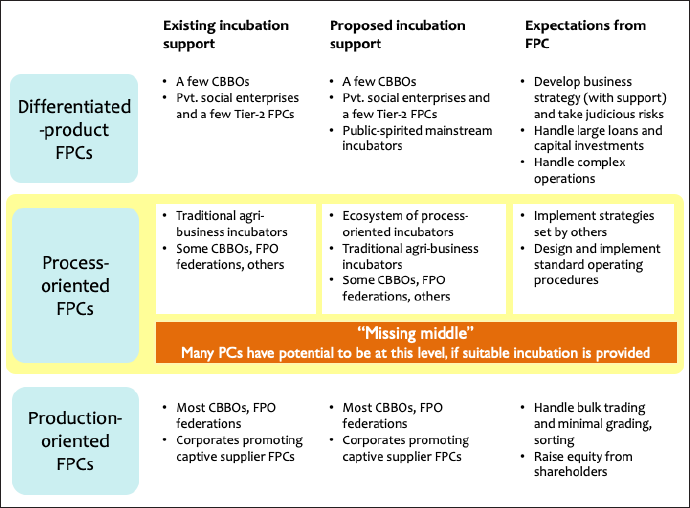
The middle category of FPCs, the process-oriented FPCs, require incubators that can help with delayed marketing, storage, processing and various certifications. This includes identifying and implementing commodity-specific business models, setting operational priorities and standard operating procedures for managing inventory, storage operations, processing, quality assessment, training on the certification process and quality assurance as well as establishing monitoring systems to ensure adherence to certification requirements. The incubators also need to have the capability to hand-hold the FPCs in raising funds for the business. Such incubators require professionals with a deep understanding of how agricultural supply chains function, storage systems, certification possibilities and government schemes catering to them. They do not require sophisticated business and processing expertise for building high-end products (Figure 3).
Incubation Support for Each Category of FPCs.
A few incubators affiliated with agriculture universities appear to cater to this space. They provide business services such as shared accounting services, assistance with setting up accredited warehouses, navigating regulatory requirements for delayed marketing or commodity futures markets, identifying relevant standards and setting up processes for compliance, among other services.
Setting up such incubators is relatively easier due to the availability of professionals with relevant expertise compared to the kinds of expertise required for setting up mainstream incubators catering to differentiated product enterprises. Such professionals are available in Tier 2 cities also, which may be more suitable locations for such incubators. Furthermore, such process-oriented incubators may not be prohibitively expensive to set up in large numbers.
As pointed out earlier, a large number of FPCs have the potential to generate remunerative returns for their members by adopting process-oriented models. They require a different type of incubation support than the one currently available. We are calling this the ‘missing middle’, both in terms of attractive business models and related incubation support. In a sense, this appears to be an unexplored Goldilocks solution, in between the two extremes of high-end incubation for differentiated product FPCs and minimal incubation provided by promoters for production-oriented FPCs (Figure 3).
POSSIBLE WAY FORWARD
This section proposes incubation approaches suitable for each of the three categories of FPOs.
Incubators for Production-oriented PCs
For production-oriented FPCs, which primarily engage in bulk trading, the current system of CBBOs as incubators may suffice, provided they can create market linkages, develop standard operating procedures, set up internal governance and compliance processes, etc. CBBOs should also be able to build the capacity of these FPCs to apply for and utilize working capital loans to start and grow their operations. If several FPCs are dealing with similar commodities in a geographic cluster, it may be more efficient and effective for CBBOs to promote and incubate them as part of a group or consortium. It may also be advantageous for CBBOs to provide business services such as shared services for accounting and other ‘back-end’ business functions. The CBBOs should evaluate the potential advantages and risks of such approaches based on the local context and the commodity. The FPO policy, as currently implemented, already allows for such possibilities. For example, many CBBOs are deputing accountants for FPCs and charging fees for that service. As the empanelment of CBBOs already requires them to have such capabilities, no policy change is required for production-oriented FPCs.
Incubators for Process-oriented PCs: The Missing Middle
For FPCs that have the potential to become process-oriented (e.g. those catering to export markets, certifications), the existing incubation approaches may not work well. There is a need to establish incubators that understand the functioning of agricultural supply chains, the requirements for storage systems, the possibility of certification and relevant government schemes. As mentioned above, they also need to assist with setting up accredited warehouses, navigating regulatory requirements for delayed marketing or commodity futures markets, identifying relevant standards, setting up processes for compliance, etc. One practical way of creating such incubators could be to expand the capabilities of well-functioning agri-incubators run by agricultural universities, agriculture departments and others. As in the case of production-oriented FPCs, there are advantages to promoting and incubating FPCs as part of a group. Specifically, in such an approach, creating shared storage facilities and other shared infrastructure, standard operating procedures, shared back-end services and adopting practices required for certification and industry compliances becomes cost-effective. Having a group of FPCs with similar needs also makes bringing in relevant external expertise easier. This can be done through the incubator or by creating a two-tier or consortium model where the second-tier company handles such aspects for the whole group. As discussed above, since a larger number of PCs have the potential to become process-oriented FPCs, a significant number of such incubators would be required in different parts of each state. Many states have established state-level institutions to support FPOs and as nodal bodies for monitoring the health of FPOs in the state. These bodies can assume the responsibility of setting up a number of incubators by upgrading well-functioning agri-business incubators at agricultural universities or setting up entirely new ones. Special attention should be paid to incubating companies in groups to enable the development of commodity-specific strategies and standard operating procedures, etc. From a public policy perspective, the objective of such incubators catering to the missing middle would be to help develop a large number of FPCs capable of generating remunerative returns for their members. The effectiveness of such incubators could, therefore, depend on their ability to increase patronage levels (usage of FPC services by members) in incubatee companies, raise share capital and improve their ability to raise loans and strengthen their business metrics such as turnover, long-term contracts, etc. Since FPCs have dual objectives (economic and social purpose), the incubators should also not be purely profit-driven but be public-spirited. This may manifest itself in terms of fees charged for services. More importantly, it also entails not focusing on activities that benefit only the large farmers (even if they may be more profitable) and not pushing FPCs into ventures that are beyond the risk-taking capacity of the typical member. Such an approach may require philanthropic and government funding.
Enabling the above will require an important change in the policies since such an imagination is currently not present in national or state FPO policies. For this purpose, FPO policies will have to include provisions for establishing a new system of incubators for process-oriented FPCs, that is, FPCs which have the potential to generate remunerative incomes for farmers through process-oriented business models.
Incubators for Differentiated-product Companies
Differentiated product companies are somewhat similar to mainstream start-ups dealing with high-value-added products that may require sophisticated processing capabilities and technology, large capital investments, risk management capabilities and the financial strength and the discipline to raise and utilize long-term loans.
Mainstream incubators can incubate such companies only if they choose to work with new FPCs with limited access to local resources and engage with the board of directors with limited education and business experience. Incubators can evaluate what kind of operating model (e.g. two-tier, federated, consortium and standalone) may be most suitable for each company, and build capacities accordingly. Differentiated-product FPCs, being too few and requiring significant individualized investment, may be best left to the social and private sectors. Therefore, the FPO policy does not need to add new provisions for such FPCs because, from a policy perspective, it is important to prioritize investment in categories of FPCs with the potential for maximum impact.
In summary, each category of FPC requires different kinds of incubation support. For production-oriented FPCs, the existing system of CBBOs may suffice—with some refinements. Differentiated-product FPCs are too few and too expensive to warrant establishing a whole new public system of incubation, separate from mainstream incubators. It may be best not to focus on these as a policy imperative. On the other hand, establishing incubation support for process-oriented FPCs can generate maximum value relative to investment in terms of 10K FPO policy objectives. Therefore, it may be desirable to prioritize establishing an incubation ecosystem for the missing middle (process-oriented FPCs).
This would require the following changes in policy: (a) FPO policy should acknowledge that different FPCs have different kinds of business potential and therefore require different kinds of business incubation and support, and not presume that CBBOs can fully support all categories of CBBOs. (b) FPO policy should include provision for a new system of incubators focused on creating a large number of successful process-oriented FPCs. (c) No change in policy is required for CBBOs, but during implementation, they may have to be strengthened to make them more effective for production-oriented FPCs.
At a collective level, a policy objective could be to develop (through experience) common standards and operating procedures relevant to specific commodities, markets and local contexts, similar to those existing for dairy. It may also be valuable to create a sustainable model for shared services relevant to seasonal crops. Therefore, a good approach would be to create incubators that have the ability to handle a cohort of companies together, rather than highly customized approaches. This is likely to help strengthen not only the individual FPC but the entire sector.
Furthermore, identifying and measuring metrics for performance assessment of FPCs is an important step in monitoring their progress and steering them towards sustainability and is an important function of incubators. Mainstream incubators and investors have developed such metrics and benchmarks for for-profit companies based on decades of experience. Eventually, this would be a valuable exercise for FPC incubators to do for this sector. However, commonly used metrics for FPCs are more akin to milestones and eligibility criteria for disbursing grants/ loans rather than performance metrics. Further, setting benchmarks requires a well-established comparative set and a sectoral understanding, which has been a challenge, due to the wide variance in objectives, business models and operational stages of FPCs. The typology presented in the paper will help incubators develop comparative benchmarks relevant to the respective category of FPCs.
While the paper suggests a possible approach, it does not provide a blueprint for establishing such incubators operationally or financially. Such a blueprint would emerge from experimentation and practice.
CONCLUSION
At their core, PCs are start-ups of farmers and other small producers. And, as such, they need incubators for FPCs. While the 10K FPO policy envisions CBBOs providing incubation support, the experience of the past several years demonstrates that this model is not working, partly due to inadequate focus on incubation (as opposed to promotion) and partly due to a mismatch in capabilities.
Incubating thousands of process-oriented FPCs requires a different kind of incubation ecosystem than what exists currently, keeping in mind both the nature of support needed and the scale of the challenge. Therefore, this paper has attempted to understand better and characterize the incubation needs of PCs. We have proposed a classification framework to capture the distinct incubation needs of different kinds of FPCs: production-oriented FPCs, process-oriented FPCs and differentiated-product FPCs. This categorization framework highlights the need to move away from a one-size-fits-all imagination of the incubation needs of FPCs.
From a public policy perspective, it is important to prioritize investment with the potential for maximum impact. Therefore, we recommend FPO policy changes that focus on supporting the middle category of process-oriented FPCs, which offers a cost-effective approach and enables large numbers of FPCs to generate remunerative incomes for producers.
To conclude, prioritizing the incubation of process-oriented FPCs can enable what policymakers and practitioners have envisioned—helping large numbers of FPCs become viable businesses to improve the livelihoods of a large number of India’s small and marginal farmers.
Footnotes
DECLARATION OF CONFLICTING INTERESTS
The authors declared no potential conflicts of interest with respect to the research, authorship and/or publication of this article.
FUNDING
The authors disclosed receipt of the following financial support for the research, authorship, and/or publication of this article: The authors received funding support from Azim Premji University for the research.

NOTE:
e-mail:
e-mail: