




Abstract
Goa is a popular destination for migrants from other states. However, according to Census 2011, migration for business comprises only 2.7% of all migration. Using Census data, this study seeks to identify the factors that determine business migration to Goa. It is found that while the size of population of the home state positively influences outmigration, distance has a dampening effect, though its importance as a deterrent is declining over time. The variables of literacy and GSDP do not exert much influence on the volume of migration. A field study conducted to gain insights into the experiences of the business migrant community in Goa shows that most of the respondents have a favourable opinion about Goa, with very few cases of discrimination and abuse.
Executive Summary
As the government eases out of economic activities and its role as an employer declines over time, there is a growing focus on attracting business and entrepreneurship and creating a conducive environment for their growth. Goa witnesses high rates of in-migration from the rest of India. However, census data reveal that of the total migration to Goa, only 2.7% of it is for business.
This study uses census data to analyse the relative importance of population, distance, literacy and gross state domestic product (GSDP) in the volume and direction of migration flows through a gravity model analysis. In the case of population, it is observed that a high population at the source state means a higher degree of outmigration. This may be due to greater competition for scarce resources and lower costs of setting up business in the destination. The highest numbers of business migrants are from the neighbouring states of Maharashtra and Karnataka, which indicates that distance may be a deterrent to mobility, especially among women migrants. Educational attainment is not a very important determinant of migration for business. Similarly, economic growth does not seem to deter outmigration, indicating that better opportunities and cost-minimization at the destination may spur migration in spite of high economic growth in the home state.
From the field study, it is observed that the majority of the businesspersons are Hindu males from the general caste. While economic factors serve as important push and pull factors, social factors are an important pull factor and determine the ease of settlement in the host state. They come to Goa for the long term and intend to settle here. They own land and housing. Though many are small businesses, through their consumption and investment activities, they play an important role in promoting growth in the state. The process of migration is self-sustaining as many bring their family members, relatives and neighbours and help settle them in business in related fields.
Migration is an important expression of the individual’s desire for sustenance, security and a better standard of living. Across the world, it has been observed that when the pace of economic growth and development accelerates, migration too increases. When effectively managed, migration brings great benefits to all stakeholders: the migrant, his household, the sending state and, equally importantly, the receiving state. Though economies are no longer self-sufficient, and mutual interdependence is the order of the day, this too is beneficial and may be encouraged to satisfy human needs and wants in a sustainable manner.
India has many instances of successful business migrants, both national and international. If the Parsi community is today an integral part of the financial and business capital of India, the Marwari businessman is a permanent fixture in every corner of the country. Businesses thrive in a free environment where political interference and bureaucratic interventions are minimal. Like goods and services, capital and technology, humans too must be free to migrate and find jobs as well as create jobs on the best possible terms.
Gainful employment is a coveted goal, now more than ever. As the government slowly exits from economic activities, business has the responsibility of providing jobs with decent wages, increasing productivity and satisfying human desires. Chandrashekhar and Ghosh (2019) report that during the period 2011–2012 to 2017–2018, employment in central public sector enterprises fell by 2.2 lakhs. Insecure workers, that is, casual and contract workers, accounted for more than one-third of the actual workforce. A comparison across countries reveals that while public employees are 159 per 1,000 population in Norway, 111 in case of Brazil and 57 in China, the corresponding figure for India was only 16 per 1,000 population for 2015. This underlines the important role that business has to play in employment creation.
GOA’S ECONOMIC PROFILE
In ancient and medieval times, the bustling ports of Goa, especially Gopakapattanam, boasted of thriving trade relations with European and other foreign traders. Given its strategic position on the western coast endowed with rivers and natural harbours, Goa was well suited for maritime activities. However, centuries of colonial rule made the Goan economy stagnant and even after liberation, the spread of education and the lure of easy money from tourism-related activities resulted in the decline of maritime trade. Nevertheless, migration continues to thrive. While many Goan youth migrate to the Gulf and European countries, others work on foreign ships. At the same time, Goa attracts a high number of migrants from other states.
Goa is the richest state of India with a per capita income of ₹4,67,998, three times that of the national average. It is also the most urbanized state in the country with 62.2% of its residents living in urban areas. A popular tourist destination, the state received eight million tourists in 2018, more than five times its population. The magnitude of tourism in the state can be understood from the fact that its area constitutes only around 0.11% of the total area of India and 0.12% of the national population.
Goa was traditionally an agrarian economy. Land was owned either by absentee landlords or the ‘communidade’, that is, the village community, which was auctioned to the highest bidder each year. The original inhabitants of the land, belonging to upper-caste groups, shared the profits, while the actual tiller—the tenant farmer—had little or no social security and could be evicted at will. The rapid expansion of mining adversely impacted agriculture. The share of the primary sector was 8.4% only in 2017–2018. The services sector witnessed rapid growth during the latter years of the 20th century and the first decade of this century with a share of 64.3% in NSDP in 2009–2010. Though tourism is an important industry in the services sector, the growth in services was largely fuelled by transport, communication and finance.
Presently, the secondary sector has been growing rapidly and has overtaken the tertiary sector. Its share increased from 31% in 2009–2010 to 56.6% in 2017–2018 while that of services came down to 34.9% (Economic Survey of Goa, 2018–2019). Among the traditional industries of Goa are cashew processing and shipbuilding. The state has 23 industrial estates which enabled the expansion of manufacturing in non-traditional areas such as pharmaceuticals, fertilizers, cement, electrical machinery, tyres and tubes and automobile accessories. Mining, pharmaceuticals and iron and steel industries are based in the North Goa district, whereas mining and shipbuilding are common in South Goa. The closure of mining adversely impacted employment and its impact was felt across sectors such as the shipping industry, real estate, etc.
The present article aims to study migration from other states to Goa for the purpose of business. The specific objectives of the study are (i) to identify the factors that determine business migration to Goa and (ii) to understand the experiences of the migrant business community in Goa.
The present study uses both census data and field data. The paper is divided into five sections. The first section gives the introduction and a brief profile of the Goan economy. The second section provides the theoretical background and research methodology used in the study. In the third section, the features of business migration to Goa have been analysed based on census data. Gravity models have been constructed to identify the determinants of migration using the variables of the population of the source state, distance between the source state and the destination, literacy rates and the GSDP of the source states. The fourth section presents insights into the migration experience of businesspersons who came to Goa from other states in the country. It is based on the findings of a field study covering 100 respondents. Their demographic profile, the push–pull factors influencing their decision to migrate, the role of networks, the economic impact of migration, migrants’ perceptions about their adopted state and issues of discrimination are described in this section. The fifth section presents the conclusions derived from the study.
THEORETICAL BACKGROUND
According to classical theory, businesses will choose to move to locations that offer the best conditions for achieving success. In contrast, neo-classical theories focus on considerations of cost-minimization or profit-maximization. The implicit assumption that businesspersons have access to complete information is incorrect as it is usually perceptions and not factual information that govern the migration decision. It does not recognize that decisions are often made under conditions of uncertainty (Pellenbarg et al., 2002).
Literature on migration for business shows that migrants are more likely to be entrepreneurial compared to natives. This may perhaps be attributed to the fact that they are less likely to be risk averse as migration itself is a risky activity (Neville et al., 2014). A notable feature of migration is that there are many success stories of migrant entrepreneurs. Deller et al. (2019) find that net migration rates have a strong positive impact on business start-ups. According to Vandor and Franke (2016), immigrants in the United States are almost twice as likely to be entrepreneurs compared to native US-born citizens. While it is possible that entrepreneurial individuals may exhibit a higher tendency to migrate and countries may favour highly motivated and capable individuals, the authors opine that discrimination against immigrants in labour markets may compel them to seek self-employment.
However, in an extensive study on immigrant entrepreneurship, Naude et al. (2017) argue that it cannot be conclusively stated that immigrants are more likely to be self-employed compared to the natives. In fact, they face various forms of discrimination in labour and consumer markets and, hence, may be prevented from taking up entrepreneurship or conversely, pushed into reluctant entrepreneurship. In a study that looks at migrant entrepreneurship within the context of emerging economies, Guerrero et al. (2021) state that while being highly skilled migrants in a dynamic emerging economy does not guarantee success, it is a determinant of international and necessity-driven entrepreneurship.
When militancy in Punjab led to violence, many business communities were forced to migrate (Bal, 2005). At the same time, caste-based occupations weakened, and agrarian communities as well as those lower down the social ladder were able to take up business activities. Though individual motivations or region-specific factors may explain some streams of business migration, it is important to note that institutional factors such as government policy, ease of doing business and access to capital are important determinants that influence the migrants’ decision to take up business in the new location. According to the findings of a study based in Sweden, female business owners show a slightly lower propensity to migrate (Niedomysl et al., 2019).
Beyond considerations of pure material benefit, the quality of life is also an important factor that influences the decision to move. However, distance may be an important deterrent in choosing a particular destination (De Vries, 2007). Once the move is made, immigrants as well as in-migrants show a greater propensity to engage in new business activity than lifelong residents (Levie, 2007). Also, when the migrant attains permanent residency in the destination, there is greater diversity in industry selection. Instead of being confined to traditional business opportunities, he may also choose businesses that require intensive investment such as manufacturing, construction and real estate (Shi, 2021).
The desire to improve one’s economic position is an important factor that makes migrants take up business rather than wage employment. According to Raijman and Tienda (2000), migrants choose different pathways to entrepreneurship depending on their country of origin. Koreans were most likely to take up business because of a mismatch between their skill sets and the jobs available in the labour market. They also seek employment in co-ethnic firms and over a period, set up their own business. For second-generation Hispanics, acquiring business through inheritance is common whereas pioneer migrants seek opportunities in the informal economy. An important constraint that non-natives face in conducting business in developed economies is the lack of command of English and they may not understand the local business scene (Schak, 1999).
Community-level factors play an important role in informal business, whereas previous capital attainment and socio-economic status ease entry into formal business (Sheehan, 2009). Migration helps households to overcome capital constraints, which in turn results in the proliferation of informality through migration. In the case of return migration, in economically dynamic communities, migrants are more likely to engage in business in the informal sector. They are more likely to take up entrepreneurial activities than non-migrant households (Sheehan & Riosmena, 2013).
In the case of Goa, in 2011, migration for business constituted only 2.7% of total migration from the rest of India into the state. The drastic fall in business migration over the last three decades may be attributed to state policy as well as public sentiment. In 2019, the village of Cana Benaulim in South Goa formally resolved a ban on migrant-run tourist businesses. The resolution mentions:
The interests of locals in traditional coastal occupations and services like fishing, shack operations, tourist taxi operations, garment and jewellery business, salons and massage parlours, restaurant business, etc., should be protected and others should not be allowed to run these activities, directly or indirectly.
The locals believe that the operations of the migrants change the demography and add burden to the limited infrastructure.
DATA AND METHODOLOGY
The study uses secondary data to understand the extent of migration to Goa from other states in the country for the purpose of business. These data have been sourced from the migration tables of census reports. An important constraint of census data is that qualitative information on migration is not obtained. It does not talk about important secondary factors that influence the decision to migrate. An emerging area of interest in migration studies is the role of social networks in facilitating migration. However, the census data do not throw light on this aspect. One of the greatest benefits of migration and development is the remittances that lift families out of poverty towards better standards of living. This aspect too is neglected.
Information on reasons for migration was collected by census since 1971. However, it was only in 1991 that ‘business’ was added as a reason. In the previous two periods, it was only ‘work/employment’. Since 1991, economic reasons for migration have been classified into ‘work/employment’ and ‘business’. Hence, the volume of migration has been assessed for the period, 1991–2011 only. This information has been obtained from Table D3: Migrants by place of last residence, duration of residence and reason for migration; Census, 1991, 2001, 2011.
In order to understand the factors that may have influenced these migrant inflows, a gravity model analysis has been attempted. The variables included are the size of the population of source states and the distance between the source state and the destination, that is, Goa. These variables have been studied to understand their influence on migration flows for business. Data on population have been taken from the respective census reports. Distance has been calculated as the distance between the capital city of the source state and the capital city of Goa, that is, Panaji, in kilometres, as given by Google Maps.
A log–log regression model was used to test the hypotheses so that results may be analysed in percentage terms. The dependent variable is the number of business migrants to Goa from other states. A few states do not report any migration for business to Goa. However, we have taken it as 1 in order to estimate the log–log model. A pooled OLS regression was used as the number of states in each census period is limited.
In addition to the study based on census data, a study of 100 self-employed persons was also undertaken using purposive sampling. The intention was to identify and select in a non-random manner, a sample of migrants that represent a cross-section of the population, which would logically be representative of the population. This is because there is no comprehensive list of migrants available from government agencies. Given that the proportion of short-term seasonal migration is increasing, it is next to impossible to have an updated list of migrants from other states.
Though sampling for proportionality was not possible, the relative ease of access to migrants from different states was considered to be indicative of the quantum of migration from each state. The findings from the sample may be generalized for the business migrant community in Goa. The respondents are from the two districts of Goa: North Goa (57) and South Goa (43). The group is quite diverse as far as the nature and size of the business are concerned. This micro approach may be useful in understanding individual migration experiences, which will help in drawing conclusions about Goa as a host to businesspersons from out of state.
BUSINESS MIGRATION INTO GOA: AN ANALYSIS BASED ON CENSUS DATA
Usually ranked first among small states in economic and social indicators of development, Goa offers employment opportunities to both, skilled and unskilled job-seekers. While the informal sector sees a high proportion of workers from out of the state, migration for business is not very high in comparison to other reasons for migration.
Extent of Business Migration
Before we look at migration for business, it would be useful to compare migration statistics for Goa with those of India in order to understand the position of migration in the state. It is seen from Table 1 that while 37.6% of Indians are classified as migrants, 78.2% of the Goan population are migrants. While migrants from other states are 12% for India, it is almost double at 24% for Goa. Migrants from other states comprise 18.5% of the total population, the highest in the country. Goa is one of only eight states to have a higher proportion of male migrants, and this is perhaps because migration due to marriage is much lower at 17.6%. For India and most other states, female migration is much higher and marriage constitutes the single-most important reason for migration. However, migration for business is very low in Goa at 2.7%, as is also the case with India at 1.6%.
Extent of Migration.
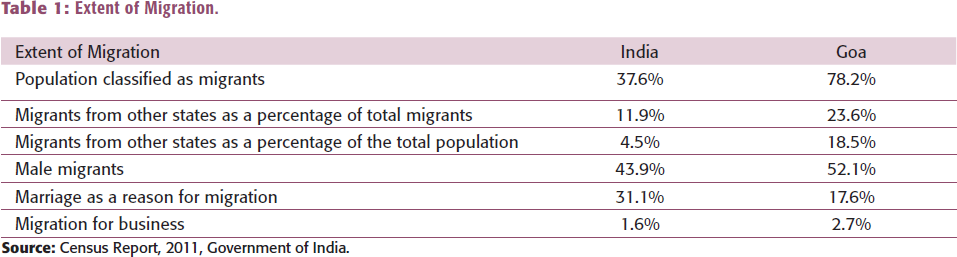
Under reason for migration, census collects information under various heads. Here, we look at only migration for ‘business’. Table 2 shows the volume of migration to Goa from other states in the country for the purpose of business.
Migration to Goa for Business.
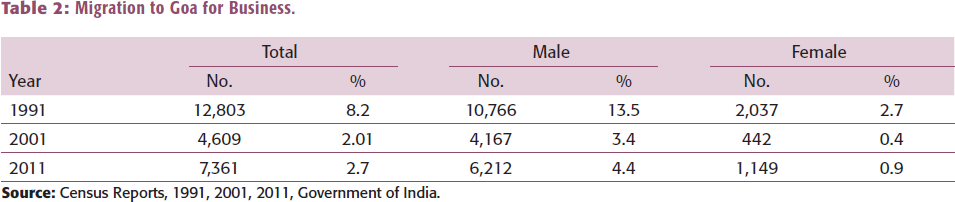
Among total migrants, only 8.2% reported moving to Goa for business in 1991. Among male migrants, while 13.5% cited business as the reason for migration, the proportion was 2.7% only for female migrants. It is intriguing to observe that by 2001, these figures had dropped to just 2.01% before improving marginally to 2.7% in 2011. There is a gendered pattern in business migration as it is observed that business migration among females is extremely low and comprised less than 1% of total female migration in 2001 and 2011.
One reason for the fall in numbers from 1991 to 2001 may be attributed to the attainment of statehood in May 1987. Goa was formerly a union territory. The policies of the state underwent a change, and the promotion of the interests of the local populace, especially in matters of employment, is now a stated objective. This has been accompanied by a slow rise in nativist tendencies and anti-migrant sentiments. Another important factor may perhaps be that some of them experienced losses in business and preferred to take up wage or salaried employment rather than bear the risks of business in an uncertain environment.
Table 3 gives details of the top five sending states for business to Goa for the Census 1991, 2001 and 2011. It is observed that in 1991, Karnataka and Maharashtra occupied the top two spots. This is not surprising as these two states share common borders with Goa and account for the highest number of total migrants to the state. What is surprising is that these two states together accounted for nearly 80% of the business migrants, lending credence to Ravenstein’s laws of migration. Kerala at third place trailed far behind. The five states together accounted for 92% of the total business migrants in Goa.
Top 5 Sending States to Goa for Business (1991, 2001 and 2011 Census).
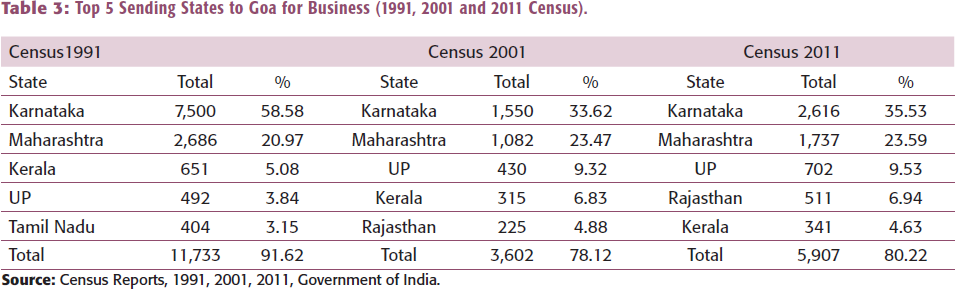
In 2001 too, Karnataka and Maharashtra retained the two top positions. However, their share declined to 57%. Uttar Pradesh now occupied third place while Kerala slipped to fourth position. Uttar Pradesh has a higher percentage share, though the absolute numbers came down, as was the case with Kerala too. Karnataka and Maharashtra continued to be the two top sending states of business migrants in 2011. Their combined share marginally improved to 59%. Rajasthan has preceded Kerala, indicating a change in the composition of business migrants over time.
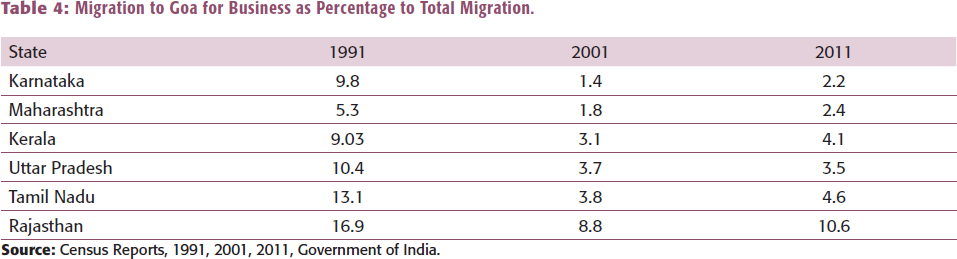
Table 4 shows the percentage share of migration for business. The top sending states have been considered for three census periods, 1991, 2001 and 2011. While the percentage shares have declined quite sharply for all states, Rajasthan shows a relatively higher share. This may be indicative of the growing difficulties for persons of non-Goan origin to set up business here. For Goa, economic reasons for migration have always been important. However, under economic reasons, the number of migrants for work/employment far exceeds that for business. While ‘work/employment’ constituted 27.3% of all reasons for migration in 2011, for ‘business’ it was only 2.7%.
Migration to Goa for Business as Percentage to Total Migration.
Rural–Urban Migration Streams
The four main streams of migration—rural to rural, rural to urban, urban to rural and urban to urban—provide important insights into the nature of migration. The general notion is that there is widespread migration from rural to urban areas. This is due to a decline in agriculture and a lack of viable alternative employment opportunities in the villages. It is assumed that in the urban areas, there will be more economic opportunities and year-round employment. In the case of business too, the implicit assumption is that businesses will do better in urban areas compared to rural areas. Hence, it is important to understand migration streams in the case of business.
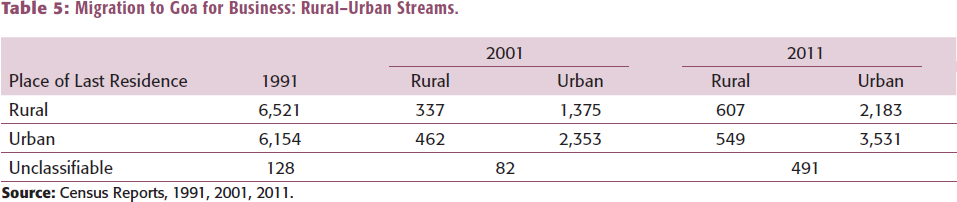
From Table 5, it is observed that in 1991, the number of migrants from rural areas is higher than that from urban areas. However, during the next two decades, migration for business is higher from urban areas. In the destination too, business migrants mostly prefer to settle in urban areas. This asserts the fact that urban areas are more robust and thriving economic centres. It is to be noted that the number of individuals categorized as unclassifiable is increasing over time.
Migration to Goa for Business: Rural–Urban Streams.
Duration of Residence
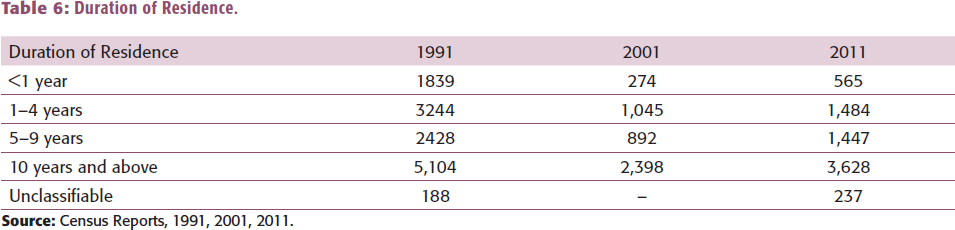
Analysing the duration of residence will enable us to understand if the migrants are here for the long term. This has important policy implications for a small state like Goa. Table 6 shows that for all three census periods, a majority of the migrants have been residing in Goa for 10 years or more. This is followed by 1–4 years of stay. Migrants who have been in Goa for less than a year comprise the smallest group. Those seeking work/employment may move often as better opportunities open up; however, migration for business is generally for the long-term due to the cost of setting up a business unless, of course, business failures compel them to move or seek other forms of employment.
Duration of Residence.
Determinants of Migration: A Gravity Model Framework
This study uses census data to estimate gravity models in order to understand the relative importance of select variables in determining migration flows.
The early gravity models on migration used the variables of population and distance to understand the direction of migration flows. Here too, an attempt was made to find the influence of these two variables on migration from other states to Goa for the purpose of business and work. A pooled OLS regression was run to compare the results of the effects of these two variables on migration for work and migration for business separately. A similar exercise in the case of male and female migration for business has been attempted. It is already seen that there is a gendered pattern in the case of business migration. Hence, it is important to assess if these factors influence male and female migration differently.
GRAVITY MODELS AND RESULTS
Two gravity models (Models 1 and 2) are specified and estimated to identify the determinants of migration. Model 2 is an extended model.
Model 1: ln Mi = β0 + β1lnPopi + β2lnDist i + ui
lnMi = Natural log of immigrants from various states
lnPop i = Log of the population of other states
lnDist i = Log of the distance of other states to Goa
Model 1 hypothesizes that the volume of the population of the source state is directly related to the volume of outmigration from the state. On the other hand, the distance between the two regions is inversely related to the volume of migration. In other words, it is hypothesized that people move in larger numbers across shorter distances. A log–log regression model is used to test the hypotheses. It is expected that the coefficient for population will have a positive sign while the coefficient for distance will have a negative sign.
Model 2: ln Mi = β0 + β1lnPop i + β2lnDist i + β3 lnLit i + β4 lnGSDP i + ui
lnLit i = log of literacy rate
lnGSDP i = Log of GSDP.
This is an extended gravity model and includes the additional variables of literacy and gross domestic product of the source states. It is hypothesized that the higher the literacy rate, the higher will be outmigration. On the other hand, in the case of the gross domestic product of states, it is hypothesized that the higher the GSDP of the source states, the lesser will be outmigration of businesspersons. Hence, it is expected that the coefficient of literacy will be positive, whereas that of GSDP will be negative.
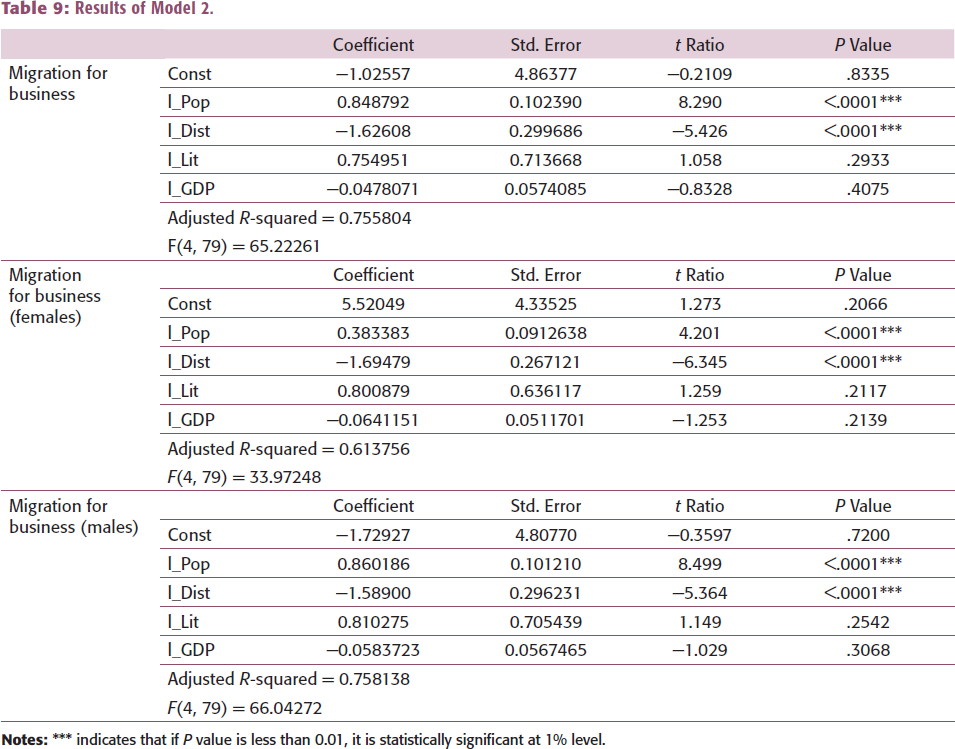
The results of Model 1 are given in Tables 7 and 8, and the results of Model 2 are given in Table 9.
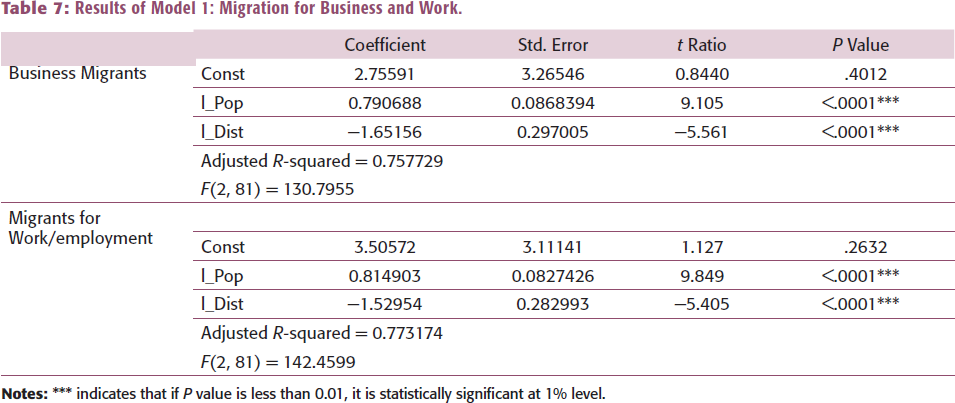
Results of Model 1: Migration for Business and Work.
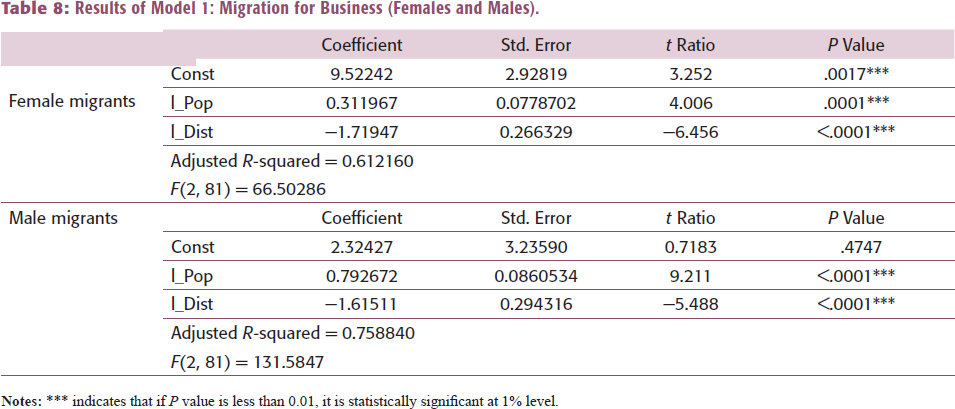
Results of Model 1: Migration for Business (Females and Males).
Results of Model 2.
Here, an attempt has been made to understand if the variables of population and distance affect migration for business and migration for work in similar ways or if there are significant differences. It is observed from Table 7 that the coefficients of population and distance are statistically significant at 1%, both in the case of migration for business as well as migration for work. As hypothesized, the coefficient of the population has a positive sign. This implies that the higher the population of the source state, the higher will be outmigration from that state. When the population increases by 1%, outmigration increases by 0.79% in the case of business and 0.81% for work. On the other hand, the coefficient of distance has a negative sign. This indicates that there is a fall in the volume of migration with an increase in the distance between the place of origin and the destination. While a 1% increase in distance causes a fall in migration for business by 1.65%, migration for work drops only by 1.53%. Adjusted R-squared is 0.757 and explains 76% variation in business migration, whereas it is 0.773 in case of migration for work and explains 77% variation in outflow due to changes in population and distance.
Though the size of the population and distance influence migration for business and for work in similar ways, it is observed that when there is an increase in population, outmigration for work is higher. Further, distance as a deterrent to migration is less pronounced in the case of work than it is for business. This may be explained by the fact that the volume of migration for work to Goa is much higher than that for business, which is quite negligible. This may also mean that it is easier to obtain wage employment in Goa than to start a business. The locals usually decline low-end jobs. On the other hand, with education still in the nascent stage in the state, highly skilled migrant professionals find it relatively easy to find jobs. Both these forms of employment fill an important gap in the local economy. In the case of business ventures by migrants, both, the state and the public, show growing hostility. This is more evident in the case of small businesses.
As observed in Table 8, the coefficients of population and distance are statistically significant at 1% in the case of both male and female migration. The positive sign of the population coefficient indicates that outmigration increases with an increase in population, whereas the negative sign of the distance coefficient indicates that long distances hinder mobility. While a 1% increase in population size leads to an increase of 0.79% in outmigration among males, female migration increases only by 0.31%. On the other hand, a 1% increase in the distance reduces migration by 1.62% in the case of males and 1.72% in the case of females. Adjusted R-squared is 0.758 for males and explains 76% variation in migration flows due to changes in population and distance. For females, the adjusted R-squared is 0.612 and explains 61% variation in migration flows.
From these results, it may be concluded that social restrictions on the mobility of women are still strong. The onus of providing for the family is mostly on the male members, and if there are no suitable openings available in the home state, they are compelled to venture out to other places in search of opportunities. Though migration for business is quite low even for males, it is obvious that barriers to movement are much stronger for women.
It is seen from Table 9 that the coefficients of literacy and GDP are found to be statistically insignificant. This means that education is not an important quality for conducting business. Also, GDP does not seem to influence outflows. On the other hand, as expected, the coefficients of population and distance are statistically significant at 1% in all three cases. A 1% increase in the population size of the source state brings about a 0.85% increase in outmigration for business. When assessed separately for males and females, it is 0.76% for males and 0.61% for females. In the case of distance, a 1% increase in distance brings down outmigration by 1.63%. For males, it is 1.59% and for females it is 1.69%. It is surprising that even with advances in transport and communication facilities that have reduced the cost of travel, distance still influences the choice of destination. Adjusted R-squared is 0.755 and explains 76% variation in migration flows due to changes in these four factors. For women, the corresponding figure is 0.613 and explains a 61% change in outflows due to changes in the four factors under consideration.
BUSINESS MIGRATION INTO GOA: AN ANALYSIS BASED ON FIELD DATA
A survey was conducted of 100 self-employed migrants in Goa selected on the basis of purposive sampling. These individuals are from the two districts of Goa: North Goa (57) and South Goa (43). The respondents were selected according to the National Sample Survey Office (NSSO) definition of self-employment. NSSO defines the self-employed as
Persons who operate their own farm or non-farm enterprises or are engaged independently in a profession or trade on own-account or with one or a few partners. The essential feature of the self-employed is that they have autonomy (i.e. how, where and when to produce) and economic independence (i.e. market, scale of operations and money) for carrying out their operations.
Among the respondents surveyed 28 are from Karnataka, 12 each from Rajasthan and Kerala, 10 from Gujarat and 6 from Maharashtra. These five states account for 68% of the self-employed persons. They are engaged in a variety of businesses ranging from plumbing and carpentry to the mine owner with 26 trucks. There are fruit and vegetable vendors, a fisherman who owns a few boats and a trawler, a beautician, an interior designer, jewellers and tailors. Others own grocery shops, sweet shops, furniture outlets, a clock factory, stationery shops, photocopying units, transport company, travel company, general stores, hotels, mobile and mobile accessories shops, sawmill, plywood and hardware shops, catering, coir and coir products, handicrafts and real estate. Some among them are contractors.
All the mithai shops are owned by Rajasthanis. They also own mobile shops. The Gujaratis are mostly in the hardware and plywood businesses and real estate. All the respondents from Udupi are in the hotel business, whereas nearly 80% of the respondents from Kerala are contractors. The interior designer from Mumbai and the beautician from Mizoram seem to reinforce stereotypes. There are some inspiring rags-to-riches stories too. Naresh Bhai, a Gujarati, came to Goa as a 14-year-old with ₹15 in his pocket. When he got down at Madgaon railway station, all he had was the address of a neighbour from back home who owned a sawmill here. Despite not knowing a word of Konkani, he managed to find him and began working for him. Today he owns four sawmills and three other businesses, a luxurious two-storey bungalow and a few cars. A contractor from Kerala came here after an agent who promised to take him to the Gulf duped him. Having borrowed heavily from relatives and friends to pay the agent, he fled to Goa. Today his annual income is in crores and he has repaid all his creditors with interest. A bhelpuri-wala from Uttar Pradesh began by selling bhel on a cart. He now owns three shops, two of which he lets out on rent.
Below is an account of their work and experiences in Goa:
Demographic Profile
From the demographic profile of the respondents, the commonalities, if any, among the persons who came to Goa for business may be identified.
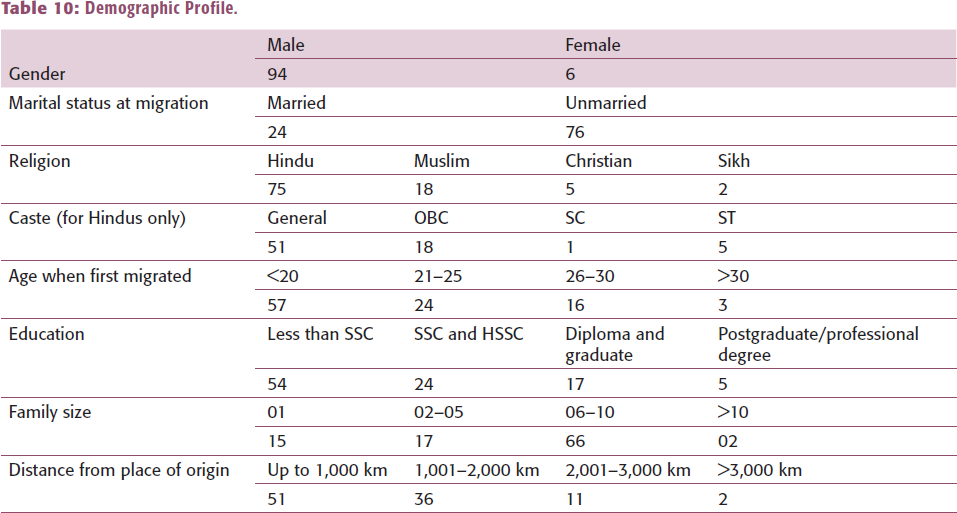
Table 10 shows that most of the self-employed persons in Goa are male, Hindu and belong to the general caste. Most have low educational attainment. They generally migrate at a younger age. The propensity to migrate diminishes with increasing age. Most of the migrants are from regions close to Goa. There is a tendency for the numbers to dwindle with an increase in distance.
Demographic Profile.
Push–Pull Factors Influencing Migration
The forces of attraction and repulsion that exist at the destination and place of origin, respectively, compel individuals to leave their home and venture out in search of greener pastures. The various push factors cited by the respondents for moving out include lack of employment (37), poor financial situation (26), low wages (4), inadequate land holdings (3), natural disasters (1), religious/caste persecution (2), family disputes (8), marriage (2) and others (17).
The pull factors cited for moving to Goa are better employment opportunities (42), better working conditions (12), presence of family or friends (13), followed family/friends that came here earlier (9), safe and congenial atmosphere (8), higher incomes (4), proximity to hometown (3), better facilities (2) and others (7).
It is evident that economic factors predominate in both push and pull factors. However, it is interesting to note that social factors such as the presence of family and friends, following family or friends who came earlier and proximity to hometown also exert an important influence on the choice of destination. Thus, it may be stated that socio-economic factors are important determinants of the migration decision.
Economic Impact of Migration on the Goan Economy
The benefits from migration have been assessed for the local economy. Businesses create jobs, generate income and demand and, in turn, boost the volume of consumption and savings.
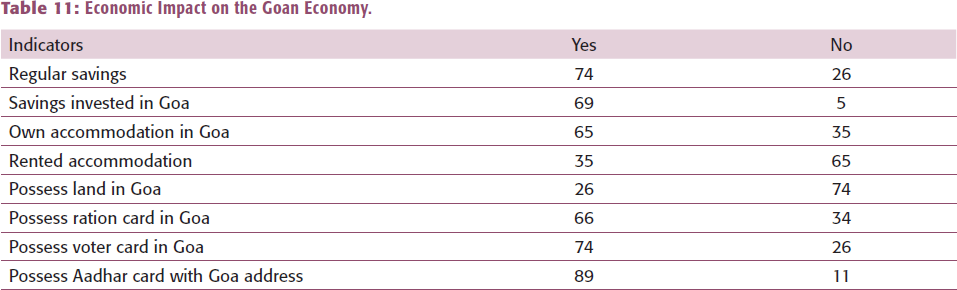
Table 11 shows that most people save and invest their money within Goa. They generate demand in the housing sector, which is a core sector for economic growth. Most have acquired important documents, which imply that they have migrated to Goa for the long term. This has important implications for the Goan economy. If the scale of the business is large, it generates employment opportunities. Goa is a consumption-driven economy. Hence, in addition to the provision of essential commodities and services, the migrant business community generates consumption demand also, thus raising aggregate demand levels in the state. Most of the respondents were reluctant to reveal their income and expenditure. However, it may be safely assumed that their consumption, savings and investment activities generate additional demand in related sectors.
Economic Impact on the Goan Economy.
Perceptions about Goa
It is important to understand the attitude of the migrant businesspersons towards the host state. The insights gained can help in shaping migration policies that protect the interests of all stakeholders.
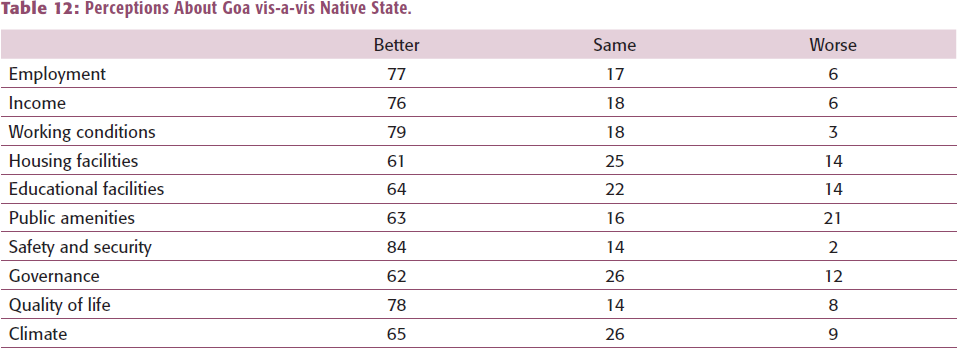
While a majority of the respondents have a favourable opinion about Goa, as observed from Table 12, a few believe that housing facilities, governance and provision of public amenities are better back home. An important concern is the high cost of living in the state. Public transport, especially taxi fares, and rents are quite exorbitant in the state. Housing, education and governance are areas identified where the state needs to improve its performance.
Perceptions About Goa vis-a-vis Native State.
Issues of Discrimination
Though empirical evidence suggests that migration greatly benefits the receiving region too, it is observed the world over that there is a growing tide of resentment against the migrant and he is viewed with suspicion and hostility (Table 13). This is natural given the rising competition in all sectors and the relative scarcity of all resources, natural and material. It is important for migrants to feel safe in their adopted land. The spirit of cosmopolitanism (Tumbe, 2018) must replace nativist tendencies.
Issues of Discrimination.
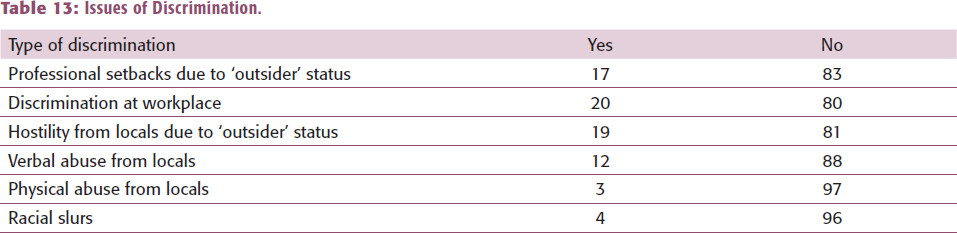
This study is part of a bigger study that looks at economic migrants employed in other sectors of the economy. It was found that the self-employed are more prone to discrimination and hostility. The corresponding figures for those employed in the unorganized, private and government sectors are negligible. A jeweller from West Bengal narrated how he was falsely implicated in a case by local business rivals and thrashed by the police. He was quite upset that even after proving his innocence, the police did not express any remorse. Racial slurs include terms such as ‘bhailo’ (outsider) and ‘ghati’. Ghati actually refers to the inhabitants of the Ghats. It is now used as a generic term to describe all non-Goans.
A few businessmen said that, overall, the situation is much better in Goa as compared to other states with very few instances of actual violence. Many acknowledged the fact that in their home states too, the migrants are not treated fairly.
Remittances
The greatest benefit for the migrant’s household back home is the improvement in the standard of living. This is achieved through the remittances sent by the migrant. Sixty- four persons said they send remittances home. Among the 36 who do not send remittances, the reason cited was either that the entire family had moved here or that their parents were no longer living. Another reason was that the family was financially well off and did not need support. Those who send remittances do so regularly (24), intermittently (30) or only when they visit home (10). These remittances are used for various purposes by the households. The primary use of remittances includes subsistence (38), medical expenses (9), savings (8), education (3), debt repayment (2) and purchase of land/vehicle (1).
PERPETUATION OF BUSINESS MIGRATION
The process of migration is self-sustaining. Networks provide useful information about conditions of work. Twenty-two respondents said that their choice of destination was influenced by the presence of family and friends here and 66 respondents stated that they received immense support from the existing network to establish their business. In return, they have helped others from their hometown to come here and set up business. Fifty-three businessmen said that they have helped others from back home to come here and set up shop. While 39 persons have brought up to 5 individuals each, another 7 individuals have brought between 6 and 10 persons here. Seven others have brought more than 10 persons. The majority (46) have helped these individuals set up businesses in a similar line, whereas in the case of the remaining, the persons they brought here chose a different line of employment. It is mostly the contractors and shop owners who bring their relatives and neighbours here. They initially work for them and over a period of time, accumulate sufficient experience and capital to set up their own business.
CONCLUSION
Statistical data from census reports show that migration is an important characteristic of the demographic profile of Goa as compared to India as a whole. Migrants from other states constitute 23.6% of all migrants in the case of Goa, whereas it is less than 12% for India. While the proportion of female migration is generally greater due to marriage, Goa is one among only eight states to report a higher proportion of male migration. Migration for business is quite low for both, India as well as Goa with the figures standing at 1.6% and 2.7% only, respectively.
The highest number of migrants for business hail from the neighbouring states of Karnataka and Maharashtra, which share common borders with Goa. However, when compared to other reasons for migration, it is observed that migration for business is negligible. They mostly migrate to urban areas in Goa, an indication of the prevalence of better opportunities and facilities in the developed regions. Further, it is observed that during all the three census periods under consideration, the maximum number of migrants have resided in the state for ten years or more. Thus, it may be safely concluded that migration for business is essentially a long-run phenomenon.
From the results of the gravity models, it may be inferred that the size of the population of the source state is an important determinant of migration flows. This is because as the population increases, there is greater pressure exerted on scarce resources. Hence, businesspersons look at investing in regions with less competition for space and resources as the cost of setting up a business will be lower here than in the case of the home state. In comparing how the size of the population of the source state influences migration for business and migration for work, it is seen that though the effects are similar, more workers move out compared to businesspersons. In the case of distance, it deters the mobility of businesspersons more than workers do. Again, when a comparison is made of the effect of these variables on male and female migration for business, it is observed that when the population of the home state increases, it is men who move out in greater numbers than women. On the other hand, distance is a stronger deterrent for female migration than it is for men. Census data on migration reveal that social reasons for migration like marriage, moved after birth and moved with family continue to be more important than economic reasons for migration among women. Literacy and GSDP do not seem to influence migration flows. Education is not an important requirement for conducting business. That high economic growth in the home states does not prevent outflows seems to suggest that people move out not because of lack of economic growth at home but because of better opportunities or lower costs at the host state. Thus, it is seen that the size of the population of the source state and distance are important determinants of business migration.
In the case of the primary study, it is observed that the majority of the businesspersons are male, Hindus and belong to the general category. To succeed in business, educational attainment is not very important, as 50% have studied only up to SSC or below. Seventeen per cent never went to school. Most migrate at a young age: 81% migrated when they were less than 25 years. For the vast majority, Goa has been the first place they migrated to. People generally migrate to closer areas. Economic reasons comprise important push factors whereas social factors assume growing importance in the case of choice of destination. Many secured jobs here initially through their networks of friends and relations. They also received help and support from them when they set up their own business.
It is seen that many among the group have small businesses and they are quite content with their earnings. The multiplier effect generated from their consumption and investment activities benefits the Goan economy greatly. Overall, the respondents have a favourable impression about working and living conditions in Goa. Very few reported instances of discrimination and abuse. The respondents are here for the long term. They have settled by building a house, buying land, acquiring important documents and intend to settle here. They help their families back home by sending remittances. In addition, they help to sustain the process of business migration by helping others from their hometown to set up business in Goa.
It may be concluded that the number of business migrants vis-a-vis other migrants is quite low in the state. By providing suitable incentives and support facilities, the government can improve these numbers. It is important to attract business to Goa as it will generate jobs within the state. There will be indirect benefits through the multiplier effect too. The migrant business community in Goa is generally happy with the conditions here, which implies that there is much scope to increase migration for business into the state.
Footnotes
DECLARATION OF CONFLICTING INTERESTS
The authors declared no potential conflicts of interest with respect to the research, authorship and/or publication of this article.
FUNDING
The authors received no financial support for the research, authorship and/or publication of this article.

P. S. Devi is an Assistant Professor in Economics at Sridora Caculo College of Commerce and Management Studies, Mapusa, Goa, with over 20 years of teaching experience. She completed her PhD in Migration Studies from the Goa Business School, Goa University.
e-mail:
P. K. Sudarsan is (Retd.) Professor of Economics at Goa Business School, Goa University, Goa, with 35 years of experience in academics and research. He was the Vice-Dean (Research) and has several publications in national and international journals. Fourteen students have successfully completed PhD under his guidance. He was a member of the Goa University Court and Academic Council.
e-mail: