




Abstract
The Indian information technology (IT) sector is traditionally known for delivering IT and business process management (BPM) services to clients across the globe. To ensure the longevity of this client and service provider relationship, Indian IT organizations have made significant client-specific investments and actively engaged them in offshore development activities. One of the outcomes from such investments can be seen in terms of the very high maturity standards that Indian IT organizations currently exhibit in the context of IT–BPM service delivery. In recent times, these organizations are also undertaking offshore projects around emerging technologies. Such projects, especially those related to artificial intelligence (AI), are largely centred around the automation of client-focused BPM services. Given their relative nascency, such projects are primarily led by the AI research units that are rapidly diffusing across Indian IT organizations. In this study, we rely on a four-month-long ethnography to explore a client and vendor (or service-provider) relationship as manifested through one such AI research unit of an Indian IT organization situated in Bengaluru, India. Our objective from this study is to understand how these new offshore AI projects affect the longevity of the relationship between clients and the Indian IT service providers. Given the nature of emerging technology workflows, our findings indicate a tilt more towards meeting client-side expectations than that of vendors in these projects. We portend that this can potentially disrupt the longevity of the client–vendor relationship in the Indian IT services sector, and, therefore, both the clients and vendors must attend to the peculiarities of offshore emerging technology projects to mitigate such disruptions.
The Indian information technology (IT) sector is globally acclaimed for providing IT software and business process management (BPM) services to clients from a variety of industry sectors—such as healthcare, logistics, banking and so on. Such services were relatively outside the clients’ core business activities, and offshoring them to vendors from developing countries like India was seen as cost-effective, resulting in a steady stream of IT-related work projects for the vendors. It also helped clients focus more on their core business activities essential to sustain competition (Oza, 2006). Indian service providers ensured the longevity of their relationship with their clients by making client-specific investments and actively engaging them in offshore development activities. They ensured a higher quality of service delivery to clients by following standard process methodologies and by achieving some of the highest process maturity levels, measured along the capability maturity model, 1 they became highly preferred offshore destinations (Cusumano et al., 2003; Jalote & Natarajan, 2019). Today, the IT–BPM services exported by Indian service providers account for a staggering 38% of the total services exports from the country (MEITY, 2017).
Although the Indian IT–BPM service providers started their journey by providing services at the lower end of client’s value chain, they have been consistently moving up, thus ensuring an ongoing flow of IT–BPM-related projects from existing and new clients. The client–vendor relationships in this sector have thus seen an entire arc, with these organizations starting by offering simple coding services for maintaining client software and with time, moving up the value chain by taking up design, implementation and deployment of customized software for their clients. In the context of BPM too, the client–vendor relationship saw an evolution from Indian service providers starting with low-end services driven by labour and cost arbitrage such as the call centres and back-office services and then moving to offer high-value customer interaction services for client’s business applications, customization of enterprise resource planning systems for suiting client’s business needs and so on (NASSCOM, 2017).
Today, given the importance of emerging technologies for the digital transformation of client’s businesses, a new era has unfolded for Indian service providers. As vendors, they are getting outsourced projects from their existing clients around technologies such as artificial intelligence (AI) and Cloud. Research labs/units to garner expertise in such technologies are rapidly diffusing within the Indian service provider organizations. Technology giants such as Infosys, Wipro, HCL and several others have already established research labs/units to cater to the custom AI requirements of their clients, over the past five years (NASSCOM, 2018a). For clients, the need to extract actionable insights from an ever-increasing volume and variety of data about their business activities is becoming essential to offer personalized services to their customers to remain competitive (Abbasi et al., 2016; Chen et al., 2012). Following this trend, the clients are now seeking AI-integrated software/cloud solutions from Indian service providers to get closer to their customers. They are also looking towards Indian service providers for augmenting their business processes with emerging technologies (Fersht & Snowdon, 2016). These emerging technology projects are pivoting the Indian IT sector towards a new stage in their client–vendor relationships.
Given this scenario, the objective of this study is to understand how the new emerging technology projects could impact the longevity of client–vendor relationships in the context of offshoring in the Indian IT sector. We address this by illustrating an evolving client–vendor relationship in an emerging technology project in an offshoring context taken up by an IT–BPM service provider. We rely on a four-month ethnographic study in an AI research unit of this IT organization located in Bengaluru, India. This organization is an established services provider to clients from various industry verticals, across the globe and has been delivering IT–BPM services for over the past 25 years. With a newly established research unit, it is now providing AI solutions to clients to meet their digital transformation expectations. Our findings indicate a dominant influence of clients’ expectations in an evolving client–vendor relationship that is manifesting in the context of offshore AI projects. This turns out to be the result of carrying on with the existing rubric meant for ongoing projects in the IT–BPM context and not realizing the differing context of emerging technology work. We discuss the differences between the workflows of these two, very different kinds of projects. We conclude by emphasizing the importance for both, clients and vendors, to address these AI-specific peculiarities to avoid any disruption to the longevity of their mutual relationship.
BACKGROUND
Factors Affecting the Longevity of Client–Vendor Relationship
Offshore outsourcing of non-core administrative and technical activities has become a mainstream practice for clients in the IT–BPM landscape. India is the world’s leading outsourcing destination and the vendors from here are known for their best practices around software process improvement and customer relationship management (Cusumano et al., 2003; Oza, 2006). Although clients have the freedom to choose from or switch between many vendors, extant literature observes that the client–vendor relationship in the context of offshore IT–BPM services is predominantly a long-term one and depends on both client-side and vendor-side factors (Manning et al., 2011; Rajkumar & Mani, 2001). See Table 1 for a short summary of such factors drawn from existing literature.
Factors Affecting the Longevity of Client–Vendor Relationship in the Offshore Outsourcing Context.
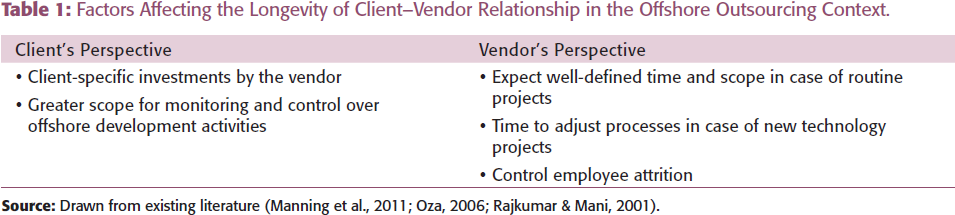
The client–vendor relationship is formally sustained through work contracts or service-level agreements. However, in addition to these, there are many ‘social exchange factors’ not written into these contracts or agreements which play a significant role in sustaining the longevity of a client–vendor relationship in the IT–BPM offshore outsourcing context (St. John et al., 2014). Client-specific investments that the vendors make, significantly affect the strength and longevity of client–vendor relationship. Some of the investments include client-specific software, infrastructure and personnel training, and nurturing teams to specialize in client-specific industry verticals to gain sufficient knowledge about their businesses (Manning et al., 2011). Clients also feel comfortable when they are given greater scope for monitoring and control of their offshored projects. Vendors almost always provide first-hand access to clients to witness the capabilities and infrastructure within their offshore development centres (ODCs) (Oza, 2006).
While the aforementioned factors are important from a client’s point of view there are several factors from the vendor’s perspective which determine the success of this relationship. Some of them include—well-defined time and scope in case of routine projects, reasonable time to evolve specifications and adjust processes in case of new technology projects and minimizing attrition of employees working on these projects (Rajkumar & Mani, 2001). The former two factors benefit vendors because they could invest in processes that can accommodate diversity in their clients rather than building specific ones for each client. In the case of new projects, it is, therefore, necessary for clients to acknowledge any such process adjustments to avoid delays and cost overruns. Vendors, on the other hand, need to educate clients about such adjustments so that the projects can succeed and the longevity of their relationship can be maintained. Control of their employee attrition is important for vendors because employees are inarguably the reason for Indian service providers attracting offshore projects from clients. This becomes particularly important with the advent of emerging technologies like AI where vendor organizations are facing a fear of job losses owing to automation (NASSCOM, 2019).
Novelty of AI Projects and the Indian IT Sector
AI embedded within traditional information management systems is expected to have a profound impact on ‘human decision-making’ within organizations (Duan et al., 2019). An increase in volume and variety of data coupled with reduction in computation costs are together driving organizations to extract actionable insights from data by adopting AI and big data analytics solutions (Abbasi et al., 2016; Chen et al., 2012). Following this trend, clients from different industry verticals are now looking towards Indian IT service providers and their skilled workforce to reap benefits from AI. While AI is an umbrella term, our context focuses on the emerging use cases of AI typically seen in the Indian IT sector: proactive and preventive diagnoses in healthcare, knowledge management, risk prevention, fraud detection and identity authentication in banking financial services and insurance sector, increasing channels for customer acquisition in retail sector and so on (NASSCOM, 2018b). More importantly, clients are seeking greater automation within their outsourced business process services in anticipation of minimizing costs. Majority of AI-related projects that clients are offshoring to their Indian vendors are therefore of this kind where AI is employed to automate the routine manual work associated with clients’ business processes (Fersht & Snowdon, 2016; NASSCOM, 2017).
The development of AI-based solutions is different in many ways when compared to the traditional software services and their development processes. For Indian service providers who are well-known for their mature process workflows in the IT–BPM space, the new AI projects pose novel challenges. The key difference between AI projects and software-based projects is the centrality of data. Unlike AI projects, software projects are centred around software modules or programmes which can be developed/customized in relative isolation and integrated as per high-level design plans. This is the principle of modularity which enables software development to be realized through a clear division of tasks between different work roles (Ghezzi et al., 1991). AI projects, on the other hand, are centred around the specific data pertaining to a particular use case. Although they build on software programmes to conduct data pre-processing, machine learning (ML) model training and evaluation, these programmes developed for a particular use case may not work even in a slightly different use case having a different kind of data (Amershi et al., 2019). As a result, the need for back-and-forth interactions between clients (for their use cases) and vendors (who are building AI solutions for these use cases) at every stage in the project (design, implementation and deployment) and the complexity of such interactions increase significantly (Sculley et al., 2015).
The Indian IT–BPM service providers have already taken up this challenge of undertaking AI projects in an offshore outsourcing context. They are ahead of the curve in terms of offering tailor-made enterprise AI solutions for their clients, but lag behind in the space of building generic AI products and platforms (Krishnan et al., 2022; NASSCOM, 2018b).
DESCRIPTION OF OUR SITE AND METHODOLOGY
Our study is based on a four-month-long ethnography (between January 2020 and May 2020) conducted in an AI unit of an established IT–BPM services organization situated in Bengaluru, India. With over 25 years of IT–BPM service provision to clients across the globe, this organization recently established a centre for excellence on AI in the form of an in-house unit that works on AI-based projects. The unit mainly deals with prototyping and executing data-driven and AI-augmented business process services for the digital transformation needs of the organization’s clients. The unit has data scientists who are PhDs in management-related disciplines such as information systems, decision sciences, operations management and management science. They spearhead novel AI research projects utilizing off-the-shelf data and build advanced ML models relying on open-source programming packages, platforms and other online resources. While research projects related to AI are important, the key to sustenance for this unit is identifying AI use cases for its clients within its existing business process services offered by its ODCs. Client-facing roles such as business analysts and project managers conduct periodic visits to the ODCs to understand the nature of business process services and identify the scope for using AI. Clients expect AI augmentation to cut down process servicing costs and improve process efficiencies. They also give out calls for proposals related to AI augmentation for their business processes not handled by this organization. According to the head of this unit, experience of developing AI projects for clients, research-related AI projects, and knowledge of business process outsourcing conducted by ODCs of their parent organization, gives this unit an edge over other product-based AI companies. Once the proposal is approved by the client, business analysts, project managers and data scientists visit the client sites, including their ODCs, to map AI use cases. If use cases are novel, data scientists build quick prototype solutions that are later enhanced or ‘productionized’ by execution engineers—data engineers and junior data scientists—of this unit and delivered to the client.
The ethnographer worked as a full-time intern within this unit in an ongoing AI project to augment an existing business process service, provided by the ODC of this organization to one of its long-standing European clients. The objective of our ethnography was to understand the nature of work and interactions in Indian IT sector transitioning towards emerging technology projects and prospects for social mobility it offers to employees in general. Ethnography as a methodology is motivated by the works of Barley and Kunda (2001) who argue for bringing out complexities of work into the foreground to make sense of organizations in transition. They highlight the importance of workplace ethnographies as they allow in-situ observation of non-relational (specialized skills pertaining to a work role) and relational (nature of interaction with other roles) aspects of work conducted within organizations (Barley, 1990, 1996). Ethnographies also serve to link observations within an organization to the overarching changes happening within the environment that influence similar organizations belonging to a sector or an industry (Barley & Kunda, 2001; Upadhya, 2008).
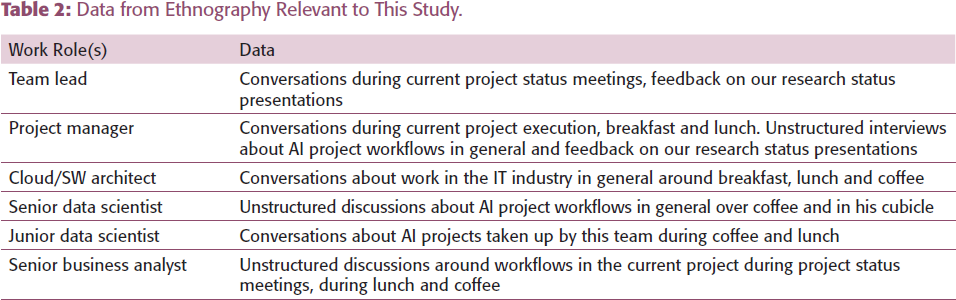
In our fieldwork, participant observation was the key. The ethnographer made quick memory markers for observations and impromptu conversations he/she was able to carry out at work each day, and at the end of the day, documented them in detailed field notes, which were shared with the second researcher. These field notes were discussed on a weekly basis, and we analysed it along with developments within the IT industry beyond this organization. Reflections that emanated from these regular discussions helped the ethnographer redirect his/her focus on observations and conversations in line with research objectives. For the purpose of this article which requires us to situate our observations around client–vendor relationship, we segregated our field notes (that ran into 114 single-spaced pages in Word and over 80k words) along each work role within this team. Summarizing the essence of observations, impromptu conversations and unstructured interviews, of actors occupying work roles at the helm of this unit allowed us to draw insights that are relevant to describing the client–vendor relationship and its influence. The unit is composed of close to 30 members, and we base this article on the insights offered by the team lead, two data scientists, a business analyst, a cloud/SW architect and a project manager—who were the senior members and were serving in client-facing roles during AI projects. Apart from data that came as a result of embedding into the project, ethnography allowed us to collect data through impromptu conversations, around coffee, breakfast and lunch breaks and unstructured interviews that the ethnographer was able to carry out during four months. Table 2 summarizes how the ethnographer interacted with these roles.
Data from Ethnography Relevant to This Study.
AN INDIAN IT ORGANIZATION WORKING ON AI PROJECTS
AI Projects for the Long-standing Clients
The primary objective of the AI unit within its parent IT organization was to garner expertise around AI, and, therefore, the key expectation from this team was to build IP cores around AI. With research efforts led by senior data scientists, this team has developed prototype AI/ML solutions around natural language processing, computer vision and graph-based ML as IP cores for this team. During their research journey, data scientists rely on open-source AI/ML packages and platforms—such as TensorFlow (spearheaded by Google AI) and PyTorch (developed by Facebook’s AI research lab)—to build their prototype models. IP cores accumulated by these members help the sales team of the parent organization to pitch AI solutions to clients that can augment their existing software and business process services. Some of them are also made available as generic products in online marketplaces such as Amazon Web Services for any customer to pay and access online. IP cores are also added during client projects insofar as their use cases are novel and on which the team has not worked before. Whenever there is scope for novel AI use cases within client business processes, data scientists initially build prototype solutions as proofs of concept (this stage is also referred by the team as hackathon) which end up as IPs, after which execution engineers develop them into final production-ready solutions for the clients.
The team lead believes that the aforementioned research strategy spearheaded by data scientists works best for this unit in both catering to client projects as well as garnering expertise around AI.
[L]ike all new emerging technologies, we will learn by trial and error, we will learn what will be the best model for AI engagements. We are currently stuck upon that whole hackathon and reiterative experimentation-based approach [where the team builds build proof of concepts] which seem to be working well for … as a company, may not be the same for some other company, where relationships and the types of clients they are dealing with are different.
In client-centric AI engagements, work roles such as that of the business analyst and project manager play a crucial role. Both these roles are client-facing, manned by people adept at working with clients for understanding requirements and eliciting projects. They team up as consultants to understand the business processes and obtain a first-hand experience of how they are managed either from ODCs of this organization or some other vendors—sometimes the in-house teams of the client organization itself. Their primary task is to translate the challenges and requirements between ODCs or software teams responsible for managing client business processes to their data scientists, who then map appropriate AI use cases for improving the efficiency of these processes. The project manager of the current AI project explains that the typical challenges lay, first, in translating the narratives of the ODC workers into understanding of their key processes and later figuring out the nodes where automation is feasible. It is fairly clear that this unit, despite its avowed goal of being set up as a research unit, has had to go beyond pure AI research projects to the more applied client-centric AI projects. According to the team lead (paraphrased quote from the ethnographer’s discussion with team lead),
If you take our team with 35 odd people, it’s a cost centre for the company. So not everyone in the IT industry can afford that.… Even after investing in the IP for example in our case for that matter, if we [fail to show] regular results in terms of the IP development for clients being signed up, I am sure the management [will lose] patience with us and [say] that … you guys are not building enough good quality IPs so let us all put you in consulting.
Tightrope Walk Between AI Automation and Job Losses
The rationale for AI projects taken up by this unit is largely driven by the client’s concerns in servicing their business processes. Automating business process-related work done in-house or by offshore workforce drives down costs for the clients. Such automation entails capturing the tacit knowledge of such a workforce and, therefore, also helps clients deal with attrition issues. In this regard, the project manager recounts his understanding,
[A]ttrition is high … people get 1- or 1.5-years’ experience and then move to [other] company … problem they [client’s team] said is that when they [workforce part of the process] leave, they take away lot of tacit knowledge along with them, and the new ones take lot of time in ramping up to this knowledge … tacit knowledge helps [them] to easily fill in some information without Googling … [client’s] productivity is going down because of this employee attrition.
Sometimes macro-level policy changes also push clients to adopt AI-based solutions. For one of the European clients from the legal sector, for example, a sudden policy change during Brexit called for an increase in their capacity to digitize contractual documents. This required the client to recruit more data-entry operators in their ODCs. Instead, it went for AI solutions that could augment manual work to increase the pace of such document processing.
In many instances, clients offshore both the management of their business processes and also their automation to a single vendor. In such cases, there the vendor has to do a tight-rope walk where it has to manage the pull for automation from clients and also work towards retaining its workforce whose jobs may be at stake due to such automation. For some in the research team, such projects merely augment the routine manual work of the ODC workforce rather than leading to job losses. For example, the nature of one such project is summarized by the business analyst of this team as follows.
The cost reduction by virtue of adopting AI technology … is only to replace the manual execution with automated execution. Despite AI-based automation, manual tasks may not completely come down because of the uncertainty in the accuracy of task execution by the AI models. Some amount of manual work, however less than what was present earlier, nevertheless exists.
Automation through AI is a real problem for Indian service providers who have been consistently relying on a large number of their offshore development workers to carry out client projects. Such workforce has historically been the basis of their long-standing relationship with clients. One of the senior data scientists (whose quote is paraphrased below) calls this as a ‘counterproductive strategy’ for Indian service providers.
[C]lients ask for AI solutions to IT-BPM companies … although IT-BPM companies work towards building such solutions and integrating it with the BPM services, like this team does, it’s actually in contradiction to the original selling point of companies like this … employee count or resource count is what makes IT service companies attractive for managing client business processes, now if AI solutions attempt to automate the work of many employees, then is it not counterproductive strategy for these companies?
Client Influence on the Nature of AI Work
The augmented AI solutions provided as services to clients often restrict the scope for innovation in this AI research unit. Because AI is also new for most of the clients, limitations of their data-management infrastructure and data-sharing concerns make it much more challenging for this unit to execute AI projects. These challenges are evident from the following narrative of a senior data scientist from this unit.
We have to struggle to convince them [the clients]. Often, they don’t know how to get data—there are data coming from disparate sources and systems—of course this won’t be worthy then, because for adopting ML, production systems must be online, data must come online in a manner that [wouldn’t warrant another round of manual gathering]. The client not very open to sharing data, [oftentimes] not enough clarity … on the meaning of data.… They ask for project plan, we give high-level overview, they ask for work breakdown [as per the usual Agile workflow], how can we give. Because there is a difference between ML and traditional SW, there is iteration and experimentation. Client sometimes says, why do you want to experiment on our systems?
Client-centric projects also push this unit to adopt AI models that are more explainable and interpretable and avoid using black-box models like deep neural networks. This has a more direct impact on AI innovation. One of the data scientists from this unit says,
[The] client was more comfortable with traditional statistical models … when we suggested deep learning … quoting explanation concerns he said no … we were getting 20% more accuracy with deep learning … but interpretability and explain-ability was more key so they were reluctant.
Even if the unit wants to actively pursue advanced AI/ML research to develop generic AI products, the data scientists claim that this is not an easy option given the client-centric focus of the parent IT organization.
If we take time for building advanced models and other things properly, then it may unnecessarily add more costs, and also can create more confusion to the clients which we have to explain … so, most of it is to do whatever possible to just meet the client requirements, not more nor less … this doesn’t give any time to work out things in a proper manner, build systems that we could enhance through time and so on.
Some members alternately look at the present client-centric AI projects as offering avenues to build a crucial competitive edge. They believe that Indian service providers have built agile work processes to dynamically respond to the changes in client projects. One of the junior data scientists with prior experience as a software developer says that the customer-centric processes which the Indian vendors have mastered will lead to currently high-in-demand customized AI solutions.
[T]his being a service delivery company we only give foremost importance to client … now big companies like Google and all are also coming to follow agile methodologies. Even though they were initially product based and were not very much in favour of such flows, now that AI requires customized solutions and not products per se, they are building verticals that are offering customized solutions.
The team lead also opines that the present client-centric projects are showcasing the way for Indian service providers to scale up the AI services value chain. Instead of providing only AI services by training and deploying data scientists for client consulting projects, bundling AI with traditional business process services works better for firms in terms of revenues. A mix of IP development and providing integrated AI solutions to clients is what he says will fetch good revenues for Indian service providers in future. During his interaction with ethnographer about the current client project, he says,
You have seen the kind of project talked about yesterday. Such a huge client-based project is close to impossible for companies which wish to work on standalone AI projects. Typical ones run into few thousand dollars but not into millions. Bundling with other services and selling integrated solutions will neatly fetch good revenues.
DISCUSSION
The quotes above point to the overwhelming influence of client requirements on the projects done by the AI research unit situated within the parent IT service provider organization. This is paradoxical in the context of a research unit that has an avowed mission of gaining substantive expertise in the space of AI and other emerging technologies. It has restricted the scope for innovation and pushed the unit further away from research on product-centric innovation. The client-centric projects largely revolved around automating the work of offshore development workers and additionally are posing to be a tightrope walk for Indian service providers. The latter have to tread carefully working on client-centric automation projects on the one end and minimizing job losses of the offshore development workers on the other. There are alternate voices that justified the predominant client influence on the functioning of this AI research unit. They saw the client-centric projects, and the predominant client influence on the nature of AI work being carried out by this team, as win–win for both the client and the vendor. Building customized AI solutions for clients, according to their needs, is considered as the main pathway for Indian service providers to scale the AI services value chain and to differentiate themselves from product-based AI companies. These findings appear to be contradictory, and only reiterate the importance of the context that we are talking about—AI research units embedded in parent IT/BPM organizations. Understanding this context is essential, because this seems to be the path laid out for the Indian IT sector of the future.
Clients and Client–Vendor Relationship in Emerging Technology Projects
Looking at vendor-side factors underpinning the longevity of a client–vendor relationship, the vendors will be better off when (a) the projects they are dealing with have a well-defined scope, (b) they are given reasonable time to adjust their process workflows incompatible to the new projects and (c) they are given adequate control to manage employee attrition (Rajkumar & Mani, 2001). However, in the context of emerging technology projects, we observe a greater weightage given to client-side factors over vendor-side factors. Our findings indicate that clients are allowed to have a significant say over how offshore AI projects get realized within the AI research unit. The expectations of clients are being laid down by the extant relationships in their existing software projects done by these vendors. We believe that considerable attention needs to be paid to vendor-side factors, particularly around building compatible project workflows and tackling the possible job loss of the offshore development workers. On the former, our ethnographic observations note that there are some tentative developments within the IT organization around building AI-compatible workflows and in educating clients about their deployment during future projects. But, as we see, concrete steps towards tackling employee attrition are currently lacking.
Address AI-specific Peculiarities to Avoid Relationship Disruption
AI projects require a drastic overhaul of process workflows when compared to traditional software development. For example, projects related to AI challenge the foundational principles of software engineering such as modularity and call for a complete rethinking of the development life cycle when compared to software development (Amershi et al., 2019; Sculley et al., 2015). Clients who wish to incorporate AI into their organizations must therefore acknowledge and understand such nuances when they offshore. To avoid disrupting the long-standing client–vendor relationships, it also becomes imperative for the clients to assess their readiness and capabilities towards incorporating AI into their systems before delegating AI projects to their vendors (NASSCOM, 2019). The contextual nature of AI solutions also expects vendors to involve clients at all stages in the solution development (Krishnan et al., 2022).
Limitations of Our Study and Future Work
Our study is limited by the kind of research context that we studied and the generalizations we could make. While there are several factors that determine the longevity of client–vendor relationship, we focused on specific ones that were manifesting in the context we studied. Therefore, it is to be noted that the generalizations we made in the foregoing discussion will be contingent upon how other factors that are discussed in the existing literature behave (Khan et al., 2009). For instance, the generalizations we made are applicable only to the IT–BPM service providers operating from India. They may not be applicable to other offshore settings such as the global capability centres of multinational software giants, or start-ups that engage purely on AI product development. Indian service providers are also heavily influenced by the industry and policy environment of the country. Therefore, while making any generalizations to other IT service providers beyond India, care should be taken to point out the difference in the industry and policy environments and how they could affect the longevity of client–vendor relationships in the era of AI.
CONCLUSION
Extant literature suggests that the longevity of client–vendor relationship in the Indian IT services sector revolves around the expectations of both, clients and vendors, being fulfilled. Some crucial client-side expectations include the extent of domain-specific investments made by the vendors, and the leeway that clients have in monitoring and controlling vendors’ offshore development activities. Some of the important vendor-side expectations include the well-defined time and scope parameters in case of routine projects and a reasonable latitude to adjust work processes in case of new technology projects. Meeting both these expectations also adds to the vendors’ ability to manage employee attrition issues. The findings from our study indicate that, in the newly emerging offshore technology projects, a greater weight ends up being given to client-side expectations over vendor-side expectations as compared to traditional IT–BPM projects. Through our organizational ethnography, we find clients significantly influencing the monitoring and controlling of offshore AI development activities along the lines of traditional IT–BPM projects. The vendors are unable to hone in on the newer expectations around emerging technology projects that are very different from the traditional IT–BPM projects. This could potentially affect vendors in their search for innovation in this sector, their capability to adjust their work processes and manage attrition of their offshore development workforce. This tilt towards meeting client-side expectations, in case of offshore emerging technology projects, can potentially weaken the long-standing client–vendor relationship in the IT services sector. We believe that clients and vendors must, therefore, acknowledge these emerging-technology-specific peculiarities and address them at the earliest to avoid any disruption to the longevity of their mutual relationship.
Footnotes
DECLARATION OF CONFLICT OF INTERESTS
The authors declared no potential conflicts of interest with respect to the research, authorship and/or publication of this article.
FUNDING
The authors received no financial support for the research, authorship and/or publication of this article.
NOTE
e-mail:
e-mail: