




Abstract
The tea estate workers of West Bengal have been victims of colonial oppression for generations. The experiences of the workers with oppressive business cultures have resulted in unique complexities within their behaviour. Migratory entrepreneurship will augur socio-economic growth among the tea estate communities while enhancing the efficiency of the tea estates. The present study explores the behavioural dimensions of migratory entrepreneurship among the tea estate workers of Bengal through a multi-dimensional approach which includes a discussion on the historical, socio-economic perspective, a field study on perceptions of migratory entrepreneurship among the garden community and a subsequent analysis of the results.
Migration is a behavioural phenomenon observed in many animals. Among humans, migration has been observed since ancient times. As such, the human brain is often described as constantly adapting livewire (Eagleman, 2020), which has evolved to enable humans to migrate and survive in perceivably alien locations. Migratory behaviour in humans might have dysfunctional causes such as war, genocide, famine, drought or economic reasons for better quality of life or professional opportunities. It is often the case in human migrations that one entity emerges as the loser. Consequently, although human brains can adapt to new conditions, humans are hardwired to avoid migration until absolutely necessary.
The German-English geographer Ernst Georg Ravenstein was a pioneer in the study of human migration. He developed a set of laws which sought to explain human migratory behaviour. Ravenstein (1885) recognized that economic factors were the most important reason for migration and claimed that most migrants travelled short distances to their destination, which was natural given the lack of sophisticated land transport. However, Ravenstein (1885) explained that human migration occurred in stages, and migrants moved from one place to the other in search of appropriate work and settled in a place which was in fact far from the place of origin. Ravenstein termed this phenomenon ‘migration by stages’ (Ravenstein, 1885, p. 183). Ravenstein (1885) classified areas into two categories: counties of dispersion (those that witnessed high levels of outward migration to other areas) and counties of absorption (those that witnessed high levels of migration from other parts into the area). Ravenstein (1885) posited that migration from an area led to a counter-current wherein individuals migrated to the area from where migration had taken place. Ravenstein’s laws were woven around these basic posits and claimed that while native dwellers of towns were less migratory than their counterparts in the villages, females were more migratory than males especially over shorter distances.
Lee (1966) proposed a model of human migration where migration was described as de facto process with an initiator, an obstacle and the destination or outcome. Lee (1966) proposed that a set of factors at the point of origin would serve as the motivator for migratory behaviour, a set of obstacles (could be physical obstacles such as oceans or mountains or man-made ones such as walls, or laws or even psychological obstacles) would act as the barrier to such migratory behaviour and a set of factors at the destination would make it a choice for the migrants. Lee (1966), however, stated that decisions to migrate are ‘never completely rational, and for some persons the rational component is much less than the irrational’ (p. 51).
Migration presents unique and interesting behavioural patterns. Da Vanzo (1983), in his studies, posited that even though most individuals avoid migration, those who move have a propensity to move again, often returning to their homes. Kennan and Walker (2013) explained that migratory decisions are usually made on expectations, and in all such decisions, the home remains the favourite option wherein migrants can return if the actual outcomes are different from the anticipated outcomes. Thus, areas which experience high outbound migration also witness high inbound migration. While studies on migration often relate economic migration to jobs (both skilled and unskilled) and primarily, thus, involve wage earners, humans have also migrated with entrepreneurship as the objective. Entrepreneurship migration as a form of economic migration should lead to job creation and expansion of the economy. Entrepreneurship migration now contributes significantly to economies worldwide. Giulietti et al. (2012) reported that in China, ‘as much as 25 per cent of the migrant labour force had started their own business’ (p. 97). Since migratory decisions involve substantial risks, migrants are perceived to be risk-averse, a trait that augurs well in entrepreneurial decisions. Neville et al. (2014) described migrants as ‘dynamic risk-takers who are inherently more prone to becoming self-employed relative to others’ (p. 58). Sjaastad (1962) had treated migratory decisions as investment decisions, in that context, entrepreneurial migration can, thus, be explored as an aggregation of two investment decisions; that of entrepreneurship and then of migration. Portes (2019) explained, ‘The essence of the economic case for migration is very simple: it is the same as the case for markets in general. If people make decisions on the basis of their own economic self-interest, this will maximise efficiency, overall output, and, at least on some measures, welfare’. In this context, migrant entrepreneurship presents as a singularly positive socio-economic activity. Entrepreneurial migration is common in developing countries, especially among workers from struggling industrial sectors. In addition, the negative socio-economic situations prevailing in certain rural areas also precipitate urban migration. Several researchers have posited that the initial intentions among the migrants are to secure salaried jobs but then are forced to begin small-scale entrepreneurial ventures since jobs are often limited and hard to come by (Ndoen et al., 2002; Wood, 1981). Migrants with relatively limited education and skills opt for entrepreneurships primarily due to their inability to meet the required qualifications for jobs; entrepreneurial activities require limited formal qualifications. Consequently, it would not be puerile to concur that labour migration and entrepreneurial migration find their source within essentially the same motivating factor; improvement of economic standards. Ndoen et al. (2002), thus, posited that ‘Entrepreneurial migration is only a variantof labour migration’.
Migrant entrepreneurships, especially from closely knit communities like tea estates, often create significant functional impacts on the socio-economic structure of an area. Entrepreneurial migrants create jobs and provide spaces for those from their community to migrate, work as apprentices under the existing migrant entrepreneurships and then move to create their own entrepreneurial ventures. Migrant entrepreneurships create socio-cultural cohesion and widespread respect for their communities by dispelling prevalent myths and biases. This could be particularly relevant in the case of migrant entrepreneurships from the tea gardens. It should be recognized that migrant entrepreneurships often create and maintain unique supply chains of distinctive non-transferable skills and exclusive ethnic products among urban neighbourhoods. In this regard, Lintner (2015) posited that; ‘The potential of migrant entrepreneurship lies on the positive impact in the human rights space in terms of participation, resilience and empowerment. Therefore, entrepreneurship among migrants must be seen as a new arena for social, economic and political action.’ Lintner (2015) further explained that migrant entrepreneurial activities depend on many factors, and different entities play a role in the conduct of their business. Kloosterman et al. (1999) described this phenomenon by the term mixed embeddedness, wherein it was explained that the successes of migrant business activities do not solely depend on the networking that ensues among the migrant community but also among the socio-economic environment of the community where the business is conducted. Consequently, it can be inferred that the nature of the business and the extant socio-economic variables of the place wherein such business is conducted determine the outcome of migratory entrepreneurships.
This paper relates to a specific case from the tea estates of West Bengal wherein entrepreneurial migration might be considered a fundamentally functional phenomenon and, thus, could be encouraged. Behavioural dynamics among the tea estate workers present with embedded historical, socio-cultural and socio-economic complexities, some of which are difficult to comprehend as outsiders.
The study presented seeks to explore the dynamics of migratory behaviour among the tea estate workers of West Bengal in the context of entrepreneurship and business. The discussion in this context is presented in several distinct but interconnected parts. The first part of the discussion opens with an overview of the history of the tea industry in West Bengal and the crisis that the industry has experienced in recent decades. A theoretical model for entrepreneurial migration involving decision problem analysis is presented after that. The discussion is then subsequently placed in the context of a field study conducted among high school students from tea garden schools and some individuals who have migrated away from the tea estates. The findings from the study are then collated and analysed.
BACKGROUND AND HISTORY OF THE TEA INDUSTRY IN WEST BENGAL
Pre-independence
In 1776, an English Botanist named Sir Joseph Banks was the first to propose tea cultivation in India. Organized tea cultivation in India began in 1833 for the British East India Company. In 1862, tea plantation began in the Terai region of West Bengal, with James White setting up a plantation named Champta. By 1877, the Dooars and Terai area of West Bengal had 13 plantations (Griffiths, 1967). The colonial coercive plantation model based on slave-dependent labour forces in the United States, the Caribbean and the colonized parts of Africa was applied in part to the tea industry in India.
The tea estates in India were situated in backward forested areas with limited communication with the outside world. The British forced thousands of poor, impoverished, landless tribal workers from Santhal parganas, Chota Nagpur plateau, Orissa and other tribal-dominated areas to migrate to the tea estates as bonded labourers who were paid little or no wages. The workers were either coerced or manipulated with the promise of a better livelihood to migrate; at times, the help of middlemen or agents called arkattis were used for the purpose (Behal & Mohapatra, 1992). The workers lived under the strict control of the colonial management in labour colonies called dhuras; each dhura had a sardar to control the tribe. Every aspect of the workers’ lives, including marriage was controlled by the management. In fact, a grotesque practice among the management was to force single workers to pair and produce offspring who would form the next generation of workers in the tea estates. Punishments for even small mistakes included caning and severe beatings. Facilities for the health and hygiene of workers were absent, thus, there were frequent outbreaks of epidemics among the severely malnourished workers. The workers were deliberately forced to depend on the management for their daily survival needs such as food, ration and housing.
POST-INDEPENDENCE
The situation in the tea industry changed substantially after the independence and the first recognized labour union was formed in 1947–1948. Further, in 1951, the Plantation Labour Act came into force, and the legislation covered the tea industry. Unfortunately, the relationship between the estate management and the workers did not radically change from the British era, and the exploitation of the workers by tea estate management continued even after independence. However, the exploitative techniques in independent India were subtle, thus, they were often ignored.
The 15th Indian labour conference was held in 1957, wherein it was decided that minimum wages for industrial workers would cover food and living costs for three units of consumption in a family. However, the association of employers claimed that since members of a family (male and female) worked in the same industry, the unit of consumption should be 1.5. The union government at that time insisted that the decision would be implemented only if there was unanimity. Thus, a game of ultimatum ensued, eventually resulting in the labour unions opting for something over nothing (Bhowmik, 2011).
The workers were, thus, still forced to work in the tea estates for generations on meagre wages because they were not given land rights, and houses were owned by the tea estate management. Since they had been uprooted from their original homes nearly two centuries ago, the workers had no connection or kin to look forward to. The workers or their children were rarely promoted to managerial positions even if they had the requisite qualifications; there is no system of promotion among the workers too. A significant percentage of workers, especially female tea pluckers, do not enjoy permanent jobs and are employed on a contractual basis. There are primary healthcare centres within most tea estates but these facilities lack infrastructure, qualified physicians and lady doctors.
CRISIS IN WEST BENGAL’S TEA INDUSTRY
In the mid-1990s, when the Indian tea industry faced an existential crisis, the condition of the tea estate workers in West Bengal deteriorated further. The reasons for the crisis were multiple and complex, but competition from countries such as Sri Lanka and China, a decrease in exports, fall in tea prices coupled with an increase in the cost of production were cited to be the main causes for the crisis (Das & Das, 2009). As a result of the crisis, many tea gardens witnessed abandonment by the management. Since the workers depended on the management for their survival, this led to a humanitarian crisis and even starvation deaths. The acute crisis in the tea industry led to dysfunctional behaviour, and the region witnessed a rapid increase in human trafficking. It has been reported that between 2000 and 2015, almost 1,400 people died due to poverty-related issues in 17 tea estates of North Bengal while the survivors are reported to be severely malnourished, as was evident when some presented with BMI as low as 14–15 (Chaudhuri, 2015).
While various extraneous factors have been cited as reasons for the crisis within the tea industry, an analysis of the colonial plantation model on which tea estates are still managed in the 21st century presents a significant cause for introspection. The tea estates were designed as self-contained units with health, rations and other facilities taken care of by the garden management. The lack of a communication network necessitated the model, and the repressive colonial approach made it viable. The facilities were rudimentary, and the cost of providing the facilities was offset by the low/no wages paid to the workers. The situation has undergone a significant change in the later decades. The wages of the workers have risen, trade unions have successfully managed to increase wages to an extent (though the wages are still low), and the cost of providing services such as healthcare, transport, rations, etc., has increased significantly, thus, overburdening the system. The workers themselves are not benefitted from a redundant colonial model. The encouragement of the current model is not beneficial either for the workers or for the management. Thus, interventional models of change have to be introduced to change the nature of the Indian tea industry.
A THEORETICAL MODEL OF ENTREPRENEURIAL MIGRATION
Decision Problem (Single-Player Game) Model of Analysis
The proclivity of the residents of an area to prefer to indulge in entrepreneurial activities within the local precincts might be inferred to be influenced by cognitive biases such as learned helplessness, risk aversion and status quo bias coupled with a lack of trust for strangers; however, if the decision choice is placed within the context of a single player game (decision problem), it exhibits a potential for strategic perspective. Consequently, it might be inferred that the decision could result from a rational choice and that migration is not a strategically wise option unless it leads to significantly enhanced income over the income that one earns while staying in their original residence. A similar position was emphasized by Stark and Yitzhaki (1988), who argued that individuals are strongly motivated to migrate only if their migratory decisions lead to a decrease in relative deprivation (indicated by the percentage of individuals in the person’s reference group who enjoy higher income than the individual) with a simultaneous increase in satisfaction. The resultant predicament can be analysed with the application of decision problem analysis, the resulting quantitative model is presented herein.
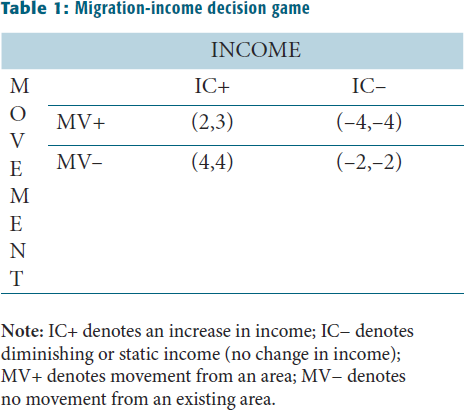
In Table 1, a standard form of a migration–income game that is played within a community is presented. The game presents the dichotomous relationship between the decision to migrate and the change in income. In the matrix, IC+ denotes an increase in income, while IC− denotes diminishing or static income (no change in income). MV+ denotes movement from an area while MV− denotes no movement from an existing area. The payoffs can be explained as thus: if migration leads to enhanced income the payoffs are (2, 3). However, if migration leads to lower or same income, then migration is a traumatic activity both psychologically and economically, and the payoffs are thus (−4, −4). If staying within one’s locality can lead to an increase in income through entrepreneurial activities, then a person saves on rent and other extra expenses, and the psychological support is high, too; therefore, the payoffs are (4, 4). If staying within the locality leads to a decrease (or no enhancement) in income, then it leads to limited economic and psychological trauma, so the payoffs are (−2, −2). Thus, it can be seen from the matrix that IC− is strictly dominated by IC+, thus, no migratory decision is a good strategy unless it leads to an increase in income. Within the IC+ options MV− weakly dominates MV+. Thus, within options that lead to an increase in income, those that can lead to such an increase without migration are preferred.
Migration-income decision game
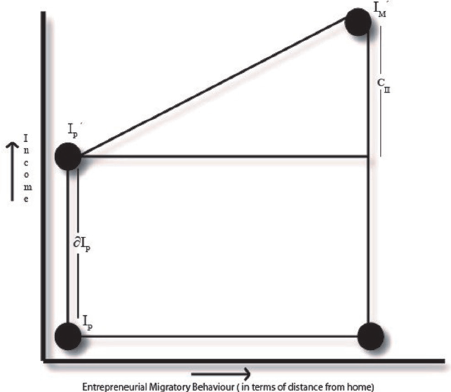
Hence, a fairly simple but effective model can be developed to assess the fundamental and essential conditions for entrepreneurship migration among a community. Suppose IP denotes the current income earned by a tea garden worker in their place of residence and IM is the proposed income after an entrepreneurial migratory decision is taken, in that case, the fundamental migratory decision is strategically stable only if IP < IM. Now if the person wants to start an entrepreneurial venture, then it can be assumed that his income increases to IP and thus IM should be greater than IPˊ to motivate the migratory decision. However, certain factors influence migratory decisions; thus, IM should be discounted by factors such as rent (RT), secondary expenses, which could be explained as those extra living expenses incurred by living outside one’s home (SE), monetized equivalent of the psychological trauma that one faces when they leave home to stay in a strange place (PT), and a risk discounting factor which takes into account the economic cost of risk taken through the migratory decision (RS). Certain convenience loads (CF) could be added to the migratory income IM to account for the increased convenience that migratory decisions might provide, such as better schools for children, better healthcare facilities and enhanced positive psychological effects like empowerment. The consequent model can be presented as:
Migration is a good strategy for an entrepreneurial shift only when:

wherein:

and U(IP)ˊ denotes utility derived from IPˊ: U(IM)ˊ denotes utility derived from IMˊ.
However, if individuals do not face any psychological trauma due to migration, then PT = 0. Thus, such individuals will derive different levels of utility from migration [U(IM)´´], wherein [U(IM)´´] > U(IM)ˊ. Hence, if the psychological trauma (PT) resulting from the migration can be reduced or eliminated, then migratory decisions can become more economically efficient ceteris paribus.
The critical incremental income (CII) that may lead to a decision on entrepreneurship migration is the difference between U(IP)ˊ and U(IM)ˊ. A higher value of CII may motivate a greater propensity for entrepreneurial migration; thus, the model which aims to augment entrepreneurial migration among the tea garden population should attempt to maximize CII. The model is illustrated in Figures 1.
Critical Incremental Income Model.
THE FIELD STUDY
Method
A limited qualitative field study was conducted among two groups of the garden population: high school students who go to local tea garden schools (N = 54) and a set of migrants from the gardens who have left the tea gardens to work elsewhere (N = 13). Convenience sampling was used to select the respondents. The study was conducted during and immediately after the covid pandemic in 2020; so, to circumvent the problems of travel and limit the use of public transportation, convenience sampling was used. The sample size was kept at a minimum that might be effectively used in the study for the same reason.
The students were chosen for the study because they were at an age wherein they would be required to decide their future plans. The study was conducted through short personal interview sessions that were held face-to-face and over the phone. The interview featured a mix of open and close-ended questions. The objective of the exercise was to explore the thoughts and ideations that motivate or prevent entrepreneurship-driven migratory behaviour among the tea garden population to frame a model which may explain the behaviour. Among the students, the sample consisted of 22 girls and 32 boys of approximate ages ranging from 15 to 18 years. All the respondents lived with their parents. Most had siblings, while a significant number of respondents (22) still had their grandparents living with them. Many families have been living in the tea estates for over a hundred years. The family income depends upon the number of earning members in a family. Each member earns approximately ₹3,000 to ₹4,000 per month on average. The daily prevailing wage rate in the gardens was ₹176 per day at the time of this study.
Findings
An overwhelming majority (32 out of 54) of the students was not happy with the current living condition of their families. However, most felt that they would not be able to improve the conditions of their family (42). The students were almost equally divided in number on whether they wanted to leave the garden to work elsewhere (28 yes; 26 no). When asked to explain the reasons for not wishing to leave the gardens, the students elaborated that staying in the gardens is better than going to an unknown place and losing everything. They further pointed out that they had no idea of life outside the tea garden. Some girls shared the experiences of their friends who had been victims of human trafficking. The absence of family and community support was a deterrent too. Most concluded that life for their families would not change substantially if they migrated outside the gardens. The students who wanted to migrate outside the gardens explained that the current situation in the tea garden was bad, with little scope for improvement in the future. They spoke about the people who had migrated to the cities and had a better life.
The interviews led to interesting outcomes when the students were asked if they would prefer a salaried job or start their own business. Only 19 of the 54 students said they would prefer to start their business. The reasons provided for preferring salaried jobs were lack of capital, peace of mind, job security, examples of those who tried and failed, government jobs (the respondents were tribal children; thus, they have quotas in government jobs) are well paying and secure. Those who preferred to start businesses stressed on wanting to make fast money and improve the conditions at home. They pointed out that there is no future in private jobs or the garden, and even government jobs are hard to get. Some students said that the lure of being one’s own boss drives them (empowerment) to begin their businesses even if they do not earn much.
A small sample of 13 respondents was chosen among those who had migrated outside the garden areas for work. All 13 respondents were salaried employees in government departments, public sector undertakings or nationalized banks. An overwhelming percentage of respondents (n= 11) from this sample were happy with their life outside the gardens. Spouses and children constituted the immediate family within this sample. Parents, if alive, lived in the tea gardens; sometimes, siblings lived in the gardens too. Annual family income within this sample depended upon the number of earning members in a family and the nature of the job. Among the respondents, central government employees earned higher than others.
The respondents put forward a variety of reasons for having migrated from the tea gardens: they needed to improve the conditions of their family; there was no job for them in the garden; government jobs were fairly easy for them to obtain since they were qualified and could avail of government quotas. Some even said that tea gardens have no future and, one lives and dies without any improvement in the quality of life. When asked why they did not think of setting up a business, they put forward a plethora of reasons such as the lack of capital, lack of expertise, family dependency on their income, etc. Moreover, government jobs were relatively easy and paid well. Importantly, government jobs elicited power which businesses did not have. One respondent explained that if he were to begin a business, he would do it in the garden area and not migrate to a place where people are unknown and the risk is greater. A majority of those who have migrated outside the tea gardens (12 out of 13) said that they kept in touch with the garden community. Most of them still had their old house in the garden where some family members still stayed. They had renovated the house and spent time there during holidays. Several respondents stressed that the old house in the garden was still regarded as the original home they could visit in troubled times. All the respondents who migrated outside the garden advised youngsters to migrate but were categorical in their advice that a good quality professional education is essential. They advised looking for government or corporate jobs instead of trying their hand at business and entrepreneurship. The reasons given were that business ventures are too risky and people from the gardens were generally simple and easily cheated by outsiders. Box 1 presents a few interesting discussions to shed light on the nature of the prevalent situation.
Biswasi and Sobha Kerketta owned a small tea shop within the precincts of the tea garden where their parents worked. They sold tea, snacks and light meals to the workers. However, due to a slew of deaths in the family, they fell into bad times and had to close the shop. Sobha has now migrated to a town outside the garden to work as a household help. She is learning tailoring at a skill development centre run by a self-help group and is saving money to start a tailoring unit at their erstwhile tea shop. She plans to arrange financing through a microloan from Bandhan Bank. However, when asked if she could set up her tailoring shop at her place of migration, she replied migration was just temporary and she would have a better life and business opportunity at her garden.
Sushil Kujur’s family had migrated out of the gardens to the outskirts of the bustling trade-centric town of Siliguri many years ago. He is a well-read and erudite man who speaks impeccable English. Sushil however chose not to opt for a salaried job and runs a small animal husbandry unit where he rears livestock for the local market. A part of his family still stays in the garden and his cousins ply taxis instead of working in the garden. Sushil emphasized that a part of the worker’s family never leaves the garden and keeps working there because they want to keep their quarters in the garden which they perceive as ancestral property since generations of their family have lived there. Since workers have no land rights if the family discontinues their work in the garden, they must vacate the quarters.
Mr Ekka is a middle-aged gentleman who has quit working for the tea garden (his wife still works there) to open a furniture store which sells handmade cane furniture. Cane furniture is in high demand among the tourists and since his shop is located on the highway through tourists pass, he records good sales. His daughters take turns to run the store while he spends time in procurement and logistics. He wants his daughters to leave the area and expand the business in Kolkata or Bangalore where some of his relatives stay but that he concludes will take some time.
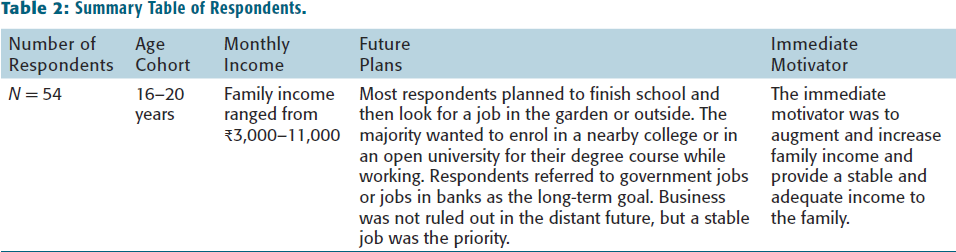
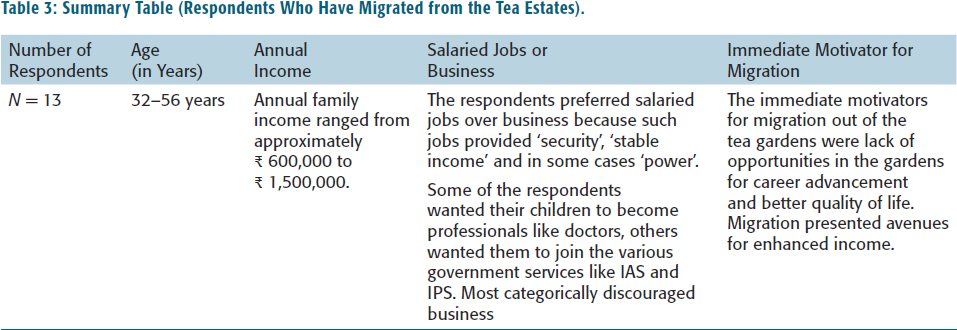
The interactions revealed the various barriers to migratory entrepreneurship behaviour among the tea estate workers in West Bengal. The barriers to business in this instance are finance, unknown markets and a psychological adherence to businesses with local connections. The general perception among workers is that finance, whether from microfinance companies or money lenders, is easier to procure in their local areas rather than for business enterprises outside one’s area. The respondents stressed that they were aware of the demand for the various products and services within their area but were grossly unaware of the markets in other places. Thus, there was enhanced uncertainty in migratory business. Moreover, a psychological tendency to see business models on local resources was apparent. Several respondents spoke of supplying sand and pebbles from local river beds to construction sites, and others bought green leaves from small tea growers to sell them to bought-leaf tea factories which had no estates of their own. Business models encouraged within the tea garden communities are often ingrained within resources inherent to the area and thus not transferable. The summation table of the responses is presented in Tables 2 and 3.
Summary Table of Respondents.
Summary Table (Respondents Who Have Migrated from the Tea Estates).
PRIMARY ANALYSIS
An analysis of the responses provides interesting insights into the perceptions of the tea garden population on migration. Some inferences may be drawn from the observable differences in the general flow of responses between the female and the male respondents; the differential analysis is presented in Table 4. An overwhelming majority (all barring one) of the female respondents felt that they could not improve the present conditions of their family. In contrast, the majority of males thought they could. It was observed that a majority of the female respondents are against migrating from the gardens to work elsewhere; however, a majority of the male respondents prefer migration. Interestingly, most female respondents want to set up their own business, while the majority of male respondents want to work in a salaried job. The reasons for the responses could be varied, and a wider survey involving a larger sample could provide better insights. However, it may logically be inferred that female respondents find garden-based entrepreneurship a safer alternative to migratory jobs.
Differential Analysis of Responses.
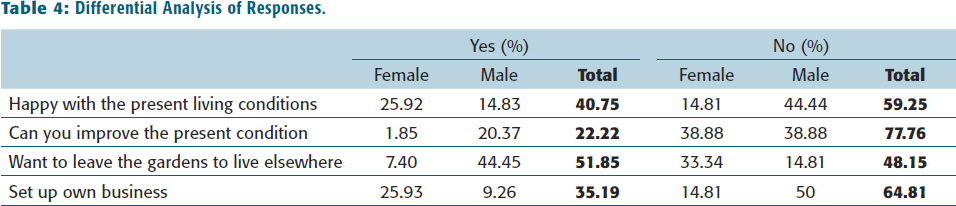
An analysis of the responses brings forth certain motivating factors that seem to catalyse migratory decisions; the overwhelmingly important motivating factor for migratory decisions in the tea estates is economic, presenting the necessity of a better income. Empowerment presents as an important factor too. Although perceptions vary, some respondents find entrepreneurships empowering, while others perceive empowerment in government jobs.
QUALITATIVE ANALYSIS: PSYCHOLOGICAL BARRIERS TO CHANGE AMONG TEA ESTATE WORKERS
Centuries of deprivation and repression have had an effect on the psychological processes of the workers in the tea estates. Thus, several psychological barriers interact to create serious impediments to the benevolent interventional processes undertaken within the community.
The first barrier to migratory behaviour is learned helplessness, which prevents workers from encouraging ambitions about their future and leads to high dropout rates in tea garden schools. Learned helplessness is a common phenomenon wherein people accept that they are powerless to improve their lot (Seligman & Maier, 1967). They feel that no amount of effort can lead to an improvement in their current situation. This phenomenon was evident from the results of the empirical study conducted among the students of tea estate schools, especially among the female respondents. Among the tea estate workers, this phenomenon, thus, leads to high school dropout rates, lack of ambition and low self-esteem. Further, the lack of effort is increased by high incidences of alcoholism and consequent delinquent behaviour among the workers. Even when tea estates are shut down, and many workers are forced to look elsewhere for work and sustenance, a significant percentage prefer to stay within the confines of the closed gardens in the hope that the garden will begin operations again.
The second barrier is status quo bias, a psychological condition that leads to a preference for the current state of affairs and discourages changes (Kahneman et al., 1991). Status quo bias prevents workers (even the educated population) from looking for work outside their areas. Status quo bias may have formed the reason for the response to the first question in the empirical study, wherein most female respondents claimed they were happy with the present living conditions. Status quo bias also leads to a psychological resentment to any positive interventional changes brought about in tea estates. The aversion to change runs deep in the psychological framework of the garden workers and creates barriers to education, migration and eventual upward mobility. Vested interests benefitting from the situation ensure that the barriers to change are augmented rather than mitigated. The change in thinking among the workers has to be gradual, structured and incremental.
The third psychological barrier is a lack of trust that the years of deprivation and repression have generated among the workers. The naturally evolved survival instincts prevent them from trusting even benevolent interventions. This aspect of loss of trust is worsened by numerous cases of cheating, fraud and crimes like human trafficking that the workers from the gardens have been subjected to over time. Lack of trust for outsiders and strangers was noticeable in the interviews among the tea garden students and the individuals who had migrated out of the gardens.
The fourth psychological barrier lies within the human bias of loss aversion. Human beings are prone to avoid loss over equivalent gains (Kahneman & Tversky, 1979). Thus, the workers are keen to protect whatever little they have over the risk of losing everything if they migrate to stranger shores. The plans to circumvent these thought barriers need to inculcate multiple approaches and involve diverse entities of influence. Loss aversion is an important element that influences behaviour in the tea garden population; this was evident in the interviews with the students from the tea garden and those who have migrated out of the gardens. Individuals who migrated still find security in the knowledge that their home in the gardens is still around for them to turn to in case they fall into bad times.
The optimal and rational decision choices among the population of workers are further influenced by the phenomenon of bounded rationality (Simon, 1955, 1992), wherein humans tend to take sub-optimal decisions due to constraints of time and knowledge, bounded willpower and bounded self-interest (Mullainathan & Thaler, 2000). Bounded willpower is a phenomenon wherein humans take decisions which affect their long-term prosperity. Alcoholism, school dropouts and delinquent behaviour among the tea garden population are outcomes of bounded willpower. Bounded self-interest is a psychological phenomenon wherein individuals sacrifice self-interest to help others. In closely knit communities like that of the workers in tea estates who live in dependent colonies, often self-interest is sacrificed to help, cajole or even please fellow member(s) of the colony, thus affecting rational decisions.
DISCUSSION AND CONCLUSION
Eichsteller (2021) described migration as ‘a form of spatial and social transplant from one local and national context to another’ (p. 174). The description emphasizes the two fundamental aspects that ultimately motivate or inhibit migratory behaviour: a long-term relocation from one’s current place of dwelling and work to another, aggregated with the required enculturation that is often necessary for the functional stability of such relocation. However, when migratory behaviour is studied within multiple constraints, the complexity of the problem is amplified. Thus, the study of migratory behaviour within the outcome constraint of entrepreneurship and the specific context of the tea community of West Bengal brought forth interesting dimensions to the issue of entrepreneurial migration.
A study and evaluation of entrepreneurial migratory decisions of the tea garden workers of Bengal find ideational relevance within Amartya Sen’s capability approach (Sen, 1983, 1990, 2009). The fundamental perspective of the capability approach relates to the freedom that people have to achieve what they want in life. Sen (1990) explained that the capability approach ‘sees human life as a set of “doings and beings”—we may call them “functionings”—and it relates the evaluation of the quality of life to the assessment of the capability to function’ (p. 320). Several experts have applied the fundamental philosophies of the capability approach to evaluate migratory behaviour (Assaduzzaman et al., 2020; Eichsteller, 2021; Juran, 2016). This study is an obscure attempt at the same.
An exploration of the unique social system of the tea estate workers of Bengal would remain incomplete if the sociohistorical dimensions were ignored. The evaluation of entrepreneurial migratory behaviour among the tea garden community may be presented within the context of the capabilities of the workers to functionally attempt such behaviour. These capabilities have been influenced by years of social oppression and experiences of prejudiced behaviour. In this context, Sen (2009) posited, ‘The capability perspective does point to the central relevance of the inequality of capabilities in the assessment of social disparities’ (p. 232). Consequently, when human behaviour is evaluated within the capability perspective, certain irrationalities and peculiarities present as de facto rational and strategically sound. The theoretical model of entrepreneurial migration presented herein attempts to explain such decisions within the context of the capabilities and limitations that the socio-economic and socio-cultural predicaments present for the workers.
A limited field study among the high school students of the tea estate schools revealed the various socio-economic and psychological barriers that prevent tea estate workers from exploring avenues for entrepreneurial migration. Significantly, Eishteller (2021) observed ‘migrants exist in the liminal spaces within social structures, where the unequal distribution of wealth and privilege determines their life chances and life choices over their lifetime’ (p. 175). So that entrepreneurial migratory behaviour is motivated among the workers of the tea gardens in Bengal, it is necessary to analyse the variables that might present as assets for catalysing such behaviour. These assets might include a plethora of ingrained traits, learned behaviour and transferable skills, viz., physical health, communication skills, education, technical skills, creativity, adaptability to various conditions, trustworthiness and industrious nature (Eichsteller, 2021). Further, the capability model includes the concept of entitlement: ‘entitlement refers to the set of alternative commodity bundles that a person can command in a society using the totality of rights and opportunities that he or she faces’ (Sen, 1983, p. 754). Eichsteller (2021) explained that entitlement includes ‘what people can and cannot do and therefore should be conceptualised to capture the complexity of entitlement relations, such as access to and affordability of health provisions, education, social equality, self-respect and freedom from harassment’ (p. 177). Suppose the predicament in the tea estates of Bengal is analysed in the light of this construct. In that case, an opportunity emerges for systemic government interventions to augment the various socio-economic variables, which might present as assets for catalysing entrepreneurial migratory behaviour among tea estate workers in Bengal. While the nature and scope of such interventions are beyond the scope of the present study, an exploration of the dynamics of entrepreneurial migratory behaviour among the tea estate workers of Bengal, thus, might present as a first step towards that direction; the study derives its significance from that point. The field study was, however, limited in terms of sample size; thus, there is a scope for a wider and more detailed study on the topic exists; further, an exploration of the design of a systemic strategy to motivate and sustain entrepreneurial migration among the tea estate workers of Bengal might present as logical furtherance of this effort.
Footnotes
DECLARATION OF CONFLICTING INTERESTS
The author declared no potential conflicts of interest with respect to the research, authorship and/or publication of this article.
FUNDING
The author received no financial support for the research, authorship and/or publication of this article.

e-mail: