




Abstract
The industrial relations (IR) environment in India and its labour market, have been undergoing significant transformations in multiple domains for around two decades after the economic liberalization. Gillan and Lambert (2013) observe several restructurings at the workplace level in the country. These include, among others, farming out job functions or services to any third party through outsourcing, engaging contract labour in the organized sector, the tendency among managers to avoid acknowledging the right of trade unions to collectively bargain and the prevalence of voluntary retirement schemes for having numerical flexibility of the workforce.
The industrial relations (IR) environment in India and its labour market, have been undergoing significant transformations in multiple domains for around two decades after the economic liberalization. Gillan and Lambert (2013) observe several restructurings at the workplace level in the country. These include, among others, farming out job functions or services to any third party through outsourcing, engaging contract labour in the organized sector, the tendency among managers to avoid acknowledging the right of trade unions to collectively bargain and the prevalence of voluntary retirement schemes for having numerical flexibility of the workforce.
In tandem with such changes, precarious forms of work are growing steadily, with ‘a generous use of flexi-category workers’ (Sapkal & Sundar, 2017 p. 342). One such flexible work arrangement, namely fixed-term employment (FTE) has been a subject of debates and controversies. The Ministry of Labour and Employment, Government of India, introduced FTE in 2018 under the classification of workers in the Industrial Employment (Standing Orders) Central Rules, 1946. Any FTE worker is to be hired for a fixed period on an employment contract provided in writing. Though the duration of employment is fixed, a worker under a fixed-term contract (FTC) is to be treated at par with a permanent (i.e., regular) worker for all aspects of service conditions like wages, allowances, other benefits, and hours of work. This work arrangement is all set to get new emphasis with the introduction and implementation of the upcoming Labour Codes (Code on Wages, 2019; Code on Occupational Safety, Health & Working Conditions, 2020; Code on Social Security, 2020 and Code on Industrial Relations, 2020).
Our study analyses the operational feasibility of having FTCs in India by discussing their merits and demerits. We have limited the scope of the article to issues like unionization of workers on FTC, termination of such workers and their inclusion in workers’ participation in management (WPM) of industries. Ahead of the introduction, the study briefly discusses the restructuring process in the Indian labour market, followed by a section that presents some of the advantages that FTE could bring to employers and some pertinent concerns related to workers in the Indian context. The section after that, reviews the practice of FTCs in other countries, the merits and demerits of these contracts and the prevalent practices of duration and rules of renewal. A discussion on policy options for regulating FTCs follows, and the study ends with concluding remarks.
RESTRUCTURINGS IN THE INDIAN LABOUR MARKET
Looking back at the evolution of the IR framework, we observe a consistent context of regulations. Moving from a pre-independence colonial setup, the legislative framework for labour has also been evolving. Since 1991, the Government has adopted several measures to reform the existing regulations in the labour market, along with more privatization and increased liberalization in the industrial policies at the national level. The overall objective of these measures has been to increase industrial output and productivity significantly. Data reported in various studies till 2019 indicate that this objective has been met, albeit partially.
However, a prevailing neoclassical view is that labour-related regulations are exogenous to a self-adjusting labour market and disturb the operations of market forces (Deakin, 2009). Therefore, labour regulations, more specifically the ones which aim to provide employment stability, are hindering new investments and economic and employment growth (Posner, 1984). Counter to this laissez-faire proposition, there have been ongoing debates citing the success of various state initiatives to improve labour market indicators.
Labour productivity has been growing significantly since 1991 in India. The real gross domestic product per employed person has increased by three-and-a-half times since 1991, while the average productivity of labour in the organized sector has grown around three times (Dasgupta & Kar, 2018). In contrast, the labour force participation rate has gone down. Such factors, coupled with a near-constant unemployment rate, indicate that the proportion of the population looking for employment has risen sharply. Real wages have also increased, although at a variable rate, across various skill levels. We consider this combination of increasing real wages and growing unemployment as a unique labour market outcome.
An analysis of the overall employment status in the country from 2004 to 2018 (see Table 1) prima facie indicates an increase in the number of regular salaried workers and a decrease in casual workers as a percentage of overall employment (Mehrotra, 2019). Figure 1 presents the share of wages and profits of the gross value added in manufacturing between 1993 and 2013. It is evident that the increase in wages has never come at the cost of profits, thereby attesting to the fact that firms, on the aggregate, are not suffering as a consequence (Abraham & Sasikumar, 2017).
Percentage Share of Overall Employment
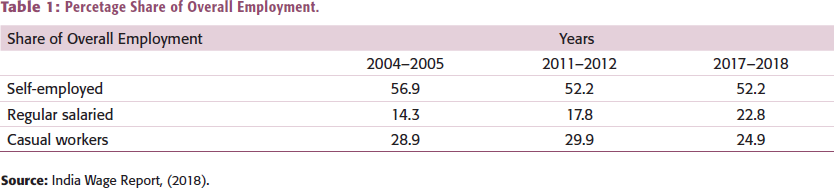
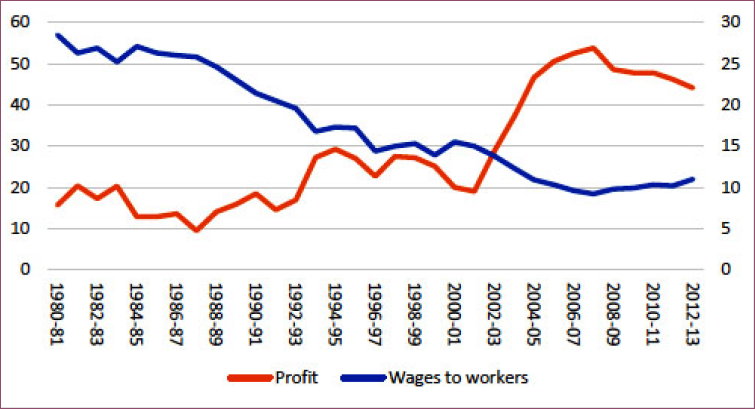
Though the increase in labour productivity and decrease in the number of casual workers have not happened at the cost of profits, this did not reflect in the formalization of the workforce. A staggering 90–94% of the labour force is still away from the protection of labour regulations and benefits generated for formal employment. Evidently, the drop in agricultural labour has not resulted in commensurate growth in the organized sector workforce.
Since the past decade, the Government has been attempting to overhaul the archaic and oft-cited rigid labour laws, so that the regulatory framework gets more in sync with the modern business landscape, pushing for higher employment flexibility. As a part of labour reforms, four categories of Codes have subsumed and consolidated 25 central labour laws. The Labour Codes are also expected to bring about better compliance with legal provisions. Of these, the Code on Industrial Relations (referred to interchangeably as Code on IR from this point ahead) is already inviting criticism for giving FTE legal sanction, on the grounds of further reducing formal, stable and regulated employment (Roychowdhury & Sarkar, 2021).
ISSUES IN FIXED-TERM EMPLOYMENT MODE IN THE INDIAN CONTEXT
FTE is not new in India. In 2003, the Government introduced FTE amidst stiff opposition from all central trade union organizations (CTUOs). Consequently, this scheme was withdrawn. More than a decade later, in October 2016, the Government introduced FTCs in the apparel manufacturing industry. The seasonal nature of employment in the industry was put up as the underlying rationale for flexible laws.
In 2017, the Government extended this form of employment in the leather and footwear sectors under the ‘Make in India’ Scheme and the National Skill Development Mission. Now, with the 2018 notification, the Government has elaborate plans to incorporate FTE. The Code on IR, which will subsume the Industrial Employment (Standing Orders) Act, 1946, has included provisions for FTE. As per Section 2 clause (l) of the Code, FTE refers to ‘the engagement of a worker on the basis of a written contract of employment for a fixed period’.
FTE is now applicable to all industries to promote ease of doing business. A worker on FTE shall get all the statutory benefits that a permanent worker is entitled to. Benefits like gratuity are to be given in proportion to the service the FTE worker renders, even if the tenure is less than the qualifying period of employment stipulated in the respective legislation.
During a phase witnessing increasing ‘non-standard work arrangements’ (International Labour Organization [ILO], 2015) to bring about employment flexibility, we perceive it imperative to understand the implications of FTE contracts, both for employers and workers. This section presents an elaborate narrative of the advantages that FTE could bring to employers and the possible risks to workers.
ARGUMENTS IN FAVOUR OF EMPLOYERS
Greater cost flexibility and better control over workers are two economic advantages that FTE offers to employers. From the neoliberal view, FTC as a work arrangement would take out the burden of long-term cost commitments of an employer (like pension and tenure-induced wage velocity) associated with formal employment, thereby paving the way for accelerated job creation (Roychowdhury, 2019). The Government has removed the original provision that prevented a private establishment from converting a permanent job to a fixed-duration job. The Code on IR does not have this restriction as well.
With the job market already gloomy in the second year of the pandemic, employers might prefer more tenure-based workers over a regular workforce, thus having a lesser burden of fixed costs. As the scheme of FTE seems more in line with providing a business with the flexibility to deal with a changing environment, it is not surprising that employers have welcomed the Government’s directive on FTE.
In developing and developed countries, FTE co-exists with regular employment (ILO, 2015). As opposed to FTEs, in regular employment, the job tenure is protected. Wage velocity leads to a ‘decent wage’, as compared with ‘acceptable wage’, and workers enjoy retirement benefits in terms of pension and gratuity. This coexistence enables employers to gradually shift jobs from regular employment to FTE, without facing any shortage of workers, given there is a lower-cost alternative ready and waiting. As a result, the FTE system enables employers to enforce discipline in their favour, exercising better control of the workforce (Basu et al., 2021).
Another vital factor to note here is the role of the government as an employer, especially for organized labour through the public sector. Though employment of regular workers in the public sector in India has steadily declined since the onset of liberalization initiatives in the 1990s (Niti Aayog, 2020), it still employs a significant part of the labour force. One reason is the extensive use of contracting out in public sector enterprises (Chandra & Walton, 2020).
The private formal sector has been experimenting with various policies on labour flexibility for a long time. The more economically stable, reputed and older firms have been following labour-related policies similar to the public sector, thereby maintaining a certain parity. It is the newer firms that are instrumental in driving the present enactments. FTE could be suspected to be a case for roundabout protectionist cover to such firms. However, contemporary research has not found much merit in favour of the role of rigid labour laws and the inability to hire and fire as a deterrent to employment growth (Roychowdhury, 2019).
Further, wherever the barriers to hire and fire are high, workers continue to work in sectors that are unproductive, the outcome of which is a loss of competitiveness and less job creation. Employment legislation that is rigid could push workers to some grey area. On the contrary, reforms aligned with the World Bank’s initiative—‘Ease of Doing Business’ have the potential to spread the scope of regulation by including employers and workers in the formal sector (World Bank, 2006). We see this as a strong advantage that FTE could bring to Indian private enterprises.
Among the other advantages to a employer, fixed-term workers can now be hired directly without the intervention of a contractor. FTE may be used as an alternative to engaging contract labour, thereby giving the simultaneous advantages of flexibility and reduced transaction costs. It is argued that FTE would benefit micro, small and medium enterprises (MSMEs) as these establishments face labour market rigidities. MSMEs work in a complicated regulatory environment that does not deter them from deploying FTE workers as and when required (Financial Express, 2019). Introducing FTE could thus help MSMEs generate employment.
Referring to the seminal work of Lepak and Snell (2002) on HR architecture, we see FTE to be located in the third quadrant of the matrix on ‘human capital characteristics and employment modes’ (p. 520). This quadrant ‘contains human capital that is neither of particularly high strategic value to a firm nor unique’ (p. 521). Our logic is backed by the argument given by these authors that such workers are fit for tasks that have limited scope or duration. Employers would thus be keen on engaging workers on FTC in tasks with low exposure to risk and lesser focus on value.
Although the two principal advantages of FTE, namely flexibility and control, are touted widely, there has been no conclusive evidence of these advantages in the long run. On the contrary, Wang and Heyes (2020) found employers who do not deploy FTE in the European Union (EU) record higher productivity advantages over those who engage workers on FTC. Similarly, the rising labour problems across establishments in India raise doubt over the validity of the claim over control (Kazi, 2021).
ISSUES RELATED TO WORKERS
The policy decision of the Government on FTE is purportedly non-discriminatory for any worker on FTC in terms of wages and related benefits. Nevertheless, there are several risks inherent to FTE for workers in the Indian IR framework. We have summarized a few such issues below.
Issues Concerning Wages and Other Benefits
Ideally, fixed-term contractual arrangements are designed by employers to complete tasks that are time-bound and tenured in nature. Therefore, the scenario could be less favourable for unskilled and semiskilled workers, who comprise the majority of the Indian workforce (Times of India, 2020) in the immediate future in terms of long-term employment prospects. This is also compounded by the fact that these workers are mostly exposed to unfair practices by their employers. Compared to European nations, short-term workers on low wages in India face a staggering 60% wage penalty because of tenurial insecurity, in sharp contrast with high-wage workers engaged in longer-term employment contracts (Menon, 2019).
In fact, we foresee a rise in employment vulnerability among workers with lower skills in the long run. Without bargaining power and legislative protection, fixed-term workers might be obligated to accept lower wages (Jimeno & Toharia, 1993). In contrast, these workers should ideally ask for higher wages because of a lack of security, based on the logic of more risk, and more returns. Hence, the possibility of a compensating differential, owing to job insecurity, does not seem to be relevant, given the massive unemployment rate in India. Instead of a rising tide lifting all boats, perhaps the biggest argument from the neoliberal camp, FTE can effectively emerge as the legally sanctioned downward spiral that can bring down the overall wage rates (Basu et al., 2021).
A typical example is an increase in wage inequality for regular urban workers from 1993–1994 to 2011–2012 (ILO, 2018), evident from a sharp rise in the wages of skilled workers compared with unskilled ones. We align with Sundaram (2018), who points out that FTE would benefit the categories of highly skilled workers, as they are in high demand in their specific industry.
On the benefits side of the argument, the Code on Social Security claims to extend all admissible benefits of a regular worker to one on FTC. But, in reality, establishments that engage workers on FTC tend to deprive the latter of provident funds and certain other benefits that are the legal entitlement of any regular worker. It would be interesting to briefly mention a recent judgement by the Supreme Court of India in its January 2020 judgement (Pawan Hans Limited and Others vs. Aviation Karmachari Sanghatana and Others). Herein, the apex court has clarified that all contractual employees who are paid wages directly or indirectly by the company are eligible for provident funds, irrespective of the nature and periodicity of their employment.
Issues Related to Termination
Perhaps the most significant challenge would be the termination of FTE workers (or retrenchment, as per the Industrial Disputes [ID] Act, 1947). An FTC implies that a worker is hired for a particular fixed period, and employers do not have to give notice to the worker before this period ends. Likewise, this would mean that employers can terminate such workers before the contract ends, possibly on the grounds of non-performance and/or other misdemeanours.
Section 2(oo)(bb) of the ID Act, 1947, defines retrenchment by clearly excluding ‘termination of the service of the workman as a result of the non-renewal of the contract of employment between the employer and the workman concerned on its expiry or of such contract being terminated under a stipulation in that behalf contained therein’. This can easily be extended to the case of fixed-term workers, the termination of whom is thus not included within the ambit of retrenchment under this Act. It follows that an employer does not have to pay retrenchment benefits to these workers, which might be construed as empowering employers to hire and fire at will. Interestingly, the Code on IR also has excluded FTE from the definition of retrenchment by specifying ‘termination of service of the worker as a result of the completion of tenure of fixed-term employment’.
Issues Related to Unionization
For workers hired under FTE, joining or forming a trade union is a pertinent issue. Low rates of union membership among workers on FTC are of concern for the trade union movement in many countries. For instance, unions representing FTC workers in the UK public sector have revealed that member-workers in casual employment are among the most insecure and exploited (Conley & Stewart, 2008). Booth and Frank (1996) point out that most USA unions focus on members who serve a relatively longer term in an establishment.
In India, the definition of a workman as per Sec. 2(g) of the Trade Unions Act, 1926, refers to ‘all persons employed in trade or industry whether or not in the employment of the employer with whom the trade dispute arises’. For the chapter on trade unions under the Code on IR, in a similar vein, a worker means ‘all persons employed in trade or industry’. The ambit of both these definitions is wide enough to include FTE workers. Yet, there are several points of concern that have to be spelt out.
The Indian labour market is still not favourable to workers. Flexibilities through contractual work have emerged as a ‘major irritant in the IR scenario of India in the last decade’ (Sohani, 2015, p. 144). The majority of the labour laws are applied only to large establishments, to which, by and large, unions are also confined. Compliance with labour legislation usually involves a cost to the employer to revise wages, contribute to social security, and so on. Unions further contribute to such an increase in costs and lessening of functional flexibility. Hence, there has been a tendency in establishments in the organized sector to avoid applying labour laws and the formation of trade unions by ensuring that the workforce employed is small (Papola, 1994). Further, within an establishment, the category of permanent workers is mostly unionized and enjoys the best social security coverage and emoluments compared with the other types of workers (Vijay, 2005). Regular contract workers mostly do not have a social security or emoluments package, nor are they members of a trade union within the establishment.
Another concern is that multinational companies (MNCs) tend to victimize employees if they try to unionize. In a study of eight firms operating in India, including Japanese and Korean MNCs, Hammer (2010) observes resistance in the management towards trade union organizations and employers’ mobilization of state interventions. In the same research, workers of one of the Japanese firms expressed that the management prevented them from forming their union and that such workers were dismissed.
Historically, CTUOs have been affected by a narrow membership base. They focussed on large-scale enterprises and public sector workers in the formal economy, which has been detrimental to the interests of other categories of workers. However, Gillan and Lambert (2013) observe a paradigm shift in the composition, strategies and priorities of trade unions in India, with specific plans to reach out to women and contract labour. Unions are extending their presence in the unorganized sector to include urban workers from industries like construction, and the service sector, including transport. Despite renewed focus of unions on increasing their membership base, it remains a question whether FTE workers would be allowed union membership with the regular workers of any establishment. If not, how can these workers fight for their legitimate rights otherwise?
Lack of clarity on unionization for FTE workers could bring multiple problems. The absence of a collective forum in the form of a trade union could expose such non-regular FTE workers to the risk of being deprived of legitimate benefits. Even if these workers are allowed to join a union, would an employer pay heed to the issues peculiar and restricted to FTE workers? One recent example is of FTE workers of Alliance Air, a subsidiary of Air India. These workers were being paid lower wages and given fewer benefits compared to permanent workers. Air India reportedly ignored the workers’ demands put up by the Centre of Indian Trade Unions (Hemalata, 2018).
Other Issues
Workers engaged through a contractor could be on the permanent rolls of the latter. Hence, removing contractors as an intermediary at the cost of fixed-term arrangements directly with the employer could invite precarious employment status. We foresee an interesting trade-off for workers on FTE, as they would get legal recognition but would not have any right to regularization on completion of the contract.
The economy has suffered from a sharp rise in unemployment from 5.27% in 2019 to 7.11% in 2020, per the Centre for Economic Data and Analysis. Although skilled workers might opt for short-term employment amidst uncertainties as recently thrown open by the pandemic, they might prefer more stable, regular employment in the long run, making FTE attractive to only skilled workers in the short run. FTE assures flexibility to employers and workers alike. However, an in-depth look into the concept reveals that this flexibility is detrimental to female workers. An employer would like to hire the best talent in the market with competitive wages and prefer someone for whom it has to be less accountable in providing various employment benefits, including maternity benefits. Under such circumstances, would women willing to work under FTC benefit?
The Indian labour market is unique, with a vast presence of unorganized labour. Since the past few decades, the unorganized sector has grown faster than the formal sector, and this phenomenon is termed as ‘informalization of the formal sector’. Prominent features of this sector are low wages, unproductivity syndrome, and poor working conditions. Another burning question is whether FTE will bring another set of workers subject to exploitation similar to the unorganized sector (NCEUS, 2007)?
For labour, one of the most prominent features of the Constitution of India is workers’ participation in the management of industries, laid down in Article 43A as one of the Directive Principles of State Policy. The very idea of empowering workers emanates from the socialist principle enshrined in the Constitution. There is a lack of clarity on whether FTE workers would be allowed to be members of worker bodies like works committees that promote joint decision-making as a component of WPM. Furthermore, the legislation on equal pay for equal work (Equal Remuneration Act, 1976, which is getting subsumed under the Code on Wages, 2019) is yet to spell out the rights for this category of workers.
All the central trade unions have opposed the directives of the Government on FTE. They argue that the Government did not consult trade unions and has ignored the tripartite mechanism. Union leaders are construing this notification to the Government’s legitimizing violation of the existing legislative framework that protects workers’ rights. Unions also translate this scheme to create a trend among employers to convert permanent workers into FTC workers (The Economic Times, 2018). Such a shift in workforce composition could adversely affect those in regular employment.
Overall, we are faced with several questions. Is the IR framework in India ready for FTE? Is FTE poised to be a new form of labour that could be subject to exploitation? Would the IR system make appropriate changes to absorb this new form of work arrangement?
FIXED-TERM EMPLOYMENT IN OTHER COUNTRIES
Among the nations in which FTE is in vogue, Spain stands out as an excellent example as non-standard work arrangements account for around one-third of the country’s total salaried employment. Most of these arrangements are fixed-term, without any implicit or explicit contract for long-term employment. Amuedo-Dorantes and Serrano-Padial (2007) have assessed the implications of a rise in wages in FTE in Spain. Their results indicate that wage growth for workers on an indefinite term mostly happens through job mobility. Fixed-term workers, on the contrary, have wage gains on the job and through job mobility. Jimeno and Toharia (1993) have empirically established that using FTCs in Spain brings the risk of greater bargaining and discrimination against such workers in terms of wages.
Blanchard and Landier (2001) have studied the negative impact of fixed-duration employment contracts in France. Theoretically, the authors have posited that such a reform may be perverse because it leads to higher turnover and lower welfare. As per the 2015 report on non-standard forms of employment by the ILO, in some countries (like the Republic of Korea after the financial crisis of 1998, Bangladesh in 2010 and Ireland in 2011–2012), the economic downturn has led to growth in hiring on very short, temporary contracts rather than permanent hires, to keep labour costs flexible. The outcome has been increased volatility in terms of both employment and unemployment. Such volatility is likely to make the public budget volatile and bring severe implications for taxpayers, as more people could claim unemployment benefits. De Matos and Parent (2016) observed increased use of FTCs primarily by start-ups in the early 2000s in Portugal, coinciding with the country’s deteriorating business climate.
RULES FOR DURATION OF CONTRACT AND RENEWAL OF CONTRACT
Without a proper legislative framework, there is no doubt that exploitation of this category of workers is bound to happen. Several countries have tried to control such exploitation by incorporating appropriate enactments. The practice of FTC varies widely, ranging from giving complete flexibility to employers to restricting the maximum duration of contracts to 18 months. Hoda and Rai (2015) have reviewed the legal perspective of FTCs in emerging countries, especially the OECD nations. They observe variations in regulatory rigour in the legislative frameworks across countries. For example, while the USA is liberal about all forms of FTC, France is strict.
Legal provisions in several countries prevent engaging FTE workers in regular tasks. FTC is permissible only for a temporary assignment unrelated to an enterprise’s core business in France. Countries that do not allow this type of employment in regular, permanent tasks include Mexico, Brazil, Argentina, Russia and India. Denmark’s legal system does not have any statutory restriction on fixed-term work. The legitimate scope for FTCs in Finland is limited only to justifiable reasons, while Norway has a strict regulatory framework (Numhauser-Henning, 2002).
Policies that impose an upper limit on the number of renewals of any FTC usually aim to render job security. Several countries have imposed limits on successive FTE contracts, while some have a legal limit on the maximum duration for which any worker on FTC could be employed. Germany is the most liberal for FTCs, permitting contracts for two years in general and four years in new businesses. It allows four renewals, with two years as the maximum cumulated duration. Similarly, Belgium, Portugal and Slovakia allow up to four renewals; the Czech Republic, Romania, Greece and the Netherlands permit three renewals (Aleksynska & Muller, 2018). In the Netherlands and Belgium, if an employer fails to comply with the provisions that regulate FTE contracts, it is mandated to change them into open-ended employment contracts (Blanpain, 2008).
Countries like Spain, Brazil, Korea and the Netherlands permit a maximum of two years for FTCs, including renewal. Earlier, Sweden had a complicated pattern of restrictions by justification for and/or maximum duration of such contracts imposed by legislation. However, since July 2007, Swedish employers may not cite any objective reason for fixed-term contractual employment. A new format, namely ‘fixed-term-at-will’ has been introduced, by which an employee can work on such contracts for the same employer for up to two years within five years. There would be no statutory protection against the abuse of successive temporary contracts (Engblom, 2008).
FTCs in Japan generally extend to 3 years. Such an extension can be up to 5 years for employees above 60 years of age or highly skilled employees, but the number of renewals has no legal limits. Brazil permits only one extension, though the cumulated duration must be restricted to two years. In France, FTCs are allowed only one renewal, with the maximum term only 18 months.
Zhao and Zhang (2010) have analysed how the Labour Contracts Law of 2008 in China has influenced employment relations therein. Workers with 10 years of continuous work can enter into the second or successive FTC with a non-FTC. Countries with the norm of two successive FTCs include Indonesia, Saudi Arabia, Spain, Brazil and Vietnam. At the other end of this continuum, South Africa has no legal restriction on the cumulative duration or the number of renewals permissible.
MERITS AND DEMERITS OF FIXED-TERM MODE OF EMPLOYMENT
Flexible forms of work find support from employers on several grounds. Among the variants of employment flexibility, fixed-term or a temporary contract arrangement is of particular interest to organizations (Guest, 2004). For example, in an investigation of the Australian black coal mining industry, Waring (2003) has commented that a rise in temporary employment arrangements represents an essential remodelling of employment relations, with the potential to change bargaining structures in favour of employers. In countries like Indonesia and China, FTCs are used as a stepping stone to regular employment in the future, as employers hire at entry-level using such contracts (Basu et al., 2021).
FTCs are applied as a flexible mechanism to adjust employment with business cycle fluctuations in an economy (Blanchard & Landier, 2001). FTE increases competition among workers and boosts labour turnover (Schomann et al., 1998; Blanchard & Landier, 2001). Some sections of the Indian information and communication technology (ICT) sector that are dependent on project workers employed on a fixed-term basis have witnessed turnover rates as high as 50–75% (Machado & Kourakos, 2004, c.f. Ross & Ali, 2011). As per the International Commission for Labour Rights (2013), auto factories in India rehire workers repeatedly on completion of their contracts instead of offering permanent employment. Basu et al. (2021) describe this phenomenon as permanent temporary employment.
Fixed-term workers have lower wages and lesser job stability than their full-time counterparts (Handler, 1995; Peck & Theodore, 2000, c.f. Amuedo-Dorantes & Serrano-Padial, 2007). These workers do not have any legal or contractual guarantee of permanent employment (Basu et al., 2021). Jobs on fixed-term represent ‘one of the most visible manifestations of job insecurity’ (Scheuring, 2020, p. 92). Kiersztyn (2020) observes that, especially in occupations that involve highly complex tasks, early on-the-job experience gained by the Polish youth could bring better chances of achieving job stability. In sharp contrast with workers in permanent contracts (usually referred to as open-ended contracts), those on FTCs are exposed to a higher risk of job loss because they have ‘a predetermined expiration date’ (Ruiz-Valenzuela, 2020). Fixed-term and outsourced ICT workers in Malaysia have less loyalty to their firms than full-time employees (Ross & Ali, 2011). As Gebel and Giesecke (2011) argue, this form of employment has increased inequalities further.
According to ILO (2015), FTE in many countries increases the risk of unemployment. For example, 2.5% of permanent workers in Spain reported a loss of jobs in the last quarter of 2008, vis-à-vis 15% of fixed-term employees. Workers in ‘non-standard arrangements’ face the consequences of economic adjustments disproportionately more than regular workers as employers avoid renewing temporary contracts during an economic downturn. Another glaring issue against the fixed-term mode of employment is unionization. The capacity to hire temporary workers throws open the risk of reducing the core workforce to a minimum and could dilute collective bargaining (Waring, 2003).
In a market where employers can choose between permanent and fixed-term (having short duration and uncertainty of rehiring) contracts for their workers, theory predicts that firms tend to invest less in developing workers on FTCs than their permanent counterparts (Guadalupe, 2003). Jimeno and Toharia (1993) highlight a de facto ranking between permanent employment and FTE, with permanent workers having the upper hand. The distinction also involves de facto ranking regarding dismissal as a worker on FTE would be the first to be dismissed. Labour market reforms in Italy since 2015 have introduced a new type of open-ended contract that renders increased protection against unfair dismissal (Pizzoferrato, 2015).
DISCUSSION
The previous sections have highlighted some of the merits and significant risks associated with FTE as a ‘non-committal’ nature of employment, both globally and in the Indian context. This section etches out some specific policy options for regulating FTCs in India.
Apart from the lack of clarity on its implementation procedure, aspects like the duration of an FTC, provision for renewal of such a contract, and implications of such renewal are still not spelt out by the Government of India. There are some urgent requirements at the policy level concerning FTCs. These include, among others, a proper framework guiding the renewal of these contracts and defining in clear terms the operations in which FTE workers could be engaged in an establishment. If FTE is introduced to control the labour costs associated with termination, what could be the limit at which it can be said to be illegal? What would be the legal remedies available in such situations? The Government needs to clarify whether FTC is to be allowed only in non-core activities in an establishment.
FTE owes its origin to the textile industry owing to the seasonal nature of work inherent to the industry. Extending this practice to all industries in the economy, many of which may not be seasonal, raises several doubts. Another glaring issue that could assume critical importance in the future is the regularization of FTE workers.
Policymakers could elaborately examine FTCs’ experiences of countries that are similar to India in socio-economic conditions and labour market indicators. The maximum legal duration for which FTE workers can be hired ranges between 1 year or less (as prevalent in Pakistan, Chile and Zimbabwe) to 10 years or more (common in China and Switzerland). Renewal of FTC is seen to range between one to four times. Any standard of duration and renewal of FTCs could be decided upon by studying the success (or failure) of such a work arrangement in any nation as per trend analysis of various socio-economic parameters.
At the same time, it is essential to give cognisance to countries such as Sweden, Japan and Germany, as pointed out by Maira (2014), that have a long-term orientation towards their human resource. In these countries, there is a significant commitment to the continuity of service of employees. ‘Flexibility in employment’ connotes employees’ ability to learn new capabilities, duly supported by employers, instead of flexibility to employers to terminate employees easily. The Government of India can customize and adapt the philosophy of flexicurity implemented by the EU for more than two decades. Flexicurity is one of the mechanisms in the EU to increase the flexibility of labour markets and enhance the adaptability of employees and enterprises (Muda, 2010).
The most impactful way to tackle the various challenges thrown open by FTE is perhaps through an enactment exclusively for FTE workers in the future, just like circumstances had paved the way for legislation on contract labour (Contract Labour [Regulation and Abolition] [or CLRA] Act, 1970). If all the stakeholders accept the practice of FTCs, an explicit legal framework for regulating this type of employment contract is perceived to be quintessential.
Regulatory guidelines on FTE contracts are laid down in the Termination of Employment Convention, 1982 (No. 158), and its accompanying Termination of Employment Recommendation, 1982 (No. 166) by ILO. The Government of India and its legislative body need to refer to both to bring about any policy on FTCs. Further, any policy related to FTE, legislation proposed exclusively for FTE workers, or an amendment in the existing legislation must be in consultation with all central trade unions as vital stakeholders in the country’s industrial scenario. The needs of employers and workers should be balanced. Maintaining equality and non-discrimination in wages, access to collective bargaining, and social security benefits must be ensured. Besides, policymakers could consider any provision by which FTE workers can be offered permanent employment to increase their morale and productivity.
Failure to comply with the provisions of the CLRA Act (which will be subsumed under the Code on Occupational Safety, Health & Working Conditions, 2020; e.g., failure to register the establishment of hiring contract labour), fetches only penal consequences equivalent to imprisonment and fine. Nowhere does the Act provide for regularization of contract labour in such an establishment. Policymakers have to be careful in framing any guidelines regulating a FTC regarding whether the failure of compliance could have only penal measures or could result in converting the FTC into a regular employment contract. Such a contract should, in clear terms, spell out the remuneration, duration, provision for renewal (like the number of renewals permissible and the cumulated duration of such renewals), and other characteristics. For transparency, it must ideally be signed by both the employer and the worker as parties to the contract. Alongside this, to avoid complications, it would be better if employers engaged FTC workers in non-core activities.
In conceptual terms, the central issue with FTE seems to be the ‘right’ of employers to exercise hire-and-fire flexibility, or, in other words, to change the size of their workforce whenever they choose. Laws limiting or banning FTE impose formal restrictions on this flexibility or encourage employers, especially in India, to evade the prevailing laws through informal (often illegal) actions. Employers prefer FTC, as these contracts do not include any long-term cost commitments like formal employment. In India, much of this debate has involved the hire-and-fire restrictions on regular workers under the Industrial Disputes Act and other related issues, such as attempts to liberalize the CLRA Act, wherein an employer claims that contract labour systems are necessary due to the excessive restrictions under the ID Act. Perhaps the design and implementation of any new policy framework covering FTE have to be understood in this context.
CONCLUDING REMARKS
The World Bank’s ‘Ease of Doing Business’ index presents a ranking of countries based on the level of business-friendly environments. Roychowdhury and Sarkar (2021) note that a country’s ranking would improve if, among other parameters, its industries offered FTE in place of regular employment. India moved up the rankings from 130 in 2017, 100 in 2018 to 63 in 2020. The Government has recently set the target to reach the top 50, for which it has prescribed around 90 reforms; FTE is one such measure.
Apart from the lack of clarity on its implementation procedure, aspects like the duration of an FTE, provision for renewal of FTE, and implications of such renewal are still unclear. Termination of FTE workers could also be challenged as it contravenes the existing legal provisions. It would be interesting to see the wage/salary structure of workers on FTC. Establishments that engage such workers, once the Labour Codes are effective, have to strategically plan out wage/salary payment. The choice between a consolidated pay or a regular pay scale, monthly or otherwise, must be framed to avoid legal repercussions.
Any policy guidelines or Act (or amendment of an existing Act) on FTE, when framed, must keep in perspective the socio-economic conditions peculiar to the Indian labour market. A fixed-duration contract needs to include the duration of the contract, the number of renewals permissible, and the cumulated duration of such renewals. As guidelines, policymakers may refer to the international instances of FTCs. Further, any guidelines for FTE workers are ideally to be framed in consultation with all CTUOs.
We have attempted to portray FTE as an ambitious flexible work arrangement in the Indian IR system through this narrative. It is somewhat evident that FTE reflects state-level initiatives to enhance employability rather than generate regular employment. Trade unions perceive this to be conservative and restrictive, against the interests of workers. Unions apprehend that FTE can spoil significantly more than it could serve to impact the labour market indicators positively.
FTE can undoubtedly provide employers with an escape route to reduce risks and costs, we argue that this work arrangement need not be seen in isolation. The design of this mode does seem to be conservative, but we perceive ample opportunity for the state to be experimental about FTE. In this context, we foresee that with time, employers could shift to the fourth quadrant on HR architecture, in which, as per Lepak and Snell (1999), they would ‘rely on alliances/partnerships for human capital that is unique but of insufficient strategic value to employ internally’ (Lepak & Snell, 2002, p. 521).
What has to be ensured is that the escape route to employers does not end up being an avenue to increase workers’ exploitation. We must say that FTE is still experimental, and it is too early to glorify or condemn it. Only time will tell if this new form of employment can withstand all challenges. Adequate consultation with all stakeholders could establish FTE as a pro-worker change, and not as a signal of hire-and-fire. All-round initiatives are necessary within the IR framework so that FTE does not end up as a policy decision that was designed to fail.
Footnotes
Declaration of Conflicting Interests
The authors declared no potential conflicts of interest with respect to the research, authorship and/or publication of this article.
Funding
The authors received no financial support for the research, authorship and/or publication of this article.
e-mail:
e-mail:
e-mail: