




Abstract
The article is an employee-level, quantitative survey-based study investigating the relationship between HR signals and job satisfaction through the intermediary role of psychological contract (PC) fulfilment. Signalling theory and attributional theory provide the theoretical context to the study linking HR signals to job satisfaction. PC fulfilment has been viewed in terms of relational and transactional contract types. Analysis of the mediating ability of the two PC types reveals the differential extent of influencing the considered relationship. Primary data, in terms of employee responses from participating firms, have been collected through questionnaires. A two-step sampling process has been followed to select participating firms and respondents. Structural equation modelling has been carried out to examine the hypothesized relationships among the variables. The study contributes to the literature and has implications for practising managers. It provides evidence towards the attributional role of HR signals within firms. Moreover, it reveals a higher mediating effect by relational PC fulfilment than transactional PC fulfilment. Based on the study’s findings, practising managers need to pay closer attention to relational PCs than transactional PCs. The study contributes to a better understanding of the role of HR signals in manufacturing sector firms. The time, cost incurred for the survey and accessibility to firms for participation are some of the significant limitations affecting the study.
Keywords
The volatile, uncertain, complex and ambiguous landscape of the Indian industry has necessitated firms to relook human resource management (HRM) in terms of systems and practices and employee behaviours (Hamid, 2019; Saridakis et al., 2017). Some scholars have recognized this necessity and called for the reconceptualization of HRM as signals from management to employees (Bowen & Ostroff, 2004; Haggerty & Wright, 2009). The signals convey appropriate messages relevant to the business and organizational priorities and issues. In response to the challenges of the volatile, uncertain, complex and ambiguous world, organizations have adopted various initiatives such as digital HR and people-focused HR, to name a few. Reports by different HR consulting firms, such as Randstad (2020), point out that organizations are reorienting and repositioning HR in response to volatility, uncertainty complexity and ambiguity of the operating environment. Challenges in the business scenario also require firms to pay attention to employees’ job satisfaction, a known predictor of turnover intentions, and other employee behaviours. In this context, the article intends to investigate the effect of HR signals’ strength on job satisfaction through the lens of social exchange, such as PC fulfilment. Researches have focused more on the role of HR signals in recruiting and selecting employees. However, HR signals’ role in exploring employee behaviours within the firm needs further exploration. Content-based HRM has been the preferred research area of HRM, wherein HRM activities are linked with employee outcomes. Bowen and Ostroff (2004), Katou et al. (2014) and Nishii et al. (2008) have recognized the importance and need for studying the process features of HRM. They affirm that process features of HRM, as opposed to content-based HRM, need exploration in the HRM firm performance relationship. Thus, research on HRM features and their relationship with employee outcomes in an attributional framework requires scholarly scrutiny.
This article argues that transactional and relational PCs have differential influences on job satisfaction. Scholars such as Chan (2021) and Schaufeli (2016) argue that differences in the PC mechanisms (relational or transactional) have dissimilar influences on employee-level outcomes such as engagement. Similarly, Agarwal and Gupta (2018) opine that not many studies have examined an employee’s workplace behaviours in terms of types of PCs (relational or transactional). Therefore, studies involving a comparative evaluation of PCs (relational and transactional) as an intervening variable on the relationship between HR and employee behaviours, such as job satisfaction, need further exploration. A social exchange perspective allows for understanding the exchange process between HRM and its outcomes.
Further, the consideration of PC fulfilment from a social exchange perspective would clarify the causation of employee behaviours. A persuasive understanding of the causal relationship between HRM and individual behaviours, such as job satisfaction, has been a long-standing call by researchers. The present study attempts to address the issues discussed above regarding a social exchange process and the signalling perspective of HR.
In line with the discussions above, the objectives of the article are as follows:
To investigate the influence of the strength of HR signals on job satisfaction. To examine the comparative mediating role of transactional and relational PC fulfilment in HR signal strength and job satisfaction.
The uniqueness of the study lies in considering HR’s signalling effect on job satisfaction. HR signals integrate HR systems and practices with changes in the business environment. Therefore, the findings of the study present an integrated understanding of how HR, in the context of changing business conditions, impacts employee behaviour. The PC is an intervening variable in the relationship between HR practices and individual behaviours. This study further examines the role of transactional and relational PC fulfilment in the relationship.
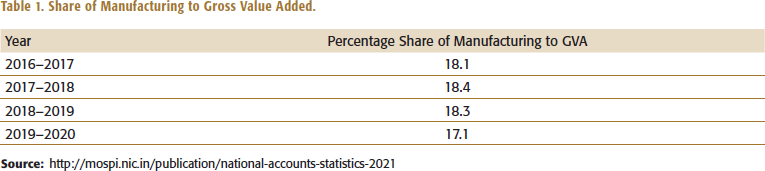
The study has been conducted in the manufacturing sector. The manufacturing sector contributes substantially to the gross domestic product of the country in terms of gross value added (GVA). Table 1 depicts the percentage share of manufacturing to the GVA from 2016–2017 to 2019–2020.
Share of Manufacturing to Gross Value Added.
The manufacturing sector, therefore, has significant implications for the economy and employment. Manufacturing industries have adopted the latest technologies to achieve operational efficiency in production and maintenance, automation, safety and environmental protection. In addition to technological sophistication, the firms have adopted enterprise-wide resource planning systems (ERPs). These interventions have enabled firms to reap the benefits of efficiency and productivity. For instance, firms in the iron and steel sector have become complex in terms of size, products, quality, specifications, technologies adopted, raw materials, market reach, communication and use of varied financial resources.
Consequently, manufacturing firms require various human resources equipped with contemporary and relevant competencies. Such employees are valued in one industry and sought after in other industries. For instance, power plant engineers find employment in power industry firms. Safety, industrial automation and maintenance technologists are sought after in multiple industries. Therefore, manufacturing firms provide a context for investigating HR signals’ attributional abilities to influence employees’ job satisfaction and fulfilment of the PC. The Indian economy’s opening up post-1991 has also exposed the manufacturing firms to new competitors’ latest technologies and management systems. Therefore, these firms need to reexamine the relationship of HR with individual employee behaviours and the role of PC fulfilment in retaining employees and managing employee satisfaction.
LITERATURE REVIEW AND HYPOTHESES DEVELOPMENT
Job satisfaction is a psychological feeling of well-being experienced by employees at the workplace arising from job experiences. Saleem (2015) viewed job satisfaction as a sense of pride and internal satisfaction experienced by employees while executing a job. It is also considered a psychological condition that aids in employees’ assessment of their work and work experience (Poon, 2004). Robbins (2005) suggests it is an aggregation of an employee’s feelings towards his/her job. Similarly, Spector (1997) refers to job satisfaction as the degree to which people love their jobs. Greenberg and Baron (2008) mention that job satisfaction is about employees’ positive and negative work attitudes. Bashayreh (2009) summarizes job satisfaction as a pleasurable positive state arising from one’s job and job experiences. Thus job satisfaction may be understood as a combination of various feelings and attitudes towards the job.
PCs based on the social exchange perspective (Blau, 1964) refer to the employer and the employee’s expectations and are in addition to the formal, written contracts of employment (Argyris, 1960). Consequently, these beliefs lead to reciprocal obligations between employers and employees (Rousseau, 1989). Rousseau (1989, 1995) and Morrison and Robinson (1997) consider it as comprising of an individual’s beliefs, shaped by the organization, concerning reciprocal obligations that occur between employee and organization (employer). They form the basis of mutual trust and cooperation, incorporating reciprocity norms (Hui et al., 2004; Memon et al., 2018; Mount et al., 2006). The PC may be relational or transactional. Relational contracts are long-term contracts built around trust and emotional attachments (Chan, 2021; O’Donohue & Sheehan., 2007) and possess flexibility to a certain extent between employees and the organization (Chan, 2021; Rousseau & McLean Parks, 1993). On the other hand, transactional contracts are short-term, explicit exchanges built primarily around economic exchanges (Chan, 2021; O’Donohue & Sheehan., 2007; Rousseau, 1995, 2004).
PC fulfilment is considered an antecedent of job satisfaction. Scholars such as Bal et al. (2010) and Kabak et al. (2014) opine that factors such as financial benefits and perks, career growth and promotion, working environment, supervisors and colleagues are part of PC fulfilment and influence job satisfaction. In line with the above understanding, researchers such as Beynon et al. (2012), Porter et al. (1998), Turnley and Feldman (1999) and Xiong et al. (2017) have reported a positive relationship between the fulfilment of PC and job satisfaction. Similarly, it has been observed that PC fulfilment can influence employee behaviours such as job satisfaction, trust, in-role and extra-role performances, and intent to remain in the organization (Hui et al., 2004).
Thus, PC has been used extensively as a mediating or intervening variable in research/discussions on ‘what leads to employee behaviour’. The PC is based on the social exchange theory that emphasizes reciprocity in social relationships. Employees who feel valued and respected are likely to exhibit, in return, trust, commitment and emotional engagement towards the employer (Ali et al., 2010; Bal et al., 2013; Blau, 1964). A PC, thereby comprising an employee’s understanding of the promises by the employer, the organization (e.g., competitive wages, advancement opportunities, job security) and what the employee expects to give to the organization in return (e.g., a fair day’s work, loyalty).
Scholars such as Rousseau and McLean Parks (1993) and Westwood et al. (2001) opine that PCs evolve from the employee’s interaction with their organizational environment. HRM practices play a vital role in this process. Although the contracts are unique to each, organizational goals encourage developing one contract over another. It is accomplished using messages or signals organizations send to employees. Researches by Rousseau and McLean Parks (1993) and Robinson and Rousseau (1994) confirm that PCs are generated during the employment relationship by HRM activities such as recruitment, performance appraisal, training and compensation discussions. PCs are influenced during events in the organizational timeline wherein organizations share plans with employees (Rousseau, 1995). The crucial role of human resource departments in shaping and affecting the PCs of employees finds support in the findings of Koene and Van Riemsdijk (2005), Rousseau (1995) and Westwood et al. (2001). The scholars posit that the human resources department’s policies, practices and actions during various employment relationship stages affect employees’ PC. Scholars such as Sonnenberg et al. (2011) and Suazo et al. (2009) have argued that the HR practices of an organization impact the fulfilment of PCs, thereby implying a positive association of HR signals with PC fulfilment. Studies provide evidence that PC fulfilment is directly associated with employee behaviours such as commitment, job satisfaction, organizational citizenship behaviour and job performance and is negatively related to intent to leave (Conway & Briner, 2005; Turnley et al., 2003; Turnley & Feldman, 2000). The positive association of PC fulfilment and organizational citizenship behaviour has also been referred to in the works of scholars such as Coyle-Shapiro and Conway (2005). However, it is interesting to note that though the overall PC fulfilment has been examined, studies involving the state and nature of the PC (transactional or relational) have been few (Aggarwal & Bhargava, 2010; Raja et al., 2004; Millward & Brewerton, 1999). Researchers believe that the state and nature of the PC can also send important messages that elicit employees’ specific behaviours (Hui et al., 2004). Raja et al. (2004) opined that evidence suggests that different factors influence relational and transactional PCs. Further, Montes and Irving (2008) infer that these types of PCs have different influences on employee attitudes and behaviours. Therefore, there is a need to examine the relational and transactional PCs separately. The present study addresses this call of literature.
Therefore, signals from the firm in terms of HRM play a vital role in shaping employees’ beliefs, which are crucial to forming the PC. Spence (1973) defines signal as an observable characteristic attached to individuals subject to manipulation. For example, education is something that an individual can invest at a certain cost of time and money. Therefore, this would be of signalling value to both the applicant/ employee and the employer. The employee may signal his productivity (high or low) through the observable characteristic of education (years of education). A higher level of education indicates higher employee productivity. Rousseau (1995) considers HRM as secondary contract makers or structural signals, vehicles people use to convey commitments and offer inducements for present and future behaviour. Organizational practices such as HRM policies and practices, organizational structure and communication systems can be considered mechanisms to indicate desired behaviours.
Organizations (represented by senior management) possess information about the business that employees may not be aware of. The organization’s information asymmetry is utilized in sending appropriate and contextual signals to employees using HRM processes. Employees observing HR signals about elements of their PC with their employer, display desired behaviours (Sonnenberg et al., 2011; Suazo et al., 2009, 2011). Suazo et al. (2009) also state that the PC has been considered an important lens through which HRM signalling can be explained. The signalling role of HRM and its attributional abilities find support in the conceptual framework of HR signalling by Bandyopadhyay and Srivastava (2021). The attributional ability of HR signals, represented by the strength of HR signals, may be assumed to play a vital role in shaping, maintaining and evaluating a PC. Kelley’s covariation model (1967) explains how individuals make attributions out of situations or events in the environment. He proposes that individuals’ attributions depend on three factors (meta-features)—distinctiveness, consistency and consensus.
Bowen and Ostroff (2004) additionally opine that strong situations or events high on distinctiveness, consistency and consensus lead to confident attributions by employees. Therefore, the meta-features play an important role in ensuring the display of effective behaviours by employees and communication of intended HRM outcomes by employers. Distinctiveness refers to the HR systems and practices’ ability to stand out, drawing attention and capturing employees’ interest. It increases the probability that the employees will notice HRM messages. Therefore, it refers to the event–effect relationship being highly observable to employees. Distinct HR signals are understandable and communicate uniqueness and the relevance of the signal to the employee, thereby influencing the creation and fulfilment of the PC. Consistency refers to the same effect occurring over time and space whenever HR systems and practices are presented to employees. According to Bowen and Ostroff (2004) and Kelley (1967), a consistent event–effect relationship across time and space increases the probability that desired behaviour gets exhibited. Consistency in space would mean that the messages are the same from different senders, whereas consistency across time would mean the signals convey the same message when communicated across time. Therefore, consistent signals better explain the creation of favourable conditions for generating and fulfilling the PC. Consensus deals with the relationship between behaviours and results. It occurs when there is agreement among employees about the event–effect relationship. Bowen and Ostroff (2004) and Kelley (1973) believe that higher consensus results in more precise interpretations of what behaviours or responses lead to what consequences. Bowen and Ostroff (2004) consider that agreement among message senders and fairness of the HR systems influence consensus. The consensus of signals, in this context, would refer to the fact that different senders/stakeholders would be in sync while sending signals.
Bowen and Ostroff (2004) and Mischel (1973, 1977) argue that an HR signal high in distinctiveness, consistency and consensus will enable employees to make confident event effect attribution.
Based on the above discussion, the following hypotheses are framed.
H1: Higher the strength of HR signals, the greater would be the job satisfaction.
H2a: Higher the strength of HR signals, the more would be the transactional PC fulfilment.
H2b: Higher the transactional contract fulfilment, more would be the job satisfaction.
H3a: Higher the strength of HR signal, the more would be the relational PC fulfilment.
H3b: Higher the relational PC fulfilment, more would be the job satisfaction
H4a&b: Transactional and relational PC fulfilments mediate the relationship between the strength of HR signal and job satisfaction.
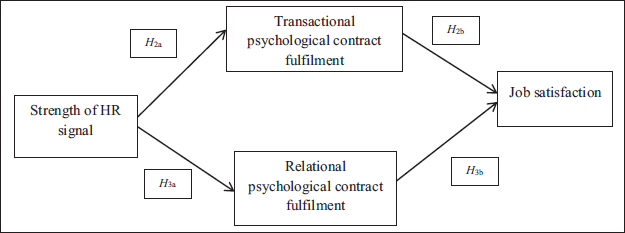
The hypotheses discussed above are represented in the conceptual Figures 1 and 2. Figure 1 depicts the relationship between HR signal strength and job satisfaction. Figure 2 considers the mediating role of transactional and relational PC fulfilment in the relationship between HR signal strength and job satisfaction.
Relationship Between the Strength of HR Signal and Job Satisfaction.

Relationship Between Strength of HR Signal, Relational and Transactional Psychological Contract Fulfilment, and Job Satisfaction.
METHOD
Sample and Data Collection
A two-step sampling procedure has been followed to meet the objectives of the study. Convenience sampling has been used in the first stage to select firms in the manufacturing industry. Firms meeting three criteria were chosen for the study. The criteria were—having more than 100 employees, having been in operation for more than five years and with established HRM systems and practices. The firms were briefed about the survey’s academic nature. They were also informed that the anonymity of the firm and respondents would be maintained. Further, they were assured of the confidentiality of responses and the non-sharing of data with a third party. Therefore, manufacturing firms located in the eastern part of the country were selected for ease of contacting the firms, a higher chance of getting approval to carry out the survey and arranging logistics to carry out the survey. The selection of respondents, that is, employees, has been done through random sampling. The HR department provided a list of managers on the firm’s rolls for more than a year. The respondents were selected randomly from the list, ensuring each department or function gets represented in the sample. A centrally convenient location was chosen for the administration of the questionnaire. The location identified was such that the respondents could approach the room without much inconvenience. The respondents were explained the study’s academic nature, research purpose use of terminology in the questionnaire and the process of filling up the questionnaire. The questionnaire contained positively as well as negatively worded items. The questionnaire was arranged so that the predictor variables preceded the criterion variables. A short video on teamwork (an aspect different from the study’s variables) was shown to the respondents to break the monotony as soon as they completed responding to the predictor variables. It broke the monotony and altered the mood of the respondents. After watching the video, the respondents completed their responses on the criterion variables.
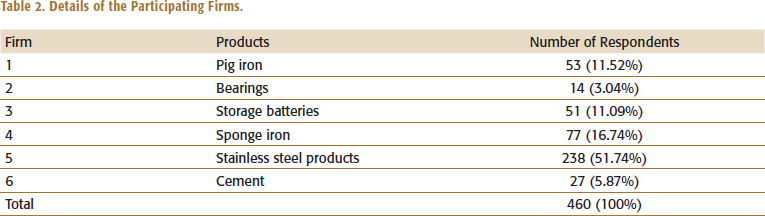
Four of the six firms (66.67%) manufacturing firms belonged to the iron and steel sector, while the rest (33.33%) pertained to other industries. A total of 460 managers spread across six firms participated in the study. A total of 80% of the participants were engaged in manufacturing iron and steel products, while the remaining 20% were involved in manufacturing bearings, batteries and cement. Table 2 displays details of the participating firms.
Details of the Participating Firms.
Measures
The study used separate scales to measure HR signals’ strength, PC fulfilment and job satisfaction. Table 3 presents the scales’ details, followed by a brief discussion.
Details of Scale.

Strength of HR Signals
The scale for measuring the strength of HR signals from the employee perspective incorporates the concept of strength of the HR system by Bowen and Ostroff (2004) and Kelley’s covariation model (1967). It also adopts certain items from the strength of HR systems scales by Coelho et al. (2015), Delmotte et al. (2012) and Qadeer and Butt (2013). The adopted items have been modified to suit the study’s purpose. The scale was shared with a panel of HR experts from academia and industry for their comments. It was also tested on 100 employees, and the indices (reliability, inter-item correlation, item-total correlation) were satisfactory. The scale contains items about the meta-features of HR systems, such as distinctiveness, consistency, change and consensus, and its reliability is 0.91. After the item analysis, 13 items were retained for the final analysis.
Psychological Contract Fulfilment
The scale on PC fulfilment is adapted from Robinson and Morrison (1995). The scale refers to fulfilling a PC from an employee’s perspective and consists of transactional and relational components. The reliability coefficients for the transactional and relational components are 0.85 and 0.87. The transactional and relational PC fulfilment comprises six and eight items, respectively, post-item analysis.
Job Satisfaction
The three-item scale refers to the feeling of contentment, happiness or joy employees derive from their job. The scale is based on Cammann et al. (1983). The reliability coefficient, Cronbach’s alpha for the scale, was 0.81.
Control Variables
The study considered the employees’ age and tenure as control variables. These variables affect the relationships among the variables (Dobrow Riza et al., 2018; Shirom et al., 2008). Hence these variables have been controlled to minimize their effect on the considered relationships.
RESULTS
The data were analysed using SPSS 21, and structural equation modelling was done using AMOS 21. Descriptive statistics and inter-variable correlations are presented first, followed by the exploratory factor analysis (EFA) results and the confirmatory factor analysis of the measurement model. The hypotheses are examined using structural equation modelling of AMOS.
Descriptive Statistics and Correlation Analysis of the Variables
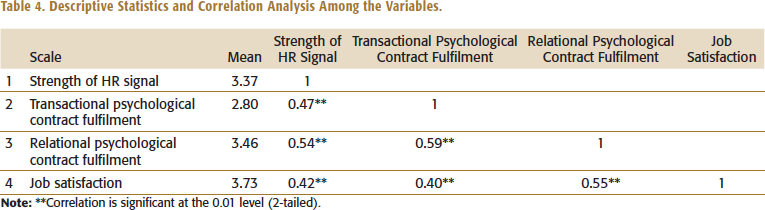
The mean for job satisfaction is 3.73, the highest among the four variables. The means for transactional and relational PC fulfilment are 2.8 and 3.46, respectively, while the HR signals’ strength is 3.37. Correlation between the variables shows a significant and positive relationship among the variables. Table 4 shows the details of the analyses.
Descriptive Statistics and Correlation Analysis Among the Variables.
Exploratory Factor Analysis
The study considers the variables as first-order reflective constructs. It also considers apriori or theoretically established dimensionality of the constructs. EFA has been conducted to identify and delete items with low factor loadings on the latent variable. Loadings greater than or equal to 0.40 have been considered along with varimax rotation and principal component analysis. Moreover, the EFA would offer an indication of the total variance explained in each latent variable. Results of the EFA indicated that the items explained 58.17% of the variance in the strength of HR signal, 58.45% of the variance in transactional PC fulfilment, 78.84% of the variance in relational PC fulfilment and 72.45% of the variance in job satisfaction.
Confirmatory Factor Analysis
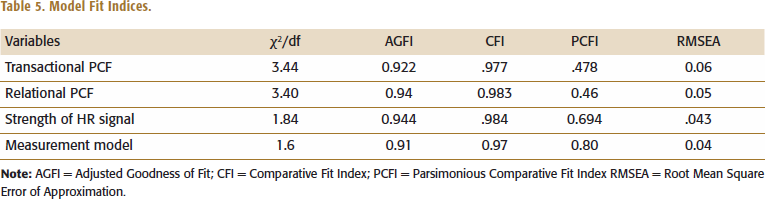
Confirmatory factor analysis is used to confirm whether measures of a variable are consistent with the apriori understanding of the nature of that variable. The fit indices of the variables met the required norms and confirmed that the indicators loaded satisfactorily on the latent variables. The measurement model also reported a good fit for the indices. The following threshold values were considered for the study: χ2/df < 5; p > .05; CFI/PCFI > 0.90; AGFI > 0.80; RMSEA < 0.08 (Hu & Bentler, 1999). Table 5 depicts the indices of the variables. The confirmatory factor analysis for job satisfaction could not be conducted as it comprised three items, and no degree of freedom was available.
Model Fit Indices.
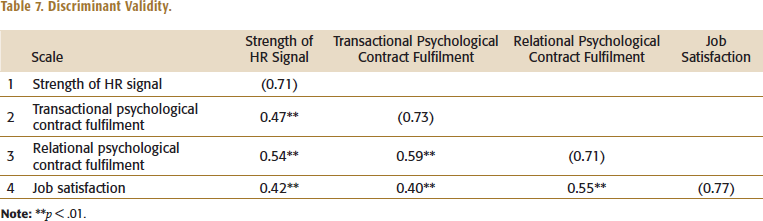
The convergent and discriminant validity of the variables were examined next. Accordingly, the average variance extracted (AVE) was computed for each variable—HR signal strength, transactional and relational PC fulfilment, and job satisfaction. Table 6 shows the AVE for each variable. The AVE for each variable exceeded 0.5, thereby meeting the convergent validity requirement (Fornell & Larcker, 1981). The discriminant validity was examined by calculating the AVE’s square root for each construct and comparing it with the respective constructs’ correlation. According to Fornell and Larcker (1981), the AVE of a construct’s square root should be greater than the correlation between the respective constructs. Table 7 depicts the results of discriminant validity analysis, and it reveals that variables discriminate against each other. The square roots of the AVEs are presented within brackets, and the values are greater than the correlations of respective constructs. The results indicate the fulfilment of the conditions of discriminant validity.
Average Variance Extracted for Each Variable.

Discriminant Validity.
The structural model was tested after the examination of the measurement model. The structural model offered an adequate fit of the indices. The results of the structural model are presented in Table 8.
Model Fit Indices: Structural Model.

SEM Results of Hypothesis
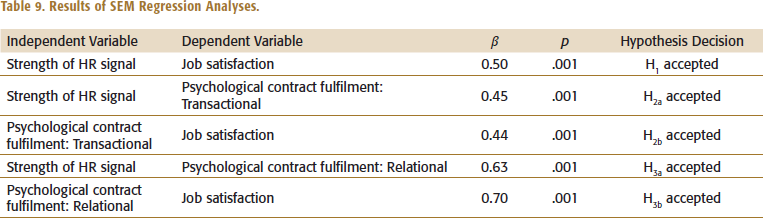
The hypotheses have been analysed by structural equation modelling using AMOS. The results of the structural model are presented in Table 9. The hypothesis has been moved under the table.
Results of SEM Regression Analyses.
H1: Higher the HR signals’ strength, the greater would be the job satisfaction.
The analysis revealed that the strength of HR signals significantly predicted job satisfaction (β = 0.50, p = .001). The result is as per conceptualization, wherein a positive relationship existed between HR signal and job satisfaction. Acceptance of the relationship may be explained by the increase in the strength of HR signals conveying to employees that various aspects of their job are being taken care of by the firm. Such aspects refer to the various resources related to jobs, performance parameters and expectations related to the job.
H2a: Higher the HR signals’ strength, the more would be the transactional PC fulfilment.
H2b: Higher the transactional contract fulfilment, more would be the job satisfaction.
The analysis revealed that the strength of HR signals significantly predicted transactional PC fulfilment (β = 0.45, p = .001). Similarly, transactional PC fulfilment significantly predicted job satisfaction (β = 0.44, p = .001). The outcomes are in line with the hypotheses, confirming that HR signals indicate to employees the extent of fulfilment of transactional aspects of HR, such as compensation. Employees evaluate how transactional aspects of the PCs are fulfilled and accordingly display satisfaction at the job.
H3a: Higher the strength of the HR signal, the more would be the relational PC fulfilment.
H3b: Higher the relational PC fulfilment, more would be the job satisfaction.
Analysis of the hypotheses revealed that the strength of HR signals significantly predicted relational PC fulfilment (β = 0.63, p = .001). Further, relational PC fulfilment significantly predicted job satisfaction (β = 0.70, p = .001). The outcomes confirm the hypotheses, implying that employees examine HR signals based on their PC’s relational components. Consequently, employees display job satisfaction depending on the fulfilment of relational PCs.
H4a&b: Transactional and relational PC fulfilments mediate the relationship between HR signal strength and job satisfaction.
Following Barron and Kenny’s (1986) approach, the mediating role of transactional PC fulfilment was evaluated. The relationship between the strength of HR signal (independent variable) and job satisfaction (dependent variable), H1, constituted the total effect. Analyses revealed that the strength of HR signals significantly influenced job satisfaction (β = 0.50, p = .001). H2a confirmed that the strength of HR signals (independent variable) significantly predicted transactional PC fulfilment (mediating variable). H2b predicted that transactional PC fulfilment (mediating variable) significantly predicted job satisfaction (dependent variable).
Additionally, the independent variable’s impact on the dependent variable in the presence of mediating variable was examined. In the presence of transactional PC fulfilment, HR signal strength significantly predicted job satisfaction (β = 0.27, p = .001). Thus the β value, indicating the influence of the strength of HR signals on job satisfaction, remained significant even considering the mediating variable. Therefore, the analysis proved partial mediation.
The mediation by relational PC fulfilment was also examined following Barron and Kenny’s approach. H1, the relationship between HR signal strength (independent variable) and job satisfaction (dependent variable), was examined. The result indicated that HR signal strength significantly predicted job satisfaction (β = 0.50, p = .001). Subsequently, analysis of H3a confirmed that the strength of HR signal (independent variable) significantly influenced relational PC fulfilment (mediating variable) with β = 0.63 and p = .001. Similarly, relational PC fulfilment (mediating variable), H3b, significantly influenced job satisfaction with β = 0.70 and p = .001. However, in the presence of a relational PC, the strength of HR signals did not significantly predict job satisfaction with β = 0.11, p = .075. Therefore, relational PC fulfilment completely mediated the relationship between the strength of HR signal and job satisfaction.
The results of mediation analysis reveal that a relational PC has a stronger influence than transactional PC fulfilment on the relationship between the strength of HR signal and job satisfaction.
DISCUSSION
The affirmation of the hypotheses implies that HR signals influence employee behaviours such as job satisfaction. It further indicates that the fulfilment of transactional and relational PCs plays a vital role in explaining the influence of HR signal strength on job satisfaction. Interestingly, however, the fulfilment of a relational PC emerges as a stronger intervening variable than transactional PC fulfilment, in explaining the relationship between the attributional ability of HR signals and job satisfaction. The outcomes may be explained by the fact that employees look up to HR signals to decipher ‘what is in it for me’. HR signals, therefore, convey meanings to employees arising out of the fulfilment of expectations from employers.
Scholars such as Allen et al. (2003), Kuvaas (2008), Snape and Redman (2010) and Alfes et al. (2013) have affirmed the acceptance of a positive impact of HR systems on job satisfaction.
Various scholars have analysed the association between PC and job satisfaction. Nishanthi and Mahalekamge (2016) opined that the PC affects job satisfaction, while Turnley and Feldman (1999b) indicated that a breach of the PC reduces job satisfaction, organizational commitment and job performance, thus increasing turnover intention. McDonald and Makin (2000) found that job satisfaction is the employee’s understanding and evaluation of what the organization gives in return. The results supplement the findings of Bal et al. (2010) and Kabak et al. (2014), who affirm that employees display appropriate behaviours consequent to their evaluation of PC fulfilment.
The differential influence of transactional and relational PC fulfilment on employee behaviours also finds support in previous researchers’ works. For instance, Anderson and Schalk (1998) report that violating transactional PCs could diminish job satisfaction. Haq et al. (2011) provide evidence that relational and transactional PCs have a differential effect on job satisfaction. He opines that the relational PC may have a higher impact than the transactional PC. The differential impact of PC types also finds support in the views of Rousseau (1995) and Rousseau and McLean Parks (1993). They opine that relational PCs should facilitate positive personal and organizational outcomes better than transactional PCs.
Furthermore, Raja et al. (2004), present evidence through their research that relation and transactional PC have a differential effect on job satisfaction. They added that the relational contract had a stronger influence on job satisfaction than a transactional contract. Similarly, Katou (2013) and Uen et al. (2009) inferred that high-performance work systems have a differential impact on relational and transactional PCs. Furthermore, Deepthi and Baral (2013) mention that relational PC fulfilment has a more significant effect on job attitudes than transactional PC fulfilment. Similarly, Uen et al. (2009) argue that relational contract fulfilment significantly affects role behaviours.
The nature of the industry and the respondent profile play a significant role in explaining the results. The manufacturing industry, especially the iron and steel industry, is highly technology-driven. They adopt various contemporary state-of-the-art technologies, machinery and equipment for their operations. It is necessary for their commercial and competitive viability in the market. Hence, they employ highly skilled technologists who are in high demand in the labour market. The survey respondents belong to this category. Employers need to take care of their PCs. Such employees pay special attention to the transactional and relational elements of their PCs. However, such employees accord more importance to relational elements of PCs such as long-term career development, training and development. Compensation is important, but developmental aspects are more important to the employees. Therefore, the full mediation by relational PC fulfilment reflects the relevance of relational aspects of PCs in their employment relationships. Thus, the expectations of responding employees who possess contemporary skills, age and employability in the external labour market.
CONTRIBUTION TO THE LITERATURE
The study adds to the literature by incorporating HR signals’ attributional role in explaining employee behaviours within the organization. Consideration of relational and transactional PCs as mediating variables offers insight into how HR (in terms of HR signals) affects employee behaviours. The study thus illuminates the HR black box by offering an insight into how HR influences employee behaviours, ultimately influencing the firm’s performance.
It adds to existing knowledge on attribution-based HRM as Nishii et al. (2008) envisaged. Nishii et al. (2008) opine that employees make attributions about management interventions and certain HR systems and practices. Further, the employees relate such attributions to their displayed attitudes and behaviours, finally leading to performance. The study adds value to attribution-based HRM by viewing HRM as signals, that is, changes in HR systems and practices. Moreover, the research extends the concept of the strength of HR systems (Bowen & Ostroff, 2004). It repositions the HR systems as HR signals and examines HR signals’ attributional ability. The research introduces ‘change’ in addition to distinctiveness, consistency and consensus as meta-features influencing the attributional ability of HR signals.
IMPLICATIONS, LIMITATIONS AND SCOPE OF FUTURE STUDIES
The study offers implications for practising managers. A signalling perspective of HR implies that senior managers of firms and HR managers need to periodically revisit and align their HR systems with their business environment. Acceptance of the role of transactional and relational PC fulfilment in influencing job satisfaction indicates that senior managers need to understand employee aspirations and mould organizational practices accordingly. Job satisfaction also affects other employee behaviours, such as commitment, engagement and intent to stay. Therefore, senior managers should devise policies and practices to enhance job satisfaction, creating an engaged and committed workforce.
Furthermore, the results indicate that managers should pay extra attention to the relational components of PCs rather than transactional components. The study shows that relational PC has a greater influence on employee behaviours such as job satisfaction.
The study has some limitations, given the time and cost of data collection and analysis. Respondents belonged to the manufacturing domain, and hence, the study’s generalizations are limited to the manufacturing sector. The participating firms in the study are recognized and established brands in the industry and have well-established HR practices. Such a context, thereby limiting the extension of the results to a broader range of firms or industries.
Future studies may be conducted across manufacturing and services sector firms. A more comprehensive range of firms, such as the public or private sector, promoter versus multinational firms, may be considered in future studies. Forthcoming studies may consider more relevant variables for a better and more in-depth reflection of reality.
Footnotes
ACKNOWLEDGEMENT
The infrastructural support provided by the FORE School of Management, New Delhi, in completing this paper is gratefully acknowledged.
DECLARATION OF CONFLICTING INTERESTS
The authors declared no potential conflicts of interest with respect to the research, authorship and/or publication of this article.
FUNDING
The authors received no financial support for the research, authorship and/or publication of this article.
e-mail:
e-mail: