




Abstract

Keywords
Infrastructure is necessary for broad-based growth and development, as also for achieving and maintaining the delivery of public goods (water supply, rural roads, primary education and healthcare, etc.) and social well-being. To give an organized thrust to infrastructure, the Government of India, in April 2020, released the first-ever National Infrastructure Pipeline (NIP) with details of 6,847 projects valued at over ₹111 lakh trillion to be implemented over a six-year period from the financial year (FY) 2020 to FY2025.
Infrastructure services need to be paid for, either through user charges or from the budget. User charges are essential for remunerating investors in toll-based infrastructure projects. If the user charges have to be below the cost of provision of these services, the government should provide explicit subsidies. For instance, after the privatization of Delhi power distribution, the tariffs for households consuming below 200 units of electricity per month are zero, and those consuming between 200 and 400 units are subsidized, and the difference between the tariffs and cost of supply to these market segments is paid explicitly by the Delhi government to the private providers as a subsidy.
Since many infrastructure services are merit goods (primary health and primary education, for example), full cost recovery (including capital cost) may not always be possible or desirable. Therefore, user charges should at least recover the operation and maintenance (O&M) costs of all infrastructure assets.
WHY DO WE NEED REASONABLE USER CHARGES?
User charges add to investment, creating a new revenue stream where none existed earlier. For example, toll roads collected ₹268.51 billion in 2019–2020 (National Highways Authority of India, Toll Information System, 2020), facilitating more infrastructure investment, helping manage demand, and mitigating adverse environmental and resource use impacts. More generally, reasonable user charges help improve efficiency in the use of resources, equity, cost recovery and mitigate environmental and resource use impacts.
Since the very rationale of inducting the private sector in most instances is the resource crunch of governments, creation of an additional revenue stream facilitates the creation of additional infrastructure and thus addresses the issue of infrastructure deficit in the country.
The environmental impact of reasonable user charges is explained below. The Central Ground Water Board imposes no charges for the extraction of groundwater, which is partly responsible for the depleting groundwater levels across the country. Out of the total 6,881 assessment units (blocks/mandals/talukas) in the country, 1,186 units in various States (17%) have been categorized as ‘over-exploited’ indicating groundwater extraction exceeding the annual replenishable groundwater recharge. Only 4,310 assessment units (63%) have been categorized as ‘safe’ where groundwater extraction is less than 70% of the recharge (Central Ground Water Board, 2019). If water is priced, less water would be extracted from the ground (as users try to equate the marginal benefits to the marginal costs of groundwater, thus managing demand), which would help mitigate adverse environmental and resource use impacts.
Similarly, as per the Composite Water Management Index (Niti Aayog, 2019), there are over 20 million wells pumping water with (subsidized) power supply provided by the government. This has been depleting groundwater while encouraging wastage of water in many States. A comparison of depth to the water level of pre-monsoon 2018 with the decadal mean pre-monsoon (2008–2017) level reveals that about 52% of wells are showing a decline in water level. Part of the reason for the declining groundwater level is that there is no charge for groundwater extraction. Even when there is a charge for water, it is a flat rate for households. Volumetric water charges would make households consume less water and thus promote environmental sustainability.
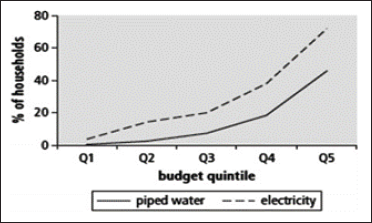
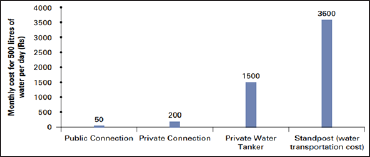
Low user charges are justified in the name of the poor, that is, the poor would not be able to afford higher rates. However, because of low cost-recovery, the poor may be getting rationed out of publicly provided services (Figure 1 shows that access to piped water supply and grid-based electricity is quite limited in the lowest budget quintile). For example, the Delhi Jal Board has only 2.2 million metered connections and about 0.15 million unmetered connections (Delhi Economic Survey, 2020) for the over 5 million households in Delhi, implying that the vast majority of the households (which invariably would be poor) are not connected to piped water supply. These poor households may be paying high charges for water supply in private markets (water supply to poor households from tankers and standposts, see Figure 2). In fact, it is well established that consumption subsidies (or low user charges) should be replaced with connection subsidies to improve efficiency and equity in providing such services (Pratap, 2017).
Low user charges lead to the vicious cycle of asset creation, their steady deterioration because of inadequate O&M owing to low-cost recovery, and finally, re-building these assets at huge costs. Adequately maintained assets are a much more efficient and financially prudent way of providing infrastructure services than the vicious cycle stated above.
Low user charges also lead to private project failures. This is exemplified by the high rate of failures in the water and sewerage sector, where 4.7% of the projects have failed, accounting for 17.7% of investment in the sector (World Bank, 2020) both significantly higher than the overall project failure rate of infrastructure.
People who have gotten used to receiving infrastructure services free (say water, power and roads) may take recourse to direct action (preventing providers from charging tolls), adding to political risks (because of de facto expropriation) faced by private infrastructure projects. Regulators may also be setting user fees below costs, as in the power distribution sector. Section 61 of the Electricity Act (2003) states that ‘The Appropriate Commission shall, subject to the provisions of this Act, specify the terms and conditions for the determination of tariff, and in doing so, shall be guided by the following … that the tariff progressively reflects the cost of supply of electricity’. Though recently, the electricity tariffs have increased in some States, the gap is still quite wide at Rs 0.72 per unit of electricity supplied in the country (Power Finance Corporation, 2020). These political and regulatory risks would be reflected in a higher risk premium charged by the investors, thereby increasing costs and decreasing the cost competitiveness of the Indian economy.
THE CURRENT SCENARIO
Most infrastructure is under-priced in India, that is, there is inadequate cost recovery (water supply, power supply, metro fares, fees in public hospitals and educational institutions, etc.). In the railways, passenger rates are low and cross-subsidized from higher freight rates, with the result that railways is losing market share (for freight) to the road sector, despite being more economically and environmentally efficient. The overall recovery rates (i.e., the cost of publicly provided services recovered from the users) on services provided by the Central Government were estimated by Eighth Five Year Plan (1992–1997) to be as low as about 35%; it was even lower at about 14% for the services provided by the State Governments.
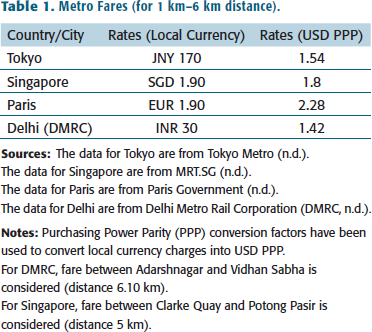
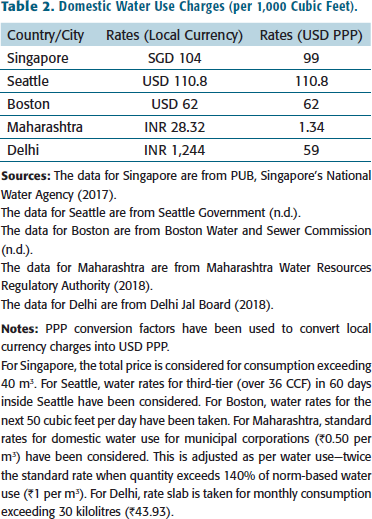
The current user charges in public utilities in India are well below that found internationally, after normalizing the user charges in US dollar (USD) terms on purchasing power parity (PPP) basis (see Tables 1–3 for international comparisons of user charges for metro rail, drinking water and tuition fees). Tables 1–3 highlight the need for raising user charges across sectors in India.
Metro Fares (for 1 km–6 km distance).
The data for Singapore are from MRT.SG (n.d.).
The data for Paris are from Paris Government (n.d.).
The data for Delhi are from Delhi Metro Rail Corporation (DMRC, n.d.).
For DMRC, fare between Adarshnagar and Vidhan Sabha is considered (distance 6.10 km).
For Singapore, fare between Clarke Quay and Potong Pasir is considered (distance 5 km).
Domestic Water Use Charges (per 1,000 Cubic Feet).
The data for Seattle are from Seattle Government (n.d.).
The data for Boston are from Boston Water and Sewer Commission (n.d.).
The data for Maharashtra are from Maharashtra Water Resources Regulatory Authority (2018).
The data for Delhi are from Delhi Jal Board (2018).
For Singapore, the total price is considered for consumption exceeding 40 m3. For Seattle, water rates for third-tier (over 36 CCF) in 60 days inside Seattle have been considered. For Boston, water rates for the next 50 cubic feet per day have been taken. For Maharashtra, standard rates for domestic water use for municipal corporations (₹0.50 per m3) have been considered. This is adjusted as per water use—twice the standard rate when quantity exceeds 140% of norm-based water use (₹1 per m3). For Delhi, rate slab is taken for monthly consumption exceeding 30 kilolitres (₹43.93).
Tuition Fees for Studying Law (for 2 Terms in a Year).
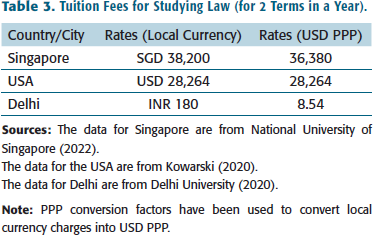
The data for the USA are from Kowarski (2020).
The data for Delhi are from Delhi University (2020).
However, because of the inefficiency of some government departments and corporations that provide these public utilities, the actual costs of provision of many of these services themselves are much higher than what they should be. To that extent, the whole of the unrecovered costs of these public utilities does not constitute a subsidy to the users of these services. Nevertheless, it appears reasonable to assume that at least a part of these unrecovered costs of public utilities is, in fact, a subsidy to the users. In view of this, some increase in the user charges of some of these public utilities aimed at recovering at least the O&M costs seems necessary. At the same time, the government departments and corporations providing these utilities should be forced to become more efficient by imposing harder budget constraints on them (Planning Commission, 1992).
WHAT CAN BE DONE?
However, the under-pricing and political difficulties in raising user charges does not mean that there is no room for improvement. For example, in the road sector, a common electronic toll system for the whole country would be ideal. It would ensure against long lines of vehicles at toll booths and consequent wastage of time and fuel, while also being a check against a major source of leakage and theft (prevalent when there is physical cash collection of tolls), thus increasing the realized user charges. The Government of India has already decided to implement the Electronic Toll Collection (ETC) system on pan-India basis, and FASTags have been made mandatory on vehicles from 1 January 2021 (Press Trust of India, 2020). There are also some successful examples of addressing political difficulties in raising user charges through a gradual increase in prices over a long period, as in the case of kerosene fuel (Choudhary, 2020) that can be replicated across sectors.
Kerala Water Authority (2021) has recently revised water rates by notifying the current water tariff as a floor rate that is subject to 5% annual increase from 1 April 2021, for all categories of consumers. This is to make the State eligible for additional borrowing of 2% of Gross State Domestic Product from the Centre, conditional upon reforms undertaken to boost urban local body revenues. So, incentivizing reasonable user charges in the most politically sensitive water sector can also play a part. Subsidies need to be well targeted through 100% metering, supplemented by lifeline tariffs and volumetric pricing (with increasing block tariffs) so that those meant for the poor are not siphoned off by the rich.
This has also been reiterated by the 15th Finance Commission and finds mention in the principles of the draft National Water Framework Bill (Ministry of Water Resources, 2016): Water used for commercial agriculture and industry or commerce may be priced based on full economic pricing, or higher if needed and appropriate in a given case. For domestic water supply, a graded pricing system may be adopted, with full cost recovery pricing for the high-income groups, affordable pricing for middle income, and a certain quantum of free supply to the poor to be determined by the appropriate government. Alternatively, a minimal quantum of water may be supplied free to all. Smart and pre-paid metering in power distribution would also help in improving billing and collection efficiency, with a commensurate impact on lowering Aggregate Technical and Commercial (AT&C) losses. This will help meet objectives of cost recovery, economic efficiency, equity, affordability and financial viability of utilities.
One of the established principles of optimal risk allocation is that risk should be allocated to the party with more control over the risk factor. Using this principle, political risks should be assigned to the government, which should be responsible for upholding the rule of law and not allowing goons to take over toll booths. Similarly, regulatory risk can be mitigated by making regulatory institutions truly autonomous; it is no coincidence that all infrastructure regulators in India are headed by retired bureaucrats too eager to tow the government line. The selection of regulators and regulatory processes needs to improve for their improved credibility and for user charges to be cost-reflective (Pratap, 2015).
Cost recovering user charges also need to be prioritized because of the growing fiscal crunch during the current COVID-19 pandemic times. There is immense potential for increasing revenues from reasonable user charges. In the scheme of financing of the NIP, user charges will be reflected in higher internal accruals and retained earnings of the providing enterprises, both public and private. However, the NIP has budgeted only 1%–3% (roughly ₹1–3 trillion) from this source, which we feel is a huge under-estimate. Let us illustrate this assertion through an analysis of the power distribution sector. There is a revenue gap of ₹0.72 per unit of electricity consumed in the country (Power Finance Corporation, 2020). The total energy generated in the country in 2018–2019 was 1,547 billion units (Ministry of Finance, 2020), of which about 22% is lost in AT & C losses. So, if the cost recovering level of tariffs is imposed on the power sector, the additional potential revenue generation is to the extent of ₹869 billion per annum. Since the NIP is a six-year infrastructure plan for the country, the total resource generation potential from making the power tariffs cost-reflective is ₹5,214 billion. This is much more than that estimated in the NIP financing plan, and that too from just one major infrastructure sector.
The NIP projects a resource gap of 8%–10% (roughly ₹8–10 trillion) over six years. Given the rough estimate of additional resource generation potential just from the power sector calculated above, it is clear that reasonable user charges across infrastructure sectors would wipe away the entire resource gap of the NIP and more.
Footnotes
DECLARATION OF CONFLICTING INTERESTS
The authors declared no potential conflicts of interest with respect to the research, authorship and/or publication of this article.
FUNDING
The authors received no financial support for the research, authorship and/or publication of this article.