



Abstract

THE LOCKDOWN
The Number of Countries Impacted by COVID-19 Over Time.

The fear of the virus and the uncertainty aroused by the lockdowns were perceptible. News reports from all over the world, particularly the high-income countries, were full of stories of empty shelves in retail outlets (Evans & Eley, 2020), hoarding of toilet papers (Jacques, 2020), scuffles at stores for hand sanitizers, etc. In March, a sharp spike in the sale of soaps, hand sanitizers and food items was seen in India and all over Europe and the USA. For example, in mid-March, Poland saw a 57% increase in the value of the basket of fast-moving consumer goods (FMCG) goods purchased compared to the same week in previous year (Sas, 2020). The sale of hand sanitizers showed a similar pattern. Its sale increased by 225% in the UK, 800% in Malaysia, 1800% in Italy and 1400% in the USA (Taylor, C., 2020). In the days leading to the lockdown, the Indian story unfolded on similar lines, with the spike in sales of grocery items and hand sanitizers (Mukherjee et al., 2020).
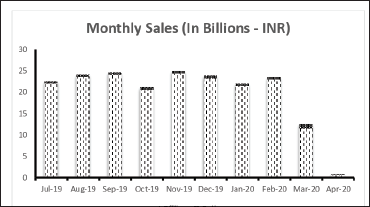
A Summary of Ashit’s Firm’s Business as of the Imposition of National Lockdown in India in March 2020.

Post the Janata Curfew 1 on 22 March 2020, the Indian government imposed a lockdown on the entire nation from 25 March 2020 (Javaid, 2020), bringing almost all the economic activities to a grinding halt. Ashit’s firm saw a near-complete collapse of sales, raising fears of excess inventory that could soon necessitate manufacturing shutdowns (Exhibit 2). As the chief marketing officer (CMO) of a large white-good manufacturer (Exhibit 3), Ashit was responsible for spearheading the marketing reaction of the group to this extraordinary event. Beyond the uncertainty about how long the lockdown could be, Ashit was more concerned with the expectedly prolonged transition phase before some form of normalcy returned. News reports hinted at a phased resumption of economic activity, beginning with sectors that involved less physical contact, for example, e-commerce. However, the situation was too fluid, and he wondered whether policy decisions could be uniform across the country under this scenario. Notably, the challenges faced by Ashit’s firm were not entirely the domain of his functional responsibility. Though he was sure his organizational peers were simultaneously exploring solutions to this crisis, Ashit believed in the vital role of marketing in tackling adversity that strikes at a community level. While he realized that keeping their brand relevant to the target consumer was central to its survival and growth, he also believed that marketing needs to view the concerns of various stakeholders and not just the customers (Hult et al., 2011). How could he alleviate the insecurities and the troubles facing their employees, suppliers, channel partners and the broader community to which all of them belong?
Ashit’s CEO, Shrimati Geetashree, in her regular meetings with him over Zoom, was urging him to chalk out and implement the brand strategy to be adopted in this situation. Ashit, a proven performer, was for a change quite puzzled. He had never encountered a situation remotely similar to the present one and could not bank on his past experiences to determine the course of action. Geetashree’s pressure was mounting on him, and he had to act fast.
THE PANDEMIC
Ashit was wondering how a variant of flu could cause such a havoc. He needed to understand it better. Ashit started to research the past epidemics and pandemics of the world. He realized that the two terms, epidemic and pandemic, have unique meanings and cannot be used interchangeably. As defined by WHO, an epidemic is a disease that ‘affects many persons at the same time, and spreads from person to person in a locality where the disease is not permanently prevalent’ (Kelly, 2011). On the other hand, the WHO defines a pandemic as ‘a worldwide spread of a new disease’ (Kelly, 2011). On 11 March 2020, due to its global spread, infectiousness and severity, COVID-19 was officially declared an outbreak of a pandemic by WHO.
Ashit looked at the number of deaths caused by the major pandemics of the past (Exhibit 4). He observed that the world had seen many pandemics that had caused many more deaths than COVID-19 (Exhibit 5). Understandably, the Middle Ages were replete with such catastrophes. However, even the modern time (twentieth and twenty-first century) is not devoid of pandemics. Ashit was wondering, given the fact that the human race is accustomed to pandemics, what might be the reason for the extreme panic that he was observing all around him. He needed to dig deeper before he could start thinking of appropriate marketing initiatives to be taken.
Deaths Caused by Major Pandemics.

Deaths Caused by COVID-19.

HIV, the largest pandemic of recent times, has no vaccine. However, rapid advances in antiretroviral medications ensure the healthy longevity of the affected people. In the case of swine flu, it was observed that a section of the population was immune to the disease (Newman, 2020). Cholera, which has repeatedly haunted the human race in the twentieth century, is now a curable disease. A very effective vaccine exists for Ebola. Unfortunately, in the case of COVID-19, neither does a vaccine exist nor is the ailment treatable. 4
The mortality rate of COVID-19 is about 7% (WHO, 2020). It is relatively higher than the flu pandemics of the past (Centers for Disease Control and Prevention (CDC), 2019). For example, the flu pandemic of 1968 was estimated to have a mortality rate of 0.03%. The pandemic of 1918 was estimated to have a mortality rate of 1%–3% throughout the world. The overall mortality rate of the swine flu of 2009 was around 0.02%.
CRISIS AND THE ROLE OF MARKETING
Adversity has been an accompanying feature of human existence, whether it is wars, earthquakes, famines, hurricanes, landslides, accidents or economic recessions. Though nature appears to play a part in most adversities enumerated above (even if in conjunction with the human role), internal weaknesses of social entities may also induce several crises. Accordingly, learning systems desist from categorizing each harmful event or consequence as an ‘act of God’ (Paté-Cornell, 1993). From this perspective, business organizations engage in economic, political and, sometimes, moral determination of resource allocation, thus, becoming not only the target but also a source of systemic generation of risk (Vaughan, 1999).
While humanity has never been oblivious to the potential of the various harms highlighted above, Ashit believed in the contention about their increased prevalence in a society characterized by a quest for urbanization, rising technological complexity and widespread neglect of environmental concerns (Richardson, 1994). Evidence to this effect also exists in terms of the rising human and economic toll from adverse occurrences (Faulkner, 2001).
Attribution of cause for a crisis signifies a vital aspect from the point of view of assigning responsibility, performing reactive actions and designing long-term mitigation efforts. Firms could be seen as primarily responsible for a crisis, for example, Enron Corporation was held singularly liable for the accounting lapses, ultimately resulting in its demise (Bondarenko, 2016). Industrial accidents, though often harder to attribute singularly to the firm or external factors, represent extreme adversity and constitute a litmus test for brands. Many regard the Bhopal gas tragedy as a blot on Union Carbide Corporation, for several warnings about its practices were publicly recorded, implying that a disaster was in the making (Business Standard, n.d.). Similarly, public opinion and legally imposed penalties castigated British Petroleum for the Gulf oil spill (Uhimann, 2010). Since economic activities are intricately linked, value-chain partners are also often responsible for crises, for example, retailers such as Amazon and Nike have faced public protests over the inhuman treatment of workers and engagement of child labour in supplier facilities (Bain, 2017; Business & Human Rights Resource Centre, 2019). Notably, brand-related crises are not necessarily related to ethical concerns. Even seemingly ordinary service failures and mismanaged complaints can lead to severe consequences, as illustrated by the United Breaks Guitars episode, which wiped off 10% of United Airlines’ market value (Andres, 2019). Lastly, even when adversity is primarily attributable to external causes, for example, natural disasters, brands—especially the established ones—are expected to contribute, and stakeholders resort to making inter-firm comparisons, often at a competitor, industry and spatial level (Horwitz, 2009).
While Ashit brooded over these multidimensional issues and the rich variability characterizing past crises, he was firm in his belief that such actions can seldom be seen in isolation from the broader community comprising all actors, including people, governments, businesses and other social collectives. Marketing as a philosophy has propagated this societal focus since at least the 1960s (Kotler & Levy, 1969). He saw the marketing function as aiding crisis management by serving essential needs and generating psychological perceptions of normalcy in providing goods and services for consumption (Baker, 2009). It interfaces with other vital stakeholders such as suppliers, channel partners, industry associations, government and its organs, media and other social entities (Hult et al., 2011). Further, its intra-firm dimension, that is, internal marketing orientation, aids employees in dealing with adversity via mechanisms such as training, flexible policies, sustained communication and empathetic conduct (Varey, 1995).
Across geographies and various forms of adverse occurrences, firms have proactively engaged in helping several stakeholders and the community. Ashit remembered how following Hurricane Katrina, Walmart endeavoured to maintain essential supplies and shipped more than a hundred free merchandise truckloads and relief material to community members in the affected areas and $20 million cash donations (Barbaro & Gillis, 2005). It maintained internal communication using satellite cell phones and allowed its store managers discretion in operational decisions based on local needs (Horwitz, 2009). Closer home, he had applauded when Taj hotels decided to pay full salary until retirement, bear the education expenses of all children and dependents, provide a medical cover for the entire family and grant loan waivers in respect of all employees who fell victim to the terrorist attack at its Mumbai hotel in 2008 (Devnani, 2009). Ashit wondered about the motives behind firms’ engagement in crisis response, in particular, and socially responsible conduct, in general.
COVID-19 AND BRAND RESPONSES
Before finalizing his marketing plans, Ashit thought it prudent to scan the reaction of other brands to this emerging crisis and absorb the learning from their actions. Informal interaction with his peer group made him realize that the crisis had left many businesses in distress and fighting for survival. As the revenue was dwindling and companies were struggling, marketing actions were taking a hit.
Though the general mood was gloomy, there were certain notable exceptions. Ashit noticed that some businesses were rising to the occasion and increasing their customer connection. Some of the worthy examples he saw in the market are further discussed.
Lush
Lush is a high-end cosmetic retailer headquartered in the UK. Lush has always positioned itself as a responsible, ethical, sustainable, creative, guilt-free indulgent, fresh and fun brand. Lush products are 100% vegetarian. Moreover, 85% of its products are also vegan. Lush is against animal testing. It does not procure from any company that indulges in any form of animal testing. It consciously does not use sodium palm kernelate in its products as it is derived from the palm trees of Southeast Asia, which are the natural habitat of the endangered orangutans. It adopts the ‘naked’ approach of packaging, thereby minimizing packaging wastes.
In its bid to contribute to the fight against COVID-19, it opened the doors of its stores to passers-by. People were not only welcomed but also encouraged to walk in and wash their hands with Lush soaps without any obligation to purchase. They put up conspicuous posters at their stores advertising their outlets as public utilities (Wood, 2020).
Instagram is a popular photo and video-sharing service owned by Facebook. It has over one billion active monthly accounts, and over 500 million people use it daily (Facebook for Business, 2020a). COVID-19 caused extreme fear and panic in the general public. Such a situation is typically a breeding ground for misinformation. Instagram tracked and identified the hashtags that were frequently used to post wrong or misleading information. Having identified those hashtags, whenever someone used any of those, they were redirected to a verified and authoritative source (Instagram, 2020). For example, in India, anyone who typed #coronavirus was directed to the WHO’s website. Instagram also blocked access to augmented reality (AR) filters that used coronavirus as a theme (Facebook for Business, 2020a).
Telenor
Telenor, headquartered in Norway and one of the largest telecommunication companies in the world, proactively used its network to help Norway fight the COVID-19 menace. It gathered detailed data on people’s movements in Norway (Telenor, 2020). It ensured that the individuals were not identifiable, and the anonymity of the data was strictly maintained. Every 6 hours, the anonymized location data was extracted from all the base stations of the country, and aggregated data was used to come up with a dynamic movement map of Norway. The knowledge of the travel pattern helped the health authorities (Norwegian Institute of Public Health) to run their epidemic model efficiently and make effective recommendations to the government. Thus, it helped protect lives and minimize the spread of the virus.
Pernod Ricard
Pernod Ricard is a French multinational that is the world’s second-largest wine and spirit seller. Present in more than 160 countries of the world, it owns 16 of the top 100 spirits brands of the world. Some of the well-known brands it owns are Absolut Vodka, Ballantine’s, Beefeater, Chivas Regal, Imperial Blue, Jameson, Kahlúa, Malibu, Royal Stag, The Glenlivet, etc. (Pernod Ricard, 2020).
Hand sanitizers emerged as one of the critical tools in the battle against COVID-19. Naturally, across the globe, there was a massive spike in demand for hand sanitizers that was much more than the supply. Pernod Ricard stepped in to help reduce this supply–demand mismatch. It voluntarily collaborated with the government to mitigate the COVID-19 crisis (Businesswire, 2020). In countries such as Sweden, Spain, France, Ireland and the USA, Pernod Ricard used its production lines to produce hand sanitizers (Pernod Ricard, 2020). It also supplied stocks of pure alcohol to the public authorities.
Cisco Webex
Cisco Webex is the leading solution provider for online meetings and video conferences. As the world went into lockdown, people transitioned into work from home mode. Apart from business, even the educational institutions started online delivery of their regular curriculum. Though the need for solutions for online meetings and conferences skyrocketed, many smaller businesses and educational institutions were not equipped with device-to-device online meeting solutions. The freely available solutions on the Internet were reported to suffer from serious security issues (Wakefield, 2020). The security concerns were so severe that some national governments had to step in and issue advisories against using those solutions for official purposes and corresponding guidelines for private use (GOI, 2020).
Cisco Webex, otherwise a paid robust enterprise solution for online meetings, made its services free for 90 days. Anyone could access all its features such as unlimited usage with no time restrictions, support for up to 100 participants, and file and whiteboard sharing features (Srinivasan, 2020).
Taj Hotels
Taj Hotels is a leading hotel brand in India owned by the Tata group. Tata group is one of the most respected conglomerates in India, commanding considerable trust and confidence of its populace. Integrity, responsibility, excellence, pioneering and unity are the five core values of the Tata group (Tata, 2020).
Mumbai, the financial capital of India, was very severely impacted by COVID-19. The doctors and the health workers had a tough time dealing with the massive inflow of patients. To complicate matters further, going back home daily was a risky proposition for the doctors as it increased the risk of infecting their family members. The doctors were advised to work in blocks of 15 days and then be on leave for seven days. They were advised not to go home for these 15 on-duty days. However, in a city like Mumbai, providing suitable accommodation to the doctors was a tall task for the government. Taj Hotels stepped in to resolve the problem. Under their #MealsToSmiles programme, they provided meals to the medical staff of key hospitals and accommodation to the doctors at its select hotels (Tripathi, 2020). In the city of Mumbai, the doors of the following hotels were opened up for this purpose: Taj Mahal Palace; Taj Lands End; Taj Santacruz; President; Ginger MIDC, Andheri; and Ginger, Madgaon.
KFC
Kentucky Fried Chicken (KFC) is a subsidiary of Yum! Brands. It is a well-known brand of a fast-food chain known for its chicken dishes. It operates more than 23,000 restaurants around the world. It is present in more than 140 countries. KFC has a proud and well-established legacy of more than 75 years. One of the fundamental house rules of KFC is make a difference (KFC, 2020). An important value of KFC is to be not afraid to constantly try new things that make it easier to enjoy our chicken (KFC, 2020).
In Vietnam, due to the outbreak of COVID-19, farmers were stuck with a large number of dragon fruits grown primarily for export to China. Since the border between China and Vietnam was closed, these dragon fruits could not be exported. The demand in the local market was inadequate to absorb the crop, and the farmers were staring at a huge loss. Despite the price dropping by 85%, there were hardly any takers. KFC in Vietnam stepped in and introduced a new item in their menu consisting of chicken sandwiches with pink buns made with dragon fruit (Taylor, K., 2020). Though the item was part of the menu for a limited time, it helped the farmers tide over the immediate problem.
Facebook is the largest social media platform in the world. It has about 3 billion active monthly users, and more than 140 million businesses use its apps for customer connect (Clement, 2020). Daily, more than 100 billion messages and 1 billion stories get shared on Facebook (Facebook, 2020). Its mission is to give people the power to build community and bring the world closer together.
In its bid to help the small businesses tide over the disruptions caused by COVID-19, it launched the Small Business Grants Program (Facebook for Business, 2020b). Up to 30,000 small businesses in more than 30 countries were the intended beneficiaries of the programme. It offered US$100 million in cash grants and ad credits to businesses that were more than a year old and had between 2 and 50 employees.
Kruger National Park
Kruger National Park (2020) is one of the largest game reserves in Africa. Situated in South Africa and covering 19,485 sq km, it is the first national park in South Africa and one of the most popular ones in Africa. A safari in Kruger provides the opportunity to spot Africa’s all the big fives, that is, elephant, lion, rhino, leopard and buffalo. About one million people visit Kruger annually.
In response to COVID-19, as a part of the national lockdown, Kruger National Park was closed down for the tourists from 25 March 2020 onwards (South African National Parks, 2020). However, to keep its patrons engaged and help them overcome the boredom of lockdown, free live-streaming of 3-hour long safaris on YouTube was organized twice daily (YouTube, 2020). WildEarth, with its expertise in wildlife broadcasting, was their technical partner in this endeavour (Indo Asian News Service, 2020).
Analysing the actions of these brands was a great learning experience for Ashit. He was now clear in his mind about what needed to be done. He walked up to Geetashree’s office to discuss his plan of action.
Footnotes
DECLARATION OF CONFLICTING INTERESTS
The authors declared no potential conflicts of interest with respect to the research, authorship and/or publication of this article.
FUNDING
The authors received no financial support for the research, authorship and/or publication of this article.
NOTES
e-mail: