




Abstract
The rise of online platforms for health information exchange is changing the traditional healthcare delivery practices. With Internet technologies, online healthcare practices are continuously growing through their diversified delivery functionalities with better and faster reachability. Participants use such forums for various purposes, for instance, to gather information, seek medical assistance, connect with other users, and purchase healthcare products or services. The need for a consolidated study, considering all key aspects of virtual healthcare, is crucial. We aim to examine the existing literature to study stakeholders of online healthcare and their behaviour dynamics, available functionalities and service delivery approaches during different phases. We have identified five key stakeholders who are vital for online healthcare deliveries and explored their contributions across life-cycle stages of online healthcare community (OHC) in India. The PRISMA reporting approach was used to select suitable literature for this study. About 78 articles were identified, which were shortlisted to 67 articles, keeping in mind the objectives of this study. Key findings from all these articles are segregated according to identified themes and systematically presented to enlarge the visibilities of associated functionalities. This study is one of the initial studies on India’s OHC that has defined associated stakeholders, functionalities and association dynamics during different life-cycle phases. People are proactively emerging towards OHC to acquire knowledge, share experience and decide their healthcare drives. Being operated virtually, information technology (IT) is the driving factor of OHC, and we have addressed the diversified IT aspects applicable in an OHC set-up. We also have accumulated all key attributes of OHC and produced a theoretical framework through this study, which academic researchers can use to understand the present approaches better and derive futuristic studies. Similarly, service providers can use the findings to evaluate their services, identify the present loopholes in the operational approaches and effectively manage the deliverables to meet end-user needs.
Keywords
INTRODUCTION
The healthcare industry has witnessed an evolution in its delivery approaches by the contemporary adoption of Internet technologies. IT systems became vital to modern healthcare delivery and have tremendous potential to bring necessary improvement for the changing needs of patient care (Ammenwerth & Rigby, 2016). Various stakeholders are associated with numerous functionalities during different phases of the virtual healthcare system. Globally, more than 4.5% of Internet inquiries are related to health (Yan et al., 2016). While the opportunity for healthcare is enormous, India spends about only 4.2% of its gross domestic product (GDP) on healthcare expenditure (Bang, 2016). The increase in the elderly population, the rising earnings of the middle class and the advancement of primary care are very likely to shape the Indian healthcare industry and set the platform for innovation like OHC. Several recent updates in India, such as Digital India, AADHAAR, e-Health and the Ayushman Bharat programme, are set to increase virtual healthcare practices. AADHAAR can enhance the efficiency of Indian healthcare delivery by centralizing the care services for supporting the electronic health records (EHR) practice and offering quick and valuable treatments (John et al., 2019).
Irrespective of numerous improvements, healthcare is a dynamic domain that changes how it behaves on a case-to-case basis, therefore, challenging to automate, unlike other domains (Chen et al., 2018). Despite being a major service industry, many technological enhancements are yet to occur for effective and state-of-the-art deliveries (Jung & Padman, 2015). In India, the possibilities to enhance healthcare delivery with the help of IT have not been exploited much when compared to developed nations (Narang et al., 2015). Even though few studies have occurred on virtual healthcare practices, there is no composite study embracing associated stakeholders and key functionalities to structure the Indian virtual healthcare system (Nirula et al., 2019). Furthermore, robust, practical and service-oriented policies are crucial for virtual healthcare practices, and India is yet to cover many aspects of this (Sandesh & Mohapatra, 2009). Therefore, it is the need of the hour to explore and segregate all scattered information related to OHC to derive a more realistic and user-friendly service framework. This crucial gap in the current system sparked the need for scholarly study on this matter to evaluate the functionalities of OHC, identify and explore associated stakeholders, and their behaviour dynamics across different life-cycle phases.
The underlying risks involved in the healthcare domain are enormous and, to address them effectively, health services need to be upgraded continuously with the latest technological enhancements. Especially during the current pandemic created by the Coronavirus Disease 2019 (COVID-19), the importance of virtual association of healthcare stakeholders has become more significant. Therefore, it is fascinating to explore how adopting the latest technological innovations can facilitate healthcare services during difficult times. Furthermore, specific attributes concerning the Indian healthcare context, like cultural practices where the family has a larger say in determining health decisions and the social media’s influence in addressing daily modalities, are also encouraging to explore.
Acknowledging the significance of above-discussed dynamics, this study aims to review the existing literature on virtual association through OHC to evaluate associated functionalities, participating stakeholders and their behaviours over different life-cycle stages. It will help to consolidate relevant theories, understand the operational modalities of online healthcare practices and set a credible platform to formulate futuristic strategies for users and service providers. So, it is imperative to determine the core factors associated with healthcare practices, using online platforms and document their significance under different circumstances. Therefore, this study explores the different attributes of OHC with various stakeholders and life-cycle stages of understanding the unexplored dynamics. The study explores the following matters:
to identify the crucial attributes in online healthcare delivery set-up and understands their alignments in different life-cycle stages; explore the key stakeholders and their participation behaviours in OHC; to study the evolution of healthcare delivery approaches from legacy to innovative modern practices empowered with IT; and to discover the usefulness of virtual care practices for a developing economy like India.<List Ends>
To meet these objectives, this study investigates the stakeholders involved, that is, doctors, patients, attendants, hospital management staff and IT managers and developers, and their activities over different life-cycle stages of OHC. We also aim to identify the key attributes that have a prominent role in formulating and delivering the objectives of OHC. Looking at the diversity in technological offerings, we also desire to explore the user-centric IT functionalities that can contribute to the acceptance and growth of an OHC. The canvas of OHC is enormous, and excluding any of the above-discussed aspects would not justify the core idea of this research. So, we have considered all the aforementioned facets to develop a robust, tangible and user-centric service framework.
Considering all the above-explained attributes, the research question that will be driving this literature review is what are the key attributes of the OHC establishment and how these attributes can be organized to receive the best service outcomes? Keeping in mind the objectives of this review, and the above research question, the rest of this assessment is organized as follows: the next section is on research methodology. It explains the search, screening and selection of literature for this review. The section on theoretical framework describes the crucial attributes of OHC. This is followed by a section on the findings that consolidate all the observations from this review and presents a comprehensive framework diagram. The section on discussion is followed by the section on conclusion, in which we discuss the importance of OHC during the COVID-19 pandemic and list the possible future research directions.
RESEARCH METHODOLOGY
The incorporation of Internet technology in healthcare delivery methods requires a cross-domain analysis in healthcare and information systems areas. The PRISMA reporting approach (Moher, 2009) was followed to search and select literature for this study.
Searching the Articles
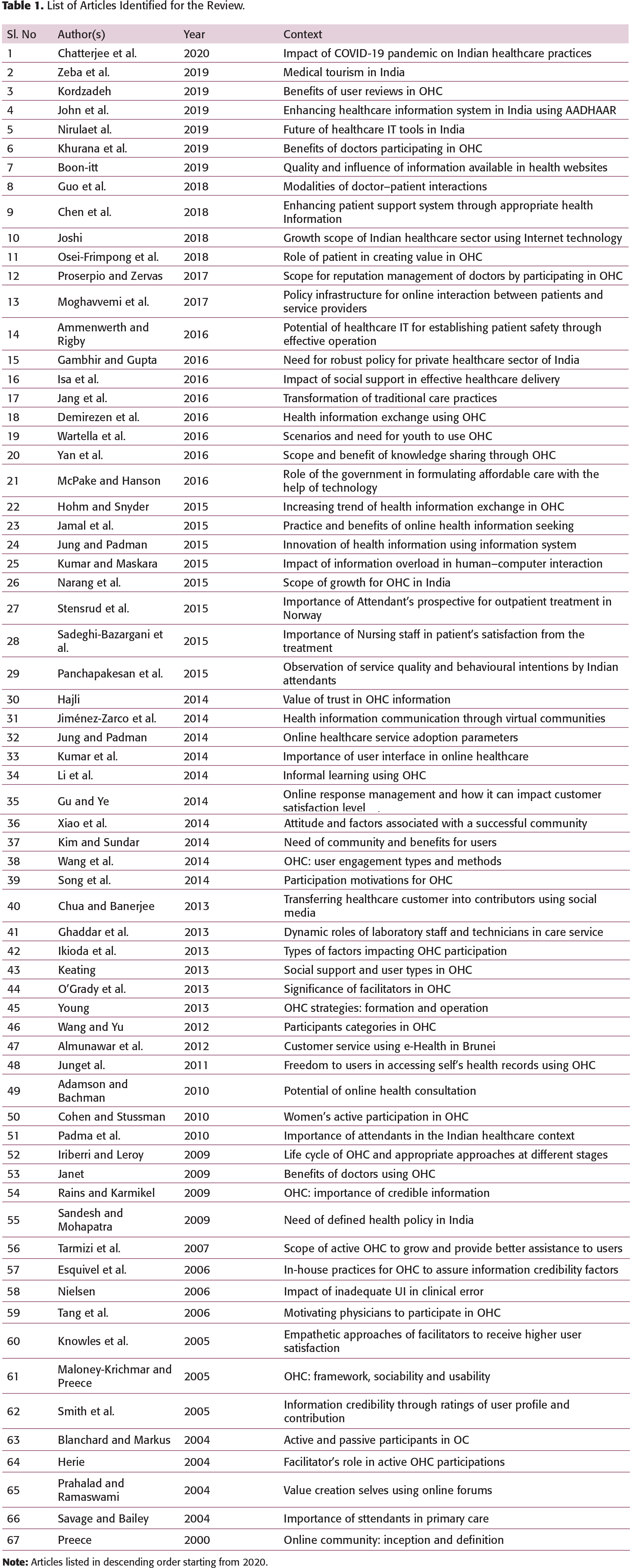
We conducted an organized electronic search of articles to explore existing literature on OHC. Reputed business management databases, such as SAGE, Taylor and Francis, Elsevier (ScienceDirect), Emerald Insight and JSTOR were explored, using keywords such as online healthcare communities, online discussion forum, doctor–patient interaction, Internet technology platform, healthcare IT in India, online social support, social media in healthcare delivery, etc. We found 92 articles by also including the process of forward (cited articles) and backward (reference articles) search. We only considered articles published in English.
Screening
Initial screening of articles was carried out by reviewing the title, abstract, keywords and findings to understand if it deals with the relevant space of online healthcare. Many articles dealing with medicine, medical instruments and physical healthcare were excluded to retain the essence of the study. Finally, 78 articles were shortlisted to use in the study.
Eligibility
Article eligibility for this study was determined after going through the full text of all the 78 articles. Both the authors independently evaluated the relevancy of the articles and excluded irrelevant ones after full-text reading.
Inclusion for Review
List of Articles Identified for the Review.
THEORETICAL FRAMEWORK
Health is not only the absence of disease or infirmity but also the presence of complete physical, mental and social well-being (WHO, 1948). The evolution of healthcare applications with the integration of Internet technology leads this vision of World Health Organization (WHO) towards reality by adding new directions to the healthcare system. The OHC concept is a practical advancement of this phenomenon. Online communities are Internet-based social platforms, where users with mutual interests meet, exchange knowledge and support each other without any physical contact or geographical boundary (Kim & Sundar, 2014). The continuous growth of participation in healthcare forums is evident. Consumers pursue information from numerous sources, including online forums, by upgrading the conventional treatment methods to modern care–centric approaches (Osei-Frimpong et al., 2018). Observing these diversified opportunities of OHC, Hajli (2014) opined that the Internet has empowered patients to share their experiences and suggestions, apart from gaining access to vast information threads in online discussion forums. OHC is also crucial from the business operation and delivery points of view.The OHC offers scope for storage and distribution of health records that provide flexibility to users to obtain and maintain medical history. Health information exchange using OHC enables centralized access to patient health information, which leads to better and faster care services by eliminating the time, distance and cost barriers (Demirezen et al., 2016).
ONLINE HEALTH COMMUNITY: FUNCTIONALITIES AND DRIVING ATTRIBUTES
Learning and Communication Aspects
Online communities shoulder a major share in supporting the learning and development of healthcare professionals, thereby helping them to remain proficient in their fields. This provision of knowledge enhancement is obtained through guidance from specialists, shared medical information and observations from operational and administrative challenges (Li et al., 2014). OHC supports geographically diversified teams to collaborate and exchange information, apply exceptional practice communication and enhance real-time judgement-making skills (Ikioda et al., 2013).
Social Support
The operational concept of learning and communication activities stands on the pillars of social support. Social support in healthcare is the information exchange process between two or more entities that provides scope for better health outcomes like a superior psychological state (Erfani & Abedin, 2016). Isa et al.(2016) found that social support, which can be delivered casually, by family, friends, neighbours and the broader society, and officially, by specialists and organizations, can directly affect the success of the treatment process. The literature on social support suggests that OHC predominantly features three types of social support: ‘informational support’, ‘emotional support’ and ‘companionship or network support’ (Keating, 2013). Informational support refers to the communication of awareness and recommendations such as suggestions, references, alertness and private experience with community users. Emotional support comprises the empathetic ability of a situation, such as encouragement, affection, support, validation, kindness, compassion and worry. This aspect minimizes the level of pressure or nervousness. Lastly, companionship or network support consists of chit-chat, joke, discussions and events unrelated to one’s health problems (Wang et al., 2014).
Participation Elements
People have increasingly begun to participate in online forums to gather health information and acquire knowledge to plan their healthcare activities (Xiao et al., 2014). It is the participants who drive the strategies applied in each stage of an OHC. Participants can quickly report irrelevant contents (e.g., service feedbacks, profile rating, expert suggestion) without professional intervention (Esquivel et al., 2006). Reviews shared by users on available services do also add value to the community. It not only helps to enhance the credibility of the forum but also facilitates users to evaluate and decide from available treatment methods (Kordzadeh, 2019). There are three types of participants in an OHC. Blanchard and Markus (2004) recognized two types of participants in online forums: an active participant who promptly participates in knowledge generation and sharing and a passive participant who prefers reading messages. Further, Wang and Yu (2012) coined the term ‘lurkers’ to classify and add the third category of users who only read posts as visitors. The study on participants’ contribution in online communities revealed that a 90–9–1 percentage share is noted for lurkers, active and passive participants, respectively (Nielsen, 2006).
Online health assessment is convenient and helpful in educating participants on both sickness and available treatment methods across the globe (Boon-itt, 2019). The youth use OHC for the versatile needs of everyday life, such as eating healthier, sleeping better, handling stress better, and staying fit. They refer to OHC to gain information regarding acute health conditions, including cold or sprain and chronic health conditions, like depression or attention deficit disorder. They also use OHC when they have a family member facing major health issues like cancer or diabetes. In all the scenarios, the youth receive help from OHC to learn about the health conditions and discover treatment options (Wartella et al., 2016). When it comes to women participants, OHC sees more footfalls from female users. Women participate in OHC to look up health-related information and their side effects, seek medical advice and prescription refills and are more active than male participants (Cohen & Stussman, 2010; Jamal et al., 2015; Jung & Padman, 2014).
ONLINE HEALTH COMMUNITY: LIFE CYCLE AND STAKEHOLDERS
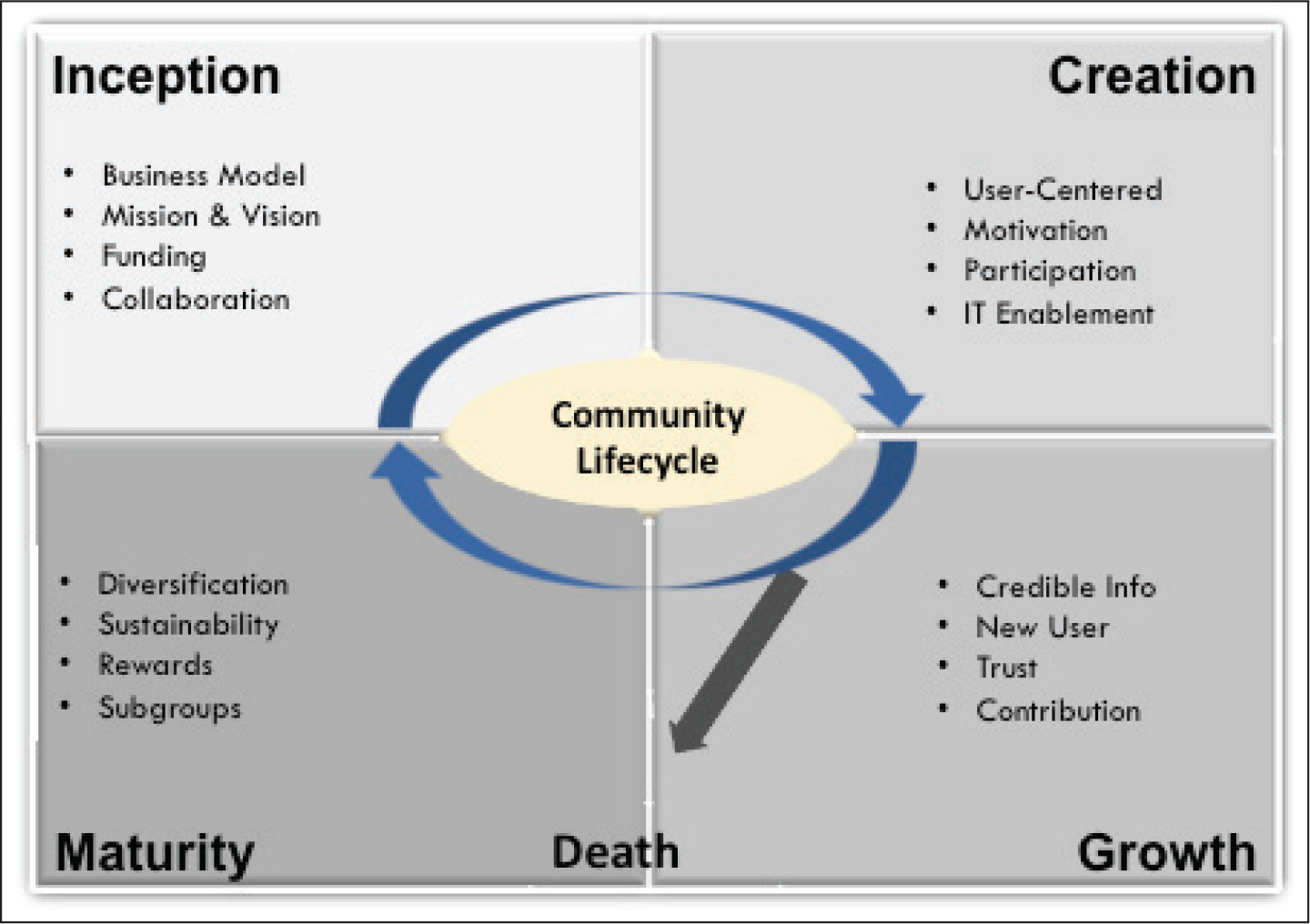
To establish a thriving online community, service providers must ensure that they have the requisite infrastructure and workforce to introduce an online forum and drive its evolution throughout its life cycle (Young, 2013). As individuals progressively turn to OHC for information and support, it is critical to recognize and manage the community at its various stages. As outlined in Figure 1, Iriberri and Leroy (2009) have documented five distinctive phases of online communities, namely inception, creation, growth, maturity and sustainability or death. At the inception stage, an online forum emerges to meet the need for information, support, regeneration and connection. In the creation stage, the developers choose the psychological and technological aspects like user-driven design, user interface (UI), data security and privacy to support the needs of its members. After creation, the growth stage arises where the forum spreads and new members join. In this stage, managers must confirm that new participants visit and join the forum, their association is smooth and quality content is offered. Once this phase occurs, online forums mature into formal communities, reflecting the maturity stage, where operators need to emphasize the sustainability and continued success of the community. Once the community reaches its growth point, there is a chance of the community’s downfall, leading to its death stage. Managers must strategically drive the forum to avoid going to this stage and retain continuous development (Iriberri & Leroy, 2009).
Stakeholders
Transforming health service exercises using Internet technology is a complex procedure because it comprises numerous stakeholders and the vigorous tasks executed in the system (Jung & Padman, 2015). The key stakeholders within the scope of this study are doctors, patients, patients’ attendance, hospital staff and management, application developers and managers.
Doctors or physicians are the backbones of care services. Online consultation can connect doctors with their patients in virtual methods regardless of location, time and cost limitations. It enables physicians to deliver care over the Internet without meeting their patients physically (Janet, 2009). Attending and responding to patient’s questions with credible inputs via online discussion platforms also help doctors achieve higher credibility (Khurana et al., 2019) and increase visibility to attain a higher volume of patients (Proserpio & Zervas, 2017).
An attendant (caregiver) practically supports a person to execute his daily care activities during critical times (Savage & Bailey, 2004). The attendant has a major stake in the treatment decision-making process for patients in India (Padma et al., 2010). The attendant uses OHC to accumulate information of the patient’s health situation and explore possible symptoms and side effects. Clinicians must make them available to the patient’s attendants and take initiatives to solve their hindrances (Stensrud et al., 2015).
Nurses are an integral part of the treatment process as they are very closely associated with all stakeholders of the hospital. They are crucial in establishing a quality and productive care environment as the facilitators of care benefits to patients (Sadeghi-Bazargani et al., 2015). Technicians and support staff are also vital in the healthcare industry due to their dynamic contributions to the treatment process at various stages (Ghaddar et al., 2013).
IT developers and managers are key for any virtual healthcare system as they need to understand the practical requirements and design the solution with contemporary market standards. Along with the business needs, developers must focus on crucial operational aspects such as secure and credible information, 24 × 7 information availability, smart and user-friendly interfaces, social media integration and user authentication, which are pivotal to any OHC (Demirezen et al., 2016).
ONLINE HEALTH COMMUNITY: INFORMATION TECHNOLOGY AND CREDIBILITY
Information Technology
In this advanced set-up of virtual association, technology is a core construct in creating value and obtaining maximum benefits (Osei-Frimpong et al., 2016). With OHC, patients are now more educated and informed about their situation. With the ever-growing usage of Internet technologies, health service providers can competently reach out to new patients everyday, which is difficult without technology (Jung & Padman, 2015). This signifies the ability of IT to tap into the enormous opportunities of the healthcare industry.
The online health consultation is an emerging trend and, if structured smartly, can substitute the conventional care methods for acute symptoms at minimal cost (Adamson & Bachman, 2010). With concepts of digital healthcare leading the innovation, a user-friendly IT system is essential for the success of online care practice. A multifaceted movement from a traditional hospital-centric approach to enhanced patient-centric practice can be witnessed with the enablement of technology, like e-health and m-health, together with patient information in real time (Jung & Padman, 2015).
Ammenwerth and Rigby (2016) suggested three design approaches of the healthcare information system: User-centred design, Cooperative design and User-driven innovation. The user-centred design reflects the process to understand users’ needs and then design the system accordingly. The cooperative design approach is a method to reckon work activity by various users. This can be complex sometimes due to the involvement of human activities for coordination and cooperation among diversified stakeholders. User-driven innovation is a participatory design process, where the basic idea is to engage users in innovating and developing products themselves (Kushniruk & Nøhr, 2016).
Unlike measures for success, some barriers can basket the benefits of online communities. Information overload is one of those barriers that can confuse users in making appropriate judgements due to excessive information (Kumar & Maskara, 2015). A flawed IT system creates difficulties for the end-users to use the system and execute necessary activities, leading to user dissatisfaction. According to Jung and Padman (2015), incompetent infrastructure, information confidentiality issues and lack of confidence in both content and conviction towards care quality are the main obstacles for online care service adoption.
Theoretical Outline.
Information Credibility
Credibility is the authenticity and reliability of presented information. The credibility of OHC is a vital factor for users as they continuously evaluate the trustworthiness and usability of available information (Rains & Karmikel, 2009). Therefore, it is significant to verify the quality of information on such forums before presenting it to end-users to build trust, expand growth and maintain brand reputation (Boon-itt, 2019). The credibility of a health application establishes on the pillars of trust and is an essential part of OHC (Hajli et al., 2015). Social media is restructuring the societal communication systems, thus encouraging individuals towards social responsibilities with knowledge and experience sharing. If OHC participants can be provided with provisions to appraise the content’s accuracy, they will confidently adhere to the recommendations (Jung & Padman, 2015). OHC offers advanced credibility features, such as detailed user profile with activity information, display of feedback received from other users and provision to rate activities in the forum (Smith et al., 2005). Such practices help online forums to develop a sense of credibility and authenticity towards available information and attract new individuals to participate.
FINDINGS
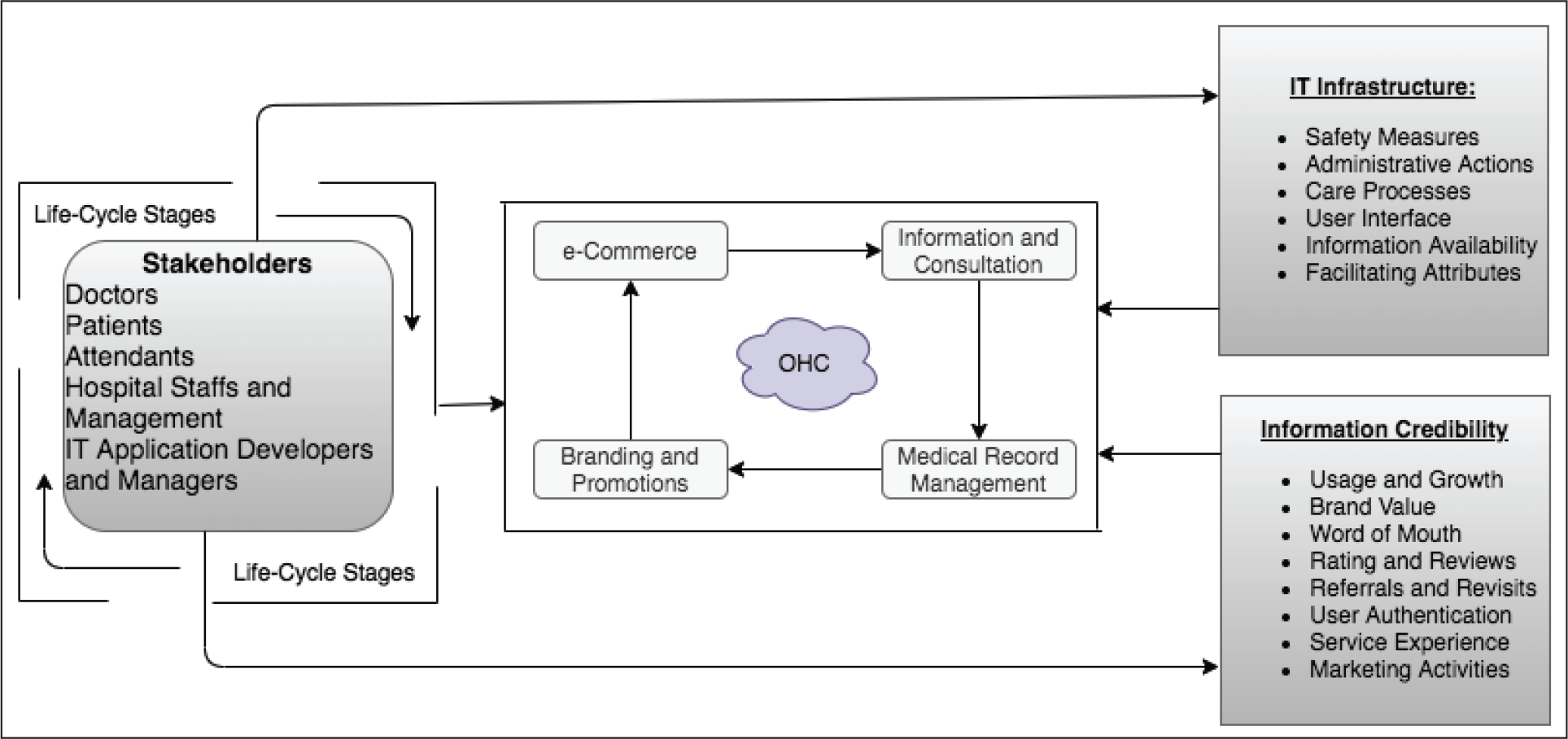
We are scripting this article when the establishment of virtual healthcare practices is still in infancy in India. Online healthcare is evolving, and new features are getting added to its basket regularly. As highlighted in Figure 2, information and consultation, medical record management, branding and promotional events and e-commerce activities are the core accomplishments of OHC that are uncovered from the existing literature. A variety of approaches are adopted in different forums for justifying their operational objectives in this virtual set-up. However, these platforms are mainly used for information and experience exchange by users, for expert opinions and IT-enabled service deliveries. The five stakeholders that were reviewed, that is, doctors, patients, attendants, staff and IT developers, are vital for OHC in executing their responsibilities at the different life-cycle stages of the community. There are five different life-cycle stages of an online community: inception, creation, growth, maturity and sustainability or death, having different dynamics individually.
Healthcare applications have become popular for facilitating the virtual association among individuals through innovative landscapes of advanced IT set-up (Khurana et al., 2019). A focused study on this innovative IT set-up has helped us segregate the offerings into two categories: IT infrastructure and information credibility. Under IT infrastructure, tangible and user-centric-facing aspects such as safety measures, administrative actions, care processes, user interface, information availability and forum-facilitating activities are observed. Information safety is highly sensitive, which must be given utmost importance. Infrastructural security of the forum is similarly crucial for smooth operation for which antivirus and firewall settings must be enabled. Administrative actions such as managing contents, upgrading the system and protecting the forum from malicious and vulgar substances are crucial in retaining the brand image. Facilitating the patient–doctor communication is one of the core attributes of any OHC and can hamper its acceptability if not addressed adequately. The user interface is the communicative space between the system and participants that enables users to input information and receive outputs from the system (Kumar et al., 2014). Information is the main sustenance of OHC, where users get associated to exchange knowledge. There should be appropriate room for smooth and hassle-free information exchange with an innovative and user-friendly user interface. Lastly, the facilitating activities of the forum such as initiating new discussions, crowd polling and corporate social responsibility (CSR) activities are vital in adding value to the forum.
Considering the importance of creating and exchanging information in OHC, the information credibility factor is perceived autonomously. Information credibility is the driving attribute of OHC that establishes trust and acceptability in the market. It consists of information-driven variables such as usage and growth, brand value, word of mouth, rating and reviews, referrals and revisits, user authentication, service experience and e-commerce activities. Use and growth are the inherited part of OHC that is directly associated over its different life-cycle stages. Trust and brand value of an OHC are the guiding factors for new users to join the forum and existing user to keep contributing. To establish trust, OHC should empower users to rate different activities in the forum and share positive outcomes that further promote revisits and referrals. Registration of new users through verified email id or social media account is a guiding attribute to achieve higher user authenticity, thereby developing trust and acceptance. Many OHCs also focus on the marketing aspects to promote different offerings through the forum. They should evaluate the changing needs of users and formulate user-driven approaches to enable participants in receiving a presidential service experience and achieve maximum customer satisfaction.
DISCUSSION
The Internet has been widely accepted as a vital source of health-based knowledge across geography and can bring overall reforms to the current healthcare practices (Hohm & Snyder, 2015; Moghavvemi et al., 2017). Looking at the current healthcare trends, demographic composition and scope of Internet technology in the Indian healthcare sphere, it is evident that there will be innovations in the future. The concept of OHC is one of these innovations, which removes the physical boundary between users and facilitates smooth collaborations in minimal time. According to a recent study by Zeba et al. (2019), medical tourism in India is progressing rapidly with every passing year. Various factors such as enhanced financial standing, awareness among people, availability of easy insurance policies and availability of online information have boosted this exponential growth (Joshi, 2018). India has become a favourite healthcare destination across the globe due to multiple attributes such as low cost, easy visa policy, availability of world-class care providers with rapid service, experienced and expert physicians, supporting staff with fluent English communication and availability of numerous post-treatment therapies like yoga and naturopathy (Zeba et al., 2019). A visible practice of OHC can assist foreign healthcare aspirants in initiating treatment procedures and appointment bookings before their arrival in India.
OHC has modified the behaviour of the actors associated with the healthcare industry. Patients access OHC to learn and understand their symptoms better before meeting a physician (Osei-Frimpong et al., 2016). An educated patient can take active participation in the consultation process and responsibly accomplish the medications. The doctor also has an educated patient who understands the situation better and is committed to the care methods co-created with the physician (Prahalad & Ramaswamy, 2004).
Doctors should actively participate in virtual forums to guide their patients and restrain them from any wrong practice (Almunawar et al., 2012). Service providers should encourage doctors to participate in online discussions by assigning incentives through compensation and accreditation, which will result in better and patient-oriented services (Tang et al., 2006).
Healthcare is now in an advanced technological evolution, empowered with electronic medical records (EMR), personal health record (PHR) systems and numerous healthcare decision support tools (Jung & Padman, 2015). This authorizes users to access health records for various activities such as evaluating medical history, seeking expert opinion, managing appointments, prescription renewals and many such unified activities (Jung et al., 2011).
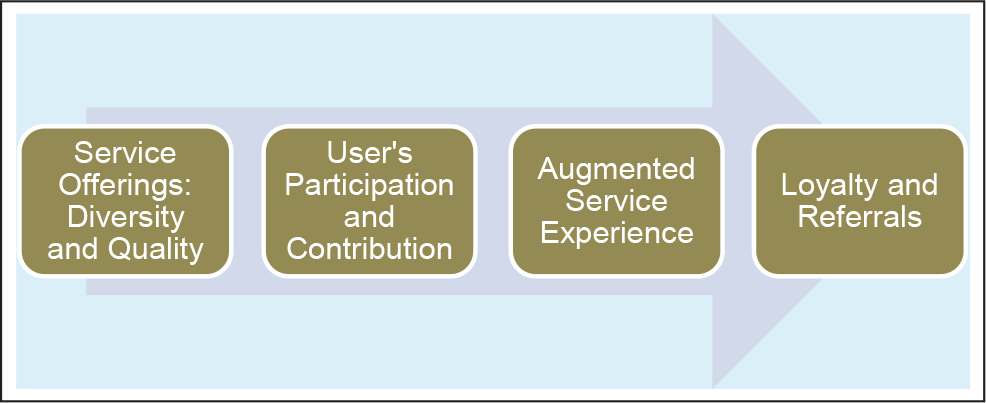
OHC is beneficial for its users and useful for service providers by actively contributing to business growth (Hajli, 2014). Service providers can evaluate the feedback provided by users and upgrade the services accordingly. Chua and Banerjee (2013) found that online communities have transformed the participants from passive content readers into active content contributors, making them significant from a business perspective. Patients like to endorse functionalities they prefer and suggest their treatment needs; thus, service providers need to create an institutional framework to endorse this and respond empathetically (Almunawar et al., 2012). Service providers must recognize the user’s participation and satisfaction process as provided in Figure 3, thereby, the impact of the online information-seeking attitude of patients and modify their services accordingly to attain maximum customer satisfaction and greater brand value. At this progressive juncture of Internet technology and user-centric IT approach, the healthcare sector has become more dynamic through social media, mobile and digital platforms. This also has a larger role while formulating marketing policies and operational approaches (Joshi, 2018). Panchapakesan et al. (2015) discovered that healthcare organizations should focus on enhancing services by empathetically assisting patients and their attendants, besides motivating them to share feedback and speak about the quality care received in public forums. From the traditional treatment centre to an epicentre for health awareness and support, healthcare practice has witnessed a paradigm shift in delivery approaches (Jang et al., 2016). Effective programmes should be designed by involving experts and users to make them feel motivated to be part of the forum and contribute regularly (Isa et al., 2016).
CONCLUSION
Looking at the massive acceptance and future scope of digital healthcare practices, it is evident that OHC has enormous potential in the coming time. Empowered by robust, user-friendly and responsive IT features, OHC has the potential to address user’s concerns without any geographical and communicative barriers. As long as the community is accessible for new members to join and the existing members to participate, there is a high possibility for the community to thrive (Tarmizi et al., 2007). Therefore, it is important to identify the guiding factors of OHC at different stages. Second, it is vital to address the essential functionalities of OHC and formulate a tangible and user-centric operation model. This can aid service providers to articulate strategies to keep the forum growing across its life-cycle phases. The technical aspects are crucial attributes of OHC and, therefore, necessary to explore attributes like IT infrastructure, the importance of human–computer interaction, the need for user-friendly graphical user interface (GUI) and 24 × 7 information flows.
OHCs become more relevant and valuable due to the present pandemic. It is convenient for both patients and doctors to stay safe and attend to their responsibilities. Determinants of OHC such as virtual consultation, information exchange, sample collection from home for a laboratory test, ordering medicines, etc., are supportive of maintaining social distancing and avoiding getting infected from others. It is even helpful to streamline the care process by overcoming resource scarcity concerns during such pandemics. Similarly, experts from different locations can meet and discuss the symptoms, precautions and cure for the virus using OHC (Chatterjee et al., 2020). Strategic collaboration through OHC can help everyone fight a pandemic effectively.
Upon observing the acceptance and scope of OHC, it is evident that the online medium has a significant future in the healthcare industry. Private players are crucial in facilitating virtual healthcare delivery, and there should be a tangible framework with robust guidelines to assist them to promote this innovation (Gambhir & Gupta, 2016). The government should formulate a public–private mix approach to ascertain the extensive availability of quality and affordable care empowered with cutting-edge technology to meet the ever-increasing healthcare needs (McPake & Hanson, 2016). Driving towards transformations in service delivery and consumer perception, OHC contributes to creating an enhanced customer experience for the healthcare industry (Worlu et al., 2016). It is now possible to address a wider mass in minimal time with useful information using a robust and responsive IT configuration (Boon-itt, 2019). Healthcare providers should understand this trend and be future-ready as technological innovation will continue to excel. Helping users with appropriate health information using accurate domain knowledge and technology platforms should be the primary operational objective of online forums. Failing to do this can lead to a decrease in OHC participation. Therefore, service providers must prioritize the OHC operation by implementing a viable socio-knowledge system without holding to the traditional socio-economic structure (Chen et al., 2018). This will accelerate participation in OHC. OHC is essential for health requirement and positive psychological reforms such as availability of adequate information, user-friendly system design, Internet technology enablement, personal information protection, real-time communication facility, the scope for recognition, availability of a variety of associated services and space for information exchange.
Future research in this direction should consider the outlines of this research and emphasize on empirical validation of the theoretical findings. This review has identified key stakeholders of OHC who participate in the forum through different needs and contribute to the knowledge system. Further studies can be conducted to appreciate the interrelationships among these stakeholders to establish better coordination among them for superior service output. Second, various key functionalities of OHC embedded with IT are also highlighted in this study. This can further be explored to understand how different functionalities are vital for a different group of users or how the diverse combination of these functionalities can motivate participants in OHC. In addition to this, cultural values like the role of family and the influence of social media are found as important aspects for the Indian audience. Recognizing how these cultural values impact the psychological behaviour of participants across life-cycle stages of OHC should also be investigated. Studies in these directions will help shape the establishment and operation of the online healthcare system, thereby making it more vibrant and valuable.
Footnotes
Declaration of Conflicting Interests
FUNDING
The authors received no financial support for the research, authorship and/or publication of this article.