




Abstract

Pressure pushing down on me
Pressing down on you no man ask for
Under pressure—that burns a building down
Splits a family in two
Puts people on streets
It is against this backdrop that an increasing interest in the form of alternative dispute resolution (ADR) (Box 1), generally referred to as online dispute resolution or ODR, has been noted. ODR primarily involves traditional ADR techniques and processes such as negotiation, mediation or arbitration, or a combination of different ADR processes, complemented by applying innovative techniques and online technologies to the process, sometimes involving multiple stakeholders, without the need of interaction in person and access to physical facilities. Even before COVID-19, in working with governments on policy reform in the insolvency and debt resolution space, a number of recent trends have been identified, which can potentially be addressed by ODR.
Alternative Dispute Resolution
ADR is commonly defined as any process or procedure for resolving a dispute other than adjudication by a judge in a statutory court. The term ADR encompasses a number of processes such as early neutral evaluation, negotiation, conciliation, mediation and arbitration, and can be provided by private institutions (ADR centres), courts (e.g., court-connected mediation programmes or multi-door courtrooms) or via public–private sector models (court-referral models). A common feature of all ADR processes is the consensual nature of either opting for dispute resolution or deciding the outcome of a dispute by the parties (although, there are mandatory mediation models as well), as well as the flexibility of the process as compared to court litigation procedures.
For more information on the different ADR processes, delivery models and applications, see World Bank Group, ‘Alternative Dispute Resolution Guidelines’, 2011.
First, in recent years governments have started to appreciate the importance of addressing financial distress before a business is insolvent, during the so-called ‘pre-insolvency’ stage, to maximize the likelihood of business rescue. There is already a well-established practice in some countries for using ADR tools, as opposed to a traditional court process, to address financial distress and facilitate dispute resolution within the context of insolvency matters. There is accordingly much potential and increasing practice for governments in emerging markets and developing economies to focus on developing effective pre-insolvency regimes by utilizing ADR tools to facilitate the resolution of early business distress.
Second, and linked to the focus on pre-insolvency procedures, with the advent of the 2019 European Union Insolvency Directive (EU Directive), all EU member states are currently in the process of enhancing their pre-insolvency measures with the adoption of additional tools such as early warning tools (EWTs) to facilitate information that can identify businesses at risk of insolvency (EU Directive, 2019). This is expected to have a spillover effect on non-EU states, as well.
Third, there has been a recent international focus on facilitating the insolvency of micro and small business enterprises to encourage risk-taking and entrepreneurship while still upholding creditor rights. Both the World Bank Group and the United Nations Commission for International Trade Law (UNCITRAL) are in the process of identifying best practices in designing insolvency regimes for micro and small enterprises, in collaboration with the International Monetary Fund (IMF), and other international organizations. In the light of COVID-19, this focus has increased, given the pressures that small businesses are facing.
When these developments are amalgamated, the use of innovative technological platforms such as ODR to facilitate collective stakeholder negotiations aimed at addressing pre-insolvent small business distress becomes a strong possibility. Use of ODR has increased over the past decade in the area of small claims resolution, in countries such as Canada, the UK, the USA and China. Regional initiatives such as by the Asia-Pacific Economic Cooperation forum have also helped to raise awareness of the advantages of the ODR process. ODR technologies not only provide access to dispute resolution services to large numbers of entrepreneurs in remote areas but also go a long way in removing the stigma of applying for court proceedings by introducing a degree of anonymity in the process, with people interfacing via their laptops and smartphones, rather than face-to-face. Moreover, the use of pre-insolvency ODR could be further incentivized in the context of a developed EWT, as an additional service, by developing such technology within an EWT advisory agency and offering ODR as a service to businesses together with notifying them of potential approaching business distress.
Finally, the current COVID-19 crisis has exacerbated the need for lawmakers, regulators, and ADR service providers to address the increased demands for change in the way debt resolution tools are provided. The executive branches of government, financial regulators, and courts will have to adapt to the effects of technological change, to utilize the new opportunities that come with it and to mitigate against any downsides.
CRITICAL NEED FOR ACCESSIBLE PRE-INSOLVENCY PROCEDURES FOR MSMES
MSMEs play a critical role in the global economy and should have access to flexible and effective tools and processes to help them resurface in times of financial distress. The World Bank Group estimates that 600 million jobs will be needed by 2030 to absorb the growing global workforce (World Bank, n.d.[a]). Small and medium enterprises (SMEs), which are estimated to generate roughly 7 out of 10 jobs in emerging markets (World Bank, n.d.[a]), are, therefore, a key layer of the economy. These businesses, however, are more vulnerable to financial shocks and present a greater credit risk for traditional financing, which limits their access to finance and makes credit more expensive. It is estimated that there are more than 160 million MSMEs in emerging economies with a finance gap of US$5.2 trillion USD (Bruhn et al., 2017). Well-functioning insolvency regimes help creditors mitigate lending risk more effectively by maximizing creditor recovery from bad loans, but traditional insolvency regimes present insurmountable hurdles to many micro and small businesses, especially in times of systemic crises. These hurdles are comprehensively discussed in a recent World Bank report (World Bank, 2017). For purposes of this article, a few key challenges are focused on.
First, micro and small businesses are often intertwined with the natural person entrepreneur. The most common legal structure of SMEs is that of a sole proprietorship, which is owned and run by one individual, and there is no legal distinction between the owner and the business. While this is the simplest way of doing business, with low initiation costs and very little formality, it also means that the natural person has intermingled personal and business debts, or has personally guaranteed the debt of the entity. For historical and societal reasons, many natural persons face or perceive stigma associated with bankruptcy, which prevents them from flagging financial distress early to their creditors and seeking court protection. Common accounts of entrepreneurs being ‘eternal optimists’ and believing that their business will turn around are part of the narrative. However, the flip side is to appreciate how complex legal systems can intimidate even well-resourced businesses. Also, a lack of credible and available information can prevent financial distress from being recognized early enough, such that most micro and small businesses inevitably end up in liquidation.
Second, insolvency regimes are overly complex and costly for many small businesses. The disclosure requirements are onerous, and many small businesses do not have the ability to generate information in the same manner as corporates; so it takes them longer and also makes it more difficult for them to collect and compile all necessary documents and information to comply with court filing prerequisites and timelines.
Third, a problem that is particularly acute for large countries is that MSMEs are typically spread out over large distances, and often in rural areas. Whereas corporates are more likely to be located in city centres, micro and small businesses, in particular, might be in remote locations where access to physical courts and ADR centres is particularly difficult (Lapkin, 2019).
At the same time, the earlier a financially distressed MSME debtor attempts a workout with creditors to restructure its debts, the better chance there is for the enterprise to be rehabilitated. The European Commission has defined pre-insolvency proceedings as ‘quasi-collective proceedings under the supervision of a court or an administrative authority which give a debtor in financial difficulties the opportunity to restructure at pre-insolvency stage and to avoid the commencement of insolvency proceedings in the traditional sense’ (European Commission, 2012), that is, in court. Indeed, the reason why many countries’ restructuring and insolvency frameworks now provide for specific early warning triggers, pre-insolvency procedures and assistance through counselling and mediation, focusing on MSMEs, is because they typically have a limited capacity to predict financial distress in short to medium term, and consequently to resurface from financial difficulties once they occur. Moreover, they often lack the sophistication to effectively approach financial and trade creditors on their own and renegotiate financial agreements which they expect to have difficulties complying with in the near future. Pre-insolvency frameworks, therefore, provide such MSMEs with a stronger likelihood of restructuring and continuing productivity.
During the current COVID-19 pandemic, many governments have introduced urgent measures aimed at flattening the corporate bankruptcy curve, including modifying their insolvency legislation to limit or suspend the use of court insolvency filings (Menezes & Muro, 2020). As part of the efforts to mitigate the effects of the crisis on businesses, out-of-court restructuring procedures have been recommended as a useful tool to facilitate flexible arrangements between debtors and creditors (Menezes & Muro, 2020). For MSMEs, the facilitative role of a mediator or a neutral restructuring expert would be key in advancing on a negotiated settlement with their financial and trade creditors. This is discussed in the next section.
ODR PLATFORMS CAN FACILITATE COLLECTIVE PROCEEDINGS AIMED AT PRE-INSOLVENCY RESTRUCTURINGS OF MSMES
The World Bank ‘Principles for Effective Insolvency and Creditor/Debtor Regimes’ explicitly state that creditors and debtors may find ADR techniques useful to facilitate informal (out of court) workouts:
an informal workout process may work better if it enables creditors and debtors to use informal techniques, such as voluntary negotiation or mediation or informal dispute resolution. While a reliable method for timely resolution of inter-creditor differences is important, the financial supervisor should play a facilitating role consistent with its regulatory duties as opposed to actively participating in the resolution of inter-creditor differences. (World Bank, 2016)
In fact, the use of ADR tools, such as mediation, to enhance the possibility of business restructuring in the face of financial distress has been increasing worldwide in the context of formal restructuring procedures (Mocheva & Shah, 2017), and their potential for pre-insolvency processes has also been grasped. For example, the Portuguese pre-insolvency conciliation procedure that is carried out by the Institute to Support Small and Medium Enterprises and Investment (Deloitte Legal, 2017) is an extrajudicial administrative procedure for the debtor to reach an agreement with some or all creditors to avoid insolvency.
These processes reflect different characteristics, but they all have nearly the same objective: the intervention of a neutral non-judicial third-party expert to facilitate negotiations between the debtor and its main creditors before the debtor is in a legal state of insolvency. The negotiations aim to reach a consensual restructuring agreement, thus avoiding the opening of ordinary collective insolvency proceedings in a court forum. Once a collective insolvency procedure is initiated in court, the company distress becomes publicly known. This may lead to workers and clients pulling out, trade creditors and state agencies will also get involved in the process, making the prospects of resurfacing from the situation less likely.
ODR platforms are innovations in the field of dispute resolution, which successfully accommodate ADR tools such as mediation and arbitration. They provide the claimant (‘debtor’ in the case of restructuring and insolvency) with effective tools to self-assess their case and be advised and/or counselled during the online procedure, without having to personally appear before any agency.
ODR is described as ‘the application of information and communications technology to the prevention, management and resolution of disputes’ (Roberge & Fraser, 2018). The American Bar Association Task Force on Electronic Commerce notes that ODR uses ADR processes, which may include negotiation, ombudsmen, conciliation, mediation or arbitration, to resolve claims or disputes that either involve the internet or are 'offline'. Online dispute resolution can be done 'entirely on the Internet through email, chat, and videoconferencing and if needed parties may also meet in person for face-to-face interaction. Often, a combination of “online” and “offline” (such as face-to-face) methods are used in 'Online Dispute Resolution' (Verma et al., 2017). This flexibility means that the system design can vary widely, most likely dependent on the type of dispute being addressed.
In the USA, The National Center for Technology and Dispute Resolution provides links to 91 ODR providers globally (National Center for Technology and Dispute Resolution, n.d.[a]). This might not be a complete list as the scenery of ODR services is changing rapidly. Recent regional initiatives, including the APEC Collaborative Framework for Online Dispute Resolution of Cross-Border Business-to-Business Disputes (2019), the European Online Dispute Resolution (ODR) platform or global initiatives—the UNCITRAL Technical Notes on Online Dispute Resolution (2017) being one, will make ODR a common practice in the near future, particularly for certain type of disputes (arising out of e-commerce transactions, consumer disputes, B2B cross-border disputes).
ODR is also gaining tractions in developing countries, such as China and Mexico, both of which have incorporated ODR platforms within their court systems (National Center for Technology and Dispute Resolution, n.d.[b]). More recently, as China is focusing on rebooting its economy in the context of COVID-19, the government has advised public and private service centre providers to introduce or strengthen existing ODR services. The Ministry of Justice issued a guideline on 3 March 2020, which emphasizes the importance of ODR for achieving its goal of getting the economy back on track while still maintaining control over the spread of COVID-19 (Chow, 2020). Hong Kong is also developing its ODR capabilities and has already announced the launch of its first ODR platform, eBRAM later in 2020. The platform will employ blockchain and artificial intelligence technology and is designed to address concerns among practitioners about the feasibility of replicating entire dispute resolution proceedings online (Conventus Law, 2020).
The common features of ODR platforms are that they provide for a staged, confidential process starting with a self-diagnostic tool to help the claimant/debtor to assess its case after filing the necessary documents on the platform, followed by the least formal dispute resolution tool—a negotiation phase with selected creditors, without the intervention of a third-party neutral. If a settlement is not reached during this phase, the dispute moves onto assisted mediation still entirely online, and if necessary—adjudication as a final step, during which a third-party neutral provides a decision based on the facts presented by all parties involved and the law. Enforcement mechanisms for settlements reached through ODR platforms vary widely among jurisdictions, depending on the available legal framework. Some of the providers that are also pioneers in the area of ODR—for example, Cybersettle or Modria (Cortes, 2014)—use advanced claim settlement technology in the initial stages of the process with the result being that most cases do not even reach the mediation stage as they get settled during the initial negotiations.
Aside from the time and cost factors, settling disputes through ODR facilitative methods, such as negotiation or mediation, allows the parties to retain their relationships. For instance, the Dutch Rechtwijzer, a collaboration between the Hague Institute for the Internationalization of Law, the Dutch Legal Aid Board and Modria, illustrates that 70 per cent of users reported their solution was effective and sustainable. The British Columbia platform called the Civil Resolution Tribunal deals with small claims under US$5,000 in the field of condominium disputes, motor vehicle injury disputes under US$50,000 and from 2019, societies and cooperatives associations disputes. Since its launch in 2016, The Civil Resolution Tribunal ODR system has handled more than 14,000 cases involving SMEs, so far, and the system has taken jurisdiction over nearly all small-claims cases in the province, worth US$5,000 or less. According to statistics, roughly 85 per cent of the cases resolved to date were settled (the rest proceeded to the formal tribunal; Vermeys & Roberge, 2019).
So far, the authors have not found many examples of the use of ODR to facilitate pre-insolvency negotiations between debtors and creditors; although online debt counselling and debt assistance services are quite common, some are supported by the regulator, while others are run by banks or privately. For example, the Insolvency and Trustee Service of New Zealand provides for an online platform to seek a Debt Repayment Order (DRO), a formal arrangement with creditors to repay the debt over time (New Zealand Insolvency and Trustee Service, n.d.). Mediation (although not necessarily through ODR) is also commonly used as a tool to prevent insolvency. For example, in Bosnia and Herzegovina, the Center for Financial and Credit Counseling provides financial education and counselling for MSMEs combined with mediation services for over-indebted clients with legal and repayment issues. The recent guidelines by the Chinese Ministry of Justice also call for expanding the scope of the current ODR system from e-commerce and domain disputes to include debt issues and labour disputes, among others (Chow, 2020). In the context of the economic challenges caused by COVID-19 specifically to SMEs, the UK appears to be looking into utilizing a government-backed ODR system for SME debt resolution, a ‘tech-enabled online dispute resolution platform for SMEs’. The intention is to create a voluntary low-cost but enforceable mechanism for settling disputes over matters such as late payments, without parties waiving their right to go to court if they ultimately cannot reach an agreement through the ODR process (Cross, 2020).
While these are all plausible initiatives, it appears that ODR is still predominantly used to resolve simpler two-party disputes. We see ample potential for applying ODR to prevent insolvency of MSMEs. This can be achieved by enhancing the existing ODR platforms to enable multiparty negotiations online—it is discreet, accessible from anywhere by anyone with an internet connection. It is informal and for that reason approachable enough for distressed MSMEs that are often reluctant or have no informal way of reaching all relevant creditors until it is too late.
ODR COULD ALSO COMPLEMENT EWT SYSTEMS TO FACILITATE PRE-INSOLVENCY RESTRUCTURINGS
EWTs to signal approaching business distress using technology to analyse credit data is another recent tool utilized to prevent insolvency, which can be further enhanced by adding an ODR system as part of its services. An EWT signalling debtors of the risk of financial distress early on is one of the new features that the 2019 EU Insolvency Directive introduced and is expected to gain traction even outside of the EU Integrating ODR within EWT has the added value that it will specifically take into account the limited resources of MSMEs for hiring experts and embed the use of flexible techniques such as expert mediation, at the pre-insolvency stage and even earlier, at the stage prior to any ‘likelihood of insolvency’, following an EWT trigger through a Notification and Counseling Entity (EU Directive, 1999).
One of the interesting features of the EWT promoted by the 2019 EU Insolvency Directive is that the initiative to act after receiving the warning lies with the debtor, which impacts the design and potential use of these tools. Prior designs of EWTs were focused on creating internal alerts for creditors and public authorities of the upcoming distress of corporate and special debtors. Specifically, financial institutions in the EU have the obligation of implementing adequate internal procedures to identify and manage potential non-performing clients at a very early stage. Public authorities, including financial sector supervisors, have also developed EWTs to prevent the failure of systemic entities and preserve financial stability. The 2019 Directive’s Article 3 shifts this approach to the debtor initiating the process, which comes with some challenges. The challenges include the enhanced need to use publicly available data which is not collected consistently and reliably in many countries, the lack of sophistication of the ultimate beneficiaries of the alert, who may not understand how to initiate a restructuring process or the natural aversion by businesses (and MSMEs in particular) to acknowledge the existence of their financial distress and tendency to avoid any action until it is too late (since the EWT does not include any mandatory requirement for MSMEs to seek assistance upon notifying them of the potential future distress).
One of the already existing EWT models (e.g., the model adopted in Belgium and Denmark) suggests the need for involvement of a public or private agency that, at the minimum, would be responsible for (a) designing and operating the EWT, as well as for (b) notifying debtors that their business might be facing difficulties in the short term. The system could also include the offer of advisory services following notification to the debtor to assist them, if the debtor so wished, in the restructuring of its business or in any other measures that are considered relevant. The main advantage of this system is that it can accommodate a gradual approach and allows a series of steps to remedy the distress situation. Additionally, a public or a private advisory agency is better placed and, most likely, has more adequate resources to design and operate a more sophisticated system that may comprise all types of data, including not only financial information of the entrepreneur but also payment history, governance and macroeconomic data.
Some examples of the possible sources of data which could be deployed by EWT to assess the debtor’s situation and make predictions are as follows: credit information bureaus—including negative and positive credit information—shared by public or privately owned credit information providers; information collected by public creditors such as tax authorities (since enterprises typically delay their tax and social security debt first, tax and customs authorities may be able to detect enterprise difficulties before other creditors); data from courts and other tribunals related to debt rescheduling agreements; and financial information from business registrars.
While not yet the case (to the authors’ knowledge), such EWT systems could also embed an ODR platform to provide, at the debtor’s request, online tools to assist the debtor with an assessment of its business and potentially to facilitate its restructuring; which might involve renegotiation of contracts, rescheduling of loans or any other measures that could help the SME avoid insolvency down the road.
In order for ODR systems to be utilized as a pre-insolvency tool, there are several features that need to be present, some of which are required for any type of ODR (such as a highly digitized economy and reliable service providers) and others are specific to the pre-insolvency context (such as the availability of experts with both mediation and restructuring expertise).
First, an ODR system can only function if there are reliable means to support it—that is, the technological aspect is crucial for the effectiveness of the process.
While each form of ODR could utilize a different technological system (e.g., online mediation can take different forms, from a fully automated internet platform using a portal based on electronic chat or videoconferencing [TheMediationRoom.com] to exclusive use of asynchronous forms of communication, that is, through methods such as e-mail [RisolviOnline.com]), it is necessary to create a legal framework that recognizes electronic tools, such as platforms and internet portals, that enable the automatic resolution of disputes without the need for legal classification, time-consuming hearings, etc.
For pre-insolvency ODR, the system must provide experienced specialists skilled both as restructuring experts and mediators/facilitators/arbitrators. One example for such professionals are the Japan Association of Turnaround Professionals (JATP), which is both certified under the 2004 Act on Promotion of Use of Alternative Dispute Resolution and qualified as a certified dispute resolution business operator under the Industrial Competitiveness Enhancement Act under the purview of the Ministry of Economy, Trade, and Industry, to manage the Turnaround ADR procedure.
Pre-insolvency ODR could be offered within the responsible organization or network, which already provides EWT. One example is Early Warning Denmark (Figure 1), a public consortium (Danish Business Authority and Early Warning Europe) which currently provides free, impartial and confidential help to SMEs with the goal to help them avoid bankruptcy and bring companies on to a new course towards growth. EWT uses financial information provided by the Danish Business Registrar, to detect potential distress (the other leading EU model, the Belgium one, uses a wider range of information including financial information, TAX, VAT, social security, seized payments, payment behaviour, court sentences, and bankruptcy procedures), and generates a list of potentially distressed companies which are then filtered by technical assistance providers. The companies are then contacted by the assistance providers (through Danish Regional Hubs) who invite them to initiate the process (see Figure 1). This may include screening, analysis, overview of the business and its financial situation; definition of its problems; matching of the business with an expert lawyer/mentor; coaching, action planning, follow-up, and assistance with debt restructuring. All this may be done entirely online if the system provides an ODR platform.
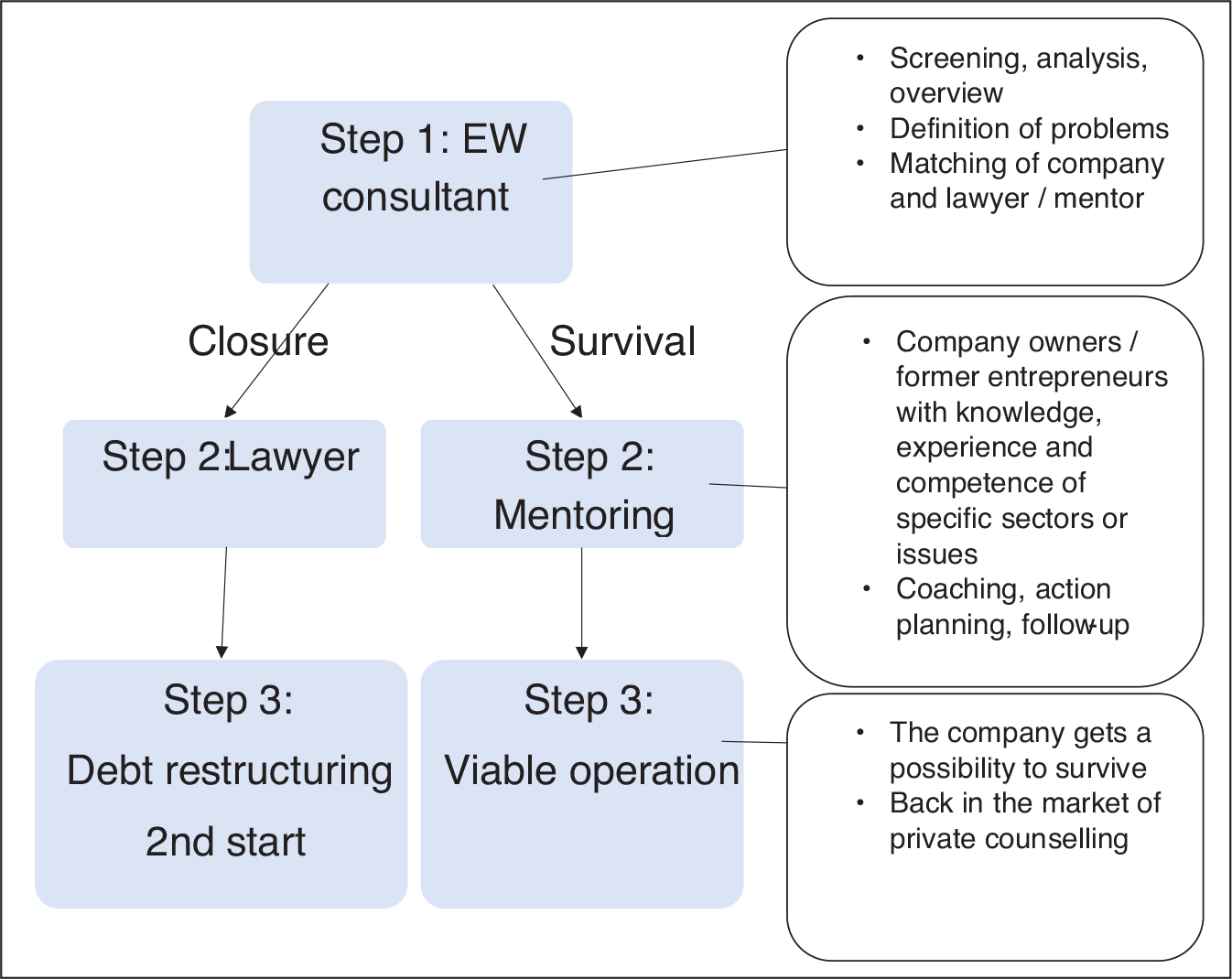
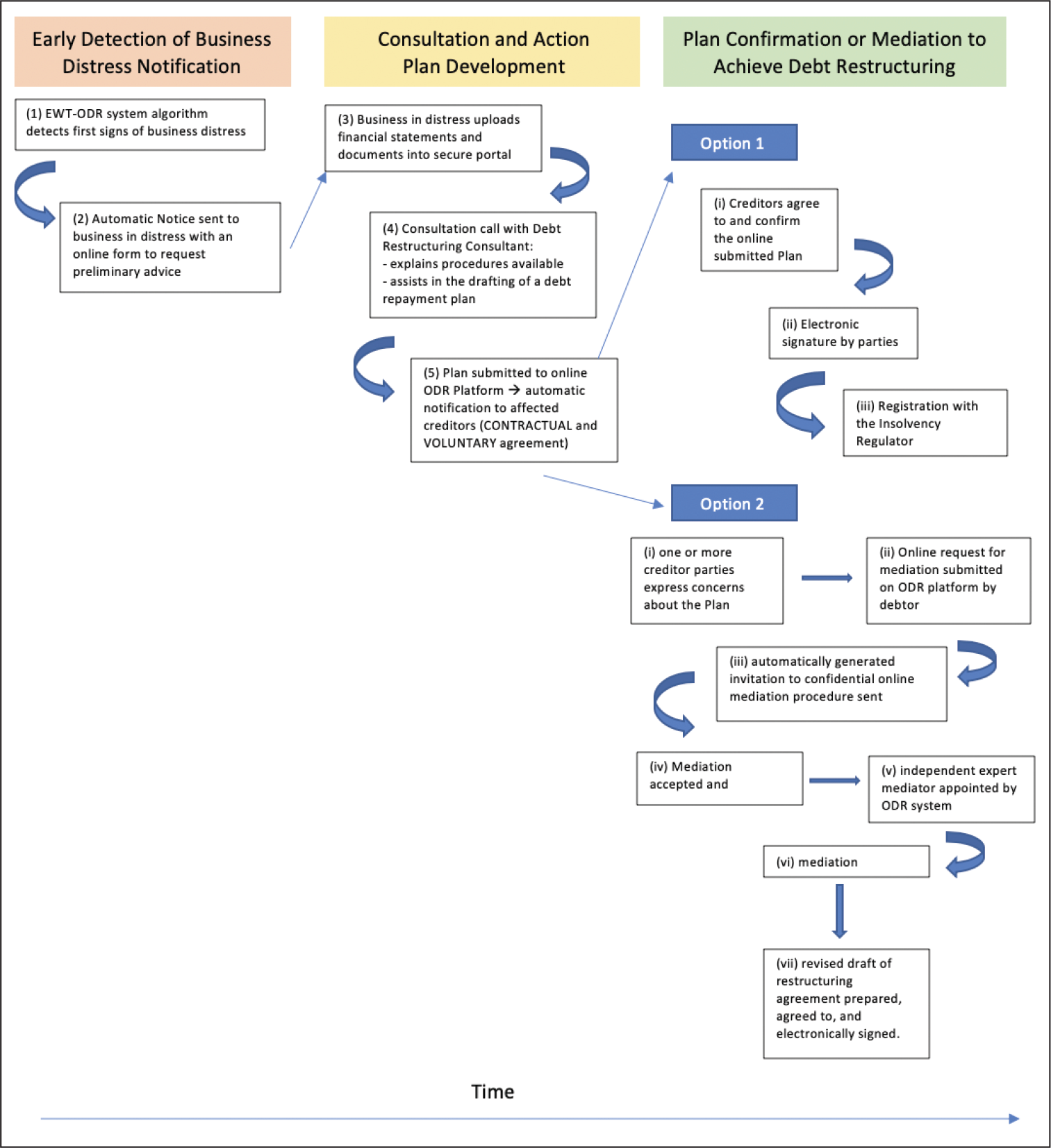
Below, we provide a hypothetical example of a distressed small entrepreneur which goes through all the steps within a hypothetical ODR process, initiated by the entrepreneur as a result of an early warning trigger received through the EWT. Figure 2 represents the proposed steps that would be followed in such a combined ODR-EWT framework.
Proposed EWT-ODR System Illustration
A HYPOTHETICAL EXAMPLE OF HOW AN INTEGRATED EWT-ODR SYSTEM COULD WORK TO PREVENT INSOLVENCY OF AN MSME
Background Facts
For almost eight years, Ms X has been operating a Bed and Breakfast lodging in a mountain village. The nearest city, including the local government agencies, banks, and a courthouse are several hours away. She has one major secured creditor, Bank A, which has a mortgage over her property and also provides her with a revolving credit loan. She has three trade creditors, Trade Creditor 1, Trade Creditor 2, and Trade Creditor 3 and 15 employees.
Ms X has been experiencing numerous problems for the past year, including broken equipment and a dwindling number of tourists due to extreme weather conditions in the area. Although her Bed and Breakfast turned a profit in years 2012–2018, her cash flow was slowing down since July 2019. On her 31 December 2019 year-end statements, Ms X reported a loss, for the first time since operating this business. Her tax payments for fiscal year 19 are deferred but will become payable in 2020. She also owes her employees their wages. Her revolving credit loan is nearing its limit, and she will have to make a payment in June 2020 as well as pay her taxes. She does not know if she will have sufficient cash flow to meet these payments, but hopes for the best while turning all her time and energy to searching for alternative funds from friends and relatives, fixing the broken equipment and attracting more customers.
The State where Ms X’s hospitality business is registered has a relatively well-developed credit information system. Several government-mandated agencies collect credit information throughout the State. The institutions that must report credit information to these agencies include all banks, non-bank financial companies, housing finance companies, development finance and investment institutions, and credit card companies. There are also other sources of credit-related information, for example, a central collateral registry that provides information on all types of secured interests (including movable and immovable, tangible, and intangible assets). The central bank of the state is also a large repository of credit information.
In addition to the above financial infrastructure, the country’s insolvency regulator, has developed an EWT-ODR system, which combines an online tool for financial distress prediction with an online platform for mediation with creditors. The EWT-ODR system relies on the credit information being collected from the agencies mentioned above as well as other relevant publicly available information on business performance, including overdue payments to financial creditors, tax authorities, utility companies, and on court records.
Step One: Early Detection of Business Distress and Notification
The insolvency regulator’s EWT-ODR system has received information from various credit information entities and has been processing information on Ms X’s business and financial performance. Its algorithm has been able to detect the first signs of business distress. This has triggered an automatic notice that was sent to Ms X by e-mail in January 2020. The notice included (a) an explanation of the basis of the financial distress prediction, (b) a link to an easy-to-use self-assessment tool, (c) a guide to the steps that Ms X could take to manage the risks of insolvency, and (d) and an online form to request preliminary confidential advice.
Step Two: Consultation and Action Plan Development
Ms X received the e-mail from the insolvency regulator on 15 January 2020. She already knew that her business was not doing well and was in fear of becoming insolvent, although she was continuing to make payments on her revolving credit loan on time. Upon receiving the notification, she was surprised to learn about the steps she could take. Assured by the promise of confidentiality, she submitted an online application for ODR, which included uploading her financial statements and documents onto a secure online portal. A few days later, she received a call from a debt restructuring consultant at the insolvency regulator who further explained the procedures available to her. After reviewing the relevant information, the debt restructuring consultant helped Ms X draft a debt repayment plan to propose to the bank, two of her three trade creditors, and the tax authority. The plan had to be submitted online via the ODR platform at which point only the affected creditors were automatically notified. Although the plan was being submitted to multiple creditors, each creditor only had access to the proposed terms of their specific arrangement and the agreement was contractual and voluntary.
Step Three: Plan Confirmation or Mediation to Achieve Debt Restructuring via an ODR Platform
Option 1: Creditors agreed to and confirmed the plan. The plan was signed electronically by the parties and registered with the insolvency regulator. The plan helped ensure that the employees will be paid on time and that the operations of the Bed and Breakfast business could continue smoothly.
Option 2: The representative of Bank A had reservations about the proposed plan and via online responses suggested that Trade Creditors 1 and 2 should make further concessions. Bank A also proposed certain changes in the way the business was being managed. Ms X already knew about her option to initiate mediation, so as soon as she received the response from Bank A, she submitted an online request for mediation via the ODR platform. The system automatically generated invitations to all parties to mediation with information on how this custom-designed confidential online mediation system works. At the threat of Ms X’s possible bankruptcy and the potential for a prolonged court procedure, mediation was accepted by all the parties involved and scheduled shortly thereafter.
An independent expert mediator was appointed by the ODR system administrator. The mediator was bound by the Code of Conduct of Mediators and custom-designed mediation rules, and was also an expert in small business debt restructuring and insolvency.
The first mediation session took place via a videoconference with the mediator and all the parties attending, with private chat rooms available for one-on-one discussions with the mediator. These discussions did not necessarily happen in real time. All data shared during the mediation process was subject to the data protection laws existing in the country. After the first joint session, the mediator also followed-up with the parties individually to clarify their positions. After another frank and confidential discussion, the mediator was able to prepare a revised draft of the restructuring agreement to which all the parties agreed. The agreement was signed electronically by all and registered with the insolvency regulator, which made it binding to all participating creditors and Ms X.
PUTTING IT INTO PRACTICE: IMPLEMENTING ODR TO ADDRESS THE PRE-INSOLVENCY FINANCIAL DISTRESS OF MSMEs IN INDIA
In 2016, India enacted the Insolvency and Bankruptcy Code (IBC), modernizing the insolvency and bankruptcy regime in the country. The IBC created a dedicated regulator for insolvency and bankruptcy, a new cadre of insolvency professionals as well as new market infrastructure such as Insolvency Professional Agencies and Information Utilities, with the goal of implementing a time-bound process for insolvency resolution. The success of the IBC in improving corporate insolvency resolution in the country is borne out by India’s rapid increase in rankings on the World Bank’s Doing Business Resolving Insolvency indicator, where it has gone from a ranking of 137 in 2015 to 52 in 2020 (World Bank, n.d.[b]).
While significant ground has been covered in the implementation of the new corporate insolvency framework in the country, the IBC’s provisions on the handling of personal insolvency and bankruptcy of natural persons are yet to be fully implemented. These provisions will be critical in the context of MSME insolvency in India, as a majority of these firms are unincorporated businesses (such as sole proprietorships and partnerships) and are significantly exposed to the challenges being experienced during COVID-19.
Unincorporated MSMEs form an important component of the Indian economy. The country has over 63 million unincorporated MSMEs, with 99 per cent of them being micro-enterprises as per the government’s definition for the same (Ministry of Micro, Small and Medium Enterprises, 2019). The sector is the second-largest employer in the country after agriculture, employing over 110 million people and contributing to over 29 per cent of India’s gross domestic product. Over 95 per cent of these MSMEs are proprietorships, which creates challenges both for access to finance as well as access to restructuring tools such as the IBC, in case they are facing financial stress. The latter issue assumes special importance in the context of COVID-19 and the ongoing lockdown in India, which is expected to have, as in other countries, significant negative impacts for MSMEs.
Availability of a Pre-insolvency Framework
The IBC in its current form does not provide a pre-insolvency resolution framework or provide for the use of alternate dispute resolutions tools and processes, both in the context of corporate insolvencies as well as in personal insolvencies and bankruptcies. However, based on recent news reports, the government appears interested in understanding how informal and administrative processes, as well as hybrid processes such as pre-packs, work in better addressing financial distress, particularly for MSMEs. The Minister of Finance also announced an upcoming special insolvency resolution framework for MSMEs, specifically as a response to COVID-19 (Ministry of Finance, 2020a). Given this, our suggestion is that a pre-insolvency framework could be developed and administered by the country’s insolvency regulator, the Insolvency and Bankruptcy Board of India, which would provide an effective process for addressing MSME financial distress at a point when there is still the opportunity for effective restructuring and the ability to continue productivity. Given that the personal bankruptcy regime is not yet in force, such a framework could offer enormous benefits to small businesses looking to recover from the impact of the COVID-19 pandemic.
Availability of ODR Platforms
ODR in India is still at a nascent stage. Still, interest in ODR solutions and platforms is rapidly increasing, with the additional impetus being provided by COVID-19 and the shutting down of physical judicial services to meet the government’s social distancing and lockdown guidelines.
ODR has been commonly used by the National Internet Exchange of India (NIXI), which follows the World Intellectual Property Organization (WIPO) domain name dispute settlement mechanism (Bharadwaj, 2017). Platforms such as PreSolv360, SAMA, Centre for Online Dispute Resolution and Resolve Disputes Online, which provide for e-mediation or e-arbitration, are also appearing in the Indian dispute resolution market. The courts in the country seem to favour these developments—the Supreme Court in Grid Corporation of Orissa Ltd. vs. AES Corporation and others held that
[w]hen an effective consultation can be achieved by resort to electronic media and remote conferencing, it is not necessary that the two persons required to act in consultation with each other must necessarily sit together at one place unless it is the requirement of law or of the ruling contract between the parties. (Bharadwaj, 2017)
Given that use of ODR platforms is already in existence in India and the increasing interest in the expansion of ODR, we believe it is feasible to transfer technologies and pre-existing platforms and adapt them for a collective, pre-insolvency restructuring context. The benefit of this, particularly in India, will be its ability to reach enormous amounts of small businesses, including in remote areas and dampen the stigma that is traditionally associated with personal bankruptcy and debt enforcement proceedings.
Availability of Early Warning Tools and Supporting Infrastructure for EWT
While India does not have an EWT system, the country does have the enabling infrastructure needed by the government or the insolvency regulator to implement such a tool. India ranks highly on availability of credit infrastructure through electronic credit bureaus and electronic collateral registries, which collect information on the credit availed by individuals in the country as well as the various assets that have been offered as collateral. This is evidenced by the country ranking 25th overall on the World Bank’s (2020) Doing Business Getting Credit indicator (World Bank, n.d.[c]).
India’s four operational credit bureaus already cover over 540 million individual creditors and over 23 million firms (World Bank, n.d.[c]). India was one of the earliest jurisdictions to include coverage of microfinance borrowers by credit bureaus; for instance, details of over 150 million microfinance borrowers or around 90 per cent of the debtor universe in this sector is available through its credit bureaus. India’s electronic collateral registry, housed with the Central Registry for Securitization Asset Reconstruction and Security Interest of India (CERSAI) is in comparison less extensive, but still has over 48 million security interests on immovable and movable collaterals registered on its platform. The CERSAI registry is primarily used by banks and financial institutions (though the law does provide for filing by individual creditors) and within them, the filings are typically limited to high-value assets such as land and real property. Recent reforms by the Indian Ministry of Finance aim at increasing the number of registrations, especially for security interests on movable collaterals.
Another key source of information for the development of an EWT will be electronic records filed with a companies' registry and electronic filings of direct and indirect taxes with the relevant tax authorities. India has had an electronic companies’ registry since 2006 when the Ministry of Corporate Affairs’ online platform for the management of company filings and compliances, called MCA21, became operational. All statutory filings and compliances can now be carried out through this platform.
Similar electronic platforms are available with the tax authorities as well. As an example, India implemented a unified Goods and Services Tax (GST) framework in 2017, which replaced and consolidated the many indirect taxes that had to be filed to the federal and state governments previously. A platform known as Goods and Services Tax Network (GSTN) was also introduced at the same time to facilitate electronic GST filings. GSTN has so far registered over 12 million taxpayers and supported the filing of over 440 million tax returns (Goods and Service Tax Network, 2020).
Although developing an EWT system seems feasible in India in light of its sophisticated credit infrastructure and high level of digitization in tax authorities and the companies' registry, it is a time-consuming task and involves several entities and linking of technological systems. Accordingly, it is suggested that the priority should be on incorporating ODR into a pre-insolvency regime, with linkages to an EWT system being of secondary importance in the longer term.
Availability of Trained Professionals
Critical in the implementation of ODR in pre-insolvency frameworks is the availability of trained professionals who can act as debt restructuring advisors and/or mediators.
Data on the number of mediators in India is not readily available. On the former, the IBC has created a licensed cadre of over 3,000 insolvency professionals, who can play the role of debt restructuring advisors (Insolvency and Bankruptcy Board of India, 2020b). These insolvency professionals have knowledge of the IBC, the subordinate regulations and jurisprudence governing the IBC, of other legislations that underpin commercial and financial transactions in the country such as the Contracts Act, as well as technical knowledge germane for carrying out insolvency resolution, such as knowledge of accounting and finance. These professionals, with adequate mediation training and sensitization, can also be tasked to carry out the role of independent mediators in an ODR system for pre-insolvency.
CONCLUSION
As outlined, many of the elements required for the implementation of ODR in pre-insolvency and EWT frameworks are already present in many emerging markets and developing countries and may be successfully utilized to facilitate MSME business distress, in particular. The current COVID-19 crisis has additionally increased the pressure to utilize innovative methods of facilitating disputes through online platforms and tools, such as ODR, as well as to identify and address financial difficulties as early as possible, which is at the core of EWT. In the case of India, designing and implementing an ODR-pre-insolvency regime (with or without EWT) would promote the growth of MSMEs, as well as provide increased comfort to banks and financial institutions in extending credit to the sector. Given the difficulties that entrepreneurs are facing in the current COVID-19 pandemic, as well as the stigma often associated with personal bankruptcy, it will be important to provide early assistance to financially restructure these enterprises and maximize their chance for survival. Indeed, as the ‘Under Pressure’ song tells us, ‘Can’t we give ourselves one more chance?’
Footnotes
ACKNOWLEDGEMENT
The authors would like to acknowledge the valuable inputs of Akvile Gropper, Professor Jean-Francois Roberge and Fabio Tarantini.
DECLARATION OF CONFLICTING INTERESTS
The authors declared no potential conflicts of interest with respect to the research, authorship and/or publication of this article.
FUNDING
The authors received no financial support for the research, authorship and/or publication of this article.