




Abstract

Keywords
Higher education is in transition, evolving continuously. This evolution has been accelerated by the post-cold war economic liberalization and the economic, political, and technological changes in the 21st century. Revolutionary developments in information and communication technologies (ICT) have led to a networked and borderless society (Coville, 2013; Eaton, 2001). There is also a felt need for the quality assurance and universalization of programmes offered by higher educational institutions (HEIs), given their variety and number. Accreditation systems, the principal means of quality assurance of HEIs are also under pressure. Possible implications for accreditation in this context identified by Van Damme (2001) are as below:
New demands on universities: Developments in ICT mean that universities must cater to net-savvy learners by designing newer programmes with online delivery modes. They also allow for increased opportunities for secondary data to be used in research. Availability of different types of higher study options: Skill development (specialized learning) has emerged as an important learning consideration and can be obtained through shorter-duration courses rather than a long-term degree or diploma. Redefinition of national educational/regulatory frameworks: Enhancement of academic networks and partnerships between universities means that norms and requirements of both partners need to be honoured, which could lead to harmonizing their degree curricula, evaluation norms, and pedagogies. However, this could also cause conflicts with national regulatory frameworks and culturally embedded programmes and practices. The emergence of borderless education: More academic institutions would promote their offerings across borders through branch campuses, e-learning, and franchising agreements. ICT capabilities are replacing bricks-and-mortar classrooms with virtual classrooms, leading to changes in accreditation as well (Eaton, 2001).
In view of such developments, the accreditation systems would also need to deal primarily with the following three issues (Van Damme, 2001):
Developing commonly accepted norms for various forms of borderless education programmes. Developing norms for international recognition of academic qualifications and credit transferability. Developing an agreement on an international approach to educational accreditation and quality assurance considering the special circumstances and requirements of different countries.
Accrediting agencies must shift from their earlier approach of input/process-orientation to an outcome-oriented approach about HEIs. This paper is organized as follows: The second section presents the evolution of accreditation and its recent growth in the context of developing countries, especially in South Asia; the third section focuses on the principles and processes of accreditation; the fourth section discusses the accreditation criteria of different systems/agencies; the fifth section outlines the impact of accreditation on institutional learning and growth, and the sixth and final section provides the conclusion and future directions.
ACCREDITATION SYSTEM: EVOLUTION AND GROWTH
The US accreditation system is a pioneer and a role model for other accreditation systems. In the late 1800s, an increased number of educational institutions were set up by private operators. This led to more choices for students and also the need for guidance in choosing appropriate educational programmes and the norms for credit transfer between them. Safety of clients of practising engineers and doctors, who had graduated from engineering and medical schools, was also an issue of concern. These concerns led to the emergence of an inter-institutional system among the academic fraternity in the 1880s with regional-level accreditation. As the safety of patients was paramount, this process began in the medical field. For-profit institutions operating at the forefront were also keen to establish their credibility. In 1912, 23 private schools came together to form the National Association of Accredited Commercial Schools (NAACS), which later became the Accrediting Council for Independent Colleges and Schools (ACICS). In 1918, a more inclusive agency, the American Council on Education (ACE) was formed, which had 14 member associations (ACE, 2020). However, the governmentís initiative of funding the training and education of war veterans led to a governmental intervention after the Second World War and the Korean War. An example of such an initiative was the Servicemenís Readjustment Act of 1944 (colloquially dubbed as the ëGI Bill of Rightsí), which contained incentives for returning war veterans to pursue their education (U. S. Department of Defense, 2019). This created a system for reviewing and recognizing accreditation agencies as only the ërecognizedí programmes would be eligible for funding support. Funding concerns also led to the passage of the Higher Education Act in 1965 (ACICS, n. d.; Brittingham, 2009; Khan, 2018). Thus, the accreditation system, created on a voluntary basis for self-regulation, was further regulated and monitored at multiple levels.
The tremendous growth in the number of institutions in different professions and disciplines has led to the creation of specialized accreditation agencies too. The more prominent ones for the management schools, for example, are the Association to Advance Collegiate Schools of Business (AACSB), Accreditation Council for Business Schools and Programs (ACBSP), European Quality Improvement System (EQUIS), and Association of MBAs (AMBA). While the first two are US-based, EQUIS is European in origin, and AMBA is UK-based.
In Europe, serious consideration for the development of a national accreditation body began almost half a century after the formation of ACICS in the USA. In the 1980s, the AMBA was formed in the UK to cater to this objective and it soon spread beyond European institutions. The convergence of accreditation took place in Europe in the 1990s, driven by the need to preserve European educational values and in the backdrop of new educational priorities by governments in Europe led by state deregulation (Hedmo et al., 2006; Hedmo & Sahlin-Andersson, 2007). The different national accrediting organizations in the European Union came together to form the European Foundation for Management Development (EFMD) Quality Improvement System (EQUIS) with a quality benchmark of the European Quality Link (EQUAL) standard (Hedmo et al., 2001). Introduced in 1997, EQUIS, administered by EFMD, specializes in the accreditation of HEIs of management and business administration.
With the financial and academic support of the EFMD between 2004 and 2006, the Association of Management Development Institutions in South Asia (AMDISA), created the South Asian Quality Assurance System (SAQS) between 2004 and 2006 (AMDISA, 2018), which has accredited more 26 business schools in the South Asian region so far (AMDISA, 2020).
One example of a government-led initiative for accreditation in Europe is the case of the Swiss Federal Government, which together with the cantons (district administration) established the Accreditation and Quality Assurance Board (AQAB) in December 2000. AQAB does not make decisions on its own but puts forth a proposal for accreditation to the Swiss University Conference, which decides based on the proposalís merit. Institutions have a right to appeal before a board of arbitration. The accreditation process is a three-step collaborative process involving the definition of standards (along with relevant partners and internal quality efforts), assessment of the institution against them, and accreditation decision (Schenker-Wiki, 2002).
Accreditation: The Indian and South Asian Scenario
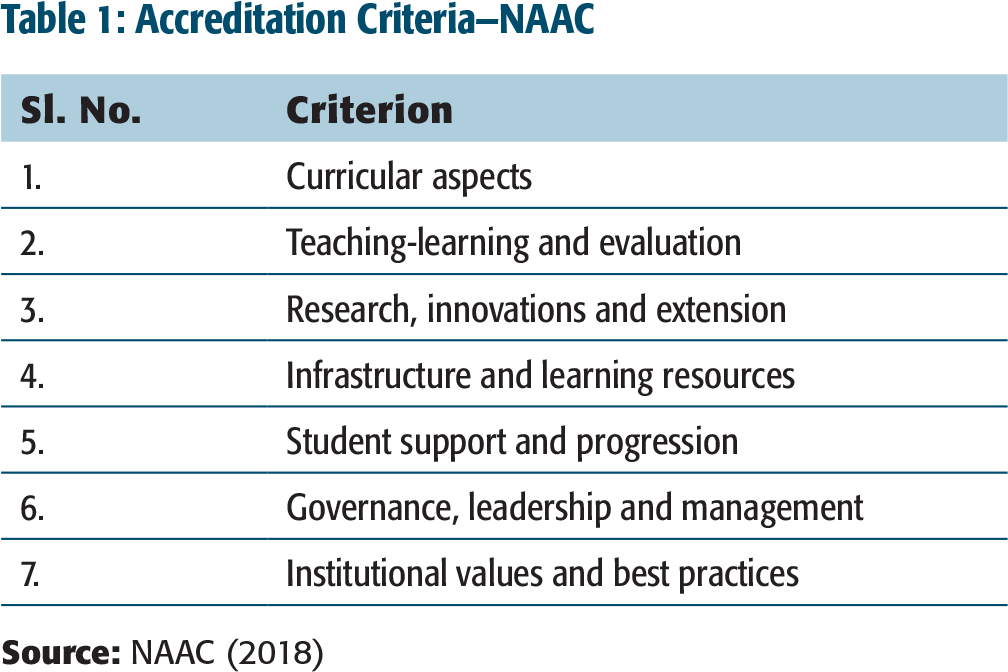
Accreditation of HEIs is a relatively new phenomenon in India, the need for which was not felt when higher education was almost entirely controlled by state-owned universities. In 1994, government initiatives began by setting up of autonomous accreditation agencies such as the National Board of Accreditation (NBA) by the All India Council for Technical Education (AICTE) and the National Assessment and Accreditation Council (NAAC) by the University Grants Commission (UGC), which was based on the recommendations of the National Policy on Education of 1986 (Kaul, 2006; Stella, 2004). NBA carries out accreditation of technical and management programmes in specific areas, and NAAC assesses institutions, their departments, schools and programmes. In 2010, NBA was made an autonomous body, and in 2013, it became a body independent of the AICTE. Such independence made the NBA eligible for membership of the Washington Accord, which made their accreditation internationally acceptable. The accreditation system followed by the NBA has also changed from an input-based 8-point set criteria to an outcome-based 1,000-point scale (Abbhilash, 2016; MHRD, 2019; NBA, 2019). From 2007 onwards, NAAC has been following a two-step process of accreditation with seven criteria (see Table 1) comprising 34 key indicators (KIs) used for assessment (MHRD, 2016; NAAC 2018).
Accreditation Criteria—NAAC
A few initiatives regarding accreditation in the context of other developing countries in south Asia are also discussed briefly. Developments in the case of Sri Lanka are more recent, around the first decade of the 21st century. A collaboration between the UGC and the Committee of Vice-Chancellors and Directors (CVCD) of the universities in Sri Lanka led to the creation of a Quality Assurance (QA) Framework in 2002 and to the publication of the Quality Assurance Handbook for Sri Lankan Universities (Coomaraswamy, 2013; CVCD-UGC, 2002; Peiris, 2007). Further developments in this direction later led to the establishment of a Quality Assurance and Accreditation (QAA) Council in September 2005 (Peiris, 2007; Quality Assurance Council, 2018) to oversee accreditation of HEIs. The quality framework had four components: (a) codes of practice, (b) credit and qualification framework, (c) external quality assessments (including subject and institutional reviews), and (d) subject benchmarking (in a broad range of disciplines) (Peiris, 2007). Initial activities of the QAA Council were supported through a World Bank-funded project on improving relevance and quality of higher education (IRQUE) (Peiris, n. d.). In Brazil, the Ministry of Education established the National Higher Education Evaluation System (SINAES) by legal decree in 2004. SINAES had three main pillars: (a) institutional evaluation (both internal and external), (b) course evaluation, and (c) student performance. Each of these pillars is evaluated using different sub-parameters and the evaluation system has already undergone an improvement in terms of assessment parameters in 2016 (Pereira et al., 2018).
In Pakistan, the National Business Education Accreditation Council (NBEAC) was set up in 2007 under the Higher Education Commission for accreditation of HEIs (Batool & Qureshi, 2007; NBEAC, 2017). A study by Nadeem et al. (2015) concluded that there existed reasonable similarities between the NBEAC and EQUIS accreditation principles. However, the authors also mentioned that a programme was the unit of evaluation (as compared to an institution in terms of EQUIS) and that NBEAC accreditation was voluntary at that time (Nadeem et al., 2015). In Bangladesh, the UGC implemented a World Bank-Funded Higher Education Quality Enhancement Project (HEQEP) between 2009 and 2018 that had four components as its focus (HEQEP, 2010): (a) promoting academic innovation, (b) building institutional capacity, (c) enhancing the connectivity capacity of the higher education sector, and (d) emphasizing project management (HEQEP, 2010; World Bank, 2018). The National Education Policy (NEP), 2010 listed the creation of an Accreditation Council for assessment and certification of academic institutions (Ministry of Education, 2010) as an objective. Though Kabir et al. (2008) have reported the formation of the Board of Accreditation for Engineering and Technological Education by the Institution of Engineers Bangladesh (IEB) for accrediting engineering courses in their study, the Accreditation Council Act was passed only in 2017 and its first chairman was appointed only in August 2018 (Solamain, 2018).
Such developments serve to highlight that accreditation of HEIs is gradually gaining importance even in the developing world, though the progress in some countries might be relatively slow. Nevertheless, country-based accreditation of HEIs is expected to move towards attaining internationally accepted standards in the coming decade.
ACCREDITATION: DEFINITION, PRINCIPLES AND PROCESS
Irrespective of the route by which accreditation has come into being, the principle involved is the same, namely: self-regulation and continuous improvement based on periodic reviews under the guidance of a recognised accrediting agency. Accreditation is a voluntary process; hence its definitions are also quite elaborate with descriptions of the process and benefits. The simplest and yet comprehensive definition is that of the Council for Higher Education Accreditation (CHEA), an association of 3,000 degree-granting colleges and universities established in 1996 that recognized 60 accrediting organizations (Eaton, 2011), which states, ëAccreditation in higher education is a collegial process of self-review and peer-review for improvement of academic quality and public accountability of institutions and programsí (CHEA, 2000). The principles to be followed in an accreditation process are enshrined in the many definitions of it, which could be elucidated as follows (as adapted from the University of Wisconsin System, 2015):
Focus on the programme outcomes, even when evaluating the academic processes. Develop and propose flexible standards to encourage innovations. Propose diagnostic, not prescriptive, recommendations. Recognize and respect institutional diversity. Avoid isolated evaluation even for specialized programmes; link and benchmark with other programmes wherever possible. Minimize the burden of accreditation (in terms of the size of the visiting team, duration of visit, amount of data required, etc.). Consult the concerned institution on the composition of the visiting team. Give greater weight to academic than professional concerns, even when evaluating professional institutions. Clarify the educational goals and develop alignment of other systems with these goals. Address, on a priority basis, the concerns emerging from the current context and issues faced by the institution (rather than focus on a standardized set of concerns).
The procedure followed for accreditation is also indicative of the principles enumerated above, especially those of integrating ëself-reviewí and ëpeer-reviewí, thereby addressing the concerns of the institution as well as the external stakeholders. A brief outline of the seven-step procedure of accreditation is given below (as compiled and integrated from the procedures being followed by various accrediting agencies):
Expression of interest: Since accreditation is a voluntary exercise, the institution wishing to get accredited should contact the accrediting agency of its choice and express their interest in initiating the process. Preparation of the self-report: Once the ëapplicationí from the institution is received, the accrediting agency would supply the standards according to which the applicant has to prepare a self-review report. On request from the applicant, the accrediting agency may also assign a ëmentorí to work with the applicant institution. The self-report prepared by the institution would typically highlight its accomplishments within the standards and framework prescribed by the accreditor. Constituting the peer-review team: The accreditor will constitute the peer-review team with academic and administrative experts drawn from sister institutions. In some countries, there is a practice of including enlightened members of the public and/or corporate executives in the peer-review team. Peer-visit and review: The peer-review team visits the institution and conducts detailed interviews with all stakeholders and examines the physical premises, equipment, and facilities as well as documents and records to assess the veracity of the claims made in the self-report. Judgement and recommendation: Based on the discussions and examinations with the stakeholders, the peer-team prepares a written report wherein they identify the areas for improvement and make their recommendation on the award of accreditation, which may be for five years, three years (also called ëconditional accreditationí), or for no accreditation. Award of accreditation: The accrediting agency considers the peer-team report, makes its decision on the type of accreditation or no accreditation and conveys it to the applicant institution along with recommendations for improvement. Continuous improvement: Since the accreditation is for a specified period (normally five, three, or zero), there is a need for re-accreditation at the end of that period if the institution wants to stay accredited. They have to go through the same process of self-review and peer-review in the subsequent accreditation cycles as well. This is the built-in incentive for the institution to do self-review and improvements continuously. The areas of improvements identified by the peer-review team are particularly useful for the institution in this regard.
In short, the three crucial phases in the process of accreditation include:
Establishing the standards and criteria. Inspection by the expert team from the accreditation agency. Publication of the decision to award accreditation or not (Allyn, 1966).
ACCREDITATION: CRITERIA FOR EVALUATION
While there is a consensus that the evaluation should be outcome focused, the criteria are mostly about the inputs by the institutions. It is the responsibility of the peer-review team to examine the connections and guide the schools to modify the inputs accordingly to meet the standards required for accreditation. Though there are some variations in the extent of details provided by the different accrediting agencies, the major dimensions are by and large similar. The variations are mostly because of the differences in the relative importance given to various outcomes. For example, the ACBSP was established in 1988 with accreditation standards, which, though similar to those of AACSB, were more teaching oriented (Hunt, 2015). AACSB gives more importance to research and publications compared to ACBSP, which focuses primarily on teaching.
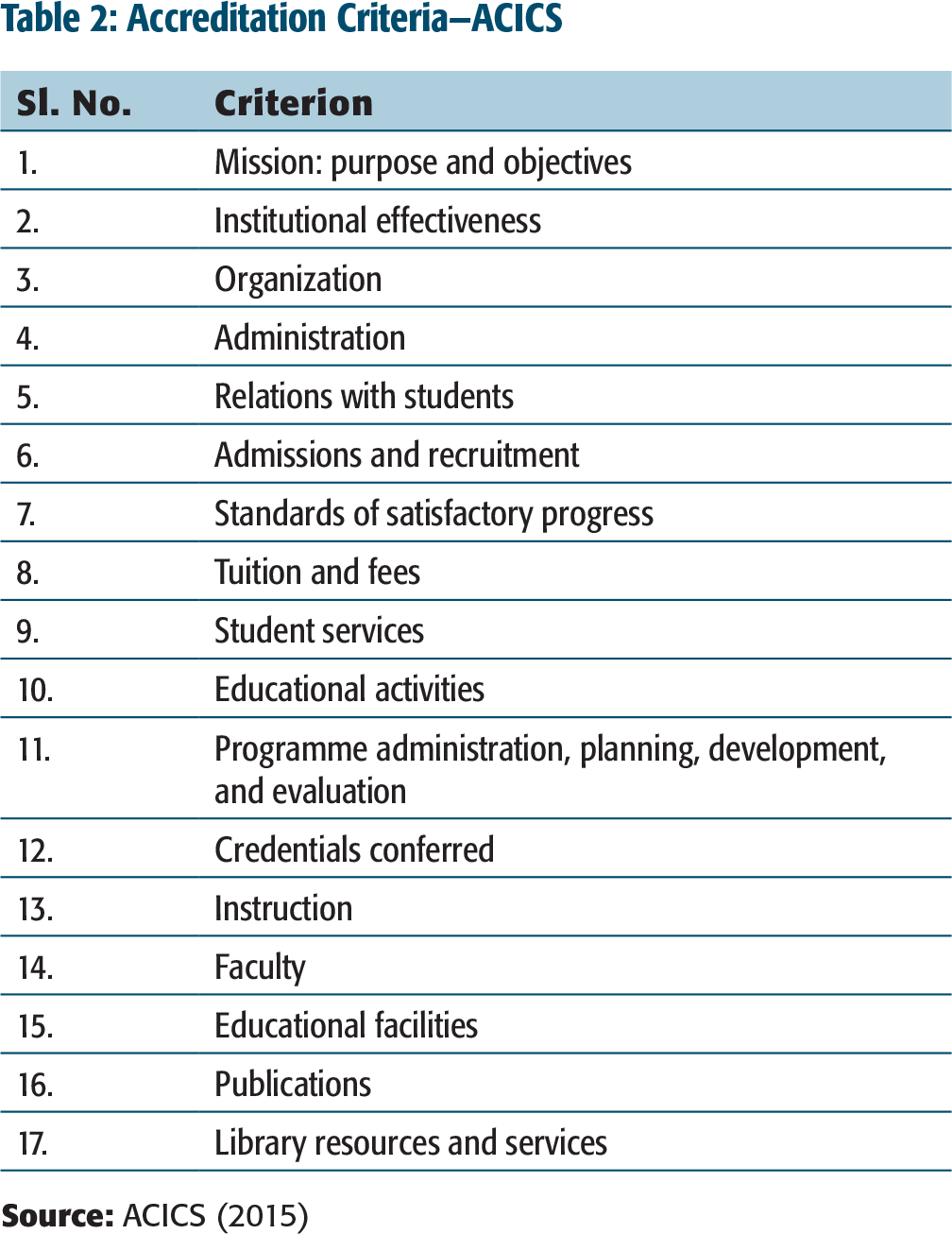
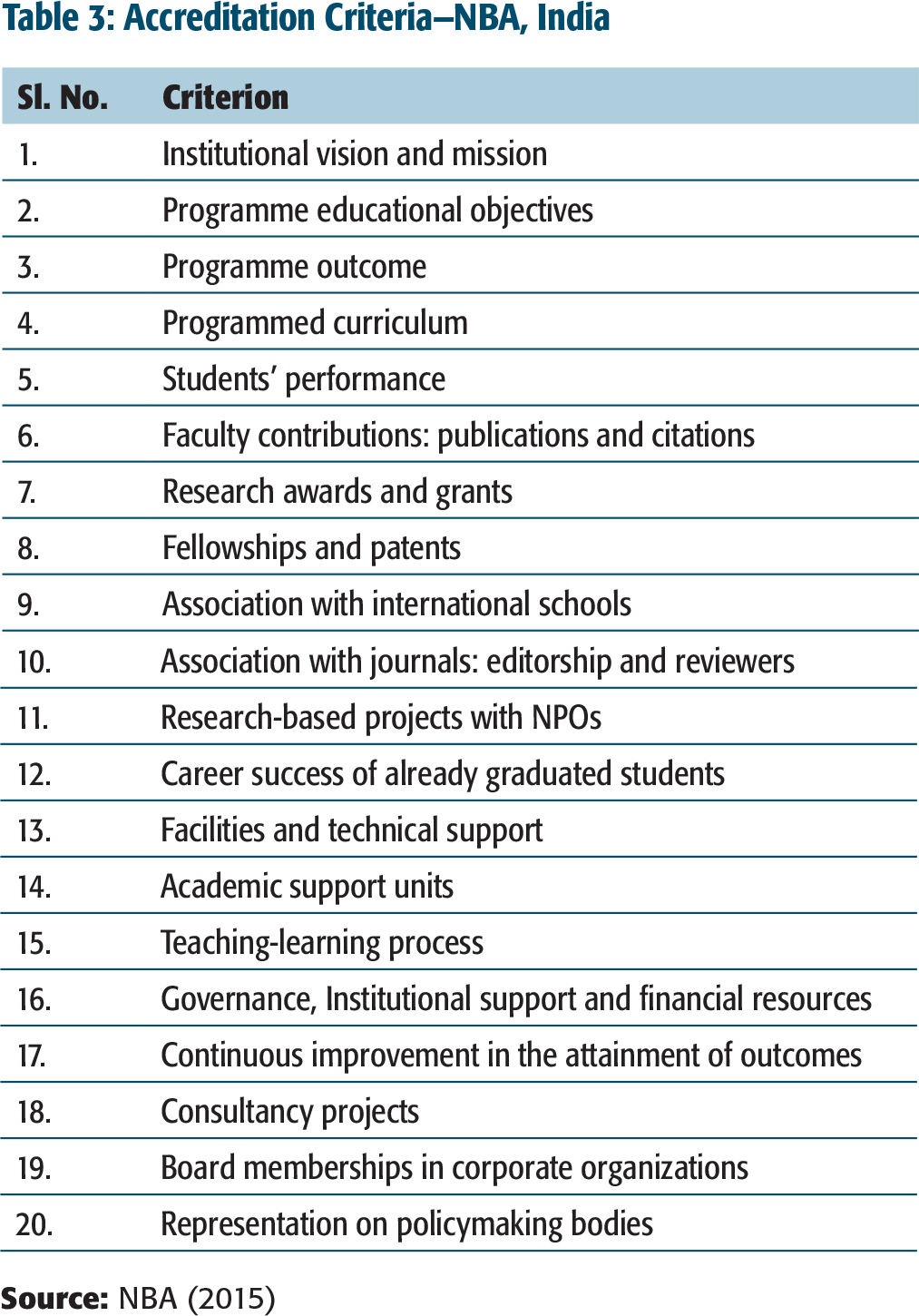
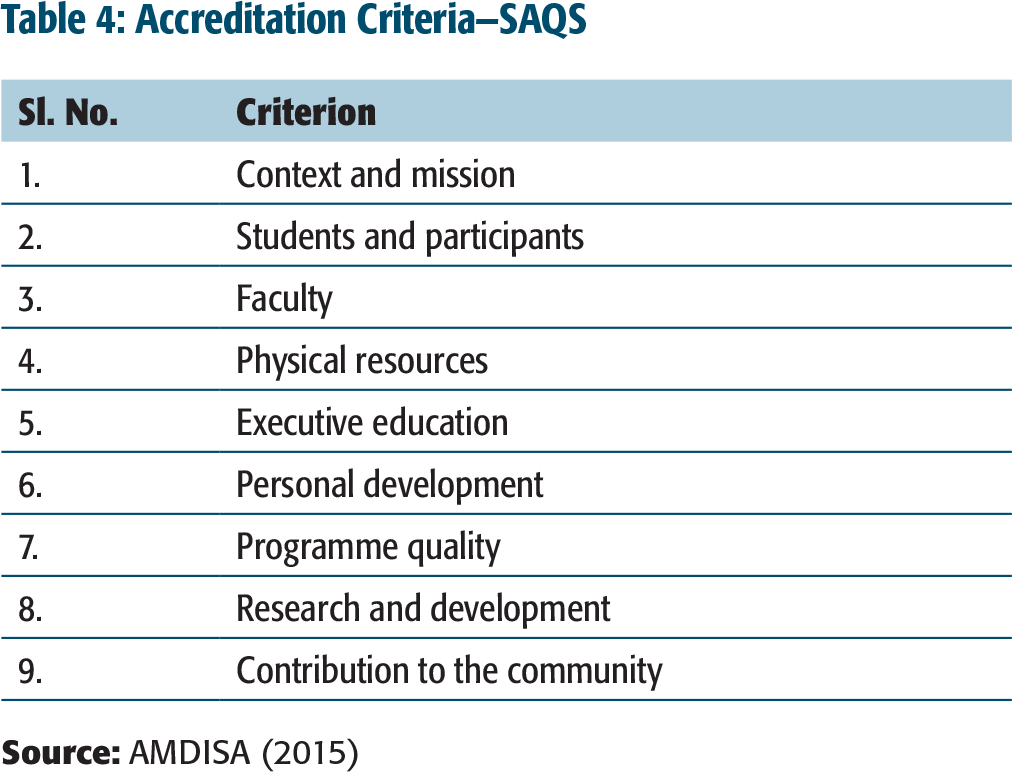
To highlight the similarities in the major themes and the differences in the details, we have reproduced the significant criteria being adopted by three different accreditation agencies below, namely: ACICS (USA), NBA (India), and SAQS (South Asia). Accrediting Council for Independent Colleges & Schools (ACICS) is the first (founded in 1912) and the largest accrediting organization of degree-granting institutions in the USA, accrediting professional, technical and occupational programmes, and is one of the two US accreditors recognized by both the US Department of Education and the CHEA. The other two (NBA and SAQS) also have the distinction of being the first in their own country/region, but one of them (NBA) is initiated by the government whereas the other (SAQS) is initiated and operated, as in the case of the US agencies, by an association of institutions, namely, the Association of Management Development Institutions in South Asia (AMDISA).
ACICS being the pioneer in accreditation, focusing on a variety of degree-awarding institutions with technical, professional and occupational programmes specifies not only a larger number of dimensions than the other two but is also more elaborate in listing out the details under each of these criteria (which are too many to reproduce here). The other two (NBA and SAQS) are rather narrowly focused on management education, which may be the reason for having a fewer number of criteria than ACICS. To understand the special focus of a particular accrediting agency, ideally one should examine the elaborations provided under the major dimensions. Viewed from this perspective, the ACICS criteria are quite comprehensive and can serve as a model for accrediting institutions having programmes in a variety of disciplines (see Table 2):
The lists of criteria from NBA and SAQS are about the accreditation of management programmes (see Tables 3 and 4). It may especially be noted that the first of the SAQS criteria assesses the operational context of the institution in accordance with its stated mission. This is indeed an important issue especially when every region of the world is facing accelerated changes in the technological, economic, and geopolitical scenarios, and therefore would like to see its educational institutions making continuous adaptation to such changes for which they should also receive support from accrediting agencies. The specialized focus of an accrediting agency can have a far-reaching influence on the detailed criteria chosen under the major ones, which can be illustrated by the ëimpact metricsí prescribed by AACSB (2013) under eight major headings, namely:
Mission alignment impact Academic impact Teaching/instructional impact Bachelorís/masterís level education impact Doctoral education impact Practice/community impact Executive education impact, and Research centre impact (see the Annexure for details).
Accreditation Criteria—ACICS
For this illustration, we have chosen AACSB because it has been known to have a special focus on research. Prior to the mid-1990s, schools underwent a rigorous process to obtain AACSB accreditation, which often involved the hiring of faculty with doctorates and a research focus. This changed with the adoption of the mission focus in 1994 (Hunt, 2015). Consistent with this special emphasis, it may be noted that out of the eight dimensions, three are exclusively on research:
Academic impact: for which all the sub-items are about research and publication, with ëteachingí separately dealt with in another section. Doctoral education impact: which is all about research and its guidance and the ensuing publications, and Research centre impact: where there is an implicit assumption that every institution should have a research centre that is externally funded, recognized for its research output especially in terms of publications, and networked with government and other relevant agencies based on its expertise). Additionally, all the other criteria are also rated concerning their linkages with research activities, some more and others less. For example, all the sub-items under ëteaching/instructional impactí are about issues related to ëresearchí such as grants for pedagogical research, development of case studies and instructional software, publications on teaching and its methods, and research-based learning projects with external agencies. Similarly, the items under the criterion ëpractice/community impactí are mostly based on recognition and usefulness of the research from the institution for the community of practitioners outside. It can be seen that research permeates the other criteria as well.
Accreditation Criteria—NBA, India
Accreditation Criteria—SAQS
Rao and Hans (2011) compared the accreditation systems followed by NBA and SAQS. NBA is a national body that accredits programmes. SAQS, which is derived from EQUIS and is a regional accreditation system (for South Asia) was found to place more emphasis on corporate connections and internationalization. Some of the key parameters on which they found differences between the two systems are as follows:
Vision, mission and goals: NBA while assessing the ëorganization and missioní aspect, placed greater emphasis on the physical, structural and governance issues, whereas SAQS was more focused on the appropriateness of the mission in the context in which the institution is operating and the extent to which the mission is achieved. Guidance and mentoring support: Guidance provided by NBA is restricted to the written guidelines available on the site, according to which the institution would prepare the self-assessment report (SAR). SAQS, on the other hand, would provide a mentor to the institution on request, with whose assistance the institution can work on their deficiencies while preparing the SAR and thereby improve their performance during the process of accreditation itself. Financial resources and infrastructure: SAQS was found to focus on the availability of dedicated facilities such as the library and research databases to further higher education and on considering the financial performance of the institution over the previous five years. In contrast, the NBA accreditation process tended to focus more on the utilization of the facilities with special focus on the self-sufficiency of their campuses, adequacy of floor area for academic activities, and monitoring of its premises to maintain levels of hygiene. Industry and corporate connections: It was found that the criterion of corporate connections was given a high degree of weight by SAQS and that the impact of corporate connections had to be reflected on the other parameters. In other words, the involvement of the corporate executives in the institutional processes would help the institution score well on this criterion. For institutions not located in tier 1 cities (which are many in the south Asian region), it was difficult to maintain good corporate connections, and hence they perceived this criterion to be discriminatory. Community contribution: The contribution of an institution to the community is assessed at the local, national and international levels in SAQS. This is done by checking the contribution of the institution to the improvement of management education, contributions to the business community, the association of the institute/faculty with professional bodies, and provision of consultancy services. This is a more broad-based assessment of the B-Schoolís contribution to the business community and the management profession, whereas, in the NBA accreditation process, the assessment in this regard focused mainly on some standard projects undertaken by the institution for social welfare.
ACCREDITATION: IMPACT ON INSTITUTIONAL LEARNING AND GROWTH
Learning from the Accreditation Experience
Zocco (2011) has documented new developments in the methodology of accreditation by the AACSB, in revising the scope and weightage of the Assurance of Learning (AoL) standards, which were first adopted in 1991. The assessment heads and weights of the AACSB were altered in 2003. Of the three heads (namely, Strategic Management Standards, Participants Standards, and Assurance of Learning Standards), the weightage for the third one (AoL Standard) was raised to one-third of the total. The revised 2003 AoL parameter was based on the outcomes or ëachievement of learningí rather than on the ëintention to provideí learning. These standards were believed to have evolved over a period of time and were periodically revised based on the emerging needs of the particular period (Miles et al., 2004). AACSB does not directly outline a specific process for AoL to be adopted by institutions, but specifies the following few tasks involved in the AoL process (AACSB, 2007):
Definition of student learning goals and objectives. Curriculum alignment with the specified goals. Identification of instruments to assess learning. Collection, analysis, and dissemination of assessment information. Utilizing the assessment information for continuous improvement of the programme curriculum.
Zoccoís (2011) study has offered an example of how implementing the new AoL guidelines of the AACSB would be beneficial for institutions of higher education. Adopting a recursive scheme of curriculum assessment and improvement that allowed for the integration of short-term time-frame-based improvements in curricula to align with long-term time-frame-based accreditation, assessment, and re-accreditation was the primary benefit achieved by using this approach.
Lessons in the Indian Context
In its first decade since inception, NAAC had assessed around 1,000 institutions using a process that included both self-assessment and peer-review stages. NAAC encountered the following challenges while adopting international standards of accreditation in the Indian context (Stella, 2004):
Participation: NAAC exercised its role as a planner (in terms of the framework), developer (preparation of instruments and conduct of training programmes), and overseer (steering the assessment process) rather than being fully involved in the assessment. Voluntary assessment: Financial and sociological constraints affected education in India and assessment alone could not address all factors. Hence, it was a voluntary rather than a mandatory process. Improvement focus: The focus was more on the improvement of institutions rather than on the assessment. With only 6 per cent of the 17ñ22 age group enrolled in higher education, an over-emphasis on accountability was avoided. Funding decisions: Linking funding and assessment is always a tenuous issue. Though there were requirements for signals to check the funding based on the assessment outcome, the focus was restricted to specialized schemes and portions of developmental grants. Institutional versus departmental accreditation: With an estimated number of 14,000 HEIs in India, it was thought that retaining the initial focus on institutional accreditation was better when compared to departmental accreditation. Reporting strategy: NAAC followed a public reporting strategy to ensure all relevant stakeholders were kept informed and their confidence was retained. Two-point versus multi-point accreditation: A staged nine-point grading system was adopted based on the score as neither a two-point (accredited/unaccredited) system nor a multi-point (100-point) reporting scale would help in the accurate assessment considering the increased variation and given the number of institutions and government involvement. Duration of accreditation: A fixed duration of accreditation meant that an assessment cycle could be initiated again. A varying duration of accreditation implied increased attraction of funds and staff for highly-rated institutions for that particular duration
Upon completion of its initial set of 125 institutional assessments, the NAAC approached the first 100 accredited institutions for feedback on its processes. Key concerns noticed during the accreditation process were: (a) lower-ranked institutions copying the higher-ranked ones, (b) adoption of methods such as coaching respondents who were interviewed and consulting experts to prepare documents. This showed a ësemblance of qualityí rather than actual quality improvement, leading to a more standardized nine-level grading pattern and the mandate to establish an internal quality assurance cell for re-accreditation (Stella, 2004). An impact study conducted by NAAC yielded significant improvements in the functioning of institutions in three areas: administrative, managerial and pedagogical. Institutions introduced changes beyond the mandate of their affiliating systems, including support for R&D by faculty, reduction of faculty workload, and better student support and learning resources (Stella, 2015). Another study by Pillai and Srinivas (2006) in the context of institutions in Indiaís north-east (100 institution heads interviewed) revealed that NAAC had a positive image among the academic community. There was an overall positive impression about the constitution of and interactions with the peer-review team, performance of evaluators, and institutional interface with NAAC. However, there were concerns regarding inter-team variance and geographical advantages enjoyed by urban colleges (Pillai & Srinivas, 2006).
Benefits to Institutions
Accreditation by a professionally managed and recognized agency can bring about several benefits to different stakeholders in the education system. The benefits accruing to the stakeholders are mostly due to interaction with the institution so that each of these interactions would add further benefits to the institution as well. However, the principal beneficiary of accreditation is an accredited institution. These are in addition to the benefits brought indirectly by the accreditation process itself, which are many, as may be seen from the list below (Alajoutsij‰rvi et al., 2015; Altbach & Knight, 2007; CHEA, 2010; Cooper et al., 2014; Gordon, 2014; Morgan, 2011; Reddy, 2008; Sarmiento-Espinel et al., 2015):
Enables self-review and introspection and thereby provides an opportunity to recognize oneís strengths and weaknesses against internationally accepted quality standards and to build confidence, which would provide a benchmark for continuous improvements and future growth. Creates a culture of communication, consultation, and collegiality among the different sections and departments of the institution as a result of the discussions and documentation done in connection with the accreditation process. Helps in identifying the institutional priorities and in developing appropriate strategies for executing them along with getting guidance for planning and resource allocation (both human and financial) for the same. Elevates the reputation and market acceptance of the institution and creates a competitive advantage for it, especially when it continues to stay accredited by acting upon the accreditorís recommendations and aligning itself with the best practices in the field to continuously improve its performance. Positively influences customer satisfaction because of improved documentation and streamlining of systems as well as consistency in policies and transparency in communication, which would inculcate a public accountability feeling within and outside the institution. May reduce legal costs since the clarity in systems, procedures, and communication as well as the strict adherence to quality standards are likely to reduce disputes and disagreements. Sustains initiatives for continuous improvements, especially in terms of innovations in contents and methods of teaching, on account of the need for re-accreditation induced by the limited period system of accreditation. Strengthens the acceptability of oneís graduates to employers and other institutions, which in turn would improve the number and quality of fresh intake. Reduces multiple audits and facilitates collaboration with other institutions and organizations, especially when accredited by a highly credible and reputed as well as the formally recognized agency, in line with the ëprincipleí, ëcertified once is accepted everywhere.í Enhances the national and international visibility and credibility of the institutions, which in turn would bring in greater funding support and national and international partnership opportunities in research and education. Develops an orientation towards ethics, social responsibility, and sustainability in the institution. Improves the quality of education and the student performance, which otherwise was lost due to liberalization of the procedures required to start an educational institution.
The periodical reviews (every three to five years) of accreditation have been made mandatory to ensure that institutions remain vigilant and watchful of their activities. The review begins with a self-examination that matches the accomplishments with the requirements of the accreditation. Peer-review of the activities helps substantiate the self-examination by the institutions themselves. Accreditation is renewed based on the self-examination report and the peer-review report (Da Costa Marques, 2010). An institution practising continuous improvement would easily qualify for the renewal of its accreditation.
Benefits to Stakeholders
Although the principal beneficiary of accreditation is the accredited institution, it would also bring several benefits to other stakeholders. Most of the accrediting agencies (including the Indian agencies, the NBA and NAAC) provide a list of stakeholders who would benefit from accreditation (particularly in a developing country context), which includes (Kawalekar, 2015):
Institutions: the status of an institution is enhanced when its programmes are certified of a certain quality. This would also enable easy movement of students between institutions, collaborative initiatives, and attraction of grants from reputed agencies. In the wake of globalization, India too needed to create a platform that enabled the integration of its degrees with the rest of the world (Kaul, 2006). Accreditation could act as an enabler. One such example in India is the National Skills Qualification Framework (NSQF), which is a 10-level framework of skills certification that includes courses of the National Institute of Electronics & Information Technology (NIELIT) (MSDE, 2018; NIELIT, 2019. Students (present, past and prospective): present students would have the confidence that they are getting quality education; past students (alumni) can take pride in their alma mater and derive the tangible and intangible benefits from it in their professions as well as higher studies; prospective students would find it easier to choose between different institutions based on their accreditation status. Employers: who would save on their recruitment efforts and costs by conducting campus recruitments from accredited institutions. Parents: who would find it easier to guide their wards towards the right kind of institutions. Service-providers: who can tailor-make their services to the required level of quality. Licensing agencies: which have the responsibility to ensure the safety and quality of services provided by their certified professionals can become more confident about their decisions if the graduates are from accredited institutions. However, these agencies should guard against promoting the wrong institutions, which could misguide the students and over a period of time lead to loss of the credibility of the process and the agency. The agency will pay the price for this mistake by losing its credibility on the one hand and causing irrevocable damage to society on the other. Funding agencies: which will be assured that their money would be used for supporting worthy projects and programmes. In India, there is pressure to accredit institutions from funding agencies that could support them (Gandhi, 2013). Agarwal (2006) has, however, pointed out that very few institutions actually receive financial support from the UGC and institutions such as private un-aided universities and colleges may not even be eligible for the same. Ironically, some colleges also require (and may fall short of) funds to prepare themselves for NAAC accreditation (Verma, 2019). This presents a dichotomous challengeóthe need for funds for accreditation and the requirement of accreditation for funding (The Sentinel, 2018)óespecially in the wake of the governmentís decision to set up the Higher Education Commission of India to replace the UGC (Vishnoi, 2018). Governments: which would benefit in various capacities, such as regulator, policymaker, funder as well as the employer. Accreditation of an institution by a recognized international agency would mean that regulators and policymakers would have a good idea of the current accreditation standards; employers and funders would also be more assured while making their decisions. Society at large and the country: which would benefit from the overall development of manpower quality and the improvements in the research and teaching activities.
CONCLUSION: ACCREDITATION—CREDITS, DISCREDITS AND FUTURE DIRECTIONS
Accreditation is the academiaís equivalent of a benchmarking exercise being carried out in the industry, with the difference that for the former (accreditation) the exercise is conducted in a much more organized manner. Such an organized system did not come about in one day nor was it externally imposed, even though it might appear to be so from the individual institutionís perspective. Admittedly, the peer-review team is from outside the institution; however, the accrediting agencies in most cases are associations created by several such institutions, often including the one being accredited. Besides, the accreditation process will be initiated only when the concerned institution requests the same. In short, the system is designed to preserve the sanctity of voluntariness as a fundamental principle behind the process. It is, therefore, a process initiated by the institution for reviewing and improving oneself against the ëindustryí standards, where the accrediting agency is an invited facilitator and consultant. A self-initiated process usually is indicative of a desire to improve, which when aided by the peer-assisted benchmarking with the best practices in the industry is expected to bring about innovations and improvements.
While the merits of accreditation are generally accepted and acclaimed, the system is not without its critics (even among the US lawmakers). Some issues raised by the critics are listed below:
The peer-review system can deteriorate into a ëmutual back-scratching clubí, where the accreditors and the accredited would reverse their roles as per the requirements of the peer-review process and hence may tend to favour one another. Since the reviewee has to make a payment to the reviewer, the latter may feel obliged to give a favourable report often ignoring the adverse data being generated, which defeats the purpose of accreditation. Accreditors tend to adopt an input-oriented approach despite the newly announced outcome-focussed approach because it is much easier to check and assess the inputs compared to outcomes. According to critics, this has led to the decline in the outcomes such as the graduation rates, academic standards, student achievements as well as an increase in unemployment and student loan defaults, as per the US statistics. Even if the system is changed to focus primarily on student outcomes, it is not easy to measure them. Since the student outcomes would vary with the quality of the students, it might once again translate into a measure of the quality of student input (May et al., 2012; Wilson, 2007). There could also be a need to change the accreditation system based on the changes taking place in the education system. For example, in many programmes, the focus is now shifting away from knowledge-acquisition to skill development (Garfolo & LíHuillier, 2016). Similarly, distance learning, especially through online technologies, are becoming increasingly popular (Eaton, 2001; Gordon, 2013). The emergence of shared and blended learning options has completely changed the paradigm in which participants access the delivery of higher education. Massive Open Online Courses (MOOCs) offered by universities online are counted for exemption against their regular courses when a student chooses to enrol for a programme of study. Accreditation providers also need to ensure that quality is maintained and not compromised while assessing such learning options (Friga et al., 2003). The diversity thus created in programmes (in terms of their content, delivery, duration/timeslots, place, type of interaction, etc.) should find the rightful place in the accreditation scheme as well. Since the accreditors are guided by a set of standards based on the ëtraditionalí system of education, the process of accreditation may increase the bureaucratic burden on the institutions and curb their academic freedom by increasing the pressures for conformity and restricting any innovation in their academic activities (Harvey, 2004; Kaul, 2006). The academic freedom of the institutions is not the only issue at stake when conforming to the norms of an accrediting agency. Since education is an open system with multiple stakeholders, it has to take care of the concerns of all its stakeholders. Moreover, since the discipline boundaries may not always represent the boundaries in real life, education has to facilitate interdisciplinary interaction (Takala et al., 2001). Conformity to the norms of one accreditation system may come in the way of interaction among disciplines and stakeholders as well as prevent the effective integration of their concerns into the education system. From an evolutionary perspective, the accreditation process can be stated to be foreign to institutions in developing countries. In the west, accreditation is by peers (associations), but in the developing countries, accreditation is pushed by the regulators. So, the accreditation process becomes all the more important in the context of developing countries when compared to developed countries to ensure all institutions ensure quality in education and its delivery process. Institutions in these contexts find the process cumbersome and face a lack of competencies to perform their tasks efficiently. All these factors lead to less effectiveness of the accreditation and increased bureaucracy and corruption. Given the possibility of accreditation across borders and that it could also carry commercial benefits, foreign agency accreditations may end up being preferred over national accreditations (Altbach & Knight, 2007). If for any reason, the accreditors make and announce a biased decision either favouring or disfavouring the institution, it can have damaging effects on the concerned institution and the education system at large. Accrediting a non-deserving candidate would lead to the deterioration in the quality of the institution and its graduates as well as the education system. On the other hand, if a deserving candidate is denied accreditation, its customer and support base would progressively shrink with the result that the institution might eventually collapse for want of patronage. One suggestion that has come up in this regard is to create commissions for academic accreditation to supervise the process and ensure that accreditation is diligently carried out and only qualified institutions are accredited (Gordon,2013). However, there is a danger that the system may become regulatory and bureaucratic. It is often feared that the accreditation process would increase the workload of the faculty, who would be asked to carry out a lot of documentation work. They may also be apprehensive about the additional efforts needed for implementing the recommendations of the accreditors and for ensuring continuous improvements after that. It may, therefore, be difficult to get faculty cooperation for accreditation work (Van Kemenade & Hardjono, 2009). Finally, there is the cost factor. There are apprehensions as to whether the benefits of accreditation are commensurate with the time, efforts and costs incurred for the periodic documentation and preparation of self-reports as well as the fees paid to the accrediting agency. The cost issue is more pronounced when one considers that institutions would like to secure accreditation from ëmultiple significant accrediting bodiesí (Lock, 1999). This trend has been particularly noticeable in the context of management education in recent times, wherein institutions view the ëtriple-accreditationí by AACSB, AMBA, and EQUIS to be a global benchmark for quality. The ëprice and valueí issue and the need for developing funding norms based on ëperformance and resultsí rather than the accreditation status are among the several issues raised on accreditation in the US Congress.
To understand and assess the impact of accreditation, mere compliance to norms prescribed by an accrediting agency is insufficient. Outcomes of the educational programmes need to be considered rather than the inputs and processes. Norcini and Banda (2011), in their study of accreditation in medical education, have mentioned key issues that accreditation processes need to address to be effective in the 21st century. A major challenge faced by educational institutions lies in shifting their focus from the inputs and processes to outcomes, as outlined below:
Increasing the application of educational research in educational practice: Institutions must move on from the old approaches to education based on tradition and fashion towards approaches based on educational research. This would be difficult for institutions in the current scenario of norms for the practice of education being recommended (often prescribed) by accrediting agencies. Focusing on both quality and efficiency: In the interest of achieving the recommended quality, institutions could raise the cost of education, making it inaccessible to poor but bright students. Balancing of quality (as suggested by accrediting agencies) and efficiency must be a priority for educational institutions. Developing a consensus on measuring and evaluating outcomes: Although there is a need for outcome-orientation, accrediting agencies continue to prescribe norms for inputs and processes, such as faculty qualifications, resource requirements, curriculum contents, and delivery methods. There is still no consensus on accrediting programmes and institutions purely based on student outcomes or how to measure them. Consequently, the tendency to ignore the outcomes in favour of inputs and processes continues.
Footnotes
DECLARATION OF CONFLICTING INTERESTS
The authors declared no potential conflicts of interest with respect to the research, authorship and/or publication of this article.
FUNDING
The authors received no financial support for the research, authorship and/or publication of this article.
ANNEXURE

Mission Alignment Impact
Alignment of intellectual contribution outcomes with themes or focus areas valued by the business schoolís mission (e.g., global development, entrepreneurship, innovation) Percentage of intellectual contribution outcomes that align with one or more îmission-relatedî focus areas for research Percentage of faculty with one or more intellectual contribution outcomes that align with one or more mission-related focus areas Research awards and recognition that document alignment with one or more îmission-relatedî focus areas for research Substantive impact and carry-forward of mission as stated in Standard 1 and as referenced throughout the remaining accreditation standards Linkage between mission as stated in Standard 1 and financial history and strategies as stated in Standard 3
Academic Impact
Publications in highly recognised, leading peer-review journals (journals in a designated journal list, Top 3, Top 10, etc.) Citation counts Download counts for electronic journals Editorships, associate editorships, editorial board memberships, and/or invitations to act as journal reviewers for recognised, leading peer-review journals Elections or appointments to leadership positions in academic and/or professional associations and societies Recognitions for research (e.g., Best Paper Award), Fellow Status in an academic society, and other recognition by professional and/or academic societies for intellectual contribution outcomes Invitations to participate in research conferences, scholarly programmes, and/or international, national, or regional research forums Inclusion of academic work in the syllabi of other professorsí courses Use of academic work in doctoral seminars Competitive grants awarded by major national and international agencies (e.g., NSF and NIH) or third-party funding for research projects Patents awarded Appointments as visiting professors or scholars in other schools or a set of schools
Teaching/Instructional Impact
Grants for research that influence teaching/pedagogical practices, materials, etc. Case-studies of research leading to the adoption of new teaching/learning practices Textbooks, teaching manuals, etc. that are widely adopted (by number of editions, number of downloads, number of views, use in teaching, sales volume, etc.) Publications that focus on research methods and teaching Research-based learning projects with companies, institutions, and/or non-profit organisations Instructional software (by number of programmes developed, number of users, etc.) Case study development (by number of studies developed, number of users, etc.)
Bachelorís/Masterís Level Education Impact
Mentorship of student research reflected in the number of student papers produced under faculty supervision that lead to publications or formal presentations at academic or professional conferences Documented improvements in learning outcomes that result from teaching innovations that incorporate research methods from learning/pedagogical research projects Hiring/placement of students Placement of students in research-based graduate programmes Career success of graduates beyond the initial placement Direct input from organisations that hire graduates regarding graduatesí preparedness for jobs and the roles they play in advancing the organisation Movement of graduates into positions of leadership in for-profit, non-profit, and professional and service organisations
Doctoral Education Impact
Hiring/placement of doctoral students, junior faculty, and post-doctoral research assistants Publications of doctoral students and graduates Invited conference attendance, as well as awards/nominations for doctoral students/graduates Research fellowships awarded to doctoral students/graduates Funding awards for students engaged in activities related to doctoral research Case-studies that document the results of doctoral research training activities, such as the transfer of knowledge to industry and impact on corporate or community practices Research outputs of junior faculty members (including post-doctoral junior professors, assistant professors, doctoral research assistants, and doctoral students) that have been influenced by their mentors/supervisors
Practice/Community Impact
Media citations (e.g., number, distribution, and effect) Requests from the practice community to utilise faculty expertise for consulting projects, broadcast forums, researcher-practitioner meetings, faculty/student consulting projects, etc. Publications in practitioner journals or other venues aimed directly at improving management expertise and practice Consulting reports Research income from various external sources such as industry and community/governmental agencies to support individual and collaborative research activities Case-studies based on research that has led to solutions to business problems Adoption of new practices or operational approaches as a result of faculty scholarship Presentations and workshops for business and management professionals Invitations for faculty to serve as experts on policy formulation, witnesses at legislative hearings, members of special interest groups/roundtables, etc. Tools/methods developed for companies Memberships on boards of directors of corporate and non-profit organisations
Executive Education Impact
Sustained and consistent involvement of research-active faculty in executive education programmes Sustained success of executive education programmes based on demand, level of participation, and repeat business Market research confirming value of executive education programmes delivered by research-active faculty Consulting activities of research-active faculty that stem from participation in executive education activities Inclusion of cases and other materials in degree programmes that can be identified as resulting from executive education activity Partnerships between the school and organisations that participate in executive education programmes, which benefit the schoolís teaching, research, and other activities and programmes Involvement of executive education participants and their organisations in the teaching mission of the school (e.g., executive-in-residence programme) Linkage between organisations participating in executive education and student internships, as well as placement of graduates in entry-level positions
Research Centre Impact