




Abstract

Executive Summary
This article presents a systematic review of social marketing and well-being. It summarizes key findings of different research articles and identifies important research gaps that need to be addressed by future research. This study explores, analyses, and presents a literature review by closely examining 94 articles. The articles focusing on social marketing and well-being have been retrieved from the databases of leading social marketing and management journals for the period 1998–2017. Adopting a content analysis method, the article presents a framework describing various antecedents, mediators, moderators, and well-being dimensions. Researchers suggest that a focused empirical and a mixed research approach be used to study social marketing and well-being. The implications of the study will help future researchers in developing robust and comprehensive models regarding social marketing and well-being. The study provides a basic theoretical background for future action or empirical research by identifying the research gaps in the area of social marketing and well-being. The study also assists social marketing managers in designing campaigns that are aimed to transform societies into a more competent, free, equitable, fair and sustainable community.
Systematic review analysis is conducted to evaluate the academic growth and development of any given discipline (Williams & Plouffe, 2007). A literature review of any academic discipline not only provides an overview of its progress but also identifies research gaps and provides future research directions (Creswell, 2009). In addition, the review also helps in clarifying our concepts regarding theoretical development, research methodologies, data analysis techniques, etc. One of the effective ways to position the developments in the academic discipline is through reviewing refereed journal articles in a particular area of study (Wilkie & Moore, 2003). In this context, Nasir (2005) carried out the literature review on management information systems by analysing the content of research papers published in business and marketing journals to trace the developments, changes, and transformations in this area. Similarly, Williams and Plouffe (2007) adopted the content analysis method to understand the knowledge developments in industrial selling and sales management, studying over 1,000 articles published in 15 key journals from 1983 to 2002. The present study undertakes a similar line of enquiry to investigate the state of research on social marketing and well-being.
The academic birth of social marketing can be traced in the early 1970s. However, it has witnessed a major growth in improving the well-being of society in the last few decades, by exploiting marketing principles and innovative approaches to bring a social change (Andreasen, 2002; Kotler & Zaltman, 1971). During this period, social marketing application tools have expanded and addressed a wide range of social issues including smoking (MacAskill, Stead, MacKintosh, & Hastings, 2002); drinking (Perry et al., 1996); STD/HIV (Poehlman et al., 2015); physical activity and hand hygiene (Forrester, Bryce, & Mediaa, 2010; Huhman et al., 2005); youth gambling problem (Messerlian & Derevensky, 2007; Powell & Tapp, 2008); health, social development, and environment (Andreasen, 1997); and sustainability (McKenzie-Mohr & Smith, 1999). Social marketing is now considered as a bona fide sub-set of commercial marketing thought. Social marketing is an approach to social change which adds many new dimensions to the commercial marketing communication theory through diffusion of innovation and social R&D. It also melds public interest sociology with a long-standing interest in public economics and public finance (Sirgy, Samli, & Meadow, 1982).
Social marketing includes the use of various marketing principles, processes, techniques, behavioural theories, models, etc. for inducing behavioural change in the society against the social issues (Dann, 2010). However, some researchers are of the opinion that social marketing involves both traditional downstream approaches which include efforts to encourage changes in those people who have already adopted unhealthy habits as well as upstream approaches that are more focused on preventing the development of unhealthy habits among people (Andreasen, 2006; Lazer & Kelley, 1973). Therefore, social marketing is concerned with the application of marketing knowledge, concepts, and techniques to enhance social and economic ends. It is also concerned with the analysis of social consequences of marketing policies, decisions, and activities (Dibb & Carrigan, 2013; Hastings & Saren, 2003; Lazer & Kelley, 1973). Thus, social marketing solutions help individuals to change their unhealthy behaviour to healthy behaviour.
Many researchers have tried to define the social marketing since its inception in the 1970s, but Lefebvre (2013, p. 4) gave one of the comprehensive definitions of social marketing defining it as ‘the application of marketing discipline to social issues and causes [that] provides a framework for developing innovative solutions to social problems that have long perplexed and frustrated us’. Six benchmark criteria have been proposed by Andreasen (2002) for labelling an intervention as social marketing. These criteria include focus on behaviour change, audience research, careful segmentation, the creation of attractive and motivational exchange with target audiences, use of 4Ps (Price, Product, Promotion, and Place) of traditional marketing mix, and consideration of competition faced by the desired behaviour. A social marketing programme does not need to satisfy all the six benchmark criteria to label itself as social marketing. The ultimate goal of social marketing is social good, which is aimed to make the world a better place for everyone (Andreasen, 2006; Kotler & Lee, 2008), through its preventive measures for social issues such as health care, alcoholism, and tobacco consumption, encouraging safe driving, mitigating poverty, etc. Social good can be categorized broadly into two dimensions with different drivers, that is, the reduction of ill-being and the increase in well-being. These two dimensions can inspire researchers and practitioners to design new tools and strategies for effective social marketing campaigns (Carvalho & Mazzon, 2015a).
National Statistics London (2013) understands well-being as how we are doing as individuals, communities, and a nation, and how sustainable this is for the future. It has defined well-being into 10 broad dimensions including the natural environment, personal well-being, our relationships, health, what we do, where we live, personal finance, the economy, education and skills, and governance. Many European countries have reported a growing demand for strengthening the quality guidelines for health care, social work, and special education (Hoyningen-Süess, Oberholzer, Stalder, & Brügger, 2012). In some of these countries, quality control guidelines have become a legal requirement, and both government and institutional services are linked to formal quality criteria. Personal well-being is one of the important dimensions which is defined as how satisfied our lives, our sense that what we do in life is worthwhile, our day-to-day emotional experiences (happiness and anxiety), and wider mental well-being (Caan, 2016; Povey et al., 2013). Social well-being is the appraisal of one’s circumstances and functioning in society. Keyes (1998) has proposed five dimensions of social well-being, namely social integration, social contribution, social coherence, social actualization, and social acceptance. Social well-being has been found to be positively correlated with community involvement, generativity, neighbourhood health, life satisfaction, and happiness, whereas negatively correlated with dysphoria and anomie (Keyes, 1998). These community issues are majorly being addressed by the social marketing programmes. The researchers have further found that social well-being increases with education and age (Tedmanson & Guerin, 2011).
Gordon and Oades (2017) have opined that the core of social marketing is to create social good that results in more sustainable, equitable, healthy, happy, and productive societies. In this context social marketing is oriented towards facilitating well-being in society through social good. Marr (2012) has defined social good in terms of technologies of power, which includes oratory, law, rituals, religion, communication, entertainment, and forces to persuade individuals to behave in a way that is believed to be beneficial to the wider society. Social marketing has potential to strive for more efficacious programmes to influence societies for social good. It can also increment societal well-being by aligning various social marketing techniques with the human goals that underlie well-being theory (Carvalho & Mazzon, 2015b). Thus, high well-being will result in an increased resistance to illness, speed up physiological recovery, and increase survival rates, whereas low well-being results in slower wound healing (Cohen, Doyle, Turner, Alper, & Skoner, 2003; De Neve, Diener, Tay, & Xuereb, 2013; Lamers, Bolier, Westerhof, Smit, & Bohlmeijer, 2012). Michaelson, Mahony, and Schifferes (2012) deciphered that social marketing enhances the effectiveness of the activities which are believed to increase overall well-being such as good physical, mental, and social health; financial and personal security; rewarding employment; inclusive communities; and attractive environments. This discussion regarding the impact of social marketing on well-being and overall society underscores the motivation for synthesizing the literature and providing insights into the form of research gaps to the future research for empirical study and subsequent validation. The current study will help social marketing researchers and practitioners to gain valuable insights regarding the recent trends in social marketing discourse as well as various methodological approaches adopted by the researchers in this area. McDonald, Slavin, Bailie, and Schobben (2011) further advocate that the insights drawn from the literature have been helpful in increasing the success of social marketing programmes. This article seeks to present a systematic review of social marketing and well-being. It also identifies important research gaps that need to be addressed by future researchers.
METHODOLOGY
A systematic review process was adopted for carrying out the literature review on social marketing and well-being. The systematic review process involves two steps. The first is to decide the inclusion criteria and the second is the selection of databases and articles (Kamboj & Rahman, 2015). The literature search and review has been conducted by the researchers during February–April, 2017 and was further updated in November–December, 2017.
Inclusion Criteria
The papers included were published during 1998–2017 in peer-reviewed/refereed journals. Sources such as working papers, reports, and publications of government or other firms, textbooks, conference proceedings, thesis or dissertations were not included. The time frame was chosen on the basis that most significant developments in social marketing research took place during this period. Initially, 2,000 was set as the starting date, but an important article on social well-being by Keyes (1998) fell outside this period and therefore the time period was reset to 1998 to include that article.
Conceptual, review, and empirical studies carried out in different countries were considered for the present study.
Non-English language articles were excluded.
Database and Article Selection
The selection of databases and articles from different journals was carried out in a three-step process. First, papers were explored/searched in the leading academic databases including Emerald Insights, Taylor & Francis, Elsevier (Science Direct), JSTOR, Springer Link, and Sage Publications. The databases searched were chosen because they had been used by prior researchers for systematic reviews on social marketing and contain most of the articles published in this area (Edgar, Huhman, & Miller, 2015; Loree, Lundahl, & Ledgerwood, 2015). These databases are the digital repositories of more than 40 million research articles drawn from journals covering diverse academic disciplines. The papers were searched in different sections of databases including article titles, abstracts, and keywords. The keywords used were social marketing, social marketing interventions, well-being, social well-being, mental well-being, and personal well-being. The words social marketing and well-being were searched both independently and together. This has resulted in the collection of 155 articles. In addition, citations of the papers identified from the previous two steps were considered as further sources. The above-mentioned inclusion criteria were applied which resulted in the elimination of 61 articles. The selected papers obtained from the above-mentioned inclusion criteria were considered on the basis of double screening, that is, the title and the abstract. Therefore, the resultant 94 papers that satisfied all the criteria were considered for the review.
RESULTS AND DISCUSSIONS
Characteristics of Reviewed Papers
The characteristics of reviewed papers include the distribution of articles according to the publication trend and journal-wise. In addition, articles were classified according to the topics they address, that is, social marketing and well-being.
Distribution of Articles by Years of Publication
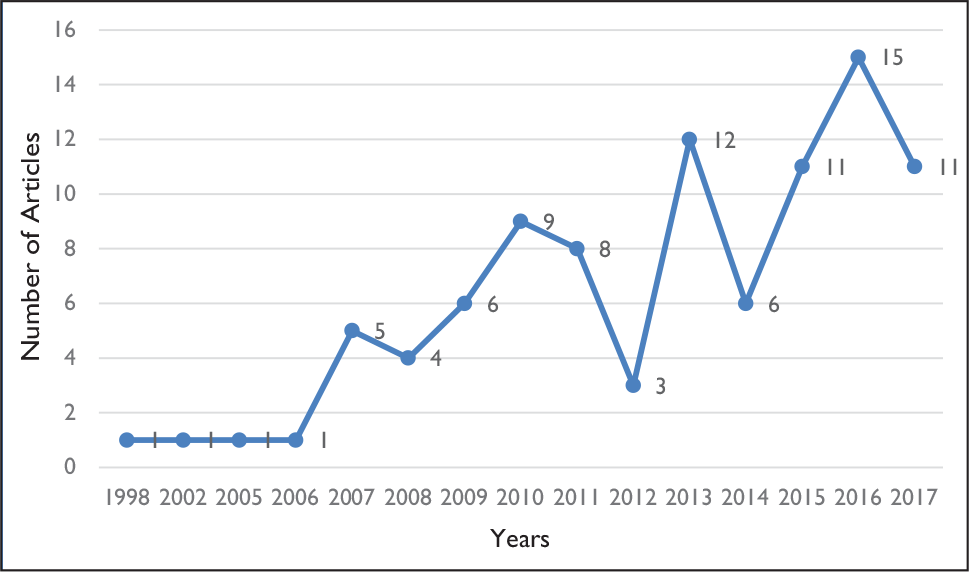
The research papers reviewed in the study were classified by the year of publications from 1998 to 2017 to identify the publication trend of academic research in the areas of social marketing and well-being as shown in Figure 1. The first article was published in 1998 as shown by the trend line. It is observed from the trend projection that the number of published articles is rising steadily with the increasing years (1998–2017). Out of the 94 articles, 75 were published after 2010. The highest number of articles were published in 2016 (15) and the lowest number of articles were published in 1998, 2002, 2005, and 2006 (one each). In the past seven years, that is, between 2011 and 2017, the maximum number of articles (70%) were published. The growing number of articles in the area of social marketing and well-being indicates that this area of research has captured the attention of researchers and has not yet reached the academic saturation point. Therefore, it is expected that this area of research will continue to expand in the coming years.
: Distribution of Articles by Years of Publication
: Distribution of Articles by Publishing Journals
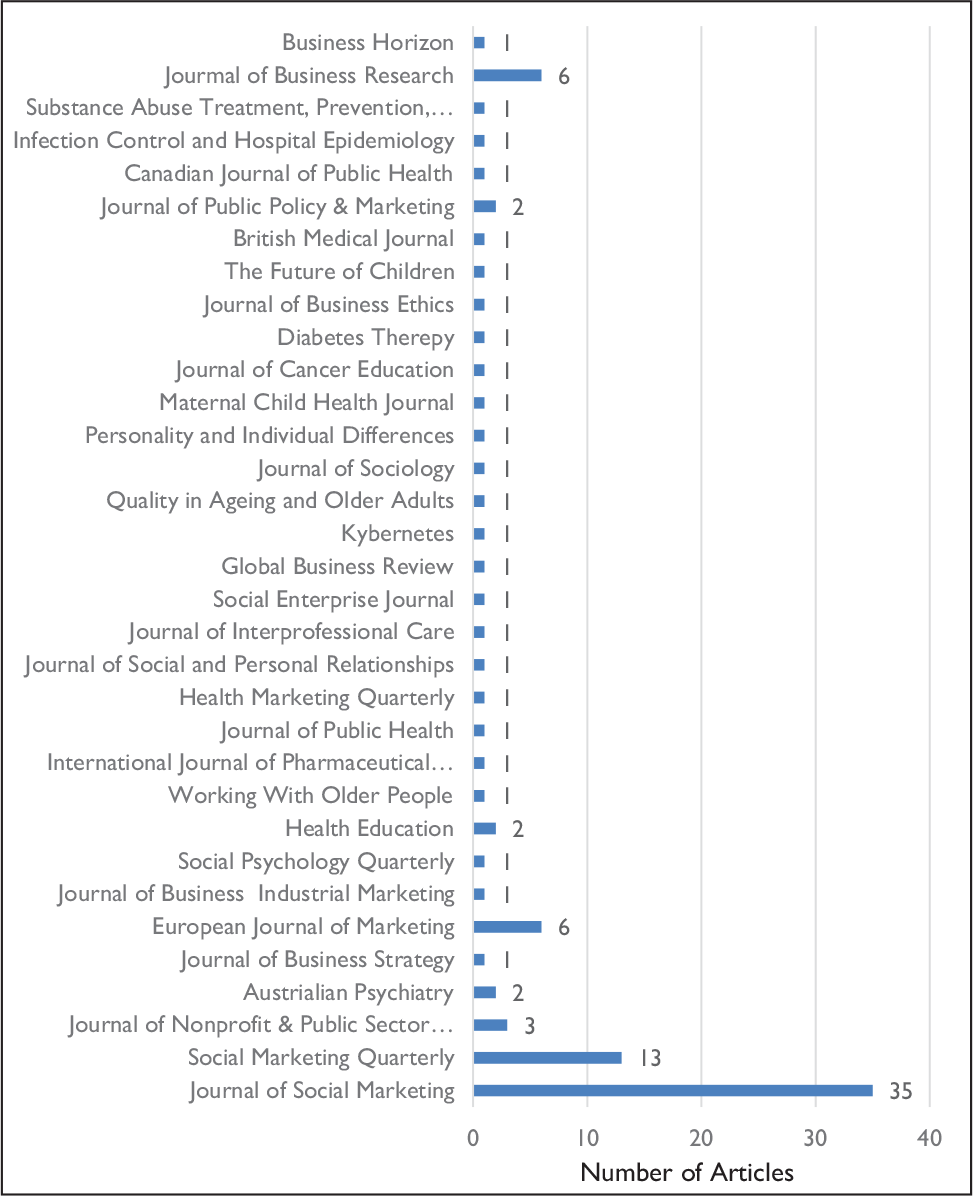
Distribution of Articles by Publishing Journals
The distribution of articles in the various published journals is given in the form of a histogram (Figure 2). Out of the total 94 articles, Journal of Social Marketing leads the tally with a maximum of 35 articles being published in this journal, followed by Social Marketing Quarterly with 13 articles published in it. The reason associated with the predominance in publishing the articles on social marketing in these two journals is that they are both dedicated to the social marketing research. It is observed from the histogram that only one paper is published in 25 journals. Further, more than 63 per cent of the papers are published in the European Journal of Marketing, Social Marketing Quarterly, Journal of Business Research, and Journal of Social Marketing.
MODELS AND THEORIES USED IN REVIEWED PAPERS
Social marketing is not a theory in itself; it is rather an extension of the marketing principles for the social cause. It draws theories and models from other behavioural sciences and applies them in determining the changes in behaviour. It was found in the present study that out of 94 articles investigated, only 32 articles (34%) explicitly indicate the use of theory/model; 44 articles (47%) were based on concepts/view points; and remaining 18 articles (19%) were based on review and do not provide any information related to the theory. It is revealed from the above data that most of the literature available regarding social marketing and well-being is conceptual and review-oriented. Only 34 per cent has reported the use of theories and models for assessing the influence of social marketing interventions on the individual/community behaviour. Further, most of the theory-oriented papers were published 2010 onwards, which indicates that both quantitative research and qualitative research are now continuously growing in the area of social marketing and well-being. These findings are in conformity to the research studies of Luca and Suggs (2013), Lefebvre (2000), and Truong and Hall (2013) who have found that a large number of social marketing studies are not based on the use of theory and model. After scrutinizing the articles, it was found that out of 94 articles, 14 addressed the topic of well-being and only 7 articles out of 14 used theories/models to explain well-being. The different theories/models used in these seven articles include the five-dimensional model of social well-being by Keyes (1998); the multi-faceted model of social well-being by Povey, Boreham, and Tomaszewski (2013); the social enterprise and well-being model by Farmer et al. (2016); the multi-method model for health and social well-being of children by Fleming, Bamford, and McCaughley (2005); big five personality domains and social well-being dimensions by Joshanloo, Rastegar, and Bakhshi (2012); the well-being model for high-risk groups by Campion and Nurse (2007); and the social marketing and well-being model proposed by Carvalho and Mazzon (2015b).
The study has also found that of the remaining 80 articles addressing social marketing issues, 24 have employed various theories/models for explaining social marketing as a tool to address social and health issues. Out of 24 articles, 7 articles have discussed theories/models related to value creation, value perception, and value destruction through customer co-creation for better designing of social marketing interventions/programmes by meeting audience needs and wants. These value creation theories/models include an empirical model of value creation in social marketing for preventive health services by Zainuddin, Russell-Bennett, and Previte (2013); co-creation model for co-designing social marketing programmes by Dietrich, Rundle-Thiele, Schuster, and Connor (2016); Butler, Gordon, Roggeveen, Waitt, and Cooper (2016); and Domegan, Collins, Stead, McHugh, and Hughes (2013); impact of the experience level on value perceptions in preventive health services by Zainuddin (2013); the model of the midstream social marketing approach and service co-creation in creating public service by Wood (2016); and the value destruction model in social marketing by Leo and Zainuddin (2017). Four articles have discussed behavioural ecological model for enhancing the understanding of social markets and proper design of social marketing programmes. Lindridge, MacAskill, Gnich, Eadie, and Holme (2013) applied ecological models of health behaviour to social marketing communications to achieve behavioural change; Brennan, Previte, and Fry (2016) have applied the behavioural ecological model to enhance the understanding of social markets; Nicholson and Xiao (2011) applied consumer behavioural analysis to social marketing practices; and Wood (2016) applied the socio-ecological model to social marketing theory and supported upstream social marketing.
The models/theories that have been used by authors in the remaining articles are the hierarchal model for social marketing strategic planning; the integrated model of social marketing for addressing social and health issues; the model of goal-directed behaviour for technology acceptance towards a social goal; spiritual dimensions of social marketing; a comparison between the social marketing indicator (SMI) and Andreasen’s Benchmark Criteria; the symbiotic relationship between integrated marketing communications and social marketing; and the social entrepreneurship and social marketing effectiveness model (Dahl, Eagle, & Low, 2015; Hastings, 2017; Key & Czaplewski, 2017; Lefebvre, 2011; Pang & Kubacki, 2015; Schuster, Drennan, & Lings, 2013; Schuster, Kubacki, & Rundle-Thiele, 2016; Singh, Saini, & Majumdar, 2015; Thaler & Helmig, 2013; Wettstein & Suggs, 2016; Wymer, 2011). These theories/models used in social marketing and well-being have their roots in a wide range of disciplines such as health, policy sciences, psychology, sociology, management, marketing, and economics. These pieces of evidence suggest a multi-disciplinary nature of social marketing and well-being. It was observed that the purpose of employing different theories and models was to effectively design, develop, promote, and evaluate the social marketing interventions addressed to a particular group of audience.
SOCIAL MARKETING: ANTECEDENTS AND MEDIATORS
This section of study covers the various social marketing antecedents and mediators found in the reviewed articles. A detailed framework of these variables and dimensions is given in Figure 3. The study found five categories of social marketing antecedents (value creation antecedents, customer perceived value dimensions, spiritual dimensions, social marketing framework, and ecological model of social marketing), co-creation model, social marketing indicators, and social marketing challenges. The value creation antecedents are further classified into organization resources and customer resources. Organization resources include administrative quality, technical quality, and interpersonal quality. Customer resources include co-production, motivational direction, and stress tolerance (Zainuddin et al., 2013). Researchers have categorized customer perceived value into functional value, emotional value, social value, economic value, ecological value, and altruistic value (Holbrook, 1994; Sheth et al., 1991; Sweeney and Soutar, 2001; Zainuddin, 2013). Spiritual dimensions are categorized as moral agency, self-transcendence, and human rights (Butler et al., 2016). The social marketing framework was proposed by Lefebvre (2011) which includes seven dimensions such as audience benefit; analysis of behavioural determinants, context, and consequences; the use of positioning, brand and personality in strategy development; and four marketing mixes. Most of the studies have employed an ecological model of health behaviour to social marketing to achieve behavioural change. The ecological model includes three domains, namely the economic domain, the environmental domain, and the social domain (Lindridge et al., 2013). The co-creation model of social marketing was proposed by Domegan et al. (2013) that includes three key steps, namely value co-discovery, value co-design, and value co-delivery. The study identified the following six challenges from the reviewed articles which the social marketers will face while implementing various social marketing interventions: expansiveness, exaggeration, effectiveness, ethicality, compatibility, and completeness (Pang & Kubacki, 2015). Social marketing indicators include scope and direction, exchange and competition, marketing mix, and monitoring and evaluation (Wettstein & Suggs, 2016).
The mediator explains the relationship between the antecedent and consequence (well-being). It has been found in the study that some variables mediate the influence of social marketing dimensions on well-being. Some of the mediators identified by the study include poverty relief, health prevention, crime prevention, community action, and goal completion (Carvalho & Mazzon, 2015a; Helliwell, Layard, & Sachs, 2012; Kamin & Anker, 2014). Thaler and Helmig (2013) have reported social marketing effectiveness as a process that includes social marketing stimulus—a process within an individual organism and response to social marketing. Indeed, social marketing addresses a few fundamental attributes of humans, namely mutuality, exchange, and reciprocity. These three attributes serve as powerful drivers to promote social good. The social good promoted by social marketing antecedents helps in addressing the issues of poverty, crime, health, and community.
WELL-BEING: DIMENSIONS AND MODERATORS
This section of the study covers various dimensions and moderators (control variables) of well-being found in the reviewed articles. These dimensions are shown in Figure 3 along with the relationship lines drawn from social marketing antecedents and mediators towards well-being dimensions. Well-being dimensions have been broadly classified into the following three categories: social/eudaimonic dimensions, hedonic dimensions, and personal development and well-being aspects (Joshanloo & Ghaedi, 2009; Joshanloo et al., 2012). The social dimensions of well-being have been identified by Keyes (1998) that includes social integration, social contribution, social coherence, social actualization, and social acceptance. The hedonic dimensions have been classified as satisfaction, pleasure, and enjoyment (Marks & Shah, 2005).
: Conceptual Framework for Social Marketing and Well-being
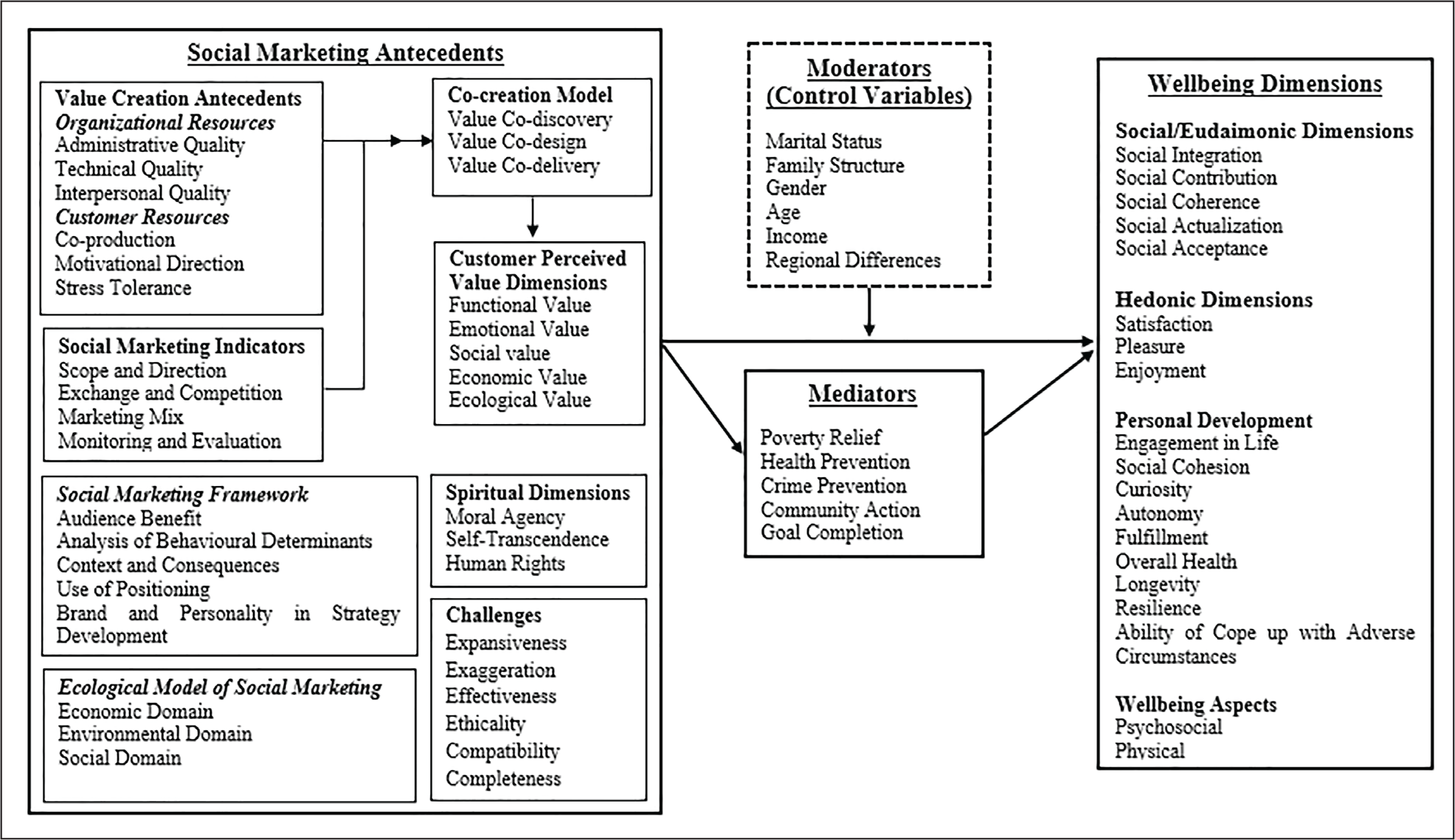
Ryan and Deci (2001) have classified personal development into nine dimensions such as engagement in life, social cohesion, curiosity, autonomy, fulfilment, overall health, longevity, resilience, and ability to cope up with adverse circumstances. Well-being aspects have been classified as psychosocial, physical, and spiritual aspects (Fleming et al., 2005). The study has found some moderators that have an interaction effect on the relationship between social marketing antecedents and well-being dimensions (Figure 3). The various control variables or moderators identified in the reviewed articles include marital status, family structure, gender, age, income, and regional differences (Joshanloo et al., 2012; Povey et al., 2013).
SOCIAL MARKETING AND WELL-BEING
The direct contribution of social marketing towards well-being is quite obvious. Various social marketing programmes and interventions are targeted to different social problems prevailing in the society, such as drinking, tobacco consumption, sexual harassment, and health issues. These social marketing interventions are aimed to curtail the ill social behaviour and develop a positive behaviour by activating well-being drivers (Carvalho & Mazzon, 2015b). Many social marketing researchers have attempted to develop a connection between social marketing and well-being. Andreasen (1997) has opined that the charm and curse of social marketing is that it addresses truly important social problems. Kennedy and Parsons (2012) have supported the concept of social engineering (a coordinated system approach to tackle upstream factors) by combining macro-social marketing with other tools to promote social change, such as taxation and education. Rothschild, Mastin, and Miller (2006); Fry (2014); Deshpande and Rundle-Thiele (2011); Gordon, McDermott, Stead, and Angus (2006); and Jones (2014) have found that social marketing interventions are one of the important remedies for addressing alcohol consumption in the community, particularly among youth. Lefebvre (2011) has confirmed that social marketing has the main focus on society or people in general, their needs and wants, aspirations, lifestyle, and freedom of choice. Thence, social marketing is aimed at large to bring behavioural change and focus on the priority sectors of the society. The root cause of a social problem is some deficiency in the well-being of groups/society. It requires an outside intervention from social marketing to determine these social problems, which in turn depends on the proper understanding of the underlying social well-being (Brenkert, 2002; Kennedy and Parsons, 2012). It has been acknowledged by Kotler and Lee (2009) that social marketing has been an important tool in alleviating poverty by enhancing social capital and addressing fundamental human needs. It was further argued by the researcher that the connection of social marketing to social well-being is through the direct influence on its drivers. Therefore, it has become imperative to widen the scope of social marketing in two domains. First is upstream, which requires the absorption of knowledge for inducing social change. Second is downstream, which requires the practical integration of the increasingly complex theoretical advances in human behaviour. This claim has been supported by Spotswood, French, Tapp, and Stead (2012) that social marketing should incorporate a broader mix of approaches to achieve social improvement.
CONTRIBUTION AND AREAS FOR FUTURE RESEARCH
Social marketing and well-being are important areas of research for social marketing managers who are interested in enhancing the well-being of the people through better positioning of social marketing programmes. Theoretically, this article has several contributions. First, this article conducts a systematic review of 94 articles to depict the investigations carried out by various researchers in the areas of social marketing and well-being as of 2017 and provide directions for future research. Second, this article conceptualizes social marketing antecedents and well-being in the existing literature, thus providing further insights into these constructs. Third, the various theories and models adopted by researchers in both social marketing and well-being studies have been presented and summarized for further understanding in the present study. Finally, a conceptual framework of social marketing antecedents, mediators, and moderators along with well-being dimensions has been presented in Figure 3, which will facilitate readers to understand the existing body of knowledge in the forms of various dimensions or aspects of social marketing, well-being, and their interrelationships.
The study has identified several areas that hold substantial potential for further research after a thorough review of the literature. It has been observed that a large number of social marketing articles are qualitative, conceptual, or perspective. A few articles have adopted quantitative, empirical, or mixed methodology. Therefore, future research should emphasize on the use of empirical and mixed research approaches in social marketing and well-being. This would help social marketers in demonstrating the effectiveness of social marketing interventions, which is one of the most crucial aspects of social marketing (Helmig & Thaler, 2010). It has been found in the study that a limited number of empirical studies have been conducted on the relationship between social marketing and well-being by taking into consideration the dimensions of social marketing and their subsequent impact on the well-being. Future researchers should understand the dimensional structure of both social marketing and well-being (social, hedonic, and personal development), and should empirically evaluate their inter-relationship.
Future research should make efforts to develop and establish a reliable measure of social marketing and well-being, as the existing scales differ in dimension and are restricted to few small constructs, thus leaving larger areas untouched (Luca & Suggs, 2013). Consequently, future research should develop valid and reliable measures of social marketing effectiveness and well-being. It was observed in the study that only 29 articles have made the use of theories or models for analysing the impact of social marketing intervention on behaviour changes among the audience. Some of these studies have reported a behaviour change (Johnson, Bellows, Beckstrom, & Anderson, 2007), while others did not report any behaviour change even though they employed theories or models in designing interventions. Research is needed to investigate this fact that why it works in some cases but not in others. In addition, research is needed to explore the negligence in the use of various behavioural and value creation theories/models in the research articles published in this area.
Most of the papers that have empirically investigated the social marketing and well-being have adopted a cross-sectional approach (Barrutia & Echebarria, 2013; Rundle-Thiele, Russell-Bennett, Leo, & Dietrich, 2013; Zainuddin et al., 2013), thereby depicting only a snapshot of community involvement in social marketing campaigns. Therefore, it is recommended (for future researchers) to adopt a longitudinal approach for a better understanding of social marketing and its relationship with well-being. The advantage of longitudinal studies is that they enable the researcher to follow a change in the behaviour of the target audience and compare results at different intervals (Jahn & Kunz, 2012; Laroche, Habibi, Richard, & Sankaranarayanan, 2012).
To gain deeper insights into the designing of social marketing interventions and their subsequent impact of social and hedonic well-being of the community, future research should take into consideration more variables (mediating and moderating variables) such as income, gender, culture, poverty relief, community action, community characteristics, and social media platforms (Laroche et al., 2012). Future research should examine the upstream potential of social marketing in promoting the well-being of community, organization, and policymakers. Targeting the upstream levels can help the social marketers avoid criticism by their target audience whose behaviour is not always under their control. There is no specific evidence of upstream social marketing and its differences from the regular lobbying activities (Gordon, 2011), which offers research gaps for future researchers. Furthermore, upstream social marketing can be combined with critical social marketing to promote structural/organizational changes and community well-being (Gordon, Moodie, Eadie, & Hastings, 2010). Critical social marketing is concerned with the application of marketing knowledge, concepts, and techniques to enhance social and economic well-being. Critical social marketing can benefit individuals, organizations, and overall society which is consistent with the core principles of the collective welfare of social marketing (Farrell & Gordon, 2012).
A majority of articles reviewed on social marketing have focused on community welfare and public health, but social marketing can be extended to the diverse areas and sectors. Future researchers can apply the social marketing concept to the field of environmental protection, natural resource conservation, poverty alleviation, and tourism promotion. Social marketing can encourage inculcating positive and eco-friendly behaviour in a community at large.
CONCLUSION
The present study has endeavoured to review and evaluate the research from 1998 to 2017 on social marketing and well-being. A database search was carried out, and 155 articles were retrieved and analysed. It is observed that social marketing and well-being have captured the attention of researchers as depicted from the growing number of published articles of the last five years. Researchers from the United Kingdom, Australia, and the United States have made a significant contribution in shaping the body of literature on well-being and social marketing. A majority of articles were published in the Journal of Social Marketing and Social Marketing Quarterly which are exclusively dedicated to the social marketing research. Behavioural theories and models for analysing community behaviour have sparsely been used in the reviewed papers. The study has proposed a framework of social marketing and well-being that includes various dimensions and antecedents of social marketing, mediator variables, moderator variables, and well-being dimensions (social, hedonic, and personal development). The study attempted to draw an association between social marketing interventions and the improvement of the social well-being of a community. Social marketing principles when applied in an effective manner can help in changing unsocial behaviour such as alcoholism, tobacco addiction, and illicit drugs. The study has also indicated the research gaps and future research direction including the need to move beyond the public health sectors to the environment and climate change issues. A social marketer should keep an eye on the various challenges identified by the present study, such as expansiveness, exaggeration, effectiveness, ethicality, compatibility, and completeness, while designing social marketing interventions.
DECLARATION OF CONFLICTING INTERESTS
The authors declared no potential conflicts of interest with respect to the research, authorship, and/or publication of this article.
FUNDING
The authors received no financial support for the research, authorship, and/or publication of this article.