




Abstract

It is no coincidence that Bitcoin was launched shortly after the failure of Lehman that marked the peak of the global financial crisis. Over the subsequent decade, cryptocurrencies have grown rapidly: as of early November 2018, Bitcoin alone had a market cap exceeding that of India’s most valuable listed company (and Bitcoin was only around half the value of all cryptocurrencies). However, even a decade after the launch of Bitcoin, we have seen only a few pilot applications of blockchains to other parts of finance. This is because cryptocurrencies (while being extremely challenging technologically) encountered very few legal/commercial barriers, and could therefore make quick progress after Bitcoin solved the engineering problem. The blockchain has many other potential finance applications—mainstream payment and settlement, securities issuance, clearing and settlement, derivatives and other financial instruments, trade repositories, credit bureaus, corporate governance, and many others. Blockchain applications in many of these domains are already technologically feasible, and the challenges are primarily legal, regulatory, institutional, and commercial. It could take many years to overcome these legal/commercial barriers, and mainstream financial intermediaries could use this time window to rebuild their lost trust quickly enough to stave off the blockchain challenge. However, whether they are successful in rebuilding the trust, or why will they be disrupted by the new technology remains to be seen.
BENEFITS OF THE BLOCKCHAIN

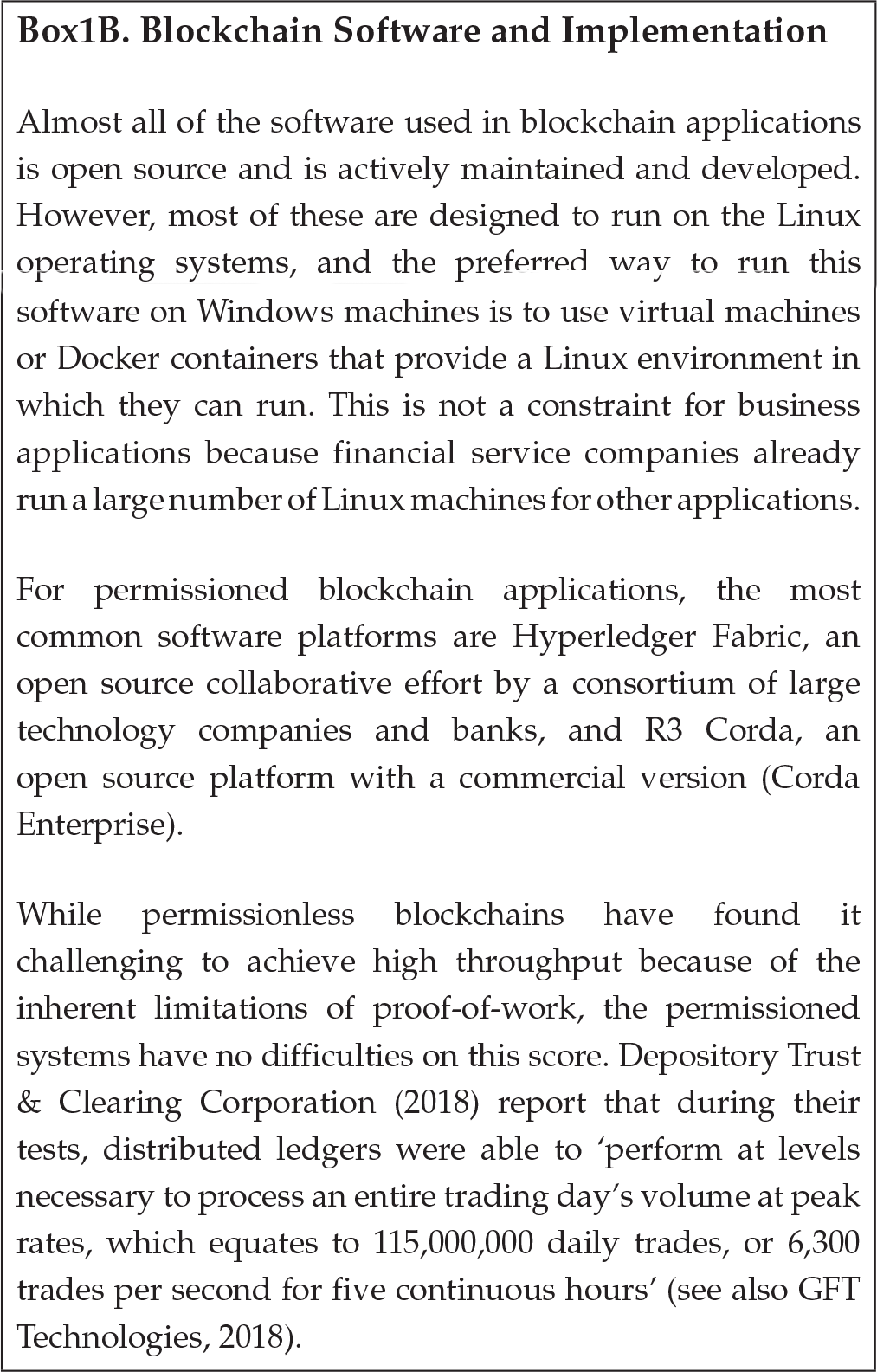
From an application point of view, the blockchain provides the following features: First, decentralization and replication means that a full audit trail is available to all participants. Moreover, the inbuilt cryptographic integrity checks ensure that this audit trail is verified by all of them. The result is a significantly lower need for trust in central hubs.
Second, the blockchain is partition resistant: if a few nodes fail or are disconnected from the network, the rest of the nodes can continue to function because they all have a copy of all the data. In traditional finance, on the other hand, if the central trusted institution is temporarily down for any reason, the whole system grinds to a halt. For example, on 20 October 2014, the real time gross settlement system (RTGS) of the United Kingdom experienced an outage of approximately nine hours (Deloitte, 2014). Though all banks and other entities were functioning, high-value payments could not happen during this period. In its subsequent consultation on building a new RTGS for the UK, the central bank described the advantages of using a distributed ledger: “the chief potential benefit when applied to core settlement in an RTGS system is resilience” (Bank of England, 2016).
The third benefit of the blockchain is Byzantine fault tolerance. While partition resistance deals with nodes that cease to function, Byzantine fault tolerance deals with nodes that malfunction and function maliciously. This has come to prominence with the rise of hacking and cyber-attacks. While criminal gangs might be content to steal money, terrorist group and nation state adversaries might seek to inflict catastrophic damage by corrupting or destroying data. The blockchain provides strong defence against this attack because of (a) replication of the data across large number of nodes running on completely different computer networks and (b) cryptographic integrity checks.
LEGAL/COMMERCIAL CHALLENGES
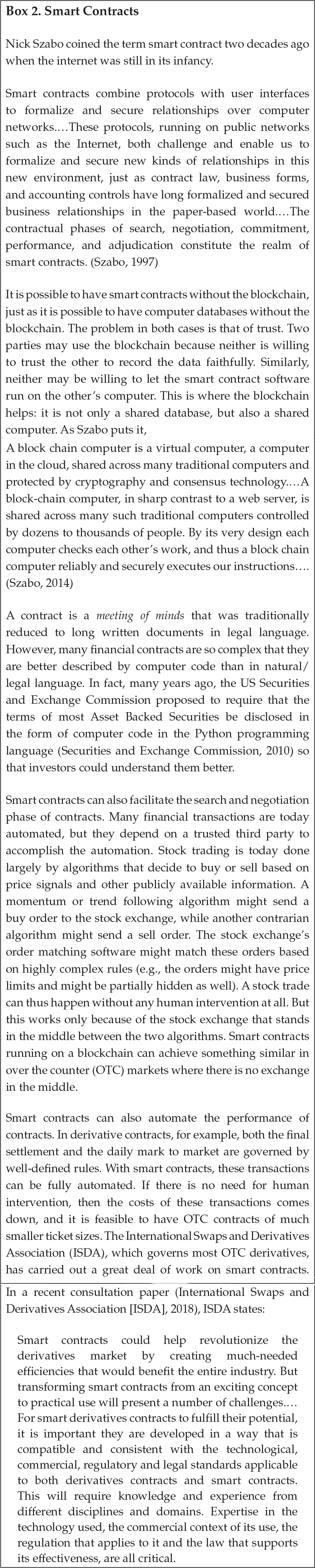
As mentioned earlier, non-cryptocurrency applications of the blockchain have to overcome some major legal/commercial barriers. First, unlike cryptocurrencies that exist only on the blockchain, in most other applications, assets that exist in the real world (dollars, rupees, securities, real estate) have to be represented by entries in the blockchain. Cryptocurrencies do not need any off-chain (real world) jurisprudence at all; they are able to go beyond the pragmatic idea that code is law to the more radical notion that only code is law. When we try to move real world finance to the blockchain, code and law have to co-exist. Some real world law has to recognize code as law at least to some limited extent so that transactions on the blockchain can effect change of ownership in the real world. Today’s mainstream financial institutions operate under similar legal protection going back to the 19th century. For example, in the United Kingdom, the Bankers’ Books Evidence Act of 1879 provided, “Subject to the provisions of this Act, a copy of any entry in a banker’s book shall in all legal proceedings be received as prima facie evidence of such entry, and of the matters, transactions, and accounts therein recorded.” A similar law was passed in India a decade later. Some law of this kind will be needed to give legal sanctity to the blockchain for assets other than cryptocurrencies.
Second, most blockchain applications in finance will need to ensure regulatory compliance on day one. Regulators are not often clear in their regulatory stance on the new technology, and obtaining their clearance is not always easy. By contrast, for a long time, cryptocurrencies could operate outside the regulatory framework entirely. In recent years, this has begun to change as many cryptocurrency exchanges have become licensed money changers, and as traditional exchanges, securities brokers, and asset managers have begun to offer cryptocurrency related products. For example, in the United States, Cboe Futures Exchange launched Bitcoin futures in December 2017 after obtaining requisite regulatory approvals.
Third, many blockchain applications in finance have to ensure commercial viability in the face of competition from incumbent players who are not only rich and powerful, but also well entrenched in the current legal and regulatory framework. Cryptocurrencies, on the other hand, were (in the initial years) dominated by ideologically motivated computer professionals (‘geeks’) and anarchists who were not too constrained by commercial considerations. By staying outside the regulatory framework, they also avoided direct confrontation with incumbents defending their monopoly/oligopoly. Only after establishing themselves outside the formal system, did cryptocurrencies become more mainstream and start attracting speculators seeking quick returns.
For the blockchain to succeed in mainstream finance, these critical hurdles will have to be overcome. The blockchain ventures that we have seen so far have been driven by either (a) venture capitalists funding potential disruptors in the hope of large rewards if they succeed or (b) the incumbents themselves launching pilot projects to protect themselves from being disrupted. It remains to be seen whether these projects will achieve sufficient scale and traction to challenge today’s entrenched business models.
POTENTIAL APPLICATIONS
Since the blockchain is basically a technology for recording transactions, it can potentially be applied to most parts of finance. However, the following sections describe applications that are most promising because the current system is not working well enough, or because blockchain pilots have been successful.
Fiat Money on the Blockchain

Micropayments and Micro Financial Services
Pre- and Post-trade Processes
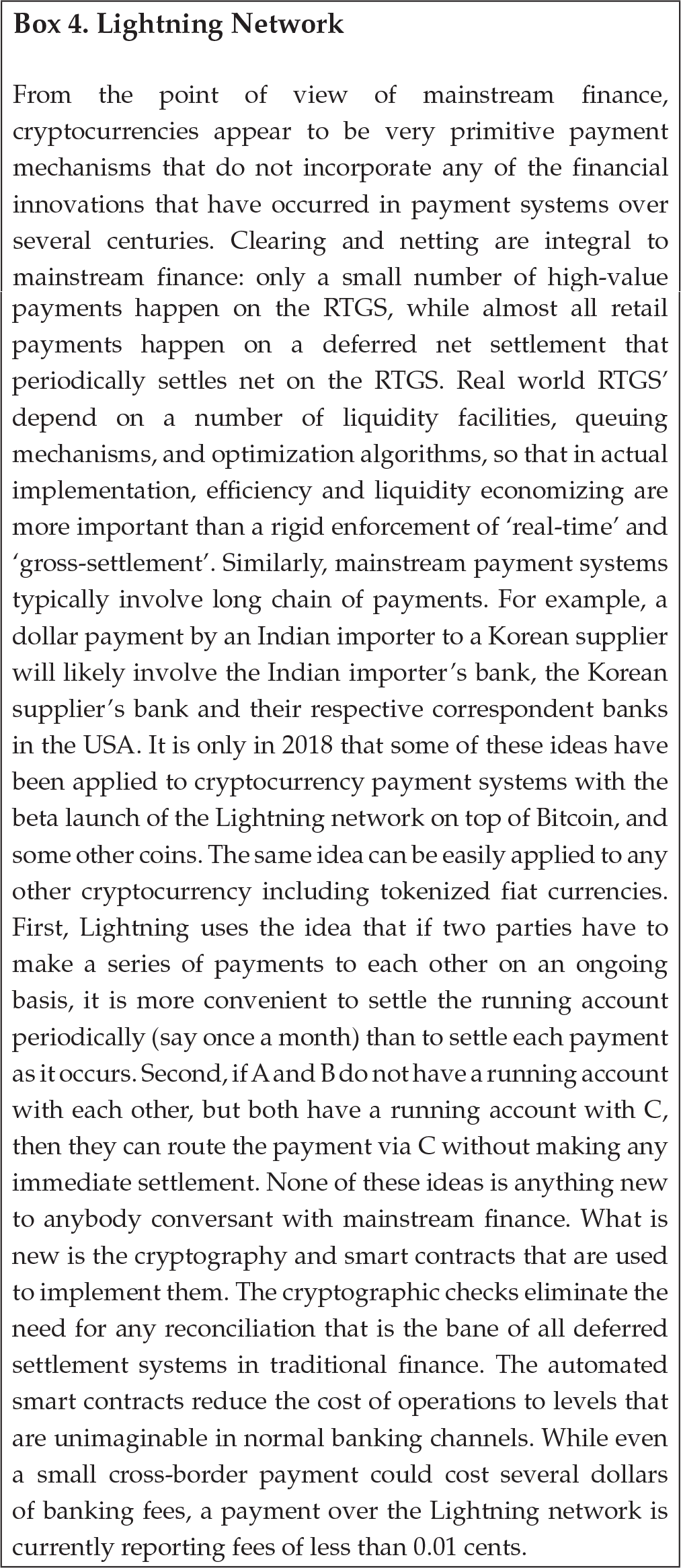
Securities trading and settlement can be divided into three stages: (a) pre-trade authorization and approval, (b) trade execution, and (c) clearing and settlement. Of these, trade execution is highly automated with stock exchanges having invested huge amounts of money to build technology infrastructure that can match trades with latencies of microseconds. It would be hard for any blockchain to achieve these speeds. Most of the potential is in the pre- and post-trade processes that involve inefficient and fragmented legacy systems.
Blockchains can provide complete transparency on the cash and securities blockchains before and after the trade. The whole set of legacy system and processes (pre-trade checks and trade confirmations) that exist to ameliorate the opaqueness of this ownership can then be eliminated. Exchanges may still be needed, but we may not need brokers and custodians. With
settlement happening on the blockchain on delivery versus payment basis, and corporate actions (dividends and stock splits) being handled by smart contracts, we may not need a depository anymore. Or perhaps, the depository could run the permissioned blockchain on which the settlement happens. The novation provided by the CCPs can be replicated by smart contracts. The challenge will be to design smart contracts that can replicate short selling, margin trading, and net settlement. Depository Trust & Clearing Corporation (2016) and Euroclear (2016) discuss the challenges and opportunities in using blockchain in securities settlement.
Customized Investment Management
Mutual funds have, for long, allowed small investors to participate in asset markets provided they are willing to accept a fixed menu of products. An investor who wants to track a popular benchmark index is well served by this market, but those who want exposure to customized indices or desire non-linear payoffs need a different vehicle. In Europe and other jurisdictions, structured products have emerged as an attractive alternative for investors who seek something more complex than a plain vanilla mutual fund. These customized investment products might have an issuance size of only a million dollars at which scale a mutual fund or a bond issuance might be unviable. Turning these into smart contracts on the blockchain might allow the issuance size to be brought down much further, possibly a thousand dollars or even less. Marex Spectron (2018) describes a structured note (a principal protected note linked to the FTSE 100 index) that was registered, cleared, and settled on the Ethereum blockchain.
Data Registries and Repositories
Modern finance depends on a number of data registries and data repositories that provide verified data needed for a variety of transactions. For example, credit bureaus and loan registries are critical elements of the infrastructure for providing credit. After the Global Financial Crisis, trade repositories have been created to ensure that regulators have data about the risk and inter-connectedness of the financial system. While these entities serve critical functions, they are beset with several problems: duplication, lack of accountability, loss of privacy, and excessive cost. Consumer groups have highlighted the difficulties that consumers face in correcting errors in their own credit information as stored by the credit bureaus. The data breach at the US credit bureau, Equifax, has been described as the worst leak of personal info ever (Goodin, 2017). The blockchain is probably part of the solution to the problems of this kind of financial infrastructure.
TRADE FINANCE: AN INDUSTRY WIDE ERP
Organizations use an enterprise resource planning (ERP) software to integrate the management of all major business processes in an enterprise. At its core is a common database that provides a single version of the truth in real time throughout the organization cutting across departmental boundaries. The blockchain is very similar: it is a real time common database that provides a single version of the truth to all participants in an industry cutting across organizational boundaries.
Within an organization, the ERP typically replaces a bunch of much cheaper department level software, and ERP deployments are often justified not on any rigorous return on investment criterion, but on grounds of internal controls and management. It is easy to see this dynamic playing out with the blockchain as well. There is a need for a single version of the truth across all organizations involved in many complex processes. Clearly, organizations do not trust each other and no organization would like to accept the formats, standards, and processes of another organization. It is a lot easier for everybody to adopt a neutral solution like the blockchain.
One area where we are seeing this happen is in trade finance that involves so many entities (exporter, importer, their respective banks, the shipping company, insurance companies, clearing and forwarding agents, and so on) that it is very hard for all of them to have a consistent view of the data. It is a lot easier to put everything on the blockchain, and then everybody sees the same version of the truth. Trade finance is one area where the blockchain appears to be moving from pilots to real world applications (D’Monte, 2018; Sanghvi, 2018).
More generally, the entire area of cross-border payment with its legacy systems, long chain of correspondent banks, and attendant fees, delays and unreliability is an attractive target for blockchain technologies. Ripple is a blockchain solution to this problem that boasts of an impressive list of customers including several large Indian banks.
VENTURE CAPITAL AND ALGORITHMIC GOVERNANCE
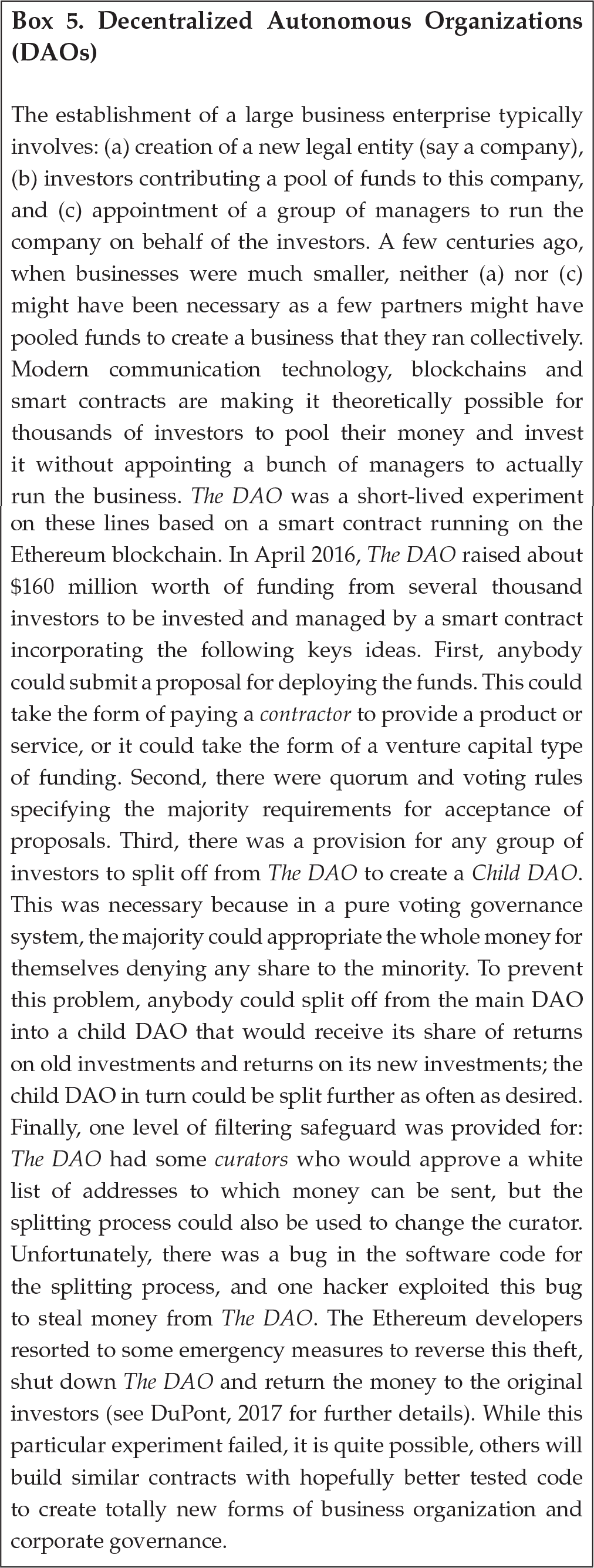
During 2017, a large number of blockchain ventures raised capital through sale of tokens in what came to be known as initial coin offerings (ICOs). However, securities regulators in the US have taken the view that these tokens are securities and the ICOs need to fulfil all the regulatory requirements of securities offerings: ICOs are just IPOs. Some ICOs continue to be launched that avoided these regulations by focusing on accredited investors or raising money outside the US, but it is doubtful whether ICOs will turn out to be a sustainable form of financing.
CONCLUSION
Blockchain is still an evolving and therefore immature technology; it is hard to predict how successful it would be outside its only proven use domain of cryptocurrencies. History teaches us that radically new technologies take many decades to realize their full potential. Thus it is perfectly possible that blockchain would prove revolutionary in the years to come despite its patchy success so far. What is certain is that businesses should be looking at this technology and understanding it because its underlying ideas are powerful and likely to be influential.
DECLARATION OF CONFLICTING INTERESTS
The author declared no potential conflicts of interest with respect to the research, authorship and/or publication of this article.
FUNDING
The author received no financial support for the research, authorship and/or publication of this article.