




Abstract
Executive Summary
Transformational leaders motivate their followers to relook their job by elevating the status of the job from being boring, repetitive and menial into something more meaningful and significant. This ascendance of employee’s job as something important and its contribution to overall organizational vision is what prompts them to engage in innovative work behaviour. Therefore, it would be interesting to test the indirect effect of transformational leadership on followers’ innovative work behaviour as mediated through followers’ perception of meaningful work.
The current study is set to serve two purposes. First, to clear the confusion regarding the findings related to transformational leadership’s influence on employee’s innovative work behaviour. Second, to investigate the mediating role of meaningful work in explaining the relationship between transformational leadership and innovative work behaviour. Data was collected from two samples, Sample I (349 executives) and Sample II (539 executives), working in two different manufacturing organizations in Eastern India.
The results of both the samples confirm that transformational leadership significantly influences employee’s innovative work behaviour. Also, the study (both Samples I and II) finds meaningful work to partially mediate the relationship between transformational leadership and employees’ innovation. In order to lend further credibility to our mediation finding, we carried out Sobel test and bootstrapping technique to strengthen our assertion.
This study replicates previous empirical investigations by exploring the relationship between transformational leadership and employee’s innovative behaviour at work in Indian manufacturing context. The study also strives to enrich the extant literature by testing the mediating role of meaningful work in explaining the relationship between transformational leadership and employee innovation.
Previous studies have indicated that employees’ innovative workplace behaviour depends a great deal on their interaction with their peers, supervisors, subordinates, and clients (Anderson, de Dreu, & Nijstad, 2004; Zhou & Shalley, 2003). One such valued interaction which leads to innovative ideas and creative work solutions is one that happens between an employee and his/her supervisor. Leaders strongly influence employees’ work behaviours (Yukl, 2002), particularly their innovative behaviours. Previous studies have reported leadership as a vital indicator of employees’ innovative behaviour (Jung, Wu, & Chow, 2008). Basadur (2004) stated that in future the most effective business leaders,
…will help individuals […] to coordinate and integrate their differing styles through a process of applied creativity that includes continuously discovering and defining new problems, solving those problems and implementing the new solutions. (p. 103)
Several leadership scholars maintain that transformational leadership leads to performance beyond expectation by linking employees’ self-concept with organization’s mission and by urging their subordinates to think out of box and display innovative behaviour (Basu & Green, 1997). Findings of several empirical studies have reported transformational leadership to positively influence innovation at individual, group and organizational level (Janssen, 2002; Sosik, 1997). However, the relationship between transformational leadership and employee innovative behaviour still remains underdeveloped. A degree of ambiguity and confusion is also associated with the effect of transformational leadership and IWB as certain studies have reported negative or insignificant result (Basu & Green, 1997). Pradhan (2015) in his empirical study of Indian IT professionals also reported insignificant influence of transformational leadership on subordinates’ IWB. Furthermore, Howell and Avolio (1999) in their study have discussed the manipulativeness of some charismatic leaders that raises question on the ethical intention of such leaders. Such leaders (pseudo-transformational leaders) will not approve of their follower’s innovativeness or creativity. These leaders would prefer their subordinates to be dependent on them than to be independent and productive. Thus, the first objective of this study is to investigate the effect of transformational leadership on employee’s IWB.
Though, most of the studies have focused on the positive effect of transformational leadership on subordinates’ innovation, the way transformational leaders affect IWBs of employees has not been adequately researched (Gong, Huang, & Farh, 2009; Jung, Chow, & Wu, 2003). Similar demands for future investigation of the underlying processes through which transformational leaders influence their followers’ job outcomes have been made by several researchers (such as Shamir, House, & Arthur, 1993; Yukl, 1999). In his study, Yukl (1999) has mentioned about the ambiguity related to the mediating processes through which transformational leaders influence their followers and urged for future empirical studies to shed more light on the intervening process. One such mediating process (explanation) through which transformational leaders positively influence followers’ job outcomes particularly their innovative behaviours is by helping them attach meaning to their work. This alignment of sense of meaningfulness of work with organizational goals motivate subordinates to perform beyond expectation, engage in extra role activities and demonstrate IWBs. Transformational leaders motivate their followers to relook at their job by elevating the status of the job from being boring, repetitive, and menial into something more meaningful and significant. This ascendance of employee’s job as something important and its contribution to overall organizational vision is what prompts them to engage in IWB. Therefore, it would be interesting to test the indirect effect of transformational leadership on followers’ IWB as mediated through followers’ perception of meaningful work.
LITERATURE REVIEW AND HYPOTHESES
Transformational Leadership and Innovative Work Behaviour
The traditional transactional style of leadership is inadequate in competing in the current dynamic business environment. Today’s organizations require leaders who are audacious enough to embrace change and motivate their employees to do the same. One of the characteristics of an effective leader is the ability to use innovative or unconventional strategies to achieve goals (Conger & Kanungo, 1988; Tichy & Devanna, 1986). These effective leaders are not averse to taking calculated risks in order to realize their vision. They are generally tolerant towards their subordinate’s mistakes and encourage them to treat mistakes as learning opportunities rather than absolute failures.
Constant changes in the marketplace in last three decades have resulted in the need for leaders who are more transformational and less transactional. The original ideas of transformational leadership can be traced back to the seminal writing of the political author James Burns. In his book Leadership, Burns (1978) introduced a form of leadership that was refreshingly different from the transactional forms of leadership. Based on the ideas originally stated by Burns (1978), Bass (1985) while studying the leadership style of some South African senior managers finds glimpses of an extraordinary form of leadership that was different from the previously known transactional form of leadership. Bass (1985) in his book Performance Beyond Expectations distinguished transformational leadership from transactional leadership in terms of what they do (outcome) and how they do it (process). Bass and Avolio’s (1990) transformational leadership model has four dimensions: idealized influence, individualized consideration, inspirational motivation, and intellectual stimulation. Transformational leaders encourage their followers to think out of box and encourage them to look at problems from different perspectives (Gardner & Avolio, 1998). Shin and Zhou (2003) found that transformational leadership is positively related to follower’s creativity, and instrumental in fostering a culture of innovation in organization. Transformational leaders offer an appealing vision to the followers and stimulate their intellect by urging them to challenge the existing mental models and to innovate better solutions to bring about positive change (Bass & Riggio, 2006; Eisenbeiss, Van Knippenberg, & Boerner, 2008). Transformational leaders also lead by example; they practice what they preach by taking calculated risk and by engaging in creative and nonconventional behaviours that stimulate innovation among the followers (Bass & Riggio, 2006). Transformational leaders boost the intrinsic motivation of their followers and encourage them to question the status quo or the old ways of doing things in organizations. In a laboratory study of student sample, Jaussi and Dionne (2003) found that transformational leadership is positively related to employee’s innovation.
Although it is logical to assume that transformational leaders will always positively influence employee’s innovative behaviour at work (Eisenbeiss et al., 2008), interestingly, prior studies report mixed results. For instance, Wilson-Evered, Hartel, and Neale (2001) found no significant relationship between transformational leadership and team innovation. Presenting a similar viewpoint, Pradhan (2015), in his study of Indian software professionals reported that transformational leadership will be able to arouse creativity and motivate followers to engage in innovative behaviour only under the circumstances where the followers expect guidance and inspiration from leader, and secondly, when the situation demands out-of-box or non-conventional solutions to the existing problems. In the absence of either or both the conditions, it would be very difficult on the part of a transformational leader to inspire innovativeness among the followers. Also, leadership scholars lament the fact that intellectual stimulation is the most underdeveloped and underexplored dimension of transformational leadership (Lowe, Kroeck, & Sivasubramaniam, 1996). This study replicates the testing of the relationship between the focal constructs (transformational leadership and IWB) in an Indian context, which is in line with Nuzzo (2014), who urged that empirical investigations need multiple replication in order to provide greater confidence and acceptability of the findings.
Thus, we propose:
H1. Transformational leadership will be positively related to employee’s IWB.
Transformational Leadership, Meaningful Work and Innovative Work Behaviour
Previous studies have linked transformational leadership with follower’s attitudes, behaviours and performance at both individual and collective level (Avolio, 1999; Kirkpatrick & Locke, 1996). Yet there is lack of clarity about the intervening (mediating) process by which transformational leaders influence their followers (Yukl, 1999). This supports Bass’s (1999) urging that, ‘much more explanation is needed about the inner workings of transformational leadership’. Similar concern was also raised by Garcia-Morales, Matias-Reche, and Hurtado-Torres (2008) who pointed out a conspicuous lack of understanding regarding how transformational leaders promote processes through which they exert positive influences on their followers.
Most of the transformational leadership literature is unequivocal about the leader’s role in raising followers’ levels of morality to more ‘principled levels of judgement’ (Burns, 1978), and in activating followers’ ‘higher order needs’ (Yukl, 1999) through altering their needs, values, preferences, and aspirations by appealing to ideological values (Shamir et al., 1993). This conceptualization of transformational leader’s effect in other words is mediated by the followers’ perception of meaningful work. A follower’s transformation occurs when they link their work with ‘higher purposes’ that goes beyond mere financial gain (Yukl, 1999). Shamir et al. (1993) in their self-concept-based theory have discussed three ways by which transformational leaders influence their followers: first, by increasing the self-efficacy of the follower; second, by increasing follower’s social identification with the group; and third, by influencing follower through value internalization and ‘self-engagement’ with work. The trio referred to the third way as an internalized personal or moral commitment of the follower towards their work. They further added that such commitment is only possible when the work or course of action is consistent with and expressive of the follower’s self-concept. Thus, a follower who is committed to a worthy cause will be more concerned about the intrinsic rewards, such as self-consistency and -efficacy, rather than any extrinsic materialistic rewards.
In their empirical study of multilevel marketing organizations, Sparks and Schenk (2001) have demanded further investigation of higher order needs like meaningful work as a mediator affecting the relationship between transformational leadership and job-related outcomes. The theoretical assumptions and previous empirical investigations urge further testing of the meditational role of meaningful work on the relationship between transformational leadership and IWB. Thus,
H2. The positive relationship between transformational leadership and IWB will be mediated by perceptions of meaningful work.
METHOD
Participants and Sample respondents
For examining the proposed hypothesis, we carried out our survey with two independent samples drawn from Indian Navaratna central public sector enterprises. Sample I data was collected from the executives employed in an aeronautical manufacturing and overhaul company. Sample II was collected from executives of a premier steel manufacturing plant. Both the organizations are situated in Eastern India.
The data collection process started with a formal communication from the HR department to the executives of both the plants regarding the purpose of the study, the voluntary nature of participation and an assurance that the responses will be kept anonymous and will be used for academic purpose only. Subsequently, the researchers visited both the plants and explained the objective and goals of the study and shared the survey weblink with the prospective respondents for participation.
Sample I: A total of 387 executives working in aero-manufacturing plant participated in the survey. After discarding 38 responses due to unusable data, the final sample was 349 responses, out of which 63.8 per cent (223) were male executives. The average age of the respondents was 32.3 years (SD 6.9). Executives with less than three years of experience in the present organization accounted for 46.4 per cent (162) responses while the remaining were middle and senior executives with more than three years of experience. About 52.3 per cent (183) of respondents hold graduate degree (mostly, bachelor’s degree in engineering and technology). The remaining respondents (166) hold post-graduates degree (MTech, MPhil, MBA, PhD).
Sample II: In the steel manufacturing plant, after discarding 33 responses because of missing information, we received 539 usable responses. Out of 539 responses, 54.6 per cent (294) were male executives with the average age as 35.2 years (SD 8.4). A total of 38.7 per cent (209) of executives had less than three years of experience in their present organization. About 28.8 per cent executives hold graduate degree whereas the remaining ones hold professional post-graduate degrees (MTech, Executive MBA) and specialized certification courses.
Measurement
Transformational Leadership: multifactor leadership questionnaire (MLQ) by Bass and Avolio (1990) was used to assess the extent to which employees attribute transformational leadership to their superior. The scale has four dimensions: (a) idealized influence (attitude and behaviour), (b) inspirational motivation, (c) intellectual stimulation and (d) individualized consideration. This questionnaire has 20 items capturing the four dimensions of transformational leadership. Examples of some of the items are, ‘my supervisor specifies the importance of having a strong sense of purpose’ and ‘my supervisor considers individuals are having different need(s), abilities, and aspiration’. The Cronbach alpha of this measure is 0.88.
Meaningful Work: A questionnaire developed by Arnold, Turner, Barling, Kelloway, and McKee (2007) based on the original workplace spirituality scale by Ashmos and Duchon (2000) was used to measure the extent by which an employee experiences meaningful work at office. Examples of some of the items of the scale are, ‘I see a connection between my work and the larger social good of my community’ and ‘the work I do is connected to what I think is important in my life’. The Cronbach alpha of this scale is 0.85.
Innovative Work Behaviour: To measure the IWB, Scott and Bruce’s (1994) innovative work behaviour scale was used. The scale has six items. Example of the sample items, ‘I search out new technologies, processes, techniques, and/or product ideas’ and ‘I develop adequate plans and schedules for the implementation of new ideas’. The Cronbach alpha of this measure is 0.81.
All responses were measured using a five-point Likert-type scale ranging from 5 (strongly agree) to 1 (strongly disagree).
Control Variables: In this study, demographic variables (age, gender, and experience in the organization) were used as control measures, so that the relationship among the study variables is not affected. Gender was coded as follows: male = 1, female = 2. Age was coded as 19 – 25 = 1, 26 – 40 = 2, 41 – 54 = 3. Experience was also coded as follows: less than 3 years = 1 and 3 years and more = 2.
FINDINGS
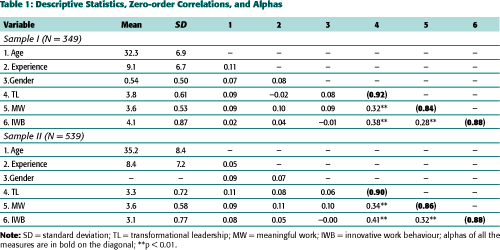
Before investigation of the relationships among the proposed variables, common method variance (CMV) was carried out in both Samples I and II. Harman’s single-factor test advocates for factorial analysis (Carson, Madhok, Varman, & John, 2003) with the pool of items employed in the study. Though there is no explicit guideline (Podsakoff, MacKenzie, Lee, & Podsakoff, 2003) for carrying out the test, the underlying assumption is that the presence of CMV in the data will emerge as a single factor when all the variables are kept together (Parkhe, 1993) during factorial analysis. The preliminary factor analysis through varimax rotation in the present study revealed the emergence of six different factors. With eigenvalue greater than 1, Sample I got 82.6 per cent of variance whereas, Sample II got 84.3 per cent of variance reporting the presence of six factors. Therefore, we may deduce from the findings that CMV is not a major concern for both Samples I and II.
Descriptive Statistics, Zero-order Correlations, and Alphas
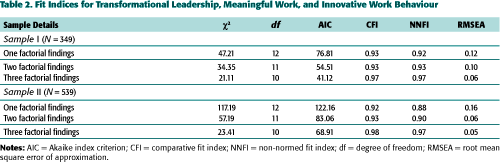
Fit Indices for Transformational Leadership, Meaningful Work, and Innovative Work Behaviour
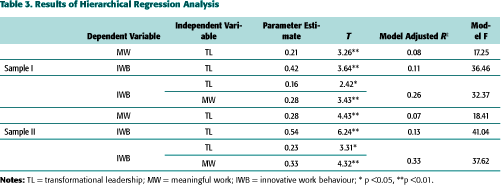
Results of Hierarchical Regression Analysis
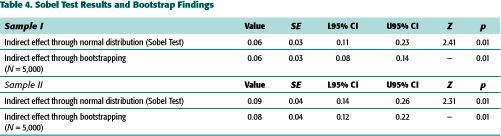
Sobel Test Results and Bootstrap Findings
The findings reported in Table 2 from both samples (I & II) suggested that all the three constructs transformational leadership, meaningful work, and IWB are distinct and different constructs.
First hypothesis of the study predicted a positive relationship between transformational leadership and IWB. Table 3 shows that transformational leadership was positively related to IWB for both Sample I (β = 0.42, p < 0.01) and Sample II (β = 0.54, p < 0.01). Therefore, H1 stands supported.
The second hypothesis of the study tested the mediating role of meaningful work on the relationship between transformational leadership and IWB. For examining the mediation of meaningful work, we have used the step-wise regression approach proposed by Baron and Kenny (1986). There are three steps for computing the mediation: first, a significant relationship between the proposed independent (transformational leadership) and dependent (IWB) variable. Second, the test necessitates having a significant association between independent (transformational leadership) and mediating (meaningful work) variable. Third, after controlling the influence of independent variable, the mediation test requires significant association between mediating variable (meaningful work) and dependent variable (IWB). The mediation is said to be partial if the effect of predictor variable on dependent variable reduces but remains significant. The mediating effect of meaningful work on the relationship between transformational leadership and IWB is reported in Table 3. The decreased magnitude of regression coefficient value of transformational leadership (Sample I from β = 0.42, p < 0.01 to β = 0.16, p < 0.05 and Sample II from β = 0.54, p < 0.01 to β = 0.23, p < 0.05) suggests partial mediation.
Several scholars have argued that Baron and Kenny’s (1986) procedure to test mediation fails to reveal whether or not the mediation effect is significantly different from zero (MacKinnon, Lockwood, Hoffman, West, & Sheets, 2002; Shrout & Bolger, 2002). Thus, in addition to Baron and Kenny (1986), we performed Sobel test and bootstrapping method to further assess the significance of the mediation. The Sobel test (Sobel, 1982) findings confirmed the indirect effect of transformational leadership on IWB (Sample I: Z = 3.41, p < 0.01; Sample II: Z = 3.93, p < 0.02) through meaningful work and was found to be significantly different from zero. Based on Shrout and Bolger’s (2002) recommendation, we carried out bootstrapping analysis (5,000 samples with 95% CI) for smaller sample respondents as the mediation process does not follow the normality of sampling distribution. Our Sobel test findings (refer to Table 4) validated the indirect effect (Sample I, L95% CI = 0.08, U95% CI = 0.12; Sample II, L95% CI = 0.14, U95% CI = 0.22) and thus, supports Hypothesis 2.
DISCUSSION AND CONCLUSION
In both the studies (Samples I and II), we observed a positive and significant relationship between transformational leadership and employee’s IWB. This clarifies the doubts raised by scholars (such as Pradhan, 2015; Wilson-Evered, Hartel, & Neale, 2001) about the influence of transformational leader on their employee’s innovation. Transformational leaders encourage their followers to challenge status quo and stimulate them intellectually to look for innovative solutions to the existing problems. Due to high performance expectations from transformational leaders, the followers reciprocate creativity, innovativeness and entrepreneurial intentions. Sosik (1997) proposed that transformational leaders inspire employees to exert creative efforts and improve their problem-solving and analytical abilities. Transformational leaders also constantly encourage their followers to not settle for mediocre results and instigate them to strive for difficult and challenging goals by transforming the follower’s inclination for creative perspectives (Whittington, Goodwin, & Murray, 2004). Hence, the finding of our first hypothesis is in agreement with several previous empirical studies.
Our second hypothesis, which investigated the mediating role of meaningful work on the relationship between transformational leadership and IWB also reported a positively significant result. Shamir et al. (1993) proposed that transformational leadership motivate their followers through value internalization by describing work in ideological terms, and through focusing on higher order needs. Thus, work assumes a transcendental position and is not explained by either the key performance areas or is guided by extrinsic rewards such as increment and incentives. Thus, followers of a transformational leader will consider work as a sacred mission that demands creativity and innovativeness on their part to accomplish performance beyond expectations. This explains why followers of transformational leaders’ challenge status quo and rise to the challenges thrown by their leaders. Our finding validates Bass and Avolio’s (1990) assertion that transformational leaders intellectually stimulate their followers by setting a vision that inspires their followers, increase their willingness to perform beyond expectations and spurs them to engage in innovative approaches in their work.
Theoretical Implications
The study makes three significant theoretical contributions. First, the study is among the few empirical studies that explores the influence of transformational leadership on employee’s IWB in an Indian context. Most of the previous studies have tested the effect of transformational leadership using western sample, so it validates transformational leadership as a universal phenomenon. Second, the finding (H1) of the study helps in addressing the apprehension raised in the earlier study about transformational leader’s ability to influence employee’s innovative behaviour (Pradhan, 2015). Third, the study is also among the few to explain the relationship between transformational leadership and innovative behaviours through the perception of meaningful work (motivational process). A central feature of transformational leadership is to display inspirational behaviours and to articulate an appealing vision to the followers’ who will find meaning in their work (Piccolo & Colquitt, 2006) and relate their individual contribution towards something more significant and purposeful (Shamir et al., 1993).
Practical Implication
This study also offers practical implications for the managers. The findings suggest that managers should design and offer training programmes that will intellectually stimulate their workforce to display innovative behaviour. Another suggestion, for the organizational leaders is to design job in a way that will satisfy both the extrinsic needs (e.g., pay hike, promotion, incentives, etc.) as well as the intrinsic needs (finding meaning in work and deriving deeper job satisfaction) of the employee. Although the extrinsic outcomes are important (Morse & Weiss, 1955), research findings have indicated that most individuals’ perception of job is not only limited to the objective characteristics of the job (Piccolo & Colquitt, 2006) but also involves intrinsic outcomes.
LIMITATION AND FUTURE RESEARCH SUGGESTIONS
Our study has number of limitations that needs to be addressed in future studies. To start with, the data used in the study suffers from the same-source and same-method bias, although we have followed Podsakoff, MacKenzie, and Podsakoff’s (2012) suggestion while collecting the data to remove any biases that might adversely affect the findings. We have also carried out Harman’s single-factor test to check CMV. Yet researchers in future might consider collecting data from multiple sources, such as an employee’s IWB can be assessed from supervisor’s or peer’s feedback or through some objective parameter like number of patents filed, suggestions given per quarter or feasible ideas generated during an idea generation boot camp, etc. A second area of concern relates to the generalization of the findings as it is a cross-sectional study, it would be difficult to ascertain the causality. Future studies might consider conducting a longitudinal study to actually assess the influence of transformational leadership’s effect on IWB. The third limitation is the use of MLQ instead of using an Indian scale that will take into account the cultural subtleties of Indian sample (Singh & Krishnan, 2007). It would also be more insightful if future studies will incorporate a more robust and valid multidimensional IWB scale which will capture additional aspects of this construct. The fourth limitation of this study is that certain important confounding variables like psychological empowerment (which might possibly influence the association between transformational leadership and employee’s IWB) should be controlled in order to attach more credibility to the finding. Future studies should reconsider these limitations while designing empirical investigation of transformational leadership’s influence on IWB, especially in Indian context.
DECLARATION OF CONFLICTING INTERESTS
The authors declared no potential conflicts of interest with respect to the research, authorship, and/or publication of this article.
FUNDING
The authors received no financial support for the research, authorship, and/or publication of this article.