




Abstract

The dominant paradigm of being a pure product manufacturer is facing a transition towards also providing services along with the product. Although manufacturing has remained embedded in a pure product environment for several years, different factors have compelled manufacturers to move towards product-service systems (PSS) or the phenomenon of servitization, that is, when firms go beyond giving support to the customers in operating the equipment to offering the experience through owning and leasing the product. This strategic move by manufacturers to have a revenue stream through services is called servitization (Vandermerwe & Rada, 1988). The value proposition of this integrated offering called PSS has been widely studied (Anderson & Narks, 1995; Baines et al., 2007; Kim, Lee, Lee, Hong, & Park, 2012; Matthyssens & Vandenbempt, 1998; Neely, 2008; Ng, Parry, Wilde, McFarlane, & Tasker, 2011; Wise & Baumgartner, 1999). By definition, it consists of tangible products and intangible services, designed and combined so that they are jointly capable of fulfilling specific customer needs (Tischner, Verkuijl, & Tukker, 2002). Although the challenges that the manufacturing firms face while moving from being a product provider to a product-service provider are multipronged, this system could add economic, environmental, and social values for a diverse set of stakeholders in the system (Mont, 2000). Product-based manufacturing and process-based manufacturing have proved to be relatively easy to imitate by competitors, whereas servitization is less easy to replicate (Wilkinson, Dainty, & Neely, 2009). This has pushed many manufacturers to recognize the strategic integration of services as a source of sustainable competitive advantage and corporate profitability (Neely, 2008; Oliva & Kallenburg, 2003).
As Colen and Lambrecht (2010) stated, the fundamental task in the process of servitization is to create a ‘service gain’ which mandates material, labour, and information to be orchestrated to serve the needs of the customer. One of the service operations strategies suggested is to derive the benefits from economies of scale and pooling. Product-oriented PSS is, arguably, the most easily implementable, but result-oriented PSS, although difficult to implement, can have the maximum reduction in environmental impact (Armstrong & Lang, 2013) because this would result in higher dematerialization. Servitization is considered an effort towards sustainable business by various stakeholders like the United Nations, regulatory authorities, manufacturers, as well as academicians. It is believed that when the original equipment manufacturers (OEMs) extend their line of influence beyond maintenance, it will lead to dematerialization and a decrease in energy consumption (Baines et al., 2009). This article will explore these questions by considering the operations perspective while also considering servitization. The illustrative case discussed to elucidate the perspective is supported by a theoretical framework from literature and design thinking.
UNDERSTANDING SERVITIZATION
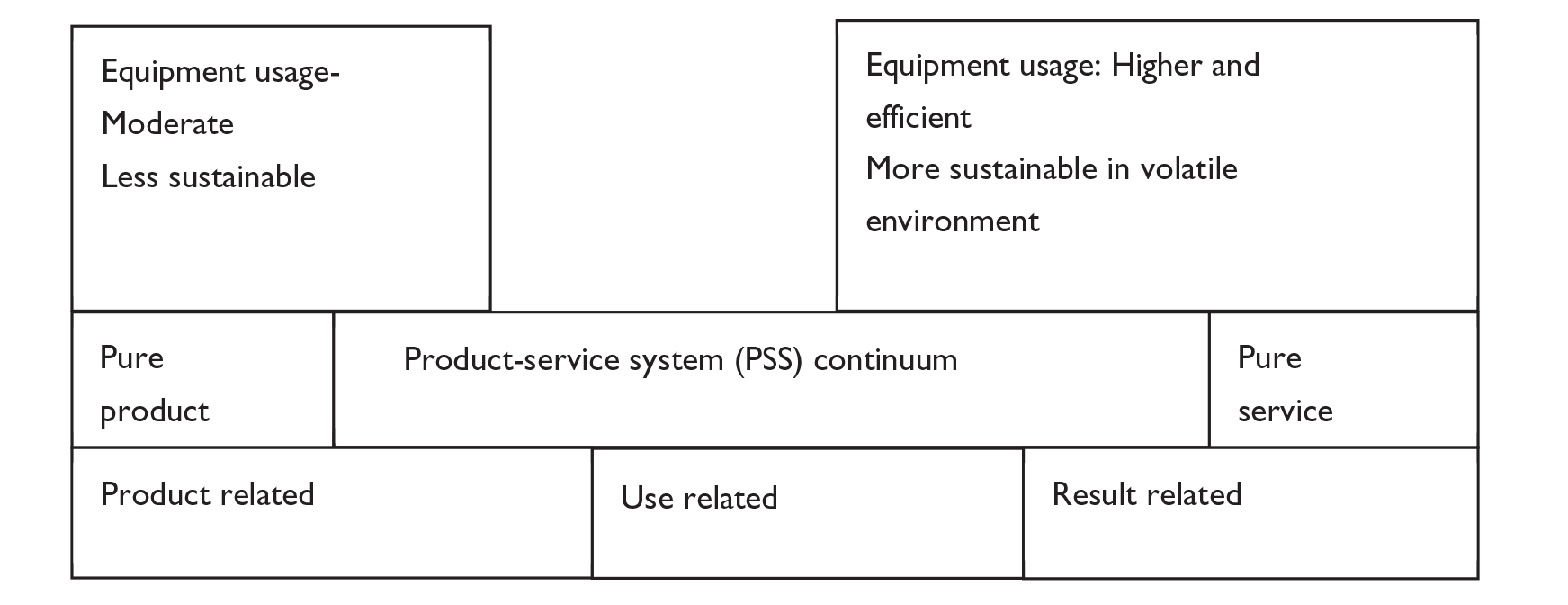
Servitization, or PSS, can be considered as a combination of the products and services so that they can fulfil the specific needs of customer (Tukker & Tischner, 2006). They can be classified into three types based on the degree of product and service component, namely product-oriented, use-oriented, and result-oriented. In a product-oriented servitization, while the focus is primarily on the sale of the product, a few additional services like maintaining the quality or improving the functional performance of the product are included. For instance, the purchase of a photocopier. An example of a use-oriented servitization model is a product lease, where the ownership of the product remains with the provider while the consumer pays a fee for the use of the product. The consumer has unlimited and individual access to the leased product. For example, if the photocopier is leased, it becomes a use-oriented servitization. In a result-oriented servitization, the consumer and the provider agree on a result (outcome) and the product itself is not pre-determined. It is a pay-per-service unit model, where the consumer does not buy the product, but only the output of the product, that is, it is a pay-per-print contract with a provider of photocopy machines. During the transition from production to PSS, when offering result-oriented servitization, there is a possibility of companies pooling up resources to provide greater efficiencies of scale for some functional areas. Szekely and Strebel (2013) in their research show that the move of collaborative consumption, that is, from manufacturing goods to supplying services, when integrated into a systems analysis can lead to dematerialization. This can be interpreted, from a consumer point of view, as a change from ownership to use or access. This is because the enhanced utilization of equipment reduces the quantity of equipment required, thereby leading to dematerialization (Figure 1).
ILLUSTRATIVE AIRLINE INDUSTRY CASE
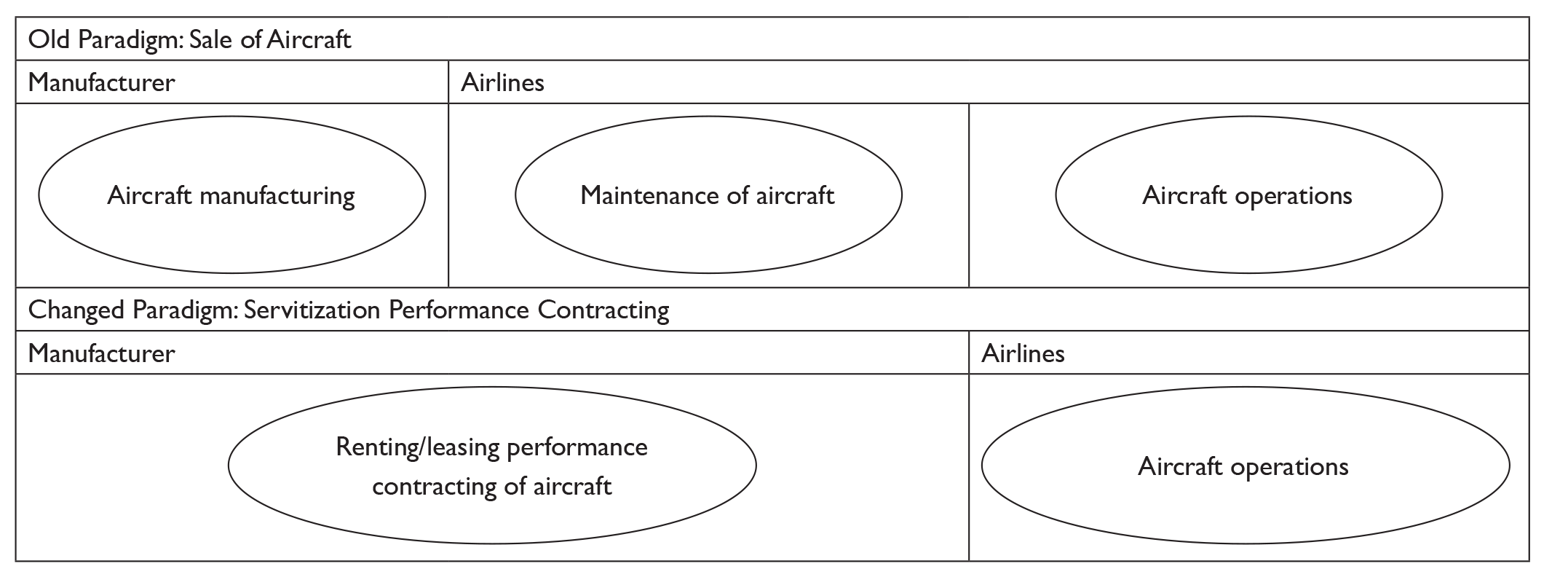
From a product perspective, an aircraft is complex equipment with a life-span of 15–20 years. Therefore, the maintenance aftermarket revenue stream is also almost 15–20 years. The aftermarket of aviation is unique because of the consequentiality and risk involved. It puts a demand of traceability on spares under a highly regulated environment. There are few manufacturers and the service providers are also limited. The providers compete but access the same supply pool, thereby creating coopetition. Isolated and mutually independent policies have negatively impacted this capital-intensive industry. The trend, as discussed by Erkoyuncu, Roy, Shehab, and Wardle (2009), for the aviation industry is towards functional capability. The industry is shifting to procuring performance services instead of buying an aircraft as a product. The basis of contracting normally happens to be aircraft availability. Implications of this can be understood by first understanding the structure of the industry. Aircrafts are a costly asset and normally all airlines strive to maximize the utilization. Spare parts are an important contributor to this availability and utilization of aircraft. Unavailability of a spare part could mean an aircraft on ground (AOG) situation which is directly linked to the revenue stream (Sharma & Singh, 2014). The usage of spare parts is highly volatile and unpredictable so the spare provisioning has to take into account the procuring cost, carrying cost, and the cost of obsolescence. One way of improving the bottom line of the airline is to resort to pooling.
The breakdown of aircraft spares is unpredictable and the demand for spare parts can be intermittent, random, or regular. With the increase of quantity of aircrafts, this volatility or the variation decreases. The idea of pooling of resources was developed from the idea of the commonality of parts and the centralization of locations and lateral shipments. As is obvious, the greater the stocking points, the more inventory is held and blocked for a given service level, and so with aggregation and centralization, inventory is reduced. Cohen, Kleindorfer, and Lee (1986) proposed creation of stocking groups where sharing of spares at the same echelon was mandated. A similar result was advocated by Dror, Hartmann, and Chang (2012) who mentioned that joint replenishment for multi-products stock keeping unit (SKU) gives lower total inventory cost. In such an arrangement, it is appropriate for the collaborating parties to find the cost minimizing solution and redistribute its savings accordingly. In a cooperative setting between airlines, the participants with relatively small fleets have chances to gain more than the participants with large fleets (Kilpi & Vepsalainen, 2004).
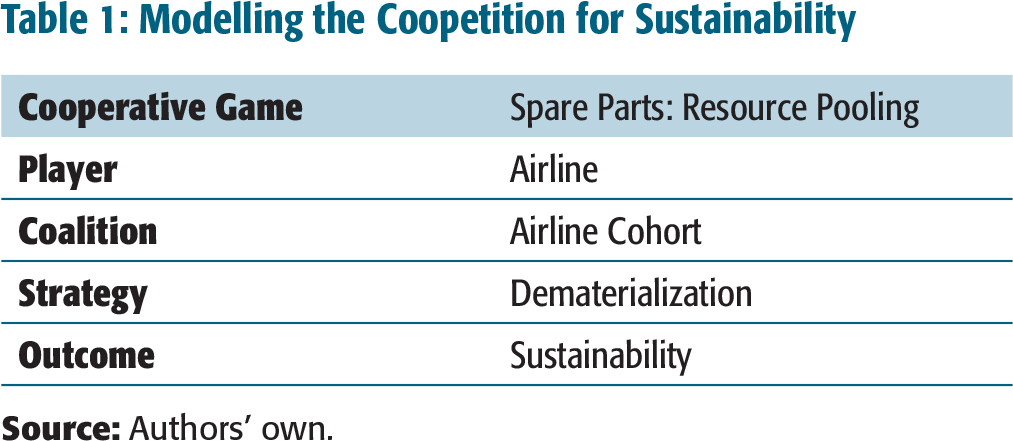
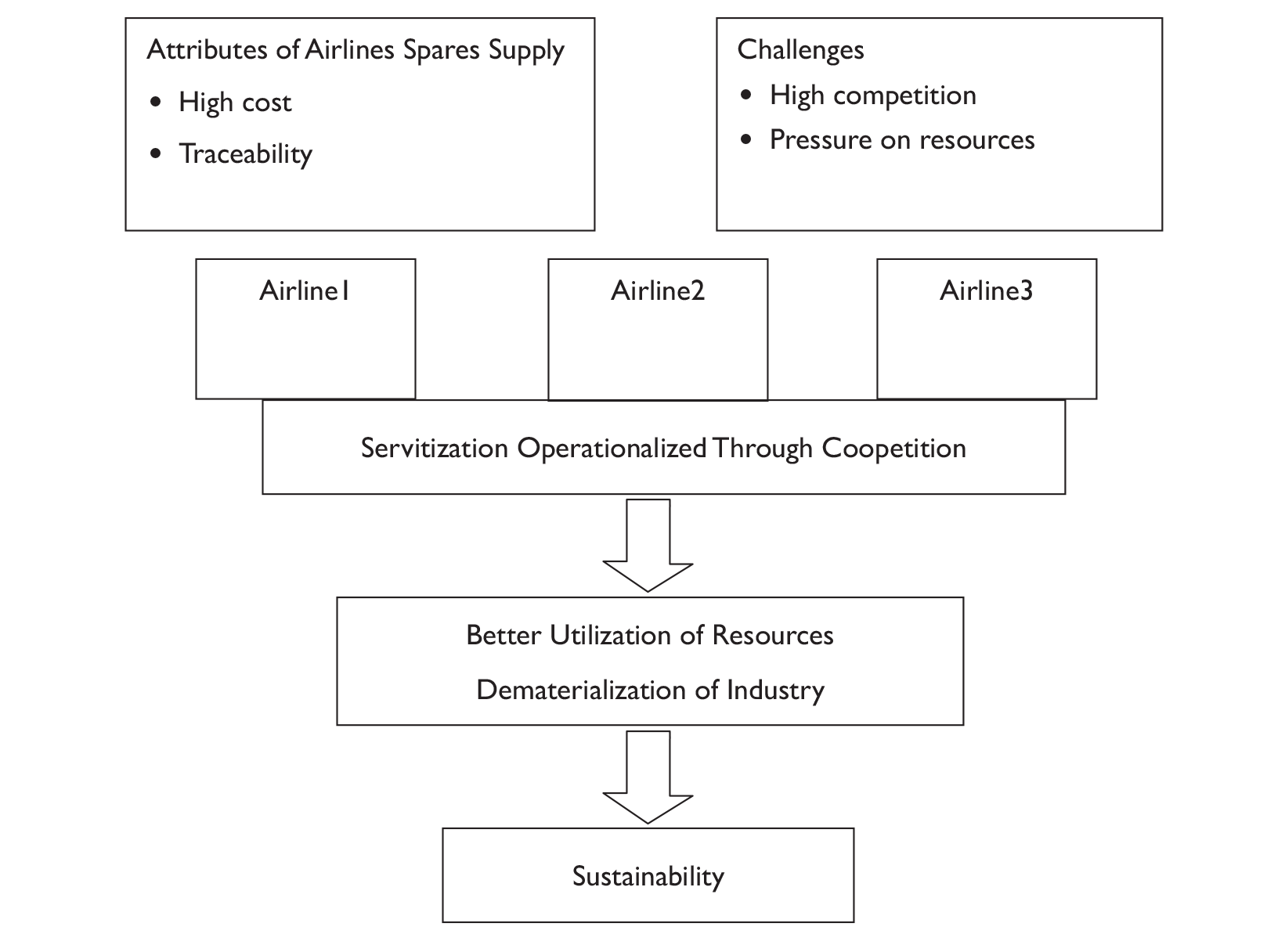
Servitization will have new dimensions as traceability becomes a unique requirement of the aviation industry. Because this arrangement would require horizontal transfer of material parts like rotables, trust and sharing of information is paramount. Airlines can have a dedicated resources contract with the provider or a pooled one, but again, these airlines are competitors so they must accept transparent information, aggregational requirements, and processes to get the benefit(s). An arrangement like this is successful only if every participant benefits from it. Additionally, the benefits should be reasonably, if not evenly, distributed between the participants, if the cooperation is to last. Therefore, the criterion for the pooling to be successful and sustainable is if the total benefit of cooperative pooling is positive. Although such cooperation offers the potential benefit of allowing firms to access a greater base of resources, they also carry an ancillary risk in exchange for this advantage because cooperation forgoes its ability to control its own destiny in the marketplace. More specifically, a firm’s success now becomes contingent on the willingness of its partners to commit their resources to the venture. The coopetition route, which refers to a new relationship of both cooperation and competition, can be a way of operationalizing servitization with the ultimate objective of sustainability. Servitization would result in dematerialization of the industry, a longer life, and better utilization of the material resources.
Modelling the Coopetition for Sustainability
THE CASE FOR COOPETITION IN SPARES SUPPLY USING GAME THEORY
Game theory as a discipline was initiated by Von Neumann and Morgenstern (1944) based on transcribing a situation into abstract formulations based on logics and rules assuming a rational behaviour. Broadly it can be classified into non-cooperative game approaches and cooperative approaches (Song & Panayides, 2002). When a decision-making unit in a market treats the others as competitors, it is known as the non-cooperative game, but when a group of decision-makers decide to undertake a task together, that is, all the players join together for a common business alternative, it is known as cooperative game. Market competition among firms/companies is always a kind of game where the firms/companies cooperate and compete with their rivals. The concept of coopetition emerged decades ago. In management literature, business behaviour consisting of cooperation and competition has been termed as coopetition. Brandenburger and Nalebuff (1996), Lado, Boyd, and Hanlon (1997), Gnyawali and Madhavan (2001), and Muller 2017 have focused on the growing importance of coopetition for today’s interfirm dynamics. According to Bengtsson and Kock (2000), the most advantageous relationship between competing firms is ‘coopetition’ where they compete and cooperate with each other. Coopetition is a business approach where competition and cooperation happen simultaneously (Figure 3). It is a game where the managers try to evolve it, such that they can obtain the best possible results (Ferreira & Matos, 2014). When companies enter into a cooperative pooling, they face a cooperative dilemma in managing the inherent tension between cooperation and competition. The intriguing question is: how to negotiate cooperation and competition among partners. This can be done by reconciliating the contradictory views and exploring how to manage the complex interdependence between cooperation and competition. It compares and contrasts the rationale between cooperation and whether the cooperation will sustain, that is, the payoff for each coalition and the payoff for each player.
In the spares inventory analysis, as the pooling of spares brings about savings in the investment in spare parts, the basis of allocation of the benefits between the players will determine the continuity of the coalition or its stability. From the knowledge of the cooperative game theory, stability requires that the cost allocation be in the core (Hartman, Dror, & Shaked, 2000). The Shapley value method is used for the efficient and fair/reasonable allocation of cost. Hartman and Dror (2003) propounded the Shapley value to be an allocation mechanism for inventory centralization and stability. The Shapley value is determined by considering the average of the possible marginal contributions of each player.
Core of an n-Player Game
The basic premise of ‘core’ is ‘imputation’. An imputation is an n-tuple of payments to the participants of an n-player game, which satisfies both ‘individual rationale’ and ‘collective (group) rationale’; the formal definitions of these are follows:
Considering an n-person game, with players P = (p1, p2, p3, … , pn). A vector x = (x1, x2, … …, x n ) of real numbers is said to be an imputation, when individual rationale (the share received by individual player pi s, when being in coalition, should be at least what he could earn himself) and collective rationale (total rewards allocated to each player in the coalition should be equal to total rewards available by cooperation guaranteed by the characteristic function) are met.
The set of imputations satisfying the conditions of the coalition rationale constitute the core. According to the definition of the core, no group has an opportunity or incentive to overturn a societal arrangement if the imputation is in the core. The reason for this is that the demand of each player and of each coalition can be satisfied; hence, the imputations in the core are particularly stable.
Assumption
The aircrafts have almost the same utilization and flying hours. For simplicity, let us consider three airlines using the same aircraft type: P1, P2, and P3 with fleet sizes of the aircrafts in this aircraft type being 30, 40, and 50, respectively. The plan is to pool their spare component inventories in an effort to reduce the total number of spare units needed, effectively lowering the capital tied into owning them. The airlines have commonality of spare parts and intend to cooperate in providing availability of one commonly used aircraft component Z. If the component is unavailable to the company, the company can then ask for lateral transshipment. The base model given by Kilpi and Vepsalainen (2004) is used to calculate how many units the combined cooperating airlines need to maintain the same acceptable service level as before. In this model, we must consider four factors: reliability of the component measured by mean time between unscheduled removals (MTBUR), turnaround time (TAT), fleet size, and the number of spares required.
The companies can decide on a combined service level of 99.5 per cent. First, we calculate the spare requirement for the three airlines separately for 99.5 per cent service level. We then calculate the spare requirements for the combined pool at 99.5 per cent service level and for different coalitions.
Determining the Spares Requirement for a Given Service Level
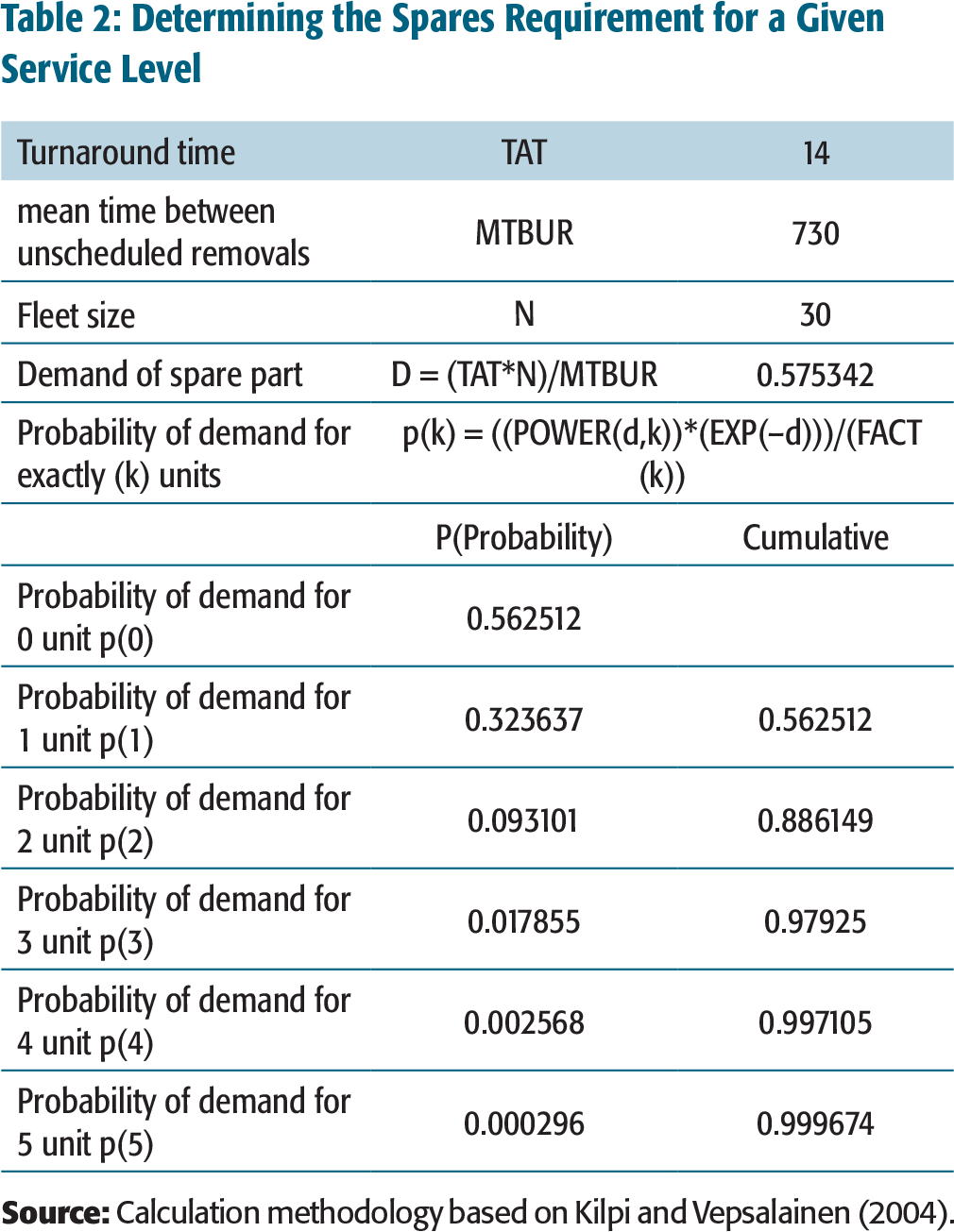
We find that, individually, if these companies wish to have a service level of 99.5 per cent, the number of spares required are as follows:
company ‘A’ (fleet size of 30) no. of spares required is 4,
company ‘B’ (fleet size 40) no. of spares required is 5, and
company ‘C’ (fleet size 50) no. of spares required is 5.
It is assumed that all the members are contributors to the group effort and there are no free-riders. To understand the stability of the arrangement, we consider the concept of core in cooperative games where players in different coalitions will get different payoffs. Suppose there are three players in a market: P1, P2, and P3. For simplicity, it is supposed that the only goal for the airlines is to pursue minimum costs by reducing investment in spares, thereby causing a reduction in material consumption. The concept of core has the sign reversed because we are considering costs. The maximum costs the airlines have to incur are 4, 5, and 5 times respectively, if they serve the market with the ‘go-it-alone’ policy. The strategic alliances of P1 and P2, P1 and P3, and P2 and P3 can guarantee them costs of 6, 7, and 7 to each coalition respectively. Finally, the strategic alliance formed by P1, P2, and P3 combined can achieve a 99.5 per cent service level with a combined investment of 8 spare costs. The calculations are based on the assumption that the combined service level is 99.5 per cent.
According to the definition of a core, a 3-tuple is an imputation in the core if, and only if, it satisfies the following condition (signs reversed because these represent cost):
X1 ≤ 4; X2 ≤ 5; X3 ≤ 5; X1 + X2 ≤ 6; X2 + X3 ≤ 6; X1 +
X3 ≤ 7; X1 + X2 + X3 = 8
Solutions to the above equation constitute core based on individual and collective rationality. As indicated in Sharma and Singh (2017), Shapley value can be utilized to determine the individual contribution for fairness.
SUSTAINABILITY IMPLICATIONS
Sustainability suggests that companies should be operating on a platform which accounts for the triple bottom line factors, namely social, environmental, and financial. Tukker and Tischner (2006), in their work, discussed that servitization can lead to sustainable benefits because of its two-pronged approach of lower material and energy consumption.
Armstrong and Lang (2013) mentioned that although PSS is still a novelty in the sustainability movement, it contributes to sustainability by separating value from material consumption. Further, arguably, it would need a major shift in competition and consumption. (Van Halen et al., 2005). The hypothesis is that through PSS one can offer more services with less material consumption. This holistically would have an impact on production, and thereby reduction of waste. Consider the aftermarket industry. Now, instead of selling spares, the businesses would earn through services that support these products. This may lead to products being designed for durability and upgradation due to their intense use (Mont, 2000). This study provides a distinct perspective to the discussion on servitization, coopetition, and sustainability. As the manufacturers servitize, the industry becomes more efficient and the service asset’s availability for intended use is maximized. Therefore, more companies are moving towards servitization and are looking towards life-time solutions. In the aviation industry, the deficiencies in the chain make the industry ineffective and many airlines are in red or under the line of operating profits. If these companies intend to benefit from cooperation and sharing, then the best strategy for each of them is to adhere to the rules of the pooling arrangement and try to determine the playing area in the cooperative world. The analysis of core gives us this information, assuming that the players are rational and act in their own self-interest. As mentioned by Shubik (1982), it is the territory over which the coalitions do battle. Thus, the importance of core for the player lies in determining the payoffs that they can get in the arrangement. Although cooperative game theory is myopic as it addresses only one aspect of the cooperation, in contrast, partners also compete to divide the anticipated benefits of such an effort. The allocation of cost is critical to the stability of the pool. The application of Shapley value can improve the maintainability and fairness in the group which would garner trust.
Leasing or renting opens the possibility of a far more intensive use of the product with the same material input (environmental outcome). Firms are in a better position to optimize the product to its true function given its characteristics. In an effort to move towards sustainability, the obstacle that this industry faces is to bring the competitors on a common platform. Pooling and coopetition seems a viable option towards sustainability. Thus, the coopetition route which refers to a new relationship of both cooperation and competition can be a way of operationalizing servitization with an ultimate objective of sustainability resulting in the dematerialization of the industry, longer life, and a better utilization of the material resources. Thus, we postulate that servitization through coopetition can represent an opportunity to provide sustainability in addition to an improved bottom line and profitability. Although the proposed model focuses on the direct gains from cooperative pooling, it also delves into fairness and its important contribution towards sustainable operations.
ACKNOWLEDGEMENT
The author wishes to thank FORE School of Management, New Delhi by providing the FORE seed money to support this work.