Abstract

On 7 January 2015, the evening flight from Mumbai to Delhi was delayed due to heavy fog in Delhi. While waiting for the boarding call, Jagdish Mitra, the Chief Strategy Officer of Tech Mahindra, glanced through the business plan of Saral Rozgar. Saral Rozgar was a mobile job marketplace for blue-collared job seekers which he had developed along with his team. Saral Rozgar was one of the projects that was close to Mitra’s heart and seemed to have the market potential for growth. The blue-collared job market in India was untested and there were very few niche players who offered such a solution, therefore giving Saral Rozgar an edge.
Although he was a firm believer in the concept of Saral Rozgar, Mitra was in a quandary while taking the decision to expand its footprints. Tech Mahindra, a technology company, had no experience in running a direct-to-consumer (D2C) business. Also, a successful business model to benchmark Saral Rozgar did not exist in the market. He boarded the flight immersed in these thoughts. Considering that the market opportunity was big for such a product, Mitra pondered on what should be the mode to scale up this business while also contemplating about its growth strategy.
BACKGROUND
The Top 10 Mobile VAS Players in India (2011–2012)
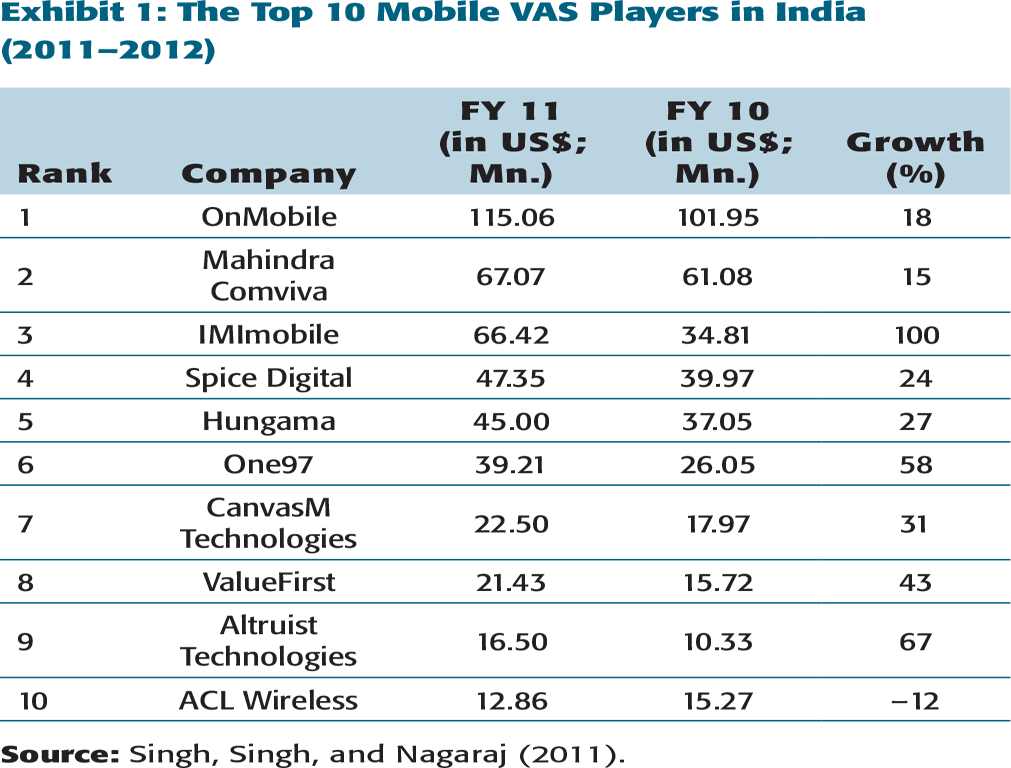
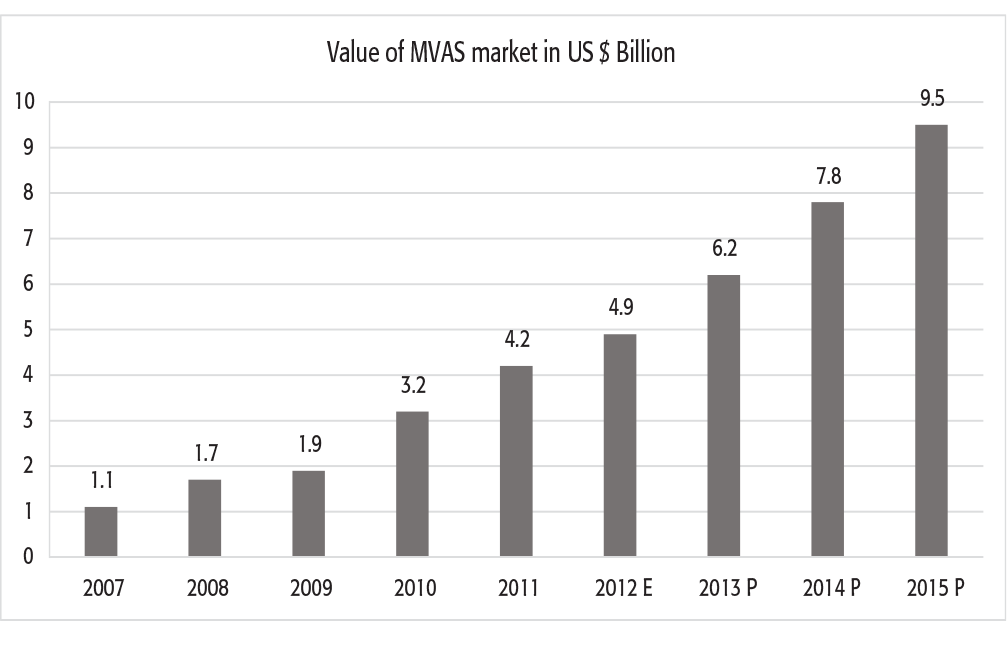
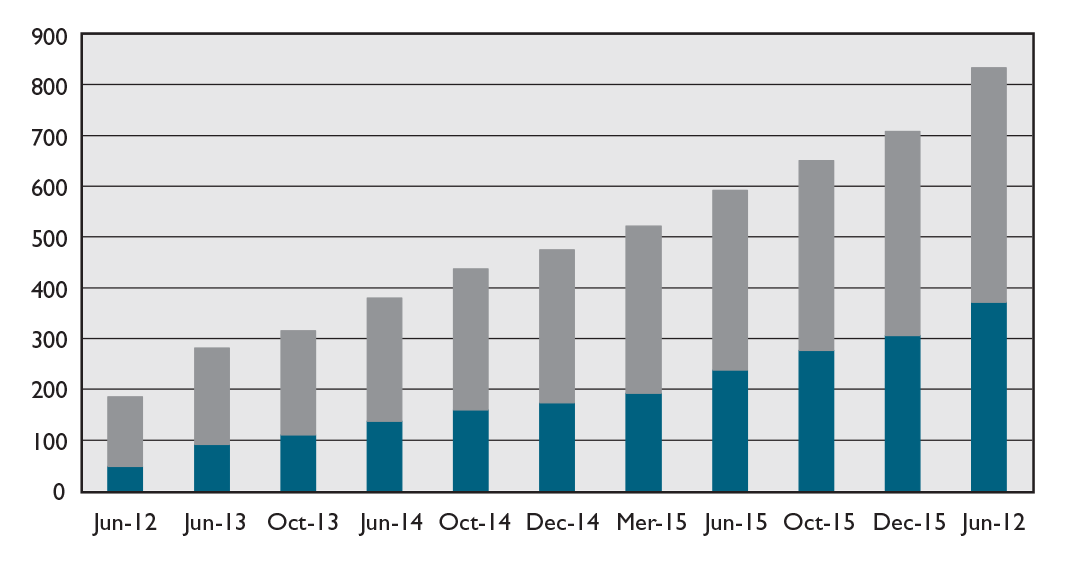
The Indian mobile market has expanded rapidly, thereby creating need for mobile-based utility services (GSMA, 2015). With this steady growth, the future of Indian M-VAS market looks promising (Exhibit 2).
In this space, Tech Mahindra offered services in various segments such as systems integration, application hosting, outsourcing services, service delivery platforms, content aggregation, content hosting and delivery, and a broad range of M-VAS applications. One such service was Saral Rozgar, a mobile job exchange platform created to help the entry level blue-collared job seekers to connect with the employers by using the mobile phone and web applications. The service was launched in November 2012 and was operational as a mobile VAS with few circles of telecom operators. Ever since its launch, Saral Rozgar was widely acknowledged across the industry and awarded by various national and international bodies for the unique positioning.
MOBILE REVOLUTION IN INDIA
The Urban–Rural Mobile Base: Telecom Subscription Data as on 31 October 2016
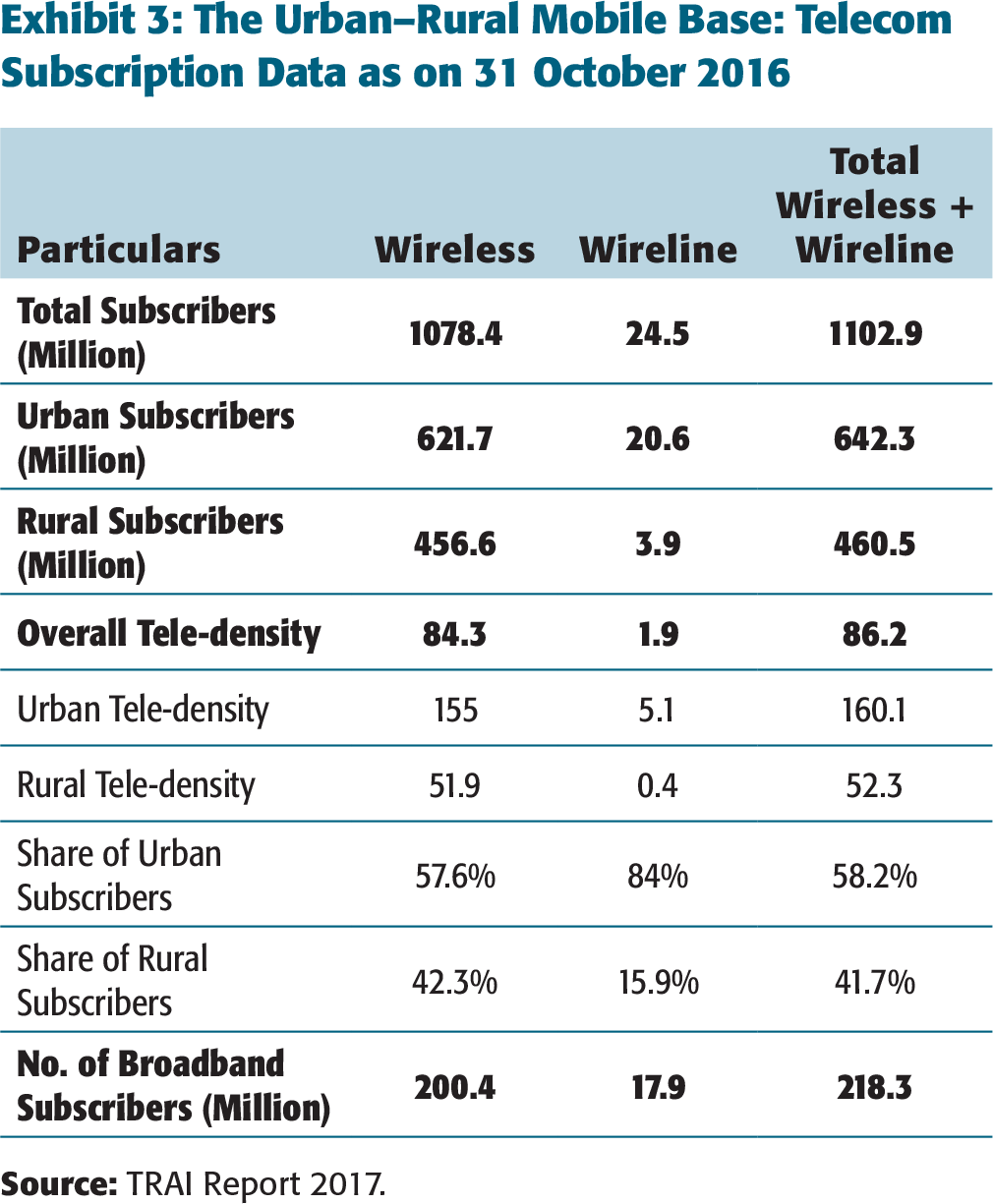
Telecom operators had invested heavily in improving the rural connectivity, speed of broadband, and data services in urban India. The total number of 3G subscribers in India was expected to grow from 42 million in 2013 to a whopping 284 million by the end of 2017 (Srivastava, 2015). Traditional mobile services such as voice calls and SMS was replaced by the data services. There was a shift of focus in the mobile content towards email services, chat, social networking, gaming applications, and news and information. The mobile phone was perceived as a game changer in the field of communication, and its impact towards the social and economic development of the masses was significant. Mobile phones brought basic amenities to the doorstep of the common man and helped in addressing issues related to agriculture, citizenship services, financial solutions, health care, and the basic level of education.
GENESIS
In 2012, Vivek Chandok, Vice President, M-VAS, New Products and Portfolio, was in charge of expanding the consumer-based utility business of the CanvasM unit. Chandok was a seasoned marketer and had worked in the telecom and M-VAS industry with leading companies such as Bharti Airtel, Lucent Technologies, and Idea Cellular. He had sensed that the Indian M-VAS market was fast evolving and the changing preferences of consumers would soon make the landscape competitive. Consumer demand towards more innovative service offerings was the need of the hour. He planned to establish a portfolio of utility M-VAS solutions which could be offered through a distribution channel, which he named as the D2C channel.
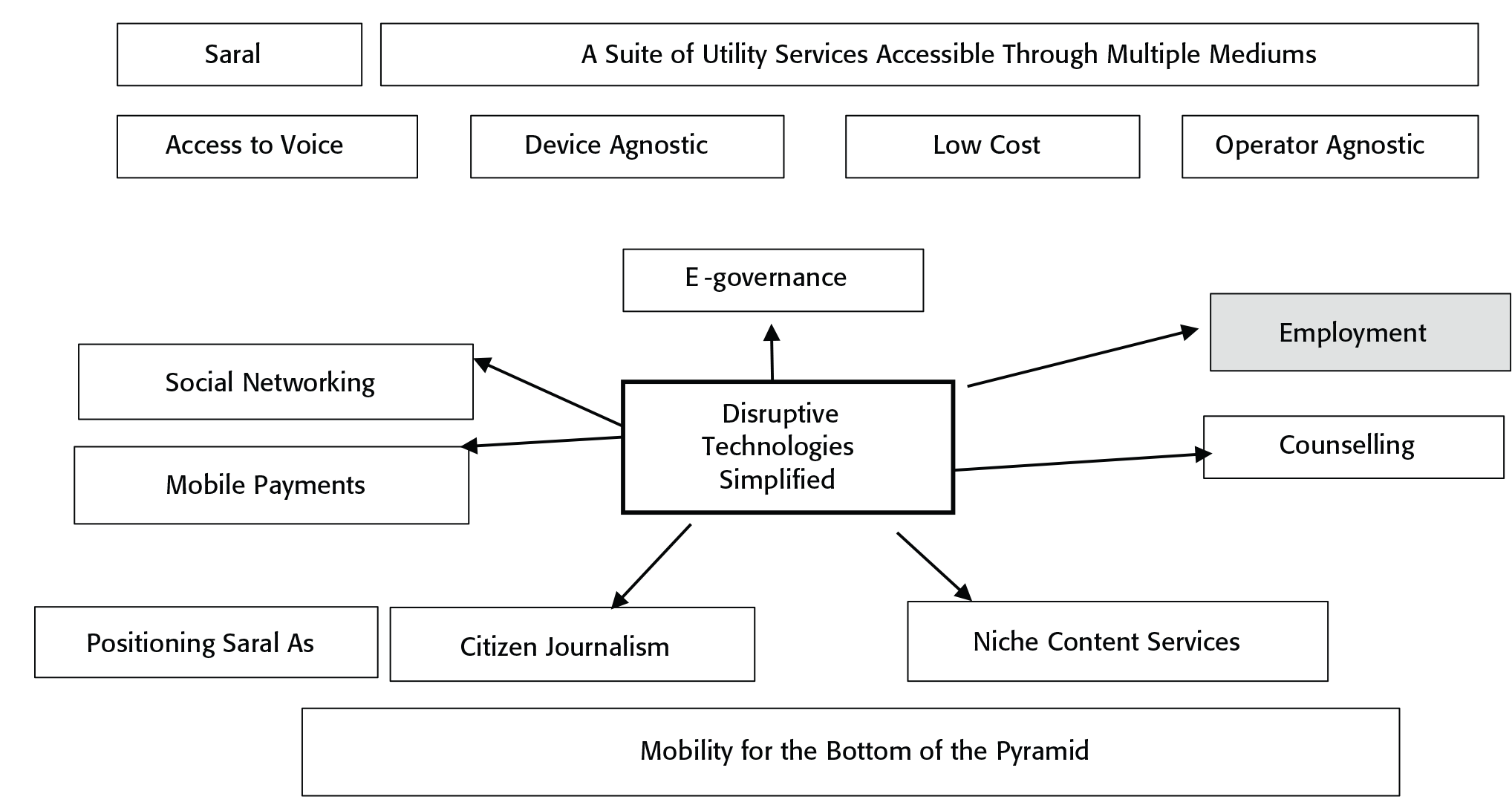
Chandok coined the idea of ‘Saral’ for offering the wide array of consumer and utility services offerings for the rural and urban markets in employment, health care, education, and mobile commerce. The concept of Saral Rozgar is depicted in Exhibit 5. During the product development stage, Anshul Gupta, Head, New Products, named the product offering as Saral Rozgar, which meant easy employment or jobs for addressing the wide need in India. As simple as the name of the product carried, the platform offered easy to access, low cost and high impact service offering to the job seekers and enabled them to reach out to the job market through the mobile phone.
According to Gupta,
Saral was positioned as a low-cost service with a unique value proposition. It was easily accessible through voice (interactive voice response) along with the combination of web and addressed the needs of all the players in this ecosystem comprising of the job seekers, employers, employment contractors and manpower consultants.
Mitra recalled,
When we looked at the product positioning of Saral, we couldn’t find any such organized portal or database where a large pool of entry level blue-collared workforce could be identified. In India, there were many job portals offering job search services which cater to the requirements for the graduates and lateral white collared jobs in but there was no such service available for the lower segment of job seekers at a wider scale.
Chandok stated,
The blue-collared job seekers had difficulties in registering or creating their resumes in an online job portal. Considering Internet connectivity, computer penetration and electricity availability in smaller cities and towns, they resort to the traditional sources for getting jobs either through peer group referencing, paying to middlemen/contractors, newspaper classifieds or spending money in travelling in search of jobs to the larger cities. Our idea of launching Saral Rozgar was to address this issue and bridge the digital divide through seamless information availability on the mobile phone. This will help the job seeker of this category to access relevant job information directly on his mobile through SMS or voice calls.
He further added,
Even a person looking for the job in far off cities need not travel unnecessarily but can opt for the choice of locations and get relevant job information directly reaching him on his mobile. Even employers looking for similar resources could directly reach out to the job seeker.
HOW DOES SARAL ROZGAR OPERATE?
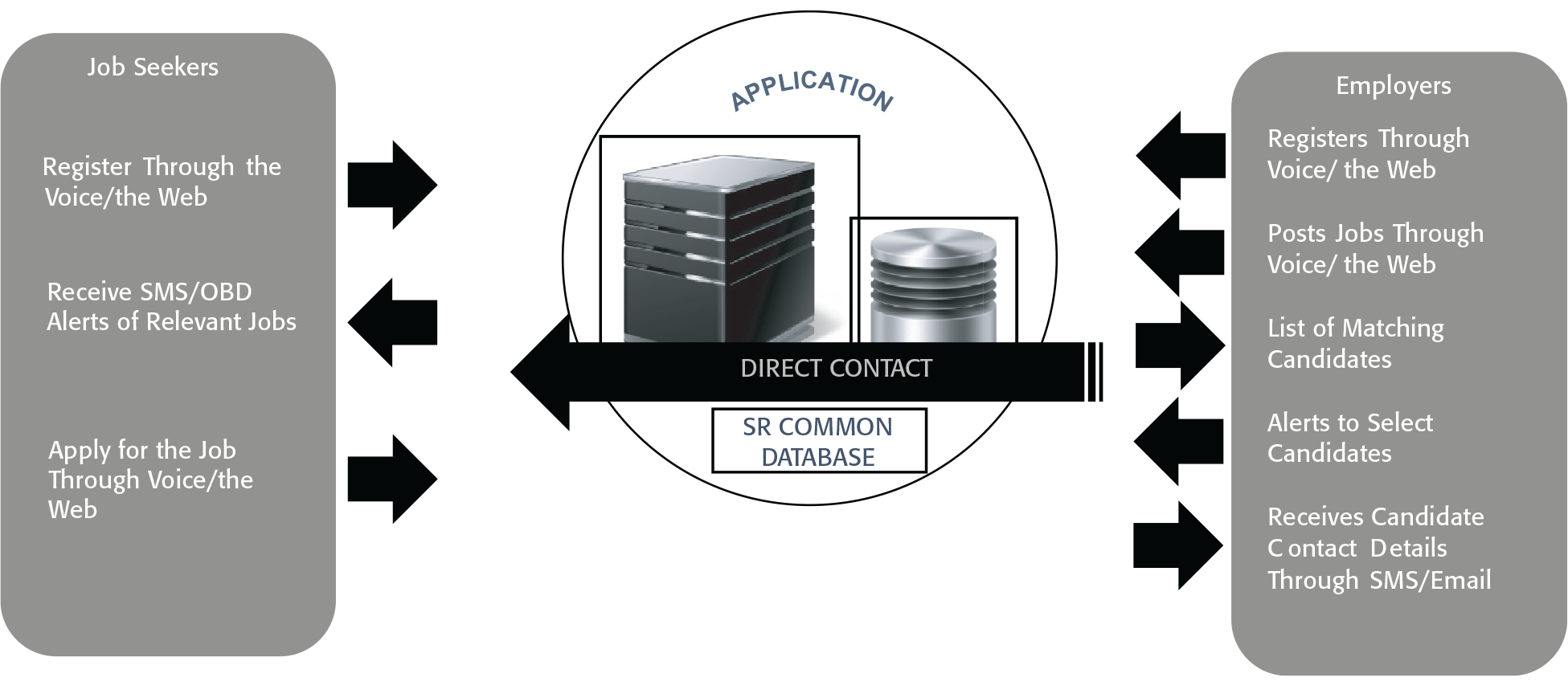
A call centre was set up in Noida located in the National Capital Region (NCR), which functioned from 9 a.m. to 9 p.m., seven days of the week with a dedicated team of customer care agents. Keeping in mind the need for vernacular resources, the call centre was manned with agents who could speak the major Indian languages such as Hindi, Bangla, Oriya, Marathi, Telugu, Tamil, Kannada and Malayalam along with English. The job seeker could dial in the number: 92-66-91-23-45 and reach out to the Saral Rozgar call centre. They could opt for the preferred language option and directly interact with the agent to create the resume. The agent captured all the relevant information of the candidate, including the locational preference for job, skill category, and salary expectations, and created a resume in less than four minutes.
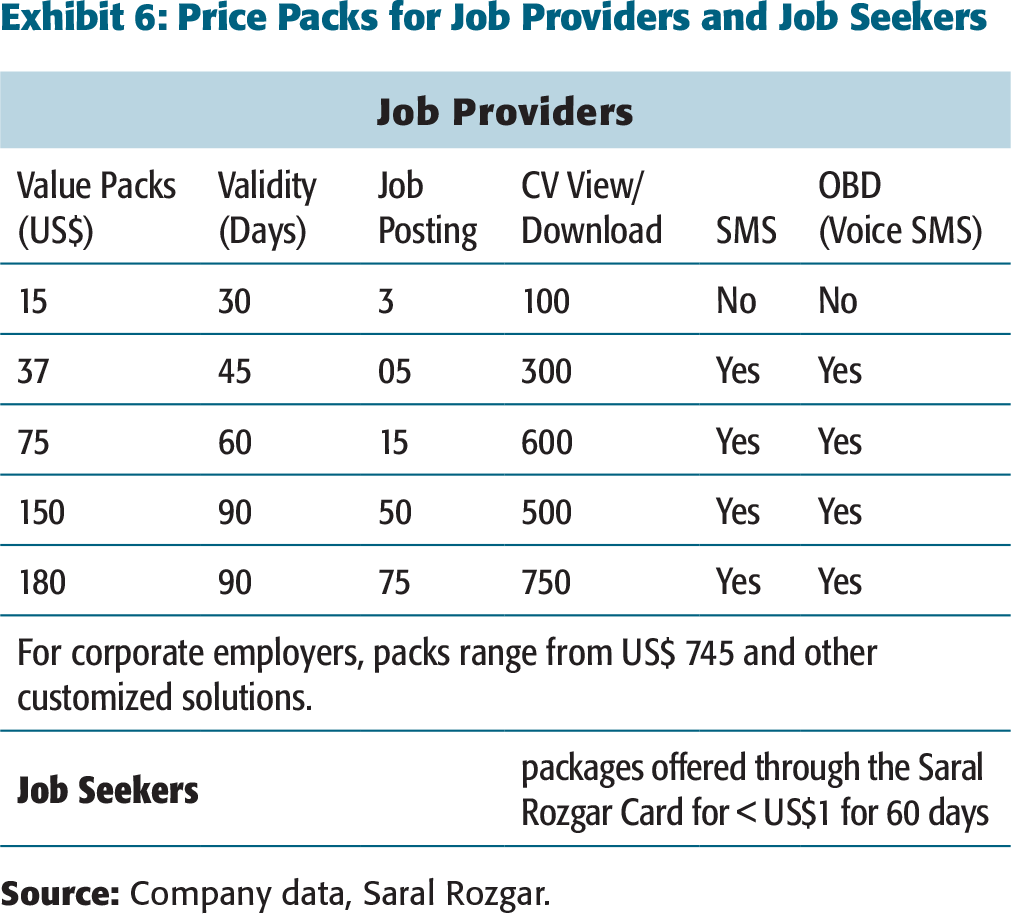
Post registration, the candidate received the relevant job alerts via SMS or automated voice calls on his mobile, prompting him to apply for various vacancies through the interactive voice response (IVR). An employer looking for talent could seamlessly search the Saral database or post his requirements through his mobile or through the web portal. The employer could initiate self-built campaign management tools which triggered automated SMS and customized voice calls to the candidates directly from the Saral portal. An employer could subscribe to the Saral Rozgar portal by selecting the various subscription packs or contact the sales team for customized corporate packs. The candidate had the option to subscribe to the service by procuring the Saral Rozgar card from the market and availing the service at less than US$ 1 for 60 days (Exhibit 6).
Price Packs for Job Providers and Job Seekers
One of the regional sales manager of Saral Rozgar stated,
The average cost for a job search for a semi-skilled/unskilled candidate ranges from US$ 4 to US$ 25. This cost was primarily for the purchase of newspapers, creation of the resume, payment of registration fees to the job consultants, cost of communication through telephone calls and sometimes also paying the agency charges for job interviews which can be equivalent to the first month’s salary of the candidate. By registering with Saral Rozgar, the job seeker can apply for a job out of more than 100 categories of jobs.
PRODUCT FEATURES OF SARAL
Since the target audience for Saral Rozgar was not very educated, the product design incorporated voice applications in order to provide ease and access to the users (Exhibit 7). Gupta stated, ‘We designed and developed several innovative features over the voice so that it becomes easy for the job seekers to shed off their hesitations and be comfortable talking to the agents in the call centre.’
Voice Resume
The job seeker in the blue-collared workforce segment did not have easy access to the Internet and hence were not in a position to create an online resume. Saral Rozgar developed the feature of ‘voice resume’ which was a self-introduction by the job seekers over the IVR. While going through the database of job seekers, the employers who hired candidates in sales, retail, and BPO found this tool effective as it helped in understanding the communication and presentation skills of the candidate. Amit Sharma, COO of Bharat BPO which ran the ‘139’ call centre for the IRCTC and a subscriber of Saral Rozgar informed, ‘We recruit voice process agents for our customer care operations in bulk. The voice resume feature of Saral Rozgar helps us in eliminating candidates at the inception and thereby saving time and cost of recruitments.’
Outbound Voice Calls (OBD)
This feature helped the job providers to run the voice call campaign to announce the relevant job openings by dialling a recorded prompt through the existing platform. An automated OBD could also be made available to the IVR for a particular state circle or database of users based on the users preferred choice of language.
SMS Campaign
The client was also able to run customized SMS campaigns for existing and new user base with customized text SMS up to 140 characters. It was possible to send an automated voice SMS in vernacular language to the job seekers through the integration of text to speech (TTS) software.
Assisted Job Search (Multi-lingual)
Saral Rozgar had a multi-lingual call centre support which provided handholding support to both the job seekers and employers. It offered job counselling services to guide the job seekers to the right kind of jobs matching their skill sets. In certain situations, the qualified agents even assisted the job seekers to prepare them for the interview as a value-added services.
THE BLUE-COLLARED JOB MARKET IN INDIA
The NSSO survey data of 2004–2005 showed that the working population in India was 459 million of which only 6 per cent was in the organized sector while approximately 93 per cent was employed in the unorganized or the informal sector (FICCI, 2012). However, in 2012, it was reported that 12 million workers comprising of skilled, semi-skilled, and unskilled workforce joined the unorganized sector on an annual basis (Dewan, 2012). Surprisingly, only 2 per cent of the Indian youth and a mere 7 per cent of the working-age population received vocational training (Varma, 2013). Therefore, India had vast challenges of not only producing skilled manpower but also absorbing new applicants to the job market. The Indian job search market mainly consisted of organized staffing firms, labour contractors, and job portals.
Among the organized job portals, Naukri.com was the market leader followed by Monster, Shine, and Timesjobs. Info Edge’s Naukri.com had more than 15 years of existence in the Indian market and was clocking a sales turnover of US$ 100 million with a net profit of US$ 20 million in the year 2014. Naukri claimed to have a base of 39 million uploaded resumes. More than 95 per cent of the database was of white-collared (graduates and above) job seekers (Exhibit 8).
Chandok said,
The issue of blue collared job search segment remained a concern as the users were neither readily available on the internet through personal computers nor had computer literacy to access information digitally. Hence, choosing the internet as a medium of communication was the biggest challenge for blue collar job portals. Moreover, the unorganized and semi-organized segment of industries had peculiar consumer behavior where the owner of the industrial unit was not having any actual measurement of the recruitment cost in his mind. The traditional ways like newspaper classifieds, employee referrals, direct walk-ins and dependency on labor contractors remained the common ways to fulfill the requirements.
According to Gupta,
An industrial unit in India had an annual attrition of 30–40% for blue-collared workforce with an average hiring cost of US$ 4 to the US$ 10 per resource. Moreover, it remained a challenge to depute skilled manpower at the right time which sometimes impacted the timely order fulfillment.
COMPETITION
Leading Job Portals in India
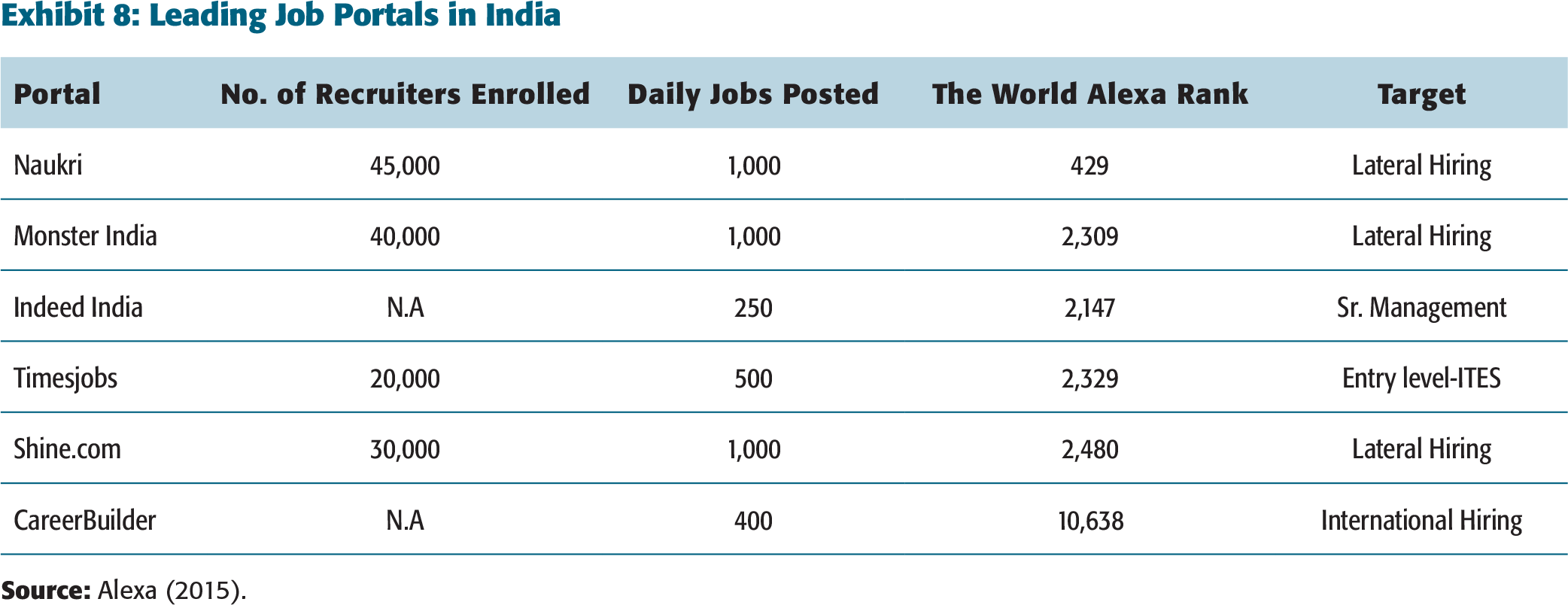
Mitra opined,
There are few niche players in the blue collared job market catering to the industrial demands, however, there exists a gap in terms of looking at the larger opportunity in this segment. Not a single company had an annual turnover of more than US$ 1 Mn. There seemed to be a bigger opportunity to grab and create a leadership position for Saral Rozgar.
PRODUCT PORTFOLIO AND PRICING
Comparative Analysis with Similar Blue-collared Job Solutions
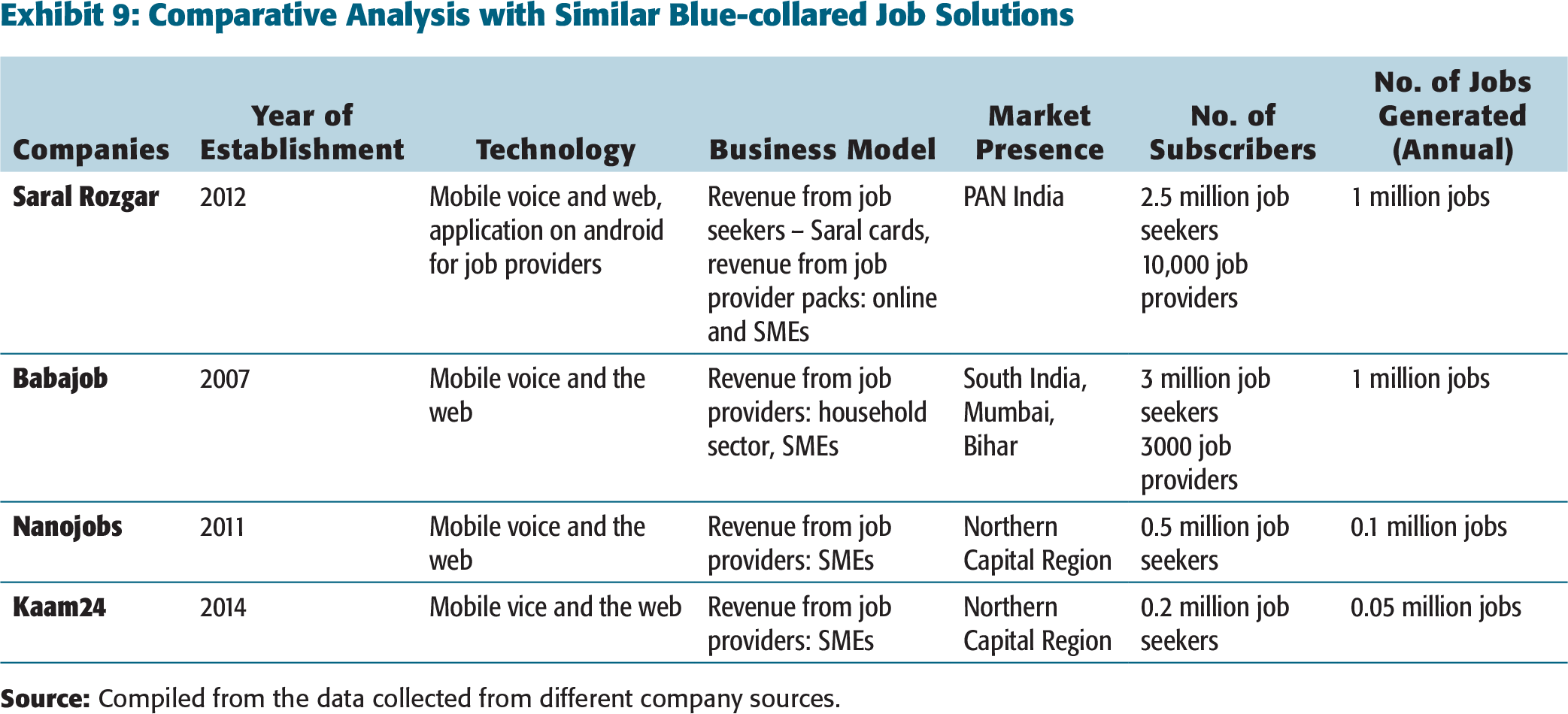
Job Seekers
A job seeker could subscribe to the Saral Rozgar service by registering for the service and paying less than US$ 1 per day from the prepaid balance in his mobile or can directly walk into one of the telecom recharge or kirana (retail) outlets and purchase the Saral Rozgar Card. The minimum cost for subscribing to Saral Rozgar was less than US$ 1 for a period of 60 days during which the person receives relevant job alert on his phone.
Job Providers/Employers
On the employer side, subscriptions for the small value packs were available over the Saral Rozgar portal. A person could choose the required service pack online and pay through debit/credit card, or Internet banking and access the database of relevant candidates or post the advertisement in the portal. For larger requirements from SMEs and corporate customers, the sales team provided product demos and sold higher subscription packs. According to one of the sales managers from the job provider team,
An SME unit spends a minimum of US$ 400 to the US$ 3,000 per annum in hiring. This cost mainly comprises of newspaper classifieds, fees to manpower contractors and consultancies and overhead expenses of travel and logistics for a search of candidates. Apart from this direct cost, the indirect cost of time, productivity and idle capacity goes unaccounted.
The subscription packs being offered by Saral Rozgar for the industry ranged from US$ 50 to US$ 2000 for one-time service offer, job posting, database search, and long duration packs for quarterly, half-yearly, and annual subscriptions.
According to Chandok, ‘Large corporate companies like Glaxo SmithKline, Godrej & Boyce, Whirlpool, Flipkart, SIS Security, Blue Dart and others are already using this service for catering to their blue collared job requirements.’
LAUNCH OF THE SARAL ROZGAR CARD
As an extension of the product feature, the Saral Rozgar Card was introduced in the market in June 2014. According to Chandok,
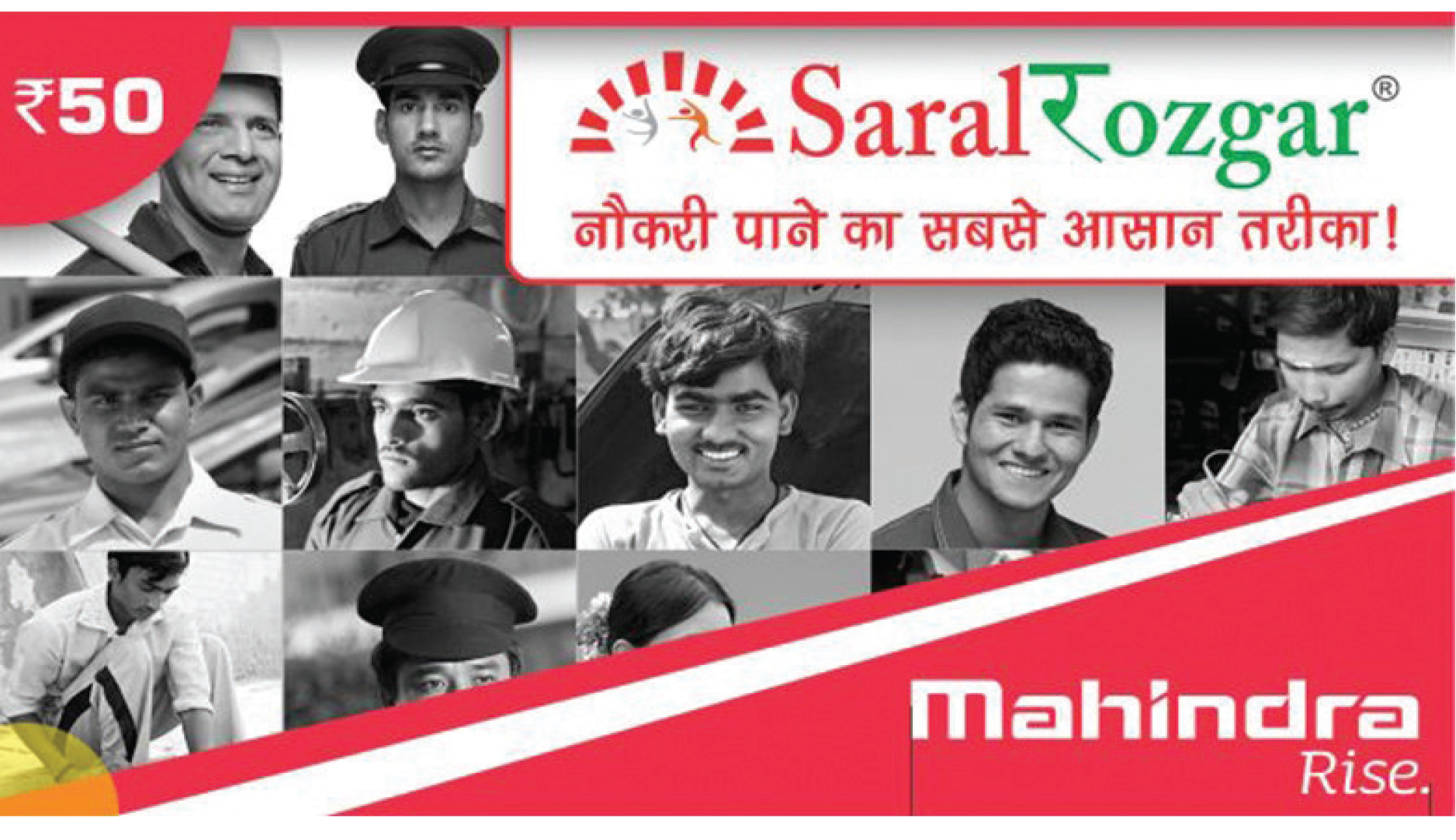
In the category of blue collared job seekers, there exists much of speculation and trust in accepting new services, hence launching a Saral Rozgar Card added further tangibility and helped in gaining the trust from the customers. The brand Mahindra helped in faster brand recall.
The concept was drawn on similar lines from the telecom prepaid vouchers which had a top-up value in it with the validity period. As a service commitment, a person procuring a job card for less than US$ 1 was assured to get 60 days of validity with relevant job alerts being sent to his mobile phone via SMS. These alerts were mapped with the job seekers preference for the job category, preferred work location, and salary expectations. The Saral Rozgar Cards were available with more than 30,000 telecom and FMCG retailers selling recharge services and other utility products (Exhibit 10).
According to Chandok,
The biggest challenge was to create the awareness among the industries on the advantages of such a service. In order to prove the functionality of the service, the industry need to embrace this concept and that could only happen once we reach out to the larger audience through a large scale brand awareness program.
FUTURE OUTLOOK
The revenue grew from US$ 0.15 million in 2013–2014 to the US$ 1.37 million in 2014–2015. The subscriber base reached 2.5 million in January 2015 (Exhibit 11). Since the inception of Saral Rozgar in 2012, the product has appeared to be successful under the growth factories initiative of Tech Mahindra. The board was keen to see the growth of business ventures like Saral which was aligned with the Mahindra group’s philosophy of ‘RISE’. According to Mitra,
The Indian blue collared job market had tremendous potential. Saral Rozgar was one such initiative which strived to create a positive impact to the prevailing digital divide in this segment. Millions of job seekers from the lower strata of the economy can get benefitted out of this initiative.
He further added,
We were the only large IT Company which had taken the plunge to introduce Direct to Consumer (D2C) product concepts for the Indian market. It is essential to evaluate the worth of further investing into a new business venture like Saral while keeping in mind the broader strategic vision of the company. Considering the growth and market acceptability of the product, it is also critical to scale up faster and look at the bigger picture. You may continue to operate as a niche player in the industry or become the harbinger of growth and set industry standards.
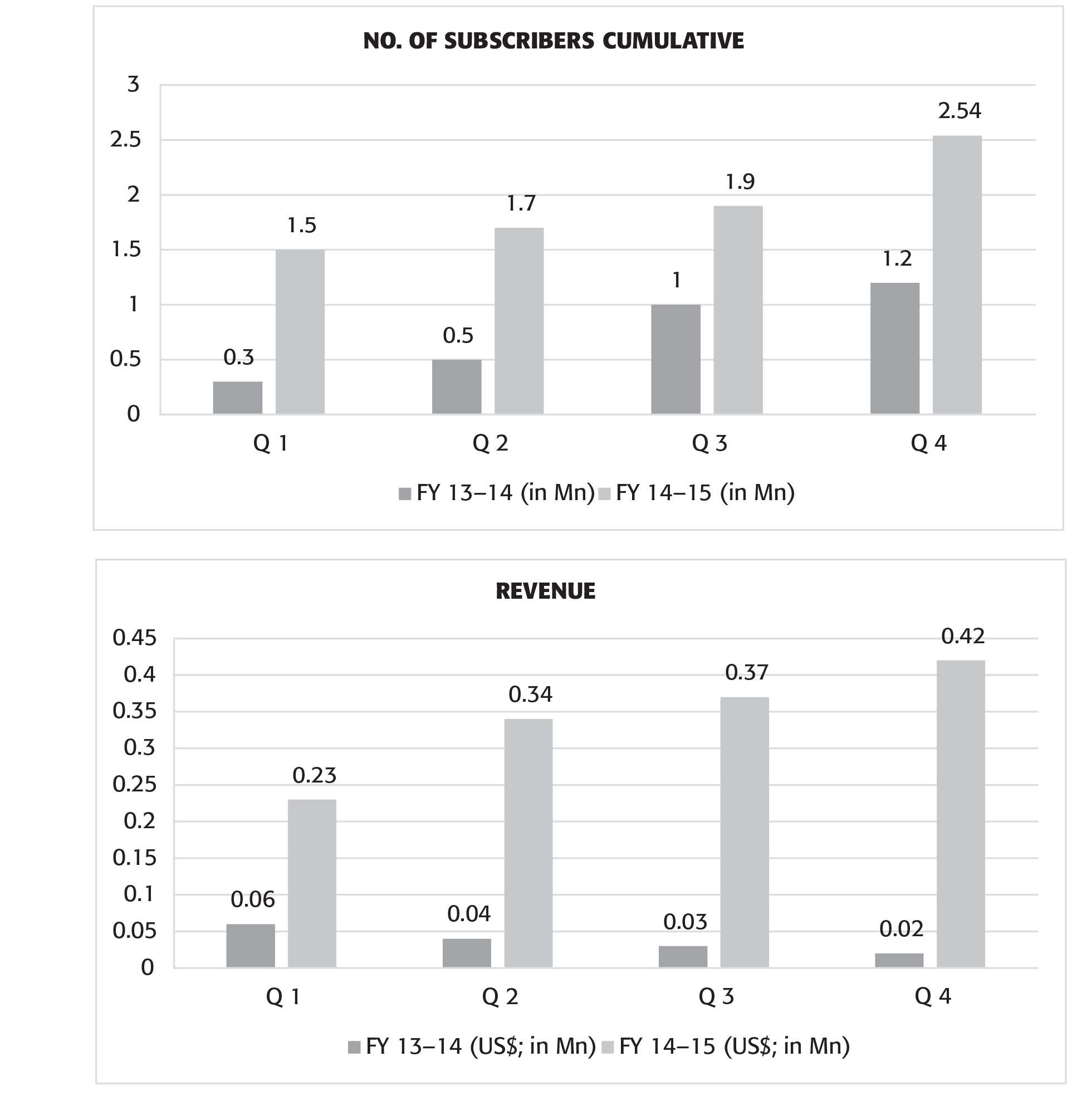
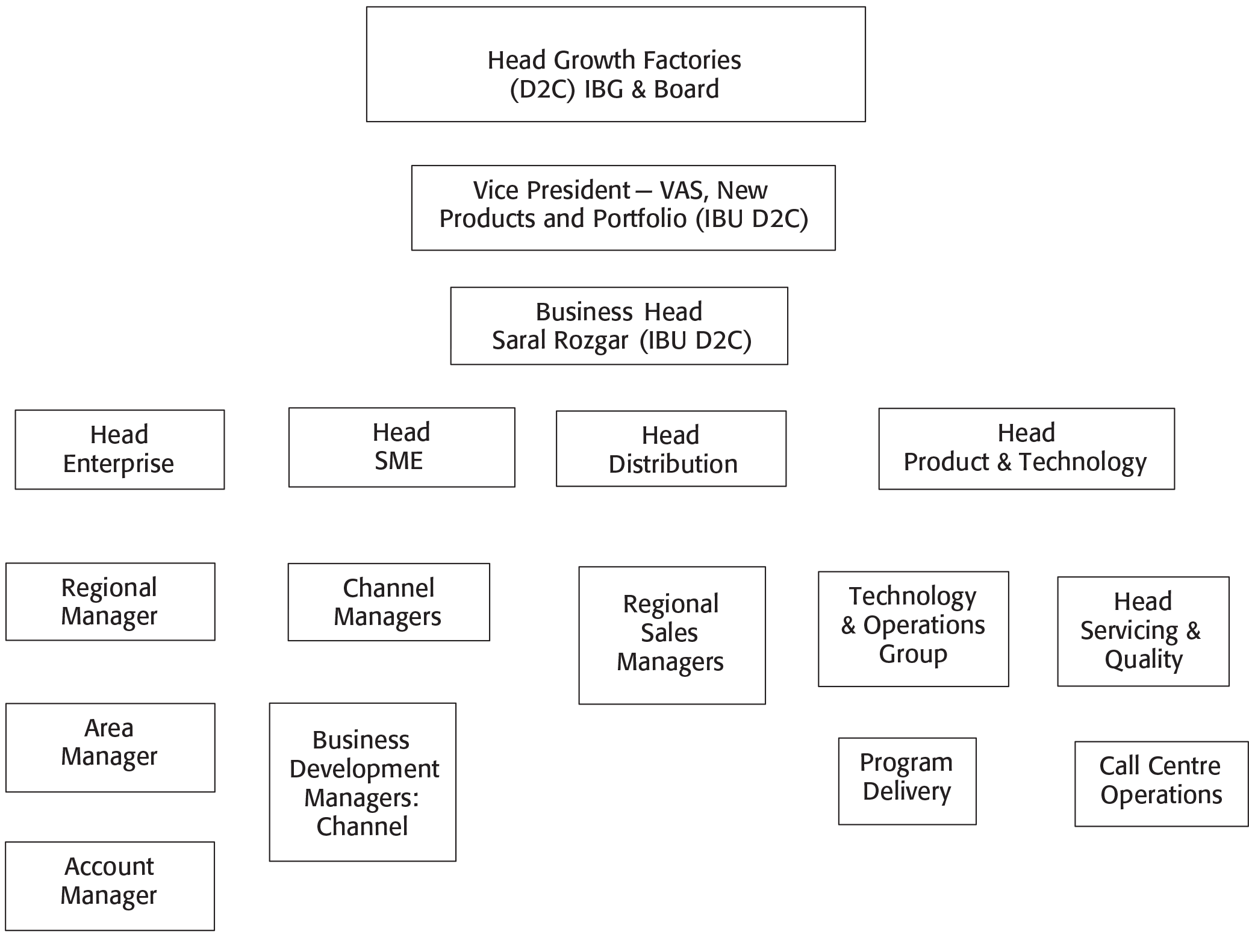
The flight was nearing Delhi. Mitra looked outside the cabin window as he pondered over his dilemma. He understood that the expansion of Saral Rozgar called for establishing a large-scale network of distribution. This would need a dedicated team (Exhibit 12). However, he also knew that he and his team would have to burn the midnight oil to scale up the operation immediately. As the flight began to land, he hoped that he would be able to take a wise decision that would direct the future for Saral Rozgar.