




Abstract
Executive Summary
A number of empirical studies have suggested that servant leadership can enhance the well-being/emotional health of its followers by creating a positive work climate (Black, 2010; Jaramillo et al., 2009a; Neubert et al., 2008). The followers’ sense of well-being, in turn, has been found to be related to greater organizational commitment (Cerit, 2010; Hale & Fields, 2007; Hamilton & Bean, 2005; Han, Kakabadse, & Kakabadse, 2010; Pekerti & Sendjaya, 2010). Greater the organizational commitment, higher is the employee job satisfaction (Cerit, 2009; Chung, Jung, Kyle, & Petrick, 2010; Jenkins & Stewart, 2010; Mayer, Bardes, & Piccolo, 2008) and lower is the employee turnover (Babakus, Yavas, & Ashill, 2011; Jaramillo, Grisaffe, Chonko, & Roberts, 2009b).
A servant leader—with reported behaviour characteristics such as empathy, compassion, and altruistic calling and healing—builds not only a mentally and emotionally healthy workforce but also inculcates a sense of cohesiveness, collaboration, and sustainable relationships among the followers by understanding and addressing their feelings and emotions. It has been reported that cohesiveness and collaboration in a servant-led organization increases pro-social and altruistic behaviour among followers that improves organizational performance (Ebener & O’Connell, 2010; Ehrhart, 2004; Hu & Liden, 2011; Walumbwa, Hartnell, & Oke, 2010) and overall team effectiveness (Mayer et al., 2008; McCuddy & Cavin, 2008; Taylor et al., 2007).
The significance of understanding and addressing the feelings and emotions of followers and ensuring their well-being becomes evident from the above findings. The aim of this qualitative study is to comprehend how servant leaders understand, empathize with, and address the emotional turmoil of their employees.
Orientation for emotional healing is reported to be a unique characteristic of servant leaders. But there is negligible empirical research to understand the way servant leaders alleviate the suffering of their employees. The present study fills this gap.
Qualitative methods and techniques from different qualitative methodologies were used for data collection and analysis. We conducted 15 semi-structured interviews with leaders in corporate, education, and government sectors to capture personal accounts about their experiences, reflections, and analysis of their approach to emotional healing.
Our results suggest that servant leaders—with their orientation for empathy, compassion, healing, altruistic calling, and listening—adopt a compassionate approach to manage employees’ emotional turmoil. All three parts of the process of compassion, described by Clark (1997) and Kanov et al. (2004) are clearly visible in the narratives of our respondents. The servant leaders, with characteristics of empathy and compassion, are oriented towards the followers’ suffering. This leads to empathic concern and compassion that trigger in them an urge to take action to relieve the followers’ suffering. This action, also termed as compassionate responding, manifests itself in a three-step behaviour: (1) patient listening and discussion; (2) empathetic handling that includes comforting and calming as well as guiding and counselling the suffering employee; and (3) taking personal responsibility and providing support (emotional, social, financial, and administrative).
Insight from this study will guide the working managers to understand and practice the process of alleviating the emotional turmoil of employees such that a culture of compassion and benevolence will emerge and sustain for the long-term health and growth of the organization.
A servant leader, with reported behavioural characteristics such as empathy, compassion, and altruistic calling and healing, builds not only a mentally and emotionally healthy workforce but also inculcates a sense of cohesiveness, collaboration, and sustainable relationships among the followers by understanding and addressing their feelings and emotions. It has been reported that cohesiveness and collaboration in a servant-led organization increases pro-social and altruistic behaviour among followers that improves organizational performance (Ebener & O’Connell, 2010; Ehrhart, 2004; Hu & Liden, 2011; Walumbwa et al., 2010) and overall team effectiveness (Mayer et al., 2008; Mc Cuddy & Cavin, 2008; Taylor et al., 2007).
The significance of understanding and addressing the feelings and emotions of followers and ensuring their well-being becomes evident from the above findings. Employees in an organization may be undergoing unpleasant subjective experiences like psychological distress, physical or emotional pain, or existential anguish. This anguish, pain, or distress of the employees could result from a personal challenge like loss or illness of a loved one (Hazen, 2003; Lilius et al., 2008), physical illness or chronic pain (Dewa & Lin, 2000), the breakup of a romantic relationship (Manns & Little, 2010), natural disasters like floods and earth quakes, human made disasters like accidents and organizational stressors like layoffs, injuries at work place, restructuring, and workplace incivility by supervisors and colleagues (Cortina, Magley, Williams, & Langhout, 2001; Driver, 2007; Frost, 2003).
Regardless of the sources of suffering, the resulting distress or anguish of the employee cannot be kept in boundaries (Burke & Greenglass, 1987; Fox & Dwyer, 1999; Frone, Russell, & Cooper, 1992; Hazen, 2008; Lilius et al., 2011; Zedeck & Mosier, 1990). So alleviating an employees’ anguish and suffering becomes very crucial for an organizational leader.
Wheeler (2011) has suggested that servant leaders have a unique orientation towards emotional healing of followers. They alleviate the suffering of the followers to nurture their mental health, empower them, and help them grow professionally and personally. There may be employees in the organization who, having suffered from a variety of emotional wounds, feel shattered. Servant leaders recognize that they have an opportunity to help these people make whole. The orientation of the servant leaders to help people make whole is what Spears (1995) terms healing. Spears (1995) remarked that when hopes and dreams of people end in disappointment or their relationships fail, emotional healing can resolve their broken spirits and emotional pain. Barbuto and Wheeler (2006) referred to emotional healing as leaders’ ability to facilitate sufferers’ spiritual recovery from hardship and trauma. Servant leaders are able to facilitate this recovery because they are highly empathetic and can show sensitivity to others (Liden et al., 2008).
Hinojosa (2010) suggests that those who want to become great servant leaders should inculcate ‘the ability to create an environment that encourages emotional mending’ (p. 1). Weymes (2003) also posited that to be effective, a leader should primarily aim at influencing feelings and emotions of employees to create an emotional heart in the organization. Barbuto and Hayden (2011) reported a very strong relationship between emotional healing component of the servant leadership and Leader–Member Exchange (LMX). This, according to them, means that the leaders who are perceived by their colleagues as able and willing to take responsibility for their emotional healing foster strong and positive relationship with their colleagues. Dacher (1999) and Sturnick (1998) also suggested that healing of suffering colleagues is the most powerful skill required by an effective leader.
The unique orientation of a servant leader for emotional healing may be strongly linked to his/her characteristic of listening, empathy, and compassion. A servant leader is a keen listener. Spears (1995) described listening as the active acceptance of employees’ opinions, ideas, and suggestions. Active acceptance involves hearing and valuing the ideas of others, thus accepting and recognizing their unique spirits. Listening also encompasses hearing one’s inner voice. The ability of the servant leader to listen and reflect may help him/her to understand and empathize with others. Barbuto and Wheeler (2006) suggest that empathy becomes an extension of listening ‘when leaders are able to put themselves in the circumstances of others, or appreciate the circumstance that others face’ (p. 306). Davis (1983) reported a positive relationship between empathetic emotion, characterized by feeling of sympathy and compassion for others and altruistic responding. He found that people with high emotional empathy offer help to people in pain even when they can easily escape from the situation.
Empathy and compassion, coupled with servant leader’s characteristic of altruistic calling—defined as fundamental conscious choice to serve others (Greenleaf, 1977)—can thus create an urge in the leader to do something to ease the pain and suffering of the followers. Using the framework of spiritual leadership, Fry (2003) has also advocated that the leaders use compassion within the context of altruistic love and empathy.
Writing about organizational scholarship, Clark (1997) and Kanov et al. (2004) described compassion as a three-part process. The first part included noticing or attending to the suffering of a person. The second part is feelings that are inherently other-regarding, that is, compassion for someone other than themselves (Cassell, 1991; Solomon, 1998). These feelings resemble empathic concern (Batson & Shaw, 1991; Davis, 1983) because of the relation felt with others. The third part included action or response, a behavioural display (Clark, 1997), aimed at easing suffering in some way (Frost et al., 2000; Reich, 1989). Thus, compassion has been defined as noticing, feeling, and responding to another’s suffering (Dutton et al., 2006).
In the light of the reported characteristics of empathy, compassion, healing, and altruistic calling and service in servant leaders, it can be assumed that servant leaders will easily notice and attend to the suffering of their followers. The characteristic of empathy enables them to feel the followers’ suffering and with altruistic calling, healing and service orientation, they can serve by taking action to alleviate their suffering.
The present qualitative study thus attempts to find out whether our assumption regarding servant leader’s compassionate approach towards emotional healing of his/her followers holds true, that is, do servant leaders manifest behaviours such as attending to employees’ suffering, experiencing empathic concern for employee’s anguish, and taking action for alleviating the suffering of the employees.
SIGNIFICANCE OF THE STUDY
Various intra- and extra-organizational pressures and challenges take a toll on the emotional well-being of the employees, threatening the long-term health of the organization. In such a scenario, organizational leaders have to be the managers of emotions rather than managers of only hard facts and data (Manikutty, 2003). Khandwala (2004) also called for humane business management in the present-day competitive and turbulent business environment. The leaders have to be sensitive to the emotional turmoil of the employees and put in extra efforts to pull the employees out of their sufferings and restore their emotional balance.
Servant leaders with their reported unique orientation for emotional healing may play a significant role in restoring the emotional balance of employees by incorporating a culture of care and compassion at work. Such a compassionate culture can foster amongst members the collective action capacities to notice, feel, and respond to others’ suffering as well as to improve their state of well-being. This positive organizational culture can impact employee development, employee satisfaction, employee engagement, and commitment and, in turn, organizational success. Support for servant leaders’ ability to facilitate positive organizational culture and positive job behaviours can be found in research studies conducted by various scholars in different contexts. According to these scholars, the positive job behaviours in servant leader lead organizations to manifest at micro (individual and group) as well as macro (organization) levels. For example, positive behaviour constructs manifested at individual level include hope, self-efficacy, resilience, optimism, flow, forgiveness, gratitude, creativity, and wisdom (Bandura, 1997; Csikszentmihalyi & Nakamura, 2005; Snyder, 2000). At group/team level, positive behaviours such as collective self-efficacy (Bandura, 1997), team psychological capital (Luthans, Youssef, & Avolio, 2007), and collective hope, (Snyder, 2000) were reported. Positive macro-level behaviour in such organizations can be discerned in terms of organizational forgiveness, organizational gratitude, organizational citizenship behaviour, organizational virtuousness, organizational resilience, and organizational compassion (Cameron, Bright, & Caza, 2004; Cameron, Dutton, & Quinn, 2003; Caza, Barker, & Cameron, 2004; Jit, Sharma, & Kawatra, 2016). These positive micro- and macro-level behaviours, in turn, create a positive organizational culture and mediate the relationship between servant leadership and higher performance (Ehrhart, 2004; Jaramilla et al., 2009a; Neubert et al., 2008). Podsakoff, Whiting, Podsakoff, and Bloom (2009) also reported an association amongst organizational citizenship behaviour and organizational productivity and efficiency, employee satisfaction and performance, and customer satisfaction.
In the light of such research findings, business organizations are increasingly focusing on the human side of management, and looking for leaders who can steer the organization by adopting a positive leadership style. Servant leaders, with their service orientation and pro-follower management approach seem to fit in this frame work.
The present study was taken up to identify various positive characteristics of servant leaders in a particular context, that is, while alleviating the suffering of their subordinates. Such positive behavioural characteristics can be assumed to pave the way for the emergence of positive, compassionate, and emotionally healthy organizations that can provide a long-term competitive advantage to the organization. A relationship between positive value orientations, characteristics, and behaviours of the leader, and the emergence of positive organizations have already been suggested by various researchers (Bennis, 1997; Karakas & Sarigollo, 2013; Sharma & Jit, 2014).
Insights provided by this study into servant leader’s approach to emotional healing will guide working managers to understand and practice the process of alleviating the emotional turmoil of the employee such that a culture of compassion and benevolence will emerge and sustain for the long-term health and growth of the organization.
Another significant contribution of the study will be to the advancement of almost non-existent empirical literature on the role of leadership in emotional healing.
METHODOLOGY
Qualitative research often uses stories, conversations, interviews, life experiences, field notes, journals, autobiographies, photos, etc. as sources of data. In the present study, semi-structured interviews were used to discover the values and perspectives of servant leaders as they interact with their subordinates in the context of their emotional turmoil.
The aim of the researchers was to ‘capture immediate pre-reflective consciousness of the participant (as his/her self-given awareness that belongs to and is processed by the participant) rather than as something which is based on his/her perception and thus existing apart from self’ (D’Cruz & Noronha, 2013, p. 6).
We are not following the grounded theory approach because the framework of servant leadership already exists. However, since there is no previous literature or theory on our area of investigation, no hypothesis has been framed.
We conducted 15 semi-structured interviews with leaders in the education sector, corporate sector, and public (government) sector. Respondents with an orientation for servant leadership were identified based on the feedback collected through in-depth interviews of present and past subordinates, and peers. About 8–10 subordinates and colleagues of each leader were interviewed. The interview questions were based on five key dimensions of servant leadership as identified by Reed, Cohen, and Colwell (2011), namely interpersonal support, building community, altruism, egalitarianism, and moral integrity. These dimensions are comprehensive, exhaustive, and robust, both conceptually as well as empirically.
Reed et al. (2011) identified 55 items measuring key dimensions of servant leadership from instruments created by Barbuto and Wheeler (2006), Ehrhart (2004), Liden et al. (2008), and Page and Wong (2000), and modified these items to specifically measure top executive behaviour. Since the present study targeted servant leaders from top management level, it was considered apt to use the scale developed by Reed et al. (2011) to identify servant leaders for our sample.
Based on feedback from the leaders’ subordinates and colleagues, we generated a list of 20 servant leaders from the education, public, and private sector. Out of the 20 shortlisted leaders, 15 were willing to participate in the study and completed the interview schedule.
There were 3 respondents from the education sector, 4 from the corporate sector and 8 were from the public sector. In all, 10 male and 5 female leaders in the age range of 45–65 were interviewed. The respondents had 20–35 years of service experience and belonged to top management.
The researchers interviewed the respondents in person over a period of six months (April, 2014–September, 2014). The questions for the semi-structured interview were prepared with inputs and suggestions from scholars with expertise in qualitative research methods. The questions tried to study the approach of servant leaders towards healing the emotional turmoil of their subordinates. The open-ended questions were designed to have an in-depth understanding of leaders’ personal experiences and their perspectives regarding these situations. The semi-structured nature of interviews gave considerable flexibility to the participants to determine the extent and direction of the conversation for the given question.
Before starting the interview, the following three things were kept in mind:
The purpose of the study was explained in detail to the participants. The respondents were given an opportunity to ask questions (if any) to the researchers before the interview started. Participants were assured about confidentiality. The interviewer spent about 5–10 minutes over an informal interaction with each participant to establish a rapport. Interviews were audio-recorded. The recordings of the interviews were transcribed verbatim and reviewed for accuracy by the researchers who conducted the interviews.
DATA ANALYSIS
Statements of the respondents were analyzed using the model of Plowman et al. (2007), which advocates the use of a predetermined framework for carrying out data analysis. In our study, the typical characteristics of servant leadership have been used as a guiding framework for carrying out data analysis, that is, the researchers have tried to find out whether typical characteristics and values of servant leadership such as empathy, altruistic calling, compassion, healing, etc. emerge while handling the emotional turmoil of employees.
Data analysis followed the below-mentioned pattern:
Transcription of interviews;
Preparation of analytical and reflective memos;
Coding by individual researchers;
Systematic inter-researcher discussions to resolve discrepancies regarding coding and thematic categories;
Selection of central theme; and
Development of narrative themes.
The primary analysis of the transcripts was conducted by two independent researchers. A third researcher reviewed the initial coding of transcripts and joined the two investigators for conducting the final analysis. Various themes were developed based on the interview data. Key themes were identified, discussed, and reviewed by all the investigators for ensuring that the saturation point (for the key themes) had been reached.
There are three different approaches to identify themes from the given data/text (Van Manen, 1998):
Holistic or sententious approach which involves attending to the data as a whole and capturing the fundamental meaning of the data; Highlighting or selective approach which involves repeatedly listening to or reading the text and examining the statements which seem to be particularly revealing; and Line-by-line approach or detailed approach which involves thorough study of each sentence cluster or sentence to determine what it says about the experience.
In the present study, the researchers adopted first two approaches (1 & 2) to identify the themes. Following the sententious/holistic approach, each transcript was read as a whole so that core/essential meaning of respondents’ experiences could be captured. Researchers, then, followed the selective/highlighting approach through which they identified the sub-themes/categories that contributed to the core theme.
Subsequently, the team of researchers tried to identify the central theme, causal and intervening conditions, and the specific context in which a particular characteristic or behaviour of a leader emerged. An effort was also made to study the relationship among various themes. For example, in our study, failure of the suffering employee to handle his/her emotional turmoil despite guidance and counselling becomes a reason for the leader to be actively involved in helping the employee by giving required support and taking greater responsibility to alleviate his/her suffering. In other words, the need for providing more support and taking up greater responsibility is felt because guidance and counselling could not serve the desired purpose, showing a relationship between the two themes.
Lincoln and Guba (1985) suggested that qualitative research can provide more appropriate standards of evaluation and also protection of scientific rigour, if it proves its trustworthiness in terms of confirmability, dependability, credibility, and transferability. To evaluate confirmability, the present study took the help of two teachers trained in qualitative research to evaluate the process of identifying codes and themes as well as the process of developing coding structures, thematic summaries and definitions, parameters, and examples of codes. By thoroughly reading and coding the transcripts, they also checked that the saturation point regarding the key themes had been reached.
To evaluate dependability of the analysis, the teachers analyzed the transcripts, developed codes and themes, and compared their interpretation of narratives with those of the researchers to match the levels of consistency between the two. The level of consistency was found to be quite high.
To evaluate credibility, the respondents were presented with the analysis of their interviews, that is, the themes and supporting statements, and they were asked to confirm whether these themes represented their statements. The respondents showed high level of agreement with the themes and their interpretations. The criteria of transferability can be met, if future research is able to corroborate and use these findings in the new contextual environments.
Harding (1987) suggests that the researchers should also be subjected to critical examination, the way it is done in case of overt subject matter. We also tried to observe and document our own assumptions, perspectives, and biases while analyzing the data. For example, it was our assumption that a servant leader will be more empathetic, caring, altruistic, and compassionate while handling employees’ emotional turmoil. This assumption could affect our interpretation, so an extra effort was made to constantly observe and guard against any intrusion by these biases and assumptions. Three stages followed in the development and evaluation of codes and themes, that is, by individual researchers, by team of researchers, and by auditors (teachers trained in qualitative research), which is an example of this effort.
FINDINGS
1
Text (quotes) in italics represents direct quotes of respondents in the interview.
Text (quotes) in italics represents direct quotes of respondents in the interview.
Many scholars have reported the existence of behavioural characteristics in servant leaders that create in them compassion, whenever they find any of their followers in emotional turmoil.
The analysis of servant leaders’ statements in our sample manifests an undercurrent of experienced or felt compassion, on awareness of the anguish or suffering of their employees. This leads to compassionate responding to relieve the suffering. The process of emotional healing is a journey from felt compassion and empathic concern to compassionate responding. The following conceptual model (Figure 1) illustrates the transition from servant leaders’ felt compassion to compassionate responding for relieving the suffering of the employee.
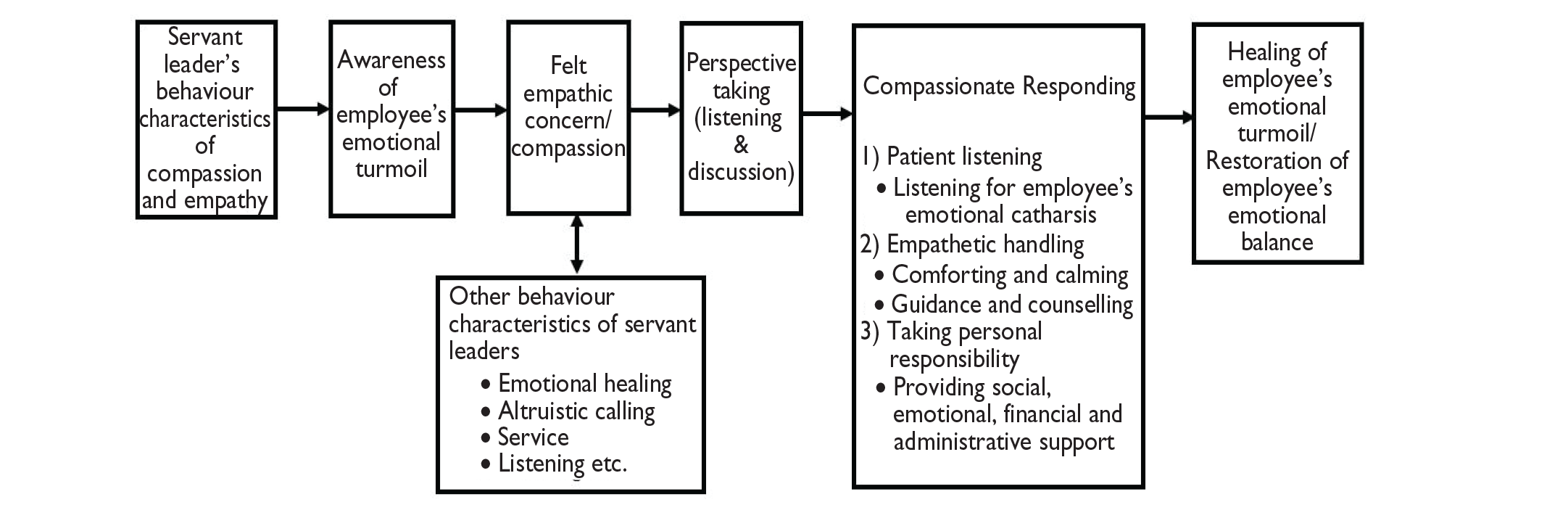
This model incorporates the construct of servant leader with inherent behavioural characteristics of empathy and compassion which facilitate his noticing of employee suffering. This awareness creates in him an experience of compassion and empathic concern, triggering the urge to understand the situation (perspective taking) and take action to relieve the suffering of the employee (compassionate responding). The felt compassion and empathic concern may be mediated by other characteristics of the servant leader such as altruistic calling, healing and service orientation, listening, etc.
The compassionate responding manifests itself in the following set of step-wise behaviours:
Patient listening and discussion (for providing the employee an opportunity for emotional catharsis); Empathic handling which includes calming and comforting, and guidance and counselling; and Taking personal responsibility and providing social, emotional, financial, and administrative support.
It is evident from various statements presented in this section, the servant leaders, through their compassionate approach, could help their employees to overcome their anguish and restore their emotional balance.
Felt/Experienced Compassion and Empathic Concern
Leader to follower compassion represents a dyadic process where leader notices the suffering of the follower, feels empathic concern, and responds compassionately (Kahn, 1993; Lilius et al., 2008; Margolis & Molinsky, 2008; Miller, 2007). There is significant research evidence demonstrating a reliable association of empathic concern with actual helping behaviour (Archer et al., 1981; Coke, Batson, & McDavis, 1978). The following statements of our respondents manifest an experience of compassion and empathic concern, whenever they noticed the emotional turmoil of the employees:
“You know one feels like a parent to someone needing help. You have to help the person unwind and get peace”. (R2)
“I was concerned for him, and felt something has to be done”. (R12)
“Just felt like doing something to relieve his pain”. (R15)
“I sincerely wished he could come out of it. I felt he required inner transformation to face the things bravely and thought of sending him for one personal development and leadership development programme.” (R11)
“Once I came to know about her problem I just wanted to help her at the earliest.” (R10)
“I ensured that I was available and that no harm happened to her.” (R4)
“Everyone goes through such phases at some time or the other. One feels empathetic.” (R6)
These statements illustrate various aspects of compassion in our respondents: a feeling of parental concern; an urge to help the employee unwind and be peaceful; a genuine concern and willingness to help relieve employee’s pain; being available; saving the employee from potential harm; and trying to bring about inner transformation of the employee so that he/she can face the odds bravely. This felt compassion or empathic concern in the servant leaders trigger in them an urge to respond compassionately to alleviate the suffering of the employees. However, before taking action, the servant leaders tried to understand the situation; for example, in this study, they tried to understand the genesis of the turmoil as well as the feelings and views of the employees about the situation. Our respondents used patient listening and discussion for this purpose (related statements have been given in the next section as in many cases listening and discussion have been used for perspective taking as well as for employee’s emotional catharsis). As suggested by Kanov et al. (2004) and Oveis, Horberg, and Keltner (2010), empathic concern which involves perspective taking, plays a significant role in the organizations by connecting awareness of employees’ suffering to compassionate responding.
Compassionate Responding
Patient Listening and Discussion
Ferch (2012) noted: ‘In listening we surrender our ego and seek the above-the-line consciousness that results in a life lived for the greater good of others and the world’ (p. 130).
In the present study, patient listening and discussion became the first step of compassionate responding and were used as a tool, giving the employee an outlet to his/her turmoil. As mentioned earlier, listening and discussion have been used for perspective taking as well. For example, to manage an employee’s turmoil, Respondent 1, as a practice, leads the talk and gives time to the employee to express his feelings so that he can understand and address the issue.
Respondent 2 prefers to create a cordial atmosphere while listening to employee’s problem. This, according to him, not only provided a deeper understanding of the problem but also reduced the turmoil of the employees by at least half, immediately. Respondent 3 also prefers to lend his/her sympathetic ear, whenever an employee comes and shares something.
Talking to the emotionally troubled employee and trying to understand him/her at length is the modus operandi adopted by Respondent 6 as well. His company prefers to arrange group outings so that the subordinates feel free to share their issues and turmoil with their superiors in an informal environment.
Like Respondent 2, Respondent 9 and Respondent 14 also use listening as a tool for subordinate’s catharsis as well as understanding the issue. Respondent 9 just lets them talk and makes them feel comfortable. He listens patiently, helping the upset employee release stress and sort out the issue, if they so desire. Respondent 14 listens to employee’s emotional problem to understand the genesis of the problem and to help solve it. Likewise, Respondent 15, a senior bureaucrat devotes separate time to her emotionally upset subordinates, listens to their woes intently, and tries to find a solution.
Empathetic Handling
Some scholars have identified empathy as a critical behaviour characteristic of servant leaders (Liden et al., 2008). Our respondents manifest this characteristic in empathetic handling of their employees. They care for their suffering employees and try to calm and comfort them when they are distressed or anguished. Kouzes and Posner (2000) suggested that leaders who care and encouraged the heart of people working with them created a feeling of well-being in them.
Respondent 6 not only uses the comforting approach himself but also encourages his managers at various levels to adopt this approach towards distressed employees. He said, “If there is any such behaviour, we calm him/her down. Each manager is told to handle the employee sympathetically”.
Respondent 9 feels that most of the employees calm down and become stable once they feel that their superior is empathically listening to them. Respondent 14 corroborated this statement, when he said that half the suffering of the employees gets relieved once you give them an opportunity to give outlet. It helps to calm their mind. Respondent 10, on the other hand, adopts an approach of handling his anguished employees very affectionately to help them feel calm and relaxed.
Respondent 2 has always been a parent figure to his employees and has handled many cases of emotional turmoil in his professional career. He said, “Many a times my employees seek my advice not as a head of the institute but as a brother or father figure. So I give them both professional advice and personal advice if they choose”.
Respondent 6 has a team of senior managers who handle such cases at different levels. Employees in turmoil are guided and counselled in a way that they can handle their problem in a mature manner. These employees are often told that everybody encounters such things in different phases of life, so they need to reason themselves out and balance themselves out.
Respondent 9 narrated the case of a female officer who was emotionally disturbed because of her family problems. The respondent counselled her to immerse herself in the office work as only time would help sort the situation. The female officer came back to him after one week, and told him that it was the best advice he gave her. Her problem got solved on its own. He said, “I told her, life is something that you carry up to 70 or 80 years and these are the small situations that can make you feel bad for some time but ultimately everything will be alright”. Respondent 10 also coaxes his employees to come to office when they are undergoing emotional disturbance. He makes them feel comfortable in the office and counsels them to help them overcome their emotional turmoil.
Respondent 13 felt that when an employee is going through a problem, he/she may get so bogged down that even a visible solution may elude him/her. The boss who can see the things objectively and from a distance can guide the employee to find the solution.
Taking Personal Responsibility
Servant leaders manifested a sense of belongingness in their interpersonal interactions with their subordinates. Many servant leaders made categorical use of the phrase like a family while speaking about the relationship of the employees to the organization. Many of these leaders suggested that since employees were spending most of their working hours in the organization, they have to be taken care of and their problems sorted out with the same sense of responsibility as one would for their own family. Seven out of 15 respondents reported that they like to take up the responsibility to help their employees whenever they were going through an emotional upheaval.
The spirit of taking responsibility manifests itself very clearly in the statement of Respondent 1 when he said, “We believe, as employees of the organization, they are part of a big family. Right? So we are responsible to take care of them”. Respondent 2 took responsibility that the emotional turmoil of the employee does not escalate. Like Respondent 1, he also felt that since the employee was spending a large part of the day with the organization, the organization has to take responsibility to bring balance in employee’s emotional life.
Respondent 7 felt that most of the emotional turmoil in the corporate employees, who spend 8–10 working hours in the organization, is triggered by organizational factors such as organizational incivility, organizational politics, organizational restructuring, etc. If she finds her employees in emotional turmoil, she tries to understand the reason and takes responsibility to cure the turmoil-inducing processes as far as possible.
Respondent 10 narrated the instance of his female employee who left her job for further studies. Due to financial and personal reasons, she was unable to pursue her studies. He re-employed this lady, ensured her readmission in the university and gave her paid study leave. Another remark made by this respondent shows his selflessness in such benevolent acts. “Next month she will be submitting her thesis and she will be coming back. Even if she does not come back, we will have a better person”.
Respondent 11 also believed in taking responsibility when his subordinates went through some personal thrive. He narrated the case of an employee who could overcome an emotional upheaval because our respondent helped him undertake a personal development and leadership development course.
Respondent 13 talked about taking responsibility of emotionally upset employees at two levels—at individual level, the employee has to be guided and helped in finding a solution and at organizational level, it has to be ensured that they feel happy and cared for while working in office.
Respondent 15 narrated the case of a female employee who was undergoing an emotional upheaval due to sexual harassment by her colleague. Our respondent, a senior government officer, intervened and made sure that the fellow was transferred from the division and the lady was allowed to work in peace.
Support (Emotional, Social, Financial, and Administrative)
Support emerged as the most prominent theme in the data analysis. Eleven out of 15 respondents stated that they took it as their responsibility to provide required support, when they became aware of the emotional turmoil of their employees. The nature of support provided depended on the requirement of the employee and the availability of resources.
For example, Respondent 1 reported that his company was always prepared to help employees facing emotional disturbance.
“If somebody is disturbed due to financial crisis, we support him in that. It could be collection through friends or we give recommendation to management, if they can give fund or salary in advance. We make sure that whenever an employee is going through tough times, we are there”.
Respondent 2 said that he had handled many cases of emotional turmoil in his professional career, always lending his shoulder to the suffering subordinates. He said smilingly, “Sometimes my faculty members jokingly remark that whenever they feel like crying they come to my office alone”.
Respondent 3 tries to go out of her way to help her emotionally disturbed subordinates. She cited the case of one of her employees who remained pretty disturbed because of personal reasons. Respondent 3 always kept that in mind and went an extra mile to help her out.
Respondent 4, who is the principal of a reputed educational institute, emphasized that as the head of the institute, he tries to be true friend of his faculty members and students. This helps them have faith that their principal will be supportive in their crisis.
Respondent 5 cited a recent case of one of his female subordinates who was not able to cope with rude colleagues. He provided her administrative support and arranged her transfer since no other desirable solution was immediately possible. Respondent 9 always gave space to his employees and intervened only if their emotional turmoil was very acute and affected their work. In such cases he extended whatever support he could, to his employees.
Respondent 10 showed extraordinary sensitivity to the emotional turmoil of his subordinates. He was ready to provide a lot of support like, releasing work pressure by assigning their work to some other employees so that they could bounce back from the problem. He stated, “We sometimes assign their job to someone else, but insist that they come to office regularly and make sure that they are very much comfortable”.
Respondent 14 provided social as well as administrative support to her subordinates when the latter were undergoing a personal trauma, like providing references of the right doctor in case of health related stress, granting required leave to take rest and to regain health, and lending an empathetic ear if an employee has an emotional problem. Respondent 15 also had an orientation for being empathetic towards her anguished employees. She said smilingly, “I am a kind of agony aunt to many. I have that. That is true”.
DISCUSSION
Analysis of the statements of servant leaders confirms our assumption that servant leaders manifest a compassionate approach towards handling of employee emotional turmoil. All three parts of the process of compassion described by Clark (1997) and Kanov et al. (2004) are clearly visible in the statements of our respondents. It was found that our respondents used their characteristic of listening to patiently listen to the follower’s problem and understand its genesis. Hall (2010) suggested that as part of compassion, this understanding or knowledge can be used ‘as a motivation for action, with specific aim of increasing happiness and diminishing suffering’ (p. 121).
Our respondents, at times, used listening as a tool for employees’ catharsis of their emotional turbulence. Many of our respondents confirmed that just lending a sympathetic ear had partially or fully alleviated employees’ suffering in many cases. Some servant leaders arranged group outings so that subordinates felt free to share and discuss their issues and problems with the leaders.
Rai and Prakash (2012) observed that servant leaders want to lead in such a way that their ‘followers become empowered, responsible, healthier, wiser and autonomous’ (p. 64). To realize this, they may want to consider acting on their awareness and understanding of followers’ suffering (Davenport, 2015). According to Davenport, a point might come ‘where the servant leader can no longer settle for an empathetic understanding of the suffering of another, but instead may seek to take necessary actions to begin working to alleviate the cause of the suffering’ (p. 307).
In this study also, once the respondents are conversant with the genesis of the problem, they proceed to handle employees’ turmoil empathetically by calming and comforting the suffering employees. Sometimes the leaders may assign a part of the emotionally disturbed employee’s workload to other co-workers to make them feel relaxed and comfortable.
Guiding and counselling the employees who seek leader’s advice also manifest empathetic handling as well as altruistic tendency of servant leaders as they are always eager to devote extra time and effort for their employees without any self-interest. The counselling not only helps the suffering employees to navigate through their turmoil but also find their own solution. However, there may be instances where the sufferer may not be able to solve the issue on his/her own. In such cases, servant leaders willingly take steps to facilitate the healing process. They are ready to take personal responsibility and provide maximum possible support—emotional, social, financial, or administrative—depending on the requirement of the employee.
Our results are largely in consonance with the findings of Dutton et al. (2006), Frost et al. (2000), and Lilius et al. (2008) who suggested that compassionate responding can take at least three forms in work organizations—emotional support, material goods, and support related to time and work- or home-related flexibility.
Our respondents also manifest a sense of belongingness/interpersonal citizenship when they take personal responsibility for easing out the suffering of their employees. Since employees spend large part of the day with the organization, servant leaders take it as their duty to bring balance to the employees’ emotional life through various pro-social behaviours. Brief and Motowidlo (1986) and Penner et al. (2005) suggested a close link between compassionate responding and pro-social behaviour while Podsakoff et al. (2000) linked it to interpersonal citizenship which, according to Dovidio and Penner (2004), focuses on helping behaviour or some intentional actions that benefit another.
Critics sometimes caution against excessive pro-follower inclination of servant leaders as it can lead to loss of focus on organizational goals in terms of shareholder value and profits. Positive psychologists, on the other hand, emphasize the need of ensuring well-being of employees through interpersonal citizenship, by understanding and meeting various needs of the employees, and by helping them to become the best. As we have already reported in the text, organizational leaders who have such pro-follower orientation are more likely to have committed, emotionally balanced, and motivated employees who, in turn, can add to organization’s competitive advantage. Levering and Maskowitz (2000) contended that as per the Fortune survey, servant leadership has been advocated and practiced in some of the best companies to work for in America.
LIMITATIONS
Reissman (1993) stated that the stories narrated by people are inherently multilayered and ambiguous. So, narrative analysis is bounded by the constructed nature of truth and presents subjective and individual perspectives. While this is a weakness, if we are able to decipher the commonalities in the aspects of perspective, it helps at generalization. Identification of themes from the narratives is actually a process of deciphering these commonalities.
Some empirical scientists may argue that for our study, we should have used a standardized tool for identifying servant leaders based on self-report. We followed an equally rigorous method of selecting our sample as has been detailed in the methodology. Selecting servant leaders on the basis of feedback from present and past subordinates and peers has its own strength. When people working with the leader testify the existence of given behavioural dimensions in the leader, it could be a more valid measure of a leader’s behaviour.
The interview questions used for getting the feedback were based on Executive Servant Leadership Scale developed by Reed et al. (2011). As already mentioned, this questionnaire has been specifically developed to measure key dimensions of top executive behaviour—a sample used in this study.
A conscious effort was made to minimize the researchers’ potential bias by taking various measures to ensure maximum objectivity at different stages of data analysis.
Lack of a comparison group may be another limitation of the study. It may constrain our conclusion that the emergent orientation for compassionate handling of employees’ emotional turmoil is associated with servant leadership only. Here we will like to emphasize that the present research study was designed to elucidate servant leaders’ approach to emotional healing, not to compare and contrast it with the approach of other leadership styles. Our results can become a basis for future qualitative research wherein a comparison can be made between emotional healing strategies of servant leaders and other value-laden leaders.
CONCLUSIONS
The ancient Indian thought christens man as amritsasya putra (child of the immortal) and emphasizes that the true aim of any human endeavour, be it business or otherwise, is to help a person recover his/her being, through the process of becoming (Chakraborty, 2004). The servant leaders in our study seem to play this role quite effectively as they help their subordinates come out of their shattered selves and be whole once again.
Davenport (2015) observed that compassion entails a deep caring and concern for one another—an attribute found in a servant leader as well. So, ‘it is possible that servant leadership and compassion can and should coexist’ (p. 304). Servant leaders, with a compassionate approach towards handling employees’ emotional suffering, can play a crucial role in defining and creating an organizational environment in which the employees can experience positive emotional health and well-being.
Positive employee attitude can have implications for the emergence of an empathetic, caring, cordial, helping, and supportive environment—all elements of a compassionate organization. Kanov et al. (2004) proposed a framework of organizational compassion wherein dyadic compassion process gradually turns into social compassion process. The members of an organization may start noticing the suffering of their colleagues, express and share their felt empathic concern, and respond to colleagues’ suffering in a collective and coordinated way. Various researchers such as Dutton et al. (2006), O Donhoe and Turley (2006), and Powley (2009) provided empirical support to Kanov et al. (2004) model/framework.
Future research can explore employee attitude towards the management of employees’ emotional turmoil by servant leaders. Another suggestion for future researchers is to have a comparison group of any value-laden leadership style such as compassionate leadership, benevolent leadership, spiritual leadership, and transformational leadership to find out differences/similarities, if any, in the modus operandi of two leadership styles in alleviating the suffering of followers. Bangari (2014), for example, reported manifestation of genuine concern by the transformational grassroots military leaders for the well-being of their subordinates while operating in high-intensity, high-risk operational environments. These leaders went beyond mere give-and-take relationships to a deeper sense of responsibility. The researchers can also address how different leadership roles and styles relate to and complement one another to create compassionate organizations.