




Abstract

Keywords
From space, planet Earth appears to be incredibly rich as exemplified in the symbolic image of ‘Earth Rise’ captured by the crew of Apollo 8 on 24 December, 1968. It seems improbable that in less than 50 years since then, the planet could be on the brink of a set of disasters. Disasters are not new phenomena; they have been faced since time immemorial. However, the current set of disasters is fundamentally different from the earlier ones since their cause is not rooted in nature. It can instead be attributable to technological progress which also provides us an opportunity to address them through human actions and behaviours.
One of the most visible disasters facing us today is the growing volume of waste generated in both the production and consumption of goods and services. The increase in waste can be traced back to two specific observations. First, there is a significant increase in world population, primarily due to reduced mortality rates stemming from medical advances. This has resulted in a larger pool of potential waste generators. Second, there has been a rise in per capita incomes of individual consumers driven in part by the fact that two of the largest populated economies, China and India, have started to develop their industrial bases. This growth in per capita income has led to increased demand for goods and services which has consequently led to an increase in the rate of waste generation.
Let us first consider the following statistics about waste across industries (UNEP, 2011, 2013; World Bank, 2012):
While there has been a consensus on the substantial increase in e-waste generated in India, the data published by different agencies reflected dissimilar figures. For example, as per the GOI data, 0.15 million tonnes of e-waste was generated in 2005 (Scientific India, Scientific India); however, the Manufacturers’ Association of Information Technology (MAIT) estimate was 0.4 million tonnes every year with Greenpeace India noting that this was probably 0.8 million tonnes since the MAIT estimate excluded electronic and electrical goods such as televisions, refrigerators, and DVD players. The most recent information available from the UN states that in 2014, 1.7 million tonnes of e-waste was generated in India. The same report also warned that the volume of global e-waste is likely to rise by 21 per cent in the next three years (The Times of India, 2015). This increase in waste generation issue is compounded by the fact that historically only 5 per cent of the country’s e-waste has been recycled, with at least 40 per cent of obsolete and unused computers and electronic products languishing in homes and warehouses (Parishwad, 2011).
The focus of this article is on waste management. The ineffective management of waste can pose significant health and ecosystem hazards. It has been observed that waste ‘leachate’ can lead to soil and water contamination; waste burning causes air pollution; and if recycling is not practiced, non-renewable natural resources could get depleted. Additionally, increase in health problems has been noted in the population residing in the vicinity of waste disposal sites.
Limited institutional capacity, scarce financial resources, and political constraints are some of the most pressing issues in effective waste management. The changing mix of environmental, social, and poverty aspects especially in developing economies has led to lack of coordination in addressing waste management problems. It is now recognized that a more holistic environmental approach which focuses on 3Rs (reduce, reuse, recycle) would be a better strategy to achieve sustainable goals. In addition, this could also generate employment and thereby contribute to economic development and simultaneously address environmental issues equitably.
This article proposes an integrative framework for waste management across the supply chain. It further identifies linkages between research and practice in the area of reverse supply chain and how it can facilitate the management of waste. More specifically, it reviews the extant research on designing and operating reverse supply chain and environmentally focused legislative practices with a view to providing insights for reducing the generation of waste, and examining how the reuse and recycling of materials can lead to a reduction of waste for disposal.
WASTE MANAGEMENT—AN INTEGRATIVE FRAMEWORK
Waste generation can be associated with multiple stages in the supply chain starting from the process used for raw materials generation to the waste generated by the end users/customers. Without loss of generality, we propose a cradle-to-grave (C2G) framework for examining waste generation using the stylized supply chain with four major stages as shown in Figure 1. At Stage 1, there are a set of firms involved in raw material generation which in turn provide input to Stage 2 firms whose primary activity is manufacturing and production. Stage 3 firms are involved in the distribution and logistics activities (and obtain input from Stage 2) which serve the final customers (Stage 4).
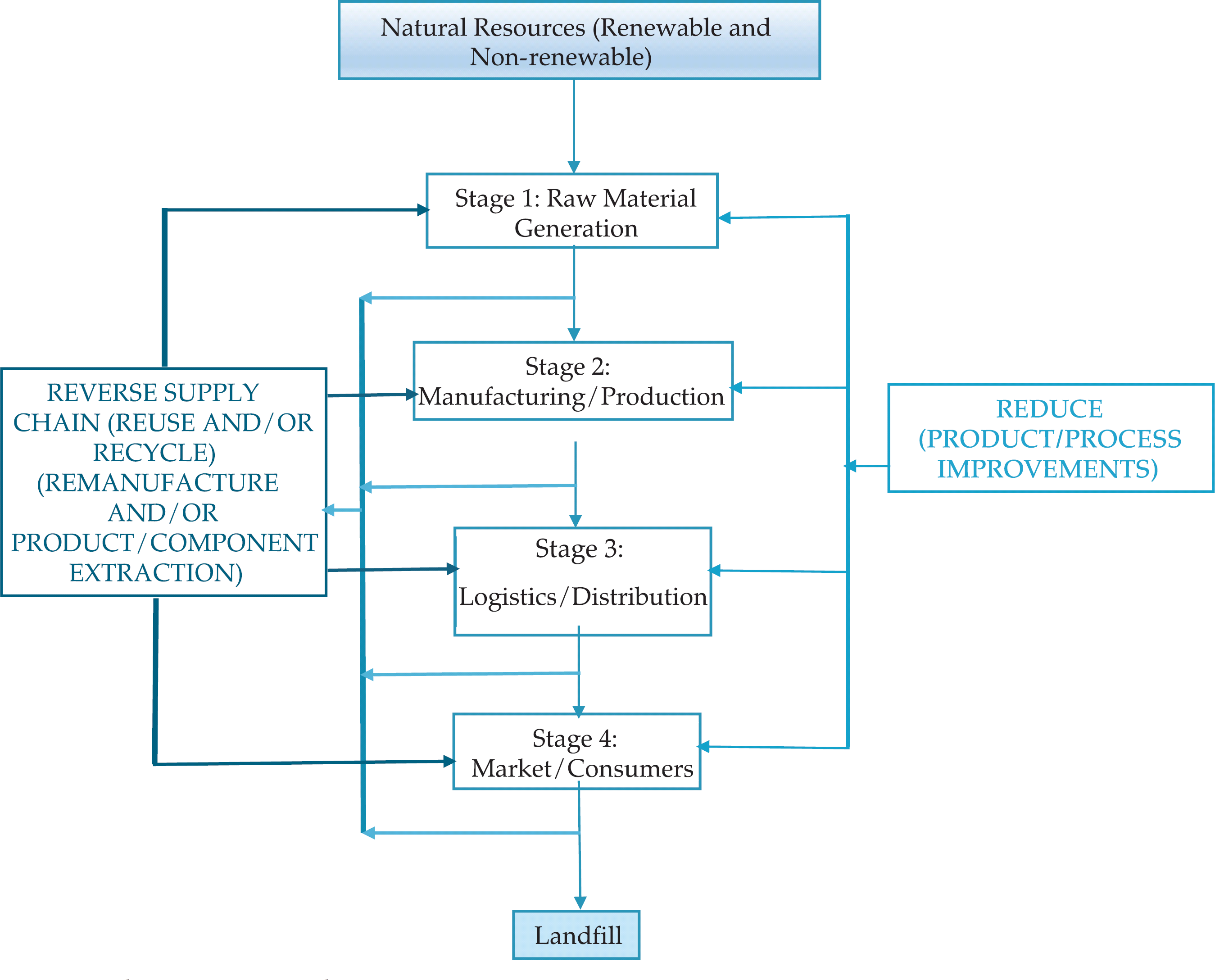
Corresponding to each stage in the stylized supply chain in Figure 1, the proposed framework identifies how the 3R’s impact the firms at each stage of supply chain. For example, from a Reduce perspective, the firms involved in all stages of the supply chain would need to evaluate product improvements to generate less waste (through for example, design for environment initiatives) and/or can focus on including more environmentally safe materials in the operating process. On the other hand, looking at the Reuse and Recycle perspective, each input to a supply chain stage would result in collection of materials and these would be processed through the reverse supply chain and fed back into the corresponding supply chain stages.
Based on this framework, it is obvious that for an effective management of waste across the supply chain, firms within the chain can adopt either a proactive approach (associated with Reduce) or a reactive approach (associated with Reuse and/or Recycle). The reactive approach which focuses on extending product life can yield positive externalities for individual firms through, for example, offering both new and remanufactured products in the market and also generating profit from recycling efforts. From a reuse and/or recycle perspective, more supply chain firms are finding reverse supply chains to be a profitable proposition. Firms are capitalizing on the opportunity to introduce remanufactured products in the market along with new products, attempting to reuse components which can be salvaged from the products and recycle other components for profit. To reduce waste generation (the proactive approach), states might need to impose mandates through legislation. This is primarily due to the fact that individual firms are motivated by self-interest and guided by price signals, and hence, any proactive endeavour would lead to negative externalities in the context of society. This has led to states formulating environmental legislative practices which attempt to internalize these negative effects.
In order to reduce waste generation, the current approach that has been adopted is to impose legislations. All legislations in this domain can generally be classified as those stemming from either a Pigouvian or Coasian tradition. The Pigouvian approach would levy taxes to cover the marginal cost of aggregate waste disposal while the Coasian approach assigns ‘property rights’ in the context of waste disposal by charging individual firms based on waste generated.
The majority of proposed legislations can be regarded as an implementation of the extended producer responsibility (EPR) concept. The rationale behind these types of legislations is to focus on reducing waste generation by those responsible for generating waste in the first place. As an example, consider the environmental legislation proposed by the state of Connecticut (USA). It requires original equipment manufacturers (OEMs) operating in the state to not only remit a registration fee with the state but each OEM is also charged a recycling fee depending upon its market share. In essence, such legislation extends OEM’s responsibility for waste management and hence, through the explicit fee structure, motivates it to not only consider product/process improvements to generate less waste but also fund the recyclers operating within the state.
A unique legislation that has been proposed by the state of California (USA) focuses on end users of electronic products (CalRecycle, n.d.). Given that such products were being replaced at an alarming rate by customers leading to a generation of substantial electronic waste, the state proposed the Electronic Waste Recycling Fee (EWRF) on all purchases of ‘covered electronic devices’. The focus of this legislation is to extend the life of a product and discourage their more frequent replacement.
After several years of campaigning by different environmental groups, the Ministry of Environment and Forests (MoEF, n.d.) of the Government of India introduced E-waste (Management and Handling) Rules, 2011, which came into effect in May 2012. These measures include EPR for recycling and reducing levels of hazardous substances in electronics. These rules also require electronic manufacturers to partner with Indian recyclers in setting up waste collection centres.
RELEVANT LITERATURE
Since management of waste in the supply chain is facilitated not only through environmental legislation but also through the management of reverse supply chain, we first discuss prior research in both streams and then critically evaluate these contributions.
Reverse Supply Chains
The entire stream of research on reverse supply chains is motivated by the observations that by reusing, remanufacturing, and recycling used products/components it is possible to reduce landfill waste. According to Blackburn et al. (2004), reverse supply chains are organized to manage activities related to used product acquisition; transportation of used products to sorting facilities; inspection, sorting, and disposition of collected products; remanufacturing (or refurbishing) of returns; and the creation of secondary markets for remanufactured products. In this subsection, we highlight the major contributions related to whether it is worthwhile to undertake remanufacturing, reverse supply chain network design, and managing the collections process.
Should OEM offer a remanufactured version of its product? Is remanufacturing a profitable activity? These questions have been addressed by several papers, and most of them use a vertical differentiation framework which incorporates the price trade-off between competing products of equivalent or unequal quality. Two implications of offering a remanufactured products are also considered: a market expansion effect, because the remanufactured product which usually has lower price reaches a segment of consumers who are not willing to pay for the new product; and a cannibalization effect as some consumers who would have previously purchased the new product switch to the remanufactured product.
Debo, Toktay, and Van Wassenhove (2005) determine when it is profitable for a manufacturer to produce a remanufacturable product in a discrete-time, infinite-horizon framework for an industry in which the manufacturer holds a monopoly in the markets for new and remanufactured products. A discounted profit-optimization problem is developed where the manufacturer’s goal is to maximize the net present value of introducing a remanufacturable product, calculated over the life cycle of this product. The key drivers for investment in remanufacturing stemming from this work are: high production costs of the single-use product, low remanufacturing costs, and low incremental costs to make a single-use product remanufacturable. The authors extend their monopoly setting to one where the manufacturer produces only the new product (i.e., it has a monopoly position) but used products are remanufactured by multiple independent competing remanufacturers. For this scenario, the authors show that the optimal level of remanufacturability offered by the manufacturer is lower than that in the monopoly model and it decreases as the number of competing remanufacturers increases.
Ferguson and Toktay (2006) study the trade-offs between new product demand versus the benefits of collection and remanufacturing activities which can extend the product life. They use a two-period setting where remanufacturing in the second period is constrained by the number of cores stemming from new product sales in the first period. The authors first identify conditions under which the firm would choose not to remanufacture its products and then characterize the potential loss of profits stemming from external remanufacturing competition and analyse two third-party entry-deterrent strategies: remanufacturing and pre-emptive collection. In some cases, the authors find that some remanufactured-branded consumer products do not cannibalize new sales and thus can be used as a strategic deterrent to low-cost competitors. Studies which have extended this analysis are those of Vorasayan and Ryan (2006) who focus on the impact of demand uncertainty; Ferrer and Swaminathan (2006) who examine the case where the OEM’s new and remanufactured products are perfect substitutes and compete with a third-party offering remanufactured product with an inferior quality; and Majumder and Groenevelt (2001) who provide an extension for the case of linearly decreasing demand as a function of price.
Atasu, Sarvary, and Van Wassenhove (2008) examine a setting in which there is a market segment which had identical valuations for both the remanufactured and the new products. They focus on a case where the OEM offers both new and remanufactured products and competes with a low-cost producer of new product. Their key result is that if the consumers have a lower valuation for the competitive product, the competitor will not have any competitive advantage. Pince et al. (2016) show that an OEM will always offer a remanufactured product if such a product can be used to meet the demand for warranty replacements.
Given that remanufacturing appears to be a viable strategy, research in this area has also examined issues related to the design of the reverse supply chain network. Fleischmann et al. (2001) consider a reverse supply chain network with four levels: plants where new products are manufactured and/or recovery takes place; warehouses for distribution of new and/or recovered products; consolidation centres; and customers. New and/or recovered products are shipped to customers via warehouses while returns are shipped to recovery facilities (or disposal) via consolidation centres. All the returns are sent to the testing centre and then shipped to different facilities. Using a mixed-integer linear programming model with the objective of minimizing total costs subject flow balancing and required disposal rate constraints, the authors provide a solution for optimally designing a reverse supply chain network. Although the assumption of static parameter settings limits the usefulness of the proposed model, it is worth noting that there is the potential for examining how changes in key parameters impact the design of the reverse supply chain.
Savaskan, Bhattacharya, and Van Wassenhove (2004) explore the problem of who should collect used products in a two-echelon stylized supply chain structure with a single manufacturer and a single retailer. They compare the profitability of different collection modes: (a) manufacturer, (b) retailer, and (c) an independent third party and find that the preferred collecting agent is the retailer, followed by the manufacturer, and the third party. Assuming perfect substitutability between new and remanufactured products, and a convex collection rate in effort, they show that preferred collection agent is the retailer, followed by the manufacturer, and the third party, respectively. Although these findings contribute to our understanding of which party in the supply chain should undertake collection activities, the results are somewhat limited based on their restrictive assumptions.
Rather than focusing on who should collect the used products, Wang et al. (2016) examine whether remanufacturing activities in a reverse supply chain should be carried out by the firm (i.e., in-house) or subcontracted to a third party (i.e., outsourcing). Their research is motivated by industry observations of GameStop which currently outsourced remanufacturing of game consoles to a third party and was contemplating whether this activity should be carried out in-house. Considering the relative cost-effectiveness of the two approaches, uncertainty in the input quality of the collected/returned used products, consumer willingness-to-pay for the remanufactured product, and the extent to which the remanufactured product cannibalizes demand for the new product, the authors identify ‘conflict’ scenarios in which the in-house strategy maximizes profits but outsourcing is better for the environment. To resolve this conflict, a profit-sharing mechanism is proposed where, under certain conditions, outsourcing becomes the retailer’s more profitable strategy while retaining an environmental advantage over the in-house approach. As a final extension, the authors also investigate how the outsourcing dominance region for profit maximization would be influenced by differences in bargaining power between the channel partners. Though their results validate industry observations which note that the relative cost-effectiveness between alternative remanufacturing technologies would be the driver to optimize profitability, this is not necessarily the driver to minimize environmental impact.
Given that the returns play an integral role in the operation of reverse supply chains, Souza, Ketzenberg, and Guide (2002) provide a framework for understanding why consumers return products and also the time scale of these returns. This is one of the first studies which provides a comprehensive perspective on examining the quality and quantity of returned products which are suitable for reusing, recycling, and/or remanufacturing. Guide et al. (2006) extend this framework using queuing networks to demonstrate the value of speed in recovery on profitability for time-sensitive consumer returns such as consumer electronics. Their results suggest that product value, price decay, return rate, and proportion of unused returns are the key factors in analysing the collections process as a driver for operating reverse supply chains as well as reducing the waste for disposal.
Two other studies which relate to the returns process are those of Ray, Boyaci, and Aras (2005) and Li, Fong, and Xu (2011). In the former study, the authors analyse trade-in discounts under three different policies: a discount dependent on the used product’s age, a discount independent of the product age, and no trade-in discount. Depending on the product parameters, they find that both policies which offer trade-in discounts dominate the policy, offering no such discount. Given that their criterion is to maximize product returns, these results are intuitively obvious. Li et al. (2011) approach the issue from a marketing and quality perspective and develop a general methodology for forecasting trade-ins based on customer segmentation and signals (return merchandise authorizations, or RMAs). They find that more focused segmentation strategies complemented with the flexibility of returning products through RMAs results in increasing the volume of returns coupled with greater variability in the quality of these returns. Remanufacturing activities in this context should be structured to handle larger quantities of collected products but also be flexible to manage quality variability of these same products.
In sum, the extant research on reverse supply chains has clearly documented that the activities are not only profitable but can also result in reducing the landfill waste. In addition, the research in this stream also provides guidelines on the design of these remanufacturing activities and on effectively managing the collections process.
Environmental Legislation
As noted earlier, managing waste through reuse and recycling is typically carried out through reverse supply chain activities. On the other hand, the proactive approach to reduce waste generation has generally been addressed through environmental legislation with the primary focus being on providing direct or indirect design for environment (DfE) incentives. In this section, we review extant literature in economics and operations which has evaluated whether such legislation has created enough incentives for DfE.
Although a multitude of legislative practices with an environmental focus have been proposed, Lifset (1993) contends that all such practices internalize externalities by changing the behaviour of producers as well as consumers and in the long run should promote environmentally oriented technological change. From an economic policy perspective, Palmer and Walls (1997) study the EPR type legislations that mandate the use of specific secondary materials content in manufacturing. They find that such policies need to be coupled with additional taxes on the final product and other production inputs so as to generate the optimal disposal amount.
Mayers, France, and Cowell (2005) focus on the waste electrical and electronic equipment (WEEE) directive within the EU. Using life cycle assessment and costing, they are unable to identify a dominant waste management scenario as compared to landfilling. They also find that contrary to belief, the use of targets in the directive would not necessarily lead to increased eco-design efforts on the part of manufacturers. Their key conclusion is to call for a revision of the scope of the directive by focusing on developing environmental objectives and standards for treatment and recycling processes. Plambeck and Wang (2009) examine the impact of e-waste regulation on new product introduction and design for remanufacturability, depending on the level of competition and form of regulation. Two specific legislations, that is, fee upon sale and fee upon disposal, are considered. The authors identify conditions under which a unique equilibrium for new product introduction process can be characterized both in monopoly and duopoly settings. The effects of the two e-waste regulations on the new product introduction process, quantity of e-waste, design for remanufacturability, and manufacturer profits are examined. A fee-for-use regulation increases manufacturers’ profits since customers pay a higher price for each new product as they anticipate using it for longer. However, such a regulation discourages manufacturers to design new products that are remanufacturable. While the social welfare increases in a duopoly, it decreases in a monopoly if and only if e-waste costs are small. In contrast, fee-upon-disposal types of e-waste regulation encourages design for remanufacturability, but simultaneously forces manufacturers to introduce new products too rapidly, which in turn generates more e-waste.
Gui et al. (2013b) provide an in-depth analysis of implementing an EPR programme in the state of Washington, USA. They are able to provide guidelines on how to achieve effective and efficient EPR implementations with a focus on design incentives, reuse and refurbishing, product scope, downstream material flows, and operational efficiency. Atasu, Van Wassenhove, and Sarvary (2009) derive efficiency conditions for EPR type legislations. In addition to these legislations being perceived as alleviating fairness concerns, they also incentivize eco-design producers to create larger environmental benefits.
Subramanian, Gupta, and Talbot (2009) examine the impact of EPR policy parameters on product design. They model a manufacturer supplying a remanufacturable product to a single customer who obtains a fixed utility (or revenue) per period from the product. Three questions are addressed in this article: Do EPR programmes provide adequate incentives to manufacturers to design green products? How can contracts be structured to improve supply chain profitability and environmental product design? How do customer attributes affect incentives for product design and supply chain coordination? They show that a supply chain with an efficient customer lowers the manufacturer’s incentive to design the product with greater remanufacturability, since remanufacturing and disposal costs are incurred less often.
Atasu and Subramaniam (2012) turn their attention to comparing collective and individual producer responsibility (CPR and IPR, respectively) models of EPR. Their primary focus being on design for product recovery (DfR), they find that IPR leads to superior DfR incentives since CPR could lead to free-riding. In a follow-up study, Gui et al. (2013a) examine collective implementations of EPR. Since the current cost allocation mechanisms in these implementations might lead to higher costs for certain producers, this could lead to market fragmentation. To address this problem, they propose and validate a cost allocation mechanism which induces participation and simultaneously maximizes efficiency. Atasu, ¨Ozdemir, and Van Wassenhove (2013) comparatively evaluate two legislative practices: a tax model where the social planner specifies a take-back fraction and charges the OEM a recovery fee; and a rate model where it is the responsibility of the OEM to ensure compliance with the take-back fraction. They are able to show that their impacts can be significantly different and hence, stakeholder preferences vary across practices.
There is another stream analysing how the policy instruments impact the incentive of supply chain members as well as the environmentally favourable design. The typical objective in this stream of research is for the social planner to maximize net social surplus subject to resource constraints, material balance constraints, and production functions. Toffel (2003) provides an excellent overview of developments in take-back legislation and their likely impacts on organizational decision making. Runkel (2003) examines how EPR influences the choice of product durability and social welfare. Several researchers have examined the economic and social efficiencies of various policy instruments such as taxes, subsidies, standards, and take-back requirements (for example, Calcott & Walls (2000); Eichner & Pethig (2001); Fullerton & Wu (1989); and Dinan (2005). An environmentally favourable design implies lower material consumption, higher fraction of recycled product, or lower cost of recycling. A consistent finding is that a combined tax/subsidy, where there is a consumption tax and a recycling subsidy (such as in a deposit-refund system), can yield a socially optimal product design and quantity of waste.
Yenipazarli (2015) studies the impact of emission taxation on the optimal production and pricing decisions of a manufacturer who could remanufacture its own product. The conditions under which the manufacturer’s decision to remanufacture under an emission regulation reduces its environmental impact while at the same time increasing its profits, are characterized. On the policy side, the conditions under which emission taxes can be instituted to realize the economic, environmental, and social benefits of remanufacturing are also characterized. The analyses are subsequently extended to an emissions trading setting where emissions are regulated using tradable permits and the economic implications of remanufacturing under emissions trading vis-à-vis emissions taxation are studied.
Wang, Rajapakshe, and Vakharia (2016) examine the strategic and policy implications of two diametrically opposed legislative practices for regulating and financing e-waste disposal. The first practice (characterized as Producer Pays) imposes a fixed market share-based fee and a per unit disposal fee on an OEM while the second practice (characterized as Anticipatory Protection) charges a per unit fee to each consumer of an electronic product. To analyse the impact of each of these legislations, they typify current practices by considering an OEM who offers two competing products: a new product and a remanufactured product. The two legislative practices are evaluated in the context of multiple stakeholder objectives: product prices, OEM profits, and consumer and environmental surplus. Their results reveal that in most cases, there is a parametric trade-off in the choice of legislative practices. By structurally characterizing this trade-off, the authors identify dominance regions for each strategy choice. Regions where a single strategy would be the preferred choice of both the social planner and the OEM are also identified by the authors. From a policy perspective, the authors provide guidelines on how the per unit fee for the OEM should be structured by the social planner so that it results in both the former and the latter players preferring a specific legislative practice.
In sum, there is conflicting evidence on whether EPR type legislations lead to adequate DfE incentives. For example, Palmer and Walls (1997) observe that EPR type legislations need to be complemented with additional policies (e.g., taxes) for desired outcomes. Plambeck and Wang (2009) find that fee-upon-disposal legislations forces manufacturers to introduce new products too rapidly, which in turn generate more e-waste. Subramanian et al. (2009) find that a supply chain with an efficient customer lowers the manufacturer’s incentive to design the product with greater remanufacturability. On the other hand, Atasu et al. (2009) note that EPR type legislations alleviate fairness concerns and incentivize eco-design producers to create larger environmental benefits.
Critical Evaluation
The evaluation of this stream of research leads us to identify several issues of relevance which need to be addressed from the waste management perspective. There is limited research on how the waste management phase of remanufacturing supply chain should be designed and operationalized. The waste management phase which is typically associated with reuse, remanufacturing, and/or recycling activities is characterized by high investments with very small margins. Issues related to the trade-off between investments and extraction and technology-related costs versus increased demand and pricing of reusable components and/or remanufactured products need to be addressed.
Prior research focusing on trade-in programmes had limited applicability since the implicit assumption in this area was that used products traded-in would have a secondary final product market. This assumption might hold for limited product categories where used products are regarded as similar to new products from a consumer perspective (e.g., video games) but for a large segment of product categories (e.g., industrial), it is difficult to make a case for trade-ins being accepted by consumers.
There is a significant stream of research documenting the cannibalization effect, that is, demand loss of new product resulting from the introduction of a remanufactured product. This stream of research, however, simply makes a case for the profitability of remanufacturing in the reverse supply chain. It must be noted, however, that this has limited applicability since the implicit assumption made in this setting is that consumers would trade off prices versus quality in choosing between a new and a remanufactured product. Instead it has been observed that remanufactured products are typically chosen by consumers only when a newer version of the product is introduced. For example, it was only when iPhone 6 and 6S were introduced that a potential remanufactured product market emerged for iPhone 5.
As far as environmental legislation is concerned, prior research has mostly focused on EPR type policies. There is emerging evidence that states are also considering (and in some cases imposing) other types of legislations which impose monitoring/subcontracting of OEM activities or those that tax consumers rather than producers. Hence, there is a need to broaden the scope of research on evaluating different legislations.
There is little research directed at financial incentives that need to be provided by the state for the effective management of waste management programmes. From a theoretical perspective, there are a variety of policy instruments (e.g., subsidies, low-interest loans, etc.) which would be viable in this context. Simply setting up EPR legislations aimed at taxing waste generators does little to effectively manage the operations of firms involved in waste disposal. From an economics perspective, it would also be interesting to examine what would be a better option for waste management: centralization or decentralization.
There is evidence of research on environmental legislation for waste management in electronics industry (i.e., e-waste), automobile industry, industrial products, and the energy sector. However, there seems to be little work addressing issues related to the impact of the legislations on these industrial groups. For the overall success of the waste management incentives, what is important is to have the research directed at how to establish mechanisms by which the waste-management activity is actively supported by not only the state but also the waste management firms.
GUIDELINES FOR PRACTICE
In formulating guidelines for effective waste management practices, it must be noted that waste management programmes are growing around the world (e.g., programmes for electronic waste in China, plastic packaging in Tunisia, and various material flows in Brazil). Some of these programmes are industry motivated, while others are implemented and operated by third parties or states.
First, a waste management programme can be successful only if recyclers and remanufacturers are willing to invest significant capital in commodity industries with razor-thin margins which would enable them to build capacity for this activity. This implies that not only should firms engaged in this activity be able to access used materials of adequate quality in substantive volume, but they would also need to establish longer term agreements to do the same. This is critical for them to plan and invest in viable product flows. As pointed out earlier, more research directed at effective management and operation of the waste management phase of the reverse supply chain would be beneficial in addressing this issue.
Second, firms engaged in waste management need to actively support and perhaps invest in newer processing options when setting up their reuse and recycling programmes. In addition, they need to be involved in creating a set of longer term contracts with the waste generators so as to be assured of adequate supply for their activities. For firms engaged in waste management activities, the focus of the state should be on how to mitigate their financial risk either through direct financial support or establishment of mandates for the waste generators which would require them to use the services of the firms engaged in reuse and recycling activities.
When designing and implementing incentive schemes, care should be taken to ensure that there is complete operating transparency in the waste management firm’s activities. This would establish a credible system from the perspective of the waste management firm’s suppliers (i.e., waste generators) and at the same time lead to easier monitoring of its activities by the state. Such transparency would also contribute to a large extent in establishing a system of continuous improvement in the entire reverse supply chain and thereby facilitate changes in collection and treatment processes as well as regulatory support.
Third, substantive state and management buy-in to the practice of waste-management activities is needed. There is substantial empirical evidence that the waste-management sector has been perceived as an informal economy and, hence, is likely to be perceived as one prone to fragmentation, opportunistic practices, corruption, and non-professional management. Given the critical importance of the three R’s in waste management, the current set-up needs to be modified to one which reflects stronger performance management by individuals having leadership, analytical, and strategic perspectives.
Finally, there is a need for integrating the current academic research and also renewing the focus of such research on the major issues of relevance in effective waste management Rather than focusing on a ‘one-size-fits-all’ strategy and guidelines, research in this area should be more industry-specific and problem-driven. For example, making a case for remanufacturing is obviously of relevance, but there is little work aimed at exploring the viability of this choice for different products and processes across industrial groups. In the same vein, there is a need to explore and examine alternative types of environmental legislations for effective waste management rather than focusing singularly on EPR type practices which have been proposed for e-waste.
CONCLUSIONS
Effective waste management requires an understanding that the focus should be on addressing longer term issues rather than on merely tackling immediate problems. For example, the scale of waste incineration facilities should be determined not only by focusing on current waste disposal but also keeping in mind how their use might decline in the longer term due to reuse and recycling efforts. This requires structuring of waste management activities such that the basics of a circular economy are taken into account. Such a process would not only enhance economic, environmental, and social values but also extend product life cycles and facilitate the use of regenerative materials. EU’s mandate on WEEE (WEEE, 2002) considers not only disposal and/or recycling but also implementation of compliance mechanisms which tend to have a longer term impact.
In sum, state-private partnerships typically address many current problems. It is essential that such partnerships evolve to integrate a system-wide focus necessary to achieve the 3R’s of waste management over a longer time horizon. These partnerships should not only be focused on designing cost-efficient systems but also do so in a technologically intensive manner to enable the aggregation and disposal of multiple waste management streams.