




Abstract

Keywords
Introduction
1
The earlier versions of the articles in this colloquium (except for the article by Hitesh Sharma) were written for the report ‘E-waste Roadmap 2023 for India’, an initiative under the India E-waste Program of the International Finance Corporation (IFC). The programme was supported by the Government of Japan and the Korea Green Growth Trust Fund of the World Bank. We gratefully acknowledge the contribution of Neeta Misra, Sarina Bolla and Kalyan Bhaskar, the editors of the ‘E-waste Roadmap 2023 for India’ report, who worked with a team of experts on e-waste in India and were responsible for the editing of the initial versions of many of the articles in the colloquium.
The earlier versions of the articles in this colloquium (except for the article by Hitesh Sharma) were written for the report ‘E-waste Roadmap 2023 for India’, an initiative under the India E-waste Program of the International Finance Corporation (IFC). The programme was supported by the Government of Japan and the Korea Green Growth Trust Fund of the World Bank. We gratefully acknowledge the contribution of Neeta Misra, Sarina Bolla and Kalyan Bhaskar, the editors of the ‘E-waste Roadmap 2023 for India’ report, who worked with a team of experts on e-waste in India and were responsible for the editing of the initial versions of many of the articles in the colloquium.
Rama Mohana R. Turaga and Kalyan Bhaskar
Electronic waste (e-waste), that is, waste arising from end-of-life electronic products such as computers and mobile phones, is one of the fastest growing waste streams in the world today. Annual global production of e-waste is estimated to surpass 50 million tons in 2020. 2
Baldé, C. P., Forti V., Gray, V., Kuehr, R., & Stegmann, P. (2017). Global E-waste monitor 2017: Quantities, flows, and resources. Bonn/Geneva/Vienna: United Nations University (UNU), International Telecommunication Union (ITU) & International Solid Waste Association (ISWA). Retrieved from
Toxics Links. (2014). On the edge: Potential hotspots in Delhi. New Delhi Retrieved from
Extended Producer Responsibility (EPR) and E-Waste
EPR, one of the more widely used approaches for regulating e-waste globally, places the responsibility of the end-of-life management of products on the manufacturers or the producers. Conceptually, EPR is designed to make the manufacturers internalize the external costs associated with the end-of-life disposal of their products. 4
Sachs, N. (2006). Planning the funeral at the birth: Extended producer responsibility in the European Union and the United States. Harvard Environmental Law Review, 30, 51.
OECD. (2006). Analytical framework for evaluating the costs and benefits of extended producer responsibility programmes. Vol. 6/8, OECD Papers, OECD, Paris.
Under the EPR approach, the producers can be made responsible in four distinct ways. 6
Toffel, M. W. (2003). The growing strategic importance of end-of-life product management. California Management Review, 45(3), 102–129.
India’s first e-waste regulations, known as E-waste (Management and Handling) Rules, 2011 used EPR approach and required the producers of electronic products to set up collection centres (i.e., physical responsibility) and inform the consumers (i.e., information responsibility) on how the used electronic products can be returned to the collection centres. Early evaluation of these rules showed that while they may have created demand for new formal dismantling and recycling centres, the rules have largely been ineffective in improving the existing practices. 7
Bhaskar, K., & Turaga, R. M. R. (2018). India’s e-waste rules and their impact on e-waste management practices: A case study. Journal of Industrial Ecology, 22(4), 930–942.
Partly as a result of the regulations, during the last eight years, Indian e-waste sector has been witnessing several changes: more serious efforts on the part of the producers, expansion of the formal waste management sector, emergence of producer responsibility organizations (PROs), and attempts to develop indigenous technologies to process and recover different components of e-waste, to name a few. However, despite these developments, the bulk of e-waste continues to be handled by the informal sector in India.
The objective of this colloquium is to take stock of the current status of the e-waste management ecosystem by identifying various challenges that the sector faces and potential paths for improvements. The colloquium brings together nine articles from national and global sectoral experts on different aspects of e-waste related to technology, finance, policies and regulations, formal and informal sector, business and PROs. The experts come from diverse work backgrounds such as government, international developmental organizations, civil society organizations, industry and academia.
Taken together, the articles in the colloquium identify several challenges, such as the inadequate resources to monitor and enforce regulations, lack of awareness among the consumers regarding the nature of e-waste and the associated regulations and a narrow focus on compliance on the part of the producers. The central theme that cuts across all the articles, however, is the role of informal sector. A strong, well-established network of individuals operates in this sector, primarily in the collection of e-waste but also in recovery and recycling. The sector generates livelihoods to a large population, mostly belonging to the marginalized sections of the society. The practices they employ, however, are unscientific and unsafe, posing risks to their own health and potentially imposing environmental and health costs on the larger society. Most of the articles in the colloquium grapple with this dilemma: How to bring this strong network of people into a robust e-waste management system, which can preserve (and enhance) their livelihoods while simultaneously mitigating the external costs associated with e-waste processing and disposal.
Introduction to the Articles
The article by Rama Mohana Turaga, one of the co-editors of this colloquium, takes us through the policy and regulatory perspectives on managing e-waste. In his article, Turaga discusses policy experiences of other countries in managing e-waste and draws valuable lessons from the last eight years of Indian policy landscape. Satish Sinha draws upon his close to two decades of experience in working with the waste management sector, and in particular, the informal sector, to bring out the nuances of how the evolving e-waste landscape is affecting or getting affected by the informal sector in India. In their article, Hinchliffe, Hemkhaus and Arora delves into the relationships between the informal sector and formal sector in managing e-waste in India and suggest possible mechanisms for partnerships between the two sectors. These authors bring a wealth of experience from their organization, GIZ, which has been actively working on waste management and other environmental issues, not only in India but also in other developing countries.
Sandip Chatterjee from Government of India’s Ministry of Electronics and Information Technology (MeitY) focuses on the need for indigenous technology development for recycling and access to technology to the informal sector. Financing of e-waste management systems within an EPR approach is an important aspect and Deepali Sinha Khetriwal provides specific roadmap and milestones. Verena Radulovic, who is associated with the United States Environmental Protection Agency, brings a global perspective by bringing out insights on the role of voluntary industry standards based on her experience of the context in the United States and her fieldwork in Indian e-waste sector. PRO is an emerging institution within the e-waste ecosystem in the country and Pranshu Singhal, in his capacity as the founder of one of the first PROs in India, draws on his own experience to identify various steps that help PROs play a constructive role in e-waste management in India. Businesses are expected to play significant role in creating a robust market for e-waste and Kalyan Bhaskar, one of the co-editors of this colloquium, brings out this aspects of e-waste. Finally, producers are the central regulated entities within the existing EPR regulations, and Hitesh Sharma’s article calls for a rethink on the role of producers within the EPR framework, arguing for a more shared responsibility approach to managing e-waste.
Public Policy for E-Waste Management in India
Rama Mohana R. Turaga
India’s e-waste regulations, employing the EPR approach, came into effect in May 2012, with further amendments in 2016. The seven years of implementation has had limited impact on the larger e-waste management system in the country. On the positive side, the regulations may have led to establishment of hundreds of new recycling and dismantling units, formally registered with regulatory authorities. The 2016 amendments, which sets collection rate targets for producers of electronic products, appears to have generated greater seriousness among the producers to comply with the regulations. More generally, the regulations could be credited with bringing greater attention to the e-waste problem among the various stakeholders. Clearly, we are a long way from developing a policy framework that could facilitate a robust e-waste management system in the country.
E-Waste Management: Issues and Challenges for Policy
Poor information on e-waste generation rates: The 2012 regulations acknowledged the lack of waste inventories as a limitation and placed the responsibility of developing state-wise e-waste inventories on the respective state pollution control boards (SPCBs). Seven years since these regulations, to our knowledge, no SPCB has released an inventory as yet. The sales data on electronic products, which is an important input in the estimation of e-waste quantities, is often available at the national-level aggregation, making it challenging to produce inventories at the state levels. In addition to domestic generation, e-waste is also imported from developed economies, often illegally. There is little understanding of the nature and amount of e-waste that gets imported into the country. Designing systems for effective collection, transportation and processing requires reasonably accurate knowledge of waste generation, composition and flows.
Environmentally unsustainable informal sector practices: Despite the growth in the formal dismantling and recycling sector (in terms of the number of such facilities), the actual waste processed in the formal sector still remains very low. Anecdotal evidence indicates that most of these formal facilities are operating well below their approved capacities because of their inability to source enough waste. The lack of awareness regarding e-waste and costs of returning the end-of-life equipment to formal collection centres are reducing the willingness of household and institutional consumers to return their waste to formal sector. Most importantly, the informal sector, through the convenience of household collection and monetary incentives (even if nominal), makes it more attractive for consumers to return their waste, relative to the formal sector, which is yet to invest in robust systems of collection and processing. The informal e-waste sector provides livelihoods to millions of people, often belonging to the most marginalized groups; on the other hand, the sector’s waste management practices pose serious environmental and health hazards to the workers themselves as well as the larger public. This presents a potential moral dilemma for public policy and sustained success of any e-waste management system will hinge on our ability to resolve this dilemma.
Frictions in markets for the end-of-life products: The inability to reliably source e-waste quantities that create economies of scale restricts entry of private players, such as PROs to set up e-waste management systems in the formal sector. For example, employing effective recycling technologies for e-waste may require significant upfront capital expenditures, which may not be justified for private entities in the absence of certainty around sourcing of enough quantities of e-waste. Also, these markets suffer from information barriers. First, given that e-waste recycling is a relatively new business, potential lack of information on cost-effective recycling technologies itself could be a market barrier. Second, the low awareness, partly because of the lack of reliable information on e-waste management among consumers, affects the functioning of markets. Public policy may have to play a greater role (beyond the current e-waste regulations) in enabling better markets for e-waste.
Inadequate regulatory design and enforcement: In the 2012 regulations, the mandatory take back system for producers, without accompanying collection targets, provided no incentives to take responsibility and thus induced little improvements in e-waste management practices. This was addressed in the 2016 amendments, which provided more regulatory certainty by specifying gradual and increasingly stricter collection targets. Nevertheless, the regulatory design places a significant burden on the already ill-equipped regulatory agencies. The regulators are expected to review the EPR plan submitted by the producers, grant authorization and enforce the provisions of the EPR plan. The regulations also specified elaborate standards and processes for other entities—collectors, dismantlers, recyclers and bulk consumers—and require the agencies to enforce compliance with these standards. Regulatory capture by lobbies that benefit from poor enforcement, lack of transparency and unwillingness to publicly share information on compliance and regulatory actions have long afflicted environmental regulatory enforcement in India, and e-waste regulations are no exception. This poses a significant public policy challenge to the future of e-waste management in the country.
Creating a Robust E-waste Management System
By constantly evaluating the effectiveness of e-waste regulation and bringing in necessary regulatory changes, the government may have to play a facilitating role to bring together various stakeholders in the system. We outline a few steps that should be considered to move forward.
Informal sector: The first step would be to more explicitly recognize (like in the case of Municipal Solid Waste Rules in 2016) the informal sector as a critical stakeholder in any future e-waste regime. Addressing the problem of informal sector e-waste practices requires a greater understanding of the sector itself in terms of their incentives and challenges. Engagement with the informal sector workers and the groups, in a manner that recognizes their right to livelihoods, builds trust and develops a shared understanding of the problems along with potential solutions, is a critical initial step. The government should institute a platform that facilitates consultations among various stakeholders such as the informal sector workers, NGOs working with the informal sector, third party private entities such as PROs and registered recyclers and manufacturers. Such forums could be constituted under the Ministry of Environment, Forest and Climate Change (MoEFCC) at the central level and under the State Departments of Environment at the state level. Working towards such cross-sector partnerships while evolving clearly defined roles for each stakeholder would be an important goal. Policy instruments under EPR: The government would need to rethink the policy instruments under the EPR approach. In the presence of an informal sector with strengths in collection logistics, a mandatory take back with collection targets may not be the ideal instrument. Producer responsibility could come in many varieties other than mandatory take back. Economic instruments such as advanced recycling fee (ARF) or advanced disposal fee (ADF) on every unit of the product sold in the market would relieve the producers of the physical responsibility of collection and the revenues generated could be used to develop markets for the end-of-the-life products. The revenues, which go into a separate fund, could be used in several ways. Some examples include (a) subsidize consumers to deposit their e-waste at designated centres, (b) directly fund recyclers or PROs and (c) assist informal sector workers in training or skill development or provide greater social security net to the workers. These decisions may be made within the consultative forum recommended in the previous point on informal sector. The key problem with economic instruments would be to determine the right fee. Principles of economics would suggest a fee equivalent to the marginal external cost of the end-of-life equipment. While the assessment of such external costs is difficult in practice, the fee should be high enough to fund a robust, environmentally safe e-waste processing and disposal. A sufficiently high fee would also provide incentives for design for environment (DoE) changes in product design, which has been one of the primary goals of EPR approach globally. In the long run, to further incentivize DoE changes, the fee could be based on such factors as the ease of dismantling, recyclability and environmental impact of materials used in the equipment. The policy framework should also focus on the development of indigenous technologies and/or technology transfer to encourage widespread application of environment-friendly e-waste recycling technologies. Regulatory enforcement: Shifting to economic instruments such as an ADF would also relieve the regulatory burden since the producers need not be regulated anymore. The long experience with tax collection should make it easy to divert the ADF on electronic products to a separate fund. The SPCBs and the Central Pollution Control Board (CPCB) will still be required to monitor and enforce compliance with the standards specified for collection centres, dismantlers, recyclers and PROs. The MoEFCC must make the regulatory actions related to e-waste transparent. Regulatory actions such as authorizations and their conditions, data on inspections of registered facilities and compliance status of inspected facilities should all be made publicly available for scrutiny. A few SPCBs already provide some of these documents publicly on their websites, but these practices should be institutionalized as part of the regulations across the country. Developing a regularly updated and publicly available inventory of district-wise generation of e-waste quantities by e-waste type (e.g., computers, mobiles, appliances), waste composition and flows will also play an important role in enforcement. E-waste imports: Under the existing regulations, e-waste is not allowed to be imported for final disposal but can be imported for reuse and recycling. In the absence of adequate infrastructure in the country for recycling, we should seriously consider banning all kinds of imports, similar to what China did recently. In order to develop accurate estimates of e-waste, data on imports must be integrated with the e-waste inventory. Public awareness: The current e-waste regulations require the producers to provide, on their websites, information on the impacts of e-waste, appropriate disposal practices and such other issues. They are also required to run awareness campaigns at regular intervals. Many producers have already provided information on their websites, but evidence shows that the overall awareness levels, even among bulk consumers, remain low. Stricter guidelines/regulations to the producers on the frequency and mode of these awareness campaigns might improve the situation. Alternatively, the producers should be mandated to run these campaigns through grassroots-level organizations working in the area of e-waste. The government on its part should consider integrating e-waste awareness campaigns with other waste streams such as batteries and municipal solid waste. Research on effective messaging techniques and evaluation of information campaigns could also form a part of the government’s role. These awareness efforts should be geared towards not only achieving safe handling of e-waste but also reducing consumption of electronic products in the long run. Overall, the public awareness generation initiatives should be based on partnerships and collaboration among various stakeholders.
Conclusion
The explosion of electronic products over the last decade or so and the corresponding rapid raise in e-waste pose a significant environmental challenge to the governments, particularly in developing countries. The limited impact that India’s seven-year old regulations have had is an indication of the challenges that the country faces as far as e-waste management is concerned. This article identifies informal sector e-waste practices, poor regulatory design and enforcement, and low awareness as some of the challenges that India faces. Meaningful engagement of all the stakeholders should be central to developing a robust e-waste management system of the future.
The Informal Sector in E-waste Management
Satish Sinha
The promulgation of a national rule for e-waste management based on the principle of EPR in 2011 was perceived as a serious effort in the right direction, but its effective implementation is yet to be witnessed on the ground. While the rules have expressly conceived a system based on the integrity and honesty of stakeholders and the state being the sole monitoring agency, the situation on the ground is ultimately proving to be much more complex and challenging.
Informal Sector as a Stakeholder
The most formidable challenge has been the existence of informal sector and their non-inclusion in the current regulation. The sector has not even been acknowledged for their role, although it performs an important role in the management of this waste stream. On another front, the producers, identified as the principal stakeholders in the regulations, have always utilized the presence of informal sector as an excuse in not fulfilling their mandated EPR obligations. The ground reality, as it exists today, is a competitive situation on multiple accounts between the formal and the informal sector. Access to waste, centred around value extraction at multiple levels of the waste trade, poses a serious challenge to EPR compliance.
It is the nature of organizational structure and the extensive network established across the country that provides the informal sector a unique advantage to access waste from both businesses and households while keeping their overheads low. The seamless network and hierarchical business operations from collection, transportation, waste aggregation, dismantling and material extraction provides the sector a business opportunity in each of the verticals. Understanding fund flows in the sector can be very deceptive since the sector has the capacity to handle extremely large volumes and the existence of deep financial pockets which is contrary to the general perception of trade being handled by small and marginal players with small means. Sourcing labour can be relatively cheap on account of urban poverty and availability of low skill migrant rural population that are exposed to unsafe working conditions. Availability of waste and existence of urban poor provides unique livelihood opportunities and a very fertile ground for innovation and newer business models that require careful examination and in-depth understanding for it to benefit the society and drive sustainability. A few specific challenges that need to be addressed with regards to informal sector’s role in e-waste management system are highlighted here:
Access to waste and flexibility: Informal sector’s structure and its inherent flexibility is its biggest advantage, but a serious threat and challenge to the formal sector. Its ability to access waste from both individuals and business is extremely critical as it captures most waste that is generated. Its network supports in aggregating the waste in large volume making the trade vibrant and profitable. While this is recognized as an advantage to the sector, it poses a serious challenge to the formal sector and its ability to compete making implementation of e-waste regulations extremely challenging. Hazardous processes: The processes involved in material refining is perhaps the biggest challenge to environment on counts of resource efficiency and absence of appropriate technology. It is also well established that collection and aggregation does not compromise environmental integrity. Most proponents have advocated for continued use of the sector in this vertical of business operations. Their role in the supply chain process of collection and transportation requires recognition and integration in value addition of the supply chain process. It is hard to understand the rationale to define activities around waste collection and its aggregation as hazardous since forward supply chain of goods and products with similar material composition are not treated hazardous. This suggests that it is not the nature of goods but the invisibility of sector that is a matter of concern. Invisibility of the informal sector: There is an inherent component of invisibility and unlawfulness associated with the informal sector. Their ability to melt away and re-establish at short notice from the glare of law is an advantage to their operations, but this nature of business operation is also perceived as a serious challenge. It is the illegality associated with their activities that compels the operators to wear this cloak of invisibility which requires resolution and reconsideration by regulation. They are also viewed as free riders and problem to the society, especially carrying the burden of environmental degradation. Capacity and response of the state: The state regulatory and oversight mechanism is inadequately capacitated to address the challenges posed by the informal sector. The state does not engage with the sector although it tacitly understands its existence which perhaps is on account of livelihood opportunities of the urban poor and the inability of the state to mitigate the issues around urban poverty. The inability of the state to effectively implement the regulation also supports the existence of a parallel system that helps mitigate some of the visible aspects of waste management. The inability of the state is also starkly played out in not acting against some of the most polluting processes that are openly carried out in clusters and perhaps right under the nose of the regulators. Kabadiwalas
8
Kabadiwala is a Hindi word that refers to a person who deals with used household objects.
Lack of awareness: One of the important and critical reasons for the failure in implementation of the regulation can be attributed to low levels of awareness among consumers and waste generators. There is very little understanding about the stakeholders and their role in e-waste management. Most consumers are unaware of the end-of-life management of electronic products. The producers have been resisting taking on this responsibility in full measure as well. Citizens, if sensitized can help strengthen the informal networks by passing on waste to them and stop them from undertaking some of the most toxic processes.
The Future of Informal Sector in E-Waste Management
The informal sector will continue to exist and engage with this waste stream more vigorously with enhanced access to waste. On account of cherry picking by the formal sector, not-so-valuable goods continue to flow into it. To handle challenges posed by the informal sector, the following steps can help in streamlining the role of the sector in e-waste management:
Recognition of the informal sector: The current status of the informal sector must be reviewed, and recognition should be granted to the sector in providing legitimacy in access to waste collection and trade. This altered status is expected to impact waste access by both formal and informal sector and also probably create seamless waste movement between both these sectors. Waste access by the existing informal sector could increase exponentially since the informal sector is capable of extracting value from products that do not have high intrinsic material value. Review of current regulations: The regulatory infrastructure is inadequate in monitoring compliance and enforcing the existing e-waste rules. This situation is unlikely to improve in the next few years since the state currently does not acknowledge its inadequacy. This situation can only be altered by another regulatory framework and governance mechanism. The current arrangement of state and central pollution boards requires a serious rethink, perhaps more powers, faster decision-making capability and accountability of individual officials. Role of the informal sector will require to be addressed in view of the current tax regime clearly defining the do’s and don’ts. List of items that are currently placed in the schedules will need review based on their hazard component rather than generic criteria, while acknowledging the need for repairs and refurbishments both in formal and informal sector thus minimizing waste generation. Waste inventorization and data generation: The volumes of waste flow in informal sector, and population directly or indirectly engaged in e-waste is purely based on weak or inadequate information, which inhibits drawing up a sound legal framework and effective implementation mechanism. The government, in collaboration with grassroots organizations, should generate more accurate estimates of people whose livelihoods depend on waste collection and processing. More generally, inadequate data on e-waste has been a matter of serious concern. The issue of waste generation and its inventorization has never been seriously attempted. Inventorization and assessment of life span for a product also requires a scientific and rationale approach. Development of online systems: The current regulatory and monitoring mechanisms draw immensely of the strength of human resource and an opaque system of paper trails almost impossible to manage. An online portal is a substitute for bringing in transparency and accountability into the system. Lessons must be drawn from the GST system that tracks movement of goods and free riders. Waste generation and its movement until its final disposal should be tracked by an online system and technology must be used to identify and track all goods until its final disposal. This should also include all goods that are handled by the informal sector being transported inwards and outwards by paying GST. Such a system would serve two immediate and long-term objectives of generation of credible data and effective monitoring, thus reducing environmental load and fostering circular economy.
Conclusion
The informal sector has played a critical role in managing e-waste in India with its vast reach and access to waste from both urban and rural areas. Their ability to collect and aggregate must be recognized as a unique strength and an advantage India can leverage to benefit the environment and the urban poor. The challenge lies in finding the right connect between the law and the sector, and this can happen only if the law acknowledges the existence and contribution of the informal sector. The MoEFCC needs to review the current regulation to more explicitly recognize the role that the informal sector plays in e-waste management. The government can also play a role in generating awareness which can be a critical driver in changing the status quo in consumer behaviour. The campaign can be modelled along the lines of the Swachh Bharat Mission which raised the level of awareness on waste management.
Informal–Formal Partnerships in the Indian Electronic Waste Sector
Daniel Hinchliffe, Morton Hemkhaus and Rachna Arora
Despite the first e-waste rules coming into force in India in 2011 and being recast in 2016, it is estimated that some 90–95 per cent of e-waste is managed in the informal sector in India. 9
Raghupathy, L., Krüger, C., Chaturvedi, A., Aroa, R., & Henzler, M. P. (2007). E-waste recycling in India: Bridging the gap between the informal and formal sector. Retrieved from
Informal collection networks are more effective than formal ones, whilst formal treatment processes are able to recover more resources from the e-waste. By bringing these two systems together, the collection and end-processing efficiency of the e-waste value chain can be maximized, whilst employment can be assured through the development of new inclusive business models. Inclusive business models integrating the formal and informal allow for higher efficiencies not only for material recovery but also bring in compliance, trust among the value chain actors and transparency in the waste management scenario. We outline a few of the challenges in integrating formal and informal e-waste management:
Informal collection networks are highly effective, but informal end-processing techniques are inefficient, dangerous and polluting. Informal workers often come from marginalized backgrounds and are reliant on e-waste and other waste streams for their livelihoods. The informal waste sector is well established and highly diverse, carrying out a range of activities, ranging from efficient collection networks, repair and refurbishment, through to dismantling and end processing. Whilst collection is not a harmful activity, informal end processing uses dangerous and polluting recycling techniques to recover valuable metals from e-waste, severely harming the health of workers and local communities. These techniques are also inefficient, causing a significant loss of critical resources. Formal operators can achieve high end-processing efficiencies but struggle to meet collection targets. From 2004 onwards, India has witnessed a rising number of dismantlers and recyclers setting up facilities in India. There are close to 150 formal companies
10
A financing gap exists between informal and formal systems. Individual consumers in India generating e-waste have become accustomed to being paid for their e-waste when collected by the informal sector. Since informal recyclers externalize health, safety and environmental costs, they are often able to offer a better price for this e-waste than formalized recyclers that apply environmental and safety standards. Both the 2011 and 2016 e-waste rules present an opportunity to overcome this price gap through the mandatory obligations of producers based on EPR. Following the publication of the 2016 rules, producers are starting to take their EPR obligations seriously and additional finance to cover this price gap is now available.
Lack of recognition of the pilot cooperation models set up in Indian cities. Various actions, interventions and initiatives have been undertaken by variety of actors such as civil society (Toxics Link, Chintan), social enterprises (SAAHAS), informal sector associations and unions like (SWaCH, HRA, SEWA), producers (Microsoft/Nokia) and international agencies like GIZ and EU. Despite working closely with the SPCBs and local municipal authorities on receiving the legal permits to operate, these pilot interventions have not been actively supported or scaled up by the government. This leads to demotivation of the informal sector workers who have invested in shifting to formal setups as they fail to see any recognition of their investments by the government, recyclers or producers. 11
Adelphi, Toxics Link, & Strategos Advisory. (2017). Building the link leveraging formal-informal partnerships in the Indian E-Waste sector. Bonn and Eschborn, Germany: GIZ.
A role for the informal sector is not recognized in current e-waste legislation. The 2016 e-waste rules fail to address the inclusion of the informal sector within the compliance framework. Lack of recognition puts this marginalized community at further risk from harassment by authorities to the loss of their livelihoods. With proper recognition, informal collectors can be an extended arm of the producers and recyclers to cater to the huge amounts of e-waste being recycled in the non-compliant way.
Vision for Informal–Formal Partnerships
To meet the Sustainable Development Goals (SDGs), it will be necessary to change the current models of production and consumption, moving away from linear, one-way business models of today towards circular business models which prioritize design for reuse, repair and recycling of EEE. Within this context, large networks of well-informed and empowered informal sector workers can be an important value chain actor for sustainable e-waste management. A vision for informal–formal partnerships is detailed here:
Informal collection networks form a vital part of the e-waste management system, giving India one of the most effective e-waste collection mechanisms in the world. Informal collection networks work in harmony with PROs and producers to bring e-waste to qualified recyclers or indeed to producers for direct reuse in their production. Various interface organizations might collaborate with local associations of organized, formerly informal collectors to deliver e-waste to refurbishment, and then on to qualified recyclers who apply the highest recycling standards. Informal recyclers have either stopped or formalized dangerous end-processing operations. Where upgrading or formalization is not possible, they are offered an alternative livelihood in collection, refurbishment or dismantling processes of formal facilities. Through manual dismantling, a higher return and resource recovery is made possible than standard shredding processes. Informal refurbishment and repair takes on a major role in extending lifetime of products in the circular economy. Informal repair and refurbishment networks are strengthened, with a better exchange of reusable parts and components linked to e-waste management as well as offering professional services on repaired goods. The standards for Right to Repair and Refurbishment are brought into formal material flows. Digital approaches enable optimized utilization of resource flows. India utilizes its position as an information technology (IT) powerhouse in order to track and monitor resource flows across the economy. This aids not only data collection, regulation compliance and transparency but also ensures that e-waste is sent to facilities that can treat them, and materials are cycled at their highest utilization in the circular economy.
Informal–formal Partnerships: The Way Forward
The first steps by NGOs and PROs since the notification of the e-waste rules are promising. Large producers such as Apple, HP, Dell, Lenovo and other multinationals are showing a willingness to engage with the informal collection networks, even though the costs are higher. The EPR plans with clear potentials on cooperation models between formal and informal sector through the interface agencies by the producers/PROs will provide transparency and scope for strict enforcement by the CPCB. 12
Based on lessons learned from collaborations in the informal sector, the GIZ has recently published short practical guidance for producers and PROs to collaborate with the informal sector under the Indian e-waste rules, titled ‘Creating Successful Formal-Informal Partnerships in the Indian E-Waste Sector’. This guidance outlines the key reasons for partnerships, as well as the necessary steps that can be taken to increase the success chances of such partnerships.
Some of the steps that can be taken in the next five years are listed here:
Identify existing collection and recycling channels and stakeholders involved. Cooperating with local interface agencies can help setting up effective systems for collection and recovery of precious materials. Launching partnerships with larger collectors and aggregators can increase collection rates. Discuss and determine options for partnering with formal organizations and informal collectors. Working out the right agreements and protocols (including payment systems) is a key to the success of formal–informal partnerships. Interface agencies should take the role of mediators which communicate the needs of informal collectors and align them with the expectations of producers or PROs. Ensuring transparency is paramount for entering successful partnerships with producers and PROs. Elaborate the inclusive EPR plan. Providing information on the formalization of informal collectors in downstream processes can strengthen the credibility of EPR plans. Establish protocols and provide incentives to foster formalization among informal collectors. Monitor partnerships and provide long-term support to partnering organizations. Choosing the right mix of incentives provided to informal collectors is important. The performance of partnerships needs to be closely monitored, regularly evaluated and developed on a long-term basis.
Some of the key milestones to achieving the steps outlined are as follows:
A critical number of producers decide to collaborate with PROs that are working with the informal sector or to organize their own cooperation with informal actors. Government encourages this approach as a way to meet collection targets in their technical guidelines and effectively monitors the operations of PROs. PROs increase cooperation and coordination efforts with their partners and agencies to increase their outreach and actively advocate the rights and needs of informal actors towards governmental institutions. Informal actors are increasingly brought on board through awareness campaigns and outreach via government, producer and civil society campaigns and empowered by the use of innovative information and communications technologies which help in identifying registered off-takers and creating transparent pricing mechanisms. These kinds of approaches are already removing market information asymmetries for informal workers Informal actors are supported with training on legal framework and working conditions such as safety, risks, non-compliance and on organizing work procedures under the umbrella of formal associations. Informal recyclers are engaged with and made aware of activities that can be carried out safely in the e-waste value chain and given alternatives to current activities deemed inappropriate. Standards are developed and implemented throughout the e-waste chain, which support a strict monitoring and verification scheme, allow for effective engagement of informal actors and enable tracking of mass flows to ensure that e-waste channelled out of informal practices is treated appropriately. This could be applied in the framework of the ISO Guidance Principles for the Sustainable Management of Secondary Metals,
13
Available at Retrieved from
Conclusions
Achieving these milestones outlined here will not be easy and will require concerted efforts from government, producers and PROs, civil society organizations and informal stakeholders. Yet, the benefits associated with promoting formal–informal partnerships cannot be understated and will contribute to securing livelihoods, achieving high collection rates and transforming the Indian economy towards a more circular one.
Technologies for E-Waste Management
Sandip Chatterjee
Electronics have made our life easier and better, and their consumption is rapidly increasing. Rapid upgradation of technology has resulted in faster obsolescence of existing products, and thereby increased generation of electronic waste (e-waste), which is a new environmental challenge for the 21st century. 14
Chatterjee, S., & Kumar, K. (2009). Effective electronic waste management and recycling process involving formal and non-formal sectors. International Journal of Physical Sciences, 4(13), 893–905; Chatterjee, S., Kumari, A., & Jha, M. K. (2016). 11 sustainable recycling technology for electronic waste. Sustainability in the Mineral and Energy Sectors.
E-waste (Management and Handling) Rules, 2016 have so far not been able to completely address these challenges. The lack of proper recycling facilities, inadequate skill sets, and knowledgebase with informal operators have further complicated the situation. Foreign technologies, although available, are expensive and often not suited to local needs. India generates two million metric ton of e-waste each year; however, about 90 per cent of the collected waste is processed in informal sector, mainly through incineration in the open air, which exposes the operators to the hazardous materials. The operators adopt hazardous method of amalgamation to recover precious metals from segregated components of e-waste. The process involves heating the amalgam on a hot frying pan in the open air. Thus not only is the recovery a small amount of precious metal, but it also leads to inhaling of the hazardous mercury vapours.
A few authorized recyclers are mainly engaged in manual dismantling and segregation of e-waste and selling the recovered materials to the market at appropriate prices. They are, however, dependent solely on the smelters in developed countries for processing the most valuable parts, that is, PCBs, as the technology for this is not available locally. PCBs contain various precious metal resources including gold, silver, palladium, copper that need to be recovered post end-of-life in environmentally sound recycling process. The foreign smelters are keen to process high value PCBs and leave the low-grade boards in the country. Moreover, these foreign smelters offer only a partial value for the sold boards and the transportation cost is an additional burden for the Indian recyclers. Exporting the boards to foreign smelters also require a case-by-case permission from the regulator. The entire process is not sustainable for the local recyclers. This in turn forces them to sell boards to informal sector through illegal channels, which in turn has created backyard PCB treatment hubs, such as Moradabad and Seelampur, in the country. Some of the recyclers in India have attempted to bring expensive foreign technologies and the necessary plant machineries in the past; however, they could not sustain due to a high running cost, low volume of input materials and the inability of the technologies to address local needs. These informal processing hubs are causing significant damage to the environment.
Technology can provide efficient, economical and easy-to-implement solutions and therefore play an important role in e-waste management. The steps discussed in the following sections will enable technology’s role.
Indigenous Technology Development and Access
E-waste comprises of multiple components including structural metals, plastics and also valuable parts such as PCBs, li-ion batteries, rare earth materials such as niobium magnet and phosphors among others. Smelters in India service only a part of this volume (recovered structural parts), while high value components (PCBs) that require high-end technology are exported to foreign smelters. These exports are expensive considering the logistics and shipping charges and also a loss of revenue due to high refining charges. Indigenous technologies that meet environmental norms have been developed for exclusively processing PCBs with a 100kg/shift capacity by the Ministry of Electronics and Information Technology (MeitY). The Council of Scientific and Industrial Research (CSIR) labs too have established cost-effective processes to recover precious metals from PCBs, which can be scaled-up to a demonstration level. These technologies are low-cost solutions, suitable for the informal sector. It will not only generate employment, improved and safer livelihood, but also safeguard the environment.
Skill Development
The presence of a vibrant informal sector can be leveraged to successfully manage e-waste. It is estimated that 90 per cent of the e-waste is handled by the informal sector. 15
Chatterjee S., (2010). Electronics waste management: An India perspective. Saarbrucken, Germany: Lambert Academic Publishing; Devika, S. (2010, November). Environmental impact of improper disposal of electronic waste. Paper presented at Recent Advances in Space Technology Services and Climate Change 2010 (RSTS & CC-2010) (pp. 29–31). IEEE; Jijun, X., Jingsi, L., & Meilian, L. (2010, January). Countermeasures to cope with waste electrical and electronic equipment in Guangxi. Paper presented at 2010 International Conference on Logistics Systems and Intelligent Management (ICLSIM), Vol. 2, pp. 682–686. IEEE.
Parthasarathy, P., Chatterjee, S., Reddy, M. R. P., & Bulbule, K. A. (2018). Environmentally sound recycling technology of scrap printed circuit boards for developing countries. International Journal of Scientific & Engineering Research 9(3), 1713–1725.
Mechanisms to Integrate Formal and Informal Sectors
The informal sector consists of a widespread network of unauthorized collectors, segregators, dismantlers and other intermediaries creating a livelihood for a large section of rural and urban poor. Integrating the activities of the informal sector into mainstream e-waste management requires synchronization between the informal and formal sector. The integration of informal operators as cooperative entities, supported financially by the government with programmes to upgrade skills, build capacities, create understanding of safety, health and environmental practices is a step towards linking both the sectors.
Eco parks can be set up across to integrate the formal and informal sector. The material flow could be streamlined from originators to the final destination of recycling centres at a few designated places. The material availability for operation, improvement in the recovering yields by using appropriate tools, process and technology, and environmental safeguarding are some of the additional benefits of these efforts. Initial financial support can be provided by the central government for capital equipment, whereas, the state government could provide land, subsidized power, water, other utilities and local approvals. These eco parks will concentrate the informal operators in a designated place and their activities could be monitored for regulatory purpose. The formal and informal sector can work together to optimize the business and revenue.
This would aim to achieve cost effective recycling technology, while minimizing landfill and zero emission to air, land and water. The recovery of valuable materials such as precious metals and reusable plastics would ensure that the recycling business was an economically profitable venture
New Technologies
There has been a disruptive shift in manufacturing sector with the introduction of a new concept—microfactory—proposed by the Mechanical Engineer Laboratory (MEL), Japan, in 1990. Microfactory is a small size factory able to produce small dimension products thereby saving significant amount of resources such as space, energy, materials and time. Due to their miniaturized dimensions, microfactories demand full automation, which contain automatic machine tools, assembly systems, quality inspection systems, material feed systems, waste elimination systems and so on. A similar concept can be utilized for processing waste materials starting from collection, segregation, dismantling, recycling and recovery of materials. Technological solutions at these designated places would ensure effective e-waste management in an environment friendly manner. It is important that the microfactories are able to access the quantum of material that is required to ensure economic sustainability. A microfactory can be located wherever waste is stockpiled. Managing greenhouse gas emissions during the process in such factories might require significant investment, a challenge for small entrepreneurs. However, the low logistic costs can perhaps help in reducing the said emissions. Microfactories can generate enormous employment, improved livelihood and recycling of the secondary resources. The effort would definitely help the country to achieve the desired SDGs, promote a circular economy and initiate the debate on resource efficiencies.
Not all waste can, however, be processed locally because some waste is hazardous in nature and requires technical expertise for its management.
Technologies developed and demonstrated at an industrial scale by Indian R&D organizations on recycling of PCBs, plastics, lithium ion, rare earth metal recovery should be made available to the entrepreneurs in the formal sector to create a sustainable eco-system of recycling business. However, there is a certain scale which is required to manage processes which involve technology.
Conclusion
The government has an important role to play in creating, promoting, sustaining and regulating cost-effective technologies to address e-waste management so as to bring an end-to-end recycling solution for the country. Integrating the formal and informal sector would require initial financial support from the government until self-sustainability is achieved.
University of New South Wales’s (UNSW) microfactories have the potential to completely reshape the manufacturing sector with the triple-bottom line benefits of sustainability, job creation and significant economic revenue. The vast pool of informal operators engaged in e-waste recycling is an opportunity for India, although it also poses a significant challenge for creating substantial environmental pollution and loosing potential secondary materials including precious metals and other valuable. Informal operators are the best collectors, and providing adequate skill sets and cost-effective technology, the society can transform them to an organized workforce and these informal units can be converted into vibrant secondary raw materials industry. These informal units can be transformed to a sustainable micro-factories to process e-waste locally with adequate environmental safeguard, instead of transporting them to large processing units and incurring transportation cost. This initiative would create local employment and would generate various such hubs of generation of secondary raw materials. The commodity market in India is such formalized so the secondary materials can compete with primary ones and their use can be enhanced in products as equivalent to primary materials. This will enhance the possibilities of manufacturing growth as is envisaged in the Make in India mission as well by the Government of India. It will also lead to benefits in the Swachh Bharat Mission. The biggest challenge, however, would be regulation, since e-waste recycling in the informal sector is a lucrative business and microfactories have a possibility to bring about a disruption which is likely to benefit the larger recyclers who are formalized and have access to sophisticated technology, unlike the informal operators who will formalize but lose out on access to precious metals which are recovered from recycling, albeit in an manner which is detrimental to human health and environment.
Financing E-Waste Management
Deepali Sinha Khetriwal
In 2019, in spite of an EPR-based e-waste legislation being in place for over eight years, the industry is only now starting to grudgingly accept the need for a systematic and securely financed e-waste management system. The E-waste Rules, 2016 provide a strong legal framework, creating a level playing field for producers while also giving the impetus to recyclers. The obligatory take-back targets set up for the industry have created the need for an evidence-based system that can be tracked and traced. The legislation, importantly, does not specify how such a system should be financed, instead giving the producers the flexibility to design the system that achieves the overall environmental objectives. The main challenges resulting in financing gaps are as follows:
Cherry picking: The e-waste rules cover both IT waste such as computers, mobiles, phones, and so on, and consumer electronics such as televisions, refrigerators, washing machines, air conditioners and lamps. However, there is a misperception that e-waste is only about IT waste, predominantly computers and mobiles that are a gold mine. Unsurprisingly, cherry picking—whereby only the positive value fractions are recycled—is rife. Negative value fractions, such as Cathode Ray Tube (CRT) TVs or lamps, are not found attractive, and therefore not accepted by many recyclers. Trends in value, composition and technology: The positive or negative intrinsic value of a product depends on the amount and type of the material, and the total costs and revenues’ potential. Products such as lamps have a negative intrinsic value, while desktop computers and laptops have a positive intrinsic value. However, in most instances, the intrinsic value is insufficient to pay for the total cost of collection, aggregation depollution, recycling and recovery. The material composition of electronics is also changing with technological advances. Over time, the non-ferrous and precious metal content of printed circuit boards (PCBs) has been declining as producers seek to make products more affordable by replacing or reducing expensive materials. As an example, modern circuits have a thin contact layer between 300 nm and 600 nm as compared to a thick layer comparatively of 1–2.5 µm in the 1980s. There is also a significant push towards plastics replacing metal parts, together with other light-weighting techniques. Miniaturization, technological developments and changing material composition has an impact on the intrinsic material value and thereby on the economics of recycling. An overriding trend in the past decade has been digitalization and increasing hardware intelligence. This has resulted in refrigerators with touch-screens, lamps with Wi-Fi connectivity, automatic self-operating vacuum cleaning robots and even suitcases and umbrellas with digital circuits that enable connectivity to smartphones. From a recycling perspective, this makes products not only more complex to dismantle and recycle but also more difficult to collect, as electronics are now dispersed in a much wider range of products and more widely diffused in urban and rural markets. Mind-set of minimal compliance: From large multinational original equipment manufacturers (OEMs) to small importers of EEE, companies are focused on keeping compliance costs for e-waste management at the minimum possible, and willing to cut corners where possible. Indicative of this mind-set is large multinationals lobbying to have volumes that are collected above the minimum collection target for 2018, count towards the collection target for the next year. Access-to-waste costs: Consumers, whether small household or bulk buyers, expect a monetary compensation for the perceived value of their e-waste. This access-to-waste cost is often based on the functional value of the product that is much higher than the material value recovered from the fractions which often does not cover the cost of collection, transport and treatment.
17
Functional value is the value of a product that is derived from using its functions as a working product. Material value is the value of the materials used, such as plastic, steel, copper, aluminium in the product that are recycled and recovered.
Absence of financing for monitoring and control: Recyclers and producers agree that monitoring and control are essential. Recyclers want monitoring to ensure more producers are financing formal recycling and there is a crackdown on informal recycling; producers want monitoring to ensure recyclers meet standards and are not paper trading. However, there is no specific financing available to ensure a trusted and well-monitored system, with the regulatory agencies bearing the brunt of the blame for insufficient monitoring.
Poor logistics complicated by geographic realities: Poor logistic networks add to the costs of aggregation and storage. These coupled with the fact that the country’s recycling capacity is concentrated in a few urban areas, make transportation of e-waste expensive. Single tax regime and e-way bills have simplified the administrative burden of transportation of e-waste. But there still remain inefficiencies in the system that make collection and transportation costs prohibitive.
Inefficient recycling processes: Poor recycling and recovery processes mean lower revenues from the materials, creating larger financing gaps. The weakest link in the chain determines overall efficiency. While the efficiency of final recovery technology has physical limits, the overall efficiency of a take back and recycling system is determined by the weakest link in the chain. Currently, many critical raw materials are either not recovered because they are lost in current treatment and recovery processes, or not economically viable. A highly efficient system with good collection and recovery rate is able to capture a higher share of the intrinsic value than a system with a high collection rate but low recovery rate. For example, the informal sector collects a very high volume of the e-waste generated, but it then uses very inefficient treatment and recovery processes, thereby losing a large proportion of the intrinsic value.
Financing E-Waste Management Systems: Key Steps
To achieve a system that provides secure, ring-fenced financing for proper collection, treatment and disposal of e-waste, we need the following supplementary actions to occur concurrently.
Full cost pricing of the entire reverse supply chain, including the cost of awareness, access-to-waste, collection, aggregation, transport, depollution, disposal, recycling, recovery and monitoring and regulating the system. This is possible through the proper implementation of the EPR mechanism already mandated in the rules. An all-inclusive scope of products that covers not only the existing narrow scope, but is flexible to include upcoming e-waste streams—from solar products to electric vehicles and cross-over products such as electronic textiles and others. A competitive market mechanism that fosters greater efficiencies and innovation in the collection, logistics and recycling domain. The system provides opportunities and rewards for entrepreneurs that improve the overall system performance through innovations in technologies, processes and business models. A framework for forward-looking financing that supports the development of the recycling industry. This includes policy-level support that enables access to capital, particularly for early stage recycling businesses as well as financing for research and development of technologies required for the treatment and recycling of future e-waste fractions. A robust monitoring and control system that checks free riders, paper traders and other illegal and unethical activities that undermine the economics of a fair system.
Milestones to Achieve a Robust E-Waste System
Most producers have the experience from the building of and participating in e-waste take-back systems that are operational around the world, many for more than 20 years. In the context of the specific challenges described earlier, suggested below are five key milestone markers:
Clarity on funding mechanism: Start by asking the right questions: Who pays? To whom? For what? How much? The answers to these questions are both political as well as technical. The question who pays is, by legislation, obligatory for producers, although effectively passed on to the consumer. Nevertheless, from a system perspective, it is the producer who should pay to create the financing required to make the system operational. There are still ambiguities in the understanding and interpretation of a producer and the products in scope under the rules. By expanding the product scope to include all EEE, and thereby all EEE producers, it would provide a more level playing field for the industry and simplify compliance monitoring. A clearly communicated roll-out plan, notified well in advance, will help the producers make the necessary strategic and budgetary plans. The roll-out of additional products in scope can be gradual with periodic updates of categories in scope, or in a single instance from a fixed date. The question to whom this funding should go to is entrusted to market forces in India: Producers may choose to finance the system individually or collectively, through one, or multiple vendors. Producers currently contract directly with recyclers, PROs or compliance service providers, and negotiate directly what they are willing to pay for and how much. There is a corollary question of when should the producer pay into the system which is both an accounting and political decision. The clarity on the funding mechanism would also ensure that cherry picking by recyclers is eliminated, as there is a clear financing to cover the cost of recycling negative value products. Robust data to support evidence-based decisions: A robust baseline and inventory supports both compliance and monitoring efforts and also provides crucial data for setting standards and targets. As a first step, an inventory, ideally based on international standards should be commissioned. Such a baseline would also provide lifespan profiles relevant to the Indian context. It will also help align the lifespan for target calculations provided by the CPCB with on-ground reality of the age of products in the waste stream. Combined with batch sampling of incoming waste streams at formal recyclers, a material composition profile of the various products/product categories would be a necessary precursor to mapping the flows and routes, and monitoring overall mass balance of the system. This would provide evidence-based data on the scale of the informal sector; the actual volumes processed in the formal and informal sectors and identify newer hotspots beyond the already known ones like Moradabad, Uttar Pradesh. A validated inventory and material flow would provide the basis for recyclers, producers and PROs to price and negotiate contracts. For the regulator, in this case the CPCB, it would provide the basis for the monitoring mechanism. Technology-enabled monitoring mechanism: All stakeholders agree that enforcement action by the government is essential. This requires the regulator to establish a robust monitoring and control mechanism by leveraging technology so that reporting, auditing and compliance checks can be synchronized and intelligence based. One of the first steps should be to introduce an online registry system for reporting by producers, PROs and recyclers. The system should be able to identify and raise red flags for regulators to have more intelligence-based monitoring, similar to systems implemented by other government departments such as the revenue authorities. The next step would be to link to GST and import–export data to validate reported figures as well as provide inputs to inventory and stock and flows data for estimating future e-waste volume and the associated financing aspects of managing it. Defined technical standards and key performance indicators (KPIs): Adhering to technical standards has a bearing on costs, especially in the distinction between the informal and formal sector. Therefore, it is essential for the regulator to establish clear standards for collection, transport, dismantling, treatment and disposal. There are several international standards such as CENELEC
18
CENELEC has published European Standards on collection, transport, reuse and treatment of WEEE. More information on the standards can be found at R2 standards for e-waste recyclers are published by SERI. More information can be found at
Mechanism to build capacity on e-waste management: The scale and diversity of skills and knowledge required for e-waste management necessitates building capacity at all levels and of all stakeholders, from policymakers and regulators at the federal and state levels, managers at PROs and other compliance services providers, dismantlers, recyclers as well as entrepreneurs, investors, researchers and academics. The investment in skills and capacity has a direct bearing on the overall costs of the system. This would mean establishing funding mechanisms and structured programmes that build capacity.
Conclusion
The economics of e-waste hinge on many factors, some a result of technological developments, some on macro and micro-economic aspects while others are defined by the laws of physics. The overriding techno-economic trends and factual realities of the system taken together mean more diffused products that are difficult to collect and take back. Combined lower intrinsic material value necessitates top-up incentives from producers for collection and recycling.
Exploring the Role of Standards to Advance Sustainable E-Waste Management in India
Verena Radulovic 20
The author is employed by the US Environmental Protection Agency. The views expressed in this paper are those of the author and do not necessarily reflect the view of policies of the US Environmental Protection Agency.
Creating a transparent and robust electronic waste (e-waste) management system that ensures safe dismantling and recycling of obsolete electronics remains a challenge in India. In other countries, the combined use of regulatory and voluntary standards have helped foster more sustainable e-waste management. Stakeholders could consider developing and leveraging standards specific to India’s context to improve its e-waste management.
Role of Standards in Driving Sustainable Practices in the Global Electronics Sector
Over the past two decades, global sustainability standards in the electronics sector have improved product design and end-of-life management of used electronics.
Regulatory, or mandatory, standards have spurred manufacturers to design more energy efficient products or replace toxic substances with alternatives. For example, the European Union’s 2003 Restriction of Hazardous Substances (RoHS) Directive bans certain materials, including cadmium and hexavalent chromium, in electronic and electrical goods, and the Waste Electrical and Electronic Equipment (WEEE) Directive mandated the creation of collection schemes for consumers to return obsolete WEEE free of charge. Producers must meet these regulatory standards to operate in the EU.
In contrast, voluntary standards have helped to drive improvements that go beyond regulatory requirements, providing a uniform means by which higher performing products and services receive reward and recognition. Voluntary standards also provide institutional purchasers a mechanism to demand more sustainable products.
Voluntary consensus standards are developed through a multi-stakeholder process, usually with representation from government, NGOs, industry, academia and other experts to develop leadership criteria. For example, the Institute of Electrical and Electronics Engineers (IEEE) 1680.1 computer standard, which includes measures for environmentally safe e-waste recycling, was developed by dozens of international stakeholders and serves as the basis for the Electronic Product Environmental Assessment Tool (EPEAT), an ecolabel for the IT sector. This label acts as a signal of the greenness of the products to the institutional purchasers, steering markets to supply more products that deliver greater environmental benefits. According to the Green Electronics Council, an organization that manages the EPEAT programme and product registry,
Over their lifetime, the 1.32 billion EPEAT-registered electronics purchased globally since 2006 will deliver significant environmental benefits. Compared to products not meeting EPEAT criteria, these electronics will result in the reduction of 167 million metric tons of greenhouse gasses, elimination of 761,898 metric tons of hazardous waste, and will reduce solid waste by the equivalent of 430,08 U.S. households’ annual waste.
21
Green Electronics Council. Retrieved from
In using voluntary consensus standards as procurement criteria, institutional purchasers (i.e., bulk consumers defined in Indian e-waste regulations) have increased demand for sustainable products and services, which has incentivized producers to deliver more of them.
Use of Standards in India and Challenges for the Electronics Sector
In India, precedent exists for using standards to accelerate market changes to improve environmental conditions. For example, despite mixed reactions from the automobile industry, but with support from public interest groups, Government of India enacted Bharat Standards (BS) VI emissions reductions ahead of schedule to improve air quality, forcing industry to leapfrog to more advanced technologies to be able to sell vehicles in the market. In other instances, industry has asked the government to develop standards to provide a level playing field in the market. For example, media content providers recently called for the development of a common standard for streaming internet protocol TV content. 22
Ahluwalia, H. (2018). Trai weighs regulations for online video streaming platforms like Netflix, Hotstar. Live Mint, February 1. Retrieved from
In India, government-issued standards could support market conditions for more sustainable e-waste management practices by mandating more rigorous operating requirements for PROs, dismantlers and recyclers, and by creating a required financial and mass balance data-reporting framework. While India’s e-waste rules do specify certain standards for dismantlers, additional standards need to be developed to complement and strengthen existing ones. The government could consider leveraging internationally developed standards if they could be appropriately tailored to India’s context. A complementary, voluntary consensus sustainability standard designed to address challenges in India could promote further transparency and build capacity. For example, the CII GreenCo rating criteria for e-waste recyclers already exists, and it could serve as the basis for criteria under a broader e-waste management regulatory or voluntary consensus standard. 23
CII. (2018). GreenCo rating for e-waste recyclers: Pilot version, abridged reference guide. Hyderabad: CII. Retrieved from
Personal communication with representatives from one PRO and three electronics producers in New Delhi and Bangalore in May 2018.
Use of Regulatory Standards and Voluntary Consensus Standards
The use of regulatory and voluntary consensus standards can help transform market conditions to achieve a more environmentally sustainable e-waste management system. Stakeholders would need to determine where regulatory standards or a voluntary consensus standard could best address barriers to progress. Below are proposed options for consideration:
Regulatory standards. These might be better suited for outlining mass balance and financial flows reporting requirements; definitions distinguishing dismantlers and recyclers; basic requirements for safe recycling operations; minimum qualification criteria for PROs; and a framework for producers to report on their outreach and education efforts. Such standards would help level the playing field for different market actors and provide greater clarity to producers developing e-waste collection and recycling programs under the Rules.
Voluntary consensus standard. This could be developed in parallel to accelerate improvements in e-waste management, foster innovative solutions and help stakeholders meet other environmental objectives, such as SDGs and resource efficiency/circular economy initiatives in India. 25
Given the focus on materials security and resource efficiency by National Institution for Transforming India (NITI Aayog) (see
Radulovic, V. (2018, December). Potential criteria for a voluntary consensus sustainability standard for electronic products in India: Informal sector capacity building to promote sustainable end-of-life management of IT equipment in India. Centre for Responsible Business and the Green Electronics Council. Retrieved from
Producer shall collect material from informal workers through third-party programmes/collectives that build capacity among informal collectors, aggregators and dismantlers via training, education and/or direct technical assistance.
Producer shall publicize annual achievements in e-waste management and include information on how accomplishments fulfil social and environmental (e.g., resource efficiency) goals.
Producer shall promote product reuse by offering a buyback, deposit refund scheme or a similar programme for products sold to bulk consumers.
Producer shall invest in technology transfer innovations that promote safe materials extraction and/or procure recycling services from recyclers using such new processing technologies.
Using Standards to Transform Market Conditions
India’s e-waste sector faces specific challenges that lead to distortions and weaknesses in e-waste markets. Regulatory standards and complementary voluntary standards can address some key challenges and lead to improvements in market conditions that foster better e-waste management. The next section outlines desired market conditions that engender more sustainable e-waste practices in India and examples of where either regulatory or voluntary standards can address specific barriers.
Desired market condition 1: Greater traceability of e-waste flows and transparency in formal recyclers’ operations. Better monitoring and enforcement of illegal activities and improved transparency of e-waste flows foster a more level playing field for formal recyclers to thrive.
Current market barriers include corrupt practices among formal recyclers and monitoring and underfunded enforcement efforts that lack coordination. In 2018, two PROs discovered that some formal recyclers resold material back into informal markets instead of safely recycling it and/or issued multiple certificates of destruction, thus double or triple counting the same amount of e-waste recycled. Government enforcement bodies face resource and staff constraints to ensure that registered formal recyclers adhere to safe recycling practices. Some formal recyclers received government-issued registrations for facilities lacking the processing capacity stated in their approved documentation, raising the potential to sell excess material back into informal markets. Moreover, since e-waste management responsibilities and activities are spread across different ministries at the central and state levels, creating a coordinated and robust system to detect violations remains an administrative challenge.
Regulatory standards for tracking and reporting e-waste flows could help alleviate these challenges, supplemented by guidance for interpreting the standards or other implementation measures. For example, producers could track and report their e-waste flows into a system managed by the government or a neutral third party that accounts for both mass balance and financial data and helps authorities monitor and enforce the rules. Such a system could be codified into a regulatory reporting standard. Regulatory definitions would also need to be established to provide greater distinction between formal dismantlers and recyclers who extract materials via chemical processes. Supplementary guidance on interpreting the definitions would help state enforcement officials evaluate companies seeking registrations for establishing local dismantling and recycling operations. Guidance is also needed for producers and PROs seeking evidence of safe processing operations when selecting dismantlers and recyclers.
Desired market condition 2: Employment opportunities in formal and informal sectors have improved. Producer-funded recycling initiatives work with informal collectors, aggregators and dismantlers and help them improve their skills and operations as needed. More material is diverted to formal recyclers for end processing, leading to a more financially robust formal sector. Although the informal workforce remains diverse and decentralized, informal collectors and dismantlers are in a better financial position to modify their operations to reduce negative health impacts; some informal workers transition to the formal economy. Technology has streamlined transactions and reduced costs of doing business with both informal and formal workers.
Currently, informal collectors and aggregators face financial incentives to sell e-waste to informal recyclers. Over 90 per cent of e-waste is managed by a complex, well-networked, informal sector that offers collectors competitive prices for material. Formal recyclers with overhead expenses often cannot compete on price with informal recyclers that employ harmful extractive, inefficient techniques. Despite short-term gains, informal collectors and aggregators often lack access to business development upskilling and must often wait several years to establish themselves in the market before they can afford better tools and equipment. Some (PROs) provide value-added services to improve livelihoods of informal collectors and aggregators entice them to work with them, such as access to digital bank accounts and business development opportunities.
Scaling up such efforts requires building local trust, providing value to workers and offering them competitive prices. A voluntary consensus standard could further require PROs to demonstrate measurable progress in upskilling informal workers or helping them create safer working conditions. Guidance could exist for producers to use the voluntary standard to intentionally select PROs or other third-party organizations with proven success in organizing, upskilling and/or formalizing informal workers.
Desired market condition 3: Most bulk consumers are aware of their responsibilities under the e-waste rules; households are more aware of recycling options. Producers and Government of India jointly implement best practices for raising awareness on e-waste recycling obligations for bulk consumers and on e-waste recycling options for households.
Bulk consumers lack awareness of their obligations under the e-waste rules to safely recycle their used electronics, which remains a market barrier to creating demand for improved e-waste management. Bulk consumers often sell their e-waste to informal collectors, mostly due to pre-existing connections or because they do not receive favourable prices from formal recyclers. Although the current e-waste rules require producers to raise awareness among bulk consumers (and households), they do not provide parameters or guidance for doing so. While some producers are beginning to offer leasing and take-back programmes to ensure safe collection and processing, awareness of such business models are still not mainstream.
A standardized reporting framework requiring producers to report to the Central Pollution Control Board (CPCB) annual outreach metrics (e.g., media coverage, campaign participation) could help address this barrier. Should the CPCB receive higher quality data, the Ministry of Electronics and Information Technology (MEITy) can then better target participation from producers in education campaigns, and civil society groups can better assess progress on producers’ public education efforts.
Desired market condition 4: Greater circularity exists. Circular economy features prominently within a government policy framework encouraging resource efficiency across industrial sectors. To incentivize more reuse of products, producers offer bulk consumers leasing and competitively priced product take back services and design products that meet standards promoting universal interoperability. More efficient and environmentally safe metals and plastics recovery systems are in place due to investment in technology transfer and private sector-supported entrepreneurial ventures. These materials are increasingly refined for use across domestic industrial sectors or exported for sale. By working with government and/or private sector-supported technology transfer initiatives, some informal metals recyclers have adopted cleaner technologies and become more transparent, formal recyclers.
Another significant challenge to more responsible e-waste management results from India’s lack of adequate metals recycling capacity. Most formal recyclers in India are dismantlers, with few formal facilities capable of extracting precious metals. PCBs and other precious metal-containing e-waste components are recycled informally or exported. Government-supported efforts developed smaller scale processing capabilities, but such technology transfer has yet to be implemented on a large scale within the formal sector or piloted for safe implementation in the informal sector.
A voluntary consensus standard provides a means to recognize such innovations in reuse and recycling. Institutional purchasers leveraging the standard in their procurement of electronics (as noted below) would be supporting producers that, in turn, would be supporting improved domestic e-waste recycling infrastructure.
Desired market condition 5: Bulk consumers leverage their purchasing power to drive sustainability. To demonstrate their commitment to sustainability, bulk consumers, including central, state and local governments, use voluntary consensus sustainability standards as procurement criteria, rewarding producers who offer more sustainable e-waste management services (e.g., deposit refund schemes, working with organizations that upskill informal workers, and ensuring material is diverted for safe recycling). Through these measures, bulk consumers would want to demonstrate their commitment to UN SDGs, where investors and the public are increasingly interested in the effectiveness of their corporate social responsibility and environmental initiatives. Potential criteria for a voluntary consensus standard could align with the following key SDGs:
Goal 8, Target 8.2. ‘Achieve higher levels of economic productivity through diversification, technological upgrading and innovation, including through a focus on high value added and labor-intensive sectors’. Goal 12, Target 12.5. ‘By 2030, substantially reduce waste generation through prevention, reduction, recycling and reuse’. Goal 12, Target 12.8. ‘By 2030, ensure that people everywhere have the relevant information and awareness for sustainable development and lifestyles in harmony with nature’. Goal 12, Target 12.6. ‘Encourage companies, especially large and transnational companies, to adopt sustainable practices and to integrate sustainability information into their reporting cycle’.
Many producers currently lack a forward-looking, innovative response to the e-waste rules, which can limit interest in e-waste management solutions that achieve other corporate goals for social and environmental improvements. They often view e-waste management as a compliance issue rather than as a business opportunity and/or adherence to social and environmental corporate responsibility efforts (as producers have begun to do in other countries).
A voluntary standard can serve as a tool for procurement officials to incentivize producers to offer more socially and environmentally responsible e-waste solutions. Producers could then shift from viewing their e-waste programmes only as means to fulfil a regulatory compliance requirement to a business opportunity that provides them a competitive market edge.
Recommended Next Steps
Going forward, under a neutral third-party convener, key stakeholders could assemble to determine where regulatory standards can best solve existing challenges and where a voluntary consensus standard provides the greatest opportunity to drive improvements. Stakeholders could include the following:
Government entities including Ministry of Environment, Forests, Climate Change (MoEFCC); CPCB; National Institution for Transforming India (NITI Aayog); and ministries engaged in sustainable purchasing initiatives Producers and electronics industry associations NGOs Any additional groups representing informal workers PROs Formal recyclers Bulk consumers and industry associations focused on sustainable procurement Private or public sector financing representatives seeking to invest in resource efficiency and new recycling technologies
Regulatory standards would be developed by government entities under their defined timeline and would ideally take effect within the next few years. Should stakeholders agree to develop a voluntary consensus standard, under the purview of a standards development body, they should aim to draft, refine and finalize the standard within two years to ensure that any proposed criteria remain relevant to address current challenges.
In developing standards to help address e-waste challenges in India, additional considerations could help ensure success. For example, stakeholders could identify for inclusion in criteria development processes those electronics companies in India furthest along in their sustainability journey, as they may support standards that promote leading practices. Another consideration, stakeholders could examine how to best engage the sustainable procurement community among bulk consumers during the development of voluntary e-waste standards to ensure greater uptake once they are finalized.
Conclusion
Where regulatory standards set minimum requirements for specific activities, in parallel, voluntary standards can reward producers for improving their e-waste management programmes and serve as the basis for procurement criteria used by bulk consumers. Both types of standards can play a key role in overcoming current barriers to more socially and environmentally responsible e-waste management. Stakeholders interested in developing regulatory and voluntary standards should monitor the market continuously to create nimble approaches that can adjust to rapid market changes and also incentivize and reward improvements.
Disrupting the Status Quo via Systematic Transformation: PROs and E-waste
Pranshu Singhal
The E-waste (Handling and Management Rules), 2016 defines a PRO as ‘a professional organisation authorised or financed collectively or individually by producers, which can take the responsibility for collection and channelization of e-waste generated from the “end-of-life” of their products to ensure environmentally sound management of such e-waste’. 27
PROs generally play a central role in the implementation of EPR and work with a range of stakeholders including governments, and create systems to bring transparency and accountability.
The PROs are required to set up a responsible and efficient e-waste management system. Some of the key functions include the following:
Partnering with a group of producers, regulated under the EPR framework, to fulfil their regulatory requirements (e.g., collection targets). These partnerships may involve developing the rules of cooperation including the identification and setting up of a fair and transparent collection/recycling charges for various waste categories. Building a holistic system for waste management that goes beyond simple compliance by collaborating with stakeholders from the entire value chain, from central and state government authorities to municipalities, international multilateral organizations, academic institutions, NGOs and civil societies. In particular, in the Indian context, the PROs must work towards partnering with the large number of informal waste pickers and aggregators and building their capacity to formalize them. Setting standards to optimize each stage of the value chain (for recycling, quality check, work place safety, fair pricing, etc.) Developing systems for bringing transparency, traceability and accountability in the full value chain, from collection to recycling (in terms of verifiable proofs of collection, movement, material balance reports, movement of material to secondary recycling stage and beyond). This will ensure creating systems for documentation and compliance management that are coherent with the government mandate.
Challenges: A PROs Perspective
Despite the new e-waste rules and the emergence of multiple PROs in India, the e-waste sector in general continues to be a black box lacking transparency, accountability and legitimacy. The entry of PROs, however, is bringing in some formal systems of working and a dialogue on accountability. We highlight a few challenges faced by PROs.
No Long-Term Commitment
Responsible PROs that create grassroots ecosystem for enabling collection and developing systems that ensure full traceability and transparency in the value chain need to develop deep-rooted ecosystems and make significant investments. Unfortunately, the only selection criteria being considered for selection of a PRO by many producers is the recycling charge/kg of the e-waste collected and recycled which limits the PROs from making long-term and deep-rooted systemic transformation efforts.
The recycling charge is dependent on multiple factors including but not limited to the cost of procurement from multiple channels, cost of development of channels, logistics cost, ecosystem development costs as well as returns from recycling which could be positive or negative. The procurement costs are in turn dependent on a number of factors, for example, on the ‘product mix’ under a particular category. If a PRO has to meet targets for ITEW2 (desktop computers) the product mix could include items such as CRT monitors, LCD monitors, CPU, keyboards, mouse and other accessories. 28
ITEW2 is a code for the type of EEE under the E-waste Management Rules, 2016.
At present, there are no systems/criteria/frameworks that the producers can use while selecting a PRO. Responsible PROs that are creating a grassroots ecosystem for enabling collection and developing systems, which ensure full traceability and transparency in the value chain, are put on the same platform with sub-standard PROs which indulge in paper trading, multiple accounting practices, misreporting. 29
Collection of higher cost categories like laptops is fulfilled by waste from another category.
Consumer Incentives and Awareness
Bulk or institutional consumers are largely unaware of their legal liability for e-waste management and filing e-waste returns. Even those who are aware, for example, the government departments, are unwilling to provide PROs with access to their e-waste as the concept of PROs is still not mainstream. For instance, a platform like Metal Scrap Trading Corporation (MSTC) which is used for selling scrap material, including e-waste, by most public institutions does not, at present, allow PROs to use its platform. CPCB now recognizes PROs and issues authorization as a stamp of approval. However, it has not been communicated to the MSTC.
The other bulk consumers, such as corporate offices, banks and educational institutions, have unreasonable expectations on the financial returns for responsible recycling of their e-waste. For example, bulk consumers usually expect
Unlike the European countries, the household consumer in India is not motivated enough to drop e-waste for free at collection points without receiving a high monetary return or other incentives. Responsible PROs, despite deep awareness and engagement programmes, are unable to collect e-waste from individuals in meaningful quantities.
Malpractices within the E-Waste Sector
There is significant challenge of systemic leakages from authorized recyclers due to the focus on collection of waste that gives higher returns to the informal sector aggregators/recyclers. For instance, the leakage of chargers, keyboards to the informal sector. Another instance of a malpractice reported is the issuance of certificates of recycling for materials that have not even been sent to recycling by the recyclers. Aggregators of e-waste have also shared that some PROs have offered to pay them 5 per cent GST and 10 per cent commission for making an invoice without physical transaction and collection of e-waste. There are also instances of multiple accounting of e-waste. 30
Multiple accounting: E-waste which has been collected and recycled is allocated to multiple brands leading to a situation where a collection/recycling of 100 tons is shown as allocated to five different brands with targets of 100 tons each.
On the producer side, there are currently no systems in place to check if the sales data provided by the producer for getting EPR plans approved is correct. This often leaves room for mis-declaration of sales data, leading to misrepresentation of true collection targets.
Enabling the Future Role of PROs
PROs have an important role to play in the development of effective e-waste management. Key areas that require attention are as follows:
Resolution of regulatory and governance gaps in existing rules. The MoEFCC has already taken a positive first step with the introduction of targets to fulfil EPR of producers. To strengthen these rules, the following steps must be taken:
Bring in measures such that PROs and recyclers exist separately and focus on their core competencies. Encourage recyclers to focus on improving recycling processes and technologies. PROs must focus on setting up collection networks and create transparent and accountable systems. Mandate bulk consumers, including government institutions, to give away e-waste only to PROs so that collection mechanisms set up on behalf of producers are strengthened. Provide a price range guide for bulk consumers to sell their e-waste depending on the recycling returns that are generated. Publish the average weight of products, their components, accessories, input and output devices. Include all WEEE in e-waste categories and bring in toxicity-based criteria for identification of product categories to be covered. Publish a comprehensive list on products, accessories, components, input/output devices that are covered under all categories of information communication technology products and consumer electronics. Ensure information symmetry on documents like EPR plans and its updates between CPCB and SPCBs at all times. Set up a support mechanism where anyone can register the challenges and proposals for improvement of the system. These challenges and proposals should be reviewed and responded to by a committee consisting of government, technical experts, producers, professionals and recyclers in a limited time duration.
Development of centralized digital system for monitoring EPR implementation. Digitizing the entire process of EPR, from the submission to recycling, will bring in accountability and transparency in the entire e-waste value chain. It will introduce measures for identifying paper-trading practices and create systems for traceability of secondary materials and mass balancing. 31
Paper trading: Instead of procuring e-waste, fake invoices and paper trails are procured to show e-waste movement and recycling.
Submissions. Sales data of producers is uploaded on a rolling basis and EPR plans covering all states are available for monitoring by SPCBs.
Reporting. Procurement and movement at all nodes is visible and state-wise awareness activities are recorded.
Recycling. Mass balance of input and output fractions and resource recovery percentages are measured.
Standardization in the entire e-waste value chain. Global standards like WEEELabex, E-Stewards, R2 and CENELEC can be used as a reference to develop India-specific standards. These standards must be developed and contextualized by Bureau of Indian Standards in collaboration with CPCB, and in consultation with NITI Aayog and MoEFCC. The national standard should aim at the following:
Setting recycling and recovery targets Creating a transparent level playing field for all stakeholders Ensuring compliance with legislation Promoting adoption of best available technologies
Conclusions
The success of PROs is dependent on the success of EPR implementation and the maturity of the e-waste sector. Producers will need to have a long-term vision and play an enabling role in the development of collection channels and recycling infrastructure. For true transformation, this sector needs a systems-thinking and a step-up approach for year-on-year enhancement. The key driver for this transformation is enforcement at all levels and the regulators will play an important, perhaps, key role.
E-waste Management and Businesses in India: What Lies Ahead?
Kalyan Bhaskar
Indian e-waste rules are based on the principle of EPR. It is therefore no surprise that the focus of governments and regulators has largely been on the producers of electronic goods. A review of published reports, research articles and anecdotal evidence suggests that the response of producers to the rules is far from satisfactory, and businesses 32
Bhaskar, K., & Turaga, R. M. R. (2018). India’s e-waste rules and their impact on India’s e-waste practices: A case study. Journal of Industrial Ecology, 22(4), 930–942.
Compliance mind-set: Businesses’ response to e-waste management in India has been almost completely driven by compliance. In the absence of other drivers such as consumer demand, environmental leadership and resource efficiency, businesses tend to design their response to keep compliance costs as low as possible. The lack of sufficient regulatory capacity at central and state levels, in terms of manpower, financial and non-financial resources, also contribute to businesses’ decisions to bank on the possibility of escaping with minimal compliance.
Lack of awareness: Business response to e-waste regulations has also been impacted by lack of awareness about negative externalities of environmentally unsafe e-waste management practices. This lack of awareness is not just restricted to key decision makers in businesses but also consumers, which in turn impacts consumer behaviour in dealing with e-waste. There is also lack of awareness about alternative technologies and processes to manage e-waste in an environmentally safe manner.
Challenges in working with the informal sector: Despite implementation of the Rules seven years ago, the informal sector continues to manage more than 90 per cent of the e-waste generated in India. 33
Insufficient waste management capacity in the formal sector: The waste management capacity of the formal sector has witnessed impressive growth since 2011, but is still only about 0.4 million tons. 34
CPCB website. Retrieved from
Global E-waste Monitor (2017). Retrieved from
Other challenges in implementing EPR: EPR originated in the West and has largely been used for management of different waste streams in developed countries. Due to several differences in markets and institutions, implementation of EPR in developing countries like India with its fragmented forward distribution network (from producers to retailers), large informal waste management sector and different cultural and social norms for waste will be different and difficult. However, little is known about mechanisms in which businesses can fulfil their responsibilities in such developing countries. This lack of established body of knowledge and business models further limit businesses’ response to regulations on e-waste management.
Emerging Trends Relevant to Business
Business response to e-waste management can no longer continue to be driven by compliance and be restricted only to producers’ response. Three key emerging trends that are likely to shape business response are as follows:
Trend 1: Compliance no more the only driver of business response. A business mind-set that is driven by compliance or fear of regulations is more likely to consider options like resisting the regulations and shirking from accepting complete responsibility as mandated by the regulations. However, as collection targets rise multi-fold from 20 per cent currently to 70 per cent in 2023 (and maybe even higher later), producers will be forced to think of more innovative ways to meet their targets. Producers will also try to align their efforts in streamlining e-waste with other business approaches and practices to gain double dividend from such efforts.
One important aspect, of these developments will be an increasing prominence of other drivers (Figure 1). While cost control could be the initial driver behind producers’ search for options, other organizational levers such as process optimization (e.g., reducing costs of e-waste channelization from consumers to end recyclers), product design changes (e.g., simplifying product design to reduce product weight without compromising on functionality, reduced weight of product helps in transporting finished products as well as collected e-waste), reduced material consumption (e.g., going for an eco-friendly or recycled option to save costs and material consumption) and change in revenue or business model (e.g., more revenue from selling services on sold products than selling new products) will increasingly lead to producers trying innovative approaches to meet targets.
Current and Future Drivers of Business Response to E-Waste Management in India
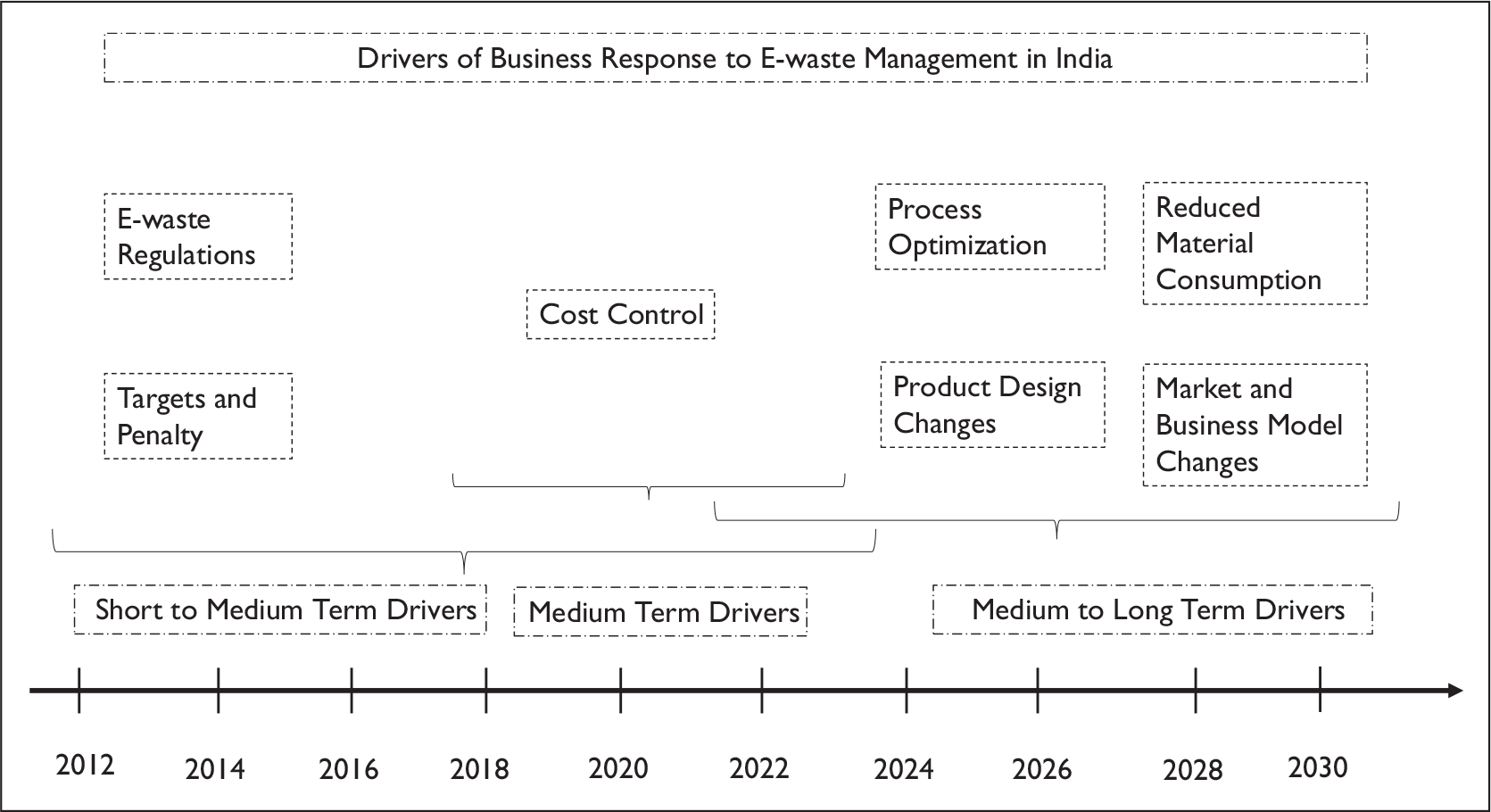
Emergence of other driving factors, however, does not mean that e-waste regulations will not be required. A clear and robust e-waste regulation whose provisions for producers and other stakeholders strengthen and do not dilute with time is pivotal for driving business response, especially in the medium term. In the short to medium term, robust regulations and fear of non-compliance will provide impetus to businesses’ search for and growth of different alternatives to manage e-waste in India. The growth of PROs in India or the introduction of deposit refund systems for electronic goods by some producers after 2016 have been possible mainly because of the regulations. Some of the challenges related to interactions of businesses with the informal sector and the lack of transparency in managing e-waste by producers and e-waste management firms will take time before a solution is found out. Time will also be required for other business drivers to emerge and become strong enough. Until that time, steady and robust regulations are essential to drive responsible business response for e-waste management. Robust regulations coupled with enhanced regulatory capacity will also mean that efforts and mechanisms to bring safe and scientific practices in the informal sector are continued.
Trend 2: Emergence of sustainability as a key agenda. One of the biggest developments that will impact the business response to e-waste in India will be the increased prominence of sustainability, globally as well as in India. Environmental degradation, climate change and resource scarcity have increasingly come to the forefront of government and public attention. The changed business environment, evolving domestic and global policies and regulations and increased demand from stakeholders such as consumers, investors, governments and NGOs are driving the sustainability agenda in businesses today. Sustainability is, therefore, increasingly becoming an integral part of corporate strategy. Businesses are responding in different ways: change in the business model, that is, from selling to renting or leasing; emergence of a sharing economy; increased supply of greener products driven by increased consumer demand.
The Indian government is a signatory to United Nations SDGs with the NITI Aayog responsible for aligning initiatives with SDGs. There have been some recent attempts to connect e-waste management with SDGs. However, for the Indian e-waste sector, while local context and circumstances may cause a time lag between global and Indian developments, the trajectory in India will not be different because of some key reasons. The reasons include the presence of foreign electronic producers in India, increased export-oriented nature of Indian electronics producers, rise in pro-environmental behaviour among Indian consumers and increased Internet penetration leading to convergence in consumer demands globally for greener products and more responsible businesses.
Trend 3: Increased response from bulk consumers. With the emergence of other drivers and the sustainability agenda, stakeholders will demand for demonstrable actions and increased response in managing e-waste by bulk consumers. The emphasis on P for producer in EPR has so far meant that almost all the attention is centred on producers. However, since electronic goods sales to bulk consumers amount to three-fourths of all electronic goods sold in India, more will be expected and demanded from bulk consumers. Many of these bulk consumers have an active and full-fledged sustainability team and agenda. The response to e-waste management will come under the realms of respective sustainability teams. Increased consumer awareness about e-waste will force not just producers but also bulk consumers to actively focus on e-waste management. All these developments will lead to a combination of responses from the producers and bulk consumers. Some of the business responses could include producers shifting from selling to leasing model, increased collaboration between producers and bulk consumers in managing e-waste, and preference in public procurement to goods made from recycled materials.
Expectations from Business in the Next Five Years
Norms for producers being strengthened
Definition of e-waste being expanded to include all electrical and electronic products that are currently excluded from the rules
Ambiguity around terms like producer and manufacturer existing in the current versions going away
Product take back percentage for producers going up
Recycling targets being introduced for producers
Cost for non-compliance going even higher
There is a need for change in the type of questions being asked from the producers. While initially producers were asked if they have a plan for consumer awareness or not, now the producers are being asked about their EPR plan. In future, questions for producers should include standards for recycling and providing measurable, verifiable and reliable data on e-waste collected. In the next five years, producers might also be expected to provide audited figures for products collected using different take back mechanisms. The producers might have to demonstrate evidence of instances where the collected e-waste has either been sent to a recycling facility or used after material recovery in production processes. Similarly, the bulk consumers should increasingly come to the attention of regulators and be asked to provide evidence about their organizational practices in dealing with e-waste.
Another set of developments expected in the next five years includes standardization of a process to inventorize e-waste data. The central regulator, CPCB and the MeitY have started pilots to inventorize e-waste data. As collection targets increase in future, there will be increased scrutiny of e-waste numbers being provided by different stakeholders. Adoption of a standardized procedure that is aligned with global practices will equip regulators and the government with a stronger ability to enforce the rules. Compliance as a driver for businesses’ response to rules would will become even stronger. With compliance becoming a strong driver, businesses will look at deriving benefits arising from improved compliance. For producers, this could mean emergence of cost control as a key driver.
E-waste rules were the first waste management rules in India to be explicitly based on EPR. In 2018, alarmed by the growth of plastic waste, several state governments have introduced measures to ban plastic in their respective states. Many of these regulations are based on EPR. The resulting market developments will be closely watched by the governments, regulators, businesses, waste management sector, NGOs working in these sectors and academia. Even today, there has been an increase in academic focus paid on understanding the different aspects of EPR and role of businesses, as evidenced by the increasing number of academic papers, conference presentations and media articles. Increased adoption of EPR in India would mean even greater focus on these aspects and rise in instances of industry academic collaboration to find better ways to manage waste streams and implement EPR.
EPR for E-Waste Management in India: A Producer Perspective
Hitesh Sharma
If the primary intent of introducing an EPR regime was to protect the environment from inefficient and ineffective management of e-waste, a conscience-led question should be: Which producer is the policy referring to?
Is it the producer of an electronic product or technology who earned by selling it to a consumer who cited some value in its use and/or usability and/or euphoria and hence, decided to make that purchase?
Is it the producer of parts and materials which gets sourced in production of an electronic product or technology by an OEM in the value-chain?
Is it the bulk/retail consumer who chooses to discard or (at best) donate the product and hence becomes the producer of e-waste, citing its non-use/non-usability/euphoria to procure anew? Moreover, doing this (mostly) at a price despite deriving of functional value and with limited or no responsibility to inform the producer from whom the product was procured.
Is it an informal stakeholder in the recycling ecosystem, who becomes a producer of polluting agents to the environment and their own health by externalizing dismantling/recycling cost?
Is it a formal stakeholder in the recycling ecosystem, who externalizes ‘left-overs’ with negative intrinsic value to an informal system in order to sustain the formal-way obligations?
Is it the government whose formal infrastructure is not available/accessible/accountable for use by any of the taxpaying stakeholder (producer and consumer alike) to reverse channelize the e-waste from a consumer’s doorstep, further reproducing conducive circumstances for informal means and mechanisms to thrive?
Is it the policymaker who chooses to act differently in the role of a bulk consumer in producing unaccounted channels and conflicting forces by offering e-waste as a resource on tender for the best price to recycle and not necessarily through producers of original products/technology who are the only stakeholders held responsible and accountable on collection-targets?
Is it the regulator who is constrained on its monitoring and evaluation infrastructure, producing a non-level playing field between the actors who choose to act and the free riders, further skewing the cost of technology/product and dis-incentivizing participation?
By defining the producer of an electronic product/technology as the only producer to be held responsible with targeted accountability on environmentally sound recycling of e-waste, this policy regime is tilted more towards treating symptoms than curing the system which involves a complex interplay of multiple stakeholders across a value spectrum. 36
EPR as ‘Extending Product Resourcefulness’: A Call for Framework Change
The current policy regime with product-centred design is more of convenience-led linear solution to a complex problem, which demands both science and conscience for a resolution. The need is to empower the most critical stakeholder in this value-spectrum, that is, the producer of electronic product/technology, to play a central role by enabling creativity, innovation and domain-expertise instead of cornering it with targets and exposing it to an extractive and exploitative ecosystem. The need for the regime is to approach it with a systemic mind-set and respond with a change in framework of EPR as ‘Extending Product Resourcefulness’ with following characteristics:
Envisioning Environment-Centred Design: Shared Values
Environmental pollution due to e-waste is not just a linear function of the toxicity potential of an electronic product. It is an intersecting function of multiple stakeholders’ values determining product resourcefulness beyond its manufactured characteristics—product design, choice and culture of use cases, decisions on usability, valuation of positive and negative intrinsic value, preference and convenience of functional value versus material value, processes and procedures in treatment ecosystem, and so forth. This requires an environment-centred design where every stakeholder has a shared but differentiated responsibility in extending the resourcefulness of a product.
Empowering Opportunity to Innovation: Shared Value Creation
When a policy instrument targets only one of the primary stakeholders with a potential to play a pivotal role across the product lifecycle, it poses a compliance risk. It is, hence, acknowledged by mitigation efforts or best addressed as the cost-to-compliance. Instead, if the policy regime realizes a level playing field and rewards fair play, it inspires as an opportunity to innovate value creation and be addressed with sustainability investments.
For instance, recognizing the potential of the informal dismantler ecosystem to be transformed into a parts supplier ecosystem will be a win-win for producers, society and the environment. This transformation can happen if producers invest to upskill the informal ecosystem, put products and domain competence in practice to create supply chain and market linkages, harnessing the quantum of these urban mines. This shared value creating proposition will redefine formalization beyond skills development and instil health safety practices, by upgrading the informal system into a micro-entrepreneurial system. It could benefit the environment by retention of functional value of the part which is much higher than the constituent materials. The nation too benefits by not losing out on rare materials, which in absence of an appropriate extraction infrastructure gets exported out of country. For a producer, in addition to the social returns on investment, such an investment optimizes and regularizes parts procurement and parts availability, further creating conducive ecosystem for EEE industry to ‘Make in India’. Moreover, the policy and markets could reward the eco-consciousness of such a product and parts supply to crossover industries such as e-vehicles, creating an incentive to sustain.
Ricoh’s Comet Circle 38
In the current schema on a non-level playing field among stakeholders where only the producer is held responsible with targeted accountability, such interventions get inhibited as the cost, both tangible and intangible, to intervene becomes unreasonably high.
Enhancing Circularity in Closing Product Loop: Shared Value Chain
The current policy instrument stresses on the responsibility of the producer to close the loop at a products end of life. It, however, oversights resource optimization and efficiency costs to the environment and undermines the producer’s design potential and an equitable participation by other stakeholders in the value chain to narrow the loop and slow the loop. This, in a way, positions the producer as a competing force among other extractive stakeholders and inhibits true potential of the producer to play a stewardship role in enhancing value quotient of a product lifecycle.
Design is where a producer of product/technology has a responsibly productive role to play in embedding the circularity features of narrowing the loop on ethos of lean manufacturing, choice of raw-material and its source as well as slowing the loop by enabling of repairability, reusability and refurbishability during the product lifecycle. Philips Lighting (now Signify) has demonstrated business model innovation by introducing this circularity in product use through its ‘Light as Service’ model in form of Philips Circular Lighting, 41
In addition to holding captive the product lifecycle maintenance and close looping, such a model positively influences sustainable consumption. But for such niche instances to be a norm, it is important for a policy instrument to empower an ecosystem which extends product resourcefulness and not enable, although non-intentionally, an extractive ecosystem which competes to speed up the downgrading of functional value of a product to its constituent material value. Moreover, an equitable participation of all stakeholders across the value chain is necessary to both narrow the loop as well as slow the loop so as to benefit the environment and its regenerative capacities, the intended beneficiary of the instrument.
Finally, it is important to be mindful of the investments required to renovate the system to align it to the circularity of shared values, shared value creation and shared value chain.
A producer, empowered and not merely enforced by a policy regime, taking up a product stewardship role coupled with validation by voluntary standards such as EPEAT, 42
But for all of this to be a possibility at scale-span-speed, it is critical to enable a central role for a producer rather than be cornered to act. A policy instrument to change framework from forcing a competitive rannbhoomi (war field) to inspiring a collaborative rangabhoomi (playground) for creativity, innovation, teamwork and impact to thrive. This shift in framework has the power to enable not only a healthy environment but also a prosperous economy and a sustainable society. And yes, I was once a producer and I do empathize!