




Abstract
Executive Summary
Since the existence of organization, organizational knowledge has been managed more informally than in formal ways. This was done through a knowledge supporting culture, by trusting and managing the employees. This was possible due to the small size of the organizations and co-location of employees. However, increasing global competition and growth of marketplaces have created a competitive incentive among many companies to consolidate and reconcile their knowledge assets as a means of creating value that is sustainable over time. In such a scenario, a need was felt to formally manage knowledge by developing capabilities.
The objective of this research article is to explore the knowledge management (KM) capabilities in large Indian organizations and their impact on knowledge effectiveness. It is based on the premise that together the perspectives of KM infrastructure and KM processes provide a useful theoretical foundation for defining important aspects of knowledge effectiveness in organizations. Knowledge management capabilities are explored with respect to infrastructure, structure, and culture. Knowledge management processes comprise creation/acquisition, storage, dissemination, and application. This research has found evidence that large Indian organizations have started realizing the importance of managing knowledge as a strategic asset. However, the approach is different in different organizations. Some organizations rely more on creating knowledge infrastructure capabilities through culture and structure while others equally emphasize the need of process approach to manage both tacit and explicit knowledge within the organization. KM effectiveness is defined in terms of improved communication, enhanced collaboration, improved employee skills, better decision-making, and improved productivity.
Data collected from 156 organizations was subject to structural equation modelling. The results established that both infrastructure capabilities and process capabilities play an important role in improving KM effectiveness.
One of the most dramatic evolutions in the business over the past decade has been the dawn of the new economy, that is, the knowledge-based economy. The increasing global competition and growth of marketplaces has created a competitive incentive among many companies to consolidate and reconcile their knowledge assets as a means of creating value that is sustainable over time. Recent studies (Moon & Lee, 2014) have concluded that culture and knowledge-sharing processes contribute to knowledge management (KM) effectiveness. Business organizations view knowledge as their most valuable and strategic resource for achieving sustainable competitive advantage (Davenport & Prusak, 2000). Thus, organizations have initiated knowledge management (KM) projects and programmes and have also emphasized on the knowledge-sharing aspects (Wang, Noe, & Wang, 2014).
The organizations have started to recognize, create, transform, and distribute knowledge and have a KM system in place (Gold, Malhotra, & Segars, 2001). The primary focus of many organizations has been to develop new applications of information technology (IT) to support the digital capture, storage, retrieval, and distribution of organization’s explicitly documented knowledge (North & Kumta, 2014). Other organizations believe that most important knowledge is tacit knowledge which can be shared by creating a culture in the organization. It has also been observed that KM is not just about capturing, storing, and transferring information; the pattern of interaction between people, technologies, and techniques is also important (Bhatt, 2001). The impact of KM has been studied on performance and knowledge effectiveness in developed nations; however, how the developing nations are building these capabilities has not been studied. This motivated the researchers to take up the study of KM capabilities and their impact in Indian organizations.
A key to understand the success and failure of KM within organizations is the identification and assessment of capabilities for successful KM effectiveness and organizational performance. In this study, therefore, the research questions are:
Which KM capabilities would impact knowledge effectiveness in the organizations?
Which capability is more critical in impacting knowledge effectiveness: knowledge infrastructure capabilities or knowledge process capabilities?
CONCEPTUAL MODEL
Knowledge Management Capabilities
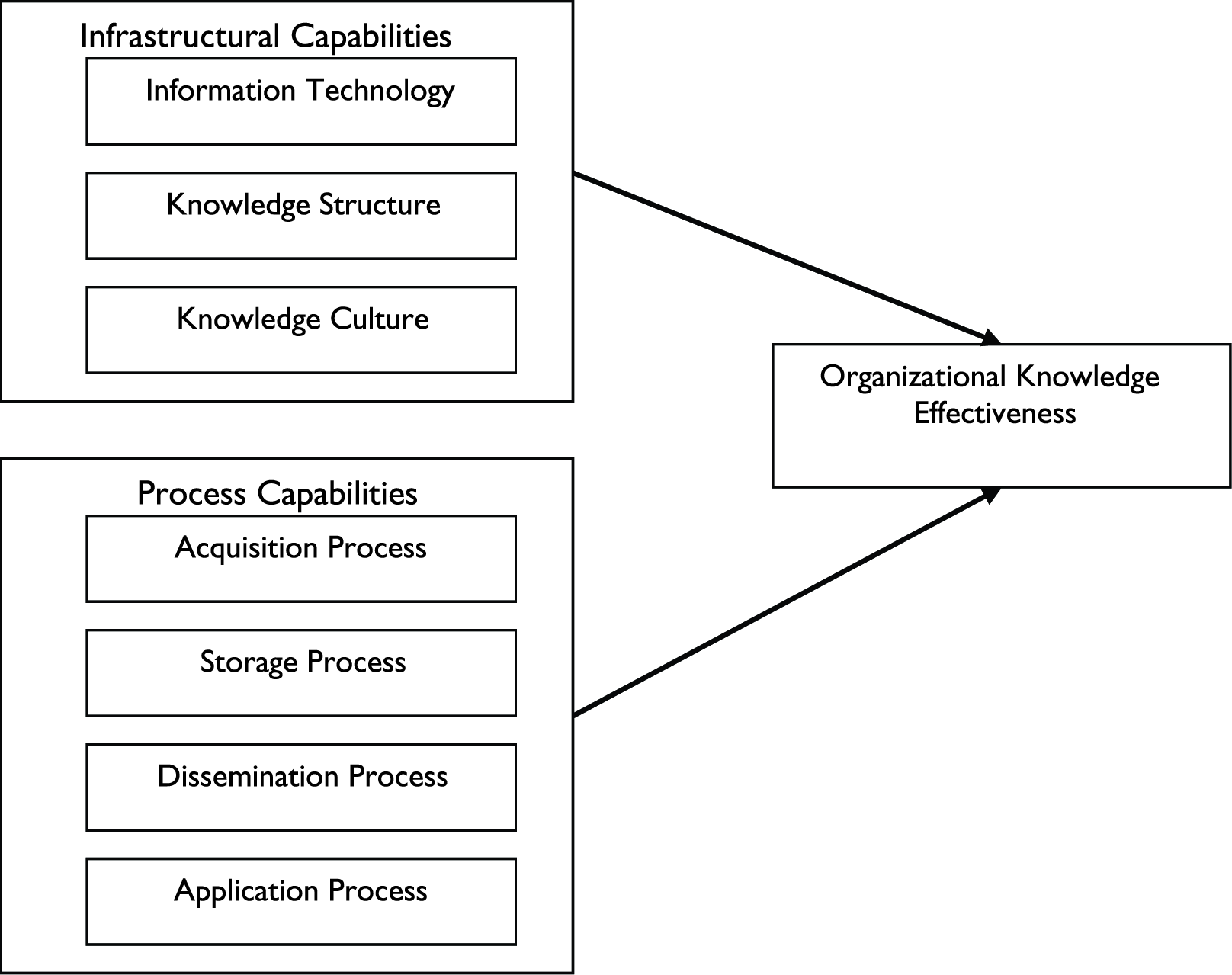
To compete effectively, firms must leverage their existing knowledge and create new knowledge that favourably positions them in their chosen markets. In order to accomplish this, firms must develop an ‘absorptive capacity’—the ability to use prior knowledge to recognize the value of new information, assimilate it, and apply it to create new knowledge and capabilities. Gold et al. (2001) have developed a model of KM based on the capabilities perspective. They refer to three key infrastructure capabilities—technical, structural, and cultural—that enable the maximization of social capital (intangible capital).
In order to leverage infrastructure, KM processes must also be present in order to store, transform, and transport knowledge throughout the organization (Almeida, 1996; Appleyard, 1996; Barnard & Spencer, 1996; Grant & Baden-Fuller, 1995; Nonaka & Konno, 1998; Porter, 1996; Szulanski, 1996). These processes enable the organization to capture, reconcile, and transfer knowledge in an efficient manner. Together, the perspectives of infrastructure and processes provide a useful theoretical foundation for defining important aspects of knowledge effectiveness in organizations (Figure 1).
Infrastructure Capabilities
Information Technology
According to Gold et al. (2001), technology comprises a crucial element of the structural dimension needed to mobilize social capital for the creation of new knowledge. ‘Technology is able to overcome the barriers of time and space that would otherwise be limiting factors in KM activities. It also serves as a repository in which knowledge can be reliably stored and efficiently retrieved’ (Chua, 2004). The entire technology infrastructure used in Organizational Knowledge Management Systems (OKMS) is tangible and it acts as an enabler for facilitating KM initiatives in the organizations.
According to Meso and Smith (2000), technology infrastructure comprises the hardware, software, middleware, and protocols that allow for the encoding and electronic exchange of knowledge. Four types of technology infrastructure are found in an OKMS:
Knowledge-oriented technologies, such as groupware and web browsers that directly process knowledge work and facilitate sharing of knowledge within the organization. Function-oriented technologies, such as office automation, robotics, and desktop computing technologies support operational level activities such as data processing, production, and service delivery while collecting the data. Specialty oriented technologies support highly specialized functions within the firm and usually require high levels of know-how. Examples of these technologies include computer-aided design and manufacture (CAD/CAM) software, and expert systems software (Davenport, De Long, & Beers, 1998; Hibbard, 1997). Social networking technologies supported through Web 2.0 is seen as a major facilitator of collaboration and information dissemination in an organization (Nieves & Ososrio, 2013; Panahi, Watson, & Partridge, 2013). Knowledge Management Capabilities and Organizational Effectiveness
Technology infrastructure provides the base or platform upon which KM solutions are built. It consists of the repositories for unstructured data (document and content management) and structured data (data warehousing, generation, and management). Groupware is also a part of infrastructure as it supports the collaboration needed for knowledge sharing (Duffy, 2001).
According to Yeh, Lai, and Ho (2006), IT that supports and coordinates KM are: databases, knowledge platforms, performance evaluation management system, and integrated performance support system. Zack (1999) believes that IT plays four different roles in KM: (a) obtaining knowledge; (b) defining, storing, categorizing, indexing, and linking knowledge-related digital items; (c) seeking and identifying related contents; and (d) flexibly expressing the content based on the various utilization backgrounds.
The technology-centred OKMS today are employing one technology or a combination of several key technologies like groupware, messaging, web browsers, document management, search and retrieval, data and text mining, visualization, push technology, group decision support, and intelligent agents. Knowledge portals (internet and intranet) are the most common infrastructure and play an important role in KM.
Knowledge Structure
According to Gold et al. (2001), structure is defined as the rules, policies, procedures, and processes, hierarchy of reporting relationships, incentive systems, and departmental boundaries that organize designs within the firm. Maturana and Varela (1980) define structure as ‘the actual static or dynamic components plus the actual relations that take place between them’. According to Mintzberg (1994), the organizations most frequently group their employees based on knowledge and skills, work process and function, time, output, client, or place. An organization’s structure is largely determined by the variety one finds in its environment. Mintzberg identifies four types of organizational forms, which are associated with four combinations of complexity.
Ebert and Griffin (2005) define organizational structure as the specification of jobs to be done within an organization and the ways in which those jobs relate to one another. According to Gold et al. (2001), organizational structure is the second most critical factor for successful KM implementation. Hasanali (2002) highlights structure as one among five critical success factors for KM. Organizational structure has been identified as a major KM enabler by many researchers in literature (Bose, 2004; Chourides, Longbottom, & Murphy, 2003; Holsapple & Joshi, 2000; Liebowitz, 1999; Wong, 2005).
Although intended to rationalize individual functions or units within an organization, structural elements have often had the unintended consequence of inhibiting collaboration and sharing of knowledge across internal organizational boundaries. It is important that the organizational structures be designed for flexibility (as opposed to rigidity) so that they encourage sharing and collaboration. Managers have realized that bureaucratic structures slow down the processes and raise constraints on information flow. In addition, such procedures often consume great amount of time in order for knowledge to filter through every level. Al-Alawi, Marzooqi, and Mohammed (2007) and Syed-Ikhsan and Rowland (2004) argue that knowledge sharing prospers with structures that support ease of information flow with fewer boundaries between divisions.
As the traditional orthodox organizational structure is inadequate for a knowledge-based organization (Nonaka & Takeuchi, 1995), a new organic organization structure that encourages effective and efficient communication is required to foster knowledge creation and sharing. Often KM models report the need for flatter organizational structures based on loosely coupled teams that form networks of functions for the organization (Van Beveren, 2003). A flexible structure would allow the formation of ad hoc cross-functional teams in which experts from different departments can be gathered to facilitate the flow of ideas across departments, or provide venues for employees to communicate informally. Conventional organizational structures need to be transformed to support the development of a knowledge structure (Oliver & Kandadi, 2006).
Nonaka and Takeuchi (1995) develop a new organizational structure, the hypertext organization that enables their five-stage process of knowledge creation to occur efficiently within the organization. This is a combination of a formal organizational structure and a non-hierarchical, self-organizing organizational structure. However, a similar effect can be achieved through maintaining the formal hierarchical structure and adding the dimension of flexibility. Gold et al. (2001) and Oliver and Kandadi (2006) have suggested a hybrid organization structure for smooth KM implementation. In such a structure, there are mixed positions with varying degree of KM and functional roles. Matrix structures and an emphasis on leadership facilitate greater knowledge sharing primarily by cutting across departmental boundaries.
As discussed earlier, some of the constituents of organization structure are flexibility, modularity, policy, and processes like rewards and incentive systems. Studies have also proposed creation of several KM roles (rather than exclusive KM jobs) which include chief knowledge officer (CKO), knowledge programmers, portal managers, content managers, and knowledge analyst (Davenport & Prusak, 2000; Gordon, 2002; Gray, 1998; Rastogi, 2000; Rumizen, 2002). These authors are of the view that some specialist positions are necessary for developing knowledge structure in the organizations. These structures are sustainable because: (a) people in KM positions are also involved in core business activities; (b) each functional division undertakes a part of KM costs with embedded KM roles; (c) KM programmes are integrated with functional divisions.
Another constituent of organization structure is the importance given to team work. If the organization structure is matrix-based as opposed to a bureaucratic hierarchical base, it encourages team work. In module and hypertext structure mentioned earlier, teams may be formed for specific objectives, for example, R&D. A flexible structure would allow the formation of ad hoc cross-functional teams in which experts from different departments can be gathered to ease the flow of ideas across departments, or provide venues for employees to communicate informally.
Many researchers have discovered that incentives and rewards play a major role in KM (Alavi & Leidner, 2001; Davenport et al., 1998). Such initiatives not only improve the amount of support that employees are willing to give to activities of KM (Yeh et al., 2006) but also enhance willingness to participate in knowledge creation and sharing. Choy (2006) refers to performance measurement as the key KM component for successful KM implementation. Al-Alawi et al. (2007) state that rewards must be based on group/team rather than individual performance. Oliver and Kandadi (2006) emphasize two points: (a) indirect rewards such as appreciation and recognition play a greater role than the monetary incentives; (b) long-term rewards such as profit sharing and employee share option (ESOPs) are more effective means than the short-term incentives. Walczak (2005) observes that any knowledge that is externalized into explicit form should be rewarded. However, this knowledge being further reused by other employees within the organization should also be associated with rewards.
Knowledge Culture
Organizational culture is very important in leveraging KM. It has been considered both as a facilitator and a hurdle/barrier for effective KM. Culture of an organization has key influence on KM, more specifically, on the effectiveness of knowledge (Chase, 1997; Demarest, 1997; Holsapple & Joshi, 2000; Pan & Scarbrough, 1998; Mårtensson, 2000) in an organization.
Tyler (1871) was the first to provide a formal description of the term ‘culture’. He defined the term as: ‘that complex whole which includes knowledge, belief, art, morals, law, custom, and any other capabilities and habits acquired by man as a member of society’. Steven (1989) notes that organizational culture is akin to the culture of the society in which the organization operates. This view considers organizational culture as a micro-culture within the culture of a given society or nation.
Since then many authors have defined organizational culture as the combination of value, core belief, behaviour model, and emblem. It represents the value system of the company and will become the employees’ behaviour norm. Every organization’s culture is an independent entity different from any other organization (Yeh et al., 2006). These cultural features of an organization may deviate from cultures of their respective societies (Lemken, Kahler, & Rittenbruch, 2000).
Since there is a crucial role of organizational culture in KM, it is imperative to know how to influence and develop knowledge culture in an organization. Oliver and Kandadi (2006) have defined knowledge culture as: ‘A way of organizational life that enables and motivates people to create, share and utilize knowledge for the benefit and enduring success of the organization.’ The presence of a ‘knowledge culture’ is critical to the success of KM within an organization (De Long & Fahey, 2000; Nahm, Vonderembse, & Koufteros, 2004) as it signals a managerial commitment to KM initiatives and promotes sharing of tacit knowledge for higher quality decision-making.
In the KM literature, a wide array of factors and concepts are cited as influencing elements for the creation and development of knowledge culture. These include organizational structure, people, reward systems, leadership, business processes, and information systems (Gupta & Govindarajan, 2000; Wenger, McDermott, & Snyder, 2002). Shaping culture is central to firm’s ability to manage its knowledge more effectively (De Long, 1997). This article discusses several variables studied in the literature that build the knowledge culture in an organization. Interaction between individuals is essential in building innovative culture (Arrow, 1962; Badaracco, 1991; Leonard & Sensiper, 1998). Dialogues between individuals or groups are often the basis for the creation of new ideas and can, therefore, be viewed as having the potential for creating knowledge.
Employee interactions should be encouraged, both formally and informally. This type of interaction and collaboration is important in shaping organizational culture conducive for KM. Instances like sharing information freely, working closely with others, and developing friends at work relate to interaction and collaboration. Many authors have defined a form of interaction where experienced workers or managers transfer knowledge to new or less experienced workers as part of their organization culture. Al-Alawi et al. (2007) refer to the communication between staff measured by high level of face-to-face interaction, use of common language, and team work discussion and collaboration as constituents of a knowledge enhancing culture.
Another important component of culture is corporate vision (D’Aveni, 1995; Leonard-Barton, 1995)—a vision that permeates the organization to provide people with a needed sense of purpose that transcends everyday activities. Through an articulated and communicated vision, it is possible to engender a sense of involvement and contribution among employees (O’Dell & Grayson, 1998). A system of corporate values determines the types of knowledge that are desired and the types of knowledge related activities that are tolerated and encouraged (Levinthal, 1998; Miles et. al., 1997). Trust (Al-Alawi et al., 2007; Park, Ribiere, & Schulte, 2004) and openness are commonly cited as two of these explicitly stated values that promote KM behaviours. Oliver and Kandadi (2006) refer to openness, to change, and to experimentation as important constituents of a knowledge enhancing culture.
Leadership at various levels of management (Oliver & Kandadi, 2006) is also an important constituent for developing knowledge culture in organizations. The attributes include empowering and involving employees. Leadership is required to develop a desired culture and, hence, to develop knowledge culture as well. The middle and front level managers play an important role in developing knowledge culture through the manifestation of various leadership characteristics. Senior managers need to understand the value of KM and are willing to support and play an aggressive role in decision-making. According to Davenport et al. (1998), one of the key successful factors is the support of senior managers and it includes: (a) conveying the information that KM and organizational learning are key to the success of an organization; (b) clarifying what kind of knowledge is important to the organization; and (c) providing financial and other resources to build the fundamental building blocks of KM.
Knowledge Process Capabilities
In today’s globally competitive environment, knowledge-intensive organizations gain knowledge and wisdom through their business activities. The adherence of organizations to inflexible, ad hoc, and indirect approaches can enable them to build an environment facilitating KM but have limited contribution towards facilitating knowledge as a strategic asset and, thus, is a big corporate challenge. Thus, we look at KM processes as those that would help us build knowledge as a strategic resource which along with infrastructure capabilities will drive knowledge effectiveness and organizational performance.
Distinct knowledge processes are modelled in a life cycle model which permits further analysis of requirements for the support of KM activity in each process. The processes of KM lifecycle approach relate to the fact that organizations utilize internal and external sources of knowledge. This knowledge has to be made available to the concerned people in the organization. Thus, a KM cycle starts with creation and/or acquisition of knowledge which has to be organized, mapped, and/or formalized to transform it in reusable form. It has to be made accessible to people, or disseminated, and/or shared with everyone in the organization. Finally, it has to be applied, used, reused, and/or exploited for achieving the organizational benefits. Gold et al. (2001) have grouped them into four broad dimensions of process capability acquiring knowledge, converting it into useful form, applying or using it, and protecting it. Acquisition, storage, dissemination, and application are identified as dimensions of process capability.
Acquisition Process
Acquisition-oriented KM processes are oriented towards obtaining knowledge. However, prior to acquisition, an organization must know the knowledge it has within the organization in some form or other, and the knowledge gaps. This sub-process is called knowledge audit. Along with knowing the current position, an organization should make efforts to acquire knowledge and create new knowledge by using processes and tools for the same. Many terms have been used to describe these processes: acquire, discover, seek, generate, create, capture, and collaborate. All of these terms have a common theme—the accumulation of knowledge. Innovation, another aspect of acquisition, is the creation of new knowledge from the application of existing knowledge. This requires concerted effort and a high degree of experience in recognizing and capturing new knowledge (Drucker, 1993). Improved use of existing knowledge and more effective acquisition of new knowledge is also a key aspect of acquisition (Thurow, 1996). These processes take place simultaneously rather than in a sequential manner.
The creation of organizational knowledge requires collaboration of personal experiences (Inkpen & Dinur, 1998). Collaboration takes place at two levels within the organization: between individuals and between the organization and its network of business partners. Collaboration between individuals brings together individual differences (e.g., cognitive style, preferred tools, backgrounds, experiences, etc.) and can be used to create knowledge (Leonard-Barton, 1995). This assumes that interaction between the individuals will promote learning (Teece, 1998). Collaboration between individuals is also the basis for socialization (Nonaka & Takeuchi, 1995). However, the ability to acquire knowledge is partly based on an organization’s absorptive capacity (Cohen & Levinthal, 1990). This is because all the necessary skills for innovation may not be found within a single organization (Inkpen & Beamish, 1997) and, hence, is the need to collaborate with partners.
Storage Process
Storage KM processes are oriented towards making existing knowledge available at a central location, easily accessible by everyone. Some of the processes that enable knowledge conversion are a firm’s ability to organize (Davenport & Klahr, 1998), integrate (Grant, 1996), combine, structure, coordinate (Miller, Friesen, & Mintzberg, 1984; Moore, 1996, Sanchez & Mahoney, 1996), and store knowledge (Zander & Kogut, 1995). An organization must develop a framework for organizing or structuring its knowledge (O’Dell & Grayson, 1998). Without common representation standards, consistency or common dialogue of knowledge would not exist. This would make it difficult to effectively manage the asset. Knowledge about a particular subject may reside in different parts of the organization or in different systems within the organization. Combining or integrating this knowledge reduces redundancy, enhances consistent representation, and improves efficiency by eliminating excess volume.
Thus, it is important for organizations to store knowledge in a user-friendly, easily accessible form. Explicit knowledge can be stored as best practices or lessons learned databases. For tacit knowledge, the conversion process makes available corporate portals for accessing the expertise locator system.
Dissemination Process
Knowledge dissemination process refers to the process of sharing among the employees in an organization. Many organizations may just hoard the knowledge, thinking that people will access the same and use it. Effective retrieval mechanisms allow for quick and easy access and sharing of knowledge. For explicit knowledge, web portals and organization intranet can play a crucial role. Using text mining techniques to mine relevant knowledge is characteristic of knowledge dissemination of unstructured knowledge. Using intelligent agents to actively build user profiles and push appropriate lessons learned and material to user is another way of knowledge dissemination. Chat rooms, bulletin boards, online communications, communities of practices, etc., on organization intranet also facilitate knowledge sharing. However, for tacit knowledge sharing, the knowledge conversion process makes available corporate portals for accessing the expertise locator system, but the dissemination process should facilitate frequent get-togethers such as knowledge fairs, seminars, and informal gatherings.
Application Process
Knowledge application processes are processes oriented towards the use of knowledge. Having a comprehensive KM system is of no utility if employees of the organization are not using the same and organization is not able to see the impact of the same on its business performance.
It is important that KM helps the organization to use the acquired knowledge to adjust strategic direction, solve new problems, and improve efficiency. A regular review is, therefore, required to know what has worked well and what has not during the lifecycle of KM. These processes also enable the organization to replace knowledge that has become outdated.
Knowledge Management Effectiveness
Measuring KM effectiveness and its contribution to the organizational performance is a key concern of many organizations. As knowledge is an intangible strategic asset of an organization, measuring it is a challenge. Several approaches have been tried to measure this intangible asset but contribution to business performance is still a major research agenda. In our KM model, we propose that a good KM infrastructure and process would improve KM effectiveness and would lead to better organization performance. Thus, an organization may invest in the KM systems but organizational performance would depend on the effectiveness of KM systems, which in turn depend on infrastructure and process capabilities of an organization. Anantatmula (2007) defines KM effectiveness in terms of useful KM outcomes, such as improved communication, enhanced collaboration, improved employee skills, better decision-making, and improved productivity. Anantatmula’s (2007) research has shown that the attributes of KM effectiveness can lead to improvements in performance such as customer satisfaction through better product or service quality. This is possible due to a learning environment, employee development, effective communication tools, and knowledge sharing.
Empirical Studies on Knowledge Management Effectiveness and Processes
Previous studies have considered relationship between organizational culture and organizational effectiveness (Park et al., 2014). Also studied is the impact of organizational culture on KM success (Zheng, 2005). Organization culture and processes have influence on KM effectiveness (Park, 2006). Mooradian, Renzl, and Matzler (2006) study the relationship between organizational culture and the knowledge sharing process at the team level. Moon and Lee (2014) study the mediating effect of the knowledge sharing process. Teo and Bhattacherjee (2014) examine infrastructural capability as an antecedent of knowledge transfer and utilization. Further, infrastructural capabilities have also been studied in terms of a KM capability between supply relationship management and performance (Tseng, 2014).
Despite different theoretical studies and assertion, the direct impact of the infrastructural and process capabilities has not been studied. This study explores the impact of these capabilities. Thus, our research hypothesis is:
Hypothesis 1: There is significant impact of organization KM infrastructure capabilities on KM effectiveness.
Hypothesis 2: There is significant impact of organization KM processes capabilities on KM effectiveness.
RESEARCH METHODOLOGY
Instrument Development and Data Collection
The unit of analysis in this study was an organization. The objective was to measure the KM practices of large Indian organizations. The latest list of 1,000 large Indian organizations available in The Economics Times (2010) was taken as the sample. The literature related to KM capabilities was reviewed in order to specify the measures. Data was gathered through a survey that tapped responses from ET 1000 companies in India. Direct telephonic conversations were made to introduce the objectives and to identify the contact person for the survey. A total of 156 filled questionnaires were received, the response rate being 15.6 per cent. The respondents were asked to evaluate the items using the Likert scale of 1–5 (1 being strongly disagree and 5 being strongly agree).
Data Analysis and Results
The goal of structured equation modelling (SEM) is to determine a valid causal model. The advantage of structured equation model is that, it can test the entire system of variables in a hypothesized model. Thus it enables the assessment of the consistency of the model with data (Byrne, 1998). SEM is chosen so that the causal relationships between construct and multiple measurement items could be tested (Jöreskog & Sörbom, 1996).
Reliability of Constructs
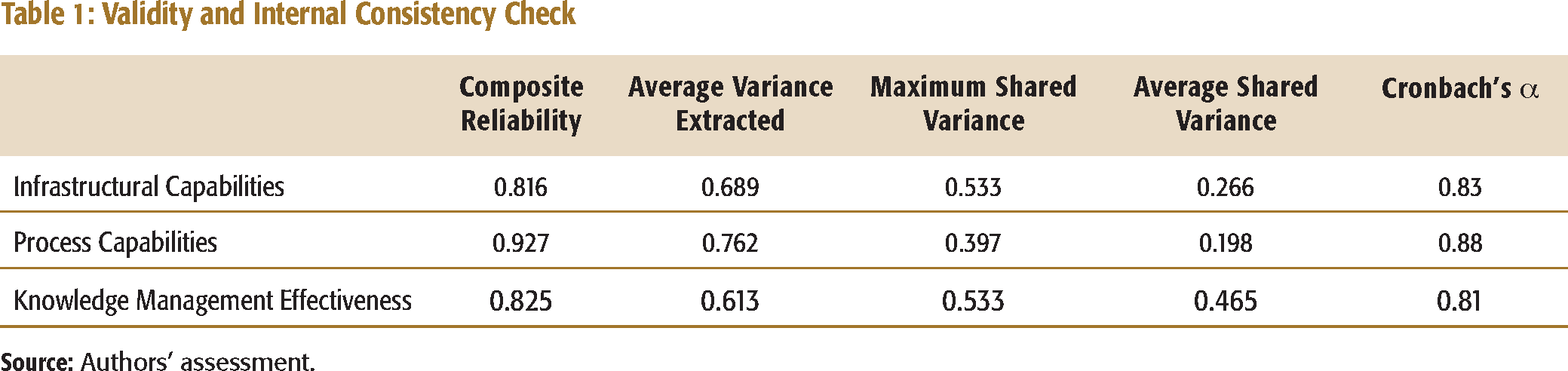
Validity and Internal Consistency Check
Structured Equation Model
The model was examined using SEM in AMOS 4 in two portions: (a) the measurement model, for checking the adequacy of measurement properties of the variables and (b) the path model, for checking the significance in the relationships among variables. The overall fit of a hypothesized model was tested by using AMOS (a software package for SEM) output and other fit indices such as the ratio of chi-square to degrees of freedom, goodness-of-fit index (GFI), adjusted GFI (AGFI), comparative fit index (CFI), root mean square residual (RMSR), root mean square error of approximation (RMSEA), standardized residual, and modification index (MI).
Measurement Model
The measurement model was checked for internal consistency, convergent validity, and discriminant validity. For convergent validity, the values of Composite Reliability (CR) and Average Variance Extracted (AVE) should be greater than 0.7 and 0.5, respectively. For discriminant validity of the constructs, the values of Maximum Shared Variance (MSV) and Average Shared Variance (ASV) should be less than AVE (Hair, Black, Babin, Anderson, & Tatham, 2010). Table 1 shows that all the variables exhibit a convergent and discriminant validity.
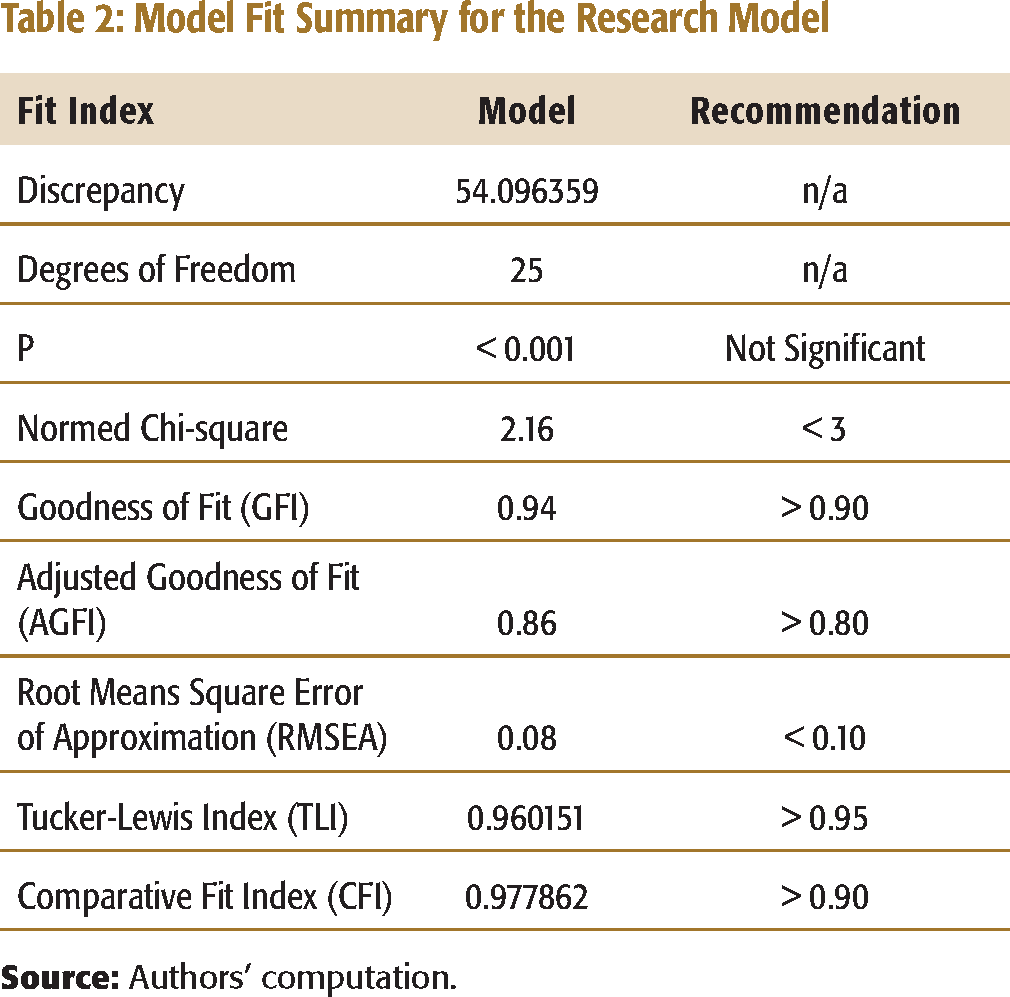
The measurement model with three variables constructs was assessed using confirmatory factor analysis. All the factor loadings exceeded 0.5 and each indicator was found to be significant at 0.01 significant levels. To assess the model fit, the chi-square (c²) values (Kline, 2010), comparative fix index (Bentler, 1990), and root mean square error of approximation (Steiger, 1990) were reported. These indexes ensure that an improved overall fit is provided relative to the null model. The CFI and GFI have been considered the best approximations, with values greater than or equal to 0.90 considered indicative of a good fit (Chin & Todd, 1995; Hoyle, 1995; Segars & Grover, 1993). RMSEA is a measure of the average standardized residual per degree of freedom; a favourable value is less than or equal to 0.10 (Browne & Cudeck, 1989).
Model Fit Summary for the Research Model
Path Model
Path Coefficients and p-Value
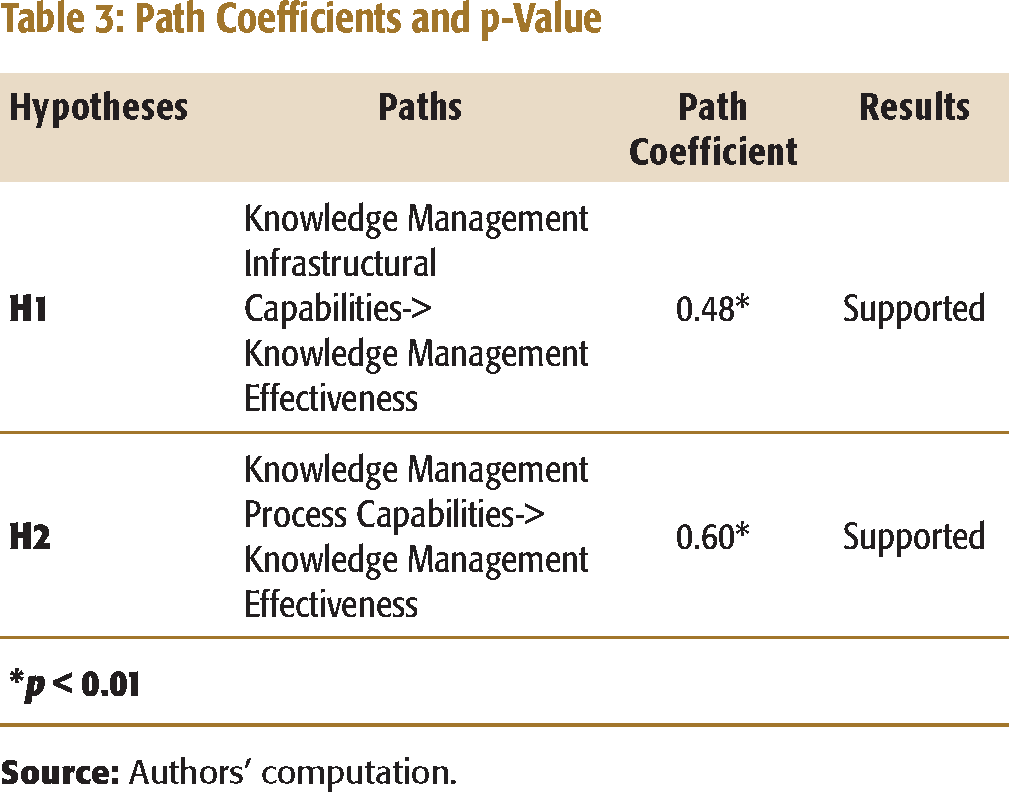
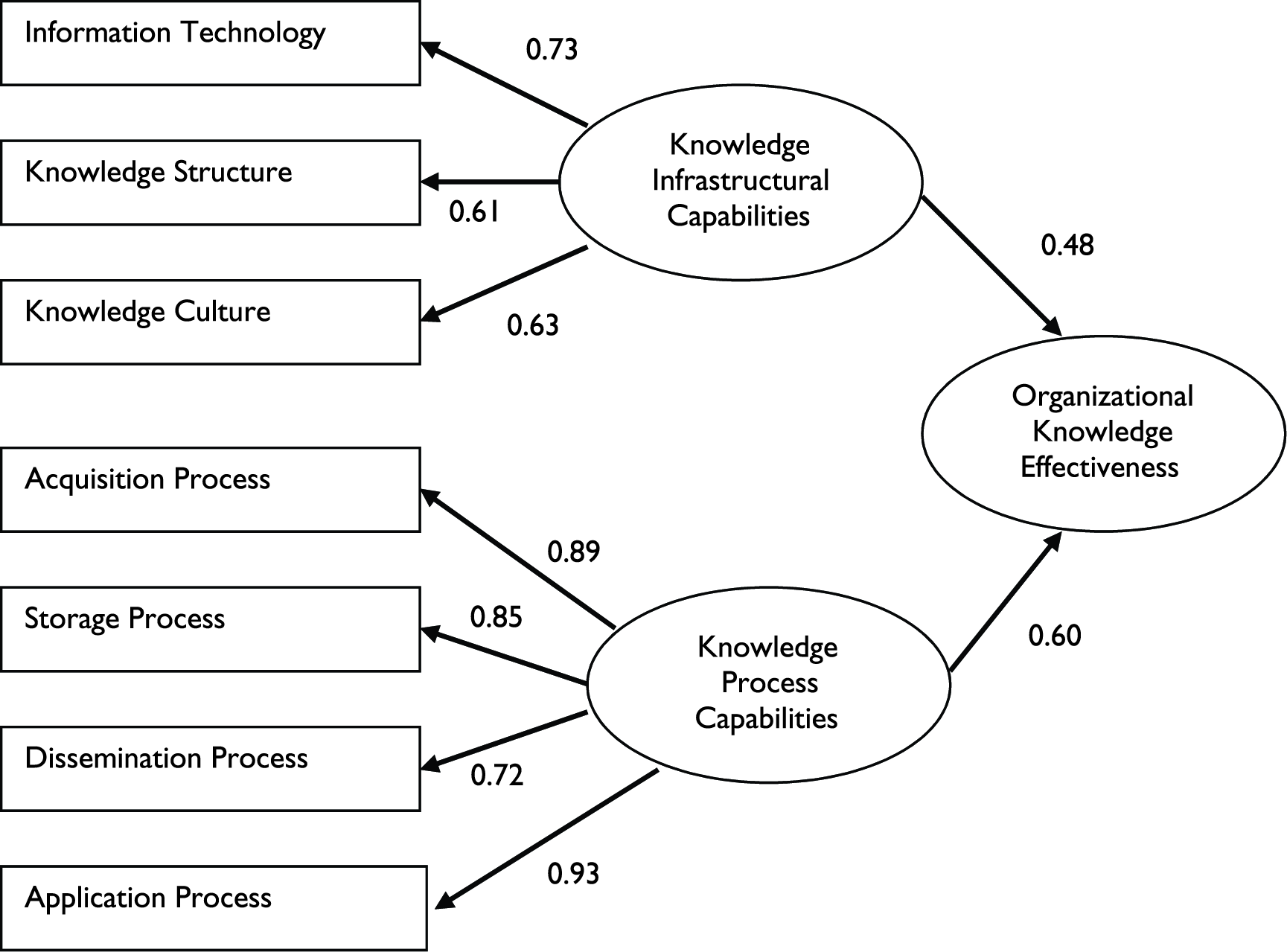
: Path Coefficients in the Research Model
DISCUSSIONS AND IMPLICATIONS
This is the first study for large Indian organizations and is in line with the other studies conducted elsewhere. Large Indian organizations have started realizing the importance of managing knowledge as a strategic asset. However, the approach towards KM varies. Some organizations rely more on creating a knowledge culture in an organization while others emphasize the need for a process approach to manage both tacit and explicit knowledge within the organization. As illustrated in Table 3, the paths between KM infrastructure capabilities and knowledge effectiveness are positive and significant. Hence, it can be concluded that infrastructure capabilities that constitute culture, structure, and IT infrastructure play an important role in improving organization effectiveness mainly resulting in improved communication, enhanced collaboration, improved employee skills, better decision-making, and improved productivity. It has been observed that culture of an organization is very deep rooted and to bring about structural changes within an organization is not that easy as it requires policy level changes. However, large organizations are process centric and implementing processes is easier. Thus, technology implementation and building and implementing KM processes would impact knowledge effectiveness significantly as it is easy to implement processes than to bring about changes in culture and structure.
LIMITATIONS AND FUTURE RESEARCH
A response rate of 15.6 per cent can give rise to inaccuracy in the survey data due to sampling bias. It is a limitation and effort should be made to improve it. Together, these results suggest that capabilities can provide a useful benchmark for KM within the firm. However, it is important to carry out further research in linking infrastructure and process variables of KM with the firm’s performance. It will, thus, give a significant tool to the managers to further implement such activities in their organizations.