




Abstract
Executive Summary
Saying that doing business in a highly dynamic and volatile work environment poses unprecedented challenges to organizations and their leaders is stating the obvious. In order to effectively deal with various challenges, and succeed, organizations need leaders who could help them realize their objectives. Furthermore, it is required that people from each level in the organization are involved in leading. Management researchers and practitioners argue that it is vital for any organization to develop leadership skills among its members if it aspires to succeed and take an edge over others. Scholars, working in the area of leadership development, maintain that leadership skills can be developed among organizational members and MBA students through carefully designed programmes/interventions. The challenge often is that leadership training is extremely resource-intensive. Leadership development arguably needs an understanding of self, others, and the systems. It is assumed that it can be best done in small groups with attention to the individual, and it takes prolonged engagement. Thus, designing learning inputs for large groups is a challenge that is real and remains unaddressed by many practitioners and faculty in management schools.
Based on the authors' understanding of what leaders need to learn, how they learn, and what are the effective methods of developing leadership, a leadership development workshop was designed for a large group of 100 participants at the same time. The objective of the workshop was to facilitate an understanding of “leadership as enabling the group to do its own work” among participants with an average 10–12 years of work experience. The design was based on the premise that leadership could be learnt and it was possible through a combination of self-development and cognitive understanding of leadership skills.
This paper presents the design of this experiential workshop, as part of the curriculum of an Executive MBA (EMBA) programme. It offers a conceptual foundation of what is leadership and what leaders do which served as the logic of the design and methodology of the workshop. Mixed learning methods such as experiential, self-awareness, feedback seeking, and reflective activities were used. Written reflections on learning from the participants who attended a two and a half day leadership development workshop are presented as a limited evidence for the effectiveness of the workshop design. The article not only shares the design but also hopes to start a dialogue among other leadership trainers towards designing innovative programmes for leadership development for student groups.
I hear and I forget. I see and I remember. I do and I understand. — A Chinese proverb
Today, organizations across the world are doing business in a highly competitive work environment with new challenges to be met on a daily basis. In order to survive and succeed, they need leaders who could help them realize their objectives. Organizations cannot be led to success only by one or two leaders who occupy pivotal roles, but people from each level in the organization have to be involved in the leadership process (Day & Halpin, 2004).
Ready and Conger (2007) argue that leadership development has become a crucial strategic process, and a lack of attention to it carries a huge cost for the organization. The success of an organization often depends upon the ability of the organization to nurture and develop leadership capacity among its employees (Riggio, 2008; Ruvolo, Petersen, & LeBoeuf, 2004; Virakul & McLean, 2012). Various leadership development programmes/interventions have been found to significantly impact organizational performance (Avolio, Reichard, Hannah, Walumbwa, & Chan, 2009; Avolio et al., 2005), and develop various skills such as communication, decision-making, teamwork, initiative, and planning among participants (Hoover, Giambatista, Sorenson, & Bommer, 2010; Kass, Benek-Rivera, & Smith, 2011; Sibthorp, Paisley, & Gookin, 2007).
Leadership development can happen in various contexts and locations such as on the job, through specially designed programmes to prepare the individual for undertaking a particular role, and as part of a degree in business management. Business schools, where prospective leaders in business get education, also have an equal responsibility to develop leadership skills among future leaders. The more commonly used methods include simulation-based training, classroom lecture, indoor training, and outdoor experiential training programmes. Each of these methods is unique and has certain advantages/disadvantages over others in one or more respects.
This paper describes one such leadership development design at a business school for full-time students in a one-year Executive MBA (EMBA) programme. The design emerged as a means to meet the challenge of developing a leadership course for a class of 90–100 with an average 10–12 years of experience. There were constraints of budget and time allocated to such a course. The paper describes the basic assumptions, our theoretical understanding of leadership, and the attendant design to deliver a meaningful and consistent leadership course. The course also required participants to submit an overall reflective paper about their learning for leadership one month after participating in the workshop. The reflections from student papers are used to demonstrate student takeaways from the workshop.
Foundation of The Design of The Leadership Workshop
We began with the assumption that leadership can be learnt. It is important for the facilitator to create conditions to learn about leadership. Hoover and colleagues (2010) argue that learning more likely occurs when participants are engaged, and it does not occur until the learner makes it happen (p. 194). According to Shrivastava (2010), this insistence on actionability “is particularly suited to the discipline of business and management” (p. 445).
For a person to acquire higher skills such as leading, it is necessary that conditions for deep learning are created (Ford, Smith, Weissbein, Gully, & Salas, 1998). There are several prominent learning models/theories for adult learning that provide an insight into designing such deep learning experiences (e.g., Hornyak & Page, 2004; Joplin, 1981; Kolb, 1984; Luckmann, 1996). As per behaviourism, the desired response can be shaped and trained in the learner by changing the stimulus. Cognitivism, on the other hand, holds that a learner repeats actions that are seen as positive and discards those that are seen as negative (actions are a result of acquiring of new information and converting the information into action). According to social learning theorists, the learner forms a relationship with the environment and then learns from the significant models in the environment. And as per the proponents of developmentalism/transformative learning, it is claimed that learning happens when learners critically reflect on the environment and stimulus around them. It has been aptly said that a “leadership development programme that incorporates the thinking of behaviourists, cognitivists, social learning theorists, and developmentalists will not only involve learners at a higher level, it will help architects of leadership development programming design interventions and environments more conducive to learning” (Scott, 2007, p. 36). Integrating concepts from adult learning theory indicates the need for learning strategies such as providing relevant experience, giving feedback, and designing activities that help the leader as a learner to maintain attention, be motivated, and remain active during the learning process.
Our understanding of learning theories and our experience of teaching executives attending leadership development programmes corroborate the observations of other scholars in the field that experiential training programmes are particularly effective in developing leadership and team-building skills among participants (Hoover et al., 2010; Judge, 2005; Mazany, Francis, & Sumich, 1997; Shivers-Blackwell, 2004; Sibthorp et al., 2007). In experiential training, facilitators lead participants (undergoing experiential learning) through various activities; they encourage participants to reflect on the experiences and help them transfer the insights to a work context (Wagner, Baldwin, & Roland, 1991).
Experiential programmes offer several advantages over traditional classroom lectures. For example, physical involvement promotes active engagement in learning, participation in novel situations helps break old patterns of thinking; experimentation with problem-solving is encouraged, and group awareness and trust are boosted (Clements, Wagner, & Roland, 1995). Participation in simulations helps the participants experience real emotions which then form the basis of learning. Judge (2005) argues that for leadership development, an experiential training programme is superior to classroom instruction, individual feedback sessions, and isolated skill-building exercises. Outdoor experiential training programmes also help participants to enhance self-concept, promote individual risk-taking, and improve problem-solving as well as communication skills (Hornyak & Page, 2004; Mazany et al., 1997; Shivers-Blackwell, 2004; Sibthorp et al., 2007; Wagner et al., 1991; Watson & Vasilieva, 2007; Williams, Graham, & Baker, 2003).
The activities that are used in experiential training programmes are only metaphorically related to the roles performed in the work context. Some of them are futuristic and may help participants learn about experiences that they have not had so far but are likely to have in the role of a leader (Williamset et al., 2003). As the Chinese saying quoted at the beginning of this research suggests, actual experiences promote an understanding of the phenomenon.
It has been observed that effective leaders exhibit a high level of self-awareness. Developing self-awareness involves a commitment to developing a keen insight about one's own motives, behaviour, and impact on others, and a willingness to continuously look for small developmental opportunities and feedback (Avolio & Hannah, 2008; Day & Harrison, 2007; Goleman, 1998; Riggio, 2008; Thompson, Grahek, Phillips, & Fay, 2008). Goleman (1998) argues that self-aware people know about their strengths and limitations and are comfortable talking about them; in fact, they demonstrate a thirst for constructive criticism. People with strong self-awareness are neither overly critical nor unrealistically hopeful; rather, they are honest – with themselves and with others (Goleman, 1998). In addition, Riggio (2008) contends that, in order to learn and develop themselves further, leaders need to be open to feedback from assessment tools, to take note of ratings of their leadership from superiors, peers, and subordinates, to heed the advice of their executive coaches, and to personally reflect on and self-critique their leadership. The motivation to develop and the ability to accept constructive criticism help positive change to occur.
In addition to learning to become more self-aware and receive constructive feedback, leaders also learn from reflecting on various experiences that they gain in their professional and personal lives. In other words, a leader's life experiences also play an important role in learning and leadership development. Avolio and Hannah (2008) assert that leaders and leadership are largely made through experiences. Furthermore, they argue that the factors that contribute to making a leader are in part a subset of all of the formative experiences an individual has accumulated throughout the course of his/her life. By constructing one's narrative or life story, people proactively make meaning of their experiences, thereby forming their identity or self-construct which then becomes the lens through which one views future experiences (Avolio & Hannah, 2008).
In agreement with Amagoh (2009), we believe that learning to reflect not only on life experiences but also on the simulated experiences that one goes through helps transfer knowledge and crystallize learning, especially about leadership. Effective leaders are often reflective of their practices. It is a skill that needs to be consciously learnt and nurtured even by the highly educated persons.
Boyatzis (2008) maintains that writing a personal vision for future and sharing it with trusted others help in leadership development. Writing of the vision helps clarify what one values and provides an opportunity to the individual to articulate his/her ideal self (what the person wants to be) and verbalize it.
We designed an experiential training workshop using a mix of learning methods including experiential, self-awareness, feedback seeking, and reflective activities. We were constrained to limit the workshop to no more than days of class time. There were two faculty members and two research associates, and a small budget with which we could hire equipment, etc. The workshop was part of a tightly run executive programme, and so participant expectations to get something in return for the time spent were high. For good learning experiences, we decided to first clarify among the faculty team our specific theoretical understanding of leadership and leadership roles. It was felt that such clarity would help in designing a tight, coherent, and meaningful workshop for a mature group. In the following section, we have explored the meaning of the term “leadership,” what we envisage as the task of a leader, and the major characteristics that an effective leader possesses.
What Is Leadership?
Leadership has been a very popular subject of study for political scientists, psychologists, historians, organizational behaviour scholars, and practitioners from various fields. However, the volume of research has not helped in arriving at a clear and widely accepted definition of leadership. Traditionally, leadership has been defined as the possession of a set of abilities and certain traits (Katz, 1974; Kirkpatrick & Locke, 1991; Yukl, 1981). Leaders are also described as exhibiting a certain style in managing people who are completing a task (Blake & Mouton, 1964). From this traditional perspective, a leader is viewed as an individual in charge of a team, providing direction and support to the team members (often described as “followers”), aligning the team's goals with the broader purpose of the organization (Day & Harrison, 2007), and providing vision to the team/organization. In the traditional approach, it is assumed that leadership rests in a certain position or role, leaders need to have superior knowledge or expertise, they have to be extraordinarily skilled, and they have to have a vision as well as the ability to influence people in their favour.
Dissatisfied with this superhuman image of a leader, we searched extensively for a way to capture our understanding of leadership as a set of actions that one performs to help a group to self-propel. It was in this context that the conceptualization provided by Heifetz (1994) in his book, Leadership Without Easy Answers, made a lot of sense to us. Heifetz and his colleague contend that leadership is the skill of an individual to help the group/organization one is leading, to recognize and face its own challenges and thus achieve group/organizational goals (Heifetz, 1994; Heifetz & Laurie, 2001). In this conceptualization, later advanced by Heifetz and Linsky (2002), it is posited that leadership is not just the use of authority to accomplish goals, and that a leader need not necessarily be in a formally superior role or a higher position. An employee at any level can emerge as a leader by acting like a leader and leading the group to recognize its challenges, the ways to face them, to help the group to move towards addressing them, and in the process enabling the group to reach its goal or objective.
Complementing this view is the perspective that describes leadership in the form of team members working together collectively to set direction, build commitment, and create alignment. Elaborating on this conceptualization of leadership, Day and Halpin (2004) argue that leadership is the aggregate ability to create shared work that is meaningful to people and adds value to an organization. Furthermore, they contend that everyone in an organization can, and should, participate in the leadership process. Day and Harrison (2007) maintain that instead of relying on a single, usually formally appointed, leader to provide leadership to a team, effective teams might develop more collective, collaborative, and shared processes that comprise its leadership.
Synthesizing prior work on leadership with our own work and understanding of leadership, we conceptualized that a leader is someone who helps the team members to discover their own potential and possibilities for recognizing and addressing their issues. We define leadership as action and responsibility, and believe that a leader needs to act as a facilitator to help members work together to recognize multiple perspectives in the team, set direction, and achieve results collectively.
WHAT DOES A LEADER DO?
To be able to help exert influence with or without authority, we believe that leaders have to become skilled on various fronts. Based on our experience of working extensively with leaders, studying effective leaders, and a perusal of literature on leadership, we posit that leaders need to ensure that plurality of viewpoints is heard, understood, and incorporated in the action plan. In doing so, they take risks, recognize trends, align interests, mentor people, motivate and encourage others, foster trust and openness, provide and receive feedback, and strive for continual self-growth. In the following section, actions that a leader undertakes are described:
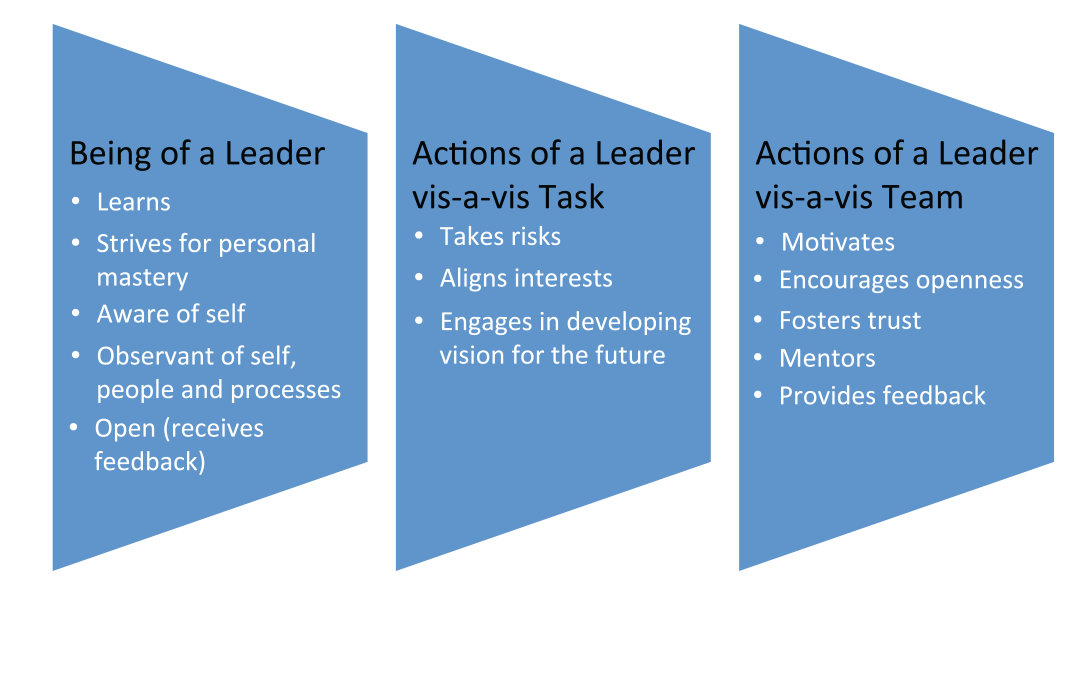
Effective leaders engage in various behaviours that differentiate them from not so effective leaders. For instance, effective leaders take sensible risks and learn from their mistakes (Kouzes & Posner, 1995; Sternberg, 2007), observe patterns (Heifetz & Laurie, 2001), align interests of all concerned parties (Sternberg, 2007), mentor and help in the development of others (Cappelli et al., 2010), motivate others (Thompson et al., 2008), foster openness and trust (Goleman, 1998), provide and receive feedback with the intention to improve (Cogner & Fulmer, 2003), and have a great desire to learn and develop oneself further (Senge, 1990). Based on these conceptualizations of effective leaders and our understanding of effective leaders and their behaviour, we devised activities that focused on amalgamating one or more of the effective leader's behaviour among participants. Figure 1 presents the diagrammatical representation of the being and actions of leaders.
Diagrammatic Representation of the Being and Actions of Leaders
The Workshop Design
Based on our understanding of what leaders need to learn, how they learn, and what are the effective methods of developing leadership, we decided that the objective of our workshop would be to “facilitate an understanding of leadership as enabling and possible through personal growth.” We felt that these objectives could be met by putting the participants through a series of activities linked to a variety of learning purposes and outcomes, to gain self-awareness, deep insight about life's experiences, experiential hands-on practices, and reflections as the methods of learning.
The leadership development workshop was designed to be conducted over days in a remote setting away from the usual classroom and institute premises. The student participants were looking to make a transition in their careers from being individual contributors to becoming responsible for the performance of a team. Run in two parallel groups of 40–50 participants each, the workshop was conducted for four batches of students, covering almost 320 participants, helping them to learn from the structured experience as well as from each other.
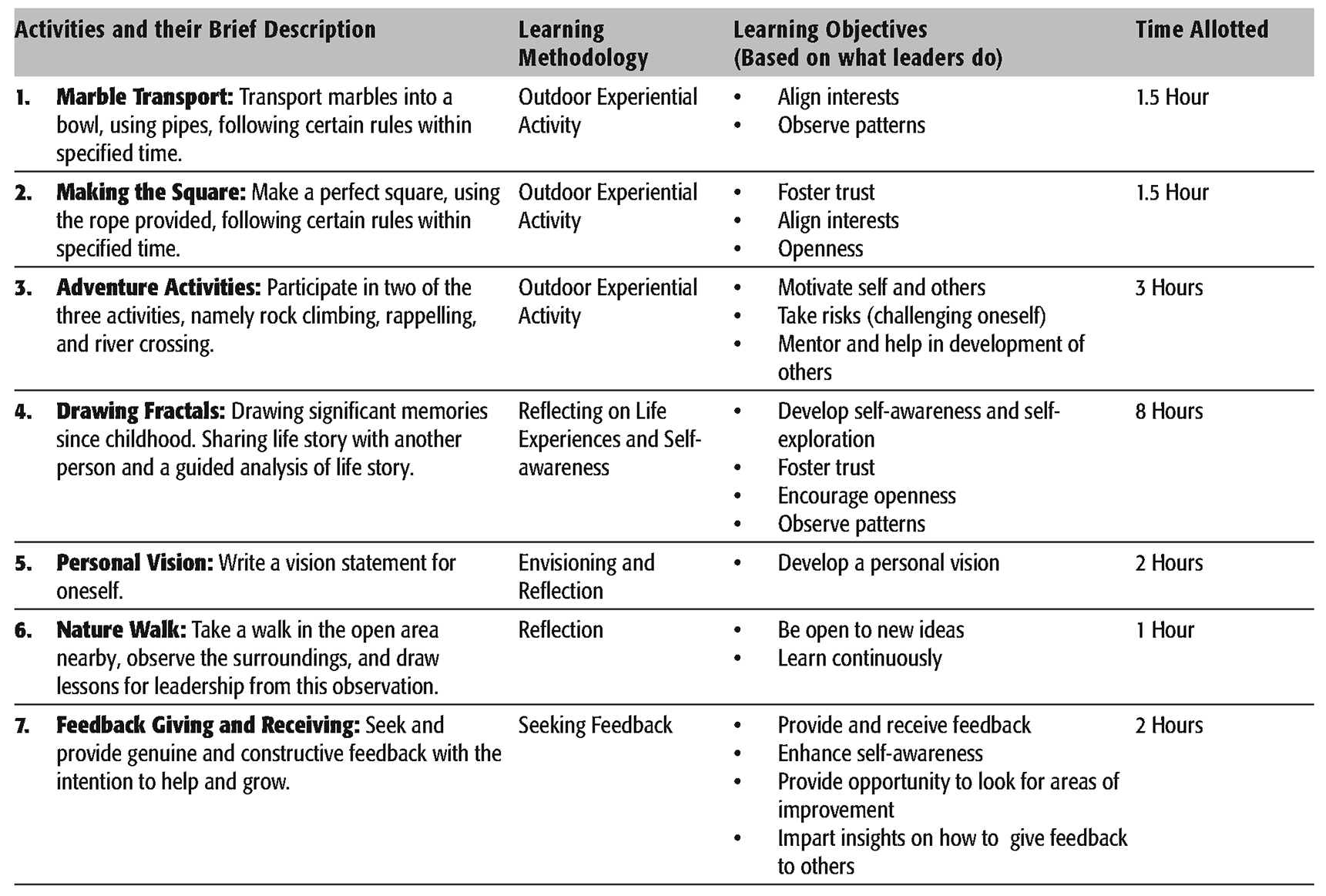
Table1: Design of the Workshop and Description of the Activities, Learning Methodology, and Learning Objectives 2
We borrowed many of these exercises from many sources, some from colleagues who have run programmes in the past and some from published sources. We have modified all of them over the years. However, we acknowledge and thank the various sourcesand people that we have learnt from.
The generic format of the workshop included activity, reflection, and debrief. The setting of the workshop was a scenic basic-amenity resort a little away from the institute campus. The participants were requested to make minimal use of their laptops or other technology devices.
One month after their participation in the leadership development workshop, the participants submitted a reflective note on their learning vis-à-vis their development as a leader. These written reflections and feedback of the participants are a good way of understanding the effectiveness of such programmes. Reflection sheets preserved over the four years of running this course were read by two of the authors. Quotes that were agreed by both as representative of the group comments were included to illustrate the participant views or reflections on the various activities. Such reflections were earlier used by several other researchers (e.g., Judge, 2005; Kass et al., 2011; Watson & Vasilieva, 2007) in order to understand the usefulness of such a workshop/training programme. In the following sections, workshop activities are briefly described and a few reflections of the participants are included to illustrate the meaning participants draw from each activity.
Marble Transport
In small groups of 8–10 persons, the participants were asked to transport the maximum number of marbles from a starting point to a finishing line using a limited number of pipes in a given time, while following some strict rules and norms. The task was simple and was designed to illustrate the skills needed by participants to be successful in technical/managerial problems. The task required cooperation, coordination, teamwork, communication, planning, finding the best solution for the problem, role assignment, and continuous improvement. One participant shared his experience in the following words, “This exercise was about trust – trust in the ability of your team mates, your ability to handover the task, and creating specialist positions. It was also an exercise in communication, planning, and then sticking to the plan during execution.”
Making the Square
In the second activity, all the participants in groups of 16–18 were blindfolded and then asked to make a perfect square with a rope in the given time. The task was simple but ambiguous and involved building trust and listening. The group had to come together to accept a solution and then implement it. “Making the Square” exercise provided an opportunity to appreciate difficulties that could arise in dealing with situations involving uncertainty and the unknown. It highlighted the need to build the total involvement of all in the team. The only way to solve this problem was to listen carefully and evolve the solution rather than try to force one's solution onto the group. This exercise was designed to simulate adaptive problems where no one had the complete or the best solution. In fact, the best solution had to emerge from the group. Even if a part of the group agreed to the solution, the task was not complete until and unless the entire group was involved. It highlighted the fact that people could perform well when challenges were known and things were under control. Moreover, the exercise emphasized that a leader should be open to new ideas. Sometimes, giving instructions is not enough; one should also actively listen to others. At times, listening and following directions can be as important for leadership as directing and telling others what to do. One participant admitted,
The task was a big learning exercise for me as I am, by nature, aggressive and headstrong and like to take control. The exercise made me think about other important dimensions of leadership, such as getting commitment from other team members, being a good listener, understanding others, and winning their trust.
Putting the Marble and Rope Exercise in Perspective
After the participants had noted down their own reflections on a sheet provided to them, the instructors led a discussion on the differences between managerial skills and leadership skills. The participants were thus led to the realization that depending on the situation, each person was expected to learn to be an effective manager as well as a good leader. They were then introduced to various skills required to become an effective leader. The remaining two days were utilized to develop and practice such skills.
Adventure Activities
Under expert supervision, the participants were encouraged to participate in two or three adventure activities such as climbing a mountain or rappelling down a straight wall or crossing a river using ropes. These activities were designed to allow them to assess their mental strength and physically challenge themselves. It helped establish the significance of taking sensible risks and trying something new. While the task was individual, it had to be carried out in the presence of other participants. The presence of others both facilitated the doing of the task and also put additional pressure to succeed. The participants were encouraged to reflect on the impact of the presence of others and realize the risk of failing in front of others, the pressure to learn a new thing and perform instantly. Likewise, they also reflected on the importance of developing confidence in their own selves. Another major learning came from their own ability to help others perform a seemingly risky and difficult task. The participants reflected on the value of expressing confidence in others' capabilities and encouraging them and not judging others prematurely. One participant put it in the following words, “A significant learning for me as a leader is not to judge the contents by the cover' – people have immense hidden potential and the spirit is stronger than the body.” The exercise helped the participants realize the power of expectations on their own and others' behaviour. Through this exercise, the participants also learnt about the importance of a leader's role in motivating others. According to one of the participants,
I noticed how those who were having trouble with the exercise, seemed to get more energy when their peers cheered them to go for it. Motivation has great power and can be a great tool for a leader. In fact, it now occurs to me that perhaps one of the most important jobs a leader can take on is to motivate his/her team to go past their limitations and help them get there under their own steam.
Fractals Activity
The “Fractals Activity” provided the participants with an opportunity for self-exploration and introspection by analysing the “top of the recall” memories of their lifetime. After relaxation exercise and guided imagery for the group, the participants were asked to draw their salient memories on a chart. Using simple tools, the drawings capturing memories were analysed to reveal underlying patterns in life. The participants realized that looking back was important for discovering new life patterns, examining their beliefs, understanding the value system, identifying what made them happy, and most importantly, for being satisfied with oneself. One participant reflected, “The complete experience to re-live the life from childhood till present through drawings gave me immense pleasure and I was personally able to connect the missing dots of happiness, joy, achievement, love, affection, and care”
The participants were also required to share their fractal chart with one other person who was a relative stranger but was regarded as being trustworthy. The sharing of their life stories with others made them realize the importance of self-disclosure in building trust and the value of a non-judgemental ear in understanding self. Self-disclosure helped in developing new relationships as well as in strengthening the existing ones. Listening to others' stories also helped the participants learn new ways of interpreting their own stories. One of the participants stated,
Sharing my journey with another individual took out a lot of internal frustration and helped me in relieving my stress. I was also impressed by others' stories, particularly to see how simple some of them could be in their approach to life at this stage.
The participants were thus encouraged to practise listening skills where they learned to be non-judgemental, to encourage openness, and to communicate support and trustworthiness by allowing the other person to share his/her view profoundly. In our mind, this is a very important skill in facilitation.
Personal Vision Statement
Using a structured set of questions, the participants were encouraged to examine their past, strengths, weaknesses, and choices, and thus arrive at a personal goal statement. This exercise was designed to help them realize the importance of thinking through a personal destination for the future and make choices about what they wanted their life to be like rather than letting situations and external pressures shape their lives. This exercise also helped people to discover their personal dream and thus to take some steps to designing that future. In the words of a participant,
Since I hadn't lived out a significant portion of my life, it filled me with a positive energy and enthusiasm to get cracking at whatever I wanted to achieve in my life. A deep powerful vision can achieve more than what any appraisal system can do.
In their reflections on learning from this activity, most of the participants said that they were not in a habit of planning their future well in advance. However, after attempting to write down their vision, they became aware of the difficulties they may face in developing and implementing it. To some participants, it also gave a sense of direction and relaxation.
Nature Walk
It is important for every leader to learn from various sources, handle solitude, and also build the ability to cope when there are failures. The leader needs a personal strategy for self-care and nurturing. One method we introduced to help the leaders was to encourage them to take a walk in nature for about an hour and find some leadership lessons from nature itself. It is our belief that nature is a great teacher and a wonderful therapist. To build the collective awareness of takeaways from the walk, each participant was asked to share one leadership lesson with the group. They were asked to use the definition of leadership as the ability to facilitate the group to do its own work. Although initially some participants felt a bit cynical about this activity, most of them came back with many insights and were eager to listen to others.
Feedback Session
The participants sought detailed feedback from one of their batch mates using a simple format of what they should continue to do, what they should stop doing, and what they could start doing. The reflections of the participants indicated that they understood the importance of giving and receiving honest and objective feedback. One participant commented,
I got a chance to get a sneak preview into the personalities of a lot of my friends in a different setting other than the classroom. Listening about them from others increased my respect for all of them. There were no barriers, no inhibitions. People were as open in giving feedback as they were in receiving. Everyone realized that there could be no better chance than this to identify the areas for improvement and this kind of interaction is still going on over emails.
In addition, participants felt that back home in normal circumstances, most often people did not receive feedback because they did not trust the person giving the feedback. One of their takeaways, as leaders, was a strong appreciation of the need to invest time in developing a climate of trust and transparency.
Another key learning from this exercise is that while a leader should know the art of giving feedback, at the same time he/she needs to be open to and welcome feedback from others. In the case of negative feedback, the leader should not feel embarrassed but instead commit to work on changing. Participants also reflected on the valuable lessons they learnt in giving feedback that was authentic and supported by facts. Learning from this activity was shared by one participant in the following words,
Various stages of shock, anger, resistance, and acceptance so aptly describe the states that our minds went through during the exercise. My own feedback turned out to be a bit of a surprise to me. What I always thought of as accommodating others was seen as indecisiveness by some. The feedback has given me a concrete goal to work upon.
The summary of the participants' reflections and their learning from different activities (presented above) clearly indicates that, to a large extent, we were able to achieve the learning objectives of each activity, and ultimately of the workshop.
Overall Insights About Leadership
Besides significant takeaways from each exercise/activity, the participants felt that the overall design of the workshop challenged their self-awareness and views on leadership, and forced them to reflect on new possibilities. Some of the typical observations from different participants are presented below:
At first, I was ceptical about the workshop. Another one of those corporate offsite gimmicks, I thought. I was in fact preparing myself for two and a half days of leisure, some fun in the resort, and some good time with fellow classmates away from the classroom grind. Little did I know that the two and a half days would be such a profound, transformative, and sometimes unsettling experience.
These two and a half days helped me understand, to some extent, my emotional and ethical priorities. Not only did I probe deep into myself to understand what I thought my values were, I also got to know how those values got manifested through my actions and how they were perceived by others. The workshop was an initiation of a process of looking within and outside, trying to relate them in a coherent manner – a process of learning and growing that I wish to continue in days to come. The leadership workshop proved to be an antidote to my inertia. Whilst covering many practical aspects of managing, motivating, and leading a team, it also provided a vehicle for a journey of self-discovery. It provided me with an opportunity to understand what motivates me, to examine my strengths and weaknesses and reflect upon them. I gained an understanding of the source from where I drew my energy and perceptions. I discovered my personal strengths I didn't know I possessed. I surprised myself by overcoming fear and doing things I would never have believed I could. Now, when faced with a difficult situation, I am sure I would reflect back to a learning experience from others.
Not everyone was equally positive. Some participants went away still sceptical about the definition of leadership and their own ability to lead. They continued to believe that leaders were born and they just did not have it within them to be leaders. Others felt that though the three days were interesting, they would not be able to remember and apply all that they had learnt when they get to work. Some felt that their biggest takeaway was knowing the group around better rather than about leadership. The dissenting and sceptical voices have helped us to continue to improve the design of the workshop. This design and paper are the outcome of our cumulative efforts of four years of continuous change, reflection, experimentation, and improvement.
Although a few participants seemed sceptical about the effectiveness of leadership development workshop, most of the participants believed that this workshop not only helped them acquire a better understanding of themselves in terms of their own thinking, feeling, and behaviour, and of the concept of leadership, but it also helped in enhancing their leadership skills. Findings of several other studies, where researchers have used outdoor experiential activities in MBA or EMBA programme to develop leadership skills, have also indicated that such programmes are quite effective in developing leadership skills among participants (e.g., Hoover et al., 2010; Judge, 2005; Kass et al., 2011; Sibthorp et al., 2007). Emphasizing the significance and inclusion of experiential learning programmes in management education curricula, Hoover et al. (2010) argue that there should be more focus on adoption of experiential learning pedagogy in business education that can help students in developing skills needed to function at an executive level in modern organizations.
Conclusion
This paper presents conceptual underpinnings and design of a leadership development workshop and reflections on learning from the participants who attended a two and a half day outdoor experiential workshop. The objective of the workshop was to foster leadership capabilities among participants. When we started designing this workshop, we could neither find any readymade design which could develop conceptual understanding and skills of participants as leaders nor did we find a workshop designed to handle large groups of participants. Most workshops are designed to work with small groups. Likewise, there were hardly any designs which used a mix of methodologies.
Given our success in designing a workshop that was both suited to large groups and used mixed methodologies, we felt that it would be useful to share our workshop design and experience with academics and practitioners. We found that the combination of doing and reflecting in the immediate term and after a month or so also helped to strengthen the learning from the workshop. The written reflections of the participants suggest that the workshop prodded all of them to think about leadership from perspectives that were different from what they had thought and believed earlier. Participants felt that the workshop helped them clarify their understanding of leadership and showed them the way to become more effective leaders in future. It can be argued that the authors have used quotes from participants selectively to prove the point. We address this concern by choosing responses that reflect what most of the participants said rather than what was only said by one or two participants.
We believe that we could achieve much within such a short period, possibly because prior to the workshop, the participants had spent a few months together as classmates. Having been involved in class projects and task-based interactions with each other, and sharing the same residential facility in the programme, most members knew each other fairly well as colleagues and knew a few as close friends. If a faculty/trainer wants to replicate this workshop with a group of stranger participants, they may want to spend more time in ice-breaking and hence budget for at least one extra day.
This paper is also written with the intent to start a dialogue among faculties about innovations in teaching and training complex concepts like leadership amidst tight budgets and large groups. We hope this paper will initiate such dialogues among faculty members and instructors.