




Abstract

The trade and labour debate is a sensitive and controversial issue. For a long time, critics and advocates have debated the link between labour standards and trade. Salem and Rozental (2012) indicate that the argument at the heart of this debate is that developing countries will end up raising the standards for their workers, and risk losing their comparative advantage, ultimately suffering a decline in export performance, leading to a dwindling per capita income. Industrialized or developed countries argue that developing countries have abusive working conditions and their wages are suppressed. Advocates of trade-linked labour standards aim to halt a ‘race to the bottom’ in which national labour conditions are reduced in an attempt to lower production costs, expanding international trade and competition. These advocates believe that labour standards provided in trade agreements level the playing field because they require countries to meet an acceptable level of labour conditions and eliminate a source of ‘unfair’ economic advantage (Salem & Rozental, 2012). Although labour standards vary from country to country, depending on the stage of development, per capita income, political, social and cultural conditions and institutions, efforts have been made to identify and achieve consensus on a group of core labour standards that should ideally apply universally (Stern & Terrell, 2003).
Although labour standards do not form part of trade agreement protocol, the inclusion of such standards are becoming more common. The relationship between trade agreements and labour standards is closely linked to changes occurring in the global marketplace, and the labour market. With technological development, economic enhancements, transformations in society, and transportation and telecommunication, there has been a clear impact on employment, business, works, as well as on the regulatory and fiscal functions played by the governments (Grandi, 2009). Governments play a key role in supporting trade agreements and labour standards which are sensitive and controversial issues, and are a primary stakeholder in addressing international issues.
Currently, there is no consensus on to what extent organizing bodies should be involved in labour issues, nor is there a clear concept as to how the various core standards may interact with trade regulation.
The Role of Organizations
World Trade Organization
The World Trade Organization (WTO) is the only global international organization dealing with the rules of trade between nations. The goal is to help producers of goods and services, exporters and importers conduct their business. The WTO is a place for governments to negotiate trade agreements, settle trade disputes and sort out trade problems they may face with one another. According to Hill (2011), the WTO is an organization that succeeded the General Agreement on Tariffs and Trade (GATT) as a result of the successful completion of the Uruguay Round of GATT negotiations. At the time, the GATT was negotiated, the framers of the Agreement did not expect that consumers would be requesting their governments to put barriers to market access in place (Bakhshi & Kerr, 2009). The developed countries pressed the WTO to incorporate labour standards into its mandate, but developing countries opposed these efforts. These opposing views have made it difficult for the WTO to create uniformity among the nations.
Following the establishment of the WTO, a number of developed countries raised the issue of ‘unfair economic advantage’ stemming from weak enforcement systems and low labour standards (Salem & Rozental, 2012). Those in favour of including labour standards in trade agreements are of the view that WTO should incorporate labour standards because labour is a factor of production, and failure by the government to regulate the means by which labour is utilized creates trade distortion. Developing nations fear that there is a relative inability of these countries to improve their labour standards because of limited resources, and will therefore be unable to meet the labour standards set out by the WTO. A slightly different view supports the WTO for focusing on incentives and preferences to help the developing nations promote higher standards, ultimately incorporating labour standards in trade agreements, improving labour which is a factor of production, and regulating the environment of trade. This fundamental debate for developing countries looks at the impact of competitiveness, and shows that inappropriate application of core labour standards generally reduces competitiveness through distortions, while applying core labour standards increases productivity and reduces the real costs of contracting workers in developed nations (Grandi, 2009). Such mandates of the WTO need to include equality, impact on number of workers, pay, working conditions and keep both developing and developed countries at the forefront of their decision making. This will support solutions that will enable successful future negotiations among the WTO members.
International Labour Organization
The International Labour Organization (ILO) was formed at the end of World War I to reflect on motives such as improvement of living conditions of human beings and illustrate the growing importance of basic workers' rights (Cottier & Caplazi, 2004). Today, the ILO is regarded as a unique organization, a tripartite. It is responsible for drawing up and overseeing international labour standards. It brings together the governments with two important sectors, the trade unions and the employer's organizations, to find common ground in basic labour market issues. It is the only international organization in which non-governmental organizations can participate and be on an equal footing with the governments. The main objective of this organization is to promote rights at work, encourage employment opportunities, enhance social protection, and strengthen the communication that currently takes place on work-related issues. The ILO's primary goal is to achieve full and productive employment and decent work for all, including women and young people (Haberli, Jansen, & Monteiro, 2012). There are eight fundamental International Labour Organization Conventions that form part of the basis of consensus, and are otherwise known as the Four Fundamental Principles and Rights at Work. These include prohibition of forced labour, freedom of association and effective recognition of the right to collective bargaining, elimination of discrimination in employment and occupation, and effective abolition of child labour (Stern & Terrell, 2003). These rights are universal and they apply to all people, regardless of their level of economic development. In addition to these fundamental core standards, the other complementary labour standards advocated through the ILO included acceptable conditions of work, minimum living wage, limitations on hours of work, and occupational safety and health in the workplace. These are now listed among the core standards with the ILO.
The issues surrounding the impact of trade, and the need for benefits of trade agreements to be protected by social and labour streamlining is the right focus for the ILO to have a positive impact and efforts to work with countries, improving enforcement of labour standards relevant to their national situation (International Organization of Employers, 2006). This assistance from the ILO will influence and enforce recognition that continued attention from employers, and continued support from interest groups, will reinforce the positive impact for information and transparency of the linkage debate. The ILO comprises representatives of governments, employers and workers who work together to achieve the organization's strategic objectives. Many governments, especially those of low income countries, have neither established nor enforced labour standards effectively. By contrast, high income countries have an enabling environment that makes it easier to establish and enforce labour standards. It is therefore not surprising that higher national income is correlated with complementing core labour standards (Salem & Rozental, 2012). The ILO Declaration supports human rights in the workplace, focuses on worker rights rather than direct economic outcomes, and obligates all members to promote the four fundamental labour principles regardless of the country's development. This stresses enabling rights, enabling people to fair compensation and to fully achieve their potential as human beings.
Labour Unions
Labour unions are an important link to the discussion of labour standards and trade. These organizations, otherwise known as trade unions, support employees on an equal playing level. They are important to the set up of where workers can sign contracts for wages and safety levels, and truly support the collection and sharing of information to ensure an optimal allocation of resources, achieving equilibrium within industries, sectors, governments and countries. They allow for voting to imply the sharing of information at the same time to all workers. The government is seen as the institution that provides the information and allows the individuals to vote, and the labour unions follow through on the implementation.
Consumer and Producer Groups with Enforced Labour Standards
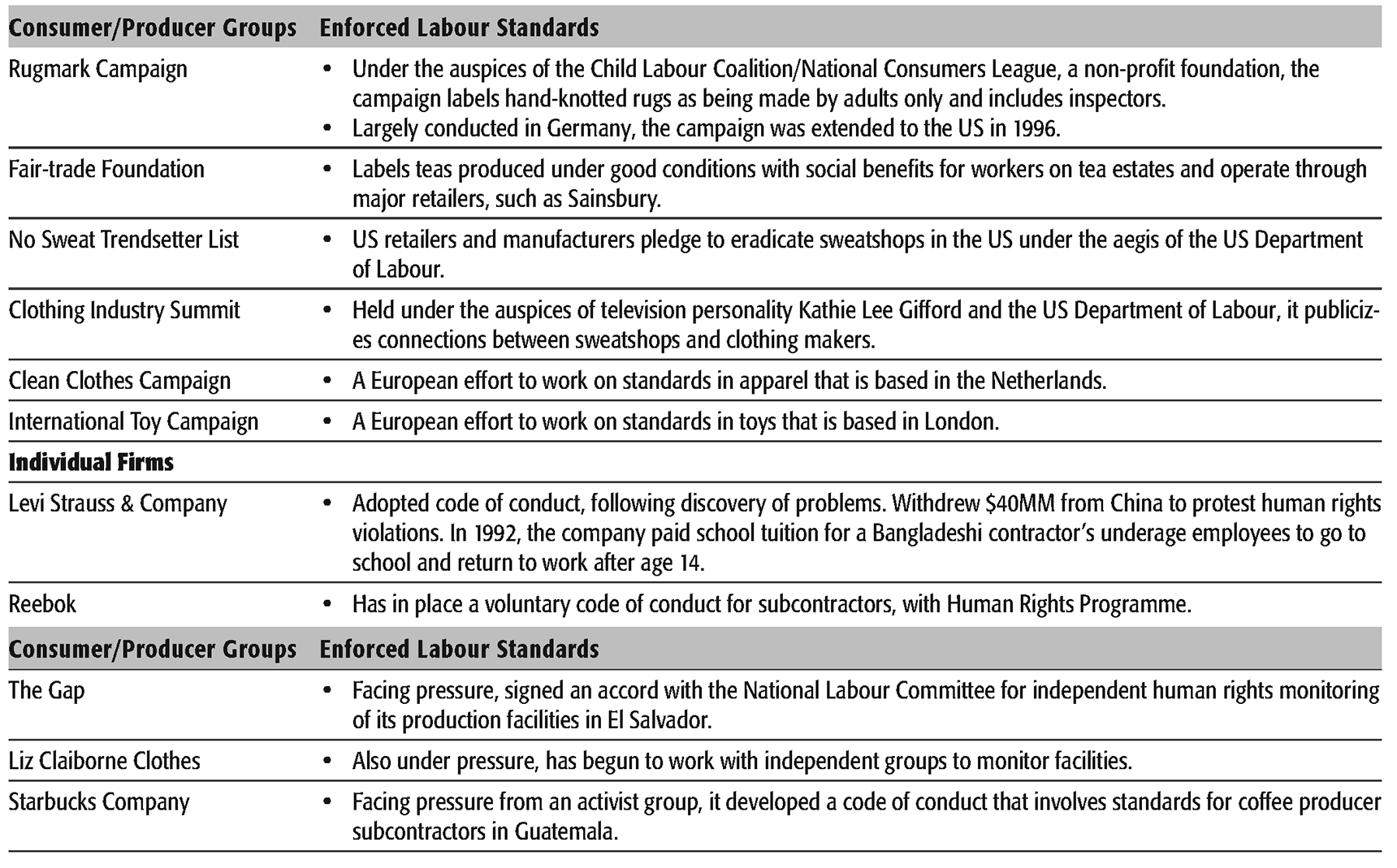
Labour unions promote a stable and positive labour relations environment. It fosters productive workplace relationships. Examples of labour union involvement include focus on settling workplace disputes under various employment-related policies, assistance in collective agreements and production of collective bargaining information. Labour unions support social and economic issues, workplace issues, international issues and environmental issues. The Ontario Ministry of Labour cites the union's scope, which includes taking a stand against abuse and exploitation of cheap labour, ensuring better conditions for everyone, producing a healthy workplace that is free of harm and encourages long-term substance free environment, and health and safety as well as job security, and fairness (Ontario Ministry of Labour, 2013). Trade unions from developed countries favour such a link, whereas trade unions in developing countries continue to be divided. Employers have been consistently against linkages of any kind.
Labour Standards in General
Core Labour Standards and Fundamental Labour Standards
Labour standards are very complex and are promoted for a number of reasons. Efforts to create international standards are an essential element for defining daily lives in the workplace. Working conditions are critical in shaping the realities of human dignity, and workers deserve protection by standards under this basic umbrella of human rights (Cottier & Caplazi, 2004). From an economic perspective, labour standards are a necessary component of productivity, and support the competitive environment and level playing field in the international landscape. The difficulty in adhering to core labour standards stems from the delicacy of the topic in general. Labour standards are multiplied with the relationship between government, trade unions, and employers, and then coupled with economic and political interests. The importance and value of these core standards are not often adopted as part of everyone's global responsibility. With the pressures of bringing labour standards into the WTO, and the impact on policies pursued in the ILO, stronger efforts were made to pursue essential standards with a view to develop better ways and means to implement them on the international front (Cottier & Caplazi, 2004). The following rights emerged as a result, and have been labelled as the core standards: freedom of association and collective bargaining, elimination of exploitative forms of child labour, prohibition of forced labour in the form of slavery and compulsory labour, and non-discrimination in employment. These core standards are recognized as human rights, and do not entertain controversial discussion of other labour standards including wages, working hours or vacation.
The main objective of labour standards is to facilitate international trade. Fundamental labour standards encompass core standards, codes of conduct, and also account for social advocacy and a consumer's right to know the terms of trade policy. A consumer's right to know entails seeking sufficient information so that the consumer can choose or not choose to consume a product that is produced in ways he/she considers unacceptable. Social advocates want labour standards in developing countries to improve, and see trade agreements as a means to affect change in foreign countries. In response, large organizations have developed corporate code of conduct for labour standards in firms to which it outsources orders. These codes are in response to consumer concerns and activist pressures about labour standards (Bakhski & Kerr, 2009). It makes good business sense to include enabling codes for the betterment of international trade, reputation and socio-economic development.
Impact of Labour Standards on Developed Countries
The majority of developed countries have ratified most if not all ILO Fundamental Principles and Rights at Work (Haberli et al., 2012). A study conducted used six different outcome-based measures for labour standards in developed countries including the percentage of total public expenditure of GDP, an index of labour market well-being, actual weekly hours worked, trade union density rates, the number of strikes and lockouts and occupational injuries. Overall, the results of the study found an association between improved performance and labour standards when standards were higher (Haberli et al., 2012). Alternatively, a secondary study was conducted on four fixed measures of labour standards including accident compensation, factory inspections, maximum working hours for women, and minimum age for child labour. These results showed that the impact on labour regulations of trade can negatively impact workers when the firms and workers need to adjust to new labour standards (Haberli et al., 2012). Developed countries have raised the issue of unfair economic advantage stemming from weak enforcement and reinforcement systems and low labour standards. There is a strong concern about the potential for a race to the bottom, as countries might feel increased pressure to downgrade their labour standards to maintain their competitiveness.
Advocates of linking labour standards and trade policy fear that increased trade and deeper integration of globalization may lead firms to move production to low-cost and low-standard locations, reducing wages in countries that maintain and enforce high labour standards, and motivate governments to weaken or remove standards in an effort to improve their country's competitive advantage. In countries where trade with each other is fairly consistent because each has the same labour standards, each developed country will begin to export the unskilled labour-intensive good, and import the skilled labour-intensive good. If a developed country decides to lower its labour standards, the amount of unskilled labour will begin to increase, wages will decrease, the number of employed workers will increase, and there will be an outward shift or lowering of production possibility (Bakhshi & Kerr, 2009).
Another development with labour related standards imposed by private bodies and companies is to require their suppliers from developing countries to comply with certain social, environmental and safety norms (Anuradha & Dudha, 2011). As these private standards have become more of a regular means of doing business, the increasing application of such standards appears to be raising potential trade restrictions and protectionist concerns. This race to the bottom would not take place in the case of implementation of core labour standards. It would ensure a level playing field. Less developed countries considering core standards as a tool would have the following impacts:
it would leave their governments with minimal international claims to respond to, it would assist the governments in enforcing minimal standards, it would remove the fear that foreign investment firms/multinational enterprises would threaten to transfer production to a more favourable country (Cottier & Caplazi, 2004).
A study investigated the relationship of labour standards and the pattern with lower developed countries and found that sectors that typically had egregious labour conditions do not occupy a primary share of a developed country's trading landscape (Stern & Terrell, 2003). Goods from low labour standard countries displace products made by workers in high labour standard countries, reduce their employment, encourage large organizations to outsource jobs to countries with lower labour standards, taking advantage of lower labour costs. Core labour standards were often lower in less export-oriented sectors or non-traded sectors such as services, and changes in technology and the structure of international trade were a leading indicator to compete in a race upward rather than a race downward (Stern & Terrell, 2003). There is no agreement or enforcement to link labour standards and market access, but developed countries have the right to suspend the import of goods produced under questionable practices.
Impact of Labour Standards on Developing Countries
Labour unions in developed countries have argued that labour standards can be trade distorting if the level of enforcement between countries differs. Lower or poorly enforced labour standards can profile a country with an unfair international competitive advantage. This argument in the debate of labour standards indicates that poor enforcement in developing countries creates job losses, and imposes trade barriers against goods produced. These will result in lower labour standards in developing countries negatively impacting the workers of developed countries. Developing countries have a high level of protection for workers. The issue is that existing laws are not enforced. A country's inability to support these standards will have a negative impact on their economic and social development. In order to achieve improvement, governments must work directly with interest groups in these countries, where this is a problem before including references in trade agreements.
Labour standards, as much as there is consistency in the core fundamentals, would be difficult for the developing countries to adopt as norms, creating further concerns on a multinational level. Developing countries argue that the applicability and implementation of labour standards in their nations will depend on how well the execution is, and feel that it will likely fail because it is driven by the political will of the country, and this is not generally strong. There is a dividing line and distinction that developing countries follow with respect to the needs between internationally recognized human rights and respect for their nations' well-being. According to the ILO, developing countries have not agreed on substantive commitment in respect of labour standards in agreements, but rather frequently mention joint projects, exchange of information, and amicable consultation as examples of cooperation (Haberli et al., 2012). Imposing outside labour standards or policies in trade agreements on developing countries that are not ready, may create a recipe for failure. There is no enabling environment to support a stronger rule of law that makes it easier to establish and enforce labour standards.
Looking at the case of India, we see that it has ratified four of the eight core ILO Labour Conventions: one on equal remuneration, one on discrimination, and two on forced labour. It has not ratified the core conventions on freedom of association, collective bargaining, worst forms of child labour or minimum wage. Although efforts have been made, and some actual improvements have been effected to improve the situation, the enforcement of legislation remains relatively poor and in the end sanctions are not sufficient.
Impact of Labour Standards on Regional Trade Agreements
Different organizations have a different preference with respect to which labour standards and provisions are included or referred to in Regional Trade Agreements (RTA). RTAs cover more than half of the international trade and operate alongside global multilateral agreements under the WTO. The OECD website states that these agreements are attractive because they are easier for a small group of neighbouring countries with similar concerns and cultures to agree on market access in a particular area than to reach an agreement in a wider forum such as the WTO. They also offer new approaches to rule-making and act as stepping stones on the ways to implement multilateral agreements. They usually include a commitment to adhere to ILO's fundamental principles, in addition to committing to prevent the undercutting of domestic labour standards, and/or improve upon the existing domestic standards.
The present legal status of labour provisions in RTAs remains unclear, despite more frequent and more focused provisions. There are three main references to domestic labour standards in RTAs that should always be included and made to strengthen adherence to the ILO, as well as national standards. The three approaches include commitments to strive to improve domestic standards, commitments not to lower the existing domestic standards avoiding ‘race to the bottom', and commitments to basically implement existing domestic standards to adhere to structure, with the overarching objective of economic development (Haberli et al., 2012). References to domestic labour market regulation can be justified on economic grounds. Commitments to not lowering the existing domestic labour standards are most likely relevant for high income countries. Developed countries hold treaty agreements and a commitment by each trading partner to ‘strive to ensure’ higher labour standards, and not to lower existing domestic standards. On the other hand, developing countries either do not contain any references to domestic labour standards or commit to undefined standard improvements (Haberli et al., 2012). Most RTAs reserve the right of the parties to establish their own labour standards, recognizing that there is considerable discretion regarding the overall enforcement.
There is a concern that developed countries are using RTAs as a way of circumventing the WTO regulations. The rush to various FTAs has been spawned by the continued delays in the Doha Round. Countries, particularly developing nations, are becoming increasingly impatient. They are turning to a variety of bilateral trade agreements to gain access to markets. For instance, since the creation of the WTO, there have been 511 RTAs compared to only 124 in the previous 40 years. This rush, however, can mean that we see the emergence of WTO-Plus provisions in many RTAs. WTO-Plus issues include the environment, labour, investment, intellectual property rights and competition.
The US and the EU have been the primary proponents of WTO-Plus provisions in areas such as labour. Interestingly, this is the area developing countries resisted during WTO negotiations. Currently, at the WTO there is no provision for labour standards in the agreement. However, the issue has been raised a number of times, most notably by the Singapore Ministerial Declaration which rejected the use of labour standards for protectionist measures. At the WTO Ministerial Conferences in Singapore (1996) and Seattle (1999), a number of developing nations (including Brazil, Egypt, India and Malaysia) vehemently opposed the pressure from developed nations (the EU and the US) to include labour standards within the WTO. The comparative advantage of countries, particularly developing (low-wage) nations, is a continued concern.
So, how do trade partners deal with WTO-Plus issues such as labour in their trade agreements? There appear to be two approaches: conditional or promotional. The conditional approach has within the RTA legally enforceable provisions in addition to sets of incentives/sanctions to ensure compliance. We see this in the US and Canadian RTAs. The promotional approach focuses mainly on capacity building provisions with the RTA. Trade agreements entered into by the EU exhibit promotional elements as do some developing country RTAs (Chile, the Philippines and Thailand).
Impact of Labour Standards on Free Trade Agreements
Free Trade Agreements or FTAs are used among industrialized countries. These agreements have proven to be one of the best ways to open up foreign market access. According to the International Trade Administration (2006), the reduction of trade barriers and the creation of a more stable and transparent trading and investment environment make it easier and cheaper for companies to export their products and services to trading partner markets. Increasing consumer, investor and multinational company demands for products produced under decent labour conditions are shaping the rules of international trade. Most FTAs now include labour standard provisions with varying degrees of enforceability. These trade agreements generally cover the majority of the ILO core labour standards, including freedom of association, the right to form unions and bargain collectively, limitations on child labour and the elimination of forced labour. In addition, some of these agreements include cash standards on minimum wages, hours and occupational health and safety. Although the ILO core labour standards are mentioned in many agreements, they generally represent aspirations rather than enforced standards.
FTAs recognize that social development is dependent on economic development. According to Haberli, Jansen, and Monteiro (2012), parties consider that economic development must be accompanied by social development. There is also a responsibility to guarantee basic social rights, the ILO core labour standards as well as the elimination of discrimination in respect of employment and occupation and the effective abolition of child labour. Typically, in FTAs, there is no title preventing a party from applying laws, regulations and requirements regarding entry, as long as they are not applied in such a manner that nullifies or impairs the benefits and true desire of the overall agreement (Haberli et al., 2012). There is a common desire to cooperate so that economic opportunities can be translated into the development of human resources and improvement in working and living conditions of all countries. On the whole, there is a certain trend towards better acceptance of social clauses between developed and developing countries.
Impact of Labour Standards on Globalization
Fair Trade and Competitiveness
An increase in international competition can lead to a decrease in the conditions of work and life better known as the ‘race to the bottom’. This would not take place if the core standards were implemented because the international trading system would operate under the same conditions, ensuring that a level playing field was enforced. A strong corporate rationale in supporting labour standards includes not only the brand of being a good corporate citizen, but shows social advocacy for being responsive to consumer demands, addressing concerns seriously, and encouraging trade versus inhibiting trade. These support the flow of free trade and smooths out levels of competition.
According to Haberli, Jansen, and Monteiro (2012), there is a lowering of labour protection in high income countries; it appears to take place only between rich countries. In middle-income countries, trade and labour protection have a positive correlation with one another. In low-income countries, there was no direct evidence of lowering labour protection in relation to trade, but was more regulatory in nature. Lower standards are associated with higher trade; countries with low labour standards would have lower costs of production, giving them an unfair advantage over countries which provide higher labour standards. While this competitive advantage may be rewarding in the short run, it is argued that the overall and long-term effect of low labour standards would result in workplace violations (Anuradha & Dutta, 2011).
The process of globalization will continue and trade and international capital will flow, regardless of whether trade and labour standards become unified. As countries become more in tune with wanting to increase the size of the pie, with respect to international trade, new opportunities for workers need to be developed with the support of economic policies, while at the same time, improving the working conditions of workers in developed and developing countries.
Linking labour standards and trade supports increased trade and deeper integration of global supply. Increased trade may enhance rather than lower labour conditions, since export growth may raise employee incomes, expand opportunities for workers to move from unprotected informal sector jobs to relatively better protected export-oriented sectors, and fuel stronger international pressure and activism aimed at compliance (Salem & Rozental, 2012). Increased trade among countries with varying levels of worker protection has questioned whether there is an unfair comparative advantage over countries with higher standards, and whether this generates competitive advantage to reduce standards in a race to the bottom. Free trade could increase and improve consumption by the population, with the consequence of potentially creating more and better work opportunities, quality employment, promoting positive changes in working conditions, and expanding social responsibility and protection.
Efficiency and Productivity
Production under the same working conditions, especially in developing countries, would remove the fear that foreign investment firms or multinational enterprises will transfer their manufacturing or production to a lower cost producing country. Similarly, when border protection is reduced, governments may feel tempted to increase their competitive position of domestic production by reducing costs of regulation, lowering the level of protection provided to workers within organizations, increasing the level of productivity and lowering the cost of doing business. In the absence of internationally agreed upon rules, the vicious circle of lowering labour standards to remain competitive, impacting trade flow as well as the human resource component of the business could get further reinforced.
There is no clear evidence to suggest a relationship between poor labour conditions and improved trade performance. However, research indicates that enforcement mechanisms, positive incentives and market forces influence the impact of trade agreements on labour standards compliance (Salem & Rozental, 2012).
Based on consumer preference between two items for purchase, each made under separate working conditions and with different sets of principles and guiding codes of conducts, most consumers would choose the product made under better working conditions. Most would pay some premium for that product, though as the premium rises, the number willing to pay the extra charge will fall, producing a demand curve for labour standards in the product market (Freeman, 1996). It is important that products are required to be produced by a certain time, and in a certain manner. For example, goods manufactured by exploited child labour, forced labour or under conditions of social dumping may be banned or restricted. The rationale is essentially an argument of level playing fields (Cottier & Caplazi, 2004). These measures are imposed in order to bring about changes that are most efficient, and bring about improvements in production, especially market access.
Standards versus Globalization
Core labour standards support good governance, and ensures that there is meaning in law. Collaboration between industrialized countries would take place at a higher frequency than the current state, if this existed. Globalization and increased social advocacy on consumer's rights, and their right to know continues to be a strong motivation for labour standards. This application of social advice can have and act as significant barriers to trade, and can have a compromising effect on companies, and their competitive advantage globally. Social advocates want labour standards to improve in developing countries, and see trade agreements as a means to affect change in foreign countries (Bakhshi & Kerr, 2009). Changes in technology and the structure of international trade are leading developing countries to compete in a race upward in terms of product quality rather than a race downward with respect to price (Bakhski & Kerr, 2009).
As a result of globalization, more and more countries are finding themselves in more open positions where public scrutiny and cross-examination are prevalent. With the public eye on at all times, how a company operates, where the company operates and who the company's partners are, are typical awareness factors that are reviewed regularly. As a result, there is a need to project a positive image for the company, its values, its beliefs and its ethics. Working conditions and productivity have been raised amongst suppliers, the opportunity to move out of poverty has been provided where it did not exist before, and a greater awareness of core labour standards is being imparted (International Organization of Employers, 2006). Companies are well aware of the damage that labour rights problems or even perceived problems can have on their reputation, global trade plan and the standards identified for implementation. Core standards involve changes in labour relations practices, how workers are treated, and has an economic effect on the elasticity of demand for developing country products with respect to changes in cost (Freeman, 1996). Labour standards can be transmitted from importer to exporter countries, similar to environmental standards; therefore supporting trade openness or expansion of globalization is based on the level of labour standards, not the overall level of trade.
Recent Events Explored
Temporary Foreign Trade Workers: RBC Outsources with iGate
In April 2013, the RBC Royal Bank found itself in a public relations mess. At the heart of the media release, the largest bank in Canada was said to be in the process of contracting out jobs of Canadian staffers to lower paid foreign workers (Tedesco, 2013). The subject of foreign trade workers is a very controversial federal law, which holds a lot of public scrutiny and outrage. This programme has received a lot of air-time from Human Resources and Skills Development, Canada, as last year, there was a clampdown on misappropriating its intent to import temporary sex trade workers from outside the country (Tedesco, 2013). The programme is meant to help companies solve growing labour shortages in certain industries. Similar to labour standards and trade, the foreign trade workers programme is a code of conduct. Organizations and governments agree to follow the standards laid out to in Canada's Temporary Foreign Workers programme to avoid heavy punishment, but also to stay committed to creating Canadian jobs, and supporting other national labour shortages within the country. When a company abuses this programme, they are using cheap labour, in pursuit of lower wages. These are the core standards applicable in trade agreements, supporting international labour standards.
RBC's external supplier, iGate, brought its own employees into Canada under the temporary foreign worker programme so that they could be trained at bank branches for the services they would be providing to the bank. iGate maintained that their hiring practices are in full compliance with all Canadian laws. In 2008, iGate was ordered to pay the US Department of Justice civil penalties to settle allegations that the company had discriminated against American citizens in its employment practices (Mehta, 2013). Two main changes that will take place as a result of this includes stricter rules for applications, new fees for employers who apply, and a promise for stricter enforcement. Critics say the programme is poorly managed; the government issues labour market opinions and work permits to companies without regulatory follow up, and there is lack of attention being paid to the low wages and bad living and working conditions many temporary foreign workers are forced to live with (Wyld, 2013). Outsourcing is an international trade in the service sector, and the rationale to support it is an economic business decision for countries and companies to invest and look after the supply and demand of their goods in a profitable manner.
International laws and federal laws are implemented for a reason. They support a country's best practice; they are an ethical way of doing business, conforming with trade agreements, supporting international language of business and supplying a code of conduct that is not a guideline, but rather an obligation. This has a direct impact on labour standards and trade. The temporary foreign worker's programme abuse is a reminder that instead of bringing in temporary workers, the government should put more money and effort into solving labour shortages through better education and training, effectively improving wages and benefits for all workers, and lastly, reducing discrimination linked to off-shore hires, improving working conditions and living standards.
Labour Standards in Bangladesh
In April 2013, Loblaw Companies Ltd. was spotlighted for a Bangladeshi building that caught fire, killing 348 people and rescuing 29 survivors. The victims and survivors were employed in a massive garment industrial company, with poor working conditions, where $38 a month was paid to produce clothing for top international brands. Loblaw Inc. was one of the customers of the factories operating in the building, providing products for Canadian Joe Fresh subsidiary. The owners of the building were ordered to evacuate the building earlier that week of the tragedy when cracks were found, but the factories ignored the order, and continued to operate.
Loblaw is committed to finding solutions to this situation by expanding the scope of their requirements to ensure the physical safety of workers producing their products (Strauss, 2013). This underlines the weak oversight that retailers have of the conditions of overseas suppliers' factories and outlines that when formal partnership and trade agreements are formed, with key principles including health and safety concerns, not being abided, there is an ethical, social, economical and political problem at hand. In an effort to improve the audit of outsourced companies, Loblaw Inc. has reached out to industry groups, including the Retail Council of Canada, and other retailers and governments, in an effort to establish a collective agreement to review and address the Bangladesh situation, to address factory standards.
With respect to labour standards and trade, this disaster highlights the pressures the retailers and their suppliers face in lowering costs to respond to customer's demand for cheap fashions (Strauss, 2013). Loblaw Ltd. admitted that they aimed to create socially responsible products, but their standards did not currently address building construction or integrity. The company is committed to finding solutions including expanding the scope of their requirements to ensure the physical safety of workers producing their products. In order to impact change, it is the responsibility of the brands and labels of the companies that outsource or international trading partners of their garment line for business and efficiency reasons to other countries, and the responsibility of the whole industry and the government to bring about change. Commitments to improving infrastructure and policies within the country's factories are in order. Also, the linkage to trade agreements and labour standards will support ethical and socially acceptable practices, enabling and protecting human rights. This is both an international and national obligation, to support the factory workers in developing countries.
Linking Labour Standards and Trade Agreements
North American Free Trade Agreement
The North American Free Trade Agreement (NAFTA) was negotiated and implemented to facilitate greater cooperation between Canada, the US and Mexico. The objective was to promote the enforcement of each country's labour laws and regulations, and protect and enhance basic workers' rights. NAFTA partners negotiated and implemented an agreement on labour cooperation to improve working conditions, living standards and to protect, enhance and enforce basic worker's rights in all three countries (NAFTA, 2013). The key areas of focus with respect to domestic labour laws include industrial relations, occupational health and safety, and employment standards. In addition, NAFTA has promoted higher wages as a result. In Mexico, export firms employ one in five workers, and these workers are paid 40 per cent more on average than those in non-export jobs. Firms with foreign direct investment employ nearly 20 per cent of the labour force and pay 26 per cent more than the domestic average manufacturing wage (NAFTA, 2013). The inclusion of labour provisions offers a number of possibilities to promote labour standards through international economic governance, and substantiates the impact of labour standards in globalization.
There is a common desire within NAFTA to support and cooperate in the economic opportunities available across all three countries. The protection of worker's fundamental rights is considered to be an important element of an economy with high productivity, a shared goal among all parties. The focus of NAFTA is tri-national, laying down fundamental principles for the operation of administrative and jurisdictional bodies and includes definitions on labour principles (Grandi, 2009). The scope and content of the labour provisions include striving for a high level of national labour laws in the area of core labour standards, as well as minimum working conditions and migrant rights (Anuradha & Dutta, 2011). There is enforcement of labour laws in these areas. The enforcement mechanisms of the labour provisions include fines in the case of non-application of national labour laws in the field of child labour, occupational health and safety and minimum wage. Since the NAFTA, specific labour rights provisions have been included in several agreements negotiated.
Canada–Chile Agreement on Labour Cooperation
The Canada–Chile Agreement was developed in response to support the free trade agreement that already existed between the two countries. This was an opportunity to adopt labour standards, similar to Canada's initial negotiation with the US in NAFTA. It allowed both countries to facilitate a better development of relations including government, workers, social groups, labour relations, social security, work inspection and transparency (Grandi, 2009). The first change included a work plan to promote the exchange of information and knowledge between both countries. The second component was providing for complaint and confliction resolutions procedures in relation to labour laws in either country. These changes in response to labour standards in trade agreements has facilitated solutions without resorting to formal channels of problem resolution.
The outcomes experienced by both countries together have been positive. The contacts between Canada and Chile include aspects of public labour policies, social dimension of globalization, child labour and more international labour matters. The agreement has facilitated a better development of relations between Canada and Chile, one of its principal achievements being the opening up of opportunities for the governments, businessmen, workers and other social groups to appreciate respective systems of labour relations and social security, including systems of legislation and work inspection (Grandi, 2009). As a result of Chile's experience with Canada, Chile has also agreed on labour inclusions with developing countries in support of their economic partnership, and has established labour agreements with China and Japan, two of the world's largest international trading partners. The complements to these trade agreements established include provisions of labour standards and a strategic economic link to trade within the FTA.
Trade Related Aspects of Intellectual Property Rights
The agreement on Trade Related Aspects of Intellectual Property Rights (TRIPs) was a positive integration into levelling the playing field of rules and principles on an international basis. The agreement established minimum standards in terms of production of human rights, procedures for trade agreements and incorporates standards previously included in multilateral agreements that can be leveraged as a guide with national legislators and courts if required (Cottier & Caplazi, 2004). The development and implementation of TRIPs, although specific to intellectual property, was negotiated with developing countries in mind, especially the fields of agriculture and textile. This adoption has been considered a milestone achieved, improving market access, receiving active participation, and providing a link between trade and labour standards, with positive enforcement and acceptance, a relationship that has been difficult to establish in other sectors.
The TRIPs Agreement introduced global minimum standards for protecting and enforcing nearly all forms of intellectual property rights. It now requires all WTO members, with few exceptions, to adapt their laws to the minimum standards, and introduce detailed obligations for the enforcement of intellectual property rights. However, TRIPs also allows a degree of flexibility for countries to accommodate their own patent and intellectual property systems and developmental needs. The TRIPs agreement has established positive rules of conduct and enforcement, and the incorporation of existing agreements administered by the ILO is legally recognized in international law. It has allowed an improved and complementary working relationship to evolve between WTO and ILO, where there have been much bureaucratic considerations and little advancement made with respect to intellectual property.
Conclusion
The trade and labour linkage is a very sensitive and controversial issue that has been debated for many years. It continues to be a point of discussion internationally among both developing and developed countries. There are both supporters and opponents to this debate. A ‘race to the bottom’ concern indicates that labour standards will continue to be lowered in order to remain competitive in global markets. Fundamental and core labour standard and codes of conduct are a means of ensuring that all parties are playing on a level playing field. Differences in these labour standards explain differences in trade patterns internationally. Governments, labour organizations and international organizations dealing with rules of trade between nations play a key role in implementing labour provisions, enforcement of foreign policy and enabling and enforcing these inclusions.
There are social, technical, economic and political implications at stake within the debate of ‘Should Labour Standards Be Included in Trade Agreements’. Developing and developed countries respond in very different manners at multilevel provisions and agreements. A review of trade agreements provided opportunities and outcomes to include ILO Fundamental Principles and Rights at Work, and the cooperation between parties on the various systems of labour relations, social security, legislation and ensuring compliance and complaint handling procedures. At the heart of the debate, countries seek to be competitive in the goods and services they provide, adding value, improving international trade and achieving growth. The result is the impact on fair trade, competitiveness, efficiency, productivity and opportunity to expand globally in footprint and economic cycle.
‘Should labour standards be included in trade agreements’ is the questionable debate. This issue raises many points of view from the consumer, employee, employer, government and international organizations. Labour standards are not an output of external enforcement, but rather realized through internal economic and social development and growth in a country. This means that governments in poor countries must implement solid growth strategies and specific policies to eliminate poverty. Governments in rich countries can help increase demand for poor countries' output by reducing barriers to imports from these countries. Consumers in rich countries play a role in increasing demand for products that are not produced by children or sweatshops, ensuring their international colleagues follow better labour practices. Rich countries should support workers in recognizing how they can benefit from the globalization process. All stakeholders in the linkage between trade and labour standards should be focused on being more flexible and adaptive to the evolving global economy. The complement or alternative to including labour standards in trade agreements is to be more effective in making workers and the economies better off through both economic change and process of policies, mandating change.
It is the authors' viewpoint that there is a place for labour standards to be included in trade agreements, both nationally and internationally. Labour standards, code of conducts and fundamental principles of work are foundational provisions that provide a level playing field in trade agreements, promoting labour standards through international economic governance. The integration and linkage will only be successful if it is enforced, and minimum standards are established versus maximum standards, thereby not limiting progress or implementation. The ILO, the WTO and the labour unions must maintain open communication and cannot reject any use of labour standards from parties. Lack of enforcement of labour standards in trade agreements should include the use of trade sanctions and fines to reinforce the human rights component. There is a direct correlation as seen in those countries that have adopted free trade agreements accompanied by labour standards, improving access to exchange of good business practices, enabling innovative labour and social policies, and expanding their experience to negotiate with other parties on other agreements. As seen in the two recent events explored, all parties involved in any form of business-related activity, industry, organization or country, should ensure that labour provisions are included in trade agreements to avoid negative impact on worker's rights, health and safety issues, environmental concerns, compensation, migrant labour issues, human rights, security arrangements, community engagement, ethical conduct, good governance and rule of law. Table 1 recaps changes and information regarding integration and linkage by firms and labour standards.