




Abstract
This study explores studio music teachers’ motivations for engaging in community music and how these experiences can enhance their teaching approaches. Semi-structured interviews were conducted with studio music teachers in Australia. A qualitative approach using thematic analysis was used to gain insights into their perspectives on community music involvement. Findings identified that being engaged with community music influenced the teaching approaches of studio music teachers in four ways: through student engagement, community engagement skills, managing practical challenges, and career development skills. A conceptual framework of Participatory Music-Making Teaching Methods was developed from the integration of these themes. The framework provides studio music teachers with guidelines towards enhancing their private studio practice to create more holistic, engaging, and effective learning environments for their students. Through this exploration, this study seeks to encourage more music educators to view community music engagements as professionally rewarding opportunities.
Introduction
Studio music teachers typically operate in isolation, working independently with their students in one-to-one instructional environments (Burwell et al., 2019). While studio teaching allows for highly personalized experiences (Karlsson & Juslin, 2008; Moniz, 2025), it is often characterized by limited opportunities for teachers’ professional dialogue, peer collaboration, or shared professional development. As a result, studio music teachers must develop and refine their teaching approaches independently, without access to structured frameworks or collaborative support. This lack of structure can lead to inconsistencies, which may create misaligned expectations between teachers and students (Mantie et al., 2021), diminish student motivation and well-being (de Bruin, 2021), or result in students disengaging from lessons. These conditions highlight a practical challenge within studio music education: teaching practices are largely in isolation, and studio music teachers need more support to deal with the challenges they face as private instructors.
From a theoretical perspective, social constructivism positions learning as a socially mediated process that develops through interaction and collaboration with others (Bozkurt, 2017; Vygotsky, 1978). In music education, there has been increasing attention paid to the importance of socially situated learning, including collaboration, reflection, and learner agency (Abramo & Austin, 2014; Camlin, 2015; Dansereau & Ilari, 2017). However, much of this work has focused on school-based contexts, where teachers often have opportunities to engage in professional learning communities and participate in collaboration or reflection (Draves, 2017; Kastner, 2014; Stanley et al., 2014; Verdi, 2022). In contrast, studio music teachers often work in relative isolation, lacking similar opportunities for ongoing professional collaboration (Williamson et al., 2019). While professional events such as conferences may offer avenues for connection, attendance often requires studio teachers to forgo teaching hours (Burwell et al., 2019), creating additional barriers to sustained professional engagement. This disconnect between socially oriented models of learning and the realities of individualized studio teaching has implications not only for studio teachers’ professional development, but also for how their teaching approaches evolve and are sustained over time.
These challenges extend beyond the development of musical skills alone. Research on studio music teaching highlights a range of demands, including the cultivation of strong teacher-student relationships, which are crucial for student retention (Blackwell, 2020; Moniz, 2025). Studies have also emphasized the importance of communication between teachers and students in one-to-one instruction (de Bruin, 2021; Leahy & Smith, 2021), alongside a growing shift from teacher-centered to learner-centered approaches in studio contexts (Daniel & Parkes, 2019). However, addressing these broader demands may become increasingly difficult if studio music teachers lack opportunities for collaborative reflection and shared professional learning.
Community music presents a potential means to address these challenges. Community music environments can function as informal professional learning environments, potentially providing studio teachers with opportunities to develop their studio teaching approaches through shared practice and interaction. Through these engagements, teachers’ roles can extend beyond private studios, promoting professional growth and fostering deeper connection with the music community (Veblen, 2007). This study explores how studio music teachers perceive community music participation and how these experiences influence their teaching approaches. By examining studio music teachers’ motivations for engaging in community music and the skills and insights developed through these experiences, this research contributes to broader discussions about professional learning for studio music teachers, and how community music participation may inform their teaching approaches within their studios.
Literature Review
Community music often refers to participatory music-making practices that occur within community settings, characterized by inclusivity, collaboration, and shared musical experiences among members with diverse musical backgrounds (Asztalos, 2025; Bartleet & Heard, 2024; Higgins, 2012). Within these settings, learning is typically embedded in collective practice and interaction (Veblen, 2007), aligning closely with social constructivist principles that emphasize learning as socially situated and collaborative. At the same time, scholars have noted that community music is not a singular or fixed concept, but one that is highly plural and context-dependent (Mantie, 2025). In this study, the term community music is used to describe collaborative, socially situated learning spaces in which learning occurs through shared practice and collaborative interaction.
Community music has been widely documented as providing participants with opportunities for lifelong learning and enhanced musicianship (Matherne, 2022), as well as networking and personal growth (Weatherly, 2025). Programs such as community bands and orchestras within the New Horizons International Music Association exemplify this by providing members with opportunities to develop their musical skills within supportive musical environments (Rohwer, 2016; Tsugawa, 2022). Participation in community music groups, including community ensembles or participatory music-making groups, has also been shown to contribute to identity development (Bartleet & Heard, 2024; Laurila & Willingham, 2017). For performer-teachers in particular, these opportunities may support the development of greater confidence in balancing teaching and professional roles, contributing positively to their evolving professional identities (Ballantyne & Canham, 2023).
However, despite the extensive documentation of what community music groups offer participants, little is known about how such engagements specifically influence studio music teachers’ teaching practices. Understanding this connection is essential to enhancing teaching effectiveness and student outcomes in studio settings. To address this gap, this study is underpinned by a social constructivist understanding of education. Social constructivism theory emphasizes the importance of social interactions in learning, suggesting that knowledge is collaboratively constructed through meaningful engagement among peers and knowledgeable individuals (D. V. I. Akpan et al., 2020; Davis et al., 2017; Rogoff, 1990). From this perspective, learning is most effective in authentic contexts that involve interactive dialogue and shared experiences with others (B. Akpan & Kennedy, 2020).
In community music settings, the traditional hierarchy of teacher-student roles is replaced by a model that favors more interactive and collaborative environments (Anderson & Willingham, 2020). Studio music teachers can be both learners and educators in community music settings, co-constructing knowledge with other members through discourse and interaction (Bozkurt, 2017). In turn, these interactions may inform and refine their teaching approaches, fostering strategies that support student learning outcomes.
Purpose of the Study
This study seeks to investigate studio music teachers’ perceptions of and experiences with community music engagements in Queensland, Australia. Utilizing semi-structured interviews, this study aims to:
Explore the motivations of studio music teachers for engaging in community music groups.
Examine the skills and knowledge that are acquired through participation in community music groups to enhance studio music teachers’ teaching approaches.
These aims are designed to address the overarching research question: How do studio music teachers perceive the role of community music participation in relation to their teaching practice?
Research Methods and Participants
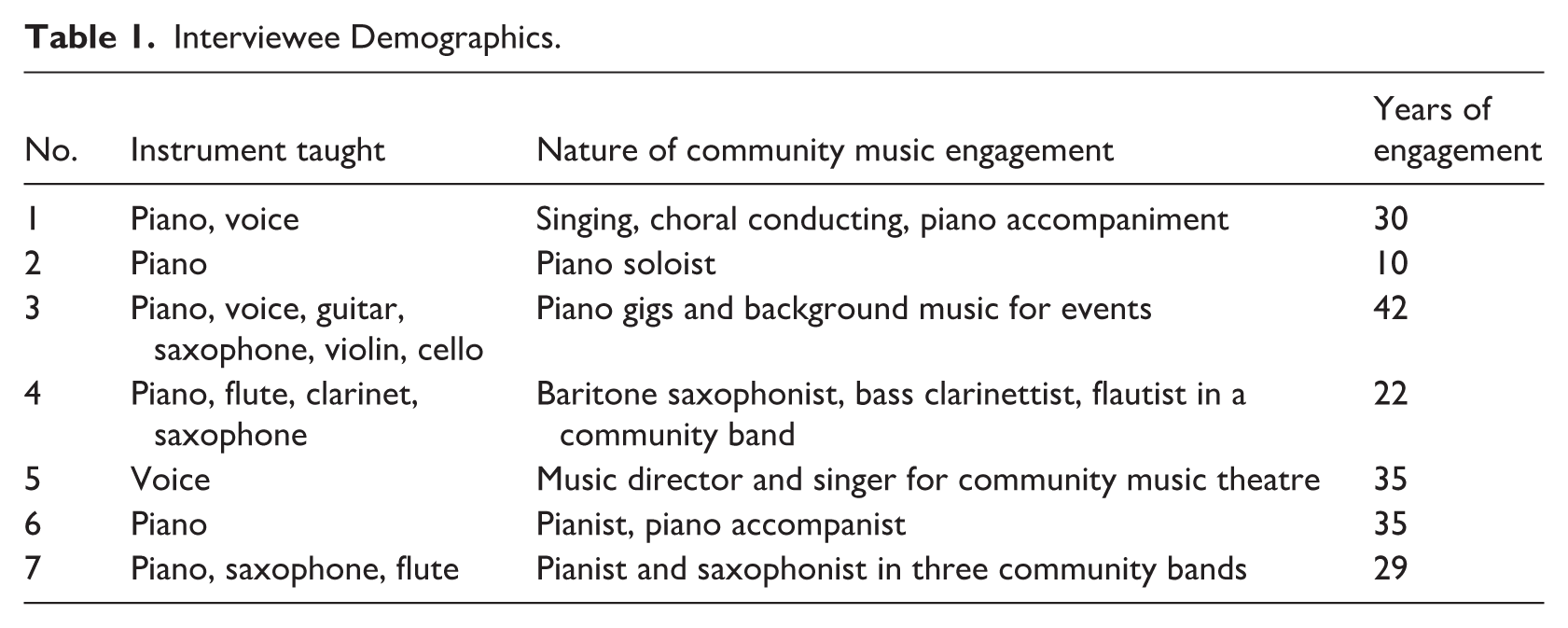
Semi-structured interviews were conducted with seven studio music teachers from the Queensland Music Teachers’ Association (QMTA). Participant recruitment was facilitated through the association. In collaboration with the secretary of the association, we identified an initial pool of teachers who met the study’s eligibility criteria: holding an active role as a studio music teacher and participating as a performer in community music contexts. Teachers who met the criteria were contacted via email and invited to participate in the study. Those who expressed interest were provided with further information and consent documentation prior to participation. A semi-structured interview approach allowed us to obtain information at a level of depth that may not have been possible through surveys or questionnaires. We have backgrounds in music education but are not participants in local community music groups. The analysis was grounded in participants’ accounts to minimize potential interpretive bias. The interviewee demographics can be found in Table 1.
Interviewee Demographics.
The following safeguards were employed to protect the participants’ rights: (a) research objectives were articulated to participants via a participant information sheet; (b) written permission to proceed with the study was obtained via a consent form signed by the participants; (c) participants were informed that they could withdraw from the study at any time without any consequences on their relationship with the authors, the university, or the QMTA; (d) participants were assured that they could decline to answer any questions, pause, or terminate the interview at any point if they experienced distress or discomfort; (e) participants were assured anonymity through the use of pseudonyms in place of their names during data storage and analysis. Ethical approval for this study was obtained from the Ethics Committee of The University of Queensland.
Data Analysis
Thematic analysis was used to analyze data from the semi-structured interviews. This analytical method identifies patterns or “themes” across participants’ experiences, making it suitable for exploring in-depth insights (Clarke & Braun, 2017). It is also adaptable to varying sample sizes, and was an appropriate method given the study’s small sample size. Our initial coding involved close reading of the seven interview transcripts, resulting in a total of 65 codes that captured features of participants’ experiences relevant to the research question. Coding was accomplished iteratively, where we discussed the 65 codes to refine focus and reach consensus. After rigorous and thorough refinement and review, we identified and categorized codes which aligned with the research question, grouping related codes into broader categories before organizing them into the final themes. For example, codes such as Performance readiness and control and Professional skill maintenance and development were grouped under Skill development, while codes including Networking and collaborative learning fell under the category of Interpersonal skills. Some codes were not retained in the final analysis because they were not closely aligned with the research aims or occurred less frequently across the dataset (e.g., government policy impacts on music education). This refinement ensured that themes reflected shared participant experiences. To enhance data validity, member checking was conducted by returning anonymized transcripts and a summary of preliminary themes to participants for review. No requests for changes were received, indicating participants’ satisfaction with the accuracy of the data and its interpretation.
Findings, Discussion, and Recommendations
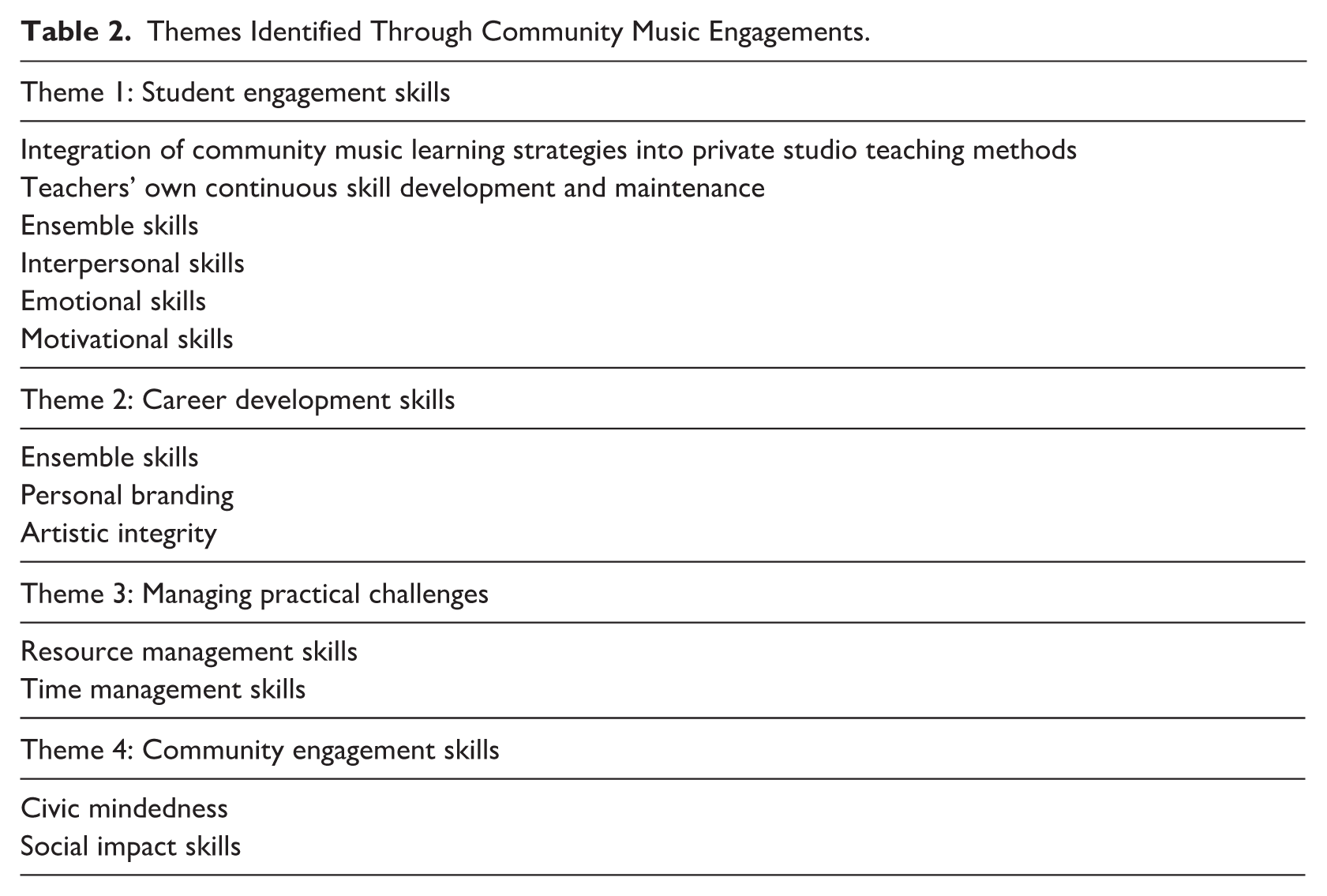
The findings are organized into four themes, each reflected across all interviewees’ accounts. These themes demonstrate how community music engagements enable studio music teachers to pursue personal motivations and enhance their teaching approaches. The four themes and their sub-themes are detailed in Table 2. The sub-theme of Ensemble skills appears in both the Student engagement skills and Career development skills theme, reflecting its relevance in both contexts. Each theme is described in greater detail through a discussion of the sub-themes in the paragraphs that follow.
Themes Identified Through Community Music Engagements.
Theme 1: Student Engagement Skills
Integration of Community Music Learning Strategies into Private Studio Teaching Methods
All interviewees were motivated to engage in community music because it provided them with learning experiences that could be directly integrated into their teaching methods. For instance, Interviewee 4 explained how community ensemble rehearsals provided practical strategies, such as metaphorical language, to simply complex rhythms: I remember one of the conductors, when we were doing our Ride of the Valkyries’ rhythm. He said just think of it as “yesterday da da, yesterday da da.” And whenever I have had to teach that rhythm, that has been the easiest way for me to communicate that to my students. (Interviewee 4)
This practical method of using relatable language to simplify complex rhythms is a teaching method that resonates strongly with students. Using informal methods such as everyday analogies can support deeper student engagement and facilitate understanding by connecting new content with students’ existing knowledge (Ng, 2020; Powell & Kalina, 2009). This can translate into more dynamic and interactive lessons that enhance student interest and knowledge retention.
Teachers’ Own Continuous Skill Development and Maintenance
Six interviewees were motivated to engage in community music to maintain their performing skills, and to keep their skills sharp and relevant. Interviewee 1 and 6 noted how engaging in community music supported their skill development and maintenance: The amateur community stuff that I do, like my being involved in musicals and that sort of thing, I see that as part of my ongoing professional development. I think that keeping my hand in the practice of what I’m teaching is really important. (Interviewee 1) I find it very refreshing. It gives you inspiration, it gives you new energy to keep going, to keep learning new pieces, or keep practicing old pieces and really raising them to the next level. (Interviewee 6)
Participants described how ongoing exposure to new techniques informed their practice and performance approaches, supporting active learning associated with social constructivism (Schreiber & Valle, 2013). For these participants, ongoing professional development was perceived as crucial for maintaining technical proficiency and integrating new perspectives that motivate students.
Ensemble Skills
Another motivation for studio music teachers to engage in community music is the desire to perform with fellow musicians. Four interviewees noted that collaborative performances provided essential performing skills not available in studio teaching, with Interviewee 1 and 7 emphasized that one of these skills is listening skills: . . .there’s a difference between a really good pianist and a really good accompanist. They’re not necessarily the same thing, because there’s that sense of ensemble . . . that ensemble work, if that hasn’t been a part of your growing, you know, your musical education as you as you’ve been growing as an art. Just it’s quite difficult then to learn that skill of ensemble. (Interviewee 1) With a solo lesson, you just have one person, one instrument, and they are pretty much listening to themselves and it would be easy to think that you don’t really have to listen. But what I have found is that everybody has to listen to themselves if it’s just a solo performance, but even more so if you’re in an ensemble. (Interviewee 7)
Interviewees noted heightened awareness to listening, coordination, and responsiveness as features of ensemble playing. Drawing on these experiences in studio teaching may encourage students to listen attentively and adjust performances in relation to others in real time. Such experiences also allow teachers to create lessons that actively engage students in musical interaction by encouraging active listening and collaborative awareness.
Interpersonal Skills
All interviewees highlighted interpersonal skill enhancement as a motivation for their participation in community music, and that these engagements support the exchanging of ideas with peers. Interviewee 1 described gaining diverse perspectives through networking with other musicians: There’s that sense of always coming into contact with somebody who knows, if not more than you, then a different aspect to what you do. To be able to grow your knowledge that way and have different perspectives and all of that sort of thing. . . (Interviewee 1)
These experiences can expose teachers to diverse perspectives and alternative ideas that can inform how they relate to students in the studio. This aligns with research on effective teaching, where interpersonal traits such as communication skills and compatibility are crucial in supporting positive learning relationships (Polk, 2006). Interpersonal awareness may also support more empathetic teaching practices, contributing to improved teaching efficacy (Steele Royston, 2017). In turn, this can assist teachers in creating studio environments that are both educational and nurturing for their students.
Emotional Skills
Interviewees highlighted that their community music engagements are shaped by the emotional connections formed during performances, particularly through audience response and feedback. Participants describe heightened awareness of the emotional impact of music-making, which reinforces their motivation to perform with intention and sensitivity. For instance, Interviewee 4 comments on how audience reaction enhances their emotional investment in performing, “if the audience is happy. Well, yeah, you would definitely want to keep . . . keep doing what you’re doing. You would be aiming to provide that same level of music and enthusiasm in your playing.” Similarly, Interviewee 5 comments, “It’s just fun to watch the audience when we finally get that far, enjoying it. And I suppose I enjoy people saying, ‘Wow, you did a good job with that. Congratulations’. That’s always nice.” These accounts suggest that community music participation can support studio teachers’ development of emotional awareness, which can encourage greater sensitivity to students’ emotional states and needs. This aligns with existing literature on the importance of helping students recognize and regulate emotions before and during performances (Kaleńska-Rodzaj, 2020) as well as the role of empathy and responsiveness in supporting student learning (Blackwell, 2020, 2021).
Motivational Skills
Six interviewees shared that their motivations for engaging in community music stem from personal fulfillment and a desire to contribute to the community. Through community music, teachers learn to emphasize joy and the communal value of music. As highlighted by Interviewee 2: I think the reason you do it is because you value the performing of music in and for the community. The basic answer to that question is life is not reducible to commercial interests. There’s something good in making music and even when it’s not rewarded commercially, people still do it. (Interviewee 2)
Similarly, Interviewee 3 reflected on the importance of giving back through voluntary participation, noting, “It’s nice to give something back to the community cause it’s all for free. You know, it’s all voluntary . . . I think just think it’s important to be honest, because not everything should be for money.” These accounts highlight how community music can be experienced as joyful, socially meaningful, and generous in spirit. Such values can be carried into studio teaching, supporting students’ long-term commitment to music and encouraging performances that are not solely commercially driven. The supportive nature of community music may contribute to teaching approaches that foster positive learning environments while supporting skill development (Kaleńska-Rodzaj, 2020), helping studio music teachers guide students in understanding the broader social and emotional aspects of music.
Theme 2: Career Development Skills
Ensemble Skills
Ensemble skills developed through community music participation were identified as relevant to both “Student engagement skills” and “Career development skills.” Four interviewees described engaging in community music to develop skills related to a desire to develop musical interdependence and group awareness skills. Interviewee 4 emphasized the adaptive nature of ensemble participation, stating, “You can’t just show up and play your part. You have to make it fit with other people, whether it’s dynamically changing, totally changing, considering the intonation, just learning to listen, or play as a group.”
This account highlights how ensemble participation developed skills of musical interdependence that interviewees did not assume would develop automatically through solo study. It draws attention to listening, adaptability, and group awareness as skills that may warrant more deliberate emphasis during studio teaching. These skills reflect the collaborative demands commonly encountered in professional musical settings, and community music participation may provide studio teachers with a practical reference point for considering how these skills can be more explicitly addressed within one-to-one studio settings.
Personal Branding
Interviewees described community music participation as contributing to their professional visibility and legitimacy. Rather than framing this in economic terms, participants linked their community music performances to the sense of credibility they brought into the teaching studio. For six interviewees, being seen to actively perform reinforced their professional profiles and signaled competence to students and families in their communities. Interviewee 1 explained how public performance shaped perceptions of their teaching role within the community: It’s definitely crucial to my engagement or my existence as a teacher, as a professional, and as a provider of that service within my community, because that’s what gets the recognition. People see me perform and then go, “Oh well, you’re not just a backyard person. You actually know what you’re doing. So yes, I’ll send my child to you.” (Interviewee 1)
Similarly, Interviewee 6 described community performances as a way “for parents to also see what my skill level is so they can feel comfortable with what their children are gaining by doing piano lessons.” These accounts suggest that community music performances highlight studio music teachers’ competence and reinforce their legitimacy as educators. Such experiences may also inform how teachers model performance (Polk, 2006), supporting closer alignment between studio teaching and real-world musicianship, and establishing trust with students and families. However, an overemphasis on personal branding risks narrowing the educational purposes of studio music teaching, highlighting the need for studio teachers to carefully consider how vocational or professional concerns are managed within their studios.
Artistic Integrity
Five interviewees are motivated to engage in community music because it helps them stay connected to their musical roots and maintain artistic integrity. They emphasize the importance of performing outside of private studios to uphold high standards in their performances and teaching practices. As Interviewee 2 and 3 state: And there’s something about music that it has to be . . . it has to be created like . . . it can’t just live . . . like with a book, it can just live between, you know, two . . . two covers and it can sit on a library shelf, but music needs to be constantly created. (Interviewee 2)
There’s a difference between live and CD’s. It makes the people that attend the events feel good, and it connects them with live music because we don’t get a lot of live music up here either. So I think it encourages them to go and see live music as well . . . (Interviewee 3). Emphasizing the importance of live music suggests that genuine musical experiences may be more impactful than synthesized or pre-recorded alternatives. Artistic integrity was described as enhancing participants’ credibility and supporting students’ engagement with music as lived and meaningful practice. By incorporating performance opportunities into teaching, studio teachers may create learning environments grounded in technical expertise and musical authenticity (Moniz, 2025; Sætre & Zhukov, 2021).
Theme 3: Managing Practical Challenges
Resource Management Skills
Three interviewees noted a lack of local music resources, including accompanists and performance opportunities. This scarcity impacts teachers’ ability to engage and provide quality experiences to the community and students. Teachers are motivated to overcome this challenge by actively seeking performance opportunities. Interviewee 6 emphasized how such issues also affect their students: I wonder why some of my advanced students are not asked for accompanying, even one piece, for their choir at school by a Choir Director, playing something casually at a Community Center, fundraiser, background live music, playing at Gallery Opening. . . (Interviewee 6)
These experiences highlight a broader issue of resource allocation and access in regional communities across Queensland, where opportunities are limited. This lack of opportunities affects not only teachers, but also the developmental options available to their students. However, interviewees also recognized these challenges as chances to enhance their logistical management skills. Interviewee 3 shared how these challenges contributed to their logistical skill development: I’ve gotten better at taking all the gear to places and packing it up. I’ve gotten a lot more tech friendly cause we usually have to take the little mixing desk because when you got guitars and microphones and the stage piano, you gotta plug it into something. So I’m getting better at the tech side of music sound. (Interviewee 3)
Overcoming resource limitations requires teachers to optimize their available resources and develop strategies for efficient logistics. By improving these skills, music teachers can better utilize materials, instruments, and technologies to enrich the student learning experience. However, to navigate these challenges, teachers should actively create or seek out opportunities, be innovative, and collaborate beyond what would be necessary in a more resource-rich environment.
Time Management Skills
Time management emerged as an essential skill for music teachers balancing lessons, community music rehearsals, and performances. All interviewees described the challenges of effectively managing these commitments, noting that poor time management skills could adversely affect themselves and others involved in community music activities. Interviewee 6 highlighted the difficulty of negotiating competing obligations, especially when community music commitments required schedule changes that were not compatible with studio teaching plans: Oh yes, the schedule conflicts are huge problem for any musician that teaches. It’s extremely difficult to move lessons. A lot of times the community engagements entail moving our schedules and it’s almost impossible to make up certain lessons. (Interviewee 6)
This perspective reflects the tension between teachers’ desire to participate in community music and the rigidity of studio teaching timetables. Interviewee 7 further emphasizes the importance of time management as a form of communal responsibility with other community musicians: You need to turn up on time with all your gear, in the correct dress, at the correct place with plenty of time. And again, that’s a time management and organization skill. You just need to do it because it’s not just you, it’s the whole band. So you need to keep up your part of the bargain. (Interviewee 7)
Here, time management is framed not simply as a personal challenge, but as accountability to others. Participating in community music can therefore strengthen teachers’ awareness of prioritization, scheduling, and accountability. Consequently, these experiences may inform how teachers structure their own teaching commitments and model professional responsibility in their studios.
Theme 4: Community Engagement Skills
Civic Mindedness
All interviewees identified civic mindedness and community connections as significant motivators for participating in community music. These experiences allow music teachers to recognize and appreciate the broader societal impact of their musical expertise beyond private teaching contexts. Interviewee 5 illustrated this point: I love to give back. I’m a person that enjoys being with people and relating to people and teaching people. And I guess with theatre music, it’s just fun to watch the audience when we finally get that far, enjoying it. (Interviewee 5)
This sense of civic mindedness can inform teaching approaches by fostering supportive and inclusive values among students. Through embodying a communal ethos, teachers can encourage students to view music as a meaningful way to contribute to their community. This perspective may potentially inspire students to participate in community-oriented performances and initiatives.
Social Impact Skills
Three interviewees identified the use of music as a powerful tool for strengthening community bonds and empowering members of society as a significant motivation for participating in community music. Interviewee 1 highlighted the empowerment and integration of older women into community activities through music: You were literally let go because you got married. And so your job then was to go home and procreate and manage a household. So for a lot of them, they have lived their lives quite vicariously through their family, through their husbands, through their children and what they’re doing. And now they’re in this time of life where all the children are all grown and gone, the husband is retired, so they’re doing things for themselves. They’ve now got the time and capacity to do these things for themselves. And watching them, the confidence that they get from getting up on stage even as a group as part of a group and using their voice. Because vocally, voices are a little bit different to instruments in that it’s not something that’s extra to you. It’s part of you and it’s how we communicate with the world. (Interviewee 1)
Such stories demonstrate community music’s role in fostering social integration, particularly among older participants. Through these interactions, studio music teachers gain insights that allow them to guide students towards understanding music as an integral component of personal and social identity, as well as community empowerment.
Conceptual Framework
Data collected from participant interviews informed the development of a structured yet flexible conceptual framework titled “Participatory Music Making Teaching Methods.” This framework portrays how skills acquired through community music participation can inform studio music teachers’ teaching approaches. At the center is the “Development of teaching approaches,” shaped by the four thematic areas (Figure 1).
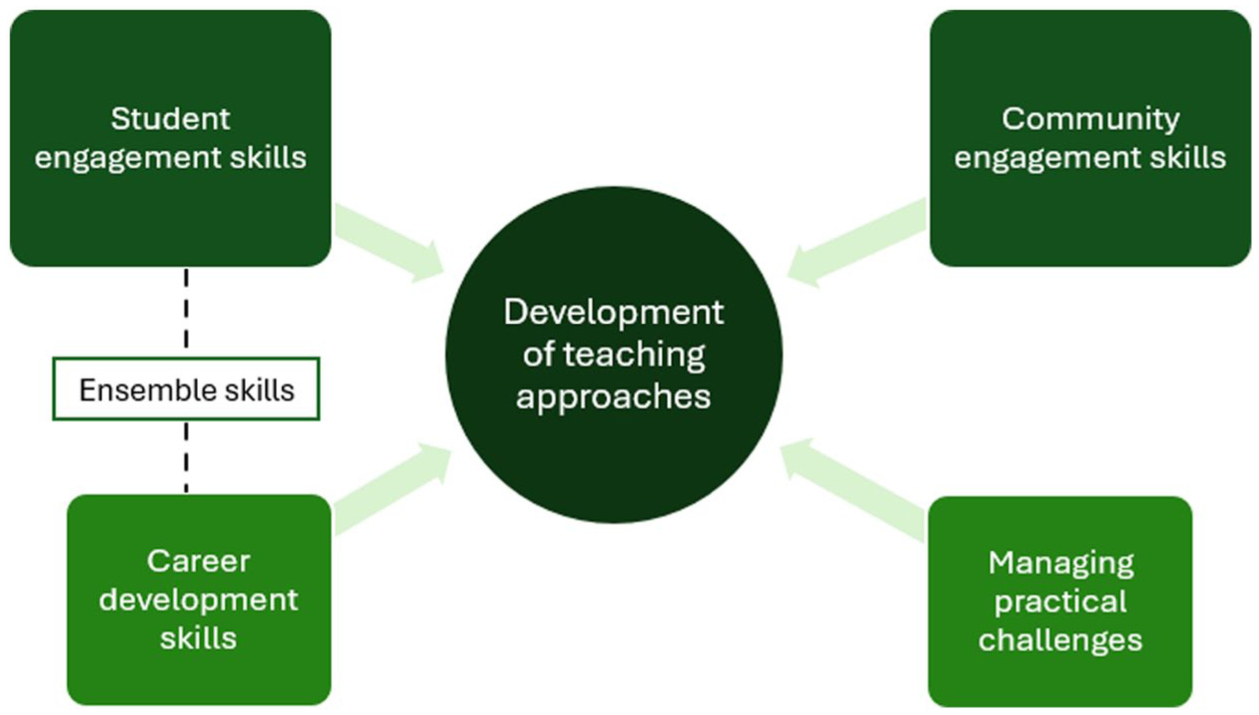
Participatory music-making teaching methods.
The themes, while distinct, can intersect. For example, “Ensemble skills” appear within both Student engagement skills and Career development skills, reflecting the critical role of collaborative music-making. This reflects the view that teaching and learning are shaped through interactions and collaboration (D. V. I. Akpan et al., 2020), and aligns with social constructivist perspectives that understand knowledge as constructed through participation and observation (Jordan et al., 2008; Sætre & Zhukov, 2021). In this sense, collaborative music-making also functions as a form of professional development for studio teachers (Williamson et al., 2019).
This framework does not prescribe teaching strategies. Instead, it functions as a reflective reference point through which studio teachers can consider their teaching, professional learning, and engagement with students in aspirational yet achievable ways. Practical themes like Career development skills and Managing practical challenges are included not to prioritize vocation-related outcomes, but rather, to acknowledge the everyday realities of studio teaching that emerged from interviewee’s accounts. Drawing on broader music education scholarship that advocates dialogic, inclusive, and community-oriented methods beyond traditional teaching approaches (Allsup, 2003; Fuelberth & Woody, 2025), this framework extends these principles into the studio context by emphasizing community engagement skills and collaborative learning. In doing so, it positions teachers not only as transmitters of musical knowledge, but also as facilitators of socially grounded musical learning, community engagement, aligning studio music teaching with broader educational and societal goals.
Conclusion
This study explored a previously underexamined area—how studio music teachers perceive community music participation and its influence on their teaching approaches. While the findings offer valuable insights, limitations should be acknowledged. The study involved a sample of seven studio music teachers in Queensland and relied on interview data. Therefore, the findings are presented as specific to this study rather than claims about a broader population. The contribution of this study lies in the conceptual understandings generated from participants’ accounts and in the resulting framework, which offers a preliminary way of thinking about how community music participation may inform studio teaching.
Future researchers may wish to continue developing this framework across different contexts and participant groups, and further examine how music teachers understand and negotiate the relationship between studio teaching and participation in community music groups.
Footnotes
Acknowledgements
Our sincerest thanks to the Queensland Music Teachers’ Association (QMTA) and the seven music teachers who participated in this study.

Ethical Considerations
This study was approved by the Ethics Committee of The University of Queensland (Ethics Code: 2024/HE000624) on May 23, 2024. This research was conducted ethically in accordance with the National Statement on Ethical Conduct in Human Research (2023).
Consent to Participate
All participants provided written informed consent prior to enrolment in the study.
Author Contributions
Funding
The authors received no financial support for the research, authorship, and/or publication of this article.
Declaration of Conflicting Interests
The authors declared no potential conflicts of interest with respect to the research, authorship, and/or publication of this article.
Data Availability Statement
The data that support the findings of this study are available on request from the corresponding author. The data are not publicly available due to preserving the anonymity of the participants. Making the data public could compromise the privacy of research participants.*